Introduction Modeling
and Simulation
Instructor
Dr. Hanafy Omar
GE 605: Modeling and Simulation of Engineering
Systems
Definition of modeling
Modeling is the process of representing a
real-world system as
• Set of concepts (Conceptual modeling)
• Abstract (abstraction or mathematical
modeling)
• Computer code or program (simulation
modeling)
• Smaller or larger replica (physical
modeling)
Conceptual modeling
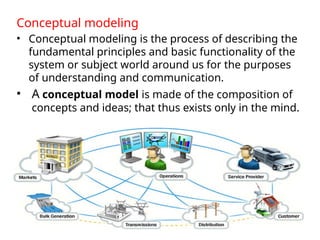
• Conceptual modeling is the process of describing the
fundamental principles and basic functionality of the
system or subject world around us for the purposes
of understanding and communication.
• A conceptual model is made of the composition of
concepts and ideas; that thus exists only in the mind.
Mathematical modeling and model
 Mathematical model is a description of properties and
interactions between the components of a real
system by means of mathematical concepts and
language. The process of developing a mathematical
model is termed mathematical modeling .
 A mathematical model usually describes a system by
means of variables and relationships (or operators).
The actual model is the set of functions that describe
the relationships between the different variables.
 The development of a mathematical model depends
on the system boundary, system components and
their interactions, and type of analysis that we want
to perform, and assumptions that we will consider
while model development.
Simulation modeling and model
Simulation modeling is the process of
building a computer model (or computational
model or simulation model) to imitate a real-
world system mathematically. Simulation is
intended to conducting experiments with the
model for understanding the behaviour of the
system and/or evaluating various strategies
for the operation of the system.
Simulation modeling is also called virtual
experimentation!
Simulation modeling and model
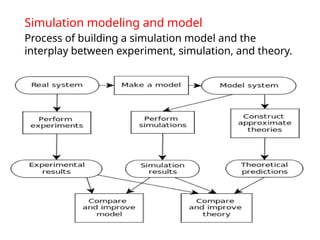
Process of building a simulation model and the
interplay between experiment, simulation, and theory.
Physical modeling and model
 The process of developing a physical model is
termed physical modeling.
 A physical model is a smaller or larger copy
(prototype) or a replica of an object.
 Physical models allow visualization, from examining
the model, of information about the thing the model
represents (an architectural model of a building).
Physical models are also used for testing purposes.
 A physical model of something large is usually
smaller, and of something very small is larger. A
physical model of something that can move, like a
vehicle or machine, may be completely static, or
have parts that can be moved manually, or be
powered.
Physical modeling and model
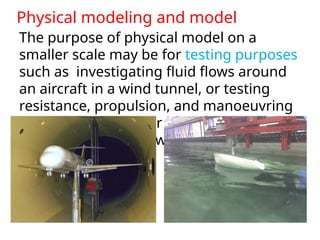
The purpose of physical model on a
smaller scale may be for testing purposes
such as investigating fluid flows around
an aircraft in a wind tunnel, or testing
resistance, propulsion, and manoeuvring
behaviour of a tow or self-propelled
model of a ship in towing tank (or basin).
Physical modeling and model
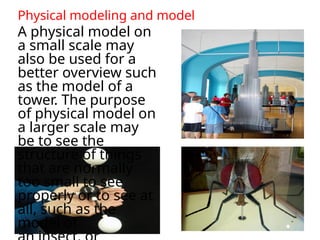
A physical model on
a small scale may
also be used for a
better overview such
as the model of a
tower. The purpose
of physical model on
a larger scale may
be to see the
structure of things
that are normally
too small to see
properly or to see at
all, such as the
model of
Why do we need modeling?
Modeling is essential in many situations, such as the
following:
 Modeling forces us to think clearly before making a
physical system: When a system does not exist and a
designer wants to design a new system like a missile or an
airplane, the model will help in knowing how this system
will work for different environmental conditions and
situations.
 It is a tool that improves the understanding about a
system, which could rather be done with the help of
experimentation on the real system itself. But, sometimes
it is inappropriate to do experiments on real systems due
to the facts that experiments may be very costly, time-
consuming and/or risky (could damage the system or risk
lives).
Why do we need modeling?
 To help predict the system behaviour under
operating conditions that are impossible to
experiment on the real system.
 To improve system performance: Models will
help in changing an existing system’s structure
to improve its performance.
 To explore the multiple solutions economically:
It also allows us to find many alternate solutions
for the improvement in system performance.
 To create virtual environments for training or
entertainment purposes.
Why do we need modeling?
Most important role of modeling is prediction of
system behavior:
To gauge the mass of the Earth, not using any
balance.
To predict the population of Saudi Arabia for
the year 2050.
To determine the time required by a satellite to
complete one orbit around the earth, say at
the height of about 10,000 km above the
ground.
To forecast the total amount of insurance
claims a company has to pay next year.
Advantages of simulation over
analytical modeling
There are six main advantages to
simulation over analytical modeling:
1. Simulation models enable you to
analyse systems and find solutions
where other methods (like analytic
calculations, linear programming, etc.)
fail.
2. Once you have selected the
appropriate level of abstraction the
development of a simulation model is
a more straightforward process than
Advantages of simulation over analytical
modeling
4. The structure of a simulation model naturally
reflects the structure of the real system. As
simulation models are developed using mostly
visual languages, it is easy to communicate the
model internals to other people.
5. Ability to play and animate the system
behaviour in time is one of the greatest
advantages of simulation. Animation is used not
only for demo purposes, but also for verification
and debugging.
Disadvantages of simulation
 Simulation gives specific not general
solutions.
 Numeric solution by simulation is only
an approximation to the exact solution
by analytical methods, which can be
applied to some limited problems.
 Simulation analysis can be time
consuming and expensive for non-
skilled people; Should not be used
when an analytical method would
Model complexity and simplifications
 Models are developed upon considering
simplifying assumptions, which result in
simpler models.
 Simpler models are desirable for ease of
analysis and design processes.
 With less assumptions, complexity
increases, which improves the realism of the
model; model is more accurate and
representative of the real system.
 Usually, a trade-off should be made between
model simplicity and model accuracy.
Simulation languages and software
• A computer simulation language tells us how
to perform simulation by using computer.
• Simulation can be performed either by using
a general purpose programming language, a
general simulation software, or a special
purpose simulation software.
• A programmer who has to perform
simulation frequently would be better of
learning a higher-level special-purpose
language, which facilitates simulation
programming and analysis.
Simulation languages and software
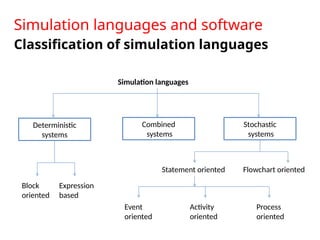
Classification of simulation languages
Deterministic
systems
Combined
systems
Stochastic
systems
Simulation languages
Block
oriented
Expression
based
Statement oriented Flowchart oriented
Event
oriented
Activity
oriented
Process
oriented
Simulation languages and software
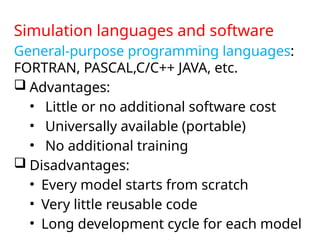
General-purpose programming languages:
FORTRAN, PASCAL,C/C++ JAVA, etc.
 Advantages:
• Little or no additional software cost
• Universally available (portable)
• No additional training
 Disadvantages:
• Every model starts from scratch
• Very little reusable code
• Long development cycle for each model
Simulation languages and software
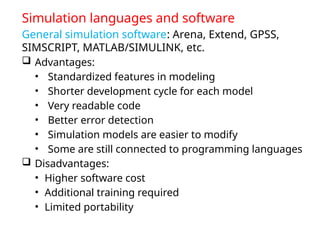
General simulation software: Arena, Extend, GPSS,
SIMSCRIPT, MATLAB/SIMULINK, etc.
 Advantages:
• Standardized features in modeling
• Shorter development cycle for each model
• Very readable code
• Better error detection
• Simulation models are easier to modify
• Some are still connected to programming languages
 Disadvantages:
• Higher software cost
• Additional training required
• Limited portability
Simulation languages and software
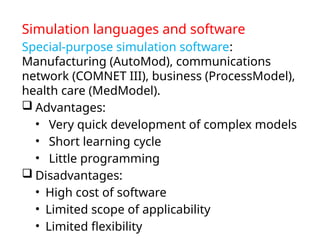
Special-purpose simulation software:
Manufacturing (AutoMod), communications
network (COMNET III), business (ProcessModel),
health care (MedModel).
 Advantages:
• Very quick development of complex models
• Short learning cycle
• Little programming
 Disadvantages:
• High cost of software
• Limited scope of applicability
• Limited flexibility
Simulation languages and software
Factors of selecting a simulation software
include:
• General capabilities in terms of computation,
optimization, data analysis, etc.
• Input-output facilities.
• User specific needs.
• Compatibility of user programming
knowledge.
• Environment including training and support
services.
• Cost.
• Recovery from the failure.

GE605_Introduction_to_ Modeling_and_Simulation.pptx

  • 1.
    Introduction Modeling and Simulation Instructor Dr.Hanafy Omar GE 605: Modeling and Simulation of Engineering Systems
  • 2.
    Definition of modeling Modelingis the process of representing a real-world system as • Set of concepts (Conceptual modeling) • Abstract (abstraction or mathematical modeling) • Computer code or program (simulation modeling) • Smaller or larger replica (physical modeling)
  • 3.
    Conceptual modeling • Conceptualmodeling is the process of describing the fundamental principles and basic functionality of the system or subject world around us for the purposes of understanding and communication. • A conceptual model is made of the composition of concepts and ideas; that thus exists only in the mind.
  • 4.
    Mathematical modeling andmodel  Mathematical model is a description of properties and interactions between the components of a real system by means of mathematical concepts and language. The process of developing a mathematical model is termed mathematical modeling .  A mathematical model usually describes a system by means of variables and relationships (or operators). The actual model is the set of functions that describe the relationships between the different variables.  The development of a mathematical model depends on the system boundary, system components and their interactions, and type of analysis that we want to perform, and assumptions that we will consider while model development.
  • 5.
    Simulation modeling andmodel Simulation modeling is the process of building a computer model (or computational model or simulation model) to imitate a real- world system mathematically. Simulation is intended to conducting experiments with the model for understanding the behaviour of the system and/or evaluating various strategies for the operation of the system. Simulation modeling is also called virtual experimentation!
  • 6.
    Simulation modeling andmodel Process of building a simulation model and the interplay between experiment, simulation, and theory.
  • 7.
    Physical modeling andmodel  The process of developing a physical model is termed physical modeling.  A physical model is a smaller or larger copy (prototype) or a replica of an object.  Physical models allow visualization, from examining the model, of information about the thing the model represents (an architectural model of a building). Physical models are also used for testing purposes.  A physical model of something large is usually smaller, and of something very small is larger. A physical model of something that can move, like a vehicle or machine, may be completely static, or have parts that can be moved manually, or be powered.
  • 8.
    Physical modeling andmodel The purpose of physical model on a smaller scale may be for testing purposes such as investigating fluid flows around an aircraft in a wind tunnel, or testing resistance, propulsion, and manoeuvring behaviour of a tow or self-propelled model of a ship in towing tank (or basin).
  • 9.
    Physical modeling andmodel A physical model on a small scale may also be used for a better overview such as the model of a tower. The purpose of physical model on a larger scale may be to see the structure of things that are normally too small to see properly or to see at all, such as the model of
  • 10.
    Why do weneed modeling? Modeling is essential in many situations, such as the following:  Modeling forces us to think clearly before making a physical system: When a system does not exist and a designer wants to design a new system like a missile or an airplane, the model will help in knowing how this system will work for different environmental conditions and situations.  It is a tool that improves the understanding about a system, which could rather be done with the help of experimentation on the real system itself. But, sometimes it is inappropriate to do experiments on real systems due to the facts that experiments may be very costly, time- consuming and/or risky (could damage the system or risk lives).
  • 11.
    Why do weneed modeling?  To help predict the system behaviour under operating conditions that are impossible to experiment on the real system.  To improve system performance: Models will help in changing an existing system’s structure to improve its performance.  To explore the multiple solutions economically: It also allows us to find many alternate solutions for the improvement in system performance.  To create virtual environments for training or entertainment purposes.
  • 12.
    Why do weneed modeling? Most important role of modeling is prediction of system behavior: To gauge the mass of the Earth, not using any balance. To predict the population of Saudi Arabia for the year 2050. To determine the time required by a satellite to complete one orbit around the earth, say at the height of about 10,000 km above the ground. To forecast the total amount of insurance claims a company has to pay next year.
  • 13.
    Advantages of simulationover analytical modeling There are six main advantages to simulation over analytical modeling: 1. Simulation models enable you to analyse systems and find solutions where other methods (like analytic calculations, linear programming, etc.) fail. 2. Once you have selected the appropriate level of abstraction the development of a simulation model is a more straightforward process than
  • 14.
    Advantages of simulationover analytical modeling 4. The structure of a simulation model naturally reflects the structure of the real system. As simulation models are developed using mostly visual languages, it is easy to communicate the model internals to other people. 5. Ability to play and animate the system behaviour in time is one of the greatest advantages of simulation. Animation is used not only for demo purposes, but also for verification and debugging.
  • 15.
    Disadvantages of simulation Simulation gives specific not general solutions.  Numeric solution by simulation is only an approximation to the exact solution by analytical methods, which can be applied to some limited problems.  Simulation analysis can be time consuming and expensive for non- skilled people; Should not be used when an analytical method would
  • 16.
    Model complexity andsimplifications  Models are developed upon considering simplifying assumptions, which result in simpler models.  Simpler models are desirable for ease of analysis and design processes.  With less assumptions, complexity increases, which improves the realism of the model; model is more accurate and representative of the real system.  Usually, a trade-off should be made between model simplicity and model accuracy.
  • 17.
    Simulation languages andsoftware • A computer simulation language tells us how to perform simulation by using computer. • Simulation can be performed either by using a general purpose programming language, a general simulation software, or a special purpose simulation software. • A programmer who has to perform simulation frequently would be better of learning a higher-level special-purpose language, which facilitates simulation programming and analysis.
  • 18.
    Simulation languages andsoftware Classification of simulation languages Deterministic systems Combined systems Stochastic systems Simulation languages Block oriented Expression based Statement oriented Flowchart oriented Event oriented Activity oriented Process oriented
  • 19.
    Simulation languages andsoftware General-purpose programming languages: FORTRAN, PASCAL,C/C++ JAVA, etc.  Advantages: • Little or no additional software cost • Universally available (portable) • No additional training  Disadvantages: • Every model starts from scratch • Very little reusable code • Long development cycle for each model
  • 20.
    Simulation languages andsoftware General simulation software: Arena, Extend, GPSS, SIMSCRIPT, MATLAB/SIMULINK, etc.  Advantages: • Standardized features in modeling • Shorter development cycle for each model • Very readable code • Better error detection • Simulation models are easier to modify • Some are still connected to programming languages  Disadvantages: • Higher software cost • Additional training required • Limited portability
  • 21.
    Simulation languages andsoftware Special-purpose simulation software: Manufacturing (AutoMod), communications network (COMNET III), business (ProcessModel), health care (MedModel).  Advantages: • Very quick development of complex models • Short learning cycle • Little programming  Disadvantages: • High cost of software • Limited scope of applicability • Limited flexibility
  • 22.
    Simulation languages andsoftware Factors of selecting a simulation software include: • General capabilities in terms of computation, optimization, data analysis, etc. • Input-output facilities. • User specific needs. • Compatibility of user programming knowledge. • Environment including training and support services. • Cost. • Recovery from the failure.