Physiatrics
Klinika geriatrie LF UK
a FNsP Milosrdní bratia s.r.o.
Introduction
 Origin of the word :
 Re- Latin prefix meaning again, back
 Habilitas – ability, sufficiency
 Rehabilitatio – restoring of previous health
condition/status
- larger sense – any therapy which purpose is
restoration of health and man’s power
- narrow sense – medical discipline, techniques for
restoration and reinforcement performance and
especially motion skills.
Physiatrics and rehabilitation
 Rehabilitation: complex of processes, which ensure
optimal somatic, psychical and social condition of an
individual. This condition should allow the individual to
take again an adequate position in society.
 Physiatrics: medical discipline applying physical
energies and factors of nature in treatment and
prophylaxy.
 Balneology: uses sources of natural waters and peloids
(peat and bog (sludge)). Thermal, chemical and
mechanic attributes can be used in the treatment.
Classification of physiatrics
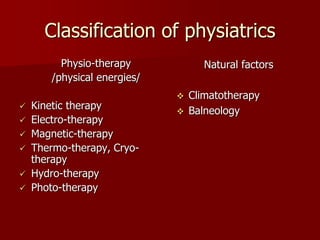
Physio-therapy
/physical energies/
 Kinetic therapy
 Electro-therapy
 Magnetic-therapy
 Thermo-therapy, Cryo-
therapy
 Hydro-therapy
 Photo-therapy
Natural factors
 Climatotherapy
 Balneology
Evaluation
 History
 Physical examination
 Goniometry
 Evaluation of muscle
strength
 Functional assessment
(Barthel Index)
 Ergometry
- bicycle
- handle
- treadmill
 EMG
Effects of physiotherapy
 Primary= direct
Local impact of physical energies on tissues; the most
common effect is: HYPERAEMIA:
- increased input of energy source molecules (O2,
proteins, fats, carbohydrates), anti-inflammatory
substances
- increased output of metabolic products – especially acid
products /e.g. lactate (it causes pain)/
- increased resorption of haematomas and blood clots
- finally, the effects of physiotherapy are analgetic,
spasmolytic and anti-inflammatory ones
 Secondary: mediated by humoral and nervous
processes
1. Kinetic therapy
Therapeutic physical training
Ergotherapy (occupational therapy)
Therapeutic massage
I. Therapeutic physical training
 method using physical motion and exercise, it’s purpose is
the same as in rehabilitation in general:
- restoring of patients to optimal functioning and achieving
functional adaptation of organism.
 exercises :
– according to intensity: exercises in vision – passive – with
the help – active motion – active motion against external
power
– according to purpose: general (conditional training ) –
special
– according to number of patients: individual – in group
– according to performance: gymnastic – practical – games
– according to type : shuttle – traction – pressure
isotonic - isometric
main application form of therapeutic physical
training
 introduction: warming - up exercises
 main part: general and special exercises
 final part: breathing, relaxation exercises,
instructions/education
I. Training unit
duration of a training unit: 15 – 45 min, adequate
frequency and repeating of exercises and training
units, progressive increasing of exercise load,
indications and contraindications, observation of
patient - subjective and objective status.
Rehabilitation after heart attack
(coronary thrombosis)
 1. phase: hospitalisation
– 0. stage – no physical activity
– 1. stage – breathing and relaxation exercises
– 2. stage – active motion of small muscle groups
– 3. stage – active motion of groups of larger
muscles, sitting with support, sitting
with legs hanging down
– 4. stage – walking on a flat ground around a bed,
in a room, in a corridor, ...
– 5. stage – walking up stairs
– 6. stage – gymnastic exercises
– 7. stage – free motion in a hospital
Rehabilitation after coronary
thrombosis
 2. phase: convalescence: period from
leaving the hospital to the starting work
 3. phase: postcovalescence: the period
after the hospitalisation for the rest of the
life
II. Occupational therapy
(ergotherapy )
 Applied especially during long-term care or long-term
hospitalisation (departments of rehabilitation,
departments of psychiatry, ...)
 occupational therapy: is defined as “the art and science
of directing man’s participation in selected tasks to
restore and enhance performance, facilitate learning of
those skills and functions essential for adaptation,
diminish or correct pathology, and to promote health.
/training of patient to service him/herself in daily
activities, activities related to his job, support aids –
wheelchair, … /
 therapy based on patient`s activity: all activities relaxing
patient (knitting, needlework, pottery, work in garden,
painting, work with PC,...)
III. Therapeutic massage
 A system of manual movements affecting on a
patient`s body = mechanotherapy
 is derived from principles of Swedish Ling`s
massage, which includes 5 movements:
stroking, friction, kneading, percussion,
compression (vibration)
 Manual massage: classic, sport, reflex, visceral
 other types of massage: water-massage,
acupuncture
III. Therapeutic massage
 indications:
• soft tissue injuries with pain, spasm and muscle
tension
• articular pain, some musculoskeletal disorders
• visceral massage – constipation
 conditions: adequate temperature, 3 hours after meal at
the earliest, muscle relaxation before the massage
 contraindications: infection, inflammatory disease of
muscle, cachexia, purulent skin diseases, febrile and
other serious clinical states
2. Electrotherapy
 uses beneficial effects of various types of
electric current
• enhances blood perfusion of tissues
– hyperaemia (without any cardiovascular loading)
• releases tension of striated and smooth muscle,
strengthens muscles
• analgetic and anti-inflammatory effect
Electro-therapy
Frequency Type of current
Frequency 0 Direct current iontophoresis
F to 1 kHz
Alternating current
Low frequency
electrostimulation
Dia-dynamic currents
F to 100 kHz Middle frequency Interferrential currents
F over 100 kHz 0,8-3MHz USG
3-30MHz Short wave dia-thermy
300MHz do 3GHz Ultra-short dia-thermy
Low frequency electric current
 For clinical fields:
 Cardioversion
 Defibrilation
 Cardiostimulation
 Electro-shocks
 Coagulation,
cauterization
 For physiotherapy
Electrogymnastics
 Träberts currents – improve
cappilarisation and tissue nutrition,
in peripheral circulation (neuralgias,
ischemic syndrome of limbs,
healing wounds)
 TENS – Transcutaneous
Electrical Nerve Stimulation –
analgetic effect, (muscle pain and
joint pain)
 Dia - dynamic currents
Interferential currents
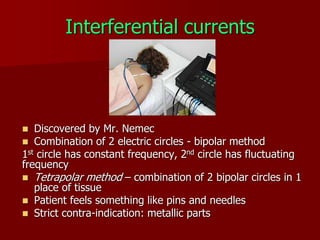
 Discovered by Mr. Nemec
 Combination of 2 electric circles - bipolar method
1st circle has constant frequency, 2nd circle has fluctuating
frequency
 Tetrapolar method – combination of 2 bipolar circles in 1
place of tissue
 Patient feels something like pins and needles
 Strict contra-indication: metallic parts
Magneto-therapy
 Also for patient with clothes and with plaster, titan parts
 Strict contra-indication: pacemaker, IUD..
 Patient does not feel anything
Ultrasound- sonotherapy or
acustic therapy
 High frequency
current changed for
mechanical and
termic energy
 Effects: germicide
(when the size of
microbial body is the
same as wave length)
 Relaxing, analgetic
Photo-therapy
 INFRA – RED
 Analgesic, spasmolytic
effect
 Soaking of tissues in
depth of 2 cm
 Mainly at home
 source:
SOLUX, sun
Photo-therapy
 linear polarised light –
BIOPTRON LAMP
 I: bed-sores, operating
wounds, not well-
healing wounds,
eczemas,
 CI: in this time not
confirmed, pregnancy,
contact lenses
Ultra-violet radiation
 From 400nm up to X - ray
 In tissues penetrate to depth up to 1 mm, it means in skin to
epidermis, in the eye to cornea
Direct effects: immunity improvement, inactivation of viruses,
anti-rachitic profylaxy, improvement of rheologic
characteristics of blood
Be aware of: Skin cancer, cataract
Source: sun, lamps
Cryo-therapy
Temperatures les than 10 degrees
 Long history – Kneipp, Priessnitz ( 17th, 18 th
century|
 Effect: vasoconstriction, analgesic effect,
 General and local
hall from - 20 to – 50
degrees C (-4 to -58F)
chamber from -120 to -160
degrees C (-184 to -256 F)
Entrance after general
warming, with shoes,
gloves, covered mouth, ears
Always in motion
Thermo-therapy
White Wax – temperature tolerance higher than
water, about 55 to 60 degrees
Parafango - wax and soil/mud
Hydro-therapy
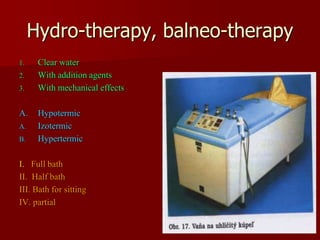
Hydro-therapy, balneo-therapy
1. Clear water
2. With addition agents
3. With mechanical effects
A. Hypotermic
A. Izotermic
B. Hypertermic
I. Full bath
II. Half bath
III. Bath for sitting
IV. partial
Hydro-therapy, balneo-therapy
 Under water massage –„a lá
Vichy“, Aix les Bains“
 whirlpool
 Bubble bath - air, oxygen or
carbon dioxide
 Sub- aqual massage - Hubbard
bath
Hydrotherapy
 Water application on human
body under high pressure
 Mechanical and termal
effect
 Water or steam
 As a rain, needles
(injection), flapper, mist
 Cold, warm, alternate
(scottish)
 Peloid – fango/mud/sludge
organic /anorganic
 Curative salts ang gases
Natural mineral water
• Contains:
gas (1g /l CO2 alebo or sulphuretted hydrogen)
or solid parts (1g/l)
From normal water differentiates by total
mineralisation, at first ionic parts, biologically
and farmacologically active parts, osmotic
pressure and natural temperature (cca 20
degrees C in place of spring)
Climatotherapy
Utilization of different
meteorological
conditions and
specific features of
climate for
therapeutical and
prophylactic purposes
Classification of climatotherapy
 aerotherapy
 heliotherapy
 thalassotherapy
 cave therapy
 mountain therapy
Indications
 The patient should be able to undergo
the treatment
 The selected organ system, which will be
cured, should be still able to reflect the
stimuli of the climate
 Enhancement of organism
 Improvement of:
- body temperature regulation
- immunity
- cortex activity
- physical and mental efficiency
The goal of
climatotherapy
Aerotherapy
 Utilization of fresh air in open-air places
 the base of climatotherapy, also called natural
oxygenotherapy
 Application: sleep and stay on the sea-coast, in
mountains …
 Fresh air stimulates and irritates skin receptors or
nerve endings and upon this the organism adapts
on these stimuli, the result is decrease in negative
and undesired reaction of regulating mechanisms
Heliotherapy
 Utilization of radiation: from sun - direct,
from sky – dispersed, from surface of
various objects -reflected
 Uses all kinds of light spectrum:
- UV radiation
- Visible part
- IR part
Indications
 hardiness (getting resistant to cold) – healthy
people
 enhancement of skin function
 prophylaxy of rachitis
 morbus Bechterev
 Skin diseases – psoriasis, alopecia areata
(baldness), ulcer of calf (ulcus cruris),
 Tuberculosis
Thalasso-therapy
• Utilization of coastal specific factors (fresh sea -
water, wind, sea - water inhalation and
gargalization )
• Inhalation -1 mg salts in 1 m3 of sea water –
prevailing NaCl, MgCl, MgSO4, CaSO4 , K2SO4 ,
MgBr2 , ozone, oxygen, iones, less of CO2 ,
iodine
• Hydro-aero-ionization of air
• Utilization of mechanical and termal water
qualities
• Training of termo-receptors – getting resistant to
cold
Thalassotherapy
 Recovery - minimum 14 days
 Prophylaxy – minimum 20 days
 Treatment – 30+ days
Increase in non- specific resistance: decreased
imunological reactivity
Cave therapy
 Therapeutical method,
using the specific and
unique properties of
environment of the
underground space of
karst caves to treat
the chronic and
allergic respiratory
disorders
 The basic treating
factor of
speleotherapy is the
cave aerosol.
Karst Cave Aerosol
 The basic proven factor of speleotherapeutic effectivity is
the aerosol
 Composition of the Karst Cave Aerosol:
• High constant relative humidity and low constant
temperature
•High content of calcium and magnesium
•High ionization rate and high electronegative charge
•Sterile environment- the absence of bacteria, mould or
fungi and aggressive allergens
•Absence of environmental pollution – organic and
anorganic
Indications
 Repeated, chronic obstructive and non-obstructive bronchitis
 Chronic and persistent cough after acute respiratory disease, or
asthmatic origin
 Repeated, chronic sinusitis
 Repeated, chronic upper respiratory tract infections
 Repeated bronchitis in the allergic person
 Allergic rhinitis, pollinosis
 Asthma bronchiale
 Dermorespiratory syndrome
 Frequent respiratory diseases in children
 Children from ecologically polluted areas
 Children of the families with severe allergic disposition and disease
Thank you for your attention!

Physiatrics.ppt

  • 1.
    Physiatrics Klinika geriatrie LFUK a FNsP Milosrdní bratia s.r.o.
  • 2.
    Introduction  Origin ofthe word :  Re- Latin prefix meaning again, back  Habilitas – ability, sufficiency  Rehabilitatio – restoring of previous health condition/status - larger sense – any therapy which purpose is restoration of health and man’s power - narrow sense – medical discipline, techniques for restoration and reinforcement performance and especially motion skills.
  • 3.
    Physiatrics and rehabilitation Rehabilitation: complex of processes, which ensure optimal somatic, psychical and social condition of an individual. This condition should allow the individual to take again an adequate position in society.  Physiatrics: medical discipline applying physical energies and factors of nature in treatment and prophylaxy.  Balneology: uses sources of natural waters and peloids (peat and bog (sludge)). Thermal, chemical and mechanic attributes can be used in the treatment.
  • 4.
    Classification of physiatrics Physio-therapy /physicalenergies/  Kinetic therapy  Electro-therapy  Magnetic-therapy  Thermo-therapy, Cryo- therapy  Hydro-therapy  Photo-therapy Natural factors  Climatotherapy  Balneology
  • 5.
    Evaluation  History  Physicalexamination  Goniometry  Evaluation of muscle strength  Functional assessment (Barthel Index)  Ergometry - bicycle - handle - treadmill  EMG
  • 6.
    Effects of physiotherapy Primary= direct Local impact of physical energies on tissues; the most common effect is: HYPERAEMIA: - increased input of energy source molecules (O2, proteins, fats, carbohydrates), anti-inflammatory substances - increased output of metabolic products – especially acid products /e.g. lactate (it causes pain)/ - increased resorption of haematomas and blood clots - finally, the effects of physiotherapy are analgetic, spasmolytic and anti-inflammatory ones  Secondary: mediated by humoral and nervous processes
  • 7.
    1. Kinetic therapy Therapeuticphysical training Ergotherapy (occupational therapy) Therapeutic massage
  • 8.
    I. Therapeutic physicaltraining  method using physical motion and exercise, it’s purpose is the same as in rehabilitation in general: - restoring of patients to optimal functioning and achieving functional adaptation of organism.  exercises : – according to intensity: exercises in vision – passive – with the help – active motion – active motion against external power – according to purpose: general (conditional training ) – special – according to number of patients: individual – in group – according to performance: gymnastic – practical – games – according to type : shuttle – traction – pressure isotonic - isometric
  • 9.
    main application formof therapeutic physical training  introduction: warming - up exercises  main part: general and special exercises  final part: breathing, relaxation exercises, instructions/education I. Training unit duration of a training unit: 15 – 45 min, adequate frequency and repeating of exercises and training units, progressive increasing of exercise load, indications and contraindications, observation of patient - subjective and objective status.
  • 10.
    Rehabilitation after heartattack (coronary thrombosis)  1. phase: hospitalisation – 0. stage – no physical activity – 1. stage – breathing and relaxation exercises – 2. stage – active motion of small muscle groups – 3. stage – active motion of groups of larger muscles, sitting with support, sitting with legs hanging down – 4. stage – walking on a flat ground around a bed, in a room, in a corridor, ... – 5. stage – walking up stairs – 6. stage – gymnastic exercises – 7. stage – free motion in a hospital
  • 11.
    Rehabilitation after coronary thrombosis 2. phase: convalescence: period from leaving the hospital to the starting work  3. phase: postcovalescence: the period after the hospitalisation for the rest of the life
  • 12.
    II. Occupational therapy (ergotherapy)  Applied especially during long-term care or long-term hospitalisation (departments of rehabilitation, departments of psychiatry, ...)  occupational therapy: is defined as “the art and science of directing man’s participation in selected tasks to restore and enhance performance, facilitate learning of those skills and functions essential for adaptation, diminish or correct pathology, and to promote health. /training of patient to service him/herself in daily activities, activities related to his job, support aids – wheelchair, … /  therapy based on patient`s activity: all activities relaxing patient (knitting, needlework, pottery, work in garden, painting, work with PC,...)
  • 13.
    III. Therapeutic massage A system of manual movements affecting on a patient`s body = mechanotherapy  is derived from principles of Swedish Ling`s massage, which includes 5 movements: stroking, friction, kneading, percussion, compression (vibration)  Manual massage: classic, sport, reflex, visceral  other types of massage: water-massage, acupuncture
  • 14.
    III. Therapeutic massage indications: • soft tissue injuries with pain, spasm and muscle tension • articular pain, some musculoskeletal disorders • visceral massage – constipation  conditions: adequate temperature, 3 hours after meal at the earliest, muscle relaxation before the massage  contraindications: infection, inflammatory disease of muscle, cachexia, purulent skin diseases, febrile and other serious clinical states
  • 15.
    2. Electrotherapy  usesbeneficial effects of various types of electric current • enhances blood perfusion of tissues – hyperaemia (without any cardiovascular loading) • releases tension of striated and smooth muscle, strengthens muscles • analgetic and anti-inflammatory effect
  • 16.
    Electro-therapy Frequency Type ofcurrent Frequency 0 Direct current iontophoresis F to 1 kHz Alternating current Low frequency electrostimulation Dia-dynamic currents F to 100 kHz Middle frequency Interferrential currents F over 100 kHz 0,8-3MHz USG 3-30MHz Short wave dia-thermy 300MHz do 3GHz Ultra-short dia-thermy
  • 17.
    Low frequency electriccurrent  For clinical fields:  Cardioversion  Defibrilation  Cardiostimulation  Electro-shocks  Coagulation, cauterization  For physiotherapy Electrogymnastics  Träberts currents – improve cappilarisation and tissue nutrition, in peripheral circulation (neuralgias, ischemic syndrome of limbs, healing wounds)  TENS – Transcutaneous Electrical Nerve Stimulation – analgetic effect, (muscle pain and joint pain)  Dia - dynamic currents
  • 18.
    Interferential currents  Discoveredby Mr. Nemec  Combination of 2 electric circles - bipolar method 1st circle has constant frequency, 2nd circle has fluctuating frequency  Tetrapolar method – combination of 2 bipolar circles in 1 place of tissue  Patient feels something like pins and needles  Strict contra-indication: metallic parts
  • 19.
    Magneto-therapy  Also forpatient with clothes and with plaster, titan parts  Strict contra-indication: pacemaker, IUD..  Patient does not feel anything
  • 20.
    Ultrasound- sonotherapy or acustictherapy  High frequency current changed for mechanical and termic energy  Effects: germicide (when the size of microbial body is the same as wave length)  Relaxing, analgetic
  • 21.
    Photo-therapy  INFRA –RED  Analgesic, spasmolytic effect  Soaking of tissues in depth of 2 cm  Mainly at home  source: SOLUX, sun
  • 22.
    Photo-therapy  linear polarisedlight – BIOPTRON LAMP  I: bed-sores, operating wounds, not well- healing wounds, eczemas,  CI: in this time not confirmed, pregnancy, contact lenses
  • 23.
    Ultra-violet radiation  From400nm up to X - ray  In tissues penetrate to depth up to 1 mm, it means in skin to epidermis, in the eye to cornea Direct effects: immunity improvement, inactivation of viruses, anti-rachitic profylaxy, improvement of rheologic characteristics of blood Be aware of: Skin cancer, cataract Source: sun, lamps
  • 24.
    Cryo-therapy Temperatures les than10 degrees  Long history – Kneipp, Priessnitz ( 17th, 18 th century|  Effect: vasoconstriction, analgesic effect,  General and local
  • 25.
    hall from -20 to – 50 degrees C (-4 to -58F) chamber from -120 to -160 degrees C (-184 to -256 F) Entrance after general warming, with shoes, gloves, covered mouth, ears Always in motion
  • 26.
    Thermo-therapy White Wax –temperature tolerance higher than water, about 55 to 60 degrees Parafango - wax and soil/mud
  • 27.
  • 28.
    Hydro-therapy, balneo-therapy 1. Clearwater 2. With addition agents 3. With mechanical effects A. Hypotermic A. Izotermic B. Hypertermic I. Full bath II. Half bath III. Bath for sitting IV. partial
  • 29.
    Hydro-therapy, balneo-therapy  Underwater massage –„a lá Vichy“, Aix les Bains“  whirlpool  Bubble bath - air, oxygen or carbon dioxide  Sub- aqual massage - Hubbard bath
  • 30.
    Hydrotherapy  Water applicationon human body under high pressure  Mechanical and termal effect  Water or steam  As a rain, needles (injection), flapper, mist  Cold, warm, alternate (scottish)
  • 32.
     Peloid –fango/mud/sludge organic /anorganic  Curative salts ang gases
  • 33.
    Natural mineral water •Contains: gas (1g /l CO2 alebo or sulphuretted hydrogen) or solid parts (1g/l) From normal water differentiates by total mineralisation, at first ionic parts, biologically and farmacologically active parts, osmotic pressure and natural temperature (cca 20 degrees C in place of spring)
  • 34.
    Climatotherapy Utilization of different meteorological conditionsand specific features of climate for therapeutical and prophylactic purposes
  • 35.
    Classification of climatotherapy aerotherapy  heliotherapy  thalassotherapy  cave therapy  mountain therapy
  • 36.
    Indications  The patientshould be able to undergo the treatment  The selected organ system, which will be cured, should be still able to reflect the stimuli of the climate
  • 37.
     Enhancement oforganism  Improvement of: - body temperature regulation - immunity - cortex activity - physical and mental efficiency The goal of climatotherapy
  • 38.
    Aerotherapy  Utilization offresh air in open-air places  the base of climatotherapy, also called natural oxygenotherapy  Application: sleep and stay on the sea-coast, in mountains …  Fresh air stimulates and irritates skin receptors or nerve endings and upon this the organism adapts on these stimuli, the result is decrease in negative and undesired reaction of regulating mechanisms
  • 39.
    Heliotherapy  Utilization ofradiation: from sun - direct, from sky – dispersed, from surface of various objects -reflected  Uses all kinds of light spectrum: - UV radiation - Visible part - IR part
  • 40.
    Indications  hardiness (gettingresistant to cold) – healthy people  enhancement of skin function  prophylaxy of rachitis  morbus Bechterev  Skin diseases – psoriasis, alopecia areata (baldness), ulcer of calf (ulcus cruris),  Tuberculosis
  • 41.
    Thalasso-therapy • Utilization ofcoastal specific factors (fresh sea - water, wind, sea - water inhalation and gargalization ) • Inhalation -1 mg salts in 1 m3 of sea water – prevailing NaCl, MgCl, MgSO4, CaSO4 , K2SO4 , MgBr2 , ozone, oxygen, iones, less of CO2 , iodine • Hydro-aero-ionization of air • Utilization of mechanical and termal water qualities • Training of termo-receptors – getting resistant to cold
  • 42.
    Thalassotherapy  Recovery -minimum 14 days  Prophylaxy – minimum 20 days  Treatment – 30+ days Increase in non- specific resistance: decreased imunological reactivity
  • 43.
    Cave therapy  Therapeuticalmethod, using the specific and unique properties of environment of the underground space of karst caves to treat the chronic and allergic respiratory disorders  The basic treating factor of speleotherapy is the cave aerosol.
  • 44.
    Karst Cave Aerosol The basic proven factor of speleotherapeutic effectivity is the aerosol  Composition of the Karst Cave Aerosol: • High constant relative humidity and low constant temperature •High content of calcium and magnesium •High ionization rate and high electronegative charge •Sterile environment- the absence of bacteria, mould or fungi and aggressive allergens •Absence of environmental pollution – organic and anorganic
  • 45.
    Indications  Repeated, chronicobstructive and non-obstructive bronchitis  Chronic and persistent cough after acute respiratory disease, or asthmatic origin  Repeated, chronic sinusitis  Repeated, chronic upper respiratory tract infections  Repeated bronchitis in the allergic person  Allergic rhinitis, pollinosis  Asthma bronchiale  Dermorespiratory syndrome  Frequent respiratory diseases in children  Children from ecologically polluted areas  Children of the families with severe allergic disposition and disease
  • 46.
    Thank you foryour attention! Thank you for your attention!