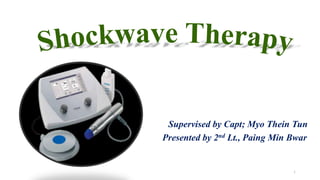
Supervised by Capt; Myo Thein Tun
Presented by 2nd Lt., Paing Min Bwar
1
Contents
2
1. Introduction
2. Shockwave Therapy Methods
3. Generation Of Focused Shock
Waves
4. Difference Between ESWT and
RSWT
5. Mechanism Of Action
6. Mechanism Of Action Of RWST
7. Advantages of RWST
8. RSWT with the enPuls Version 2.0
9. Preparation
10. Basic Rules
11. Dosing
12. Application methods
13. Recommendation For Chronic Soft
Tissues
14. Indications
15. Contraindications
16. Cautions
17. Treatment Protocol
18. References
Introduction
• Shockwaves are mechanical pressure waves that
work on the tissue.
• widely used to treat musculoskeletal problems.
• Originally → non-invasive disintegration of
kidney stones.
• Shockwave therapy has since also been used
successfully in orthopaedics.
3
Users
• Orthopaedic consultants
• Sport doctors
• Physiotherapists
• Osteopaths
• Emergency surgeons
• Pain doctors
4
Introduction (Contd.,)
Objectives
• Pain relief
• Elimination of the cause of the pain
• Effect on muscle tone
• Stimulation of cell metabolism
• Activation of regeneration processes
• Improvement of muscle trophic level
• Stimulation of vascular renewal
5
Introduction (Contd.,)
Shockwave Therapy Methods
Shockwave therapy methods
Extracorporeal Shockwave
Therapy (ESWT)
Radial Shockwave Therapy
(RSWT)
6
Shockwave therapy methods (Contd.,)
Extracorporeal Shockwave Therapy (ESWT) - 1990s,
• chronic pain management, impaired bone healing and other disorders.
• electrohydraulic or piezoelectric pressure pulses are generated –
so-called shockwaves.
• also known as focused shockwave therapy
• curve is a steep slope of the order of 10 ns
• pressure up to 140 MPa then to 10 MPa
• depth of up to 140 mm.
7
Radial Shockwave Therapy (RSWT)
• ESWT is referred to as RSWT,
• An electromagnetic generator
• Rise time of the pressure pulse is longer than with ESWT.
• maximum pressure is around 15 MPa
• penetrate approximately 35-40 mm.
8
Shockwave therapy methods (Contd.,)
• At 40 cm → wavelength is much longer than diameter of the
applicator heads, resulting in divergent, on-focused wave propagation
• Amount of energy → controlled with different acceleration of
projectile
• effective amount of energy → considerably by additional factors, such
as contact area and contact pressure, etc.
9
Shockwave therapy methods (Contd.,)
Radial Shockwave Therapy (RSWT)
10
Shockwave therapy methods (Contd.,)
• ESWT → generated piezoelectric or electrohydraulic .
• RSWT → electromagnetic .
Electromagnetic principles are characterized by;
• optimized intensities and focus zones,
• with long lasting constant dosage outputs,
• resulting in a gentle, less painful thus well tolerable
11
Shockwave therapy methods (Contd.,)
Generation Of Focused Shock Waves
12
Difference Between ESWT and RSWT
• wave speeds → ESWT > RSWT
• ESWT waves are not long and not less intense like RSWT.
• ESWT → more of an acoustic wave with a very high pressured
amplitude with short intense pulses while RSWT → more of a
pressure wave.
• RSWT → put right onto skin itself and waves of pressure are created
along skin surfaces.
• ESWT → waves and force is transferred to skin and tissues without
effect, and is focused at a specific desired depth.
13
Difference Between ESWT and RSWT (Contd.,)
• RSWT → pressure waves are generated by repeatedly bouncing upon
skin with, creating pressure waves through body.
• RSWT → waves disperses through to tissue beneath.
• ESWT → treating deep tissue injuries.
• RSWT → treating superficial injuries.
• ESWT→ may be required to undergo anesthesia when undergoing
14
Mechanism Of Action
• Kinetic energy of projectile, created by compressed air → transmit at
end of applicator → into tissue.
• Pulses of acoustic energy are focused on target tissues by the
applicator of the shockwave therapy machine (handpiece) .
• It cause localized microtrauma that stimulates the bodies natural
healing processes.
15
• It stimulate angiogenesis / neovascularization (new blood
vessels) and neurogenesis(new nerve cells).
• Microtrauma increases local circulation and enhances
break down of calcifications (calcium build-up).
16
Mechanism Of Action (Contd.,)
Mechanism Of Action Of RWST
• RWST → release as Hormones, trigger various pain
inhibiting and stimulating reactions in body.
• Results in a reduction in pain, expansion of blood vessels,
and, as a result, improved blood flow and tissue healing.
•Inhibition of the COX II enzyme (cyclooxygenase)
•Activation of cellular defenses
17
•Inhibition of the COX II enzyme (cyclooxygenase)
• Inflammatory mediators such as COX II can be
inhibited by radial shockwaves.
• This attenuates inflammatory processes (anti-
inflammatory effect).
• Activation of cellular defenses
• Radial shockwaves trigger the release of free radicals.
• Hence this strengthens the body’s cellular defense
mechanisms.
18
Mechanism Of Action Of RWST (Contd.,)
Advantages of RWST
• Increasing significance for treatment of superficial orthopaedic
conditions. Therapeutic outcome → very good in 70% of cases
• This is essentially due to:
ovirtually same therapeutic outcome as with ESWT
oRSWT treatment costs less than ESWT
• According to studies, a positive reaction (pain relief / improved
function) has been recorded in over 80% of patients (painful plantar
fasciitis)
19
RSWT with the enPuls Version 2.0
20
RSWT with the enPuls Version 2.0 (Contd.,)
Parameter
• Shock energy of 90 and 120 mJ
• Frequencies of around 10 Hz.
• Small, light, fully mobile device
• Long life-span of the hand piece (guaranteed at least 2,000,000 pulses)
Energy
• Energy levels at the applicator tip: 60 mJ, 90 mJ, 120 mJ and 185 mJ,
21
Available shockwave Application head
22
RSWT with the enPuls Version 2.0 (Contd.,)
Frequency
23
RSWT with the enPuls Version 2.0 (Contd.,)
Preparation
• patients → safe, comfortable position for treatment.
• Therapist → can easily reach affected area in an upright
position and handpiece →vertically.
• When treating muscles and joints, prepare the area or
muscles and move or stretch in a pain-free region in
advance.
24
Basic Rules
• In case of pain/trigger points → Pinpoint the treatment area and
detect point with the greatest sensitivity
• Create a virtual grid over the treatment area
• Position the handpiece at right angles and apply its own weight
• Apply moderate pressure
• Contact gel is used in silicone cap
25
• Handpiece can be held in one hand and the second hand can be used to
hold the treatment area
• Start with the most sensitive point
• Every point in the grid must be treated with the number of pulses
stipulated in the protocol.
• If possible, start with the most sensitive point.
26
Basic Rules (Contd.,)
Steps of treatment
27
Basic rules
Dosing
• start with the large applicator head to a smaller surface
area.
• energy level and frequency can be changed for dosing
purposes.
• If treatment intensity has to be reduced on tolerance, this
should initially be done via the frequency.
28
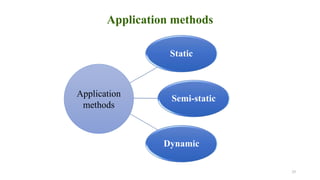
Application methods
Static
Semi-static
Dynamic
29
Application
methods
Application methods (Contd.,)
Static
• Handpiece is applied to one point and only vertically with
contact pressure.
• a method of procedure based on experience and common
sense when treating localised problems (pain point, trigger
point).
30
Semi-static
• The handpiece remains on the point and also treated by
moving the handpiece evenly, working outwards from the
vertical position.
31
Application methods (Contd.,)
Dynamic
• Handpiece is moved with head and by applying contact
pressure over the structure to be treated, without
interrupting the pulse sequence.
• This method is used to treat soft tissue areas (muscles) and
tendons.
32
Application methods (Contd.,)
Combined Therapy
• In particularly painful situations or if the patient is
sensitive, Cryo 6 can alternatively be applied prior to
treatment in order to reduce the pain.
33
Application methods (Contd.,)
Recommendation For Chronic Soft Tissues
• 3-5 treatments be taken at weekly intervals.
• body will require 3-4 weeks to go through the healing
phase.
• Treatments last approximately 5 minutes
• The area treated may have a throbbing discomfort for up to
48 hours after treatment which is expected due to the
inflammatory response created.
34
Indications
• Myofascial trigger points
• Calcific tendonitis of the shoulder
• Radial and ulnar epicondylitis
• Plantar fasciitis / heel spores
• Deep back pain / lumbago
• Trochanteric bursitis
• Achillodynia
35
Contraindications
• Vascular diseases
• Local infections
• Malignant or benign tumours
• Cartilage surfaces or near the small facet joints
• Pacemakers or analgesic pumps
• Metal implants for fractures, muscle pulls or tears
36
A computerized pump
attached to the IV lets
release pain medicine
by pressing a handheld
button.
• Recent cortisone injection within 6 weeks
• Blood thinning medication (i.e., Heparin or Coumadin)
• Large nerves or vessels close to the area being treated
• Pregnancy
• Diseases with vasomotor impairment
• fibromyalgia
37
Contraindications (Contd.,)
Caution
• impaired aesthesia
• severe autonomic disorders
• influence of drugs and/or alcohol
• applied to the head,
• above the lungs,
• over the abdomen and
• epiphyseal plates of children
38
Muscular back pain
39
Treatment Protocol / Recommendations
Myofascial trigger point treatment e.g. on the back, in the case of
muscular back pain
40
Treatment Protocol / Recommendations Contd.,
Myofascial trigger point treatment e.g. neck
41
Treatment Protocol / Recommendations Contd.,
• Painful muscle spasms of the upper margin of the trapezius muscle
42
Treatment Protocol / Recommendations Contd.,
Calcific tendonitis of the shoulder
43
Treatment Protocol / Recommendations Contd.,
Radial epicondylitis
44
Treatment Protocol / Recommendations Contd.,
Myofascial trigger point treatment in the event of radial epicondylitis
45
Treatment Protocol / Recommendations Contd.,
Tendonitis of the shoulder / shoulder problems
46
Treatment Protocol / Recommendations Contd.,
Ulnar epicondylitis
47
Treatment Protocol / Recommendations Contd.,
• Thumb basal joint arthritis / rhizarthritis
48
Treatment Protocol / Recommendations Contd.,
• Dupuytren’s disease
49
Treatment Protocol / Recommendations Contd.,
Trochanteric bursitis
50
Treatment Protocol / Recommendations Contd.,
• Tendinitis of the iliotibial tract
51
Treatment Protocol / Recommendations Contd.,
Trigger point treatment, Pes anserinus
52
Treatment Protocol / Recommendations Contd.,
Patellar apex syndrome
53
Treatment Protocol / Recommendations Contd.,
Patellar tendon syndrome
54
Treatment Protocol / Recommendations Contd.,
Achillodynia
55
Treatment Protocol / Recommendations Contd.,
Plantar fasciitis
56
Treatment Protocol / Recommendations Contd.,
Heel spurs
57
Treatment Protocol / Recommendations Contd.,
• Achillodynia, combined with Cryo 6
58
Treatment Protocol / Recommendations Contd.,
• Status post muscular injuries
59
Treatment Protocol / Recommendations Contd.,
• Trigger point treatment of the sternocleidomastoid muscle insertion
60
Treatment Protocol / Recommendations Contd.,
References
• http://www.fortephysiotherapy.com/services/shock-wave-
therapy/
• http://physicaltherapyweb.com/shockwave-therapy/
• https://zimmer.de/en/products/physical-therapy/shockwave-
therapy/enpuls-version-2-0/
• https://www.shockwavetherapy.eu/subpage
61
Thank you
62

Shockwave [Read-Only].pptx

  • 1.
    Supervised by Capt;Myo Thein Tun Presented by 2nd Lt., Paing Min Bwar 1
  • 2.
    Contents 2 1. Introduction 2. ShockwaveTherapy Methods 3. Generation Of Focused Shock Waves 4. Difference Between ESWT and RSWT 5. Mechanism Of Action 6. Mechanism Of Action Of RWST 7. Advantages of RWST 8. RSWT with the enPuls Version 2.0 9. Preparation 10. Basic Rules 11. Dosing 12. Application methods 13. Recommendation For Chronic Soft Tissues 14. Indications 15. Contraindications 16. Cautions 17. Treatment Protocol 18. References
  • 3.
    Introduction • Shockwaves aremechanical pressure waves that work on the tissue. • widely used to treat musculoskeletal problems. • Originally → non-invasive disintegration of kidney stones. • Shockwave therapy has since also been used successfully in orthopaedics. 3
  • 4.
    Users • Orthopaedic consultants •Sport doctors • Physiotherapists • Osteopaths • Emergency surgeons • Pain doctors 4 Introduction (Contd.,)
  • 5.
    Objectives • Pain relief •Elimination of the cause of the pain • Effect on muscle tone • Stimulation of cell metabolism • Activation of regeneration processes • Improvement of muscle trophic level • Stimulation of vascular renewal 5 Introduction (Contd.,)
  • 6.
    Shockwave Therapy Methods Shockwavetherapy methods Extracorporeal Shockwave Therapy (ESWT) Radial Shockwave Therapy (RSWT) 6
  • 7.
    Shockwave therapy methods(Contd.,) Extracorporeal Shockwave Therapy (ESWT) - 1990s, • chronic pain management, impaired bone healing and other disorders. • electrohydraulic or piezoelectric pressure pulses are generated – so-called shockwaves. • also known as focused shockwave therapy • curve is a steep slope of the order of 10 ns • pressure up to 140 MPa then to 10 MPa • depth of up to 140 mm. 7
  • 8.
    Radial Shockwave Therapy(RSWT) • ESWT is referred to as RSWT, • An electromagnetic generator • Rise time of the pressure pulse is longer than with ESWT. • maximum pressure is around 15 MPa • penetrate approximately 35-40 mm. 8 Shockwave therapy methods (Contd.,)
  • 9.
    • At 40cm → wavelength is much longer than diameter of the applicator heads, resulting in divergent, on-focused wave propagation • Amount of energy → controlled with different acceleration of projectile • effective amount of energy → considerably by additional factors, such as contact area and contact pressure, etc. 9 Shockwave therapy methods (Contd.,)
  • 10.
    Radial Shockwave Therapy(RSWT) 10 Shockwave therapy methods (Contd.,)
  • 11.
    • ESWT →generated piezoelectric or electrohydraulic . • RSWT → electromagnetic . Electromagnetic principles are characterized by; • optimized intensities and focus zones, • with long lasting constant dosage outputs, • resulting in a gentle, less painful thus well tolerable 11 Shockwave therapy methods (Contd.,)
  • 12.
    Generation Of FocusedShock Waves 12
  • 13.
    Difference Between ESWTand RSWT • wave speeds → ESWT > RSWT • ESWT waves are not long and not less intense like RSWT. • ESWT → more of an acoustic wave with a very high pressured amplitude with short intense pulses while RSWT → more of a pressure wave. • RSWT → put right onto skin itself and waves of pressure are created along skin surfaces. • ESWT → waves and force is transferred to skin and tissues without effect, and is focused at a specific desired depth. 13
  • 14.
    Difference Between ESWTand RSWT (Contd.,) • RSWT → pressure waves are generated by repeatedly bouncing upon skin with, creating pressure waves through body. • RSWT → waves disperses through to tissue beneath. • ESWT → treating deep tissue injuries. • RSWT → treating superficial injuries. • ESWT→ may be required to undergo anesthesia when undergoing 14
  • 15.
    Mechanism Of Action •Kinetic energy of projectile, created by compressed air → transmit at end of applicator → into tissue. • Pulses of acoustic energy are focused on target tissues by the applicator of the shockwave therapy machine (handpiece) . • It cause localized microtrauma that stimulates the bodies natural healing processes. 15
  • 16.
    • It stimulateangiogenesis / neovascularization (new blood vessels) and neurogenesis(new nerve cells). • Microtrauma increases local circulation and enhances break down of calcifications (calcium build-up). 16 Mechanism Of Action (Contd.,)
  • 17.
    Mechanism Of ActionOf RWST • RWST → release as Hormones, trigger various pain inhibiting and stimulating reactions in body. • Results in a reduction in pain, expansion of blood vessels, and, as a result, improved blood flow and tissue healing. •Inhibition of the COX II enzyme (cyclooxygenase) •Activation of cellular defenses 17
  • 18.
    •Inhibition of theCOX II enzyme (cyclooxygenase) • Inflammatory mediators such as COX II can be inhibited by radial shockwaves. • This attenuates inflammatory processes (anti- inflammatory effect). • Activation of cellular defenses • Radial shockwaves trigger the release of free radicals. • Hence this strengthens the body’s cellular defense mechanisms. 18 Mechanism Of Action Of RWST (Contd.,)
  • 19.
    Advantages of RWST •Increasing significance for treatment of superficial orthopaedic conditions. Therapeutic outcome → very good in 70% of cases • This is essentially due to: ovirtually same therapeutic outcome as with ESWT oRSWT treatment costs less than ESWT • According to studies, a positive reaction (pain relief / improved function) has been recorded in over 80% of patients (painful plantar fasciitis) 19
  • 20.
    RSWT with theenPuls Version 2.0 20
  • 21.
    RSWT with theenPuls Version 2.0 (Contd.,) Parameter • Shock energy of 90 and 120 mJ • Frequencies of around 10 Hz. • Small, light, fully mobile device • Long life-span of the hand piece (guaranteed at least 2,000,000 pulses) Energy • Energy levels at the applicator tip: 60 mJ, 90 mJ, 120 mJ and 185 mJ, 21
  • 22.
    Available shockwave Applicationhead 22 RSWT with the enPuls Version 2.0 (Contd.,)
  • 23.
    Frequency 23 RSWT with theenPuls Version 2.0 (Contd.,)
  • 24.
    Preparation • patients →safe, comfortable position for treatment. • Therapist → can easily reach affected area in an upright position and handpiece →vertically. • When treating muscles and joints, prepare the area or muscles and move or stretch in a pain-free region in advance. 24
  • 25.
    Basic Rules • Incase of pain/trigger points → Pinpoint the treatment area and detect point with the greatest sensitivity • Create a virtual grid over the treatment area • Position the handpiece at right angles and apply its own weight • Apply moderate pressure • Contact gel is used in silicone cap 25
  • 26.
    • Handpiece canbe held in one hand and the second hand can be used to hold the treatment area • Start with the most sensitive point • Every point in the grid must be treated with the number of pulses stipulated in the protocol. • If possible, start with the most sensitive point. 26 Basic Rules (Contd.,)
  • 27.
  • 28.
    Dosing • start withthe large applicator head to a smaller surface area. • energy level and frequency can be changed for dosing purposes. • If treatment intensity has to be reduced on tolerance, this should initially be done via the frequency. 28
  • 29.
  • 30.
    Application methods (Contd.,) Static •Handpiece is applied to one point and only vertically with contact pressure. • a method of procedure based on experience and common sense when treating localised problems (pain point, trigger point). 30
  • 31.
    Semi-static • The handpieceremains on the point and also treated by moving the handpiece evenly, working outwards from the vertical position. 31 Application methods (Contd.,)
  • 32.
    Dynamic • Handpiece ismoved with head and by applying contact pressure over the structure to be treated, without interrupting the pulse sequence. • This method is used to treat soft tissue areas (muscles) and tendons. 32 Application methods (Contd.,)
  • 33.
    Combined Therapy • Inparticularly painful situations or if the patient is sensitive, Cryo 6 can alternatively be applied prior to treatment in order to reduce the pain. 33 Application methods (Contd.,)
  • 34.
    Recommendation For ChronicSoft Tissues • 3-5 treatments be taken at weekly intervals. • body will require 3-4 weeks to go through the healing phase. • Treatments last approximately 5 minutes • The area treated may have a throbbing discomfort for up to 48 hours after treatment which is expected due to the inflammatory response created. 34
  • 35.
    Indications • Myofascial triggerpoints • Calcific tendonitis of the shoulder • Radial and ulnar epicondylitis • Plantar fasciitis / heel spores • Deep back pain / lumbago • Trochanteric bursitis • Achillodynia 35
  • 36.
    Contraindications • Vascular diseases •Local infections • Malignant or benign tumours • Cartilage surfaces or near the small facet joints • Pacemakers or analgesic pumps • Metal implants for fractures, muscle pulls or tears 36 A computerized pump attached to the IV lets release pain medicine by pressing a handheld button.
  • 37.
    • Recent cortisoneinjection within 6 weeks • Blood thinning medication (i.e., Heparin or Coumadin) • Large nerves or vessels close to the area being treated • Pregnancy • Diseases with vasomotor impairment • fibromyalgia 37 Contraindications (Contd.,)
  • 38.
    Caution • impaired aesthesia •severe autonomic disorders • influence of drugs and/or alcohol • applied to the head, • above the lungs, • over the abdomen and • epiphyseal plates of children 38
  • 39.
    Muscular back pain 39 TreatmentProtocol / Recommendations
  • 40.
    Myofascial trigger pointtreatment e.g. on the back, in the case of muscular back pain 40 Treatment Protocol / Recommendations Contd.,
  • 41.
    Myofascial trigger pointtreatment e.g. neck 41 Treatment Protocol / Recommendations Contd.,
  • 42.
    • Painful musclespasms of the upper margin of the trapezius muscle 42 Treatment Protocol / Recommendations Contd.,
  • 43.
    Calcific tendonitis ofthe shoulder 43 Treatment Protocol / Recommendations Contd.,
  • 44.
  • 45.
    Myofascial trigger pointtreatment in the event of radial epicondylitis 45 Treatment Protocol / Recommendations Contd.,
  • 46.
    Tendonitis of theshoulder / shoulder problems 46 Treatment Protocol / Recommendations Contd.,
  • 47.
  • 48.
    • Thumb basaljoint arthritis / rhizarthritis 48 Treatment Protocol / Recommendations Contd.,
  • 49.
    • Dupuytren’s disease 49 TreatmentProtocol / Recommendations Contd.,
  • 50.
  • 51.
    • Tendinitis ofthe iliotibial tract 51 Treatment Protocol / Recommendations Contd.,
  • 52.
    Trigger point treatment,Pes anserinus 52 Treatment Protocol / Recommendations Contd.,
  • 53.
    Patellar apex syndrome 53 TreatmentProtocol / Recommendations Contd.,
  • 54.
    Patellar tendon syndrome 54 TreatmentProtocol / Recommendations Contd.,
  • 55.
    Achillodynia 55 Treatment Protocol /Recommendations Contd.,
  • 56.
    Plantar fasciitis 56 Treatment Protocol/ Recommendations Contd.,
  • 57.
    Heel spurs 57 Treatment Protocol/ Recommendations Contd.,
  • 58.
    • Achillodynia, combinedwith Cryo 6 58 Treatment Protocol / Recommendations Contd.,
  • 59.
    • Status postmuscular injuries 59 Treatment Protocol / Recommendations Contd.,
  • 60.
    • Trigger pointtreatment of the sternocleidomastoid muscle insertion 60 Treatment Protocol / Recommendations Contd.,
  • 61.
    References • http://www.fortephysiotherapy.com/services/shock-wave- therapy/ • http://physicaltherapyweb.com/shockwave-therapy/ •https://zimmer.de/en/products/physical-therapy/shockwave- therapy/enpuls-version-2-0/ • https://www.shockwavetherapy.eu/subpage 61
  • 62.