Who’s reporting?
BSED-ENGLISH
Catherine
Esteban
Nolyn Angelique
Manalo
Mary Divine
Samoy
Mojarri
Villacencio
Principles of Technical Writing
DESCRIPTION
1 2 3 4 5
principles of
Technical writing
WHAT IS TECHNICAL WRITING
Technical Writing, sometimes called business writing, is writing for a
specific purpose and with a specific goal. Usually its goal is to
inform/instruct or persuade/argue. Technical writing can really be
considered transactional writing because there are two people or
groups involved in the communication.
Why is Technical Writing
Important?
PRINCIPLES OF TECHNICAL
WRITING
1. USE GOOD GRAMMAR
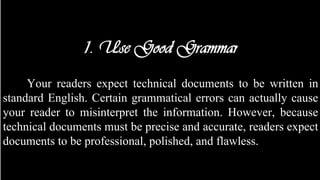
1. Use Good Grammar
Your readers expect technical documents to be written in
standard English. Certain grammatical errors can actually cause
your reader to misinterpret the information. However, because
technical documents must be precise and accurate, readers expect
documents to be professional, polished, and flawless.
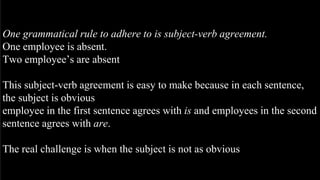
One grammatical rule to adhere to is subject-verb agreement.
One employee is absent.
Two employee’s are absent
This subject-verb agreement is easy to make because in each sentence,
the subject is obvious
employee in the first sentence agrees with is and employees in the second
sentence agrees with are.
The real challenge is when the subject is not as obvious
2. WRITING CONCISELY
2.Writing Concisely
In technical writing, clarity and brevity is your goal. Why
take 32 words to express what could be stated in 14 or 15? The
dictates of effective technical writing suggest that the average
length for a sentence is 15-20 words.
3. USING THE ACTIVE
VOICE
3.Using the Active Voice
Imperative sentences, or command sentences, are written in the
active voice. The active voice is more natural to people when they speak,
but technical writers often turn to the passive voice when writing
technical documents. One of the main reasons you should use the active
voice rather than the passive in technical writing is the active voice more
closely resembles the way people remember and process information
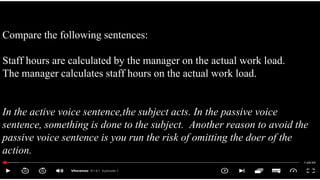
Compare the following sentences:
Staff hours are calculated by the manager on the actual work load.
The manager calculates staff hours on the actual work load.
In the active voice sentence,the subject acts. In the passive voice
sentence, something is done to the subject. Another reason to avoid the
passive voice sentence is you run the risk of omitting the doer of the
action.
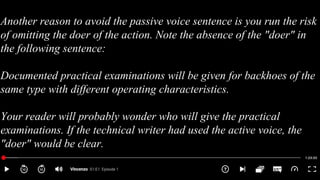
Another reason to avoid the passive voice sentence is you run the risk
of omitting the doer of the action. Note the absence of the "doer" in
the following sentence:
Documented practical examinations will be given for backhoes of the
same type with different operating characteristics.
Your reader will probably wonder who will give the practical
examinations. If the technical writer had used the active voice, the
"doer" would be clear.
4. USING POSITIVE
STATEMENTS
4.Using Positive Statements
Technical writers should word instructions as positive
statements. Whenever possible, phrase commands in a
positive manner.
5. AVOID LONG
SENTENCES
5. Avoiding Long Sentences
Short sentences are easier to understand than long sentences.
For this reason, it is best to write your technical documents in
short sentences. If you are asking your readers to perform several
actions, begin the step with an active verb.
When separating steps into distinct bullet points is to make sure that the
action verbs in each bulleted item are in the same tense.
For example, if the first step was worded, "Creating an empty workspace
," then the next bullet would be, "Populating it with application source
code ," and the third bullet point would be, "Compiling the workspace ."
6. USING STANDARD
PUNCTUATION
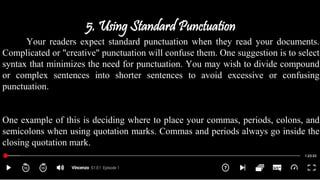
5. Using Standard Punctuation
Your readers expect standard punctuation when they read your documents.
Complicated or "creative" punctuation will confuse them. One suggestion is to select
syntax that minimizes the need for punctuation. You may wish to divide compound
or complex sentences into shorter sentences to avoid excessive or confusing
punctuation.
One example of this is deciding where to place your commas, periods, colons, and
semicolons when using quotation marks. Commas and periods always go inside the
closing quotation mark.
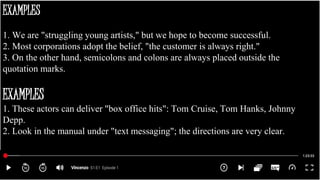
EXAMPLES
1. We are "struggling young artists," but we hope to become successful.
2. Most corporations adopt the belief, "the customer is always right."
3. On the other hand, semicolons and colons are always placed outside the
quotation marks.
EXAMPLES
1. These actors can deliver "box office hits": Tom Cruise, Tom Hanks, Johnny
Depp.
2. Look in the manual under "text messaging"; the directions are very clear.
CONCLUSION
THANK YOU FOR
LISTENING!

Principles of technical writing

  • 3.
  • 4.
    Principles of TechnicalWriting DESCRIPTION 1 2 3 4 5
  • 5.
    principles of Technical writing WHATIS TECHNICAL WRITING Technical Writing, sometimes called business writing, is writing for a specific purpose and with a specific goal. Usually its goal is to inform/instruct or persuade/argue. Technical writing can really be considered transactional writing because there are two people or groups involved in the communication.
  • 6.
    Why is TechnicalWriting Important?
  • 7.
  • 8.
    1. USE GOODGRAMMAR
  • 9.
    1. Use GoodGrammar Your readers expect technical documents to be written in standard English. Certain grammatical errors can actually cause your reader to misinterpret the information. However, because technical documents must be precise and accurate, readers expect documents to be professional, polished, and flawless.
  • 10.
    One grammatical ruleto adhere to is subject-verb agreement. One employee is absent. Two employee’s are absent This subject-verb agreement is easy to make because in each sentence, the subject is obvious employee in the first sentence agrees with is and employees in the second sentence agrees with are. The real challenge is when the subject is not as obvious
  • 11.
  • 12.
    2.Writing Concisely In technicalwriting, clarity and brevity is your goal. Why take 32 words to express what could be stated in 14 or 15? The dictates of effective technical writing suggest that the average length for a sentence is 15-20 words.
  • 13.
    3. USING THEACTIVE VOICE
  • 14.
    3.Using the ActiveVoice Imperative sentences, or command sentences, are written in the active voice. The active voice is more natural to people when they speak, but technical writers often turn to the passive voice when writing technical documents. One of the main reasons you should use the active voice rather than the passive in technical writing is the active voice more closely resembles the way people remember and process information
  • 15.
    Compare the followingsentences: Staff hours are calculated by the manager on the actual work load. The manager calculates staff hours on the actual work load. In the active voice sentence,the subject acts. In the passive voice sentence, something is done to the subject. Another reason to avoid the passive voice sentence is you run the risk of omitting the doer of the action.
  • 16.
    Another reason toavoid the passive voice sentence is you run the risk of omitting the doer of the action. Note the absence of the "doer" in the following sentence: Documented practical examinations will be given for backhoes of the same type with different operating characteristics. Your reader will probably wonder who will give the practical examinations. If the technical writer had used the active voice, the "doer" would be clear.
  • 17.
  • 18.
    4.Using Positive Statements Technicalwriters should word instructions as positive statements. Whenever possible, phrase commands in a positive manner.
  • 19.
  • 20.
    5. Avoiding LongSentences Short sentences are easier to understand than long sentences. For this reason, it is best to write your technical documents in short sentences. If you are asking your readers to perform several actions, begin the step with an active verb.
  • 21.
    When separating stepsinto distinct bullet points is to make sure that the action verbs in each bulleted item are in the same tense. For example, if the first step was worded, "Creating an empty workspace ," then the next bullet would be, "Populating it with application source code ," and the third bullet point would be, "Compiling the workspace ."
  • 22.
  • 23.
    5. Using StandardPunctuation Your readers expect standard punctuation when they read your documents. Complicated or "creative" punctuation will confuse them. One suggestion is to select syntax that minimizes the need for punctuation. You may wish to divide compound or complex sentences into shorter sentences to avoid excessive or confusing punctuation. One example of this is deciding where to place your commas, periods, colons, and semicolons when using quotation marks. Commas and periods always go inside the closing quotation mark.
  • 24.
    EXAMPLES 1. We are"struggling young artists," but we hope to become successful. 2. Most corporations adopt the belief, "the customer is always right." 3. On the other hand, semicolons and colons are always placed outside the quotation marks. EXAMPLES 1. These actors can deliver "box office hits": Tom Cruise, Tom Hanks, Johnny Depp. 2. Look in the manual under "text messaging"; the directions are very clear.
  • 25.
  • 26.