PHYSICAL CHANGE
A change which alters some specific
physical property of the matter , like its
state, texture, magnetic or electrical
conditions or its colour without any
change in the composition of its
molecules, is called a physical change .
It also gets reversed if the cause
producing the change is removed.
Or changes in which no new substances
are formed.
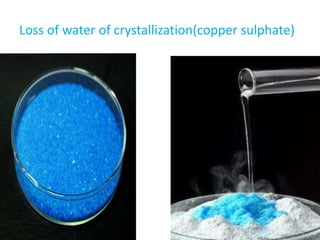
Loss of water of crystallization(copper sulphate)
CHEMICAL CHANGE
A change which takes place in the state,
texture, colour, magnetic or electrical
properties along with change in the
composition of its molecules, is called a
chemical change . It does not get reversed
if the cause producing the change is
removed.
Or changes in which new substances are
formed.
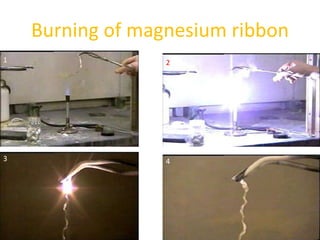
Burning of magnesium ribbon
1 2
3 4
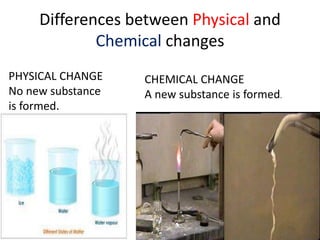
Differences between Physical and
Chemical changes
PHYSICAL CHANGE
No new substance
is formed.
CHEMICAL CHANGE
A new substance is formed.
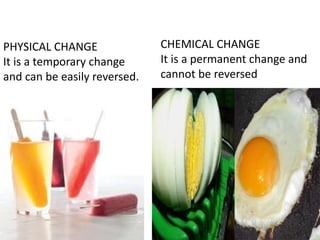
PHYSICAL CHANGE
It is a temporary change
and can be easily reversed.
CHEMICAL CHANGE
It is a permanent change and
cannot be reversed
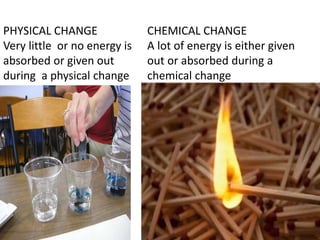
PHYSICAL CHANGE
Very little or no energy is
absorbed or given out
during a physical change
CHEMICAL CHANGE
A lot of energy is either given
out or absorbed during a
chemical change
PHYSICAL CHANGE
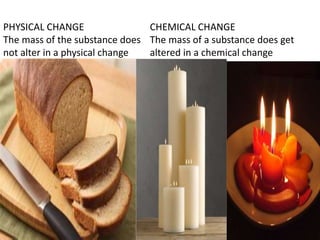
The mass of the substance does
not alter in a physical change
CHEMICAL CHANGE
The mass of a substance does get
altered in a chemical change
Q1) Give one example of a physical change.
Q2) Give one example of a chemical change.
Q3) Classify the following as physical and chemical changes:-
•Burning of candle wax ___________________________
•Melting of candle wax ___________________________
•Breaking a piece of chalk __________________________
•Germination of seed ______________________________
•Formation of curds from milk _______________________
•Condensation of steam ____________________________
Q4) A person eats a chocolate and then digests it . In doing so
there takes place a physical and a chemical change .identify
the changes and give a reason for your answer.

Physical & chemical changes

  • 1.
    PHYSICAL CHANGE A changewhich alters some specific physical property of the matter , like its state, texture, magnetic or electrical conditions or its colour without any change in the composition of its molecules, is called a physical change . It also gets reversed if the cause producing the change is removed. Or changes in which no new substances are formed.
  • 2.
    Loss of waterof crystallization(copper sulphate)
  • 3.
    CHEMICAL CHANGE A changewhich takes place in the state, texture, colour, magnetic or electrical properties along with change in the composition of its molecules, is called a chemical change . It does not get reversed if the cause producing the change is removed. Or changes in which new substances are formed.
  • 4.
    Burning of magnesiumribbon 1 2 3 4
  • 5.
    Differences between Physicaland Chemical changes PHYSICAL CHANGE No new substance is formed. CHEMICAL CHANGE A new substance is formed.
  • 6.
    PHYSICAL CHANGE It isa temporary change and can be easily reversed. CHEMICAL CHANGE It is a permanent change and cannot be reversed
  • 7.
    PHYSICAL CHANGE Very littleor no energy is absorbed or given out during a physical change CHEMICAL CHANGE A lot of energy is either given out or absorbed during a chemical change
  • 8.
    PHYSICAL CHANGE The massof the substance does not alter in a physical change CHEMICAL CHANGE The mass of a substance does get altered in a chemical change
  • 9.
    Q1) Give oneexample of a physical change. Q2) Give one example of a chemical change. Q3) Classify the following as physical and chemical changes:- •Burning of candle wax ___________________________ •Melting of candle wax ___________________________ •Breaking a piece of chalk __________________________ •Germination of seed ______________________________ •Formation of curds from milk _______________________ •Condensation of steam ____________________________ Q4) A person eats a chocolate and then digests it . In doing so there takes place a physical and a chemical change .identify the changes and give a reason for your answer.