BASIC RESEARCH
VS.
APPLIED RESEARCH
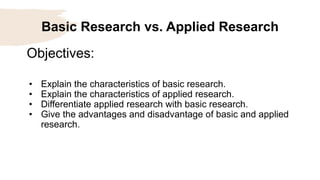
Basic Research vs. Applied Research
• Explain the characteristics of basic research.
• Explain the characteristics of applied research.
• Differentiate applied research with basic research.
• Give the advantages and disadvantage of basic and applied
research.
Objectives:
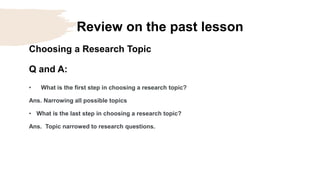
Review on the past lesson
Choosing a Research Topic
Q and A:
• What is the first step in choosing a research topic?
Ans. Narrowing all possible topics
• What is the last step in choosing a research topic?
Ans. Topic narrowed to research questions.
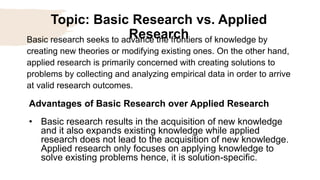
Topic: Basic Research vs. Applied
Research
Advantages of Basic Research over Applied Research
• Basic research results in the acquisition of new knowledge
and it also expands existing knowledge while applied
research does not lead to the acquisition of new knowledge.
Applied research only focuses on applying knowledge to
solve existing problems hence, it is solution-specific.
Basic research seeks to advance the frontiers of knowledge by
creating new theories or modifying existing ones. On the other hand,
applied research is primarily concerned with creating solutions to
problems by collecting and analyzing empirical data in order to arrive
at valid research outcomes.
Applied research is a research methodology that creates
practical solutions for specific problems while basic research is
an approach to research that seeks to expand knowledge in a
field of study. This means that applied research is solution-
driven while basic research is knowledge-specific.
Advantages of Applied Research over Basic Research
• Applied research helps organizations and individuals to solve
specific problems, unlike basic research that is simply focused
on expanding knowledge without providing solutions to existing
problems. This, however, does not negate the fact that findings
from basic research are useful to offer solutions to problems.
• Unlike basic research which is somewhat subjective in
its approach, applied research is an objective method of
inquiry.
• Typically, applied research is unbiased because it
arrives at outcomes by subjecting empirical evidence to
standardized scientific procedures and this makes it a
more valid research method.
• Empirical = realistic, practical, experimental
• Scientific = systematic, logical, exact
Examples of Research in Education
• In education, applied research is used to improve
teaching and learning methods by providing practical
solutions to pedagogic problems.
• On the other hand, basic research is used in education
to develop new pedagogic theories that explain different
behaviors by teachers and students within the learning
environment.
Examples of basic research in education include:
• How does the human memory work?
• How do children acquire new languages?
Examples of applied research in education include:
• A study to build students' interests in religious studies.
• A study to improve classroom interaction between teachers and
students.
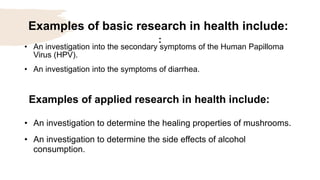
Examples of basic research in health include:
:
• An investigation into the secondary symptoms of the Human Papilloma
Virus (HPV).
• An investigation into the symptoms of diarrhea.
Examples of applied research in health include:
• An investigation to determine the healing properties of mushrooms.
• An investigation to determine the side effects of alcohol
consumption.
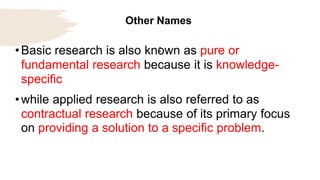
Other Names
:
•Basic research is also known as pure or
fundamental research because it is knowledge-
specific
•while applied research is also referred to as
contractual research because of its primary focus
on providing a solution to a specific problem.
Uses
• Basic research explores the functions and features of
newly discovered phenomena in order to improve the
understanding of these concepts hence; it fuels scientific
and technological innovations.
Uses
• Applied research, on the other hand, helps to
provide solutions to improve a specific condition or
create new technology.
Research Purpose
• Basic research is driven by curiosity and the need to explore
new areas of knowledge in different fields.
• On the other hand, applied research is driven by the need to
provide answers to specific questions in order to solve a
problem.
Scope of the Research
• applied research is more limited in scope when compared
to basic research.
• This is because unlike basic research that can be applied
to diverse concepts, applied research largely focuses on a
specific subject, and its research outcomes are primarily
relevant to this subject.
Theory Formulation
• Basic research aims at formulating theories that explain
research findings and in the process, improve a body of
knowledge
• while applied research aims at arriving at research findings
that can solve practical problems. Basic research focuses on
principles and theories while applied research focuses on
solutions.
Theory Formulation
• Typically, basic research aims at formulating theories and
generalizations that explain a concept, subject or
phenomenon and are universally applicable.
• On the other hand, applied research or conceptual
research studies empirical evidence in order to align its
findings with a specific problem.
Research Outcomes
• After carrying out applied research by testing the empirical
evidence, the researcher arrives at valid findings or conclusions
that confirm or negate the research hypotheses. These findings
typically answer the specific research questions, that is, the reason
for the applied research.
• On the other hand, at the endpoint of basic research lies new
theories, new dimensions to existing theories or new
information that improves on a body of knowledge. The
outcomes of basic research do not directly serve as
innovative solutions to a practical problem.
Research Approach
• Basic research is theoretical in nature while applied research is practical
in nature.
• In this sense, basic research generates theories and improves on
existing theories with the aim of contributing to an existing knowledge
bank.
• Applied research, on the other hand, is practical and more
descriptive in nature. It is more concerned with the utility and
value of research outcomes in terms of their end usage, that is,
how they can be used to solve existing problems and develop
innovations.

BASIC RESEARCH VS APPLIED RESEARCH.pptx

  • 1.
  • 2.
    Basic Research vs.Applied Research • Explain the characteristics of basic research. • Explain the characteristics of applied research. • Differentiate applied research with basic research. • Give the advantages and disadvantage of basic and applied research. Objectives:
  • 3.
    Review on thepast lesson Choosing a Research Topic Q and A: • What is the first step in choosing a research topic? Ans. Narrowing all possible topics • What is the last step in choosing a research topic? Ans. Topic narrowed to research questions.
  • 4.
    Topic: Basic Researchvs. Applied Research Advantages of Basic Research over Applied Research • Basic research results in the acquisition of new knowledge and it also expands existing knowledge while applied research does not lead to the acquisition of new knowledge. Applied research only focuses on applying knowledge to solve existing problems hence, it is solution-specific. Basic research seeks to advance the frontiers of knowledge by creating new theories or modifying existing ones. On the other hand, applied research is primarily concerned with creating solutions to problems by collecting and analyzing empirical data in order to arrive at valid research outcomes.
  • 5.
    Applied research isa research methodology that creates practical solutions for specific problems while basic research is an approach to research that seeks to expand knowledge in a field of study. This means that applied research is solution- driven while basic research is knowledge-specific. Advantages of Applied Research over Basic Research • Applied research helps organizations and individuals to solve specific problems, unlike basic research that is simply focused on expanding knowledge without providing solutions to existing problems. This, however, does not negate the fact that findings from basic research are useful to offer solutions to problems.
  • 6.
    • Unlike basicresearch which is somewhat subjective in its approach, applied research is an objective method of inquiry. • Typically, applied research is unbiased because it arrives at outcomes by subjecting empirical evidence to standardized scientific procedures and this makes it a more valid research method. • Empirical = realistic, practical, experimental • Scientific = systematic, logical, exact
  • 7.
    Examples of Researchin Education • In education, applied research is used to improve teaching and learning methods by providing practical solutions to pedagogic problems. • On the other hand, basic research is used in education to develop new pedagogic theories that explain different behaviors by teachers and students within the learning environment.
  • 8.
    Examples of basicresearch in education include: • How does the human memory work? • How do children acquire new languages? Examples of applied research in education include: • A study to build students' interests in religious studies. • A study to improve classroom interaction between teachers and students.
  • 9.
    Examples of basicresearch in health include: : • An investigation into the secondary symptoms of the Human Papilloma Virus (HPV). • An investigation into the symptoms of diarrhea. Examples of applied research in health include: • An investigation to determine the healing properties of mushrooms. • An investigation to determine the side effects of alcohol consumption.
  • 10.
    Other Names : •Basic researchis also known as pure or fundamental research because it is knowledge- specific •while applied research is also referred to as contractual research because of its primary focus on providing a solution to a specific problem.
  • 11.
    Uses • Basic researchexplores the functions and features of newly discovered phenomena in order to improve the understanding of these concepts hence; it fuels scientific and technological innovations.
  • 12.
    Uses • Applied research,on the other hand, helps to provide solutions to improve a specific condition or create new technology.
  • 13.
    Research Purpose • Basicresearch is driven by curiosity and the need to explore new areas of knowledge in different fields. • On the other hand, applied research is driven by the need to provide answers to specific questions in order to solve a problem.
  • 14.
    Scope of theResearch • applied research is more limited in scope when compared to basic research. • This is because unlike basic research that can be applied to diverse concepts, applied research largely focuses on a specific subject, and its research outcomes are primarily relevant to this subject.
  • 15.
    Theory Formulation • Basicresearch aims at formulating theories that explain research findings and in the process, improve a body of knowledge • while applied research aims at arriving at research findings that can solve practical problems. Basic research focuses on principles and theories while applied research focuses on solutions.
  • 16.
    Theory Formulation • Typically,basic research aims at formulating theories and generalizations that explain a concept, subject or phenomenon and are universally applicable. • On the other hand, applied research or conceptual research studies empirical evidence in order to align its findings with a specific problem.
  • 17.
    Research Outcomes • Aftercarrying out applied research by testing the empirical evidence, the researcher arrives at valid findings or conclusions that confirm or negate the research hypotheses. These findings typically answer the specific research questions, that is, the reason for the applied research. • On the other hand, at the endpoint of basic research lies new theories, new dimensions to existing theories or new information that improves on a body of knowledge. The outcomes of basic research do not directly serve as innovative solutions to a practical problem.
  • 18.
    Research Approach • Basicresearch is theoretical in nature while applied research is practical in nature. • In this sense, basic research generates theories and improves on existing theories with the aim of contributing to an existing knowledge bank. • Applied research, on the other hand, is practical and more descriptive in nature. It is more concerned with the utility and value of research outcomes in terms of their end usage, that is, how they can be used to solve existing problems and develop innovations.