PLATFORM
DECOMMISSIONING
Structural Integrity and Operability of Offshore
Platform
 Introduction
 Jacket Platform Decommissioning Method
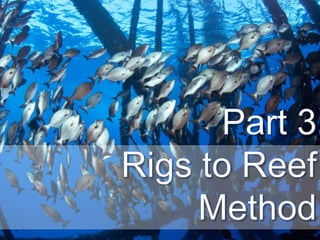
 Rig to Reef Method
Outline
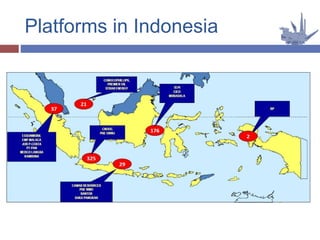
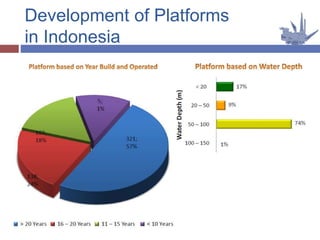
Platforms in Indonesia
Development of Platforms
in Indonesia
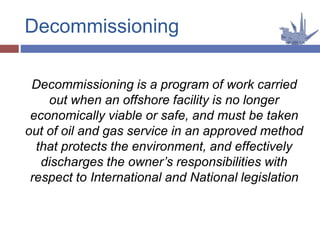
Decommissioning is a program of work carried
out when an offshore facility is no longer
economically viable or safe, and must be taken
out of oil and gas service in an approved method
that protects the environment, and effectively
discharges the owner’s responsibilities with
respect to International and National legislation
Decommissioning
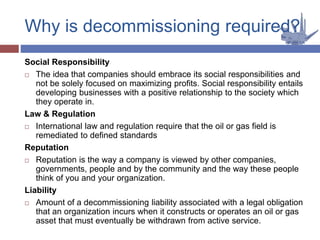
Social Responsibility
 The idea that companies should embrace its social responsibilities and
not be solely focused on maximizing profits. Social responsibility entails
developing businesses with a positive relationship to the society which
they operate in.
Law & Regulation
 International law and regulation require that the oil or gas field is
remediated to defined standards
Reputation
 Reputation is the way a company is viewed by other companies,
governments, people and by the community and the way these people
think of you and your organization.
Liability
 Amount of a decommissioning liability associated with a legal obligation
that an organization incurs when it constructs or operates an oil or gas
asset that must eventually be withdrawn from active service.
Why is decommissioning required?
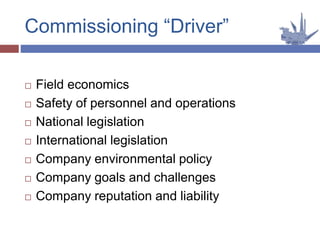
 Field economics
 Safety of personnel and operations
 National legislation
 International legislation
 Company environmental policy
 Company goals and challenges
 Company reputation and liability
Commissioning “Driver”
 UndangUndang No. 17 Tahun 1985 : United Nations
Convention on the Law of the Sea (UNCLOS) Ratification
 Undang UndangNo. 17 Tahun 2008 : Sea Voyage
(Pasal195)
 Peraturan Pemerintah No. 17 Tahun 1974 : Supervision of
Oil and Gas Exploration and Exploitation Activities in
Offshore
 Peraturan Menteri ESDM No. 01 Tahun 2011 : Technical
Guidelines for Abandonment of Oil and Gas Installation in
Offshore
 PM no. 71 Tahun 2013 : Salvage and/or Under Water
Activities
 PM No. 68 Tahun 2011 : Shipping Channels
Regulation on Safety Aspect
 Article 60 of UNCLOS & 1989 IMO Guidelines
 Any structure protruding the sea should be maintained to prevent
structural failure. If a structure is partially removed, an
unobstructed water column of not less than 55 meters should be
maintained
 All strucures in 100 meters water depth and weighing less than
4,000 tonnes, excluding topsides and decks, should be removed
 The London Convention 1972 & the 1996 Protocol
 All dumping at sea are banned except for a list of wastes for which
a permit may be sought from the host state. Man-made structures
are included on this list
 It is required that reuse or recycling to be considered ahead of
dumping, with the emphasis on minimizing the impact on
environement
Decommissioning Regulations
Applicable to the North Sea Region
 OSPAR (Oslo-Paris Commission) Decision 98/3 on the
Disposal of Disused Offshore Installations
 Dumping whole, or part, of a disused offshore structure in the
marine environment is forbidden. However, under certain
circumstances, the host state is allowed to consider granting a
derogation to leave all, or part, of a structure in place. This applies
to:
• Steel structures weighing more than 10,000 tonnes in air and were
installed before February 1999. Derogations may be granted for all, or part,
of the footings
• Gravity-based concrete installations
• Any other disused offshore structure, which has suffered unforeseen
structural damage or deterioration to an extent that its removal represents
equivalent difficulties
 Cutting Activity: No explosive use on 3 meter below seabed
Decommissioning Regulations
Applicable to the North Sea Region
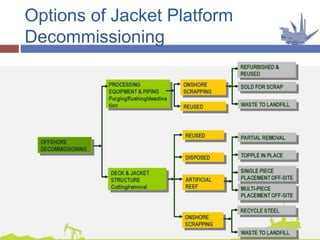
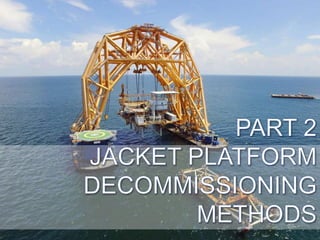
Options of Jacket Platform
Decommissioning
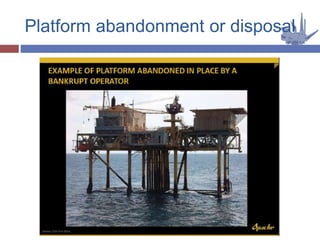
Platform abandonment or disposal
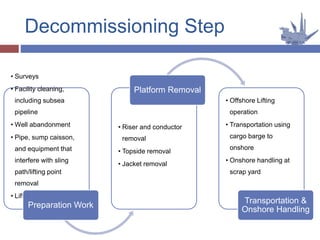
Decommissioning Step
• Surveys
• Facility cleaning,
including subsea
pipeline
• Well abandonment
• Pipe, sump caisson,
and equipment that
interfere with sling
path/lifting point
removal
• Lifting point installation
Preparation Work
• Riser and conductor
removal
• Topside removal
• Jacket removal
Platform Removal
• Offshore Lifting
operation
• Transportation using
cargo barge to
onshore
• Onshore handling at
scrap yard
Transportation &
Onshore Handling
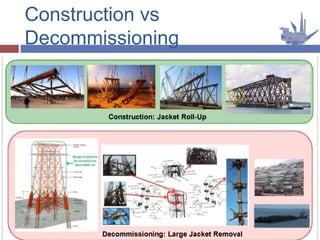
Construction vs
Decommissioning
 Decommissioning is NOT the reverse of
installation
 95% of installations were NOT designed for
decommissioning
“Decommissioning is times more difficult than
installation”
PREPARATION WORK
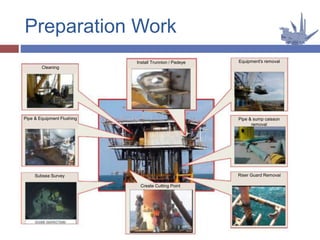
Preparation Work
Cleaning
Pipe & Equipment Flushing
Subsea Survey
Install Trunnion / Padeye
Create Cutting Point
Pipe & sump caisson
removal
Equipment's removal
Riser Guard Removal
Preparation Work
1. Cleaning and Flushing:
 Venting and draining all of hydrocarbon gas and liquid, flushing with seawater
 Pipelines flushing and pigging
2. Topside preparation:
 Existing pad eye NDT
 Removal of loosen pipes & equipment
 Gussets installation on topside leg cutting points
 Access for lifting gear (making top deck opening)
 Permanent working deck around jacket leg (access platform during topside leg cutting, as well as
internal pile dredging and pile internal cutting)
 Drifting operations on inner string of each conductors to ensure clear access of internal abrasive
cutter (IMCT)
3. Subsea preparation:
 Cutting points survey, marine growth removal at certain area (cutting point, conductor slot, existing
pad eyes)
 Pipeline risers removal, sump caissons removal, pull tubes removal, other pump caissons removal
(fire water, jockey)
 Pre-installed jacket clamp at below cutting point
PLATFORM REMOVAL
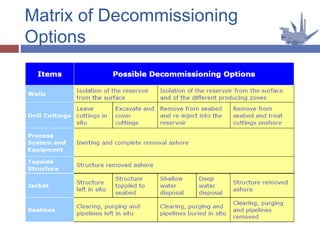
Matrix of Decommissioning
Options
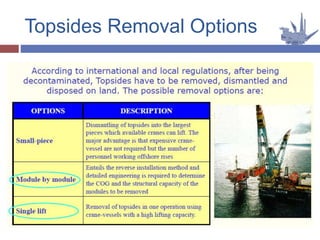
Topsides Removal Options
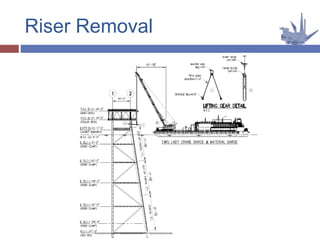
Riser Removal
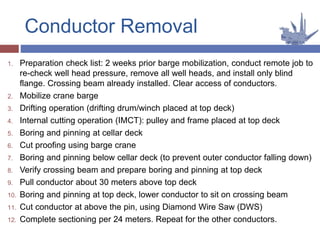
1. Preparation check list: 2 weeks prior barge mobilization, conduct remote job to
re-check well head pressure, remove all well heads, and install only blind
flange. Crossing beam already installed. Clear access of conductors.
2. Mobilize crane barge
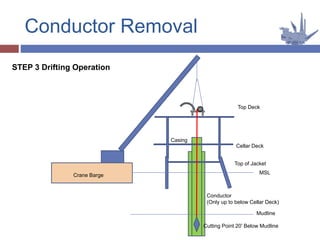
3. Drifting operation (drifting drum/winch placed at top deck)
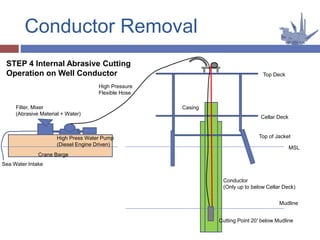
4. Internal cutting operation (IMCT): pulley and frame placed at top deck
5. Boring and pinning at cellar deck
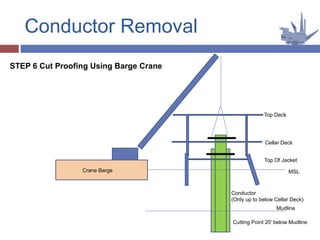
6. Cut proofing using barge crane
7. Boring and pinning below cellar deck (to prevent outer conductor falling down)
8. Verify crossing beam and prepare boring and pinning at top deck
9. Pull conductor about 30 meters above top deck
10. Boring and pinning at top deck, lower conductor to sit on crossing beam
11. Cut conductor at above the pin, using Diamond Wire Saw (DWS)
12. Complete sectioning per 24 meters. Repeat for the other conductors.
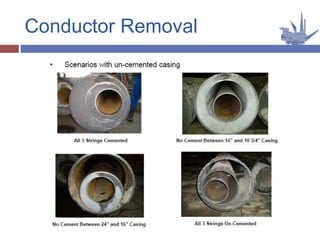
Conductor Removal
Conductor Removal
MSL
Top Deck
Cellar Deck
Top of Jacket
Mudline
Cutting Point 20’ Below Mudline
Crane Barge
Conductor
(Only up to below Cellar Deck)
Casing
STEP 3 Drifting Operation
Conductor Removal
MSL
Top Deck
Cellar Deck
Top of Jacket
Mudline
Cutting Point 20’ below Mudline
Filter, Mixer
(Abrasive Material + Water)
High Press Water Pump
(Diesel Engine Driven)
Crane Barge
Sea Water Intake
High Pressure
Flexible Hose
Conductor
(Only up to below Cellar Deck)
Casing
STEP 4 Internal Abrasive Cutting
Operation on Well Conductor
Conductor Removal
MSL
Top Deck
Cellar Deck
Top Of Jacket
Mudline
Cutting Point 20’ below Mudline
Crane Barge
Conductor
(Only up to below Cellar Deck)
STEP 6 Cut Proofing Using Barge Crane
Conductor Removal
1. Preparation check list prior to mobilization: access for
rigging, gussets installed
2. Lifting gear set-up on existing pad eyes below top
deck
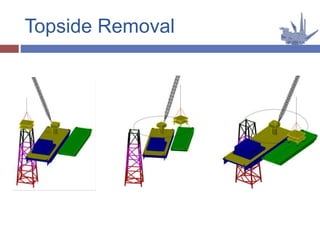
3. Cut topside legs at transition pipe (above crown)
4. Lift and place topside onto cargo barge
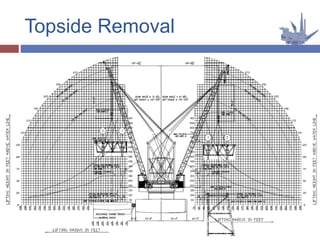
Topside Removal
Topside Removal
Topside Removal
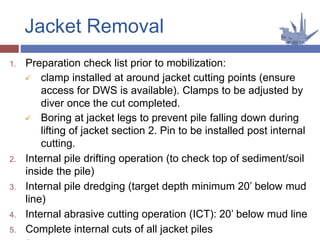
1. Preparation check list prior to mobilization:
 clamp installed at around jacket cutting points (ensure
access for DWS is available). Clamps to be adjusted by
diver once the cut completed.
 Boring at jacket legs to prevent pile falling down during
lifting of jacket section 2. Pin to be installed post internal
cutting.
2. Internal pile drifting operation (to check top of sediment/soil
inside the pile)
3. Internal pile dredging (target depth minimum 20’ below mud
line)
4. Internal abrasive cutting operation (ICT): 20’ below mud line
5. Complete internal cuts of all jacket piles
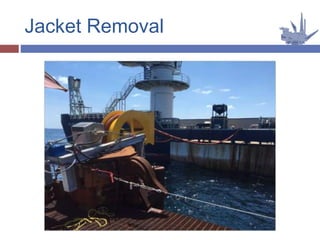
Jacket Removal
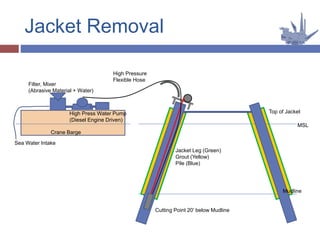
Jacket Removal
MSL
Top of Jacket
Mudline
Cutting Point 20’ below Mudline
Filter, Mixer
(Abrasive Material + Water)
High Press Water Pump
(Diesel Engine Driven)
Crane Barge
Sea Water Intake
High Pressure
Flexible Hose
Jacket Leg (Green)
Grout (Yellow)
Pile (Blue)
Jacket Removal
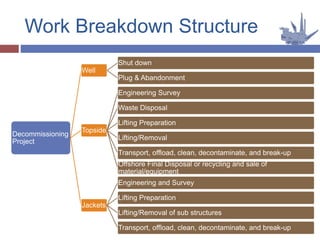
Work Breakdown Structure
Decommissioning
Project
Well
Shut down
Plug & Abandonment
Topside
Engineering Survey
Waste Disposal
Lifting Preparation
Lifting/Removal
Transport, offload, clean, decontaminate, and break-up
Offshore Final Disposal or recycling and sale of
material/equipment
Jackets
Engineering and Survey
Lifting Preparation
Lifting/Removal of sub structures
Transport, offload, clean, decontaminate, and break-up
TRANSPORTATION & ONSHORE
HANDLING
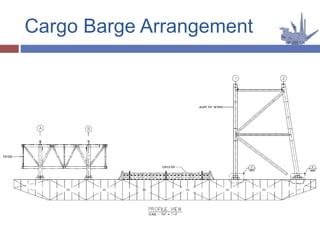
Cargo Barge Arrangement
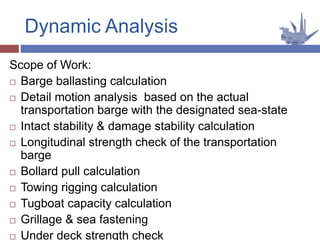
Scope of Work:
 Barge ballasting calculation
 Detail motion analysis based on the actual
transportation barge with the designated sea-state
 Intact stability & damage stability calculation
 Longitudinal strength check of the transportation
barge
 Bollard pull calculation
 Towing rigging calculation
 Tugboat capacity calculation
 Grillage & sea fastening
 Under deck strength check
Dynamic Analysis
The Case for Rig-to-Reef in
Southeast Asia
The facts:
 40% marine biodiversity in SEA seas under high
endemic threats (human and natural)
 Destroyed habitats but highly productive systems
 Removal platform = removal reef associated
community
 Proof of production of new fish communities develop
(not only attraction)
 Also potential pathway for alien species
Source: Offshore Decommissioning in Southeast Asia and the opportunity for Rig-to-R
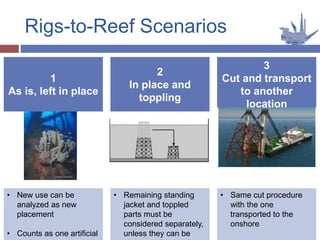
Rigs-to-Reef Scenarios
1
As is, left in place
2
In place and
toppling
3
Cut and transport
to another
location
• New use can be
analyzed as new
placement
• Counts as one artificial
• Remaining standing
jacket and toppled
parts must be
considered separately,
unless they can be
• Same cut procedure
with the one
transported to the
onshore
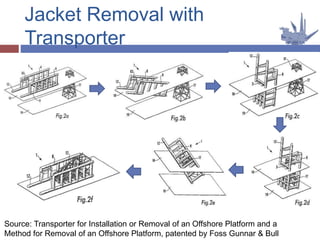
Jacket Removal with
Transporter
Source: Transporter for Installation or Removal of an Offshore Platform and a
Method for Removal of an Offshore Platform, patented by Foss Gunnar & Bull
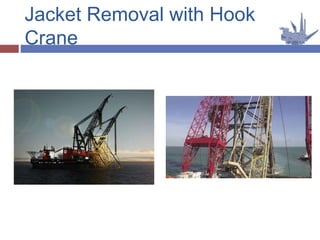
Jacket Removal with Hook
Crane
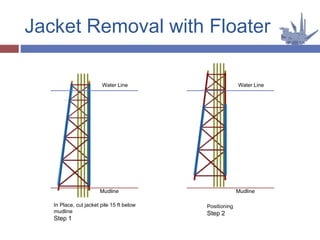
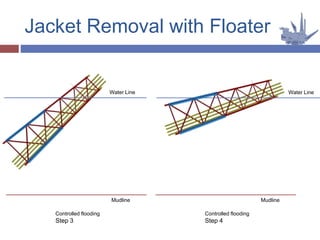
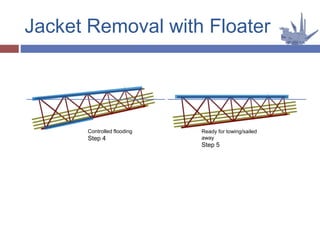
Jacket Removal with Floater
Water Line
Mudline
In Place, cut jacket pile 15 ft below
mudline
Step 1
Water Line
Mudline
Positioning
Step 2
Jacket Removal with Floater
Water Line
Mudline
Controlled flooding
Step 3
Water Line
Mudline
Controlled flooding
Step 4
Jacket Removal with Floater
Controlled flooding
Step 4
Ready for towing/sailed
away
Step 5
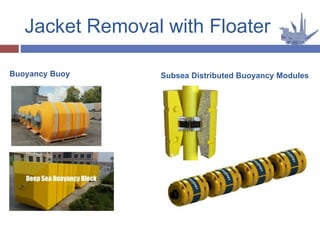
Jacket Removal with Floater
Buoyancy Buoy Subsea Distributed Buoyancy Modules

Platform Decommissioning.pptx
  • 1.
    PLATFORM DECOMMISSIONING Structural Integrity andOperability of Offshore Platform
  • 2.
     Introduction  JacketPlatform Decommissioning Method  Rig to Reef Method Outline
  • 4.
  • 5.
  • 6.
    Decommissioning is aprogram of work carried out when an offshore facility is no longer economically viable or safe, and must be taken out of oil and gas service in an approved method that protects the environment, and effectively discharges the owner’s responsibilities with respect to International and National legislation Decommissioning
  • 7.
    Social Responsibility  Theidea that companies should embrace its social responsibilities and not be solely focused on maximizing profits. Social responsibility entails developing businesses with a positive relationship to the society which they operate in. Law & Regulation  International law and regulation require that the oil or gas field is remediated to defined standards Reputation  Reputation is the way a company is viewed by other companies, governments, people and by the community and the way these people think of you and your organization. Liability  Amount of a decommissioning liability associated with a legal obligation that an organization incurs when it constructs or operates an oil or gas asset that must eventually be withdrawn from active service. Why is decommissioning required?
  • 8.
     Field economics Safety of personnel and operations  National legislation  International legislation  Company environmental policy  Company goals and challenges  Company reputation and liability Commissioning “Driver”
  • 9.
     UndangUndang No.17 Tahun 1985 : United Nations Convention on the Law of the Sea (UNCLOS) Ratification  Undang UndangNo. 17 Tahun 2008 : Sea Voyage (Pasal195)  Peraturan Pemerintah No. 17 Tahun 1974 : Supervision of Oil and Gas Exploration and Exploitation Activities in Offshore  Peraturan Menteri ESDM No. 01 Tahun 2011 : Technical Guidelines for Abandonment of Oil and Gas Installation in Offshore  PM no. 71 Tahun 2013 : Salvage and/or Under Water Activities  PM No. 68 Tahun 2011 : Shipping Channels Regulation on Safety Aspect
  • 10.
     Article 60of UNCLOS & 1989 IMO Guidelines  Any structure protruding the sea should be maintained to prevent structural failure. If a structure is partially removed, an unobstructed water column of not less than 55 meters should be maintained  All strucures in 100 meters water depth and weighing less than 4,000 tonnes, excluding topsides and decks, should be removed  The London Convention 1972 & the 1996 Protocol  All dumping at sea are banned except for a list of wastes for which a permit may be sought from the host state. Man-made structures are included on this list  It is required that reuse or recycling to be considered ahead of dumping, with the emphasis on minimizing the impact on environement Decommissioning Regulations Applicable to the North Sea Region
  • 11.
     OSPAR (Oslo-ParisCommission) Decision 98/3 on the Disposal of Disused Offshore Installations  Dumping whole, or part, of a disused offshore structure in the marine environment is forbidden. However, under certain circumstances, the host state is allowed to consider granting a derogation to leave all, or part, of a structure in place. This applies to: • Steel structures weighing more than 10,000 tonnes in air and were installed before February 1999. Derogations may be granted for all, or part, of the footings • Gravity-based concrete installations • Any other disused offshore structure, which has suffered unforeseen structural damage or deterioration to an extent that its removal represents equivalent difficulties  Cutting Activity: No explosive use on 3 meter below seabed Decommissioning Regulations Applicable to the North Sea Region
  • 12.
    Options of JacketPlatform Decommissioning
  • 13.
  • 15.
    Decommissioning Step • Surveys •Facility cleaning, including subsea pipeline • Well abandonment • Pipe, sump caisson, and equipment that interfere with sling path/lifting point removal • Lifting point installation Preparation Work • Riser and conductor removal • Topside removal • Jacket removal Platform Removal • Offshore Lifting operation • Transportation using cargo barge to onshore • Onshore handling at scrap yard Transportation & Onshore Handling
  • 16.
  • 17.
     Decommissioning isNOT the reverse of installation  95% of installations were NOT designed for decommissioning “Decommissioning is times more difficult than installation”
  • 18.
  • 19.
    Preparation Work Cleaning Pipe &Equipment Flushing Subsea Survey Install Trunnion / Padeye Create Cutting Point Pipe & sump caisson removal Equipment's removal Riser Guard Removal
  • 20.
    Preparation Work 1. Cleaningand Flushing:  Venting and draining all of hydrocarbon gas and liquid, flushing with seawater  Pipelines flushing and pigging 2. Topside preparation:  Existing pad eye NDT  Removal of loosen pipes & equipment  Gussets installation on topside leg cutting points  Access for lifting gear (making top deck opening)  Permanent working deck around jacket leg (access platform during topside leg cutting, as well as internal pile dredging and pile internal cutting)  Drifting operations on inner string of each conductors to ensure clear access of internal abrasive cutter (IMCT) 3. Subsea preparation:  Cutting points survey, marine growth removal at certain area (cutting point, conductor slot, existing pad eyes)  Pipeline risers removal, sump caissons removal, pull tubes removal, other pump caissons removal (fire water, jockey)  Pre-installed jacket clamp at below cutting point
  • 21.
  • 22.
  • 23.
  • 24.
  • 25.
    1. Preparation checklist: 2 weeks prior barge mobilization, conduct remote job to re-check well head pressure, remove all well heads, and install only blind flange. Crossing beam already installed. Clear access of conductors. 2. Mobilize crane barge 3. Drifting operation (drifting drum/winch placed at top deck) 4. Internal cutting operation (IMCT): pulley and frame placed at top deck 5. Boring and pinning at cellar deck 6. Cut proofing using barge crane 7. Boring and pinning below cellar deck (to prevent outer conductor falling down) 8. Verify crossing beam and prepare boring and pinning at top deck 9. Pull conductor about 30 meters above top deck 10. Boring and pinning at top deck, lower conductor to sit on crossing beam 11. Cut conductor at above the pin, using Diamond Wire Saw (DWS) 12. Complete sectioning per 24 meters. Repeat for the other conductors. Conductor Removal
  • 26.
    Conductor Removal MSL Top Deck CellarDeck Top of Jacket Mudline Cutting Point 20’ Below Mudline Crane Barge Conductor (Only up to below Cellar Deck) Casing STEP 3 Drifting Operation
  • 27.
    Conductor Removal MSL Top Deck CellarDeck Top of Jacket Mudline Cutting Point 20’ below Mudline Filter, Mixer (Abrasive Material + Water) High Press Water Pump (Diesel Engine Driven) Crane Barge Sea Water Intake High Pressure Flexible Hose Conductor (Only up to below Cellar Deck) Casing STEP 4 Internal Abrasive Cutting Operation on Well Conductor
  • 28.
    Conductor Removal MSL Top Deck CellarDeck Top Of Jacket Mudline Cutting Point 20’ below Mudline Crane Barge Conductor (Only up to below Cellar Deck) STEP 6 Cut Proofing Using Barge Crane
  • 29.
  • 30.
    1. Preparation checklist prior to mobilization: access for rigging, gussets installed 2. Lifting gear set-up on existing pad eyes below top deck 3. Cut topside legs at transition pipe (above crown) 4. Lift and place topside onto cargo barge Topside Removal
  • 31.
  • 32.
  • 33.
    1. Preparation checklist prior to mobilization:  clamp installed at around jacket cutting points (ensure access for DWS is available). Clamps to be adjusted by diver once the cut completed.  Boring at jacket legs to prevent pile falling down during lifting of jacket section 2. Pin to be installed post internal cutting. 2. Internal pile drifting operation (to check top of sediment/soil inside the pile) 3. Internal pile dredging (target depth minimum 20’ below mud line) 4. Internal abrasive cutting operation (ICT): 20’ below mud line 5. Complete internal cuts of all jacket piles Jacket Removal
  • 34.
    Jacket Removal MSL Top ofJacket Mudline Cutting Point 20’ below Mudline Filter, Mixer (Abrasive Material + Water) High Press Water Pump (Diesel Engine Driven) Crane Barge Sea Water Intake High Pressure Flexible Hose Jacket Leg (Green) Grout (Yellow) Pile (Blue)
  • 35.
  • 36.
    Work Breakdown Structure Decommissioning Project Well Shutdown Plug & Abandonment Topside Engineering Survey Waste Disposal Lifting Preparation Lifting/Removal Transport, offload, clean, decontaminate, and break-up Offshore Final Disposal or recycling and sale of material/equipment Jackets Engineering and Survey Lifting Preparation Lifting/Removal of sub structures Transport, offload, clean, decontaminate, and break-up
  • 37.
  • 38.
  • 39.
    Scope of Work: Barge ballasting calculation  Detail motion analysis based on the actual transportation barge with the designated sea-state  Intact stability & damage stability calculation  Longitudinal strength check of the transportation barge  Bollard pull calculation  Towing rigging calculation  Tugboat capacity calculation  Grillage & sea fastening  Under deck strength check Dynamic Analysis
  • 41.
    The Case forRig-to-Reef in Southeast Asia The facts:  40% marine biodiversity in SEA seas under high endemic threats (human and natural)  Destroyed habitats but highly productive systems  Removal platform = removal reef associated community  Proof of production of new fish communities develop (not only attraction)  Also potential pathway for alien species Source: Offshore Decommissioning in Southeast Asia and the opportunity for Rig-to-R
  • 42.
    Rigs-to-Reef Scenarios 1 As is,left in place 2 In place and toppling 3 Cut and transport to another location • New use can be analyzed as new placement • Counts as one artificial • Remaining standing jacket and toppled parts must be considered separately, unless they can be • Same cut procedure with the one transported to the onshore
  • 43.
    Jacket Removal with Transporter Source:Transporter for Installation or Removal of an Offshore Platform and a Method for Removal of an Offshore Platform, patented by Foss Gunnar & Bull
  • 44.
  • 45.
    Jacket Removal withFloater Water Line Mudline In Place, cut jacket pile 15 ft below mudline Step 1 Water Line Mudline Positioning Step 2
  • 46.
    Jacket Removal withFloater Water Line Mudline Controlled flooding Step 3 Water Line Mudline Controlled flooding Step 4
  • 47.
    Jacket Removal withFloater Controlled flooding Step 4 Ready for towing/sailed away Step 5
  • 48.
    Jacket Removal withFloater Buoyancy Buoy Subsea Distributed Buoyancy Modules