Data Communication
Topics We are covering
What is Data Communication?
Types & Characteristics of Data Communication.
Components of Data Communication
Computer Networks
Transmission Medium
Singnuching Marma
ID: 171-15-9366
What is Data Communication?
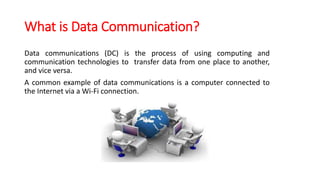
Data communications (DC) is the process of using computing and
communication technologies to transfer data from one place to another,
and vice versa.
A common example of data communications is a computer connected to
the Internet via a Wi-Fi connection.
Types of Data Communication
Two types of data communication:
 Local: If the communicating devices are in same place.
 Remote: If the devices are farther apart.
Fundamental Characteristics
Delivery: The system must deliver data to the correct destination. Data must
be received by the intended device or user and only by that device or user.
Accuracy: The system must deliver the data accurately. Data that have been
altered in transmission and left uncorrected are unusable.
Timeliness: The system must deliver data in a timely manner. Data delivered
late are useless.
Components of Data
Communication
Ashraful Alam
171-15-9363
There are 5 components in Data
Communication.
• The message
• The sender
• The receiver
• Transmission media
• Protocol
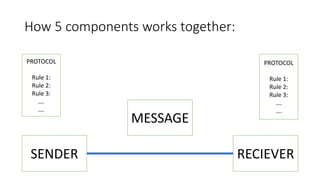
How 5 components works together:
MESSAGE
SENDER RECIEVER
PROTOCOL
Rule 1:
Rule 2:
Rule 3:
….
….
PROTOCOL
Rule 1:
Rule 2:
Rule 3:
….
….
1: THE MESSAGE
• This is the information (Data) to be communicated.
• Can be an image, text, audio, video.
2: THE SENDER
• The sender is device or person that sends the data.
• It can be sent using a computer, telephone or camera.
3: THE RECIEVER
• The receiver is device or person that receives the data.
• It can be received using a telephone, computer or television.
4: TRANSMISSION MEDIA
• This is the physical path by which massage travel from
source to destination.
• Example: Twisted pair, Coaxial cable, Fiber optic, Radio
waves.
• A protocol is set of rules that govern data communication.
• It provides agreement between sender and receiver devices.
5: PROTOCOL
Anik Das
ID: 171-15-9378
Computer Network
Transmission Medium
by
Shahriar tasjid Araf
171-15-9384
Transmission Medium
• Located below Physical Layer
• Directly controlled by Physical Layer
• Pathway for carrying information
• It can be twisted cable, fiber optics, radio waves etc.
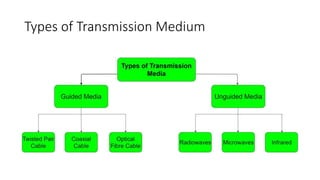
Types of Transmission Medium
Fiber Optic Cable
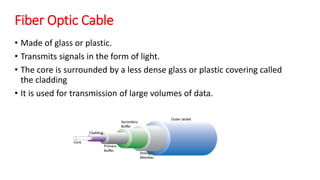
• Made of glass or plastic.
• Transmits signals in the form of light.
• The core is surrounded by a less dense glass or plastic covering called
the cladding
• It is used for transmission of large volumes of data.
Advantage of Fiber Optic Cable
• Higher Bandwidth
• Less signal attenuation
• Immunity to electromagnetic interference
• Light weight
• Resistance to corrosive material
• We can transfer data at a rate of 1600gbps
• It can be used in cable television, telephone, internet, computer
networking, military and space applications.
WE are at the END
Thanks For Your Time

Basic of Data Communication

  • 1.
  • 2.
    Topics We arecovering What is Data Communication? Types & Characteristics of Data Communication. Components of Data Communication Computer Networks Transmission Medium
  • 3.
  • 4.
    What is DataCommunication? Data communications (DC) is the process of using computing and communication technologies to transfer data from one place to another, and vice versa. A common example of data communications is a computer connected to the Internet via a Wi-Fi connection.
  • 5.
    Types of DataCommunication Two types of data communication:  Local: If the communicating devices are in same place.  Remote: If the devices are farther apart.
  • 6.
    Fundamental Characteristics Delivery: Thesystem must deliver data to the correct destination. Data must be received by the intended device or user and only by that device or user. Accuracy: The system must deliver the data accurately. Data that have been altered in transmission and left uncorrected are unusable. Timeliness: The system must deliver data in a timely manner. Data delivered late are useless.
  • 7.
  • 8.
    There are 5components in Data Communication. • The message • The sender • The receiver • Transmission media • Protocol
  • 9.
    How 5 componentsworks together: MESSAGE SENDER RECIEVER PROTOCOL Rule 1: Rule 2: Rule 3: …. …. PROTOCOL Rule 1: Rule 2: Rule 3: …. ….
  • 10.
    1: THE MESSAGE •This is the information (Data) to be communicated. • Can be an image, text, audio, video. 2: THE SENDER • The sender is device or person that sends the data. • It can be sent using a computer, telephone or camera. 3: THE RECIEVER • The receiver is device or person that receives the data. • It can be received using a telephone, computer or television.
  • 11.
    4: TRANSMISSION MEDIA •This is the physical path by which massage travel from source to destination. • Example: Twisted pair, Coaxial cable, Fiber optic, Radio waves. • A protocol is set of rules that govern data communication. • It provides agreement between sender and receiver devices. 5: PROTOCOL
  • 12.
  • 13.
  • 14.
  • 15.
    Transmission Medium • Locatedbelow Physical Layer • Directly controlled by Physical Layer • Pathway for carrying information • It can be twisted cable, fiber optics, radio waves etc.
  • 16.
  • 17.
    Fiber Optic Cable •Made of glass or plastic. • Transmits signals in the form of light. • The core is surrounded by a less dense glass or plastic covering called the cladding • It is used for transmission of large volumes of data.
  • 18.
    Advantage of FiberOptic Cable • Higher Bandwidth • Less signal attenuation • Immunity to electromagnetic interference • Light weight • Resistance to corrosive material • We can transfer data at a rate of 1600gbps • It can be used in cable television, telephone, internet, computer networking, military and space applications.
  • 19.
    WE are atthe END Thanks For Your Time