Why Ultrasound?
Appropriate use is helpful in obstetric practice, especially in gestational age estimation, fetal growth monitoring,
obstetric hemorrhage, and anomaly screening

Indicated or Routine Ultrasound?
•

Generally well accepted for examination with indication

•

Routine screening at 18-20 weeks, recent more common practice, better or earlier diagnosis of GA,
twins or anomaly but significant increase in cost and workload

•

The policy must be considered for cost-effectiveness and cost-benefit

Common Indications
1.

Diagnosis: pregnancy, number of fetuses, fetal life

2.

Size inconsistent with date: multiple pregnancy, oligo-, polyhydramnios, hydrocephalus, fetal growth
restriction

3.

Estimate gestational age

4.

Growth monitoring

5.

Bleeding: abortion, placenta previa, placental abrutpion

6.

Amniotic fluid evaluation

7.

Pathology in the pelvis

8.

Anomaly screening: Routine at 18-20 wk or pregnancy at risk (maternal DM, familial history,advanced
maternal age)

9.

Guidance for invasive procedures, i.e. amniocentesis, cordocentesis

Sonoembryology
Early Fetal Development
(Transvaginal Sonography; TVS)
•

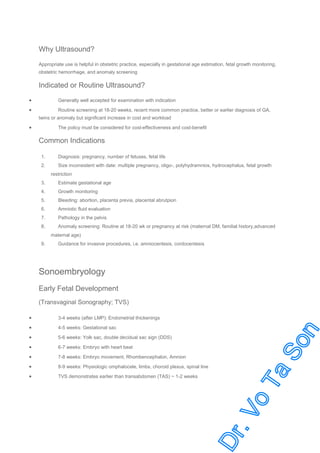
3-4 weeks (after LMP): Endometrial thickenings

•

4-5 weeks: Gestational sac

•

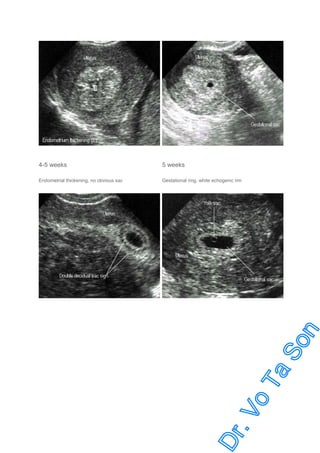
5-6 weeks: Yolk sac, double decidual sac sign (DDS)

•

6-7 weeks: Embryo with heart beat

•

7-8 weeks: Embryo movement, Rhombencephalon, Amnion

•

8-9 weeks: Physiologic omphalocele, limbs, choroid plexus, spinal line

•

TVS demonstrates earlier than transabdomen (TAS) ~ 1-2 weeks
4-5 weeks

5 weeks

Endometrial thickening, no obvious sac

Gestational ring, white echogenic rim
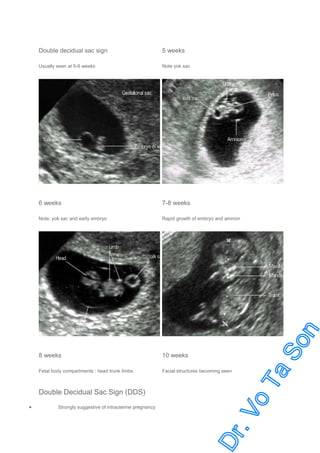
Double decidual sac sign

5 weeks

Usually seen at 5-6 weeks

Note yok sac

6 weeks

7-8 weeks

Note: yok sac and early embryo

Rapid growth of embryo and amnion

8 weeks

10 weeks

Fetal body compartments : head trunk limbs

Facial structures becoming seen

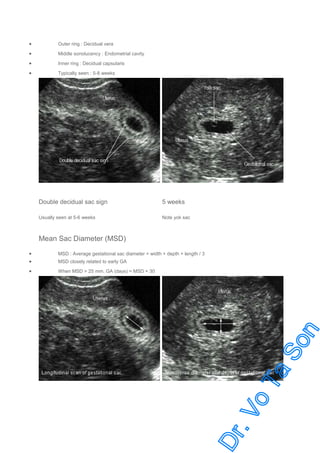
Double Decidual Sac Sign (DDS)
•

Strongly suggestive of intrauterine pregnancy
•

Outer ring : Decidual vera

•

Middle sonolucency : Endometrial cavity

•

Inner ring : Decidual capsularis

•

Typically seen : 5-8 weeks

Double decidual sac sign

5 weeks

Usually seen at 5-6 weeks

Note yok sac

Mean Sac Diameter (MSD)
•
•

MSD : Average gestational sac diameter = width + depth + length / 3

•

When MSD > 25 mm. GA (days) = MSD + 30

MSD closely related to early GA
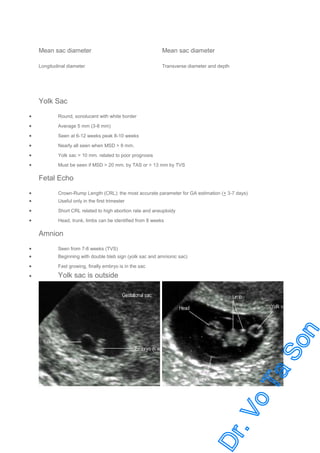
Mean sac diameter

Mean sac diameter

Longitudinal diameter

Transverse diameter and depth

Yolk Sac
•

Round, sonolucent with white border

•

Average 5 mm (3-8 mm)

•

Seen at 6-12 weeks peak 8-10 weeks

•

Nearly all seen when MSD > 8 mm.

•

Yolk sac > 10 mm. related to poor prognosis

•

Must be seen if MSD > 20 mm. by TAS or > 13 mm by TVS

Fetal Echo
•
•

Crown-Rump Length (CRL): the most accurate parameter for GA estimation (+ 3-7 days)

•

Short CRL related to high abortion rate and aneuploidy

•

Head, trunk, limbs can be identified from 8 weeks

Useful only in the first trimester

Amnion
•
•

Seen from 7-8 weeks (TVS)

•

Fast growing, finally embryo is in the sac

•

Yolk sac is outside

Beginning with double bleb sign (yolk sac and amnionic sac)
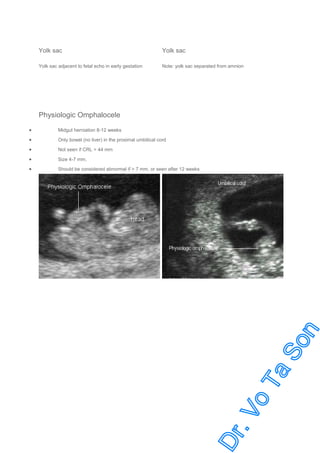
Yolk sac

Yolk sac

Yolk sac adjacent to fetal echo in early gestation

Note: yolk sac separated from amnion

Physiologic Omphalocele
•

Midgut herniation 8-12 weeks

•

Only bowel (no liver) in the proximal umbilical cord

•

Not seen if CRL > 44 mm

•

Size 4-7 mm.

•

Should be considered abnormal if > 7 mm, or seen after 12 weeks
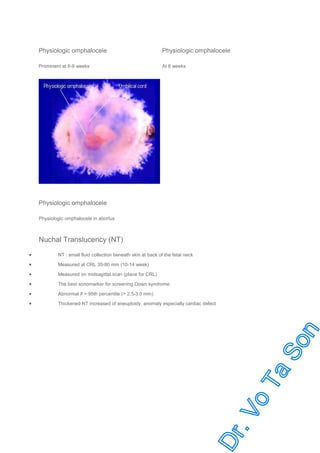
Physiologic omphalocele

Physiologic omphalocele

Prominent at 8-9 weeks

At 8 weeks

Physiologic omphalocele
Physiologic omphalocele in abortus

Nuchal Translucency (NT)
•

NT : small fluid collection beneath skin at back of the fetal neck

•

Measured at CRL 35-80 mm (10-14 week)

•

Measured on midsagittal scan (plane for CRL)

•

The best sonomarker for screening Down syndrome

•

Abnormal if > 95th percentile (> 2.5-3.0 mm)

•

Thickened NT increased of aneuploidy, anomaly especially cardiac defect
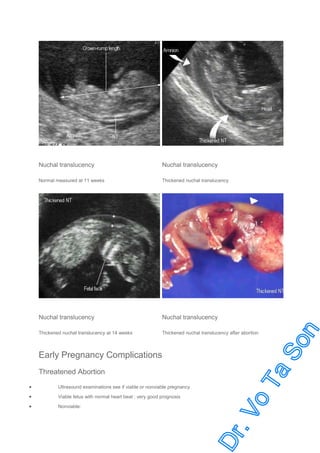
Nuchal translucency

Nuchal translucency

Normal measured at 11 weeks

Thickened nuchal translucency

Nuchal translucency

Nuchal translucency

Thickened nuchal translucency at 14 weeks

Thickened nuchal translucency after abortion

Early Pregnancy Complications
Threatened Abortion
•

Ultrasound examinations see if viable or nonviable pregnancy

•

Viable fetus with normal heart beat : very good prognosis

•

Nonviable:
o

blighted ovum

o

missed / incomplete abortion

o

fetal death

o

ectopic pregnancy

o

molar pregnancy

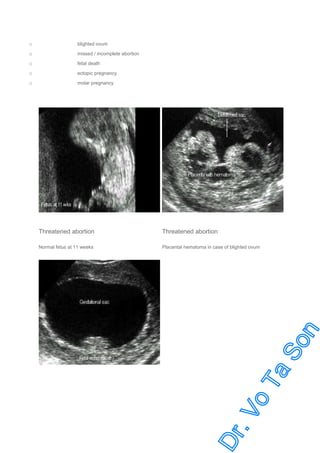
Threatened abortion

Threatened abortion

Normal fetus at 11 weeks

Placental hematoma in case of blighted ovum
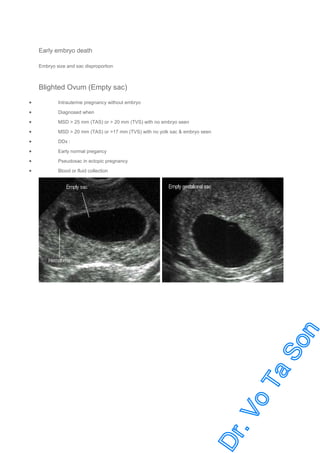
Early embryo death
Embryo size and sac disproportion

Blighted Ovum (Empty sac)
•

Intrauterine pregnancy without embryo

•

Diagnosed when

•

MSD > 25 mm (TAS) or > 20 mm (TVS) with no embryo seen

•

MSD > 20 mm (TAS) or >17 mm (TVS) with no yolk sac & embryo seen

•

DDx :

•

Early normal pregancy

•

Pseudosac in ectopic pregnancy

•

Blood or fluid collection
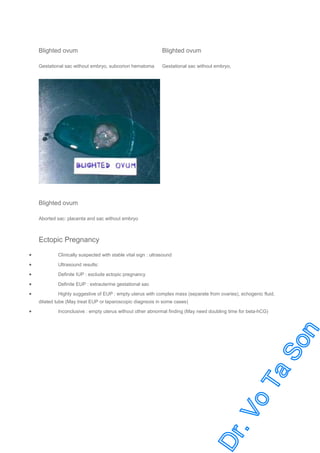
Blighted ovum

Blighted ovum

Gestational sac without embryo, subcorion hematoma

Gestational sac without embryo,

Blighted ovum
Aborted sac: placenta and sac without embryo

Ectopic Pregnancy
•

Clinically suspected with stable vital sign : ultrasound

•

Ultrasound results:

•

Definite IUP : exclude ectopic pregnancy

•

Definite EUP : extrauterine gestational sac

•

Highly suggestive of EUP : empty uterus with complex mass (separate from ovaries), echogenic fluid,
dilated tube (May treat EUP or laparoscopic diagnsois in some cases)

•

Inconclusive : empty uterus without other abnormal finding (May need doubling time for beta-hCG)
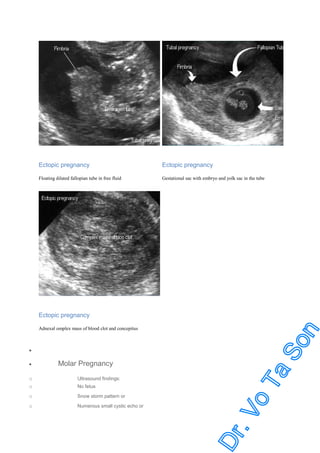
Ectopic pregnancy

Ectopic pregnancy

Floating dilated fallopian tube in free fluid

Gestational sac with embryo and yolk sac in the tube

Ectopic pregnancy
Adnexal omplex mass of blood clot and concepitus

•
•

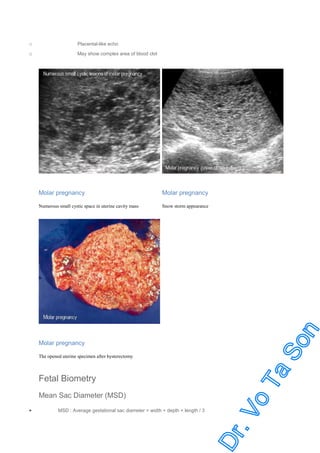
Molar Pregnancy

o
o

Ultrasound findings:

o

Snow storm pattern or

o

Numerous small cystic echo or

No fetus
o

Placental-like echo

o

May show complex area of blood clot

Molar pregnancy

Molar pregnancy

Numerous small cystic space in uterine cavity mass

Snow storm appearance

Molar pregnancy
The opened uterine specimen after hysterectomy

Fetal Biometry
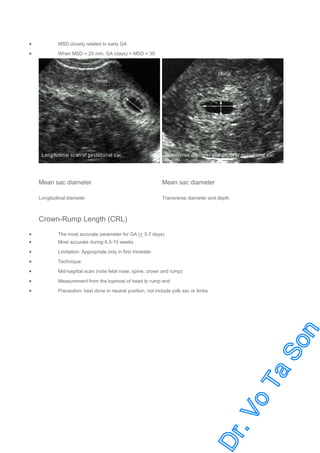
Mean Sac Diameter (MSD)
•

MSD : Average gestational sac diameter = width + depth + length / 3
•

MSD closely related to early GA

•

When MSD > 25 mm. GA (days) = MSD + 30

Mean sac diameter

Mean sac diameter

Longitudinal diameter

Transverse diameter and depth

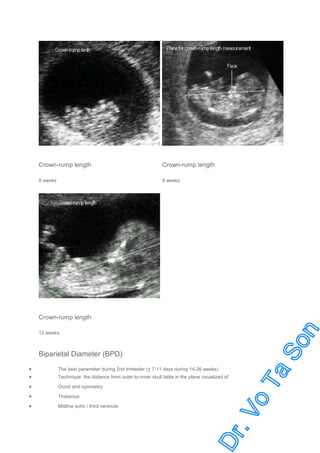
Crown-Rump Length (CRL)
•
•

The most accurate parameter for GA (+ 3-7 days)

•

Limitation: Appropriate only in first trimester

•

Technique:

•

Mid-sagittal scan (note fetal nose, spine, crown and rump)

•

Measurement from the topmost of head to rump end

•

Precaution: best done in neutral position, not include yolk sac or limbs

Most accurate during 6.5-10 weeks
Crown-rump length

Crown-rump length

8 weeks

9 weeks

Crown-rump length
12 weeks

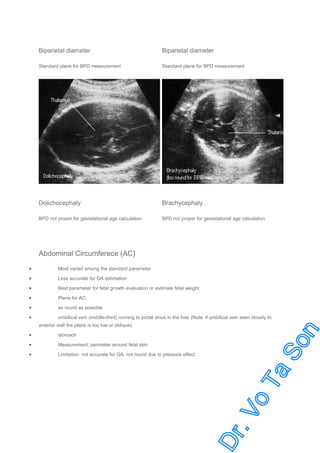
Biparietal Diameter (BPD)
•
•

The best parameter during 2nd trimester (+ 7-11 days during 14-26 weeks)

•

Ovoid and symmetry

•

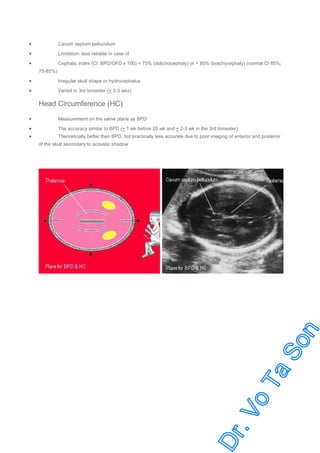
Thalamus

•

Midline echo / third ventricle

Technique: the distance from outer-to-inner skull table in the plane visualized of
•

Cavum septum pellucidum

•

Limitation: less reliable in case of

•

Cephalic index (CI: BPD/OFD x 100) < 75% (dolichocephaly) or > 85% (brachycephaly) (normal CI 85%;
75-85%)

•

Irregular skull shape or hydrocephalus

•

Varied in 3rd trimester (+ 2-3 wks)

Head Circumference (HC)
•

Measurement on the same plane as BPD

•
•

The accuracy similar to BPD (+ 1 wk before 20 wk and + 2-3 wk in the 3rd trimester)
Theoretically better than BPD, but practically less accurate due to poor imaging of anterior and posterior
of the skull secondary to acoustic shadow
Biparietal diameter

Biparietal diameter

Standard plane for BPD measurement

Standard plane for BPD measurement

Dolichocephaly

Brachycephaly

BPD not proper for gestatational age calculation

BPD not proper for gestatational age calculation

Abdominal Circumferece (AC)
•

Most varied among the standard parameter

•

Less accurate for GA estimation

•

Best parameter for fetal growth evaluation or estimate fetal weight

•

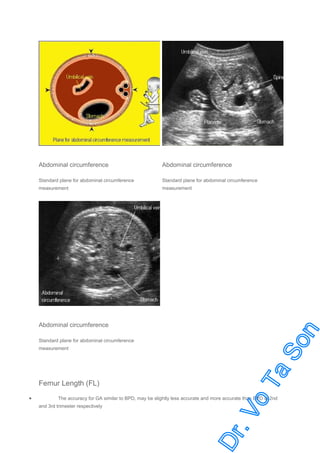
Plane for AC:

•

as round as possible

•

umbilical vein (middle-third) running to portal sinus in the liver (Note: if umbilical vein seen closely to
anterior wall the plane is too low or oblique)

•

stomach

•

Measurement: perimeter around fetal skin

•

Limitation: not accurate for GA, not round due to pressure effect
Abdominal circumference

Abdominal circumference

Standard plane for abdominal circumference

Standard plane for abdominal circumference

measurement

measurement

Abdominal circumference
Standard plane for abdominal circumference
measurement

Femur Length (FL)
•

The accuracy for GA similar to BPD, may be slightly less accurate and more accurate than BPD in 2nd
and 3rd trimester respectively
•

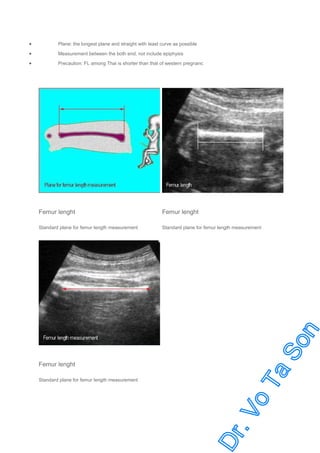
Plane: the longest plane and straight with least curve as possible

•

Measurement between the both end, not include epiphysis

•

Precaution: FL among Thai is shorter than that of western pregnanc

Femur lenght

Femur lenght

Standard plane for femur length measurement

Standard plane for femur length measurement

Femur lenght
Standard plane for femur length measurement
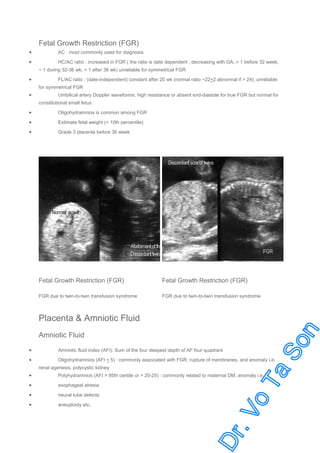
Fetal Growth Restriction (FGR)
•

AC : most commonly used for diagnosis

•

HC/AC ratio : increased in FGR ( the ratio is date dependent ; decreasing with GA, > 1 before 32 week,
~ 1 during 32-36 wk, > 1 after 36 wk) unreliable for symmetrical FGR

•

FL/AC ratio : (date-independent) constant after 20 wk (normal ratio ~22+2 abnormal if > 24), unreliable
for symmetrical FGR

•

Umbilical artery Doppler waveforms: high resistance or absent end-diastole for true FGR but normal for
constitutional small fetus

•

Oligohydramnios is common among FGR

•

Estimate fetal weight (< 10th percentile)

•

Grade 3 placenta before 36 week

Fetal Growth Restriction (FGR)

Fetal Growth Restriction (FGR)

FGR due to twin-to-twin transfusion syndrome

FGR due to twin-to-twin transfusion syndrome

Placenta & Amniotic Fluid
Amniotic Fluid
•
•

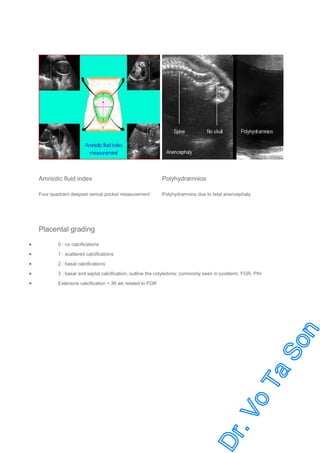
Amniotic fluid index (AFI): Sum of the four deepest depth of AF four quadrant
Oligohydramnios (AFI < 5) : commonly associated with FGR, rupture of membranes, and anomaly i.e.
renal agenesis, polycystic kidney

•

Polyhydramnios (AFI > 95th centile or > 20-25) : commonly related to maternal DM, anomaly i.e.

•

esophageal atresia

•

neural tube defects

•

aneuploidy etc.
Amniotic fluid index

Polyhydramnios

Four quadrant deepest verical pocket measurement

Polyhydramnios due to fetal anencephaly

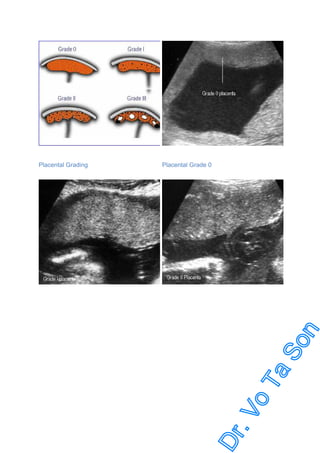
Placental grading
•

0 : no calcifications

•

1 : scattered calcifications

•

2 : basal calcifications

•

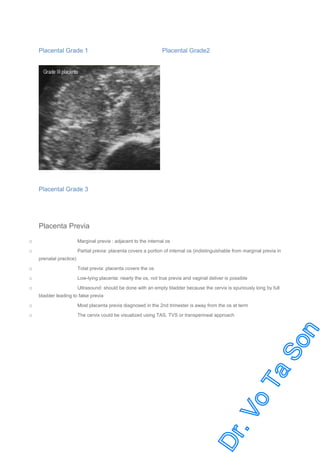
3 : basal and septal calcification; outline the cotyledons; commonly seen in postterm, FGR, PIH

•

Extensive calcification < 36 wk related to FGR
Placental Grading

Placental Grade 0
Placental Grade 1

Placental Grade2

Placental Grade 3

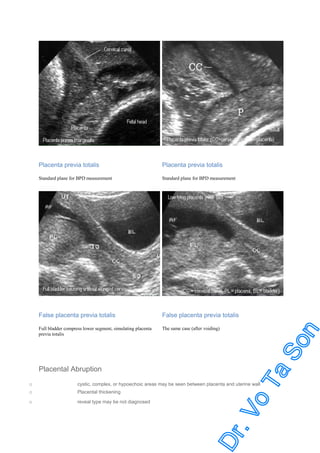
Placenta Previa
Marginal previa : adjacent to the internal os

o

Partial previa: placenta covers a portion of internal os (indistinguishable from marginal previa in

o
prenatal practice)

o

Total previa: placenta covers the os

o

Low-lying placenta: nearly the os, not true previa and vaginal deliver is possible

o

Ultrasound: should be done with an empty bladder because the cervix is spuriously long by full
bladder leading to false previa

o

Most placenta previa diagnosed in the 2nd trimester is away from the os at term

o

The cervix could be visualized using TAS, TVS or transperineal approach
Placenta previa totalis

Placenta previa totalis

Standard plane for BPD measurement

Standard plane for BPD measurement

False placenta previa totalis

False placenta previa totalis

Full bladder compress lower segment, simulating placenta
previa totalis

The same case (after voiding)

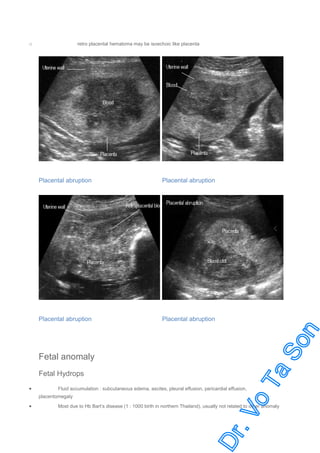
Placental Abruption
o
o

cystic, complex, or hypoechoic areas may be seen between placenta and uterine wall

o

reveal type may be not diagnosed

Placental thickening
retro placental hematoma may be isoechoic like placenta

o

Placental abruption

Placental abruption

Placental abruption

Placental abruption

Fetal anomaly
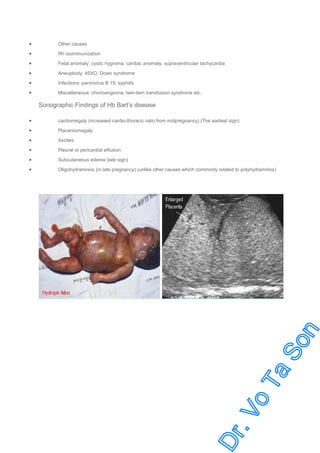
Fetal Hydrops
•

Fluid accumulation : subcutaneous edema, ascites, pleural effusion, pericardial effusion,
placentomegaly

•

Most due to Hb Bart’s disease (1 : 1000 birth in northern Thailand), usually not related to other anomaly
•

Other causes

•

Rh isoimmunization

•

Fetal anomaly: cystic hygroma, cardiac anomaly, supraventricular tachycardia

•

Aneuploidy: 45XO, Down syndrome

•

Infections: parvovirus B 19, syphilis

•

Miscellaneous: chorioangioma, twin-twin transfusion syndrome etc.

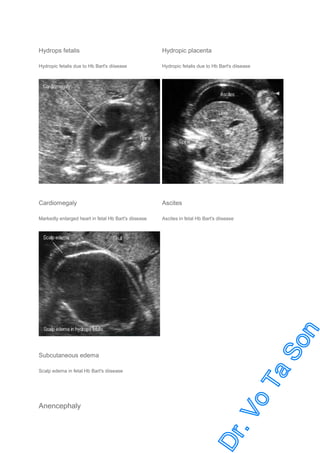
Sonographic Findings of Hb Bart’s disease
•

cardiomegaly (increased cardio-thoracic ratio from midpregnancy) (The earliest sign)

•

Placentomegaly

•

Ascites

•

Pleural or pericardial effusion

•

Subcutaneous edema (late sign)

•

Oligohydramnios (in late pregnancy) (unlike other causes which commonly related to polyhydramnios)
Hydrops fetalis

Hydropic placenta

Hydropic fetalis due to Hb Bart's diisease

Hydropic fetalis due to Hb Bart's diisease

Cardiomegaly

Ascites

Markedly enlarged heart in fetal Hb Bart's diisease

Ascites in fetal Hb Bart's diisease

Subcutaneous edema
Scalp edema in fetal Hb Bart's diisease

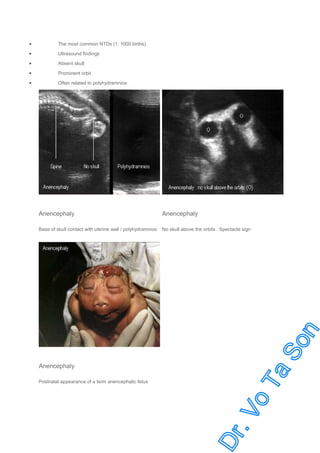
Anencephaly
•

The most common NTDs (1: 1000 births)

•

Ultrasound findings

•

Absent skull

•

Prominent orbit

•

Often related to polyhydramnios

Anencephaly

Anencephaly

Base of skull contact with uterine wall / polyhydramnios

No skull above the orbits : Spectacle sign

Anencephaly
Postnatal appearance of a term anencephalic fetus
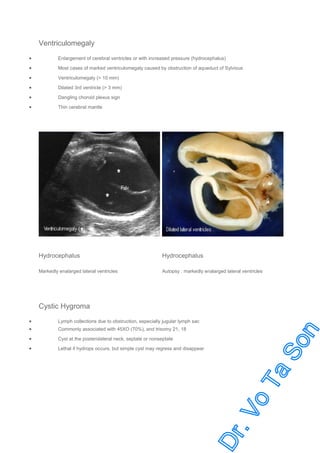
Ventriculomegaly
•

Enlargement of cerebral ventricles or with increased pressure (hydrocephalus)

•

Most cases of marked ventriculomegaly caused by obstruction of aqueduct of Sylvious

•

Ventriculomegaly (> 10 mm)

•

Dilated 3rd ventricle (> 3 mm)

•

Dangling choroid plexus sign

•

Thin cerebral mantle

Hydrocephalus

Hydrocephalus

Markedly enalarged lateral ventricles

Autopsy : markedly enalarged lateral ventricles

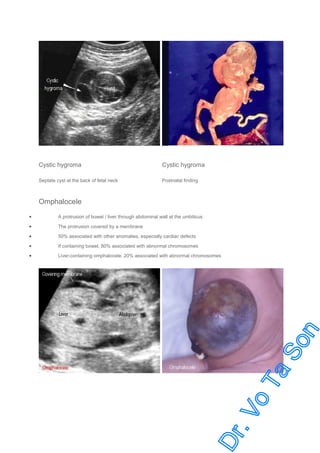
Cystic Hygroma
•
•

Lymph collections due to obstruction, especially jugular lymph sac

•

Cyst at the posterolateral neck, septate or nonseptate

•

Lethal if hydrops occurs, but simple cyst may regress and disappear

Commonly associated with 45XO (70%), and trisomy 21, 18
Cystic hygroma

Cystic hygroma

Septate cyst at the back of fetal neck

Postnatal finding

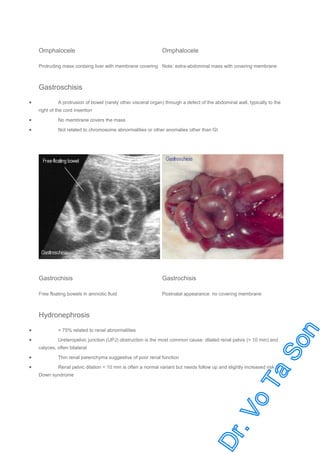
Omphalocele
•

A protrusion of bowel / liver through abdominal wall at the umbilicus

•

The protrusion covered by a membrane

•

50% associated with other anomalies, especially cardiac defects

•

If containing bowel, 80% associated with abnormal chromosomes

•

Liver-containing omphalocele: 20% associated with abnormal chromosomes
Omphalocele

Omphalocele

Protruding mass containg liver with membrane covering Note: extra-abdominal mass with covering membrane

Gastroschisis
•

A protrusion of bowel (rarely other visceral organ) through a defect of the abdominal wall, typically to the
right of the cord insertion

•

No membrane covers the mass

•

Not related to chromosome abnormalities or other anomalies other than GI

Gastrochisis

Gastrochisis

Free floating bowels in amniotic fluid

Postnatal appearance: no covering membrane

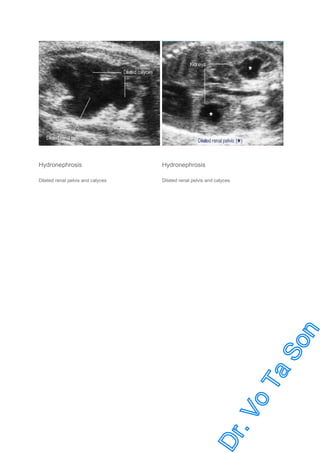
Hydronephrosis
•

> 75% related to renal abnormalities

•

Ureteropelvic junction (UPJ) obstruction is the most common cause: dilated renal pelvis (> 10 mm) and
calyces, often bilateral

•
•

Thin renal parenchyma suggestive of poor renal function
Renal pelvic dilation < 10 mm is often a normal variant but needs follow up and slightly increased risk of
Down syndrome
Hydronephrosis

Hydronephrosis

Dilated renal pelvis and calyces

Dilated renal pelvis and calyces

Basic ob ultrasound

  • 1.
    Why Ultrasound? Appropriate useis helpful in obstetric practice, especially in gestational age estimation, fetal growth monitoring, obstetric hemorrhage, and anomaly screening Indicated or Routine Ultrasound? • Generally well accepted for examination with indication • Routine screening at 18-20 weeks, recent more common practice, better or earlier diagnosis of GA, twins or anomaly but significant increase in cost and workload • The policy must be considered for cost-effectiveness and cost-benefit Common Indications 1. Diagnosis: pregnancy, number of fetuses, fetal life 2. Size inconsistent with date: multiple pregnancy, oligo-, polyhydramnios, hydrocephalus, fetal growth restriction 3. Estimate gestational age 4. Growth monitoring 5. Bleeding: abortion, placenta previa, placental abrutpion 6. Amniotic fluid evaluation 7. Pathology in the pelvis 8. Anomaly screening: Routine at 18-20 wk or pregnancy at risk (maternal DM, familial history,advanced maternal age) 9. Guidance for invasive procedures, i.e. amniocentesis, cordocentesis Sonoembryology Early Fetal Development (Transvaginal Sonography; TVS) • 3-4 weeks (after LMP): Endometrial thickenings • 4-5 weeks: Gestational sac • 5-6 weeks: Yolk sac, double decidual sac sign (DDS) • 6-7 weeks: Embryo with heart beat • 7-8 weeks: Embryo movement, Rhombencephalon, Amnion • 8-9 weeks: Physiologic omphalocele, limbs, choroid plexus, spinal line • TVS demonstrates earlier than transabdomen (TAS) ~ 1-2 weeks
  • 2.
    4-5 weeks 5 weeks Endometrialthickening, no obvious sac Gestational ring, white echogenic rim
  • 3.
    Double decidual sacsign 5 weeks Usually seen at 5-6 weeks Note yok sac 6 weeks 7-8 weeks Note: yok sac and early embryo Rapid growth of embryo and amnion 8 weeks 10 weeks Fetal body compartments : head trunk limbs Facial structures becoming seen Double Decidual Sac Sign (DDS) • Strongly suggestive of intrauterine pregnancy
  • 4.
    • Outer ring :Decidual vera • Middle sonolucency : Endometrial cavity • Inner ring : Decidual capsularis • Typically seen : 5-8 weeks Double decidual sac sign 5 weeks Usually seen at 5-6 weeks Note yok sac Mean Sac Diameter (MSD) • • MSD : Average gestational sac diameter = width + depth + length / 3 • When MSD > 25 mm. GA (days) = MSD + 30 MSD closely related to early GA
  • 5.
    Mean sac diameter Meansac diameter Longitudinal diameter Transverse diameter and depth Yolk Sac • Round, sonolucent with white border • Average 5 mm (3-8 mm) • Seen at 6-12 weeks peak 8-10 weeks • Nearly all seen when MSD > 8 mm. • Yolk sac > 10 mm. related to poor prognosis • Must be seen if MSD > 20 mm. by TAS or > 13 mm by TVS Fetal Echo • • Crown-Rump Length (CRL): the most accurate parameter for GA estimation (+ 3-7 days) • Short CRL related to high abortion rate and aneuploidy • Head, trunk, limbs can be identified from 8 weeks Useful only in the first trimester Amnion • • Seen from 7-8 weeks (TVS) • Fast growing, finally embryo is in the sac • Yolk sac is outside Beginning with double bleb sign (yolk sac and amnionic sac)
  • 6.
    Yolk sac Yolk sac Yolksac adjacent to fetal echo in early gestation Note: yolk sac separated from amnion Physiologic Omphalocele • Midgut herniation 8-12 weeks • Only bowel (no liver) in the proximal umbilical cord • Not seen if CRL > 44 mm • Size 4-7 mm. • Should be considered abnormal if > 7 mm, or seen after 12 weeks
  • 7.
    Physiologic omphalocele Physiologic omphalocele Prominentat 8-9 weeks At 8 weeks Physiologic omphalocele Physiologic omphalocele in abortus Nuchal Translucency (NT) • NT : small fluid collection beneath skin at back of the fetal neck • Measured at CRL 35-80 mm (10-14 week) • Measured on midsagittal scan (plane for CRL) • The best sonomarker for screening Down syndrome • Abnormal if > 95th percentile (> 2.5-3.0 mm) • Thickened NT increased of aneuploidy, anomaly especially cardiac defect
  • 8.
    Nuchal translucency Nuchal translucency Normalmeasured at 11 weeks Thickened nuchal translucency Nuchal translucency Nuchal translucency Thickened nuchal translucency at 14 weeks Thickened nuchal translucency after abortion Early Pregnancy Complications Threatened Abortion • Ultrasound examinations see if viable or nonviable pregnancy • Viable fetus with normal heart beat : very good prognosis • Nonviable:
  • 9.
    o blighted ovum o missed /incomplete abortion o fetal death o ectopic pregnancy o molar pregnancy Threatened abortion Threatened abortion Normal fetus at 11 weeks Placental hematoma in case of blighted ovum
  • 10.
    Early embryo death Embryosize and sac disproportion Blighted Ovum (Empty sac) • Intrauterine pregnancy without embryo • Diagnosed when • MSD > 25 mm (TAS) or > 20 mm (TVS) with no embryo seen • MSD > 20 mm (TAS) or >17 mm (TVS) with no yolk sac & embryo seen • DDx : • Early normal pregancy • Pseudosac in ectopic pregnancy • Blood or fluid collection
  • 11.
    Blighted ovum Blighted ovum Gestationalsac without embryo, subcorion hematoma Gestational sac without embryo, Blighted ovum Aborted sac: placenta and sac without embryo Ectopic Pregnancy • Clinically suspected with stable vital sign : ultrasound • Ultrasound results: • Definite IUP : exclude ectopic pregnancy • Definite EUP : extrauterine gestational sac • Highly suggestive of EUP : empty uterus with complex mass (separate from ovaries), echogenic fluid, dilated tube (May treat EUP or laparoscopic diagnsois in some cases) • Inconclusive : empty uterus without other abnormal finding (May need doubling time for beta-hCG)
  • 12.
    Ectopic pregnancy Ectopic pregnancy Floatingdilated fallopian tube in free fluid Gestational sac with embryo and yolk sac in the tube Ectopic pregnancy Adnexal omplex mass of blood clot and concepitus • • Molar Pregnancy o o Ultrasound findings: o Snow storm pattern or o Numerous small cystic echo or No fetus
  • 13.
    o Placental-like echo o May showcomplex area of blood clot Molar pregnancy Molar pregnancy Numerous small cystic space in uterine cavity mass Snow storm appearance Molar pregnancy The opened uterine specimen after hysterectomy Fetal Biometry Mean Sac Diameter (MSD) • MSD : Average gestational sac diameter = width + depth + length / 3
  • 14.
    • MSD closely relatedto early GA • When MSD > 25 mm. GA (days) = MSD + 30 Mean sac diameter Mean sac diameter Longitudinal diameter Transverse diameter and depth Crown-Rump Length (CRL) • • The most accurate parameter for GA (+ 3-7 days) • Limitation: Appropriate only in first trimester • Technique: • Mid-sagittal scan (note fetal nose, spine, crown and rump) • Measurement from the topmost of head to rump end • Precaution: best done in neutral position, not include yolk sac or limbs Most accurate during 6.5-10 weeks
  • 15.
    Crown-rump length Crown-rump length 8weeks 9 weeks Crown-rump length 12 weeks Biparietal Diameter (BPD) • • The best parameter during 2nd trimester (+ 7-11 days during 14-26 weeks) • Ovoid and symmetry • Thalamus • Midline echo / third ventricle Technique: the distance from outer-to-inner skull table in the plane visualized of
  • 16.
    • Cavum septum pellucidum • Limitation:less reliable in case of • Cephalic index (CI: BPD/OFD x 100) < 75% (dolichocephaly) or > 85% (brachycephaly) (normal CI 85%; 75-85%) • Irregular skull shape or hydrocephalus • Varied in 3rd trimester (+ 2-3 wks) Head Circumference (HC) • Measurement on the same plane as BPD • • The accuracy similar to BPD (+ 1 wk before 20 wk and + 2-3 wk in the 3rd trimester) Theoretically better than BPD, but practically less accurate due to poor imaging of anterior and posterior of the skull secondary to acoustic shadow
  • 17.
    Biparietal diameter Biparietal diameter Standardplane for BPD measurement Standard plane for BPD measurement Dolichocephaly Brachycephaly BPD not proper for gestatational age calculation BPD not proper for gestatational age calculation Abdominal Circumferece (AC) • Most varied among the standard parameter • Less accurate for GA estimation • Best parameter for fetal growth evaluation or estimate fetal weight • Plane for AC: • as round as possible • umbilical vein (middle-third) running to portal sinus in the liver (Note: if umbilical vein seen closely to anterior wall the plane is too low or oblique) • stomach • Measurement: perimeter around fetal skin • Limitation: not accurate for GA, not round due to pressure effect
  • 18.
    Abdominal circumference Abdominal circumference Standardplane for abdominal circumference Standard plane for abdominal circumference measurement measurement Abdominal circumference Standard plane for abdominal circumference measurement Femur Length (FL) • The accuracy for GA similar to BPD, may be slightly less accurate and more accurate than BPD in 2nd and 3rd trimester respectively
  • 19.
    • Plane: the longestplane and straight with least curve as possible • Measurement between the both end, not include epiphysis • Precaution: FL among Thai is shorter than that of western pregnanc Femur lenght Femur lenght Standard plane for femur length measurement Standard plane for femur length measurement Femur lenght Standard plane for femur length measurement
  • 20.
    Fetal Growth Restriction(FGR) • AC : most commonly used for diagnosis • HC/AC ratio : increased in FGR ( the ratio is date dependent ; decreasing with GA, > 1 before 32 week, ~ 1 during 32-36 wk, > 1 after 36 wk) unreliable for symmetrical FGR • FL/AC ratio : (date-independent) constant after 20 wk (normal ratio ~22+2 abnormal if > 24), unreliable for symmetrical FGR • Umbilical artery Doppler waveforms: high resistance or absent end-diastole for true FGR but normal for constitutional small fetus • Oligohydramnios is common among FGR • Estimate fetal weight (< 10th percentile) • Grade 3 placenta before 36 week Fetal Growth Restriction (FGR) Fetal Growth Restriction (FGR) FGR due to twin-to-twin transfusion syndrome FGR due to twin-to-twin transfusion syndrome Placenta & Amniotic Fluid Amniotic Fluid • • Amniotic fluid index (AFI): Sum of the four deepest depth of AF four quadrant Oligohydramnios (AFI < 5) : commonly associated with FGR, rupture of membranes, and anomaly i.e. renal agenesis, polycystic kidney • Polyhydramnios (AFI > 95th centile or > 20-25) : commonly related to maternal DM, anomaly i.e. • esophageal atresia • neural tube defects • aneuploidy etc.
  • 21.
    Amniotic fluid index Polyhydramnios Fourquadrant deepest verical pocket measurement Polyhydramnios due to fetal anencephaly Placental grading • 0 : no calcifications • 1 : scattered calcifications • 2 : basal calcifications • 3 : basal and septal calcification; outline the cotyledons; commonly seen in postterm, FGR, PIH • Extensive calcification < 36 wk related to FGR
  • 22.
  • 23.
    Placental Grade 1 PlacentalGrade2 Placental Grade 3 Placenta Previa Marginal previa : adjacent to the internal os o Partial previa: placenta covers a portion of internal os (indistinguishable from marginal previa in o prenatal practice) o Total previa: placenta covers the os o Low-lying placenta: nearly the os, not true previa and vaginal deliver is possible o Ultrasound: should be done with an empty bladder because the cervix is spuriously long by full bladder leading to false previa o Most placenta previa diagnosed in the 2nd trimester is away from the os at term o The cervix could be visualized using TAS, TVS or transperineal approach
  • 24.
    Placenta previa totalis Placentaprevia totalis Standard plane for BPD measurement Standard plane for BPD measurement False placenta previa totalis False placenta previa totalis Full bladder compress lower segment, simulating placenta previa totalis The same case (after voiding) Placental Abruption o o cystic, complex, or hypoechoic areas may be seen between placenta and uterine wall o reveal type may be not diagnosed Placental thickening
  • 25.
    retro placental hematomamay be isoechoic like placenta o Placental abruption Placental abruption Placental abruption Placental abruption Fetal anomaly Fetal Hydrops • Fluid accumulation : subcutaneous edema, ascites, pleural effusion, pericardial effusion, placentomegaly • Most due to Hb Bart’s disease (1 : 1000 birth in northern Thailand), usually not related to other anomaly
  • 26.
    • Other causes • Rh isoimmunization • Fetalanomaly: cystic hygroma, cardiac anomaly, supraventricular tachycardia • Aneuploidy: 45XO, Down syndrome • Infections: parvovirus B 19, syphilis • Miscellaneous: chorioangioma, twin-twin transfusion syndrome etc. Sonographic Findings of Hb Bart’s disease • cardiomegaly (increased cardio-thoracic ratio from midpregnancy) (The earliest sign) • Placentomegaly • Ascites • Pleural or pericardial effusion • Subcutaneous edema (late sign) • Oligohydramnios (in late pregnancy) (unlike other causes which commonly related to polyhydramnios)
  • 27.
    Hydrops fetalis Hydropic placenta Hydropicfetalis due to Hb Bart's diisease Hydropic fetalis due to Hb Bart's diisease Cardiomegaly Ascites Markedly enlarged heart in fetal Hb Bart's diisease Ascites in fetal Hb Bart's diisease Subcutaneous edema Scalp edema in fetal Hb Bart's diisease Anencephaly
  • 28.
    • The most commonNTDs (1: 1000 births) • Ultrasound findings • Absent skull • Prominent orbit • Often related to polyhydramnios Anencephaly Anencephaly Base of skull contact with uterine wall / polyhydramnios No skull above the orbits : Spectacle sign Anencephaly Postnatal appearance of a term anencephalic fetus
  • 29.
    Ventriculomegaly • Enlargement of cerebralventricles or with increased pressure (hydrocephalus) • Most cases of marked ventriculomegaly caused by obstruction of aqueduct of Sylvious • Ventriculomegaly (> 10 mm) • Dilated 3rd ventricle (> 3 mm) • Dangling choroid plexus sign • Thin cerebral mantle Hydrocephalus Hydrocephalus Markedly enalarged lateral ventricles Autopsy : markedly enalarged lateral ventricles Cystic Hygroma • • Lymph collections due to obstruction, especially jugular lymph sac • Cyst at the posterolateral neck, septate or nonseptate • Lethal if hydrops occurs, but simple cyst may regress and disappear Commonly associated with 45XO (70%), and trisomy 21, 18
  • 30.
    Cystic hygroma Cystic hygroma Septatecyst at the back of fetal neck Postnatal finding Omphalocele • A protrusion of bowel / liver through abdominal wall at the umbilicus • The protrusion covered by a membrane • 50% associated with other anomalies, especially cardiac defects • If containing bowel, 80% associated with abnormal chromosomes • Liver-containing omphalocele: 20% associated with abnormal chromosomes
  • 31.
    Omphalocele Omphalocele Protruding mass containgliver with membrane covering Note: extra-abdominal mass with covering membrane Gastroschisis • A protrusion of bowel (rarely other visceral organ) through a defect of the abdominal wall, typically to the right of the cord insertion • No membrane covers the mass • Not related to chromosome abnormalities or other anomalies other than GI Gastrochisis Gastrochisis Free floating bowels in amniotic fluid Postnatal appearance: no covering membrane Hydronephrosis • > 75% related to renal abnormalities • Ureteropelvic junction (UPJ) obstruction is the most common cause: dilated renal pelvis (> 10 mm) and calyces, often bilateral • • Thin renal parenchyma suggestive of poor renal function Renal pelvic dilation < 10 mm is often a normal variant but needs follow up and slightly increased risk of Down syndrome
  • 32.
    Hydronephrosis Hydronephrosis Dilated renal pelvisand calyces Dilated renal pelvis and calyces