ROLE OF FIRST TRIMESTER
ULTRASONOGRAPHY
Presented by :Dr. JYOTI BAGHEL
Junior Resident, OBGY
JIPMER
Introduction
 Integral part of obstetrics today
 First developed by Prof.Langevin to detect submarines during I-WW
 Previously known as SONAR(Sound navigation and ranging)
 Oceanographic studies
 Sir Ian Donald first to demonstrate the use in obstetrics(1950s)
 Robinson measured CRL and EDD
Mechanics Inverse piezo electric effect
 Electric current applied to piezoelectric crystals -Ultra sound wave produced
 Transducer transmits and receives USG waves reflected from tissues.
 TAS – 2 – 6.5 MHz
 TVS – 5 – 15 MHz
 Real time grey scale B mode study (2 D study)
 M mode – Motion mode in B mode; for cardiac motion to assess heart rate
and rhythm
 3D – 3 dimensional image through a special computer software.
 4D – Real time 3D ultra sound
 Doppler and power Doppler.
Safety:
 Use of sound waves, not a form of ionizing radiation.
 Many international bodies recommends, including ISUOG,that use of B
mode and M mode prenatal ultrasonography,due to its limited acoustic
output ,appears to be safe for all stages of pregnancy.
 Energy exposure from ultrasonography has been arbitrarily limited to
94 mW/cm2
(US FDA) (ref: ACOG Committee Guidelines Number
299, September 2004)
 No contraindications to ultrasound procedure
 ALARA Principle(As low as reasonably achievable ) principle
COMPONENTS OF STANDARD USG
EXAMINATION
 Ideally before 14 weeks.
 4-9 weeks – early first trimester scan
 10-14 weeks – late first trimester scan
USES :
 In early pregnancy, it is important to:
 Confirm viability
 to assign a gestational age accurately
 Accurate dating - reduces the need for intervention for post-maturity
First trimester scan:
 To determine whether early pregnancy has a normal appearance, and signs
of viability
 fetal number, and in multiple pregnancies the chorionicity/amnionicity
 detection of gross fetal abnormalities
 To evaluate maternal symptoms such as pain or bleeding
 To evaluate uterine contents before termination of pregnancy
 To guide diagnostic and therapeutic procedures
USES conti..
Fetal structures-timing
 Comet sign – choriodecidual reaction and vascularity
before G sac becomes visible
 Gestational sac – 4-5 weeks
 Yolk sac – 5-6 weeks
 Fetal pole – 6-7 weeks
 Cardiac activity - 6-7 weeks
Gestational sac
 Gestational sac – first seen by
 4 weeks+ 1-3 days TVS wen the g sac is 2-3mm
 5 weeks by TAS
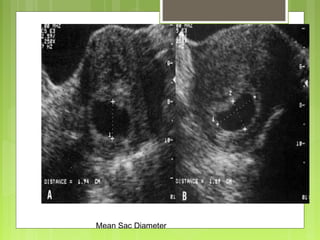
 Quantified by calculating Mean sac diameter (MSD) , mean
of three diameters , inner wall margin to inner wall margin in
three planes perpendicular to each other.
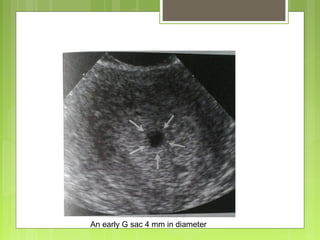
An early G sac 4 mm in diameter
Mean Sac Diameter
Double decidual sac sign
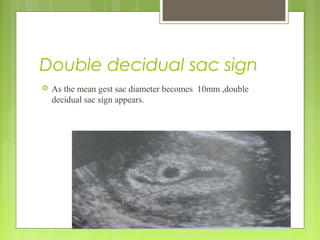
 As the mean gest sac diameter becomes 10mm ,double
decidual sac sign appears.
Yolk sac
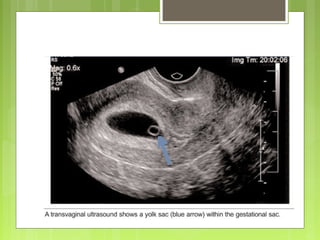
 1st
structure to appear with in G sac
 TVS - Earliest when MSD – 5mm and should
always by MSD of 8mm
 TAS – MSD of 20mm
Embryonic disc
Image showing the developing fetus,yolk sac within the G sac.CRL of 4mm
corresponding to 6.1 weeks
Crown rump length
 Can be carried out transabominally or transvaginally.
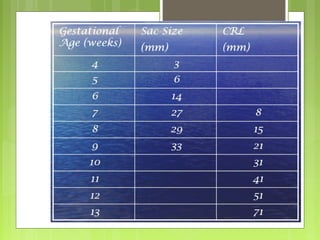
 Gestational age from 5 weeks 4 days to 13 weeks – crown rump length.
 Crown rump length at 8 to 12 weeks - most accurate method to date pregnancy
 Predict EDD to within 5 days (2 SD)
 CRL increases 1mm per day
 Measuring CRL – Midline sagittal section of the whole embryo or fetus should be
obtained.
 Fetus should be in a neutral position (i.e neither flexed nor hyperextended)
5wk+6d,7wk+4d,9wk+1d
`
 6.2 weeks
Cardiac activity
Visible as early as – 34 days of GA or embryonic legth of 1.6
mm
Definitely evident by the time embryo is 4-5mm(6 weeks)
Heart rate around 100bpm initially, then 130-159bpm by
8weeks and plateaus at 137-144bpm after 9weeks
Signs of failed pregnancy
 G sac >16mm without embryo
 G sac >8mm without yolk sac
 Large yolk sac > 10 mm or small sac
 Calcified or echogenic yolk sac
 Double yolk sac
 Pulse less embryo CRL >= 5mm
 Choriodecidual hemorrhage
ABORTION
 First trimester ultrasound is recommended for assessmentof threatened abortion
to document fetal viability
 Termination of pregnancy spontaneous or induced before the period of viability
 Presentation –variable amounts of bleeding PV with or without pain
 Fetal viability - confirms the presence of an embryo with cardiac activity at the
time of examination
 Recommended in - incomplete abortion to identify retained products of
conception
 Not recommended to investigate an inevitable abortion
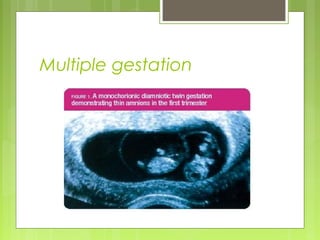
Multiple gestation
T sign in monochorionic diamniotic twin
INVASIVE DIAGNOSTIC OR THERAPEUTIC
PROCEDURES
• Chorionic villus sampling (CVS) and amniocentesis – to be
done under continuous ultrasound guidance.
• Success depends on - reliable placental localization.
• Selective reduction in multifetal pregnancies
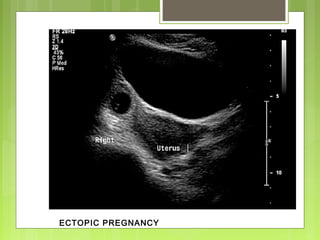
ECTOPIC PREGNANCY
Lavanya
Positive predictive value of 100% and a negative predictive value of
92% in women with a clinical suspicion of an ectopic pregnancy.
In combination with β-human chorionic gonadotropin - 96% of
ectopic pregnancies with a specificity of 100%.
If the β-hCG is at or above the discriminatory zone, AND no IUP can
be identified, the pregnancy may be ectopic
Ultra sound features :
Visualization of extra uterine G sac
Non specific, variably vascular, variably tender adnexal mass
ECTOPIC PREGNANCY
Molar pregnancy
Molar pregnancy
partial mole
NUCHAL TRANSLUCENCY
• At 10 to 13 weeks + 6 days (11–14 week scan)
• CRL from 45 mm to 84 mm,
• sonolucent area in the posterior fetal neck between the
soft tissues of the neck and skin
• quantify the risk of Down syndrome, trisomy 21, 18
and13,certain other chromosomal or developmental
abnormalities, and numerous genetic syndromes
• for chromosomally normal fetuses with increased nuchal
Translucency- higher risk of congenital heart disease
NUCHAL TRANSLUCENCY
Cystic hygroma
Fetal abnormalities
 Neural tube defects-anencephaly
 Cranial and spinal cord defects
 Facial clefts
 Gastroscisis/omphalocele
 polydactyly
Gastroschisis
holoprosencephaly
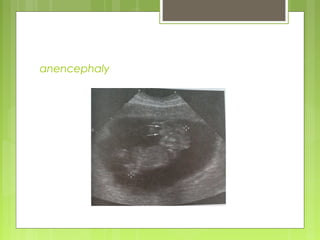
anencephaly

Usg

  • 1.
    ROLE OF FIRSTTRIMESTER ULTRASONOGRAPHY Presented by :Dr. JYOTI BAGHEL Junior Resident, OBGY JIPMER
  • 2.
    Introduction  Integral partof obstetrics today  First developed by Prof.Langevin to detect submarines during I-WW  Previously known as SONAR(Sound navigation and ranging)  Oceanographic studies  Sir Ian Donald first to demonstrate the use in obstetrics(1950s)  Robinson measured CRL and EDD
  • 3.
    Mechanics Inverse piezoelectric effect  Electric current applied to piezoelectric crystals -Ultra sound wave produced  Transducer transmits and receives USG waves reflected from tissues.  TAS – 2 – 6.5 MHz  TVS – 5 – 15 MHz  Real time grey scale B mode study (2 D study)  M mode – Motion mode in B mode; for cardiac motion to assess heart rate and rhythm  3D – 3 dimensional image through a special computer software.  4D – Real time 3D ultra sound  Doppler and power Doppler.
  • 4.
    Safety:  Use ofsound waves, not a form of ionizing radiation.  Many international bodies recommends, including ISUOG,that use of B mode and M mode prenatal ultrasonography,due to its limited acoustic output ,appears to be safe for all stages of pregnancy.  Energy exposure from ultrasonography has been arbitrarily limited to 94 mW/cm2 (US FDA) (ref: ACOG Committee Guidelines Number 299, September 2004)  No contraindications to ultrasound procedure  ALARA Principle(As low as reasonably achievable ) principle
  • 5.
    COMPONENTS OF STANDARDUSG EXAMINATION
  • 6.
     Ideally before14 weeks.  4-9 weeks – early first trimester scan  10-14 weeks – late first trimester scan USES :  In early pregnancy, it is important to:  Confirm viability  to assign a gestational age accurately  Accurate dating - reduces the need for intervention for post-maturity First trimester scan:
  • 7.
     To determinewhether early pregnancy has a normal appearance, and signs of viability  fetal number, and in multiple pregnancies the chorionicity/amnionicity  detection of gross fetal abnormalities  To evaluate maternal symptoms such as pain or bleeding  To evaluate uterine contents before termination of pregnancy  To guide diagnostic and therapeutic procedures USES conti..
  • 8.
    Fetal structures-timing  Cometsign – choriodecidual reaction and vascularity before G sac becomes visible  Gestational sac – 4-5 weeks  Yolk sac – 5-6 weeks  Fetal pole – 6-7 weeks  Cardiac activity - 6-7 weeks
  • 9.
    Gestational sac  Gestationalsac – first seen by  4 weeks+ 1-3 days TVS wen the g sac is 2-3mm  5 weeks by TAS  Quantified by calculating Mean sac diameter (MSD) , mean of three diameters , inner wall margin to inner wall margin in three planes perpendicular to each other.
  • 10.
    An early Gsac 4 mm in diameter
  • 11.
  • 12.
    Double decidual sacsign  As the mean gest sac diameter becomes 10mm ,double decidual sac sign appears.
  • 13.
    Yolk sac  1st structureto appear with in G sac  TVS - Earliest when MSD – 5mm and should always by MSD of 8mm  TAS – MSD of 20mm
  • 15.
  • 16.
    Image showing thedeveloping fetus,yolk sac within the G sac.CRL of 4mm corresponding to 6.1 weeks
  • 17.
    Crown rump length Can be carried out transabominally or transvaginally.  Gestational age from 5 weeks 4 days to 13 weeks – crown rump length.  Crown rump length at 8 to 12 weeks - most accurate method to date pregnancy  Predict EDD to within 5 days (2 SD)  CRL increases 1mm per day  Measuring CRL – Midline sagittal section of the whole embryo or fetus should be obtained.  Fetus should be in a neutral position (i.e neither flexed nor hyperextended)
  • 19.
  • 20.
  • 22.
    Cardiac activity Visible asearly as – 34 days of GA or embryonic legth of 1.6 mm Definitely evident by the time embryo is 4-5mm(6 weeks) Heart rate around 100bpm initially, then 130-159bpm by 8weeks and plateaus at 137-144bpm after 9weeks
  • 24.
    Signs of failedpregnancy  G sac >16mm without embryo  G sac >8mm without yolk sac  Large yolk sac > 10 mm or small sac  Calcified or echogenic yolk sac  Double yolk sac  Pulse less embryo CRL >= 5mm  Choriodecidual hemorrhage
  • 26.
    ABORTION  First trimesterultrasound is recommended for assessmentof threatened abortion to document fetal viability  Termination of pregnancy spontaneous or induced before the period of viability  Presentation –variable amounts of bleeding PV with or without pain  Fetal viability - confirms the presence of an embryo with cardiac activity at the time of examination  Recommended in - incomplete abortion to identify retained products of conception  Not recommended to investigate an inevitable abortion
  • 27.
  • 28.
    T sign inmonochorionic diamniotic twin
  • 31.
    INVASIVE DIAGNOSTIC ORTHERAPEUTIC PROCEDURES • Chorionic villus sampling (CVS) and amniocentesis – to be done under continuous ultrasound guidance. • Success depends on - reliable placental localization. • Selective reduction in multifetal pregnancies
  • 32.
    ECTOPIC PREGNANCY Lavanya Positive predictivevalue of 100% and a negative predictive value of 92% in women with a clinical suspicion of an ectopic pregnancy. In combination with β-human chorionic gonadotropin - 96% of ectopic pregnancies with a specificity of 100%. If the β-hCG is at or above the discriminatory zone, AND no IUP can be identified, the pregnancy may be ectopic Ultra sound features : Visualization of extra uterine G sac Non specific, variably vascular, variably tender adnexal mass
  • 33.
  • 34.
  • 35.
  • 36.
  • 37.
    NUCHAL TRANSLUCENCY • At10 to 13 weeks + 6 days (11–14 week scan) • CRL from 45 mm to 84 mm, • sonolucent area in the posterior fetal neck between the soft tissues of the neck and skin • quantify the risk of Down syndrome, trisomy 21, 18 and13,certain other chromosomal or developmental abnormalities, and numerous genetic syndromes • for chromosomally normal fetuses with increased nuchal Translucency- higher risk of congenital heart disease
  • 38.
  • 39.
  • 40.
    Fetal abnormalities  Neuraltube defects-anencephaly  Cranial and spinal cord defects  Facial clefts  Gastroscisis/omphalocele  polydactyly
  • 41.
  • 42.
  • 43.

Editor's Notes

  • #5 To explain ALARA