POETRY
BASIC VERSIFICATION
GROUP 6
GEBY WIRA PRATIWI
LUCIA SARI
NILUH HARTINI PUSPITA SARI
NOVITA WULANDARI
TITO BAKRI
BASIC VERSIFICATION

 the study and analysis of the
structure of verse.
it is in this area of examination
that our tools for analyzing poetry
are most specific and definitive
RHYTHM AND METRICS
RHYTHM IN POETRY
 Rhythm is created by the pattern of repeated
sounds in terms of both duration, quality and
ideas.

ACCENT
 Poem has lines that consist number of syllables,
come of which are accented (receive stress) and
also some are not accented (receive no stress).
POETIC FEET
 Most reader will have noticed that the line to be
divided into a number of repeated units
combining the same number of accented
syllables. This units is known as poetic foot.
Feet containing different number of syllables,
accented and unaccented have different
names.
A. Iambic
 The iambic foot (an Iamb) is composed of one
unstressed syllable followed by one stressed
syllable.
B. Trochaic
• The trochaic foot (a trochee) is the reverse of an
iambic foot, it is made of two syllables, the first
one stressed and the second the unstressed.
C. Dactylic
•
Dactylic is composed of one stressed
syllable followed by two unstressed syllables.
D. Anapestic
 Anapestic is composed of two unstressed
followed by one that is stress.
E. Spondaic
 The spondaic is the fifth kind of foot that has two
stressed and no unstressed syllable.
METRICAL LINES
 Metrical lines is the name of poetic feet in every
lines of poem. They are monometer (1 poetic
foot), dimeter (2 poetic feet), trimeter, tetrameter,
pentameter, hexameter, heptameter, and
octameter.
COMPLETE DESCRIPTIONS OF POETIC LINES
 If in a line there are four iambic, it is called
iambic tetrameter, then if there are three
trochaic, it is called trochaic trimeter.
RISING AND FALLING METER
 Rising meter is the moving up toward emphasis
(from unstressed to stressed syllable).

MASCULINE AND FEMININE ENDINGS
 Feminine is the soft ending with an extra or
additional without accented syllable, and
masculine is the hard end of line or the end of
line without additional syllable.

THE CAESURA
 The pause in a line is referred to as a caesura
and is often best discovered by reading the
poem loud.
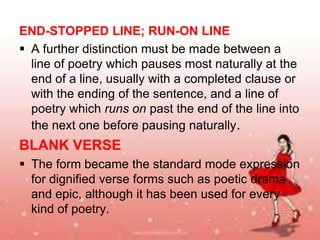
END-STOPPED LINE; RUN-ON LINE
 A further distinction must be made between a
line of poetry which pauses most naturally at the
end of a line, usually with a completed clause or
with the ending of the sentence, and a line of
poetry which runs on past the end of the line into
the next one before pausing naturally.

BLANK VERSE
 The form became the standard mode expression
for dignified verse forms such as poetic drama
and epic, although it has been used for every
kind of poetry.
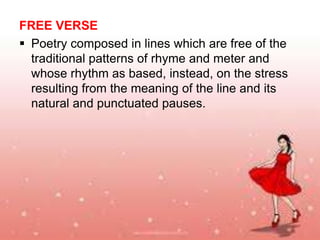
FREE VERSE
 Poetry composed in lines which are free of the
traditional patterns of rhyme and meter and
whose rhythm as based, instead, on the stress
resulting from the meaning of the line and its
natural and punctuated pauses.
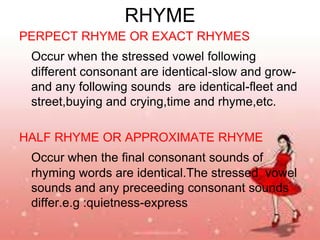
RHYME
PERPECT RHYME OR EXACT RHYMES
Occur when the stressed vowel following
different consonant are identical-slow and growand any following sounds are identical-fleet and
street,buying and crying,time and rhyme,etc.

HALF RHYME OR APPROXIMATE RHYME
Occur when the final consonant sounds of
rhyming words are identical.The stressed vowel
sounds and any preceeding consonant sounds
differ.e.g :quietness-express
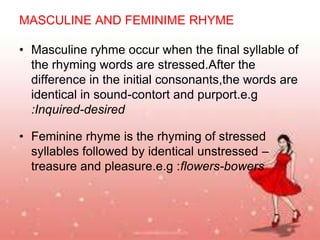
MASCULINE AND FEMINIME RHYME
• Masculine ryhme occur when the final syllable of
the rhyming words are stressed.After the
difference in the initial consonants,the words are
identical in sound-contort and purport.e.g
:Inquired-desired

• Feminine rhyme is the rhyming of stressed
syllables followed by identical unstressed –
treasure and pleasure.e.g :flowers-bowers
INTERNAL RHYME
• Occur when the rhyming words are found within
the lines,often a word in the middle of a line
rhyming with the last word or sound in the line.
RHYME-SCHEME
• Rhyme scheme refers to the pattern of end
rhymes in a poem.When we want to describe the
pattern of rhyme in a poem or a stanza,we label
the entire stanza by saying that pattern of rhyme
is abcbca,etc.This is known as rhyme-scheme.
ALLITERATION
• Alliteration is the repeating of beginning
consonant sounds in a group of
words.Alliteration refers to the first sound rather
than the first letter.
ASSONANCE AND CONSONANCE
• Assonance is the use of identical sounds
surrounded by different kinds of consonant
sounds in words in close proximity each other.
• Consonant is repetition of consonant sounds
anywhere within a word.
ONOMATOPEIA
• Word,such as plop,buzz,or snap,whose sound
suggests its meaning.Onomatopoeia provides
sounds effects,and appears most frequently in
poetry,advertising and children’s tales.
•E.g: The moan of doves in immemorial elms.
And murmuring of innumerable bees.
STANZA
STANZAS
• Stanza is a group of lines and therefore a
recognizable unit in a poem. the pattern of
rhyme are organized into verse paragraph,or
blocks of lines.
• Common stanza patterns include
couplets,triplets
quatrains,sestets,octaves,sonnet,spenserian
stanza and ottava rima.
Basic versification klmpk 5

Basic versification klmpk 5

  • 1.
    POETRY BASIC VERSIFICATION GROUP 6 GEBYWIRA PRATIWI LUCIA SARI NILUH HARTINI PUSPITA SARI NOVITA WULANDARI TITO BAKRI
  • 2.
    BASIC VERSIFICATION  thestudy and analysis of the structure of verse. it is in this area of examination that our tools for analyzing poetry are most specific and definitive
  • 3.
    RHYTHM AND METRICS RHYTHMIN POETRY  Rhythm is created by the pattern of repeated sounds in terms of both duration, quality and ideas. ACCENT  Poem has lines that consist number of syllables, come of which are accented (receive stress) and also some are not accented (receive no stress).
  • 4.
    POETIC FEET  Mostreader will have noticed that the line to be divided into a number of repeated units combining the same number of accented syllables. This units is known as poetic foot. Feet containing different number of syllables, accented and unaccented have different names. A. Iambic  The iambic foot (an Iamb) is composed of one unstressed syllable followed by one stressed syllable.
  • 5.
    B. Trochaic • Thetrochaic foot (a trochee) is the reverse of an iambic foot, it is made of two syllables, the first one stressed and the second the unstressed. C. Dactylic • Dactylic is composed of one stressed syllable followed by two unstressed syllables. D. Anapestic  Anapestic is composed of two unstressed followed by one that is stress. E. Spondaic  The spondaic is the fifth kind of foot that has two stressed and no unstressed syllable.
  • 6.
    METRICAL LINES  Metricallines is the name of poetic feet in every lines of poem. They are monometer (1 poetic foot), dimeter (2 poetic feet), trimeter, tetrameter, pentameter, hexameter, heptameter, and octameter. COMPLETE DESCRIPTIONS OF POETIC LINES  If in a line there are four iambic, it is called iambic tetrameter, then if there are three trochaic, it is called trochaic trimeter.
  • 7.
    RISING AND FALLINGMETER  Rising meter is the moving up toward emphasis (from unstressed to stressed syllable). MASCULINE AND FEMININE ENDINGS  Feminine is the soft ending with an extra or additional without accented syllable, and masculine is the hard end of line or the end of line without additional syllable. THE CAESURA  The pause in a line is referred to as a caesura and is often best discovered by reading the poem loud.
  • 8.
    END-STOPPED LINE; RUN-ONLINE  A further distinction must be made between a line of poetry which pauses most naturally at the end of a line, usually with a completed clause or with the ending of the sentence, and a line of poetry which runs on past the end of the line into the next one before pausing naturally. BLANK VERSE  The form became the standard mode expression for dignified verse forms such as poetic drama and epic, although it has been used for every kind of poetry.
  • 9.
    FREE VERSE  Poetrycomposed in lines which are free of the traditional patterns of rhyme and meter and whose rhythm as based, instead, on the stress resulting from the meaning of the line and its natural and punctuated pauses.
  • 10.
    RHYME PERPECT RHYME OREXACT RHYMES Occur when the stressed vowel following different consonant are identical-slow and growand any following sounds are identical-fleet and street,buying and crying,time and rhyme,etc. HALF RHYME OR APPROXIMATE RHYME Occur when the final consonant sounds of rhyming words are identical.The stressed vowel sounds and any preceeding consonant sounds differ.e.g :quietness-express
  • 11.
    MASCULINE AND FEMINIMERHYME • Masculine ryhme occur when the final syllable of the rhyming words are stressed.After the difference in the initial consonants,the words are identical in sound-contort and purport.e.g :Inquired-desired • Feminine rhyme is the rhyming of stressed syllables followed by identical unstressed – treasure and pleasure.e.g :flowers-bowers
  • 12.
    INTERNAL RHYME • Occurwhen the rhyming words are found within the lines,often a word in the middle of a line rhyming with the last word or sound in the line. RHYME-SCHEME • Rhyme scheme refers to the pattern of end rhymes in a poem.When we want to describe the pattern of rhyme in a poem or a stanza,we label the entire stanza by saying that pattern of rhyme is abcbca,etc.This is known as rhyme-scheme.
  • 13.
    ALLITERATION • Alliteration isthe repeating of beginning consonant sounds in a group of words.Alliteration refers to the first sound rather than the first letter. ASSONANCE AND CONSONANCE • Assonance is the use of identical sounds surrounded by different kinds of consonant sounds in words in close proximity each other. • Consonant is repetition of consonant sounds anywhere within a word.
  • 14.
    ONOMATOPEIA • Word,such asplop,buzz,or snap,whose sound suggests its meaning.Onomatopoeia provides sounds effects,and appears most frequently in poetry,advertising and children’s tales. •E.g: The moan of doves in immemorial elms. And murmuring of innumerable bees.
  • 15.
    STANZA STANZAS • Stanza isa group of lines and therefore a recognizable unit in a poem. the pattern of rhyme are organized into verse paragraph,or blocks of lines. • Common stanza patterns include couplets,triplets quatrains,sestets,octaves,sonnet,spenserian stanza and ottava rima.