MECHATRONICS
BY
NAVIN H. YADAV
Department of Mechanical Engineering ,
KAUTILYA INSTITUTE OF TECHNOLOGY & ENGINEERING
SCHOOL OF MANAGEMENT
CONTENT
1. Introduction of mechatronics
2. Multi-disciplinary scenario.
3. Origin of Mechatronic system.
4. Evaluation of Mechatronics.
5. Advantages of Mechatronic Systems
6. Disadvantages of Mechatronic Systems.
7. Characteristics of Mechatronic system
8. Applications of Mechatronic systems
9. Process control automation
10. Advantages Of Automation
11. Limitations Of Automation
12. Basic Steps In Process Control
13. Definition Of Some Terms In Process Control
INTRODUCTION OF MECHATRONICS
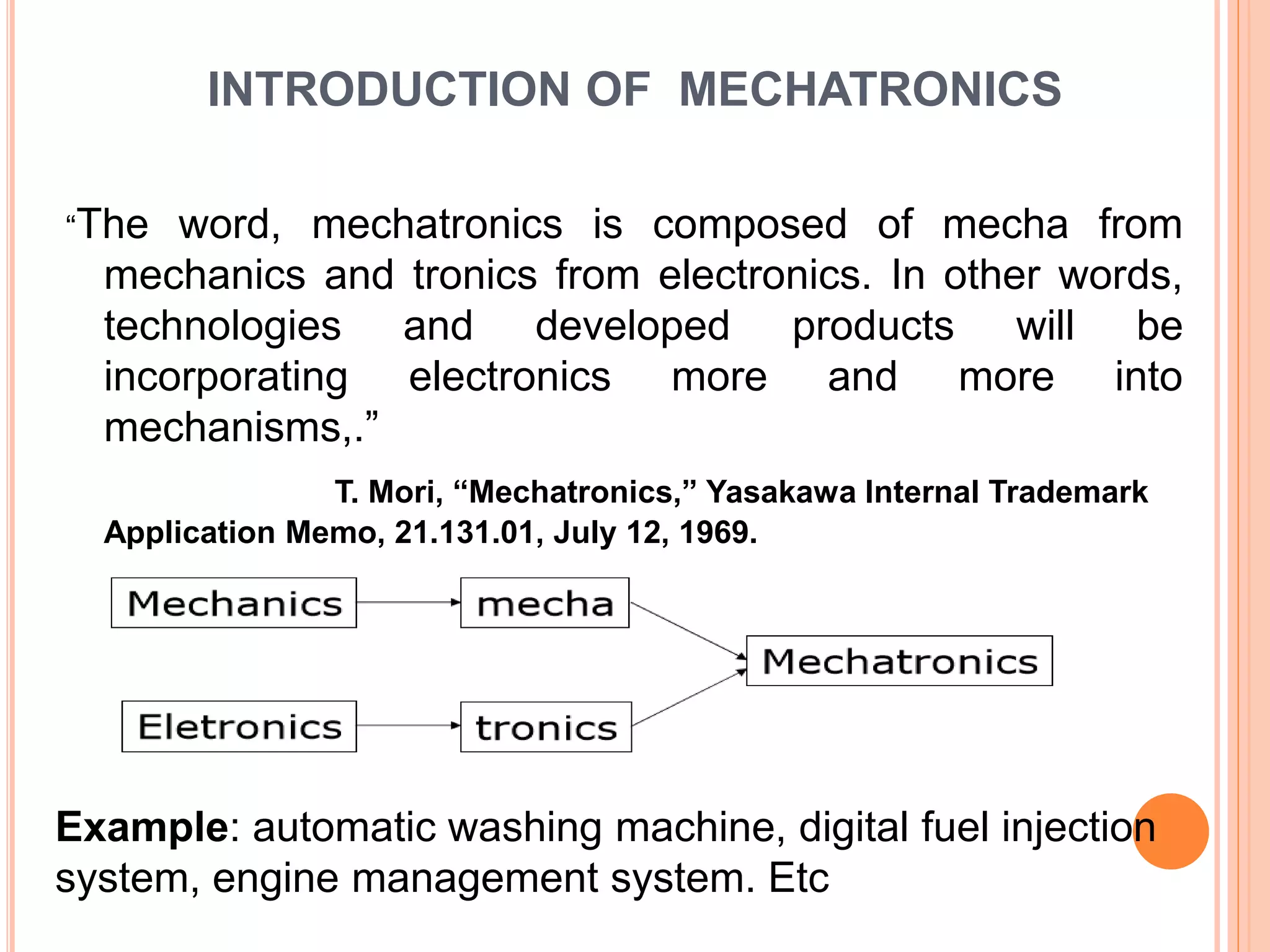
“The word, mechatronics is composed of mecha from
mechanics and tronics from electronics. In other words,
technologies and developed products will be
incorporating electronics more and more into
mechanisms,.”
T. Mori, “Mechatronics,” Yasakawa Internal Trademark
Application Memo, 21.131.01, July 12, 1969.
Example: automatic washing machine, digital fuel injection
system, engine management system. Etc
“Integration of electronics, control engineering, and
mechanical engineering.”
W. Bolton, Mechatronics: Electronic Control Systems
in Mechanical Engineering, Longman, 1995.
• “Application of complex decision making to the operation
of physical systems.”
D. M. Auslander and C. J. Kempf, Mechatronics:
Mechanical System Interfacing, Prentice-Hall, 1996.
• “Synergistic integration of mechanical engineering with
electronics and intelligent computer control in the design
and manufacturing of industrial products and processes.”
F. Harshama, M. Tomizuka, and T. Fukuda,
“Mechatronics-what is it, why, and how?-and editorial,” IEEE/ASME Trans.
on Mechatronics, 1(1), 1-4, 1996
Multi-disciplinary scenario
 Mechatronics is the synergistic (Together) combination of mechanical
engineering, electronic engineering, control engineering and systems thinking in
the design of products and manufacturing processes”.
 Multi-disciplinary products are not new; they have been successfully designed
and used for many years. Most common is the electromechanical system.
 It employs a sequential design-by-discipline approach. For example in the
design of electromechanical system three stages of design are adopted.
 They are design of mechanical system, design of microelectronic system and
control system.
 Each design application follows the completion of the previous one.
 It‟s having so many drawbacks, to overcome this Mechatronics has been
developed and it uses concurrent engineering
Origin of Mechatronic system
 The word Mechatronics was coined by Japanese in the late 1970‟s to
describe the philosophy adopted in the design of subsystem of
electromechanical systems.
 The field of Mechatronics received the international recognitions only in
the last few years.
 The field has been derived by rapid progress in the field of
microelectronics.
 At R&D level the following areas have been recognized under
Mechatronics discipline.
1. Motion control actuators and sensors
2. Micro devices and optoelectronics
3. Robotics
4. Automotive systems
5. Modeling and design
6. System integration
7. Manufacturing
8. Vibration and noise control.
Evaluation of Mechatronics
The technology has evolved through several stages that
are termed as levels. The evolution levels of
Mechatronics are:
1. Primary level Mechatronics (first)
2. Secondary level Mechatronics (second)
3. Tertiary level Mechatronics (third)
4. Quaternary level Mechatronics (fourth)
Primary level Mechatronics (first)
 In the early days Mechatronics products were at primary level
containing devices such as sensors, and actuators that integrated
electrical signals with mechanical action at the basic control level.
Examples: electrically controlled fluid valves
Secondary level Mechatronics (second)
 This level integrates microelectronics into electrically controlled
devices.
Examples: cassette player.
Tertiary level Mechatronics (third)
Mechatronics system at this level is called ‘smart system’
 The control strategy includes microelectronics, microprocessor and other
application specific integrated circuits‟ (ASIC).
Examples: DVD player, CD drives, automatic washing machine, CD
drives, etc
Quaternary level Mechatronics (fourth)
This level includes intelligent control in Mechatronics system. The level
attempts to improve smartness a step ahead by introducing intelligence and
fault detection and isolation (FDI) capability system.
Examples: artificial neural network and fuzzy logic technologies.
Advantages of Mechatronics
1. The products produced are cost effective and very good
quality.
2. High degree of flexibility
3. Greater extent of machine utilization
4. Greater productivity
5. High life expected by proper maintenance.
6. The integration of sensor and control system in a
complex system reduces capital expenses
Disadvantages:
1. Higher initial cost of the system
2. Imperative to have Knowledge of different engineering fields for design and
implementation.
3. It is expenses to incorporate Mechatronics approaches to existing/old
systems
. 4. Specific problem of various systems will have to be addressed separately
and properly
Characteristics Of Mechatronic System
1. High quality product.
2. Safe.
3. Low cost.
4. Portable produced quickly
5. Serviceability, maintainability and upgradeability.
Mechatronics Applications
• Smart consumer products: home security, camera, microwave
oven, toaster, dish washer, laundry washer-dryer, climate control
units, etc.
• Medical: implant-devices, assisted surgery, etc.
• Defense: unmanned air, ground, and underwater vehicles, smart
munitions, jet engines, etc.
• Manufacturing: robotics, machines, processes, etc.
• Automotive: climate control, antilock brake, active suspension,
cruise control, air bags, engine management, safety, etc.
• Network-centric, distributed systems: distributed robotics,
telerobotics, intelligent highways, etc
PROCESS CONTROL AUTOMATION
Automatic control has played a vital role in the advance of
engineering and science. In addition to its extreme importance
in space-vehicle systems, robotic systems and the like,
automatic control has become an important and integral part
of modern manufacturing and industrial processes.
- A process – is the transformation of a set of inputs, which
may be material, actions, methods and operations into
desired outputs in the form of a product.
- Control - means measurement of the performance of a
process and the feedback required and corrective actions
where necessary.
- Automation – Automation means reductions in the use of
direct labour.
Advantages of Automation include:
• Consistency and accuracy in the positioning of moving
parts of an equipment.
• A more consistent product.
• The more economic use of existing plant by saving of
fuel/and or electrical energy.
• The release of skilled personnel for other productive work
.
• Reduction of physical effort with consequent reduction of
fatigue and boredom
• Improved working conditions.
Limitations of automation:
– Initial cost is high
– power fluctuations,
– Lack of skilled personnel etc.
Basic steps in process control are:
• Measurement of the process variable;
• Evaluation and comparison with desired level; and
• Control of the required level of the parameter involved
Definition of some terms in process control
• Controller – A device that measures a variable condition
(Temperature, pressure, humidity, moisture content) like
thermostats, humidistat or pressure controllers.
• Control system – consist of controller, controlled device
and source of energy or input.
• Controlled device – it reacts to the signal received from a
controller and varied the flow of the controlled agents.
motor driving a pump, fan etc.
• Control agents – the medium being manipulated by the
action of controlled device e.g. air or gas.
• Controlled variables – are system parameters which are
under control e.g. Temperature, pressure, humidity etc.
• Manipulated variable – is the quantity or condition that is
varied by the controller so as to affect the value of the
controlled variable.
• Plant – This may be a piece of equipment or a set of
machine parts functioning together, the purpose of which is
to perform a particular operation.
• Disturbances – A disturbance is a signal that tends to
adversely affect the value of the output of a system.
THANK YOU

mechatronics ,Process control & automation

  • 1.
    MECHATRONICS BY NAVIN H. YADAV Departmentof Mechanical Engineering , KAUTILYA INSTITUTE OF TECHNOLOGY & ENGINEERING SCHOOL OF MANAGEMENT
  • 2.
    CONTENT 1. Introduction ofmechatronics 2. Multi-disciplinary scenario. 3. Origin of Mechatronic system. 4. Evaluation of Mechatronics. 5. Advantages of Mechatronic Systems 6. Disadvantages of Mechatronic Systems. 7. Characteristics of Mechatronic system 8. Applications of Mechatronic systems 9. Process control automation 10. Advantages Of Automation 11. Limitations Of Automation 12. Basic Steps In Process Control 13. Definition Of Some Terms In Process Control
  • 3.
    INTRODUCTION OF MECHATRONICS “Theword, mechatronics is composed of mecha from mechanics and tronics from electronics. In other words, technologies and developed products will be incorporating electronics more and more into mechanisms,.” T. Mori, “Mechatronics,” Yasakawa Internal Trademark Application Memo, 21.131.01, July 12, 1969. Example: automatic washing machine, digital fuel injection system, engine management system. Etc
  • 4.
    “Integration of electronics,control engineering, and mechanical engineering.” W. Bolton, Mechatronics: Electronic Control Systems in Mechanical Engineering, Longman, 1995. • “Application of complex decision making to the operation of physical systems.” D. M. Auslander and C. J. Kempf, Mechatronics: Mechanical System Interfacing, Prentice-Hall, 1996. • “Synergistic integration of mechanical engineering with electronics and intelligent computer control in the design and manufacturing of industrial products and processes.” F. Harshama, M. Tomizuka, and T. Fukuda, “Mechatronics-what is it, why, and how?-and editorial,” IEEE/ASME Trans. on Mechatronics, 1(1), 1-4, 1996
  • 5.
    Multi-disciplinary scenario  Mechatronicsis the synergistic (Together) combination of mechanical engineering, electronic engineering, control engineering and systems thinking in the design of products and manufacturing processes”.  Multi-disciplinary products are not new; they have been successfully designed and used for many years. Most common is the electromechanical system.  It employs a sequential design-by-discipline approach. For example in the design of electromechanical system three stages of design are adopted.  They are design of mechanical system, design of microelectronic system and control system.  Each design application follows the completion of the previous one.  It‟s having so many drawbacks, to overcome this Mechatronics has been developed and it uses concurrent engineering
  • 6.
    Origin of Mechatronicsystem  The word Mechatronics was coined by Japanese in the late 1970‟s to describe the philosophy adopted in the design of subsystem of electromechanical systems.  The field of Mechatronics received the international recognitions only in the last few years.  The field has been derived by rapid progress in the field of microelectronics.  At R&D level the following areas have been recognized under Mechatronics discipline. 1. Motion control actuators and sensors 2. Micro devices and optoelectronics 3. Robotics 4. Automotive systems 5. Modeling and design 6. System integration 7. Manufacturing 8. Vibration and noise control.
  • 7.
    Evaluation of Mechatronics Thetechnology has evolved through several stages that are termed as levels. The evolution levels of Mechatronics are: 1. Primary level Mechatronics (first) 2. Secondary level Mechatronics (second) 3. Tertiary level Mechatronics (third) 4. Quaternary level Mechatronics (fourth)
  • 8.
    Primary level Mechatronics(first)  In the early days Mechatronics products were at primary level containing devices such as sensors, and actuators that integrated electrical signals with mechanical action at the basic control level. Examples: electrically controlled fluid valves Secondary level Mechatronics (second)  This level integrates microelectronics into electrically controlled devices. Examples: cassette player.
  • 9.
    Tertiary level Mechatronics(third) Mechatronics system at this level is called ‘smart system’  The control strategy includes microelectronics, microprocessor and other application specific integrated circuits‟ (ASIC). Examples: DVD player, CD drives, automatic washing machine, CD drives, etc Quaternary level Mechatronics (fourth) This level includes intelligent control in Mechatronics system. The level attempts to improve smartness a step ahead by introducing intelligence and fault detection and isolation (FDI) capability system. Examples: artificial neural network and fuzzy logic technologies.
  • 10.
    Advantages of Mechatronics 1.The products produced are cost effective and very good quality. 2. High degree of flexibility 3. Greater extent of machine utilization 4. Greater productivity 5. High life expected by proper maintenance. 6. The integration of sensor and control system in a complex system reduces capital expenses
  • 11.
    Disadvantages: 1. Higher initialcost of the system 2. Imperative to have Knowledge of different engineering fields for design and implementation. 3. It is expenses to incorporate Mechatronics approaches to existing/old systems . 4. Specific problem of various systems will have to be addressed separately and properly
  • 12.
    Characteristics Of MechatronicSystem 1. High quality product. 2. Safe. 3. Low cost. 4. Portable produced quickly 5. Serviceability, maintainability and upgradeability.
  • 13.
    Mechatronics Applications • Smartconsumer products: home security, camera, microwave oven, toaster, dish washer, laundry washer-dryer, climate control units, etc. • Medical: implant-devices, assisted surgery, etc. • Defense: unmanned air, ground, and underwater vehicles, smart munitions, jet engines, etc. • Manufacturing: robotics, machines, processes, etc. • Automotive: climate control, antilock brake, active suspension, cruise control, air bags, engine management, safety, etc. • Network-centric, distributed systems: distributed robotics, telerobotics, intelligent highways, etc
  • 14.
    PROCESS CONTROL AUTOMATION Automaticcontrol has played a vital role in the advance of engineering and science. In addition to its extreme importance in space-vehicle systems, robotic systems and the like, automatic control has become an important and integral part of modern manufacturing and industrial processes.
  • 15.
    - A process– is the transformation of a set of inputs, which may be material, actions, methods and operations into desired outputs in the form of a product. - Control - means measurement of the performance of a process and the feedback required and corrective actions where necessary. - Automation – Automation means reductions in the use of direct labour.
  • 16.
    Advantages of Automationinclude: • Consistency and accuracy in the positioning of moving parts of an equipment. • A more consistent product. • The more economic use of existing plant by saving of fuel/and or electrical energy. • The release of skilled personnel for other productive work . • Reduction of physical effort with consequent reduction of fatigue and boredom • Improved working conditions.
  • 17.
    Limitations of automation: –Initial cost is high – power fluctuations, – Lack of skilled personnel etc. Basic steps in process control are: • Measurement of the process variable; • Evaluation and comparison with desired level; and • Control of the required level of the parameter involved
  • 18.
    Definition of someterms in process control • Controller – A device that measures a variable condition (Temperature, pressure, humidity, moisture content) like thermostats, humidistat or pressure controllers. • Control system – consist of controller, controlled device and source of energy or input. • Controlled device – it reacts to the signal received from a controller and varied the flow of the controlled agents. motor driving a pump, fan etc. • Control agents – the medium being manipulated by the action of controlled device e.g. air or gas.
  • 19.
    • Controlled variables– are system parameters which are under control e.g. Temperature, pressure, humidity etc. • Manipulated variable – is the quantity or condition that is varied by the controller so as to affect the value of the controlled variable. • Plant – This may be a piece of equipment or a set of machine parts functioning together, the purpose of which is to perform a particular operation. • Disturbances – A disturbance is a signal that tends to adversely affect the value of the output of a system.
  • 20.