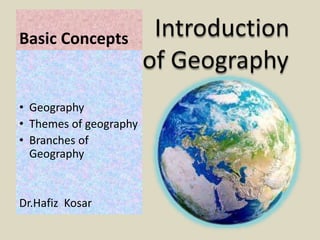
Basic Concepts
• Geography
• Themes of geography
• Branches of
Geography
Dr.Hafiz Kosar
What Defines Geography?
• It is the study of the location of people and places
and the patterns in which they are arranged on
earth.
• Physical Geography – focuses on physical patterns
of Earth
• Human Geography – focuses on the political,
economic, or cultural aspects of human behavior.
• Understanding how physical and human geography
interact and impact each other is largely what
geographers focus on.
• Its the interaction between people and their
environment!`
Themes of Geography
The study of geography includes specific topic such
as landforms, climates, population and culture.
Geography also entails a number of unifying
interrelated concepts. Among the most important
concepts are the five themes of geography.
• 1. Location
• 2. Place
• 3.Human- Environmental interaction
• 4. Movement
• 5. Region
Branches of Geography
Geography is divided into two main branches:
HUMAN GEOGRAPHY and PHYSICAL GEOGRAPHY.
HUMAN GEOGRAPHY : it mainly covers studies of the human
race.
 ECONOMIC GEOGRAPHY • this branch normally study the
manner in which products are usually produced and
consequently distributed in their respective, they also study
the way in which wealth is distributed in various regions
 POPULATION GEOGRAPHY • the study of the patterns of a
group of people with regards to birth, marriage & death as is
the case with demography
 MEDICAL GEOGRAPHY • In this branch, the patterns in which
particular diseases spread. are usually studied.
Branches of Geography
• PHYSICAL GEOGRAPHY • the branch of natural science which
deals with the study of processes and patterns in the natural
environment.
EXAMPLES OF PHYSICAL GEOGRAPHY • understanding the
surface of the Earth and the processes by which it is shaped.
Hydrology- concerned with the amounts and quality of water
moving and accumulating on the land surface
Glaciology- the study of glacier and ice sheets
Climatology- weather conditions averaged over a long period of
time.
Meteorology- scientific study of the atmosphere that focuses on
weather processes and short term forecasting.
Pedology- is the study of soils in their natural environment.

Basic Concepts Of Geography.pptx

  • 1.
    Basic Concepts • Geography •Themes of geography • Branches of Geography Dr.Hafiz Kosar
  • 2.
    What Defines Geography? •It is the study of the location of people and places and the patterns in which they are arranged on earth. • Physical Geography – focuses on physical patterns of Earth • Human Geography – focuses on the political, economic, or cultural aspects of human behavior. • Understanding how physical and human geography interact and impact each other is largely what geographers focus on. • Its the interaction between people and their environment!`
  • 3.
    Themes of Geography Thestudy of geography includes specific topic such as landforms, climates, population and culture. Geography also entails a number of unifying interrelated concepts. Among the most important concepts are the five themes of geography. • 1. Location • 2. Place • 3.Human- Environmental interaction • 4. Movement • 5. Region
  • 4.
    Branches of Geography Geographyis divided into two main branches: HUMAN GEOGRAPHY and PHYSICAL GEOGRAPHY. HUMAN GEOGRAPHY : it mainly covers studies of the human race.  ECONOMIC GEOGRAPHY • this branch normally study the manner in which products are usually produced and consequently distributed in their respective, they also study the way in which wealth is distributed in various regions  POPULATION GEOGRAPHY • the study of the patterns of a group of people with regards to birth, marriage & death as is the case with demography  MEDICAL GEOGRAPHY • In this branch, the patterns in which particular diseases spread. are usually studied.
  • 5.
    Branches of Geography •PHYSICAL GEOGRAPHY • the branch of natural science which deals with the study of processes and patterns in the natural environment. EXAMPLES OF PHYSICAL GEOGRAPHY • understanding the surface of the Earth and the processes by which it is shaped. Hydrology- concerned with the amounts and quality of water moving and accumulating on the land surface Glaciology- the study of glacier and ice sheets Climatology- weather conditions averaged over a long period of time. Meteorology- scientific study of the atmosphere that focuses on weather processes and short term forecasting. Pedology- is the study of soils in their natural environment.