B. KALPANA
TECHNIQUES FOR
DEMAND FORECASTING
HRP
There are several techniques use for
forecasting
1. Managerial Judgment
2. Trend Analysis
3. Ratio Analysis
4. Scatter Plot
5. Computerized Forecast
6. Work Study Technique
7. Delphi technique
8. Regression Analysis
9. Econometric Models
cont…..
10. Nominal Group Technique
11. H R Budget and Planning Analysis
12. Scenario Forecasting
13. Workforce Analysis
14. Workload Analysis
15. Job Analysis
MANAGERIAL JUDGMENT
This techniques is very simple. In this, manager sit together, discuss and
arrive at a figure which would be the future demand for labor. The
technique may involve a ‘bottom-to-top’ or ‘top-to-bottom’ approach.
TOP DOWN
APPROACH
BOTTOM UP
APPROACH
PARTICIPAT
IVE
APPROACH
TREND ANALYSIS
Method which forecast employments requirements
on the basis of some organizational index and is one
of the most commonly used approaches for
projecting HR demand.
1. Business Factor Annual Volume of Sales. (N.U)
2. Total Number of Employees.
3. Compare the Productivity Ratio.
4. Calculate Human Resources demand.
5. Forecasted Human Resource Requirements.
RATIO ANALYSIS
Another approach , Ratio analysis , means making forecasts based on the
ratio between.
1. Some causal factor (like sales volume)
2. The number of employees required
For example: no of workers: volume of sales (1:150)
An organization needs= 1,50,000 units
When 150 units are produced by 1 man
1,50,000units will be produced by 1/150*150000=1000 workers
SCATTER PLOT
A graphical method used to help identify the
relationship between two variables. A scatter plot is
another option. HR planner can use scatter plots to
determine whether two factors – measure of business
activity and staffing levels are related.
COMPUTERIZED FORECAST
The determination of future staff needs by projecting a
firm’s sales, volume of production, and personnel
required to maintain this required volume of output,
using computers and software packages. Employers also
used computerized system to personnel requirements .
WORK STUDY TECHNIQUE
It is used when, what length of operations and number
of labour is required?
Example:
Total amount of production required= 4,00,000units
Time required to produce 1 unit = 2 hour
Work ability per employee = 1600hr/annum
Time required to produce 4 lakh unit = 4,00,000*2
hour= 8,00,000
hour
Total workers needed to produce 4 lakh
unit=8,00,000/1600=500 workers.
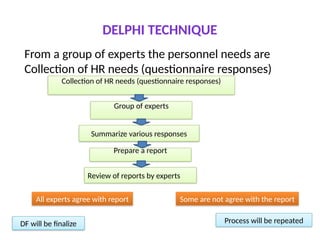
DELPHI TECHNIQUE
From a group of experts the personnel needs are
Collection of HR needs (questionnaire responses)
Group of experts
Summarize various responses
Prepare a report
Review of reports by experts
All experts agree with report Some are not agree with the report
DF will be finalize Process will be repeated
REGRESSION ANALYSIS
 Regression analysis identifies the movement of two or more
inter-related series.
 It is used to measure the changes in a variable as a result of
changes in other variables.
 Regression analysis determines the relationship between Y
variables such as the number of employees and X variables
such as service delivery by actually measuring the
relationship that existed in the past.
 Use of the method begins with a series of observation each
costing of a value for the Y variable plus a value for each X
variable.
ECONOMETRIC MODELS
 Econometric models for estimation of manpower
requirement differ from the statistical methods.
 Past statistical data are analyzed in the hope that
it will prove possible to describe precisely the
relationships between a number of variables in
mathematical and statistical terms.
SCENARIO FORECASTING
Scenario techniques is used to explore the likelihood of
possible future developments and changes and to
identify the interaction of uncertain future trends and
events.
Preparation of Background
Selection of Critical Indicators
Establishing Past Behavior of Indicators
Verification of Potential Future Events
Forecasting the indicators
Writing of scenarios
JOB ANALYSIS
 Job analysis helps in finding out the abilities or
skills required to do the jobs efficiently.
 A detailed study of jobs is usually made to
identify the qualification and experience required
for them.
THANK YOU

DEMAND FORECASTING TECHNIQUES-HUMAN RESOURCE PLANNING.pptx

  • 1.
  • 2.
    There are severaltechniques use for forecasting 1. Managerial Judgment 2. Trend Analysis 3. Ratio Analysis 4. Scatter Plot 5. Computerized Forecast 6. Work Study Technique 7. Delphi technique 8. Regression Analysis 9. Econometric Models cont…..
  • 3.
    10. Nominal GroupTechnique 11. H R Budget and Planning Analysis 12. Scenario Forecasting 13. Workforce Analysis 14. Workload Analysis 15. Job Analysis
  • 4.
    MANAGERIAL JUDGMENT This techniquesis very simple. In this, manager sit together, discuss and arrive at a figure which would be the future demand for labor. The technique may involve a ‘bottom-to-top’ or ‘top-to-bottom’ approach. TOP DOWN APPROACH BOTTOM UP APPROACH PARTICIPAT IVE APPROACH
  • 5.
    TREND ANALYSIS Method whichforecast employments requirements on the basis of some organizational index and is one of the most commonly used approaches for projecting HR demand. 1. Business Factor Annual Volume of Sales. (N.U) 2. Total Number of Employees. 3. Compare the Productivity Ratio. 4. Calculate Human Resources demand. 5. Forecasted Human Resource Requirements.
  • 6.
    RATIO ANALYSIS Another approach, Ratio analysis , means making forecasts based on the ratio between. 1. Some causal factor (like sales volume) 2. The number of employees required For example: no of workers: volume of sales (1:150) An organization needs= 1,50,000 units When 150 units are produced by 1 man 1,50,000units will be produced by 1/150*150000=1000 workers
  • 7.
    SCATTER PLOT A graphicalmethod used to help identify the relationship between two variables. A scatter plot is another option. HR planner can use scatter plots to determine whether two factors – measure of business activity and staffing levels are related.
  • 8.
    COMPUTERIZED FORECAST The determinationof future staff needs by projecting a firm’s sales, volume of production, and personnel required to maintain this required volume of output, using computers and software packages. Employers also used computerized system to personnel requirements .
  • 9.
    WORK STUDY TECHNIQUE Itis used when, what length of operations and number of labour is required? Example: Total amount of production required= 4,00,000units Time required to produce 1 unit = 2 hour Work ability per employee = 1600hr/annum Time required to produce 4 lakh unit = 4,00,000*2 hour= 8,00,000 hour Total workers needed to produce 4 lakh unit=8,00,000/1600=500 workers.
  • 10.
    DELPHI TECHNIQUE From agroup of experts the personnel needs are Collection of HR needs (questionnaire responses) Collection of HR needs (questionnaire responses) Group of experts Summarize various responses Prepare a report Review of reports by experts All experts agree with report Some are not agree with the report DF will be finalize Process will be repeated
  • 11.
    REGRESSION ANALYSIS  Regressionanalysis identifies the movement of two or more inter-related series.  It is used to measure the changes in a variable as a result of changes in other variables.  Regression analysis determines the relationship between Y variables such as the number of employees and X variables such as service delivery by actually measuring the relationship that existed in the past.  Use of the method begins with a series of observation each costing of a value for the Y variable plus a value for each X variable.
  • 12.
    ECONOMETRIC MODELS  Econometricmodels for estimation of manpower requirement differ from the statistical methods.  Past statistical data are analyzed in the hope that it will prove possible to describe precisely the relationships between a number of variables in mathematical and statistical terms.
  • 13.
    SCENARIO FORECASTING Scenario techniquesis used to explore the likelihood of possible future developments and changes and to identify the interaction of uncertain future trends and events. Preparation of Background Selection of Critical Indicators Establishing Past Behavior of Indicators Verification of Potential Future Events Forecasting the indicators Writing of scenarios
  • 14.
    JOB ANALYSIS  Jobanalysis helps in finding out the abilities or skills required to do the jobs efficiently.  A detailed study of jobs is usually made to identify the qualification and experience required for them.
  • 15.