Management Skills
Lecture - 9
Facilitator- Seenam Afridi
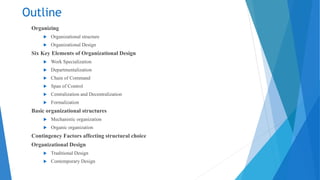
Outline
Organizing
 Organizational structure
 Organizational Design
Six Key Elements of Organizational Design
 Work Specialization
 Departmentalization
 Chain of Command
 Span of Control
 Centralization and Decentralization
 Formalization
Basic organizational structures
 Mechanistic organization
 Organic organization
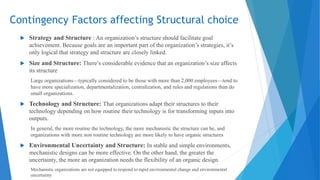
Contingency Factors affecting structural choice
Organizational Design
 Traditional Design
 Contemporary Design
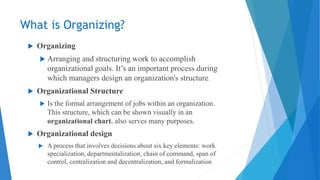
What is Organizing?
 Organizing
 Arranging and structuring work to accomplish
organizational goals. It’s an important process during
which managers design an organization's structure.
 Organizational Structure
 Is the formal arrangement of jobs within an organization.
This structure, which can be shown visually in an
organizational chart, also serves many purposes.
 Organizational design
 A process that involves decisions about six key elements: work
specialization, departmentalization, chain of command, span of
control, centralization and decentralization, and formalization
Six Elements of Organizational Design
1. Work Specialization
• Which is dividing work activities into separate job tasks.
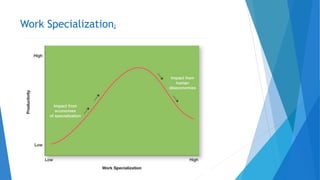
• Individual employees “specialize” in doing part of an activity
rather than the entire activity in order to increase work output.
• It’s also known as division of labor.
• Work specialization makes efficient use of the diversity of skills
that workers have.
• E.g McDonald’s uses high work specialization to get its
products made and delivered to customers efficiently and
quickly— that’s why it’s called “fast” food.
4
Work Specialization:
Six Elements of Organizational Design
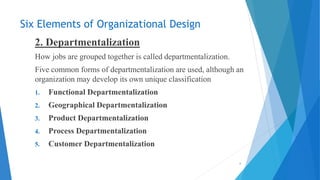
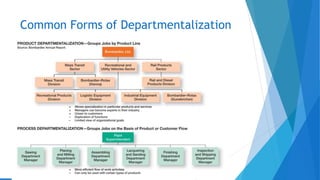
2. Departmentalization
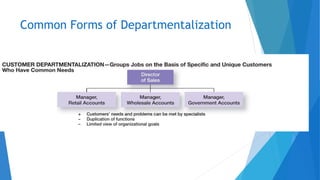
How jobs are grouped together is called departmentalization.
Five common forms of departmentalization are used, although an
organization may develop its own unique classification
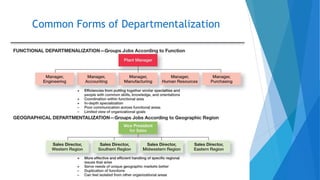
1. Functional Departmentalization
2. Geographical Departmentalization
3. Product Departmentalization
4. Process Departmentalization
5. Customer Departmentalization
6
Common Forms of Departmentalization
Six Elements of Organizational Design
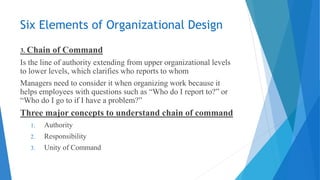
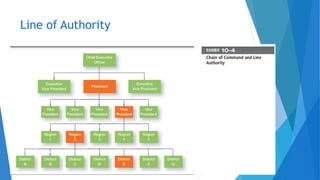
3. Chain of Command
Is the line of authority extending from upper organizational levels
to lower levels, which clarifies who reports to whom
Managers need to consider it when organizing work because it
helps employees with questions such as “Who do I report to?” or
“Who do I go to if I have a problem?”
Three major concepts to understand chain of command
1. Authority
2. Responsibility
3. Unity of Command
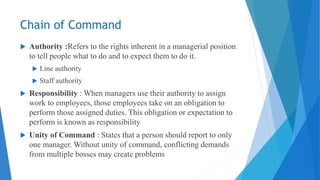
Chain of Command
 Authority :Refers to the rights inherent in a managerial position
to tell people what to do and to expect them to do it.
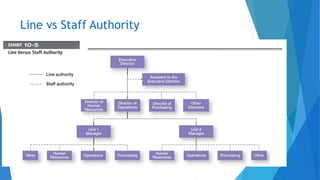
 Line authority
 Staff authority
 Responsibility : When managers use their authority to assign
work to employees, those employees take on an obligation to
perform those assigned duties. This obligation or expectation to
perform is known as responsibility
 Unity of Command : States that a person should report to only
one manager. Without unity of command, conflicting demands
from multiple bosses may create problems
Line of Authority
Line vs Staff Authority
Six Elements of Organizational Design
4. Span of Control
 How many employees can a manager
efficiently and effectively manage?
 The traditional view was that managers
could not—and should not— directly
supervise more than five or six subordinates
 The contemporary view of span of control
recognizes that there is no magic number.
Many factors influence the number of
employees that a manager can efficiently
and effectively manage.
 These factors include the skills and abilities
of the manager and the employees, and the
characteristics of the work being done.
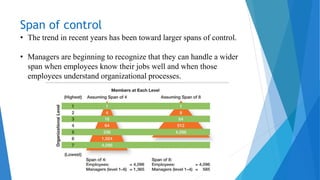
Span of control
• The trend in recent years has been toward larger spans of control.
• Managers are beginning to recognize that they can handle a wider
span when employees know their jobs well and when those
employees understand organizational processes.
Six Elements of Organizational Design
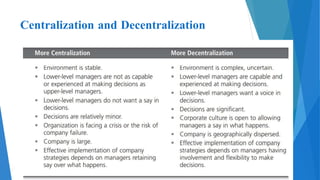
5. Centralization and Decentralization
 Centralization is the degree to which decision making
takes place at upper levels of the organization.
If top managers make key decisions with little input from
below, then the organization is more centralized.
 Decentralization is the more that lower-level
employees provide input or actually make decisions.
Centralization and Decentralization
Six Elements of Organizational Design
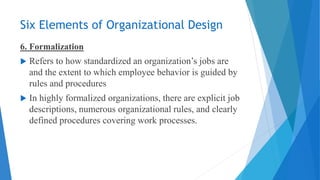
6. Formalization
 Refers to how standardized an organization’s jobs are
and the extent to which employee behavior is guided by
rules and procedures
 In highly formalized organizations, there are explicit job
descriptions, numerous organizational rules, and clearly
defined procedures covering work processes.
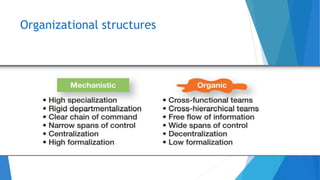
Organizational structures
 Basic organizational design revolves around two organizational forms
Mechanistic organization:
Was the natural result of combining the six elements of structure also
called as bureaucracy.
Organic organization
Is a highly adaptive form that is as loose and flexible as the mechanistic
organization is rigid and stable
Organizational structures
Contingency Factors affecting Structural choice
Appropriate structure depends on four contingency variables:
1. The organization’s strategy
2. Size
3. Technology
4. Degree of environmental uncertainty.
Contingency Factors affecting Structural choice
 Strategy and Structure : An organization’s structure should facilitate goal
achievement. Because goals are an important part of the organization’s strategies, it’s
only logical that strategy and structure are closely linked.
 Size and Structure: There’s considerable evidence that an organization’s size affects
its structure
Large organizations—typically considered to be those with more than 2,000 employees—tend to
have more specialization, departmentalization, centralization, and rules and regulations than do
small organizations.
 Technology and Structure: That organizations adapt their structures to their
technology depending on how routine their technology is for transforming inputs into
outputs.
In general, the more routine the technology, the more mechanistic the structure can be, and
organizations with more non routine technology are more likely to have organic structures
 Environmental Uncertainty and Structure: In stable and simple environments,
mechanistic designs can be more effective. On the other hand, the greater the
uncertainty, the more an organization needs the flexibility of an organic design.
Mechanistic organizations are not equipped to respond to rapid environmental change and environmental
uncertainty
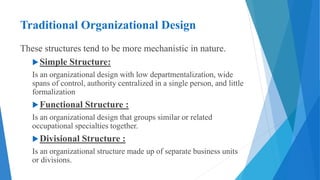
Traditional Organizational Design
These structures tend to be more mechanistic in nature.
Simple Structure:
Is an organizational design with low departmentalization, wide
spans of control, authority centralized in a single person, and little
formalization
Functional Structure :
Is an organizational design that groups similar or related
occupational specialties together.
Divisional Structure :
Is an organizational structure made up of separate business units
or divisions.
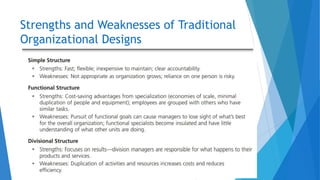
Strengths and Weaknesses of Traditional
Organizational Designs
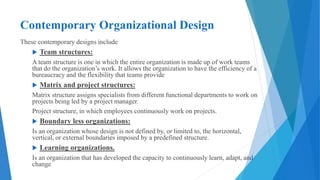
Contemporary Organizational Design
These contemporary designs include
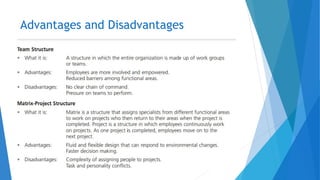
 Team structures:
A team structure is one in which the entire organization is made up of work teams
that do the organization’s work. It allows the organization to have the efficiency of a
bureaucracy and the flexibility that teams provide
 Matrix and project structures:
Matrix structure assigns specialists from different functional departments to work on
projects being led by a project manager.
Project structure, in which employees continuously work on projects.
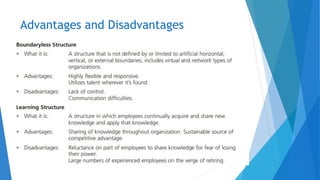
 Boundary less organizations:
Is an organization whose design is not defined by, or limited to, the horizontal,
vertical, or external boundaries imposed by a predefined structure.
 Learning organizations.
Is an organization that has developed the capacity to continuously learn, adapt, and
change
Advantages and Disadvantages

Management skills- 9.pptx

  • 1.
    Management Skills Lecture -9 Facilitator- Seenam Afridi
  • 2.
    Outline Organizing  Organizational structure Organizational Design Six Key Elements of Organizational Design  Work Specialization  Departmentalization  Chain of Command  Span of Control  Centralization and Decentralization  Formalization Basic organizational structures  Mechanistic organization  Organic organization Contingency Factors affecting structural choice Organizational Design  Traditional Design  Contemporary Design
  • 3.
    What is Organizing? Organizing  Arranging and structuring work to accomplish organizational goals. It’s an important process during which managers design an organization's structure.  Organizational Structure  Is the formal arrangement of jobs within an organization. This structure, which can be shown visually in an organizational chart, also serves many purposes.  Organizational design  A process that involves decisions about six key elements: work specialization, departmentalization, chain of command, span of control, centralization and decentralization, and formalization
  • 4.
    Six Elements ofOrganizational Design 1. Work Specialization • Which is dividing work activities into separate job tasks. • Individual employees “specialize” in doing part of an activity rather than the entire activity in order to increase work output. • It’s also known as division of labor. • Work specialization makes efficient use of the diversity of skills that workers have. • E.g McDonald’s uses high work specialization to get its products made and delivered to customers efficiently and quickly— that’s why it’s called “fast” food. 4
  • 5.
  • 6.
    Six Elements ofOrganizational Design 2. Departmentalization How jobs are grouped together is called departmentalization. Five common forms of departmentalization are used, although an organization may develop its own unique classification 1. Functional Departmentalization 2. Geographical Departmentalization 3. Product Departmentalization 4. Process Departmentalization 5. Customer Departmentalization 6
  • 7.
    Common Forms ofDepartmentalization
  • 8.
    Common Forms ofDepartmentalization
  • 9.
    Common Forms ofDepartmentalization
  • 10.
    Six Elements ofOrganizational Design 3. Chain of Command Is the line of authority extending from upper organizational levels to lower levels, which clarifies who reports to whom Managers need to consider it when organizing work because it helps employees with questions such as “Who do I report to?” or “Who do I go to if I have a problem?” Three major concepts to understand chain of command 1. Authority 2. Responsibility 3. Unity of Command
  • 11.
    Chain of Command Authority :Refers to the rights inherent in a managerial position to tell people what to do and to expect them to do it.  Line authority  Staff authority  Responsibility : When managers use their authority to assign work to employees, those employees take on an obligation to perform those assigned duties. This obligation or expectation to perform is known as responsibility  Unity of Command : States that a person should report to only one manager. Without unity of command, conflicting demands from multiple bosses may create problems
  • 12.
  • 13.
    Line vs StaffAuthority
  • 14.
    Six Elements ofOrganizational Design 4. Span of Control  How many employees can a manager efficiently and effectively manage?  The traditional view was that managers could not—and should not— directly supervise more than five or six subordinates  The contemporary view of span of control recognizes that there is no magic number. Many factors influence the number of employees that a manager can efficiently and effectively manage.  These factors include the skills and abilities of the manager and the employees, and the characteristics of the work being done.
  • 15.
    Span of control •The trend in recent years has been toward larger spans of control. • Managers are beginning to recognize that they can handle a wider span when employees know their jobs well and when those employees understand organizational processes.
  • 16.
    Six Elements ofOrganizational Design 5. Centralization and Decentralization  Centralization is the degree to which decision making takes place at upper levels of the organization. If top managers make key decisions with little input from below, then the organization is more centralized.  Decentralization is the more that lower-level employees provide input or actually make decisions.
  • 17.
  • 18.
    Six Elements ofOrganizational Design 6. Formalization  Refers to how standardized an organization’s jobs are and the extent to which employee behavior is guided by rules and procedures  In highly formalized organizations, there are explicit job descriptions, numerous organizational rules, and clearly defined procedures covering work processes.
  • 19.
    Organizational structures  Basicorganizational design revolves around two organizational forms Mechanistic organization: Was the natural result of combining the six elements of structure also called as bureaucracy. Organic organization Is a highly adaptive form that is as loose and flexible as the mechanistic organization is rigid and stable
  • 20.
  • 21.
    Contingency Factors affectingStructural choice Appropriate structure depends on four contingency variables: 1. The organization’s strategy 2. Size 3. Technology 4. Degree of environmental uncertainty.
  • 22.
    Contingency Factors affectingStructural choice  Strategy and Structure : An organization’s structure should facilitate goal achievement. Because goals are an important part of the organization’s strategies, it’s only logical that strategy and structure are closely linked.  Size and Structure: There’s considerable evidence that an organization’s size affects its structure Large organizations—typically considered to be those with more than 2,000 employees—tend to have more specialization, departmentalization, centralization, and rules and regulations than do small organizations.  Technology and Structure: That organizations adapt their structures to their technology depending on how routine their technology is for transforming inputs into outputs. In general, the more routine the technology, the more mechanistic the structure can be, and organizations with more non routine technology are more likely to have organic structures  Environmental Uncertainty and Structure: In stable and simple environments, mechanistic designs can be more effective. On the other hand, the greater the uncertainty, the more an organization needs the flexibility of an organic design. Mechanistic organizations are not equipped to respond to rapid environmental change and environmental uncertainty
  • 23.
    Traditional Organizational Design Thesestructures tend to be more mechanistic in nature. Simple Structure: Is an organizational design with low departmentalization, wide spans of control, authority centralized in a single person, and little formalization Functional Structure : Is an organizational design that groups similar or related occupational specialties together. Divisional Structure : Is an organizational structure made up of separate business units or divisions.
  • 24.
    Strengths and Weaknessesof Traditional Organizational Designs
  • 25.
    Contemporary Organizational Design Thesecontemporary designs include  Team structures: A team structure is one in which the entire organization is made up of work teams that do the organization’s work. It allows the organization to have the efficiency of a bureaucracy and the flexibility that teams provide  Matrix and project structures: Matrix structure assigns specialists from different functional departments to work on projects being led by a project manager. Project structure, in which employees continuously work on projects.  Boundary less organizations: Is an organization whose design is not defined by, or limited to, the horizontal, vertical, or external boundaries imposed by a predefined structure.  Learning organizations. Is an organization that has developed the capacity to continuously learn, adapt, and change
  • 26.
  • 27.