Flow-based programming
In Golang
25 April 2017
Thuc Le
Software Engineer
De nition
Flow-based Programing is a programing paradigm that de nes applications as networks of
black box processes which exchange data across prede ned connections by message
passing, where connections are speci ed externally to the processes.
- Paul Morrison
Core concepts
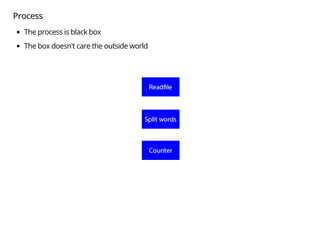
Process
The process is black box
The box doesn't care the outside world
Ports
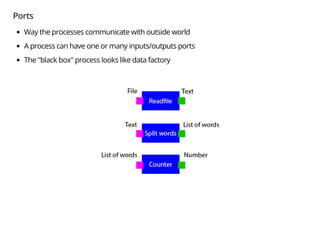
Way the processes communicate with outside world
A process can have one or many inputs/outputs ports
The "black box" process looks like data factory
Connection
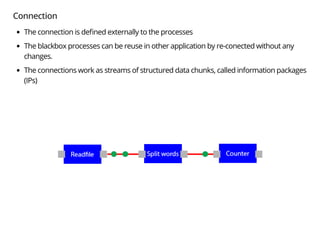
The connection is de ned externally to the processes
The blackbox processes can be reuse in other application by re-conected without any
changes.
The connections work as streams of structured data chunks, called information packages
(IPs)
Other notes:
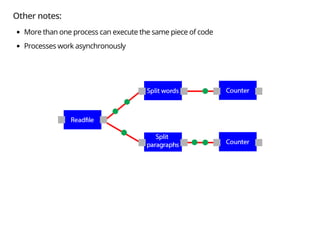
More than one process can execute the same piece of code
Processes work asynchronously
Bene ts:
Improve the work ow visualization
When develop the process, we focus on components development. It's easier for coding
and testing.
When develop the network, we focus on application's ow.
FBP applications generally run in less elapsed time than conventional programs
Drawback
Complex the simple logic
Take time of CPU to setup of the network of processes before running
Go ow
Go ow
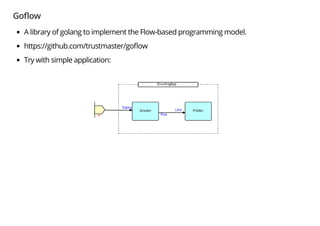
A library of golang to implement the Flow-based programming model.
https://github.com/trustmaster/go ow
Try with simple application:
Go ow - De ne processes
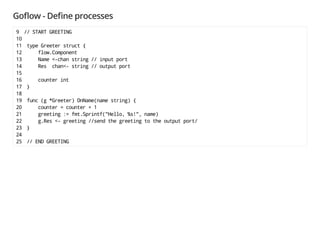
9 // START GREETING
10
11 type Greeter struct {
12 flow.Component
13 Name <-chan string // input port
14 Res chan<- string // output port
15
16 counter int
17 }
18
19 func (g *Greeter) OnName(name string) {
20 counter = counter + 1
21 greeting := fmt.Sprintf("Hello, %s!", name)
22 g.Res <- greeting //send the greeting to the output port/
23 }
24
25 // END GREETING
Go ow - De ne processes
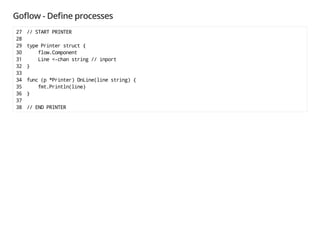
27 // START PRINTER
28
29 type Printer struct {
30 flow.Component
31 Line <-chan string // inport
32 }
33
34 func (p *Printer) OnLine(line string) {
35 fmt.Println(line)
36 }
37
38 // END PRINTER
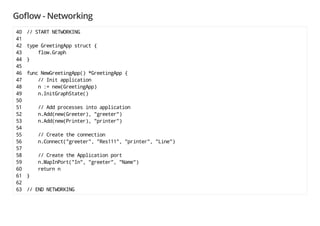
Go ow - Networking
40 // START NETWORKING
41
42 type GreetingApp struct {
43 flow.Graph
44 }
45
46 func NewGreetingApp() *GreetingApp {
47 // Init application
48 n := new(GreetingApp)
49 n.InitGraphState()
50
51 // Add processes into application
52 n.Add(new(Greeter), "greeter")
53 n.Add(new(Printer), "printer")
54
55 // Create the connection
56 n.Connect("greeter", "Res111", "printer", "Line")
57
58 // Create the Application port
59 n.MapInPort("In", "greeter", "Name")
60 return n
61 }
62
63 // END NETWORKING
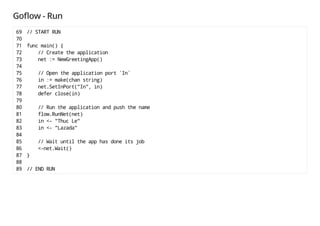
Go ow - Run
69 // START RUN
70
71 func main() {
72 // Create the application
73 net := NewGreetingApp()
74
75 // Open the application port `In`
76 in := make(chan string)
77 net.SetInPort("In", in)
78 defer close(in)
79
80 // Run the application and push the name
81 flow.RunNet(net)
82 in <- "Thuc Le"
83 in <- "Lazada"
84
85 // Wait until the app has done its job
86 <-net.Wait()
87 }
88
89 // END RUN
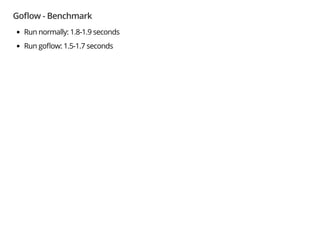
Go ow - Benchmark
Run normally: 1.8-1.9 seconds
Run go ow: 1.5-1.7 seconds
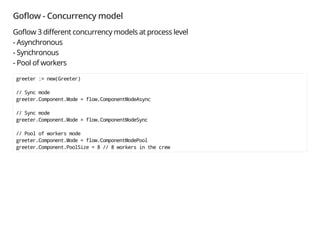
Go ow - Concurrency model
Go ow 3 di erent concurrency models at process level
- Asynchronous
- Synchronous
- Pool of workers
greeter := new(Greeter)
// Sync mode
greeter.Component.Mode = flow.ComponentModeAsync
// Sync mode
greeter.Component.Mode = flow.ComponentModeSync
// Pool of workers mode
greeter.Component.Mode = flow.ComponentModePool
greeter.Component.PoolSize = 8 // 8 workers in the crew
Go ow - State lock
Support built-in lock in process
type StateExample struct {
flow.Component
In1 <-chan string
// lock
StateLock *sync.Mutex
// state
counter int
buffer [32]string
}
func (p *StateExample) OnIn2(item String) {
// We can safely modify fields here
p.buffer = append(item, s)
p.counter++
}
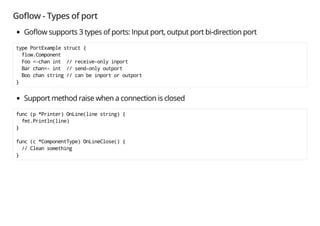
Go ow - Types of port
Go ow supports 3 types of ports: Input port, output port bi-direction port
type PortExample struct {
flow.Component
Foo <-chan int // receive-only inport
Bar chan<- int // send-only outport
Boo chan string // can be inport or outport
}
Support method raise when a connection is closed
func (p *Printer) OnLine(line string) {
fmt.Println(line)
}
func (c *ComponentType) OnLineClose() {
// Clean something
}
Thank you
Thuc Le
Software Engineer
ledongthuc@gmail.com(mailto:ledongthuc@gmail.com)
Flow based programming in golang

Flow based programming in golang

  • 1.
    Flow-based programming In Golang 25April 2017 Thuc Le Software Engineer
  • 2.
    De nition Flow-based Programingis a programing paradigm that de nes applications as networks of black box processes which exchange data across prede ned connections by message passing, where connections are speci ed externally to the processes. - Paul Morrison
  • 3.
  • 4.
    Process The process isblack box The box doesn't care the outside world
  • 5.
    Ports Way the processescommunicate with outside world A process can have one or many inputs/outputs ports The "black box" process looks like data factory
  • 6.
    Connection The connection isde ned externally to the processes The blackbox processes can be reuse in other application by re-conected without any changes. The connections work as streams of structured data chunks, called information packages (IPs)
  • 7.
    Other notes: More thanone process can execute the same piece of code Processes work asynchronously
  • 8.
    Bene ts: Improve thework ow visualization When develop the process, we focus on components development. It's easier for coding and testing. When develop the network, we focus on application's ow. FBP applications generally run in less elapsed time than conventional programs
  • 9.
    Drawback Complex the simplelogic Take time of CPU to setup of the network of processes before running
  • 10.
  • 11.
    Go ow A libraryof golang to implement the Flow-based programming model. https://github.com/trustmaster/go ow Try with simple application:
  • 12.
    Go ow -De ne processes 9 // START GREETING 10 11 type Greeter struct { 12 flow.Component 13 Name <-chan string // input port 14 Res chan<- string // output port 15 16 counter int 17 } 18 19 func (g *Greeter) OnName(name string) { 20 counter = counter + 1 21 greeting := fmt.Sprintf("Hello, %s!", name) 22 g.Res <- greeting //send the greeting to the output port/ 23 } 24 25 // END GREETING
  • 13.
    Go ow -De ne processes 27 // START PRINTER 28 29 type Printer struct { 30 flow.Component 31 Line <-chan string // inport 32 } 33 34 func (p *Printer) OnLine(line string) { 35 fmt.Println(line) 36 } 37 38 // END PRINTER
  • 14.
    Go ow -Networking 40 // START NETWORKING 41 42 type GreetingApp struct { 43 flow.Graph 44 } 45 46 func NewGreetingApp() *GreetingApp { 47 // Init application 48 n := new(GreetingApp) 49 n.InitGraphState() 50 51 // Add processes into application 52 n.Add(new(Greeter), "greeter") 53 n.Add(new(Printer), "printer") 54 55 // Create the connection 56 n.Connect("greeter", "Res111", "printer", "Line") 57 58 // Create the Application port 59 n.MapInPort("In", "greeter", "Name") 60 return n 61 } 62 63 // END NETWORKING
  • 15.
    Go ow -Run 69 // START RUN 70 71 func main() { 72 // Create the application 73 net := NewGreetingApp() 74 75 // Open the application port `In` 76 in := make(chan string) 77 net.SetInPort("In", in) 78 defer close(in) 79 80 // Run the application and push the name 81 flow.RunNet(net) 82 in <- "Thuc Le" 83 in <- "Lazada" 84 85 // Wait until the app has done its job 86 <-net.Wait() 87 } 88 89 // END RUN
  • 16.
    Go ow -Benchmark Run normally: 1.8-1.9 seconds Run go ow: 1.5-1.7 seconds
  • 17.
    Go ow -Concurrency model Go ow 3 di erent concurrency models at process level - Asynchronous - Synchronous - Pool of workers greeter := new(Greeter) // Sync mode greeter.Component.Mode = flow.ComponentModeAsync // Sync mode greeter.Component.Mode = flow.ComponentModeSync // Pool of workers mode greeter.Component.Mode = flow.ComponentModePool greeter.Component.PoolSize = 8 // 8 workers in the crew
  • 18.
    Go ow -State lock Support built-in lock in process type StateExample struct { flow.Component In1 <-chan string // lock StateLock *sync.Mutex // state counter int buffer [32]string } func (p *StateExample) OnIn2(item String) { // We can safely modify fields here p.buffer = append(item, s) p.counter++ }
  • 19.
    Go ow -Types of port Go ow supports 3 types of ports: Input port, output port bi-direction port type PortExample struct { flow.Component Foo <-chan int // receive-only inport Bar chan<- int // send-only outport Boo chan string // can be inport or outport } Support method raise when a connection is closed func (p *Printer) OnLine(line string) { fmt.Println(line) } func (c *ComponentType) OnLineClose() { // Clean something }
  • 20.
    Thank you Thuc Le SoftwareEngineer ledongthuc@gmail.com(mailto:ledongthuc@gmail.com)