Barriers to BIM
implementation in GCC
HAMZEH NAWAR
Hamzeh Nawar
- Chartered Construction Manager
- Master Degree In Mechanical Engineering
- BIM Specialist
◦ Certified in BIM project management by RICS
◦ Certified in BIM international ISO19650 Standards by BRE
UK
- Involved in BIM transformation for:
◦ Lead Contractor
◦ Consultant
◦ Governmental Developer/Operator
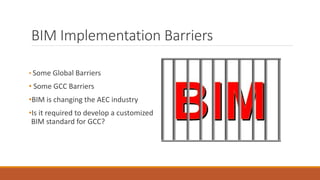
BIM Implementation Barriers
• Some Global Barriers
• Some GCC Barriers
•BIM is changing the AEC industry
•Is it required to develop a customized
BIM standard for GCC?
Some Global Barriers
Misunderstanding of BIM
BIM introduced to industry as a product
Lack of Expertise
Variety of standards and protocols
Mindsets
Maturity of Technology
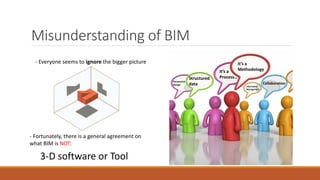
Misunderstanding of BIM
- Everyone seems to ignore the bigger picture
- Fortunately, there is a general agreement on
what BIM is NOT:
3-D software or Tool
It’s a
Methodology
Information
Management
It’s a
Process…Structured
data Collaboration
Parametric
Design
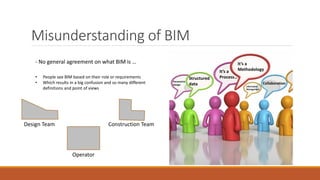
Misunderstanding of BIM
- No general agreement on what BIM is … It’s a
Methodology
Information
Management
It’s a
Process…Structured
data Collaboration
Parametric
Design
• People see BIM based on their role or requirements
• Which results in a big confusion and so many different
definitions and point of views
Construction TeamDesign Team
Operator
BIM Introduced to industry as a product
- Software vendors and developers took
the lead in introducing BIM to industry
“Purchase today and start saving in cost
and time immediately”
- Misleading the decision makers? High
expectations?
“All we need is few licenses and software
operators”
- Disappointed?
“We are doing BIM but we are not saving!
BIM is the biggest scam!”
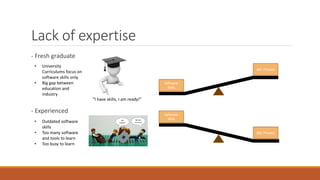
Lack of expertise
- Fresh graduate
Software
Skills
AEC Process
• University
Curriculums focus on
software skills only.
• Big gap between
education and
industry
“I have skills, I am ready!”
- Experienced
• Outdated software
skills
• Too many software
and tools to learn
• Too busy to learn
Software
Skills
AEC Process
Variety of standards and protocols
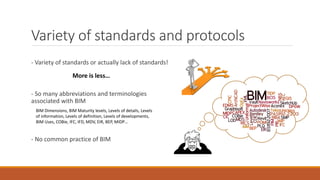
- Variety of standards or actually lack of standards!
More is less…
- So many abbreviations and terminologies
associated with BIM
BIM Dimensions, BIM Maturity levels, Levels of details, Levels
of information, Levels of definition, Levels of developments,
BIM Uses, COBie, IFC, IFD, MDV, EIR, BEP, MIDP…
- No common practice of BIM
Mindsets
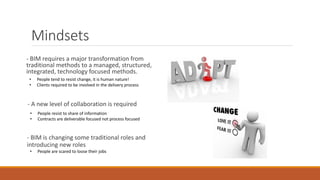
- BIM requires a major transformation from
traditional methods to a managed, structured,
integrated, technology focused methods.
- A new level of collaboration is required
• People tend to resist change, it is human nature!
• Clients required to be involved in the delivery process
• People resist to share of information
• Contracts are deliverable focused not process focused
- BIM is changing some traditional roles and
introducing new roles
• People are scared to loose their jobs
Maturity of Technology
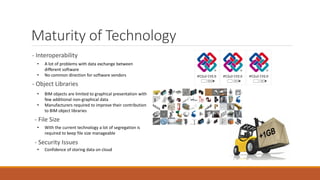
- Interoperability
• A lot of problems with data exchange between
different software
• No common direction for software vendors
- Object Libraries
• BIM objects are limited to graphical presentation with
few additional non-graphical data
• Manufacturers required to improve their contribution
to BIM object libraries
- File Size
• With the current technology a lot of segregation is
required to keep file size manageable
- Security Issues
• Confidence of storing data on cloud
Some GCC Barriers
Procurement Strategy
Unclear employer/client requirements
The requirements of fast delivery of
projects
Absence of unified BIM standards
Procurement Strategy
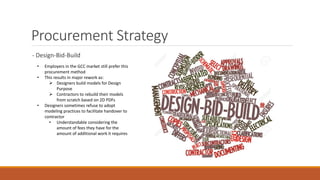
- Design-Bid-Build
• Employers in the GCC market still prefer this
procurement method
• This results in major rework as:
 Designers build models for Design
Purpose
 Contractors to rebuild their models
from scratch based on 2D PDFs
• Designers sometimes refuse to adopt
modeling practices to facilitate handover to
contractor
• Understandable considering the
amount of fees they have for the
amount of additional work it requires
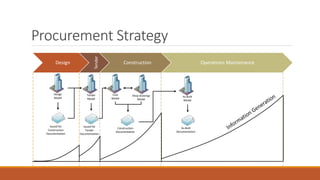
Procurement Strategy
Design
Tender
Construction Operations Maintenance
Design
Model
Issued for
Construction
Documentation
Tender
Model
Issued for
Tender
Documentation
Cost
Model
Construction
Documentation
As-Built
Model
As-Built
Documentation
Shop drawings
Model
How many models on a project?
Design
Tender
Construction Operations Maintenance
Design
Model
Tender
Model
Cost
Model
As-Built
Model
Shop drawings
Model
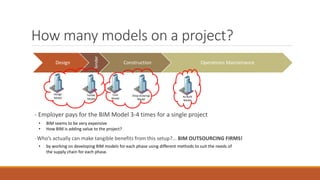
- Employer pays for the BIM Model 3-4 times for a single project
• BIM seems to be very expensive
• How BIM is adding value to the project?
-Who’s actually can make tangible benefits from this setup?... BIM OUTSOURCING FIRMS!
• by working on developing BIM models for each phase using different methods to suit the needs of
the supply chain for each phase.
Unclear Employer Requirements
EMPLOYER: WE WANT BIM.
• Employers in GCC think of BIM as a
deliverable!
• BIM to be delivered in the project. It
should be this project must be delivered
by BIM.
• They are not involved enough in the
delivery process
• Only few employers develop EIRs
The requirements of fast delivery of
projects
- Very famous issue in GCC: High
expectations in short period
• Employers do not spend enough time on the
strategy stage of projects
• Huge number of projects running at the same
time
- Success of BIM implementation
highly affected by a flawless start
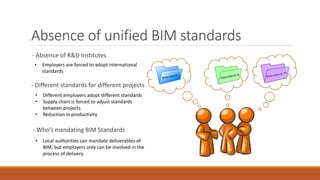
Absence of unified BIM standards
- Absence of R&D Institutes
- Different standards for different projects
- Who’s mandating BIM Standards
• Employers are forced to adopt international
standards
• Different employers adopt different standards
• Supply chain is forced to adjust standards
between projects
• Reduction in productivity
• Local authorities can mandate deliverables of
BIM, but employers only can be involved in the
process of delivery
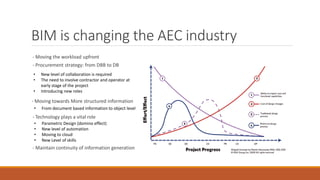
BIM is changing the AEC industry
- Moving the workload upfront
- Procurement strategy: from DBB to DB
- Moving towards More structured information
• From document based information to object level
• New level of collaboration is required
• The need to involve contractor and operator at
early stage of the project
• Introducing new roles
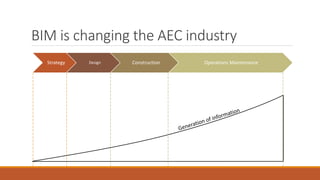
- Maintain continuity of information generation
- Technology plays a vital role
• Parametric Design (domino effect)
• New level of automation
• Moving to cloud
• New Level of skills
BIM is changing the AEC industry
Strategy Design Construction Operations Maintenance
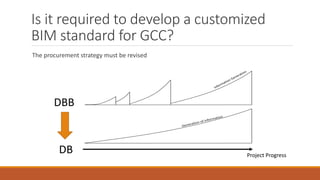
Is it required to develop a customized
BIM standard for GCC?
The procurement strategy must be revised
Project Progress
DBB
DB
Is it required to develop a customized
BIM standard for GCC?
- Clear BIM Requirement must come from the employer
• Spend enough time in developing the employer BIM
requirement for the project
• Employer or employer representative must be engaged in
the delivery process of the project
• BIM requirements should not be developed in isolation
- A combined effort must be formed to unify the direction of BIM in GCC
• Starting with governmental employers
• Mandate of BIM should come from the employer
• Adopt a BIM standard for all GCC projects (British
standard)
In Summary
- Barriers to BIM implementation can be seen globally
- Procurement strategy plays a huge role in the success of BIM implementation
- The requirement for fast delivery of projects is a major BIM barrier in GCC
- Employer is expected to be more engaged in the delivery process
- BIM shouldn’t work in isolation
- BIM introduced new challenges to the AEC industry
- The adoption of BIM in GCC must be unified
- BIM mandate must come from the employer not local authorities

Barriers to bim implementation in gcc

  • 1.
    Barriers to BIM implementationin GCC HAMZEH NAWAR
  • 2.
    Hamzeh Nawar - CharteredConstruction Manager - Master Degree In Mechanical Engineering - BIM Specialist ◦ Certified in BIM project management by RICS ◦ Certified in BIM international ISO19650 Standards by BRE UK - Involved in BIM transformation for: ◦ Lead Contractor ◦ Consultant ◦ Governmental Developer/Operator
  • 3.
    BIM Implementation Barriers •Some Global Barriers • Some GCC Barriers •BIM is changing the AEC industry •Is it required to develop a customized BIM standard for GCC?
  • 4.
    Some Global Barriers Misunderstandingof BIM BIM introduced to industry as a product Lack of Expertise Variety of standards and protocols Mindsets Maturity of Technology
  • 5.
    Misunderstanding of BIM -Everyone seems to ignore the bigger picture - Fortunately, there is a general agreement on what BIM is NOT: 3-D software or Tool It’s a Methodology Information Management It’s a Process…Structured data Collaboration Parametric Design
  • 6.
    Misunderstanding of BIM -No general agreement on what BIM is … It’s a Methodology Information Management It’s a Process…Structured data Collaboration Parametric Design • People see BIM based on their role or requirements • Which results in a big confusion and so many different definitions and point of views Construction TeamDesign Team Operator
  • 7.
    BIM Introduced toindustry as a product - Software vendors and developers took the lead in introducing BIM to industry “Purchase today and start saving in cost and time immediately” - Misleading the decision makers? High expectations? “All we need is few licenses and software operators” - Disappointed? “We are doing BIM but we are not saving! BIM is the biggest scam!”
  • 8.
    Lack of expertise -Fresh graduate Software Skills AEC Process • University Curriculums focus on software skills only. • Big gap between education and industry “I have skills, I am ready!” - Experienced • Outdated software skills • Too many software and tools to learn • Too busy to learn Software Skills AEC Process
  • 9.
    Variety of standardsand protocols - Variety of standards or actually lack of standards! More is less… - So many abbreviations and terminologies associated with BIM BIM Dimensions, BIM Maturity levels, Levels of details, Levels of information, Levels of definition, Levels of developments, BIM Uses, COBie, IFC, IFD, MDV, EIR, BEP, MIDP… - No common practice of BIM
  • 10.
    Mindsets - BIM requiresa major transformation from traditional methods to a managed, structured, integrated, technology focused methods. - A new level of collaboration is required • People tend to resist change, it is human nature! • Clients required to be involved in the delivery process • People resist to share of information • Contracts are deliverable focused not process focused - BIM is changing some traditional roles and introducing new roles • People are scared to loose their jobs
  • 11.
    Maturity of Technology -Interoperability • A lot of problems with data exchange between different software • No common direction for software vendors - Object Libraries • BIM objects are limited to graphical presentation with few additional non-graphical data • Manufacturers required to improve their contribution to BIM object libraries - File Size • With the current technology a lot of segregation is required to keep file size manageable - Security Issues • Confidence of storing data on cloud
  • 12.
    Some GCC Barriers ProcurementStrategy Unclear employer/client requirements The requirements of fast delivery of projects Absence of unified BIM standards
  • 13.
    Procurement Strategy - Design-Bid-Build •Employers in the GCC market still prefer this procurement method • This results in major rework as:  Designers build models for Design Purpose  Contractors to rebuild their models from scratch based on 2D PDFs • Designers sometimes refuse to adopt modeling practices to facilitate handover to contractor • Understandable considering the amount of fees they have for the amount of additional work it requires
  • 14.
    Procurement Strategy Design Tender Construction OperationsMaintenance Design Model Issued for Construction Documentation Tender Model Issued for Tender Documentation Cost Model Construction Documentation As-Built Model As-Built Documentation Shop drawings Model
  • 15.
    How many modelson a project? Design Tender Construction Operations Maintenance Design Model Tender Model Cost Model As-Built Model Shop drawings Model - Employer pays for the BIM Model 3-4 times for a single project • BIM seems to be very expensive • How BIM is adding value to the project? -Who’s actually can make tangible benefits from this setup?... BIM OUTSOURCING FIRMS! • by working on developing BIM models for each phase using different methods to suit the needs of the supply chain for each phase.
  • 16.
    Unclear Employer Requirements EMPLOYER:WE WANT BIM. • Employers in GCC think of BIM as a deliverable! • BIM to be delivered in the project. It should be this project must be delivered by BIM. • They are not involved enough in the delivery process • Only few employers develop EIRs
  • 17.
    The requirements offast delivery of projects - Very famous issue in GCC: High expectations in short period • Employers do not spend enough time on the strategy stage of projects • Huge number of projects running at the same time - Success of BIM implementation highly affected by a flawless start
  • 18.
    Absence of unifiedBIM standards - Absence of R&D Institutes - Different standards for different projects - Who’s mandating BIM Standards • Employers are forced to adopt international standards • Different employers adopt different standards • Supply chain is forced to adjust standards between projects • Reduction in productivity • Local authorities can mandate deliverables of BIM, but employers only can be involved in the process of delivery
  • 19.
    BIM is changingthe AEC industry - Moving the workload upfront - Procurement strategy: from DBB to DB - Moving towards More structured information • From document based information to object level • New level of collaboration is required • The need to involve contractor and operator at early stage of the project • Introducing new roles - Maintain continuity of information generation - Technology plays a vital role • Parametric Design (domino effect) • New level of automation • Moving to cloud • New Level of skills
  • 20.
    BIM is changingthe AEC industry Strategy Design Construction Operations Maintenance
  • 21.
    Is it requiredto develop a customized BIM standard for GCC? The procurement strategy must be revised Project Progress DBB DB
  • 22.
    Is it requiredto develop a customized BIM standard for GCC? - Clear BIM Requirement must come from the employer • Spend enough time in developing the employer BIM requirement for the project • Employer or employer representative must be engaged in the delivery process of the project • BIM requirements should not be developed in isolation - A combined effort must be formed to unify the direction of BIM in GCC • Starting with governmental employers • Mandate of BIM should come from the employer • Adopt a BIM standard for all GCC projects (British standard)
  • 23.
    In Summary - Barriersto BIM implementation can be seen globally - Procurement strategy plays a huge role in the success of BIM implementation - The requirement for fast delivery of projects is a major BIM barrier in GCC - Employer is expected to be more engaged in the delivery process - BIM shouldn’t work in isolation - BIM introduced new challenges to the AEC industry - The adoption of BIM in GCC must be unified - BIM mandate must come from the employer not local authorities