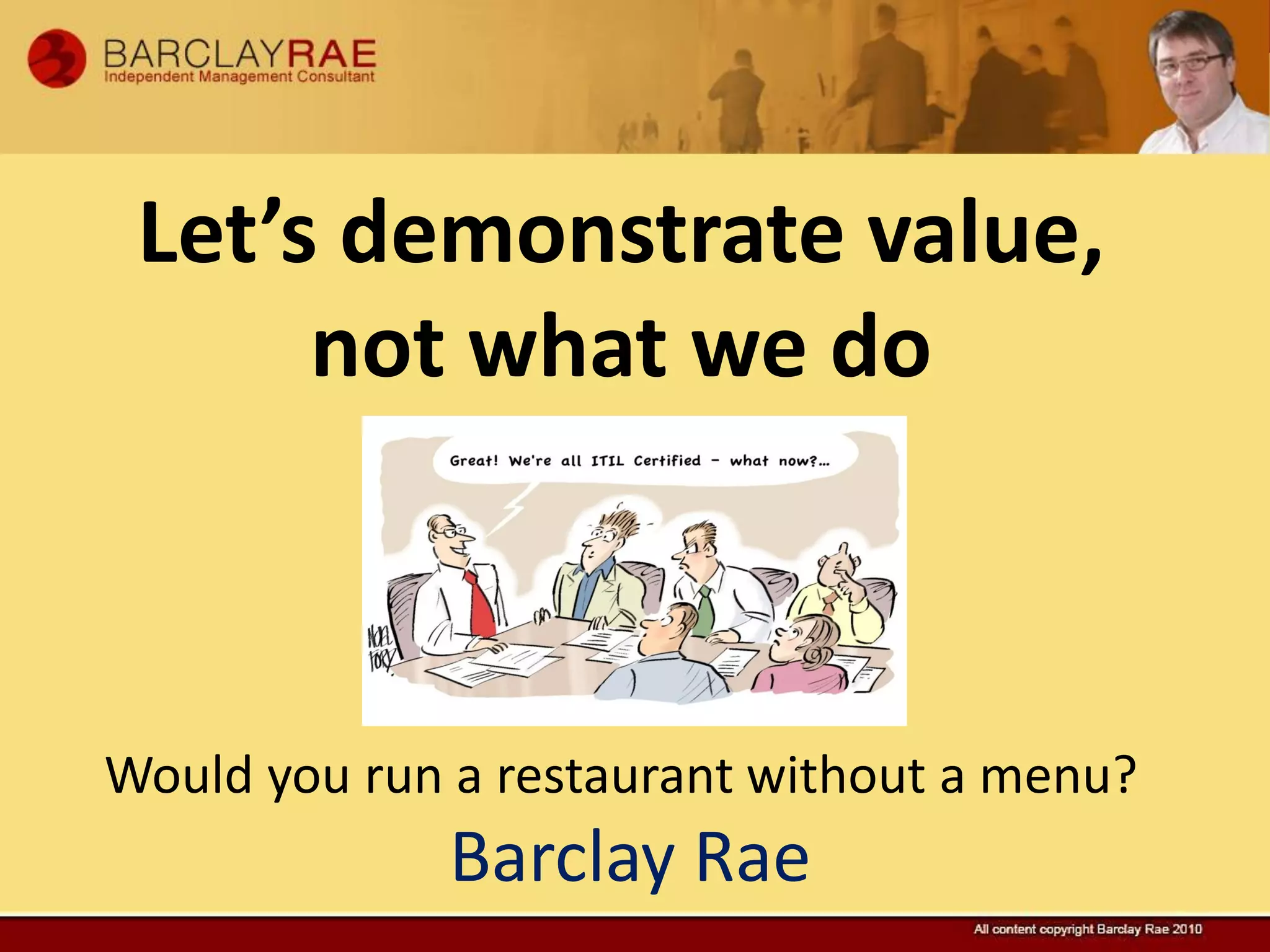
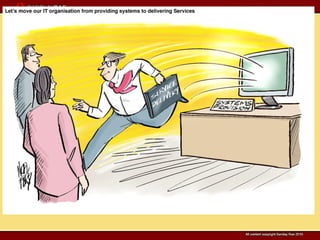
Let’s demonstrate value,
      not what we do


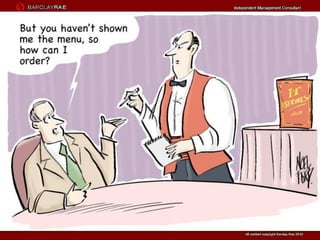
Would you run a restaurant without a menu?
              Barclay Rae
Service Desk, SLM and ITSM Goodness

EMAIL
bjr@barclayrae.com
TWITTER
@barclayrae
#ITSMgoodness
WEB
www.barclayrae.com
www.itsmtv.co.uk


       2
‘ITSM Goodness’
• Don't write an SLA like you are a frustrated lawyer, a novelist, or a
  tech junkie...

• SLAs need to show up gaps in capability and performance.
  Otherwise how can you improve?

• Don't fudge SLA targets into % of % of %. Keep goals real, not just
  easy targets.

• SLAs should be about positive value delivered by IT services, not
  just how IT responds to failure.
                                                     #ITSMGoodness
Agenda
What metrics do we currently produce?

SLM + Service Catalogue concepts

Delivering and Demonstrating Value
‘ITSM Goodness’
• No one is interested in what IT does - SLAs should refer business
  outcomes

• SLAs breathe business life and relevance into fairly dull IT
  operational processes

• If you can't measure it somehow, don't set up an SLA for it...

• If your SLAs are long documents, they don't represent real
  agreement - ie they're SLDs (service level disagreements)
                                                       #ITSMGoodness
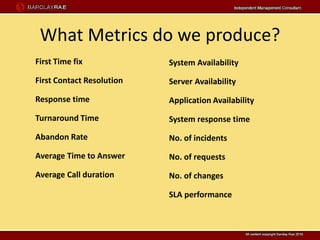
What Metrics do we produce?
First Time fix

First Contact Resolution

Response time

Turnaround Time

Abandon Rate

Average Time to Answer

Average Call duration
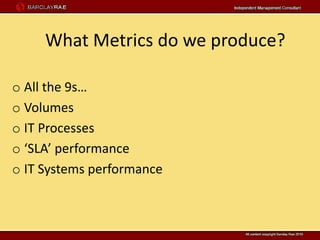
What Metrics do we produce?
First Time fix             System Availability
First Contact Resolution   Server Availability
Response time              Application Availability
Turnaround Time            System response time
Abandon Rate               No. of incidents
Average Time to Answer     No. of requests
Average Call duration      No. of changes

                           SLA performance
What Metrics do we produce?

o All the 9s…
o Volumes
o IT Processes
o ‘SLA’ performance
o IT Systems performance
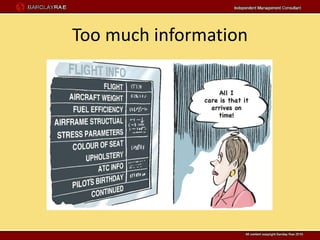
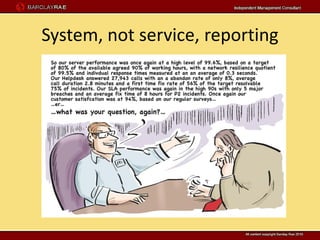
Too much information
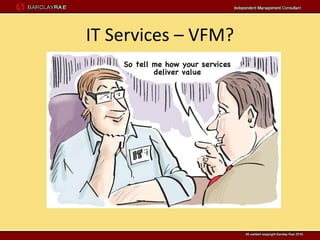
IT Services – VFM?
System, not service, reporting
‘ITSM Goodness’
• SLM projects are not for the faint or tech-hearted...

• Don't expect too much if you ask a junior person to set up SLAs

• Turns out you can't actually set up SLAs without defining Services
  first. No really...

• "We tried doing SLAs before - no one was interested" (Surprised?)

                                                      #ITSMGoodness
SLM concepts
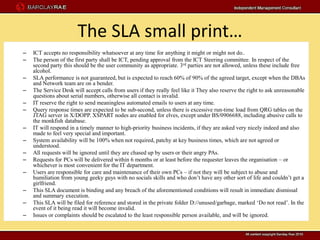
The SLA small print…
–   ICT accepts no responsibility whatsoever at any time for anything it might or might not do..
–   The person of the first party shall be ICT, pending approval from the ICT Steering committee. In respect of the
    second party this should be the user community as appropriate. 3 rd parties are not allowed, unless these include free
    alcohol.
–   SLA performance is not guaranteed, but is expected to reach 60% of 90% of the agreed target, except when the DBAs
    and Network team are on a bender.
–   The Service Desk will accept calls from users if they really feel like it They also reserve the right to ask unreasonable
    questions about serial numbers, otherwise all contact is invalid.
–   IT reserve the right to send meaningless automated emails to users at any time.
–   Query response times are expected to be sub-second, unless there is excessive run-time load from QRG tables on the
    JTAG server in X/DOPP. XSPART nodes are enabled for elves, except under BS/0906688, including abusive calls to
    the monkfish database.
–   IT will respond in a timely manner to high-priority business incidents, if they are asked very nicely indeed and also
    made to feel very special and important.
–   System availability will be 100% when not required, patchy at key business times, which are not agreed or
    understood.
–   All requests will be ignored until they are chased up by users or their angry PAs.
–   Requests for PCs will be delivered within 6 months or at least before the requester leaves the organisation – or
    whichever is most convenient for the IT department.
–   Users are responsible for care and maintenance of their own PCs – if not they will be subject to abuse and
    humiliation from young geeky guys with no socials skills and who don’t have any other sort of life and couldn’t get a
    girlfriend.
–   This SLA document is binding and any breach of the aforementioned conditions will result in immediate dismissal
    and summary execution.
–   This SLA will be filed for reference and stored in the private folder D://unused/garbage, marked ‘Do not read’. In the
    event of it being read it will become invalid.
–   Issues or complaints should be escalated to the least responsible person available, and will be ignored.
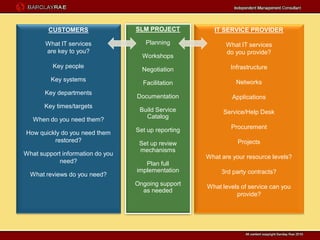
CUSTOMERS                 SLM PROJECT          IT SERVICE PROVIDER

       What IT services              Planning              What IT services
       are key to you?                                     do you provide?
                                    Workshops
          Key people                                         Infrastructure
                                    Negotiation
         Key systems                                           Networks
                                    Facilitation
       Key departments
                                  Documentation               Applications
       Key times/targets
                                   Build Service           Service/Help Desk
   When do you need them?            Catalog

                                  Set up reporting           Procurement
How quickly do you need them
         restored?                                              Projects
                                   Set up review
                                   mechanisms
What support information do you
                                                     What are your resource levels?
           need?                     Plan full
                                  implementation          3rd party contracts?
  What reviews do you need?
                                  Ongoing support    What levels of service can you
                                    as needed
                                                               provide?
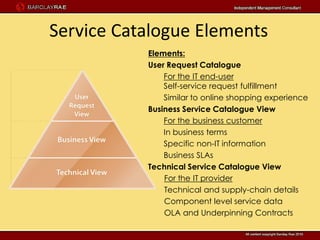
Service Catalogue Elements
           Elements:
           User Request Catalogue
               For the IT end-user
               Self-service request fulfillment
               Similar to online shopping experience
           Business Service Catalogue View
               For the business customer
               In business terms
               Specific non-IT information
               Business SLAs
           Technical Service Catalogue View
               For the IT provider
               Technical and supply-chain details
               Component level service data
               OLA and Underpinning Contracts
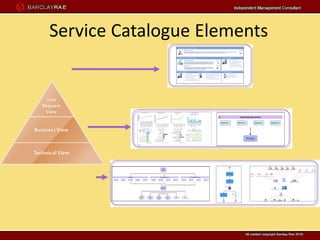
Service Catalogue Elements
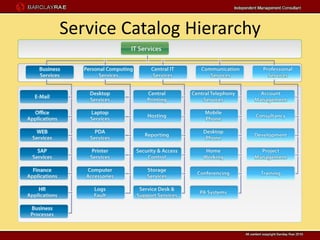
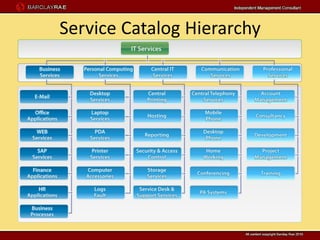
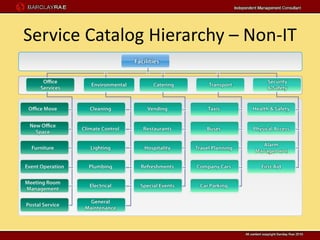
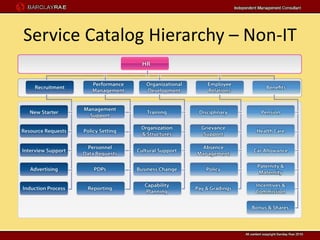
Service Catalog Hierarchy
‘ITSM Goodness’
• Don't write an SLA like you are a frustrated lawyer, a novelist, or a
  tech junkie...

• SLAs need to show up gaps in capability and performance.
  Otherwise how can you improve?

• Don't fudge SLA targets into % of % of %. Keep goals real, not just
  easy targets.

• SLAs should be about positive value delivered by IT services, not
  just how IT responds to failure.
                                                     #ITSMGoodness
Delivering and
Demonstrating Value
Key Questions

• Do we deliver what our customers need via our
  services?
• Can we demonstrate this?
• Would our customers agree?
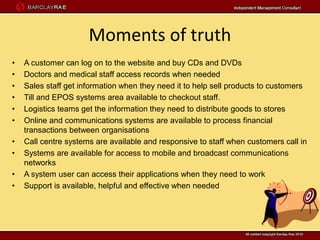
Moments of truth
•   A customer can log on to the website and buy CDs and DVDs
•   Doctors and medical staff access records when needed
•   Sales staff get information when they need it to help sell products to customers
•   Till and EPOS systems area available to checkout staff.
•   Logistics teams get the information they need to distribute goods to stores
•   Online and communications systems are available to process financial
    transactions between organisations
•   Call centre systems are available and responsive to staff when customers call in
•   Systems are available for access to mobile and broadcast communications
    networks
•   A system user can access their applications when they need to work
•   Support is available, helpful and effective when needed
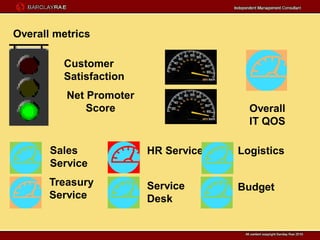
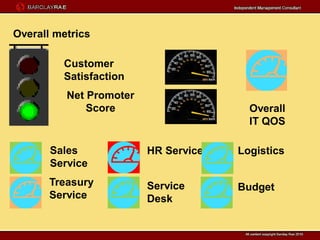
Overall metrics

         Customer
         Satisfaction
          Net Promoter
              Score                     Overall
                                        IT QOS

       Sales             HR Service   Logistics
       Service
       Treasury          Service      Budget
       Service           Desk
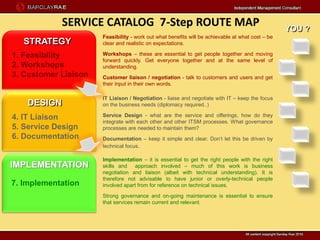
SERVICE CATALOG 7-Step ROUTE MAP                                                     YOU ?
                      Feasibility - work out what benefits will be achievable at what cost – be
   STRATEGY           clear and realistic on expectations.

1. Feasibility        Workshops – these are essential to get people together and moving
                      forward quickly. Get everyone together and at the same level of
2. Workshops          understanding.
3. Customer Liaison   Customer liaison / negotiation - talk to customers and users and get
                      their input in their own words.

                      IT Liaison / Negotiation - liaise and negotiate with IT – keep the focus
    DESIGN            on the business needs (diplomacy required..)

4. IT Liaison         Service Design - what are the service and offerings, how do they
                      integrate with each other and other ITSM processes. What governance
5. Service Design     processes are needed to maintain them?
6. Documentation      Documentation – keep it simple and clear. Don’t let this be driven by
                      technical focus.

                      Implementation – it is essential to get the right people with the right
IMPLEMENTATION        skills and approach involved – much of this work is business
                      negotiation and liaison (albeit with technical understanding). It is
                      therefore not advisable to have junior or overly-technical people
7. Implementation     involved apart from for reference on technical issues.

                      Strong governance and on-going maintenance is essential to ensure
                      that services remain current and relevant.
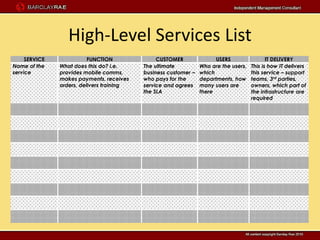
High-Level Services List
     SERVICE              FUNCTION              CUSTOMER               USERS                 IT DELIVERY
Name of the    What does this do? i.e.     The ultimate          Who are the users,   This is how IT delivers
service        provides mobile comms,      business customer –   which                this service – support
               makes payments, receives    who pays for the      departments, how     teams, 3rd parties,
               orders, delivers training   service and agrees    many users are       owners, which part of
                                           the SLA               there                the infrastructure are
                                                                                      required
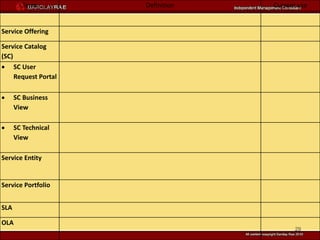
Term          Definition   Current use


Service Offering

Service Catalog
(SC)
 SC User
     Request Portal

     SC Business
      View

     SC Technical
      View

Service Entity


Service Portfolio


SLA

OLA
                                         29
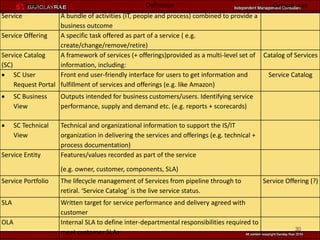
Term                                      Definition                                    Current use
Service             A bundle of activities (IT, people and process) combined to provide a
                    business outcome
Service Offering    A specific task offered as part of a service ( e.g.
                    create/change/remove/retire)
Service Catalog     A framework of services (+ offerings)provided as a multi-level set of Catalog of Services
(SC)                information, including:
 SC User           Front end user-friendly interface for users to get information and     Service Catalog
     Request Portal fulfillment of services and offerings (e.g. like Amazon)
     SC Business    Outputs intended for business customers/users. Identifying service
      View           performance, supply and demand etc. (e.g. reports + scorecards)

     SC Technical   Technical and organizational information to support the IS/IT
      View           organization in delivering the services and offerings (e.g. technical +
                     process documentation)
Service Entity       Features/values recorded as part of the service

                     (e.g. owner, customer, components, SLA)
Service Portfolio    The lifecycle management of Services from pipeline through to             Service Offering (?)
                     retiral. ‘Service Catalog’ is the live service status.
SLA                  Written target for service performance and delivery agreed with
                     customer
OLA                  Internal SLA to define inter-departmental responsibilities required to
                                                                                                          30
                     meet customer SLAs
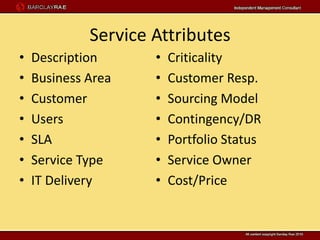
Service Attributes
•   Description      •   Criticality
•   Business Area    •   Customer Resp.
•   Customer         •   Sourcing Model
•   Users            •   Contingency/DR
•   SLA              •   Portfolio Status
•   Service Type     •   Service Owner
•   IT Delivery      •   Cost/Price
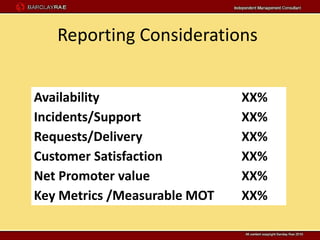
Reporting Considerations


Availability                  XX%
Incidents/Support             XX%
Requests/Delivery             XX%
Customer Satisfaction         XX%
Net Promoter value            XX%
Key Metrics /Measurable MOT   XX%
Service Catalog Hierarchy
Service Catalog Hierarchy – Non-IT
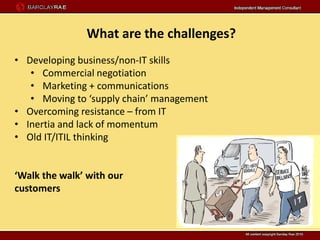
What are the challenges?
• Developing business/non-IT skills
   • Commercial negotiation
   • Marketing + communications
   • Moving to ‘supply chain’ management
• Overcoming resistance – from IT
• Inertia and lack of momentum
• Old IT/ITIL thinking


‘Walk the walk’ with our
customers
Overall metrics

         Customer
         Satisfaction
          Net Promoter
              Score                     Overall
                                        IT QOS

       Sales             HR Service   Logistics
       Service
       Treasury          Service      Budget
       Service           Desk
Fast ITSM - Principles

• All IT activity must be clearly related to a customer / business
  outcome or demand
• It is IT’s responsibility to consult and communicate with its
  customers to identify Service needs
• IT must demonstrate its value in relation to delivery of these
  services
• IT must manage and communicate its performance to all
  stakeholders
Fast ITSM - Practicalities
What can we achieve in 20 days?
•   Get customer feedback and implement quick wins
•   Identify cost per service
•   Agree cost per service unit – e.g. incident
•   Build business metrics model
•   Reduce cost of service request handling
•   Reduce % incidents + problems
•   Increase first time fix by %
•   Reduce errors caused by failed changes
•   Define service framework
•   Design key services
‘ITSM Goodness’

• Good news! Your service reporting is a bundle of stuff you already
  report on, like availability, customer satisfaction, and support
  performance

• IT SLM documentation should be written in human English,
  otherwise it's self-serving, patronising tech BS...

• Don't be side-tracked from setting aspirational SLA targets because
  of 1 or 2 occasions where it will fail - that's the point!

                                                    #ITSMGoodness
Thank you for listening…
For more information:

bjr@barclayrae.com
@barclayrae
#ITSMGoodness
www.barclayrae.com
www.itsmtv.co.uk


        41

Barclay rae itsmf itsm12 presentation nov 2012

  • 1.
    Let’s demonstrate value, not what we do Would you run a restaurant without a menu? Barclay Rae
  • 2.
    Service Desk, SLMand ITSM Goodness EMAIL bjr@barclayrae.com TWITTER @barclayrae #ITSMgoodness WEB www.barclayrae.com www.itsmtv.co.uk 2
  • 4.
    ‘ITSM Goodness’ • Don'twrite an SLA like you are a frustrated lawyer, a novelist, or a tech junkie... • SLAs need to show up gaps in capability and performance. Otherwise how can you improve? • Don't fudge SLA targets into % of % of %. Keep goals real, not just easy targets. • SLAs should be about positive value delivered by IT services, not just how IT responds to failure. #ITSMGoodness
  • 5.
    Agenda What metrics dowe currently produce? SLM + Service Catalogue concepts Delivering and Demonstrating Value
  • 6.
    ‘ITSM Goodness’ • Noone is interested in what IT does - SLAs should refer business outcomes • SLAs breathe business life and relevance into fairly dull IT operational processes • If you can't measure it somehow, don't set up an SLA for it... • If your SLAs are long documents, they don't represent real agreement - ie they're SLDs (service level disagreements) #ITSMGoodness
  • 8.
    What Metrics dowe produce? First Time fix First Contact Resolution Response time Turnaround Time Abandon Rate Average Time to Answer Average Call duration
  • 9.
    What Metrics dowe produce? First Time fix System Availability First Contact Resolution Server Availability Response time Application Availability Turnaround Time System response time Abandon Rate No. of incidents Average Time to Answer No. of requests Average Call duration No. of changes SLA performance
  • 10.
    What Metrics dowe produce? o All the 9s… o Volumes o IT Processes o ‘SLA’ performance o IT Systems performance
  • 11.
  • 12.
  • 13.
  • 14.
    ‘ITSM Goodness’ • SLMprojects are not for the faint or tech-hearted... • Don't expect too much if you ask a junior person to set up SLAs • Turns out you can't actually set up SLAs without defining Services first. No really... • "We tried doing SLAs before - no one was interested" (Surprised?) #ITSMGoodness
  • 15.
  • 16.
    The SLA smallprint… – ICT accepts no responsibility whatsoever at any time for anything it might or might not do.. – The person of the first party shall be ICT, pending approval from the ICT Steering committee. In respect of the second party this should be the user community as appropriate. 3 rd parties are not allowed, unless these include free alcohol. – SLA performance is not guaranteed, but is expected to reach 60% of 90% of the agreed target, except when the DBAs and Network team are on a bender. – The Service Desk will accept calls from users if they really feel like it They also reserve the right to ask unreasonable questions about serial numbers, otherwise all contact is invalid. – IT reserve the right to send meaningless automated emails to users at any time. – Query response times are expected to be sub-second, unless there is excessive run-time load from QRG tables on the JTAG server in X/DOPP. XSPART nodes are enabled for elves, except under BS/0906688, including abusive calls to the monkfish database. – IT will respond in a timely manner to high-priority business incidents, if they are asked very nicely indeed and also made to feel very special and important. – System availability will be 100% when not required, patchy at key business times, which are not agreed or understood. – All requests will be ignored until they are chased up by users or their angry PAs. – Requests for PCs will be delivered within 6 months or at least before the requester leaves the organisation – or whichever is most convenient for the IT department. – Users are responsible for care and maintenance of their own PCs – if not they will be subject to abuse and humiliation from young geeky guys with no socials skills and who don’t have any other sort of life and couldn’t get a girlfriend. – This SLA document is binding and any breach of the aforementioned conditions will result in immediate dismissal and summary execution. – This SLA will be filed for reference and stored in the private folder D://unused/garbage, marked ‘Do not read’. In the event of it being read it will become invalid. – Issues or complaints should be escalated to the least responsible person available, and will be ignored.
  • 17.
    CUSTOMERS SLM PROJECT IT SERVICE PROVIDER What IT services Planning What IT services are key to you? do you provide? Workshops Key people Infrastructure Negotiation Key systems Networks Facilitation Key departments Documentation Applications Key times/targets Build Service Service/Help Desk When do you need them? Catalog Set up reporting Procurement How quickly do you need them restored? Projects Set up review mechanisms What support information do you What are your resource levels? need? Plan full implementation 3rd party contracts? What reviews do you need? Ongoing support What levels of service can you as needed provide?
  • 19.
    Service Catalogue Elements Elements: User Request Catalogue For the IT end-user Self-service request fulfillment Similar to online shopping experience Business Service Catalogue View For the business customer In business terms Specific non-IT information Business SLAs Technical Service Catalogue View For the IT provider Technical and supply-chain details Component level service data OLA and Underpinning Contracts
  • 20.
  • 21.
  • 22.
    ‘ITSM Goodness’ • Don'twrite an SLA like you are a frustrated lawyer, a novelist, or a tech junkie... • SLAs need to show up gaps in capability and performance. Otherwise how can you improve? • Don't fudge SLA targets into % of % of %. Keep goals real, not just easy targets. • SLAs should be about positive value delivered by IT services, not just how IT responds to failure. #ITSMGoodness
  • 23.
  • 24.
    Key Questions • Dowe deliver what our customers need via our services? • Can we demonstrate this? • Would our customers agree?
  • 25.
    Moments of truth • A customer can log on to the website and buy CDs and DVDs • Doctors and medical staff access records when needed • Sales staff get information when they need it to help sell products to customers • Till and EPOS systems area available to checkout staff. • Logistics teams get the information they need to distribute goods to stores • Online and communications systems are available to process financial transactions between organisations • Call centre systems are available and responsive to staff when customers call in • Systems are available for access to mobile and broadcast communications networks • A system user can access their applications when they need to work • Support is available, helpful and effective when needed
  • 26.
    Overall metrics Customer Satisfaction Net Promoter Score Overall IT QOS Sales HR Service Logistics Service Treasury Service Budget Service Desk
  • 27.
    SERVICE CATALOG 7-StepROUTE MAP YOU ? Feasibility - work out what benefits will be achievable at what cost – be STRATEGY clear and realistic on expectations. 1. Feasibility Workshops – these are essential to get people together and moving forward quickly. Get everyone together and at the same level of 2. Workshops understanding. 3. Customer Liaison Customer liaison / negotiation - talk to customers and users and get their input in their own words. IT Liaison / Negotiation - liaise and negotiate with IT – keep the focus DESIGN on the business needs (diplomacy required..) 4. IT Liaison Service Design - what are the service and offerings, how do they integrate with each other and other ITSM processes. What governance 5. Service Design processes are needed to maintain them? 6. Documentation Documentation – keep it simple and clear. Don’t let this be driven by technical focus. Implementation – it is essential to get the right people with the right IMPLEMENTATION skills and approach involved – much of this work is business negotiation and liaison (albeit with technical understanding). It is therefore not advisable to have junior or overly-technical people 7. Implementation involved apart from for reference on technical issues. Strong governance and on-going maintenance is essential to ensure that services remain current and relevant.
  • 28.
    High-Level Services List SERVICE FUNCTION CUSTOMER USERS IT DELIVERY Name of the What does this do? i.e. The ultimate Who are the users, This is how IT delivers service provides mobile comms, business customer – which this service – support makes payments, receives who pays for the departments, how teams, 3rd parties, orders, delivers training service and agrees many users are owners, which part of the SLA there the infrastructure are required
  • 29.
    Term Definition Current use Service Offering Service Catalog (SC)  SC User Request Portal  SC Business View  SC Technical View Service Entity Service Portfolio SLA OLA 29
  • 30.
    Term Definition Current use Service A bundle of activities (IT, people and process) combined to provide a business outcome Service Offering A specific task offered as part of a service ( e.g. create/change/remove/retire) Service Catalog A framework of services (+ offerings)provided as a multi-level set of Catalog of Services (SC) information, including:  SC User Front end user-friendly interface for users to get information and Service Catalog Request Portal fulfillment of services and offerings (e.g. like Amazon)  SC Business Outputs intended for business customers/users. Identifying service View performance, supply and demand etc. (e.g. reports + scorecards)  SC Technical Technical and organizational information to support the IS/IT View organization in delivering the services and offerings (e.g. technical + process documentation) Service Entity Features/values recorded as part of the service (e.g. owner, customer, components, SLA) Service Portfolio The lifecycle management of Services from pipeline through to Service Offering (?) retiral. ‘Service Catalog’ is the live service status. SLA Written target for service performance and delivery agreed with customer OLA Internal SLA to define inter-departmental responsibilities required to 30 meet customer SLAs
  • 31.
    Service Attributes • Description • Criticality • Business Area • Customer Resp. • Customer • Sourcing Model • Users • Contingency/DR • SLA • Portfolio Status • Service Type • Service Owner • IT Delivery • Cost/Price
  • 32.
    Reporting Considerations Availability XX% Incidents/Support XX% Requests/Delivery XX% Customer Satisfaction XX% Net Promoter value XX% Key Metrics /Measurable MOT XX%
  • 33.
  • 34.
  • 35.
  • 36.
    What are thechallenges? • Developing business/non-IT skills • Commercial negotiation • Marketing + communications • Moving to ‘supply chain’ management • Overcoming resistance – from IT • Inertia and lack of momentum • Old IT/ITIL thinking ‘Walk the walk’ with our customers
  • 37.
    Overall metrics Customer Satisfaction Net Promoter Score Overall IT QOS Sales HR Service Logistics Service Treasury Service Budget Service Desk
  • 38.
    Fast ITSM -Principles • All IT activity must be clearly related to a customer / business outcome or demand • It is IT’s responsibility to consult and communicate with its customers to identify Service needs • IT must demonstrate its value in relation to delivery of these services • IT must manage and communicate its performance to all stakeholders
  • 39.
    Fast ITSM -Practicalities What can we achieve in 20 days? • Get customer feedback and implement quick wins • Identify cost per service • Agree cost per service unit – e.g. incident • Build business metrics model • Reduce cost of service request handling • Reduce % incidents + problems • Increase first time fix by % • Reduce errors caused by failed changes • Define service framework • Design key services
  • 40.
    ‘ITSM Goodness’ • Goodnews! Your service reporting is a bundle of stuff you already report on, like availability, customer satisfaction, and support performance • IT SLM documentation should be written in human English, otherwise it's self-serving, patronising tech BS... • Don't be side-tracked from setting aspirational SLA targets because of 1 or 2 occasions where it will fail - that's the point! #ITSMGoodness
  • 41.
    Thank you forlistening… For more information: bjr@barclayrae.com @barclayrae #ITSMGoodness www.barclayrae.com www.itsmtv.co.uk 41