Framework for Action
Building A World-Class IT Department
Odom’s Tennessee Pride Values

       Trust
      Honesty
 Personal Integrity
  Mutual Respect
 Open Mindedness
  Ethical Behavior
Odom’s Tennessee Pride
            Mission


   Dedicated to delighting
customers with products and
          services
Odom’s Tennessee Pride Vision


To be recognized as the leader
   in changing the industry
      through technology
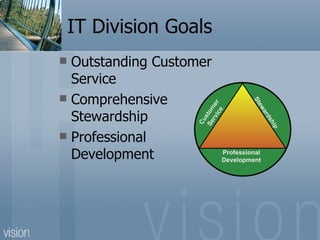
IT Division Goals
 Outstanding Customer
  Service
 Comprehensive


                                       St
                        i ce er


                                        ew
                   Se tom
  Stewardship


                                             ar
                      s


                                             ds
                     rv
                   Cu


                                                h ip
 Professional
  Development                 Professional
                              Development
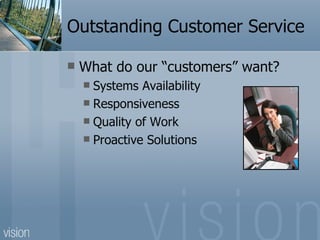
Outstanding Customer Service

   What do our “customers” want?
     Systems Availability
     Responsiveness
     Quality of Work
     Proactive Solutions
Comprehensive Stewardship

 Protection of IT Assets
 Iterative Planning Processes
 Personal Responsibility
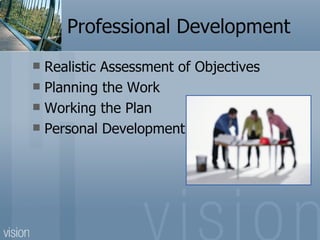
Professional Development
 Realistic Assessment of Objectives
 Planning the Work
 Working the Plan
 Personal Development
Outstanding Customer Service

1. Systems Availability
     Maintaining “Up Time” on Servers
         Rotational Replacement
             3-4 years on critical servers
         Planned & Tested Upgrades
             Understand the impact
     Planning the Bandwidth
         Proactive Capacity Expansion
Outstanding Customer Service

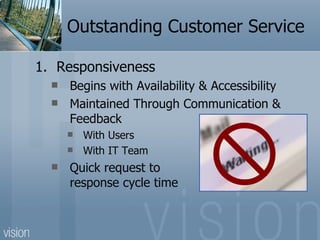
1. Responsiveness
     Begins with Availability & Accessibility
     Maintained Through Communication &
      Feedback
         With Users
         With IT Team
     Quick request to
      response cycle time
Outstanding Customer Service

1. Quality of Work
     Know Your Systems – Become the Expert
     Suggest Better Methods Where
      Appropriate
     Ask for Help
     Share Your Successes
Outstanding Customer Service

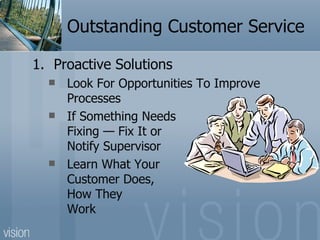
1. Proactive Solutions
     Look For Opportunities To Improve
      Processes
     If Something Needs
      Fixing — Fix It or
      Notify Supervisor
     Learn What Your
      Customer Does,
      How They
      Work
Comprehensive Stewardship

1. Protection of IT Assets
     Identification of Assets & Potential
      Risk(s) due to loss of use of the
      asset
         Our IT Personnel are Assets
     Publish a Backup/Protection Plan
     Test the Plan
     Implement the Plan
     Test the Plan
Comprehensive Stewardship

1. Iterative Planning Processes
     Achieve Incremental, Measurable
      Improvement Year-by-Year, Month-
      by-Month, Week-by-Week
     100% Participation in The Process
     Visibility To All
Comprehensive Stewardship

1. Personal Responsibility
     We are collectively and individually
      charged with being stewards of our
      IT assets.
     Comprehensive, tested procedural
      documentation
     One of our non-replaceable assets is
      our time.
Professional Development
1. Realistic Assessment of Objectives
     Objectives Need To Be Specific
     They can be classified as long-term
      (over 2 years), medium-term (1-2
      years), short-term (< 1 year) and
      immediate (< 1 month)
     They will change over time
Professional Development
1. Planning the Work – How do I
   accomplish my objectives?
     Prioritize
     Schedule
     Objectives = Projects
     Projects involve one or more tasks
     Tasks and be planned, worked &
      completed
Professional Development
1. Working the Plan
     What are my current projects?
     What tasks did I work on today to
      make progress on my projects?
     What roadblocks do I have that are
      impeding my progress?
     Progress Reporting
Professional Development
1. Personal Development
     What can I do to improve my
      performance? (habits, processes,
      time management)
     What do I need to learn?
     Am I allocating time to my own
      education?
Keys to Success

Framework for action

  • 1.
    Framework for Action BuildingA World-Class IT Department
  • 2.
    Odom’s Tennessee PrideValues Trust Honesty Personal Integrity Mutual Respect Open Mindedness Ethical Behavior
  • 3.
    Odom’s Tennessee Pride Mission Dedicated to delighting customers with products and services
  • 4.
    Odom’s Tennessee PrideVision To be recognized as the leader in changing the industry through technology
  • 5.
    IT Division Goals Outstanding Customer Service  Comprehensive St i ce er ew Se tom Stewardship ar s ds rv Cu h ip  Professional Development Professional Development
  • 6.
    Outstanding Customer Service  What do our “customers” want?  Systems Availability  Responsiveness  Quality of Work  Proactive Solutions
  • 7.
    Comprehensive Stewardship  Protectionof IT Assets  Iterative Planning Processes  Personal Responsibility
  • 8.
    Professional Development  RealisticAssessment of Objectives  Planning the Work  Working the Plan  Personal Development
  • 9.
    Outstanding Customer Service 1.Systems Availability  Maintaining “Up Time” on Servers  Rotational Replacement  3-4 years on critical servers  Planned & Tested Upgrades  Understand the impact  Planning the Bandwidth  Proactive Capacity Expansion
  • 10.
    Outstanding Customer Service 1.Responsiveness  Begins with Availability & Accessibility  Maintained Through Communication & Feedback  With Users  With IT Team  Quick request to response cycle time
  • 11.
    Outstanding Customer Service 1.Quality of Work  Know Your Systems – Become the Expert  Suggest Better Methods Where Appropriate  Ask for Help  Share Your Successes
  • 12.
    Outstanding Customer Service 1.Proactive Solutions  Look For Opportunities To Improve Processes  If Something Needs Fixing — Fix It or Notify Supervisor  Learn What Your Customer Does, How They Work
  • 13.
    Comprehensive Stewardship 1. Protectionof IT Assets  Identification of Assets & Potential Risk(s) due to loss of use of the asset  Our IT Personnel are Assets  Publish a Backup/Protection Plan  Test the Plan  Implement the Plan  Test the Plan
  • 14.
    Comprehensive Stewardship 1. IterativePlanning Processes  Achieve Incremental, Measurable Improvement Year-by-Year, Month- by-Month, Week-by-Week  100% Participation in The Process  Visibility To All
  • 15.
    Comprehensive Stewardship 1. PersonalResponsibility  We are collectively and individually charged with being stewards of our IT assets.  Comprehensive, tested procedural documentation  One of our non-replaceable assets is our time.
  • 16.
    Professional Development 1. RealisticAssessment of Objectives  Objectives Need To Be Specific  They can be classified as long-term (over 2 years), medium-term (1-2 years), short-term (< 1 year) and immediate (< 1 month)  They will change over time
  • 17.
    Professional Development 1. Planningthe Work – How do I accomplish my objectives?  Prioritize  Schedule  Objectives = Projects  Projects involve one or more tasks  Tasks and be planned, worked & completed
  • 18.
    Professional Development 1. Workingthe Plan  What are my current projects?  What tasks did I work on today to make progress on my projects?  What roadblocks do I have that are impeding my progress?  Progress Reporting
  • 19.
    Professional Development 1. PersonalDevelopment  What can I do to improve my performance? (habits, processes, time management)  What do I need to learn?  Am I allocating time to my own education?
  • 20.

Editor's Notes

  • #2 This meeting is about Vision. The vision is to become a world-class IT department. This session is to give us a framework for getting there.
  • #6 Chuck Odom used to say, “IT will not be a roadblock.” His intent was to make sure that OTP always had the tools needed to accomplish whatever objectives were placed before us. However, we all know that we did not have a plan that was communicated throughout the department and to our customers. I am broadening our vision through stating some specific &amp; measurable goals for the IT division. These goals will insure that our vision is attainable.
  • #7 Who is our customer &amp; what do they want? Our customer is anyone who interacts with any OTP IT or communication system or that system’s outputs.
  • #8 The IT Division is entrusted with a critical set of assets. Without these assets, the company might not survive.
  • #9 To becoming a world-class IT Division, we have to have world-class IT personnel. How do we get there? world-class (wûrld &apos; klăs &apos; ) adj. 1. Ranking among the foremost in the world; of an international standard of excellence; of the highest order: a world-class figure skater. 2. Great, as in importance, concern, or notoriety. World Class Manufacturing - A definition World Class Manufacturers are those that demonstrate industry best practice. To achieve this companies should attempt to be best in the field at each of the competitive priorities (quality, price, delivery speed, delivery reliability, flexibility and innovation). Organizations should therefore aim to maximize performance in these areas in order to maximize competitiveness. We have to be focused and intentional.
  • #15 We have a great opportunity to improve our internal IT processes through adopting better planning methods and tools. We are not going to “micromanage” your work. Everyone will participate in the process. The process will become the monitoring tool.
  • #16 Being a steward means we are entrusted with protecting our IT assets and using them wisely. A vital part of protecting our assets is protecting ourselves against loss due to personnel unavailability. We must document all procedures that we perform as a regular part of our duties so that the procedure can be carried out by someone else who may know little or nothing about the process beforehand. We are not being a good steward if we are wasteful in our time management. We are not being a good steward if we are unavailable and no one else in the department knows where we are or when we will return. The key to this is communication within the IT department. If you are going to be out of the office, you must let someone know when you will return. As a matter of protocol, you should always e-mail special circumstances to your direct supervisor.
  • #17 We have various sets of objectives that we will work on over the course of a year. Some of these are stated explicitly in our performance review, others will develop during the year. These objectives must be described clearly so that we can measure our progress toward achieving them. In our IT team meetings, we will review our progress on making our objectives as a group.
  • #18 First things first. It is absolutely essential that we keep our focus on the right things by prioritizing our objectives according to the schedule we set for their delivery. From a planning point of view, we must break our objectives down into the tasks that are needed to accomplish the objective. Task progress can be monitored and reported.
  • #19 We should use our projects and tasks to keep us focused on those things that will allow us to meet our goals. We need to monitor our progress and report any obstacles we encounter.
  • #20 Incremental improvement is the key to long-term success in our profession. We can all improve what we are doing, how we do it and our ability to do it well. Identify your strengths and weaknesses and make a plan to improve upon your weaknesses. “Downtime” is crucial for IT workers. You must schedule time each week to keep up with what is going on inside your particular specialty. If you do not, you will eventually fall behind and you will be less valuable as an employee.