Barclay Rae
Having technical trouble? Contact BrightTalk directly at www.brighttalk.com
Tweeting today? Please include #itsmfweb
Questions? Submit them via the question box on your screen
Problem Management not
Problem Adminstration
Problem
Management
not
Problem
Administration
itSMF USA
Webinar
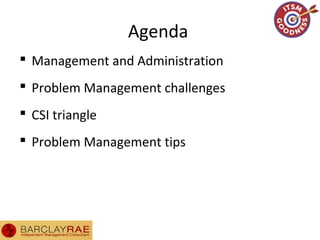
Agenda
 Management and Administration
 Problem Management challenges
 CSI triangle
 Problem Management tips
4
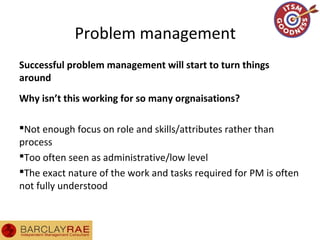
Problem management
Successful problem management will start to turn things
around
Why isn’t this working for so many orgnaisations?
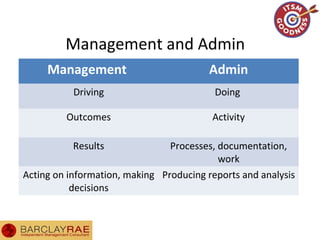
Management and Admin
Management Admin
Driving Doing
Outcomes Activity
Results Processes, documentation,
work
Acting on information, making
decisions
Producing reports and analysis
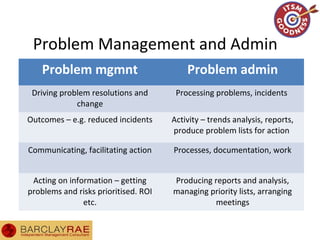
Problem Management and Admin
Problem mgmnt Problem admin
Driving problem resolutions and
change
Processing problems, incidents
Outcomes – e.g. reduced incidents Activity – trends analysis, reports,
produce problem lists for action
Communicating, facilitating action Processes, documentation, work
Acting on information – getting
problems and risks prioritised. ROI
etc.
Producing reports and analysis,
managing priority lists, arranging
meetings
Problem management
Successful problem management will start to turn things
around
Why isn’t this working for so many orgnaisations?
Not enough focus on role and skills/attributes rather than
process
Too often seen as administrative/low level
The exact nature of the work and tasks required for PM is often
not fully understood
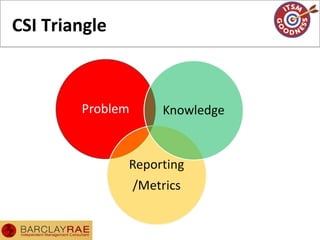
CSI Triangle
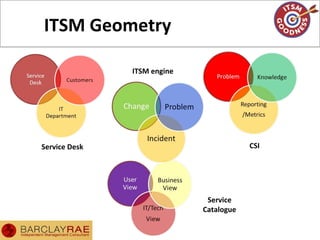
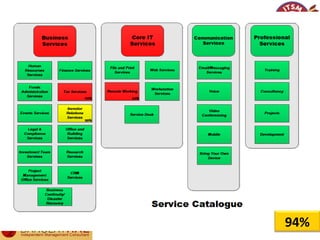
ITSM Geometry
Service Desk
ITSM engine
Service
Catalogue
CSI
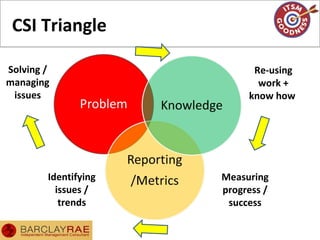
CSI Triangle
Solving /
managing
issues
Re-using
work +
know how
Identifying
issues /
trends
Measuring
progress /
success
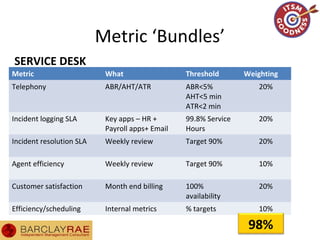
Metric ‘Bundles’
Metric What Threshold Weighting
Telephony ABR/AHT/ATR ABR<5%
AHT<5 min
ATR<2 min
20%
Incident logging SLA Key apps – HR +
Payroll apps+ Email
99.8% Service
Hours
20%
Incident resolution SLA Weekly review Target 90% 20%
Agent efficiency Weekly review Target 90% 10%
Customer satisfaction Month end billing 100%
availability
20%
Efficiency/scheduling Internal metrics % targets 10%
SERVICE DESK
98%
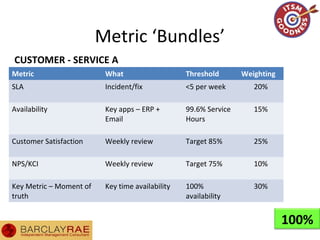
Metric What Threshold Weighting
SLA Incident/fix <5 per week 20%
Availability Key apps – ERP +
Email
99.6% Service
Hours
15%
Customer Satisfaction Weekly review Target 85% 25%
NPS/KCI Weekly review Target 75% 10%
Key Metric – Moment of
truth
Key time availability 100%
availability
30%
CUSTOMER - SERVICE A
100%
Metric ‘Bundles’
94%
Problem
Management
Tips
itSMF USA
Webinar
Problem Management tips
 Where to start?
 Problem Management role
 Questions
 Visibility
 Top 10
 Codes and categories
 Customer / Service Experience principles
 CSI – knowledge/metrics
Where to start?
• Benchmark
• Identify and promote some individual
successes
• Clarify goals and objectives for PM
• Use customer experience to drive
improvements
• Build an initial problem list + CSI Register
Problem Mgmnt role
 More about ownership + people than just a
process
 Problem Management – part analyst,
investigator, mostly project manager
 Need to clearly define role and objectives
Questions
• How are we doing?
• How can we improve?
• Why is this happening?
• Why does it keep happening?
• How can we stop it ?
• What’s the impact/cost/benefit
• Why breaches – ‘Watermelon SLAs’ and reports?
• Why do we use this model/do it this way?
Visibility
• Open up your problems to a wide audience –
to speed up resolution
Top 10
• Develop process for building and maintaining
an agreed list of top 5/10 problems – for the
department.
• Ask management – what are they doing about
the top 10?
Review codes and Categories
• Separate logging and closing categories, Cause
codes, Reason for Failure
• Review and rationalise codes/tables, inputs
• Think outputs
Customer / Service Experience
Use Customer experience (mapping, touch
points, moments of truth, outcomes) to drive
improvements
Define and use targeted initiatives – e.g. like
‘shift left’ for focus
See SITS/Cherwell/SDI CX paper
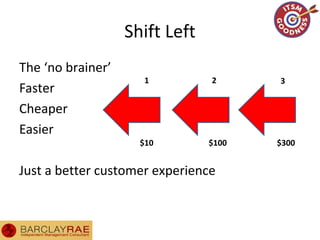
Shift Left
The ‘no brainer’
Faster
Cheaper
Easier
Just a better customer experience
1 2 3
$10 $100 $300
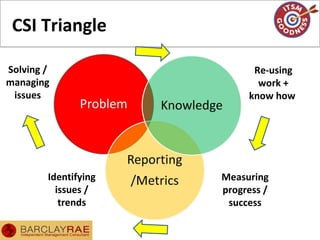
CSI Triangle
Solving /
managing
issues
Re-using
work +
know how
Identifying
issues /
trends
Measuring
progress /
success
26
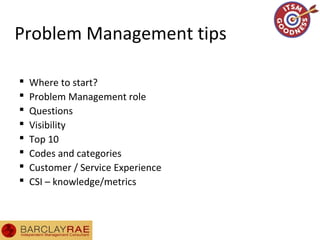
Problem Management tips
 Where to start?
 Problem Management role
 Questions
 Visibility
 Top 10
 Codes and categories
 Customer / Service Experience
 CSI – knowledge/metrics
Summary
Ultimately, problem management is about
digging out the real issues
and
finding effective ways to get them
communicated, escalated and resolved
Summary
• Think person/people and role over process
• Outcome over activity
• Driving delivery over doing stuff
• This process won’t happen by itself
• Use customer and business focus to drive
action
• Build on initial successes – however small
Thank you for
listening!
barclayrae.com
Itsmgoodness.com
BrightTALK CH 9885
#itsmgoodness
@barclayrae
Thank You
For Attending!
 Please “Rate This” webinar
― Include any comments to help us build quality events for you
 Please plan to join us for our next event
 Want to share this with others?
― Recorded version of it will be available shortly at:
http://www.itsmfusa.org/the-forum-on-line-conferences-webcasts

It smf usa webinar problem mgmnt not admin - barclay rae

  • 1.
    Barclay Rae Having technicaltrouble? Contact BrightTalk directly at www.brighttalk.com Tweeting today? Please include #itsmfweb Questions? Submit them via the question box on your screen Problem Management not Problem Adminstration
  • 2.
  • 3.
    Agenda  Management andAdministration  Problem Management challenges  CSI triangle  Problem Management tips
  • 4.
  • 5.
    Problem management Successful problemmanagement will start to turn things around Why isn’t this working for so many orgnaisations?
  • 6.
    Management and Admin ManagementAdmin Driving Doing Outcomes Activity Results Processes, documentation, work Acting on information, making decisions Producing reports and analysis
  • 7.
    Problem Management andAdmin Problem mgmnt Problem admin Driving problem resolutions and change Processing problems, incidents Outcomes – e.g. reduced incidents Activity – trends analysis, reports, produce problem lists for action Communicating, facilitating action Processes, documentation, work Acting on information – getting problems and risks prioritised. ROI etc. Producing reports and analysis, managing priority lists, arranging meetings
  • 8.
    Problem management Successful problemmanagement will start to turn things around Why isn’t this working for so many orgnaisations? Not enough focus on role and skills/attributes rather than process Too often seen as administrative/low level The exact nature of the work and tasks required for PM is often not fully understood
  • 9.
  • 10.
    ITSM Geometry Service Desk ITSMengine Service Catalogue CSI
  • 11.
    CSI Triangle Solving / managing issues Re-using work+ know how Identifying issues / trends Measuring progress / success
  • 12.
    Metric ‘Bundles’ Metric WhatThreshold Weighting Telephony ABR/AHT/ATR ABR<5% AHT<5 min ATR<2 min 20% Incident logging SLA Key apps – HR + Payroll apps+ Email 99.8% Service Hours 20% Incident resolution SLA Weekly review Target 90% 20% Agent efficiency Weekly review Target 90% 10% Customer satisfaction Month end billing 100% availability 20% Efficiency/scheduling Internal metrics % targets 10% SERVICE DESK 98%
  • 13.
    Metric What ThresholdWeighting SLA Incident/fix <5 per week 20% Availability Key apps – ERP + Email 99.6% Service Hours 15% Customer Satisfaction Weekly review Target 85% 25% NPS/KCI Weekly review Target 75% 10% Key Metric – Moment of truth Key time availability 100% availability 30% CUSTOMER - SERVICE A 100% Metric ‘Bundles’
  • 14.
  • 15.
  • 16.
    Problem Management tips Where to start?  Problem Management role  Questions  Visibility  Top 10  Codes and categories  Customer / Service Experience principles  CSI – knowledge/metrics
  • 17.
    Where to start? •Benchmark • Identify and promote some individual successes • Clarify goals and objectives for PM • Use customer experience to drive improvements • Build an initial problem list + CSI Register
  • 18.
    Problem Mgmnt role More about ownership + people than just a process  Problem Management – part analyst, investigator, mostly project manager  Need to clearly define role and objectives
  • 19.
    Questions • How arewe doing? • How can we improve? • Why is this happening? • Why does it keep happening? • How can we stop it ? • What’s the impact/cost/benefit • Why breaches – ‘Watermelon SLAs’ and reports? • Why do we use this model/do it this way?
  • 20.
    Visibility • Open upyour problems to a wide audience – to speed up resolution
  • 21.
    Top 10 • Developprocess for building and maintaining an agreed list of top 5/10 problems – for the department. • Ask management – what are they doing about the top 10?
  • 22.
    Review codes andCategories • Separate logging and closing categories, Cause codes, Reason for Failure • Review and rationalise codes/tables, inputs • Think outputs
  • 23.
    Customer / ServiceExperience Use Customer experience (mapping, touch points, moments of truth, outcomes) to drive improvements Define and use targeted initiatives – e.g. like ‘shift left’ for focus See SITS/Cherwell/SDI CX paper
  • 24.
    Shift Left The ‘nobrainer’ Faster Cheaper Easier Just a better customer experience 1 2 3 $10 $100 $300
  • 25.
    CSI Triangle Solving / managing issues Re-using work+ know how Identifying issues / trends Measuring progress / success
  • 26.
  • 27.
    Problem Management tips Where to start?  Problem Management role  Questions  Visibility  Top 10  Codes and categories  Customer / Service Experience  CSI – knowledge/metrics
  • 28.
    Summary Ultimately, problem managementis about digging out the real issues and finding effective ways to get them communicated, escalated and resolved
  • 29.
    Summary • Think person/peopleand role over process • Outcome over activity • Driving delivery over doing stuff • This process won’t happen by itself • Use customer and business focus to drive action • Build on initial successes – however small
  • 30.
  • 31.
    Thank You For Attending! Please “Rate This” webinar ― Include any comments to help us build quality events for you  Please plan to join us for our next event  Want to share this with others? ― Recorded version of it will be available shortly at: http://www.itsmfusa.org/the-forum-on-line-conferences-webcasts