







INTRODUCTION ACKNOWLEDGEMENT LOW COST AIRLINES AFFECTING THE   DEVELOPMENT OF AVIATION INDUSTRY DOMESTIC AIRLINES AFFECTING THE DEVELOPMENT OF AVIATION INDUSTRY INDIA’S IMPROVING ECONOMY AFFECTING THE DEVELOPMENT OF AVIATION INDUSTRY EXTERNAL  PARTS OF AN AIRCRAFT 7.   INTERNAL PARTS OF AN AIRCRAFT INDEX
8. PARTS OF COCKPIT 9. PARTS OF CARGO 10. PERSONAL ATTRIBUTES REQUIRE TO BE A CABIN CREW 11. ROLES AND RESPONSIBILITIES OF A CABIN CREW 12. EMERGENCY SITUATION 13. EMERGENCY EQUIPMENTS 14. FIRST-AID 15. SUMMARY 16. BIBLIOGRAPHY INDEX
LEARNER’S NAME:-  BALRAM KUMAR FACULTY’S NAME:- Mrs. MANISHA GUPTA. BATCH CODE:- K3. UNIT NO. - 4 & 9.(AVIATION). ASSIGNMENT No. – C2.A.4/9/10. Introduction
ACKNOWLEDGEMENT I am Balram Kumar   from K3 batch. I would like to thank frankfinn institute of air hostess training for giving me an opportunity to do a project on aviation. I would also like to thank my aviation faculty for her support and guidance.
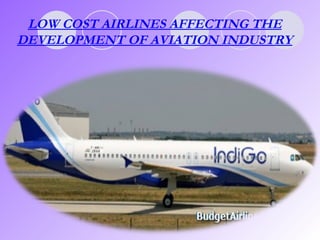
LOW COST AIRLINES AFFECTING THE DEVELOPMENT OF AVIATION INDUSTRY
Low cost airlines are airlines that generally offer low fares in exchange for eliminating many traditional passengers’ services. These airlines has a single configuration, single type of aircraft, reducing training and service cost, simple fare scheme, unreserved seats, flying to cheaper, less congested, secondary airports, simplified routes employees working in multiple roles.  LOW COST AIRLINES AFFECTING THE DEVELOPMENT OF AVIATION INDUSTRY
ADVANTAGES OF LOW COST AIRLINES Saves time Middle class people can fly More profit
DISADVANTAGES OF LOW COST AIRLINES Food and beverage are not served Unreserved seats Low baggage allowance
EXAMPLES OF LOW COST AIRLINES
 
PARAMOUNT AIRWAYS FOUNDED : ON 2005 (OCT) HUBS :  1.  CHENNAI  INTERNATIONAL  AIRPORT FLEET SIZE : 5 (+ 15 ORDERS) DESTINATION : 15 PARENT COMPANY :PARAMOUNT AIRWAYS. COMPANY SLOGAN : A WORLD OF DIFFERENCE. HEAD QUARTER :  CHENNAI , INDIA. KEY PEOPLE: MR. THIAGARAJAN .
 
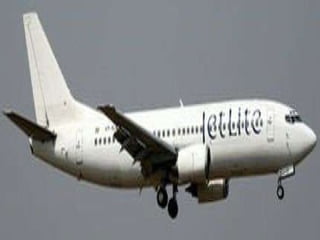
JET LITE FOUNDED : ON 1991 FREQUENT FLYER PROGRAM : JET PRIVILEGE.  FLEET SIZE : 24 (+ 10 ORDERS) DESTINATION : 28 PARENT COMPANY : TAILWINTS LIMITED. COMPANY SLOGAN :EMOTIONALLY YOURS. HEAD QUARTER : NEW DELHI , INDIA. KEY PEOPLE: SUBRATA ROY FOUNDER. NARESH GOYEL .
 
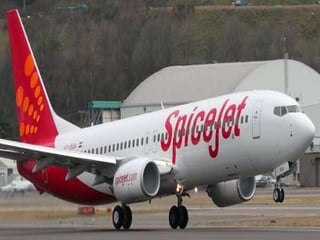
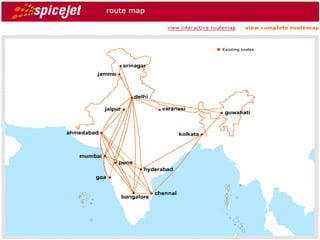
SPICEJET FOUNDED : ON 2005 FLEET SIZE : 21 (+ 9 ORDERS) DESTINATION : 18 HEAD QUARTER : NEW DELHI , INDIA. KEY PEOPLE:  MR. SANJAY AGARWAL.(CEO)
 
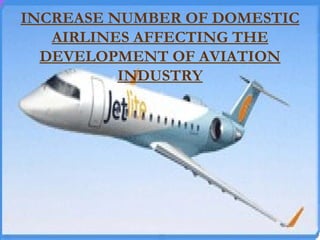
INCREASE NUMBER OF DOMESTIC AIRLINES AFFECTING THE DEVELOPMENT OF AVIATION INDUSTRY
INCREASE NUMBER OF DOMESTIC AIRLINE AFFECTING THE DEVELOPMENT OF AVIATION INDUSTRY Open sky policy:-In 1990 government of India passed a policy called open sky policy. According to this policy any carrier is allowed to invest in the Indian aviation sector. Previously aviation industry was under government rule by 1995. Many private airlines had ventured in to this business. Including jet airways, Sahara, continental, NEPC airline, Damania airways but only jet and Sahara survive in this industry.
ADVANTAGES More employment Good network More option for  the  passengers
DISADVANTAGES More competition More air traffic congestion More fuel consumption
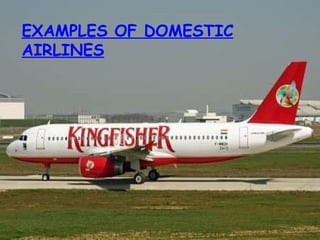
EXAMPLES OF DOMESTIC   AIRLINES
 
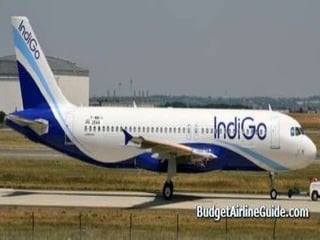
INDIGO AIRLINES FOUNDED : ON 2005 FLEET SIZE : 19 (+ 75 ORDERS) DESTINATION : 17 PARENT COMPANY : INTERGLOBLE ENTERPRISE. COMPANY SLOGAN : GO INDIA GO. HEAD QUARTER : GURGAON. KEY PEOPLE:  ADITYA GHOSH.
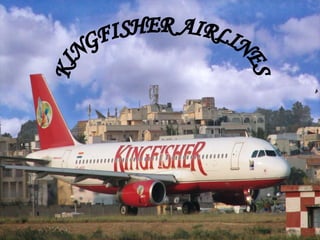
KINGFISHER AIRLINES
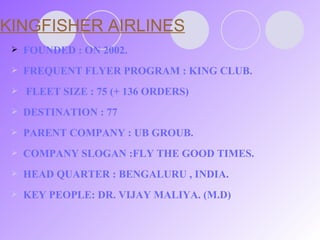
KINGFISHER AIRLINES FOUNDED : ON 2002. FREQUENT FLYER PROGRAM : KING CLUB.  FLEET SIZE : 75 (+ 136 ORDERS) DESTINATION : 77 PARENT COMPANY : UB GROUB. COMPANY SLOGAN :FLY THE GOOD TIMES. HEAD QUARTER : BENGALURU , INDIA. KEY PEOPLE: DR. VIJAY MALIYA. (M.D)
 
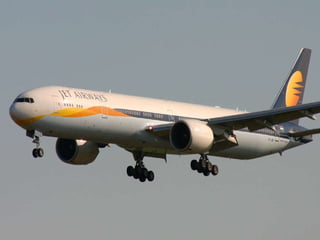
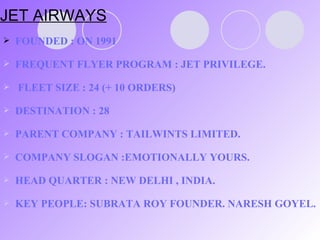
JET AIRWAYS FOUNDED : ON 1991 FREQUENT FLYER PROGRAM : JET PRIVILEGE.  FLEET SIZE : 24 (+ 10 ORDERS) DESTINATION : 28 PARENT COMPANY : TAILWINTS LIMITED. COMPANY SLOGAN :EMOTIONALLY YOURS. HEAD QUARTER : NEW DELHI , INDIA. KEY PEOPLE: SUBRATA ROY FOUNDER. NARESH GOYEL.
India’s improving economy affecting  the development of Aviation Industry . Current economy:- The airline industry is deeply impacted by the elasticity of demand, externalities, wage inequality, and monetary, fiscal, and federal policies. The elasticity of demand is based purely on current market condition, the customer’s purpose for travel, and available substitutes. Externalities continue to influence the elasticity of demand. The airline industry is viewed has being unstable because it is based on current market condition, and the market is always changing.
INDIA’S IMPROVING ECONOMY EFFECTING THE  DEVELOPMENT OF AVIATION INDUSTRY Construction of new airports and runways Multinational Companies are investing Modernization of airports Foreign Exchange
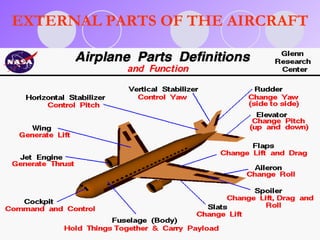
EXTERNAL PARTS OF THE AIRCRAFT
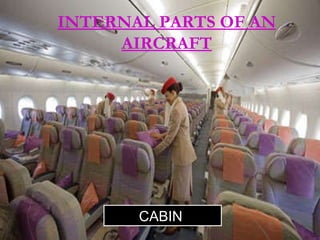
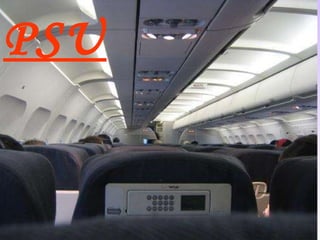
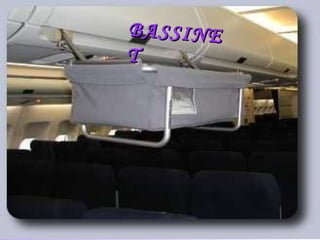
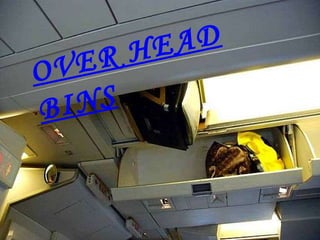
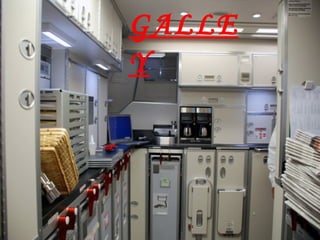
CABIN  INTERNAL PARTS OF AN AIRCRAFT
PSU
BASSINET
AISLE (SINGLE) NARROW BODIED AIRCRAFT
OVER HEAD BINS
GALLEY
DOG HOUSE
LAVATORY
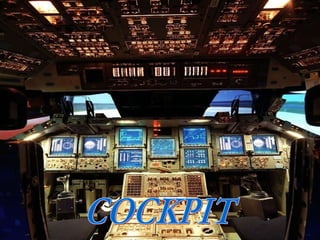
COCKPIT
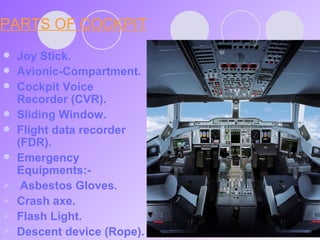
PARTS OF COCKPIT Joy Stick. Avionic-Compartment. Cockpit Voice Recorder (CVR). Sliding Window. Flight data recorder (FDR). Emergency Equipments:- Asbestos Gloves. Crash axe. Flash Light. Descent device (Rope).
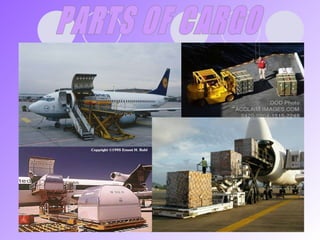
There are three zones of cargo forward zone, the mid zone and aft zone.  All three zones are pressurized.  Light baggage's are kept in the forward zone.  Heavy cargo in the mid and aft zone. Loading for the forward and mid zone is done in huge containers or mechanically.  The aft zone is Air Conditioned.  Pet animals in a cage and dead body in coffin are kept in the aft zone.  Loading for the aft zone is done by the loaders or manually. PARTS OF CARGO
PARTS OF CARGO
Personal attributes to become a cabin crew   Smartness Communication skill Eagerness to help Body language Punctuality
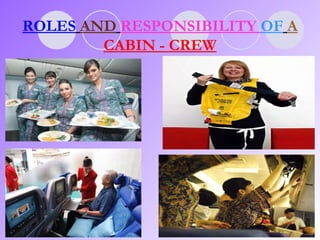
ROLES AND RESPONSIBILITY OF A CABIN - CREW The responsibility of a cabin crew ranges from taking care of the safety of the passengers give medicine to the passengers in case of a medical emergency and lastly to do the in flight service according to the laid down procedure.   Safety Medical emergency In flight service
ROLES   AND   RESPONSIBILITY  OF   A   CABIN - CREW
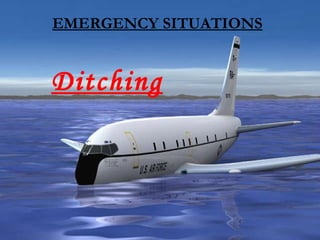
Ditching EMERGENCY SITUATIONS
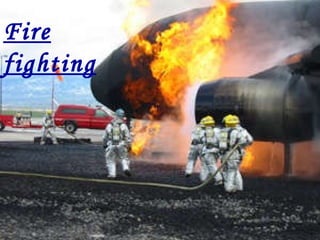
Fire fighting
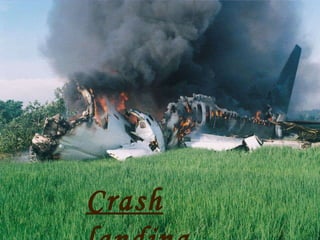
Crash landing
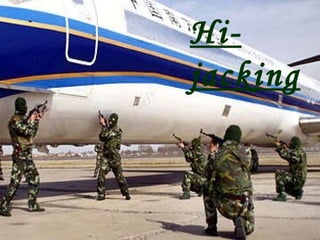
Hi-jacking
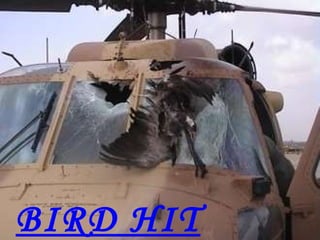
BIRD HIT
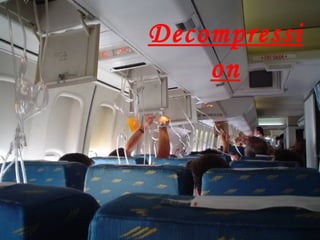
Decompression
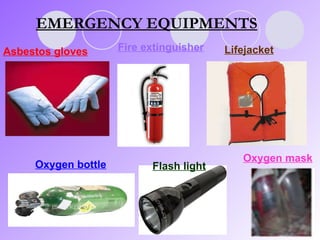
Oxygen bottle   Fire extinguisher   Lifejacket   Asbestos gloves EMERGENCY EQUIPMENTS Oxygen mask Flash light
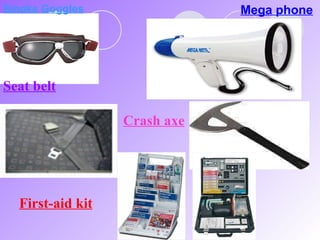
Smoke Goggles   Mega phone Seat belt Crash axe First-aid kit
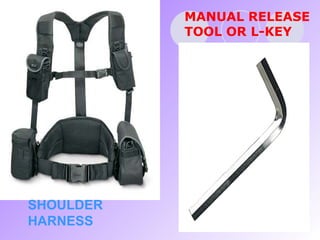
MANUAL RELEASE TOOL OR L-KEY SHOULDER HARNESS
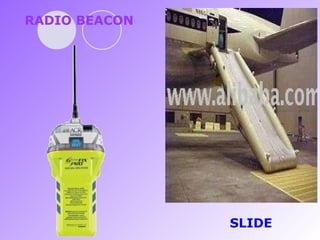
RADIO BEACON SLIDE
FIRST AID
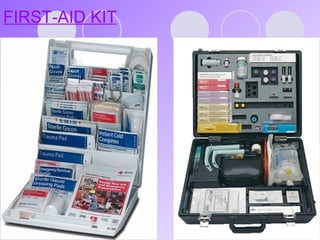
FIRST-AID KIT
FIRST-AID EAR ACHE AND EAR DISCOMFORT:- This is a very common phenomenon during a flight and due to sudden change in cabin-pressure while the aircraft is ascending or descending. TREATMENT:- If an insect has gone into the ear, put a drop of water in the ear. All other types of foreign bodies have to be left alone. For discomfort during the flight. Serve passenger something to drink or to chew. Ask passenger to blow out with mouth and the close the nose. Massage them below and behind their ear, may help If it is a baby ask the mother to feed the baby or to let the baby cry. PRECAUTIONS:- If the earache is due to a foreign baby lodged in the ear, do not attempt to remove the foreign body.
SUMMARY In our aviation class we have been taught a lot of things about airlines. We have learnt about the aircraft terms and parts of cockpit, interior and exterior of an aircraft, parts of a cargo aircraft in unit-4 (LO1). Evaluation of roles and justifying and aircraft equipment in (LO2). Analyzing of emergency situations in (LO3). Justification of safety and emergency equipment in (LO4). We also learnt about First aid in unit-9 (LO1). How to undertake a range of airbus in-flight service in (LO2). About the cockpit and cargo operations for an airbus in (LO3). And lastly about demonstrate in-flight skills with domestic carrier in (LO4).
BIBLIOGRAPHY I collected all the information from certain sites :- http://www.yahoo.com. http://www.google.com. The full details collected from :- wikipedia.com -> web pages -> name of airlines. Google.com -> web pages -> name of  airlines . The pictures collected from :- Google.com -> images -> name of airlines. Yahoo.com -> images -> name of parts, situations, equipments .
THANK YOU

Balram kumar

  • 1.
    INTRODUCTION ACKNOWLEDGEMENT LOWCOST AIRLINES AFFECTING THE DEVELOPMENT OF AVIATION INDUSTRY DOMESTIC AIRLINES AFFECTING THE DEVELOPMENT OF AVIATION INDUSTRY INDIA’S IMPROVING ECONOMY AFFECTING THE DEVELOPMENT OF AVIATION INDUSTRY EXTERNAL PARTS OF AN AIRCRAFT 7. INTERNAL PARTS OF AN AIRCRAFT INDEX
  • 2.
    8. PARTS OFCOCKPIT 9. PARTS OF CARGO 10. PERSONAL ATTRIBUTES REQUIRE TO BE A CABIN CREW 11. ROLES AND RESPONSIBILITIES OF A CABIN CREW 12. EMERGENCY SITUATION 13. EMERGENCY EQUIPMENTS 14. FIRST-AID 15. SUMMARY 16. BIBLIOGRAPHY INDEX
  • 3.
    LEARNER’S NAME:- BALRAM KUMAR FACULTY’S NAME:- Mrs. MANISHA GUPTA. BATCH CODE:- K3. UNIT NO. - 4 & 9.(AVIATION). ASSIGNMENT No. – C2.A.4/9/10. Introduction
  • 4.
    ACKNOWLEDGEMENT I amBalram Kumar from K3 batch. I would like to thank frankfinn institute of air hostess training for giving me an opportunity to do a project on aviation. I would also like to thank my aviation faculty for her support and guidance.
  • 5.
    LOW COST AIRLINESAFFECTING THE DEVELOPMENT OF AVIATION INDUSTRY
  • 6.
    Low cost airlinesare airlines that generally offer low fares in exchange for eliminating many traditional passengers’ services. These airlines has a single configuration, single type of aircraft, reducing training and service cost, simple fare scheme, unreserved seats, flying to cheaper, less congested, secondary airports, simplified routes employees working in multiple roles. LOW COST AIRLINES AFFECTING THE DEVELOPMENT OF AVIATION INDUSTRY
  • 7.
    ADVANTAGES OF LOWCOST AIRLINES Saves time Middle class people can fly More profit
  • 8.
    DISADVANTAGES OF LOWCOST AIRLINES Food and beverage are not served Unreserved seats Low baggage allowance
  • 9.
    EXAMPLES OF LOWCOST AIRLINES
  • 10.
  • 11.
    PARAMOUNT AIRWAYS FOUNDED: ON 2005 (OCT) HUBS : 1. CHENNAI INTERNATIONAL AIRPORT FLEET SIZE : 5 (+ 15 ORDERS) DESTINATION : 15 PARENT COMPANY :PARAMOUNT AIRWAYS. COMPANY SLOGAN : A WORLD OF DIFFERENCE. HEAD QUARTER : CHENNAI , INDIA. KEY PEOPLE: MR. THIAGARAJAN .
  • 12.
  • 13.
    JET LITE FOUNDED: ON 1991 FREQUENT FLYER PROGRAM : JET PRIVILEGE. FLEET SIZE : 24 (+ 10 ORDERS) DESTINATION : 28 PARENT COMPANY : TAILWINTS LIMITED. COMPANY SLOGAN :EMOTIONALLY YOURS. HEAD QUARTER : NEW DELHI , INDIA. KEY PEOPLE: SUBRATA ROY FOUNDER. NARESH GOYEL .
  • 14.
  • 15.
    SPICEJET FOUNDED :ON 2005 FLEET SIZE : 21 (+ 9 ORDERS) DESTINATION : 18 HEAD QUARTER : NEW DELHI , INDIA. KEY PEOPLE: MR. SANJAY AGARWAL.(CEO)
  • 16.
  • 17.
    INCREASE NUMBER OFDOMESTIC AIRLINES AFFECTING THE DEVELOPMENT OF AVIATION INDUSTRY
  • 18.
    INCREASE NUMBER OFDOMESTIC AIRLINE AFFECTING THE DEVELOPMENT OF AVIATION INDUSTRY Open sky policy:-In 1990 government of India passed a policy called open sky policy. According to this policy any carrier is allowed to invest in the Indian aviation sector. Previously aviation industry was under government rule by 1995. Many private airlines had ventured in to this business. Including jet airways, Sahara, continental, NEPC airline, Damania airways but only jet and Sahara survive in this industry.
  • 19.
    ADVANTAGES More employmentGood network More option for the passengers
  • 20.
    DISADVANTAGES More competitionMore air traffic congestion More fuel consumption
  • 21.
  • 22.
  • 23.
    INDIGO AIRLINES FOUNDED: ON 2005 FLEET SIZE : 19 (+ 75 ORDERS) DESTINATION : 17 PARENT COMPANY : INTERGLOBLE ENTERPRISE. COMPANY SLOGAN : GO INDIA GO. HEAD QUARTER : GURGAON. KEY PEOPLE: ADITYA GHOSH.
  • 24.
  • 25.
    KINGFISHER AIRLINES FOUNDED: ON 2002. FREQUENT FLYER PROGRAM : KING CLUB. FLEET SIZE : 75 (+ 136 ORDERS) DESTINATION : 77 PARENT COMPANY : UB GROUB. COMPANY SLOGAN :FLY THE GOOD TIMES. HEAD QUARTER : BENGALURU , INDIA. KEY PEOPLE: DR. VIJAY MALIYA. (M.D)
  • 26.
  • 27.
    JET AIRWAYS FOUNDED: ON 1991 FREQUENT FLYER PROGRAM : JET PRIVILEGE. FLEET SIZE : 24 (+ 10 ORDERS) DESTINATION : 28 PARENT COMPANY : TAILWINTS LIMITED. COMPANY SLOGAN :EMOTIONALLY YOURS. HEAD QUARTER : NEW DELHI , INDIA. KEY PEOPLE: SUBRATA ROY FOUNDER. NARESH GOYEL.
  • 28.
    India’s improving economyaffecting the development of Aviation Industry . Current economy:- The airline industry is deeply impacted by the elasticity of demand, externalities, wage inequality, and monetary, fiscal, and federal policies. The elasticity of demand is based purely on current market condition, the customer’s purpose for travel, and available substitutes. Externalities continue to influence the elasticity of demand. The airline industry is viewed has being unstable because it is based on current market condition, and the market is always changing.
  • 29.
    INDIA’S IMPROVING ECONOMYEFFECTING THE DEVELOPMENT OF AVIATION INDUSTRY Construction of new airports and runways Multinational Companies are investing Modernization of airports Foreign Exchange
  • 30.
    EXTERNAL PARTS OFTHE AIRCRAFT
  • 31.
    CABIN INTERNALPARTS OF AN AIRCRAFT
  • 32.
  • 33.
  • 34.
    AISLE (SINGLE) NARROWBODIED AIRCRAFT
  • 35.
  • 36.
  • 37.
  • 38.
  • 39.
  • 40.
    PARTS OF COCKPITJoy Stick. Avionic-Compartment. Cockpit Voice Recorder (CVR). Sliding Window. Flight data recorder (FDR). Emergency Equipments:- Asbestos Gloves. Crash axe. Flash Light. Descent device (Rope).
  • 41.
    There are threezones of cargo forward zone, the mid zone and aft zone. All three zones are pressurized. Light baggage's are kept in the forward zone. Heavy cargo in the mid and aft zone. Loading for the forward and mid zone is done in huge containers or mechanically. The aft zone is Air Conditioned. Pet animals in a cage and dead body in coffin are kept in the aft zone. Loading for the aft zone is done by the loaders or manually. PARTS OF CARGO
  • 42.
  • 43.
    Personal attributes tobecome a cabin crew Smartness Communication skill Eagerness to help Body language Punctuality
  • 44.
    ROLES AND RESPONSIBILITYOF A CABIN - CREW The responsibility of a cabin crew ranges from taking care of the safety of the passengers give medicine to the passengers in case of a medical emergency and lastly to do the in flight service according to the laid down procedure. Safety Medical emergency In flight service
  • 45.
    ROLES AND RESPONSIBILITY OF A CABIN - CREW
  • 46.
  • 47.
  • 48.
  • 49.
  • 50.
  • 51.
  • 52.
    Oxygen bottle Fire extinguisher Lifejacket Asbestos gloves EMERGENCY EQUIPMENTS Oxygen mask Flash light
  • 53.
    Smoke Goggles Mega phone Seat belt Crash axe First-aid kit
  • 54.
    MANUAL RELEASE TOOLOR L-KEY SHOULDER HARNESS
  • 55.
  • 56.
  • 57.
  • 58.
    FIRST-AID EAR ACHEAND EAR DISCOMFORT:- This is a very common phenomenon during a flight and due to sudden change in cabin-pressure while the aircraft is ascending or descending. TREATMENT:- If an insect has gone into the ear, put a drop of water in the ear. All other types of foreign bodies have to be left alone. For discomfort during the flight. Serve passenger something to drink or to chew. Ask passenger to blow out with mouth and the close the nose. Massage them below and behind their ear, may help If it is a baby ask the mother to feed the baby or to let the baby cry. PRECAUTIONS:- If the earache is due to a foreign baby lodged in the ear, do not attempt to remove the foreign body.
  • 59.
    SUMMARY In ouraviation class we have been taught a lot of things about airlines. We have learnt about the aircraft terms and parts of cockpit, interior and exterior of an aircraft, parts of a cargo aircraft in unit-4 (LO1). Evaluation of roles and justifying and aircraft equipment in (LO2). Analyzing of emergency situations in (LO3). Justification of safety and emergency equipment in (LO4). We also learnt about First aid in unit-9 (LO1). How to undertake a range of airbus in-flight service in (LO2). About the cockpit and cargo operations for an airbus in (LO3). And lastly about demonstrate in-flight skills with domestic carrier in (LO4).
  • 60.
    BIBLIOGRAPHY I collectedall the information from certain sites :- http://www.yahoo.com. http://www.google.com. The full details collected from :- wikipedia.com -> web pages -> name of airlines. Google.com -> web pages -> name of airlines . The pictures collected from :- Google.com -> images -> name of airlines. Yahoo.com -> images -> name of parts, situations, equipments .
  • 61.