DISTINCTION
INTRODUCTION
I’m here going to present about
 the advantage and disadvantage
 of current scenario aviation
 industry and comparison of old
 technology (A300) and new
 technology (A380) and with my
 conclusion.
CONTENTS

Acknowledgement.
Advantage and disadvantage
 of aviation industry.
Analysis of advantage.
Analysis of disadvantage.
Comparison of A300 and A380.
ACKNOWLDGEMENT
I owe a great many thanks to a great many people who helped and
supported me during the aviation assignment.

My deepest thanks to trainer Mrs.Ramya rai the Guide of the assignment for
guiding and correcting various documents of mine with attention and care. She has
taken pain to go through the assignment and make necessary correction as and
when I needed.

I express my thanks to the center head of FAIT frankfinn koramangala, Bangalore
for extending her support.

I would also thank my Institution and my faculty members without whom this
assignment would have been a distant reality.

I also extend my heartfelt thanks to my family and well wishers.
AVIATION INDUSTRY
Advantage                           Disadvantage
 Visit many tourist place by air      Spoilage.
  transport.                           Aircraft is expensive.
 Low cost airline.                    High fuel price.
 Job opportunity.                     Infrastructure of airline
 Modernization of airport.             industry.
Analysis
Advantage of aviation industry
Visit many tourist places by air transport.
 Aviation provides the only worldwide transportation network, which makes it
  essential for global business and tourism.
 Air transpiration alleviates poverty and helps to improve living standards by
  facilitating tourism.
 Air transport improves quality of life by broadening people’s leisure and
  cultural experiences. It provides a wider choice of holiday destinations
  around the world and an affordable means to visit distance tourism place.
 Air transport contributes to sustainable development not only by facilitating
  tourism and trade.
 It generates economic growth, provides jobs, increase revenues from taxes
  as well as facilitates the delivery of emergency humanitarian aid relief and
  swift delivery of medical supplies anywhere on the earth.
 Thomas Cook, is the World Wide travel agency arranging tour packages to
  people. This is one advantage to the airline industry.
 Most of the airlines are flying to the tourist place like Switzerland, Goa, UK,
  France, Japan, Spain, Dubai, etc.
 Due to growth in tourism, there has been an increase in number of the
  international and domestic passenger. The estimated growth of domestic
  passenger segment is at 50% per annum and the growth for international
  passenger is 25% (p.a).
Tourisms places
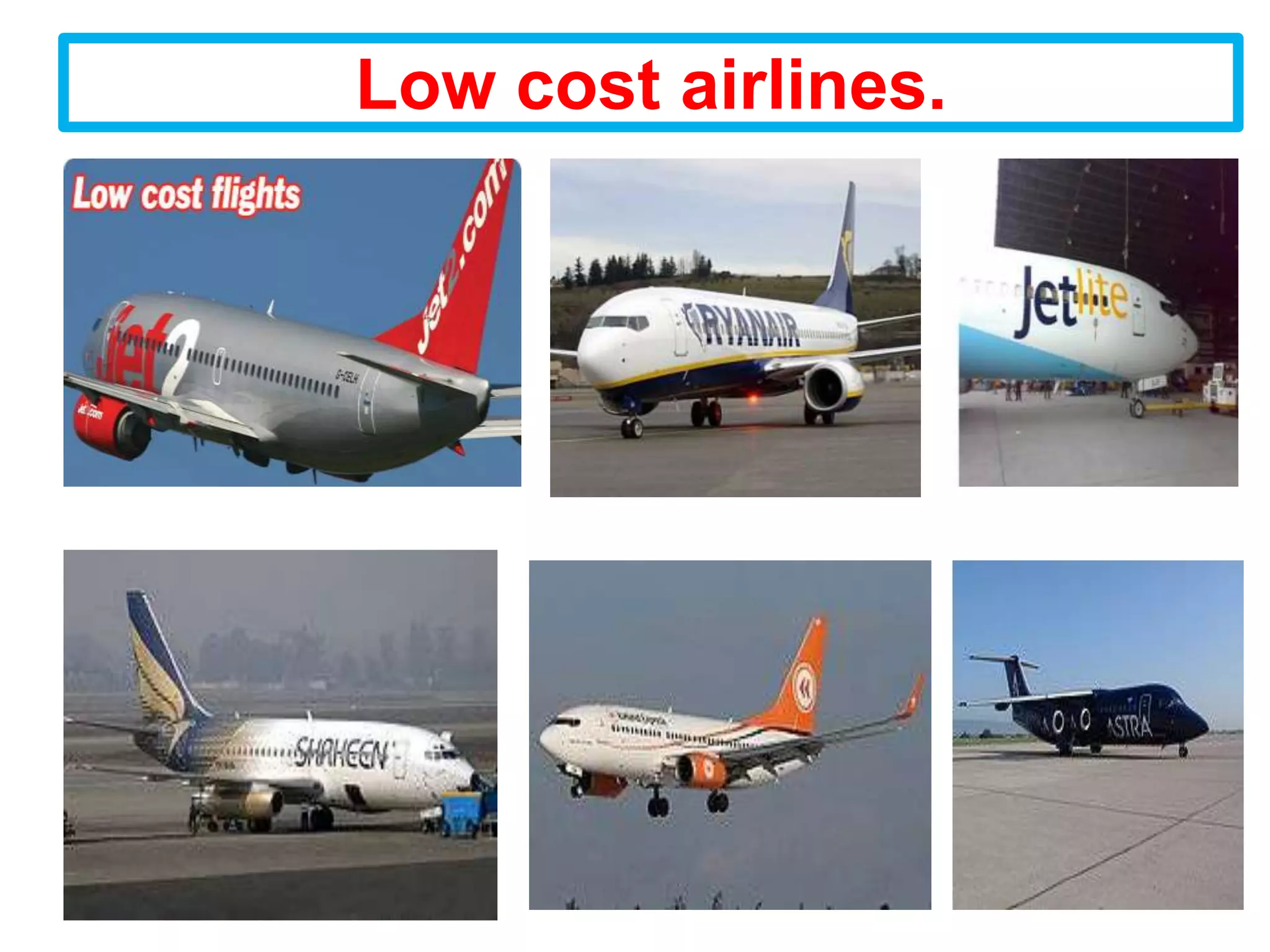
Low cost airline.
The advantage of low cost flights also include the fact that you would be able to cover more
ground and therefore helps you to be more productive. Besides, flying is fun and everybody
Should experience it at one time or other and the low cost flights offer you just the right
opportunity to do so.
 It saves you precious time
This is one advantage that many find irresistible. Time is a very precious commodity today, and
if you can fly for just a small increase of time compared to a train journey, then it is definitely
worthwhile.
 It is extremely convenient
One of the most important of the advantages of low cost flights is the convenience of travelling.
you do not need to worry anymore about long and tiresome journeys by bus, train or car. This
would invariably involve countless days on road, living out of a suitcase and staying in
uncomfortable hotels. The flight does away with all this inconvenience.
 It saves money
Many people compare only the flight ticket cost to the gasoline bill or bus ticket cost (or any
other form of travel you choose). the difference would still be quite a lot, and therefore are
happy that by choosing alternative modes of travel they are saving some money. But is it so
really.
 Non stop service
a low cost airline, provides non-stop service from small airports to almost all Major airports
nonstop.
 Meal Service
Commercial airlines offer limited refreshments, often just peanuts or a beverage on domestic
flights. Budget airlines offer the same fare but for a price. With Transportation Safety
Administration restrictions, the days of brown bagging on a flight are over.
 Market share:
In 2010, the private carriers accounted for around 75% share of
the domestic aviation market.
STUDENT CONCESSION FORM FOR DOMESTIC TRAVEL
 The ‘Form’ shall be accepted only if it is verified and attested
   by the Principal/Head of the Educational establishment.
 The attested Form should be verified by the Air lines (IC)
   office, nearest to the Educational Establishment before
   issuance of the ticket. In case an Educational Establishments
   located at a place where Air lines do not have an office but an
   approved Travel Agent is available, the approved Travel agent
   may verify this form and issue tickets.
 Flights/Routes with high seat factor may be placed under
   Embargo for travel under ‘Student Discount’. On such
   Routes/Flights only those students shall be permitted to avail
   of students discount who are traveling between Place of study
   and Home Town.
Low cost airlines.
Job opportunity.
 Since deregulation in 1978, the airline industry has hired twice as many new
   employees as were hired. Previous 35 year combined. This ever changing
   industry requires thousands of new employees monthly.
 Over of the year experience in the aviation sector, Airline specialists have
   developed sophisticated systems and models for the assessment of
   candidates for various positions in cabin crew, flight crew, ground crew etc,
   either or in various recruitment phases.
 A successful airline required inter and intra personal relationship
Every airline workforce into separate departments
1) Commercial pilot              12) Maintence controller.
2) Co-pilot.                     13) Licensed aircraft maintence engineering.
3) Air cargo pilot.              14) Quality control manager.
4) Expat cabin crew.              15) Cargo officer.
5) Air traffic controller.        16) Guest service agents.
6) Cabin safety instructor.       17) Ground staff.
7) In flight manager.
8) In flight base manager.
9) Cabin service instructor.
10) Cabin crew.
11) Training instructor.
Advantage to employee:
 Travel
 Camaraderie.
 Absence of monotony.
 Appreciation.
 Personal development and other benefits.
Benefits to employee:
 Personal and family travel passes.
 Health insurance.
 Life insurance.
 Vision care insurance.
 Dental insurance.
 Sick pay.
 Paid vocation.
 Profit sharing.
 Retirement program.
Additional benefits:
 Full or part time employment.
 Wide pay range.
 Flexible schedule.
 Multiple days off.
 Job shares.
 Leave of absence.
 Personal adventure and excitement.
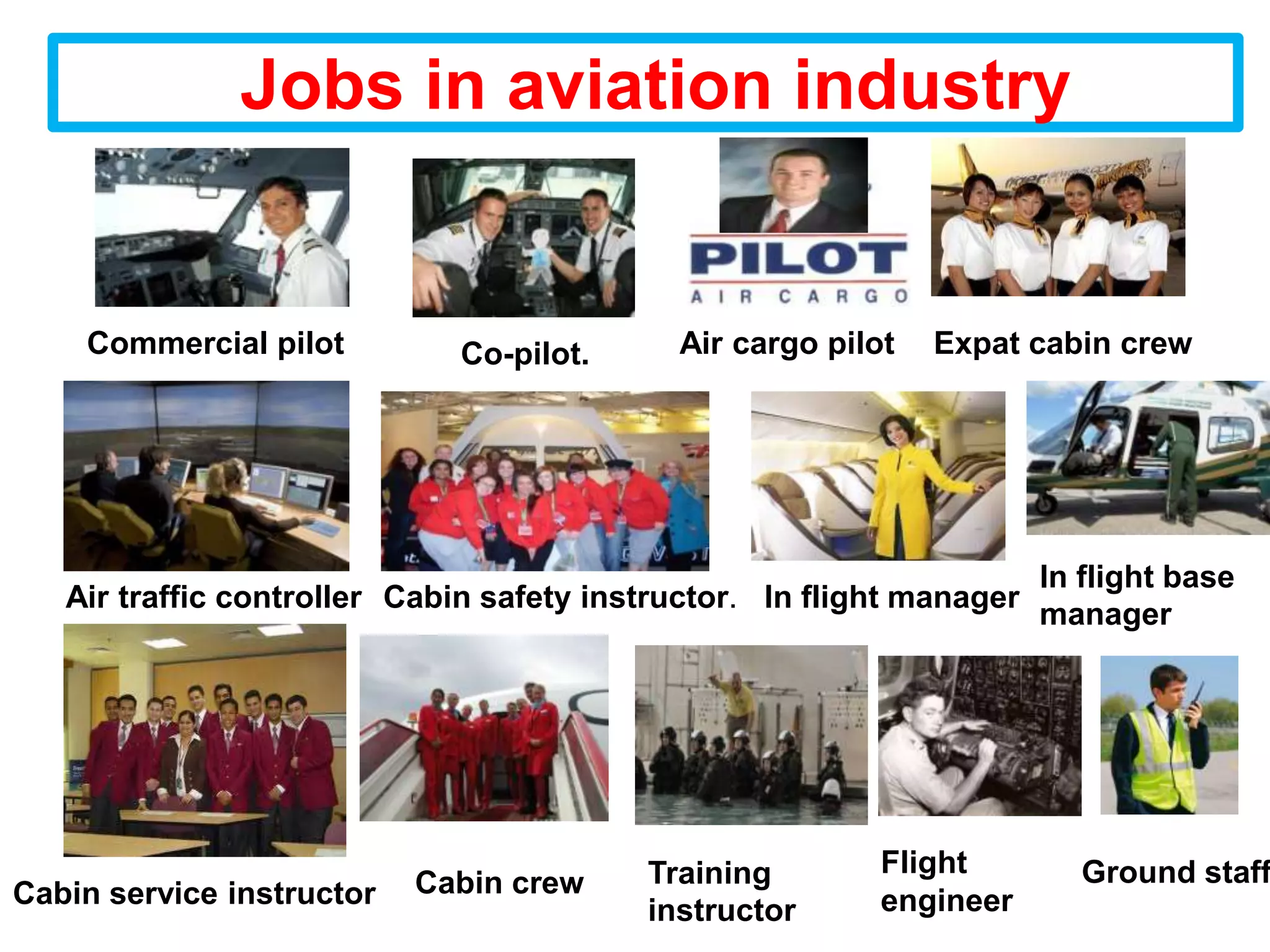
Jobs in aviation industry


    Commercial pilot         Co-pilot.      Air cargo pilot   Expat cabin crew


                                                                       In flight base
   Air traffic controller Cabin safety instructor. In flight manager
                                                                       manager


                                          Training        Flight          Ground staff
Cabin service instructor   Cabin crew
                                          instructor      engineer
Modernization of airports
 The Airports Authority of India (AAI) is undertaking the development and
  modernization of all 35 non-metro airports in the country simultaneously and work is
  due to be completed by March 2010.
 Wholly owned subsidiaries of AAI are being created for the development and
  operation of these airports. According to the AAI, it has already awarded work orders
  for terminal buildings at 13 airports, and for airside development, including runway,
  taxiway, apron, fire station, control tower and isolation bay, at 19 airports.
 Two greenfield airports at Bangalore and Hyderabad are being developed .The first
  phase is planned to be finished by end-2008.
 The other two metro airports - Chennai, Kolkata -- may soon be on the modernization
  path. At least 10 non-metro airports are being developed as strategic airports serving
  the region or respective states, and at least a few more non-metro airports are being
  positioned strategically as regional hub airports or nodes providing better connectivity
  to overall airport network and feeding international network through hub/metro
  airports.
 With these developments in aviation infrastructure, we may also see some airports
  making money not purely on passenger traffic, but also by means of cargo, logistics,
  and real estate projects being developed adjacent to airports.
 Domestic passenger movement across airports is likely to grow at a 20-25 per cent
  till 2010, and passenger traffic is expected to increase to around 120 million by 2010.
  Hence modernization, privatization and development of airports in the form of
  greenfield and/or brownfield airports is the need of the hour.
Modernization of airport
 Indira Gandhi International Airport has become India's and South Asia's largest and
  most important aviation hub, with a current capacity of handling more than 46
  million passengers and aimed at handling more than 100 million passengers by
  2030.
 There is also a separate Technical Area for VVIP passengers.
 IGI Airport is the home of several Indian airlines including Air India, Air India
  Regional, Indian Airlines, IndiGo, JetLite, SpiceJet. Jet Airways, Kingfisher Airlines,
  GoAir use IGI Airport as their secondary hub. Approximately 80 airlines serve this
  airport. There are Six operational terminals making up this airport, they are the
  following:
 Terminal 1 Domestic
 This cater to Indian Airlines domestic flights only. bigger luggage reclaim area, It is
  currently used by GoAir, IndiGo, SpiceJet
 Terminal 2 -immigration and emigration counters have been implemented, new
  seats have been brought in, new baggage belts, more business lounges, eateries,
  and duty free shops had also been added
 Terminal 3-the world’s eighth largest passenger terminal handle 34 million
  passengers annually. This terminal has 168 check-in counters, 78 aerobridges at 48
  contact stands, 30 parking bays, 72 immigration counters, 15 X-ray screening
  areas, for less waiting times, duty-free shops, and other features. Over 90% of
  passengers will use this terminal.
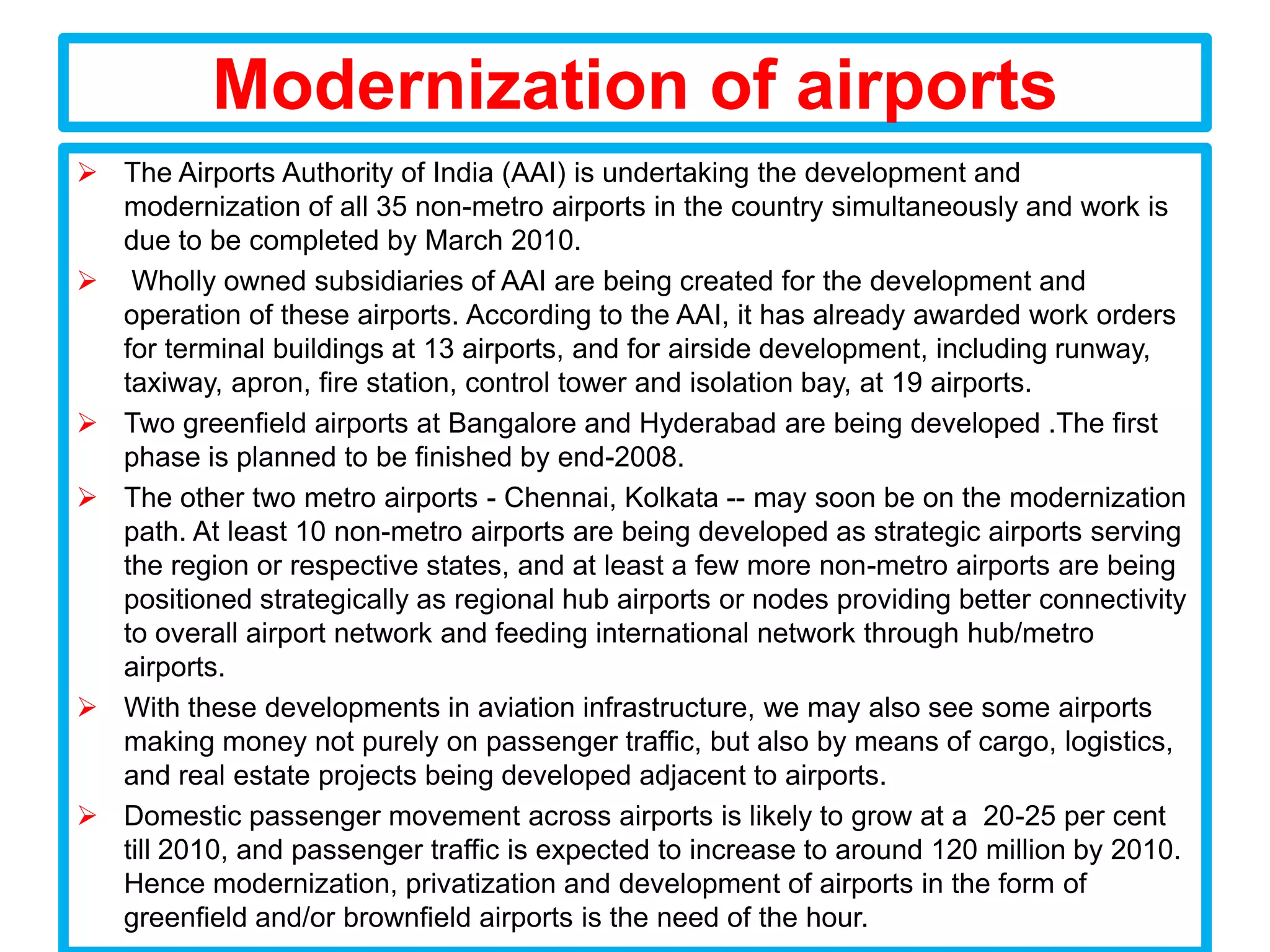
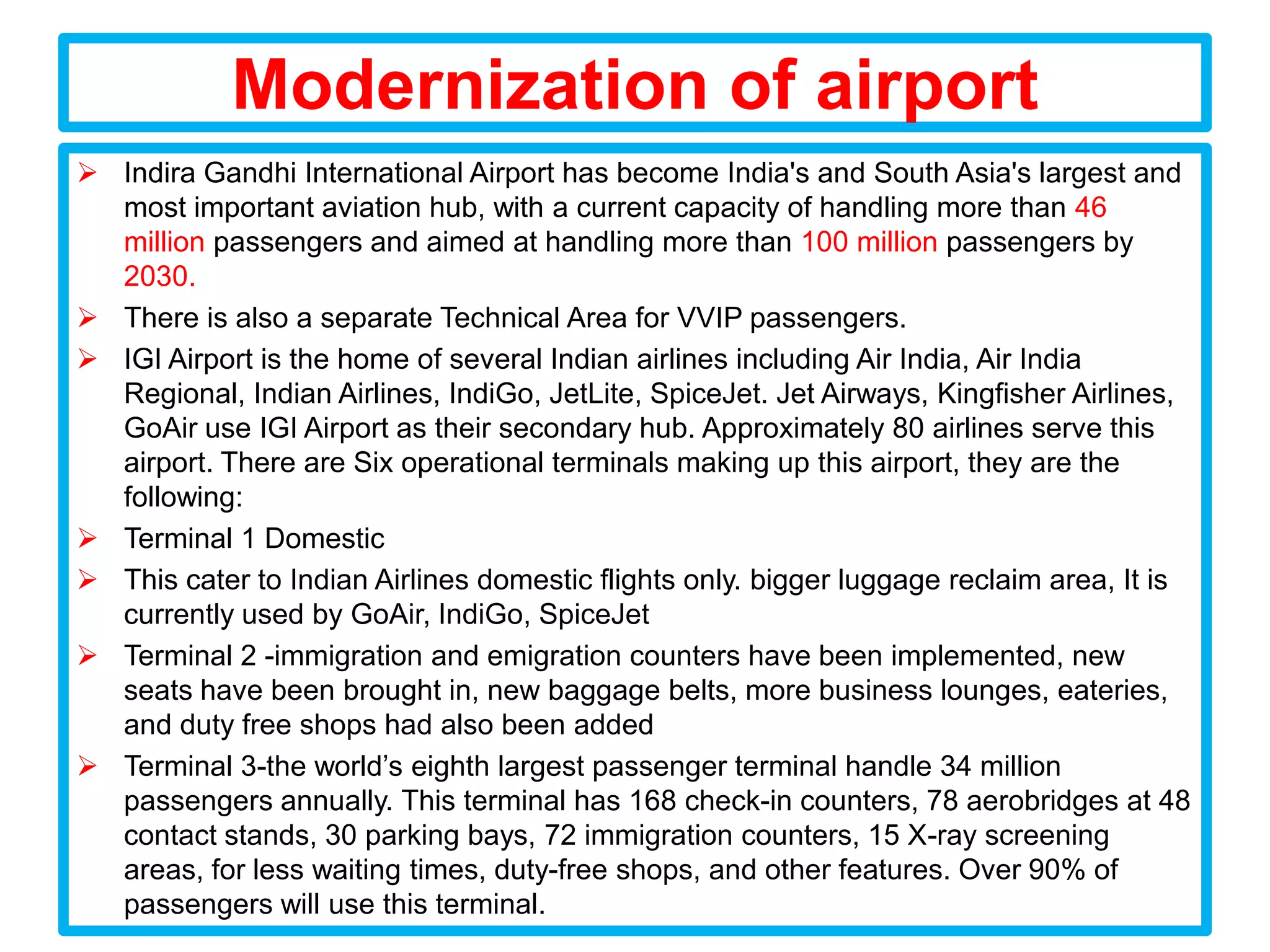
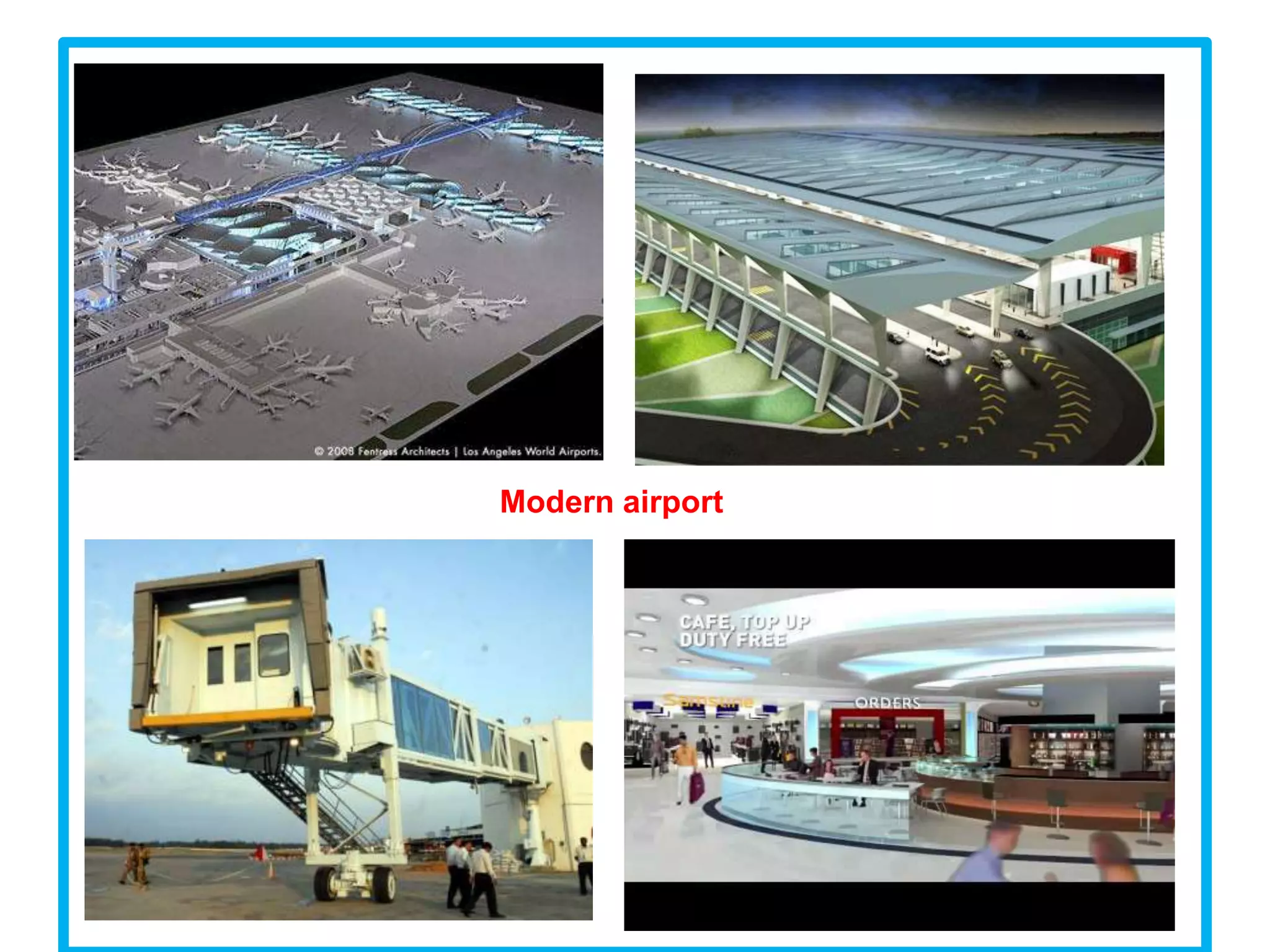
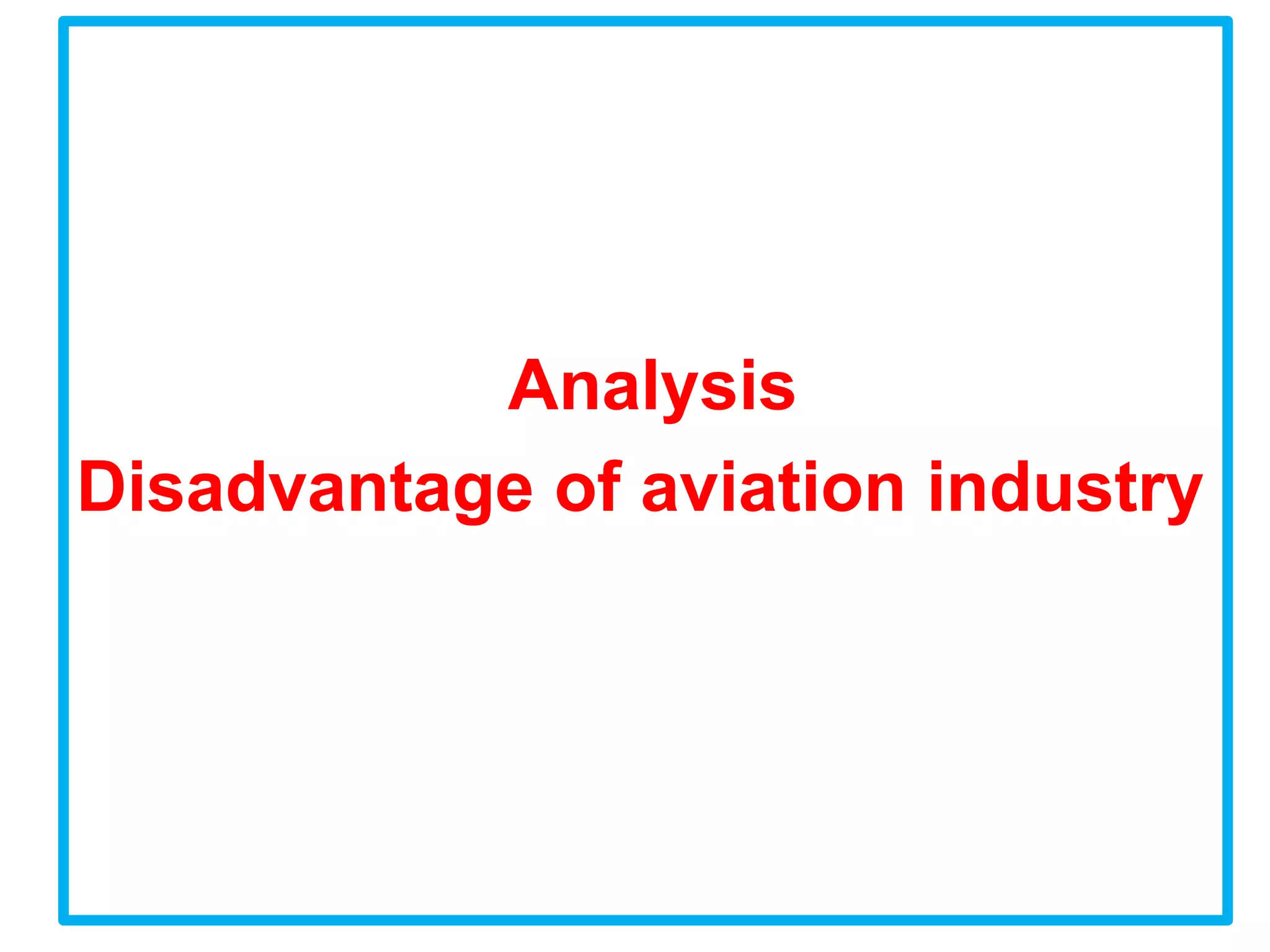
Modern airport
Analysis
Disadvantage of aviation industry
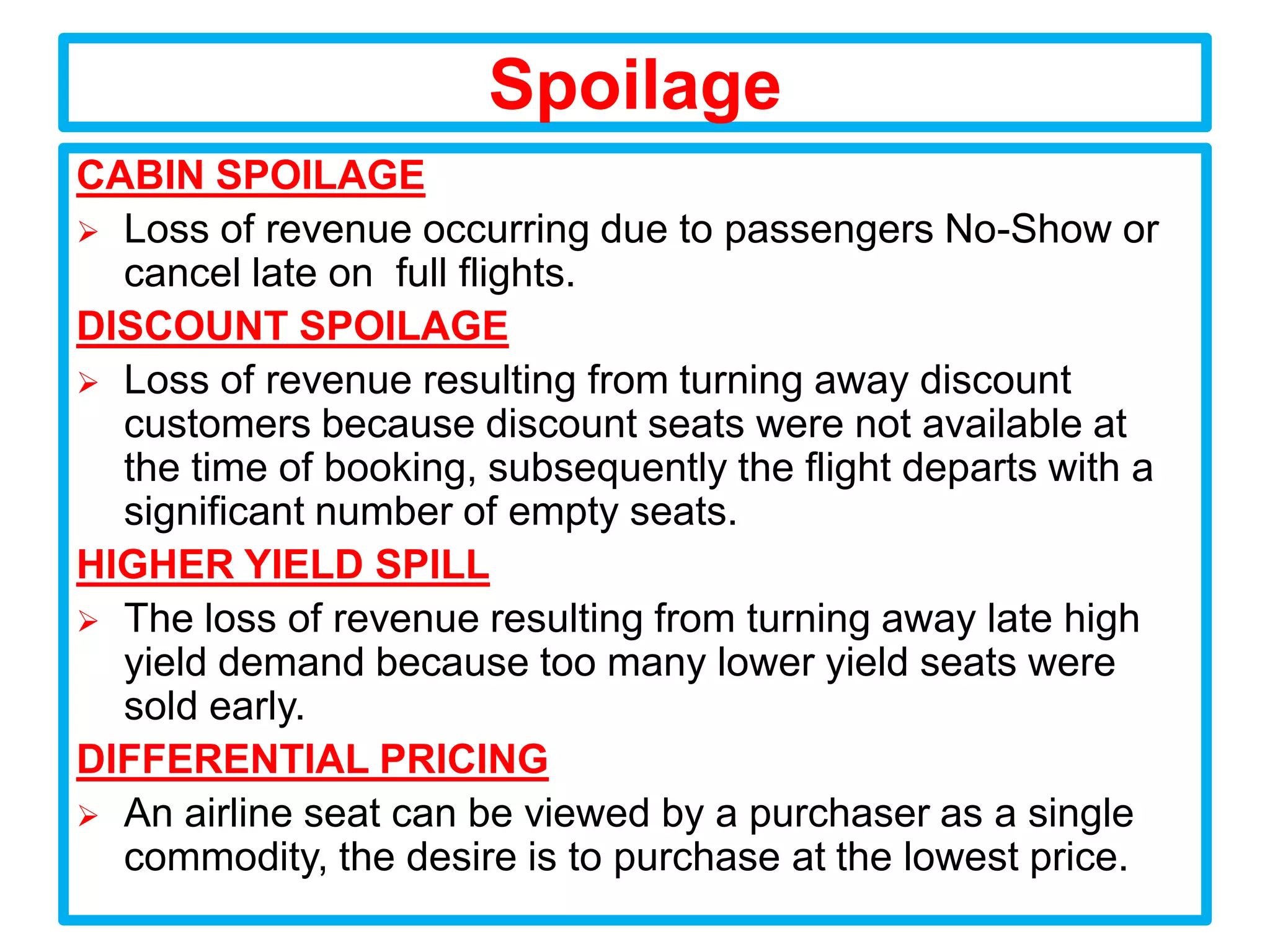
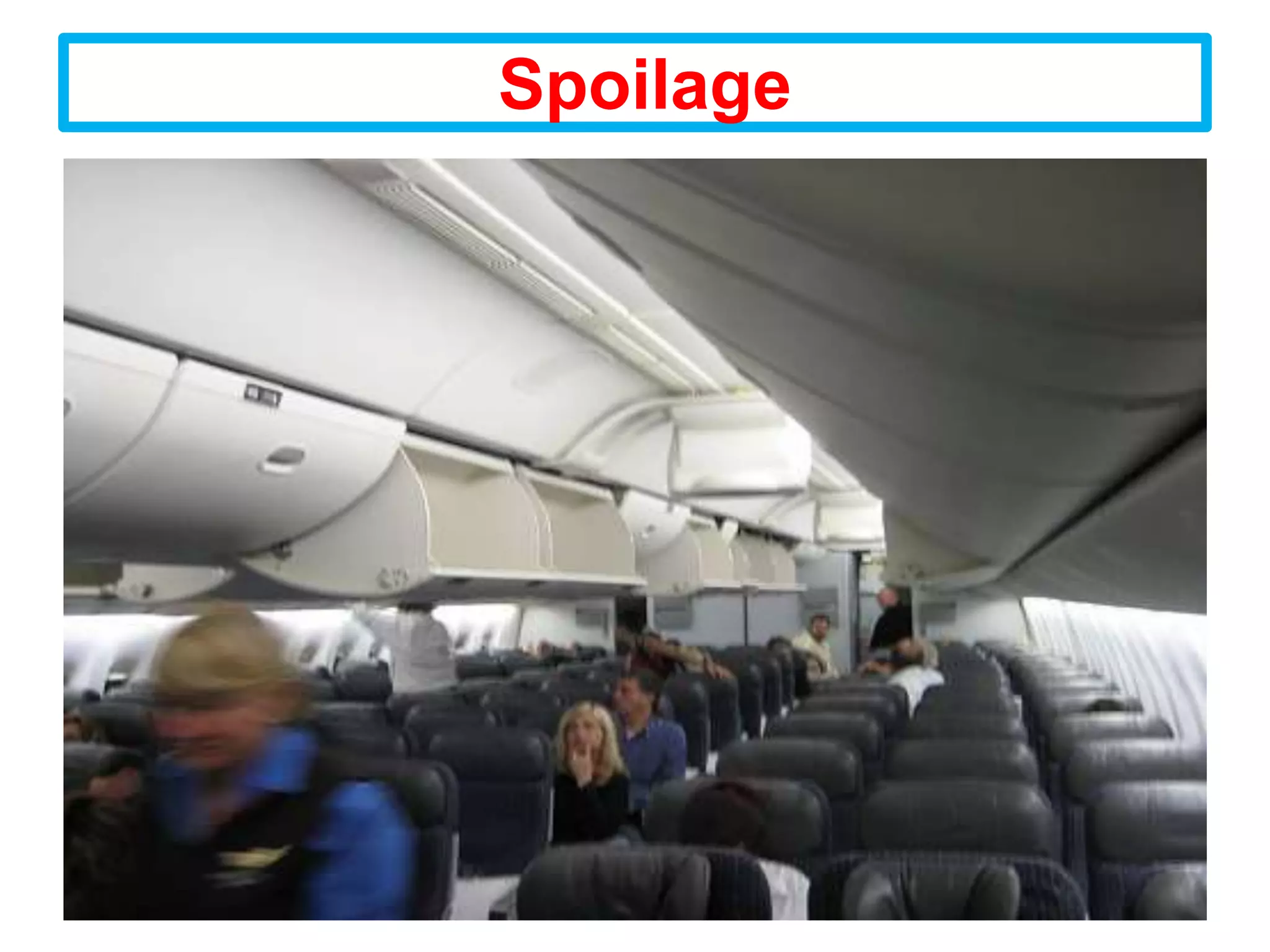
Spoilage
CABIN SPOILAGE
 Loss of revenue occurring due to passengers No-Show or
  cancel late on full flights.
DISCOUNT SPOILAGE
 Loss of revenue resulting from turning away discount
  customers because discount seats were not available at
  the time of booking, subsequently the flight departs with a
  significant number of empty seats.
HIGHER YIELD SPILL
 The loss of revenue resulting from turning away late high
  yield demand because too many lower yield seats were
  sold early.
DIFFERENTIAL PRICING
 An airline seat can be viewed by a purchaser as a single
  commodity, the desire is to purchase at the lowest price.
Spoilage
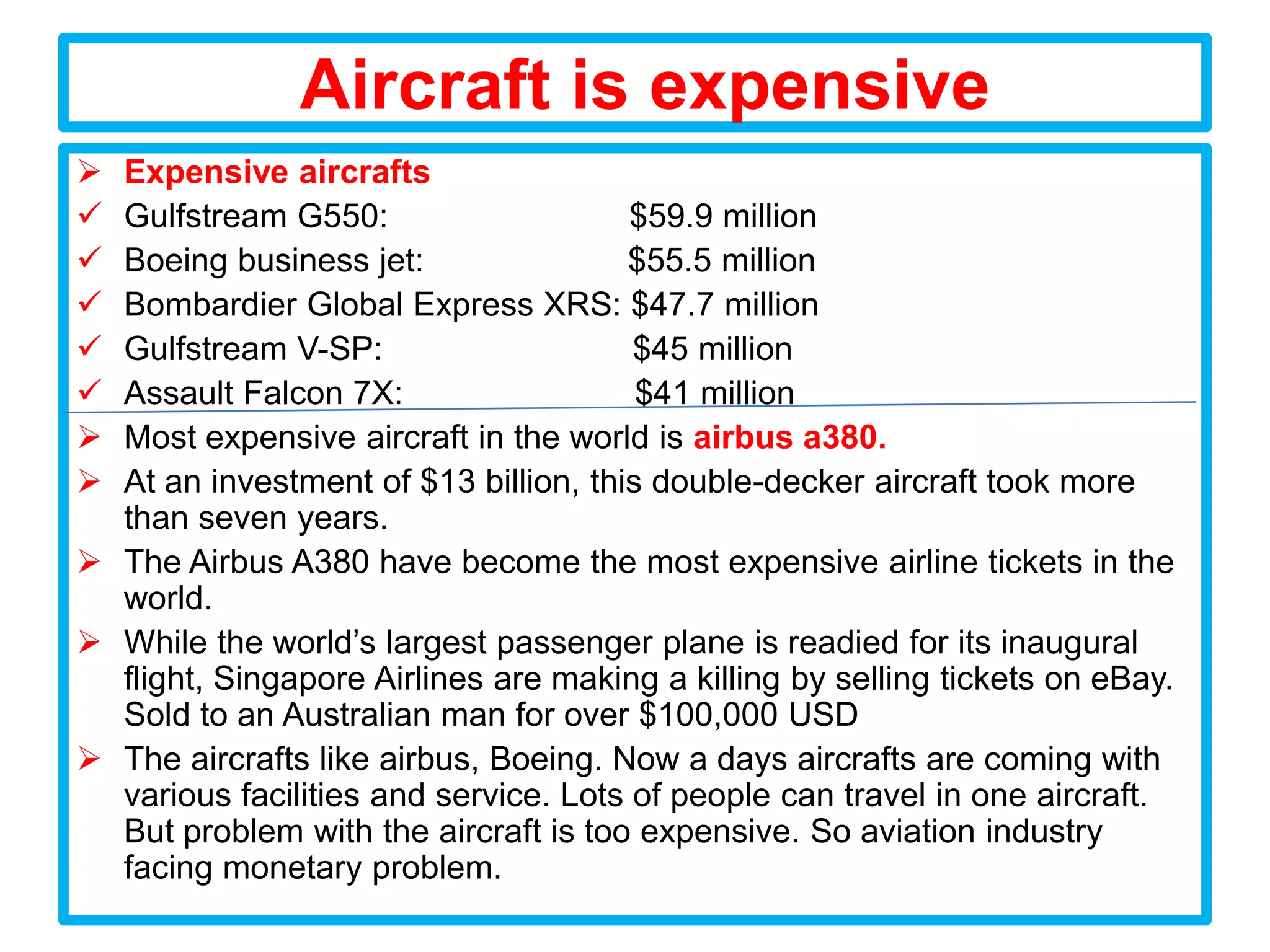
Aircraft is expensive
 Expensive aircrafts
 Gulfstream G550:                     $59.9 million
 Boeing business jet:                $55.5 million
 Bombardier Global Express XRS: $47.7 million
 Gulfstream V-SP:                     $45 million
 Assault Falcon 7X:                   $41 million
 Most expensive aircraft in the world is airbus a380.
 At an investment of $13 billion, this double-decker aircraft took more
  than seven years.
 The Airbus A380 have become the most expensive airline tickets in the
  world.
 While the world’s largest passenger plane is readied for its inaugural
  flight, Singapore Airlines are making a killing by selling tickets on eBay.
  Sold to an Australian man for over $100,000 USD
 The aircrafts like airbus, Boeing. Now a days aircrafts are coming with
  various facilities and service. Lots of people can travel in one aircraft.
  But problem with the aircraft is too expensive. So aviation industry
  facing monetary problem.
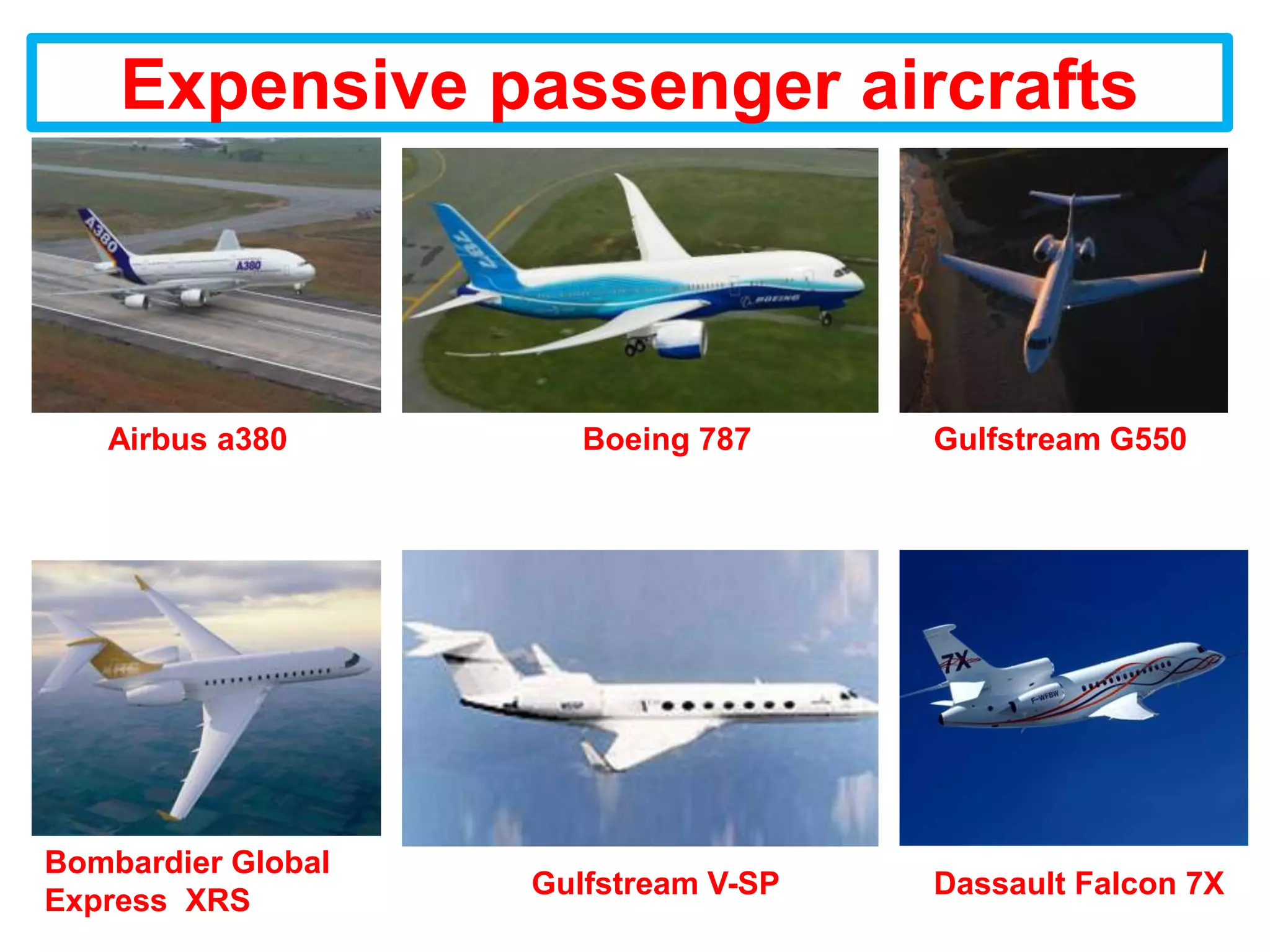
Expensive passenger aircrafts


   Airbus a380         Boeing 787     Gulfstream G550


Bombardier Global
                    Gulfstream V-SP   Dassault Falcon 7X
Express XRS
High fuel price
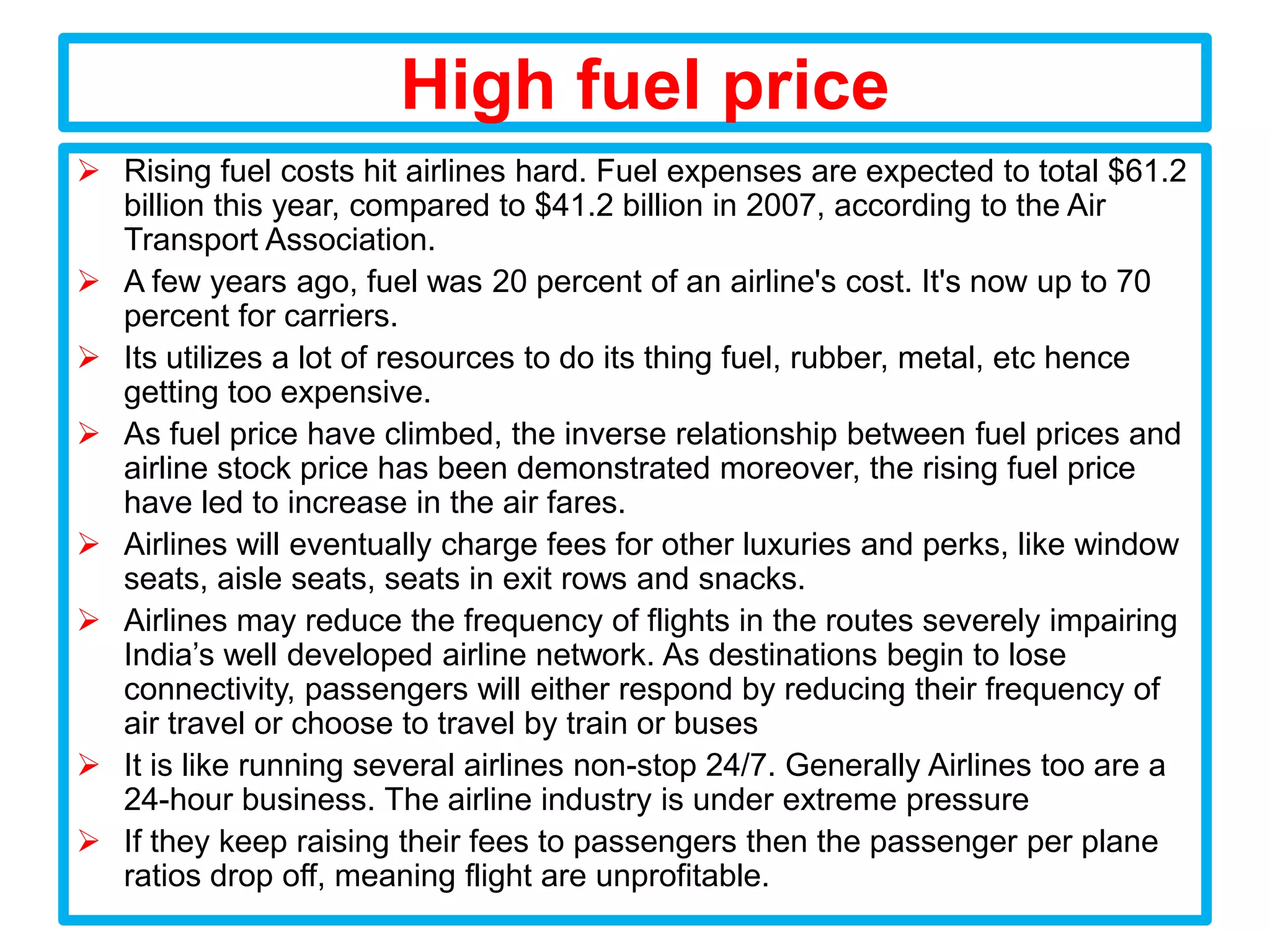
 Rising fuel costs hit airlines hard. Fuel expenses are expected to total $61.2
  billion this year, compared to $41.2 billion in 2007, according to the Air
  Transport Association.
 A few years ago, fuel was 20 percent of an airline's cost. It's now up to 70
  percent for carriers.
 Its utilizes a lot of resources to do its thing fuel, rubber, metal, etc hence
  getting too expensive.
 As fuel price have climbed, the inverse relationship between fuel prices and
  airline stock price has been demonstrated moreover, the rising fuel price
  have led to increase in the air fares.
 Airlines will eventually charge fees for other luxuries and perks, like window
  seats, aisle seats, seats in exit rows and snacks.
 Airlines may reduce the frequency of flights in the routes severely impairing
  India’s well developed airline network. As destinations begin to lose
  connectivity, passengers will either respond by reducing their frequency of
  air travel or choose to travel by train or buses
 It is like running several airlines non-stop 24/7. Generally Airlines too are a
  24-hour business. The airline industry is under extreme pressure
 If they keep raising their fees to passengers then the passenger per plane
  ratios drop off, meaning flight are unprofitable.
High fuel price
Infrastructure
The Outlook
 The aviation industry in India is improving everyday. The future is bright enough as
   per the experts worldwide. Here's am outlook about India aviation industry, the
   looking crisis, and the global response.
 With the global economic recovery on the horizon, the aviation industry in India is
   poised for a spectacular takeoff. Unprecedented changes are anticipated in the
   aviation sector as the domestic passenger segment is expected to register annual
   growth rates of over 50% . Even the international passenger segment is slated to
   grow at 25% annually as per industry forecasts
The looming crisis
 the current situation in the industry continues to alarm policy makers, regulators
   and industry leaders alike.
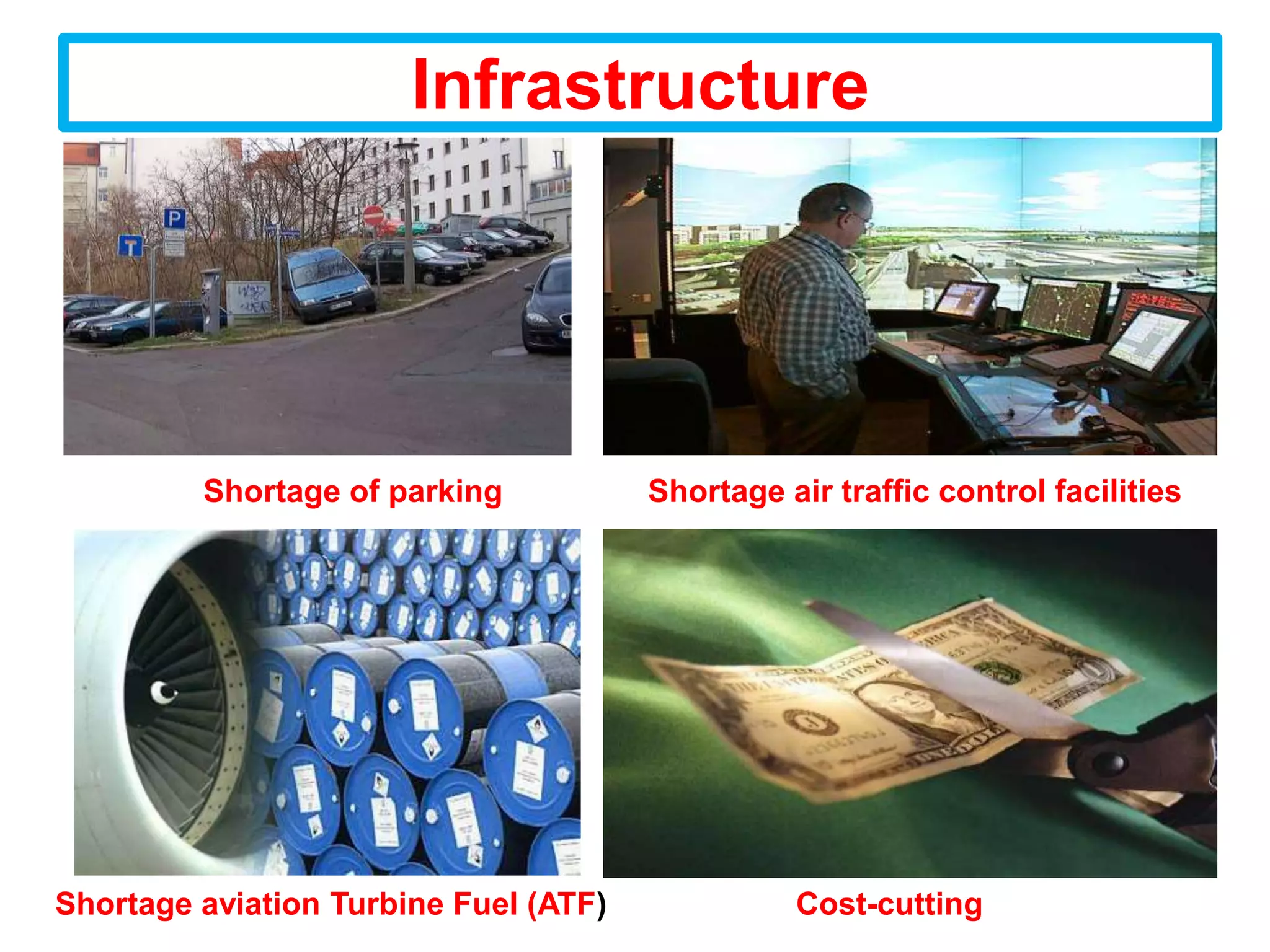
 Adding to the woes of the industry is the abysmal airport infrastructure visible in the
   acute shortage of parking bays, takeoff / landing slots& air traffic control facilities
 Shortage of pilots, engineering, all department staffs,
 The recent hike in the price of Aviation Turbine Fuel (ATF) has further added to the
   anguish of the airlines as it has the potential to take the industry on a downward
   spiral that can prove fatal.
 The industry has embarked on a cost-cutting spree and that too with a vengeance.
Infrastructure


         Shortage of parking           Shortage air traffic control facilities


Shortage aviation Turbine Fuel (ATF)             Cost-cutting
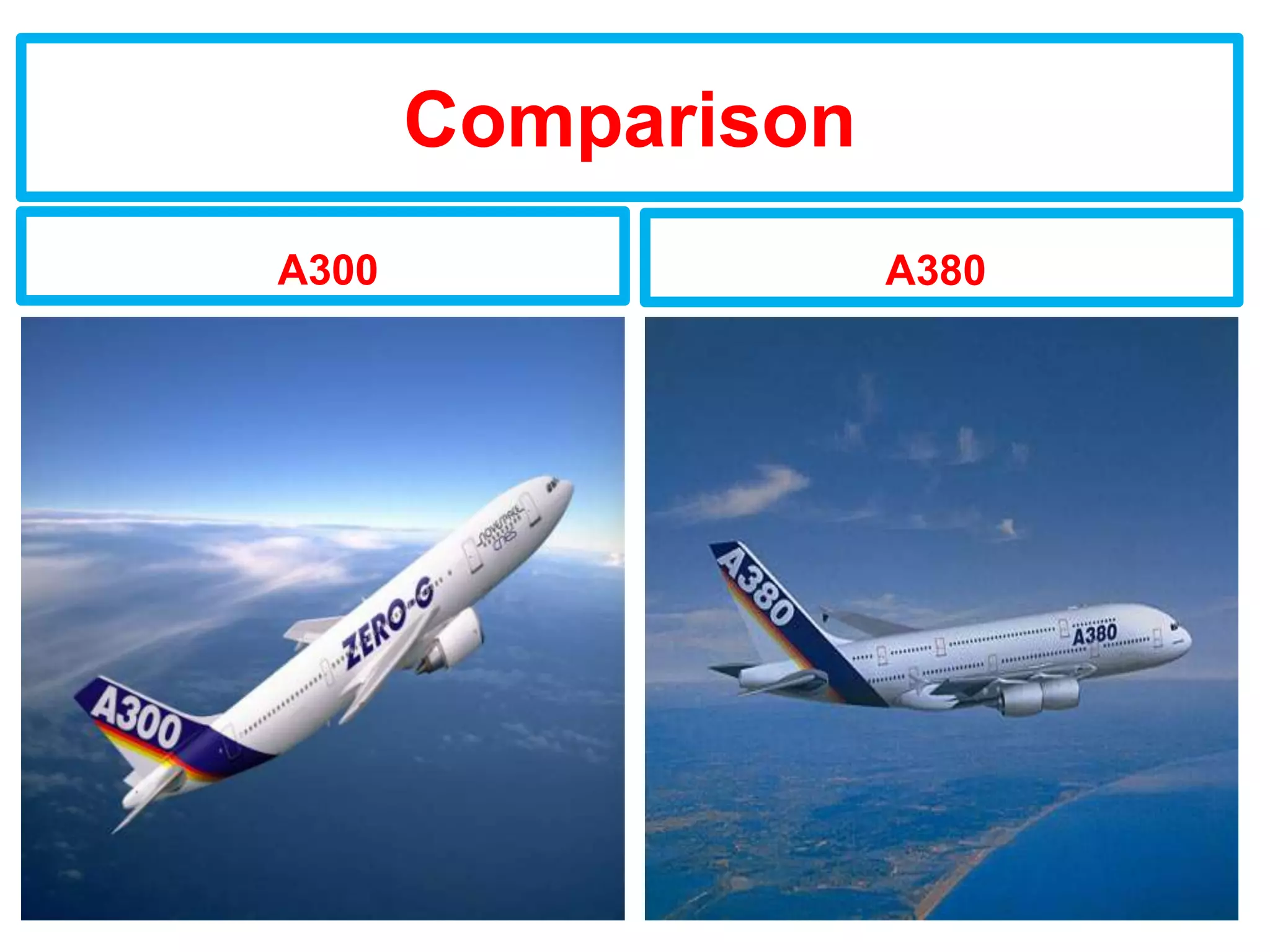
Comparison
A300                A380
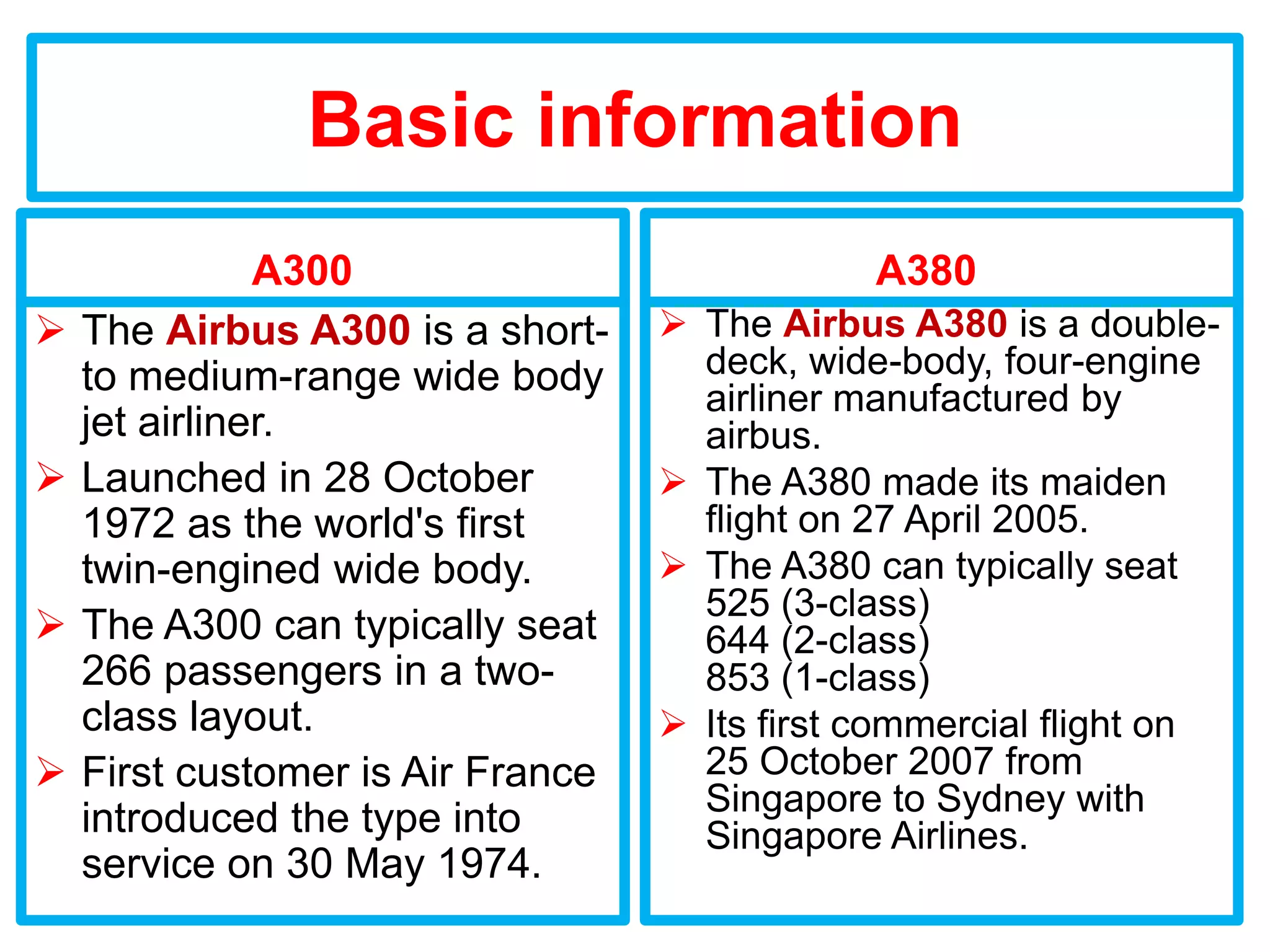
Basic information
               A300                            A380
   The Airbus A300 is a short-     The Airbus A380 is a double-
    to medium-range wide body        deck, wide-body, four-engine
                                     airliner manufactured by
    jet airliner.                    airbus.
   Launched in 28 October          The A380 made its maiden
    1972 as the world's first        flight on 27 April 2005.
    twin-engined wide body.         The A380 can typically seat
                                     525 (3-class)
   The A300 can typically seat      644 (2-class)
    266 passengers in a two-         853 (1-class)
    class layout.                   Its first commercial flight on
   First customer is Air France     25 October 2007 from
                                     Singapore to Sydney with
    introduced the type into         Singapore Airlines.
    service on 30 May 1974.
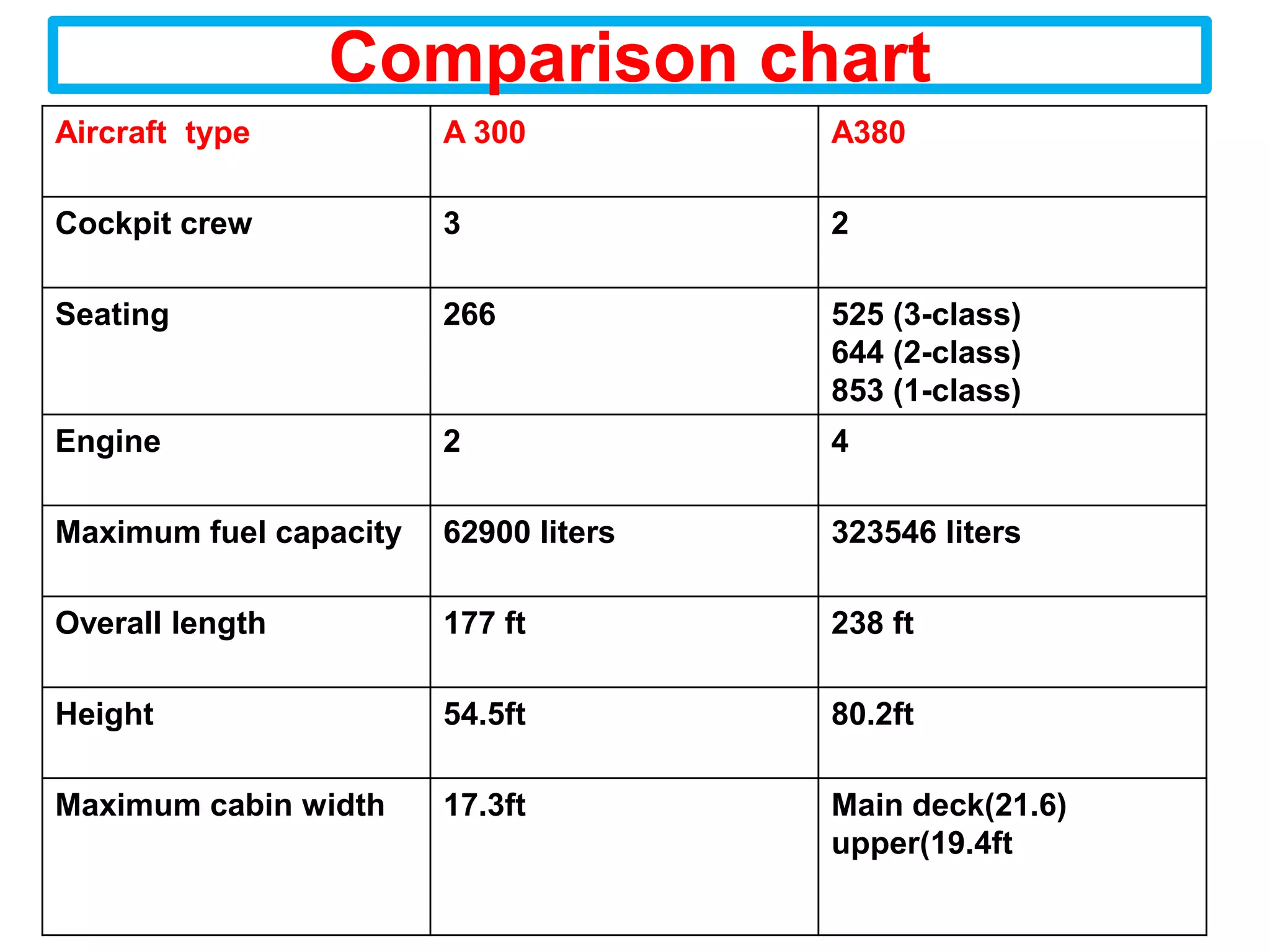
Comparison chart
Aircraft type           A 300          A380

Cockpit crew            3              2

Seating                 266            525 (3-class)
                                       644 (2-class)
                                       853 (1-class)
Engine                  2              4

Maximum fuel capacity   62900 liters   323546 liters

Overall length          177 ft         238 ft

Height                  54.5ft         80.2ft

Maximum cabin width     17.3ft         Main deck(21.6)
                                       upper(19.4ft
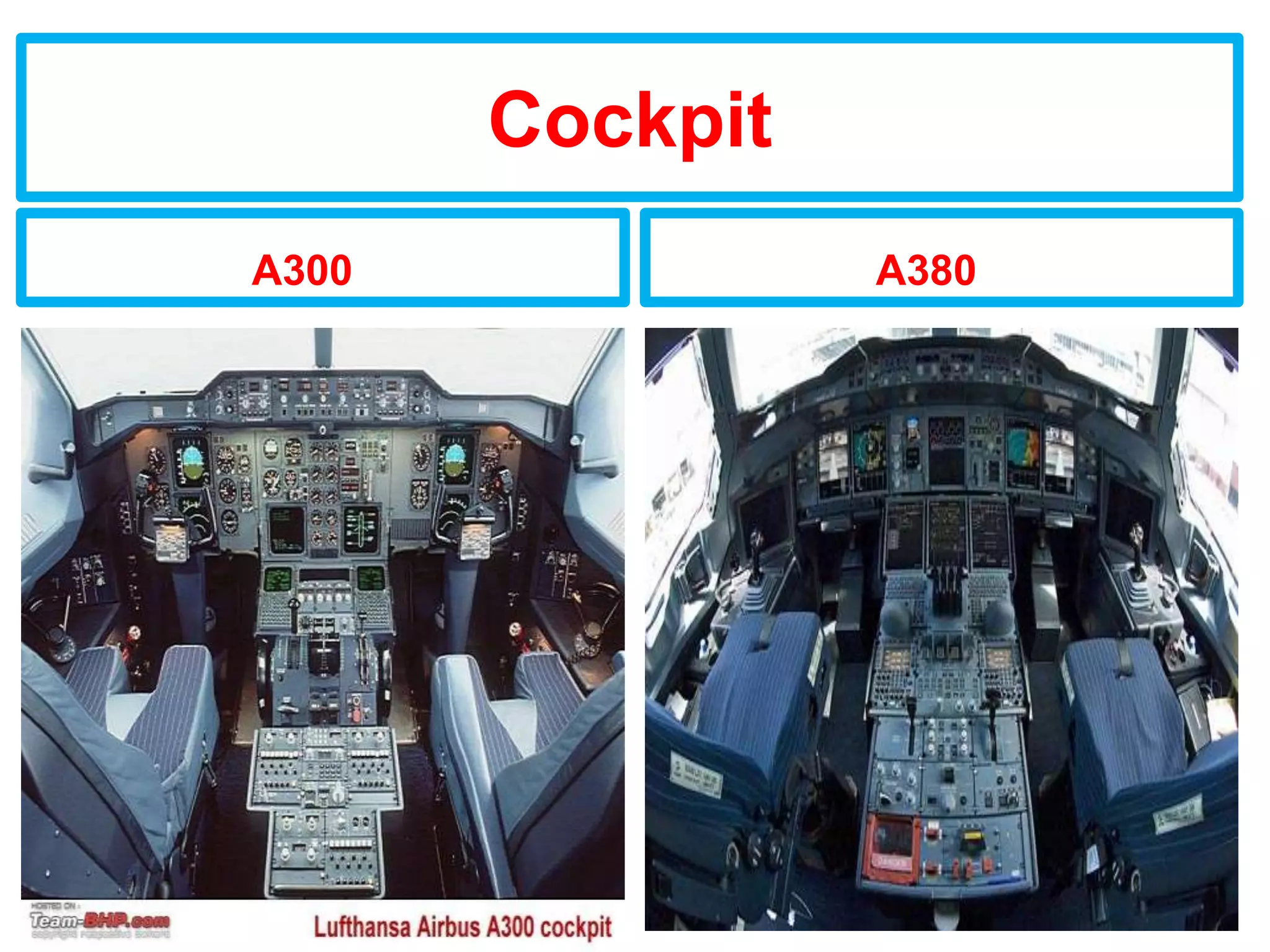
Cockpit
A300             A380
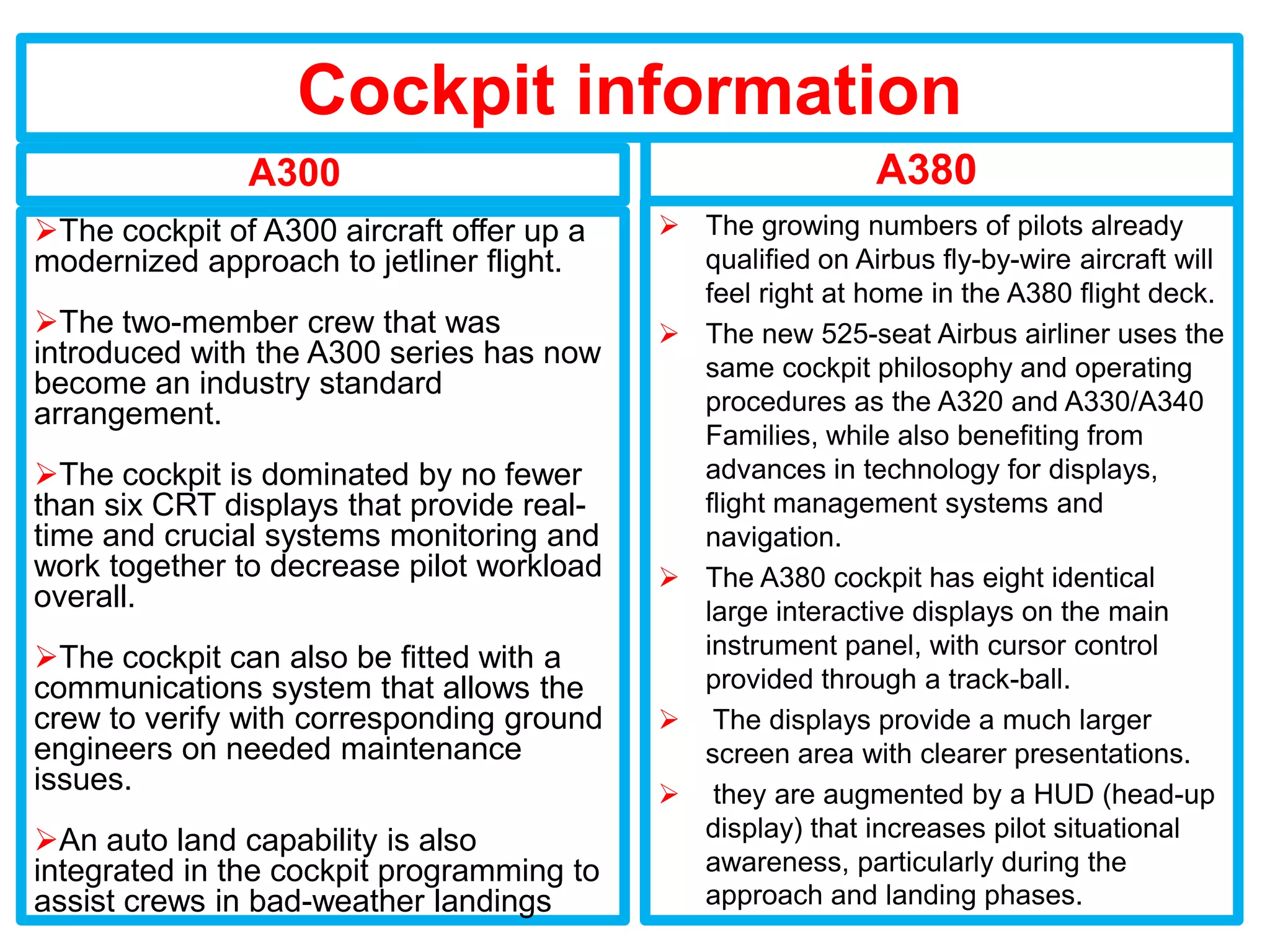
Cockpit information
               A300                                          A380
The cockpit of A300 aircraft offer up a    The growing numbers of pilots already
modernized approach to jetliner flight.      qualified on Airbus fly-by-wire aircraft will
                                             feel right at home in the A380 flight deck.
The two-member crew that was               The new 525-seat Airbus airliner uses the
introduced with the A300 series has now      same cockpit philosophy and operating
become an industry standard
arrangement.                                 procedures as the A320 and A330/A340
                                             Families, while also benefiting from
The cockpit is dominated by no fewer        advances in technology for displays,
than six CRT displays that provide real-     flight management systems and
time and crucial systems monitoring and      navigation.
work together to decrease pilot workload    The A380 cockpit has eight identical
overall.                                     large interactive displays on the main
The cockpit can also be fitted with a       instrument panel, with cursor control
communications system that allows the        provided through a track-ball.
crew to verify with corresponding ground    The displays provide a much larger
engineers on needed maintenance              screen area with clearer presentations.
issues.                                     they are augmented by a HUD (head-up
An auto land capability is also             display) that increases pilot situational
integrated in the cockpit programming to     awareness, particularly during the
assist crews in bad-weather landings         approach and landing phases.
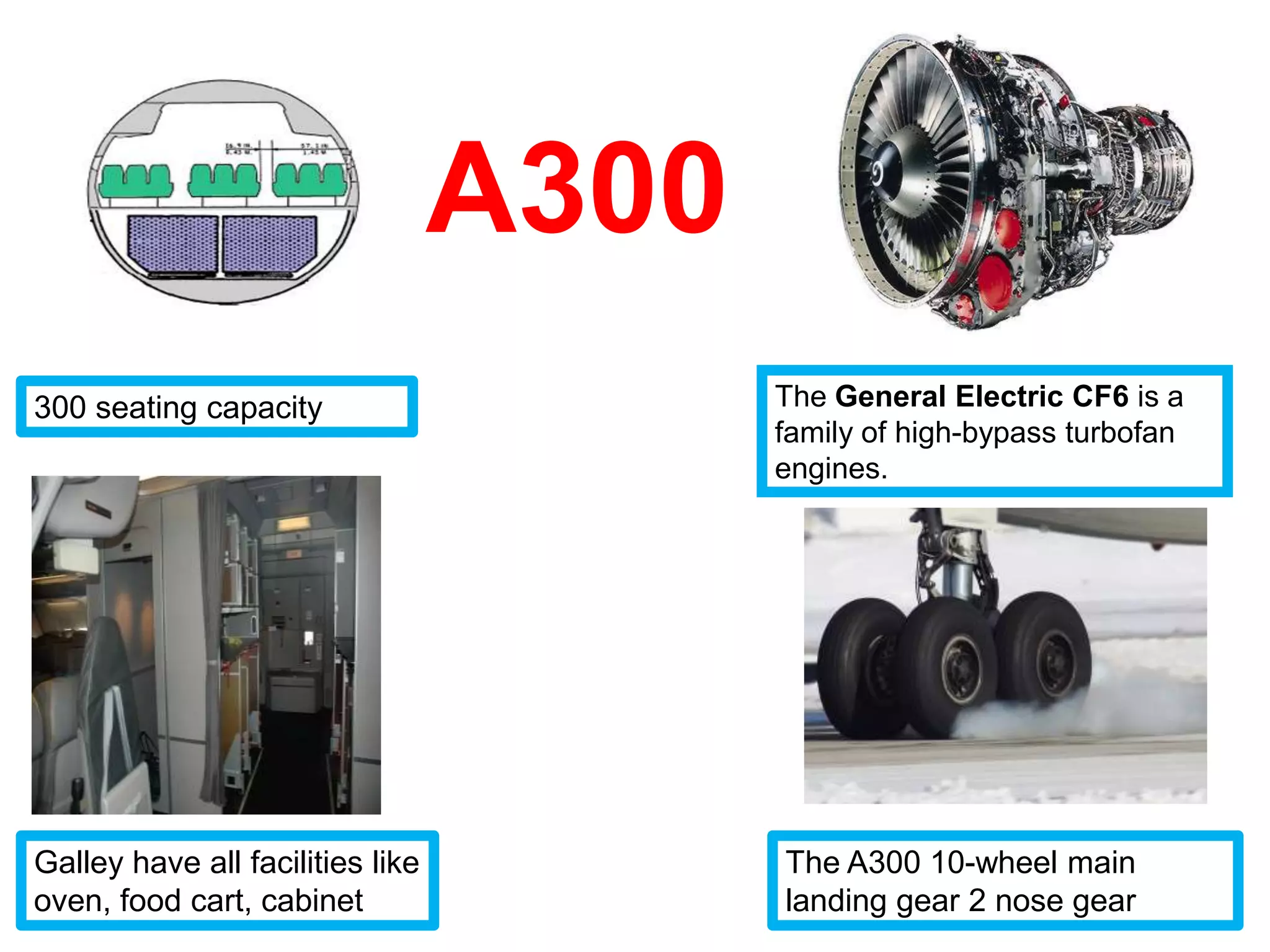
A300
300 seating capacity                     The General Electric CF6 is a
                                         family of high-bypass turbofan
                                         engines.


Galley have all facilities like          The A300 10-wheel main
oven, food cart, cabinet                 landing gear 2 nose gear
A380
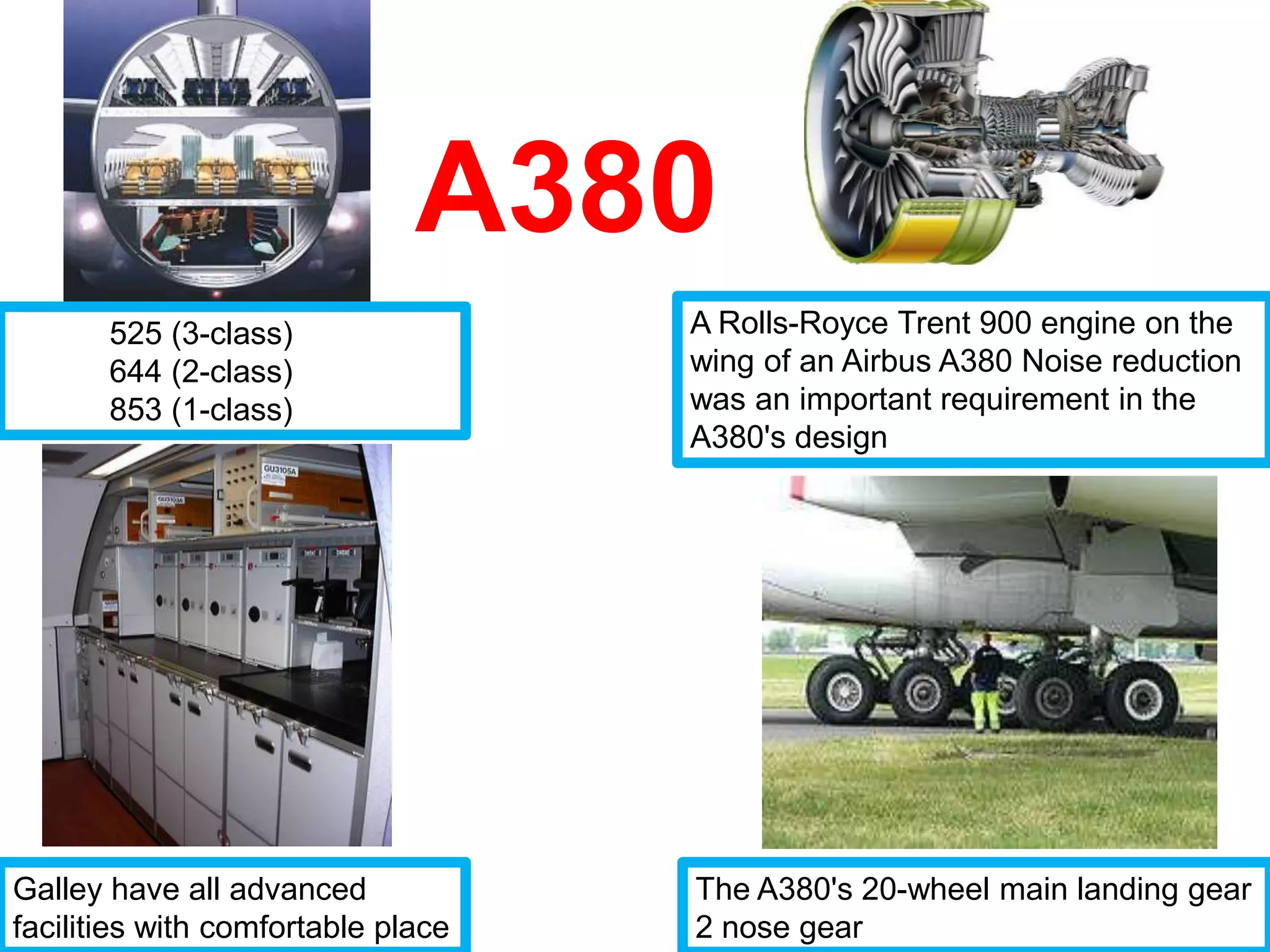
       525 (3-class)                A Rolls-Royce Trent 900 engine on the
       644 (2-class)                wing of an Airbus A380 Noise reduction
       853 (1-class)                was an important requirement in the
                                    A380's design


Galley have all advanced            The A380's 20-wheel main landing gear
facilities with comfortable place   2 nose gear
Bibliography
Airbus a300.com
Airbus a380.com
Wikipedia.com
Most expensive passenger aircraft.com
A Rolls-Royce Trent 900 engine
Landing gear for a380.com
Largest Fusalage.com
Conclusion
From this assignment I understood
 the advantage and disadvantage
 current scenario of aviation industry.
 Airbus a300 (old technology) and
 airbus a380 (new technology)
 I’m concluding this assignment is
 the good experience for me.

3)arvinth aviation assignment distinction

  • 1.
  • 2.
    INTRODUCTION I’m here goingto present about the advantage and disadvantage of current scenario aviation industry and comparison of old technology (A300) and new technology (A380) and with my conclusion.
  • 3.
    CONTENTS Acknowledgement. Advantage and disadvantage of aviation industry. Analysis of advantage. Analysis of disadvantage. Comparison of A300 and A380.
  • 4.
    ACKNOWLDGEMENT I owe agreat many thanks to a great many people who helped and supported me during the aviation assignment. My deepest thanks to trainer Mrs.Ramya rai the Guide of the assignment for guiding and correcting various documents of mine with attention and care. She has taken pain to go through the assignment and make necessary correction as and when I needed. I express my thanks to the center head of FAIT frankfinn koramangala, Bangalore for extending her support. I would also thank my Institution and my faculty members without whom this assignment would have been a distant reality. I also extend my heartfelt thanks to my family and well wishers.
  • 5.
    AVIATION INDUSTRY Advantage Disadvantage  Visit many tourist place by air  Spoilage. transport.  Aircraft is expensive.  Low cost airline.  High fuel price.  Job opportunity.  Infrastructure of airline  Modernization of airport. industry.
  • 6.
  • 7.
    Visit many touristplaces by air transport.  Aviation provides the only worldwide transportation network, which makes it essential for global business and tourism.  Air transpiration alleviates poverty and helps to improve living standards by facilitating tourism.  Air transport improves quality of life by broadening people’s leisure and cultural experiences. It provides a wider choice of holiday destinations around the world and an affordable means to visit distance tourism place.  Air transport contributes to sustainable development not only by facilitating tourism and trade.  It generates economic growth, provides jobs, increase revenues from taxes as well as facilitates the delivery of emergency humanitarian aid relief and swift delivery of medical supplies anywhere on the earth.  Thomas Cook, is the World Wide travel agency arranging tour packages to people. This is one advantage to the airline industry.  Most of the airlines are flying to the tourist place like Switzerland, Goa, UK, France, Japan, Spain, Dubai, etc.  Due to growth in tourism, there has been an increase in number of the international and domestic passenger. The estimated growth of domestic passenger segment is at 50% per annum and the growth for international passenger is 25% (p.a).
  • 8.
  • 9.
    Low cost airline. Theadvantage of low cost flights also include the fact that you would be able to cover more ground and therefore helps you to be more productive. Besides, flying is fun and everybody Should experience it at one time or other and the low cost flights offer you just the right opportunity to do so.  It saves you precious time This is one advantage that many find irresistible. Time is a very precious commodity today, and if you can fly for just a small increase of time compared to a train journey, then it is definitely worthwhile.  It is extremely convenient One of the most important of the advantages of low cost flights is the convenience of travelling. you do not need to worry anymore about long and tiresome journeys by bus, train or car. This would invariably involve countless days on road, living out of a suitcase and staying in uncomfortable hotels. The flight does away with all this inconvenience.  It saves money Many people compare only the flight ticket cost to the gasoline bill or bus ticket cost (or any other form of travel you choose). the difference would still be quite a lot, and therefore are happy that by choosing alternative modes of travel they are saving some money. But is it so really.  Non stop service a low cost airline, provides non-stop service from small airports to almost all Major airports nonstop.  Meal Service Commercial airlines offer limited refreshments, often just peanuts or a beverage on domestic flights. Budget airlines offer the same fare but for a price. With Transportation Safety Administration restrictions, the days of brown bagging on a flight are over.
  • 10.
     Market share: In2010, the private carriers accounted for around 75% share of the domestic aviation market. STUDENT CONCESSION FORM FOR DOMESTIC TRAVEL  The ‘Form’ shall be accepted only if it is verified and attested by the Principal/Head of the Educational establishment.  The attested Form should be verified by the Air lines (IC) office, nearest to the Educational Establishment before issuance of the ticket. In case an Educational Establishments located at a place where Air lines do not have an office but an approved Travel Agent is available, the approved Travel agent may verify this form and issue tickets.  Flights/Routes with high seat factor may be placed under Embargo for travel under ‘Student Discount’. On such Routes/Flights only those students shall be permitted to avail of students discount who are traveling between Place of study and Home Town.
  • 11.
  • 12.
    Job opportunity.  Sincederegulation in 1978, the airline industry has hired twice as many new employees as were hired. Previous 35 year combined. This ever changing industry requires thousands of new employees monthly.  Over of the year experience in the aviation sector, Airline specialists have developed sophisticated systems and models for the assessment of candidates for various positions in cabin crew, flight crew, ground crew etc, either or in various recruitment phases.  A successful airline required inter and intra personal relationship Every airline workforce into separate departments 1) Commercial pilot 12) Maintence controller. 2) Co-pilot. 13) Licensed aircraft maintence engineering. 3) Air cargo pilot. 14) Quality control manager. 4) Expat cabin crew. 15) Cargo officer. 5) Air traffic controller. 16) Guest service agents. 6) Cabin safety instructor. 17) Ground staff. 7) In flight manager. 8) In flight base manager. 9) Cabin service instructor. 10) Cabin crew. 11) Training instructor.
  • 13.
    Advantage to employee: Travel  Camaraderie.  Absence of monotony.  Appreciation.  Personal development and other benefits. Benefits to employee:  Personal and family travel passes.  Health insurance.  Life insurance.  Vision care insurance.  Dental insurance.  Sick pay.  Paid vocation.  Profit sharing.  Retirement program. Additional benefits:  Full or part time employment.  Wide pay range.  Flexible schedule.  Multiple days off.  Job shares.  Leave of absence.  Personal adventure and excitement.
  • 14.
    Jobs in aviationindustry Commercial pilot Co-pilot. Air cargo pilot Expat cabin crew In flight base Air traffic controller Cabin safety instructor. In flight manager manager Training Flight Ground staff Cabin service instructor Cabin crew instructor engineer
  • 15.
    Modernization of airports The Airports Authority of India (AAI) is undertaking the development and modernization of all 35 non-metro airports in the country simultaneously and work is due to be completed by March 2010.  Wholly owned subsidiaries of AAI are being created for the development and operation of these airports. According to the AAI, it has already awarded work orders for terminal buildings at 13 airports, and for airside development, including runway, taxiway, apron, fire station, control tower and isolation bay, at 19 airports.  Two greenfield airports at Bangalore and Hyderabad are being developed .The first phase is planned to be finished by end-2008.  The other two metro airports - Chennai, Kolkata -- may soon be on the modernization path. At least 10 non-metro airports are being developed as strategic airports serving the region or respective states, and at least a few more non-metro airports are being positioned strategically as regional hub airports or nodes providing better connectivity to overall airport network and feeding international network through hub/metro airports.  With these developments in aviation infrastructure, we may also see some airports making money not purely on passenger traffic, but also by means of cargo, logistics, and real estate projects being developed adjacent to airports.  Domestic passenger movement across airports is likely to grow at a 20-25 per cent till 2010, and passenger traffic is expected to increase to around 120 million by 2010. Hence modernization, privatization and development of airports in the form of greenfield and/or brownfield airports is the need of the hour.
  • 16.
    Modernization of airport Indira Gandhi International Airport has become India's and South Asia's largest and most important aviation hub, with a current capacity of handling more than 46 million passengers and aimed at handling more than 100 million passengers by 2030.  There is also a separate Technical Area for VVIP passengers.  IGI Airport is the home of several Indian airlines including Air India, Air India Regional, Indian Airlines, IndiGo, JetLite, SpiceJet. Jet Airways, Kingfisher Airlines, GoAir use IGI Airport as their secondary hub. Approximately 80 airlines serve this airport. There are Six operational terminals making up this airport, they are the following:  Terminal 1 Domestic  This cater to Indian Airlines domestic flights only. bigger luggage reclaim area, It is currently used by GoAir, IndiGo, SpiceJet  Terminal 2 -immigration and emigration counters have been implemented, new seats have been brought in, new baggage belts, more business lounges, eateries, and duty free shops had also been added  Terminal 3-the world’s eighth largest passenger terminal handle 34 million passengers annually. This terminal has 168 check-in counters, 78 aerobridges at 48 contact stands, 30 parking bays, 72 immigration counters, 15 X-ray screening areas, for less waiting times, duty-free shops, and other features. Over 90% of passengers will use this terminal.
  • 17.
  • 18.
  • 19.
    Spoilage CABIN SPOILAGE  Lossof revenue occurring due to passengers No-Show or cancel late on full flights. DISCOUNT SPOILAGE  Loss of revenue resulting from turning away discount customers because discount seats were not available at the time of booking, subsequently the flight departs with a significant number of empty seats. HIGHER YIELD SPILL  The loss of revenue resulting from turning away late high yield demand because too many lower yield seats were sold early. DIFFERENTIAL PRICING  An airline seat can be viewed by a purchaser as a single commodity, the desire is to purchase at the lowest price.
  • 20.
  • 21.
    Aircraft is expensive Expensive aircrafts  Gulfstream G550: $59.9 million  Boeing business jet: $55.5 million  Bombardier Global Express XRS: $47.7 million  Gulfstream V-SP: $45 million  Assault Falcon 7X: $41 million  Most expensive aircraft in the world is airbus a380.  At an investment of $13 billion, this double-decker aircraft took more than seven years.  The Airbus A380 have become the most expensive airline tickets in the world.  While the world’s largest passenger plane is readied for its inaugural flight, Singapore Airlines are making a killing by selling tickets on eBay. Sold to an Australian man for over $100,000 USD  The aircrafts like airbus, Boeing. Now a days aircrafts are coming with various facilities and service. Lots of people can travel in one aircraft. But problem with the aircraft is too expensive. So aviation industry facing monetary problem.
  • 22.
    Expensive passenger aircrafts Airbus a380 Boeing 787 Gulfstream G550 Bombardier Global Gulfstream V-SP Dassault Falcon 7X Express XRS
  • 23.
    High fuel price Rising fuel costs hit airlines hard. Fuel expenses are expected to total $61.2 billion this year, compared to $41.2 billion in 2007, according to the Air Transport Association.  A few years ago, fuel was 20 percent of an airline's cost. It's now up to 70 percent for carriers.  Its utilizes a lot of resources to do its thing fuel, rubber, metal, etc hence getting too expensive.  As fuel price have climbed, the inverse relationship between fuel prices and airline stock price has been demonstrated moreover, the rising fuel price have led to increase in the air fares.  Airlines will eventually charge fees for other luxuries and perks, like window seats, aisle seats, seats in exit rows and snacks.  Airlines may reduce the frequency of flights in the routes severely impairing India’s well developed airline network. As destinations begin to lose connectivity, passengers will either respond by reducing their frequency of air travel or choose to travel by train or buses  It is like running several airlines non-stop 24/7. Generally Airlines too are a 24-hour business. The airline industry is under extreme pressure  If they keep raising their fees to passengers then the passenger per plane ratios drop off, meaning flight are unprofitable.
  • 24.
  • 25.
    Infrastructure The Outlook  Theaviation industry in India is improving everyday. The future is bright enough as per the experts worldwide. Here's am outlook about India aviation industry, the looking crisis, and the global response.  With the global economic recovery on the horizon, the aviation industry in India is poised for a spectacular takeoff. Unprecedented changes are anticipated in the aviation sector as the domestic passenger segment is expected to register annual growth rates of over 50% . Even the international passenger segment is slated to grow at 25% annually as per industry forecasts The looming crisis  the current situation in the industry continues to alarm policy makers, regulators and industry leaders alike.  Adding to the woes of the industry is the abysmal airport infrastructure visible in the acute shortage of parking bays, takeoff / landing slots& air traffic control facilities  Shortage of pilots, engineering, all department staffs,  The recent hike in the price of Aviation Turbine Fuel (ATF) has further added to the anguish of the airlines as it has the potential to take the industry on a downward spiral that can prove fatal.  The industry has embarked on a cost-cutting spree and that too with a vengeance.
  • 26.
    Infrastructure Shortage of parking Shortage air traffic control facilities Shortage aviation Turbine Fuel (ATF) Cost-cutting
  • 27.
  • 28.
    Basic information A300 A380  The Airbus A300 is a short-  The Airbus A380 is a double- to medium-range wide body deck, wide-body, four-engine airliner manufactured by jet airliner. airbus.  Launched in 28 October  The A380 made its maiden 1972 as the world's first flight on 27 April 2005. twin-engined wide body.  The A380 can typically seat 525 (3-class)  The A300 can typically seat 644 (2-class) 266 passengers in a two- 853 (1-class) class layout.  Its first commercial flight on  First customer is Air France 25 October 2007 from Singapore to Sydney with introduced the type into Singapore Airlines. service on 30 May 1974.
  • 29.
    Comparison chart Aircraft type A 300 A380 Cockpit crew 3 2 Seating 266 525 (3-class) 644 (2-class) 853 (1-class) Engine 2 4 Maximum fuel capacity 62900 liters 323546 liters Overall length 177 ft 238 ft Height 54.5ft 80.2ft Maximum cabin width 17.3ft Main deck(21.6) upper(19.4ft
  • 30.
  • 31.
    Cockpit information A300 A380 The cockpit of A300 aircraft offer up a  The growing numbers of pilots already modernized approach to jetliner flight. qualified on Airbus fly-by-wire aircraft will feel right at home in the A380 flight deck. The two-member crew that was  The new 525-seat Airbus airliner uses the introduced with the A300 series has now same cockpit philosophy and operating become an industry standard arrangement. procedures as the A320 and A330/A340 Families, while also benefiting from The cockpit is dominated by no fewer advances in technology for displays, than six CRT displays that provide real- flight management systems and time and crucial systems monitoring and navigation. work together to decrease pilot workload  The A380 cockpit has eight identical overall. large interactive displays on the main The cockpit can also be fitted with a instrument panel, with cursor control communications system that allows the provided through a track-ball. crew to verify with corresponding ground  The displays provide a much larger engineers on needed maintenance screen area with clearer presentations. issues.  they are augmented by a HUD (head-up An auto land capability is also display) that increases pilot situational integrated in the cockpit programming to awareness, particularly during the assist crews in bad-weather landings approach and landing phases.
  • 32.
    A300 300 seating capacity The General Electric CF6 is a family of high-bypass turbofan engines. Galley have all facilities like The A300 10-wheel main oven, food cart, cabinet landing gear 2 nose gear
  • 33.
    A380 525 (3-class) A Rolls-Royce Trent 900 engine on the 644 (2-class) wing of an Airbus A380 Noise reduction 853 (1-class) was an important requirement in the A380's design Galley have all advanced The A380's 20-wheel main landing gear facilities with comfortable place 2 nose gear
  • 34.
    Bibliography Airbus a300.com Airbus a380.com Wikipedia.com Mostexpensive passenger aircraft.com A Rolls-Royce Trent 900 engine Landing gear for a380.com Largest Fusalage.com
  • 35.
    Conclusion From this assignmentI understood the advantage and disadvantage current scenario of aviation industry. Airbus a300 (old technology) and airbus a380 (new technology)  I’m concluding this assignment is the good experience for me.