Pakistan Aviation
Industry
Introduction
The Pakistan aviation industry started with Orient Airways, founded on 23 October
1946.
Orient Airways commenced operations with four Douglas DC-3s on 4 June 1947 and
ceased its operations on 11 March 1955 by merging into the Pakistan International
Airlines Corporation to become the national flag carrier of Pakistan called Pakistan
International Airlines (PIA), it is the 16th largest airline in Asia operating scheduled
services to 73 destinations throughout Asia, the Middle East, Europe and North
America, as well as an extensive domestic network linking 24 destinations.
Main bases are Jinnah International Airport, Karachi, the Allama Iqbal International
Airport, Lahore and the Islamabad International Airport, Islamabad/Rawalpindi. The
airline also has secondary bases, including Peshawar International Airport, Faisalabad
International Airport, Quetta International Airport and Multan International Airport,
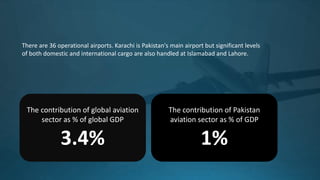
There are 36 operational airports. Karachi is Pakistan's main airport but significant levels
of both domestic and international cargo are also handled at Islamabad and Lahore.
The contribution of global aviation
sector as % of global GDP
3.4%
The contribution of Pakistan
aviation sector as % of GDP
1%
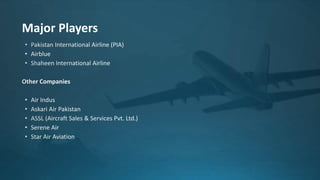
Major Players
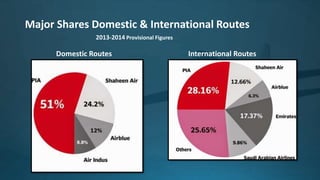
Major Shares Domestic & International Routes
Domestic Routes International Routes
2013-2014 Provisional Figures
IATA (International Air Transport Association) forecast Pakistan domestic air travel will
grow at least 9.5 percent per year, more than two times faster than the world annual
growth rate of 4.1 percent over the next 20 years.
Pakistan Air Travel Growth
The Gwadar Port project (CPEC) would have deep effects on the civil aviation sector of
the country and would result in significant increase in passengers, cargo activities and
flights.
The government had also planned for a development project to improve infrastructure
of Pakistan Civil Aviation Authority.
Political Analysis:
• Government played an active role in increasing competition in the airline
industry.
• Others airlines such as AirBlue and Shaheen Air have been awarded licenses.
• Pakistan has achieved some political stability in recent years.
• If government will perform well (consistently), then there will be more
investment in the form of purchase of new airplanes and latest technology.
• The over all industry will grow resulting in more luxurious and comfortable
flights.
PEST ANALYSIS
Economic Analysis:
Currently, Airlines industry has three major players: Pakistan International Airlines, an Airblue and Shaheen
Airlines. Their target market includes domestic travelers as well as Pakistanis living abroad particularly in
the UAE, UK and USA.
• As inflation rate is unstable in Pakistan, spending power of consumers has effected in the long term.
• The September 11 incident revolutionized the whole world. Consequently, there was a global
depression.
• The economy began to boom because of greater remittances from abroad and whole sum immigration
by expatriates. As a result, demand for air travel in South Asia rose.
• Economic conditions of Pakistan are however improving and will further improve. (CPEC impact)
• PIA has cost advantage because of its newly developed Boeing which give longer range and better fuel
economy. This advantage is a barrier to entry for new firms.
Social Analysis:
• The general public is educated and is more aware of market conditions and available
options and want to get best value for their money.
• Word of mouth has a important impact in the use of airline services.
• Hajj attracts a huge number of customers.
• The initiative to automate check-in and ticket booking process very popular with the
general public.
• The consumers have a warm reaction to the prospect of less costly but quality service
flights.
PEST ANALYSIS
Technological Analysis:
Technology is vital for competitive advantage. Major technological changes are taking place
with innovations in the reservations and booking systems. PIA has always led the path of
technological innovations by introducing new technologies ahead of its competitors.
• In-flight entertainment systems and auto check in counters are two examples of such
innovations.
• Internet plays a key role in e-ticketing as consumer can easily reserve tickets or check
the status of the flight.
• PIA auto check-in counters has helped it gain market share.
• It was the first airline in Pakistan to install Sabre system followed by the market leader.
PEST ANALYSIS
Pakistan Aviation Industry

Pakistan Aviation Industry

  • 1.
  • 2.
    Introduction The Pakistan aviationindustry started with Orient Airways, founded on 23 October 1946. Orient Airways commenced operations with four Douglas DC-3s on 4 June 1947 and ceased its operations on 11 March 1955 by merging into the Pakistan International Airlines Corporation to become the national flag carrier of Pakistan called Pakistan International Airlines (PIA), it is the 16th largest airline in Asia operating scheduled services to 73 destinations throughout Asia, the Middle East, Europe and North America, as well as an extensive domestic network linking 24 destinations. Main bases are Jinnah International Airport, Karachi, the Allama Iqbal International Airport, Lahore and the Islamabad International Airport, Islamabad/Rawalpindi. The airline also has secondary bases, including Peshawar International Airport, Faisalabad International Airport, Quetta International Airport and Multan International Airport,
  • 3.
    There are 36operational airports. Karachi is Pakistan's main airport but significant levels of both domestic and international cargo are also handled at Islamabad and Lahore. The contribution of global aviation sector as % of global GDP 3.4% The contribution of Pakistan aviation sector as % of GDP 1%
  • 4.
  • 5.
    Major Shares Domestic& International Routes Domestic Routes International Routes 2013-2014 Provisional Figures
  • 6.
    IATA (International AirTransport Association) forecast Pakistan domestic air travel will grow at least 9.5 percent per year, more than two times faster than the world annual growth rate of 4.1 percent over the next 20 years. Pakistan Air Travel Growth The Gwadar Port project (CPEC) would have deep effects on the civil aviation sector of the country and would result in significant increase in passengers, cargo activities and flights. The government had also planned for a development project to improve infrastructure of Pakistan Civil Aviation Authority.
  • 7.
    Political Analysis: • Governmentplayed an active role in increasing competition in the airline industry. • Others airlines such as AirBlue and Shaheen Air have been awarded licenses. • Pakistan has achieved some political stability in recent years. • If government will perform well (consistently), then there will be more investment in the form of purchase of new airplanes and latest technology. • The over all industry will grow resulting in more luxurious and comfortable flights. PEST ANALYSIS
  • 8.
    Economic Analysis: Currently, Airlinesindustry has three major players: Pakistan International Airlines, an Airblue and Shaheen Airlines. Their target market includes domestic travelers as well as Pakistanis living abroad particularly in the UAE, UK and USA. • As inflation rate is unstable in Pakistan, spending power of consumers has effected in the long term. • The September 11 incident revolutionized the whole world. Consequently, there was a global depression. • The economy began to boom because of greater remittances from abroad and whole sum immigration by expatriates. As a result, demand for air travel in South Asia rose. • Economic conditions of Pakistan are however improving and will further improve. (CPEC impact) • PIA has cost advantage because of its newly developed Boeing which give longer range and better fuel economy. This advantage is a barrier to entry for new firms.
  • 9.
    Social Analysis: • Thegeneral public is educated and is more aware of market conditions and available options and want to get best value for their money. • Word of mouth has a important impact in the use of airline services. • Hajj attracts a huge number of customers. • The initiative to automate check-in and ticket booking process very popular with the general public. • The consumers have a warm reaction to the prospect of less costly but quality service flights. PEST ANALYSIS
  • 10.
    Technological Analysis: Technology isvital for competitive advantage. Major technological changes are taking place with innovations in the reservations and booking systems. PIA has always led the path of technological innovations by introducing new technologies ahead of its competitors. • In-flight entertainment systems and auto check in counters are two examples of such innovations. • Internet plays a key role in e-ticketing as consumer can easily reserve tickets or check the status of the flight. • PIA auto check-in counters has helped it gain market share. • It was the first airline in Pakistan to install Sabre system followed by the market leader. PEST ANALYSIS