You only get out what you put in

Write this title in your notebooks
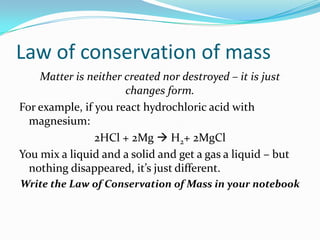
Law of conservation of mass
    Matter is neither created nor destroyed – it is just
                      changes form.
For example, if you react hydrochloric acid with
  magnesium:
                2HCl + 2Mg  H2+ 2MgCl
You mix a liquid and a solid and get a gas a liquid – but
  nothing disappeared, it’s just different.
Write the Law of Conservation of Mass in your notebook
Reaction equations
Equations are like the recipes you use to cook
They tell you what to put in – Reactants
And what you’ll get out – Products

  Write definitions of reactants and products in your
                         notebook
Equations and balancing
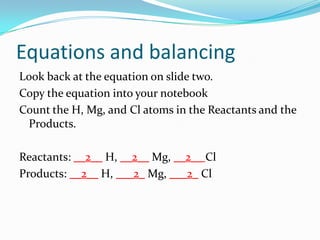
Look back at the equation on slide two.
Copy the equation into your notebook
Count the H, Mg, and Cl atoms in the Reactants and the
 Products.
Reactants: _____ H, _____ Mg, _____ Cl
Products: _____ H, _____ Mg, _____ Cl
Equations and balancing
Look back at the equation on slide two.
Copy the equation into your notebook
Count the H, Mg, and Cl atoms in the Reactants and the
 Products.
Reactants: __2__ H, __2__ Mg, __2__ Cl
Products: __2__ H, ___2_ Mg, ___2_ Cl
There were the same number of atoms of each element
 in the products as the reactants


 You only get out what you
           put in.
Balancing equations
Whenever we write or use an equation in chemistry it
 MUST be balanced and obey the law of conservation of
 mass

           You only get out what you put in.
Balancing equations
Some equations are harder to balance than others, use
  the following technique and you’ll be fine.

First write the equation BIG – so it goes all the way
  across the page.

Balance this equation in your notebook as you watch a
 step by step demonstration.
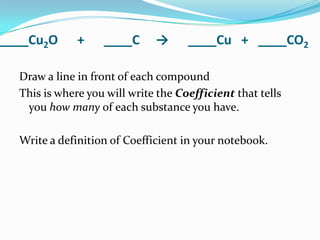
____Cu2O      +    ____C      →      ____Cu + ____CO2

  Draw a line in front of each compound
  This is where you will write the Coefficient that tells
   you how many of each substance you have.

  Write a definition of Coefficient in your notebook.
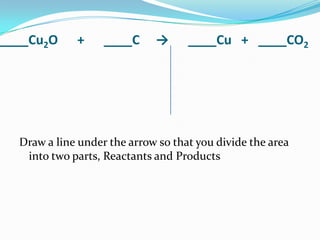
____Cu2O     +     ____C     →      ____Cu + ____CO2


  Draw a line under the arrow so that you divide the area
   into two parts, Reactants and Products
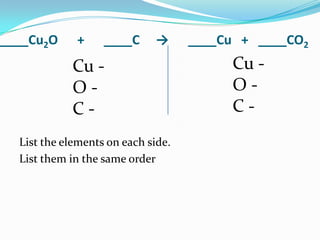
____Cu2O     +     ____C     →      ____Cu + ____CO2
            Cu -                         Cu -
            O-                           O-
            C-                           C-
  List the elements on each side.
  List them in the same order
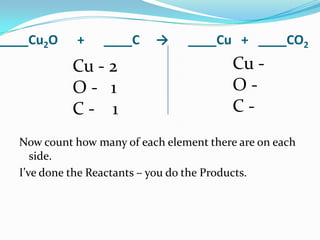
____Cu2O    +    ____C     →     ____Cu + ____CO2
            Cu - 2                        Cu -
            O- 1                          O-
            C- 1                          C-
  Now count how many of each element there are on each
     side.
  I’ve done the Reactants – you do the Products.
____Cu2O     +    ____C     →     ____Cu + ____CO2
            Cu - 2                         Cu - 1
            O- 1                           O- 2
            C- 1                           C- 1
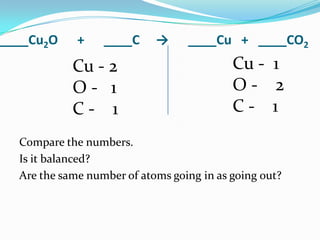
  Compare the numbers.
  Is it balanced?
  Are the same number of atoms going in as going out?
____Cu2O     +    ____C     →     ____Cu + ____CO2
            Cu - 2                         Cu - 1
            O- 1                           O- 2
            C- 1                           C- 1
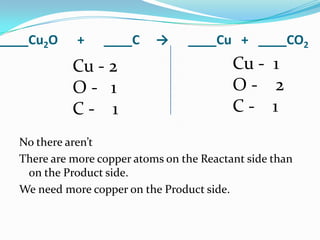
  No there aren’t
  There are more copper atoms on the Reactant side than
   on the Product side.
  We need more copper on the Product side.
____Cu2O     +    ____C      →     ____Cu + ____CO2
            Cu - 2                          Cu - 1
            O- 1                            O- 2
            C- 1                            C- 1
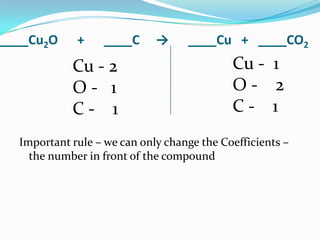
  Important rule – we can only change the Coefficients –
    the number in front of the compound
____Cu2O     +    ____C      →     __2_Cu + ____CO2
            Cu - 2                           Cu - 1 2
            O- 1                             O- 2
            C- 1                             C- 1
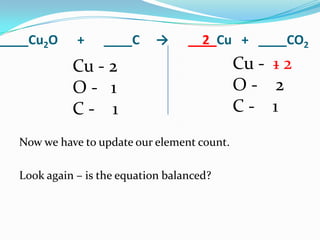
  Now we have to update our element count.

  Look again – is the equation balanced?
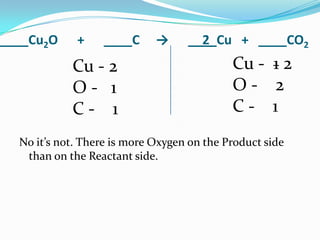
____Cu2O     +    ____C      →     __2_Cu + ____CO2
            Cu - 2                          Cu - 1 2
            O- 1                            O- 2
            C- 1                            C- 1
  No it’s not. There is more Oxygen on the Product side
   than on the Reactant side.
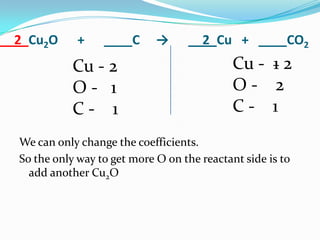
__2_Cu2O      +    ____C      →     __2_Cu + ____CO2
             Cu - 2                           Cu - 1 2
             O- 1                             O- 2
             C- 1                             C- 1
  We can only change the coefficients.
  So the only way to get more O on the reactant side is to
    add another Cu2O
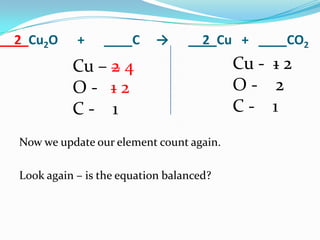
__2_Cu2O     +    ____C      →     __2_Cu + ____CO2
            Cu – 2 4                       Cu - 1 2
            O- 12                          O- 2
            C- 1                           C- 1
  Now we update our element count again.

  Look again – is the equation balanced?
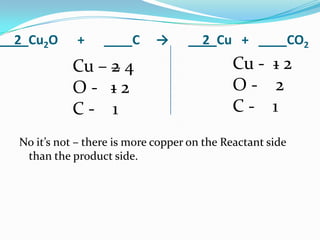
__2_Cu2O     +     ____C      →     __2_Cu + ____CO2
            Cu – 2 4                         Cu - 1 2
            O- 12                            O- 2
            C- 1                             C- 1
  No it’s not – there is more copper on the Reactant side
   than the product side.
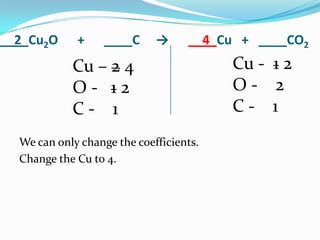
__2_Cu2O     +    ____C      →     __4_Cu + ____CO2
            Cu – 2 4                     Cu - 1 2
            O- 12                        O- 2
            C- 1                         C- 1
  We can only change the coefficients.
  Change the Cu to 4.
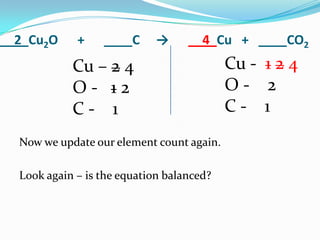
__2_Cu2O     +    ____C      →     __4_Cu + ____CO2
            Cu – 2 4                       Cu - 1 2 4
            O- 12                          O- 2
            C- 1                           C- 1
  Now we update our element count again.

  Look again – is the equation balanced?
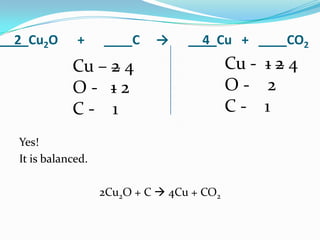
__2_Cu2O      +     ____C    →     __4_Cu + ____CO2
             Cu – 2 4                       Cu - 1 2 4
             O- 12                          O- 2
             C- 1                           C- 1
  Yes!
  It is balanced.

                    2Cu2O + C  4Cu + CO2
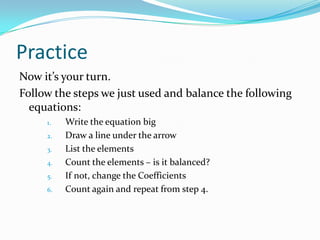
Practice
Now it’s your turn.
Follow the steps we just used and balance the following
  equations:
     1.   Write the equation big
     2.   Draw a line under the arrow
     3.   List the elements
     4.   Count the elements – is it balanced?
     5.   If not, change the Coefficients
     6.   Count again and repeat from step 4.
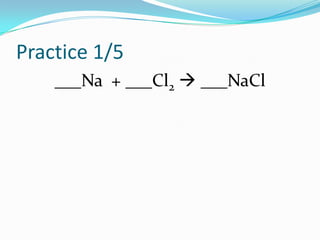
Practice 1/5
    ___Na + ___Cl2  ___NaCl
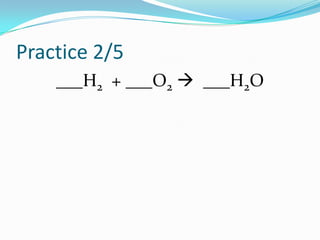
Practice 2/5
    ___H2 + ___O2  ___H2O
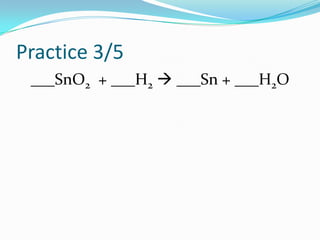
Practice 3/5
 ___SnO2 + ___H2  ___Sn + ___H2O
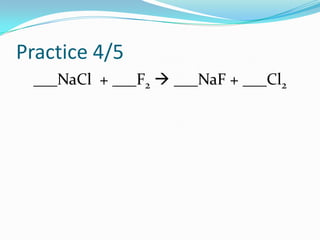
Practice 4/5
 ___NaCl + ___F2  ___NaF + ___Cl2
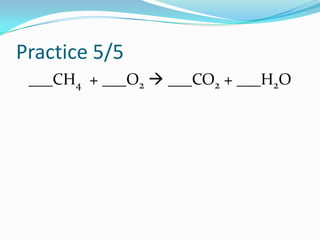
Practice 5/5
 ___CH4 + ___O2  ___CO2 + ___H2O
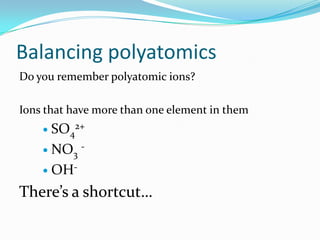
Balancing polyatomics
Do you remember polyatomic ions?

Ions that have more than one element in them
     SO42+
     NO3 -

     OH-

There’s a shortcut…
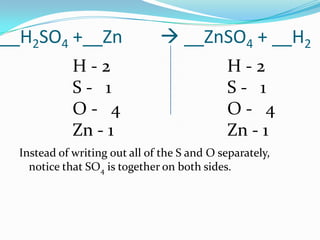
__H2SO4 +__Zn                   __ZnSO4 + __H2
             H-2                             H-2
             S- 1                            S- 1
             O- 4                            O- 4
             Zn - 1                          Zn - 1
  Instead of writing out all of the S and O separately,
    notice that SO4 is together on both sides.
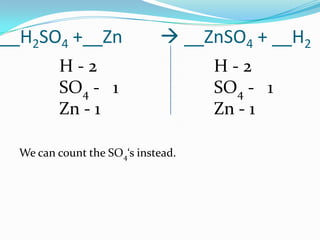
__H2SO4 +__Zn                 __ZnSO4 + __H2
         H-2                        H-2
         SO4 - 1                    SO4 - 1
         Zn - 1                     Zn - 1

  We can count the SO4‘s instead.
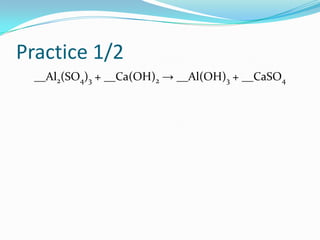
Practice 1/2
  __Al2(SO4)3 + __Ca(OH)2 → __Al(OH)3 + __CaSO4
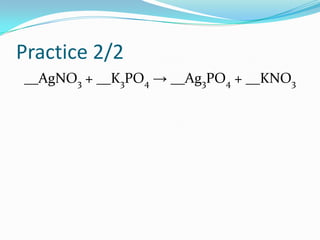
Practice 2/2
__AgNO3 + __K3PO4 → __Ag3PO4 + __KNO3
The end.

Balancing equations

  • 1.
    You only getout what you put in Write this title in your notebooks
  • 2.
    Law of conservationof mass Matter is neither created nor destroyed – it is just changes form. For example, if you react hydrochloric acid with magnesium: 2HCl + 2Mg  H2+ 2MgCl You mix a liquid and a solid and get a gas a liquid – but nothing disappeared, it’s just different. Write the Law of Conservation of Mass in your notebook
  • 3.
    Reaction equations Equations arelike the recipes you use to cook They tell you what to put in – Reactants And what you’ll get out – Products Write definitions of reactants and products in your notebook
  • 4.
    Equations and balancing Lookback at the equation on slide two. Copy the equation into your notebook Count the H, Mg, and Cl atoms in the Reactants and the Products. Reactants: _____ H, _____ Mg, _____ Cl Products: _____ H, _____ Mg, _____ Cl

  • 5.
    Equations and balancing Lookback at the equation on slide two. Copy the equation into your notebook Count the H, Mg, and Cl atoms in the Reactants and the Products. Reactants: __2__ H, __2__ Mg, __2__ Cl Products: __2__ H, ___2_ Mg, ___2_ Cl

  • 6.
    There were thesame number of atoms of each element in the products as the reactants You only get out what you put in.
  • 7.
    Balancing equations Whenever wewrite or use an equation in chemistry it MUST be balanced and obey the law of conservation of mass You only get out what you put in.
  • 8.
    Balancing equations Some equationsare harder to balance than others, use the following technique and you’ll be fine. First write the equation BIG – so it goes all the way across the page. Balance this equation in your notebook as you watch a step by step demonstration.
  • 9.
    ____Cu2O + ____C → ____Cu + ____CO2 Draw a line in front of each compound This is where you will write the Coefficient that tells you how many of each substance you have. Write a definition of Coefficient in your notebook.
  • 10.
    ____Cu2O + ____C → ____Cu + ____CO2 Draw a line under the arrow so that you divide the area into two parts, Reactants and Products
  • 11.
    ____Cu2O + ____C → ____Cu + ____CO2 Cu - Cu - O- O- C- C- List the elements on each side. List them in the same order
  • 12.
    ____Cu2O + ____C → ____Cu + ____CO2 Cu - 2 Cu - O- 1 O- C- 1 C- Now count how many of each element there are on each side. I’ve done the Reactants – you do the Products.
  • 13.
    ____Cu2O + ____C → ____Cu + ____CO2 Cu - 2 Cu - 1 O- 1 O- 2 C- 1 C- 1 Compare the numbers. Is it balanced? Are the same number of atoms going in as going out?
  • 14.
    ____Cu2O + ____C → ____Cu + ____CO2 Cu - 2 Cu - 1 O- 1 O- 2 C- 1 C- 1 No there aren’t There are more copper atoms on the Reactant side than on the Product side. We need more copper on the Product side.
  • 15.
    ____Cu2O + ____C → ____Cu + ____CO2 Cu - 2 Cu - 1 O- 1 O- 2 C- 1 C- 1 Important rule – we can only change the Coefficients – the number in front of the compound
  • 16.
    ____Cu2O + ____C → __2_Cu + ____CO2 Cu - 2 Cu - 1 2 O- 1 O- 2 C- 1 C- 1 Now we have to update our element count. Look again – is the equation balanced?
  • 17.
    ____Cu2O + ____C → __2_Cu + ____CO2 Cu - 2 Cu - 1 2 O- 1 O- 2 C- 1 C- 1 No it’s not. There is more Oxygen on the Product side than on the Reactant side.
  • 18.
    __2_Cu2O + ____C → __2_Cu + ____CO2 Cu - 2 Cu - 1 2 O- 1 O- 2 C- 1 C- 1 We can only change the coefficients. So the only way to get more O on the reactant side is to add another Cu2O
  • 19.
    __2_Cu2O + ____C → __2_Cu + ____CO2 Cu – 2 4 Cu - 1 2 O- 12 O- 2 C- 1 C- 1 Now we update our element count again. Look again – is the equation balanced?
  • 20.
    __2_Cu2O + ____C → __2_Cu + ____CO2 Cu – 2 4 Cu - 1 2 O- 12 O- 2 C- 1 C- 1 No it’s not – there is more copper on the Reactant side than the product side.
  • 21.
    __2_Cu2O + ____C → __4_Cu + ____CO2 Cu – 2 4 Cu - 1 2 O- 12 O- 2 C- 1 C- 1 We can only change the coefficients. Change the Cu to 4.
  • 22.
    __2_Cu2O + ____C → __4_Cu + ____CO2 Cu – 2 4 Cu - 1 2 4 O- 12 O- 2 C- 1 C- 1 Now we update our element count again. Look again – is the equation balanced?
  • 23.
    __2_Cu2O + ____C → __4_Cu + ____CO2 Cu – 2 4 Cu - 1 2 4 O- 12 O- 2 C- 1 C- 1 Yes! It is balanced. 2Cu2O + C  4Cu + CO2
  • 24.
    Practice Now it’s yourturn. Follow the steps we just used and balance the following equations: 1. Write the equation big 2. Draw a line under the arrow 3. List the elements 4. Count the elements – is it balanced? 5. If not, change the Coefficients 6. Count again and repeat from step 4.
  • 25.
    Practice 1/5 ___Na + ___Cl2  ___NaCl
  • 26.
    Practice 2/5 ___H2 + ___O2  ___H2O
  • 27.
    Practice 3/5 ___SnO2+ ___H2  ___Sn + ___H2O
  • 28.
    Practice 4/5 ___NaCl+ ___F2  ___NaF + ___Cl2
  • 29.
    Practice 5/5 ___CH4+ ___O2  ___CO2 + ___H2O
  • 30.
    Balancing polyatomics Do youremember polyatomic ions? Ions that have more than one element in them  SO42+  NO3 -  OH- There’s a shortcut…
  • 31.
    __H2SO4 +__Zn  __ZnSO4 + __H2 H-2 H-2 S- 1 S- 1 O- 4 O- 4 Zn - 1 Zn - 1 Instead of writing out all of the S and O separately, notice that SO4 is together on both sides.
  • 32.
    __H2SO4 +__Zn  __ZnSO4 + __H2 H-2 H-2 SO4 - 1 SO4 - 1 Zn - 1 Zn - 1 We can count the SO4‘s instead.
  • 33.
    Practice 1/2 __Al2(SO4)3 + __Ca(OH)2 → __Al(OH)3 + __CaSO4
  • 34.
    Practice 2/2 __AgNO3 +__K3PO4 → __Ag3PO4 + __KNO3
  • 36.