ENTREPRENEURSHIP
AND ETHICS
Presentation on
Presented By:
Deexith
The Amazon logo was created to represent the
message that it sells everything from A to Z (the
arrow connects the two letters) and also represents
the smile that customers would experience by
shopping on theAmazon.com Web site (the arrow
becomes a smile).
Company Overview
 Amazon.com, Inc. (NASDAQ: AMZN) is an American-
based multinational electronic commerce company.
 Headquartered -Seattle, Washington.
 America's largest online retailer.
 Jeff Bezos founded Amazon.com, Inc. in 1994 and launched it
online In 1995. It started as an online bookstore.
 With 2.5 million titles, it became the “Earth’s Biggest
Bookstore”.
• Vision & Mission Statement
Vision
 “To be earth’s most customer centric company; to build a place
where people can come to find and discover anything they might
want to buy online.”
Mission
 “To leverage technology and the expertise of invaluable
employees and to provide customer with the best shopping
experience on the internet.”
Ethical issues of Amazon.com coming to India
 Stakeholders: Justified returns to them has to be ensured
 Suppliers: Suppliers forms an integral part for any business
operations. Amazon being an online retail chain has to have good
relationship with its partners.
 Customers: These are the most important category for any
organisation. Amazon has to make sure that it provides genuine
products to its customers. Since they could not have touch feel or
test facility in their type of business
Ethical issues of Amazon.com coming to India
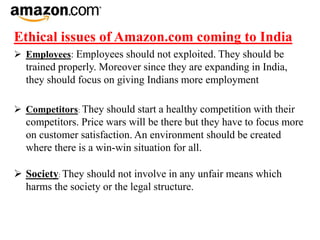
 Employees: Employees should not exploited. They should be
trained properly. Moreover since they are expanding in India,
they should focus on giving Indians more employment
 Competitors: They should start a healthy competition with their
competitors. Price wars will be there but they have to focus more
on customer satisfaction. An environment should be created
where there is a win-win situation for all.
 Society: They should not involve in any unfair means which
harms the society or the legal structure.
Strategic Issues
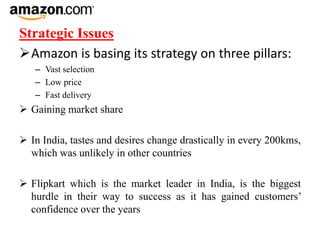
Amazon is basing its strategy on three pillars:
– Vast selection
– Low price
– Fast delivery
 Gaining market share
 In India, tastes and desires change drastically in every 200kms,
which was unlikely in other countries
 Flipkart which is the market leader in India, is the biggest
hurdle in their way to success as it has gained customers’
confidence over the years
Analysis of Strategic shift
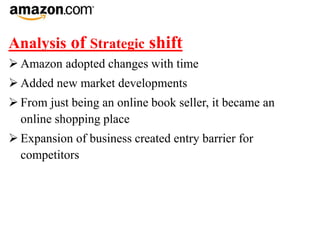
 Amazon adopted changes with time
 Added new market developments
 From just being an online book seller, it became an
online shopping place
 Expansion of business created entry barrier for
competitors
Understanding Indian Market
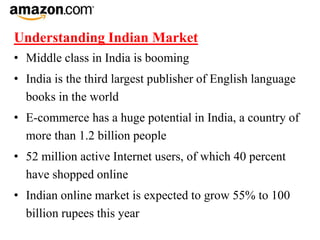
• Middle class in India is booming
• India is the third largest publisher of English language
books in the world
• E-commerce has a huge potential in India, a country of
more than 1.2 billion people
• 52 million active Internet users, of which 40 percent
have shopped online
• Indian online market is expected to grow 55% to 100
billion rupees this year
What Amazon looks to achieve in India?
• Customer satisfaction in India
• Looking for a long term business
• Considers new markets where the company could enter
or additional products that could be developed
SWOT Analysis of Amazon
Strengths:
 Brand well known along with a strong customer base in
many parts of the world.
 Diverse product offerings
 Free home delivery above a minimum purchase
 Working with minimum profit and gaining from
economies of scale
 Strong business relationships with publishing houses,
major electronic companies etc.
 Experience of almost a decade in online shopping
industry
Weakness:
 Operates at very low margin
 Criticism for its working conditions
 ‘KINDLE’ is not up to the mark of its competitors
Opportunity:
 Acquiring more small business enterprises, enabling them to
expand
 Opening physical stores so as to give the customers a feel of
touch and experience
 Indian retail industry is estimated to be $450 Billion
 Expand into more product segments
 Tie ups with major players of untapped market
Threats:
 Online security threats
 Regional low-cost retailers
 Strong online presence of Indian competitors like Flipkart and
Myntra
 Flexible rules against FDI enabling other major players like Wal-
Mart etc. to enter
Innovation
Only pricing cannot be taken as a differentiating factor, innovation
is also needed. The company should create a total buying
experience that has been missing in the Indian context. Promotion
should be done through Push and Pull strategies which will
include offers and advertising.
Amazon
Amazon
Amazon

Amazon

  • 1.
  • 2.
    The Amazon logowas created to represent the message that it sells everything from A to Z (the arrow connects the two letters) and also represents the smile that customers would experience by shopping on theAmazon.com Web site (the arrow becomes a smile).
  • 3.
    Company Overview  Amazon.com,Inc. (NASDAQ: AMZN) is an American- based multinational electronic commerce company.  Headquartered -Seattle, Washington.  America's largest online retailer.  Jeff Bezos founded Amazon.com, Inc. in 1994 and launched it online In 1995. It started as an online bookstore.  With 2.5 million titles, it became the “Earth’s Biggest Bookstore”.
  • 4.
    • Vision &Mission Statement Vision  “To be earth’s most customer centric company; to build a place where people can come to find and discover anything they might want to buy online.” Mission  “To leverage technology and the expertise of invaluable employees and to provide customer with the best shopping experience on the internet.”
  • 5.
    Ethical issues ofAmazon.com coming to India  Stakeholders: Justified returns to them has to be ensured  Suppliers: Suppliers forms an integral part for any business operations. Amazon being an online retail chain has to have good relationship with its partners.  Customers: These are the most important category for any organisation. Amazon has to make sure that it provides genuine products to its customers. Since they could not have touch feel or test facility in their type of business
  • 6.
    Ethical issues ofAmazon.com coming to India  Employees: Employees should not exploited. They should be trained properly. Moreover since they are expanding in India, they should focus on giving Indians more employment  Competitors: They should start a healthy competition with their competitors. Price wars will be there but they have to focus more on customer satisfaction. An environment should be created where there is a win-win situation for all.  Society: They should not involve in any unfair means which harms the society or the legal structure.
  • 7.
    Strategic Issues Amazon isbasing its strategy on three pillars: – Vast selection – Low price – Fast delivery  Gaining market share  In India, tastes and desires change drastically in every 200kms, which was unlikely in other countries  Flipkart which is the market leader in India, is the biggest hurdle in their way to success as it has gained customers’ confidence over the years
  • 8.
    Analysis of Strategicshift  Amazon adopted changes with time  Added new market developments  From just being an online book seller, it became an online shopping place  Expansion of business created entry barrier for competitors
  • 9.
    Understanding Indian Market •Middle class in India is booming • India is the third largest publisher of English language books in the world • E-commerce has a huge potential in India, a country of more than 1.2 billion people • 52 million active Internet users, of which 40 percent have shopped online • Indian online market is expected to grow 55% to 100 billion rupees this year
  • 10.
    What Amazon looksto achieve in India? • Customer satisfaction in India • Looking for a long term business • Considers new markets where the company could enter or additional products that could be developed
  • 11.
    SWOT Analysis ofAmazon Strengths:  Brand well known along with a strong customer base in many parts of the world.  Diverse product offerings  Free home delivery above a minimum purchase  Working with minimum profit and gaining from economies of scale  Strong business relationships with publishing houses, major electronic companies etc.  Experience of almost a decade in online shopping industry
  • 12.
    Weakness:  Operates atvery low margin  Criticism for its working conditions  ‘KINDLE’ is not up to the mark of its competitors Opportunity:  Acquiring more small business enterprises, enabling them to expand  Opening physical stores so as to give the customers a feel of touch and experience  Indian retail industry is estimated to be $450 Billion  Expand into more product segments  Tie ups with major players of untapped market
  • 13.
    Threats:  Online securitythreats  Regional low-cost retailers  Strong online presence of Indian competitors like Flipkart and Myntra  Flexible rules against FDI enabling other major players like Wal- Mart etc. to enter
  • 14.
    Innovation Only pricing cannotbe taken as a differentiating factor, innovation is also needed. The company should create a total buying experience that has been missing in the Indian context. Promotion should be done through Push and Pull strategies which will include offers and advertising.