WRITING BAD-NEWS
MESSAGES
Presentation of business
communication
Objectives
• Choose correctly between indirect and direct
approaches
• Establish proper tone from the beginning of
message
• Present bad news in a reasonable and
understandable way
• Write messages that motivate your audience
to take constructive action
• Close messages that build positive
relationship with your business
Objective of Indirect Approach
• Ease the reader/audience into the part
of the message that justifies the decision
or builds goodwill
• Convey the bad-news without bruising
the reader’s feelings
• Help reader know the decision is firm, fair,
and still build goodwill
Indirect Approach
• Open with a buffer statement to soften
the blow & demonstrate respect
• Give reasons for refusing
• Refuse
• Offer alternative, if possible
• Close with positive, helpful tone
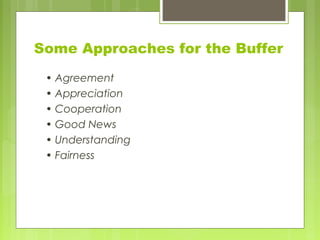
Some Approaches for the Buffer
• Agreement
• Appreciation
• Cooperation
• Good News
• Understanding
• Fairness
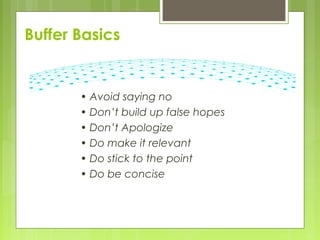
Buffer Basics
• Avoid saying no
• Don’t build up false hopes
• Don’t Apologize
• Do make it relevant
• Do stick to the point
• Do be concise
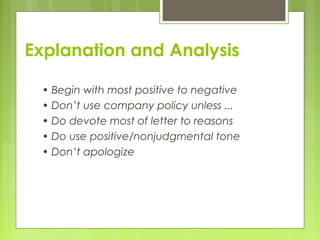
Explanation and Analysis
• Begin with most positive to negative
• Don’t use company policy unless ...
• Do devote most of letter to reasons
• Do use positive/nonjudgmental tone
• Don’t apologize
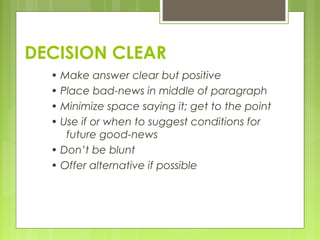
DECISION CLEAR
• Make answer clear but positive
• Place bad-news in middle of paragraph
• Minimize space saying it; get to the point
• Use if or when to suggest conditions for
future good-news
• Don’t be blunt
• Offer alternative if possible
10
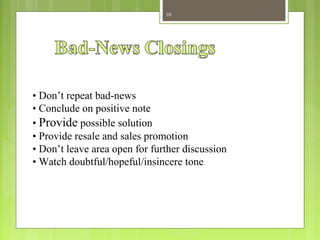
• Don’t repeat bad-news
• Conclude on positive note
• Provide possible solution
• Provide resale and sales promotion
• Don’t leave area open for further discussion
• Watch doubtful/hopeful/insincere tone
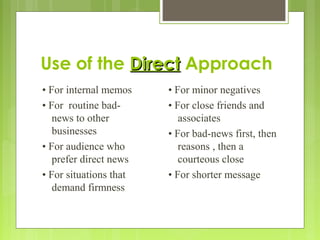
Use of the DirectDirect Approach
• For internal memos
• For routine bad-
news to other
businesses
• For audience who
prefer direct news
• For situations that
demand firmness
• For minor negatives
• For close friends and
associates
• For bad-news first, then
reasons , then a
courteous close
• For shorter message
Your Mission
Review the poorly written bad-news
letter in groups and be prepared to
indicate how it could be rewritten.

Bad news indirect approach

  • 1.
  • 2.
  • 3.
    Objectives • Choose correctlybetween indirect and direct approaches • Establish proper tone from the beginning of message • Present bad news in a reasonable and understandable way • Write messages that motivate your audience to take constructive action • Close messages that build positive relationship with your business
  • 4.
    Objective of IndirectApproach • Ease the reader/audience into the part of the message that justifies the decision or builds goodwill • Convey the bad-news without bruising the reader’s feelings • Help reader know the decision is firm, fair, and still build goodwill
  • 5.
    Indirect Approach • Openwith a buffer statement to soften the blow & demonstrate respect • Give reasons for refusing • Refuse • Offer alternative, if possible • Close with positive, helpful tone
  • 6.
    Some Approaches forthe Buffer • Agreement • Appreciation • Cooperation • Good News • Understanding • Fairness
  • 7.
    Buffer Basics • Avoidsaying no • Don’t build up false hopes • Don’t Apologize • Do make it relevant • Do stick to the point • Do be concise
  • 8.
    Explanation and Analysis •Begin with most positive to negative • Don’t use company policy unless ... • Do devote most of letter to reasons • Do use positive/nonjudgmental tone • Don’t apologize
  • 9.
    DECISION CLEAR • Makeanswer clear but positive • Place bad-news in middle of paragraph • Minimize space saying it; get to the point • Use if or when to suggest conditions for future good-news • Don’t be blunt • Offer alternative if possible
  • 10.
    10 • Don’t repeatbad-news • Conclude on positive note • Provide possible solution • Provide resale and sales promotion • Don’t leave area open for further discussion • Watch doubtful/hopeful/insincere tone
  • 11.
    Use of theDirectDirect Approach • For internal memos • For routine bad- news to other businesses • For audience who prefer direct news • For situations that demand firmness • For minor negatives • For close friends and associates • For bad-news first, then reasons , then a courteous close • For shorter message
  • 12.
    Your Mission Review thepoorly written bad-news letter in groups and be prepared to indicate how it could be rewritten.