Business Writing
3 x 3 Writing Process.
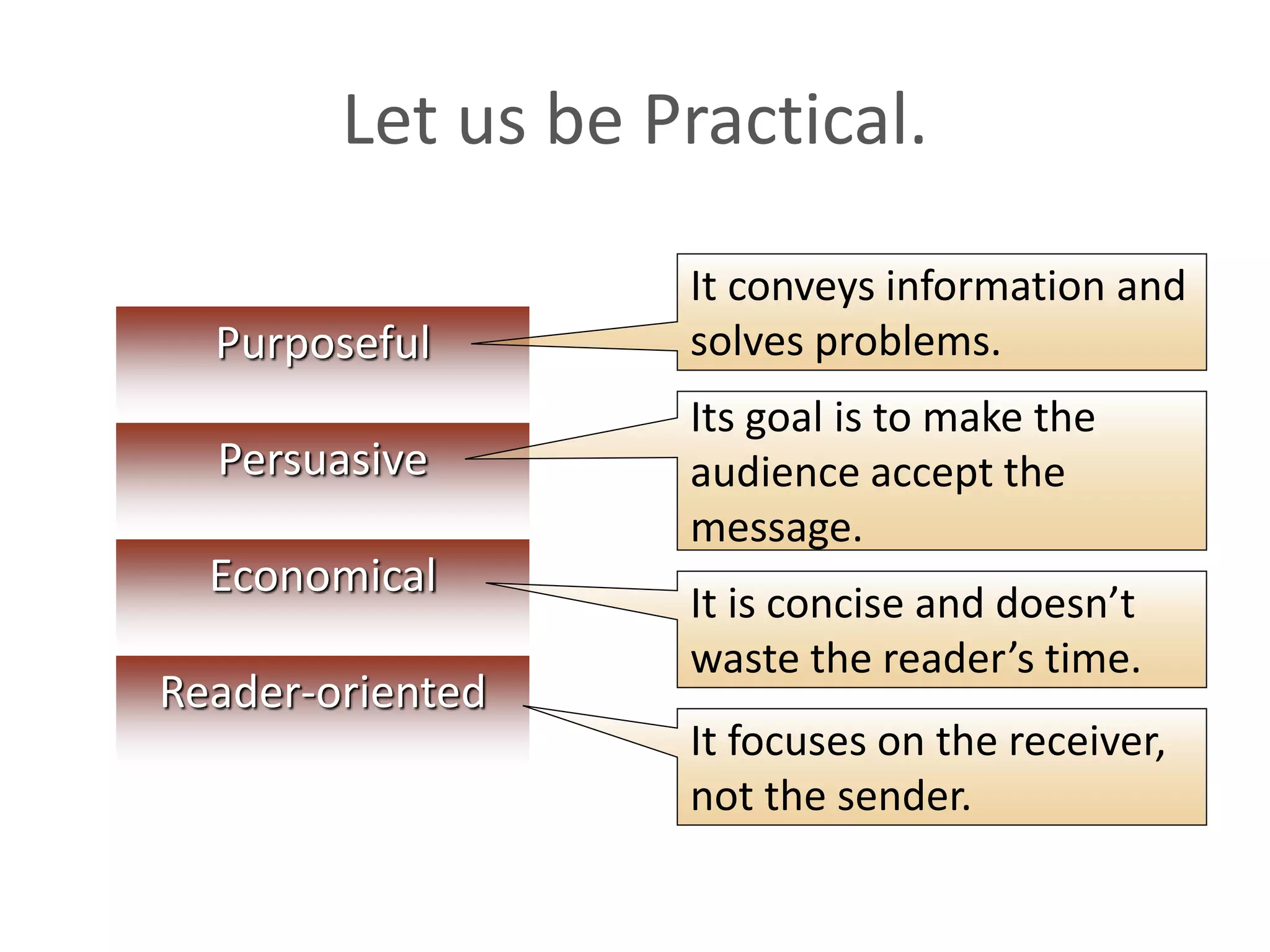
Let us be Practical.
Purposeful
Persuasive
Economical
Reader-oriented
It is concise and doesn’t
waste the reader’s time.
It focuses on the receiver,
not the sender.
It conveys information and
solves problems.
Its goal is to make the
audience accept the
message.
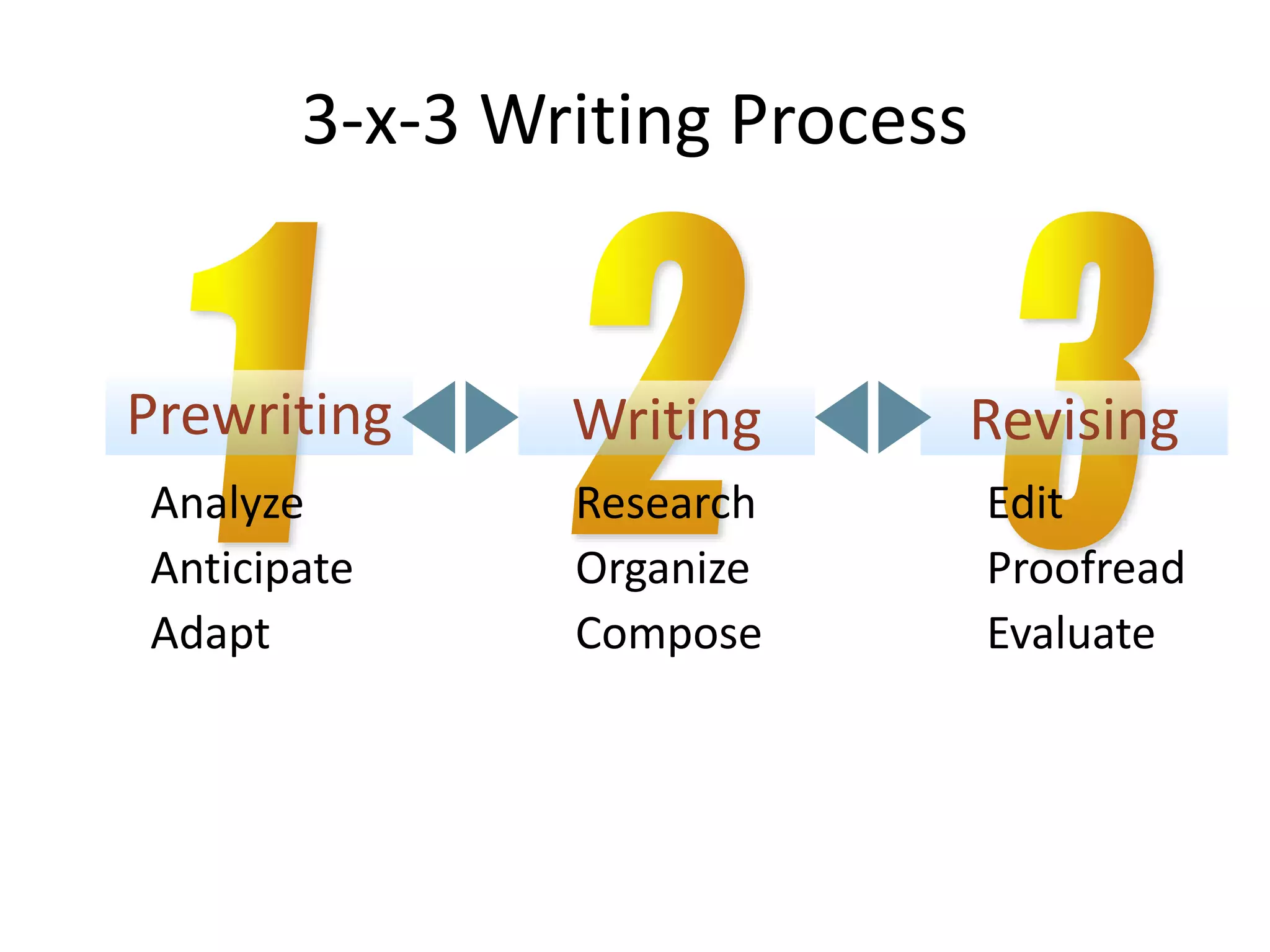
3-x-3 Writing Process
Prewriting Writing Revising
Analyze
Anticipate
Adapt
Research
Organize
Compose
Edit
Proofread
Evaluate
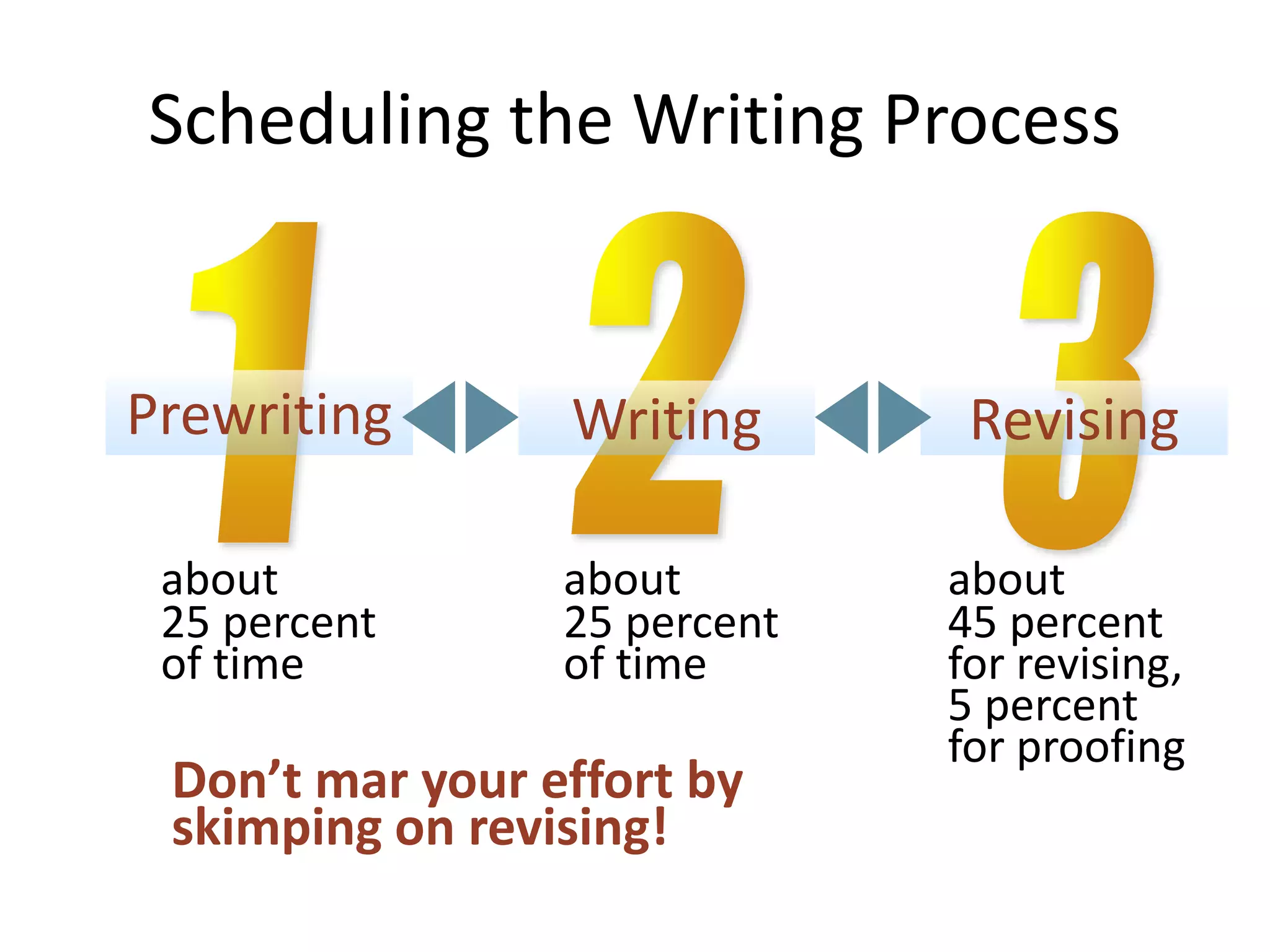
Scheduling the Writing Process
Prewriting Writing Revising
about
25 percent
of time
about
25 percent
of time
about
45 percent
for revising,
5 percent
for proofing
Don’t mar your effort by
skimping on revising!
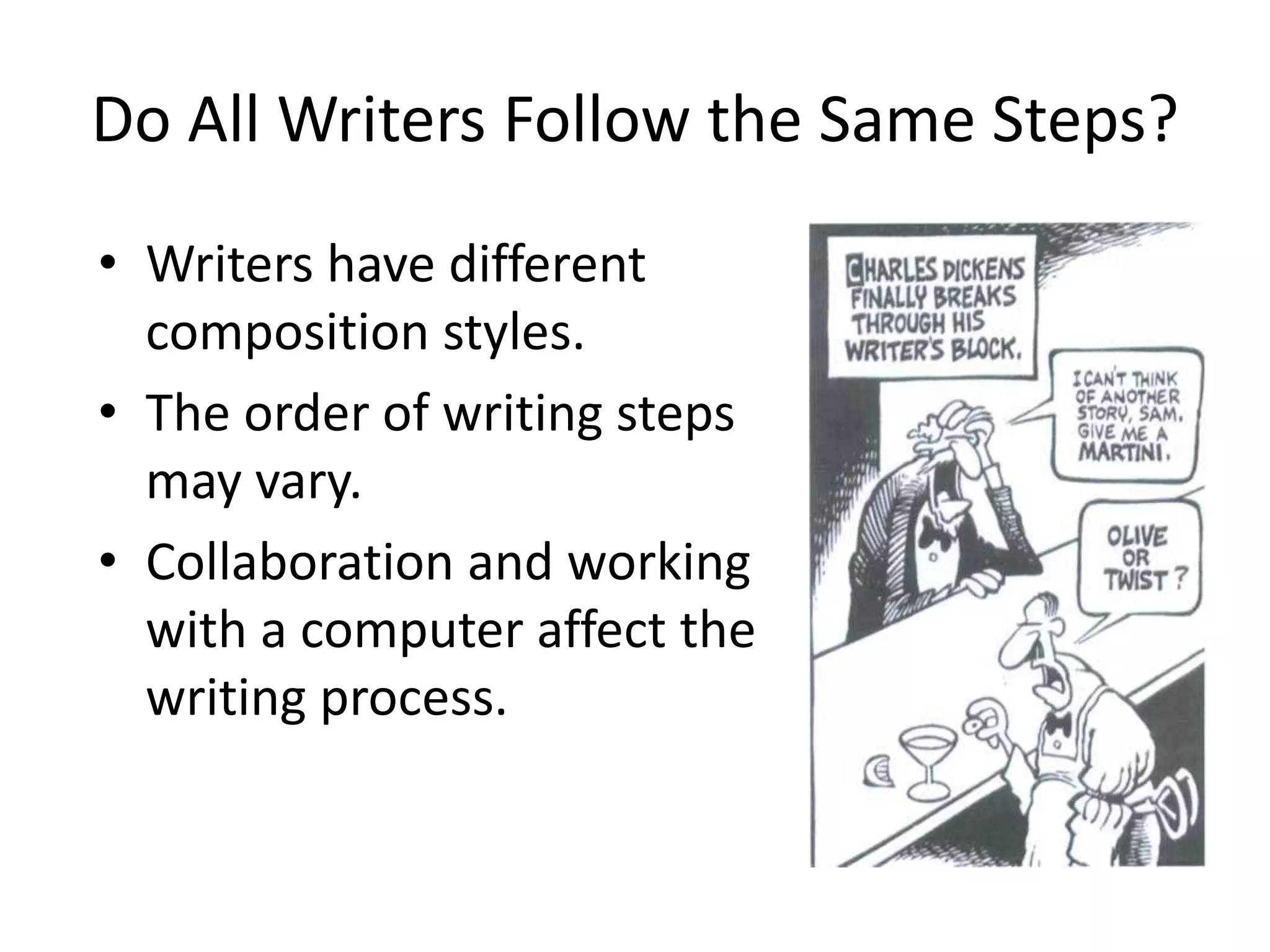
Do All Writers Follow the Same Steps?
• Writers have different
composition styles.
• The order of writing steps
may vary.
• Collaboration and working
with a computer affect the
writing process.
Do Short Messages Require a
Writing Process?
• The steps may be condensed or
performed rapidly, but good writers
consider them all.
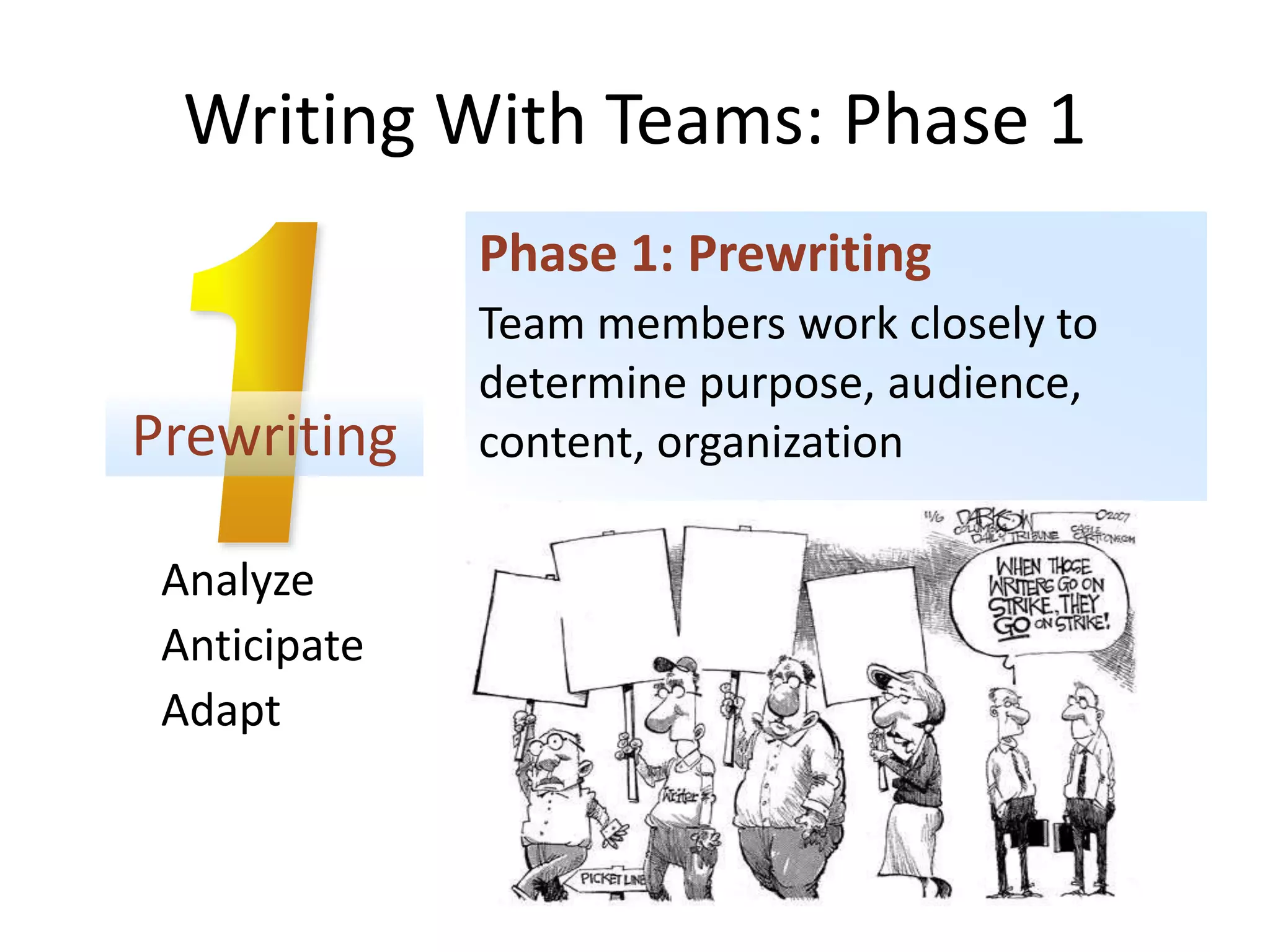
Writing With Teams: Phase 1
Analyze
Anticipate
Adapt
Phase 1: Prewriting
Team members work closely to
determine purpose, audience,
content, organizationPrewriting
Adapting to Task and Audience:
Spotlight audience benefits.
The warranty starts working for you
immediately.
Cultivate the “you” view.
You will receive your order.
Your account is now open.
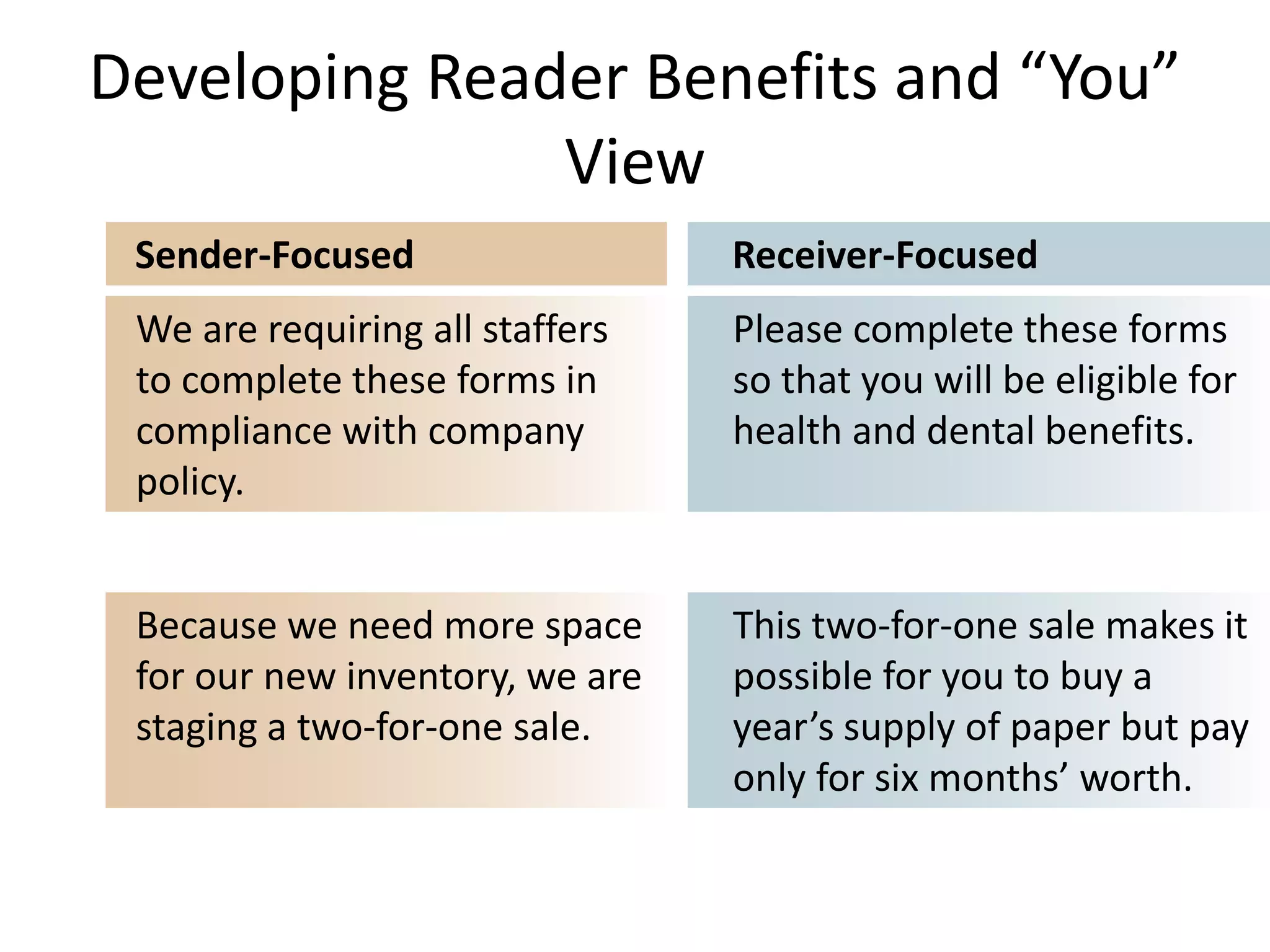
Developing Reader Benefits and “You”
View
We are requiring all staffers
to complete these forms in
compliance with company
policy.
Please complete these forms
so that you will be eligible for
health and dental benefits.
Sender-Focused Receiver-Focused
Because we need more space
for our new inventory, we are
staging a two-for-one sale.
This two-for-one sale makes it
possible for you to buy a
year’s supply of paper but pay
only for six months’ worth.
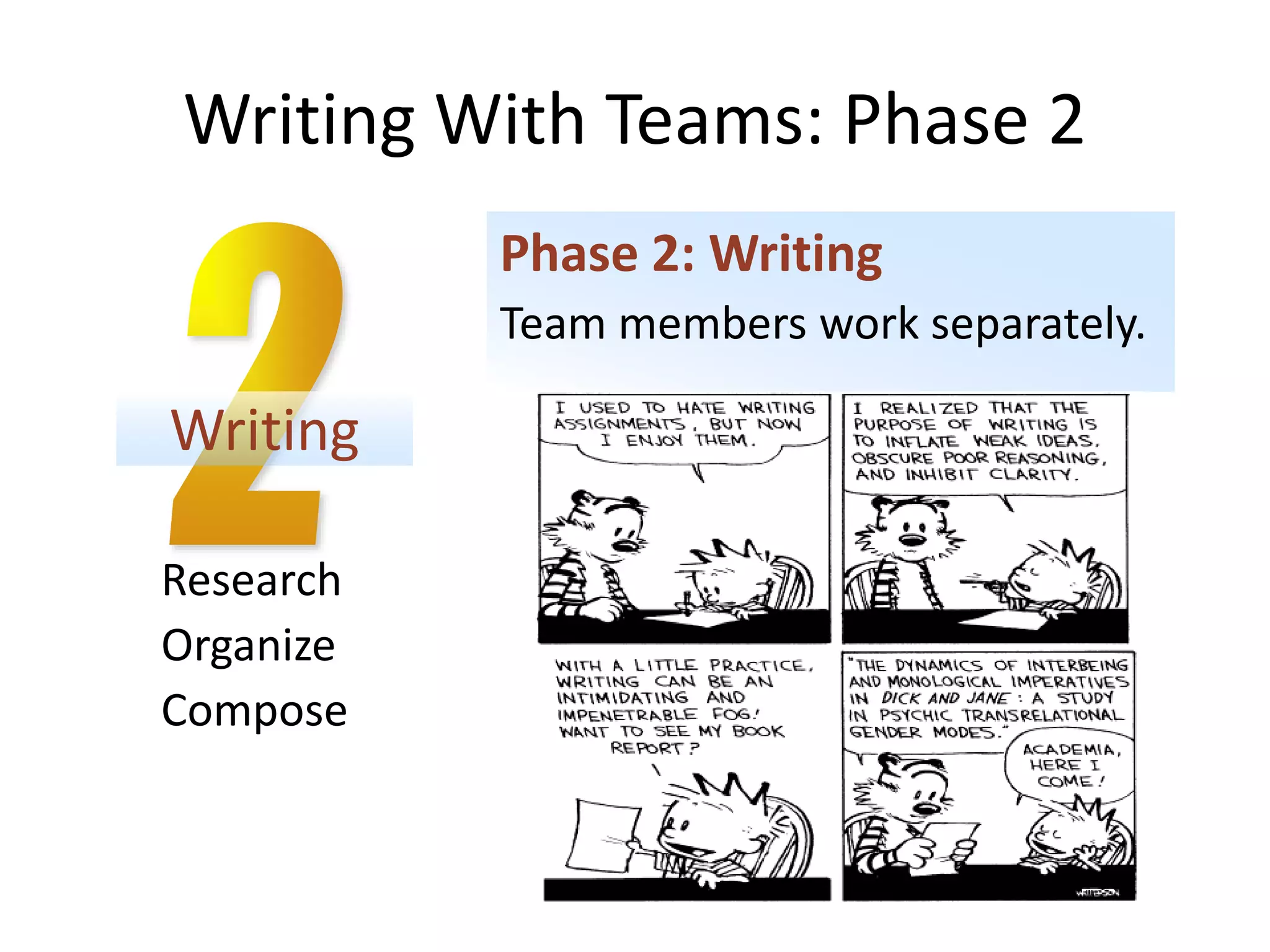
Writing With Teams: Phase 2
Phase 2: Writing
Team members work separately.
Writing
Research
Organize
Compose
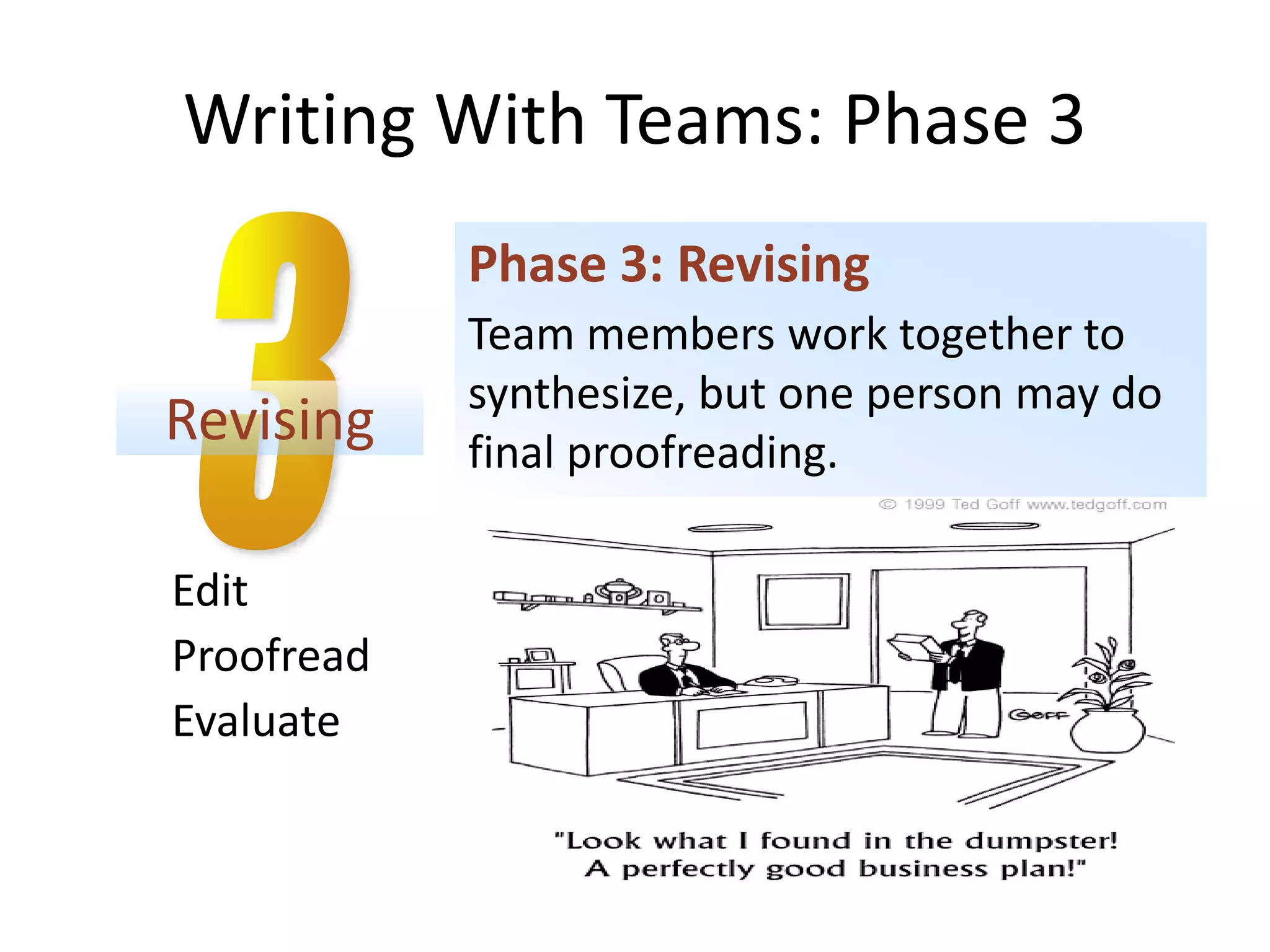
Writing With Teams: Phase 3
Revising
Edit
Proofread
Evaluate
Phase 3: Revising
Team members work together to
synthesize, but one person may do
final proofreading.
Writing Task:
Reasons Why High School Students Choose OU
Step 1: Prewriting
Analyze
Anticipate
Adapt
Step 2: Writing
Research
Organize
Compose
Step 3: Revising
Edit
Proofread
Evaluate
• What is the purpose of
the writing?
• Who is the Audience?
• What expectations are
there for the writing?
• Conduct informal
research
• Create an outline
• Write – two paragraphs
for a newsletter
Focus on:
1. Word and content
meaning
2. Grammar and
mechanics
3. Formatting
You decide! After Interview
Collect Info/Data
Write
Edit, Evaluate

3 x3 writing process

  • 1.
    Business Writing 3 x3 Writing Process.
  • 2.
    Let us bePractical. Purposeful Persuasive Economical Reader-oriented It is concise and doesn’t waste the reader’s time. It focuses on the receiver, not the sender. It conveys information and solves problems. Its goal is to make the audience accept the message.
  • 3.
    3-x-3 Writing Process PrewritingWriting Revising Analyze Anticipate Adapt Research Organize Compose Edit Proofread Evaluate
  • 4.
    Scheduling the WritingProcess Prewriting Writing Revising about 25 percent of time about 25 percent of time about 45 percent for revising, 5 percent for proofing Don’t mar your effort by skimping on revising!
  • 5.
    Do All WritersFollow the Same Steps? • Writers have different composition styles. • The order of writing steps may vary. • Collaboration and working with a computer affect the writing process.
  • 6.
    Do Short MessagesRequire a Writing Process? • The steps may be condensed or performed rapidly, but good writers consider them all.
  • 7.
    Writing With Teams:Phase 1 Analyze Anticipate Adapt Phase 1: Prewriting Team members work closely to determine purpose, audience, content, organizationPrewriting
  • 8.
    Adapting to Taskand Audience: Spotlight audience benefits. The warranty starts working for you immediately. Cultivate the “you” view. You will receive your order. Your account is now open.
  • 9.
    Developing Reader Benefitsand “You” View We are requiring all staffers to complete these forms in compliance with company policy. Please complete these forms so that you will be eligible for health and dental benefits. Sender-Focused Receiver-Focused Because we need more space for our new inventory, we are staging a two-for-one sale. This two-for-one sale makes it possible for you to buy a year’s supply of paper but pay only for six months’ worth.
  • 10.
    Writing With Teams:Phase 2 Phase 2: Writing Team members work separately. Writing Research Organize Compose
  • 11.
    Writing With Teams:Phase 3 Revising Edit Proofread Evaluate Phase 3: Revising Team members work together to synthesize, but one person may do final proofreading.
  • 12.
    Writing Task: Reasons WhyHigh School Students Choose OU Step 1: Prewriting Analyze Anticipate Adapt Step 2: Writing Research Organize Compose Step 3: Revising Edit Proofread Evaluate • What is the purpose of the writing? • Who is the Audience? • What expectations are there for the writing? • Conduct informal research • Create an outline • Write – two paragraphs for a newsletter Focus on: 1. Word and content meaning 2. Grammar and mechanics 3. Formatting You decide! After Interview Collect Info/Data Write Edit, Evaluate

Editor's Notes

  • #3 Business writing is purposeful, persuasive, economical and reader oriented. Purposeful: you will be writing to solve problems and convey information. You will have a definite purpose to fulfill in each message. Persuasive: you want your audience to believe and accept your message. Economical: you will try to present ideas clearly but concisely. Length is not rewarded. Reader oriented: you will concentrate on looking at a problem from the reader’s perspective instead of seeing it for your own. Remember business writers seek to express rather than impress.
  • #4 Steps in the writing process may be rearranged, shortened, or repeated. When writing in teams: Remember, team-written documents are necessary for big projects that have short deadlines and that require the efforts of many people. Team-written documents and presentations produce better products. Teams generally work closely in Phase 1, work separately in Phase 2, and synthesize their drafts in Phase 3.
  • #5 The third phase of the writing process is the most time consuming phase of the 3x3 writing process because it involves revising and proofreading your message. Revising means improving the content and sentence structure of your message. Proofreading involves correcting its grammar, spelling, punctuation, format, and mechanics. During phase 3, you will revise the message for clarity, conciseness, tone, and readability; proofread for correct spelling, grammar, punctuation, and format; and evaluate the message to see if accomplishes your goal.
  • #7 Examples of using the writing process for a simple note to a formal report.
  • #8 Identify the purpose Why am I writing this message? What do I hope to achieve? Selecting the best channel How important is the message? How much feedback is required? How fast is feedback needed? Is a permanent record necessary? How much can be spent? How formal is the message?
  • #11 Formal Research Methods Informal Research Methods Collecting Information & Generating Ideas
  • #12 Clarity Tone Conciseness Vigor & Directness Readability Word and content meaning Grammar and mechanics formatting How successful will the message be? Does it say what you want it to? Will it achieve its purpose? How will you know whether it succeeds?