PERSUASIVE & BAD
NEWS LETTER
Presented by :M.Rizwaan Minhas
Email:Rixwaanminhas@gmail.com
Presented to : Sir Shakeel Daniel
WHAT IS PERSUASIVE LETTER
• a letter meant for a specific audience
• tries to convince the reader to do something
• has a date, greeting, body, closing, and signature
PERSUASIVE LETTERS
• The purpose of a persuasive letter is to sell your idea to someone.
You are trying to get them to do something they may not want to
do.
• AIDA Formula
• First paragraph A-Attention;
• Second paragraph I-Interest;
• Third paragraph D-Desire;
• Fourth paragraph A-Action.
3
WHAT ARE THE PARTS OF A
PERSUASIVE LETTER?
• beginning - states your opinion
• middle - gives two or three reasons for your opinion
• end - tells the reader what action to take
LANGUAGE FEATURES
Use powerful verbs and strong adjectives
Use mainly the present tense.
Use logical and cause and effect connectives.
Use emotive language.
BAD NEWS MESSAGES
In business writing, a letter, memo, or email that conveys
negative or unpleasant information--information that is
likely to disappoint, upset, or even anger a reader.
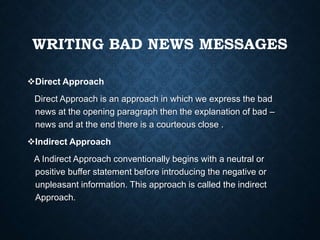
WRITING BAD NEWS MESSAGES
Direct Approach
Direct Approach is an approach in which we express the bad
news at the opening paragraph then the explanation of bad –
news and at the end there is a courteous close .
Indirect Approach
A Indirect Approach conventionally begins with a neutral or
positive buffer statement before introducing the negative or
unpleasant information. This approach is called the indirect
Approach.
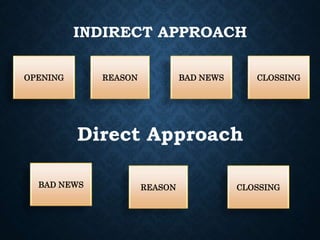
INDIRECT APPROACH
OPENING REASON BAD NEWS CLOSSING
Direct Approach
BAD NEWS REASON CLOSSING
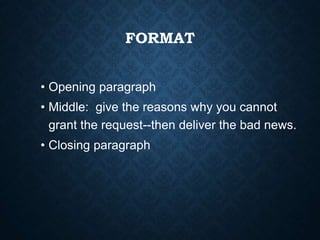
FORMAT
• Opening paragraph
• Middle: give the reasons why you cannot
grant the request--then deliver the bad news.
• Closing paragraph
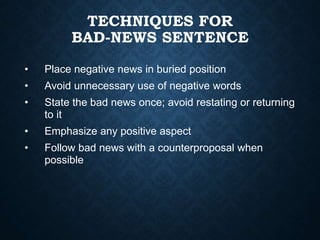
TECHNIQUES FOR
BAD-NEWS SENTENCE
• Place negative news in buried position
• Avoid unnecessary use of negative words
• State the bad news once; avoid restating or returning
to it
• Emphasize any positive aspect
• Follow bad news with a counterproposal when
possible
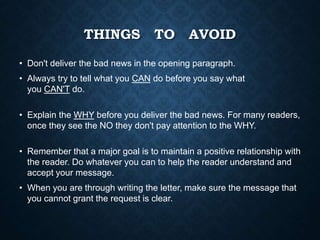
THINGS TO AVOID
• Don't deliver the bad news in the opening paragraph.
• Always try to tell what you CAN do before you say what
you CAN'T do.
• Explain the WHY before you deliver the bad news. For many readers,
once they see the NO they don't pay attention to the WHY.
• Remember that a major goal is to maintain a positive relationship with
the reader. Do whatever you can to help the reader understand and
accept your message.
• When you are through writing the letter, make sure the message that
you cannot grant the request is clear.
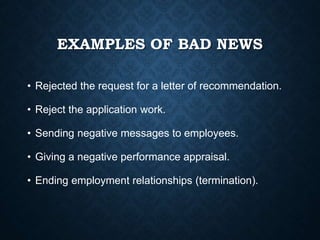
EXAMPLES OF BAD NEWS
• Rejected the request for a letter of recommendation.
• Reject the application work.
• Sending negative messages to employees.
• Giving a negative performance appraisal.
• Ending employment relationships (termination).
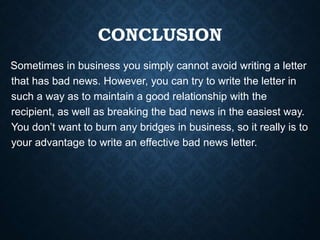
CONCLUSION
Sometimes in business you simply cannot avoid writing a letter
that has bad news. However, you can try to write the letter in
such a way as to maintain a good relationship with the
recipient, as well as breaking the bad news in the easiest way.
You don’t want to burn any bridges in business, so it really is to
your advantage to write an effective bad news letter.
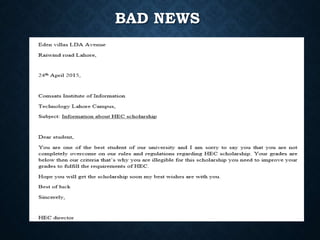
BAD NEWS
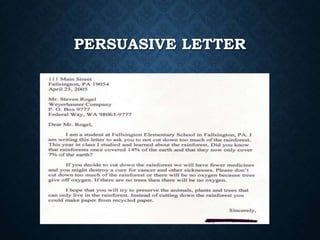
PERSUASIVE LETTER
THANK YOU

Persuavice and bad letters

  • 1.
    PERSUASIVE & BAD NEWSLETTER Presented by :M.Rizwaan Minhas Email:Rixwaanminhas@gmail.com Presented to : Sir Shakeel Daniel
  • 2.
    WHAT IS PERSUASIVELETTER • a letter meant for a specific audience • tries to convince the reader to do something • has a date, greeting, body, closing, and signature
  • 3.
    PERSUASIVE LETTERS • Thepurpose of a persuasive letter is to sell your idea to someone. You are trying to get them to do something they may not want to do. • AIDA Formula • First paragraph A-Attention; • Second paragraph I-Interest; • Third paragraph D-Desire; • Fourth paragraph A-Action. 3
  • 4.
    WHAT ARE THEPARTS OF A PERSUASIVE LETTER? • beginning - states your opinion • middle - gives two or three reasons for your opinion • end - tells the reader what action to take
  • 5.
    LANGUAGE FEATURES Use powerfulverbs and strong adjectives Use mainly the present tense. Use logical and cause and effect connectives. Use emotive language.
  • 6.
    BAD NEWS MESSAGES Inbusiness writing, a letter, memo, or email that conveys negative or unpleasant information--information that is likely to disappoint, upset, or even anger a reader.
  • 7.
    WRITING BAD NEWSMESSAGES Direct Approach Direct Approach is an approach in which we express the bad news at the opening paragraph then the explanation of bad – news and at the end there is a courteous close . Indirect Approach A Indirect Approach conventionally begins with a neutral or positive buffer statement before introducing the negative or unpleasant information. This approach is called the indirect Approach.
  • 8.
    INDIRECT APPROACH OPENING REASONBAD NEWS CLOSSING Direct Approach BAD NEWS REASON CLOSSING
  • 9.
    FORMAT • Opening paragraph •Middle: give the reasons why you cannot grant the request--then deliver the bad news. • Closing paragraph
  • 10.
    TECHNIQUES FOR BAD-NEWS SENTENCE •Place negative news in buried position • Avoid unnecessary use of negative words • State the bad news once; avoid restating or returning to it • Emphasize any positive aspect • Follow bad news with a counterproposal when possible
  • 11.
    THINGS TO AVOID •Don't deliver the bad news in the opening paragraph. • Always try to tell what you CAN do before you say what you CAN'T do. • Explain the WHY before you deliver the bad news. For many readers, once they see the NO they don't pay attention to the WHY. • Remember that a major goal is to maintain a positive relationship with the reader. Do whatever you can to help the reader understand and accept your message. • When you are through writing the letter, make sure the message that you cannot grant the request is clear.
  • 12.
    EXAMPLES OF BADNEWS • Rejected the request for a letter of recommendation. • Reject the application work. • Sending negative messages to employees. • Giving a negative performance appraisal. • Ending employment relationships (termination).
  • 13.
    CONCLUSION Sometimes in businessyou simply cannot avoid writing a letter that has bad news. However, you can try to write the letter in such a way as to maintain a good relationship with the recipient, as well as breaking the bad news in the easiest way. You don’t want to burn any bridges in business, so it really is to your advantage to write an effective bad news letter.
  • 14.
  • 15.
  • 16.