BACTERIAL CELL
INCLUSIONS
PRESENTED BY :
A.DHEERAJ (BP211504),
DEPARTMENT OF MICROBIOLOGY,
SACRED HEART COLLEGE (AUTONOMOUS),
TIRUPATTUR.
CELL
INCLUSIONS
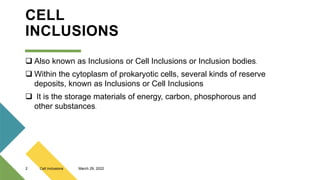
 Also known as Inclusions or Cell Inclusions or Inclusion bodies.
 Within the cytoplasm of prokaryotic cells, several kinds of reserve
deposits, known as Inclusions or Cell Inclusions
 It is the storage materials of energy, carbon, phosphorous and
other substances.
2 Cell inclusions March 29, 2022
TYPES OF CELL
INCLUSIONS
.
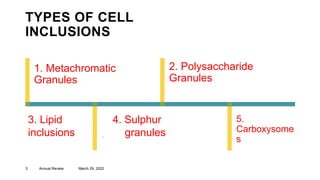
1. Metachromatic
Granules
.
3. Lipid 4. Sulphur
inclusions granules .
5.
Carboxysome
s
.
2. Polysaccharide
Granules
March 29, 2022
Annual Review
3
1.Metachromatic granules
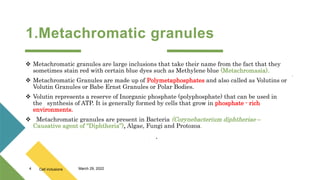
 Metachromatic granules are large inclusions that take their name from the fact that they
sometimes stain red with certain blue dyes such as Methylene blue (Metachromasia).
 Metachromatic Granules are made up of Polymetaphosphates and also called as Volutins or
Volutin Granules or Babe Ernst Granules or Polar Bodies.
 Volutin represents a reserve of Inorganic phosphate (polyphosphate) that can be used in
the synthesis of ATP. It is generally formed by cells that grow in phosphate - rich
environments.
 Metachromatic granules are present in Bacteria (Corynebacterium diphtheriae –
Causative agent of “Diphtheria”), Algae, Fungi and Protozoa.

.
.
.
4 Cell inclusions March 29, 2022
b) Polysaccharide Granules c) Lipid inclusions
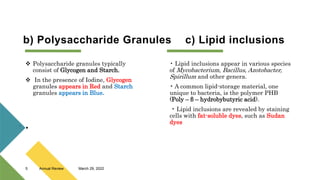
 Polysaccharide granules typically
consist of Glycogen and Starch.
 In the presence of Iodine, Glycogen
granules appears in Red and Starch
granules appears in Blue.
• Lipid inclusions appear in various species
of Mycobacterium, Bacillus, Azotobacter,
Spirillum and other genera.
• A common lipid-storage material, one
unique to bacteria, is the polymer PHB
(Poly – β – hydrobybutyric acid).
• Lipid inclusions are revealed by staining
cells with fat-soluble dyes, such as Sudan
dyes

.
March 29, 2022
Annual Review
5
d) Sulfur Granules e) Carboxysomes
 Certain bacteria - the "Sulfur bacteria" that
belong to the genus Thiobacillus sp. derive
energy by oxidizing sulfur and sulfur-
containing compounds.
 The Sulfur bacteria may deposit sulfur
granules in the cell, where they serve as an
energy reserve.
 Carboxysomes are the bacterial Cell
inclusions that contain the enzyme
Ribulose 1,5 - diphosphate carboxylase.
 Photosynthetic bacteria use Carbon-di-
oxide as their sole source of carbon and
require this enzyme for Carbon-di-oxide
fixation.
 Carboxysomes containing bacteria are
Nitrifying bacteria, Cyanobacteria and
Thiobacilli.

.
•
.
March 29, 2022
Annual Review
6
Thank you
.
.

BACTERIAL CELL INCLUSIONS.pptx

  • 1.
    BACTERIAL CELL INCLUSIONS PRESENTED BY: A.DHEERAJ (BP211504), DEPARTMENT OF MICROBIOLOGY, SACRED HEART COLLEGE (AUTONOMOUS), TIRUPATTUR.
  • 2.
    CELL INCLUSIONS  Also knownas Inclusions or Cell Inclusions or Inclusion bodies.  Within the cytoplasm of prokaryotic cells, several kinds of reserve deposits, known as Inclusions or Cell Inclusions  It is the storage materials of energy, carbon, phosphorous and other substances. 2 Cell inclusions March 29, 2022
  • 3.
    TYPES OF CELL INCLUSIONS . 1.Metachromatic Granules . 3. Lipid 4. Sulphur inclusions granules . 5. Carboxysome s . 2. Polysaccharide Granules March 29, 2022 Annual Review 3
  • 4.
    1.Metachromatic granules  Metachromaticgranules are large inclusions that take their name from the fact that they sometimes stain red with certain blue dyes such as Methylene blue (Metachromasia).  Metachromatic Granules are made up of Polymetaphosphates and also called as Volutins or Volutin Granules or Babe Ernst Granules or Polar Bodies.  Volutin represents a reserve of Inorganic phosphate (polyphosphate) that can be used in the synthesis of ATP. It is generally formed by cells that grow in phosphate - rich environments.  Metachromatic granules are present in Bacteria (Corynebacterium diphtheriae – Causative agent of “Diphtheria”), Algae, Fungi and Protozoa.  . . . 4 Cell inclusions March 29, 2022
  • 5.
    b) Polysaccharide Granulesc) Lipid inclusions  Polysaccharide granules typically consist of Glycogen and Starch.  In the presence of Iodine, Glycogen granules appears in Red and Starch granules appears in Blue. • Lipid inclusions appear in various species of Mycobacterium, Bacillus, Azotobacter, Spirillum and other genera. • A common lipid-storage material, one unique to bacteria, is the polymer PHB (Poly – β – hydrobybutyric acid). • Lipid inclusions are revealed by staining cells with fat-soluble dyes, such as Sudan dyes  . March 29, 2022 Annual Review 5
  • 6.
    d) Sulfur Granulese) Carboxysomes  Certain bacteria - the "Sulfur bacteria" that belong to the genus Thiobacillus sp. derive energy by oxidizing sulfur and sulfur- containing compounds.  The Sulfur bacteria may deposit sulfur granules in the cell, where they serve as an energy reserve.  Carboxysomes are the bacterial Cell inclusions that contain the enzyme Ribulose 1,5 - diphosphate carboxylase.  Photosynthetic bacteria use Carbon-di- oxide as their sole source of carbon and require this enzyme for Carbon-di-oxide fixation.  Carboxysomes containing bacteria are Nitrifying bacteria, Cyanobacteria and Thiobacilli.  . • . March 29, 2022 Annual Review 6
  • 7.