Backpropagation Through
Time (BPTT)
Backpropagation Through Time (BPTT) is the adaptation of the standard
backpropagation algorithm for training Recurrent Neural Networks
(RNNs). Since RNNs deal with sequential data, where each time step
depends on the previous one, BPTT unrolls the RNN across time steps
and applies backpropagation to calculate the gradients for weight
updates.
BPTT Working flow
1.Unrolling the RNN:
• An RNN can be thought of as a network with loops, where the hidden
state at each time step is influenced by both the input at that time
step and the hidden state from the previous time step.
• To apply backpropagation, the network is "unrolled" over several time
steps, creating a deep feedforward network where each layer
represents the network at one time step.
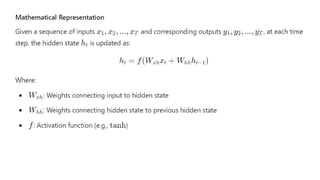
2.Forward Pass: In the forward pass, the input is passed through the
network sequentially, updating the hidden state and producing outputs at
each time step.
The hidden state at time step t depends on the previous hidden state
𝑡
ℎ −1
𝑡 ​, the current input 𝑥𝑡​, and the model parameters.
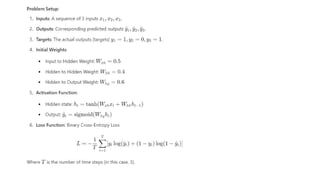
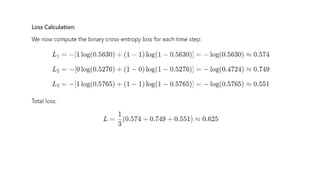
3.Error Calculation: After the forward pass, an error is computed (typically
using a loss function like Mean Squared Error for regression tasks or Cross-
Entropy for classification).
The total loss is usually the sum of losses over all time steps.
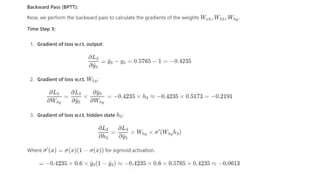
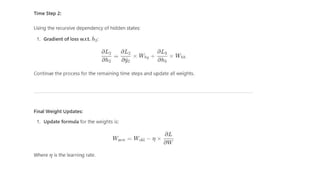
4.Backward Pass (BPTT):During the backward pass, the error is propagated
backward through time, step by step. The gradients of the loss with
respect to each parameter are computed across the unrolled layers.
This backward pass involves computing partial derivatives of the loss
function with respect to the network’s weights at each time step.
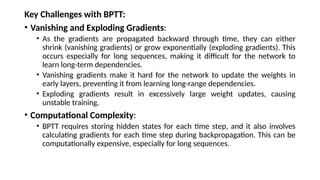
Key Challenges with BPTT:
• Vanishing and Exploding Gradients:
• As the gradients are propagated backward through time, they can either
shrink (vanishing gradients) or grow exponentially (exploding gradients). This
occurs especially for long sequences, making it difficult for the network to
learn long-term dependencies.
• Vanishing gradients make it hard for the network to update the weights in
early layers, preventing it from learning long-range dependencies.
• Exploding gradients result in excessively large weight updates, causing
unstable training.
• Computational Complexity:
• BPTT requires storing hidden states for each time step, and it also involves
calculating gradients for each time step during backpropagation. This can be
computationally expensive, especially for long sequences.
Strategies to Address Challenges:
• Truncated BPTT:
• In full BPTT, the network is unrolled across all time steps, which can be
inefficient for very long sequences. Truncated BPTT is a variation where the
unrolling is limited to a fixed number of time steps, reducing computational
complexity.
• Instead of unrolling the entire sequence, the network is only unrolled over a
smaller window (e.g., 5 or 10 time steps). After this window, the hidden state
is treated as if it were coming from the previous step.
• This allows the network to learn over shorter time horizons, mitigating some
issues with long-term dependencies.
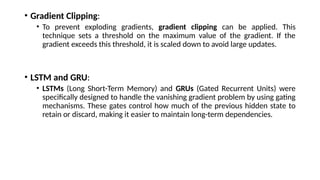
• Gradient Clipping:
• To prevent exploding gradients, gradient clipping can be applied. This
technique sets a threshold on the maximum value of the gradient. If the
gradient exceeds this threshold, it is scaled down to avoid large updates.
• LSTM and GRU:
• LSTMs (Long Short-Term Memory) and GRUs (Gated Recurrent Units) were
specifically designed to handle the vanishing gradient problem by using gating
mechanisms. These gates control how much of the previous hidden state to
retain or discard, making it easier to maintain long-term dependencies.
Backpropagation Through Time (BPTT).pptx

Backpropagation Through Time (BPTT).pptx

  • 1.
  • 2.
    Backpropagation Through Time(BPTT) is the adaptation of the standard backpropagation algorithm for training Recurrent Neural Networks (RNNs). Since RNNs deal with sequential data, where each time step depends on the previous one, BPTT unrolls the RNN across time steps and applies backpropagation to calculate the gradients for weight updates.
  • 3.
    BPTT Working flow 1.Unrollingthe RNN: • An RNN can be thought of as a network with loops, where the hidden state at each time step is influenced by both the input at that time step and the hidden state from the previous time step. • To apply backpropagation, the network is "unrolled" over several time steps, creating a deep feedforward network where each layer represents the network at one time step.
  • 4.
    2.Forward Pass: Inthe forward pass, the input is passed through the network sequentially, updating the hidden state and producing outputs at each time step. The hidden state at time step t depends on the previous hidden state 𝑡 ℎ −1 𝑡 ​, the current input 𝑥𝑡​, and the model parameters. 3.Error Calculation: After the forward pass, an error is computed (typically using a loss function like Mean Squared Error for regression tasks or Cross- Entropy for classification). The total loss is usually the sum of losses over all time steps. 4.Backward Pass (BPTT):During the backward pass, the error is propagated backward through time, step by step. The gradients of the loss with respect to each parameter are computed across the unrolled layers. This backward pass involves computing partial derivatives of the loss function with respect to the network’s weights at each time step.
  • 7.
    Key Challenges withBPTT: • Vanishing and Exploding Gradients: • As the gradients are propagated backward through time, they can either shrink (vanishing gradients) or grow exponentially (exploding gradients). This occurs especially for long sequences, making it difficult for the network to learn long-term dependencies. • Vanishing gradients make it hard for the network to update the weights in early layers, preventing it from learning long-range dependencies. • Exploding gradients result in excessively large weight updates, causing unstable training. • Computational Complexity: • BPTT requires storing hidden states for each time step, and it also involves calculating gradients for each time step during backpropagation. This can be computationally expensive, especially for long sequences.
  • 8.
    Strategies to AddressChallenges: • Truncated BPTT: • In full BPTT, the network is unrolled across all time steps, which can be inefficient for very long sequences. Truncated BPTT is a variation where the unrolling is limited to a fixed number of time steps, reducing computational complexity. • Instead of unrolling the entire sequence, the network is only unrolled over a smaller window (e.g., 5 or 10 time steps). After this window, the hidden state is treated as if it were coming from the previous step. • This allows the network to learn over shorter time horizons, mitigating some issues with long-term dependencies.
  • 9.
    • Gradient Clipping: •To prevent exploding gradients, gradient clipping can be applied. This technique sets a threshold on the maximum value of the gradient. If the gradient exceeds this threshold, it is scaled down to avoid large updates. • LSTM and GRU: • LSTMs (Long Short-Term Memory) and GRUs (Gated Recurrent Units) were specifically designed to handle the vanishing gradient problem by using gating mechanisms. These gates control how much of the previous hidden state to retain or discard, making it easier to maintain long-term dependencies.