Mayur Nanotkar
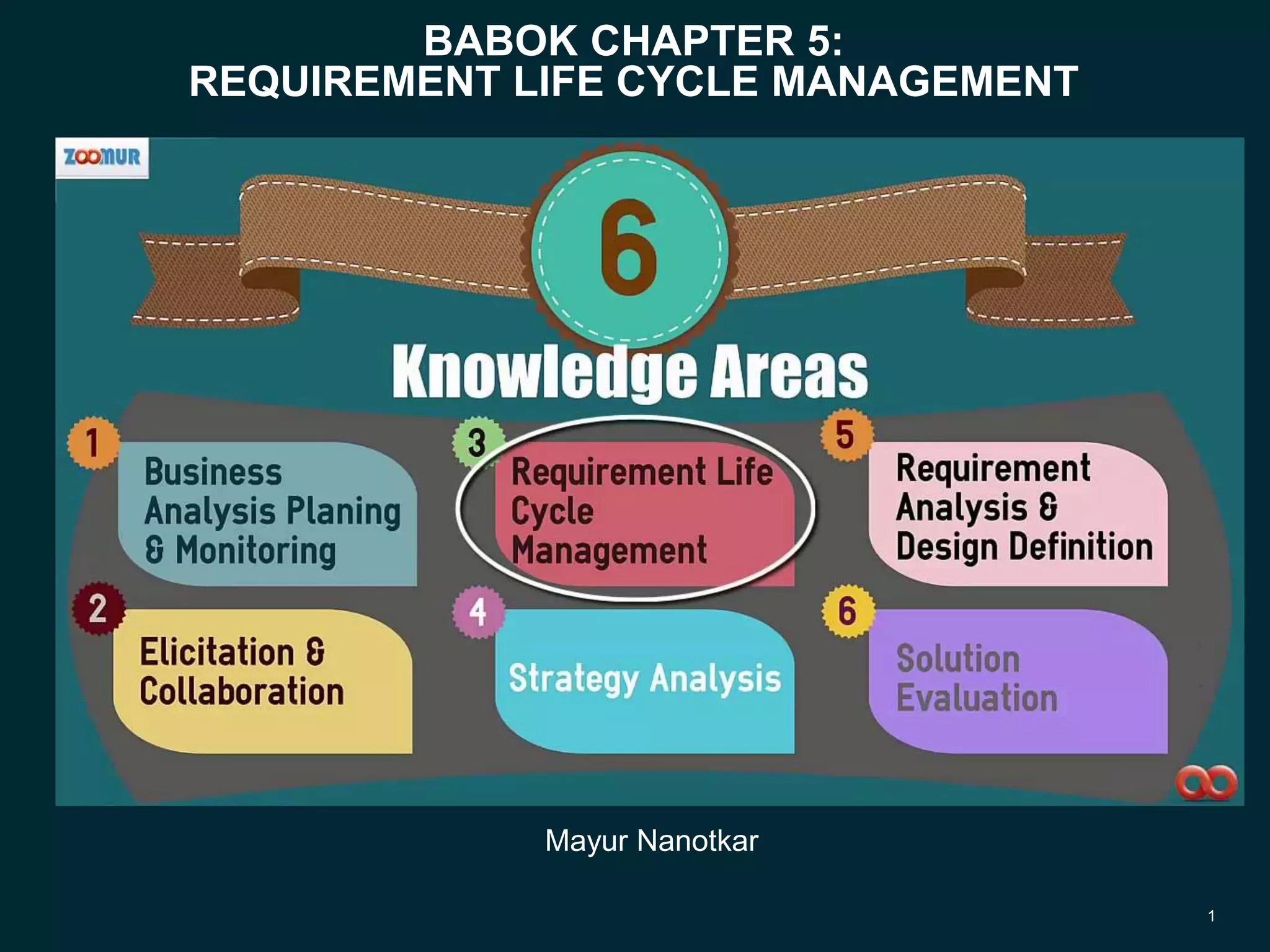
BABOK CHAPTER 5:
REQUIREMENT LIFE CYCLE MANAGEMENT
1
AGENDA
2
Introduction to Requirements
Requirement Life Cycle Management?
Trace Requirements
Maintain Requirements
Prioritize Requirements
Assess Requirement Changes
Approve Requirements
Introduction to Requirements – What, Why
3
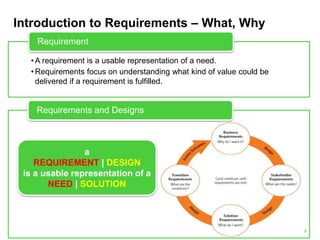
• A requirement is a usable representation of a need.
• Requirements focus on understanding what kind of value could be
delivered if a requirement is fulfilled.
Requirement
a
REQUIREMENT | DESIGN
is a usable representation of a
NEED | SOLUTION
Requirements and Designs
REQUIREMENT LIFE CYCLE MANAGEMENT (RLCM)
4
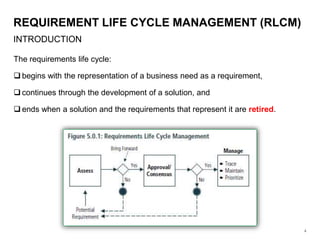
The requirements life cycle:
 begins with the representation of a business need as a requirement,
 continues through the development of a solution, and
 ends when a solution and the requirements that represent it are retired.
INTRODUCTION
REQUIREMENT LIFE CYCLE MANAGEMENT (RLCM)
5
INTRODUCTION (Cont.…)
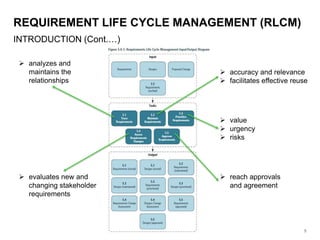
 analyzes and
maintains the
relationships
 accuracy and relevance
 facilitates effective reuse
 value
 urgency
 risks
 evaluates new and
changing stakeholder
requirements
 reach approvals
and agreement
REQUIREMENT LIFE CYCLE MANAGEMENT (RLCM)
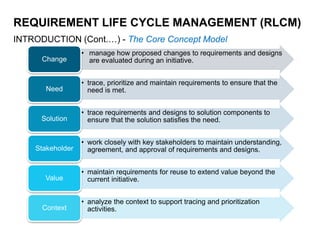
INTRODUCTION (Cont.…) - The Core Concept Model
• manage how proposed changes to requirements and designs
are evaluated during an initiative.
Change
• trace, prioritize and maintain requirements to ensure that the
need is met.
Need
• trace requirements and designs to solution components to
ensure that the solution satisfies the need.
Solution
• work closely with key stakeholders to maintain understanding,
agreement, and approval of requirements and designs.
Stakeholder
• maintain requirements for reuse to extend value beyond the
current initiative.
Value
• analyze the context to support tracing and prioritization
activities.
Context
REQUIREMENT LIFE CYCLE MANAGEMENT (RLCM)
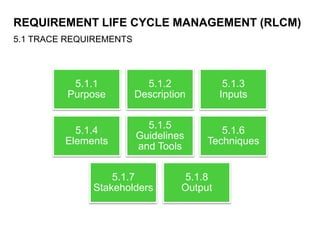
5.1 TRACE REQUIREMENTS
5.1.1
Purpose
5.1.2
Description
5.1.3
Inputs
5.1.4
Elements
5.1.5
Guidelines
and Tools
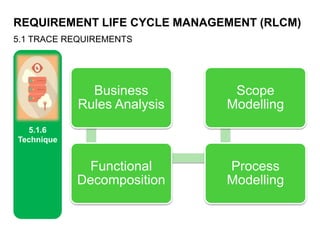
5.1.6
Techniques
5.1.7
Stakeholders
5.1.8
Output
REQUIREMENT LIFE CYCLE MANAGEMENT (RLCM)
5.1 TRACE REQUIREMENTS
5.1.1
Purpose
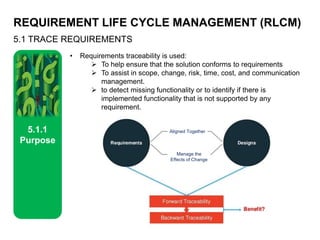
• Requirements traceability is used:
 To help ensure that the solution conforms to requirements
 To assist in scope, change, risk, time, cost, and communication
management.
 to detect missing functionality or to identify if there is
implemented functionality that is not supported by any
requirement.
Aligned Together
Manage the
Effects of Change
REQUIREMENT LIFE CYCLE MANAGEMENT (RLCM)
5.1 TRACE REQUIREMENTS
5.1.2
Description
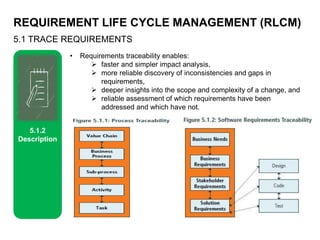
• Requirements traceability enables:
 faster and simpler impact analysis,
 more reliable discovery of inconsistencies and gaps in
requirements,
 deeper insights into the scope and complexity of a change, and
 reliable assessment of which requirements have been
addressed and which have not.
REQUIREMENT LIFE CYCLE MANAGEMENT (RLCM)
5.1 TRACE REQUIREMENTS
5.1.3
Inputs
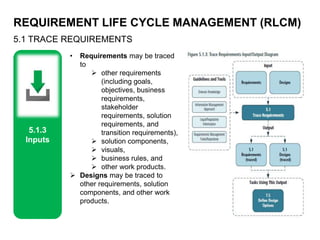
• Requirements may be traced
to
 other requirements
(including goals,
objectives, business
requirements,
stakeholder
requirements, solution
requirements, and
transition requirements),
 solution components,
 visuals,
 business rules, and
 other work products.
 Designs may be traced to
other requirements, solution
components, and other work
products.
REQUIREMENT LIFE CYCLE MANAGEMENT (RLCM)
5.1 TRACE REQUIREMENTS
5.1.4
Elements
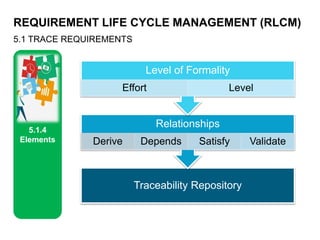
Traceability Repository
Relationships
Derive Depends Satisfy Validate
Level of Formality
Effort Level
REQUIREMENT LIFE CYCLE MANAGEMENT (RLCM)
5.1 TRACE REQUIREMENTS
5.1.5
Guidelines
and Tools
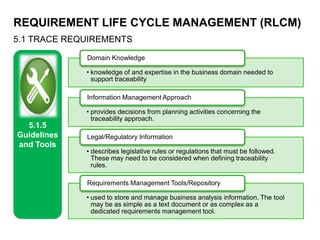
• knowledge of and expertise in the business domain needed to
support traceability
Domain Knowledge
• provides decisions from planning activities concerning the
traceability approach.
Information Management Approach
• describes legislative rules or regulations that must be followed.
These may need to be considered when defining traceability
rules.
Legal/Regulatory Information
• used to store and manage business analysis information. The tool
may be as simple as a text document or as complex as a
dedicated requirements management tool.
Requirements Management Tools/Repository
REQUIREMENT LIFE CYCLE MANAGEMENT (RLCM)
5.1 TRACE REQUIREMENTS
5.1.6
Technique
Business
Rules Analysis
Functional
Decomposition
Process
Modelling
Scope
Modelling
REQUIREMENT LIFE CYCLE MANAGEMENT (RLCM)
5.1 TRACE REQUIREMENTS
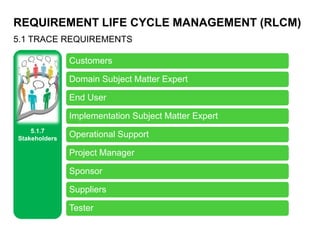
5.1.7
Stakeholders
Customers
Domain Subject Matter Expert
End User
Implementation Subject Matter Expert
Operational Support
Project Manager
Sponsor
Suppliers
Tester
REQUIREMENT LIFE CYCLE MANAGEMENT (RLCM)
5.1 TRACE REQUIREMENTS
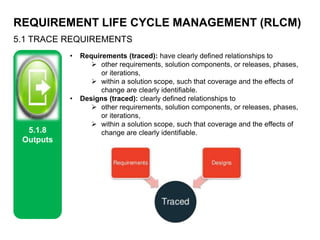
5.1.8
Outputs
• Requirements (traced): have clearly defined relationships to
 other requirements, solution components, or releases, phases,
or iterations,
 within a solution scope, such that coverage and the effects of
change are clearly identifiable.
• Designs (traced): clearly defined relationships to
 other requirements, solution components, or releases, phases,
or iterations,
 within a solution scope, such that coverage and the effects of
change are clearly identifiable.
REQUIREMENT LIFE CYCLE MANAGEMENT (RLCM)
5.2 MAINTAIN REQUIREMENTS
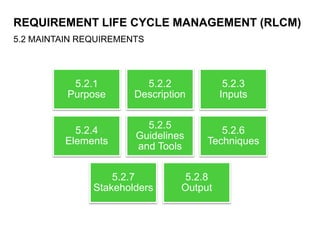
5.2.1
Purpose
5.2.2
Description
5.2.3
Inputs
5.2.4
Elements
5.2.5
Guidelines
and Tools
5.2.6
Techniques
5.2.7
Stakeholders
5.2.8
Output
REQUIREMENT LIFE CYCLE MANAGEMENT (RLCM)
5.2 MAINTAIN REQUIREMENTS
5.2.1
Purpose
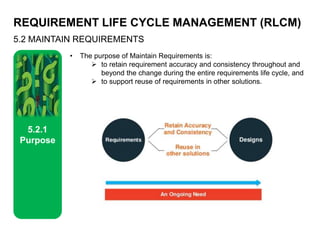
• The purpose of Maintain Requirements is:
 to retain requirement accuracy and consistency throughout and
beyond the change during the entire requirements life cycle, and
 to support reuse of requirements in other solutions.
REQUIREMENT LIFE CYCLE MANAGEMENT (RLCM)
5.2 MAINTAIN REQUIREMENTS
5.2.2
Description
• A requirement that represents an ongoing need must be maintained to
ensure that it remains valid over time.
• In order to maximize the benefits of maintaining and reusing
requirements, the requirements should be:
 consistently represented,
 reviewed and approved for maintenance using a standardized
process that
 defines proper access rights and ensures quality, and easily
accessible and understandable.
REQUIREMENT LIFE CYCLE MANAGEMENT (RLCM)
5.2 MAINTAIN REQUIREMENTS
5.2.3
Inputs
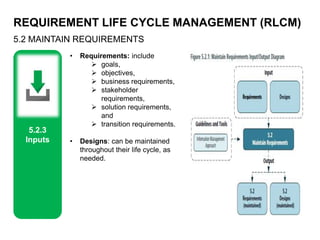
• Requirements: include
 goals,
 objectives,
 business requirements,
 stakeholder
requirements,
 solution requirements,
and
 transition requirements.
• Designs: can be maintained
throughout their life cycle, as
needed.
REQUIREMENT LIFE CYCLE MANAGEMENT (RLCM)
5.2 MAINTAIN REQUIREMENTS
5.2.4
Elements
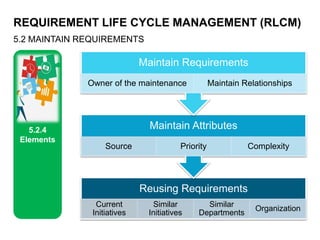
Reusing Requirements
Current
Initiatives
Similar
Initiatives
Similar
Departments
Organization
Maintain Attributes
Source Priority Complexity
Maintain Requirements
Owner of the maintenance Maintain Relationships
REQUIREMENT LIFE CYCLE MANAGEMENT (RLCM)
5.2 MAINTAIN REQUIREMENTS
5.2.5
Guidelines
and Tools • indicates how requirements
will be managed for reuse.
Information
Management Approach
REQUIREMENT LIFE CYCLE MANAGEMENT (RLCM)
5.2 MAINTAIN REQUIREMENTS
5.2.6
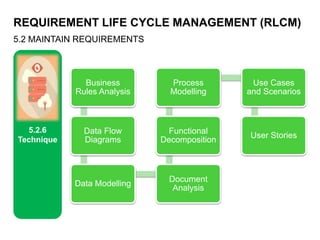
Technique
Business
Rules Analysis
Data Flow
Diagrams
Data Modelling
Document
Analysis
Functional
Decomposition
Process
Modelling
Use Cases
and Scenarios
User Stories
REQUIREMENT LIFE CYCLE MANAGEMENT (RLCM)
5.2 MAINTAIN REQUIREMENTS
5.2.7
Stakeholders
Domain Subject Matter Expert
Implementation Subject Matter Expert
Operational Support
Regulator
Tester
REQUIREMENT LIFE CYCLE MANAGEMENT (RLCM)
5.2 MAINTAIN REQUIREMENTS
5.2.8
Outputs
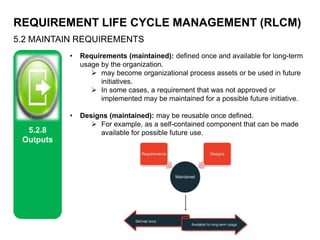
• Requirements (maintained): defined once and available for long-term
usage by the organization.
 may become organizational process assets or be used in future
initiatives.
 In some cases, a requirement that was not approved or
implemented may be maintained for a possible future initiative.
• Designs (maintained): may be reusable once defined.
 For example, as a self-contained component that can be made
available for possible future use.
REQUIREMENT LIFE CYCLE MANAGEMENT (RLCM)
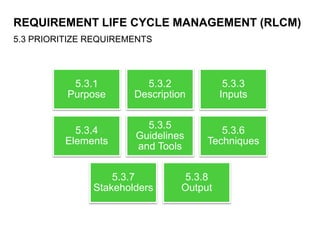
5.3 PRIORITIZE REQUIREMENTS
5.3.1
Purpose
5.3.2
Description
5.3.3
Inputs
5.3.4
Elements
5.3.5
Guidelines
and Tools
5.3.6
Techniques
5.3.7
Stakeholders
5.3.8
Output
REQUIREMENT LIFE CYCLE MANAGEMENT (RLCM)
5.3 PRIORITIZE REQUIREMENTS
5.3.1
Purpose
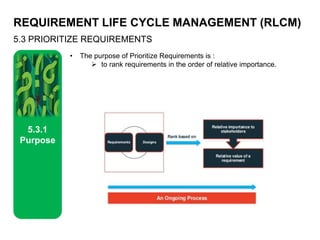
• The purpose of Prioritize Requirements is :
 to rank requirements in the order of relative importance.
REQUIREMENT LIFE CYCLE MANAGEMENT (RLCM)
5.3 PRIORITIZE REQUIREMENTS
5.3.2
Description
• Prioritization is the act of ranking requirements to determine their
relative importance to stakeholders.
• When a requirement is prioritized, it is given greater or lesser priority.
• Priority can refer:
 to the relative value of a requirement, or
 to the sequence in which it will be implemented.
• Prioritization is an ongoing process, with priorities changing as the
context changes.
• Inter-dependencies between requirements are identified and may be
used as the basis for prioritization.
• Prioritization is a critical exercise that seeks to ensure the maximum
value is achieved.
REQUIREMENT LIFE CYCLE MANAGEMENT (RLCM)
5.3 PRIORITIZE REQUIREMENTS
5.3.3
Inputs
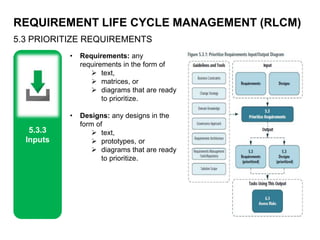
• Requirements: any
requirements in the form of
 text,
 matrices, or
 diagrams that are ready
to prioritize.
• Designs: any designs in the
form of
 text,
 prototypes, or
 diagrams that are ready
to prioritize.
REQUIREMENT LIFE CYCLE MANAGEMENT (RLCM)
5.3 PRIORITIZE REQUIREMENTS
5.3.4
Elements
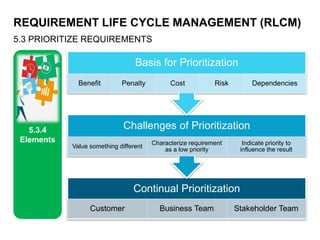
Continual Prioritization
Customer Business Team Stakeholder Team
Challenges of Prioritization
Value something different
Characterize requirement
as a low priority
Indicate priority to
influence the result
Basis for Prioritization
Benefit Penalty Cost Risk Dependencies
REQUIREMENT LIFE CYCLE MANAGEMENT (RLCM)
5.3 PRIORITIZE REQUIREMENTS
5.3.5
Guidelines
and Tools
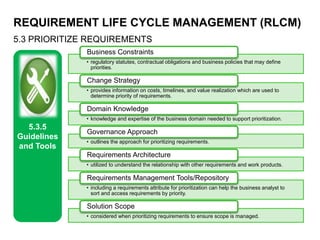
• regulatory statutes, contractual obligations and business policies that may define
priorities.
Business Constraints
• provides information on costs, timelines, and value realization which are used to
determine priority of requirements.
Change Strategy
• knowledge and expertise of the business domain needed to support prioritization.
Domain Knowledge
• outlines the approach for prioritizing requirements.
Governance Approach
• utilized to understand the relationship with other requirements and work products.
Requirements Architecture
• including a requirements attribute for prioritization can help the business analyst to
sort and access requirements by priority.
Requirements Management Tools/Repository
• considered when prioritizing requirements to ensure scope is managed.
Solution Scope
REQUIREMENT LIFE CYCLE MANAGEMENT (RLCM)
5.3 PRIORITIZE REQUIREMENTS
5.3.6
Technique
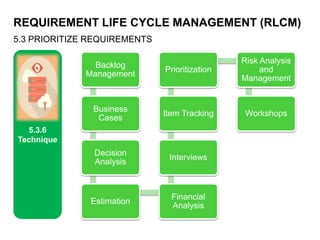
Backlog
Management
Business
Cases
Decision
Analysis
Estimation
Financial
Analysis
Interviews
Item Tracking
Prioritization
Risk Analysis
and
Management
Workshops
REQUIREMENT LIFE CYCLE MANAGEMENT (RLCM)
5.3 PRIORITIZE REQUIREMENTS
5.3.7
Stakeholders
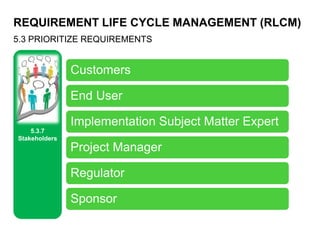
Customers
End User
Implementation Subject Matter Expert
Project Manager
Regulator
Sponsor
REQUIREMENT LIFE CYCLE MANAGEMENT (RLCM)
5.3 PRIORITIZE REQUIREMENTS
5.3.8
Outputs
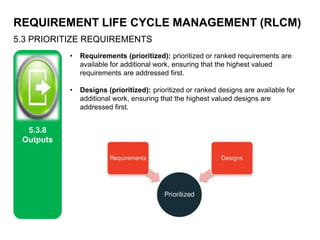
• Requirements (prioritized): prioritized or ranked requirements are
available for additional work, ensuring that the highest valued
requirements are addressed first.
• Designs (prioritized): prioritized or ranked designs are available for
additional work, ensuring that the highest valued designs are
addressed first.
REQUIREMENT LIFE CYCLE MANAGEMENT (RLCM)
5.4 ASSESS REQUIREMENTS CHANGES
5.4.1
Purpose
5.4.2
Description
5.4.3
Inputs
5.4.4
Elements
5.4.5
Guidelines
and Tools
5.4.6
Techniques
5.4.7
Stakeholders
5.4.8
Output
REQUIREMENT LIFE CYCLE MANAGEMENT (RLCM)
5.4 ASSESS REQUIREMENTS CHANGES
5.4.1
Purpose
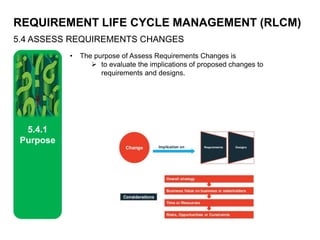
• The purpose of Assess Requirements Changes is
 to evaluate the implications of proposed changes to
requirements and designs.
REQUIREMENT LIFE CYCLE MANAGEMENT (RLCM)
5.4 ASSESS REQUIREMENTS CHANGES
5.4.2
Description
• Performed as new needs or possible solutions are identified. These
may or may not align to the change strategy and/ or solution scope.
• Must be performed to determine whether a proposed change will
increase the value of the solution, and if so, what action should be
taken.
• When assessing changes, business analysts consider if each proposed
change:
 aligns with the overall strategy,
 affects value delivered to the business or stakeholder groups,
 impacts the time to deliver or the resources required to deliver
the value, and
 alters any risks, opportunities, or constraints associated with the
overall initiative.
REQUIREMENT LIFE CYCLE MANAGEMENT (RLCM)
5.4 ASSESS REQUIREMENTS CHANGES
5.4.3
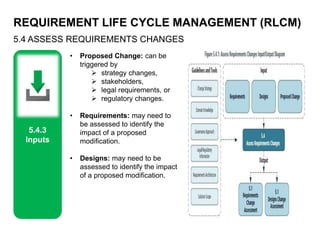
Inputs
• Proposed Change: can be
triggered by
 strategy changes,
 stakeholders,
 legal requirements, or
 regulatory changes.
• Requirements: may need to
be assessed to identify the
impact of a proposed
modification.
• Designs: may need to be
assessed to identify the impact
of a proposed modification.
REQUIREMENT LIFE CYCLE MANAGEMENT (RLCM)
5.4 ASSESS REQUIREMENTS CHANGES
5.4.4
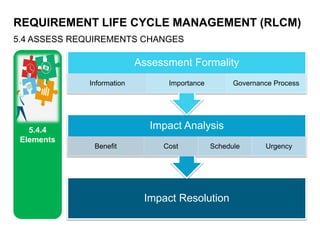
Elements
Impact Resolution
Impact Analysis
Benefit Cost Schedule Urgency
Assessment Formality
Information Importance Governance Process
REQUIREMENT LIFE CYCLE MANAGEMENT (RLCM)
5.4 ASSESS REQUIREMENTS CHANGES
5.4.5
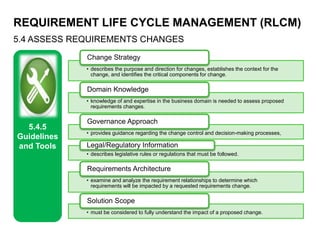
Guidelines
and Tools
• describes the purpose and direction for changes, establishes the context for the
change, and identifies the critical components for change.
Change Strategy
• knowledge of and expertise in the business domain is needed to assess proposed
requirements changes.
Domain Knowledge
• provides guidance regarding the change control and decision-making processes,
Governance Approach
• describes legislative rules or regulations that must be followed.
Legal/Regulatory Information
• examine and analyze the requirement relationships to determine which
requirements will be impacted by a requested requirements change.
Requirements Architecture
• must be considered to fully understand the impact of a proposed change.
Solution Scope
REQUIREMENT LIFE CYCLE MANAGEMENT (RLCM)
5.4 ASSESS REQUIREMENTS CHANGES
5.4.6
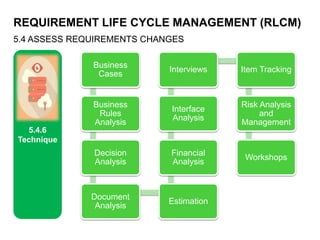
Technique
Business
Cases
Business
Rules
Analysis
Decision
Analysis
Document
Analysis
Estimation
Financial
Analysis
Interface
Analysis
Interviews Item Tracking
Risk Analysis
and
Management
Workshops
REQUIREMENT LIFE CYCLE MANAGEMENT (RLCM)
5.4 ASSESS REQUIREMENTS CHANGES
5.4.7
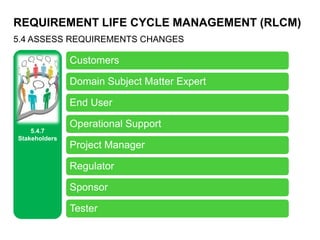
Stakeholders
Customers
Domain Subject Matter Expert
End User
Operational Support
Project Manager
Regulator
Sponsor
Tester
REQUIREMENT LIFE CYCLE MANAGEMENT (RLCM)
5.4 ASSESS REQUIREMENTS CHANGES
5.4.8
Outputs
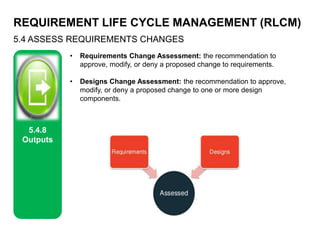
• Requirements Change Assessment: the recommendation to
approve, modify, or deny a proposed change to requirements.
• Designs Change Assessment: the recommendation to approve,
modify, or deny a proposed change to one or more design
components.
REQUIREMENT LIFE CYCLE MANAGEMENT (RLCM)
5.5 APPROVE REQUIREMENTS
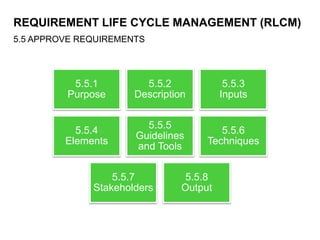
5.5.1
Purpose
5.5.2
Description
5.5.3
Inputs
5.5.4
Elements
5.5.5
Guidelines
and Tools
5.5.6
Techniques
5.5.7
Stakeholders
5.5.8
Output
REQUIREMENT LIFE CYCLE MANAGEMENT (RLCM)
5.5 APPROVE REQUIREMENTS
5.5.1
Purpose
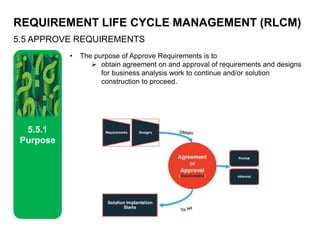
• The purpose of Approve Requirements is to
 obtain agreement on and approval of requirements and designs
for business analysis work to continue and/or solution
construction to proceed.
REQUIREMENT LIFE CYCLE MANAGEMENT (RLCM)
5.5 APPROVE REQUIREMENTS
5.5.2
Description
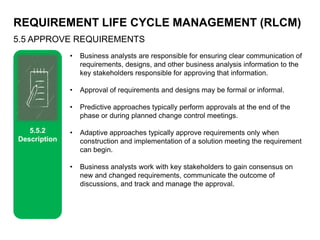
• Business analysts are responsible for ensuring clear communication of
requirements, designs, and other business analysis information to the
key stakeholders responsible for approving that information.
• Approval of requirements and designs may be formal or informal.
• Predictive approaches typically perform approvals at the end of the
phase or during planned change control meetings.
• Adaptive approaches typically approve requirements only when
construction and implementation of a solution meeting the requirement
can begin.
• Business analysts work with key stakeholders to gain consensus on
new and changed requirements, communicate the outcome of
discussions, and track and manage the approval.
REQUIREMENT LIFE CYCLE MANAGEMENT (RLCM)
5.5 APPROVE REQUIREMENTS
5.5.3
Inputs
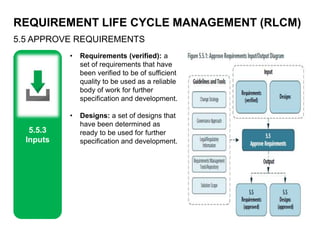
• Requirements (verified): a
set of requirements that have
been verified to be of sufficient
quality to be used as a reliable
body of work for further
specification and development.
• Designs: a set of designs that
have been determined as
ready to be used for further
specification and development.
REQUIREMENT LIFE CYCLE MANAGEMENT (RLCM)
5.5 APPROVE REQUIREMENTS
5.5.4
Elements
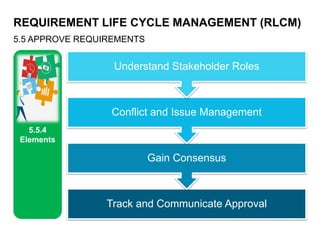
Track and Communicate Approval
Gain Consensus
Conflict and Issue Management
Understand Stakeholder Roles
REQUIREMENT LIFE CYCLE MANAGEMENT (RLCM)
5.5 APPROVE REQUIREMENTS
5.5.5
Guidelines
and Tools
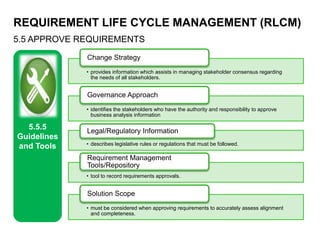
• provides information which assists in managing stakeholder consensus regarding
the needs of all stakeholders.
Change Strategy
• identifies the stakeholders who have the authority and responsibility to approve
business analysis information
Governance Approach
• describes legislative rules or regulations that must be followed.
Legal/Regulatory Information
• tool to record requirements approvals.
Requirement Management
Tools/Repository
• must be considered when approving requirements to accurately assess alignment
and completeness.
Solution Scope
REQUIREMENT LIFE CYCLE MANAGEMENT (RLCM)
5.5 APPROVE REQUIREMENTS
5.5.6
Technique
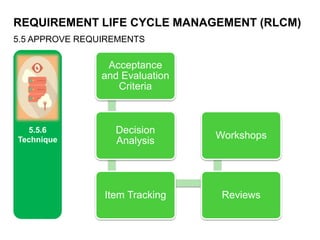
Acceptance
and Evaluation
Criteria
Decision
Analysis
Item Tracking Reviews
Workshops
REQUIREMENT LIFE CYCLE MANAGEMENT (RLCM)
5.5 APPROVE REQUIREMENTS
5.5.7
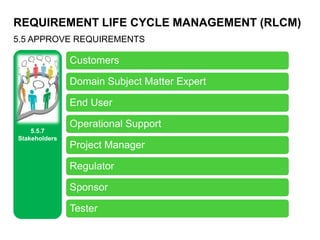
Stakeholders
Customers
Domain Subject Matter Expert
End User
Operational Support
Project Manager
Regulator
Sponsor
Tester
REQUIREMENT LIFE CYCLE MANAGEMENT (RLCM)
5.5 APPROVE REQUIREMENTS
5.5.8
Outputs
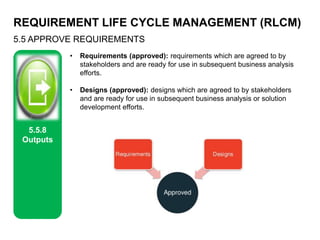
• Requirements (approved): requirements which are agreed to by
stakeholders and are ready for use in subsequent business analysis
efforts.
• Designs (approved): designs which are agreed to by stakeholders
and are ready for use in subsequent business analysis or solution
development efforts.
52
“I had six honest serving men –
they taught me all I knew: Their
names were Where and What
and When and Why and How and
Who.”
- Rudyard Kipling

Babok Requirement Life Cycle Management

  • 1.
    Mayur Nanotkar BABOK CHAPTER5: REQUIREMENT LIFE CYCLE MANAGEMENT 1
  • 2.
    AGENDA 2 Introduction to Requirements RequirementLife Cycle Management? Trace Requirements Maintain Requirements Prioritize Requirements Assess Requirement Changes Approve Requirements
  • 3.
    Introduction to Requirements– What, Why 3 • A requirement is a usable representation of a need. • Requirements focus on understanding what kind of value could be delivered if a requirement is fulfilled. Requirement a REQUIREMENT | DESIGN is a usable representation of a NEED | SOLUTION Requirements and Designs
  • 4.
    REQUIREMENT LIFE CYCLEMANAGEMENT (RLCM) 4 The requirements life cycle:  begins with the representation of a business need as a requirement,  continues through the development of a solution, and  ends when a solution and the requirements that represent it are retired. INTRODUCTION
  • 5.
    REQUIREMENT LIFE CYCLEMANAGEMENT (RLCM) 5 INTRODUCTION (Cont.…)  analyzes and maintains the relationships  accuracy and relevance  facilitates effective reuse  value  urgency  risks  evaluates new and changing stakeholder requirements  reach approvals and agreement
  • 6.
    REQUIREMENT LIFE CYCLEMANAGEMENT (RLCM) INTRODUCTION (Cont.…) - The Core Concept Model • manage how proposed changes to requirements and designs are evaluated during an initiative. Change • trace, prioritize and maintain requirements to ensure that the need is met. Need • trace requirements and designs to solution components to ensure that the solution satisfies the need. Solution • work closely with key stakeholders to maintain understanding, agreement, and approval of requirements and designs. Stakeholder • maintain requirements for reuse to extend value beyond the current initiative. Value • analyze the context to support tracing and prioritization activities. Context
  • 7.
    REQUIREMENT LIFE CYCLEMANAGEMENT (RLCM) 5.1 TRACE REQUIREMENTS 5.1.1 Purpose 5.1.2 Description 5.1.3 Inputs 5.1.4 Elements 5.1.5 Guidelines and Tools 5.1.6 Techniques 5.1.7 Stakeholders 5.1.8 Output
  • 8.
    REQUIREMENT LIFE CYCLEMANAGEMENT (RLCM) 5.1 TRACE REQUIREMENTS 5.1.1 Purpose • Requirements traceability is used:  To help ensure that the solution conforms to requirements  To assist in scope, change, risk, time, cost, and communication management.  to detect missing functionality or to identify if there is implemented functionality that is not supported by any requirement. Aligned Together Manage the Effects of Change
  • 9.
    REQUIREMENT LIFE CYCLEMANAGEMENT (RLCM) 5.1 TRACE REQUIREMENTS 5.1.2 Description • Requirements traceability enables:  faster and simpler impact analysis,  more reliable discovery of inconsistencies and gaps in requirements,  deeper insights into the scope and complexity of a change, and  reliable assessment of which requirements have been addressed and which have not.
  • 10.
    REQUIREMENT LIFE CYCLEMANAGEMENT (RLCM) 5.1 TRACE REQUIREMENTS 5.1.3 Inputs • Requirements may be traced to  other requirements (including goals, objectives, business requirements, stakeholder requirements, solution requirements, and transition requirements),  solution components,  visuals,  business rules, and  other work products.  Designs may be traced to other requirements, solution components, and other work products.
  • 11.
    REQUIREMENT LIFE CYCLEMANAGEMENT (RLCM) 5.1 TRACE REQUIREMENTS 5.1.4 Elements Traceability Repository Relationships Derive Depends Satisfy Validate Level of Formality Effort Level
  • 12.
    REQUIREMENT LIFE CYCLEMANAGEMENT (RLCM) 5.1 TRACE REQUIREMENTS 5.1.5 Guidelines and Tools • knowledge of and expertise in the business domain needed to support traceability Domain Knowledge • provides decisions from planning activities concerning the traceability approach. Information Management Approach • describes legislative rules or regulations that must be followed. These may need to be considered when defining traceability rules. Legal/Regulatory Information • used to store and manage business analysis information. The tool may be as simple as a text document or as complex as a dedicated requirements management tool. Requirements Management Tools/Repository
  • 13.
    REQUIREMENT LIFE CYCLEMANAGEMENT (RLCM) 5.1 TRACE REQUIREMENTS 5.1.6 Technique Business Rules Analysis Functional Decomposition Process Modelling Scope Modelling
  • 14.
    REQUIREMENT LIFE CYCLEMANAGEMENT (RLCM) 5.1 TRACE REQUIREMENTS 5.1.7 Stakeholders Customers Domain Subject Matter Expert End User Implementation Subject Matter Expert Operational Support Project Manager Sponsor Suppliers Tester
  • 15.
    REQUIREMENT LIFE CYCLEMANAGEMENT (RLCM) 5.1 TRACE REQUIREMENTS 5.1.8 Outputs • Requirements (traced): have clearly defined relationships to  other requirements, solution components, or releases, phases, or iterations,  within a solution scope, such that coverage and the effects of change are clearly identifiable. • Designs (traced): clearly defined relationships to  other requirements, solution components, or releases, phases, or iterations,  within a solution scope, such that coverage and the effects of change are clearly identifiable.
  • 16.
    REQUIREMENT LIFE CYCLEMANAGEMENT (RLCM) 5.2 MAINTAIN REQUIREMENTS 5.2.1 Purpose 5.2.2 Description 5.2.3 Inputs 5.2.4 Elements 5.2.5 Guidelines and Tools 5.2.6 Techniques 5.2.7 Stakeholders 5.2.8 Output
  • 17.
    REQUIREMENT LIFE CYCLEMANAGEMENT (RLCM) 5.2 MAINTAIN REQUIREMENTS 5.2.1 Purpose • The purpose of Maintain Requirements is:  to retain requirement accuracy and consistency throughout and beyond the change during the entire requirements life cycle, and  to support reuse of requirements in other solutions.
  • 18.
    REQUIREMENT LIFE CYCLEMANAGEMENT (RLCM) 5.2 MAINTAIN REQUIREMENTS 5.2.2 Description • A requirement that represents an ongoing need must be maintained to ensure that it remains valid over time. • In order to maximize the benefits of maintaining and reusing requirements, the requirements should be:  consistently represented,  reviewed and approved for maintenance using a standardized process that  defines proper access rights and ensures quality, and easily accessible and understandable.
  • 19.
    REQUIREMENT LIFE CYCLEMANAGEMENT (RLCM) 5.2 MAINTAIN REQUIREMENTS 5.2.3 Inputs • Requirements: include  goals,  objectives,  business requirements,  stakeholder requirements,  solution requirements, and  transition requirements. • Designs: can be maintained throughout their life cycle, as needed.
  • 20.
    REQUIREMENT LIFE CYCLEMANAGEMENT (RLCM) 5.2 MAINTAIN REQUIREMENTS 5.2.4 Elements Reusing Requirements Current Initiatives Similar Initiatives Similar Departments Organization Maintain Attributes Source Priority Complexity Maintain Requirements Owner of the maintenance Maintain Relationships
  • 21.
    REQUIREMENT LIFE CYCLEMANAGEMENT (RLCM) 5.2 MAINTAIN REQUIREMENTS 5.2.5 Guidelines and Tools • indicates how requirements will be managed for reuse. Information Management Approach
  • 22.
    REQUIREMENT LIFE CYCLEMANAGEMENT (RLCM) 5.2 MAINTAIN REQUIREMENTS 5.2.6 Technique Business Rules Analysis Data Flow Diagrams Data Modelling Document Analysis Functional Decomposition Process Modelling Use Cases and Scenarios User Stories
  • 23.
    REQUIREMENT LIFE CYCLEMANAGEMENT (RLCM) 5.2 MAINTAIN REQUIREMENTS 5.2.7 Stakeholders Domain Subject Matter Expert Implementation Subject Matter Expert Operational Support Regulator Tester
  • 24.
    REQUIREMENT LIFE CYCLEMANAGEMENT (RLCM) 5.2 MAINTAIN REQUIREMENTS 5.2.8 Outputs • Requirements (maintained): defined once and available for long-term usage by the organization.  may become organizational process assets or be used in future initiatives.  In some cases, a requirement that was not approved or implemented may be maintained for a possible future initiative. • Designs (maintained): may be reusable once defined.  For example, as a self-contained component that can be made available for possible future use.
  • 25.
    REQUIREMENT LIFE CYCLEMANAGEMENT (RLCM) 5.3 PRIORITIZE REQUIREMENTS 5.3.1 Purpose 5.3.2 Description 5.3.3 Inputs 5.3.4 Elements 5.3.5 Guidelines and Tools 5.3.6 Techniques 5.3.7 Stakeholders 5.3.8 Output
  • 26.
    REQUIREMENT LIFE CYCLEMANAGEMENT (RLCM) 5.3 PRIORITIZE REQUIREMENTS 5.3.1 Purpose • The purpose of Prioritize Requirements is :  to rank requirements in the order of relative importance.
  • 27.
    REQUIREMENT LIFE CYCLEMANAGEMENT (RLCM) 5.3 PRIORITIZE REQUIREMENTS 5.3.2 Description • Prioritization is the act of ranking requirements to determine their relative importance to stakeholders. • When a requirement is prioritized, it is given greater or lesser priority. • Priority can refer:  to the relative value of a requirement, or  to the sequence in which it will be implemented. • Prioritization is an ongoing process, with priorities changing as the context changes. • Inter-dependencies between requirements are identified and may be used as the basis for prioritization. • Prioritization is a critical exercise that seeks to ensure the maximum value is achieved.
  • 28.
    REQUIREMENT LIFE CYCLEMANAGEMENT (RLCM) 5.3 PRIORITIZE REQUIREMENTS 5.3.3 Inputs • Requirements: any requirements in the form of  text,  matrices, or  diagrams that are ready to prioritize. • Designs: any designs in the form of  text,  prototypes, or  diagrams that are ready to prioritize.
  • 29.
    REQUIREMENT LIFE CYCLEMANAGEMENT (RLCM) 5.3 PRIORITIZE REQUIREMENTS 5.3.4 Elements Continual Prioritization Customer Business Team Stakeholder Team Challenges of Prioritization Value something different Characterize requirement as a low priority Indicate priority to influence the result Basis for Prioritization Benefit Penalty Cost Risk Dependencies
  • 30.
    REQUIREMENT LIFE CYCLEMANAGEMENT (RLCM) 5.3 PRIORITIZE REQUIREMENTS 5.3.5 Guidelines and Tools • regulatory statutes, contractual obligations and business policies that may define priorities. Business Constraints • provides information on costs, timelines, and value realization which are used to determine priority of requirements. Change Strategy • knowledge and expertise of the business domain needed to support prioritization. Domain Knowledge • outlines the approach for prioritizing requirements. Governance Approach • utilized to understand the relationship with other requirements and work products. Requirements Architecture • including a requirements attribute for prioritization can help the business analyst to sort and access requirements by priority. Requirements Management Tools/Repository • considered when prioritizing requirements to ensure scope is managed. Solution Scope
  • 31.
    REQUIREMENT LIFE CYCLEMANAGEMENT (RLCM) 5.3 PRIORITIZE REQUIREMENTS 5.3.6 Technique Backlog Management Business Cases Decision Analysis Estimation Financial Analysis Interviews Item Tracking Prioritization Risk Analysis and Management Workshops
  • 32.
    REQUIREMENT LIFE CYCLEMANAGEMENT (RLCM) 5.3 PRIORITIZE REQUIREMENTS 5.3.7 Stakeholders Customers End User Implementation Subject Matter Expert Project Manager Regulator Sponsor
  • 33.
    REQUIREMENT LIFE CYCLEMANAGEMENT (RLCM) 5.3 PRIORITIZE REQUIREMENTS 5.3.8 Outputs • Requirements (prioritized): prioritized or ranked requirements are available for additional work, ensuring that the highest valued requirements are addressed first. • Designs (prioritized): prioritized or ranked designs are available for additional work, ensuring that the highest valued designs are addressed first.
  • 34.
    REQUIREMENT LIFE CYCLEMANAGEMENT (RLCM) 5.4 ASSESS REQUIREMENTS CHANGES 5.4.1 Purpose 5.4.2 Description 5.4.3 Inputs 5.4.4 Elements 5.4.5 Guidelines and Tools 5.4.6 Techniques 5.4.7 Stakeholders 5.4.8 Output
  • 35.
    REQUIREMENT LIFE CYCLEMANAGEMENT (RLCM) 5.4 ASSESS REQUIREMENTS CHANGES 5.4.1 Purpose • The purpose of Assess Requirements Changes is  to evaluate the implications of proposed changes to requirements and designs.
  • 36.
    REQUIREMENT LIFE CYCLEMANAGEMENT (RLCM) 5.4 ASSESS REQUIREMENTS CHANGES 5.4.2 Description • Performed as new needs or possible solutions are identified. These may or may not align to the change strategy and/ or solution scope. • Must be performed to determine whether a proposed change will increase the value of the solution, and if so, what action should be taken. • When assessing changes, business analysts consider if each proposed change:  aligns with the overall strategy,  affects value delivered to the business or stakeholder groups,  impacts the time to deliver or the resources required to deliver the value, and  alters any risks, opportunities, or constraints associated with the overall initiative.
  • 37.
    REQUIREMENT LIFE CYCLEMANAGEMENT (RLCM) 5.4 ASSESS REQUIREMENTS CHANGES 5.4.3 Inputs • Proposed Change: can be triggered by  strategy changes,  stakeholders,  legal requirements, or  regulatory changes. • Requirements: may need to be assessed to identify the impact of a proposed modification. • Designs: may need to be assessed to identify the impact of a proposed modification.
  • 38.
    REQUIREMENT LIFE CYCLEMANAGEMENT (RLCM) 5.4 ASSESS REQUIREMENTS CHANGES 5.4.4 Elements Impact Resolution Impact Analysis Benefit Cost Schedule Urgency Assessment Formality Information Importance Governance Process
  • 39.
    REQUIREMENT LIFE CYCLEMANAGEMENT (RLCM) 5.4 ASSESS REQUIREMENTS CHANGES 5.4.5 Guidelines and Tools • describes the purpose and direction for changes, establishes the context for the change, and identifies the critical components for change. Change Strategy • knowledge of and expertise in the business domain is needed to assess proposed requirements changes. Domain Knowledge • provides guidance regarding the change control and decision-making processes, Governance Approach • describes legislative rules or regulations that must be followed. Legal/Regulatory Information • examine and analyze the requirement relationships to determine which requirements will be impacted by a requested requirements change. Requirements Architecture • must be considered to fully understand the impact of a proposed change. Solution Scope
  • 40.
    REQUIREMENT LIFE CYCLEMANAGEMENT (RLCM) 5.4 ASSESS REQUIREMENTS CHANGES 5.4.6 Technique Business Cases Business Rules Analysis Decision Analysis Document Analysis Estimation Financial Analysis Interface Analysis Interviews Item Tracking Risk Analysis and Management Workshops
  • 41.
    REQUIREMENT LIFE CYCLEMANAGEMENT (RLCM) 5.4 ASSESS REQUIREMENTS CHANGES 5.4.7 Stakeholders Customers Domain Subject Matter Expert End User Operational Support Project Manager Regulator Sponsor Tester
  • 42.
    REQUIREMENT LIFE CYCLEMANAGEMENT (RLCM) 5.4 ASSESS REQUIREMENTS CHANGES 5.4.8 Outputs • Requirements Change Assessment: the recommendation to approve, modify, or deny a proposed change to requirements. • Designs Change Assessment: the recommendation to approve, modify, or deny a proposed change to one or more design components.
  • 43.
    REQUIREMENT LIFE CYCLEMANAGEMENT (RLCM) 5.5 APPROVE REQUIREMENTS 5.5.1 Purpose 5.5.2 Description 5.5.3 Inputs 5.5.4 Elements 5.5.5 Guidelines and Tools 5.5.6 Techniques 5.5.7 Stakeholders 5.5.8 Output
  • 44.
    REQUIREMENT LIFE CYCLEMANAGEMENT (RLCM) 5.5 APPROVE REQUIREMENTS 5.5.1 Purpose • The purpose of Approve Requirements is to  obtain agreement on and approval of requirements and designs for business analysis work to continue and/or solution construction to proceed.
  • 45.
    REQUIREMENT LIFE CYCLEMANAGEMENT (RLCM) 5.5 APPROVE REQUIREMENTS 5.5.2 Description • Business analysts are responsible for ensuring clear communication of requirements, designs, and other business analysis information to the key stakeholders responsible for approving that information. • Approval of requirements and designs may be formal or informal. • Predictive approaches typically perform approvals at the end of the phase or during planned change control meetings. • Adaptive approaches typically approve requirements only when construction and implementation of a solution meeting the requirement can begin. • Business analysts work with key stakeholders to gain consensus on new and changed requirements, communicate the outcome of discussions, and track and manage the approval.
  • 46.
    REQUIREMENT LIFE CYCLEMANAGEMENT (RLCM) 5.5 APPROVE REQUIREMENTS 5.5.3 Inputs • Requirements (verified): a set of requirements that have been verified to be of sufficient quality to be used as a reliable body of work for further specification and development. • Designs: a set of designs that have been determined as ready to be used for further specification and development.
  • 47.
    REQUIREMENT LIFE CYCLEMANAGEMENT (RLCM) 5.5 APPROVE REQUIREMENTS 5.5.4 Elements Track and Communicate Approval Gain Consensus Conflict and Issue Management Understand Stakeholder Roles
  • 48.
    REQUIREMENT LIFE CYCLEMANAGEMENT (RLCM) 5.5 APPROVE REQUIREMENTS 5.5.5 Guidelines and Tools • provides information which assists in managing stakeholder consensus regarding the needs of all stakeholders. Change Strategy • identifies the stakeholders who have the authority and responsibility to approve business analysis information Governance Approach • describes legislative rules or regulations that must be followed. Legal/Regulatory Information • tool to record requirements approvals. Requirement Management Tools/Repository • must be considered when approving requirements to accurately assess alignment and completeness. Solution Scope
  • 49.
    REQUIREMENT LIFE CYCLEMANAGEMENT (RLCM) 5.5 APPROVE REQUIREMENTS 5.5.6 Technique Acceptance and Evaluation Criteria Decision Analysis Item Tracking Reviews Workshops
  • 50.
    REQUIREMENT LIFE CYCLEMANAGEMENT (RLCM) 5.5 APPROVE REQUIREMENTS 5.5.7 Stakeholders Customers Domain Subject Matter Expert End User Operational Support Project Manager Regulator Sponsor Tester
  • 51.
    REQUIREMENT LIFE CYCLEMANAGEMENT (RLCM) 5.5 APPROVE REQUIREMENTS 5.5.8 Outputs • Requirements (approved): requirements which are agreed to by stakeholders and are ready for use in subsequent business analysis efforts. • Designs (approved): designs which are agreed to by stakeholders and are ready for use in subsequent business analysis or solution development efforts.
  • 52.
    52 “I had sixhonest serving men – they taught me all I knew: Their names were Where and What and When and Why and How and Who.” - Rudyard Kipling

Editor's Notes

  • #4 Business requirements: statements of goals, objectives, and outcomes that describe why a change has been initiated. They can apply to the whole of an enterprise, a business area, or a specific initiative. • Stakeholder requirements: describe the needs of stakeholders that must be met in order to achieve the business requirements. They may serve as a bridge between business and solution requirements. • Solution requirements: describe the capabilities and qualities of a solution that meets the stakeholder requirements. They provide the appropriate level of detail to allow for the development and implementation of the solution. Solution requirements can be divided into two sub-categories: • functional requirements: describe the capabilities that a solution must have in terms of the behaviour and information that the solution will manage, and • non-functional requirements or quality of service requirements: do not relate directly to the behaviour of functionality of the solution, but rather describe conditions under which a solution must remain effective or qualities that a solution must have. • Transition requirements: describe the capabilities that the solution must have and the conditions the solution must meet to facilitate transition from the current state to the future state, but which are not needed once the change is complete. They are differentiated from other requirements types because they are of a temporary nature. Transition requirements address topics such as data conversion, training, and business continuity.