SOA Design Pattern
S90-08A
Course Calendar
Exam 1 : Fundamental SOA & Service-Oriented Computing
Exam 2 : SOA Technology Concepts
Exam 3 : SOA Design & Architecture
Exam 4 : Advanced SOA Design & Architecture
Exam 5 : SOA Design & Architecture Lab
S90.08
Advanced SOA Design &
Architecture
Session Agenda
1. ESB Design Patterns
2. Inventory Design Patterns
3. Service Design Patterns
4. Orchestration Design Patterns
Enterprise Service Bus
▷ Service Broker
▷ Data Model Transformation
▷ Data Format Transformation
▷ Protocol Bridging
▷ Intermediate Routing
▷ Asynchronous Queue
▷ Reliable Messaging
▷ Event-Driven Messaging
▷ Rules Centralization
▷ Policy Centralization
11
1 Enterprise Service Bus
▷ Introduction
▷ ESB Message Processing
▷ Extended Enterprise Service Bus
[704]
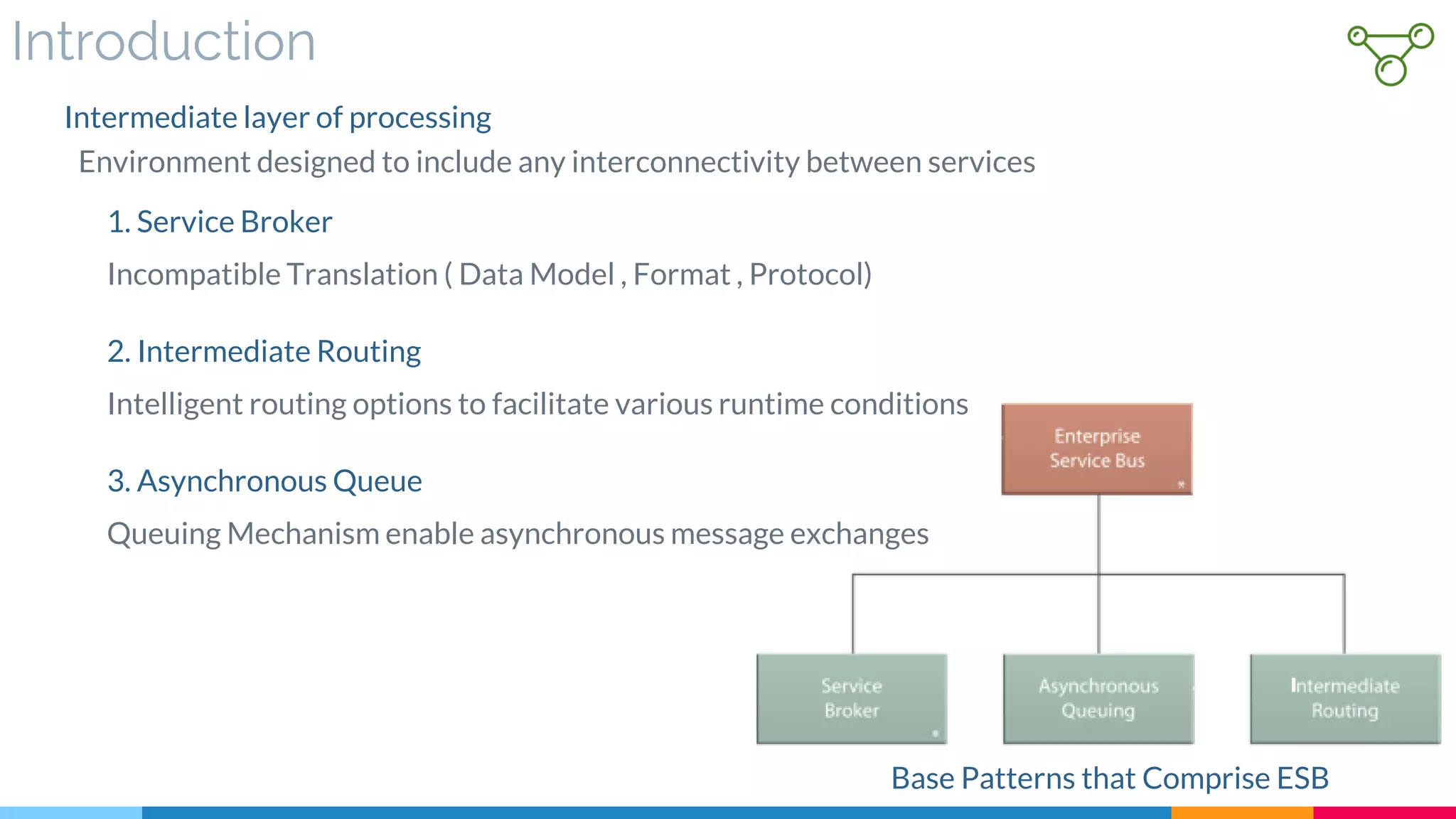
Introduction
Environment designed to include any interconnectivity between services
Intermediate layer of processing
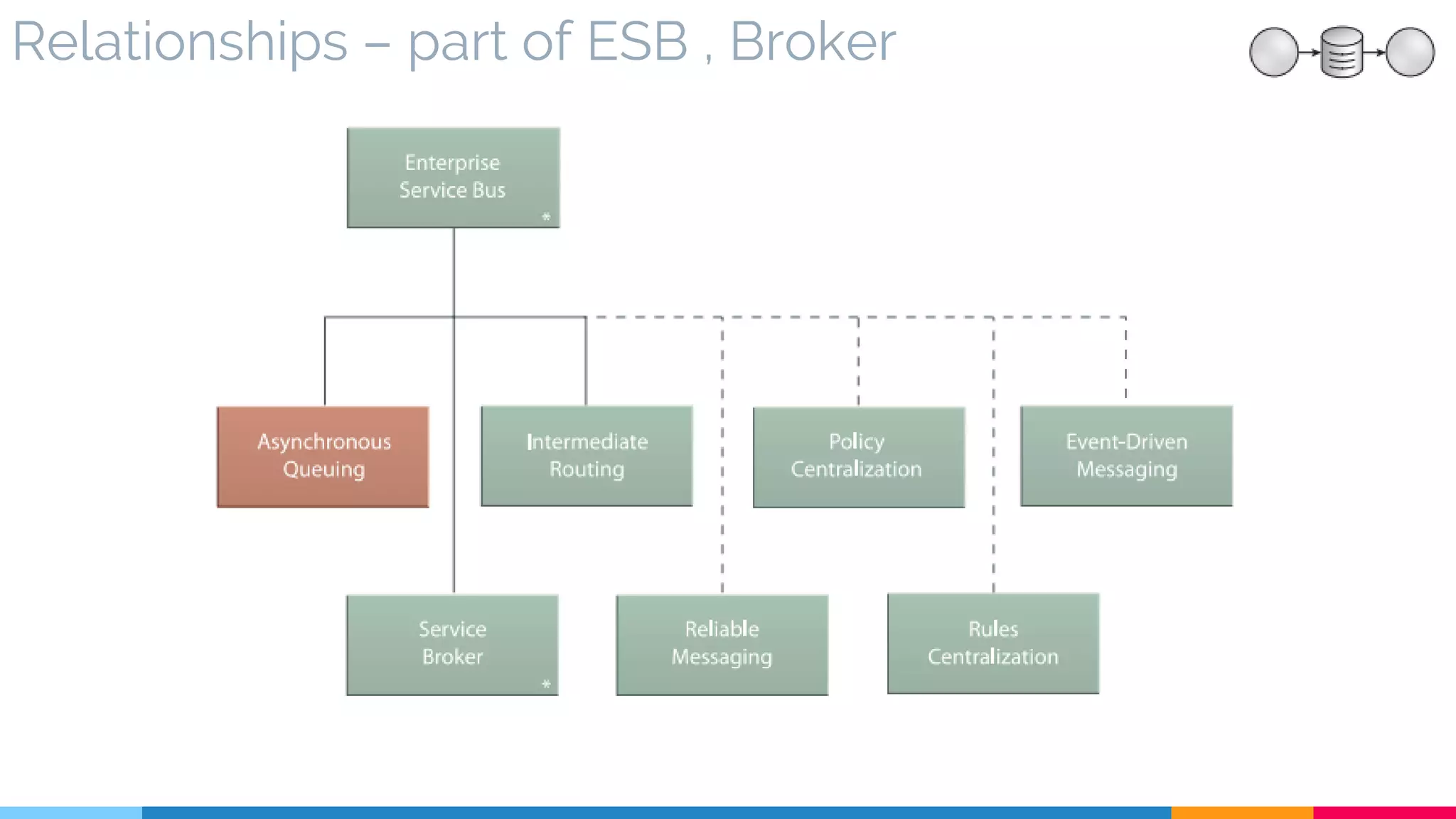
Base Patterns that Comprise ESB
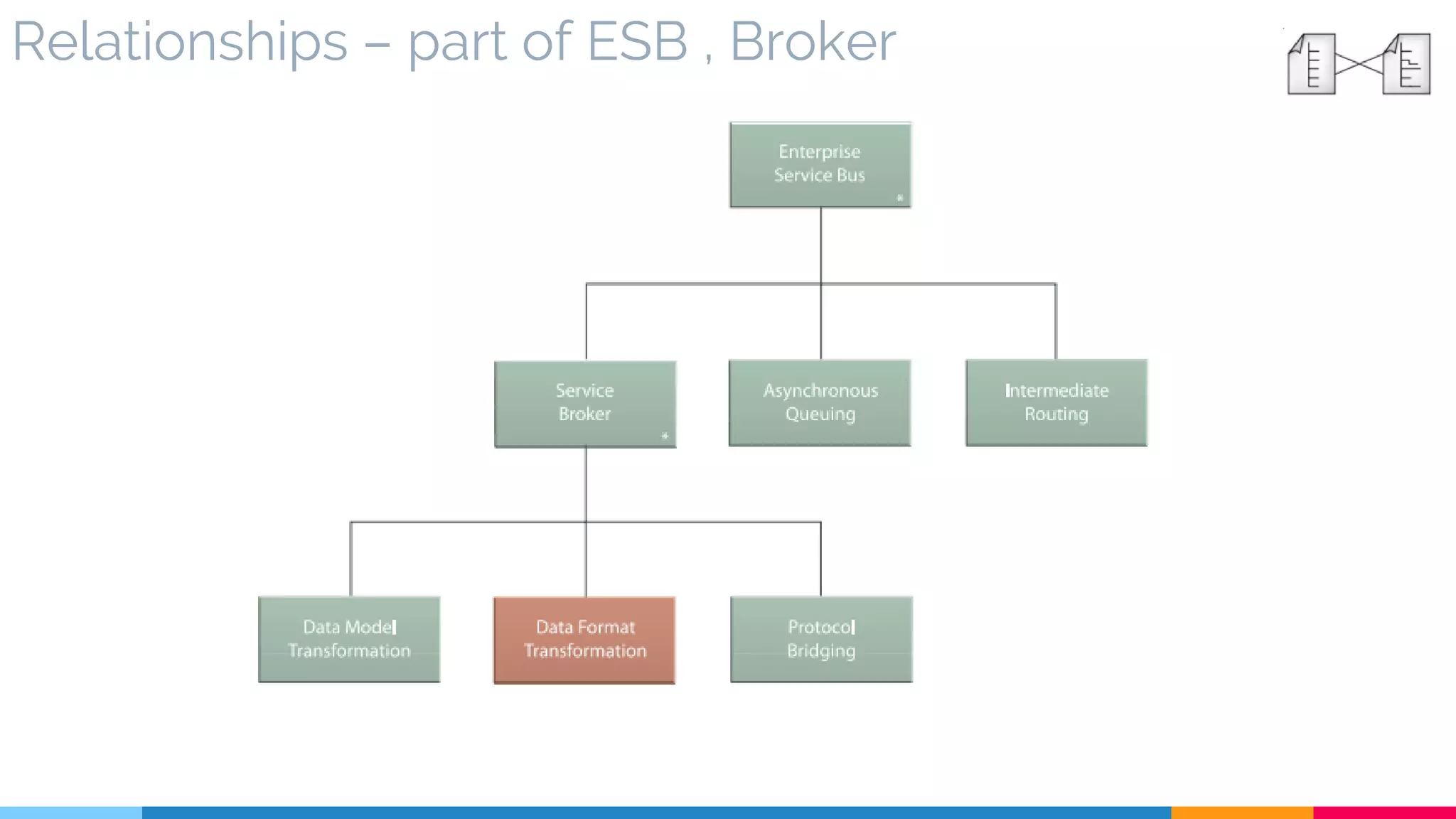
Incompatible Translation ( Data Model , Format , Protocol)
1. Service Broker
Queuing Mechanism enable asynchronous message exchanges
3. Asynchronous Queue
Intelligent routing options to facilitate various runtime conditions
2. Intermediate Routing
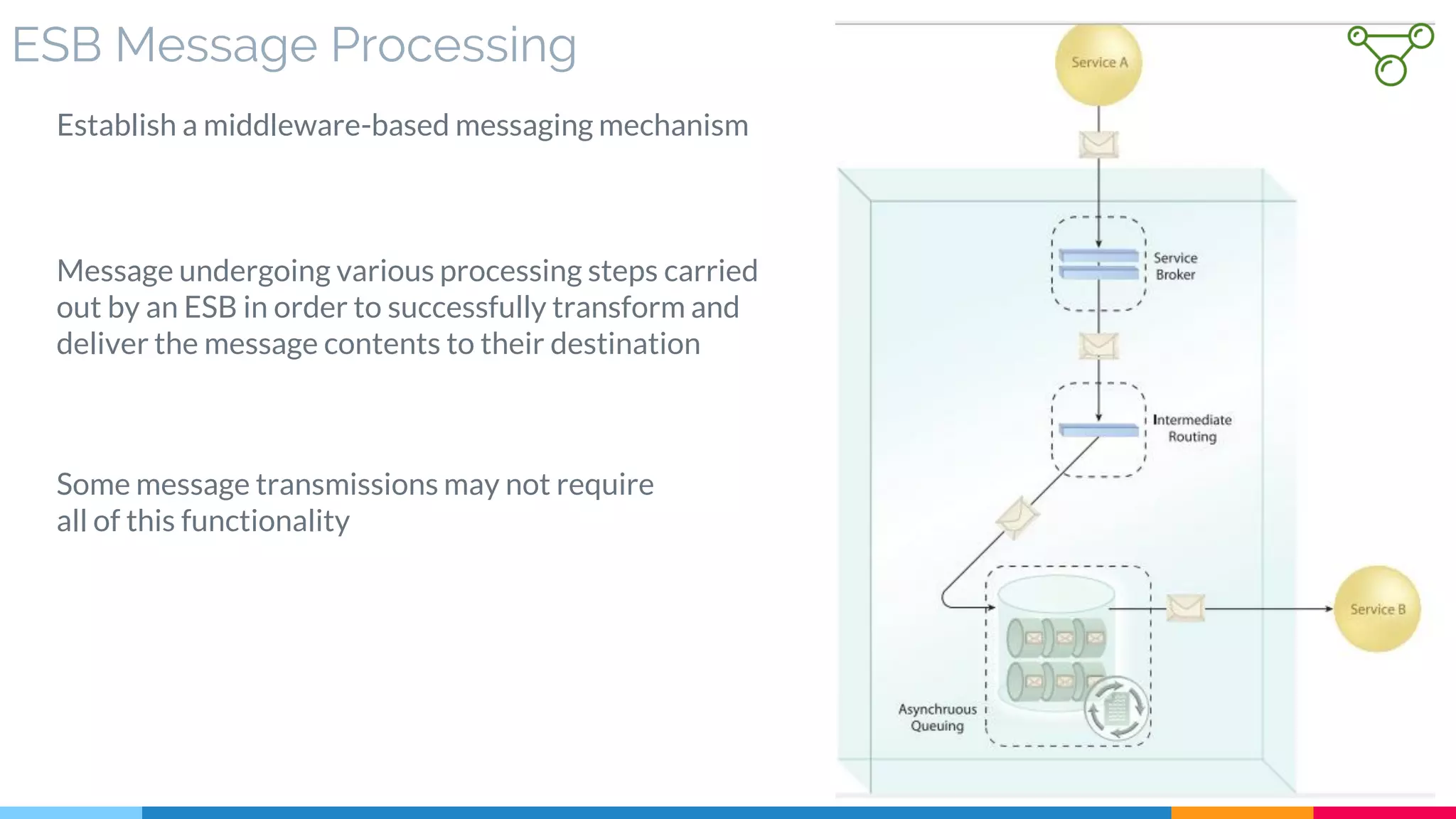
ESB Message Processing
Establish a middleware-based messaging mechanism
Message undergoing various processing steps carried
out by an ESB in order to successfully transform and
deliver the message contents to their destination
Some message transmissions may not require
all of this functionality
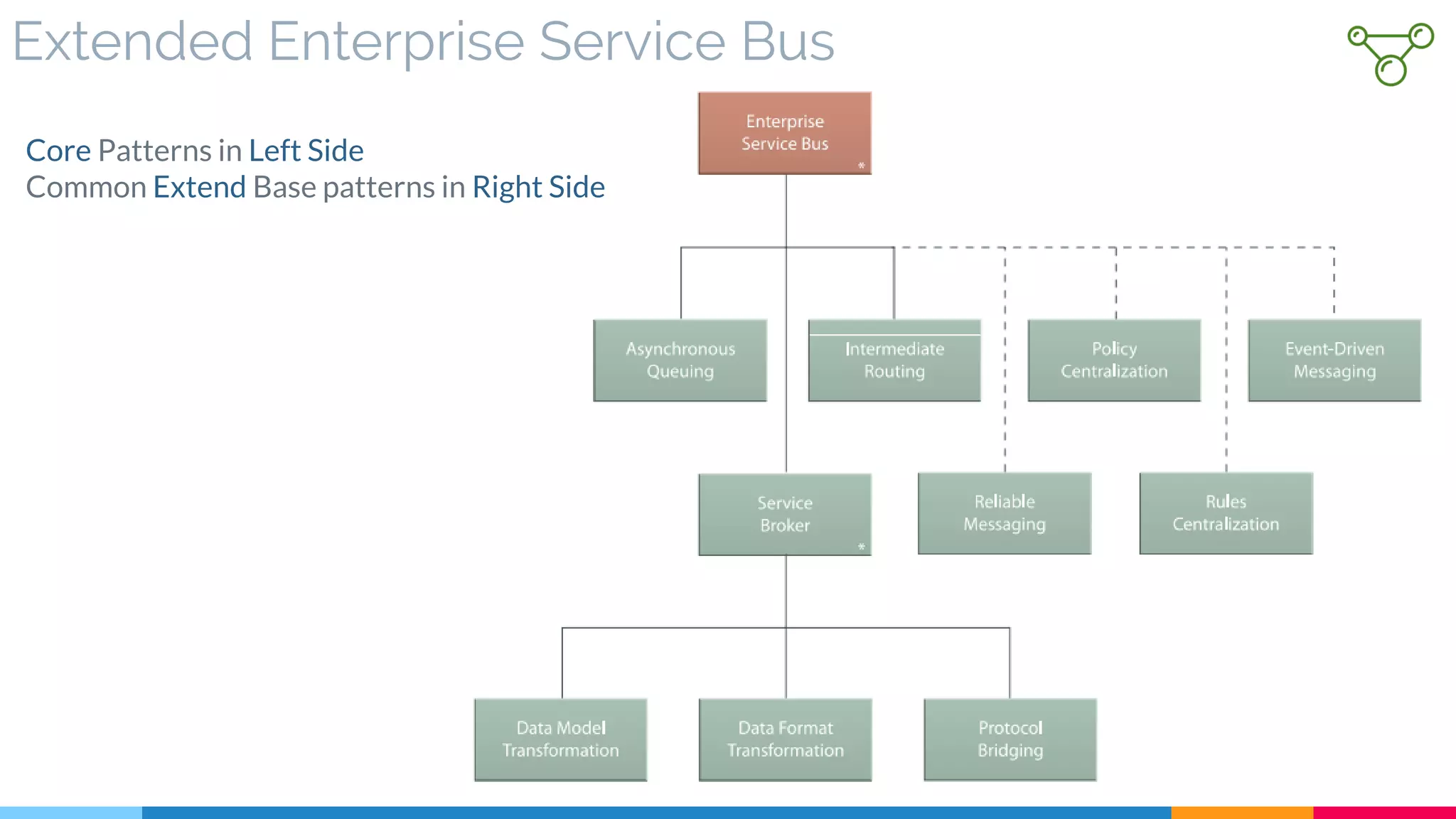
Extended Enterprise Service Bus
Core Patterns in Left Side
Common Extend Base patterns in Right Side
2 Service Broker
▷ Introduction
▷ Nested Patterns of Service Broker
▷ Core Part of ESB
[707]
Introduction
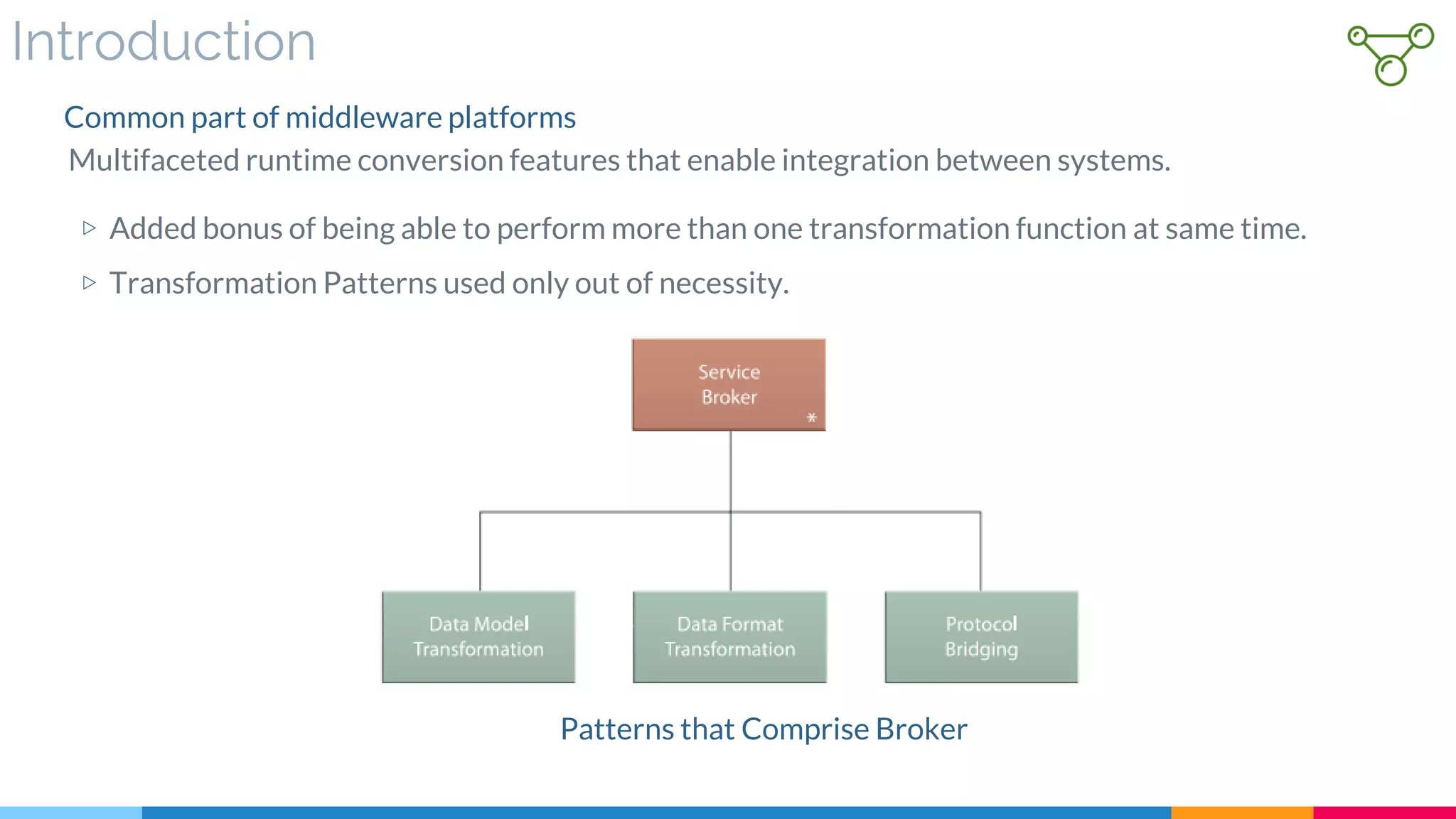
Multifaceted runtime conversion features that enable integration between systems.
Common part of middleware platforms
Patterns that Comprise Broker
▷ Added bonus of being able to perform more than one transformation function at same time.
▷ Transformation Patterns used only out of necessity.
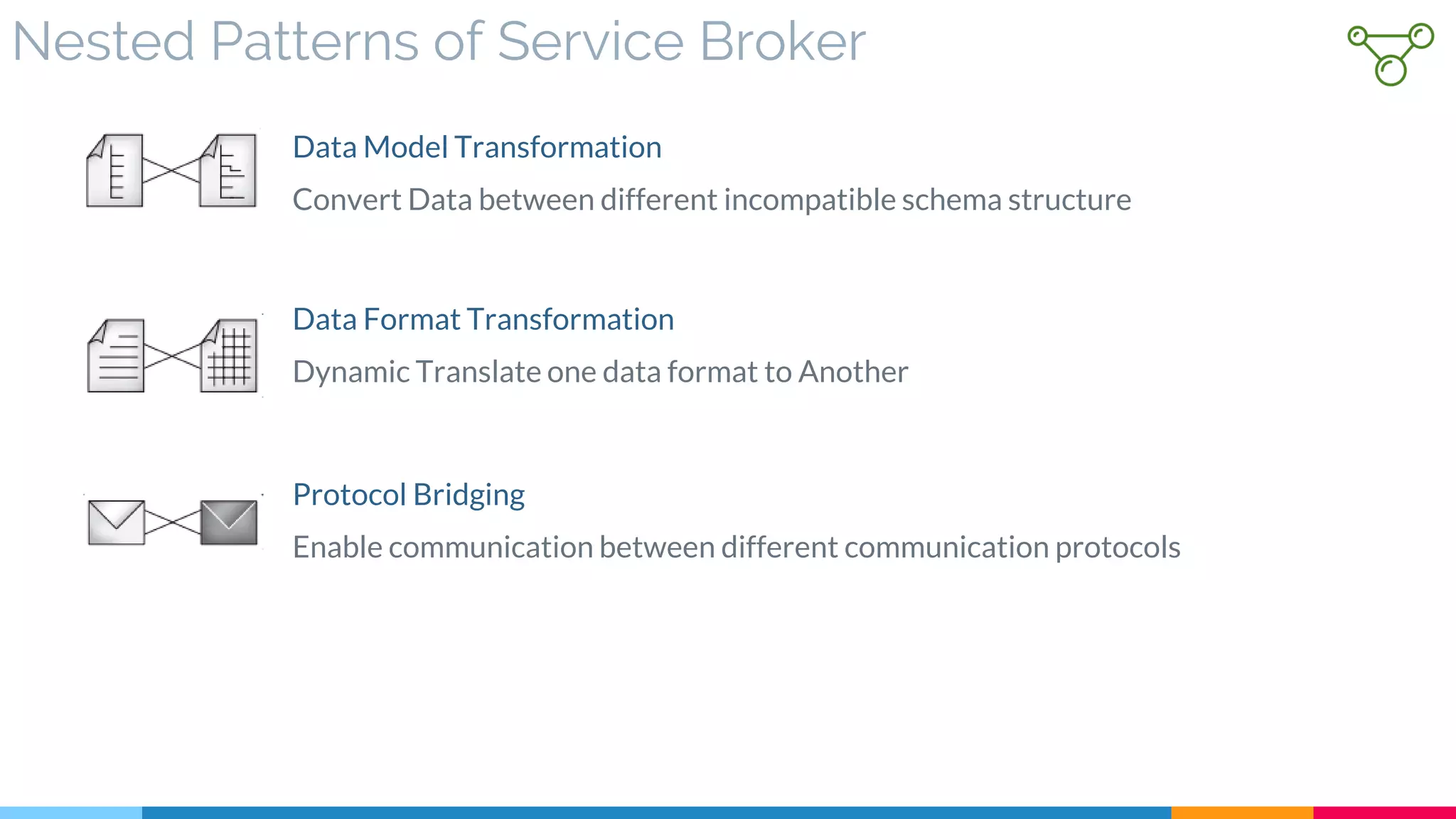
Nested Patterns of Service Broker
Convert Data between different incompatible schema structure
Data Model Transformation
Enable communication between different communication protocols
Protocol Bridging
Dynamic Translate one data format to Another
Data Format Transformation
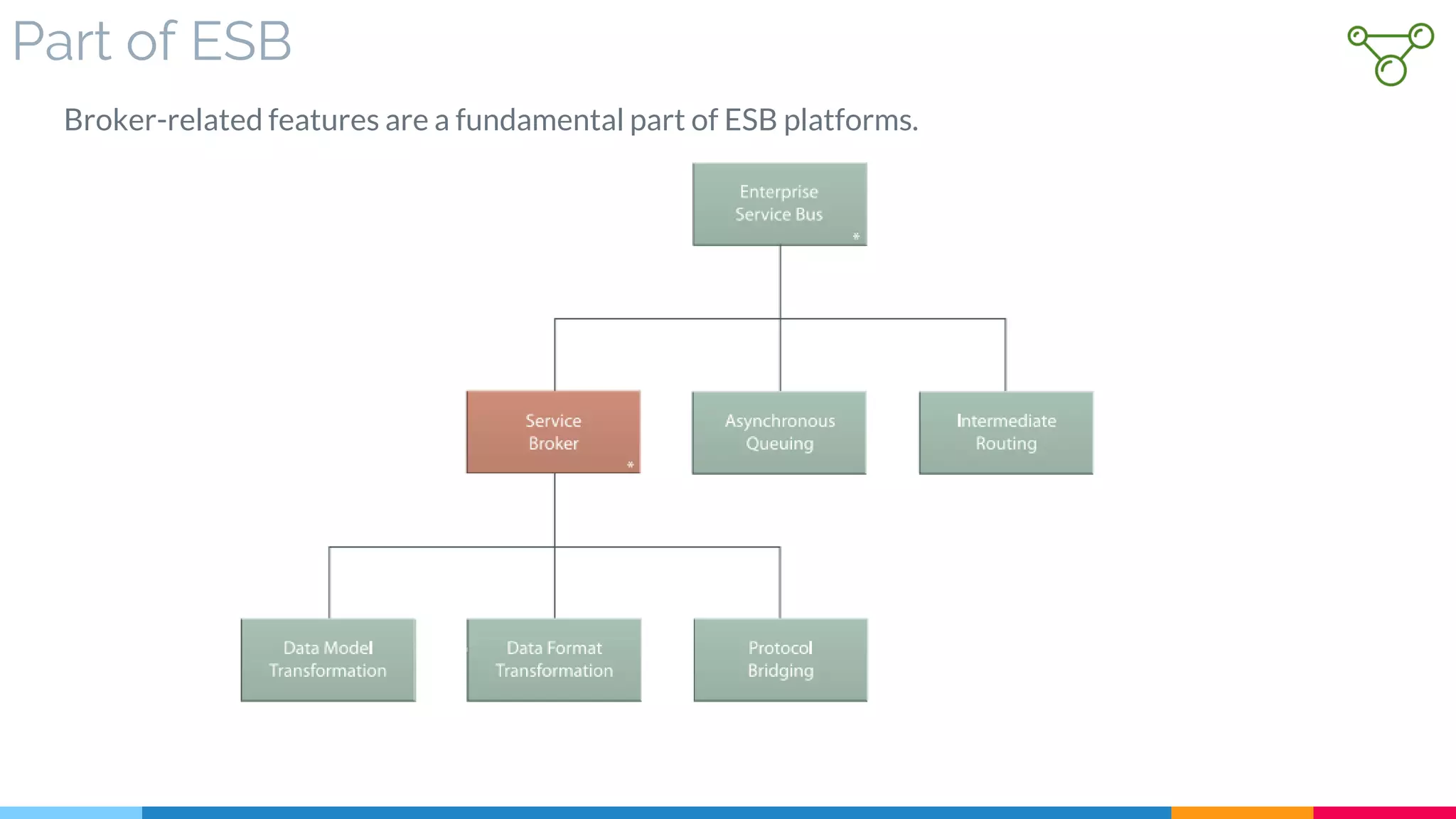
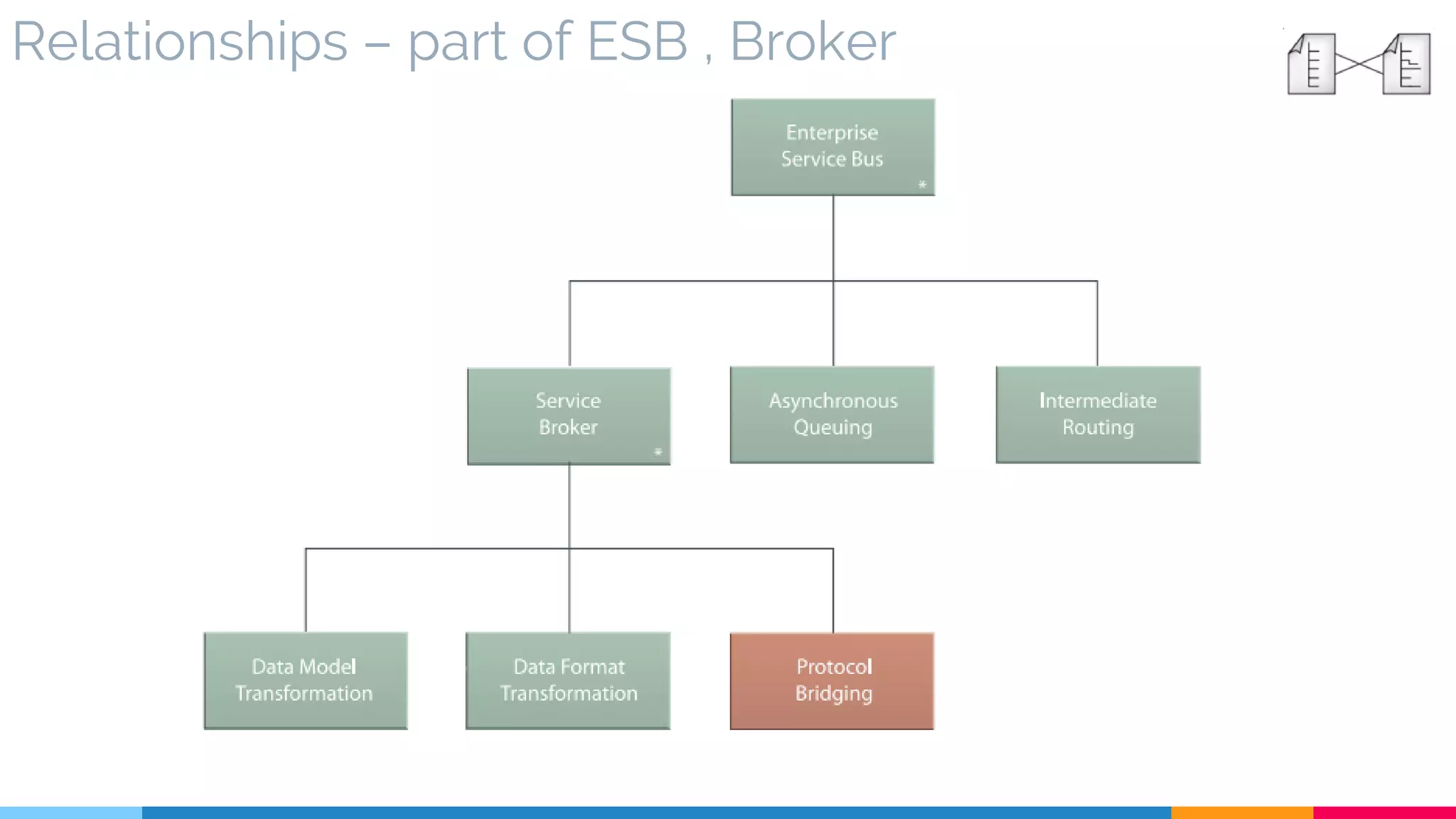
Part of ESB
Broker-related features are a fundamental part of ESB platforms.
3 Data Model Transformation
▷ Problem
▷ Solution
▷ Real World Sample
▷ Application
▷ Impact
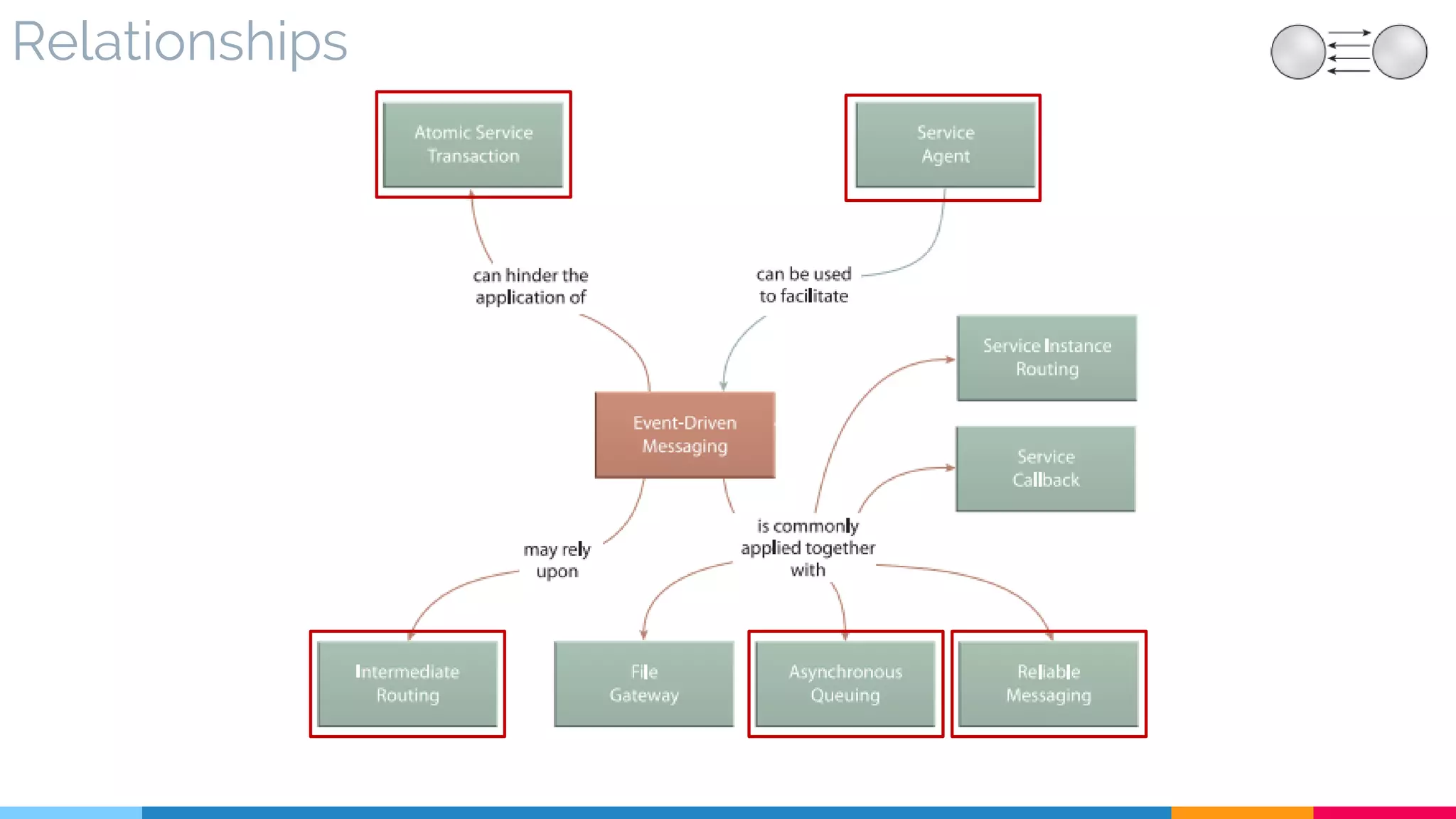
▷ Relationships
[671]
Problem
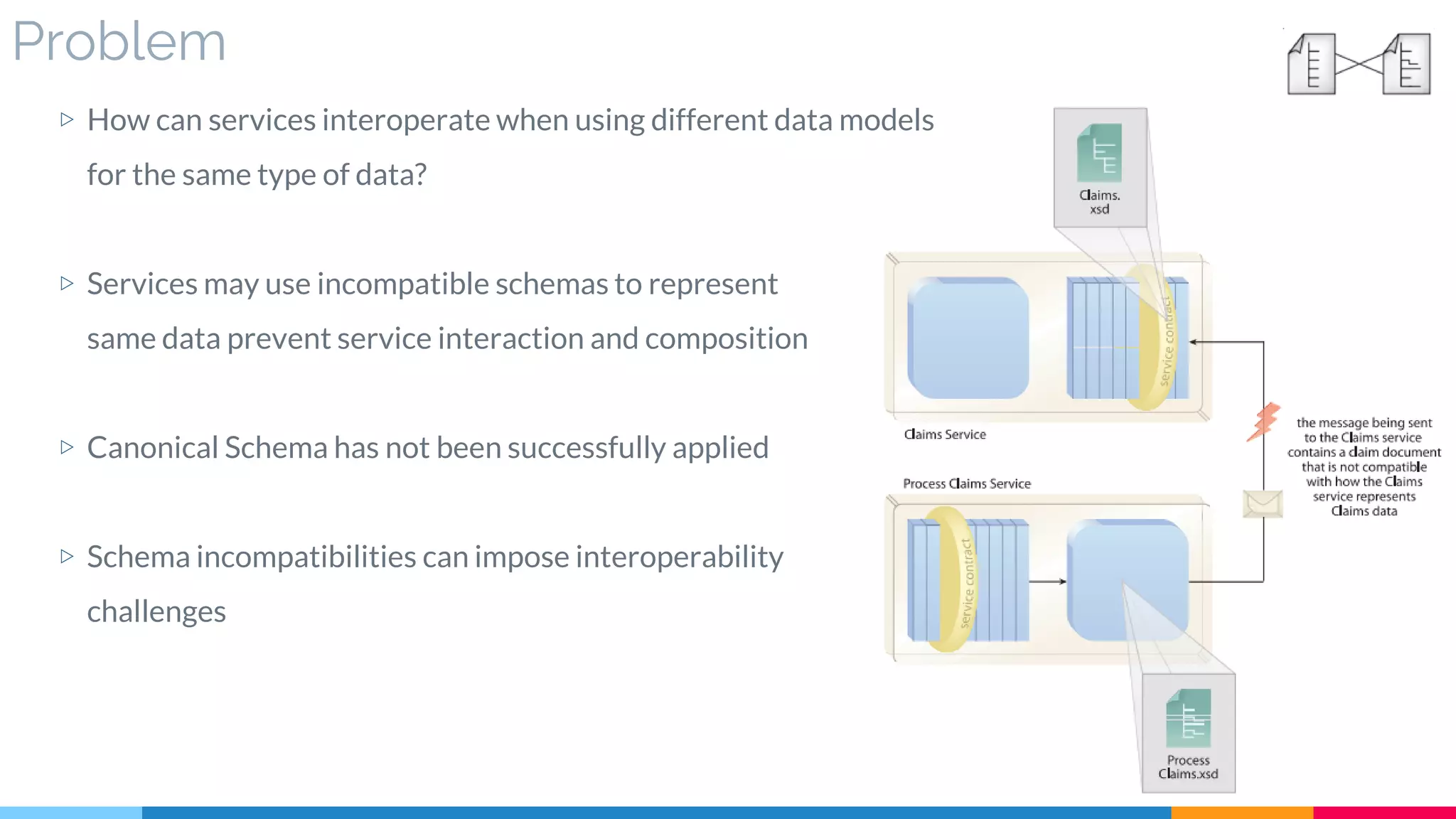
▷ How can services interoperate when using different data models
for the same type of data?
▷ Services may use incompatible schemas to represent
same data prevent service interaction and composition
▷ Canonical Schema has not been successfully applied
▷ Schema incompatibilities can impose interoperability
challenges
Solution
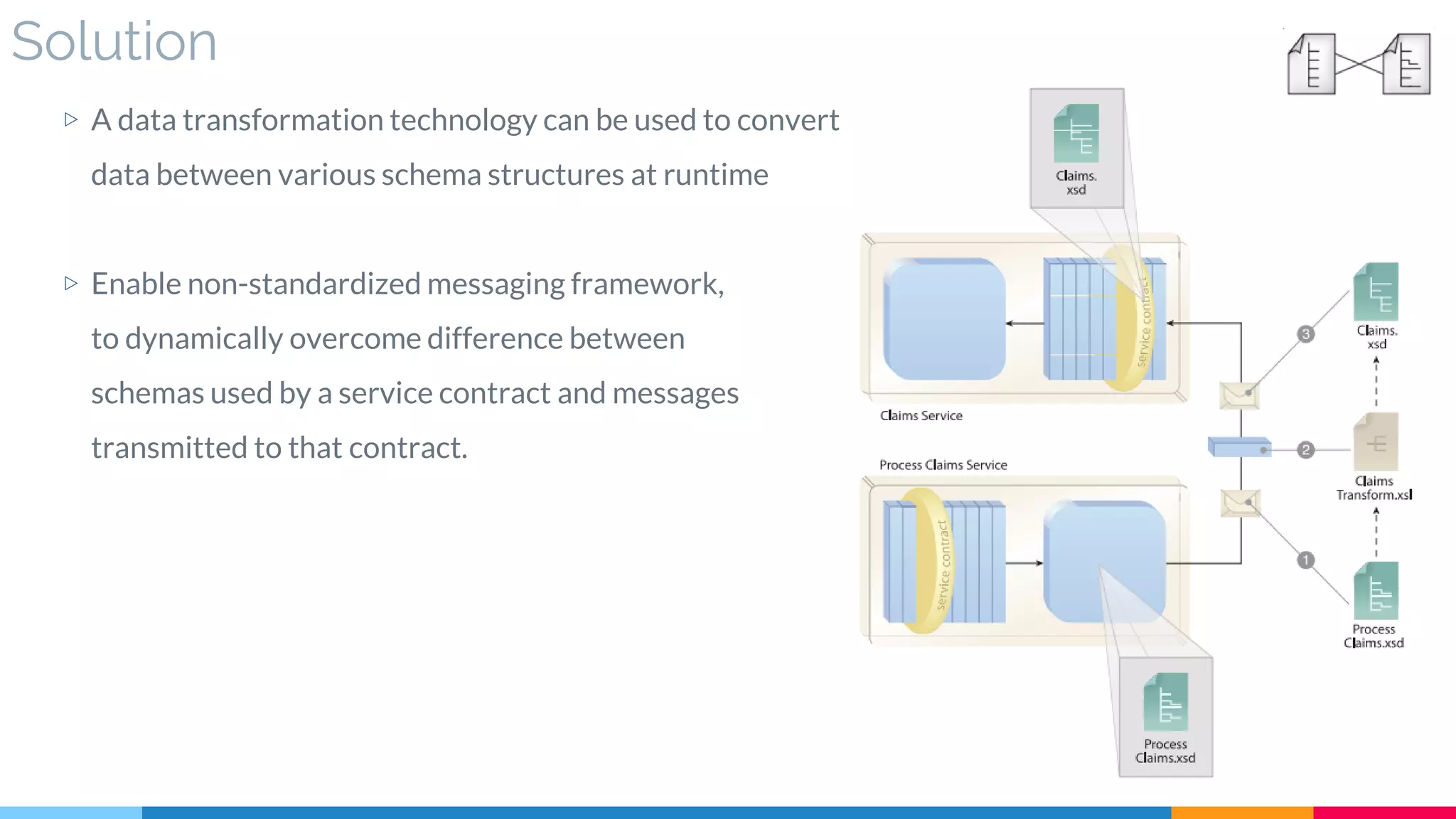
▷ A data transformation technology can be used to convert
data between various schema structures at runtime
▷ Enable non-standardized messaging framework,
to dynamically overcome difference between
schemas used by a service contract and messages
transmitted to that contract.
Real World Sample
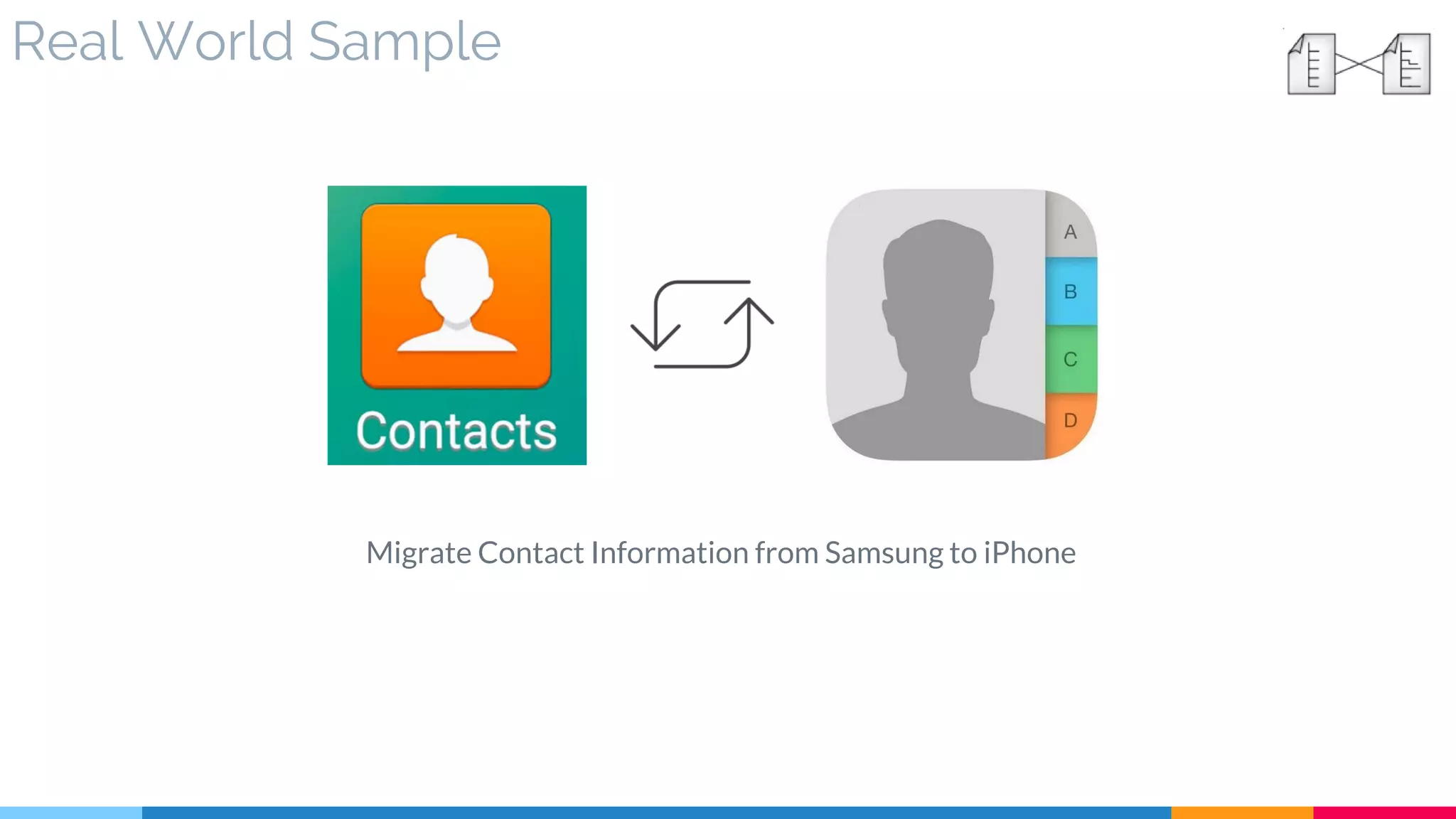
Migrate Contact Information from Samsung to iPhone
Application
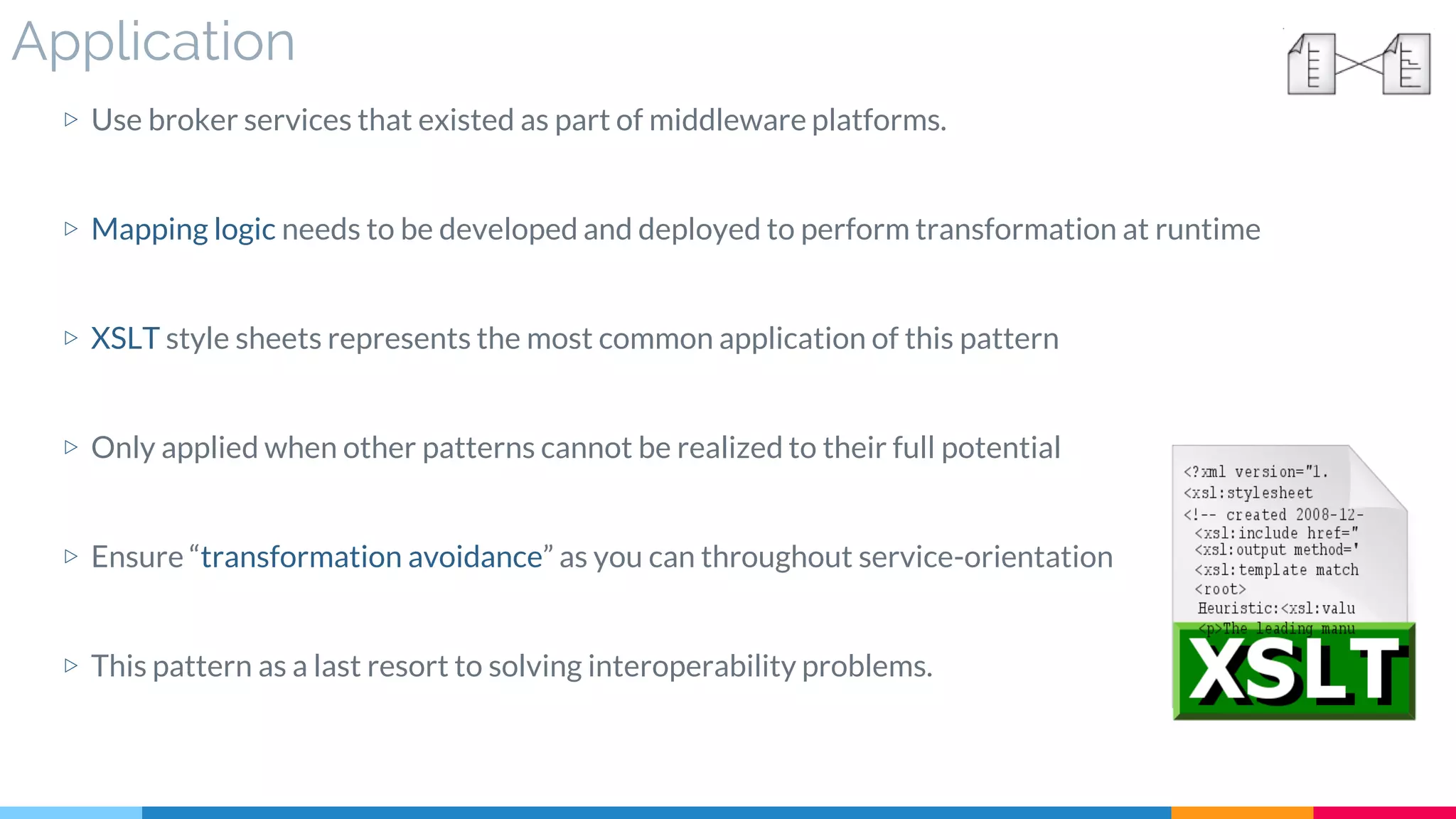
▷ Use broker services that existed as part of middleware platforms.
▷ Mapping logic needs to be developed and deployed to perform transformation at runtime
▷ XSLT style sheets represents the most common application of this pattern
▷ Only applied when other patterns cannot be realized to their full potential
▷ Ensure “transformation avoidance” as you can throughout service-orientation
▷ This pattern as a last resort to solving interoperability problems.
Impact
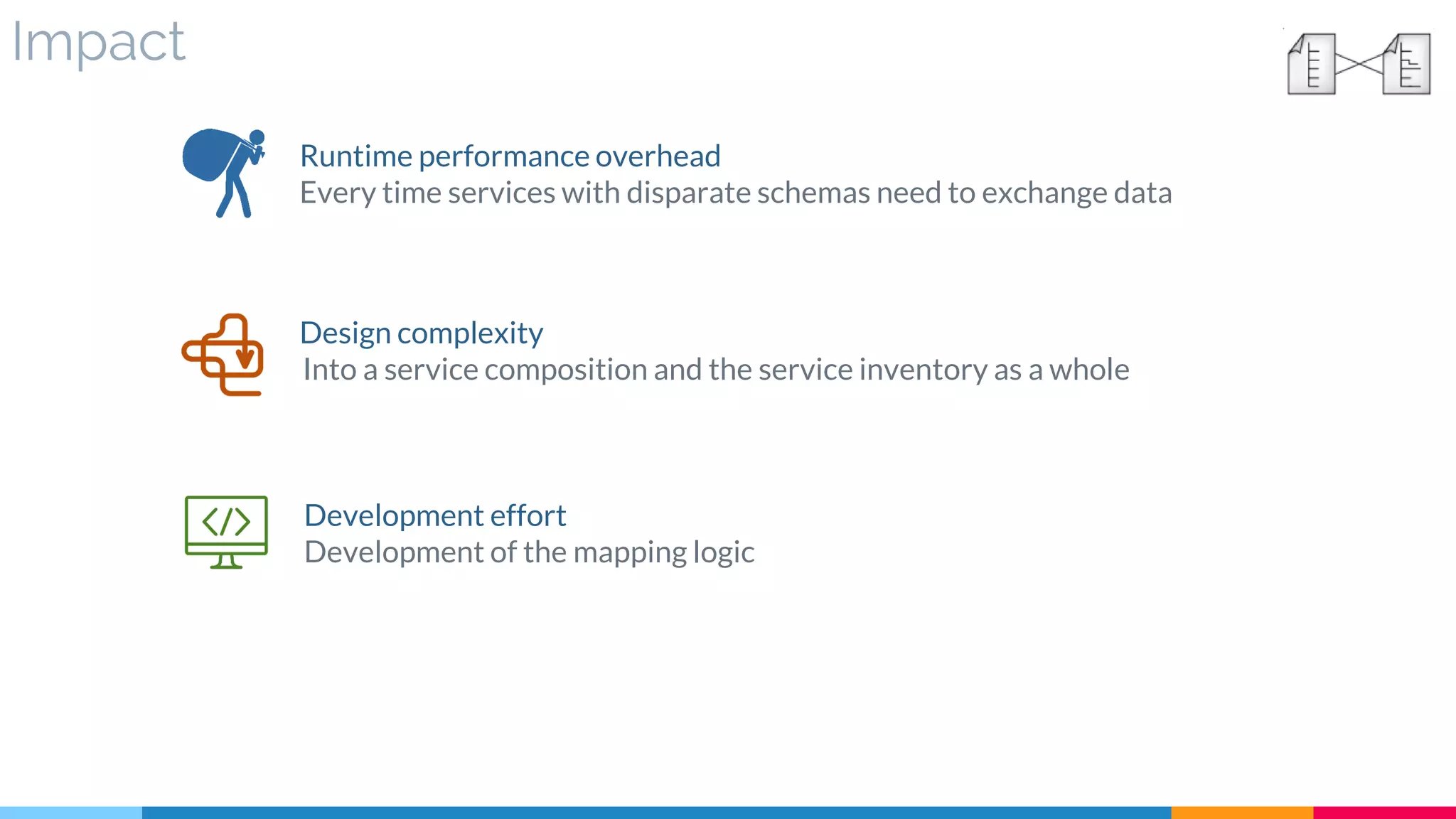
Runtime performance overhead
Every time services with disparate schemas need to exchange data
Development effort
Development of the mapping logic
Design complexity
Into a service composition and the service inventory as a whole
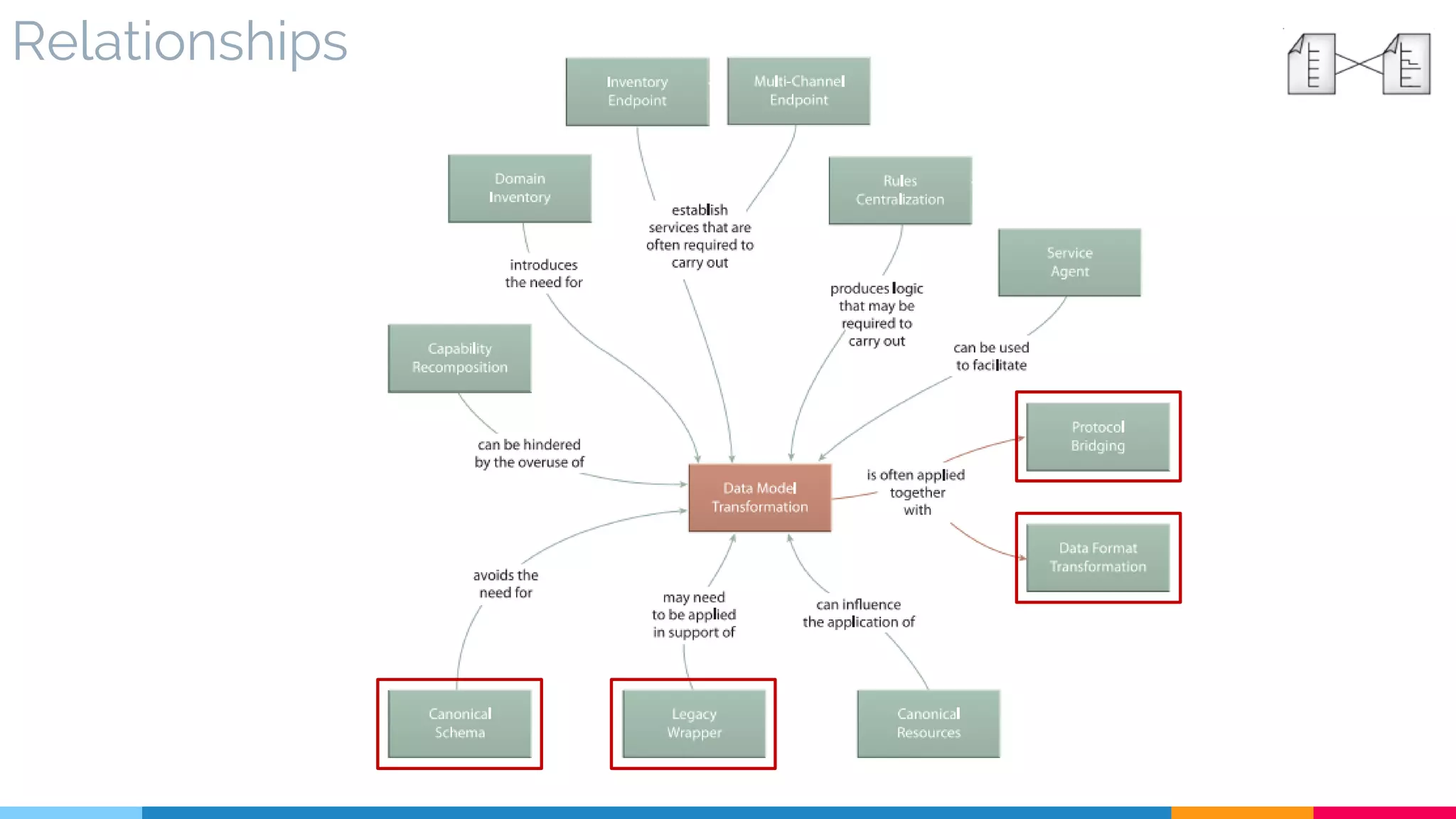
Relationships
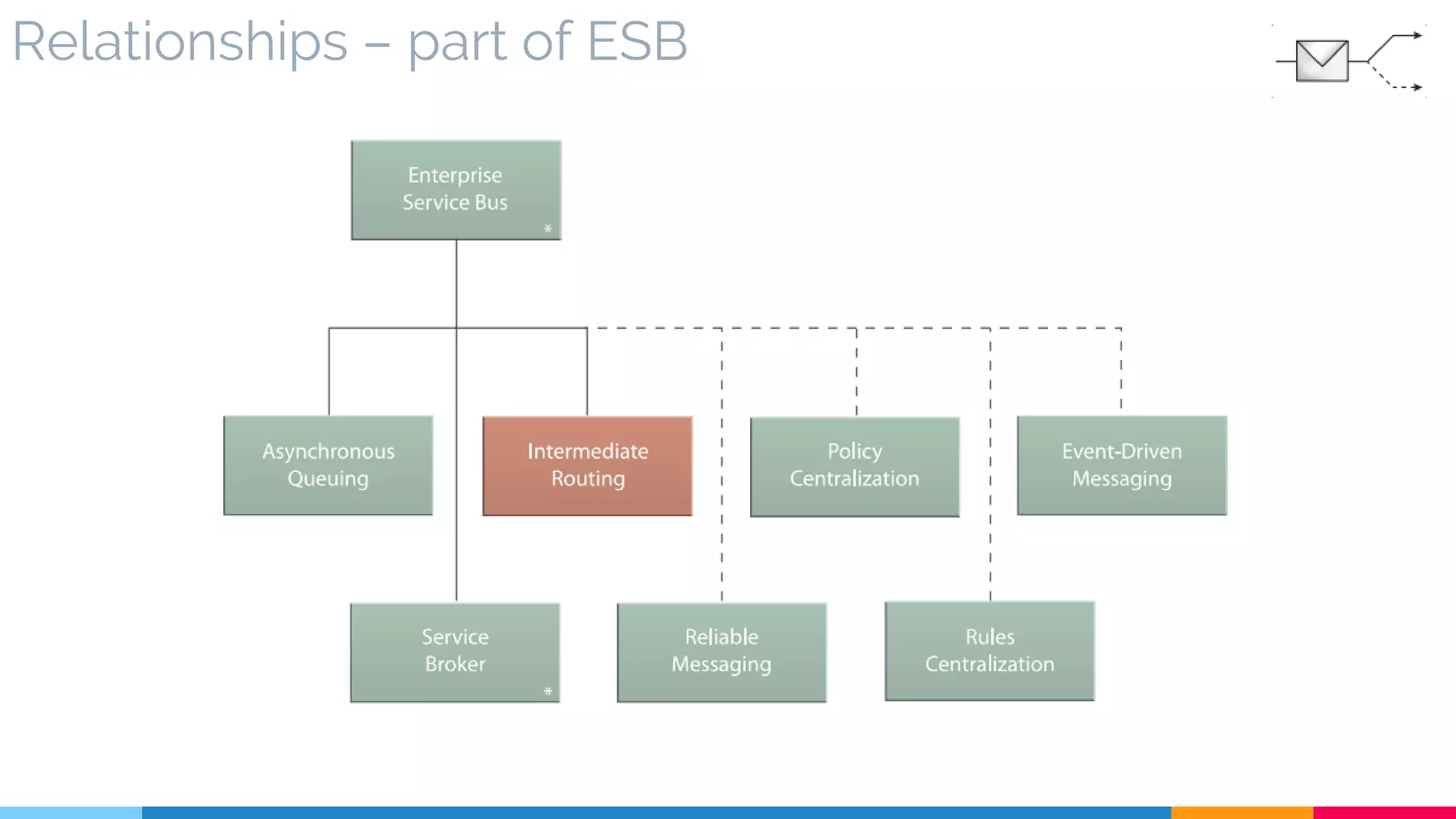
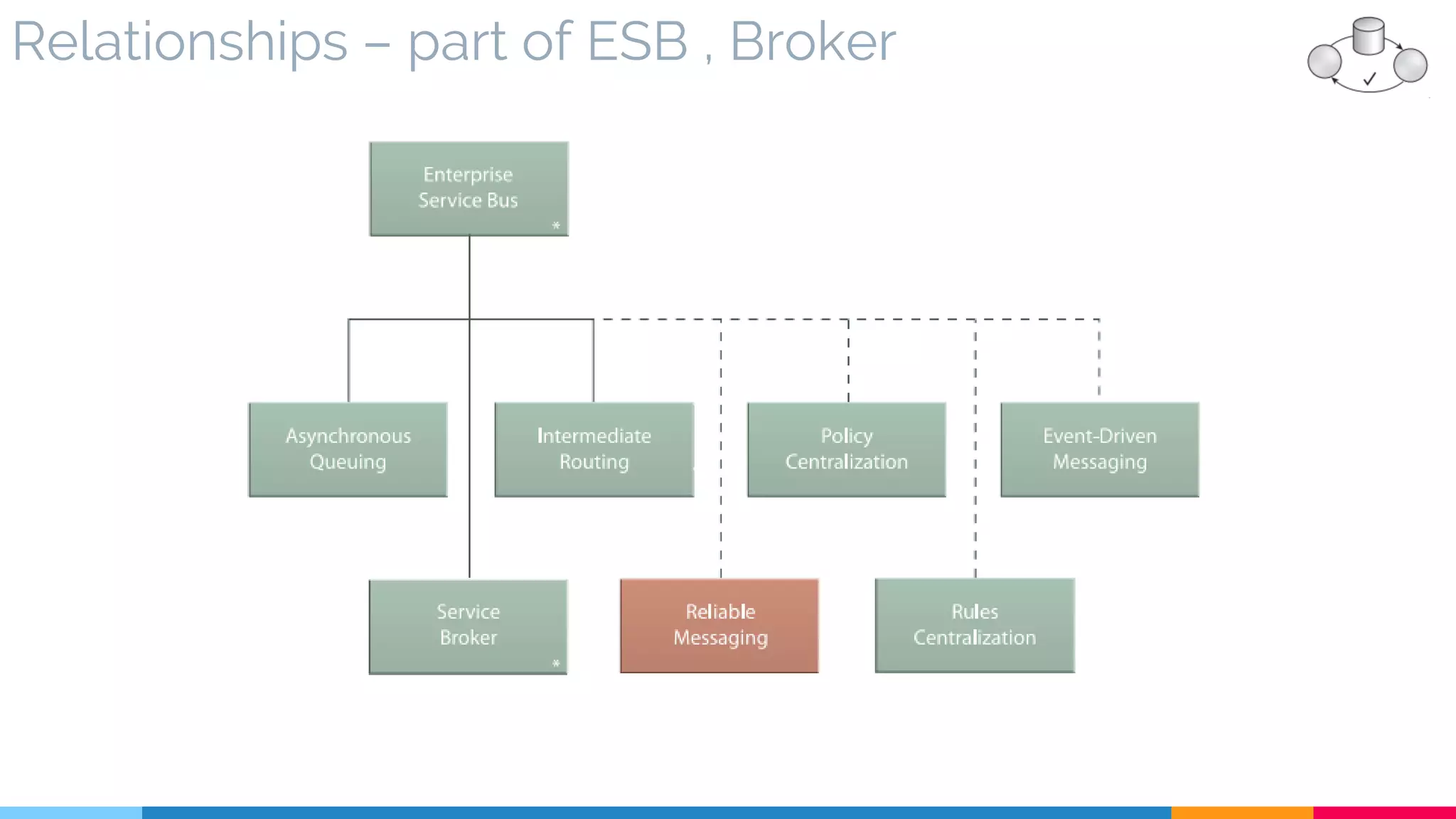
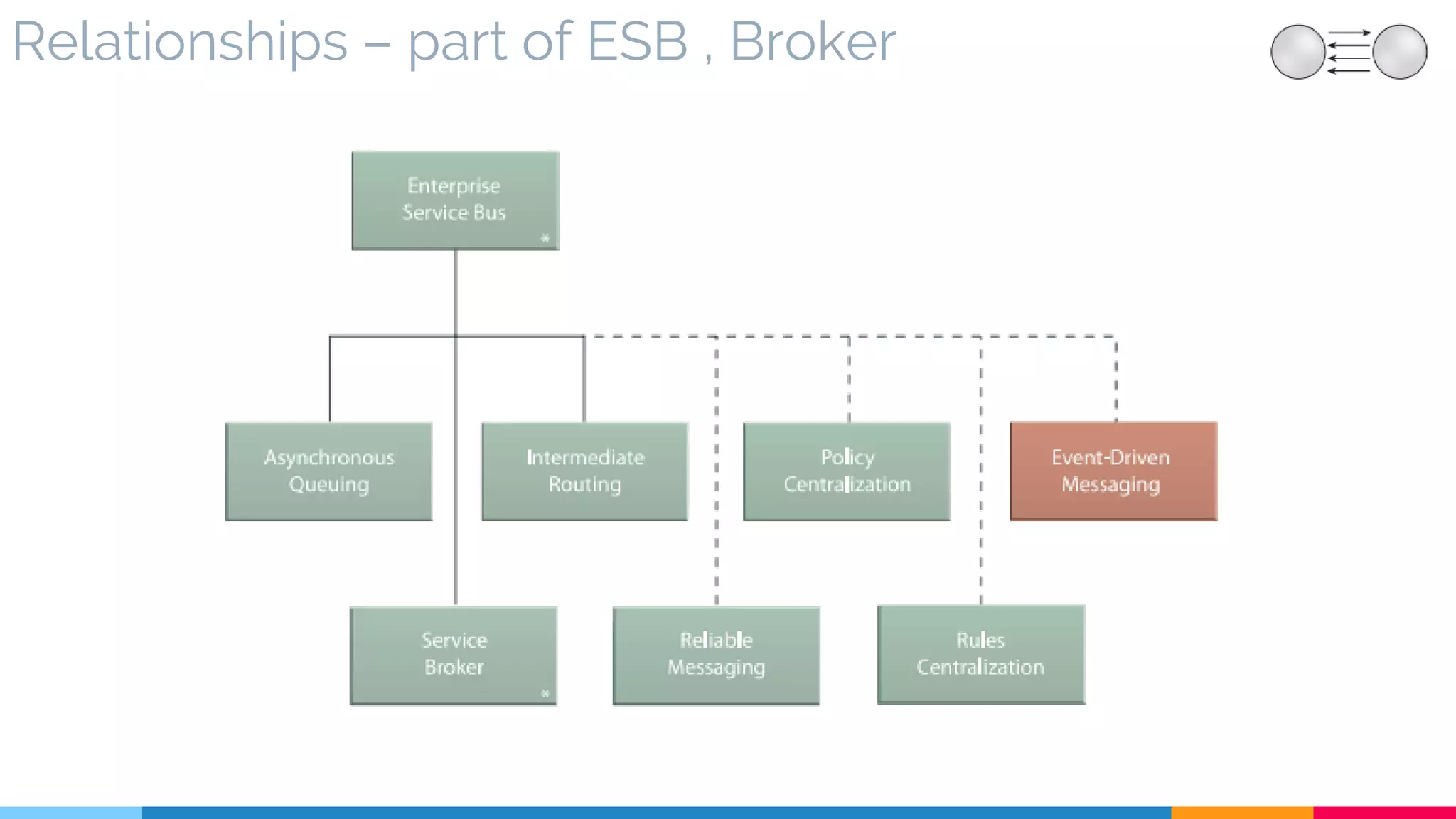
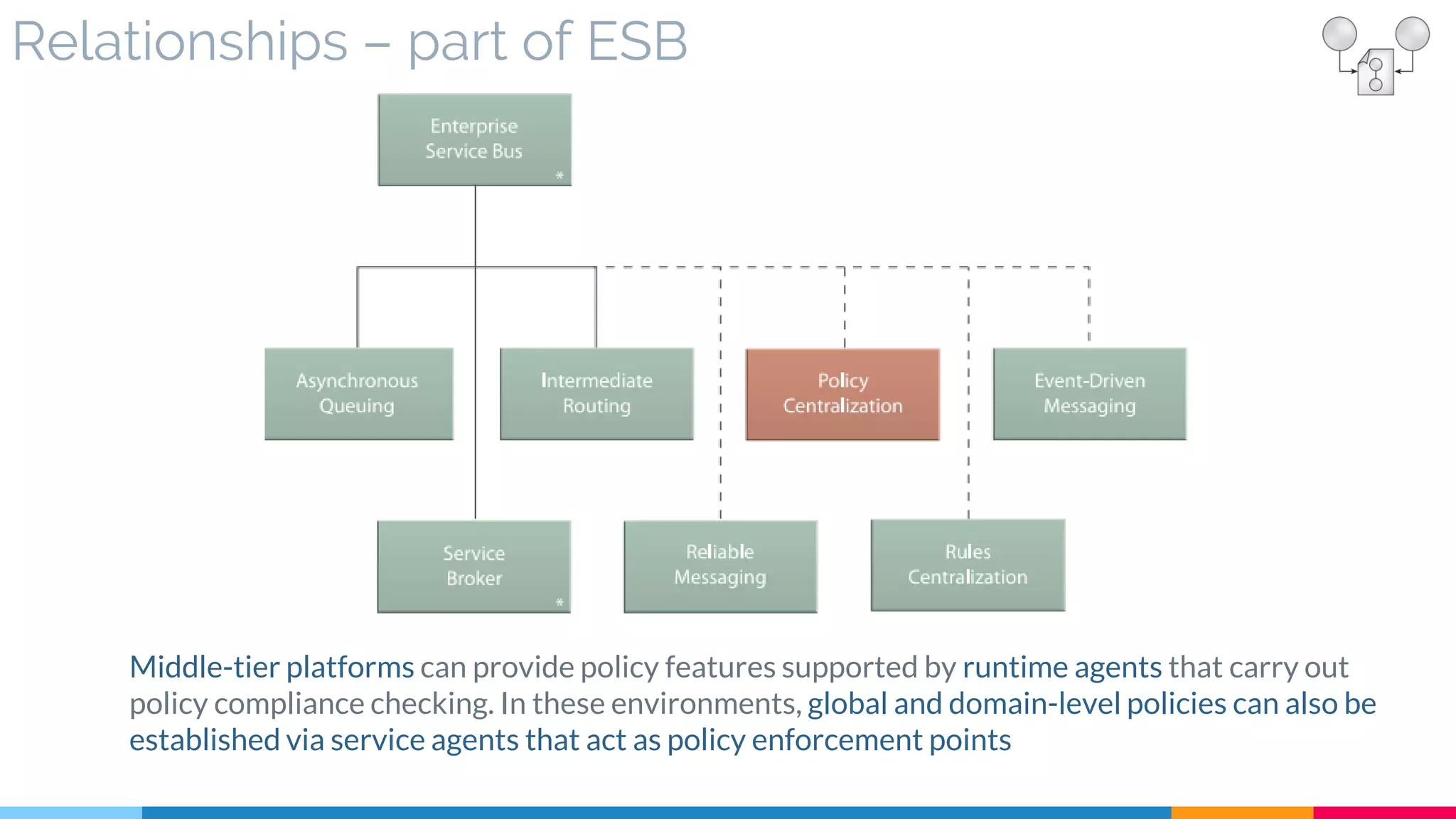
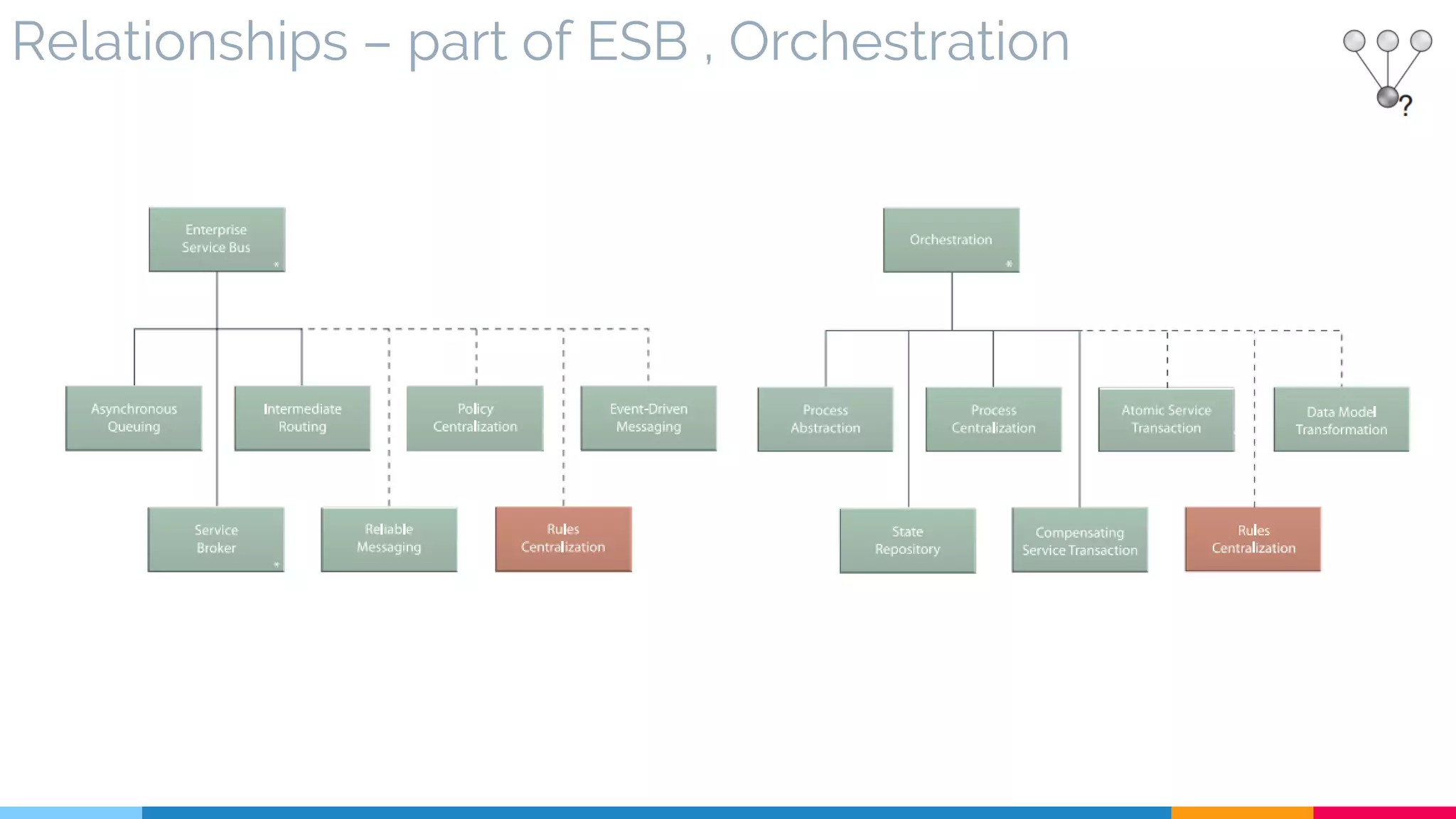
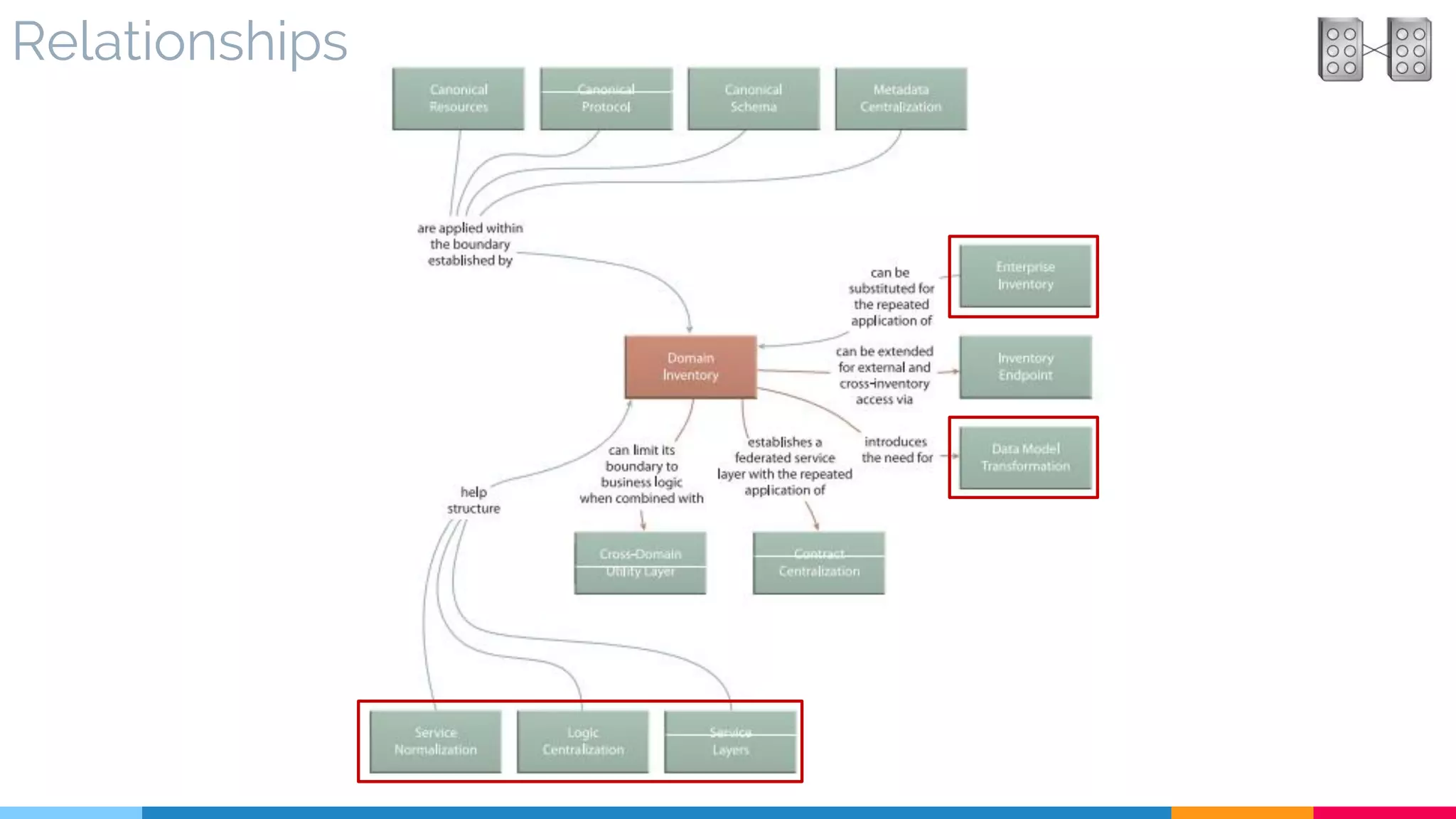
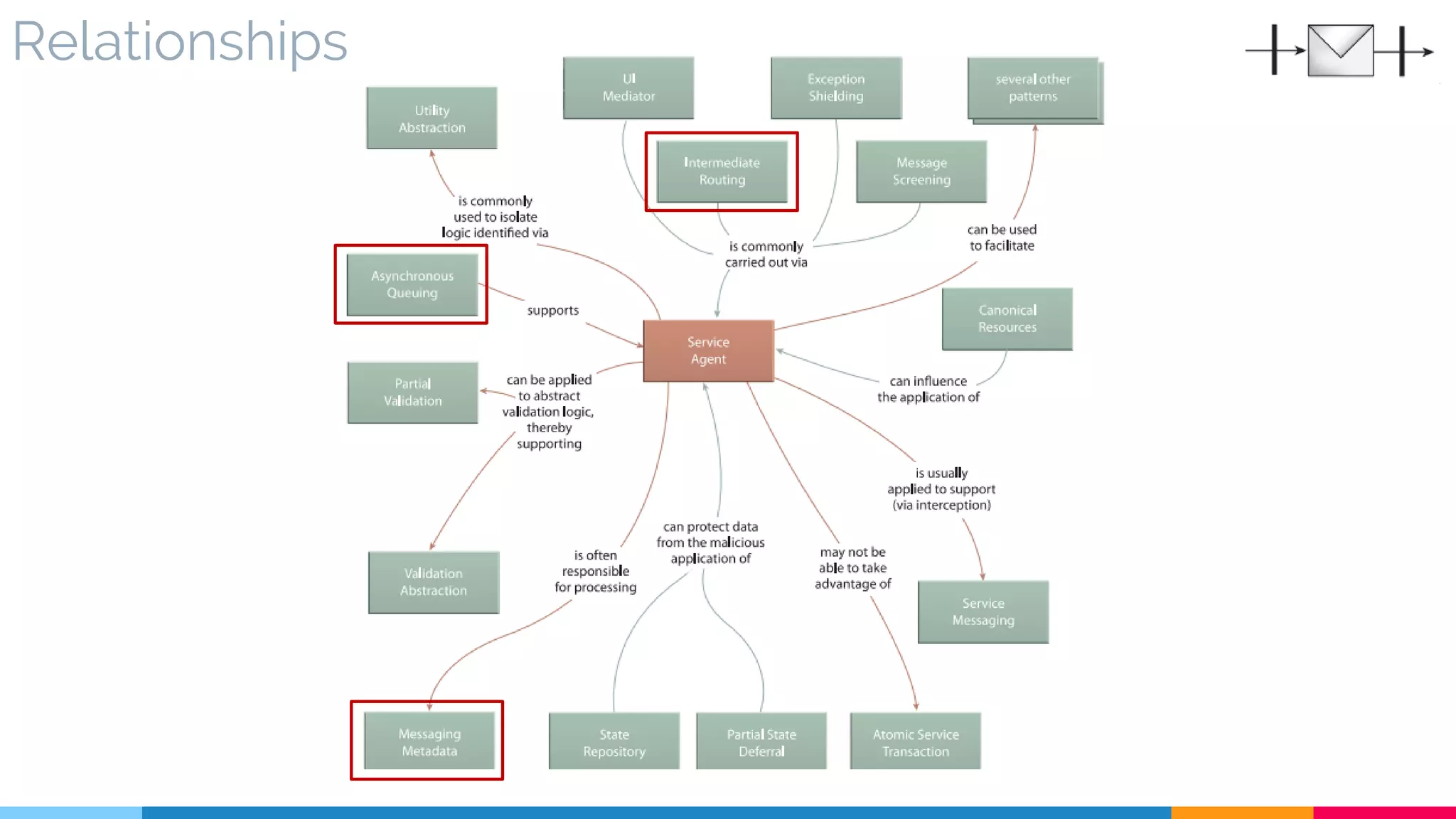
Relationships – part of ESB , Broker
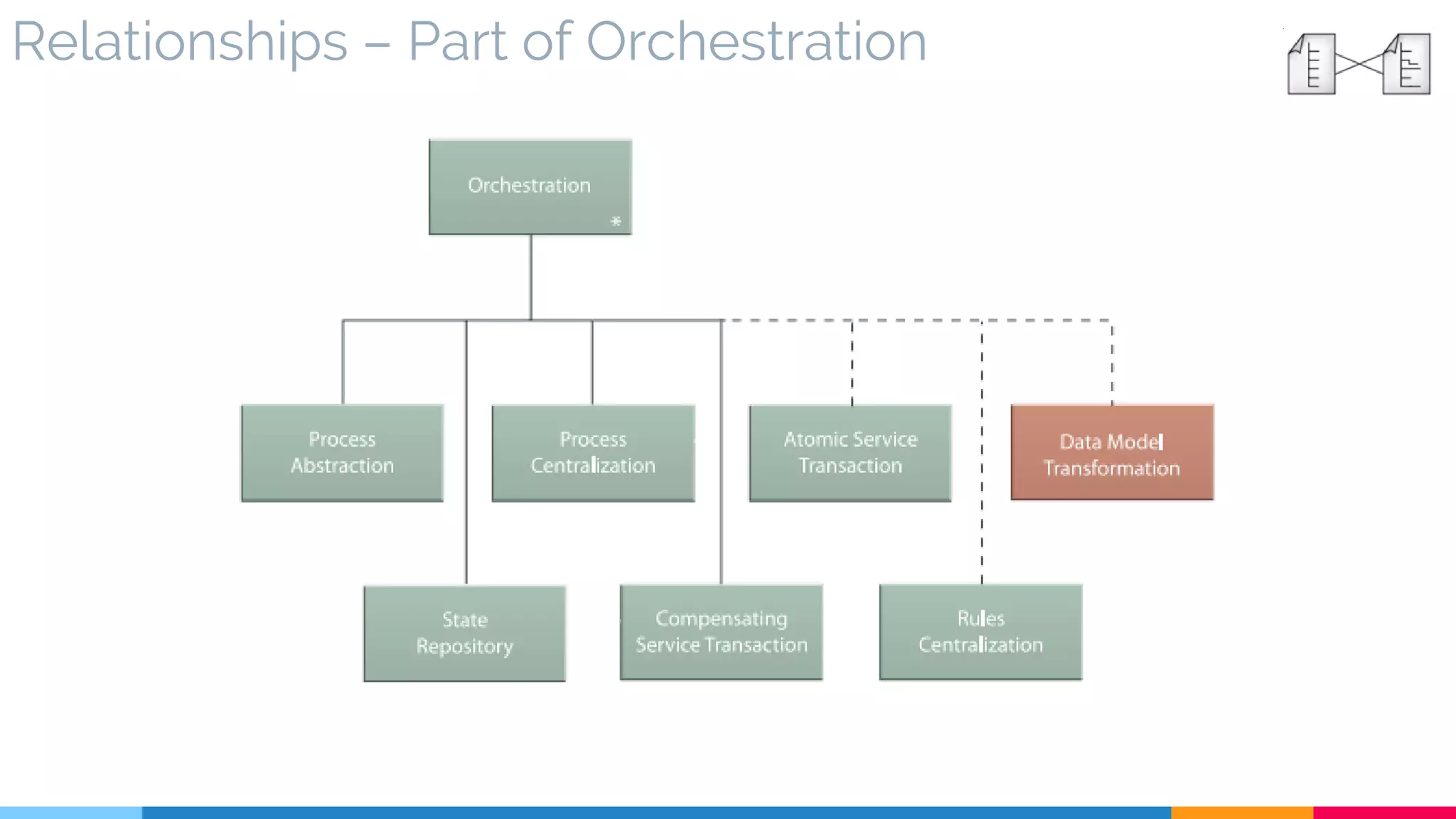
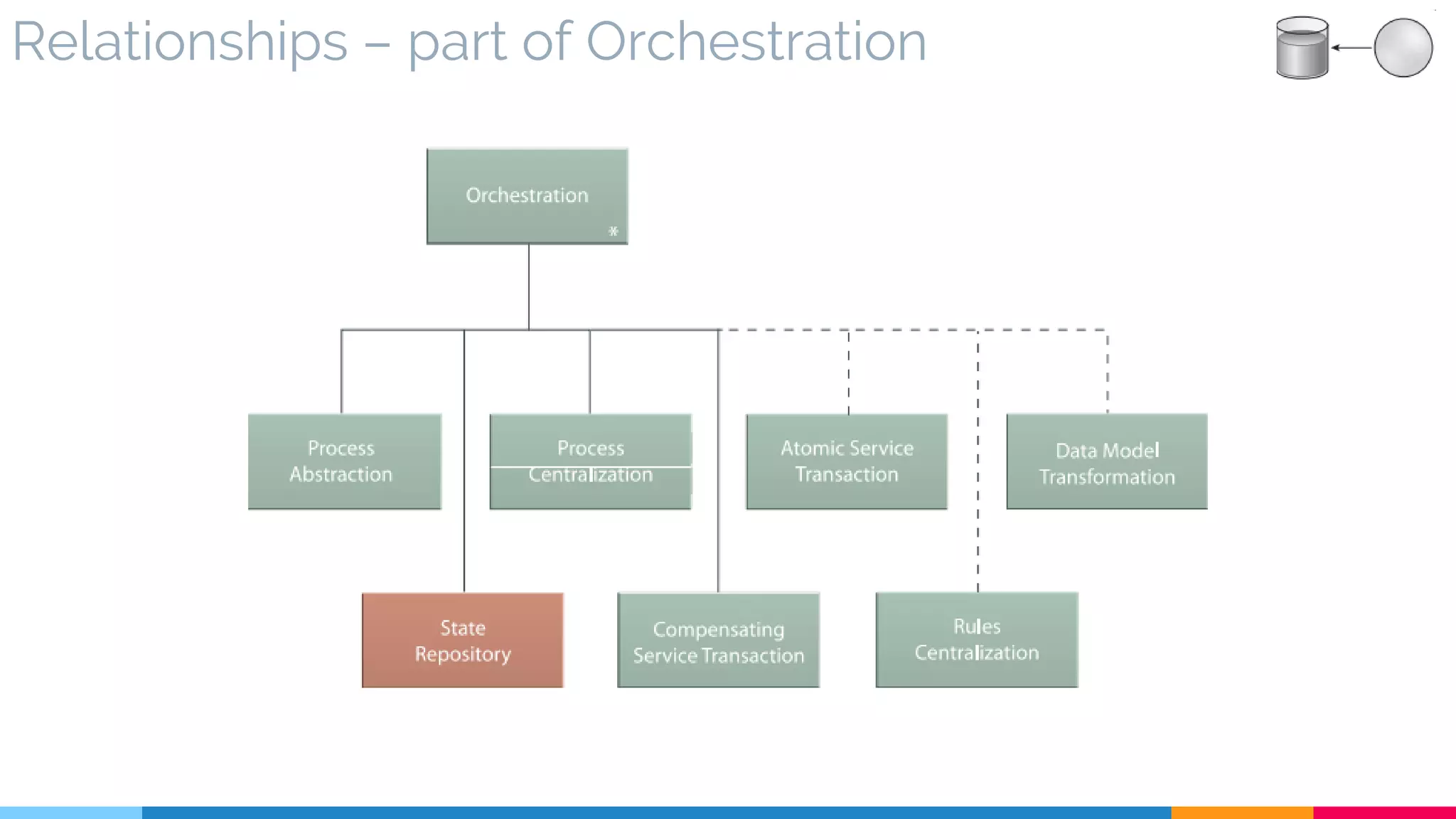
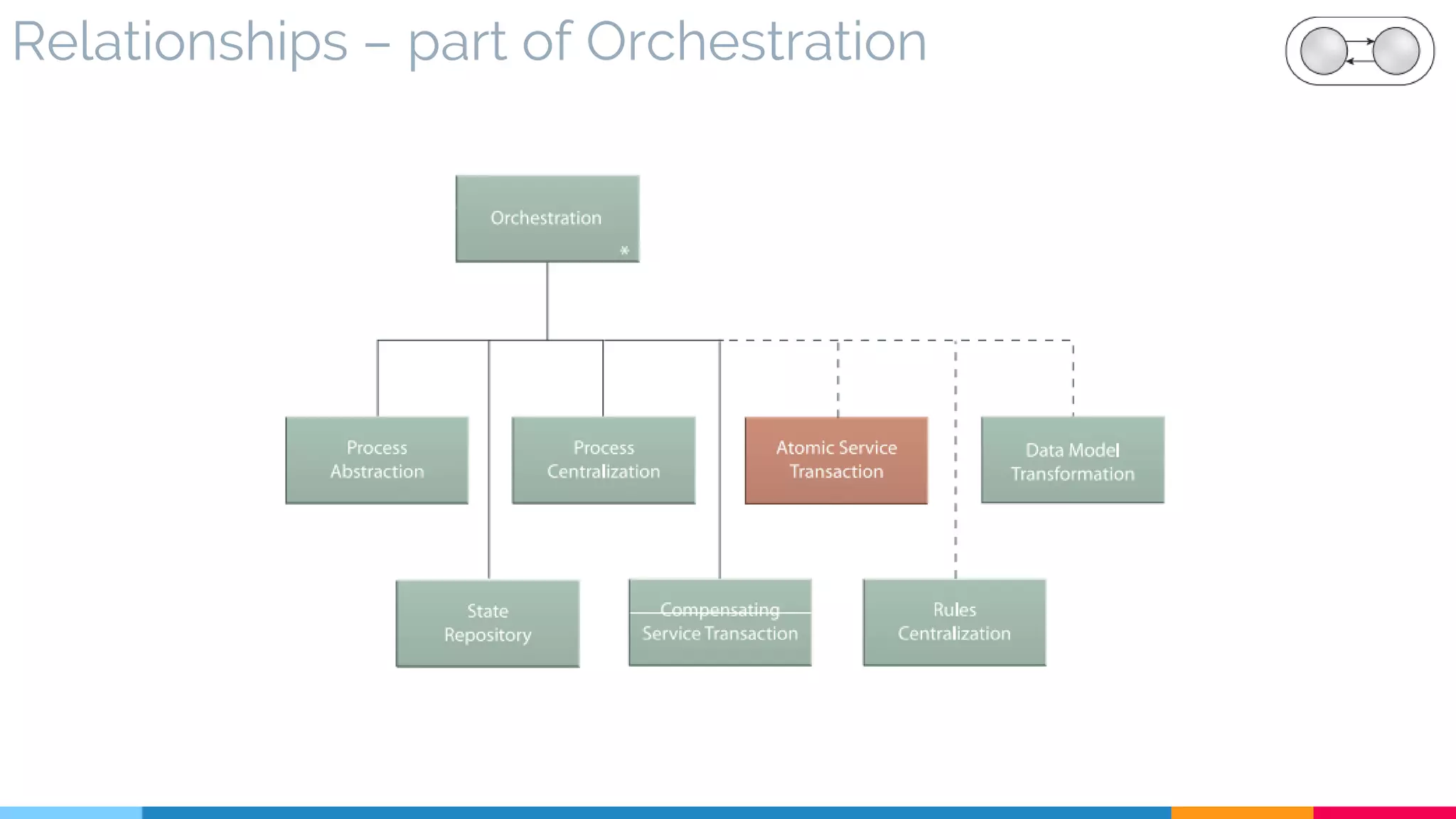
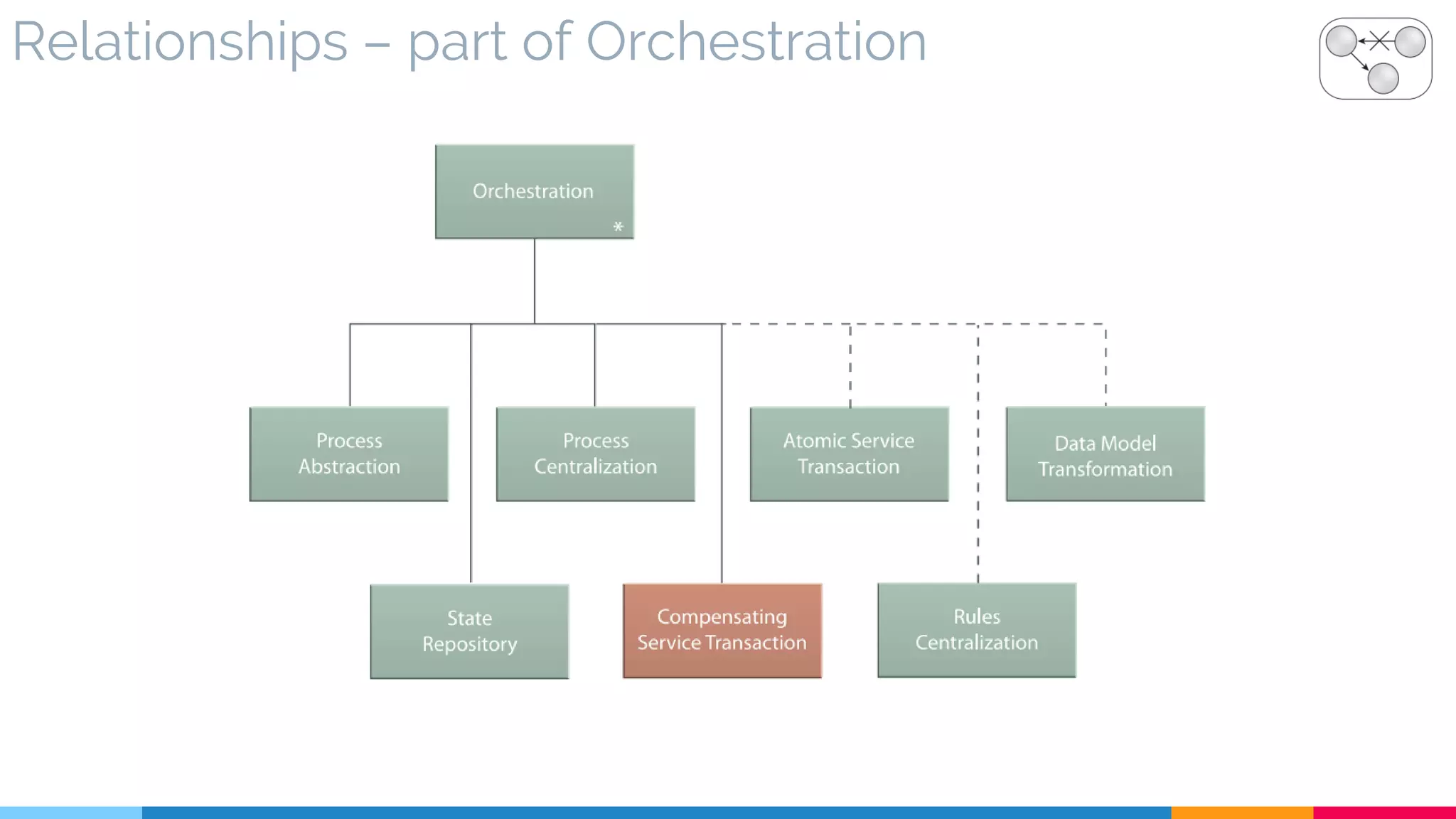
Relationships – Part of Orchestration
4 Data Format Transformation
▷ Problem
▷ Solution
▷ Real World Sample
▷ Application
▷ Impact
▷ Relationships
[681]
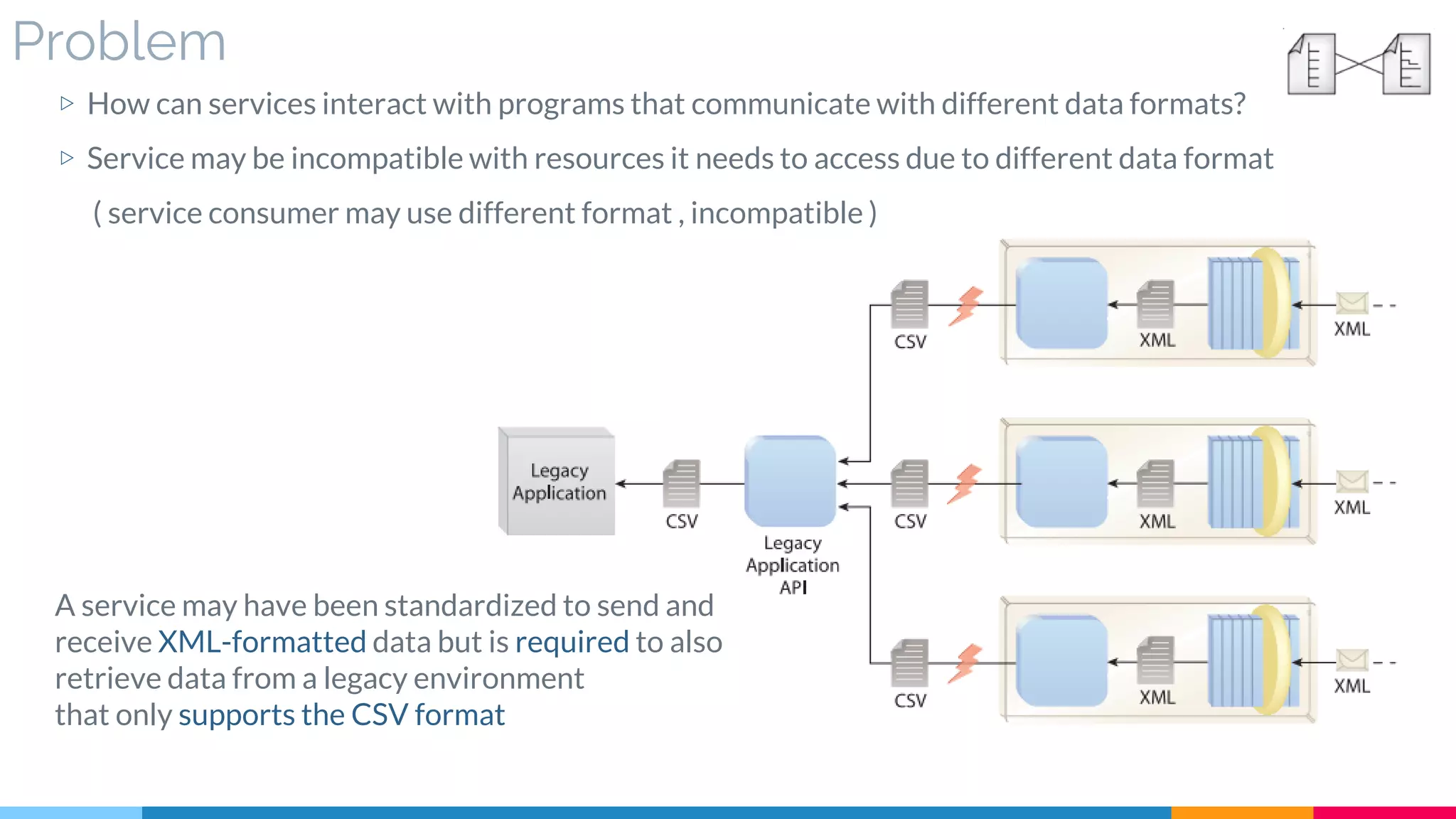
Problem
▷ How can services interact with programs that communicate with different data formats?
▷ Service may be incompatible with resources it needs to access due to different data format
( service consumer may use different format , incompatible )
A service may have been standardized to send and
receive XML-formatted data but is required to also
retrieve data from a legacy environment
that only supports the CSV format
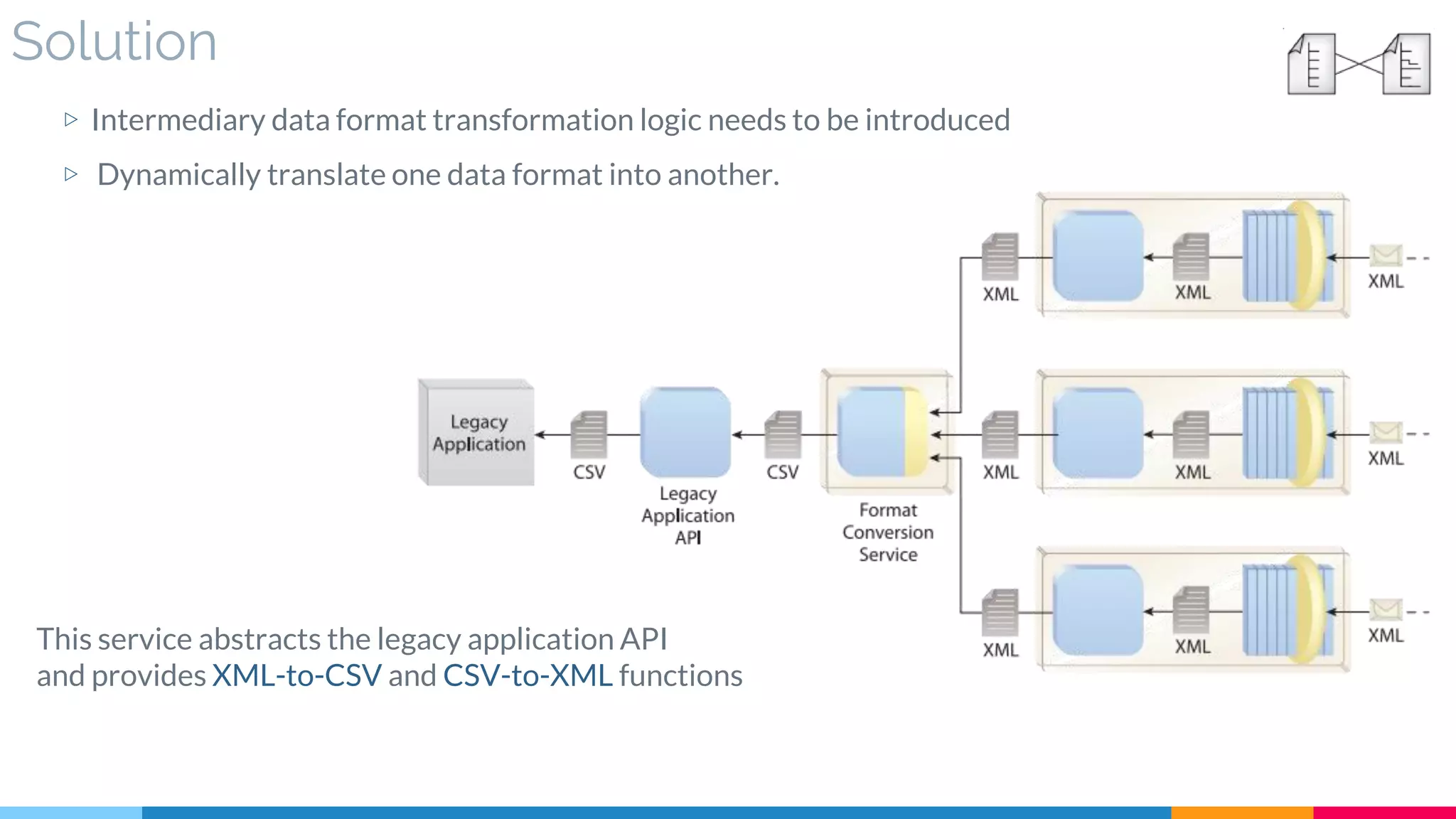
Solution
▷ Intermediary data format transformation logic needs to be introduced
▷ Dynamically translate one data format into another.
This service abstracts the legacy application API
and provides XML-to-CSV and CSV-to-XML functions
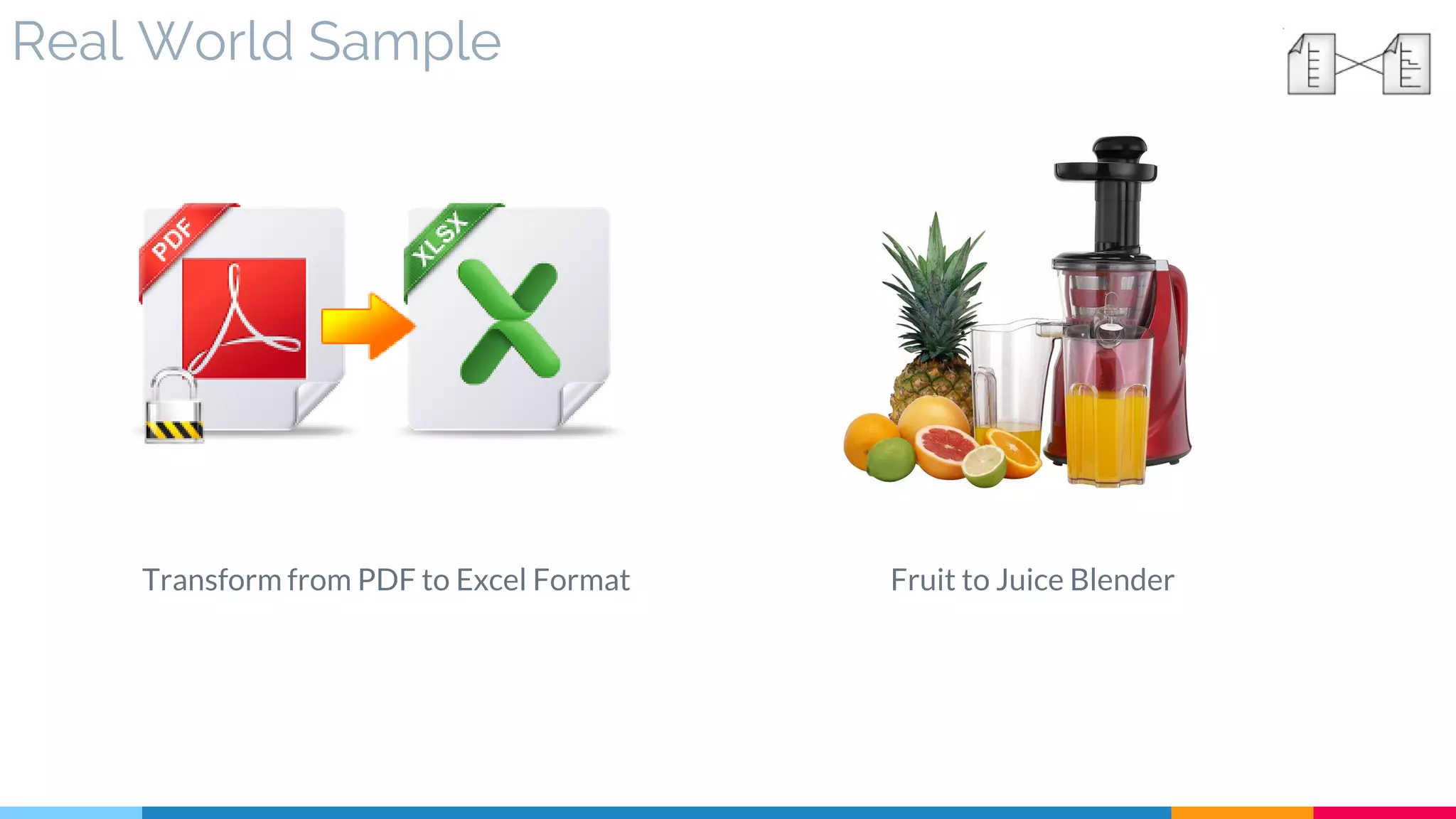
Real World Sample
Transform from PDF to Excel Format Fruit to Juice Blender
Application
▷ Add dedicated transformation service.
▷ Data format transformation logic can exist within a service’s internal logic, within
a service Agent
▷ Middleware will often provide out-of-the-box services and agents that perform
a variety of data format conversions.
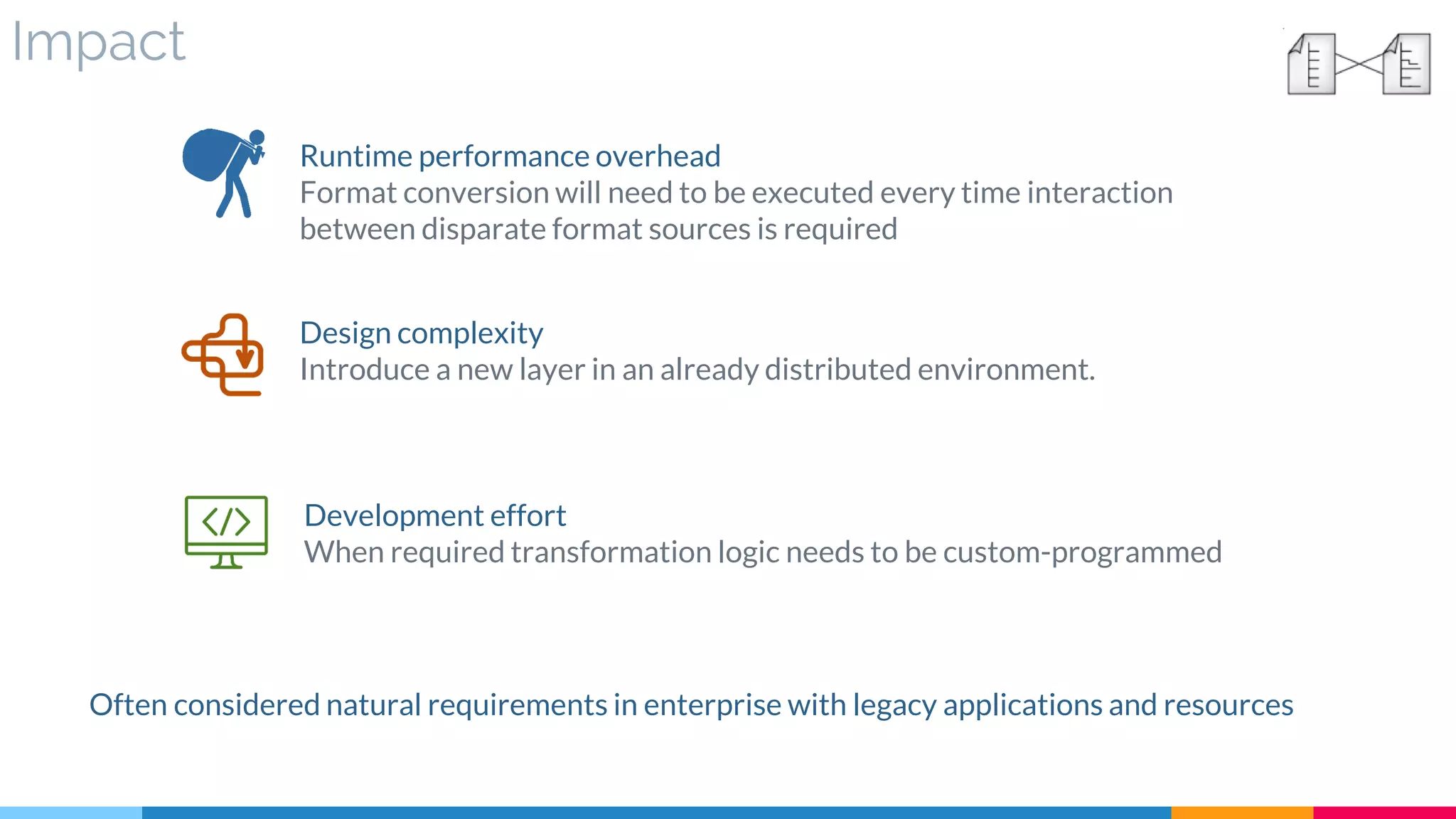
Impact
Runtime performance overhead
Format conversion will need to be executed every time interaction
between disparate format sources is required
Development effort
When required transformation logic needs to be custom-programmed
Design complexity
Introduce a new layer in an already distributed environment.
Often considered natural requirements in enterprise with legacy applications and resources
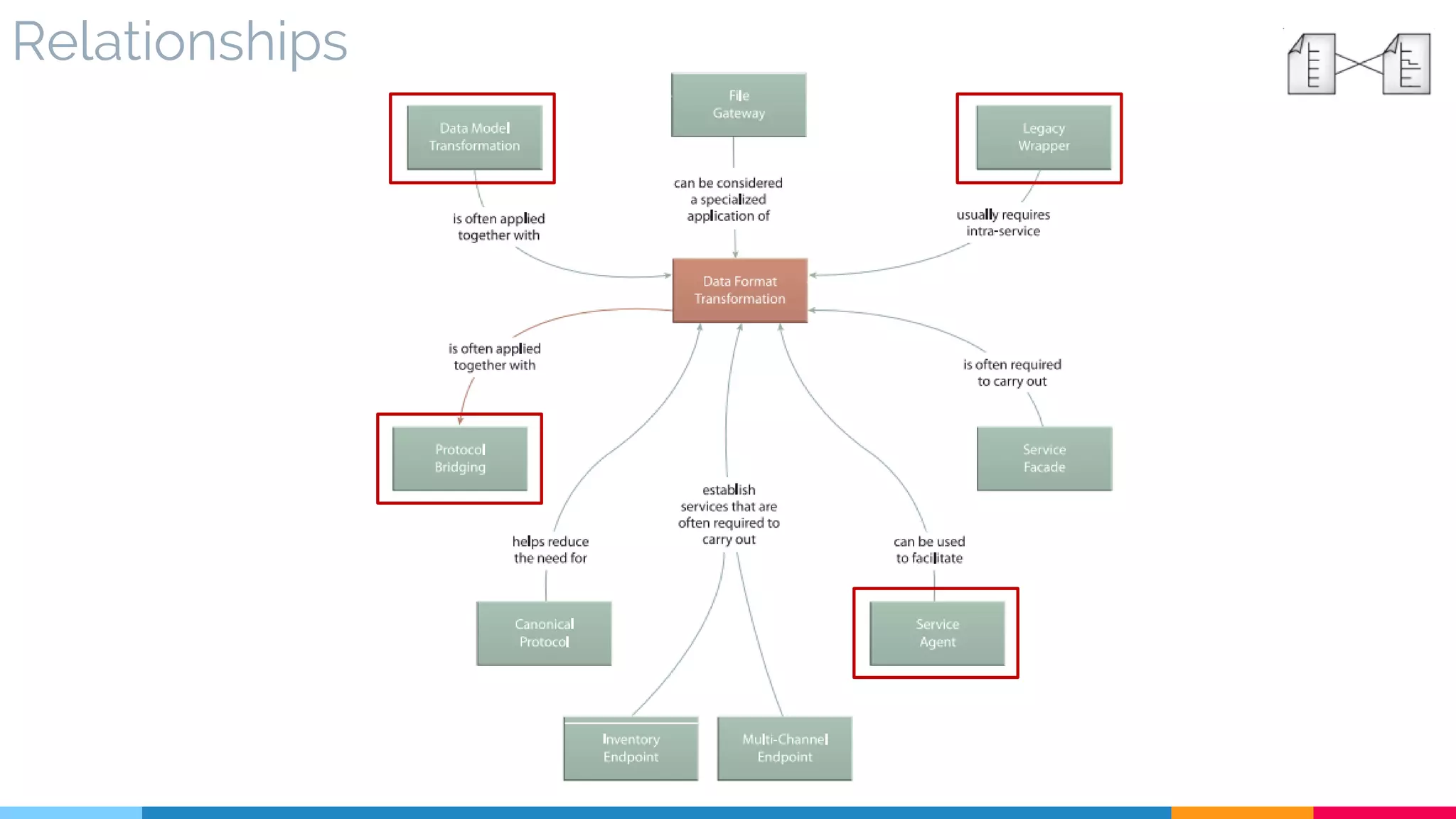
Relationships
Relationships – part of ESB , Broker
5 Protocol Bridging
▷ Problem
▷ Solution
▷ Real World Sample
▷ Application
▷ Impact
▷ Relationships
[687]
Problem
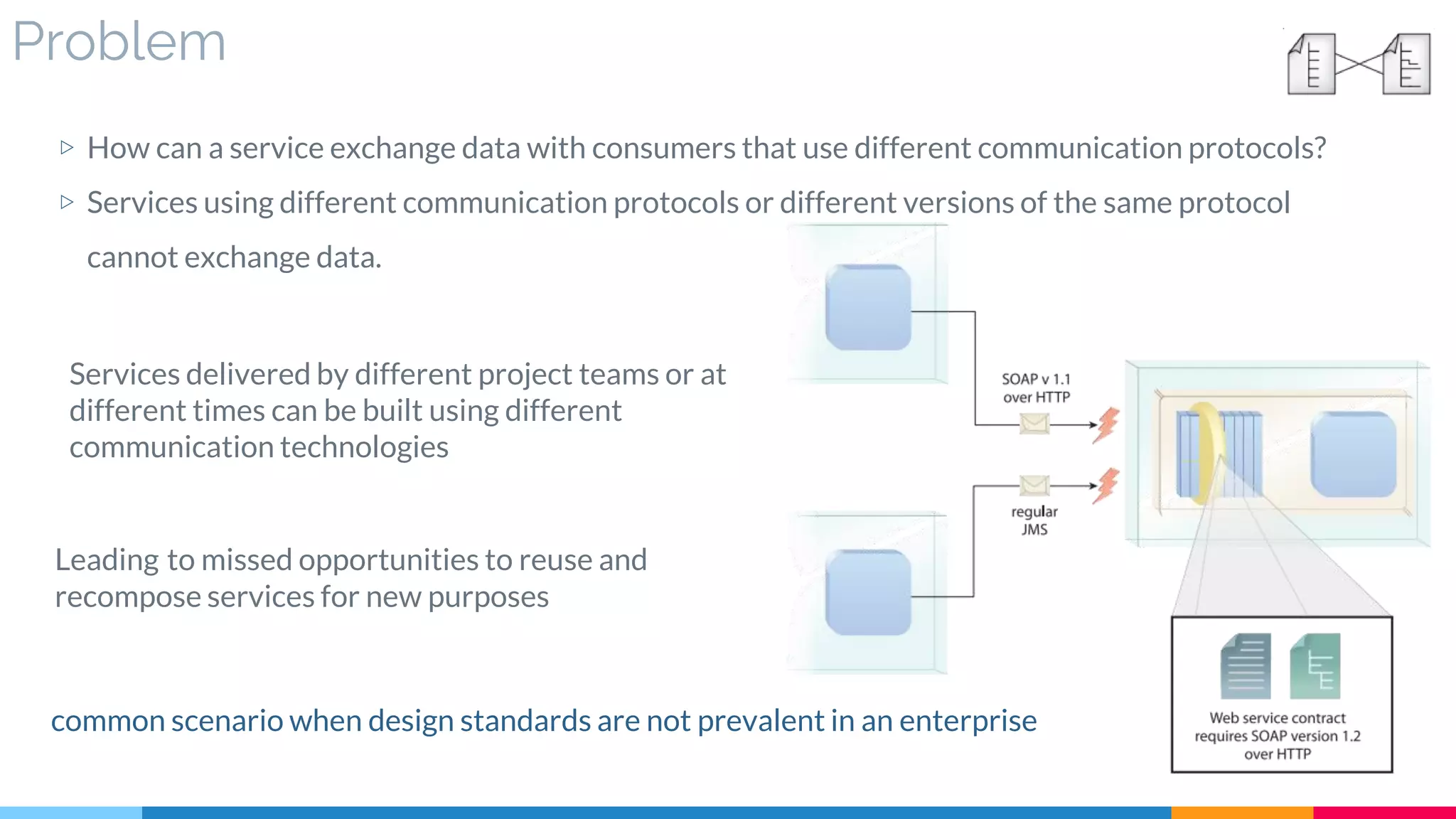
▷ How can a service exchange data with consumers that use different communication protocols?
▷ Services using different communication protocols or different versions of the same protocol
cannot exchange data.
Services delivered by different project teams or at
different times can be built using different
communication technologies
common scenario when design standards are not prevalent in an enterprise
Leading to missed opportunities to reuse and
recompose services for new purposes
Solution
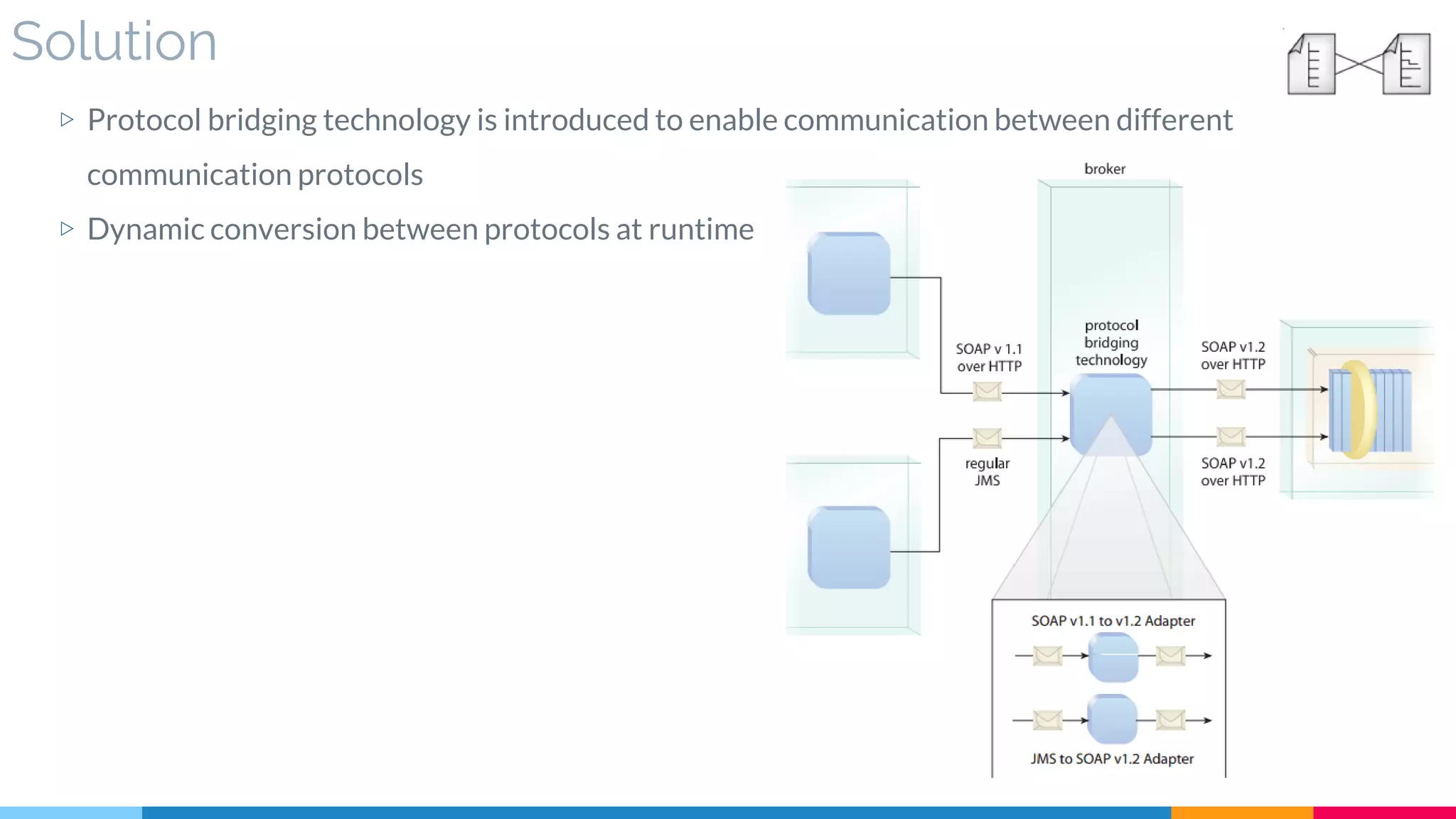
▷ Protocol bridging technology is introduced to enable communication between different
communication protocols
▷ Dynamic conversion between protocols at runtime
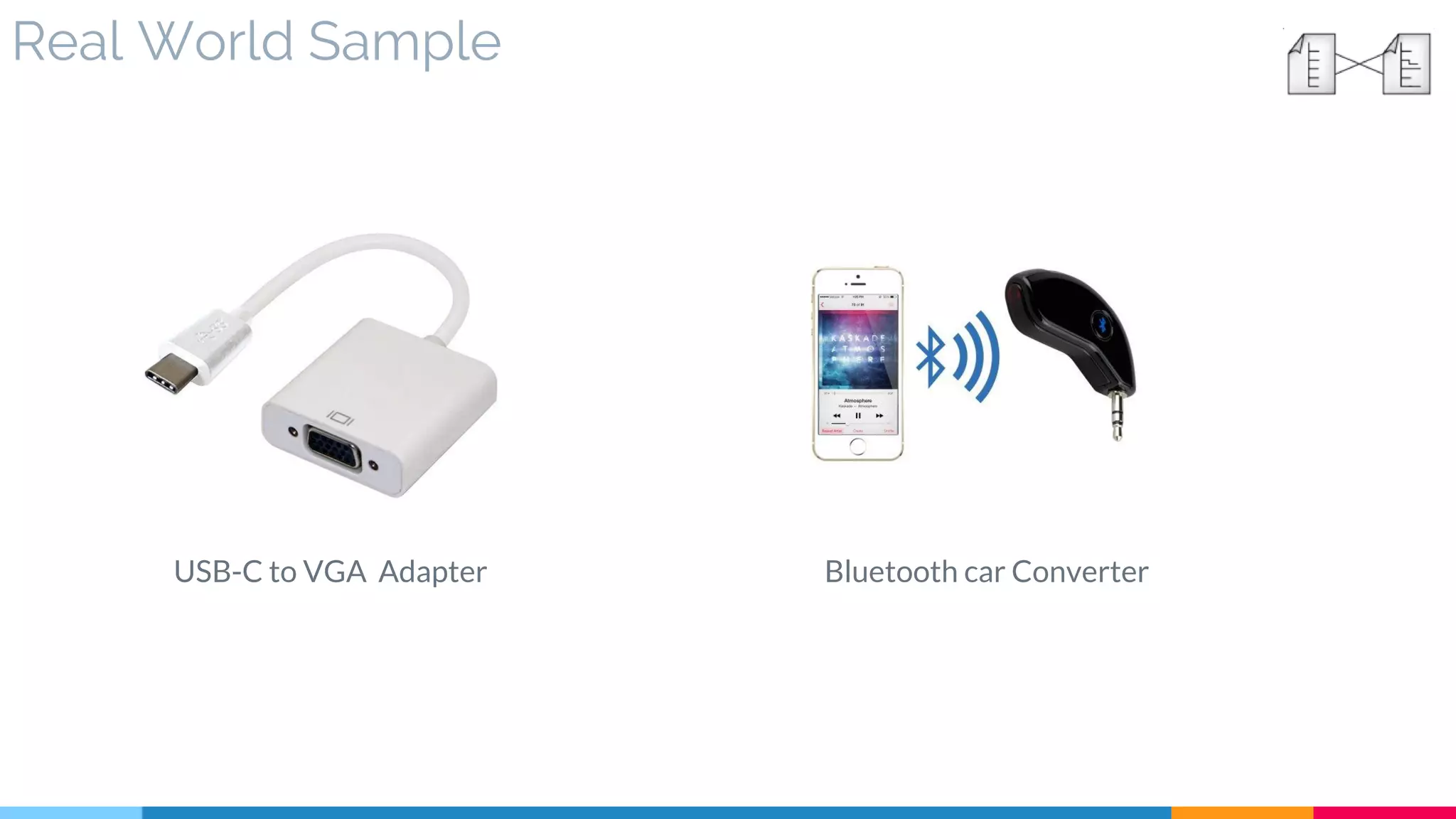
Real World Sample
USB-C to VGA Adapter Bluetooth car Converter
Application
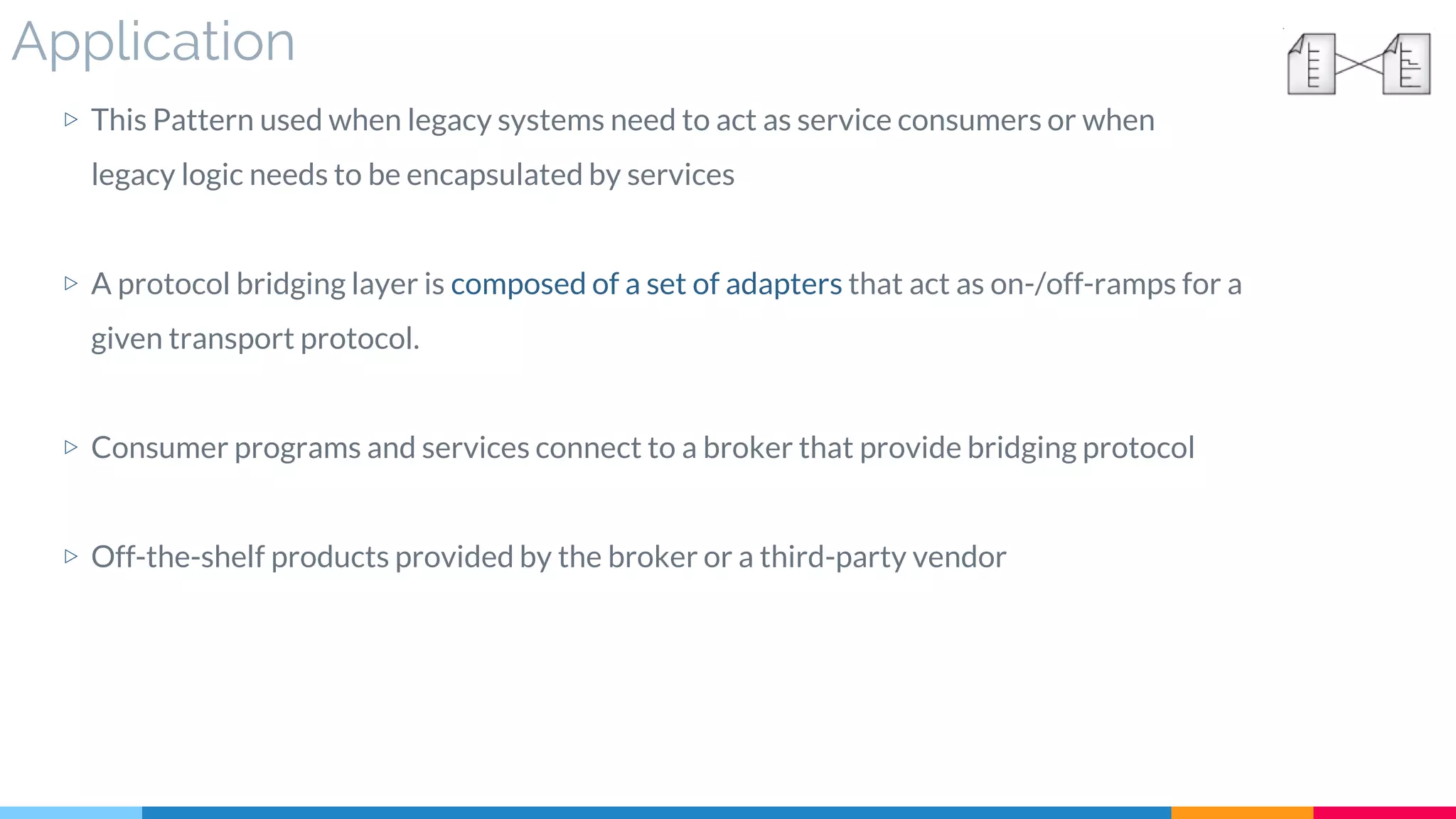
▷ This Pattern used when legacy systems need to act as service consumers or when
legacy logic needs to be encapsulated by services
▷ A protocol bridging layer is composed of a set of adapters that act as on-/off-ramps for a
given transport protocol.
▷ Consumer programs and services connect to a broker that provide bridging protocol
▷ Off-the-shelf products provided by the broker or a third-party vendor
Impact
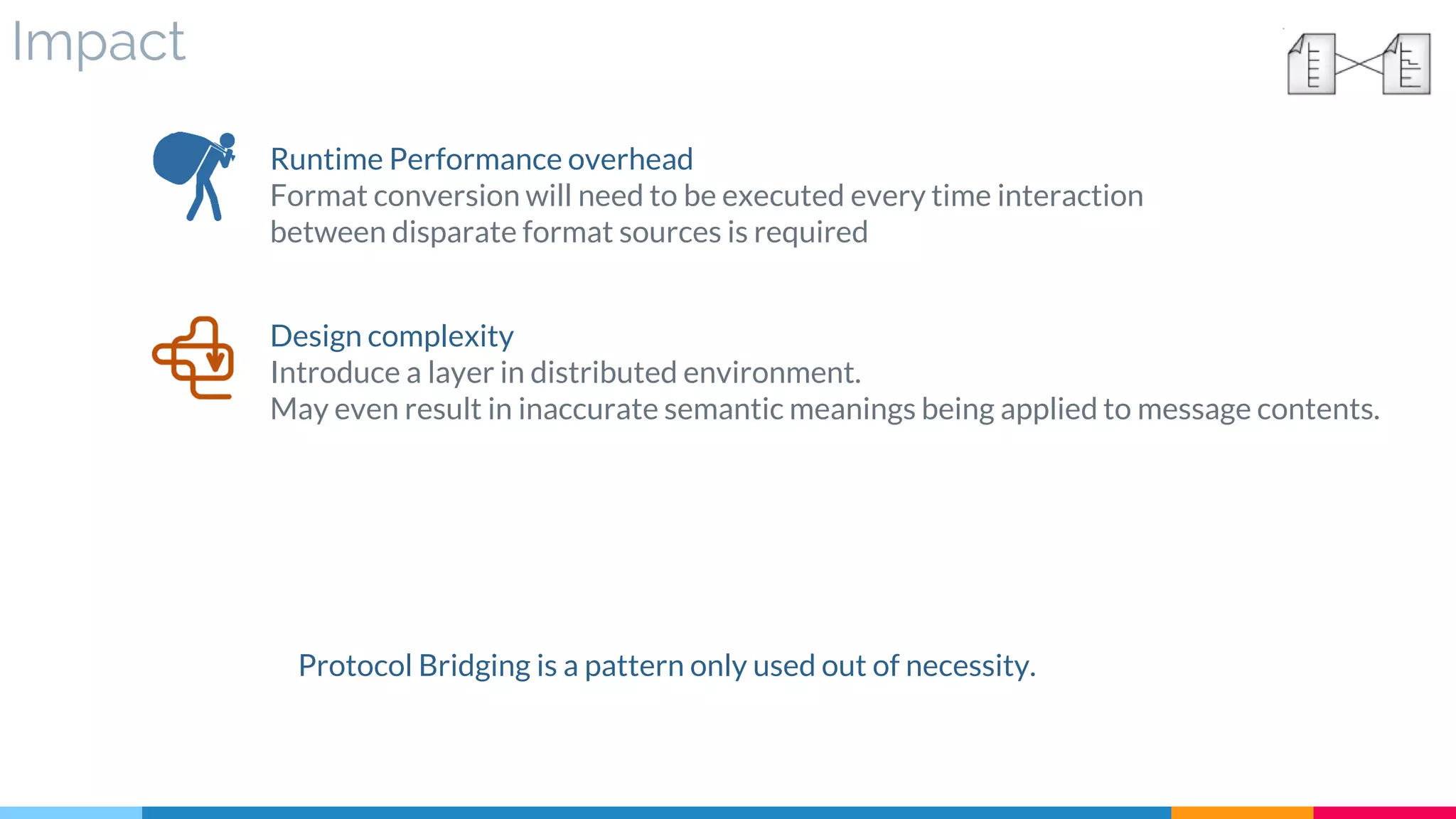
Runtime Performance overhead
Format conversion will need to be executed every time interaction
between disparate format sources is required
Protocol Bridging is a pattern only used out of necessity.
Design complexity
Introduce a layer in distributed environment.
May even result in inaccurate semantic meanings being applied to message contents.
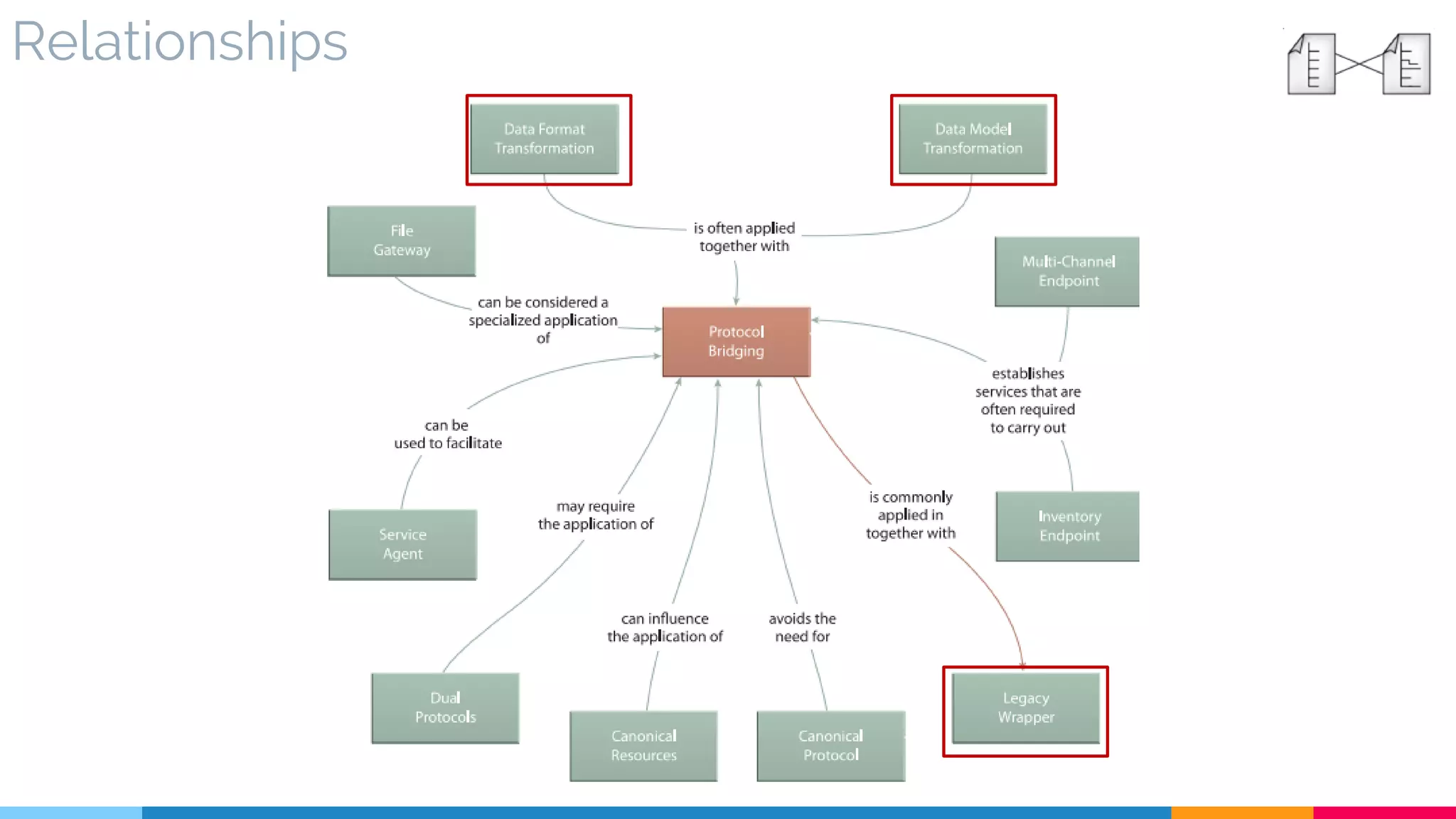
Relationships
Relationships – part of ESB , Broker
6 Intermediate Routing
▷ Problem
▷ Solution
▷ Real World Sample
▷ Application
▷ Impact
▷ Relationships
[549]
Problem
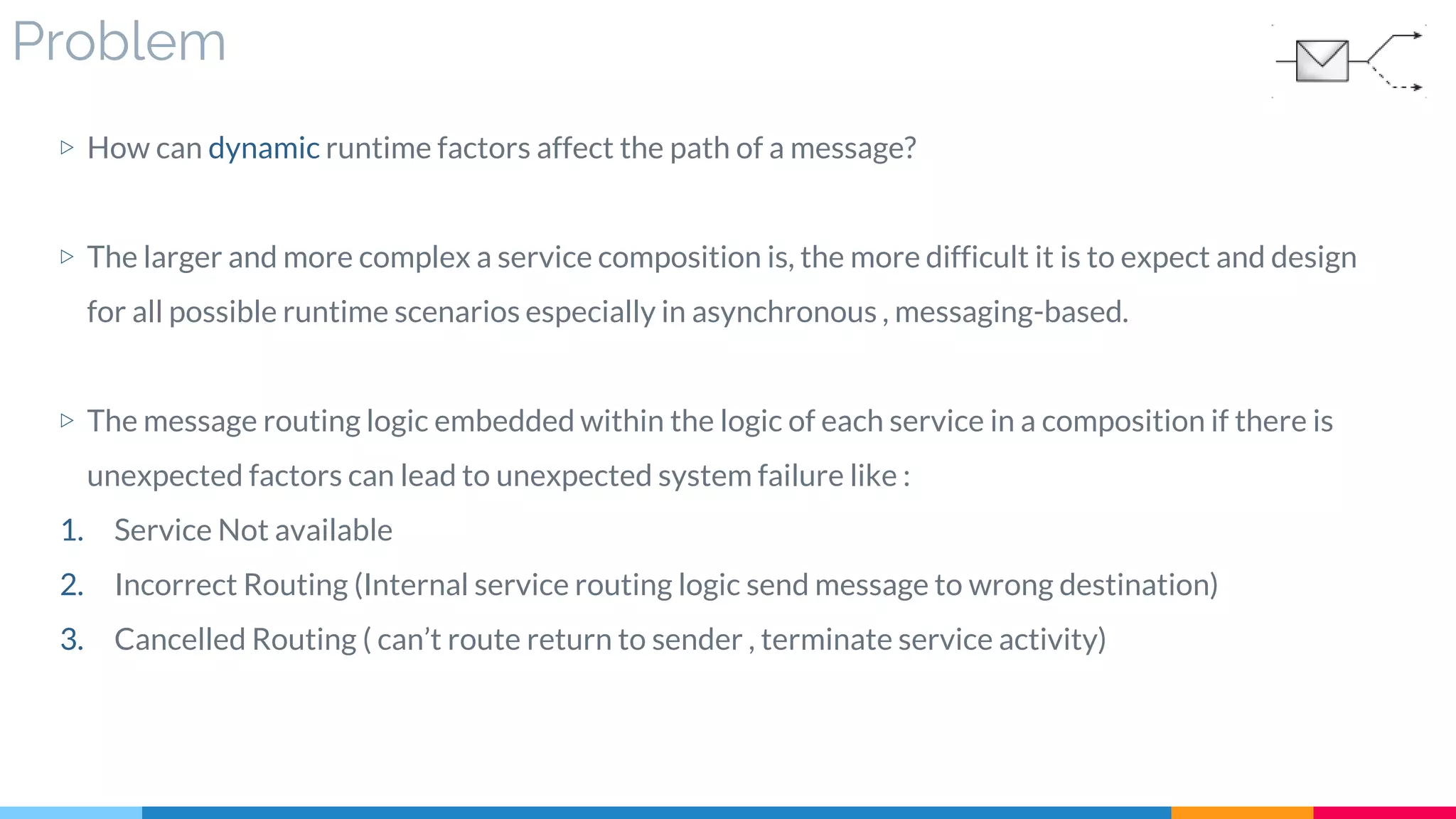
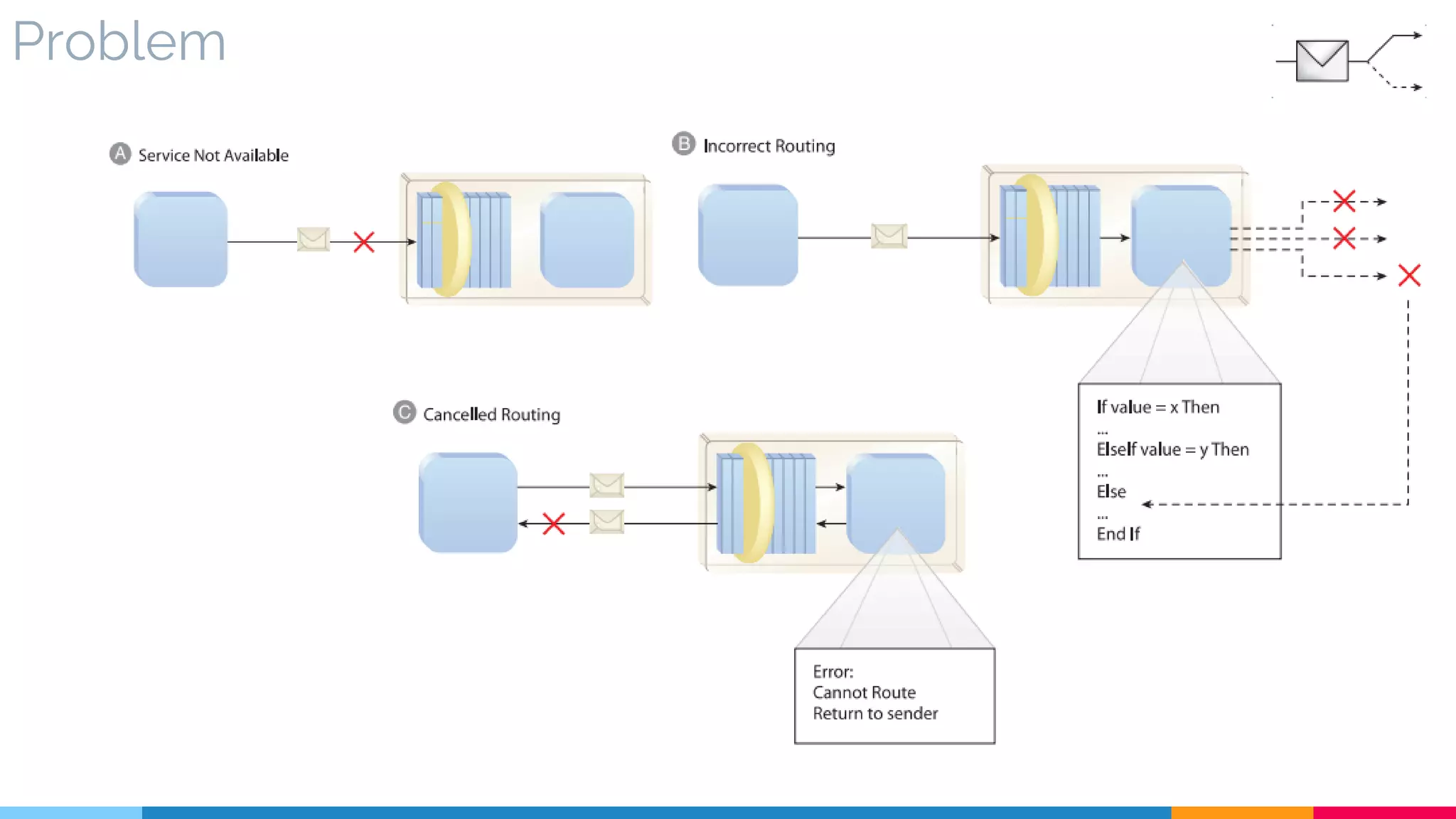
▷ How can dynamic runtime factors affect the path of a message?
▷ The larger and more complex a service composition is, the more difficult it is to expect and design
for all possible runtime scenarios especially in asynchronous , messaging-based.
▷ The message routing logic embedded within the logic of each service in a composition if there is
unexpected factors can lead to unexpected system failure like :
1. Service Not available
2. Incorrect Routing (Internal service routing logic send message to wrong destination)
3. Cancelled Routing ( can’t route return to sender , terminate service activity)
Problem
Solution
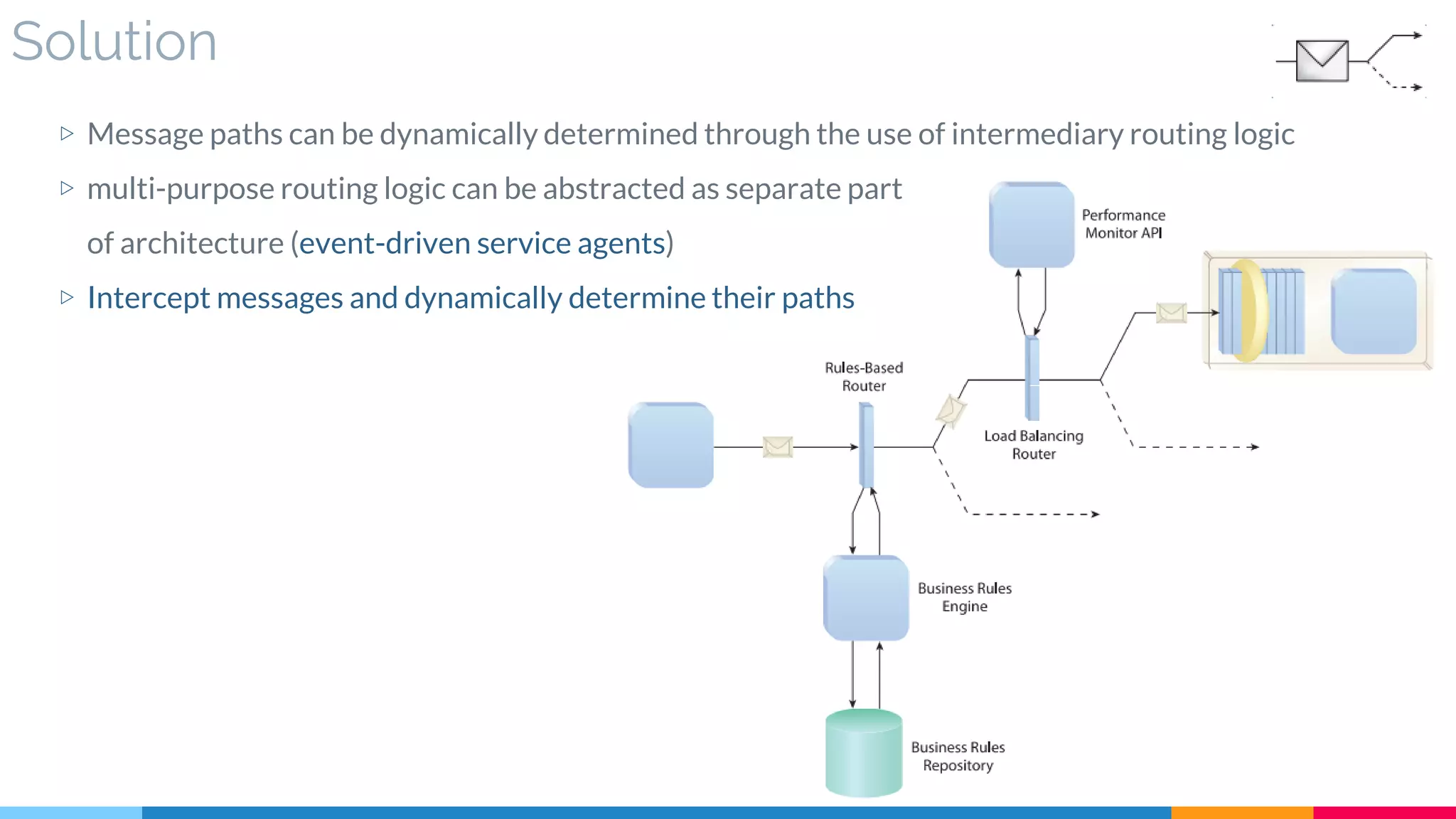
▷ Message paths can be dynamically determined through the use of intermediary routing logic
▷ multi-purpose routing logic can be abstracted as separate part
of architecture (event-driven service agents)
▷ Intercept messages and dynamically determine their paths
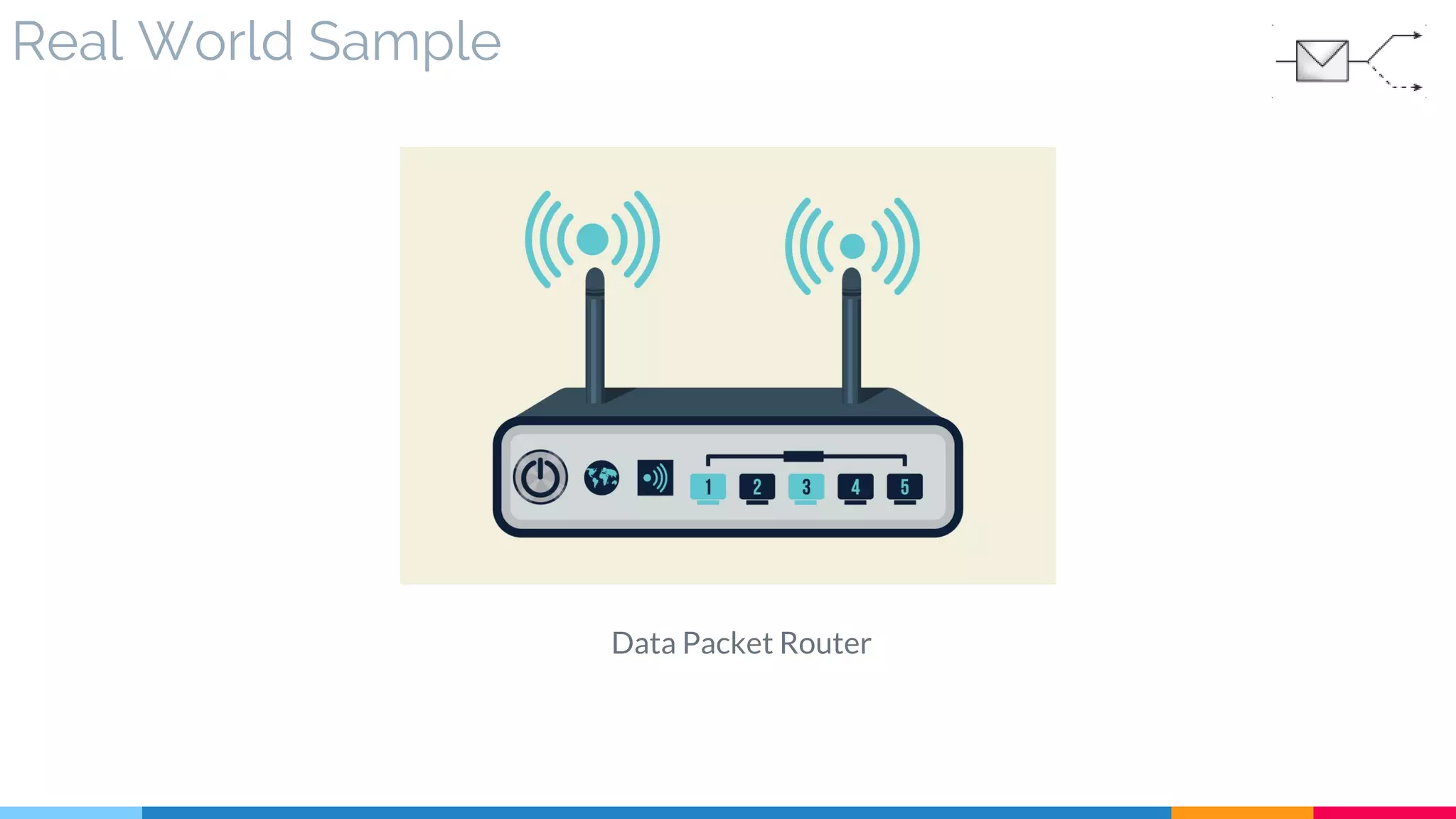
Real World Sample
Data Packet Router
Application
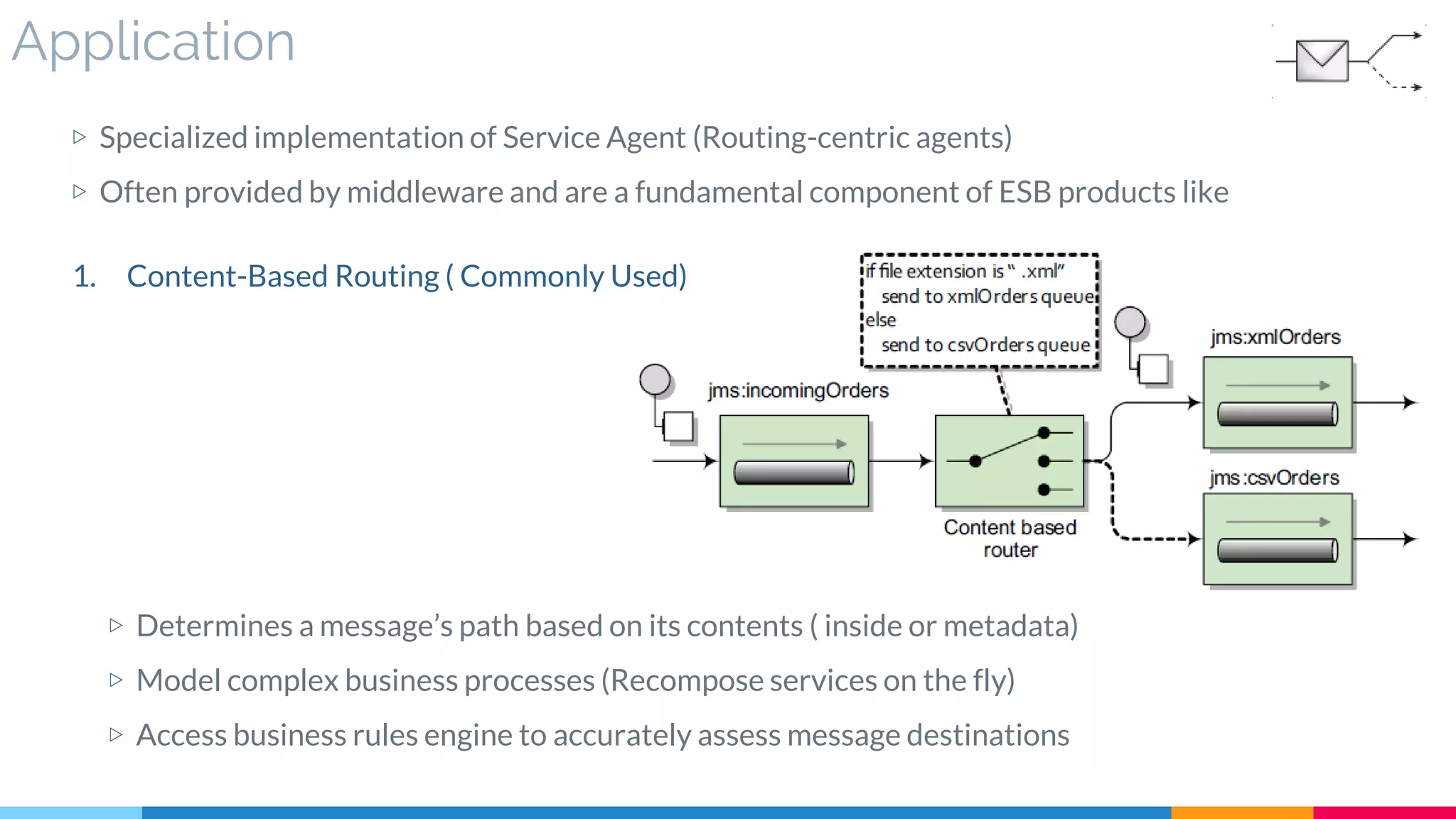
▷ Specialized implementation of Service Agent (Routing-centric agents)
▷ Often provided by middleware and are a fundamental component of ESB products like
▷ Determines a message’s path based on its contents ( inside or metadata)
▷ Model complex business processes (Recompose services on the fly)
▷ Access business rules engine to accurately assess message destinations
1. Content-Based Routing ( Commonly Used)
Application
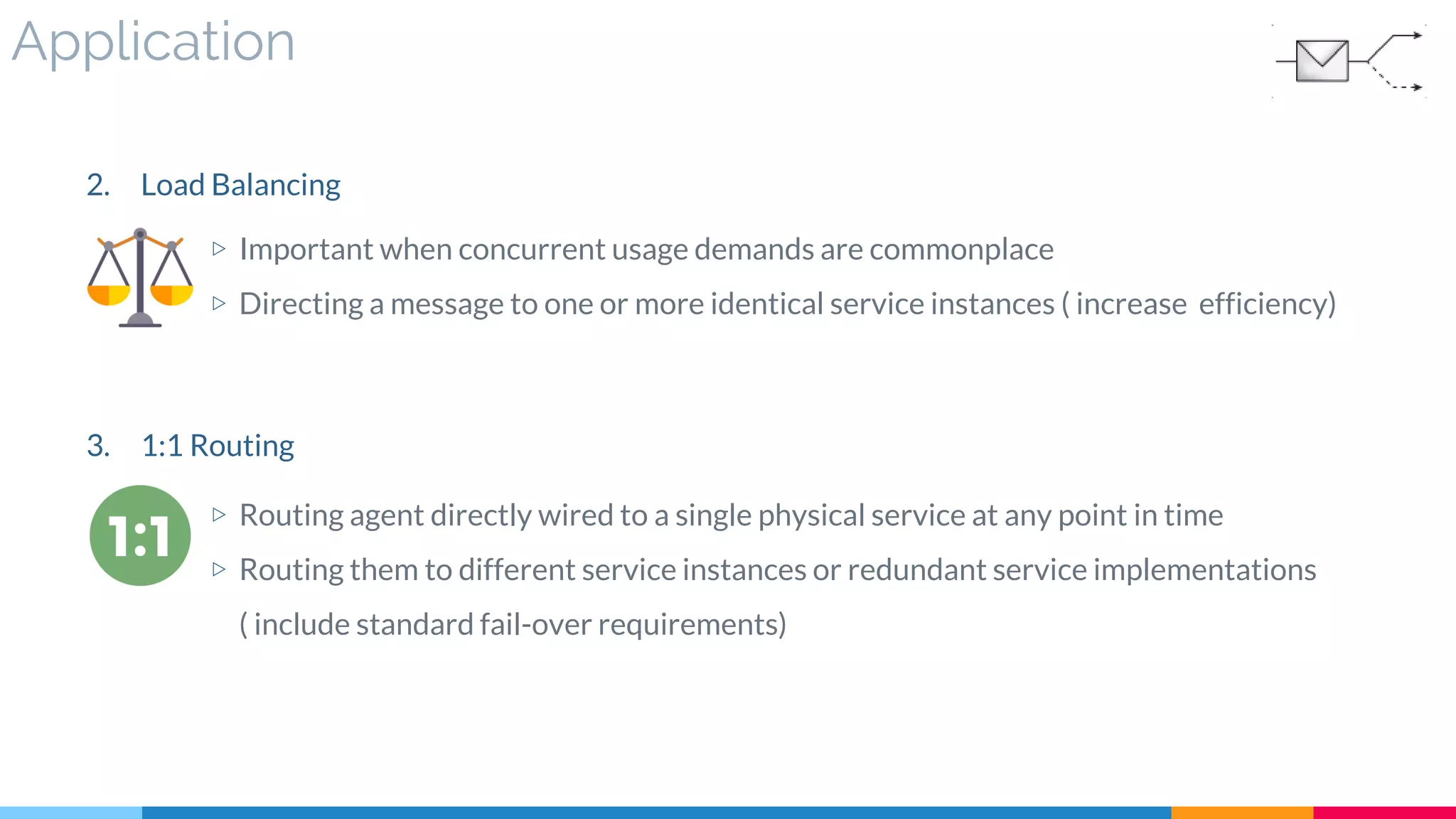
2. Load Balancing
▷ Important when concurrent usage demands are commonplace
▷ Directing a message to one or more identical service instances ( increase efficiency)
3. 1:1 Routing
▷ Routing agent directly wired to a single physical service at any point in time
▷ Routing them to different service instances or redundant service implementations
( include standard fail-over requirements)
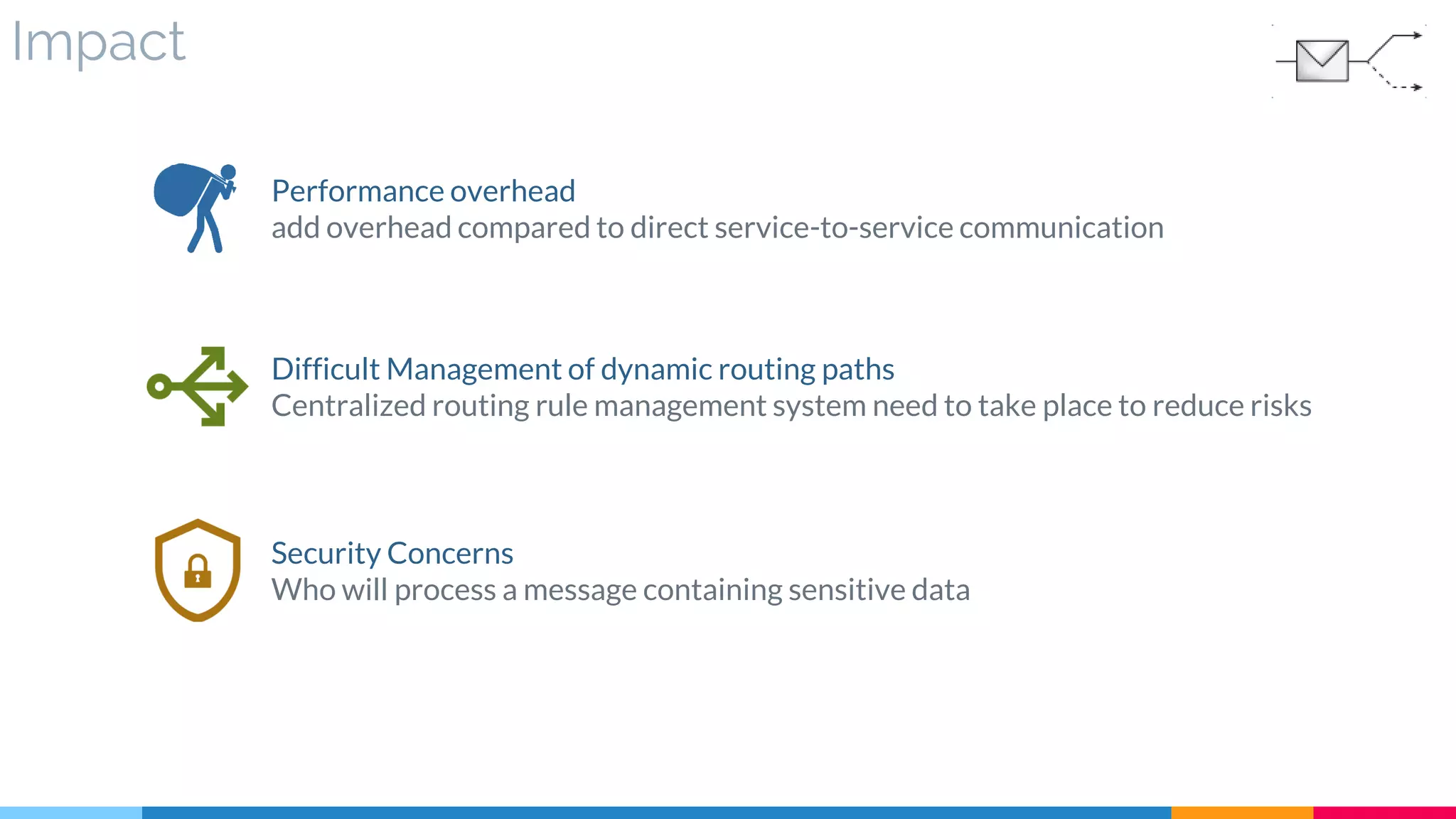
Impact
Performance overhead
add overhead compared to direct service-to-service communication
Security Concerns
Who will process a message containing sensitive data
Difficult Management of dynamic routing paths
Centralized routing rule management system need to take place to reduce risks
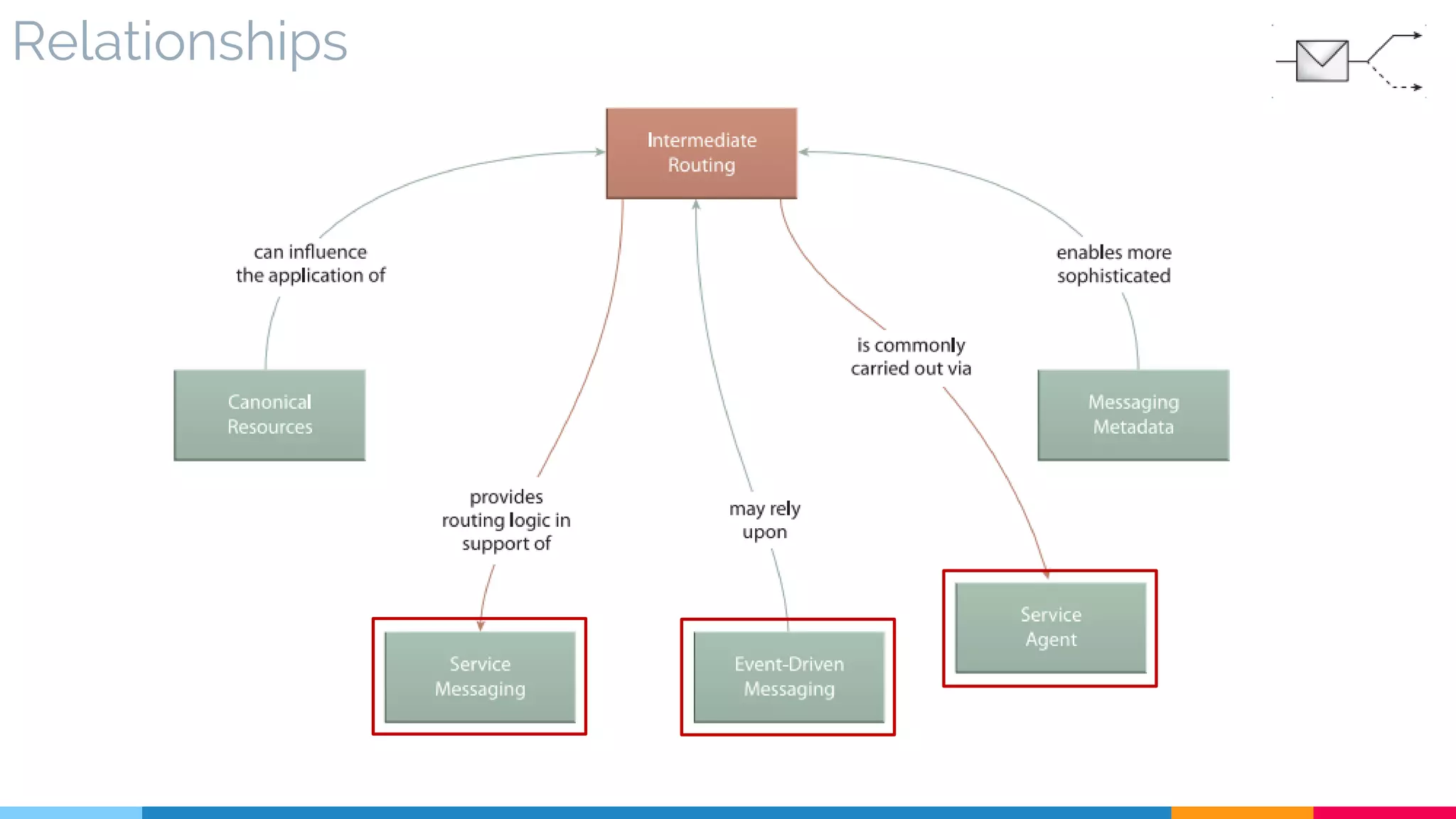
Relationships
Relationships – part of ESB
7 Asynchronous Queue
▷ Problem
▷ Solution
▷ Real World Sample
▷ Application
▷ Impact
▷ Relationships
[582]
Problem
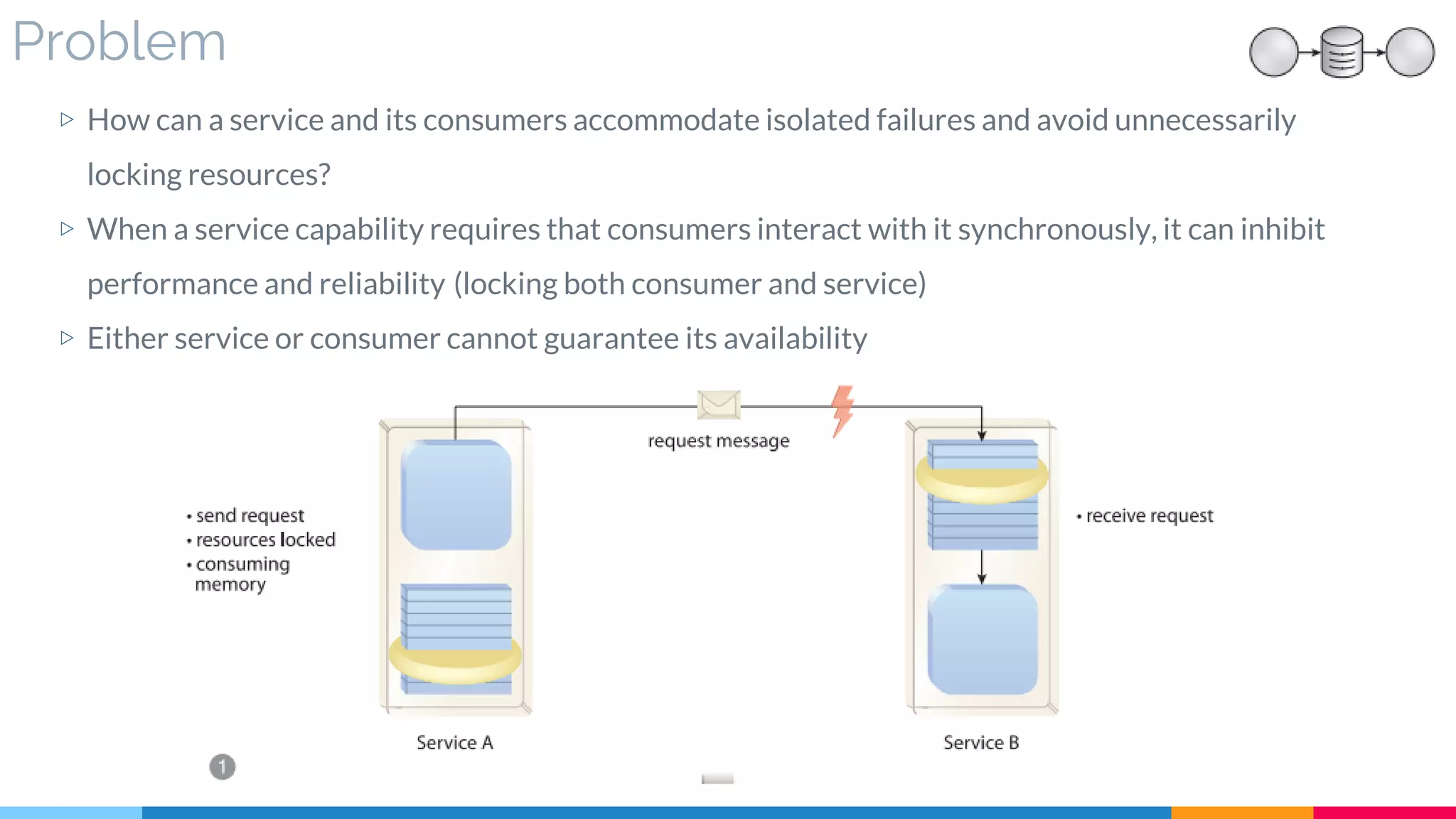
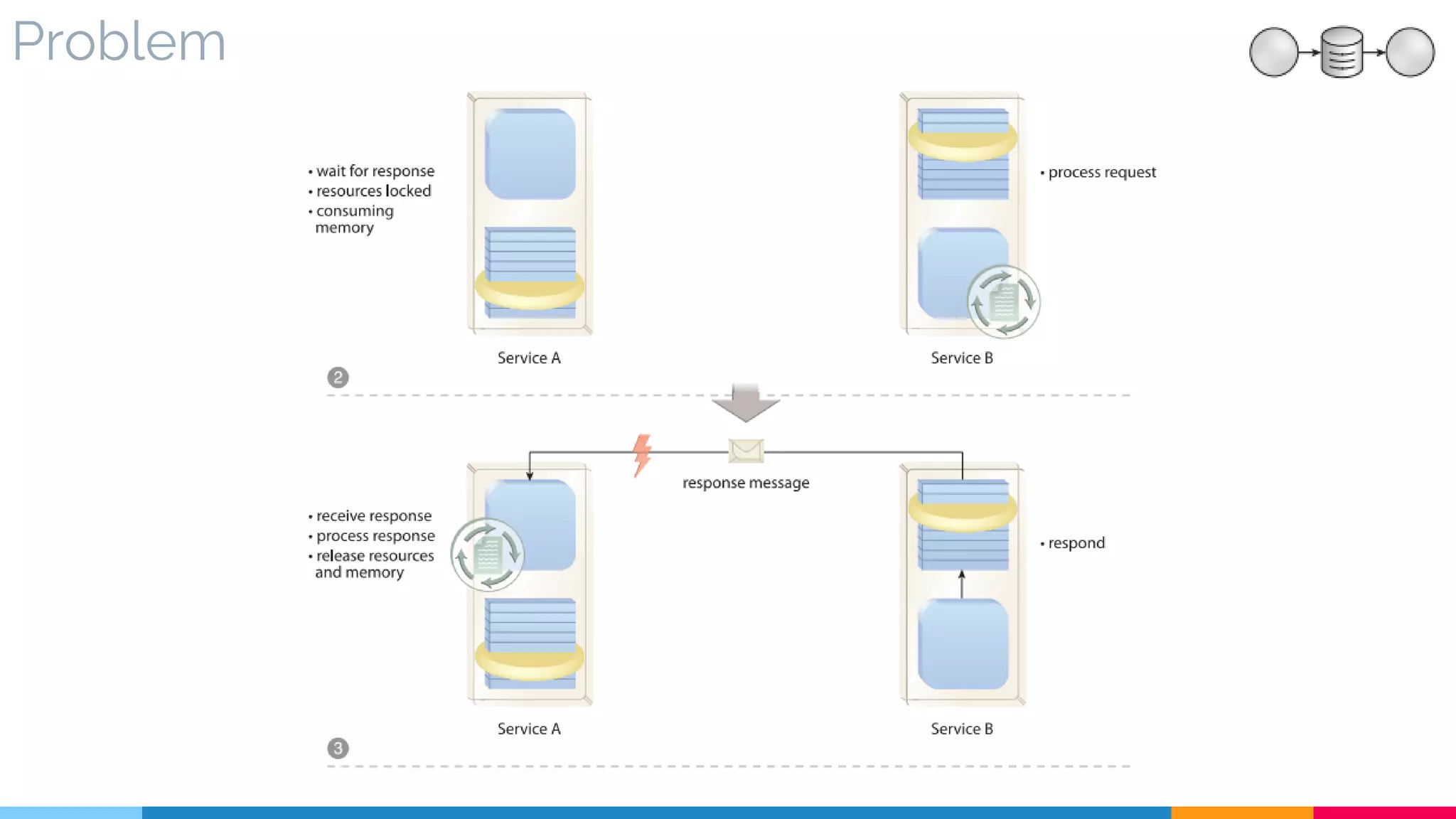
▷ How can a service and its consumers accommodate isolated failures and avoid unnecessarily
locking resources?
▷ When a service capability requires that consumers interact with it synchronously, it can inhibit
performance and reliability (locking both consumer and service)
▷ Either service or consumer cannot guarantee its availability
Problem
Solution
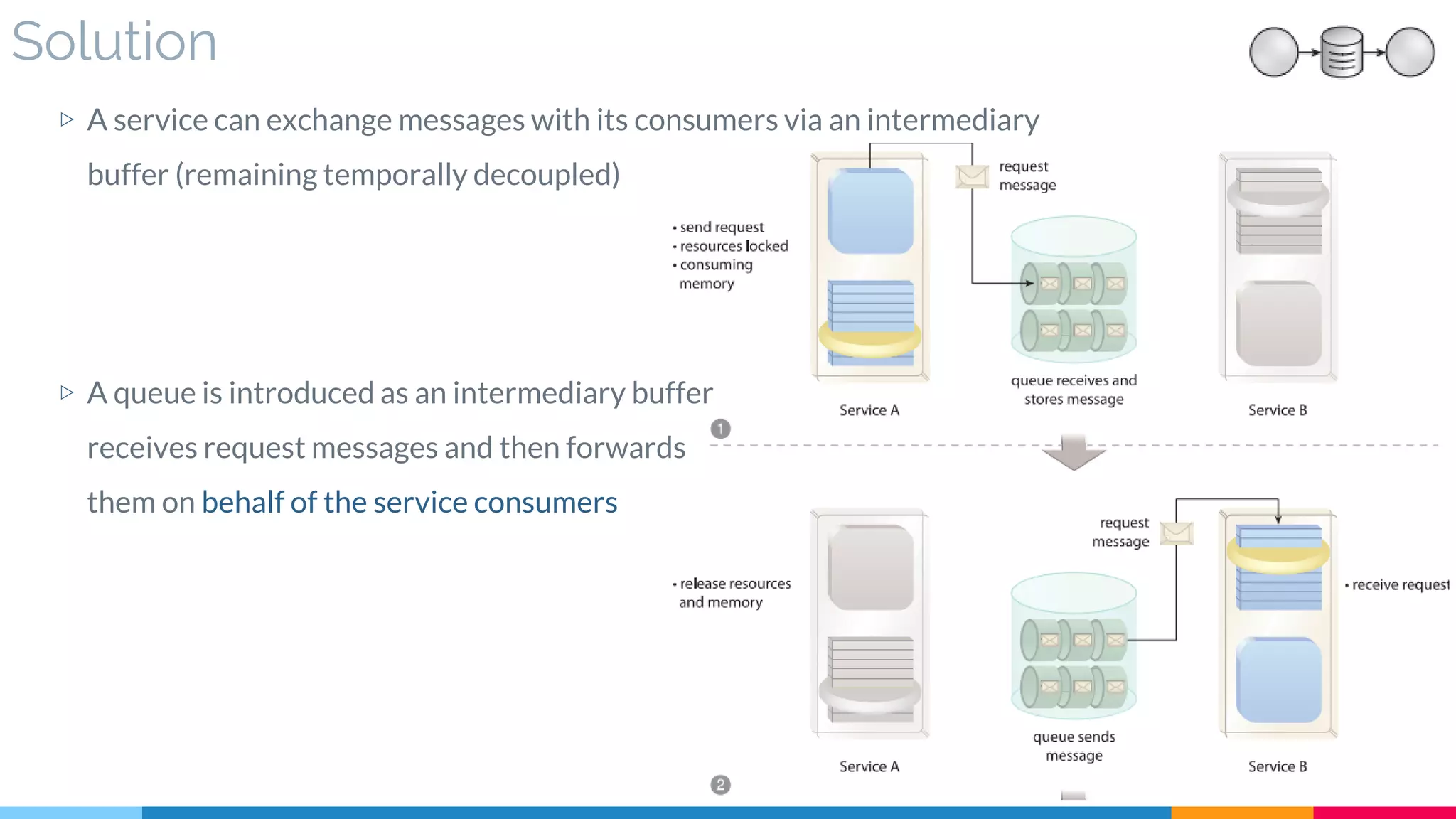
▷ A service can exchange messages with its consumers via an intermediary
buffer (remaining temporally decoupled)
▷ A queue is introduced as an intermediary buffer
receives request messages and then forwards
them on behalf of the service consumers
Solution
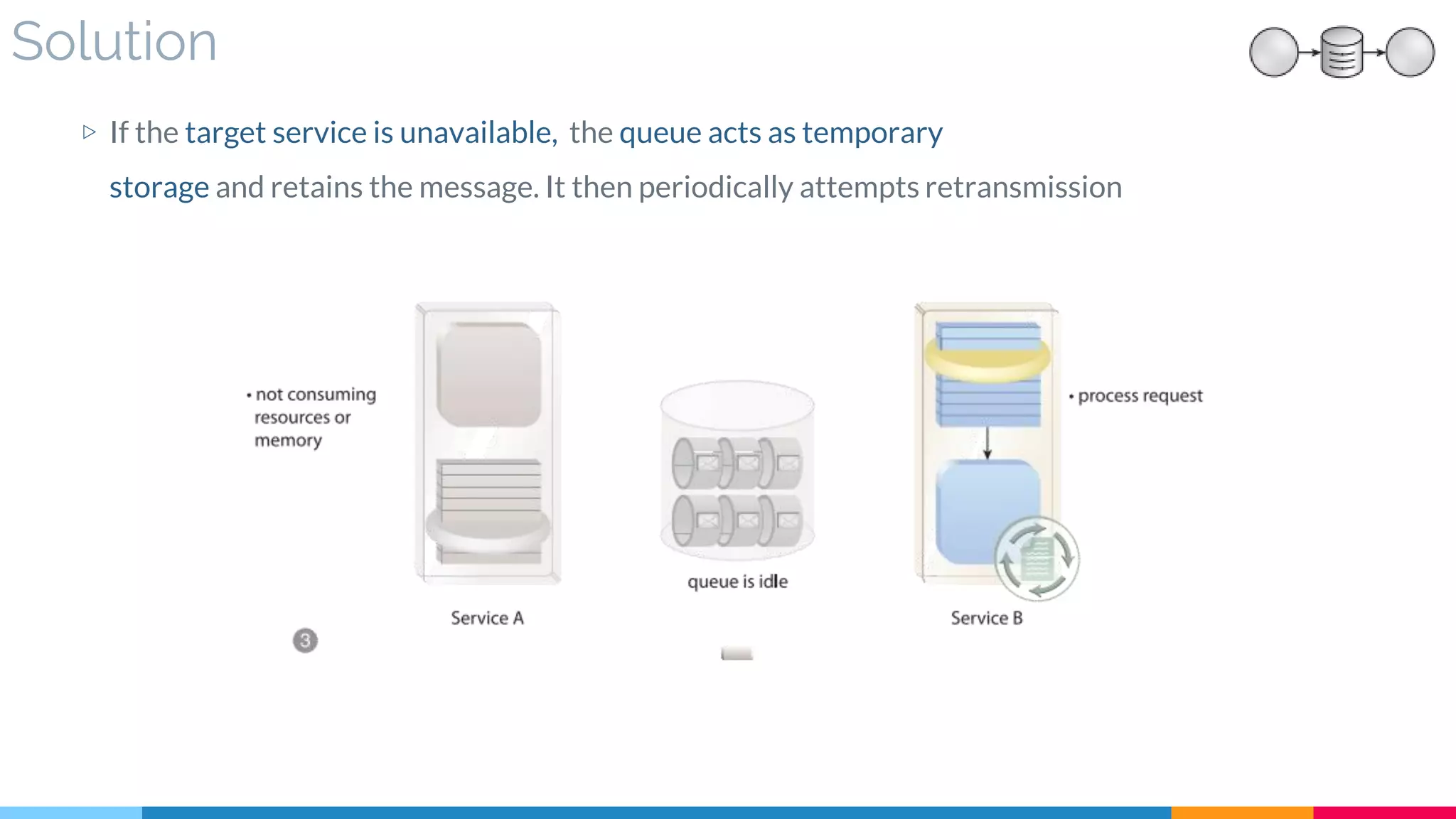
▷ If the target service is unavailable, the queue acts as temporary
storage and retains the message. It then periodically attempts retransmission
Real World Sample
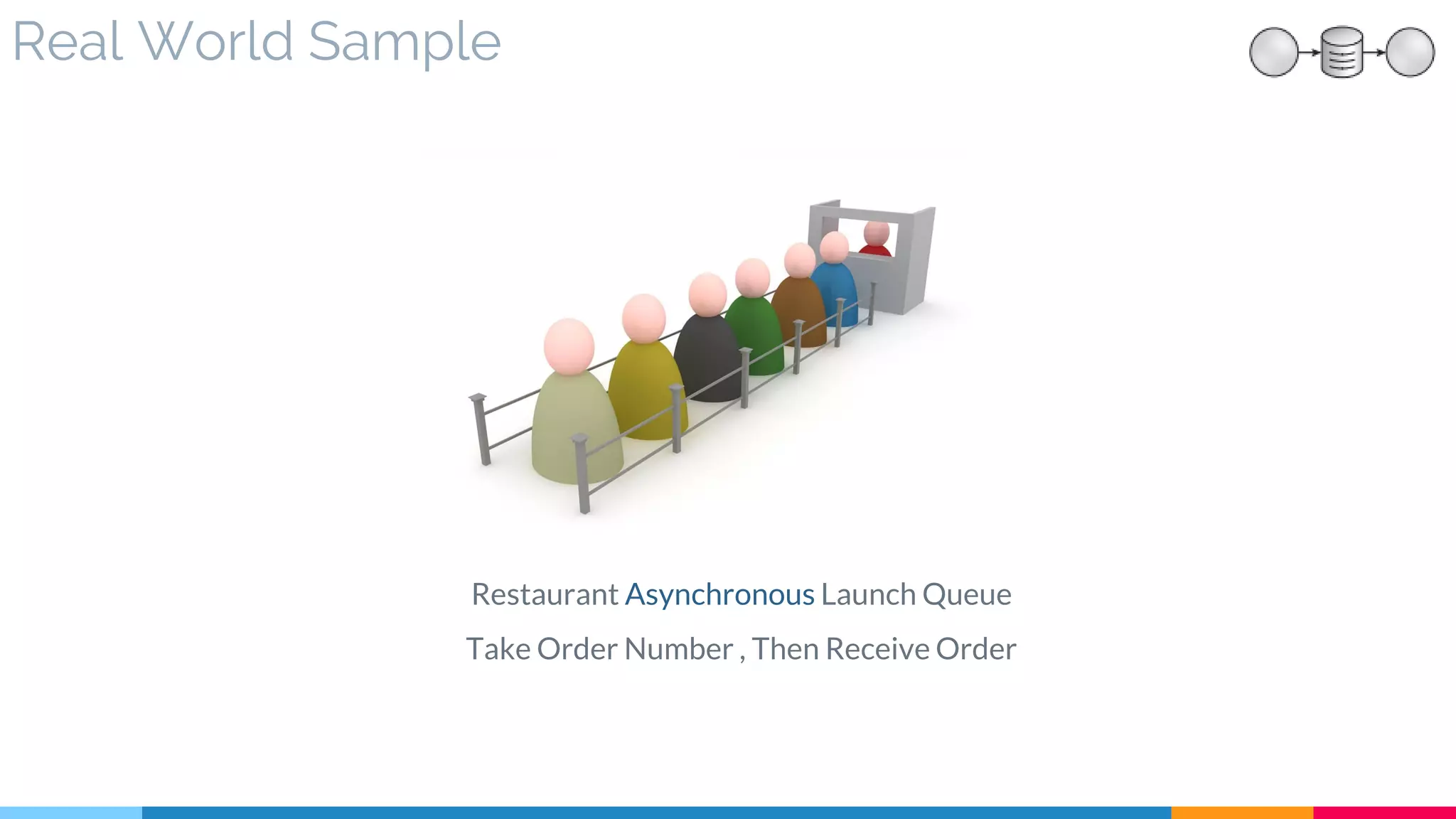
Restaurant Asynchronous Launch Queue
Take Order Number , Then Receive Order
Application
▷ Queuing technology needs to be incorporated into the surrounding architecture
▷ In modern ESB platforms, the use of a queue can be completely transparent
(neither consumer nor service may know that a queue was involved in a data exchange)
▷ The queuing framework can be supported by intelligent service agents that detect when a
queue is required and intercept message transmissions
▷ Queue Can Leverage asynchronous message exchange by incorporating topics and message
broadcasts to multiple consumers, as per Event-Driven Messaging
Impact
There may be no acknowledgement of successful message delivery
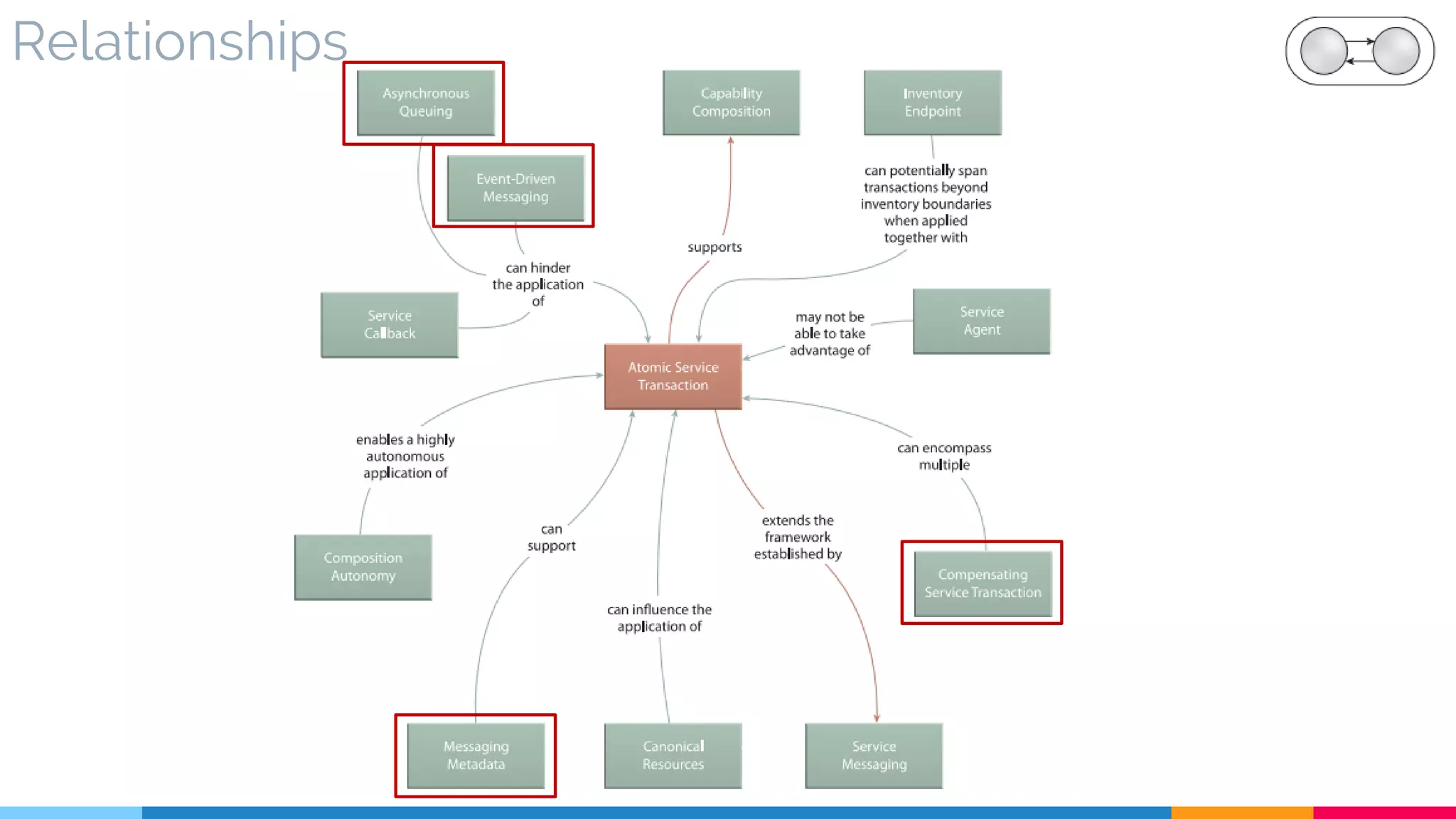
Atomic transactions may not be possible
Difficult to control and monitor.
Can lead to complex service activities that are difficult to design
Relationships
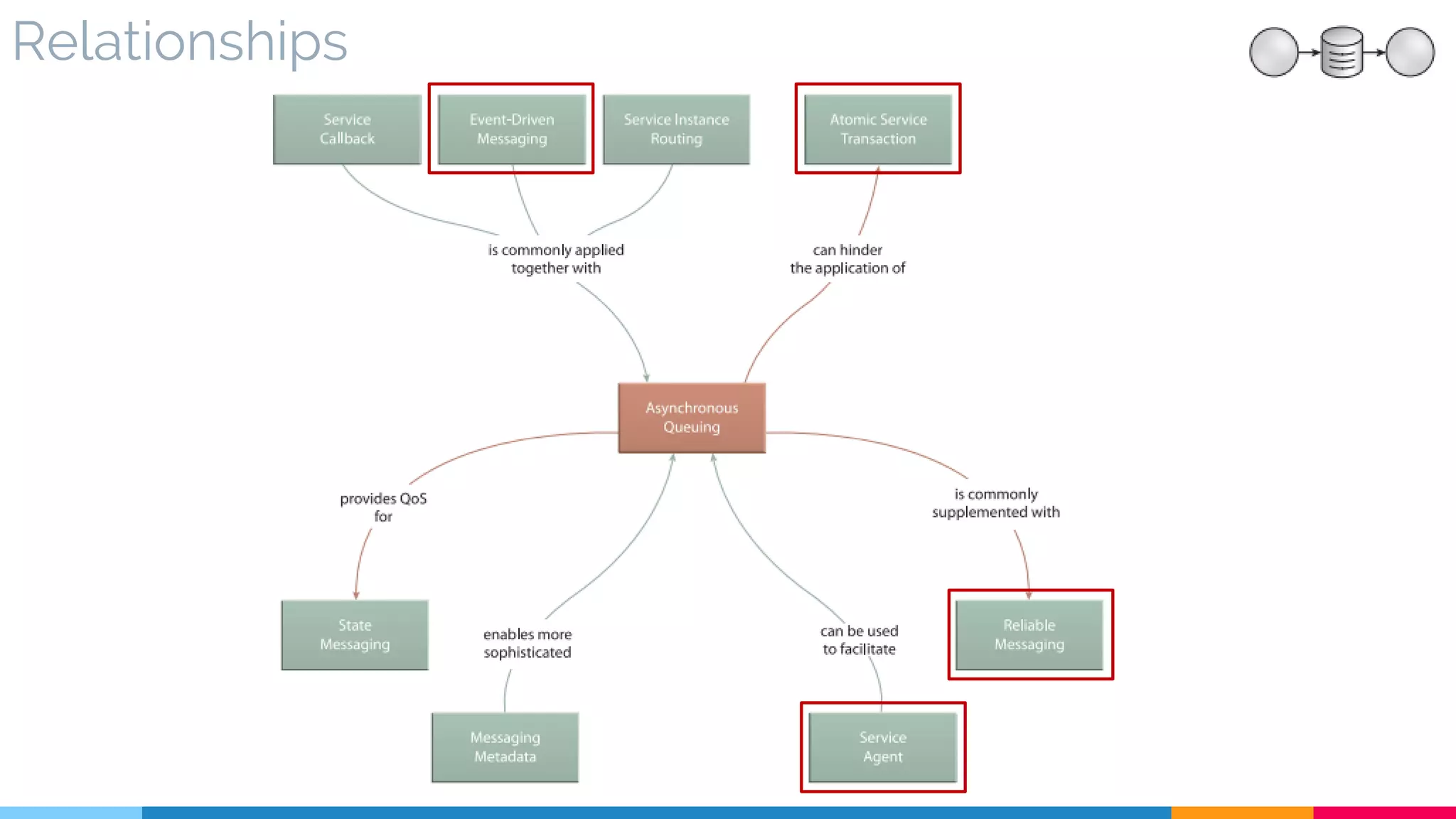
Relationships – part of ESB , Broker
8 Reliable Messaging
▷ Problem
▷ Solution
▷ Real World Sample
▷ Application
▷ Impact
▷ Relationships
▷ Reliability (Acknowledgment – Assurance)
[592]
Problem
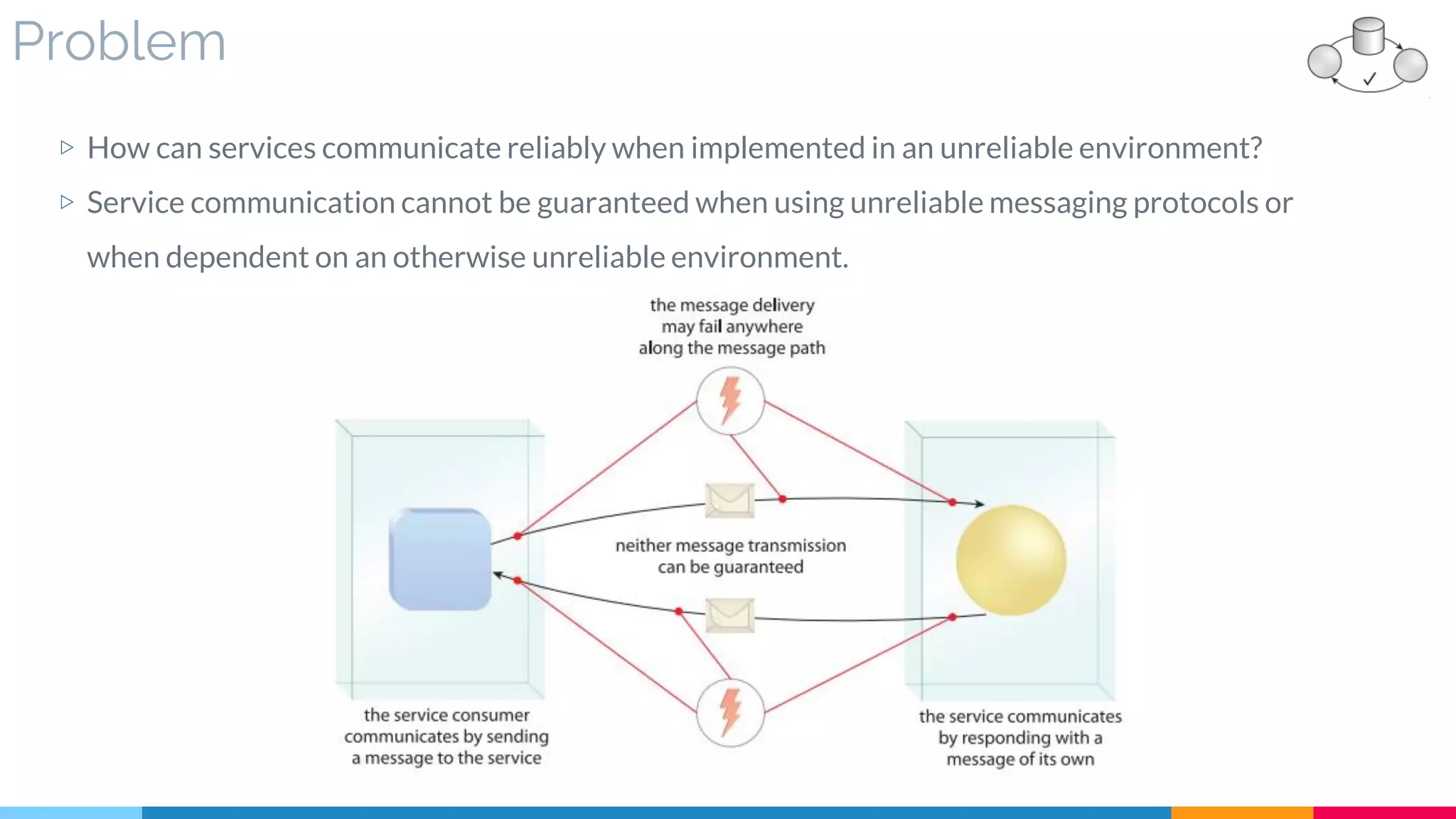
▷ How can services communicate reliably when implemented in an unreliable environment?
▷ Service communication cannot be guaranteed when using unreliable messaging protocols or
when dependent on an otherwise unreliable environment.
Solution
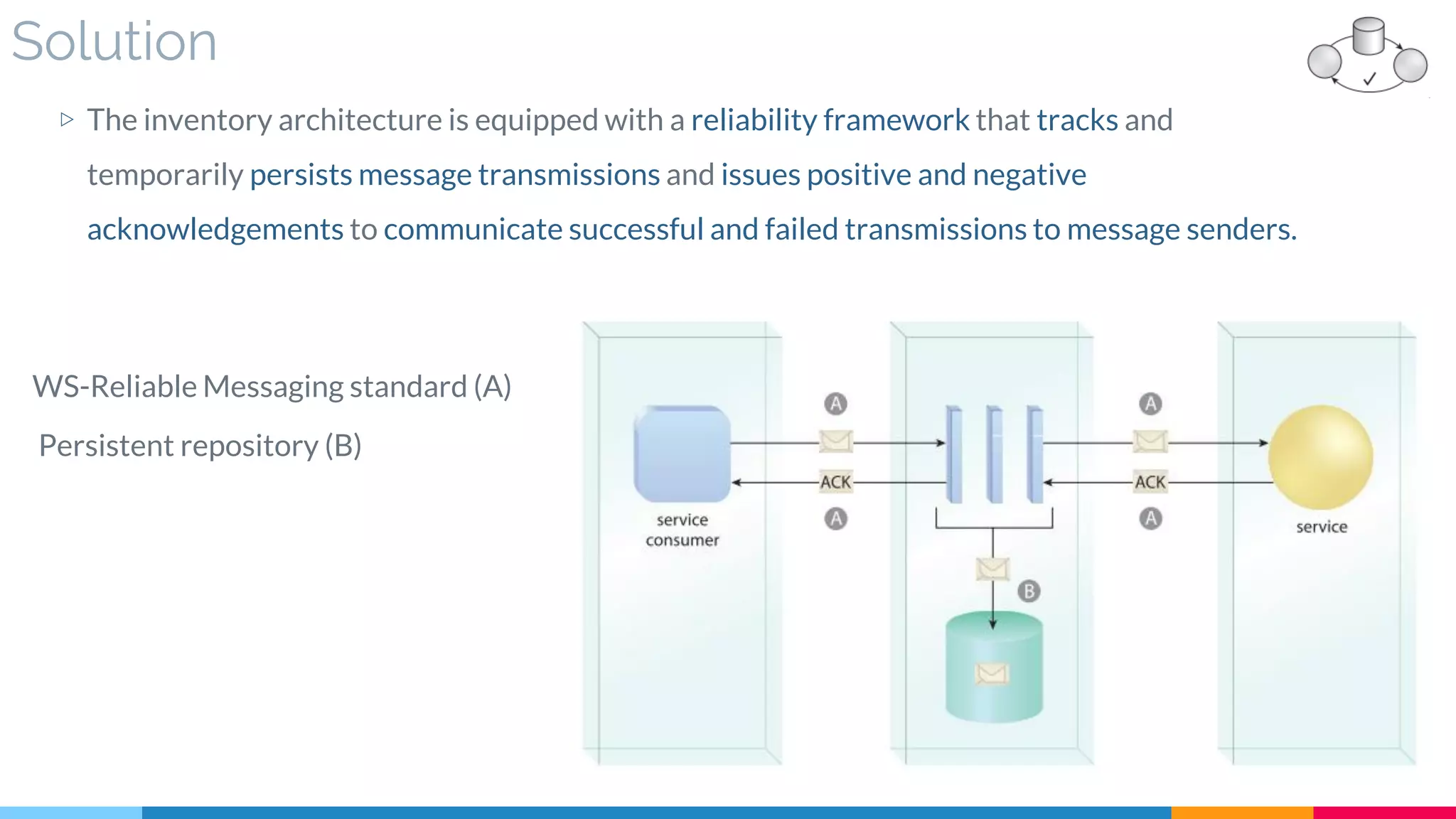
▷ The inventory architecture is equipped with a reliability framework that tracks and
temporarily persists message transmissions and issues positive and negative
acknowledgements to communicate successful and failed transmissions to message senders.
WS-Reliable Messaging standard (A)
Persistent repository (B)
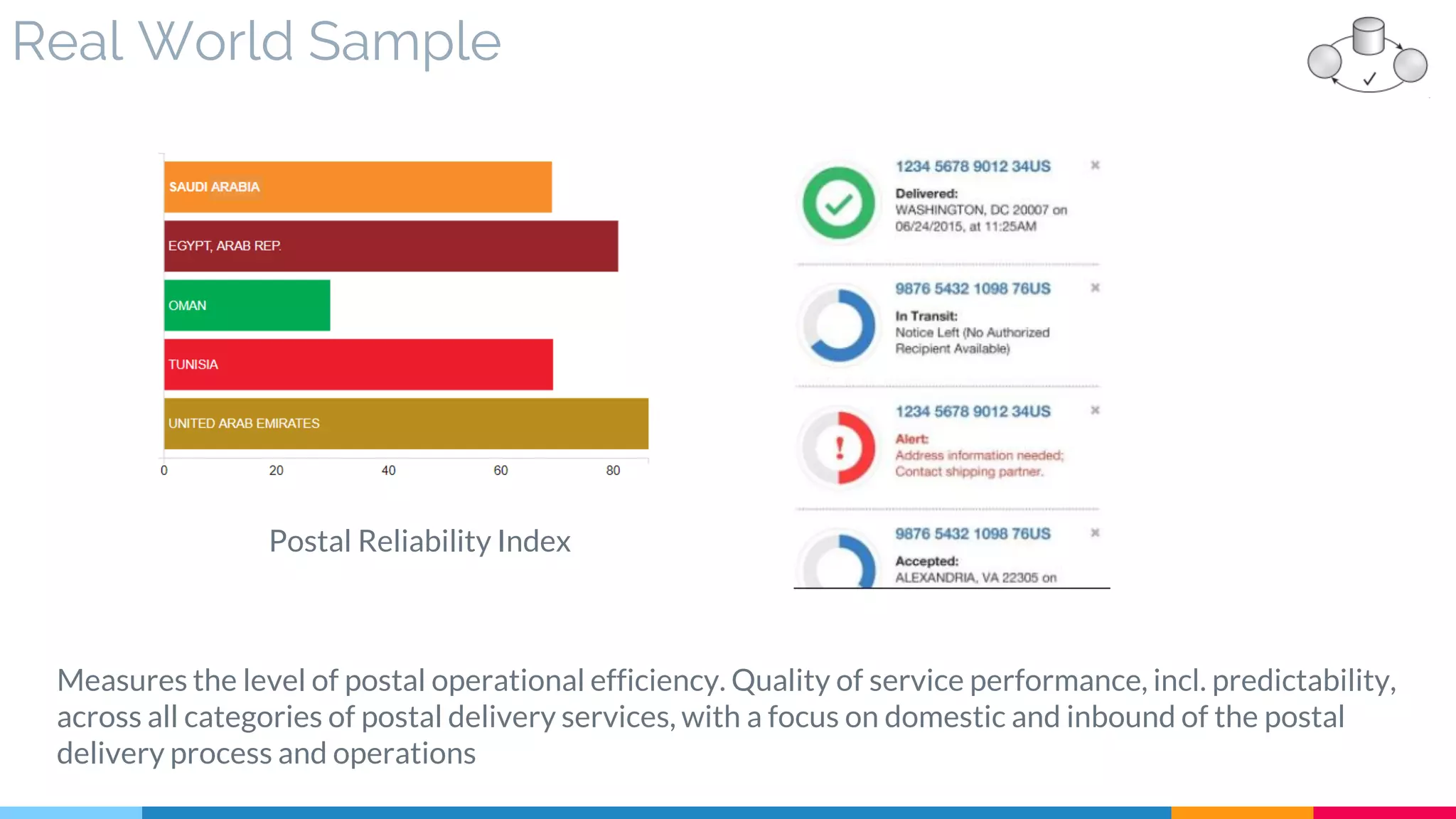
Real World Sample
Postal Reliability Index
Measures the level of postal operational efficiency. Quality of service performance, incl. predictability,
across all categories of postal delivery services, with a focus on domestic and inbound of the postal
delivery process and operations
Application
▷ A reliability framework is typically comprised of infrastructure and intermediary processing logic
capable of:
1. Guaranteeing message delivery during failure conditions via the use of a persistence store
2. Tracking messages at runtime
3. Issuing acknowledgements for individual or sequences of message
▷ The repository used for guaranteed delivery may provide the option to store messages in
memory or on disk so as to act as a back-up mechanism for when message transmissions fail
▷ Allows admins to track status of messages and trace causes behind unresolved delivery problems.
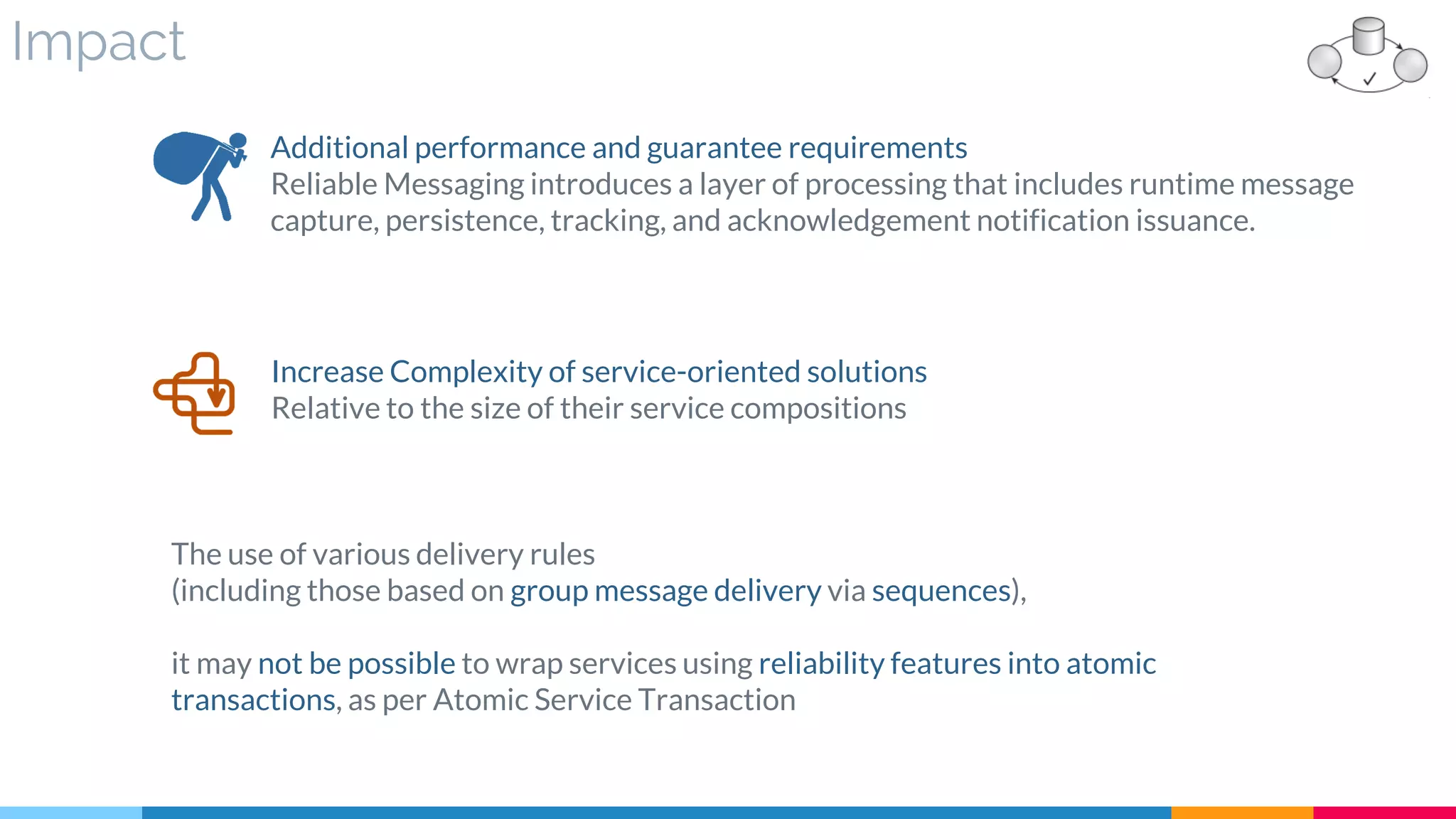
Impact
Additional performance and guarantee requirements
Reliable Messaging introduces a layer of processing that includes runtime message
capture, persistence, tracking, and acknowledgement notification issuance.
Increase Complexity of service-oriented solutions
Relative to the size of their service compositions
The use of various delivery rules
(including those based on group message delivery via sequences),
it may not be possible to wrap services using reliability features into atomic
transactions, as per Atomic Service Transaction
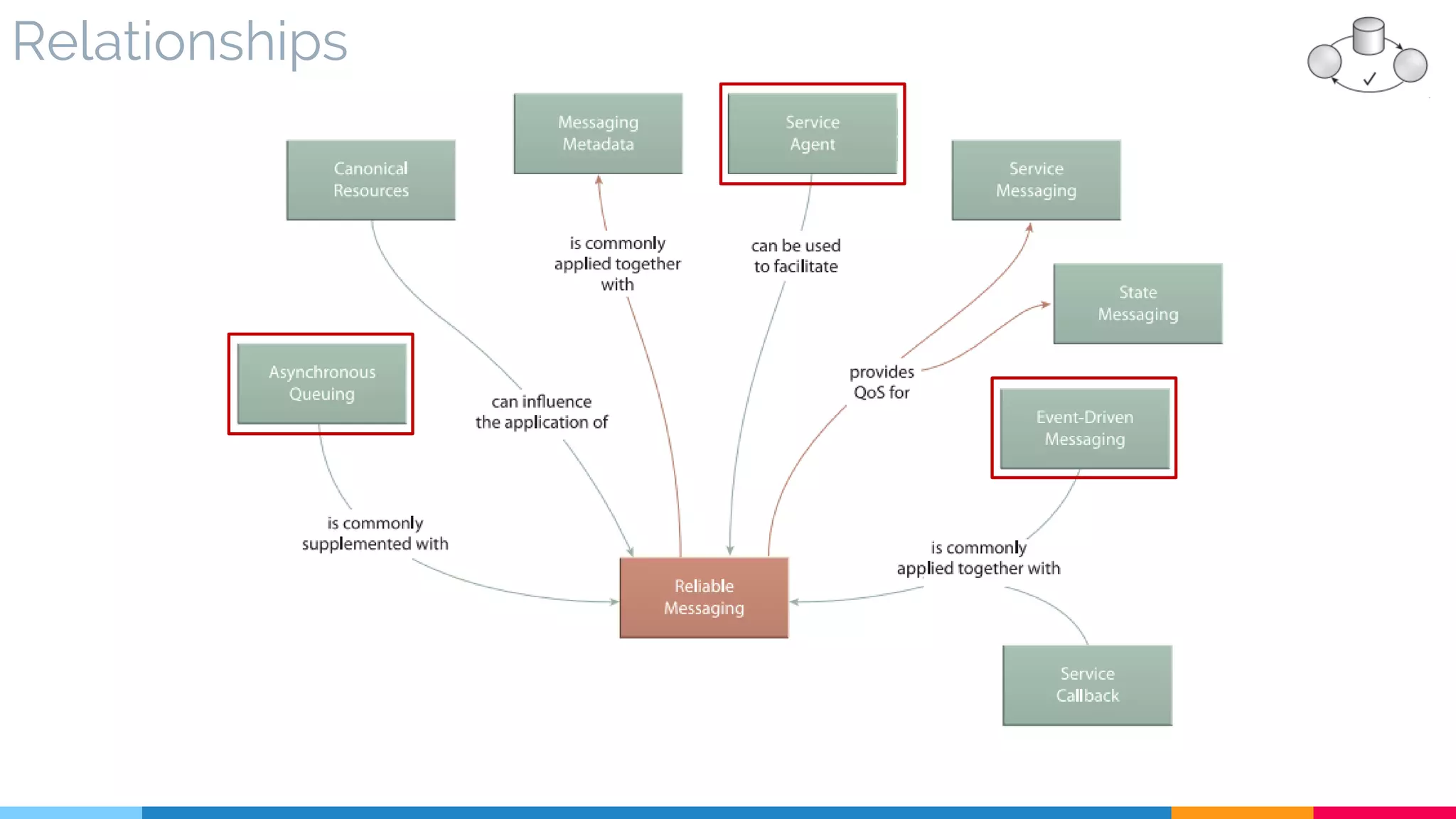
Relationships
Relationships – part of ESB , Broker
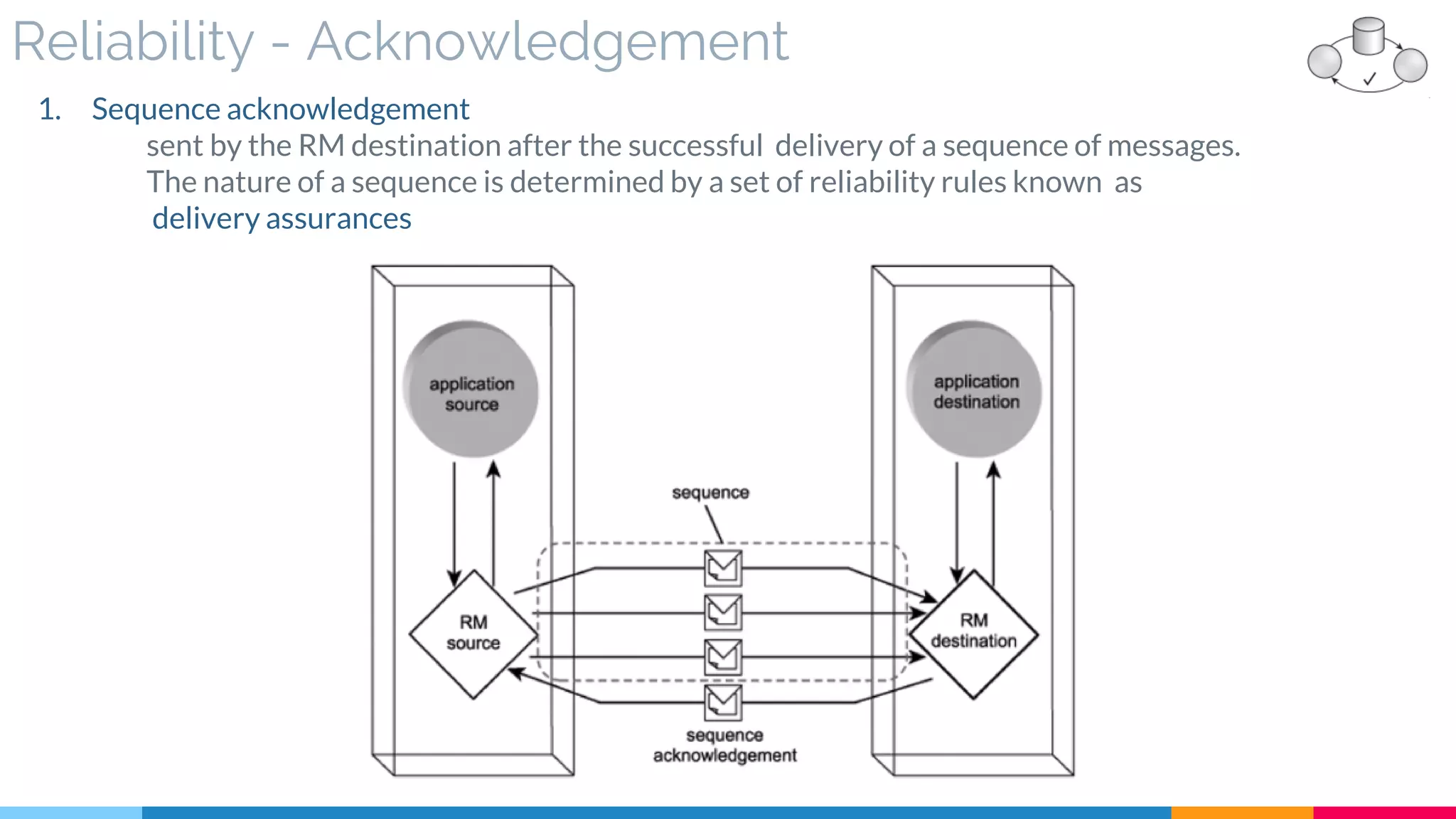
Reliability - Acknowledgement
1. Sequence acknowledgement
sent by the RM destination after the successful delivery of a sequence of messages.
The nature of a sequence is determined by a set of reliability rules known as
delivery assurances
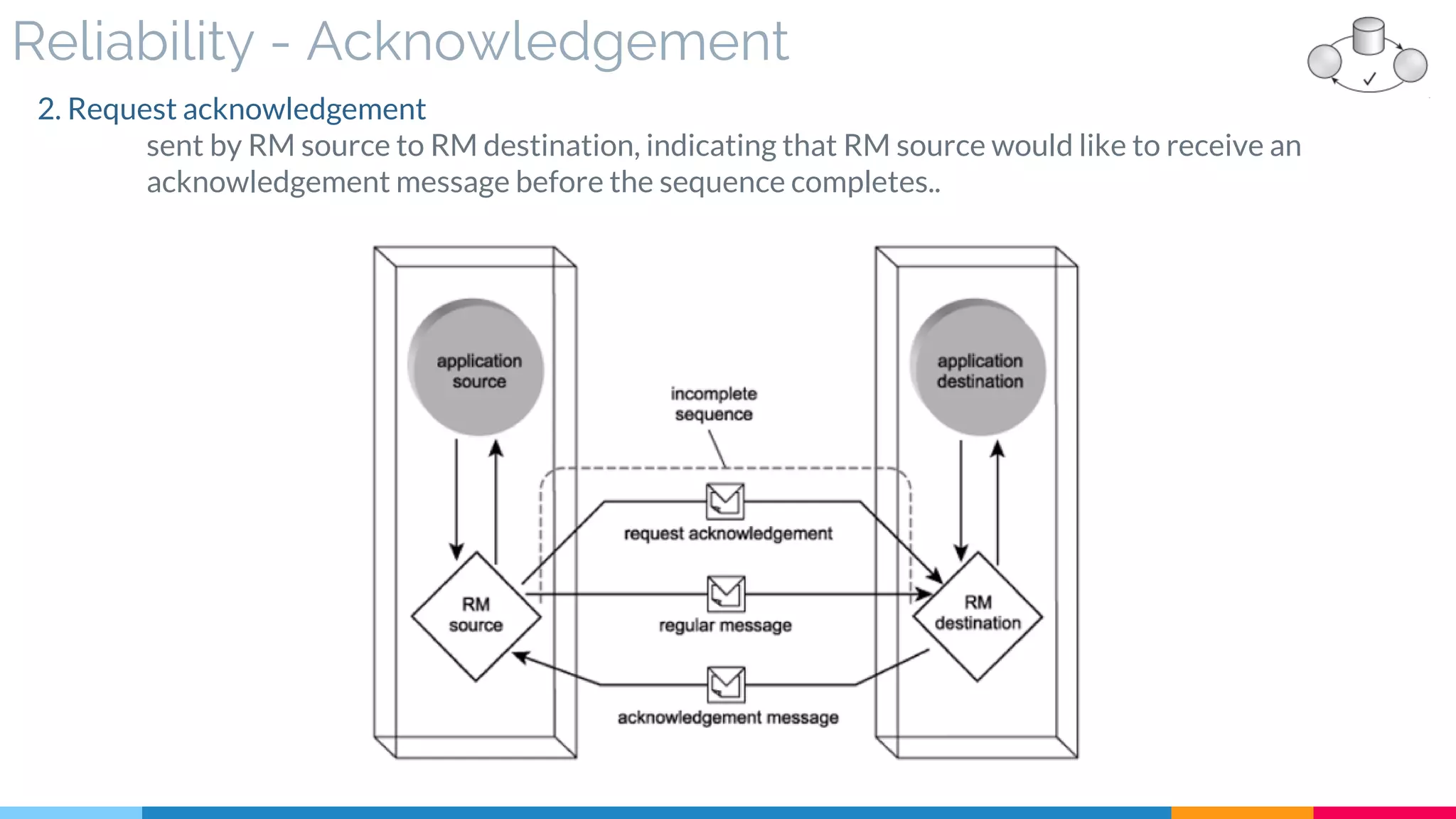
Reliability - Acknowledgement
2. Request acknowledgement
sent by RM source to RM destination, indicating that RM source would like to receive an
acknowledgement message before the sequence completes..
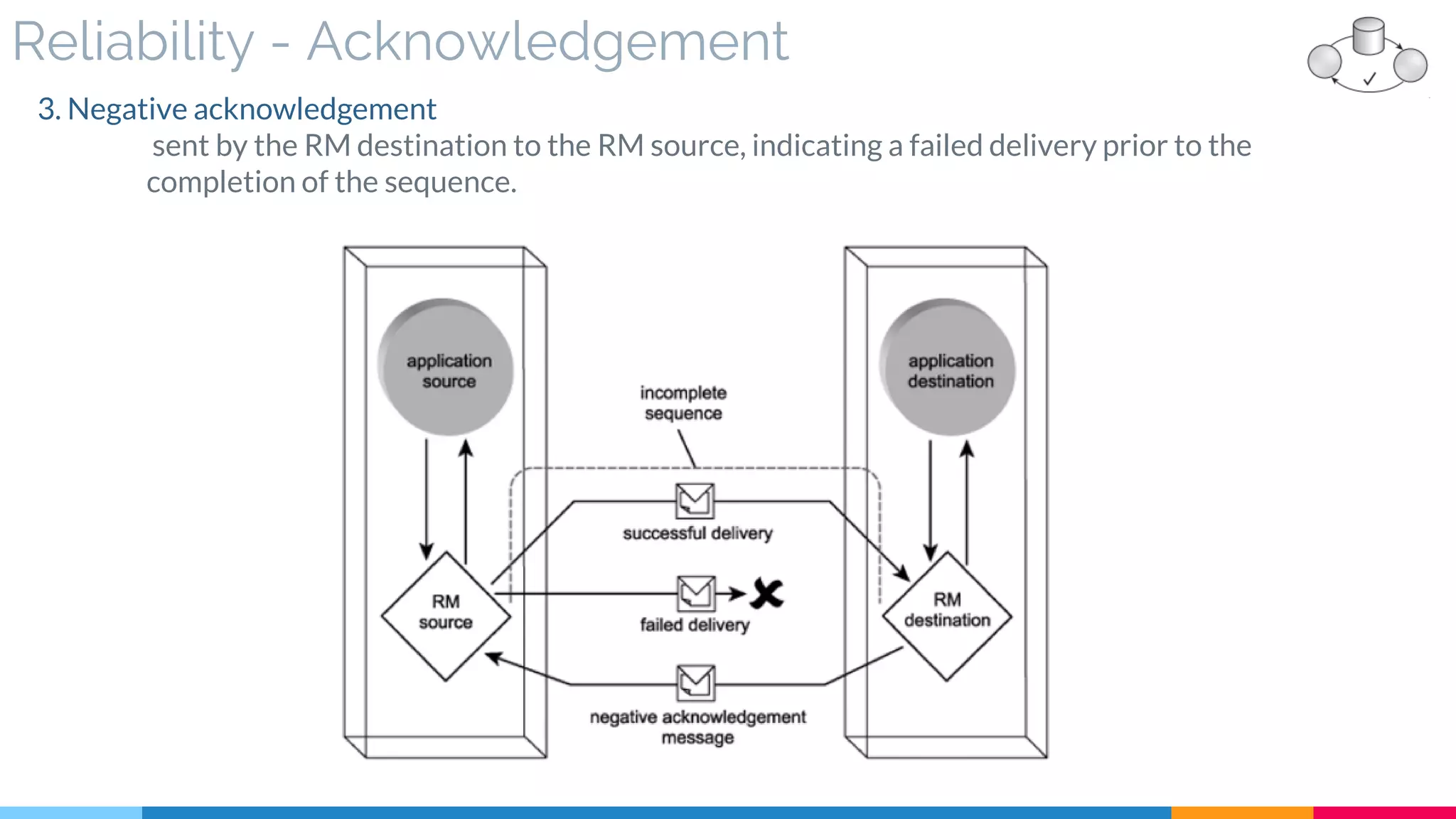
Reliability - Acknowledgement
3. Negative acknowledgement
sent by the RM destination to the RM source, indicating a failed delivery prior to the
completion of the sequence.
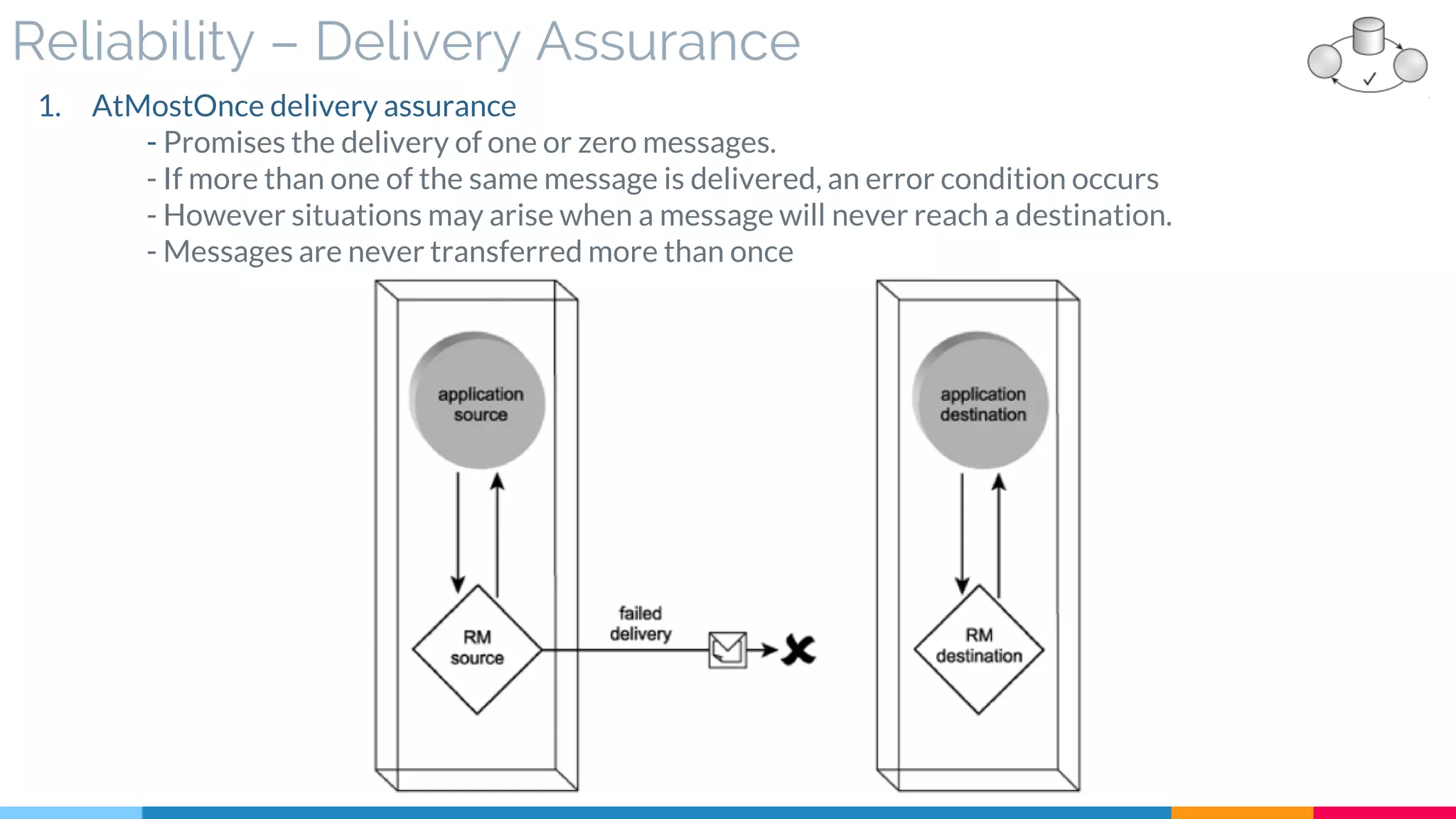
Reliability – Delivery Assurance
1. AtMostOnce delivery assurance
- Promises the delivery of one or zero messages.
- If more than one of the same message is delivered, an error condition occurs
- However situations may arise when a message will never reach a destination.
- Messages are never transferred more than once
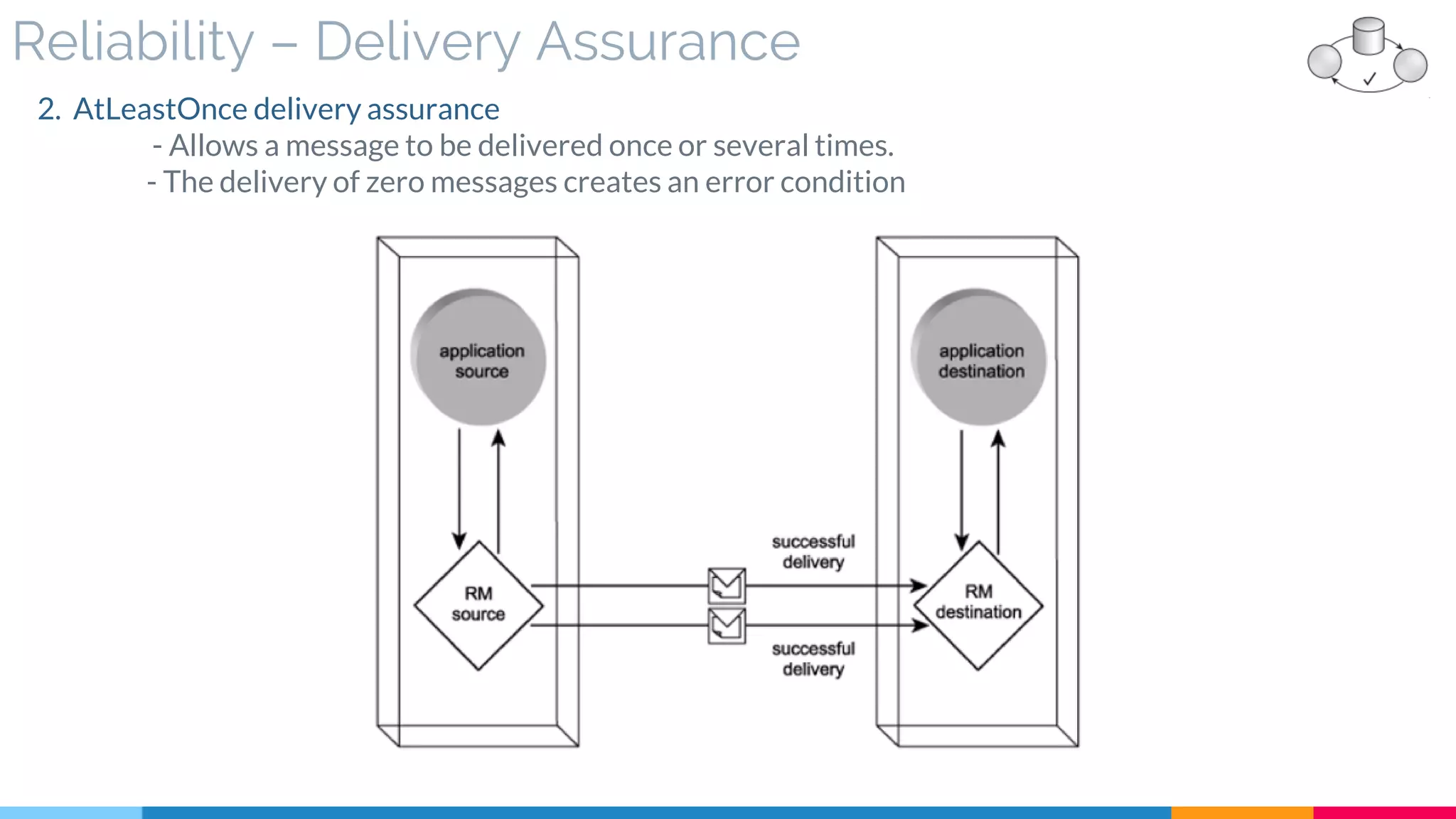
Reliability – Delivery Assurance
2. AtLeastOnce delivery assurance
- Allows a message to be delivered once or several times.
- The delivery of zero messages creates an error condition
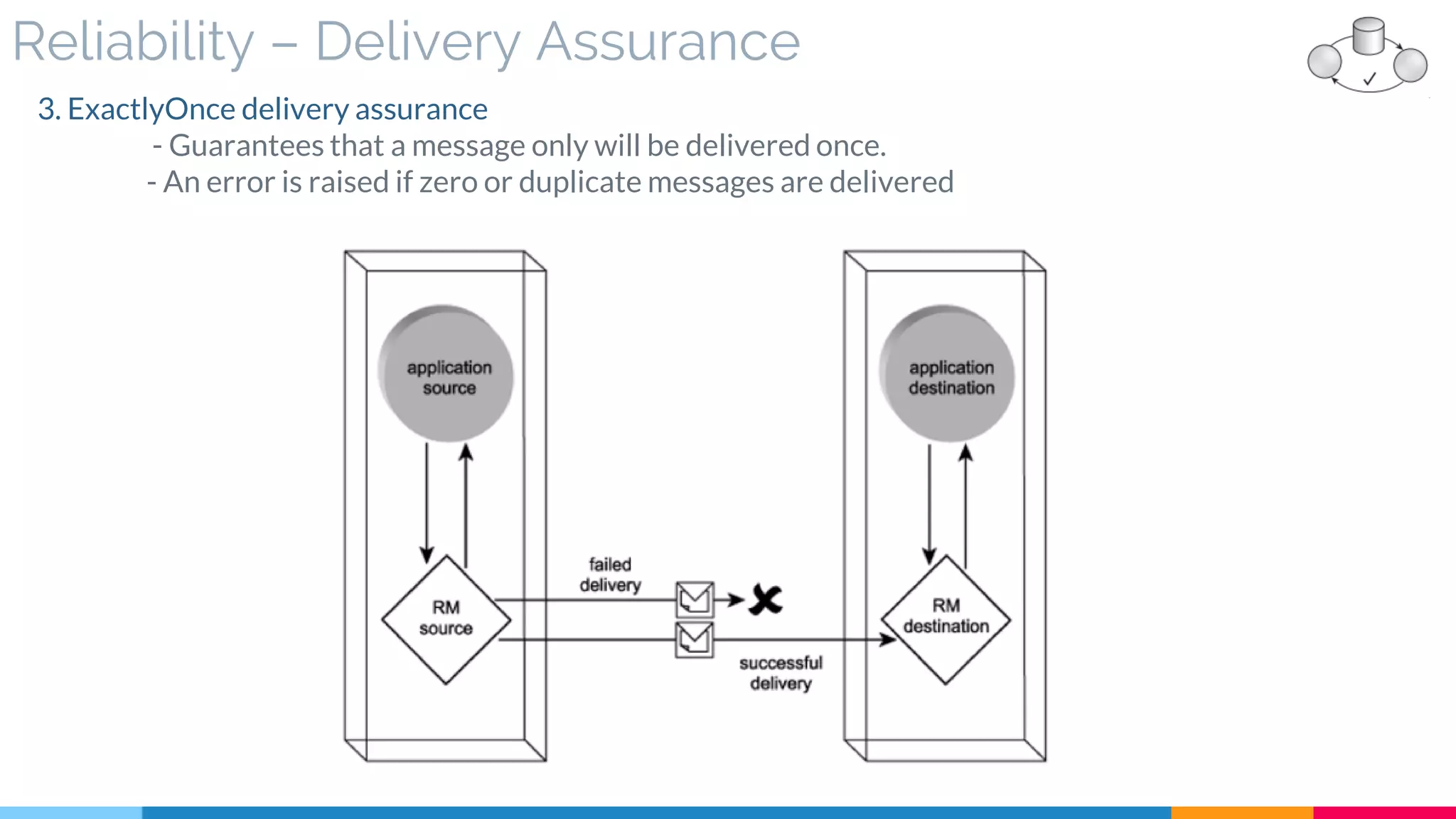
Reliability – Delivery Assurance
3. ExactlyOnce delivery assurance
- Guarantees that a message only will be delivered once.
- An error is raised if zero or duplicate messages are delivered
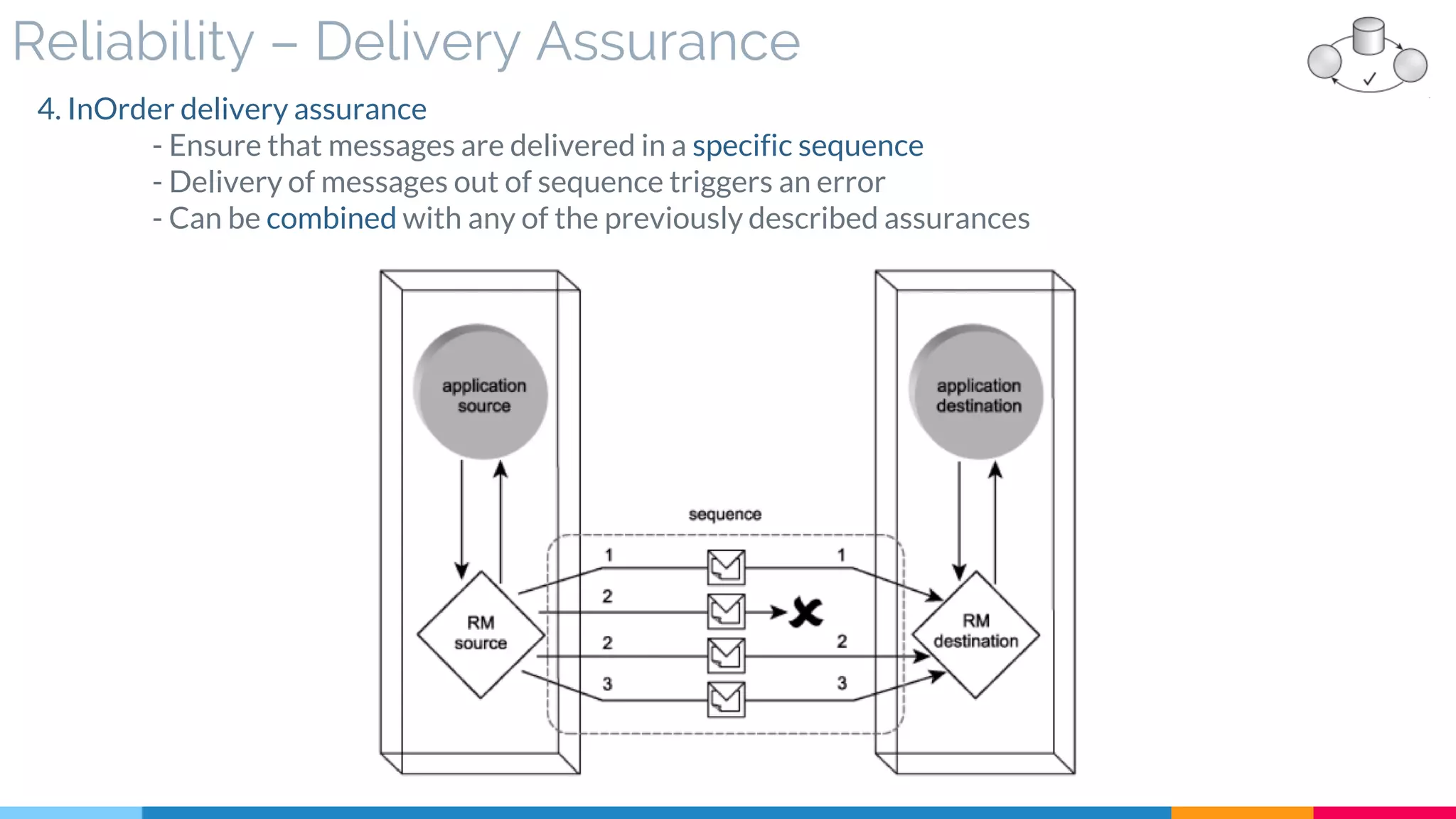
Reliability – Delivery Assurance
4. InOrder delivery assurance
- Ensure that messages are delivered in a specific sequence
- Delivery of messages out of sequence triggers an error
- Can be combined with any of the previously described assurances
9 Event-Driven Messaging
▷ Problem
▷ Solution
▷ Real World Sample
▷ Application
▷ Impact
▷ Relationships
[599]
Problem
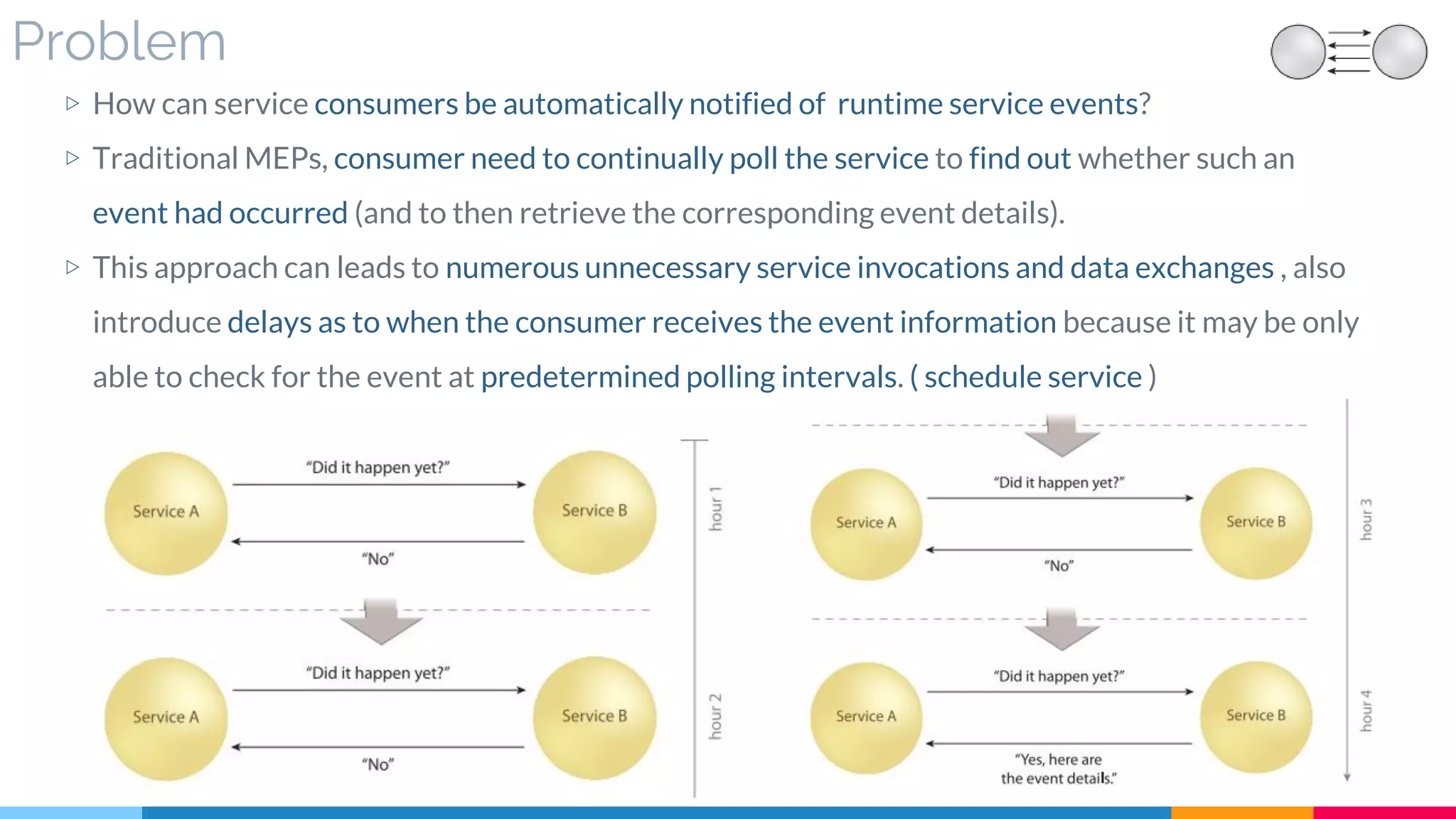
▷ How can service consumers be automatically notified of runtime service events?
▷ Traditional MEPs, consumer need to continually poll the service to find out whether such an
event had occurred (and to then retrieve the corresponding event details).
▷ This approach can leads to numerous unnecessary service invocations and data exchanges , also
introduce delays as to when the consumer receives the event information because it may be only
able to check for the event at predetermined polling intervals. ( schedule service )
Solution
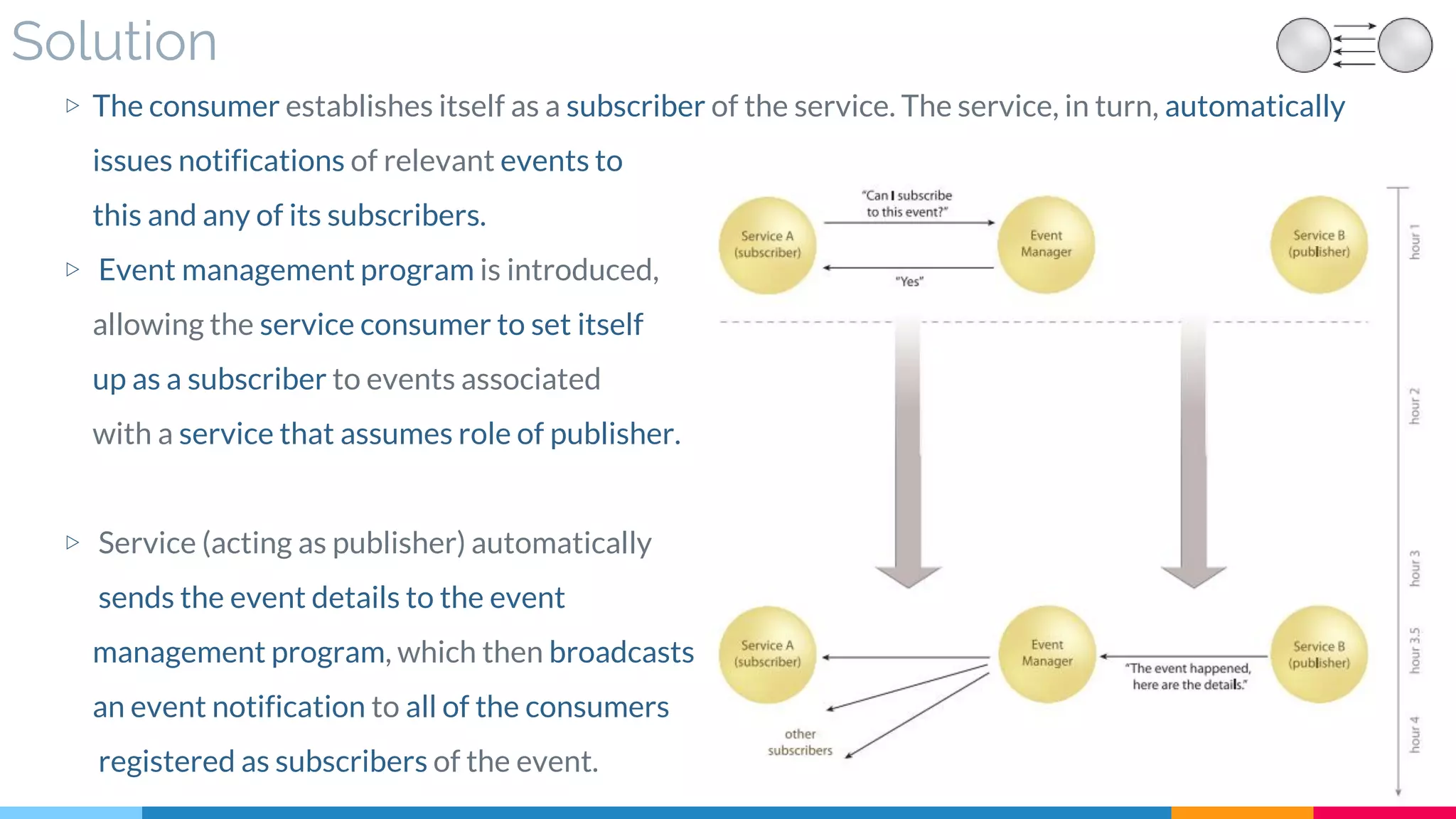
▷ The consumer establishes itself as a subscriber of the service. The service, in turn, automatically
issues notifications of relevant events to
this and any of its subscribers.
▷ Event management program is introduced,
allowing the service consumer to set itself
up as a subscriber to events associated
with a service that assumes role of publisher.
▷ Service (acting as publisher) automatically
sends the event details to the event
management program, which then broadcasts
an event notification to all of the consumers
registered as subscribers of the event.
Real World Sample
Subscribe to Youtube Channel
Notification Bell
Application
▷ A messaging framework is implemented capable of supporting the publish-and-subscribe MEP and
associated complex event processing and tracking.
▷ An event-driven messaging framework is implemented as an extension to the service inventory.
▷ Runtime platforms, messaging middleware, and ESB products commonly provide the necessary
infrastructure for message processing and tracing capabilities, along with service agents that
supply complex event processing, filtering, and correlation
Impact
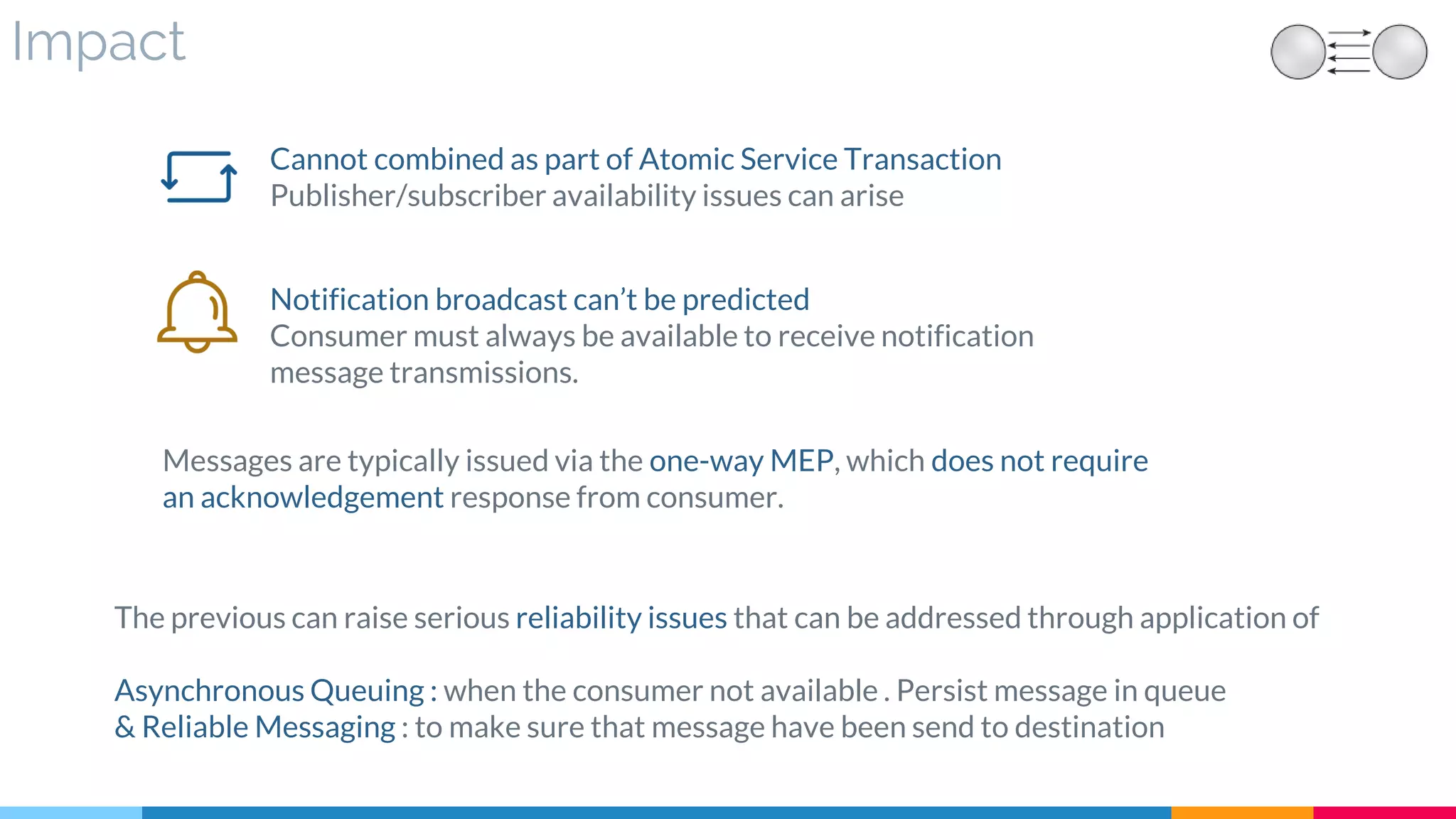
Notification broadcast can’t be predicted
Consumer must always be available to receive notification
message transmissions.
Cannot combined as part of Atomic Service Transaction
Publisher/subscriber availability issues can arise
Messages are typically issued via the one-way MEP, which does not require
an acknowledgement response from consumer.
The previous can raise serious reliability issues that can be addressed through application of
Asynchronous Queuing : when the consumer not available . Persist message in queue
& Reliable Messaging : to make sure that message have been send to destination
Relationships
Relationships – part of ESB , Broker
10. Policy Centralization
▷ Problem
▷ Solution
▷ Real World Sample
▷ Application
▷ Impact
▷ Relationships
[207]
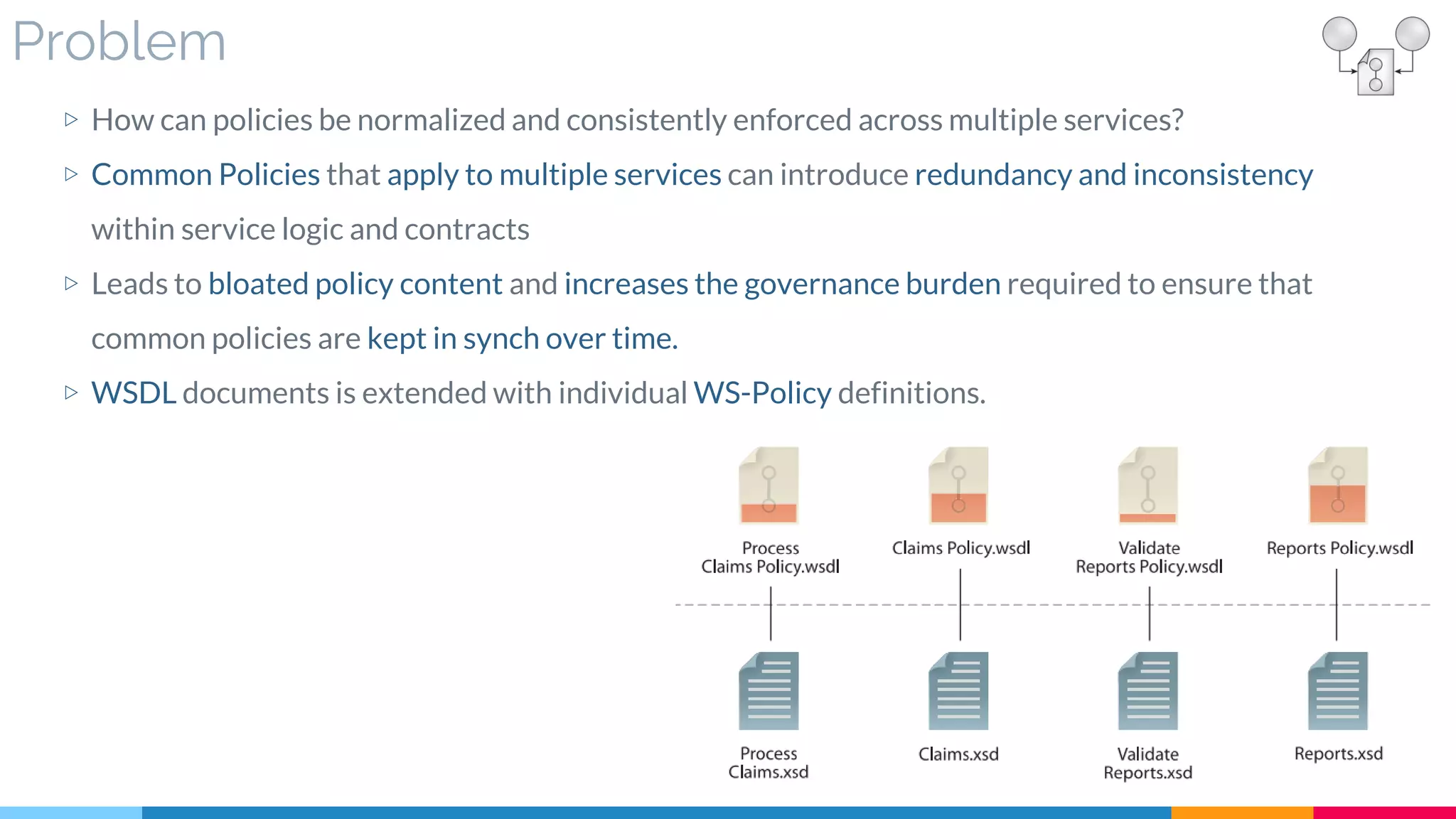
Problem
▷ How can policies be normalized and consistently enforced across multiple services?
▷ Common Policies that apply to multiple services can introduce redundancy and inconsistency
within service logic and contracts
▷ Leads to bloated policy content and increases the governance burden required to ensure that
common policies are kept in synch over time.
▷ WSDL documents is extended with individual WS-Policy definitions.
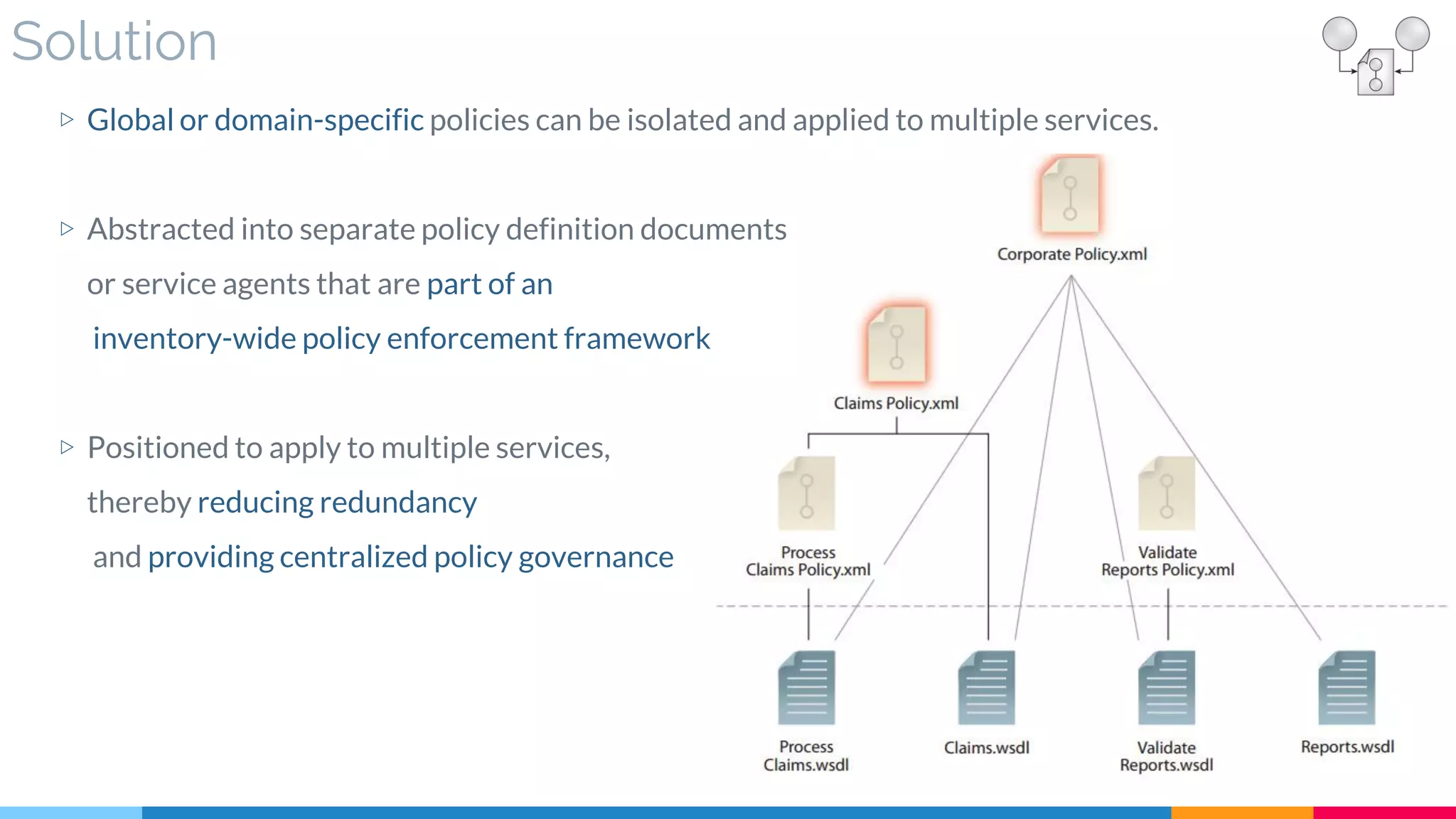
Solution
▷ Global or domain-specific policies can be isolated and applied to multiple services.
▷ Abstracted into separate policy definition documents
or service agents that are part of an
inventory-wide policy enforcement framework
▷ Positioned to apply to multiple services,
thereby reducing redundancy
and providing centralized policy governance
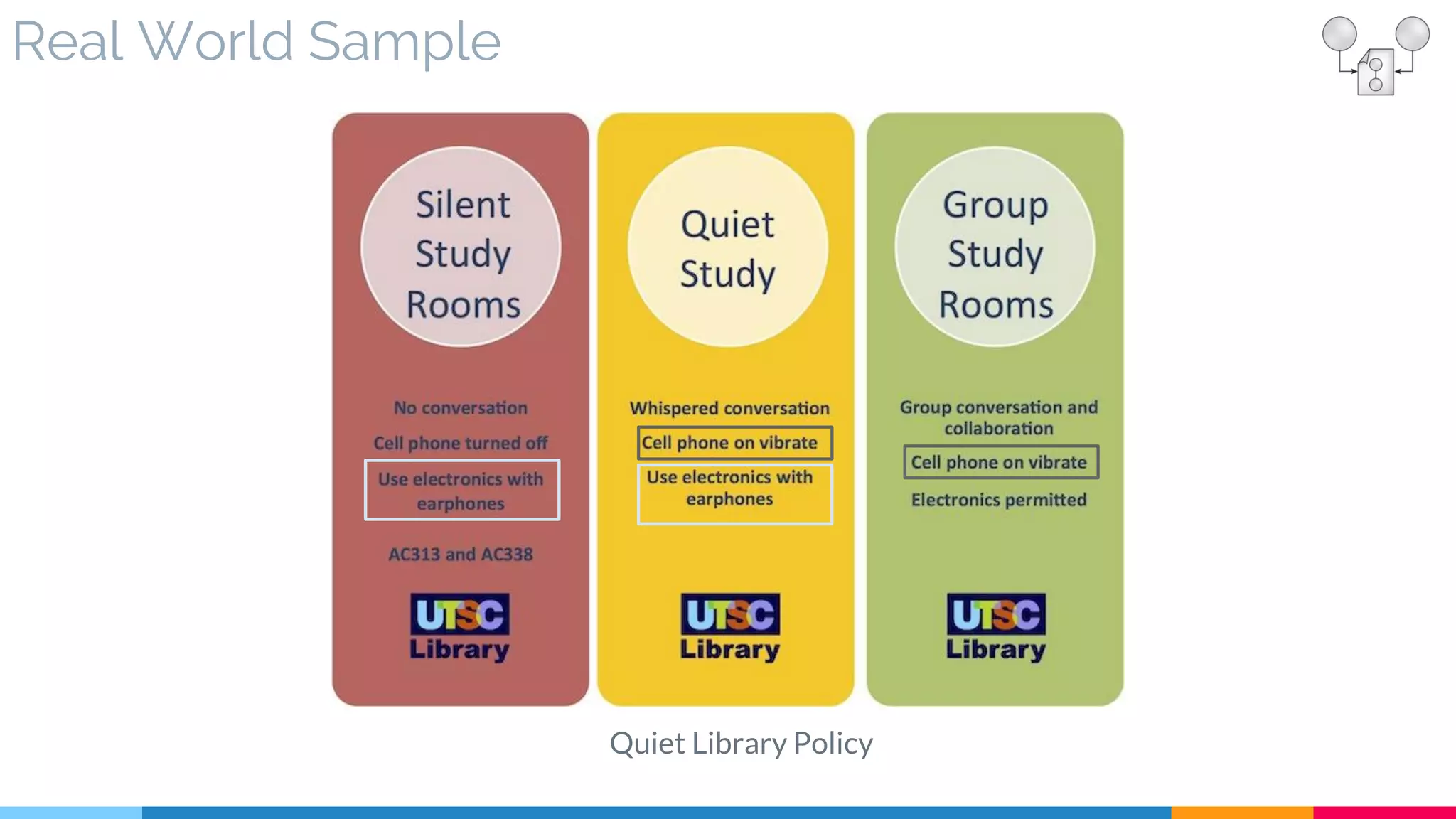
Real World Sample
Quiet Library Policy
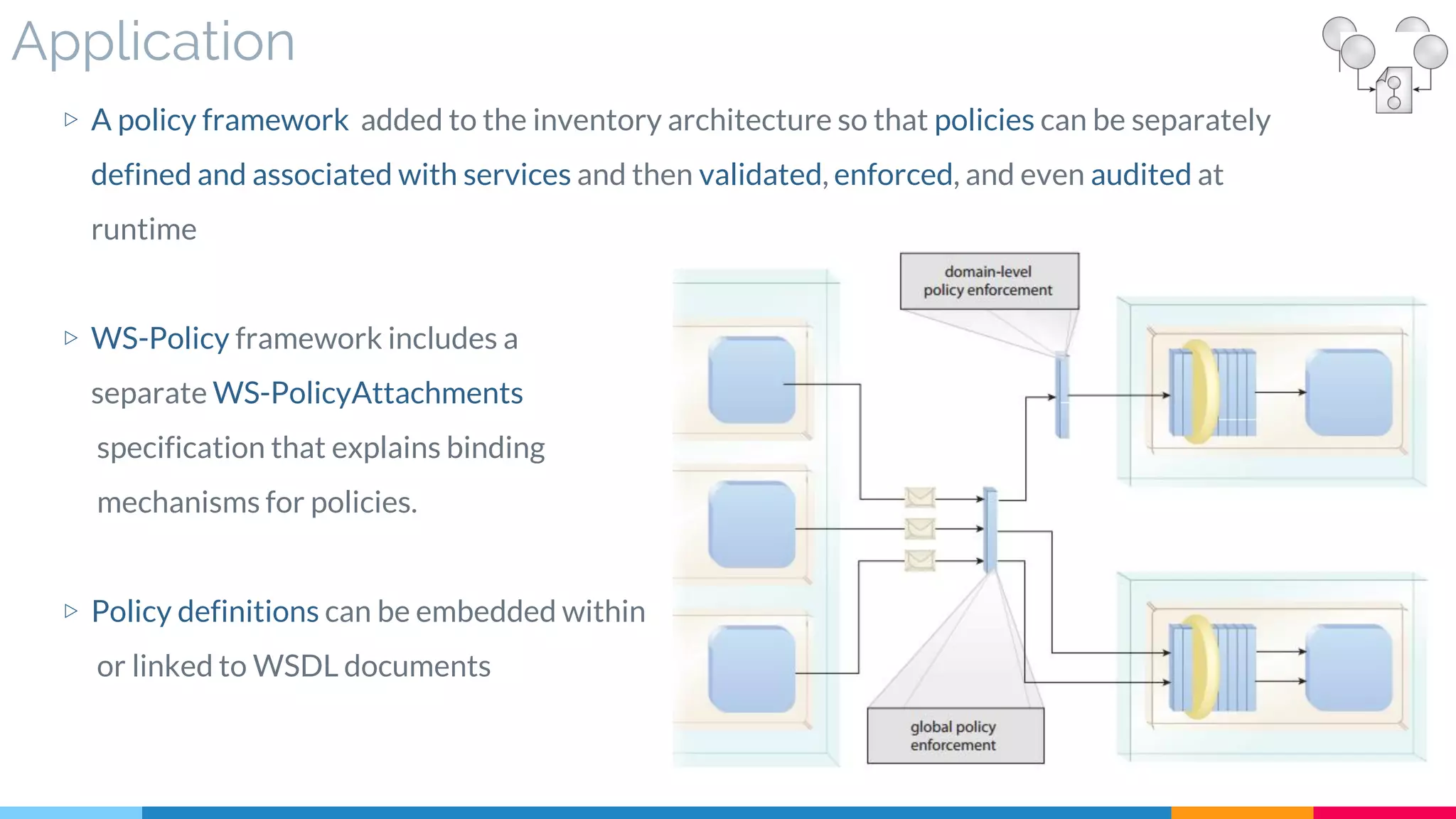
Application
▷ A policy framework added to the inventory architecture so that policies can be separately
defined and associated with services and then validated, enforced, and even audited at
runtime
▷ WS-Policy framework includes a
separate WS-PolicyAttachments
specification that explains binding
mechanisms for policies.
▷ Policy definitions can be embedded within
or linked to WSDL documents
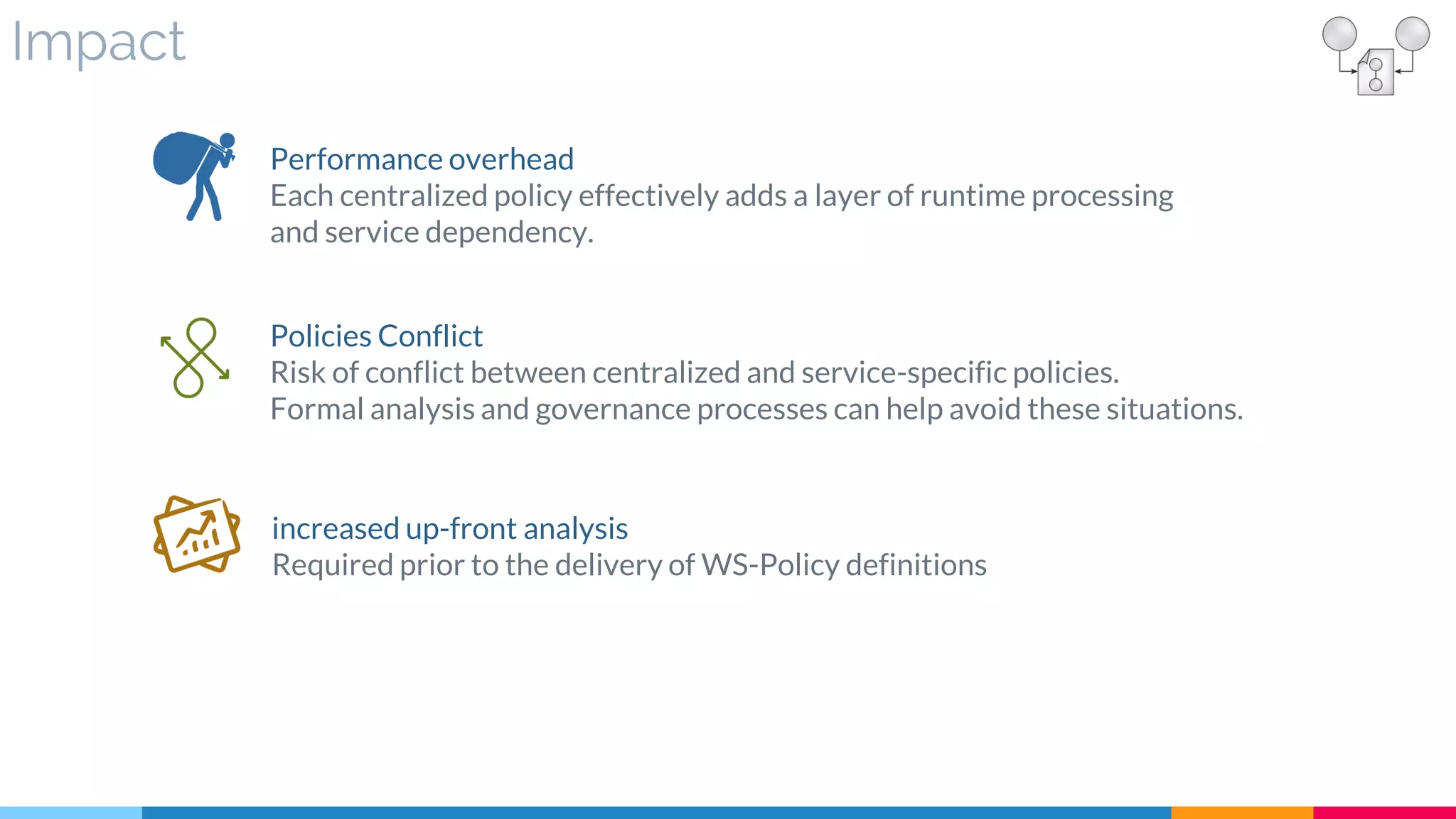
Impact
Performance overhead
Each centralized policy effectively adds a layer of runtime processing
and service dependency.
Policies Conflict
Risk of conflict between centralized and service-specific policies.
Formal analysis and governance processes can help avoid these situations.
increased up-front analysis
Required prior to the delivery of WS-Policy definitions
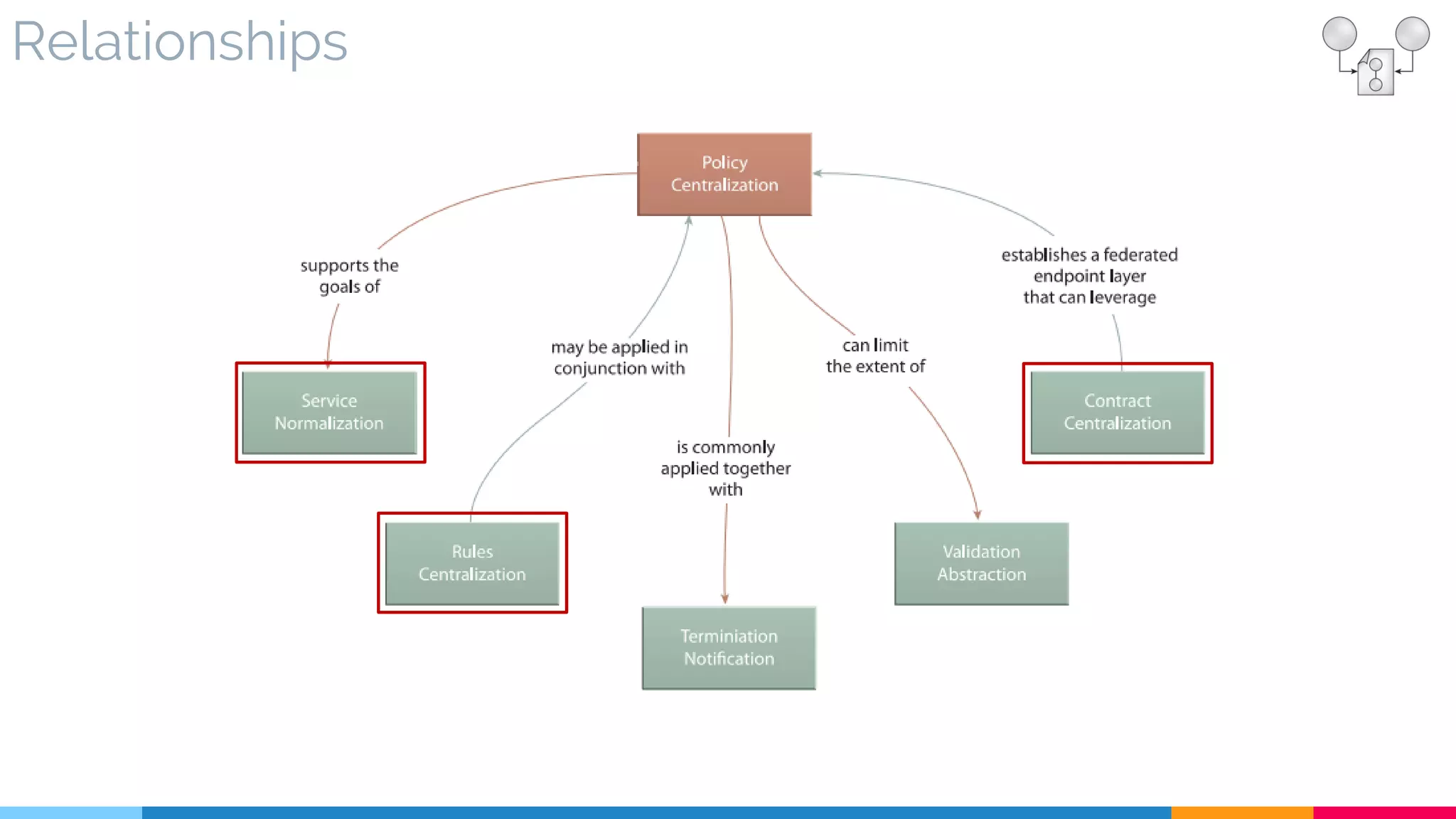
Relationships
Relationships – part of ESB
Middle-tier platforms can provide policy features supported by runtime agents that carry out
policy compliance checking. In these environments, global and domain-level policies can also be
established via service agents that act as policy enforcement points
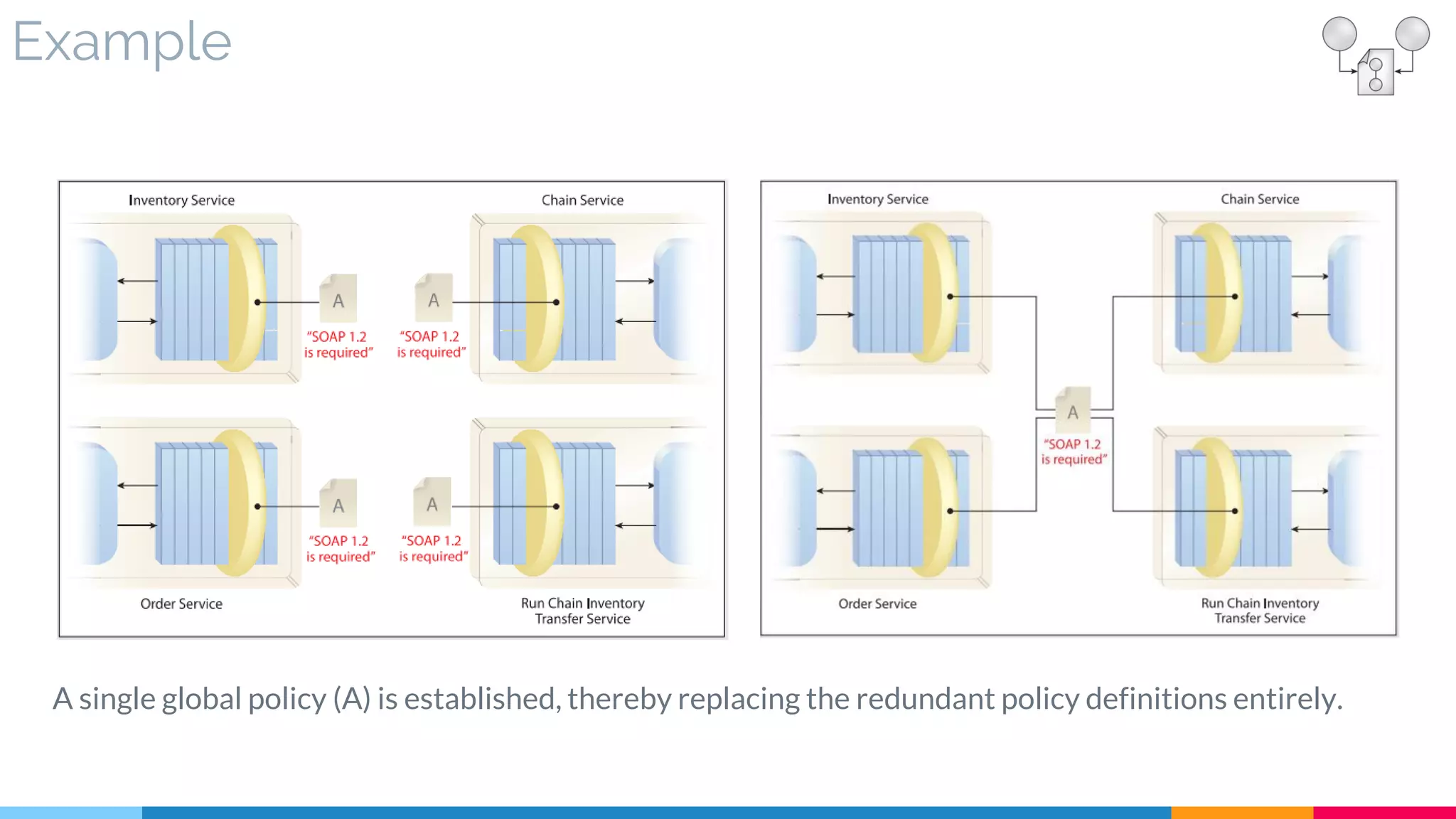
Example
A single global policy (A) is established, thereby replacing the redundant policy definitions entirely.
11 Rules Centralization
▷ Problem
▷ Solution
▷ Real World Sample
▷ Application
▷ Impact
▷ Relationships
[216]
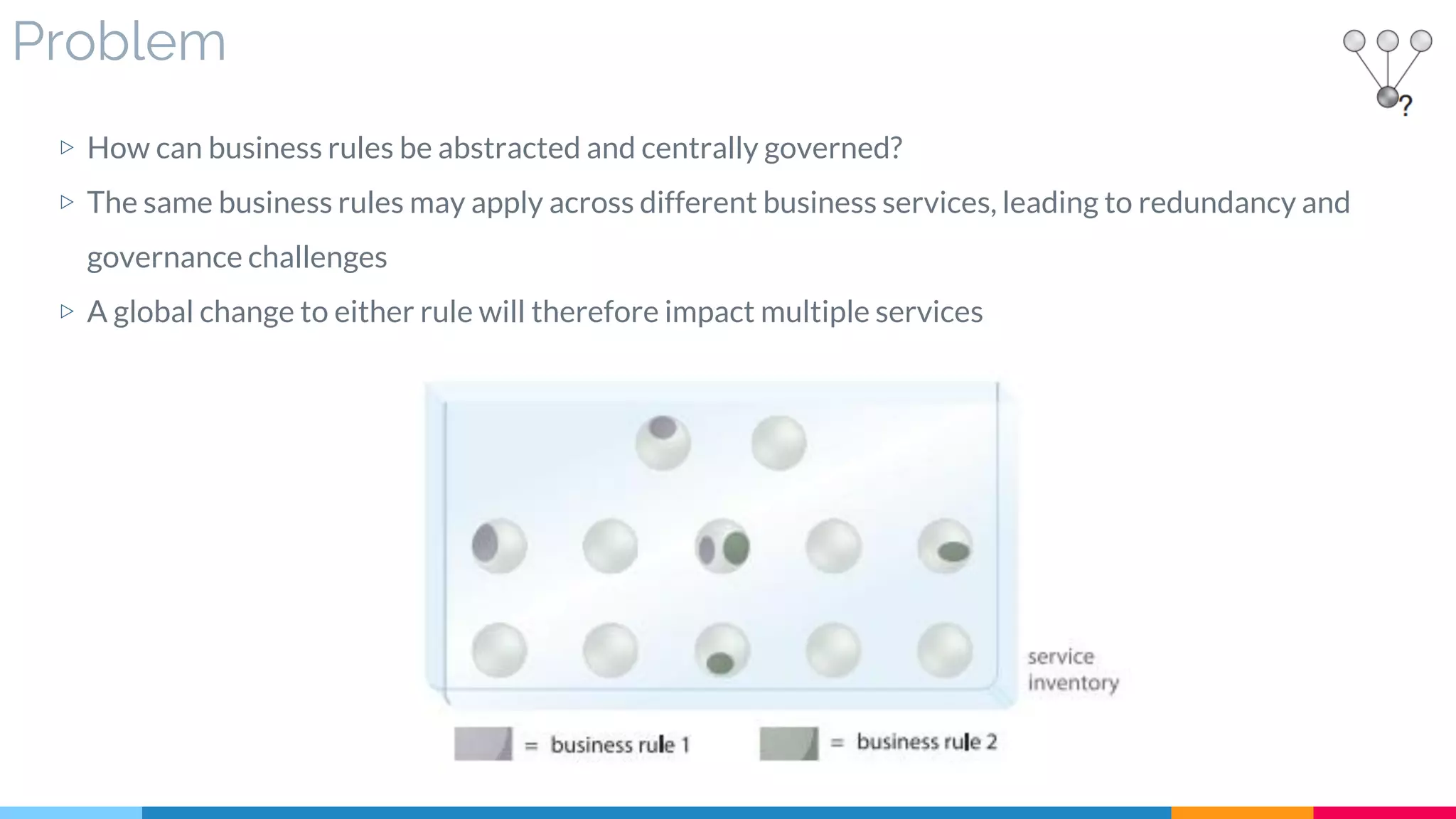
Problem
▷ How can business rules be abstracted and centrally governed?
▷ The same business rules may apply across different business services, leading to redundancy and
governance challenges
▷ A global change to either rule will therefore impact multiple services
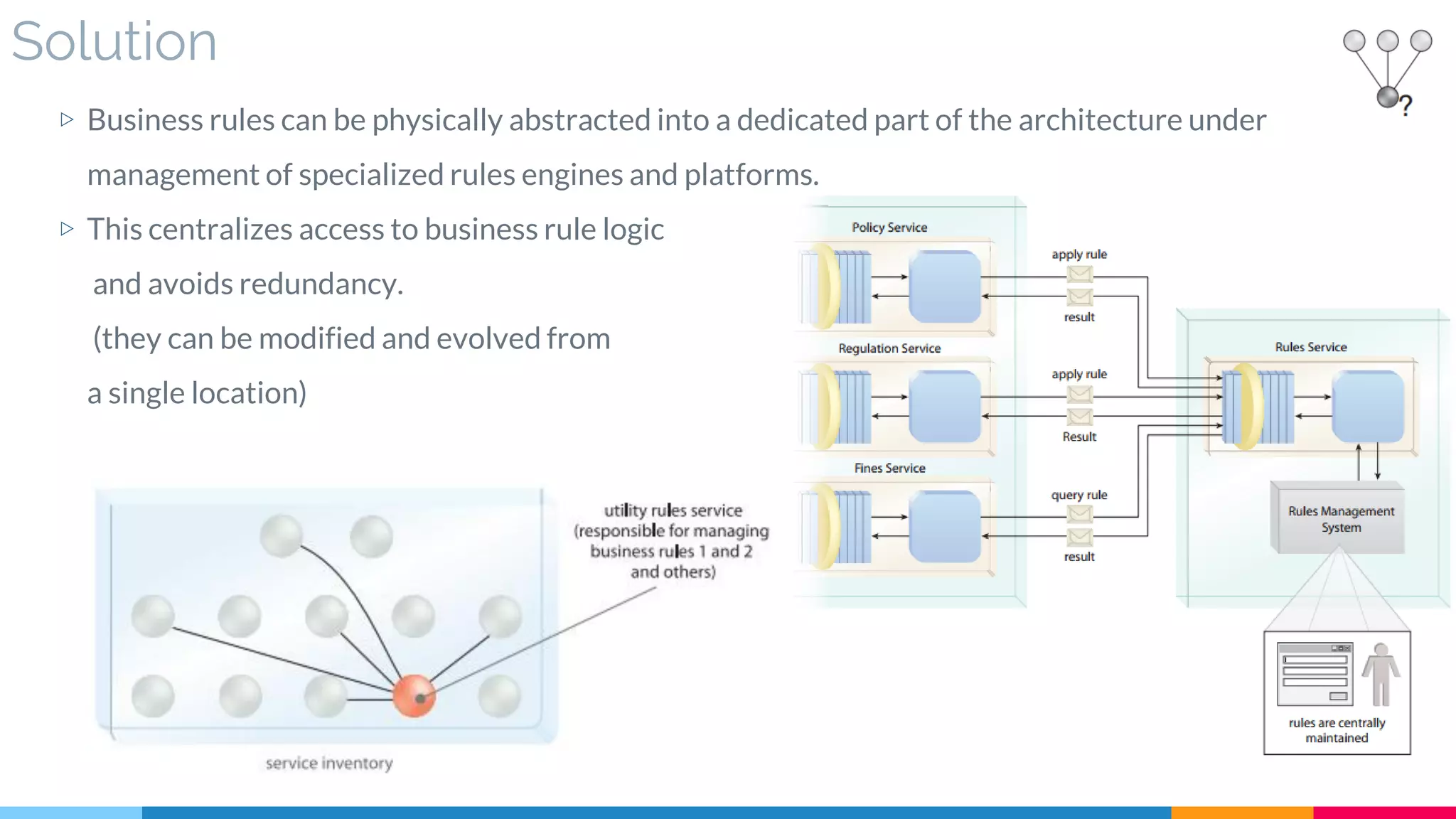
Solution
▷ Business rules can be physically abstracted into a dedicated part of the architecture under
management of specialized rules engines and platforms.
▷ This centralizes access to business rule logic
and avoids redundancy.
(they can be modified and evolved from
a single location)
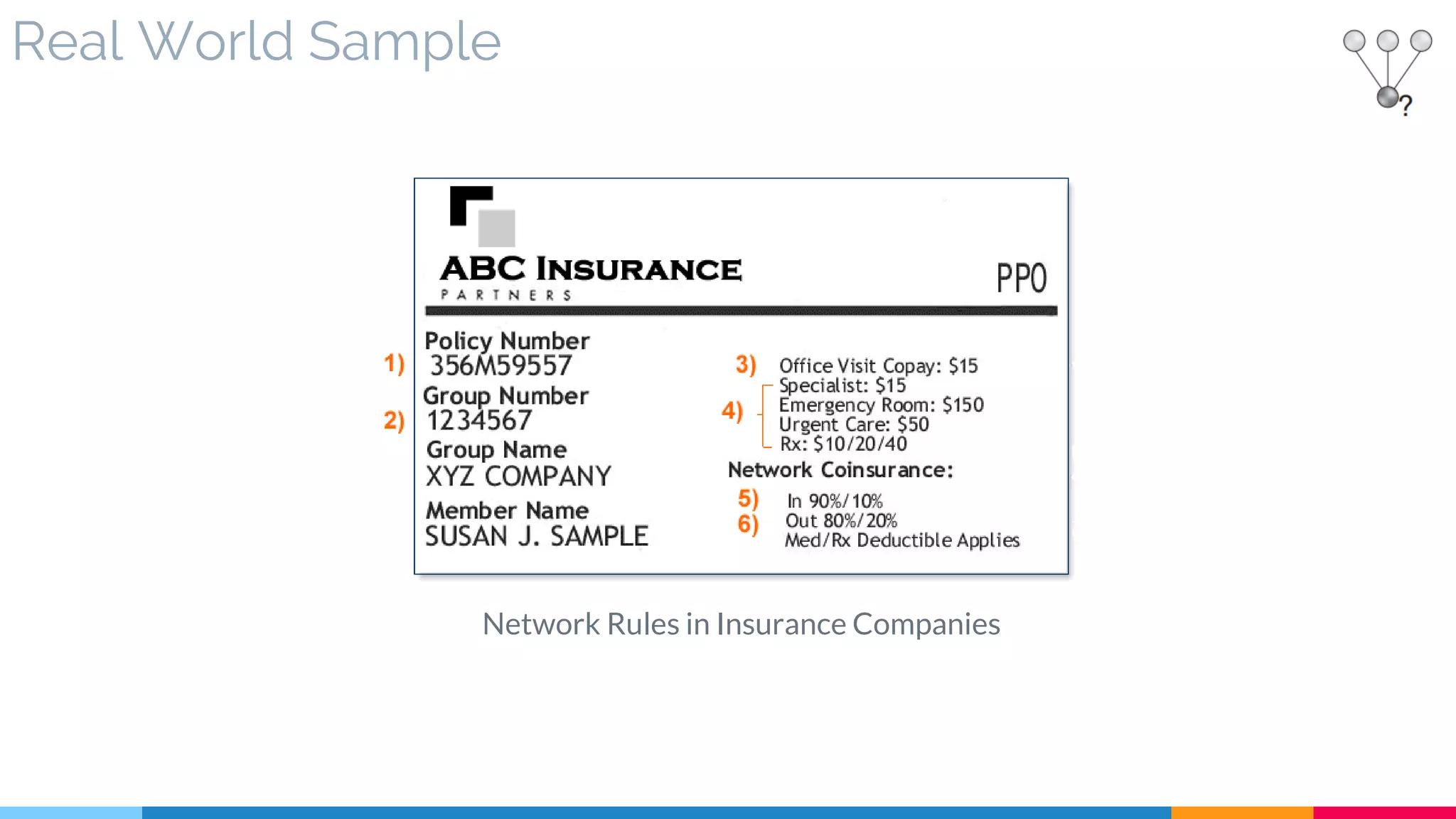
Real World Sample
Network Rules in Insurance Companies
Application
▷ A central service can be established to provide an official access point for the creation,
modification, retrieval, and application of business rules.
▷ Modern runtime platforms have native rules repositories and processing logic that is made
accessible via a set of system service agents and APIs.
▷ This allows any service to interface with business rules-related logic without having to
compose a separate service
▷ Centralized rule services are most often classified as members of the utility service layer
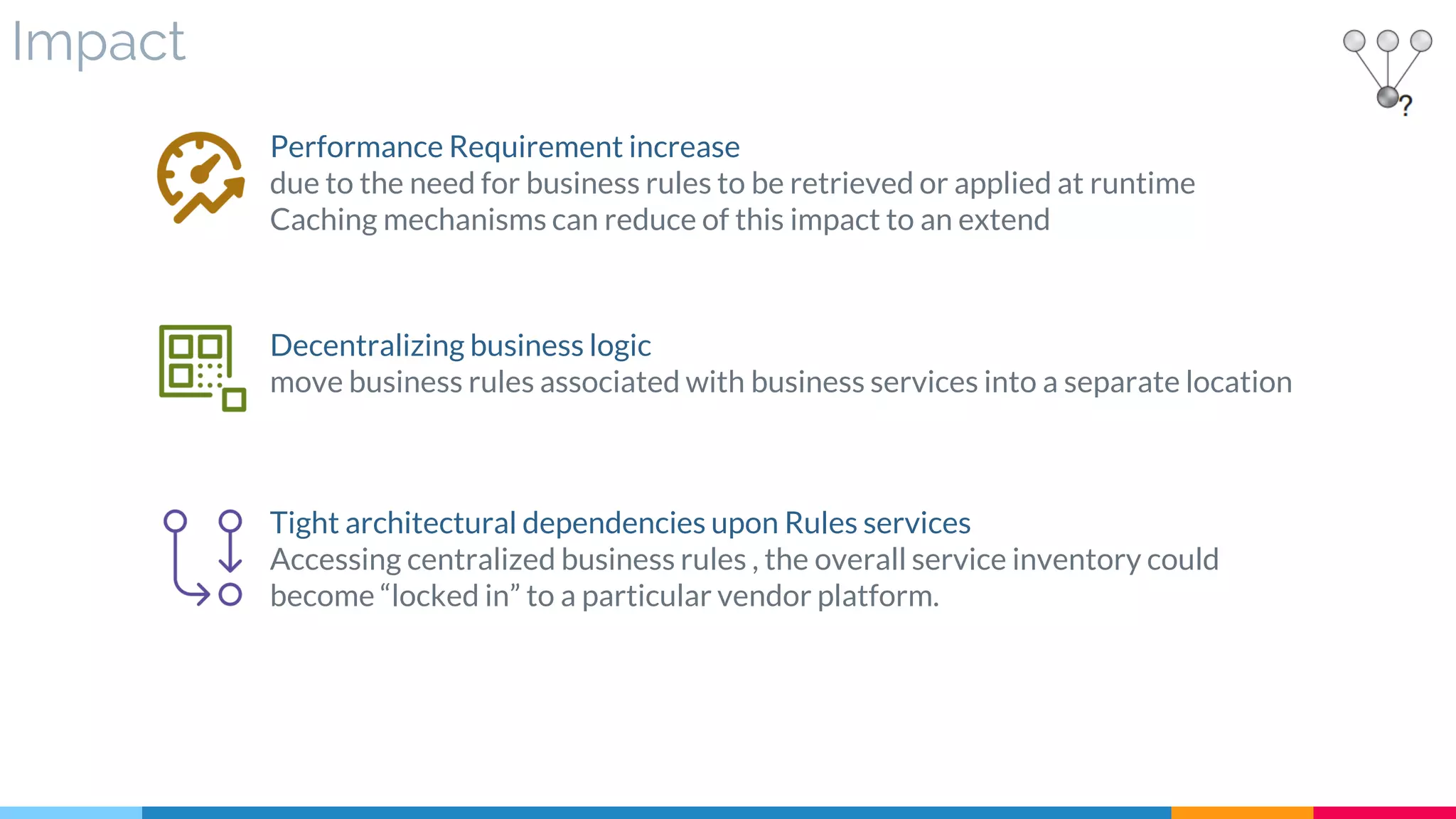
Impact
Tight architectural dependencies upon Rules services
Accessing centralized business rules , the overall service inventory could
become “locked in” to a particular vendor platform.
Decentralizing business logic
move business rules associated with business services into a separate location
Performance Requirement increase
due to the need for business rules to be retrieved or applied at runtime
Caching mechanisms can reduce of this impact to an extend
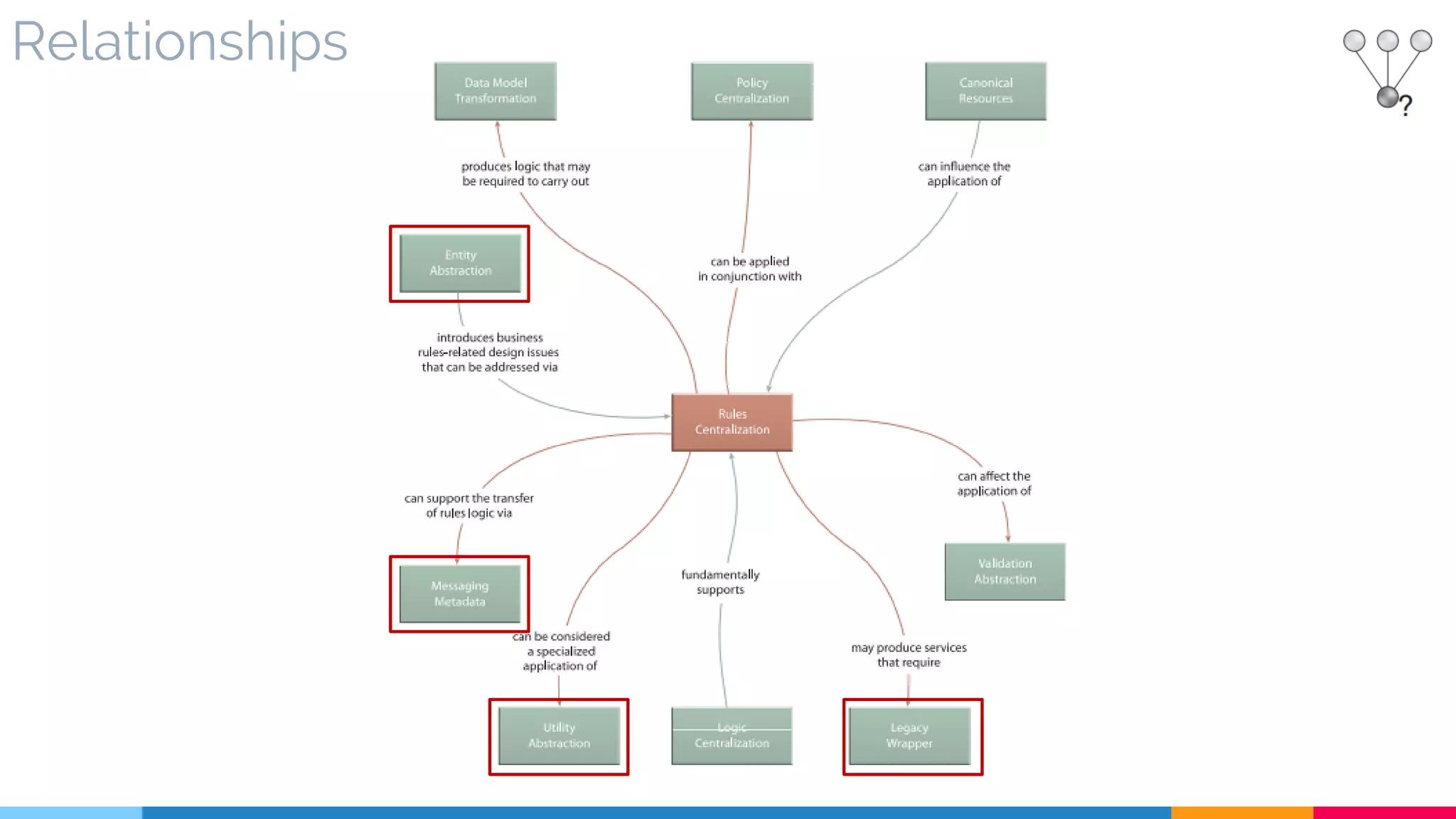
Relationships
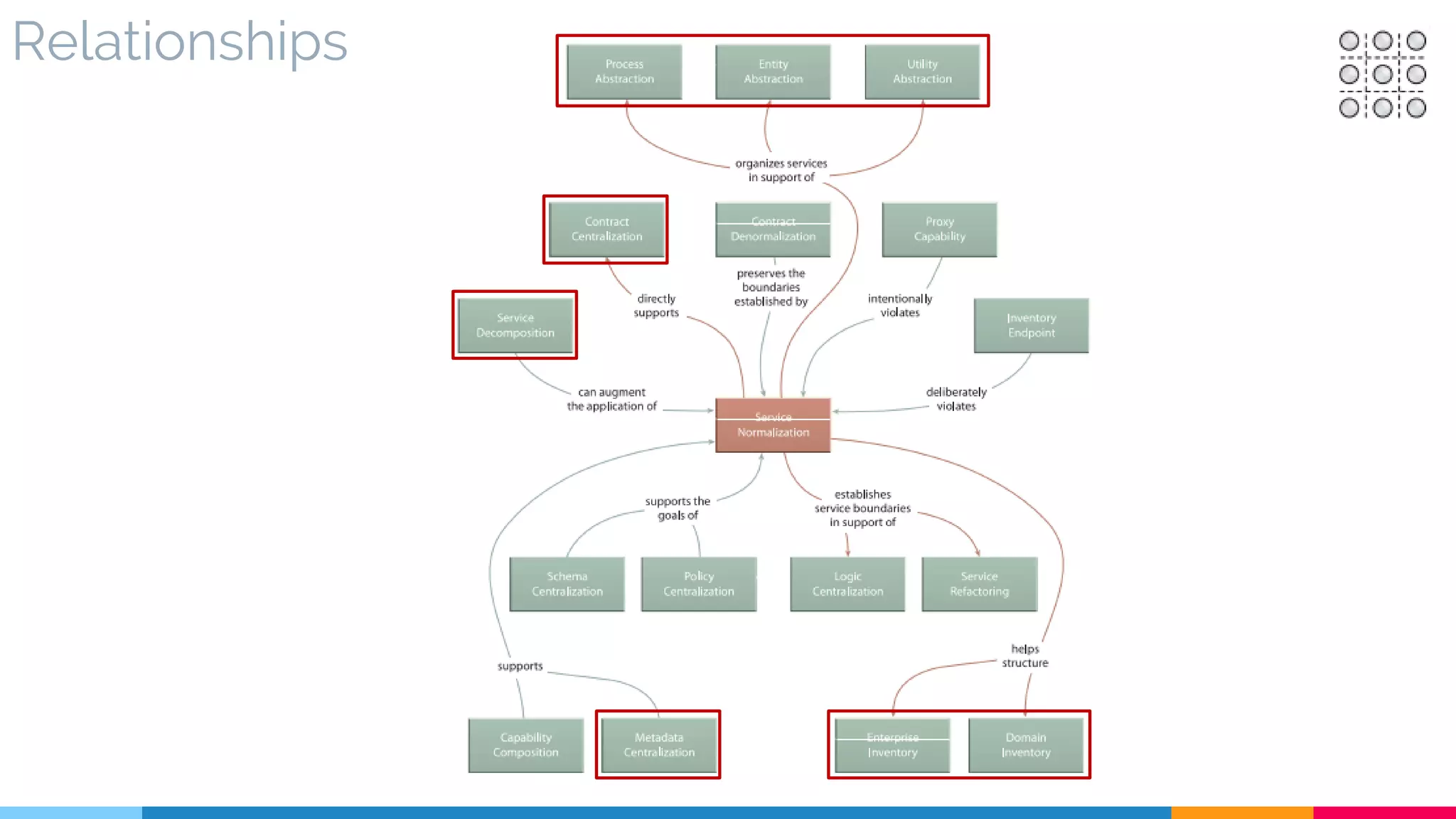
Relationships – part of ESB , Orchestration
Service Inventory Patterns
▷Domain Inventory
▷Service Normalization
▷Logic Centralization
▷Schema Centralization
4
12 Domain Inventory
▷ Problem
▷ Solution
▷ Real World Sample
▷ Application
▷ Impact
▷ Relationships
[123]
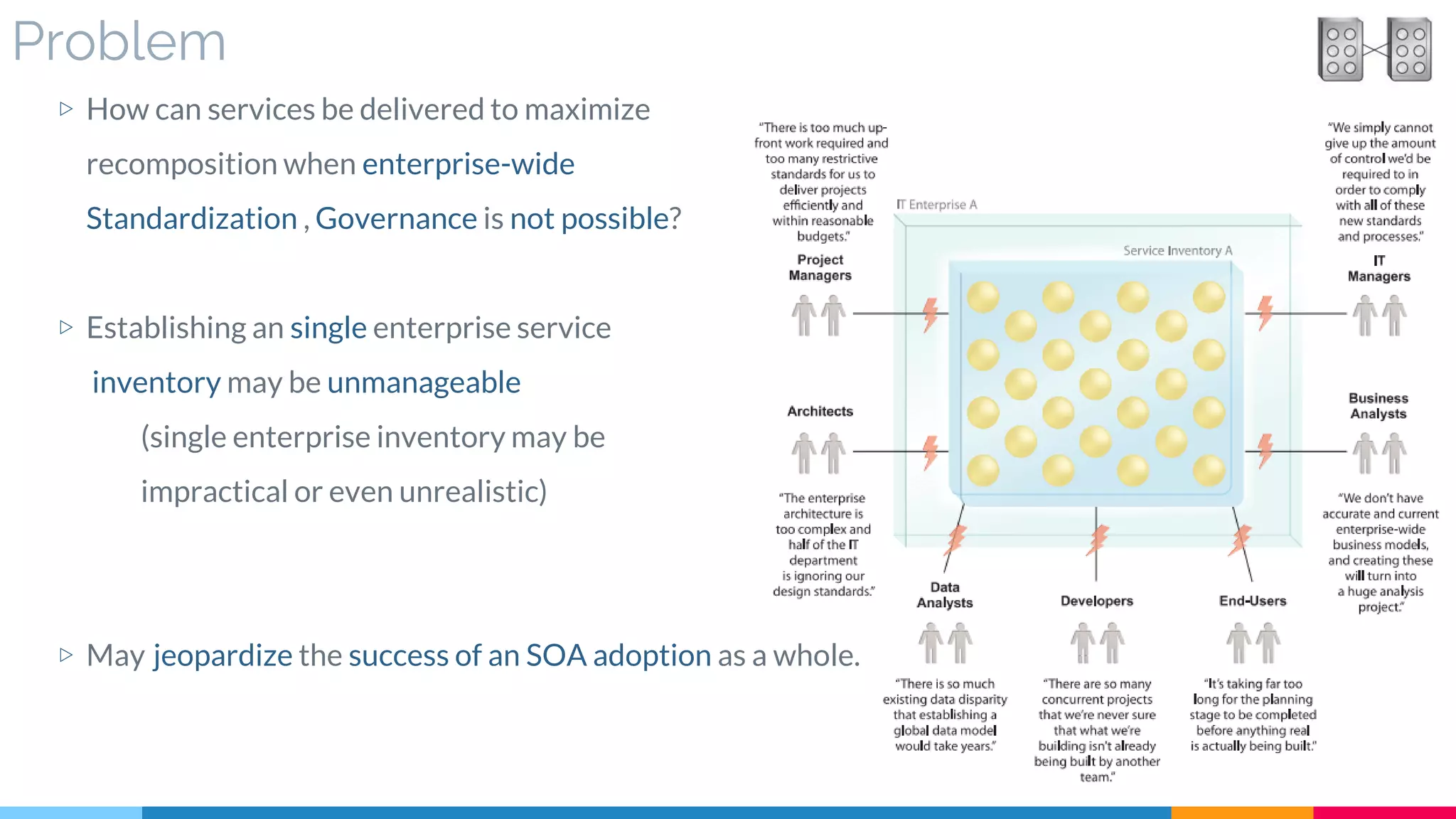
Problem
▷ How can services be delivered to maximize
recomposition when enterprise-wide
Standardization , Governance is not possible?
▷ Establishing an single enterprise service
inventory may be unmanageable
(single enterprise inventory may be
impractical or even unrealistic)
▷ May jeopardize the success of an SOA adoption as a whole.
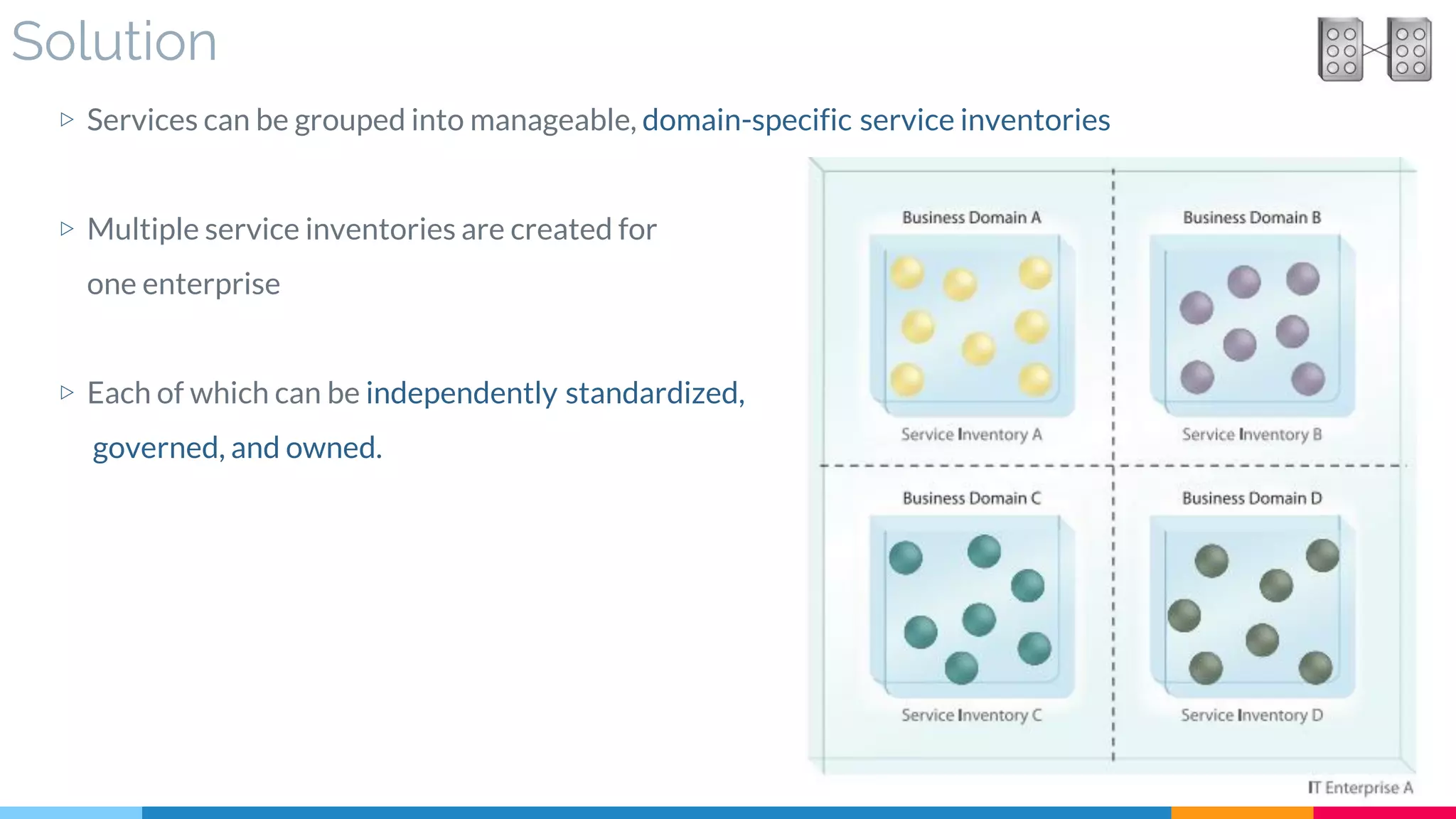
Solution
▷ Services can be grouped into manageable, domain-specific service inventories
▷ Multiple service inventories are created for
one enterprise
▷ Each of which can be independently standardized,
governed, and owned.
Real World Sample
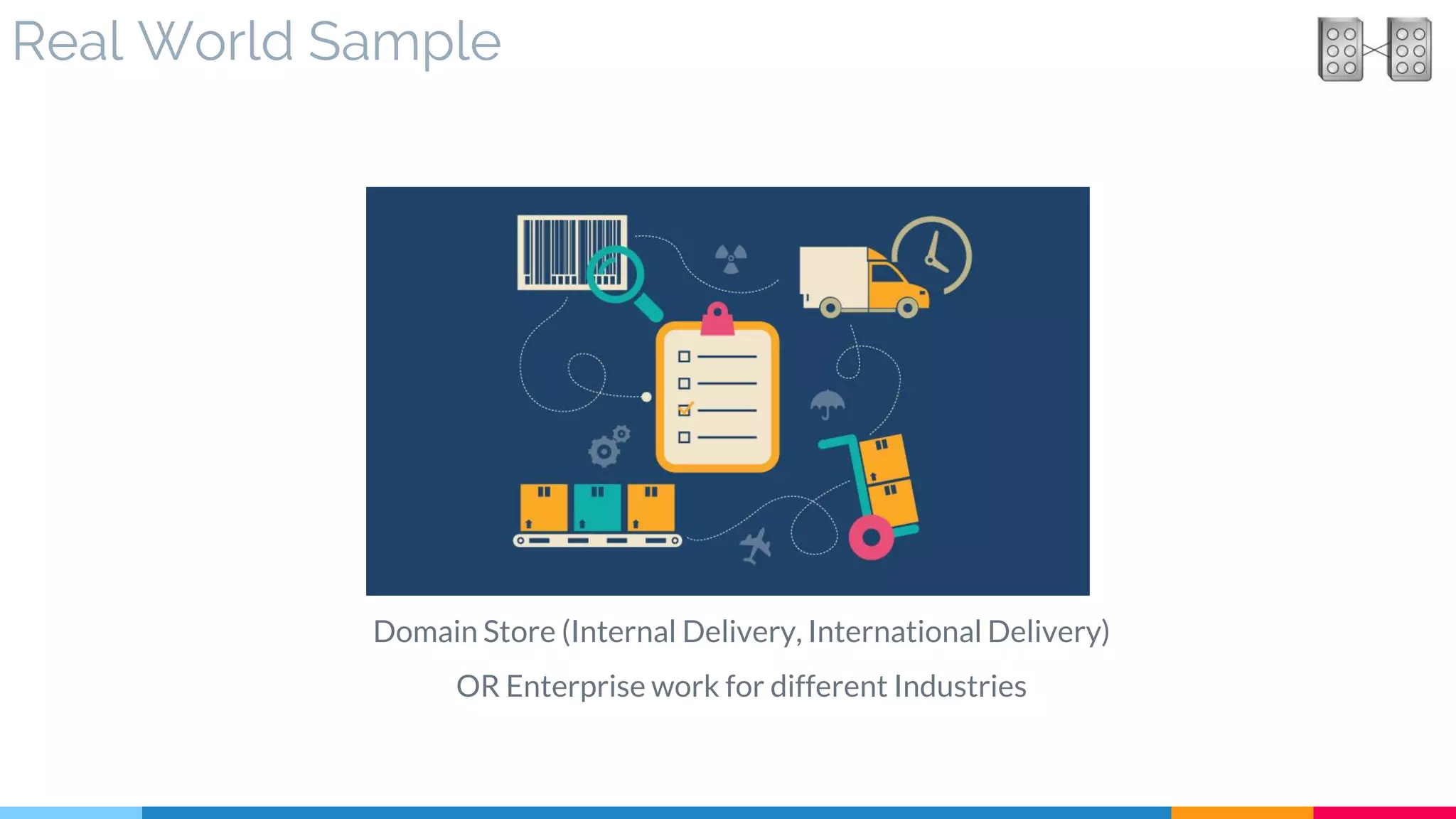
Domain Store (Internal Delivery, International Delivery)
OR Enterprise work for different Industries
Application
▷ Inventory domain boundaries need to be carefully established.
▷ Domain service inventories are an appropriate alternative when :
 Enterprise does not have an established, global data models and creating
them is considered unrealistic.
 Implementation environment is a large enterprise without strong executive
sponsorship and wide-spread support for the SOA initiative
 Organization is incapable of changing the complexion of its IT departments
in support of a more centralized governance model.
Application
▷ Organizations will often have options as to how the domains are defined like :
 Organizational business areas represented by specific IT departments or groups.
These business areas would then establish the basis for business domains.
 Organizational business domains not represented by separate IT departments or
groups. These domains can still form the basis of service inventory boundaries but
require cooperation across IT departments.
 Remote offices, each with its own IT department and development center. This can
result in geographical-based domains.
Impact
Cross-domain Transformation Requirements
Because of Standardization differences between domain service inventories
Reduces the overall benefit potential of the SOA adoption.
Performance Overhead
Cross-domain data exchange impact the development and design effort of
corresponding service compositions often lead to the creation of redundant
services across domains.
Relationships
13 Service Normalization
▷ Problem
▷ Solution
▷ Real World Sample
▷ Application
▷ Impact
▷ Relationships
[131]
Problem
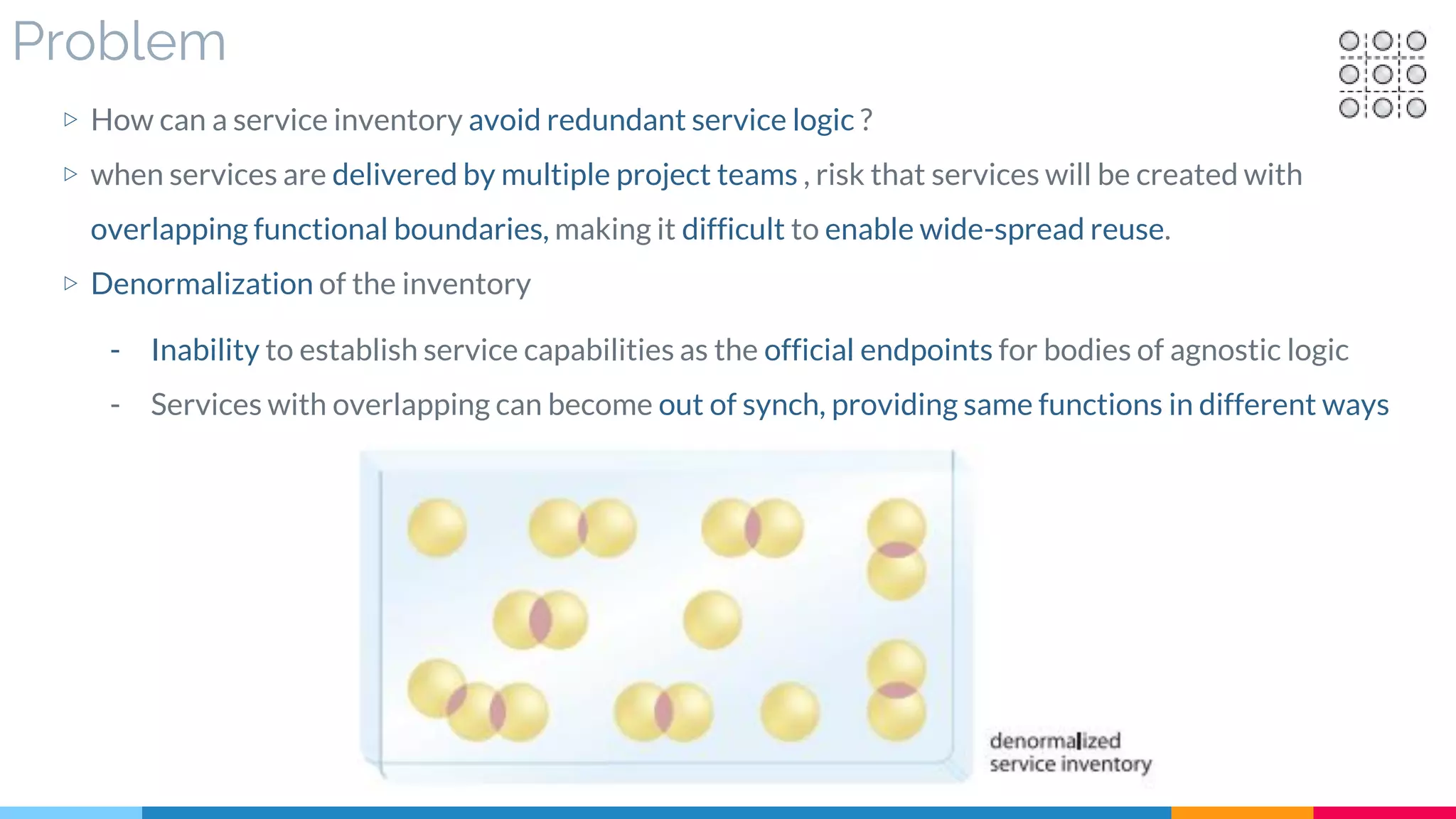
▷ How can a service inventory avoid redundant service logic ?
▷ when services are delivered by multiple project teams , risk that services will be created with
overlapping functional boundaries, making it difficult to enable wide-spread reuse.
▷ Denormalization of the inventory
- Inability to establish service capabilities as the official endpoints for bodies of agnostic logic
- Services with overlapping can become out of synch, providing same functions in different ways
Solution
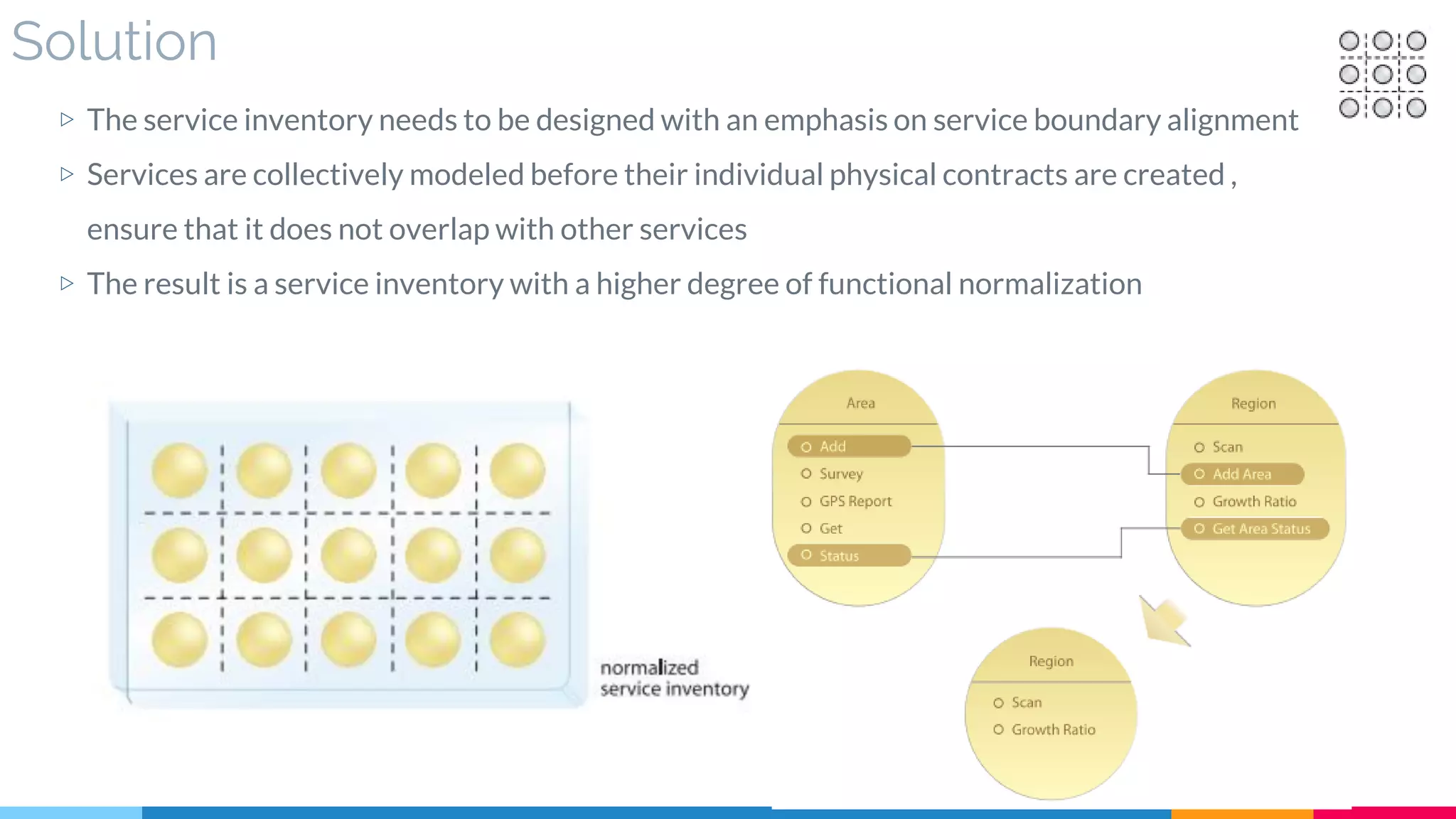
▷ The service inventory needs to be designed with an emphasis on service boundary alignment
▷ Services are collectively modeled before their individual physical contracts are created ,
ensure that it does not overlap with other services
▷ The result is a service inventory with a higher degree of functional normalization
Real World Sample
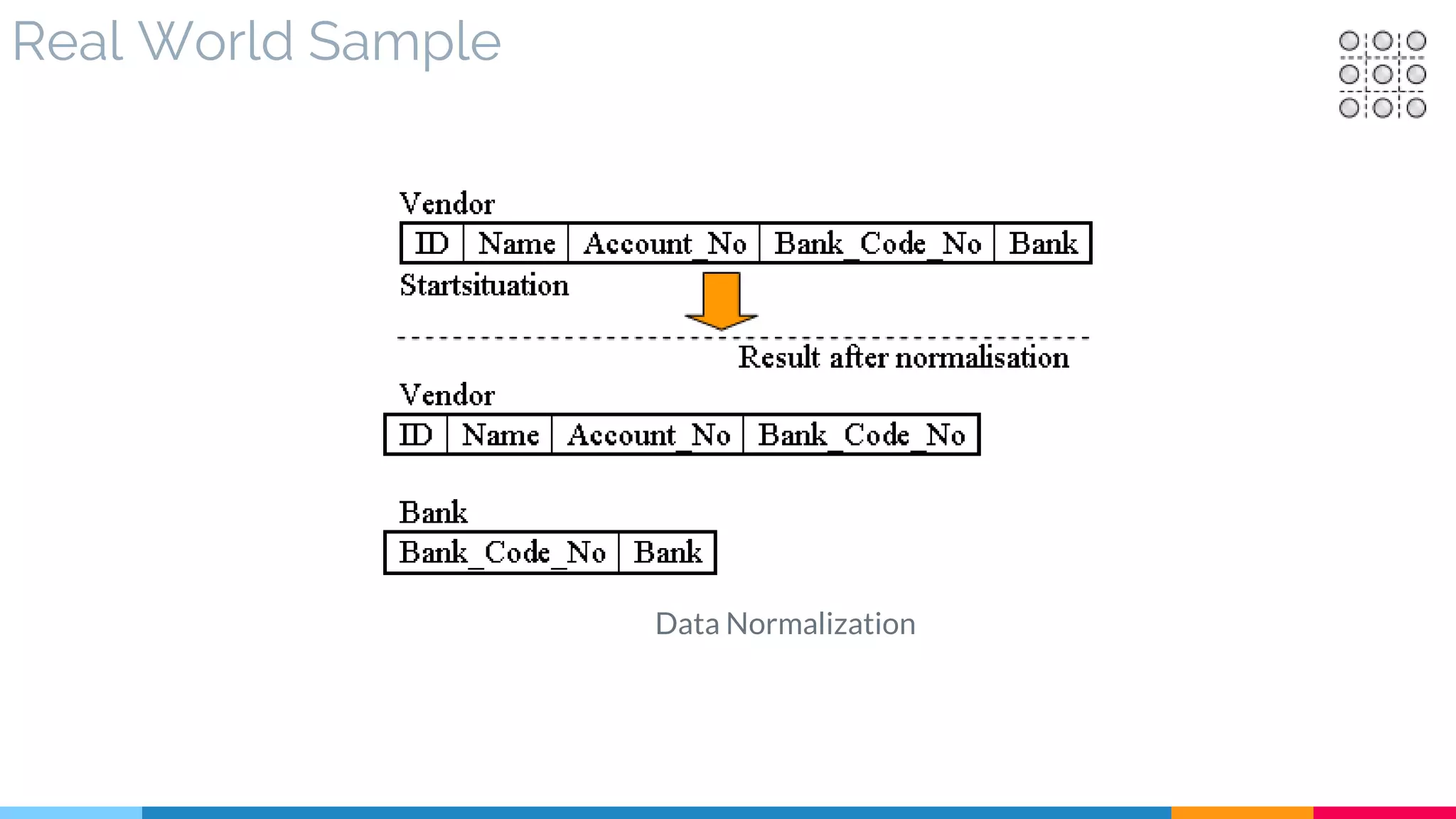
Data Normalization
Application
▷ Ensure service-level autonomy applied – Common Steps include :
1. Identifying and decomposing a business process definition that pertains to the
inventory boundary
2. Allocating the individual parts of the process into appropriate new or existing
conceptual service candidates
3. Validating that no two service boundaries overlap.
To fully apply Service Normalization requires that this process be carried out iteratively ,
once for every business process that is associated with the scope of the service inventory
Typically part of a top-down delivery effort.
(Up Front Analysis)
Impact
Continual governance effort
Ensure that services maintain normalization throughout the inventory
as they are revised and evolved over time.
Conceptually modeled prior to delivery
Can result in separate analysis project that needs to be completed before any
service can actually be built to guarantee inventory-wide normalization
(as part of inventory service blueprint specification)
Relationships
14 Logic Centralization
▷ Problem
▷ Solution
▷ Real World Sample
▷ Application
▷ Impact
▷ Relationships
[136]
Problem
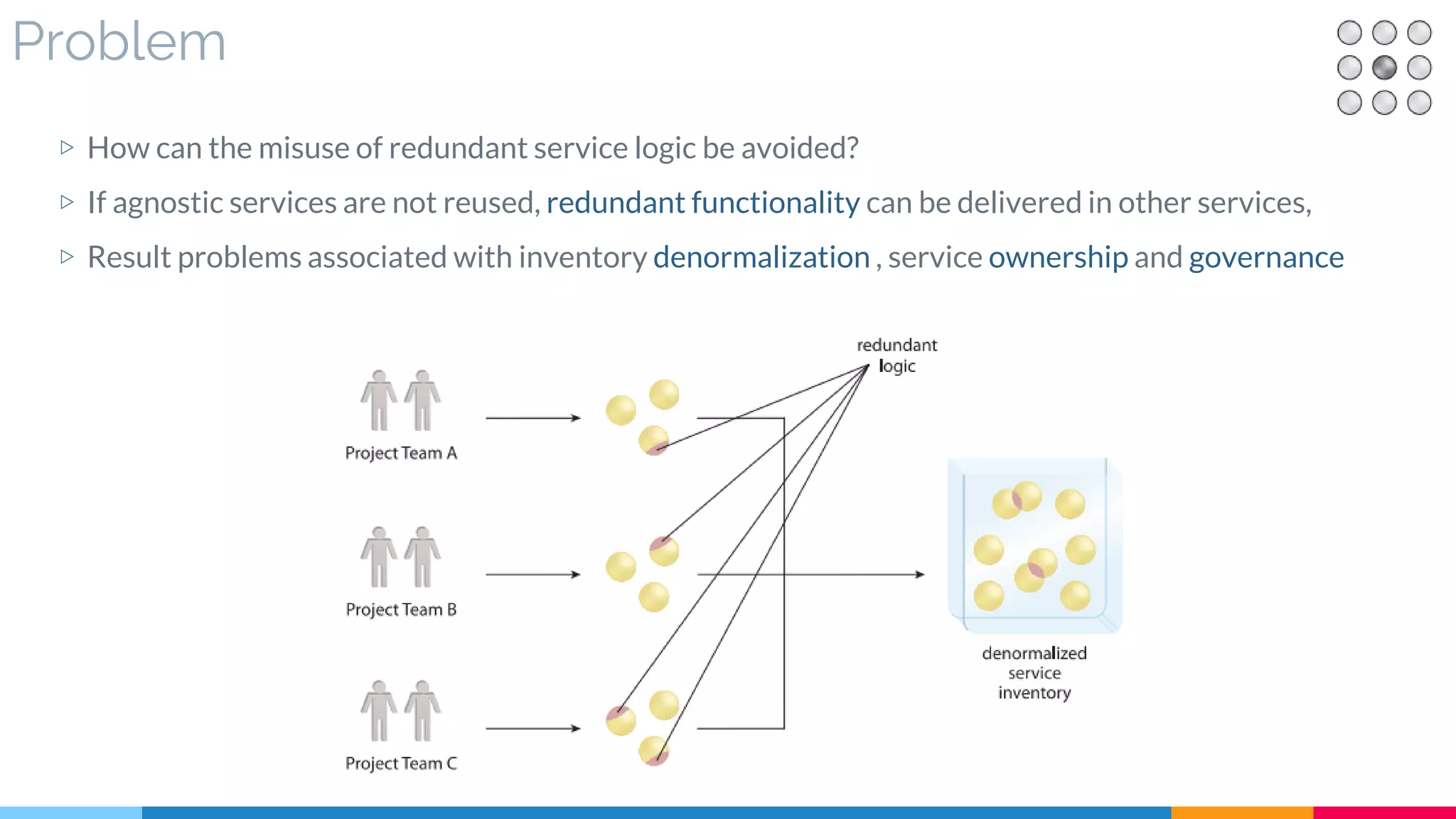
▷ How can the misuse of redundant service logic be avoided?
▷ If agnostic services are not reused, redundant functionality can be delivered in other services,
▷ Result problems associated with inventory denormalization , service ownership and governance
Solution
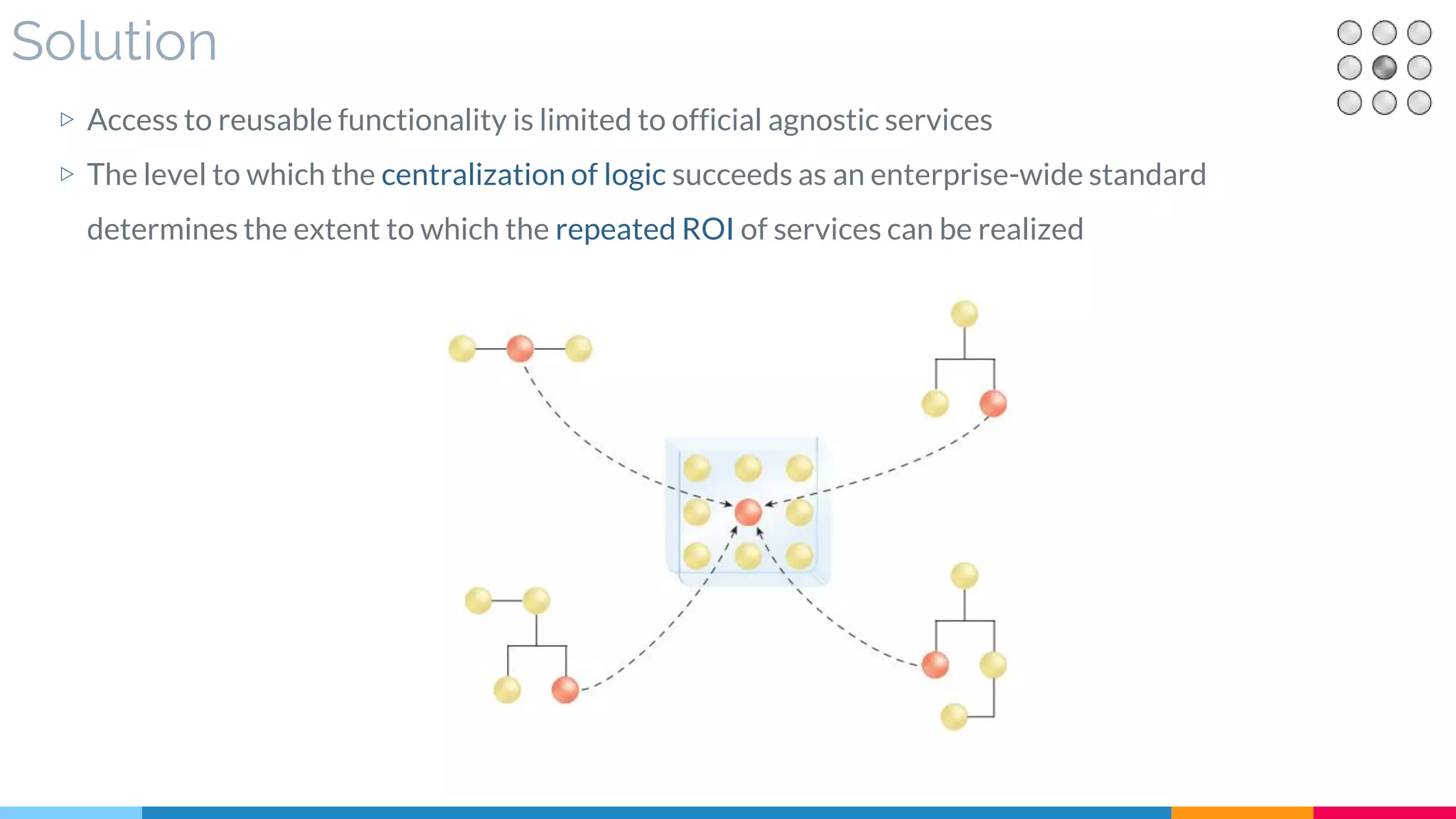
▷ Access to reusable functionality is limited to official agnostic services
▷ The level to which the centralization of logic succeeds as an enterprise-wide standard
determines the extent to which the repeated ROI of services can be realized
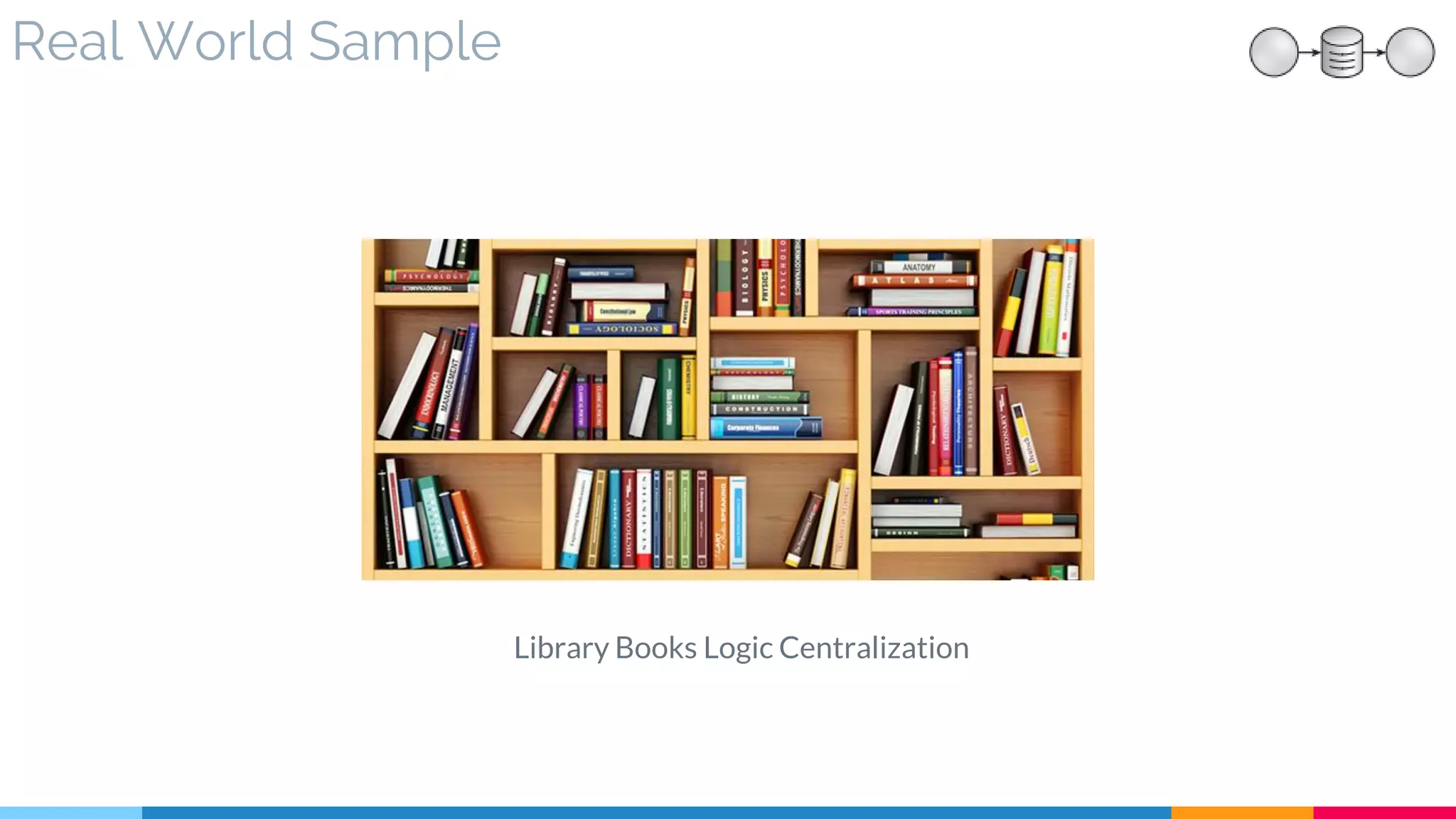
Real World Sample
Library Books Logic Centralization
Application
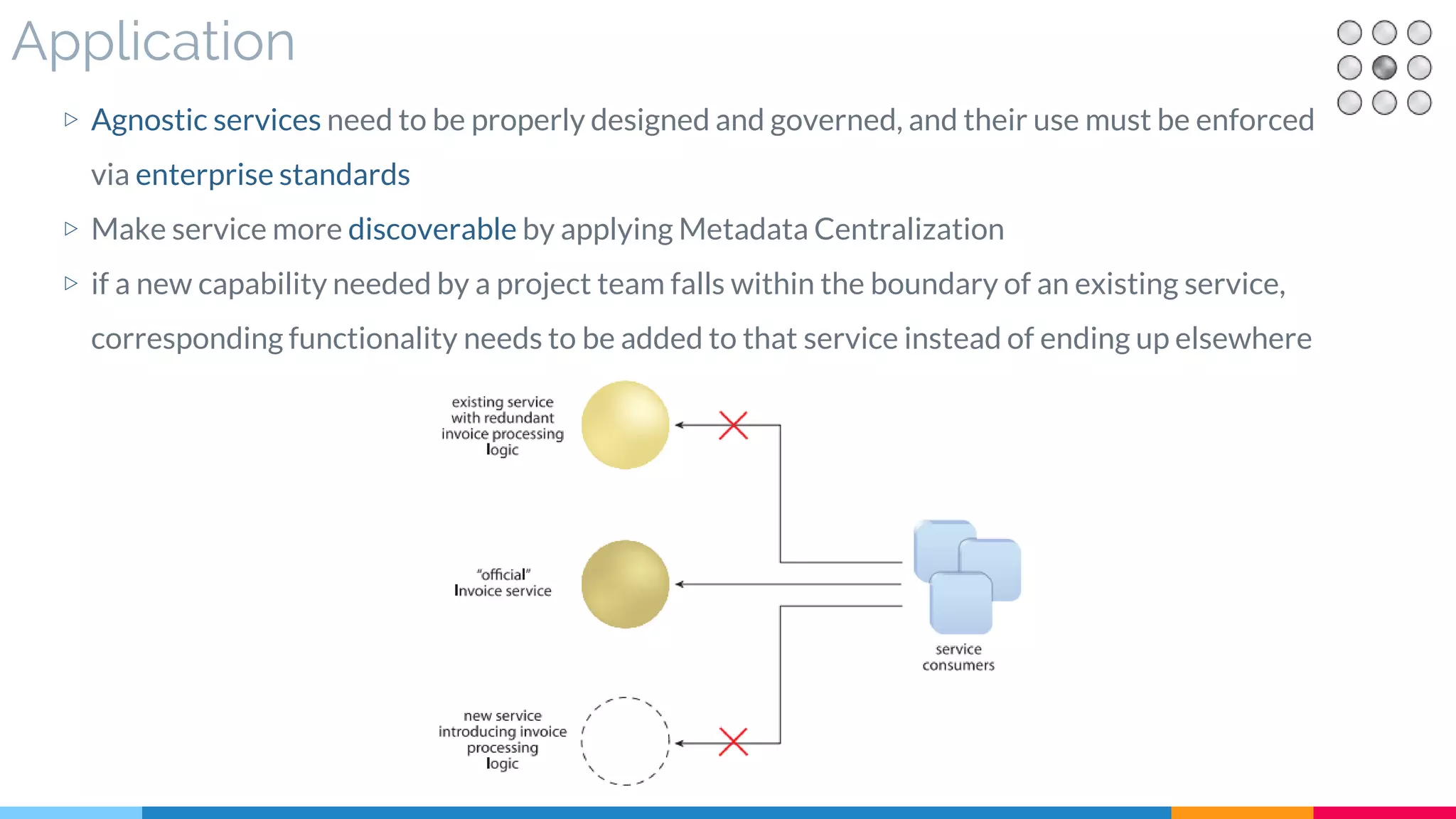
▷ Agnostic services need to be properly designed and governed, and their use must be enforced
via enterprise standards
▷ Make service more discoverable by applying Metadata Centralization
▷ if a new capability needed by a project team falls within the boundary of an existing service,
corresponding functionality needs to be added to that service instead of ending up elsewhere
Impact
For example:
- Existing project plans and processes are impacted by requiring the involvement of
reusable services as part of their development projects.
- There may be resistance to giving up control of solution designs if teams are forced to
include existing agnostic services or produce new services that need to be reusable.
Raise Cultural Issues
Introduce Logic Centralization into organization that does not sponsor reuse
raise issues with people and IT departments affected by service delivery projects
Relationships
15 Schema Centralization
▷ Problem
▷ Solution
▷ Real World Sample
▷ Application
▷ Impact
▷ Relationships
[200]
Problem
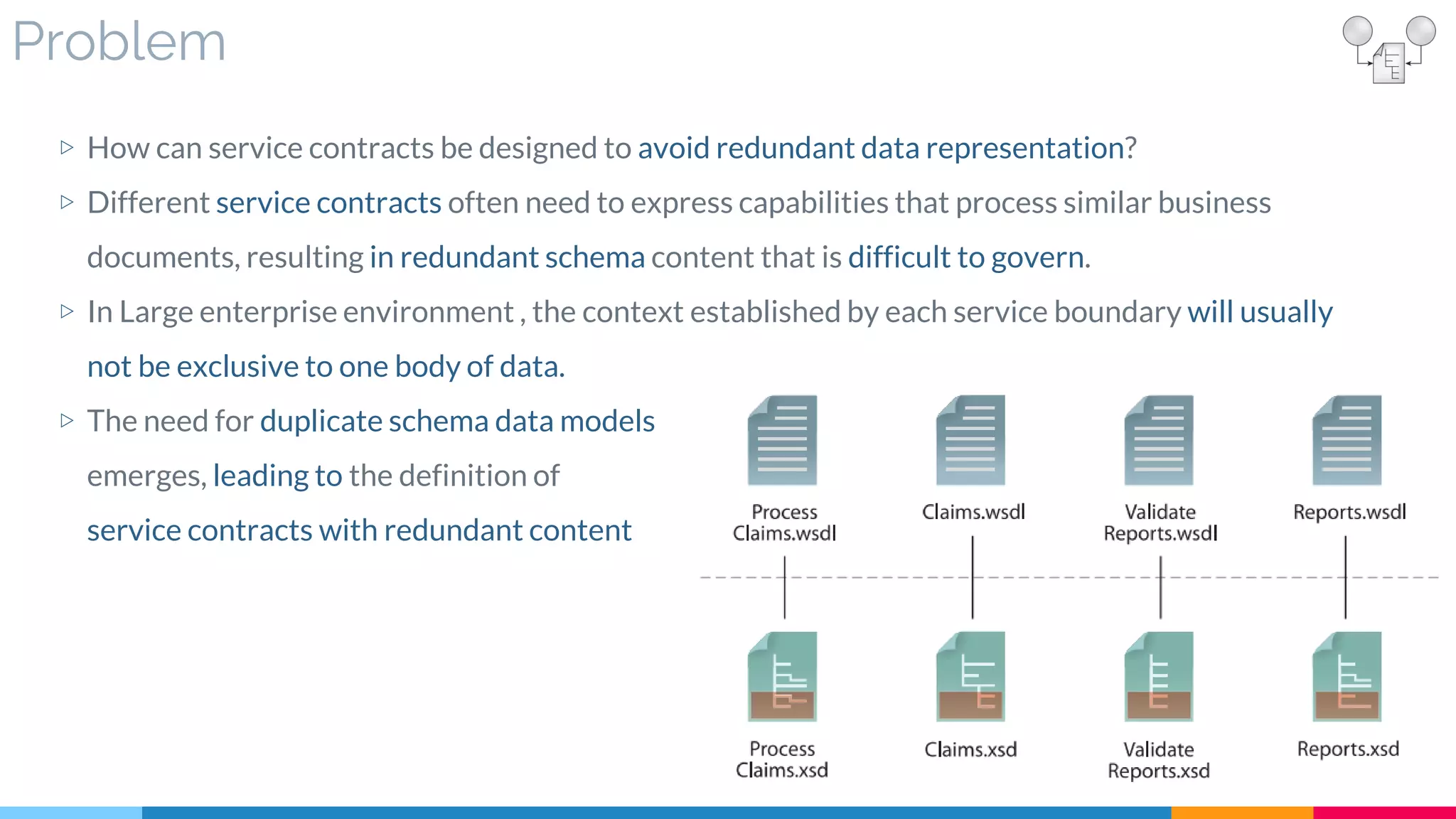
▷ How can service contracts be designed to avoid redundant data representation?
▷ Different service contracts often need to express capabilities that process similar business
documents, resulting in redundant schema content that is difficult to govern.
▷ In Large enterprise environment , the context established by each service boundary will usually
not be exclusive to one body of data.
▷ The need for duplicate schema data models
emerges, leading to the definition of
service contracts with redundant content
Solution
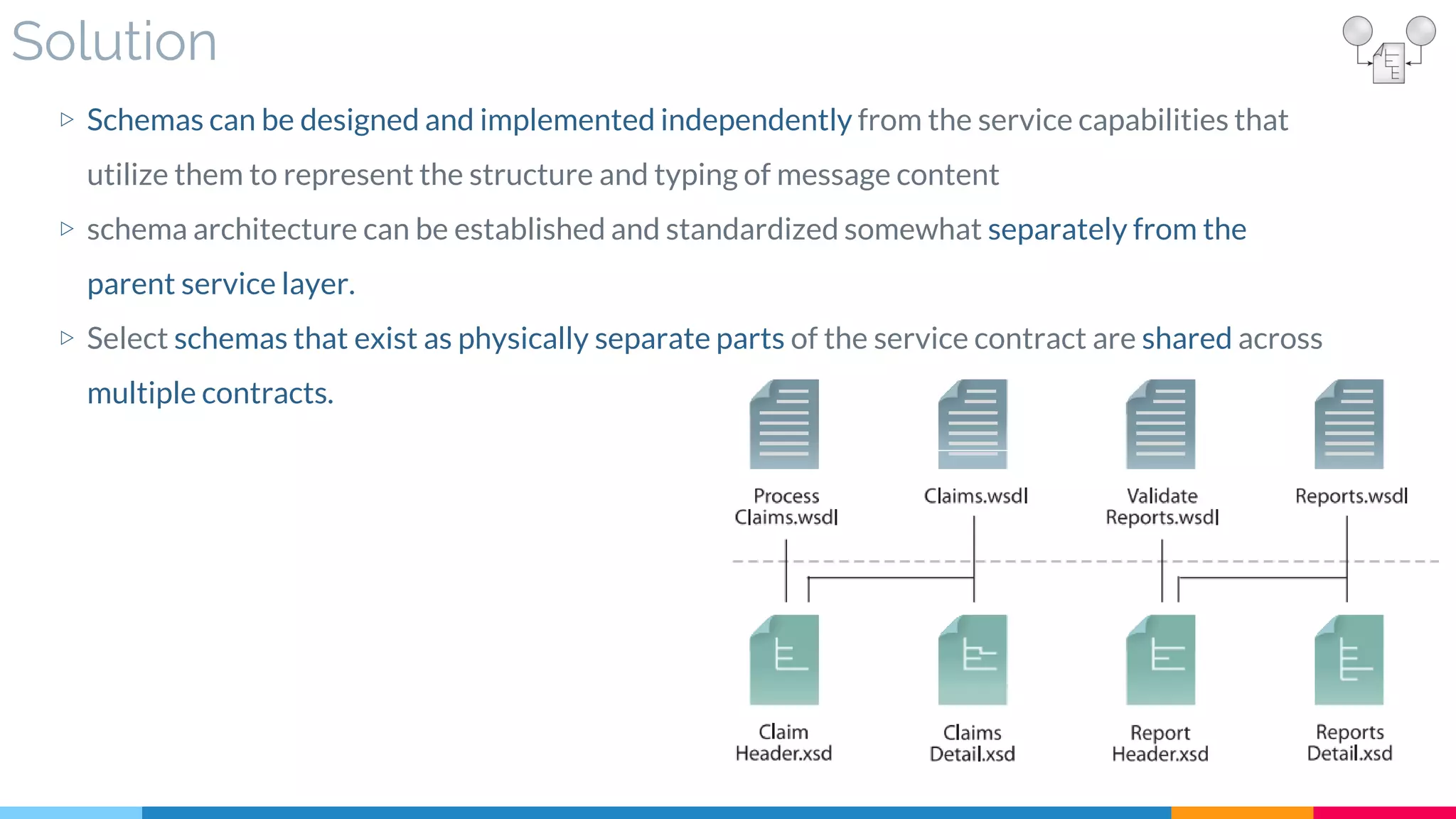
▷ Schemas can be designed and implemented independently from the service capabilities that
utilize them to represent the structure and typing of message content
▷ schema architecture can be established and standardized somewhat separately from the
parent service layer.
▷ Select schemas that exist as physically separate parts of the service contract are shared across
multiple contracts.
Real World Sample
Login Schema for Google Services
Application
▷ Up-front analysis effort is required to establish a schema layer independent of and in support
of the service layer
▷ Separate schema layer is taken into account subsequent to the completion of the service
inventory blueprint as following steps :
1. Complete a service inventory blueprint to establish a conceptual representation of
planned searvices within an inventory.
2. Determine the required centralized schema definitions to represent the common
business entities and information sets likely to be processed by services in this inventory.
3. Create the schema definitions by applying design standards to ensure consistency
and normalization.
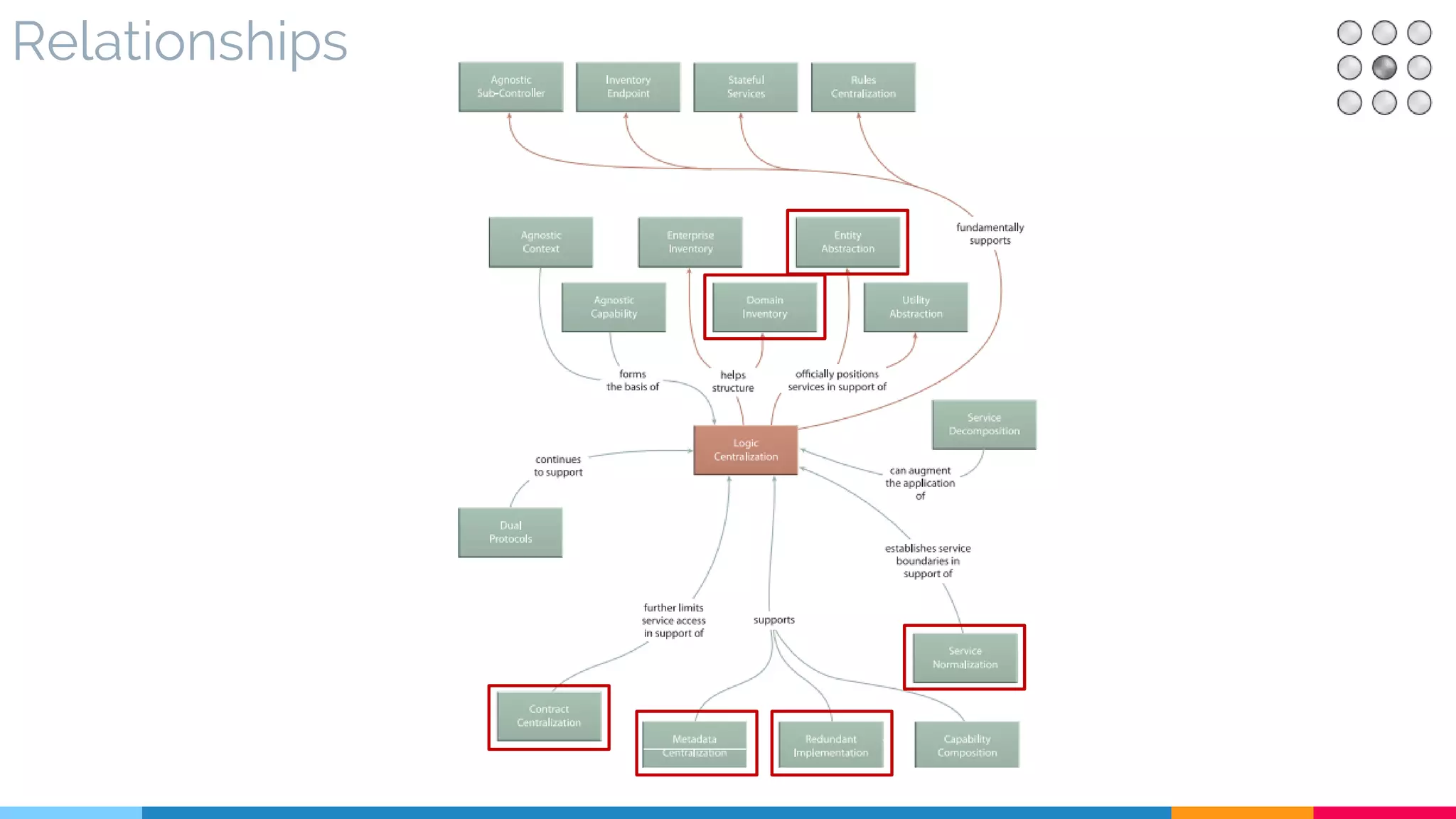
4. Create the WSDL definitions using the standard schemas wherever appropriate
and supplementing the contract with any required service-specific schemas.
Impact
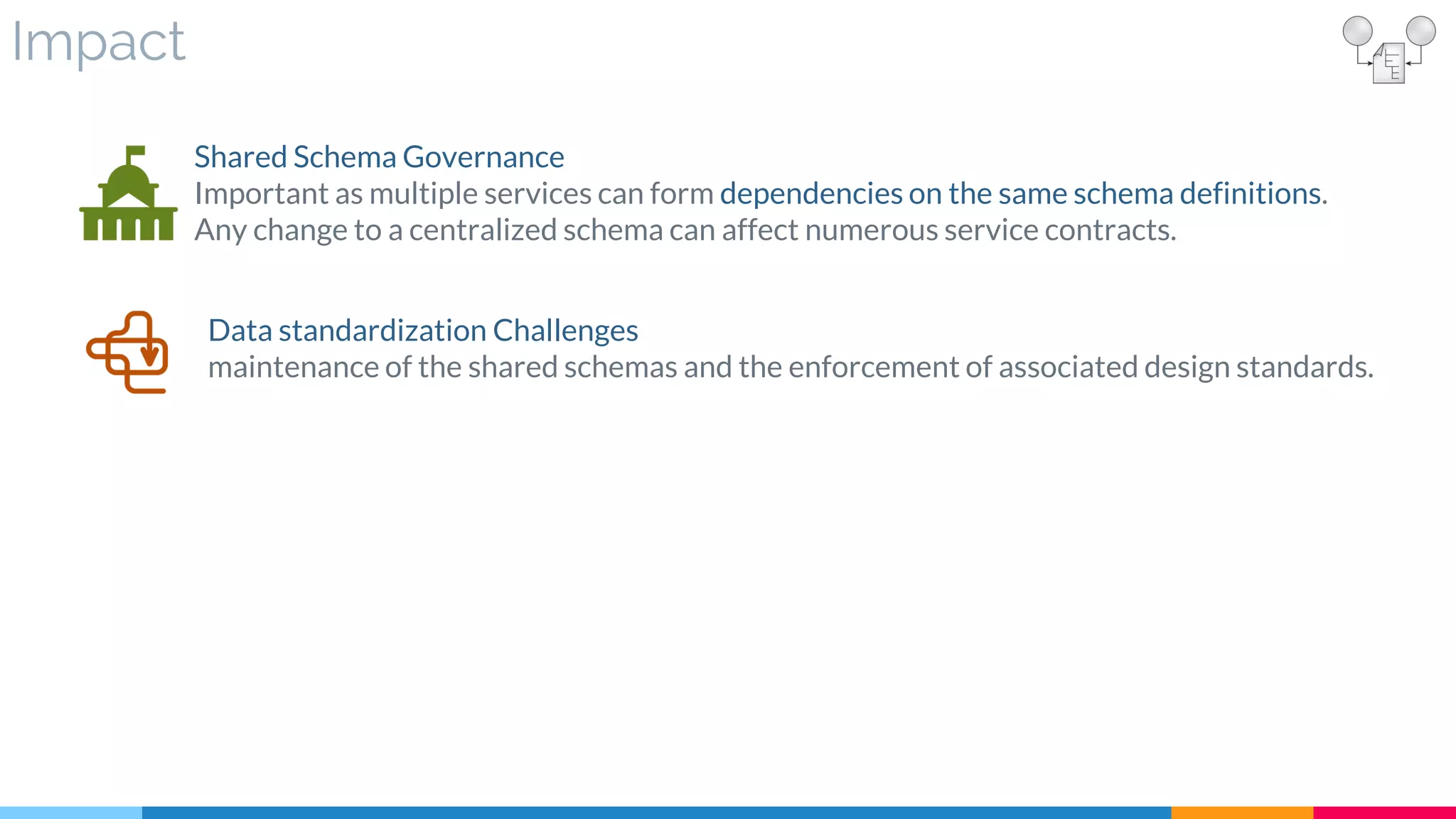
Data standardization Challenges
maintenance of the shared schemas and the enforcement of associated design standards.
Shared Schema Governance
Important as multiple services can form dependencies on the same schema definitions.
Any change to a centralized schema can affect numerous service contracts.
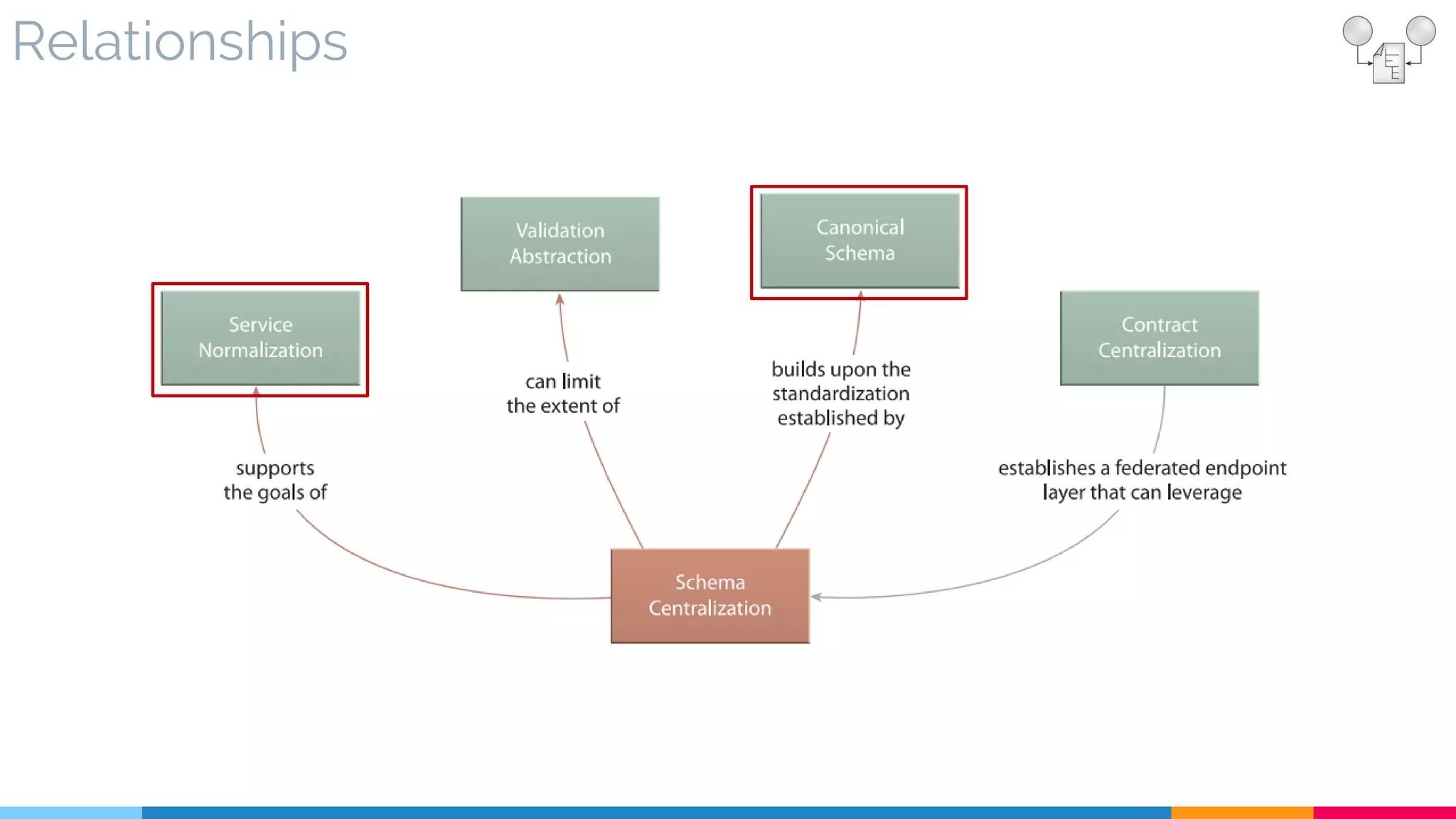
Relationships
Relationships – Canonical Schema
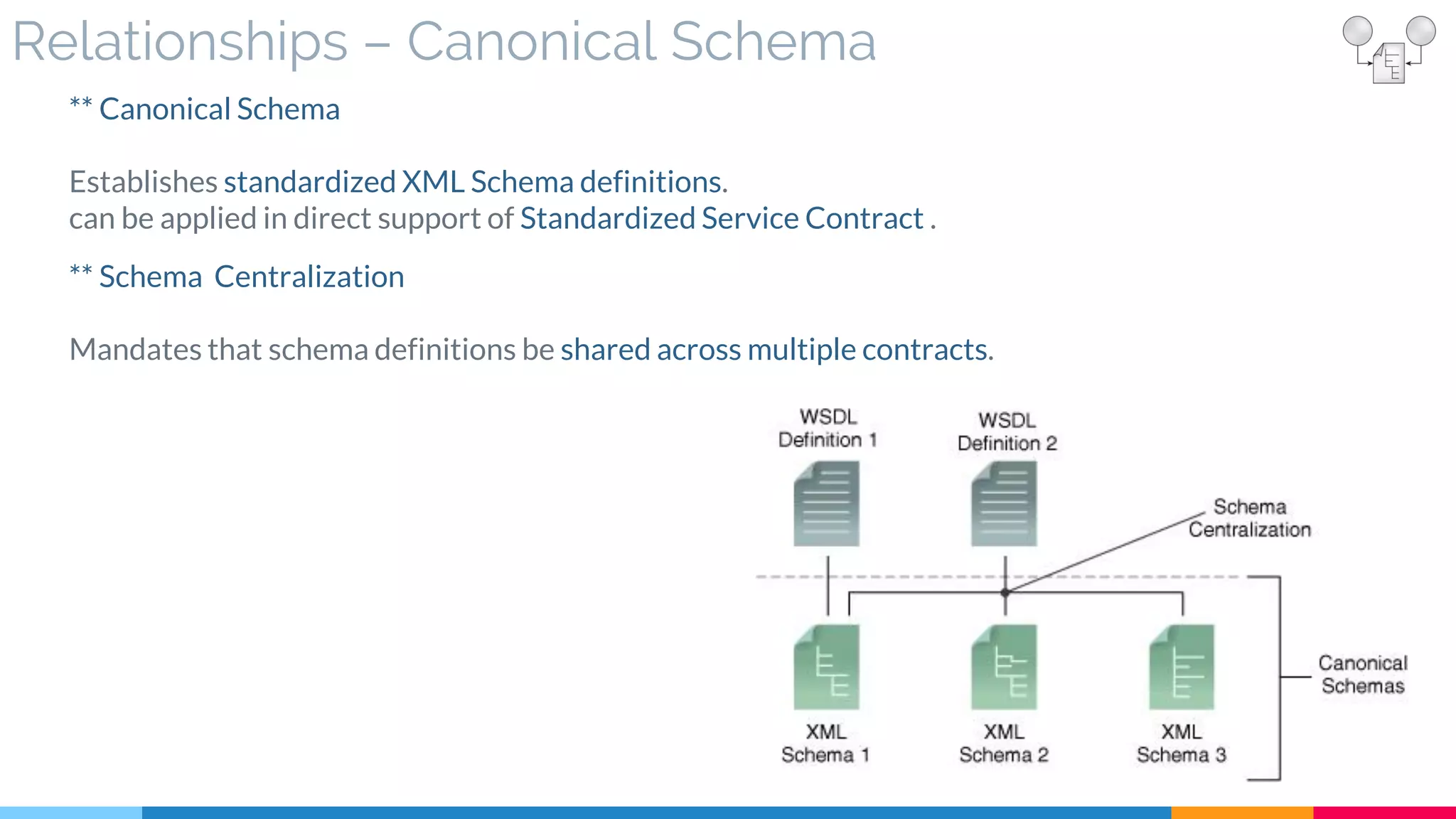
** Canonical Schema
Establishes standardized XML Schema definitions.
can be applied in direct support of Standardized Service Contract .
** Schema Centralization
Mandates that schema definitions be shared across multiple contracts.
Service Design Patterns
▷ Contract Centralization
▷ Official Endpoint
▷ Service Façade
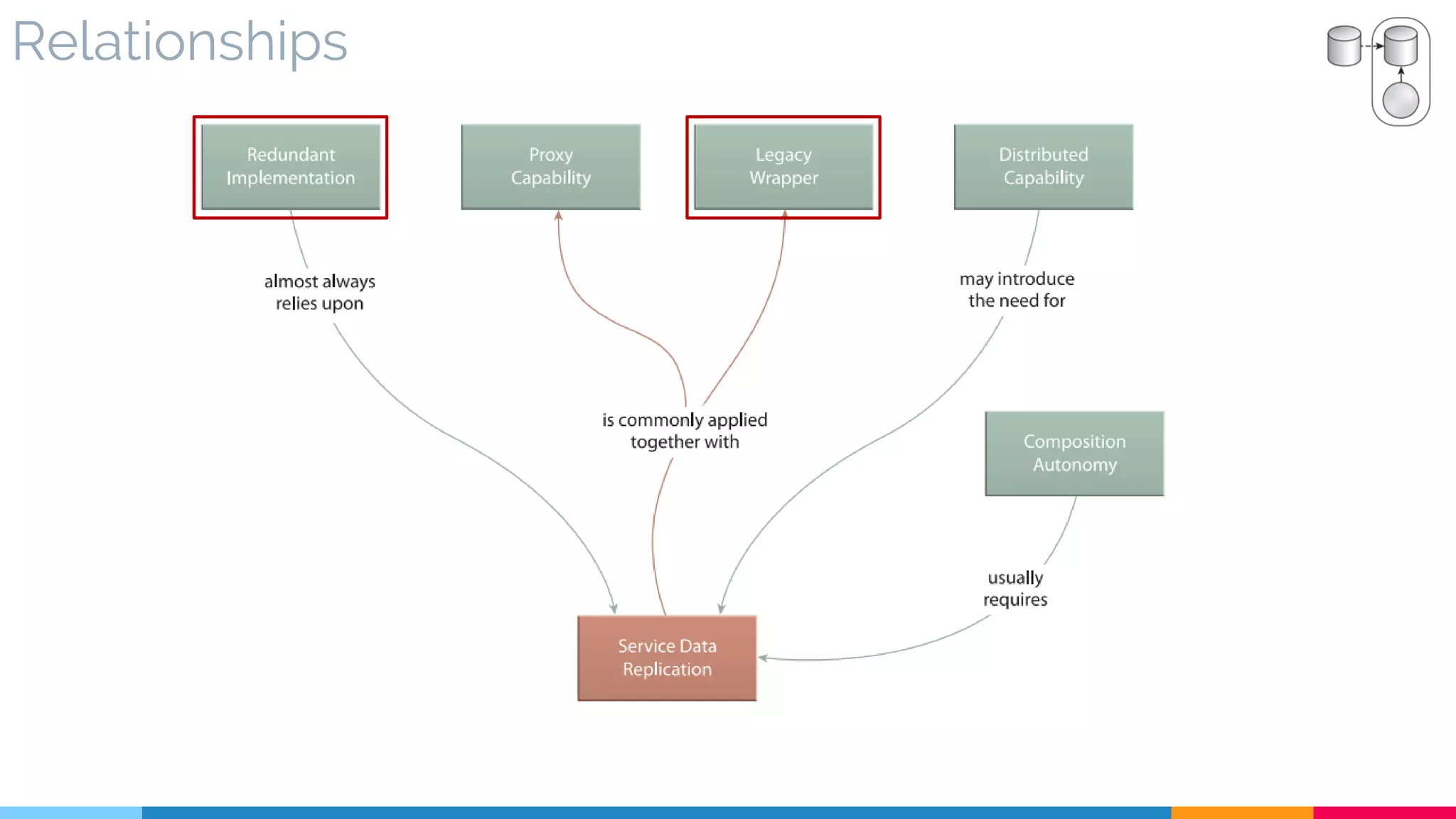
▷ Redundant Implementation
▷ Service Data Replication
▷ Decoupled Contract
▷ Concurrent Contract
▷ Legacy Wrapper
▷ Service Agent
▷ Messaging Metadata
10
16 Contract Centralization
▷ Problem
▷ Solution
▷ Real World Sample
▷ Application
▷ Impact
▷ Relationships
[409]
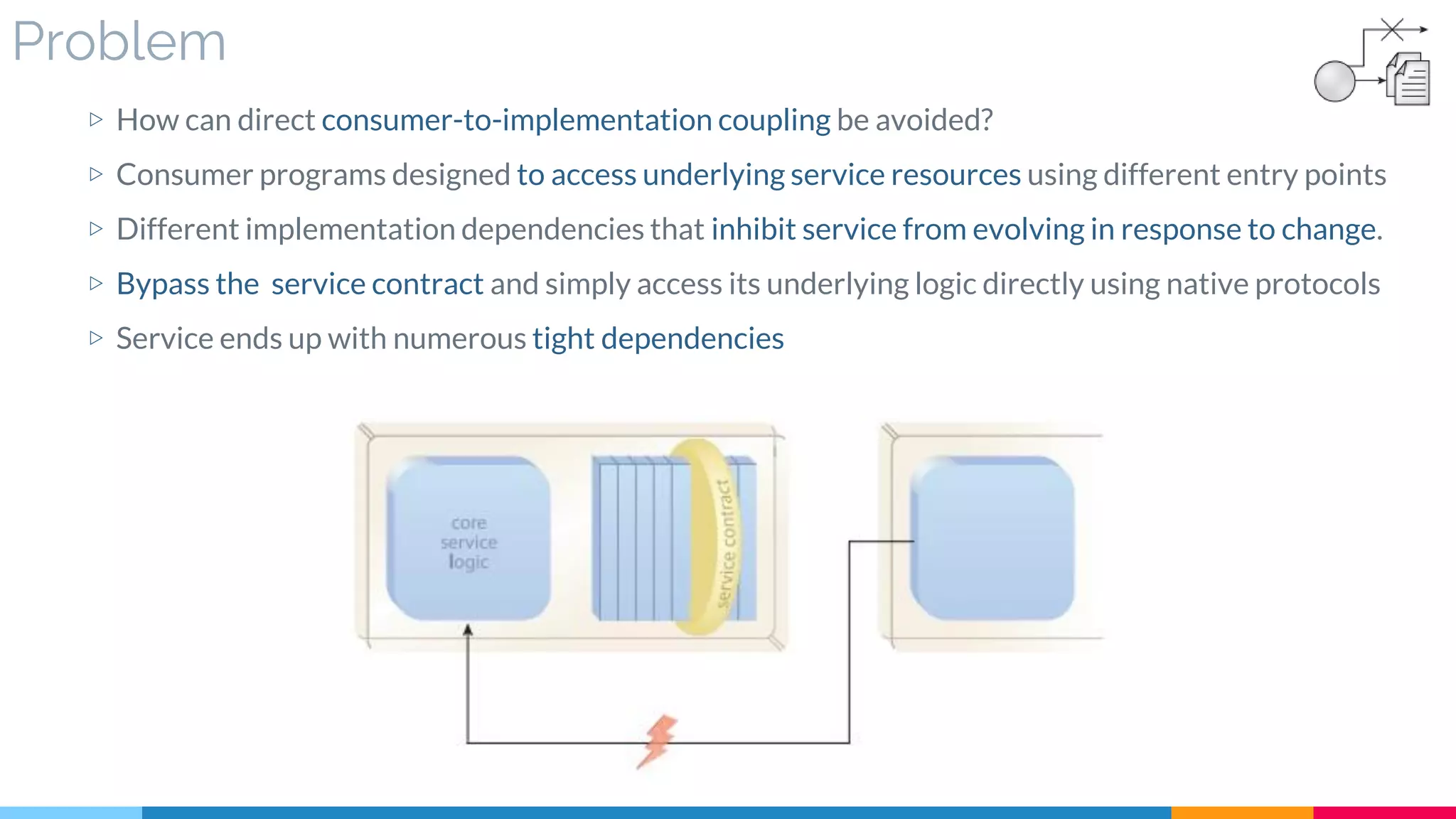
Problem
▷ How can direct consumer-to-implementation coupling be avoided?
▷ Consumer programs designed to access underlying service resources using different entry points
▷ Different implementation dependencies that inhibit service from evolving in response to change.
▷ Bypass the service contract and simply access its underlying logic directly using native protocols
▷ Service ends up with numerous tight dependencies
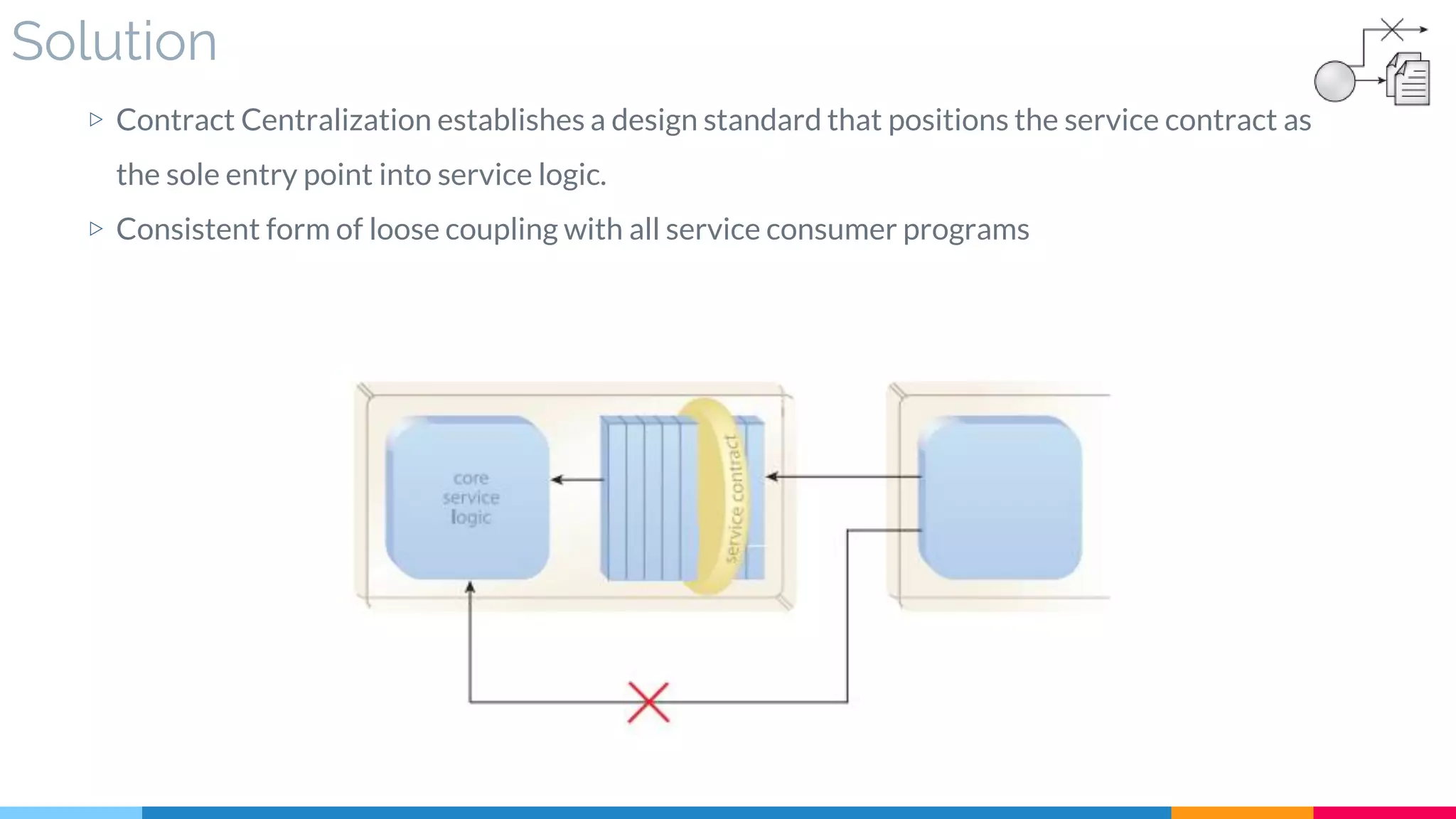
Solution
▷ Contract Centralization establishes a design standard that positions the service contract as
the sole entry point into service logic.
▷ Consistent form of loose coupling with all service consumer programs
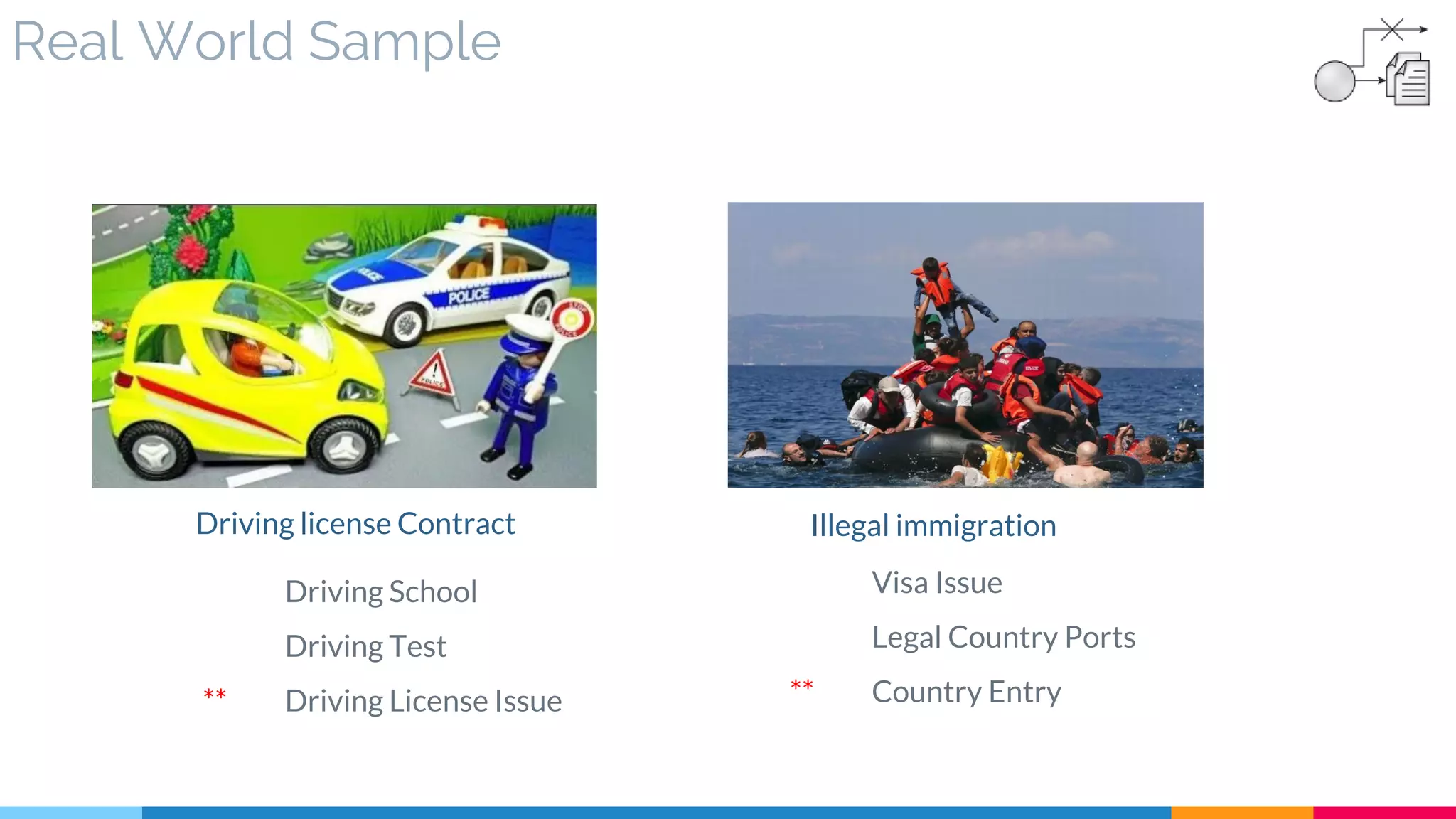
Real World Sample
Driving license Contract
Driving School
Driving Test
** Driving License Issue
Illegal immigration
Visa Issue
Legal Country Ports
** Country Entry
Application
▷ This pattern establishes a distinction between the official published service contract and other
parts of the service that can also be accessed via separate technical endpoints
▷ For example, a consumer could interface with an underlying service component via that
component’s API. This API still represents a technical contract, but not the “official” service entry
point.
▷ Web services and REST services provide an effective means of establishing a centralized contract
while remaining decoupled from the service’s underlying environment as per Decoupled Contract
Impact
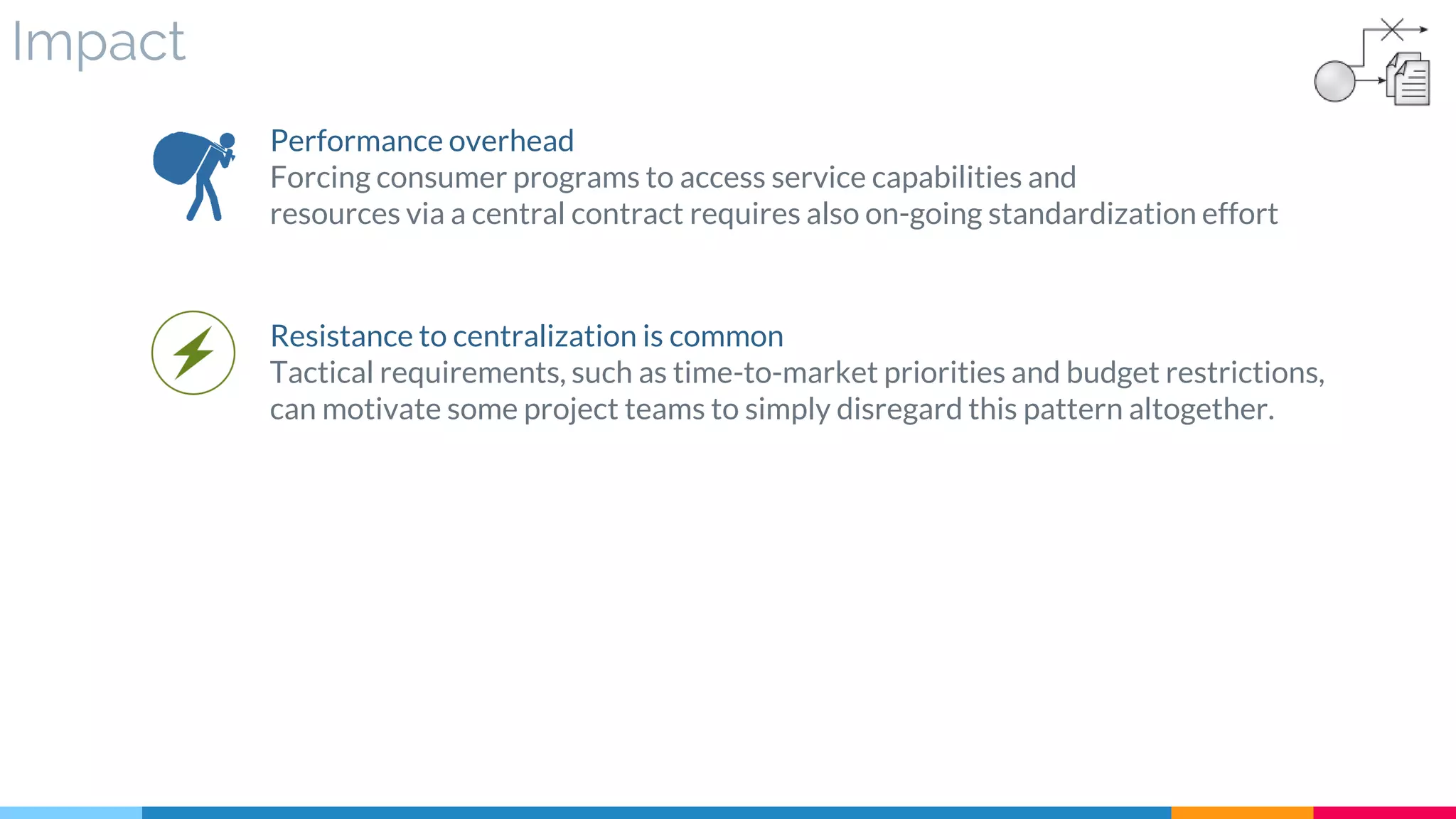
Performance overhead
Forcing consumer programs to access service capabilities and
resources via a central contract requires also on-going standardization effort
Resistance to centralization is common
Tactical requirements, such as time-to-market priorities and budget restrictions,
can motivate some project teams to simply disregard this pattern altogether.
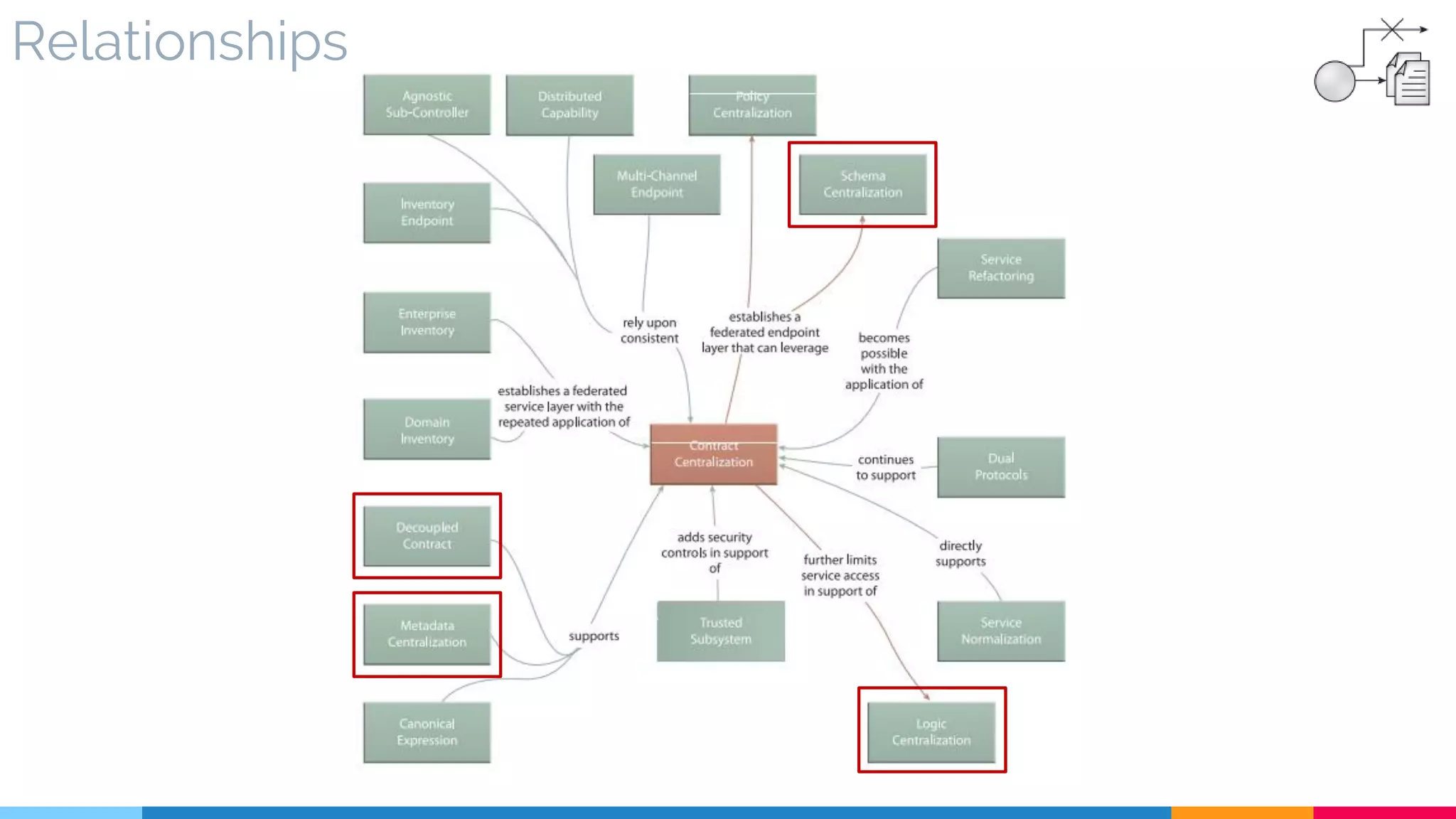
Relationships
17 Official Endpoint
▷ Introduction
[711]
Introduction
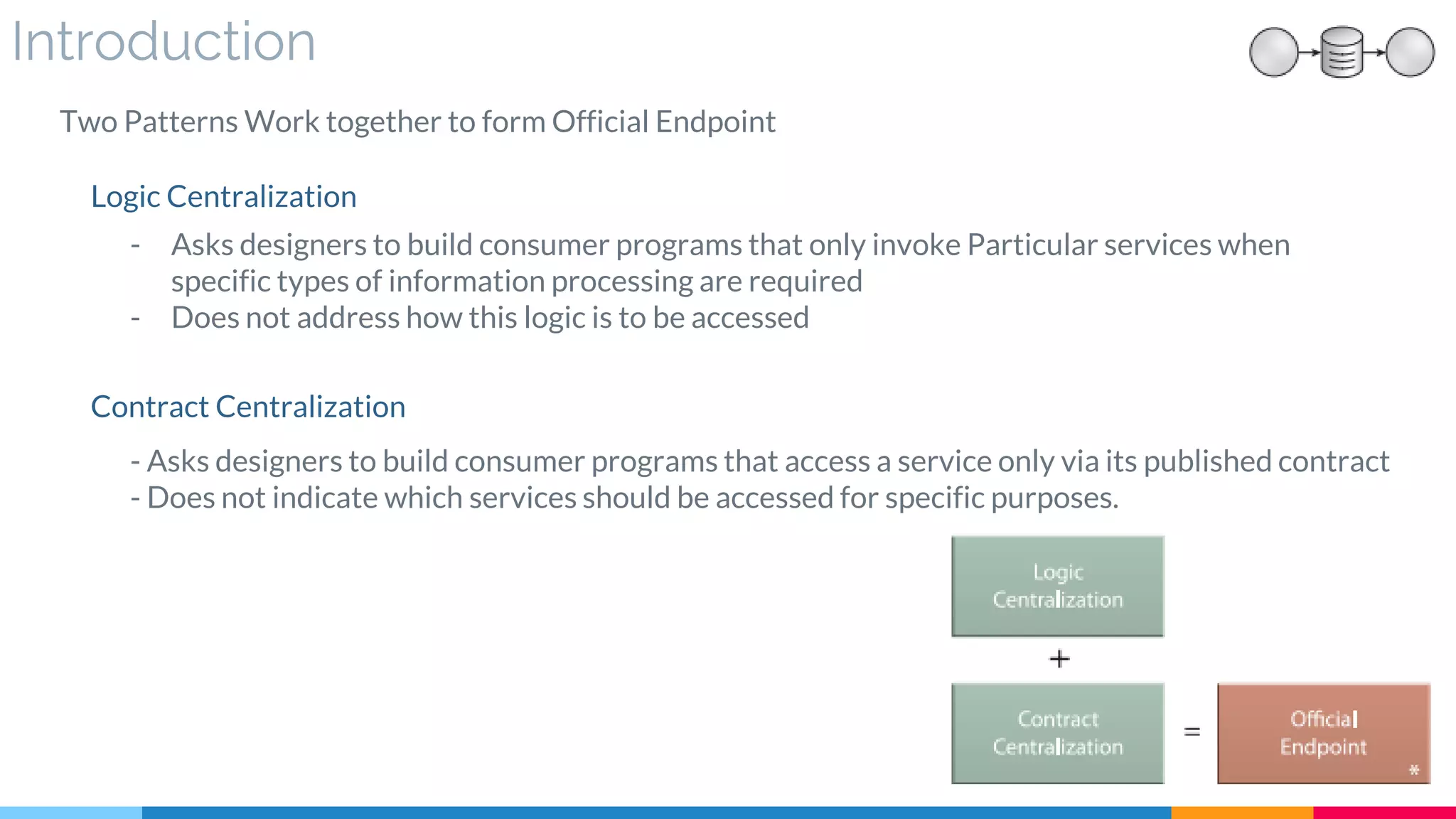
Two Patterns Work together to form Official Endpoint
Logic Centralization
Contract Centralization
- Asks designers to build consumer programs that only invoke Particular services when
specific types of information processing are required
- Does not address how this logic is to be accessed
- Asks designers to build consumer programs that access a service only via its published contract
- Does not indicate which services should be accessed for specific purposes.
Introduction
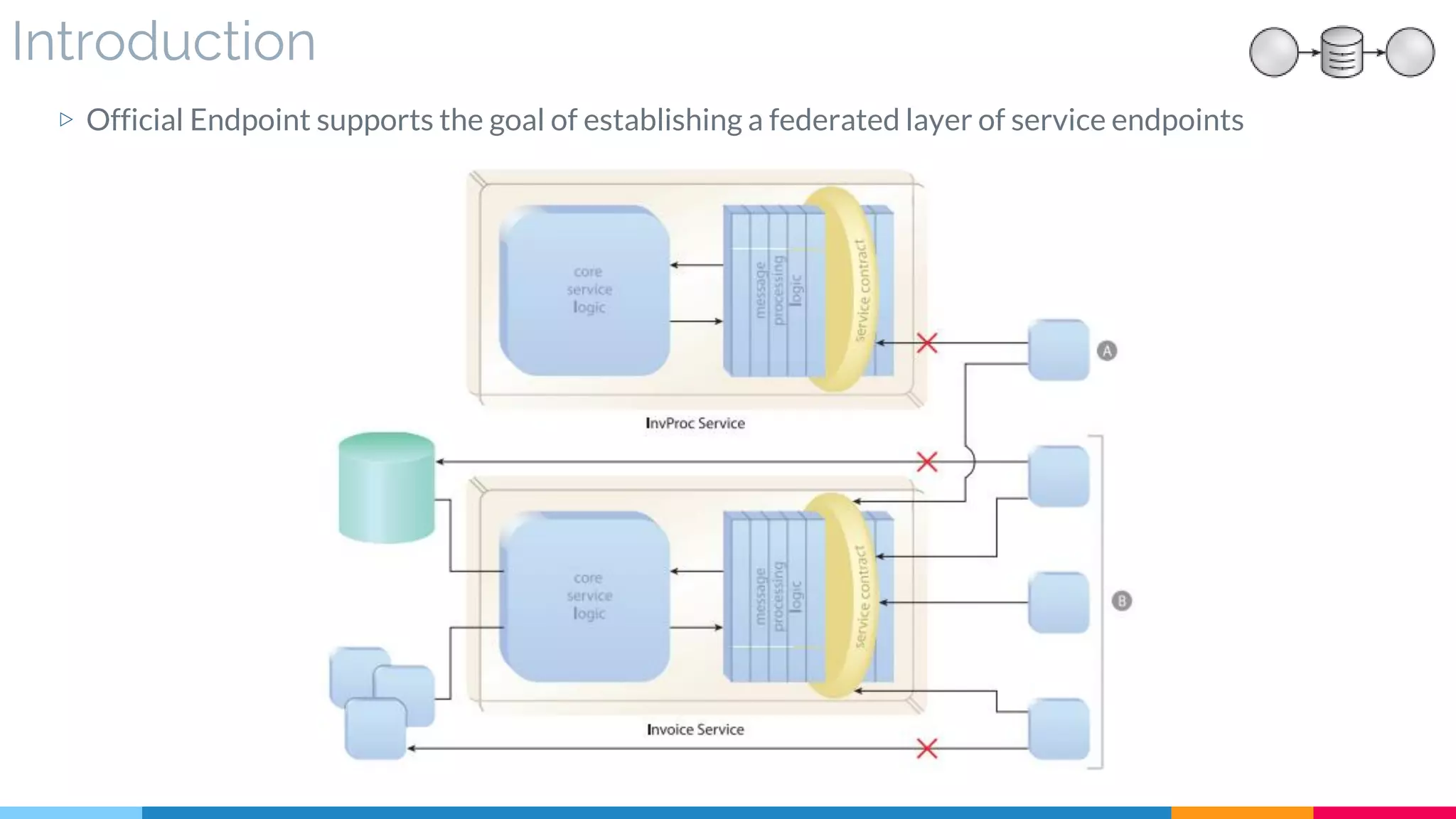
▷ Official Endpoint supports the goal of establishing a federated layer of service endpoints
18 Service Façade
▷ Problem
▷ Solution
▷ Real World Sample
▷ Application
▷ Impact
▷ Relationships
[333]
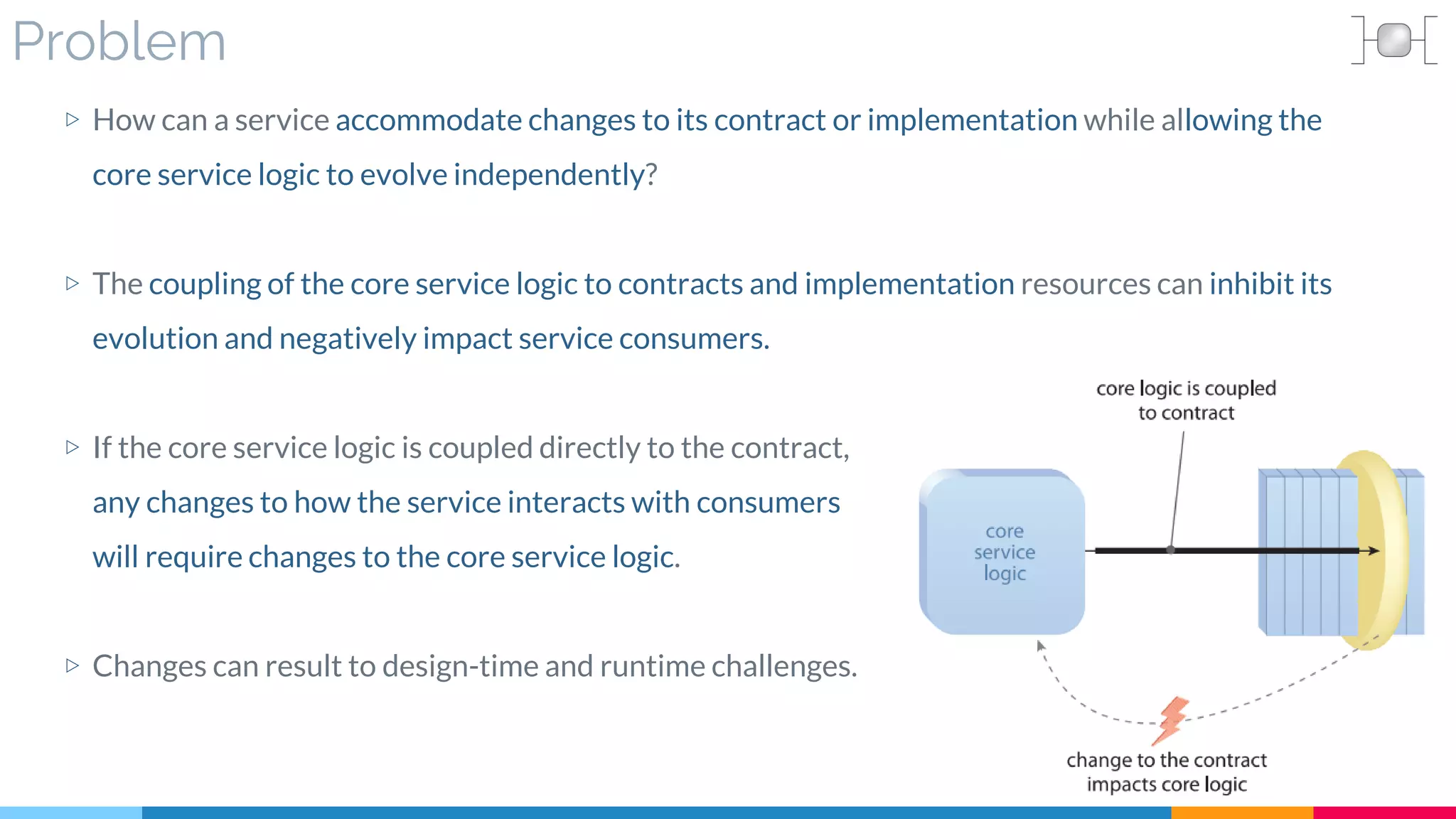
Problem
▷ How can a service accommodate changes to its contract or implementation while allowing the
core service logic to evolve independently?
▷ The coupling of the core service logic to contracts and implementation resources can inhibit its
evolution and negatively impact service consumers.
▷ If the core service logic is coupled directly to the contract,
any changes to how the service interacts with consumers
will require changes to the core service logic.
▷ Changes can result to design-time and runtime challenges.
Problem – design-time , runtime challenges
▷ Single body of service logic required to support multiple contracts, so introducing new decision
logic and requiring core business routines to process different types of input and output messages.
▷ The usage patterns of shared resources accessed by the service are changed, resulting
in changes to the established service behavior that end up negatively affecting existing service
consumers.
▷ The service implementation is upgraded or refactored, resulting in changes to the core business
logic in order to accommodate the new and/or improved implementation.
▷ The service is subjected to decomposition, as per Service Decomposition
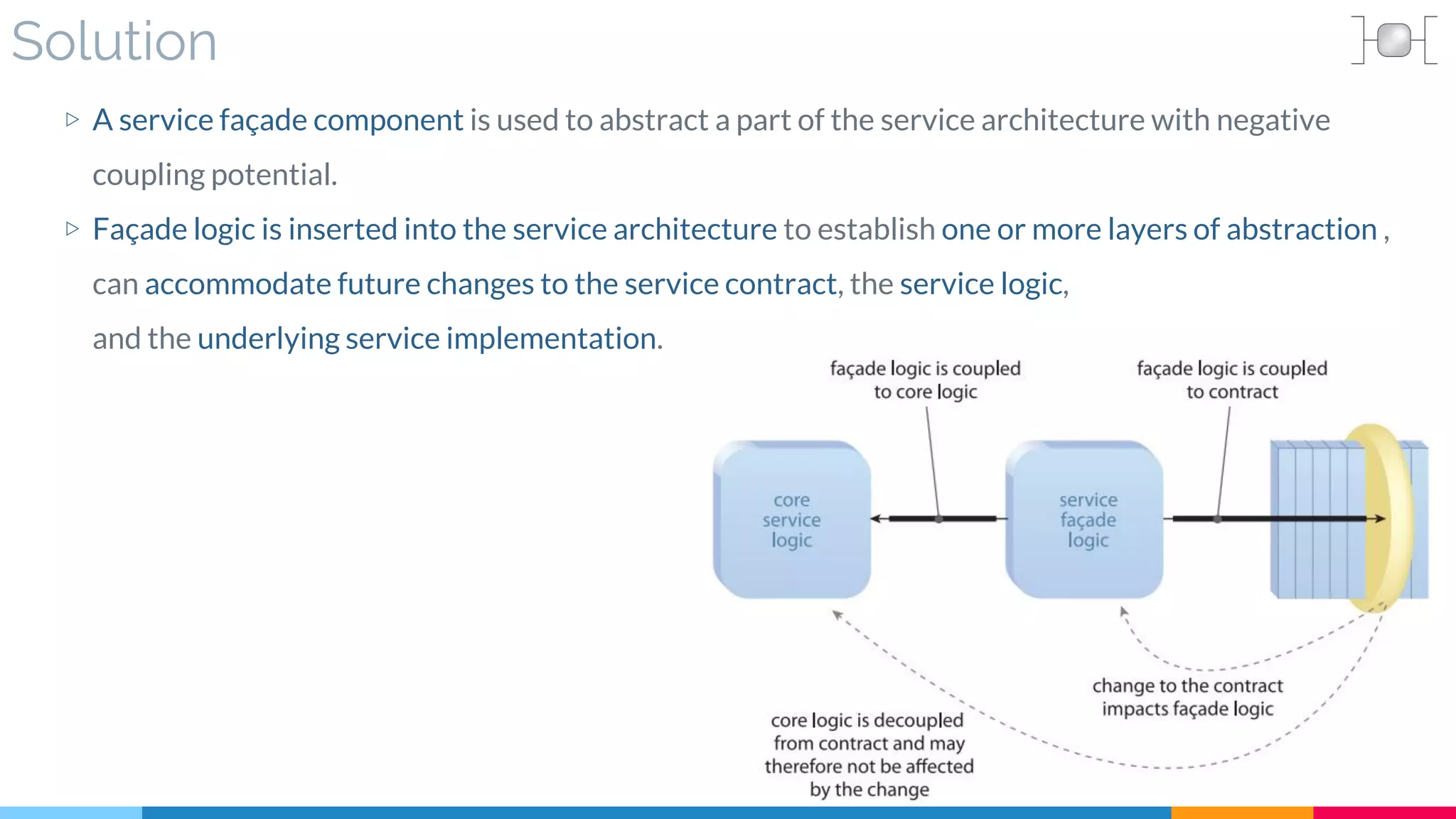
Solution
▷ A service façade component is used to abstract a part of the service architecture with negative
coupling potential.
▷ Façade logic is inserted into the service architecture to establish one or more layers of abstraction ,
can accommodate future changes to the service contract, the service logic,
and the underlying service implementation.
Real World Sample
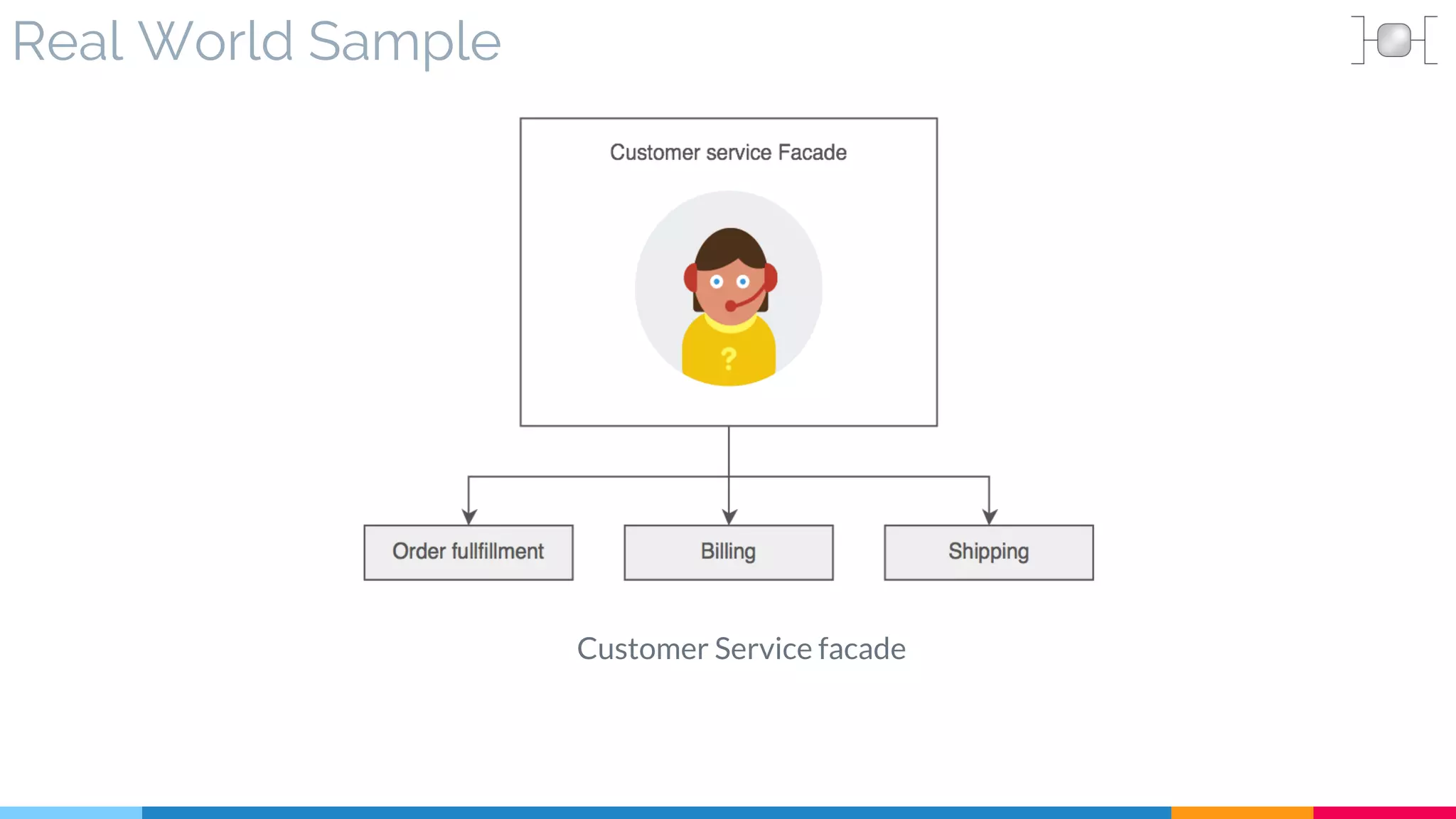
Customer Service facade
Application
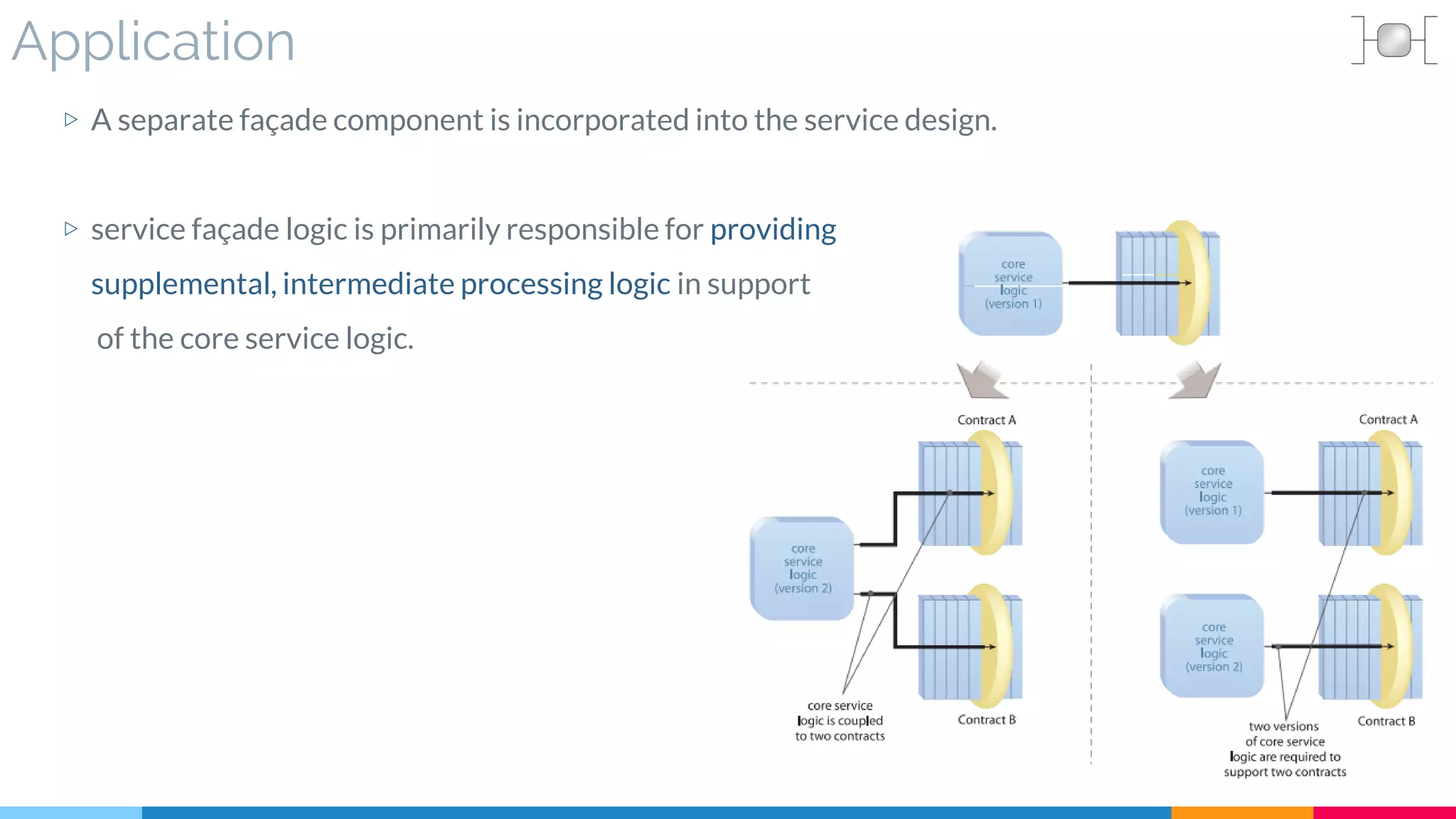
▷ A separate façade component is incorporated into the service design.
▷ service façade logic is primarily responsible for providing
supplemental, intermediate processing logic in support
of the core service logic.
Application
Common types of logic that tend to reside within a service façade component include:
1. Relaying Logic :
Façade logic simply relays input and output messages between contract and core service logic
or between the core service logic and other parts of the service architecture.
2. Broker Logic :
- Façade logic carries out transformation logic as per patterns associated with Service Broker
- This may be required when a single unit of core service logic is used together with multiple
service contracts, as per Concurrent Contracts
3. Behavior Correction:
Façade logic is used compensate for changes in the behavior of the core service logic in order to
maintain the service behavior to which established consumers have become familiar.
Application
4. Contract-Specific Requirements
- Service facades are coupled to contracts to accommodate different types of service consumers,
- This can include special security, reliability, and activity management processing requirements.
While all of this processing can also be located within the core service logic, it
may be desirable to isolate it into façade components when the processing requirements are
exclusive to specific contracts.
Application
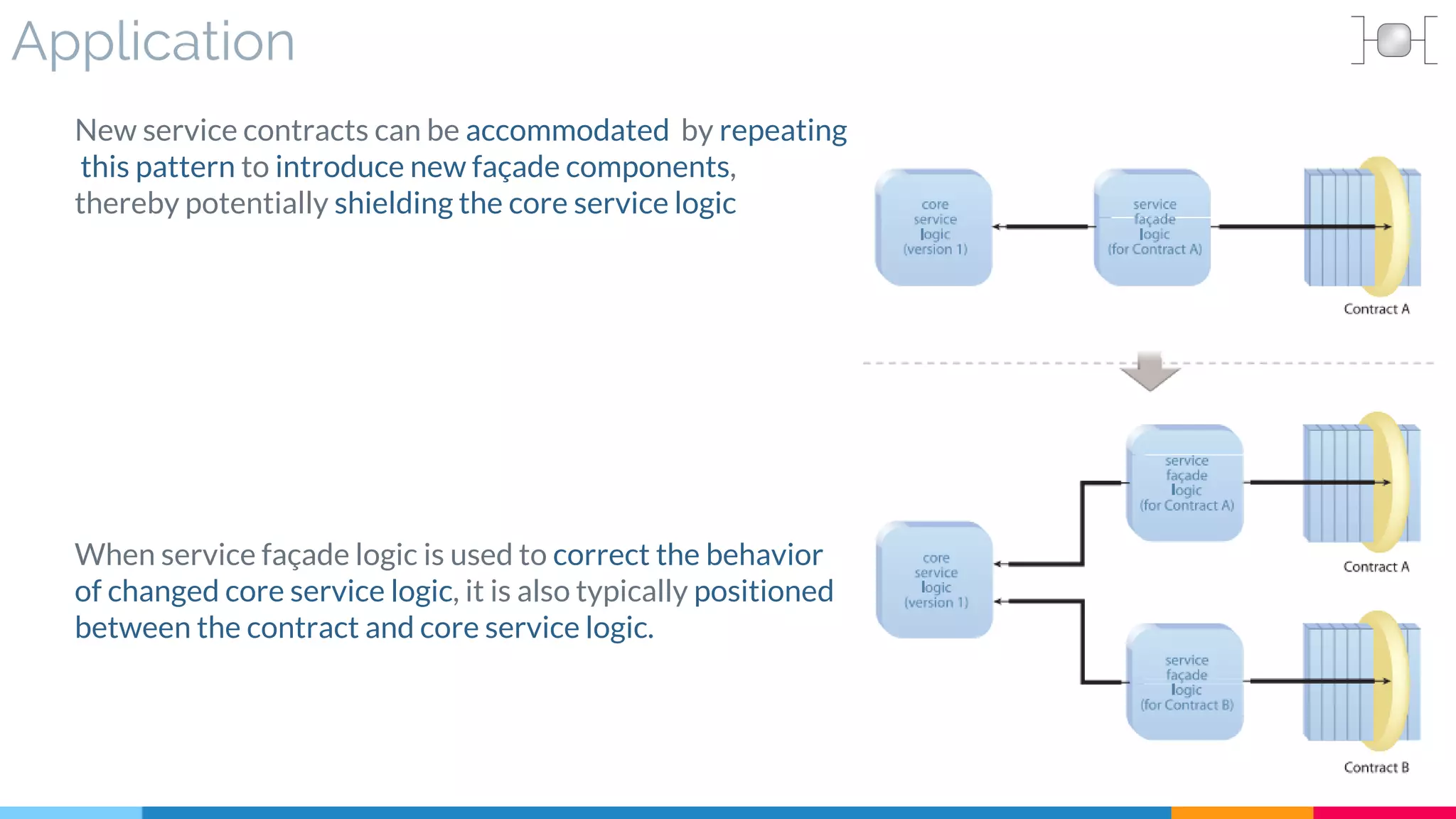
New service contracts can be accommodated by repeating
this pattern to introduce new façade components,
thereby potentially shielding the core service logic
When service façade logic is used to correct the behavior
of changed core service logic, it is also typically positioned
between the contract and core service logic.
Application
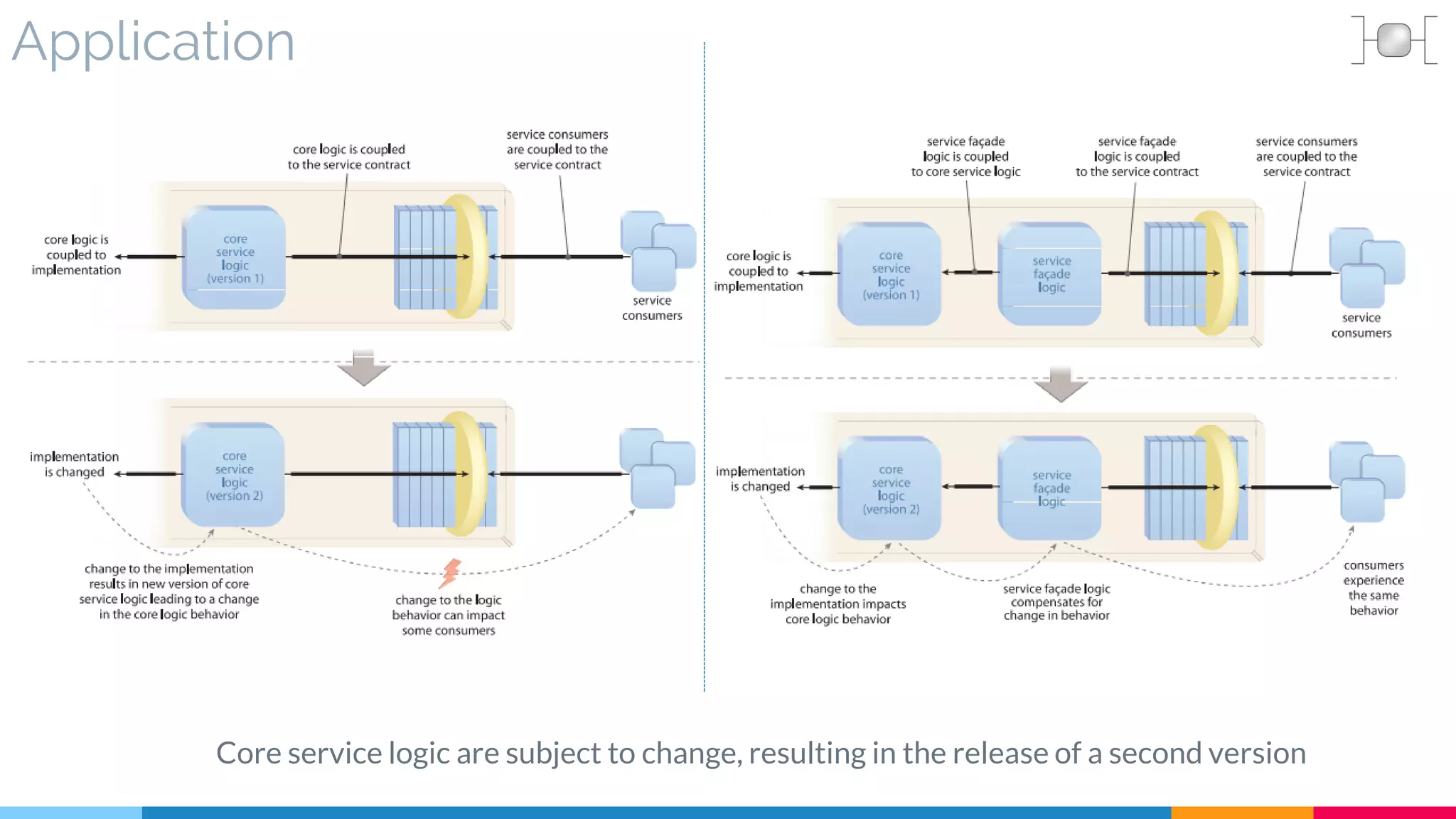
Core service logic are subject to change, resulting in the release of a second version
Application
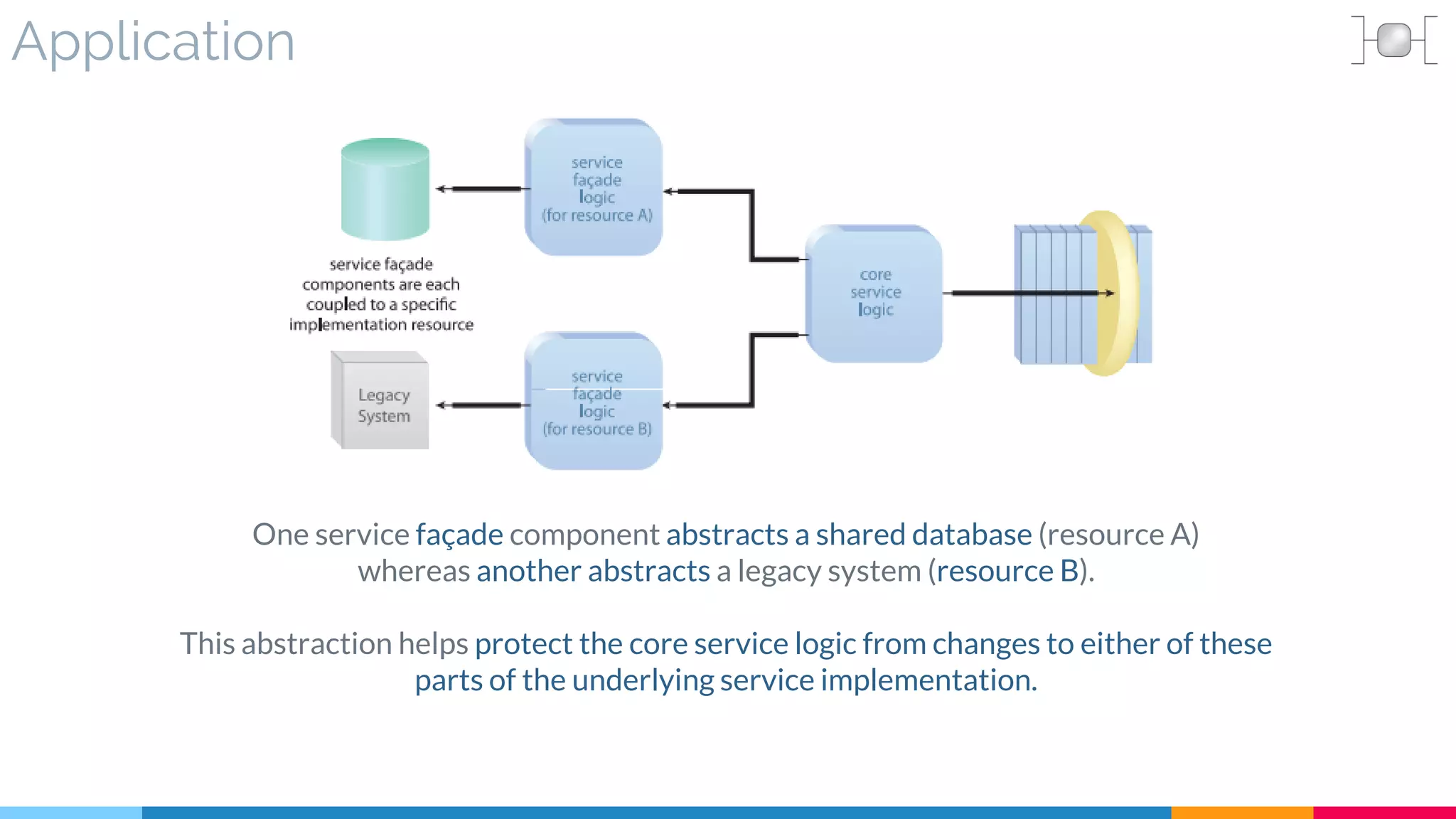
One service façade component abstracts a shared database (resource A)
whereas another abstracts a legacy system (resource B).
This abstraction helps protect the core service logic from changes to either of these
parts of the underlying service implementation.
Impact
Performance overhead , Design and development effort
Due to Addition of façade component
Although some performance overhead is expected, it is generally minor as long as
façade and core service components are located on the same physical server.
Some governance overhead can also be expected, due to the increased amount of
components per service
Creating façade components results in an increased amount of physical logic decomposition.
Relationships
19 Redundant Implementation
▷ Problem
▷ Solution
▷ Real World Sample
▷ Application
▷ Impact
▷ Relationships
[345]
Problem
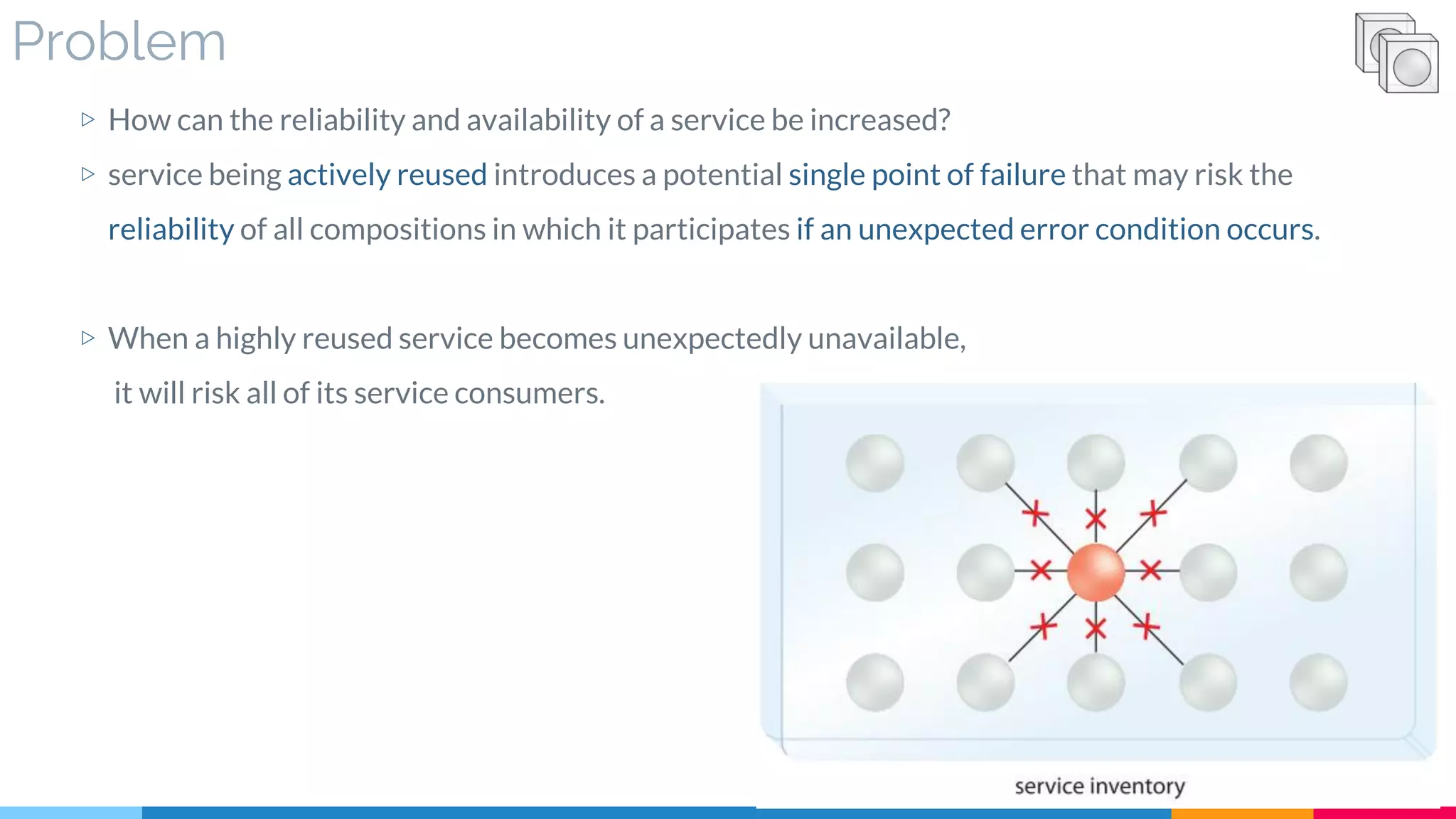
▷ How can the reliability and availability of a service be increased?
▷ service being actively reused introduces a potential single point of failure that may risk the
reliability of all compositions in which it participates if an unexpected error condition occurs.
▷ When a highly reused service becomes unexpectedly unavailable,
it will risk all of its service consumers.
Solution
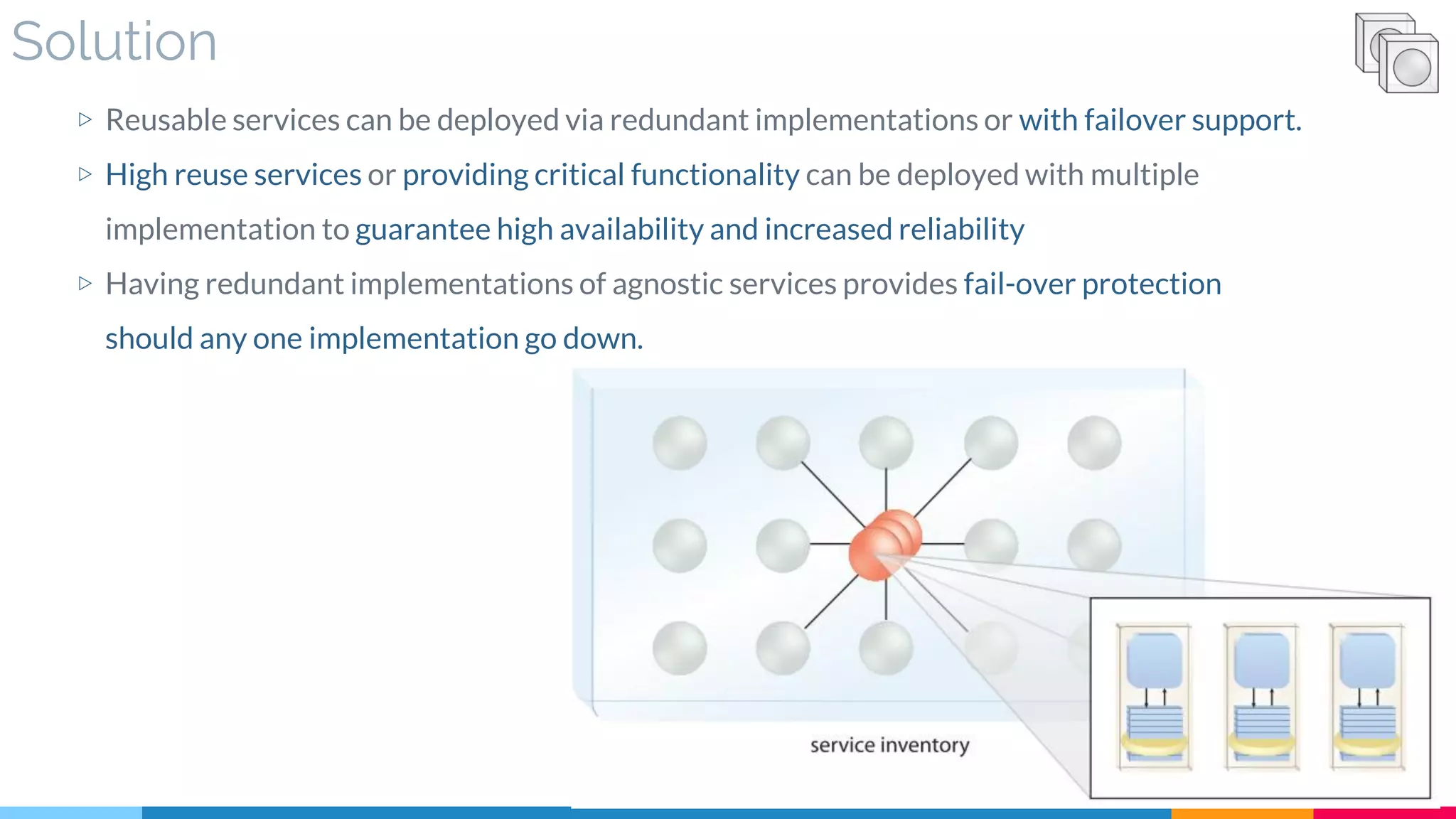
▷ Reusable services can be deployed via redundant implementations or with failover support.
▷ High reuse services or providing critical functionality can be deployed with multiple
implementation to guarantee high availability and increased reliability
▷ Having redundant implementations of agnostic services provides fail-over protection
should any one implementation go down.
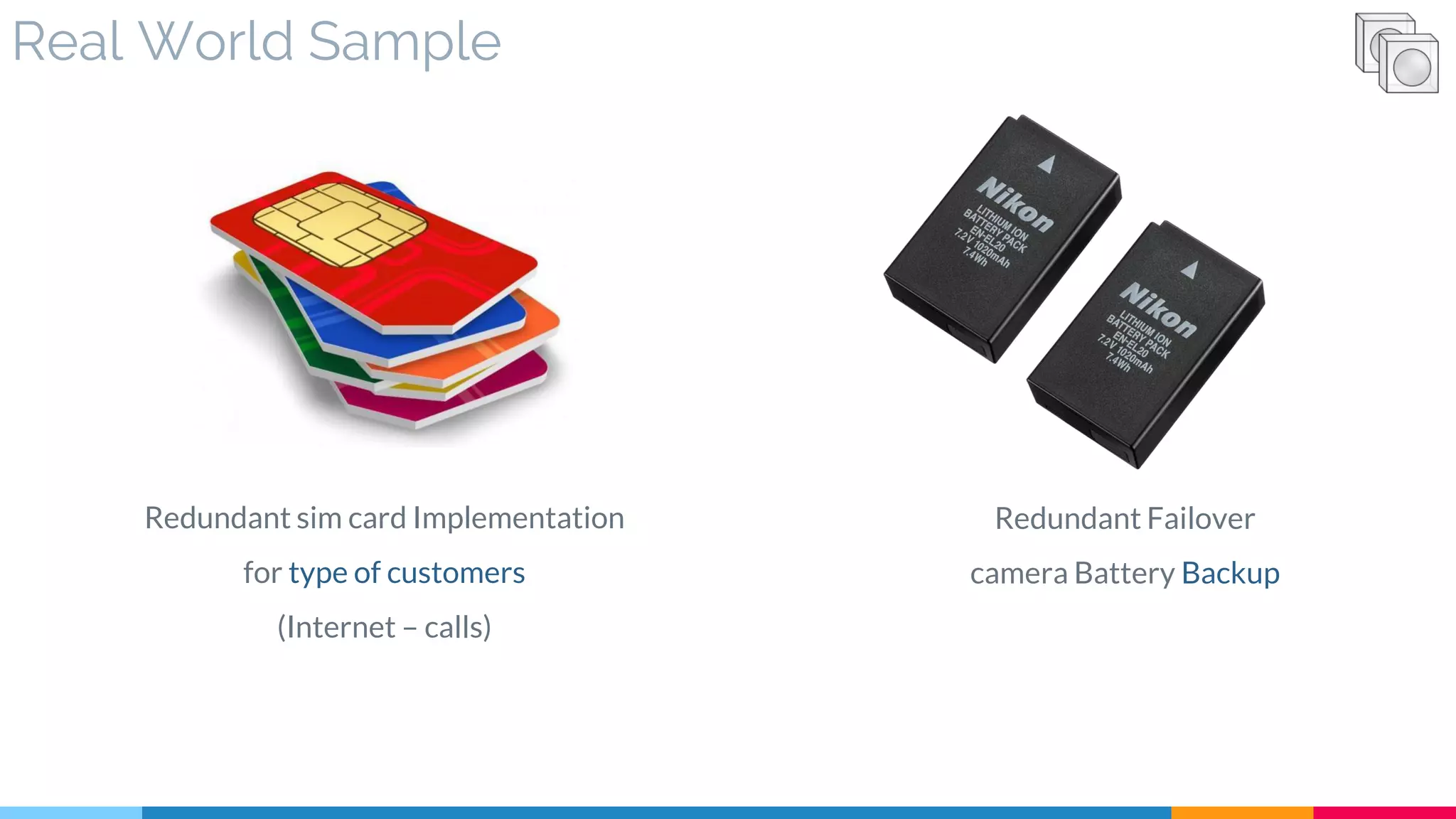
Real World Sample
Redundant Failover
camera Battery Backup
Redundant sim card Implementation
for type of customers
(Internet – calls)
Application
▷ The same service implementation is redundantly deployed or supported by infrastructure with
redundancy features.
▷ there are several ways to apply this pattern
• Different redundant service implementations can be established for different sets of service
consumers.
• One service implementation is designated as the official contact point for consumers, but it is
further supported by one or more backup implementations that are used in case of failure or
unavailability.
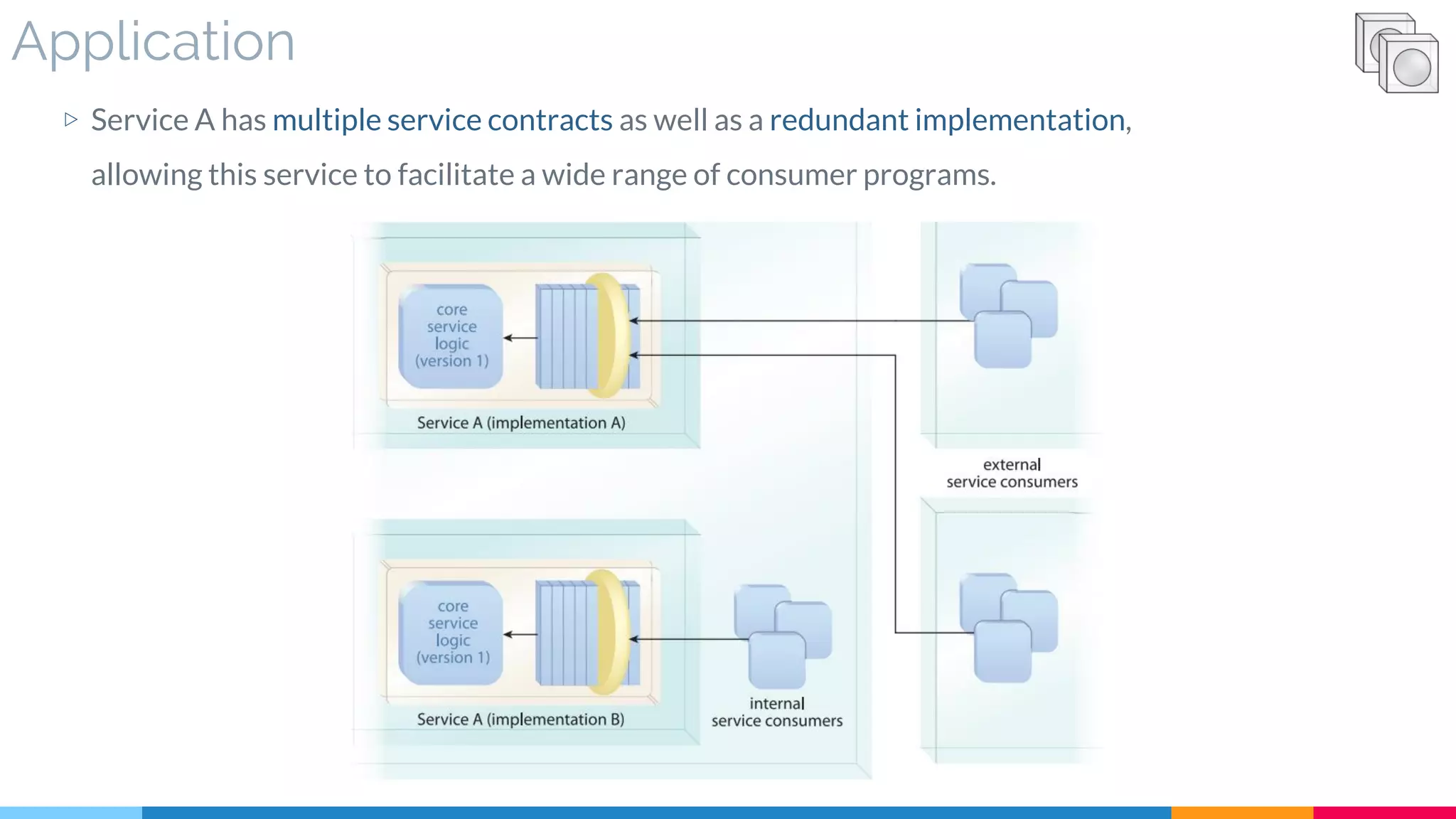
Application
▷ Service A has multiple service contracts as well as a redundant implementation,
allowing this service to facilitate a wide range of consumer programs.
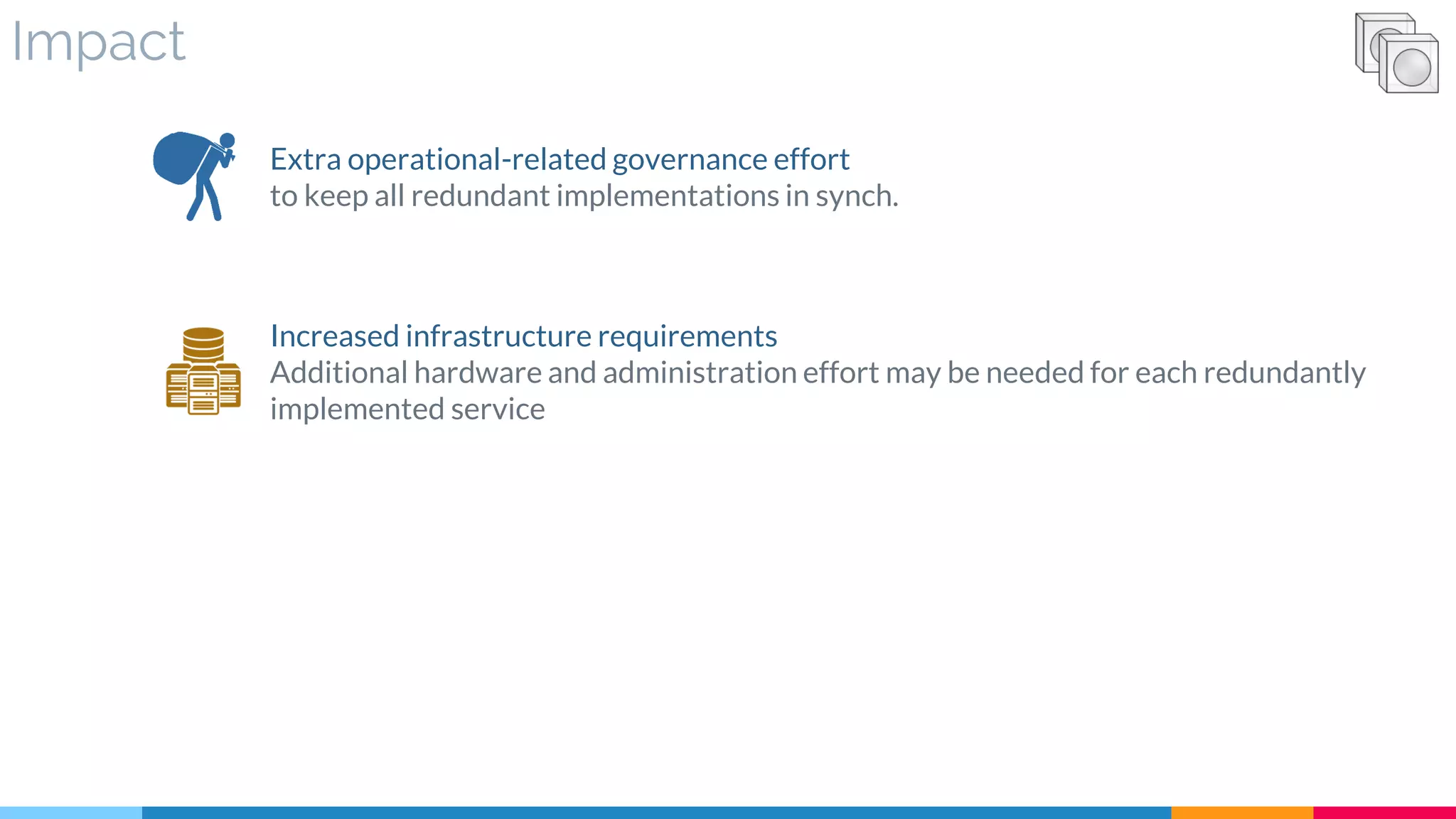
Impact
Extra operational-related governance effort
to keep all redundant implementations in synch.
Increased infrastructure requirements
Additional hardware and administration effort may be needed for each redundantly
implemented service
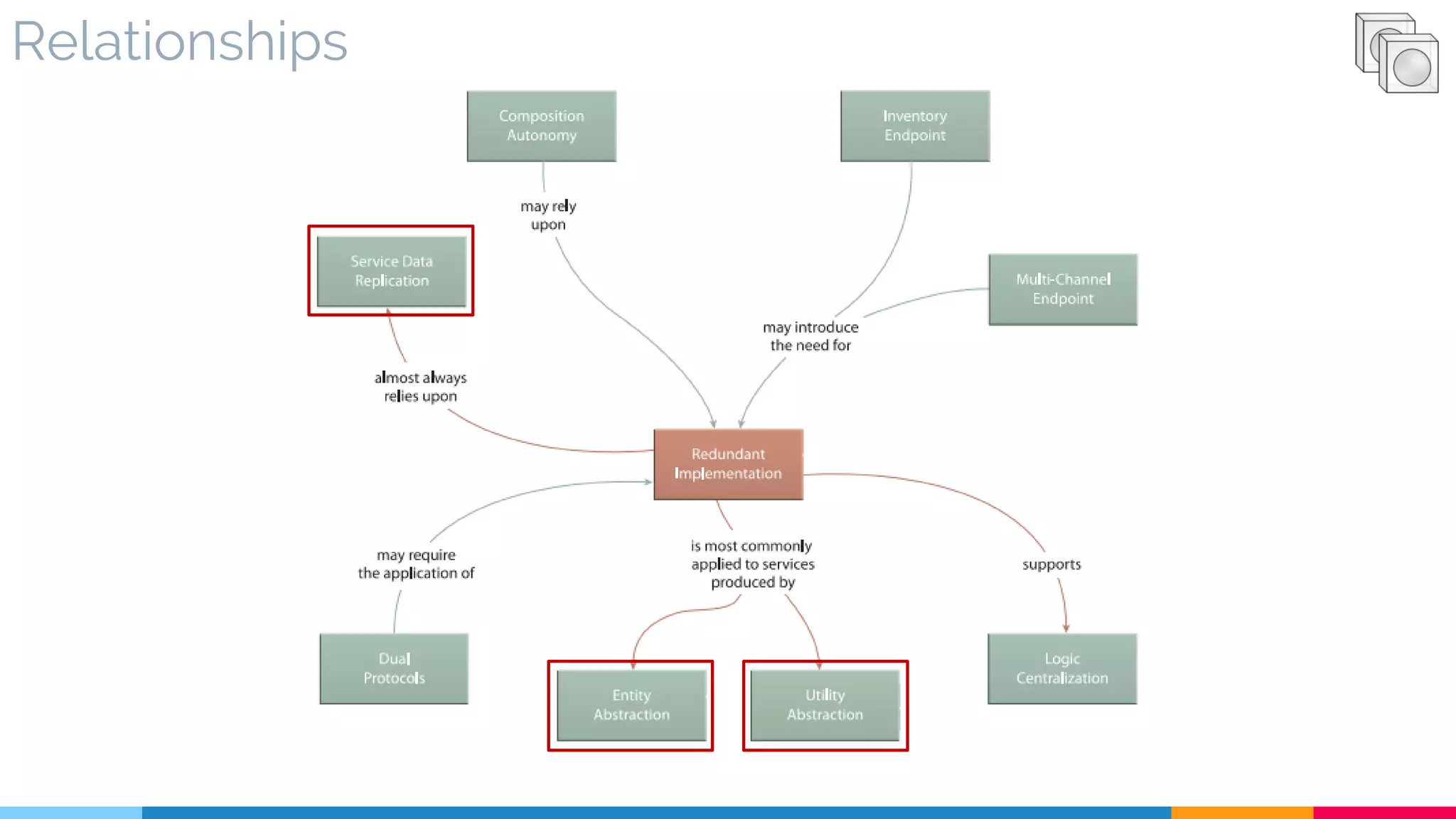
Relationships
20 Service Data Replication
▷ Problem
▷ Solution
▷ Real World Sample
▷ Application
▷ Impact
▷ Relationships
[350]
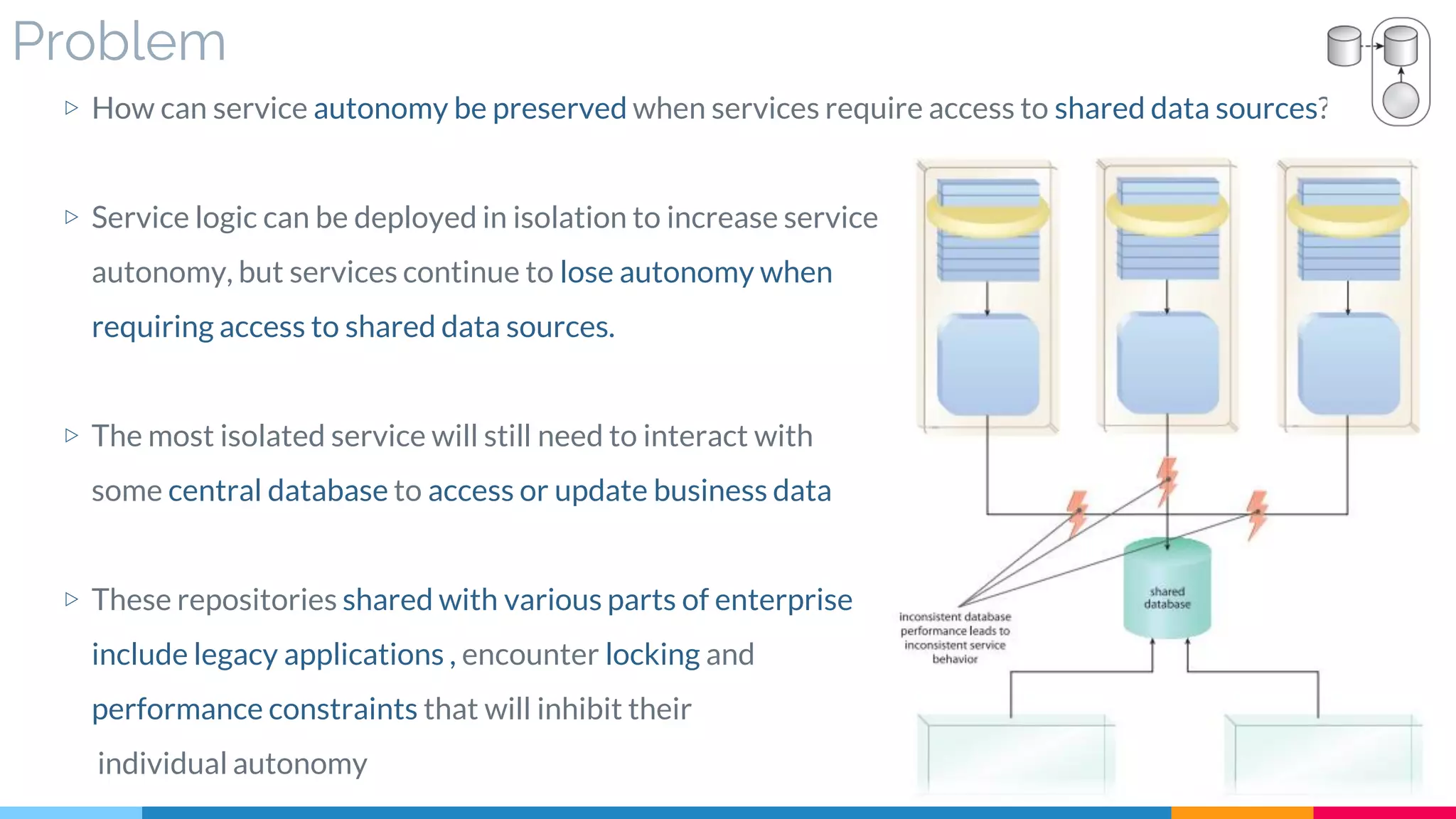
Problem
▷ How can service autonomy be preserved when services require access to shared data sources?
▷ Service logic can be deployed in isolation to increase service
autonomy, but services continue to lose autonomy when
requiring access to shared data sources.
▷ The most isolated service will still need to interact with
some central database to access or update business data
▷ These repositories shared with various parts of enterprise
include legacy applications , encounter locking and
performance constraints that will inhibit their
individual autonomy
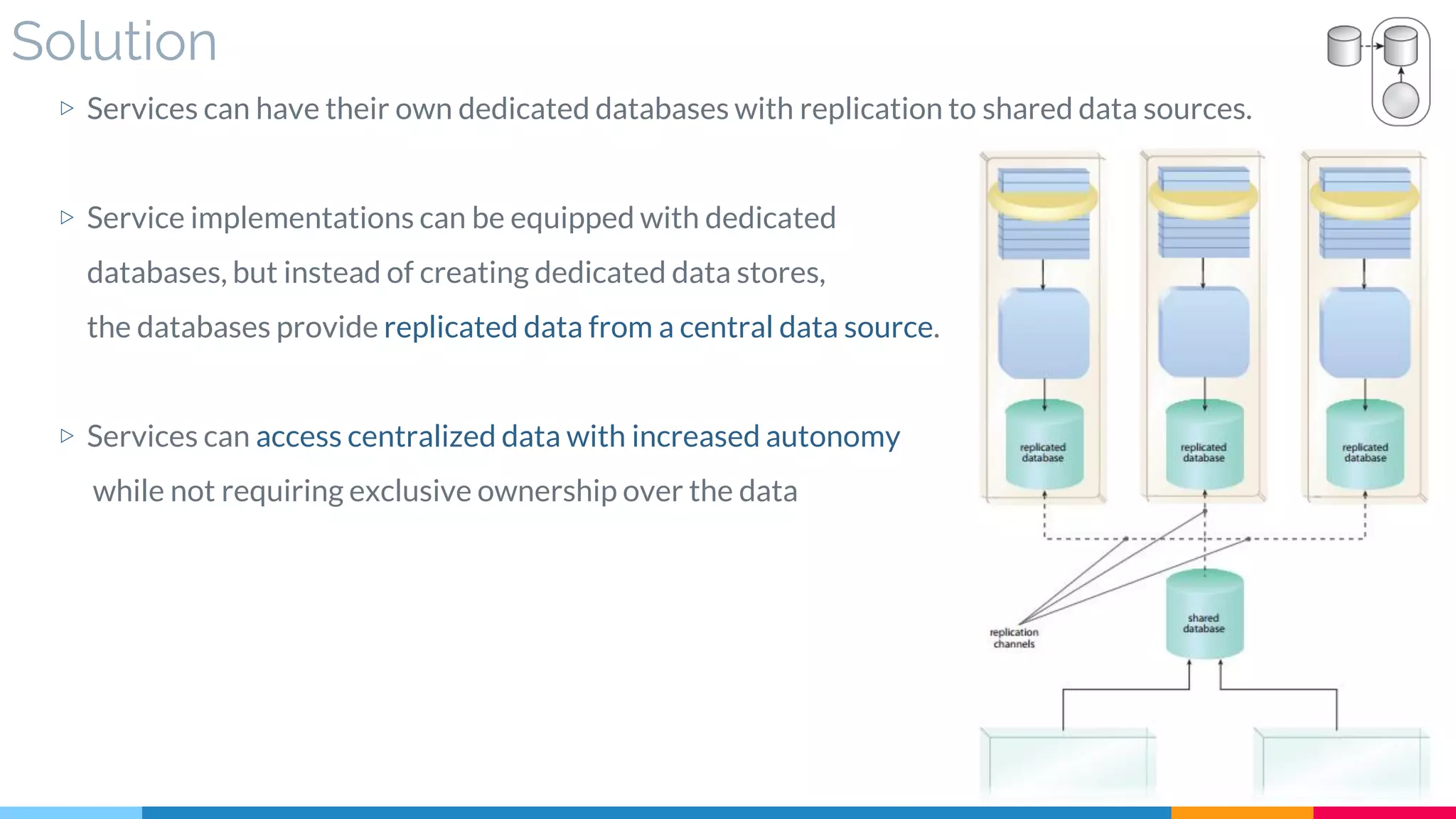
Solution
▷ Services can have their own dedicated databases with replication to shared data sources.
▷ Service implementations can be equipped with dedicated
databases, but instead of creating dedicated data stores,
the databases provide replicated data from a central data source.
▷ Services can access centralized data with increased autonomy
while not requiring exclusive ownership over the data
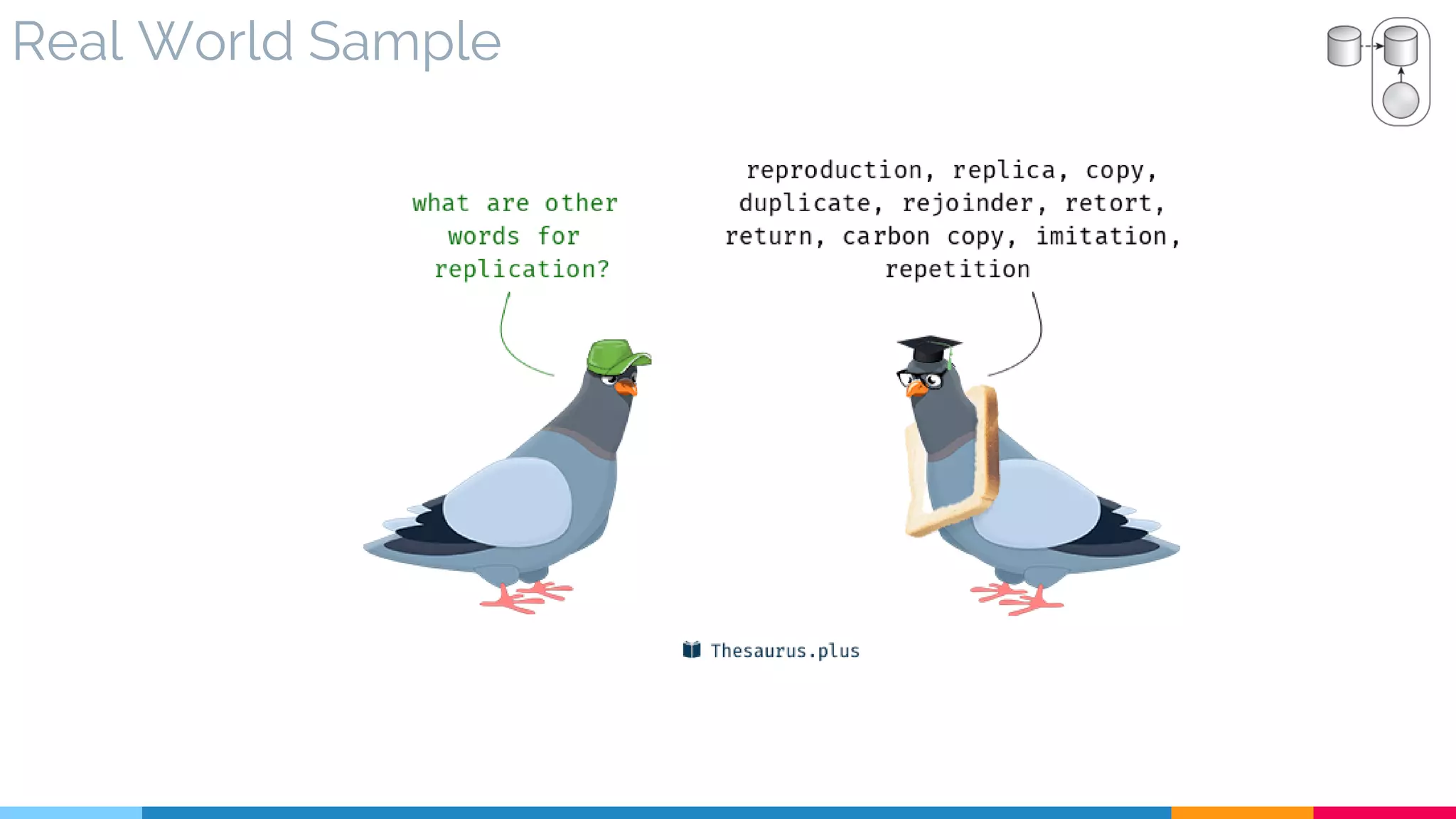
Real World Sample
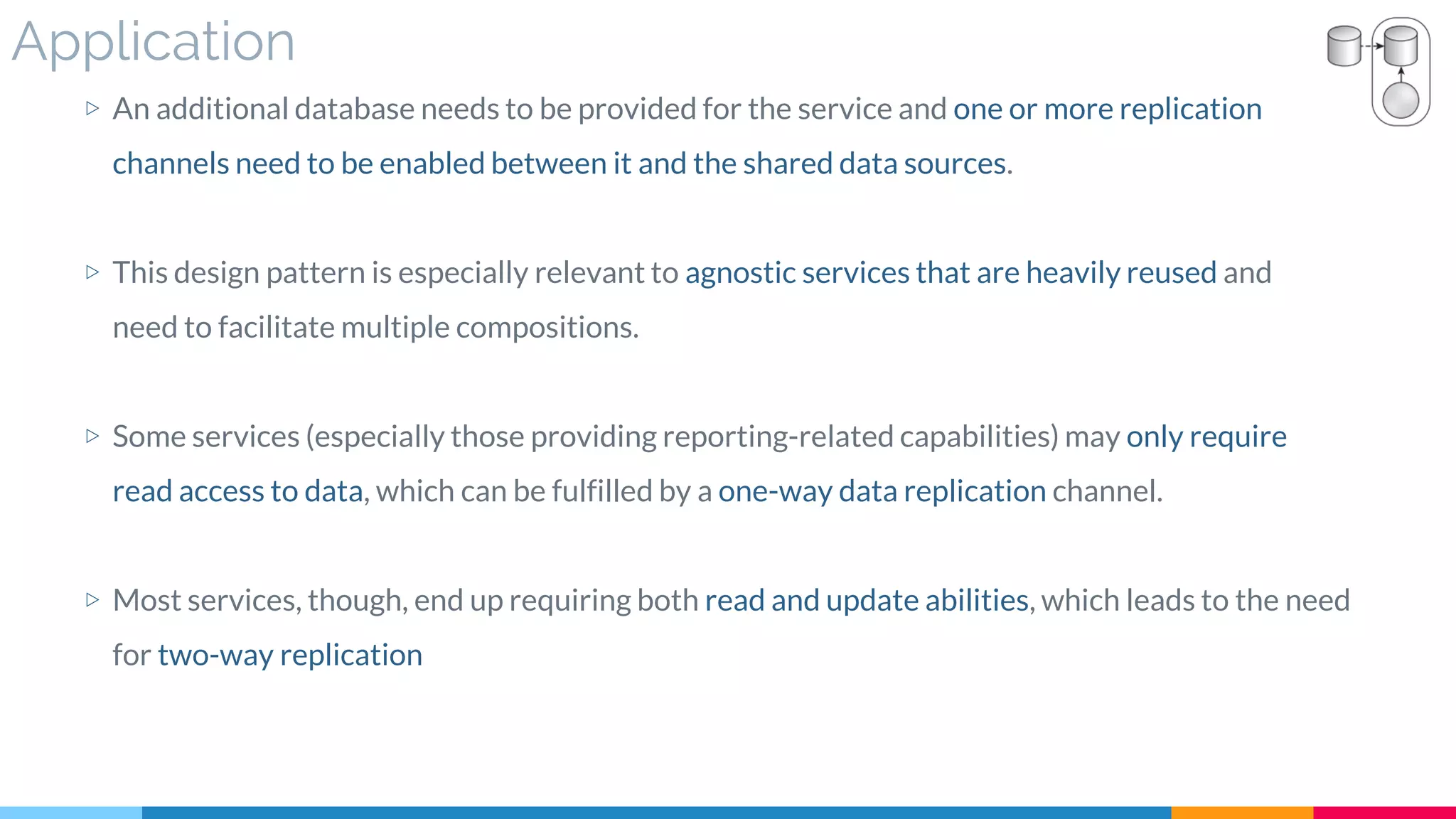
Application
▷ An additional database needs to be provided for the service and one or more replication
channels need to be enabled between it and the shared data sources.
▷ This design pattern is especially relevant to agnostic services that are heavily reused and
need to facilitate multiple compositions.
▷ Some services (especially those providing reporting-related capabilities) may only require
read access to data, which can be fulfilled by a one-way data replication channel.
▷ Most services, though, end up requiring both read and update abilities, which leads to the need
for two-way replication
Application
▷ Some replication strategies can even introduce the need for additional databases that
provide fully replicated data sets on behalf of a central database
▷ Become the contact point for service databases requiring only a subset of the replicated
information.
▷ Modern replication technology allows for the runtime transformation of database
schemas , enable the replicated database to be tuned for individual service architectures
while performance and reliability is acceptable.
Impact
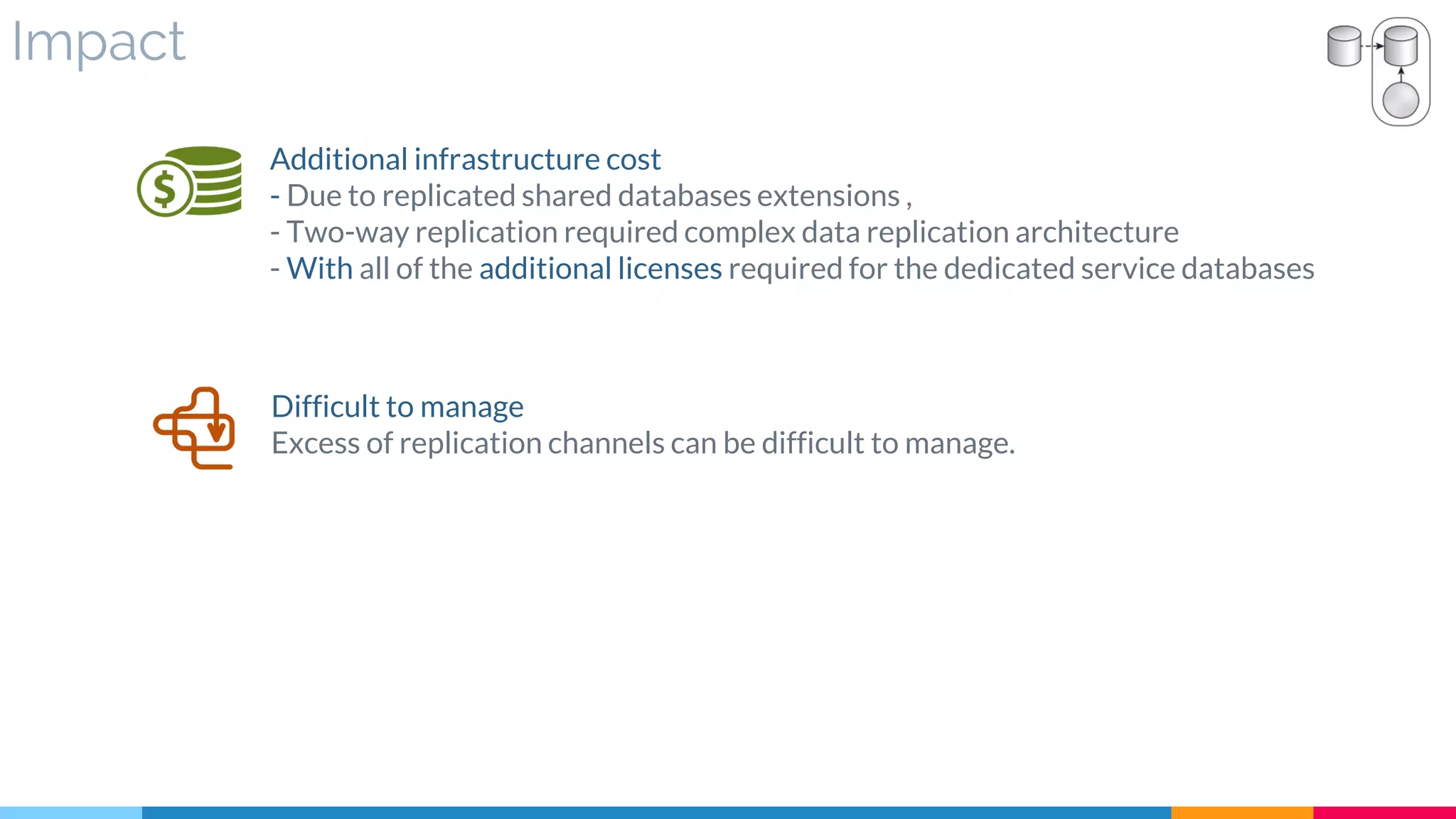
Additional infrastructure cost
- Due to replicated shared databases extensions ,
- Two-way replication required complex data replication architecture
- With all of the additional licenses required for the dedicated service databases
Difficult to manage
Excess of replication channels can be difficult to manage.
Relationships
21 Decoupled Contract
▷ Problem
▷ Solution
▷ Real World Sample
▷ Application
▷ Impact
▷ Relationships
[401]
Problem
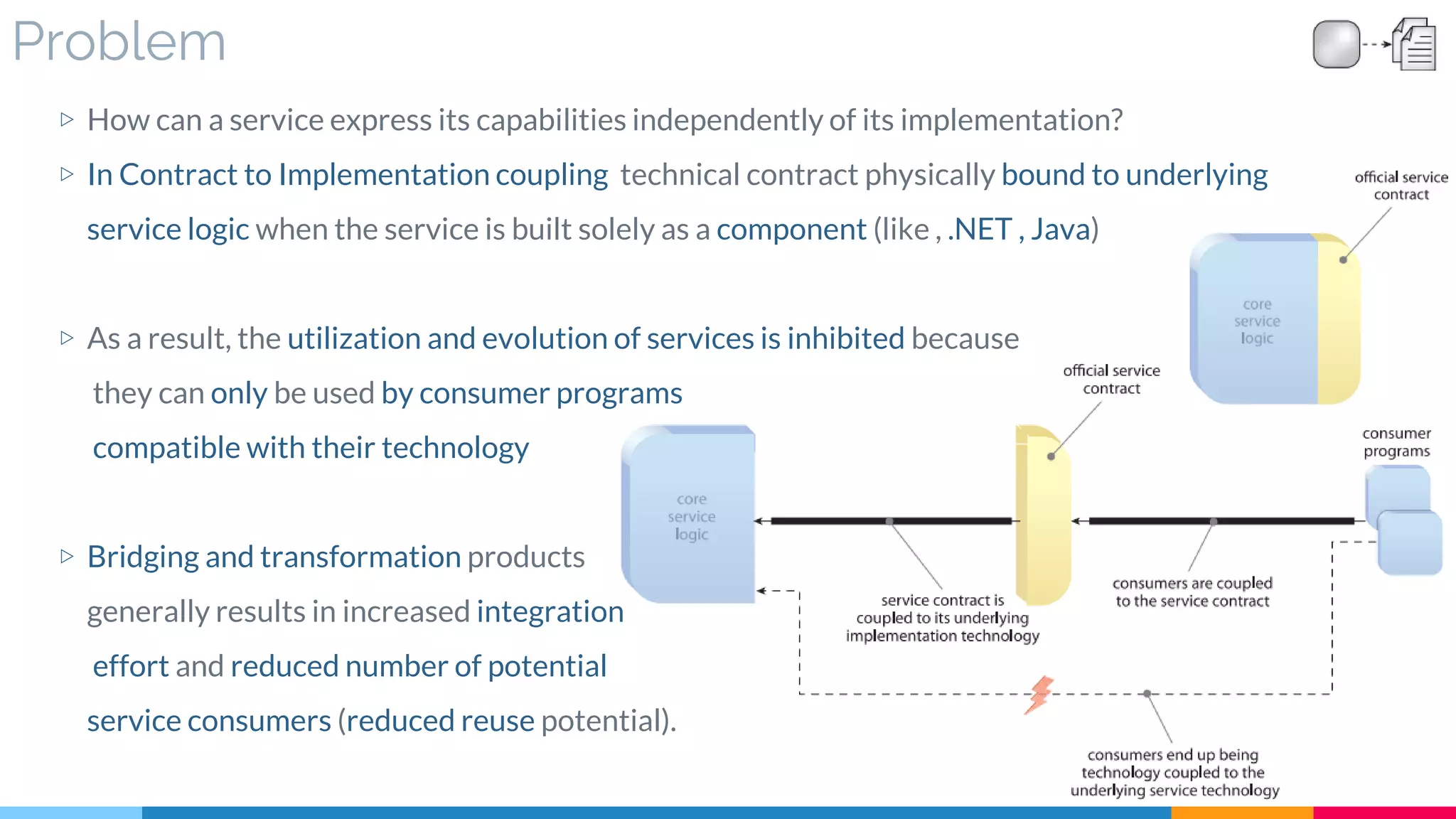
▷ How can a service express its capabilities independently of its implementation?
▷ In Contract to Implementation coupling technical contract physically bound to underlying
service logic when the service is built solely as a component (like , .NET , Java)
▷ As a result, the utilization and evolution of services is inhibited because
they can only be used by consumer programs
compatible with their technology
▷ Bridging and transformation products
generally results in increased integration
effort and reduced number of potential
service consumers (reduced reuse potential).
Solution
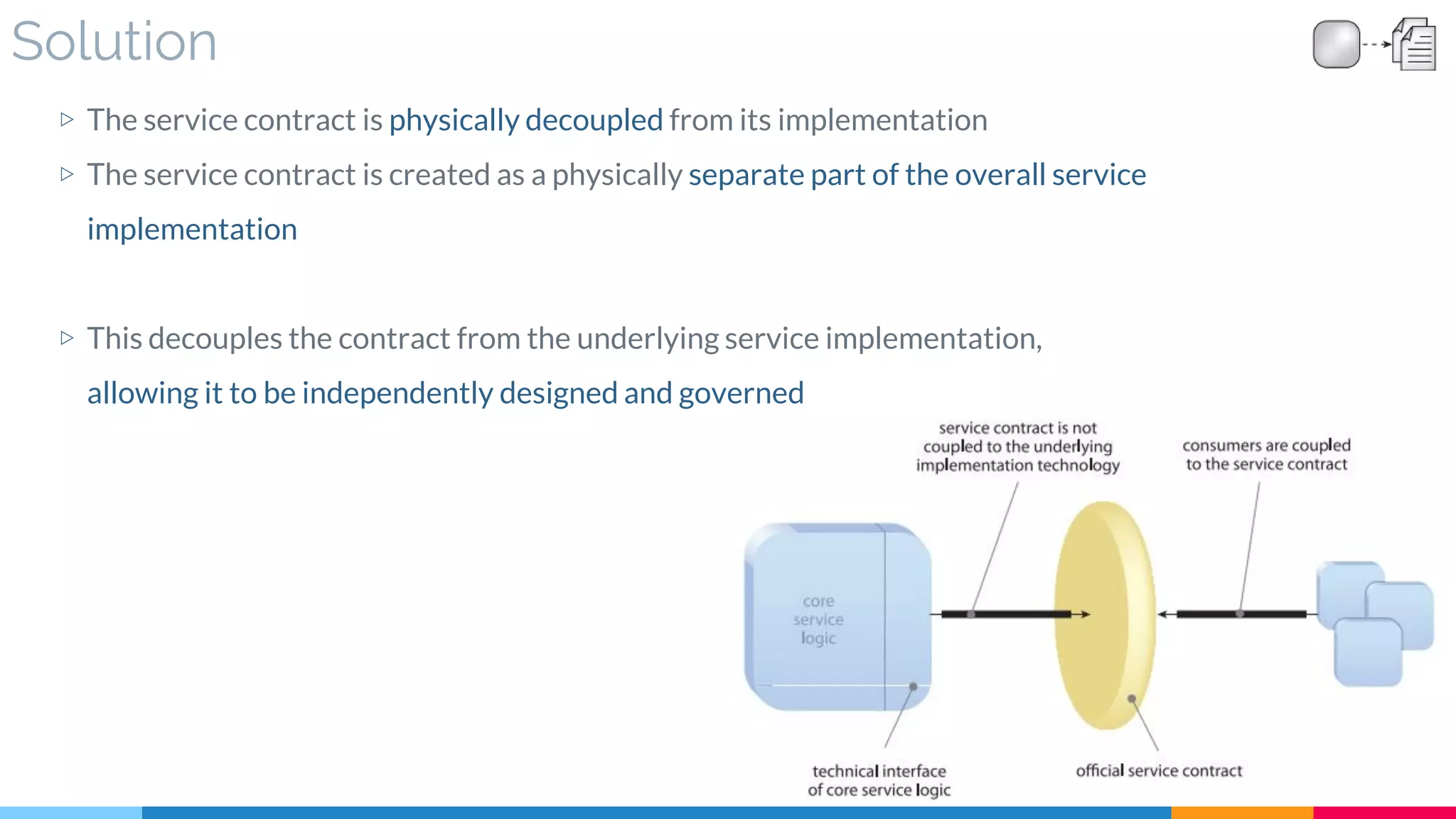
▷ The service contract is physically decoupled from its implementation
▷ The service contract is created as a physically separate part of the overall service
implementation
▷ This decouples the contract from the underlying service implementation,
allowing it to be independently designed and governed
Real World Sample
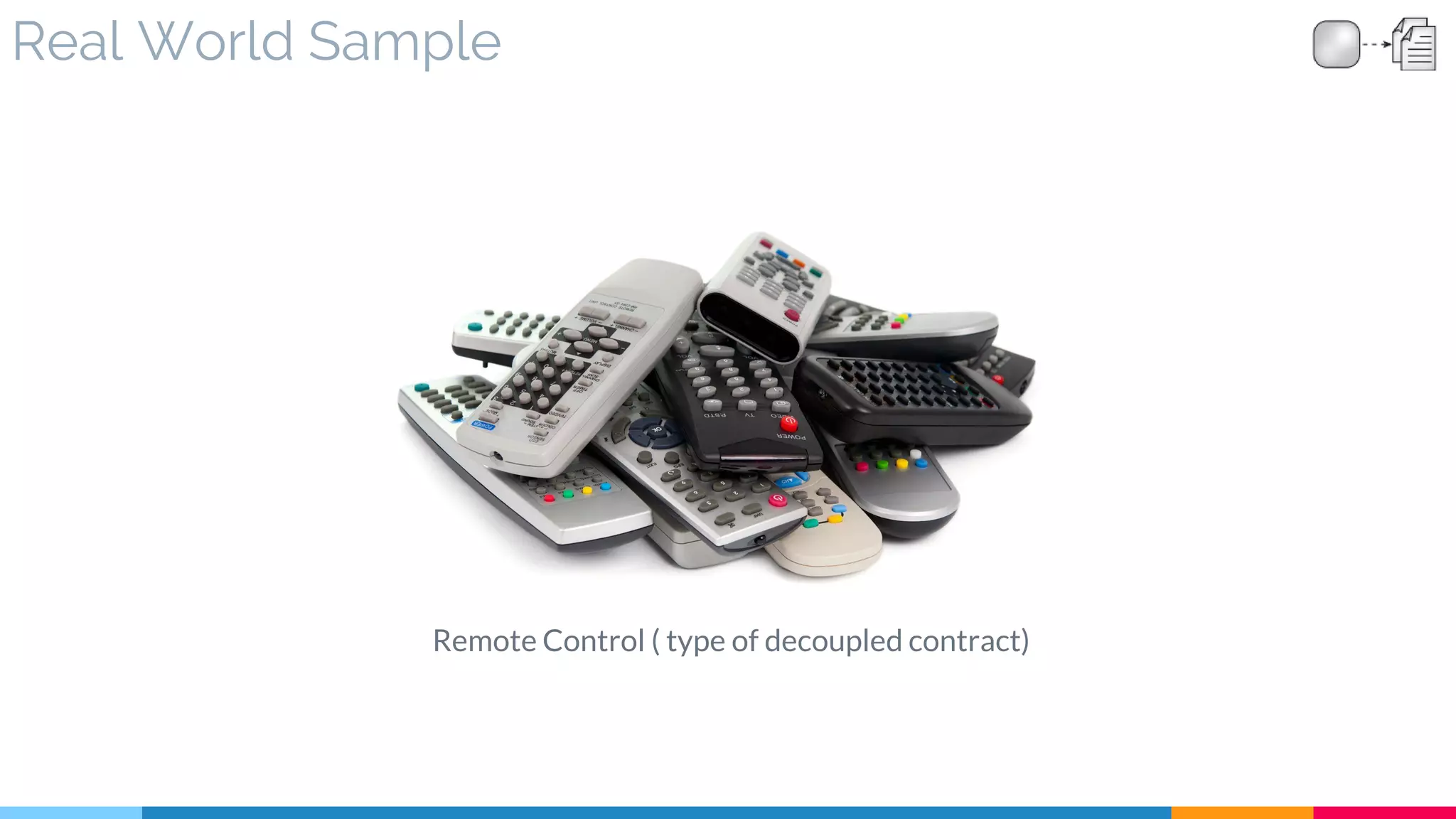
Remote Control ( type of decoupled contract)
Application
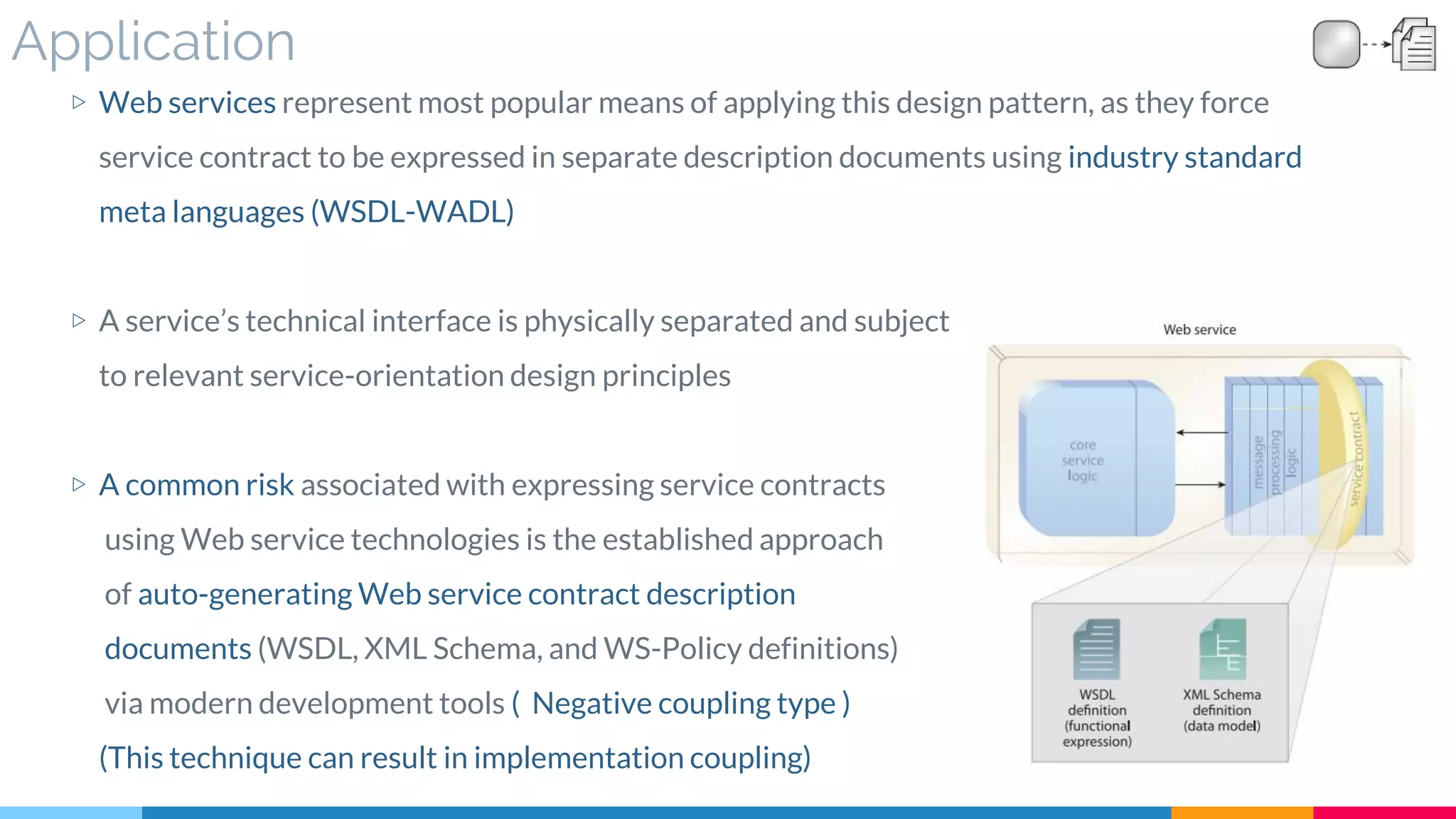
▷ Web services represent most popular means of applying this design pattern, as they force
service contract to be expressed in separate description documents using industry standard
meta languages (WSDL-WADL)
▷ A service’s technical interface is physically separated and subject
to relevant service-orientation design principles
▷ A common risk associated with expressing service contracts
using Web service technologies is the established approach
of auto-generating Web service contract description
documents (WSDL, XML Schema, and WS-Policy definitions)
via modern development tools ( Negative coupling type )
(This technique can result in implementation coupling)
Application
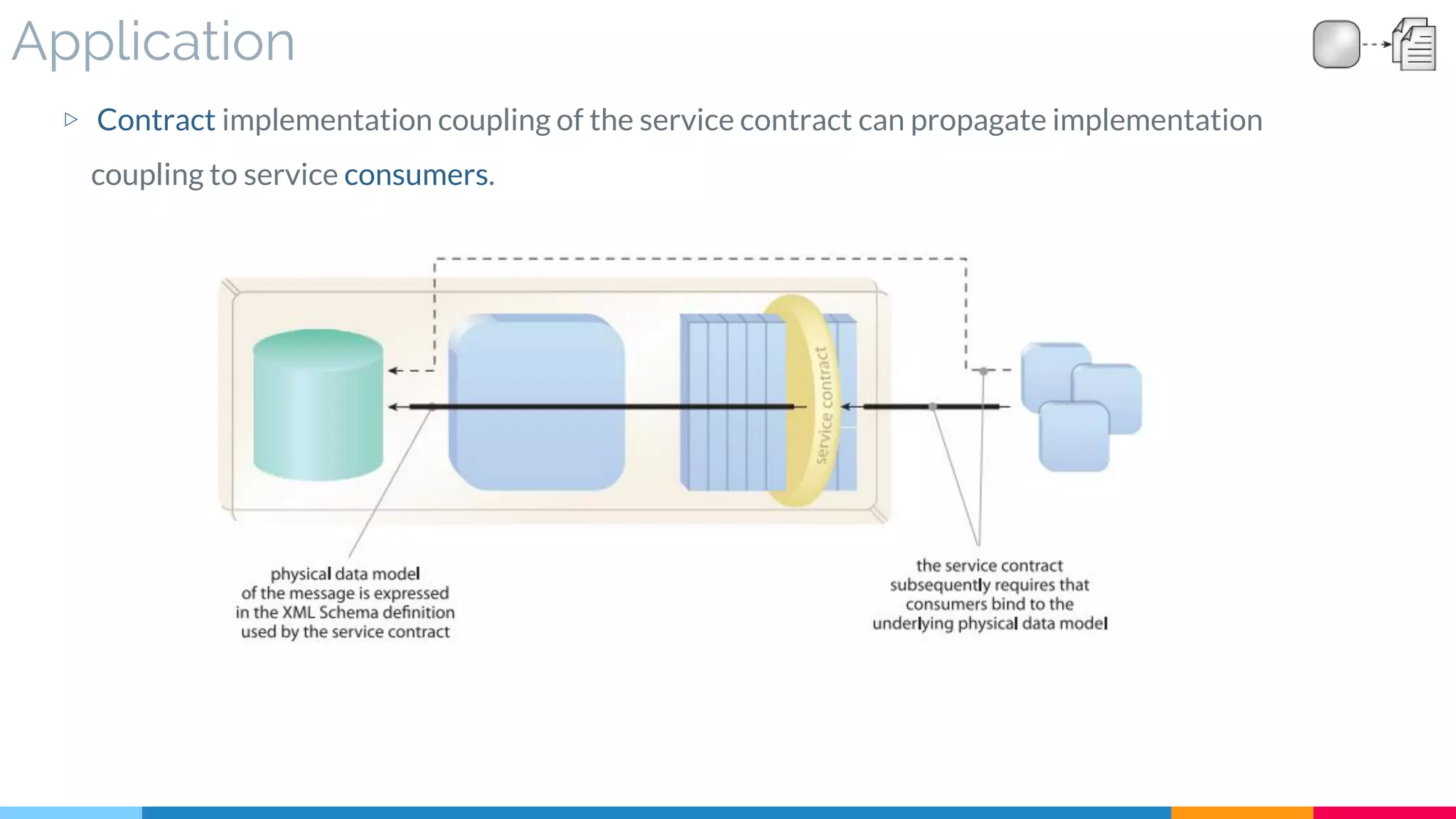
▷ Contract implementation coupling of the service contract can propagate implementation
coupling to service consumers.
Application
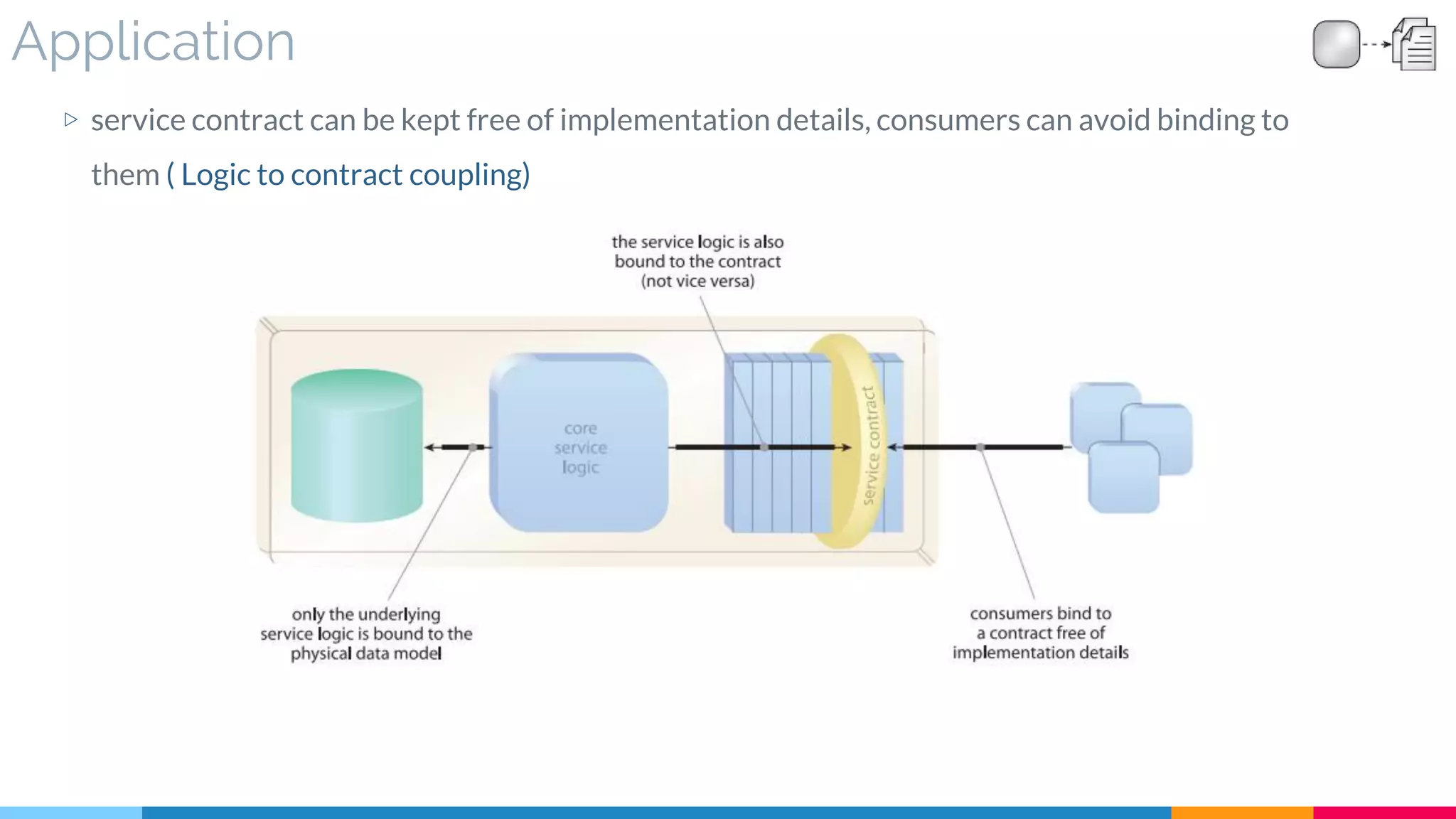
▷ service contract can be kept free of implementation details, consumers can avoid binding to
them ( Logic to contract coupling)
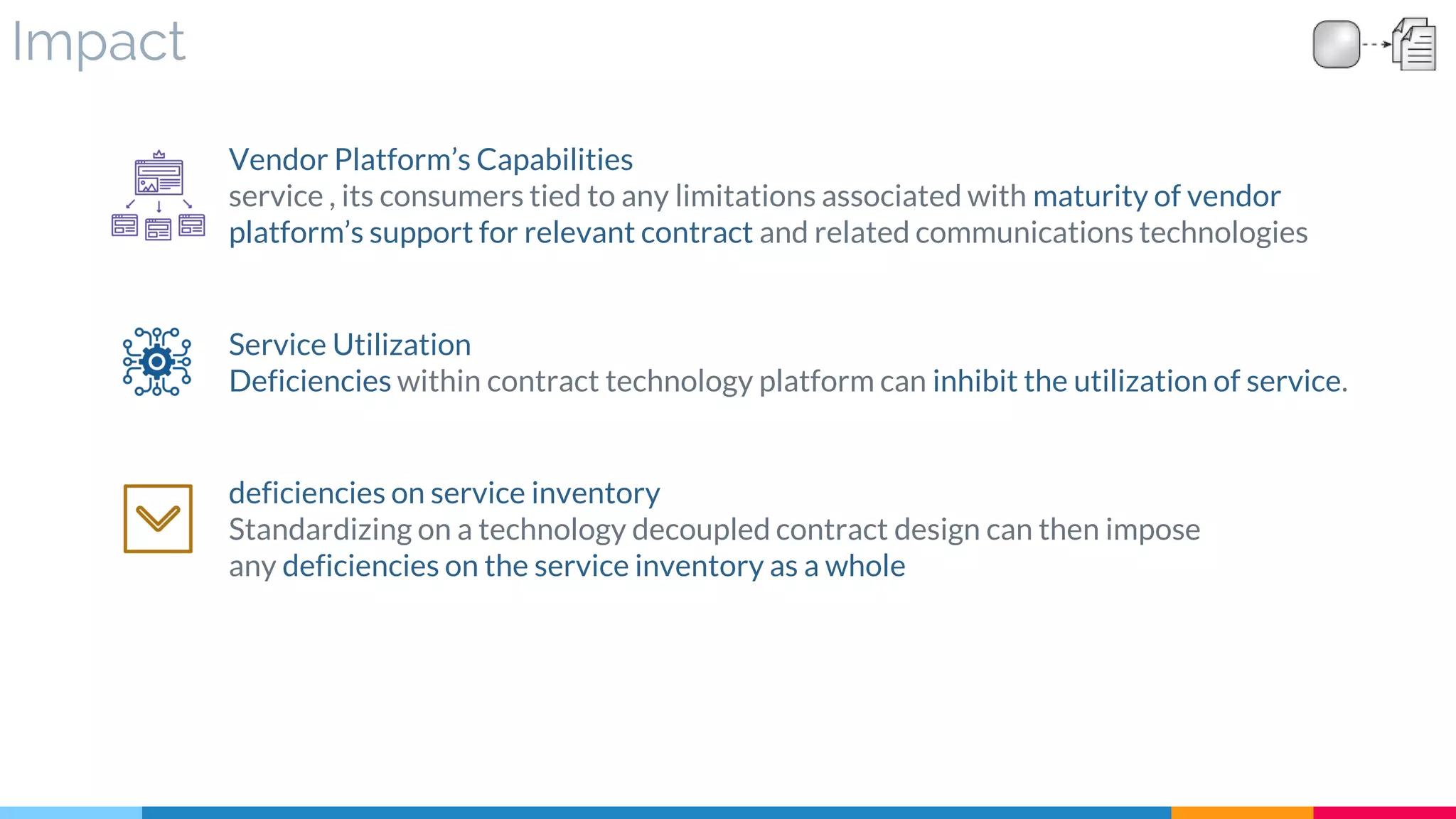
Impact
Service Utilization
Deficiencies within contract technology platform can inhibit the utilization of service.
Vendor Platform’s Capabilities
service , its consumers tied to any limitations associated with maturity of vendor
platform’s support for relevant contract and related communications technologies
deficiencies on service inventory
Standardizing on a technology decoupled contract design can then impose
any deficiencies on the service inventory as a whole
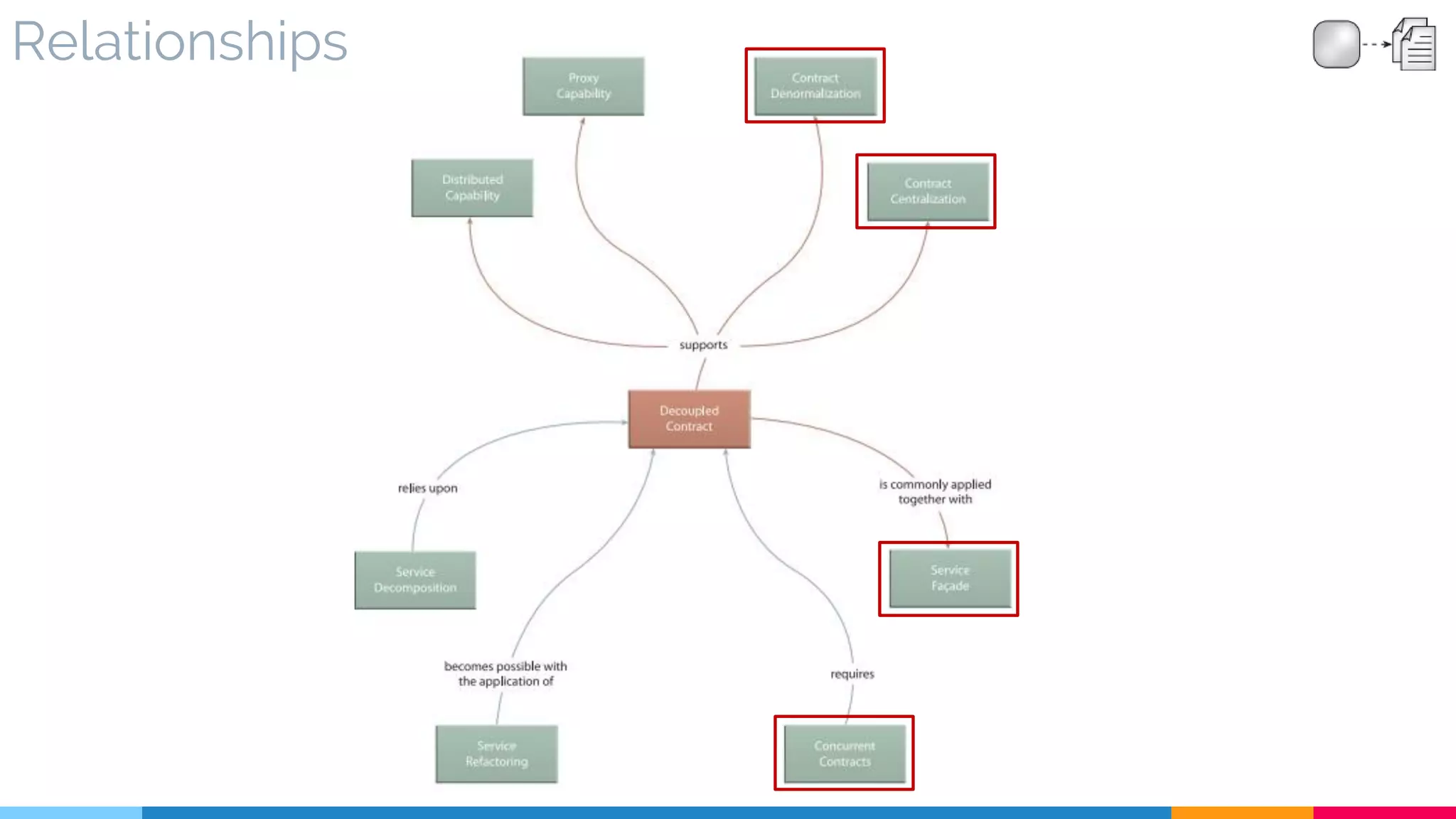
Relationships
22 Concurrent Contract
▷ Problem
▷ Solution
▷ Real World Sample
▷ Application
▷ Impact
▷ Relationships
[421]
Problem
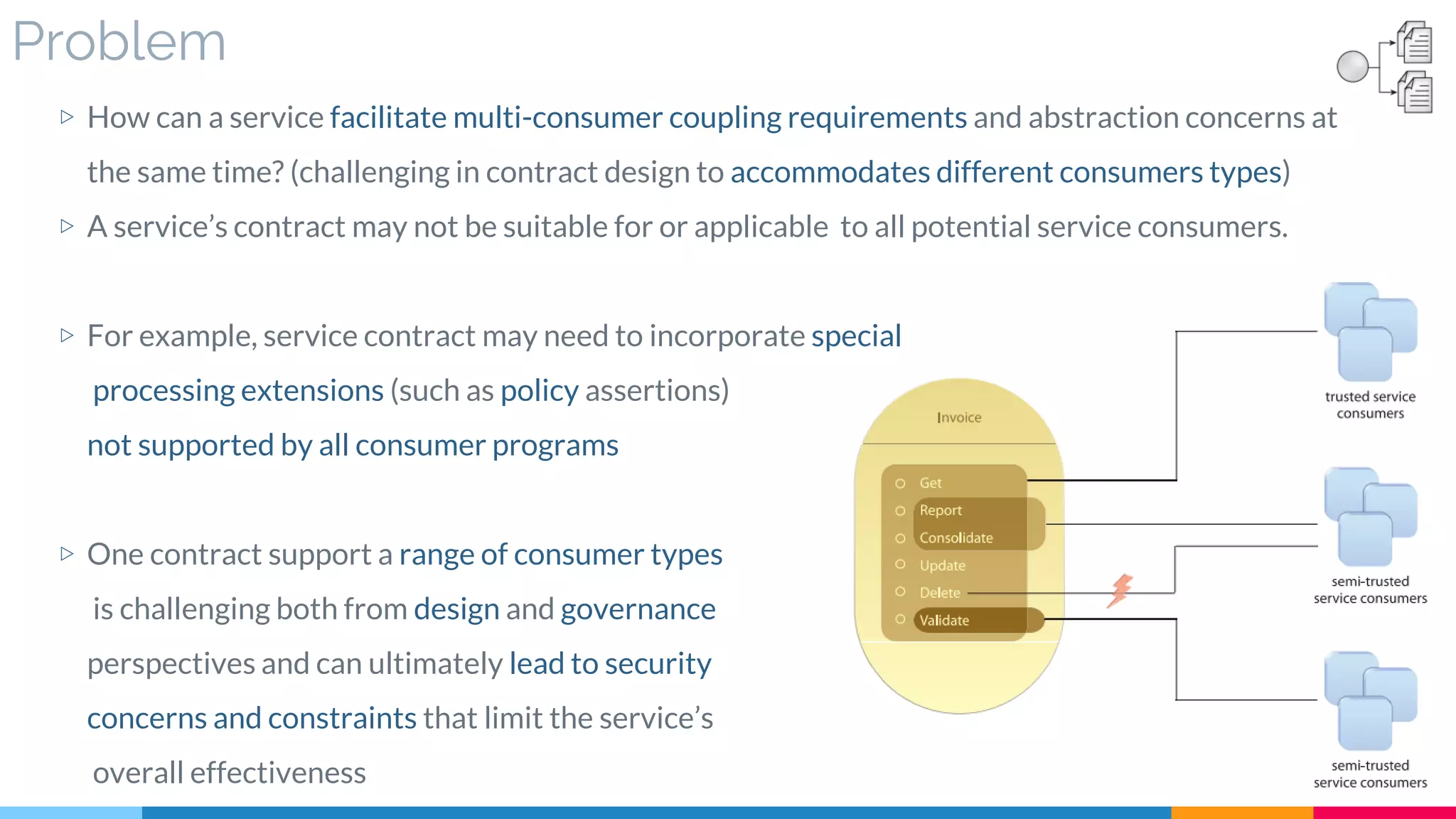
▷ How can a service facilitate multi-consumer coupling requirements and abstraction concerns at
the same time? (challenging in contract design to accommodates different consumers types)
▷ A service’s contract may not be suitable for or applicable to all potential service consumers.
▷ For example, service contract may need to incorporate special
processing extensions (such as policy assertions)
not supported by all consumer programs
▷ One contract support a range of consumer types
is challenging both from design and governance
perspectives and can ultimately lead to security
concerns and constraints that limit the service’s
overall effectiveness
Solution
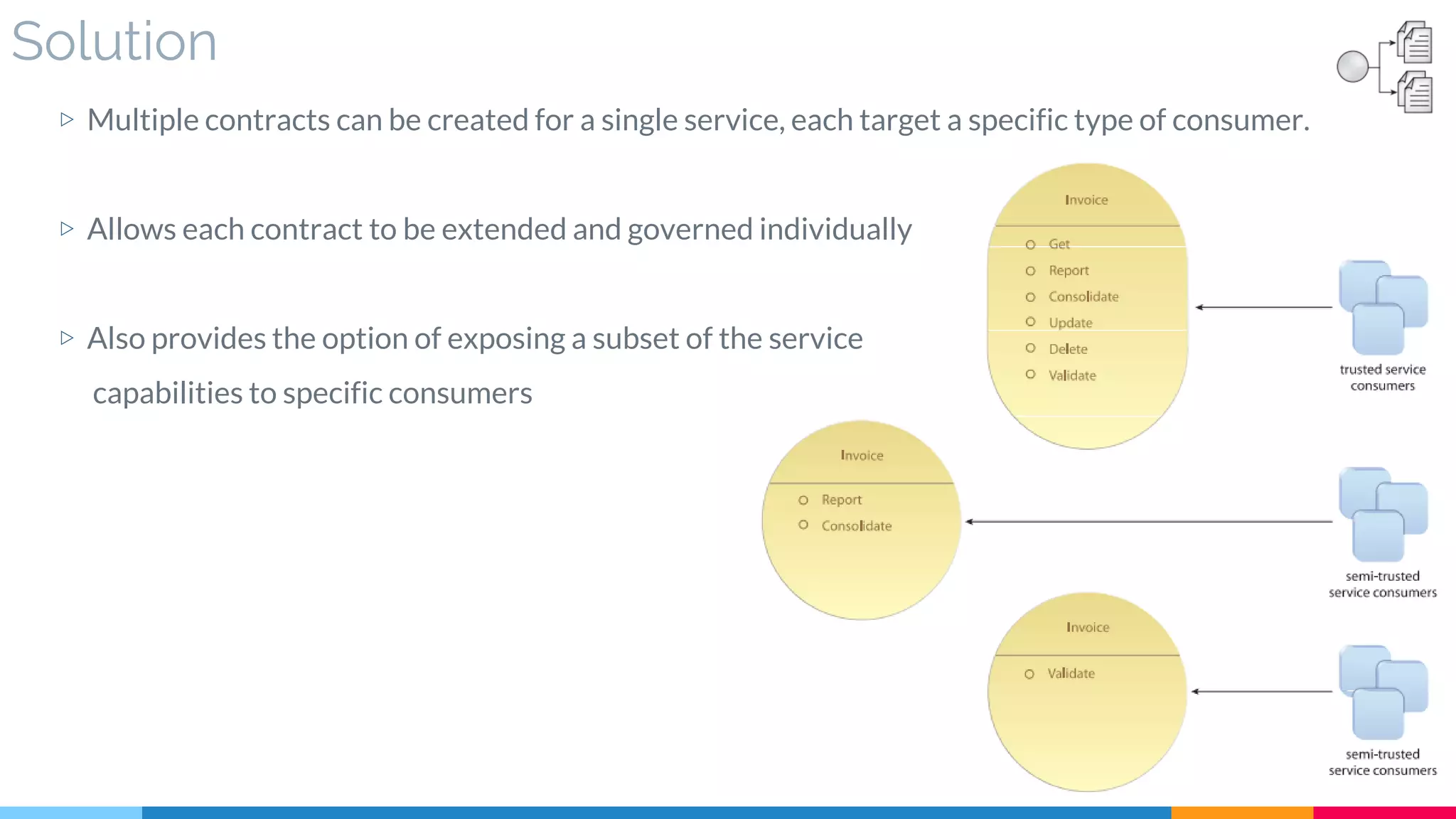
▷ Multiple contracts can be created for a single service, each target a specific type of consumer.
▷ Allows each contract to be extended and governed individually
▷ Also provides the option of exposing a subset of the service
capabilities to specific consumers
Real World Sample
Concurrent Edition contract [ Same service provided by
multiple contracts to accommodate consumers concerns]
Application
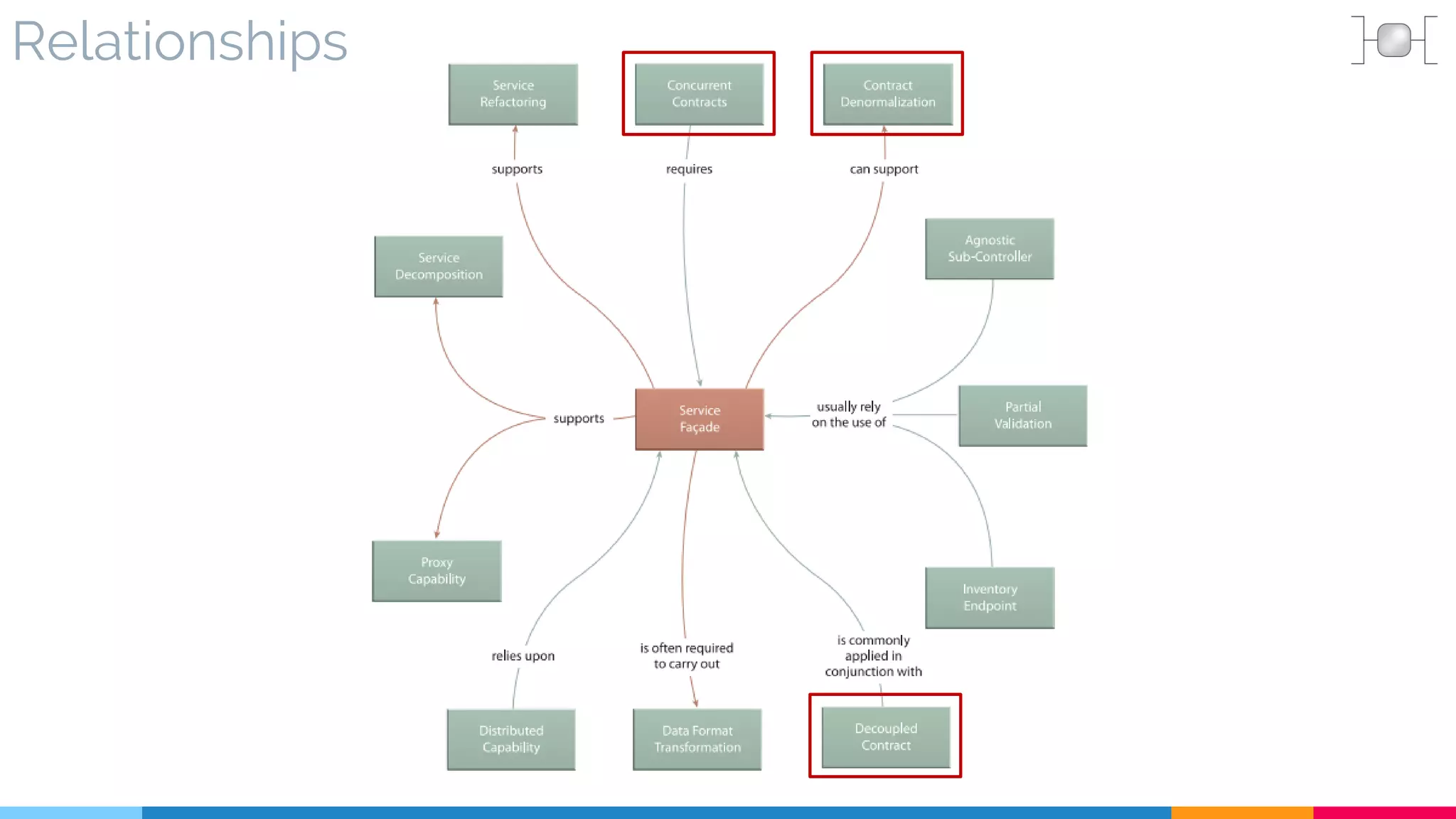
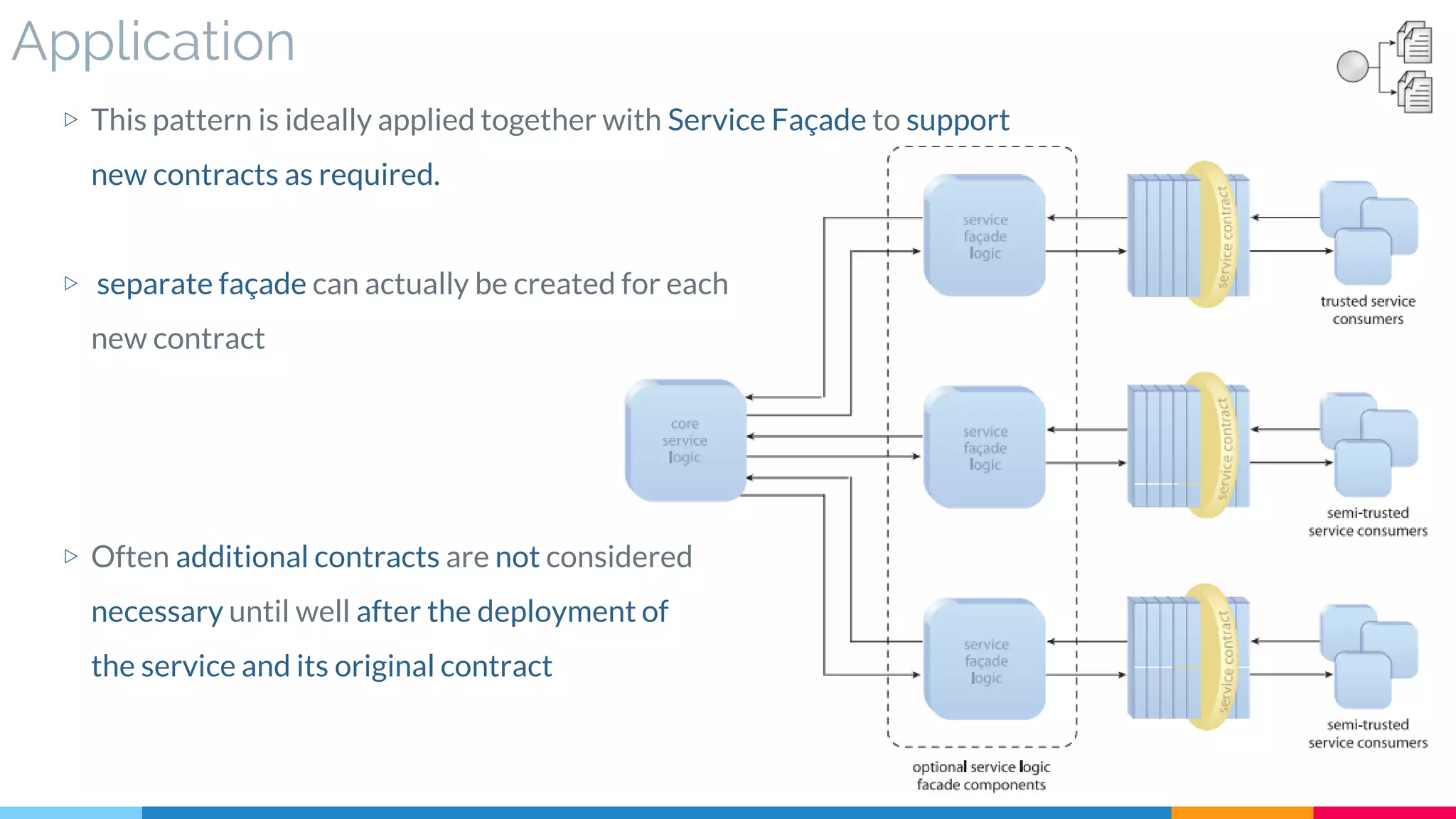
▷ This pattern is ideally applied together with Service Façade to support
new contracts as required.
▷ separate façade can actually be created for each
new contract
▷ Often additional contracts are not considered
necessary until well after the deployment of
the service and its original contract
Impact
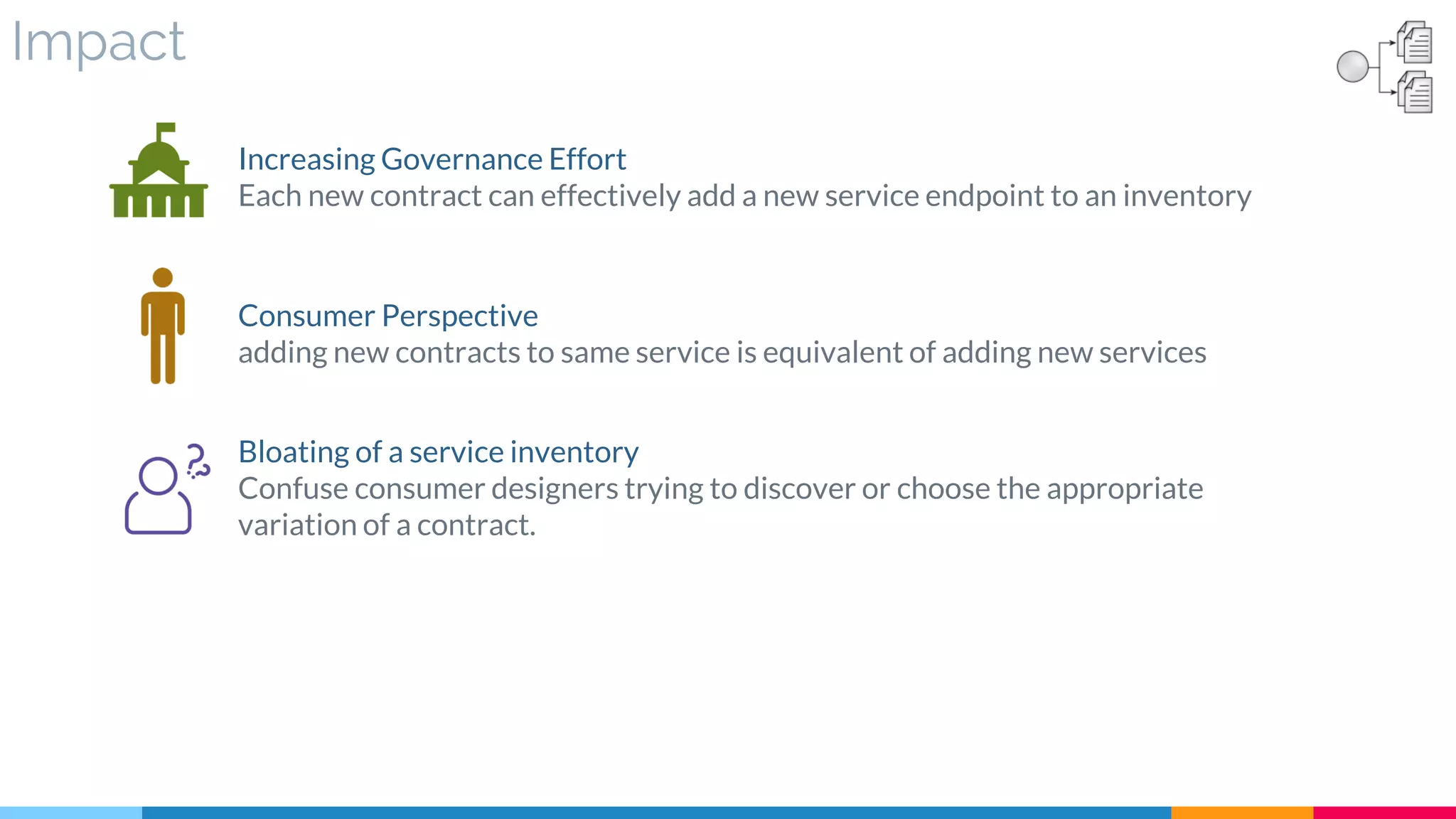
Increasing Governance Effort
Each new contract can effectively add a new service endpoint to an inventory
Consumer Perspective
adding new contracts to same service is equivalent of adding new services
Bloating of a service inventory
Confuse consumer designers trying to discover or choose the appropriate
variation of a contract.
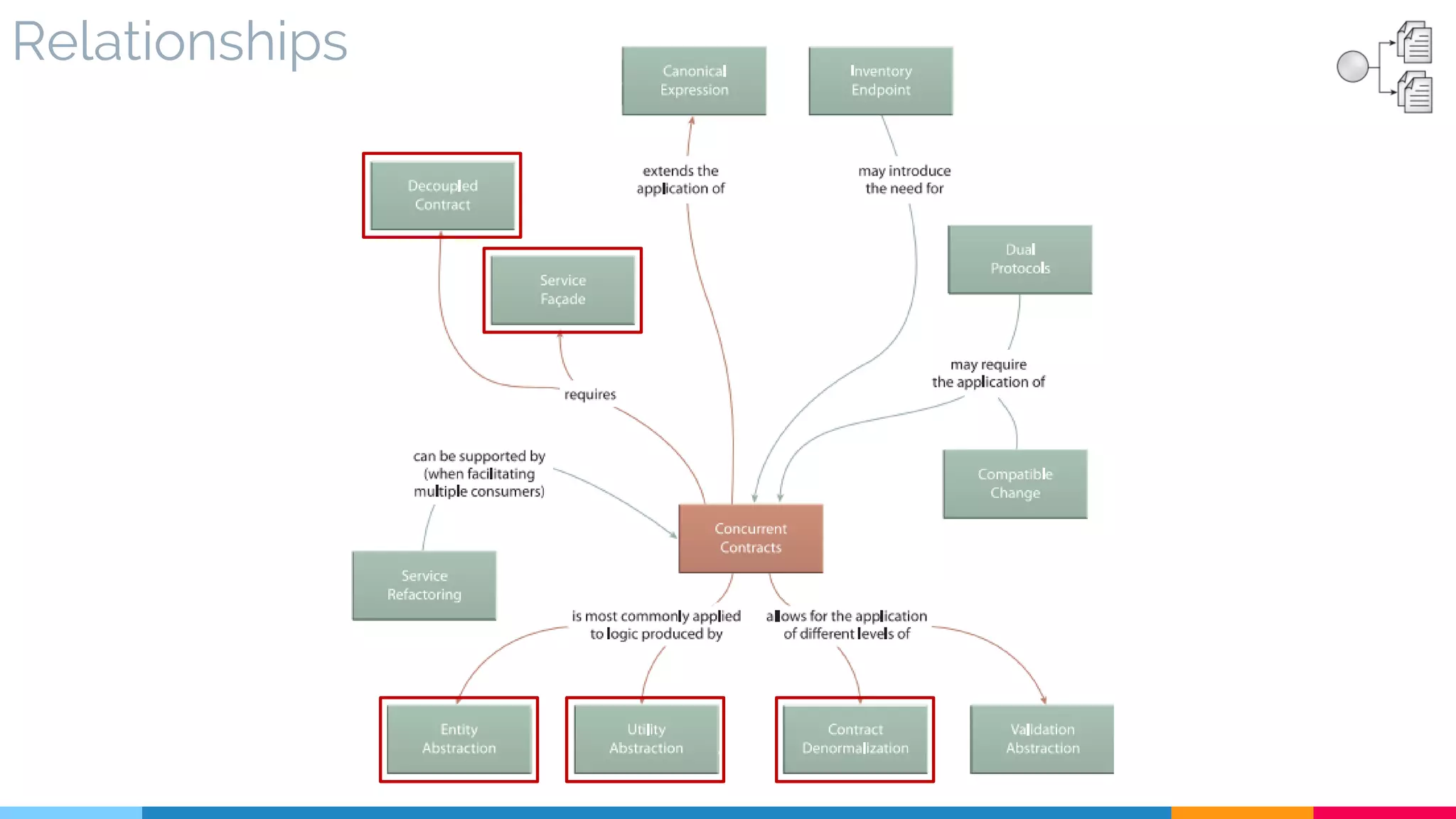
Relationships
23 Legacy Wrapper
▷ Problem
▷ Solution
▷ Real World Sample
▷ Application
▷ Impact
▷ Relationships
[441]
Problem
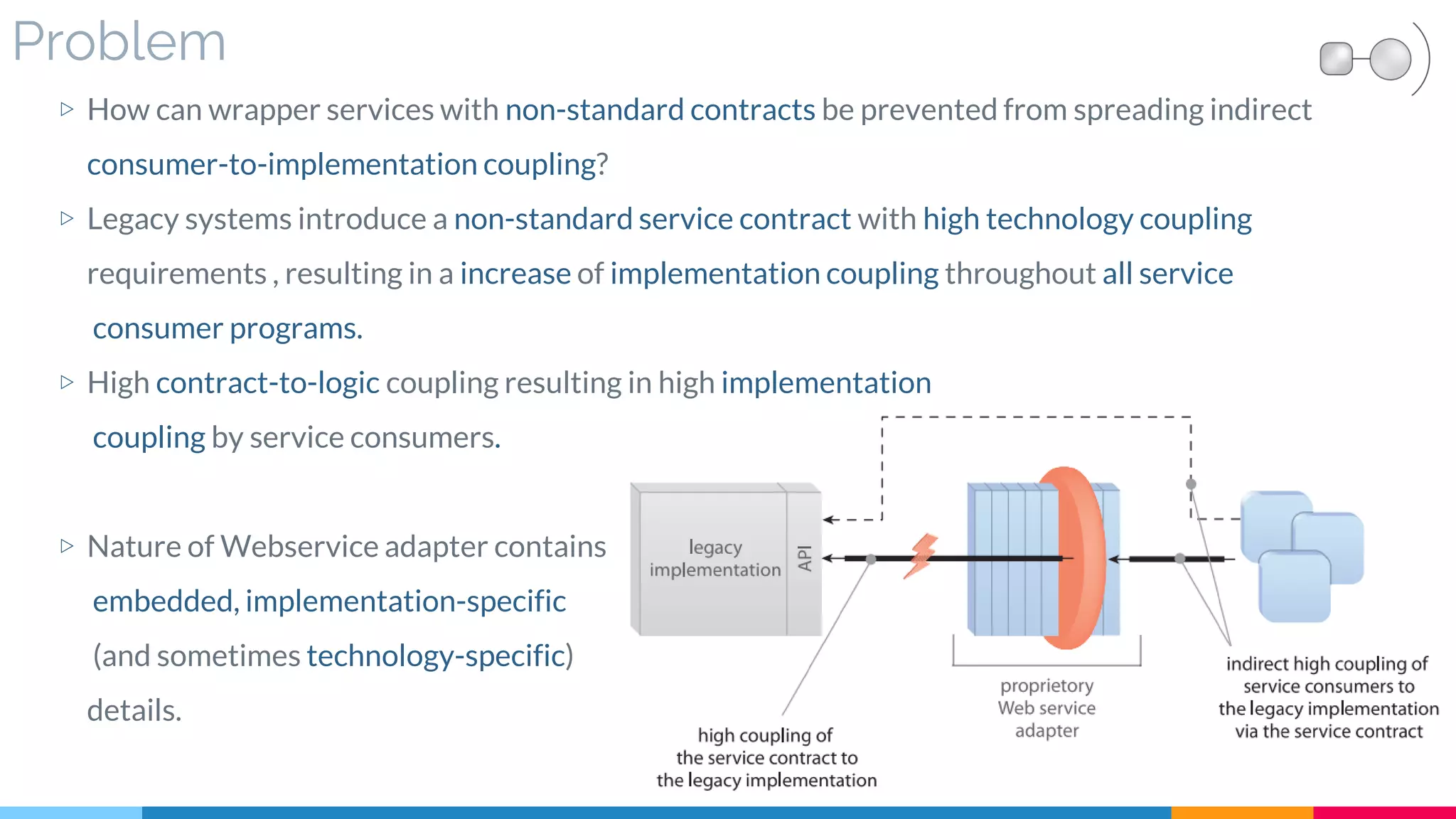
▷ How can wrapper services with non-standard contracts be prevented from spreading indirect
consumer-to-implementation coupling?
▷ Legacy systems introduce a non-standard service contract with high technology coupling
requirements , resulting in a increase of implementation coupling throughout all service
consumer programs.
▷ High contract-to-logic coupling resulting in high implementation
coupling by service consumers.
▷ Nature of Webservice adapter contains
embedded, implementation-specific
(and sometimes technology-specific)
details.
Solution
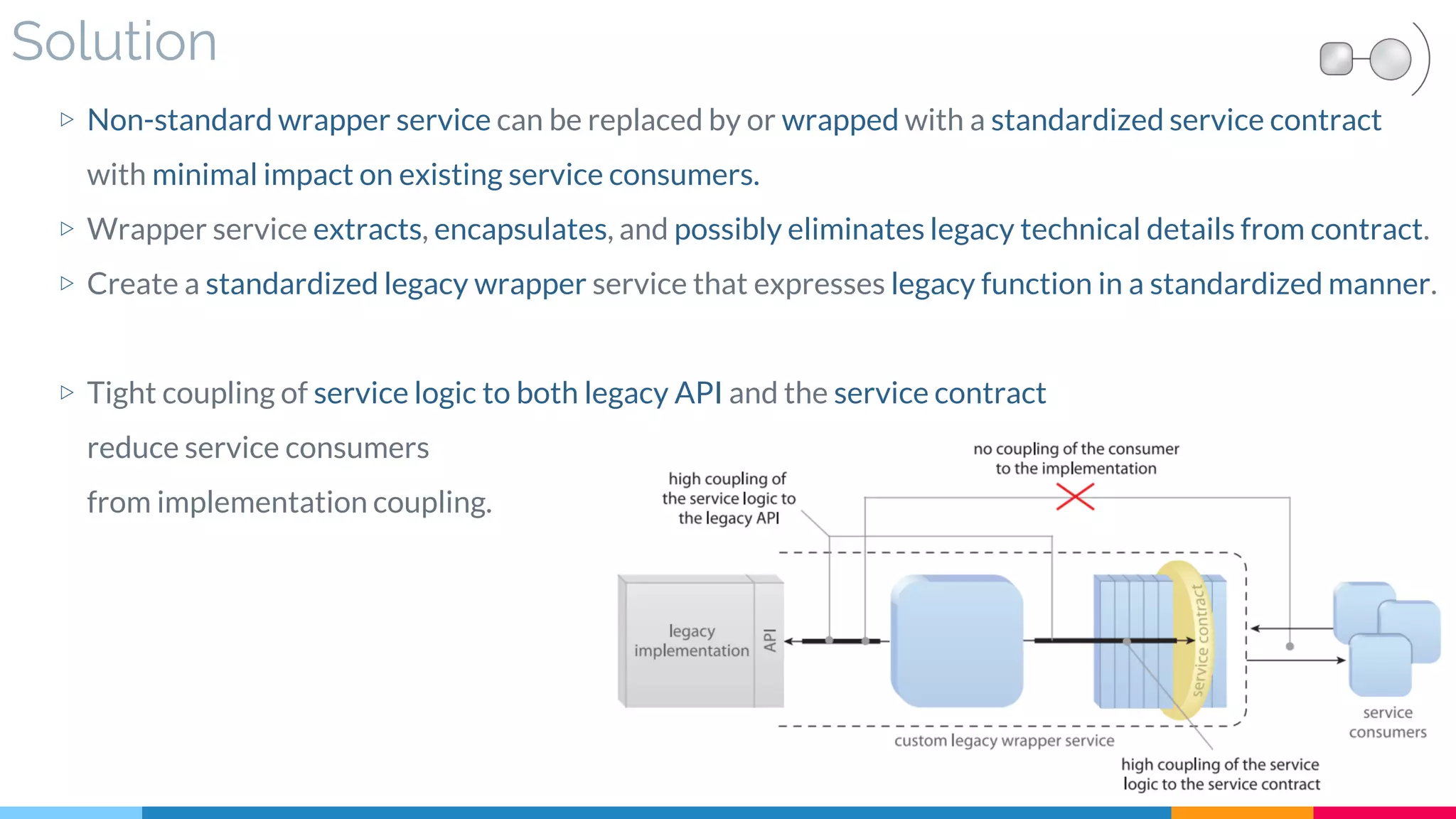
▷ Non-standard wrapper service can be replaced by or wrapped with a standardized service contract
with minimal impact on existing service consumers.
▷ Wrapper service extracts, encapsulates, and possibly eliminates legacy technical details from contract.
▷ Create a standardized legacy wrapper service that expresses legacy function in a standardized manner.
▷ Tight coupling of service logic to both legacy API and the service contract
reduce service consumers
from implementation coupling.
Real World Sample
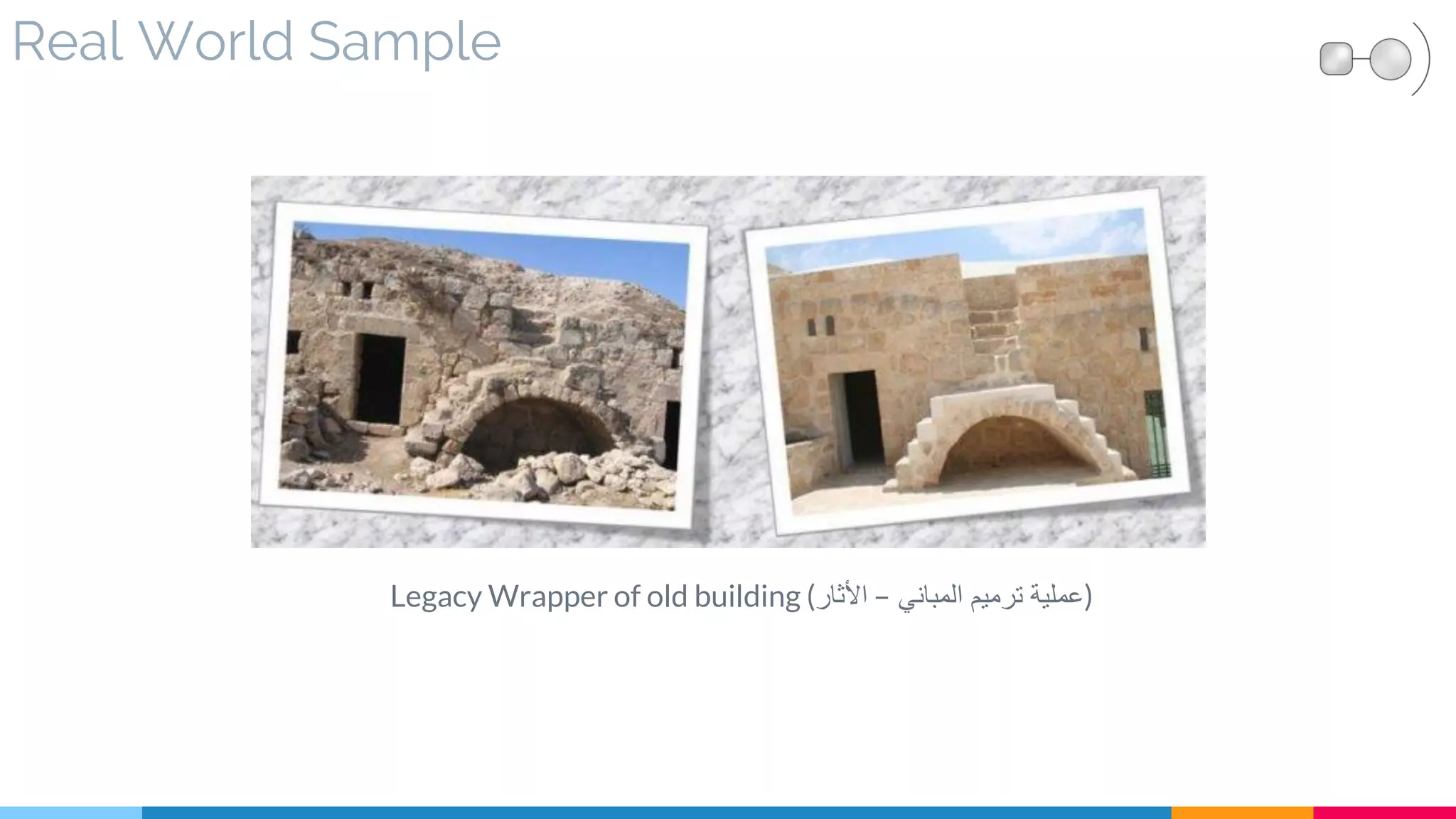
Legacy Wrapper of old building ( ‫المباني‬ ‫ترميم‬ ‫عملية‬–‫األثار‬ )
Application
▷ A custom service contract and required service logic need to be developed to represent the
proprietary legacy interface represent in two ways :
1. Add New Wrapper Service : if introduce new service contract
2. Add New service Capability : if parts of a legacy resource fall within a predefined service boundary
▷ Wrapper service (or capability) will typically contain logic that performs transformation between its
standardized contract and the native legacy interface, accomplished by eliminating and encapsulating
technical information
Application
▷ Eliminating Technical Information:
1. Eliminate input and output data contain highly proprietary characteristics like
[error code can be replaced by SOAP Fault]
2. Usually result in Utility service
▷ Encapsulating Technical Information:
1. Replace legacy-specific data with standardized business data
2. Partition standardized business data from proprietary legacy data into body and header sections
3. Usually result in add the wrapper logic as an extension of a business service.
Impact
Performance overhead
adds a layer of processing and associated performance overhead with
the additional service invocation and data transformation requirements.
When new systems or resources are introduced into a service architecture,
1. The overall behavior of the service may be impacted,
2. It may be required to supplement the service logic with additional functions
that compensate for any potential negative effects these behavioral changes may
have on consumers , Service Façade is often used for this purpose.
Relationships
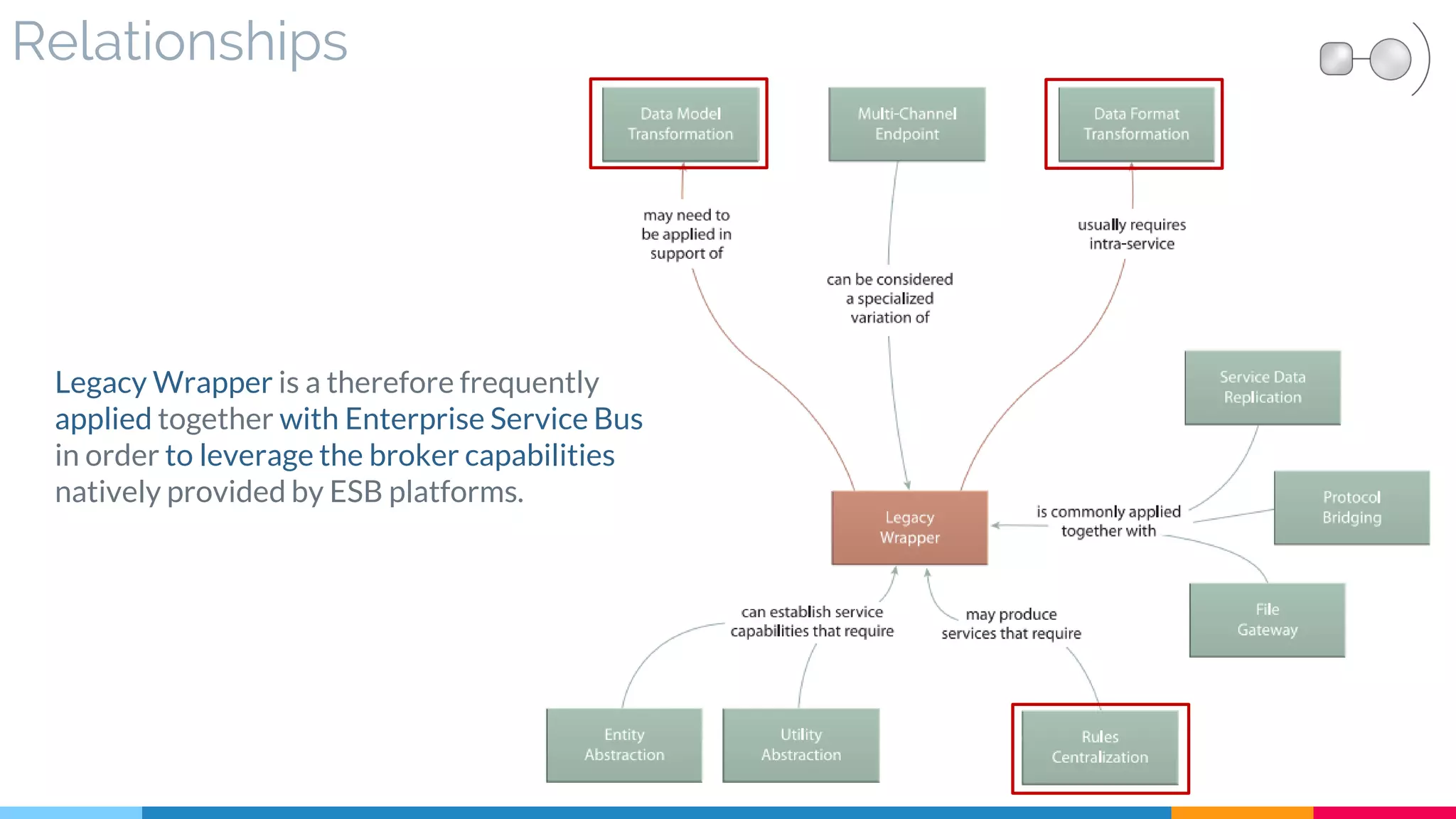
Legacy Wrapper is a therefore frequently
applied together with Enterprise Service Bus
in order to leverage the broker capabilities
natively provided by ESB platforms.
24 Service Agent
▷ Problem
▷ Solution
▷ Real World Sample
▷ Application
▷ Impact
▷ Relationships
[543]
Problem
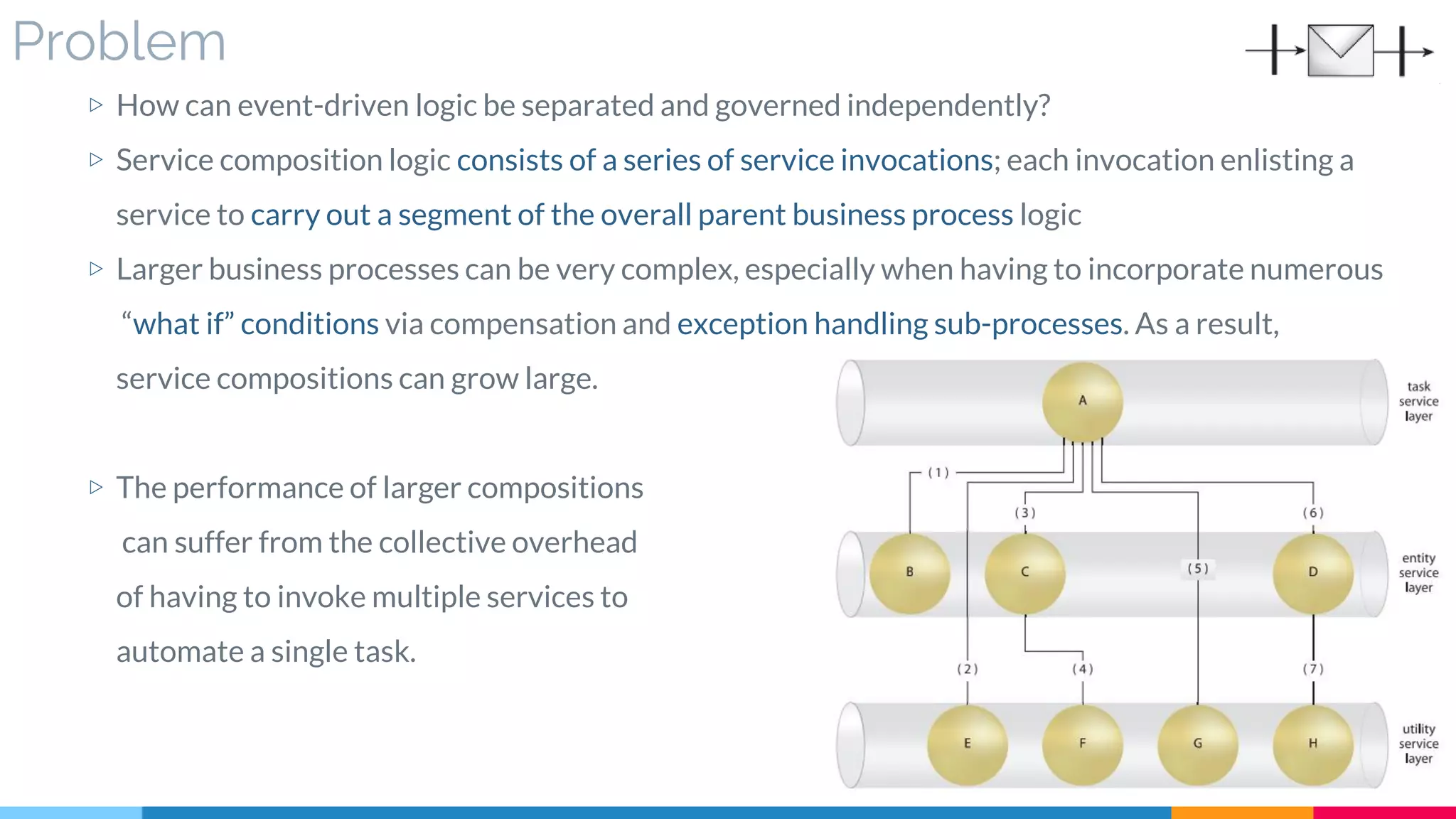
▷ How can event-driven logic be separated and governed independently?
▷ Service composition logic consists of a series of service invocations; each invocation enlisting a
service to carry out a segment of the overall parent business process logic
▷ Larger business processes can be very complex, especially when having to incorporate numerous
“what if” conditions via compensation and exception handling sub-processes. As a result,
service compositions can grow large.
▷ The performance of larger compositions
can suffer from the collective overhead
of having to invoke multiple services to
automate a single task.
Solution
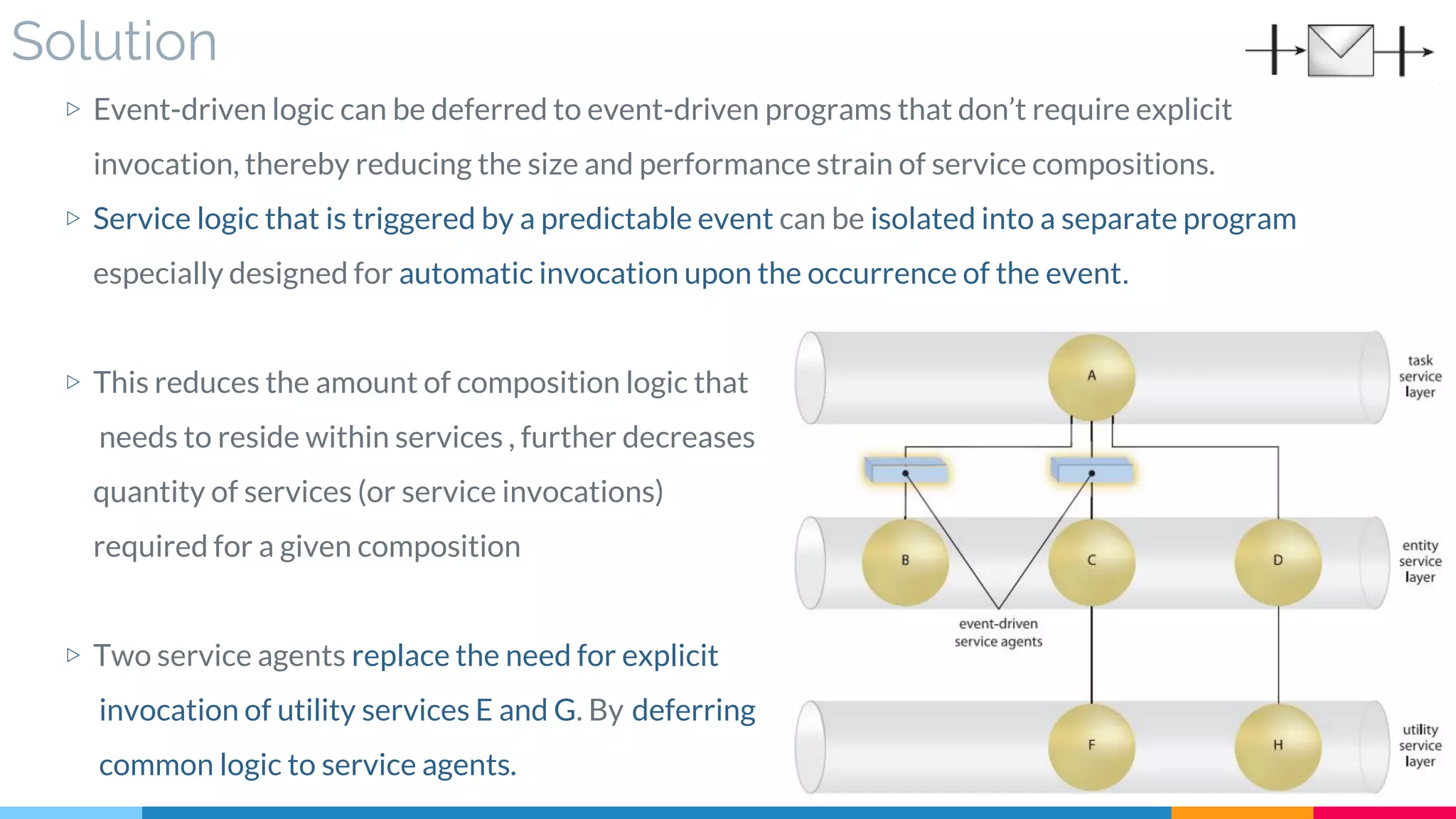
▷ Event-driven logic can be deferred to event-driven programs that don’t require explicit
invocation, thereby reducing the size and performance strain of service compositions.
▷ Service logic that is triggered by a predictable event can be isolated into a separate program
especially designed for automatic invocation upon the occurrence of the event.
▷ This reduces the amount of composition logic that
needs to reside within services , further decreases
quantity of services (or service invocations)
required for a given composition
▷ Two service agents replace the need for explicit
invocation of utility services E and G. By deferring
common logic to service agents.
Real World Sample
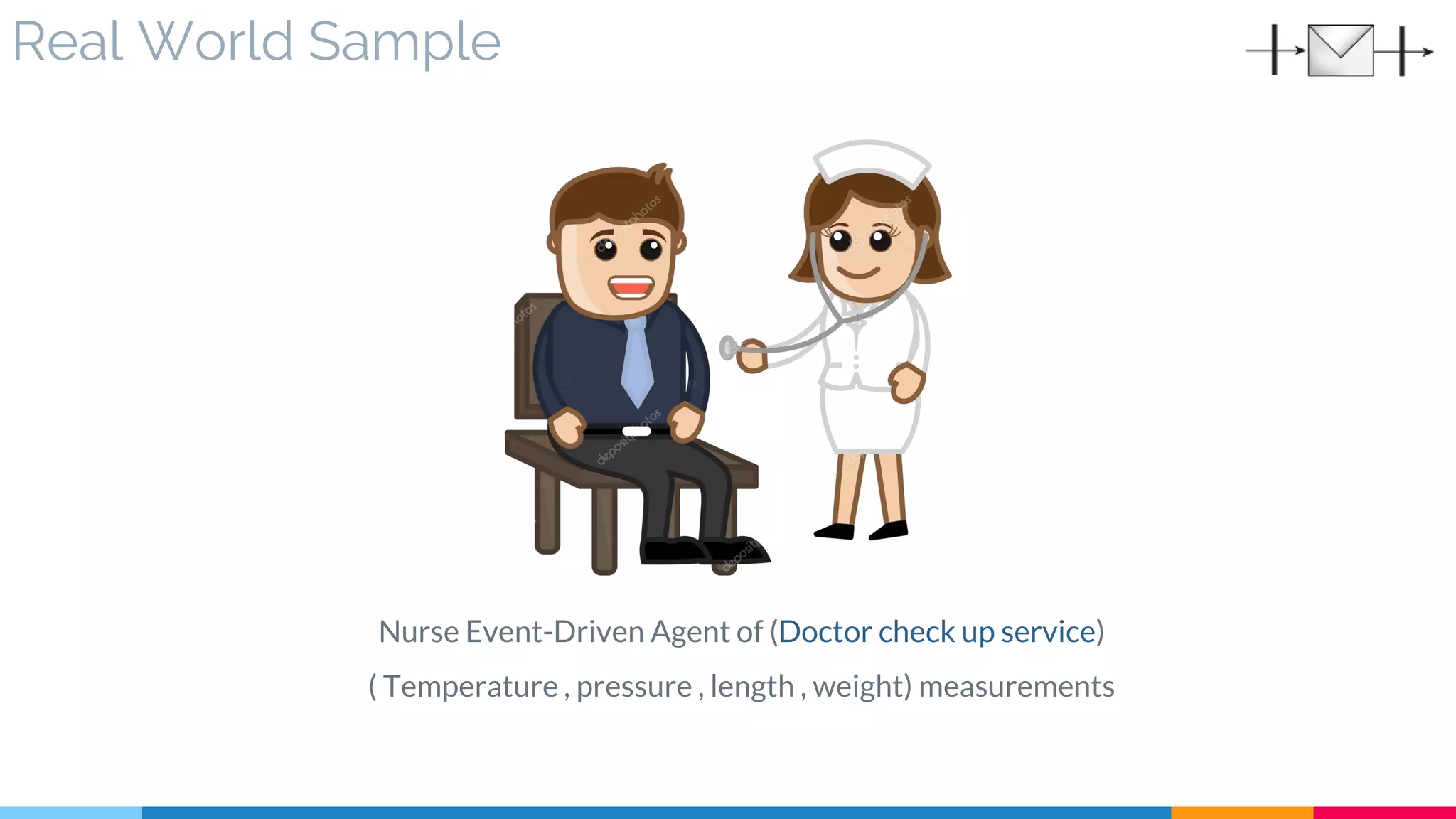
Nurse Event-Driven Agent of (Doctor check up service)
( Temperature , pressure , length , weight) measurements
Application
▷ The event-driven logic is implemented as a service agent—a program with no published
contract that is capable of intercepting and processing messages at runtime.
▷ Service agents can be designed to automatically respond to predefined conditions without
invocation via a published contract , service agent typically lightweight , generally
contain common utility-centric processing logic , commonly deployed to facilitate inter-service
communication
▷ vendor runtime platforms commonly provide “system-level” agents that carry out utility functions
such as authentication, authorization, logging, audit, and load balancing.
▷ Service agents can also be custom-developed to provide business-centric and/or single-purpose
logic as well.
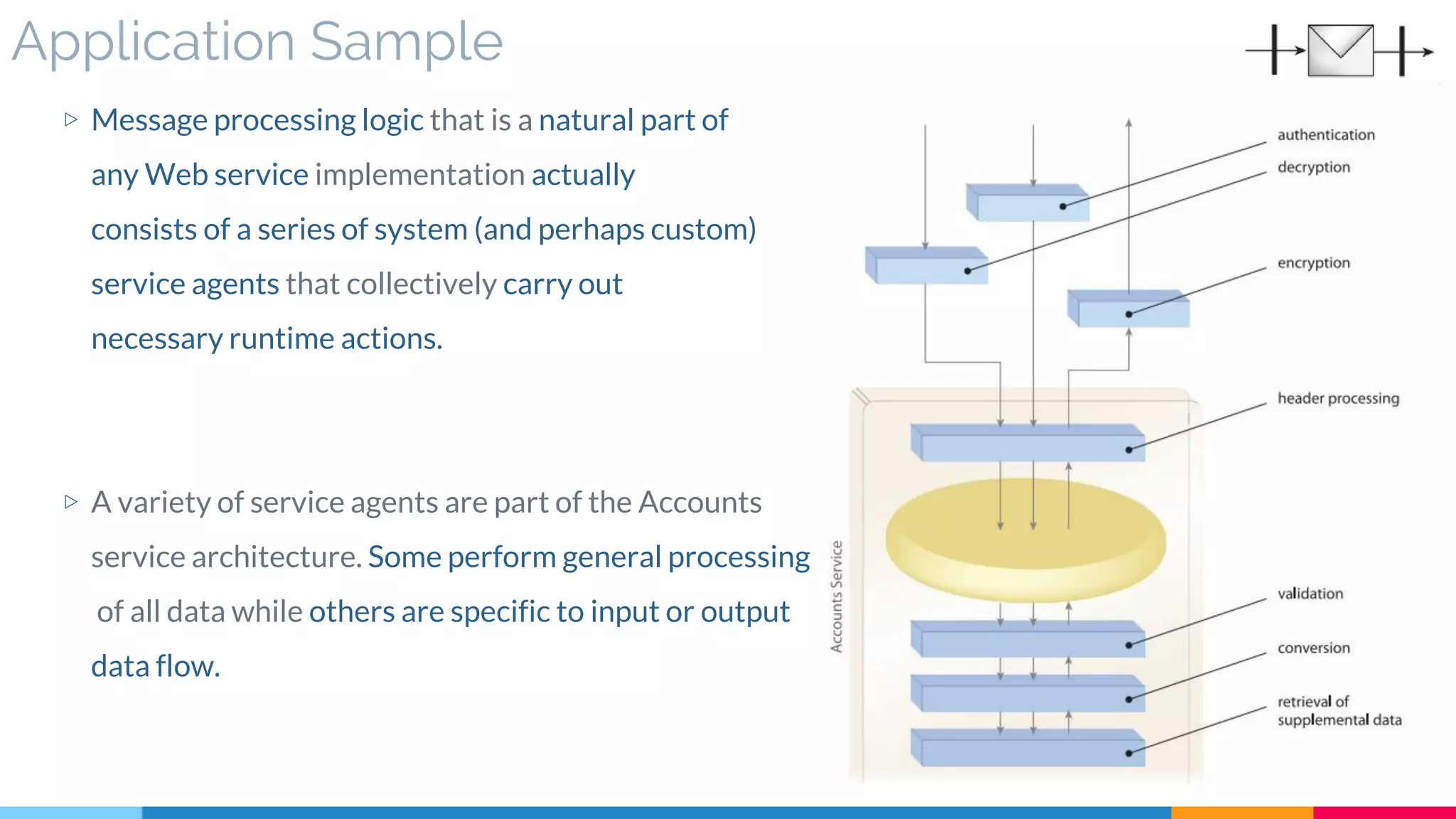
Application Sample
▷ Message processing logic that is a natural part of
any Web service implementation actually
consists of a series of system (and perhaps custom)
service agents that collectively carry out
necessary runtime actions.
▷ A variety of service agents are part of the Accounts
service architecture. Some perform general processing
of all data while others are specific to input or output
data flow.
Impact
Composition complexity not reduced
Although the perceived size of the composition may be reduced,
The actual complexity of the composition itself does not decrease.
Governance Issue
Service agents will need to be owned and maintained by a separate group that needs
to understand the inventory-wide impacts of any changes made to agent logic ,
An agent versioning system will be further required to address these challenges.
Dependency of service agents vendor technology
Event-driven agents and over reliance on service agents can further tie an inventory
architecture to proprietary vendor technology.
Relationships
25 Messaging Metadata
▷ Problem
▷ Solution
▷ Real World Sample
▷ Application
▷ Impact
▷ Relationships
[538]
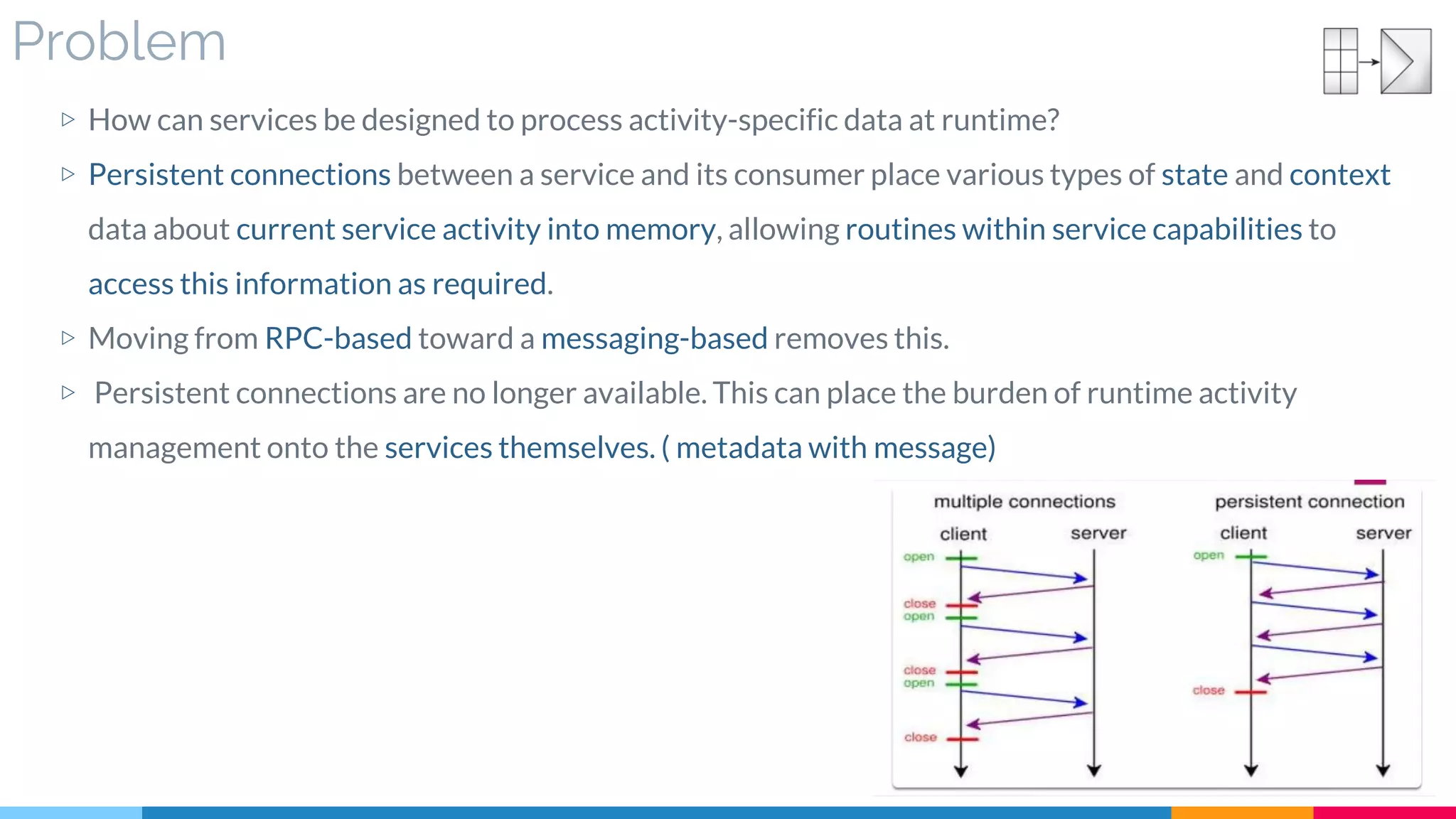
Problem
▷ How can services be designed to process activity-specific data at runtime?
▷ Persistent connections between a service and its consumer place various types of state and context
data about current service activity into memory, allowing routines within service capabilities to
access this information as required.
▷ Moving from RPC-based toward a messaging-based removes this.
▷ Persistent connections are no longer available. This can place the burden of runtime activity
management onto the services themselves. ( metadata with message)
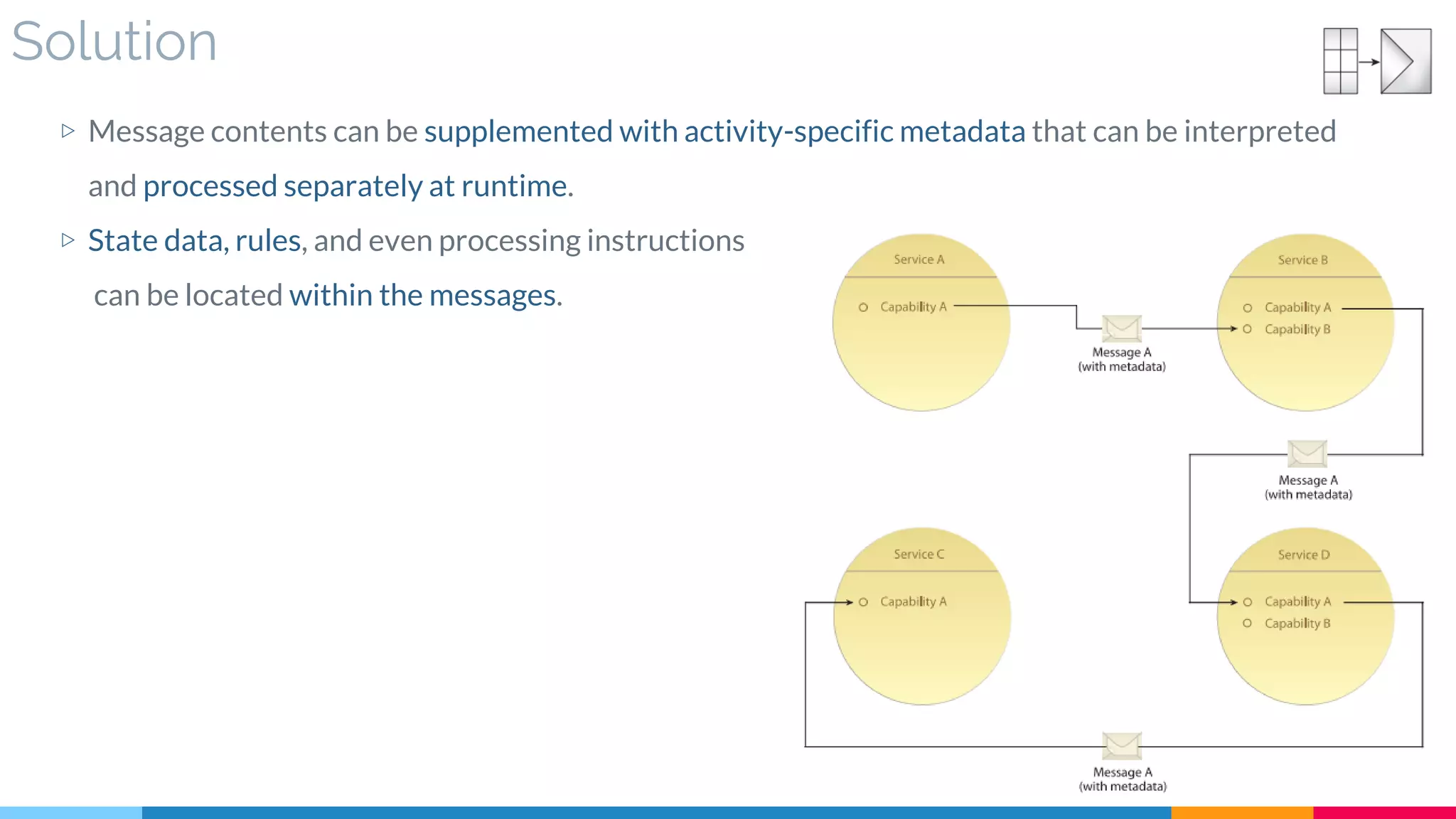
Solution
▷ Message contents can be supplemented with activity-specific metadata that can be interpreted
and processed separately at runtime.
▷ State data, rules, and even processing instructions
can be located within the messages.
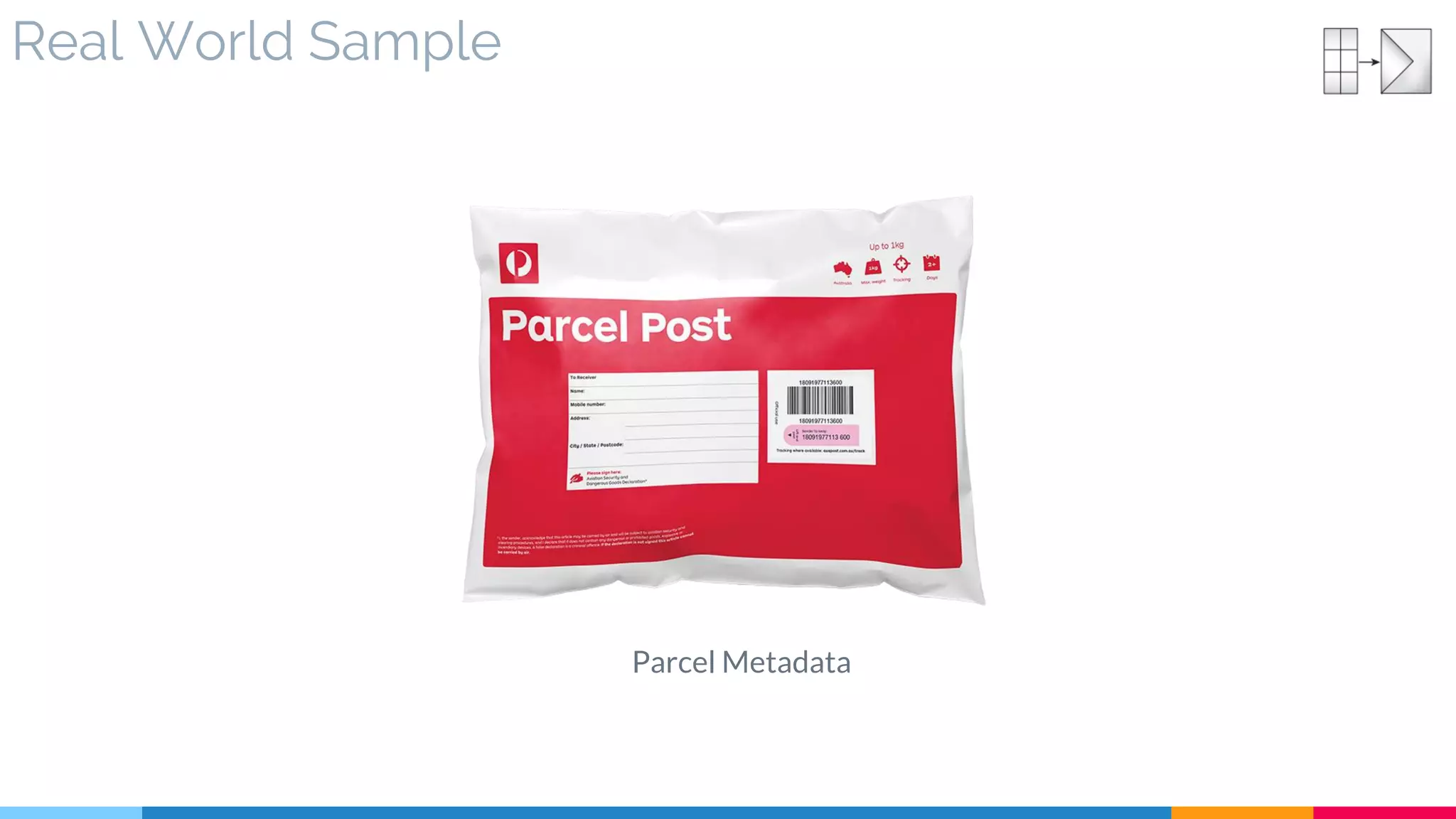
Real World Sample
Parcel Metadata
Application
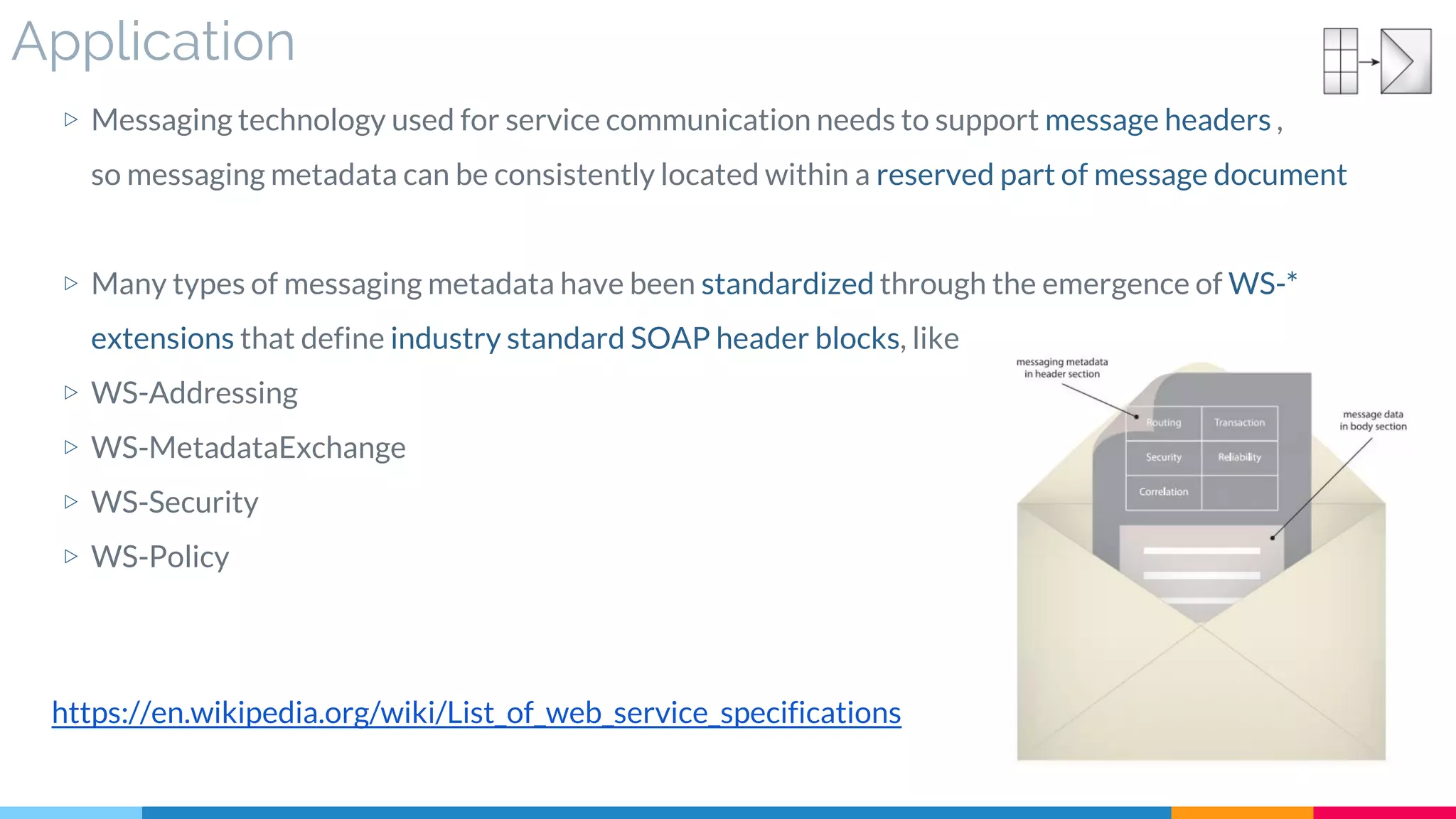
▷ Messaging technology used for service communication needs to support message headers ,
so messaging metadata can be consistently located within a reserved part of message document
▷ Many types of messaging metadata have been standardized through the emergence of WS-*
extensions that define industry standard SOAP header blocks, like
▷ WS-Addressing
▷ WS-MetadataExchange
▷ WS-Security
▷ WS-Policy
https://en.wikipedia.org/wiki/List_of_web_service_specifications
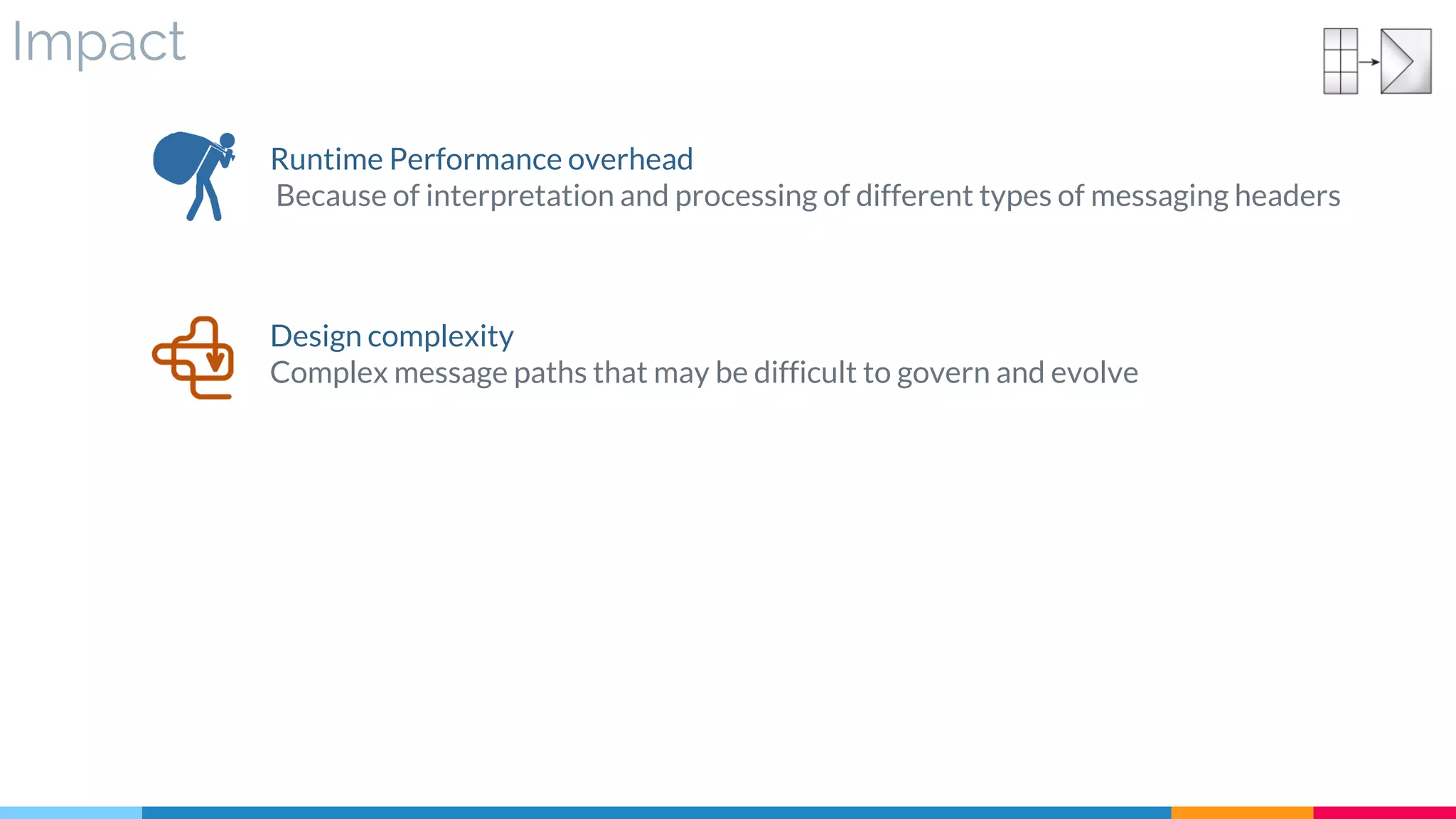
Impact
Runtime Performance overhead
Because of interpretation and processing of different types of messaging headers
Design complexity
Complex message paths that may be difficult to govern and evolve
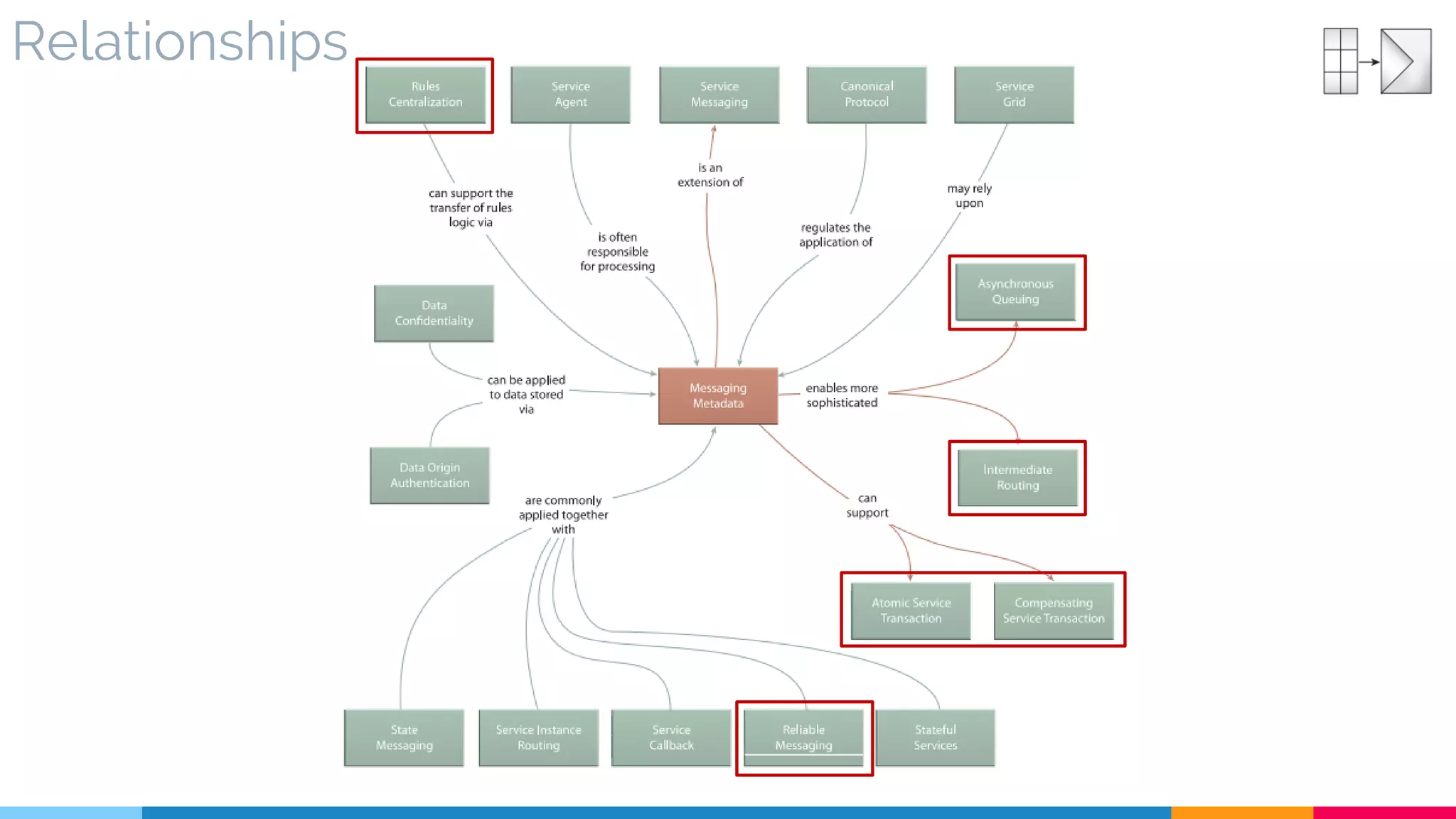
Relationships
Orchestration Patterns
▷Process Abstraction
▷State Repository
▷Atomic Service Transaction
▷Compensating Service Transaction
▷Process Centralization
5
26 Orchestration
▷ Introduction
▷ Orchestration Components
▷ Extended Orchestration
[701]
Introduction
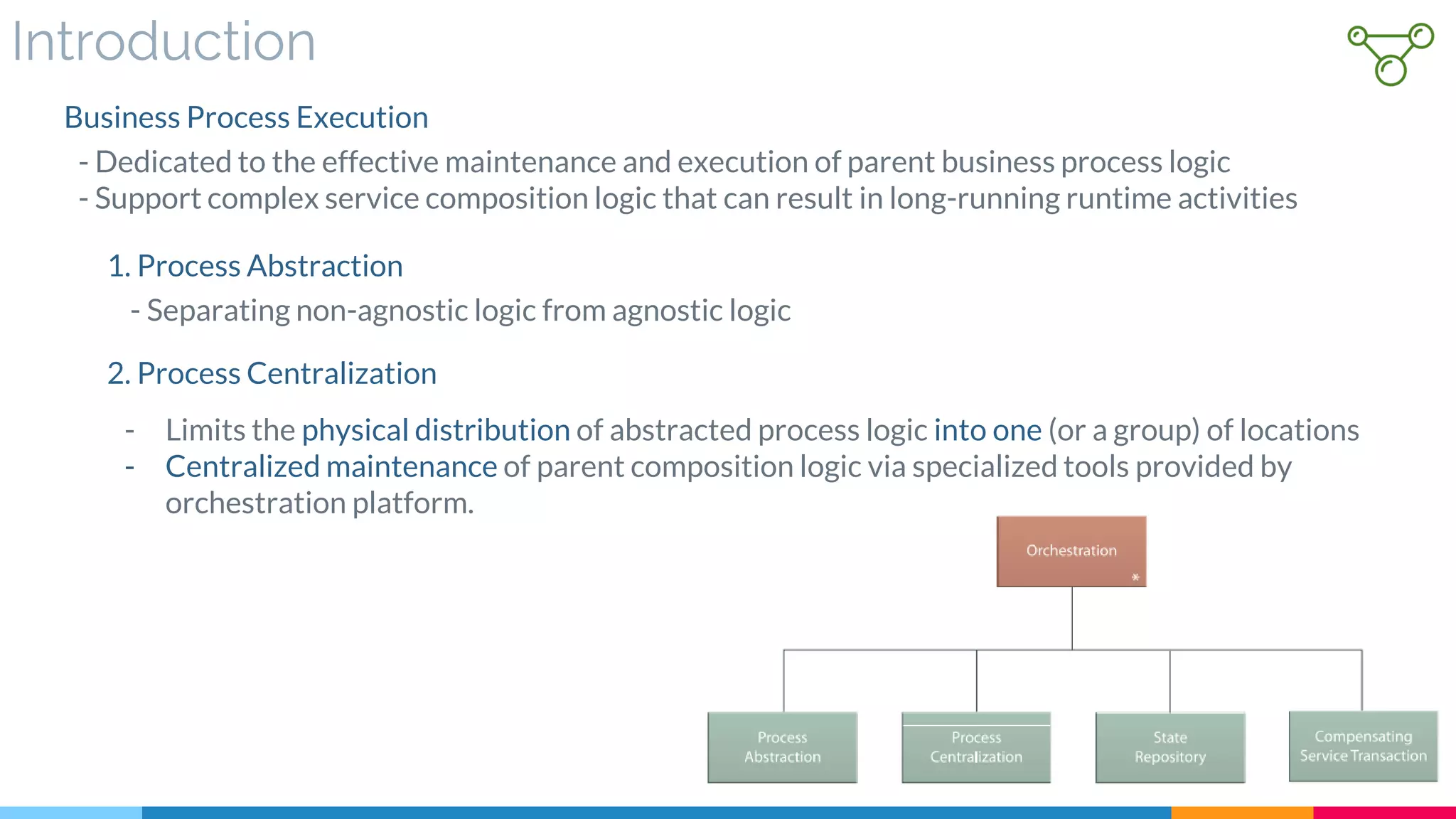
- Dedicated to the effective maintenance and execution of parent business process logic
- Support complex service composition logic that can result in long-running runtime activities
Business Process Execution
- Separating non-agnostic logic from agnostic logic
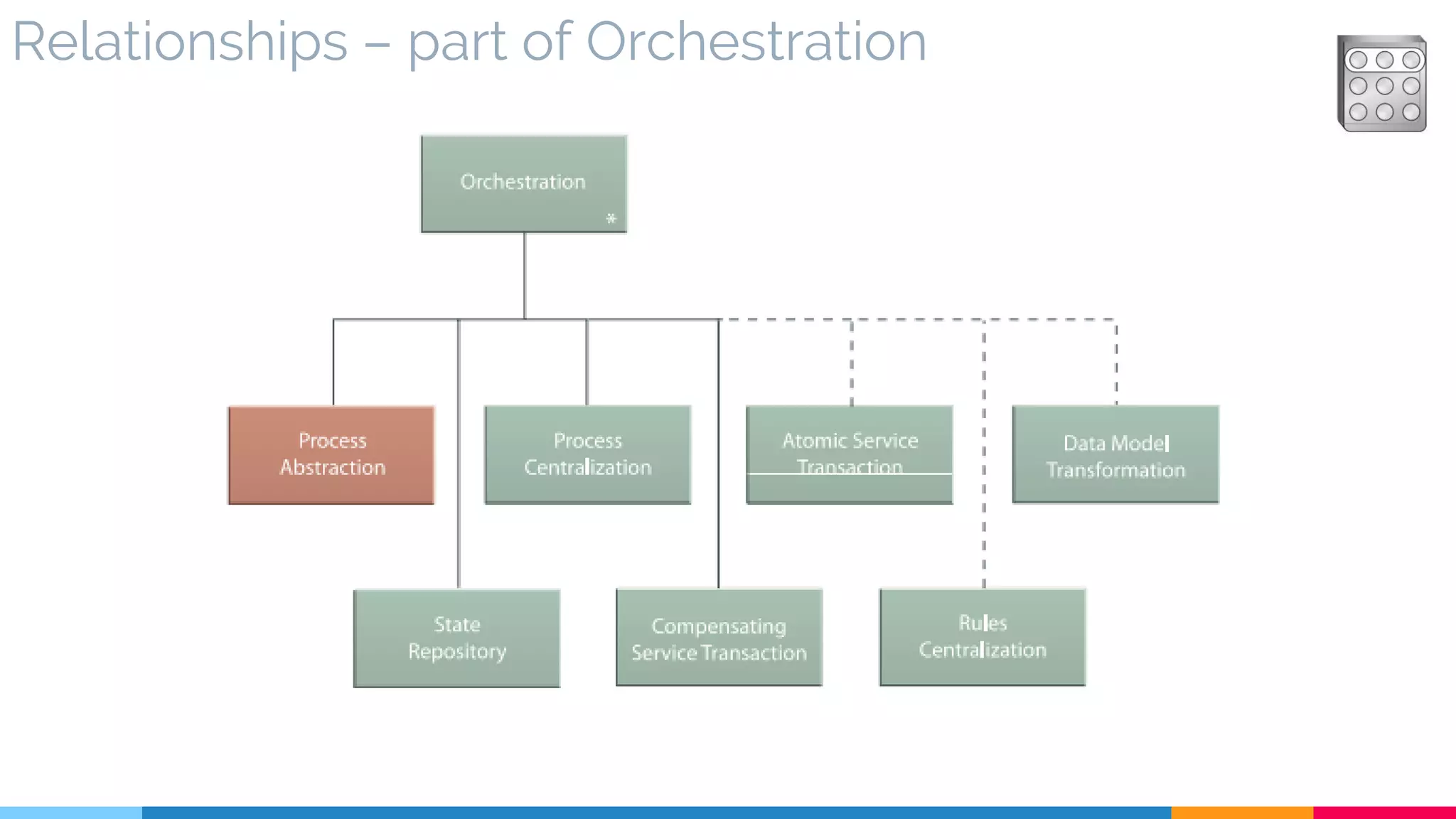
1. Process Abstraction
- Limits the physical distribution of abstracted process logic into one (or a group) of locations
- Centralized maintenance of parent composition logic via specialized tools provided by
orchestration platform.
2. Process Centralization
Introduction
- Enables orchestration to support long-running service activities
- Provide state management repository that can be leveraged as a state deferral mechanism.
3. State Repository
- Supports long-running processes by allowing parent composition logic to be supplemented
with compensation sub processes that address exception conditions.
4. Compensating service Transaction
Orchestration Components
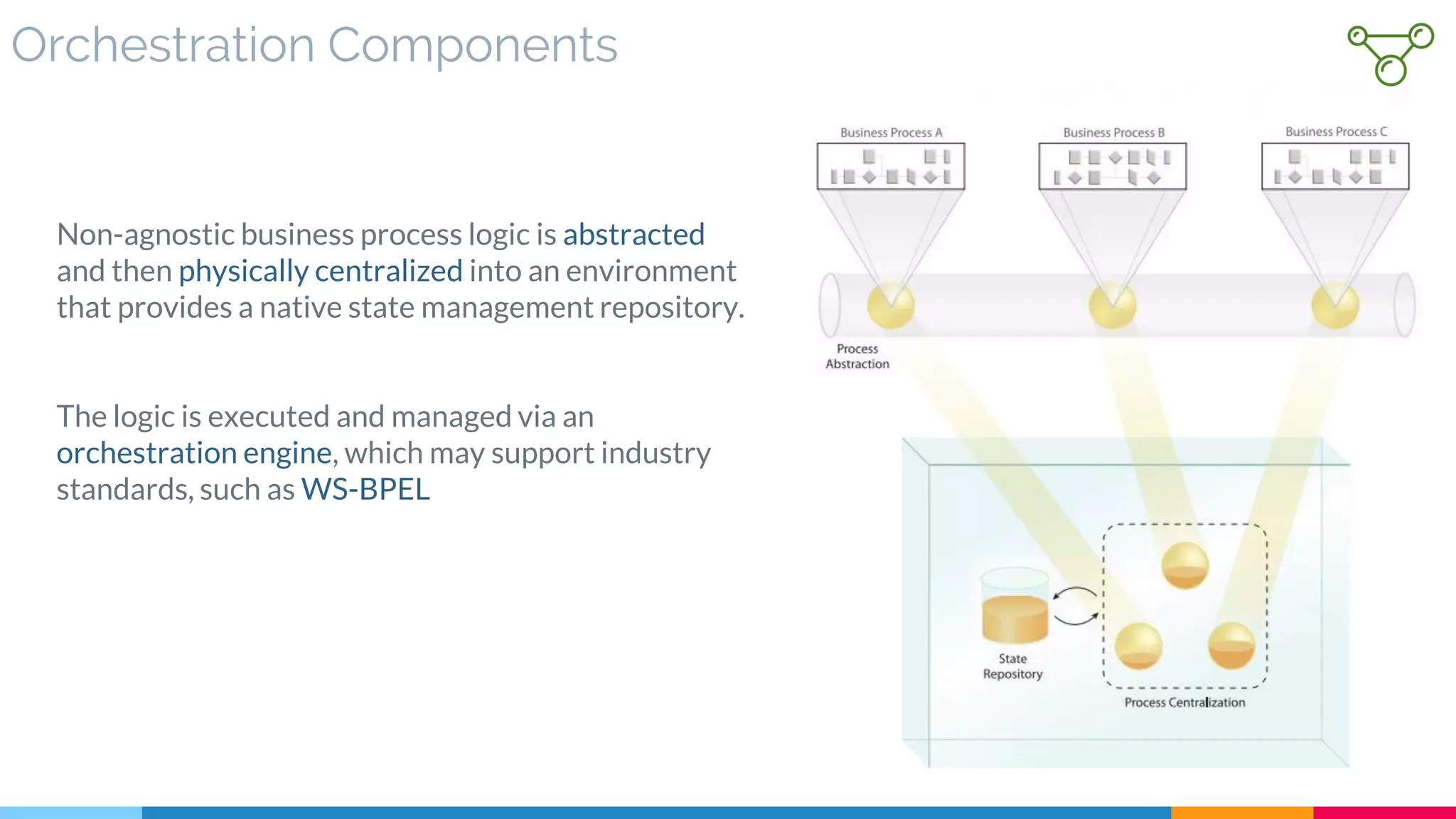
Non-agnostic business process logic is abstracted
and then physically centralized into an environment
that provides a native state management repository.
The logic is executed and managed via an
orchestration engine, which may support industry
standards, such as WS-BPEL
Extended Orchestration
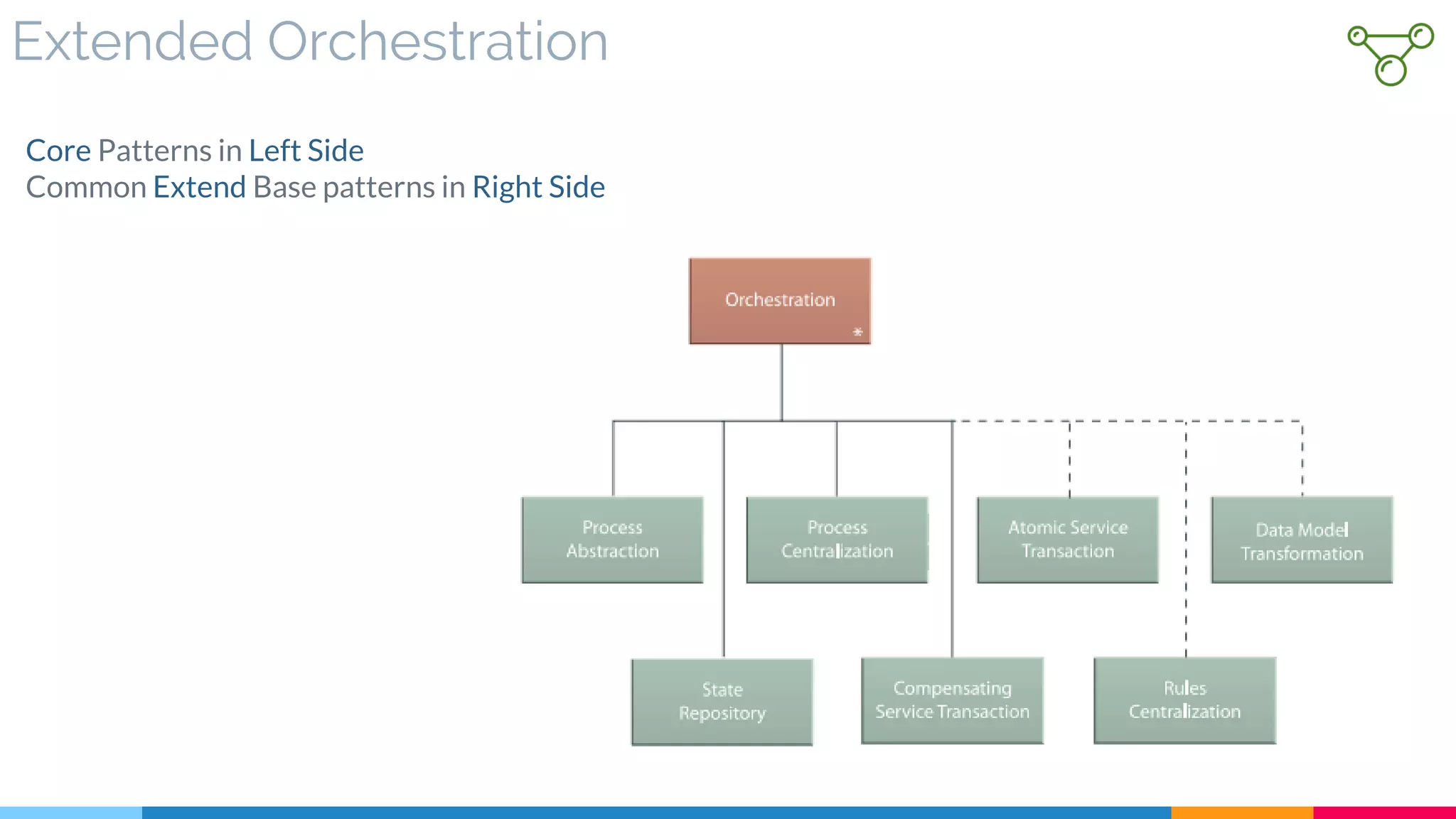
Core Patterns in Left Side
Common Extend Base patterns in Right Side
27 Process Abstraction
▷ Problem
▷ Solution
▷ Real World Sample
▷ Application
▷ Impact
▷ Relationships
[182]
Problem
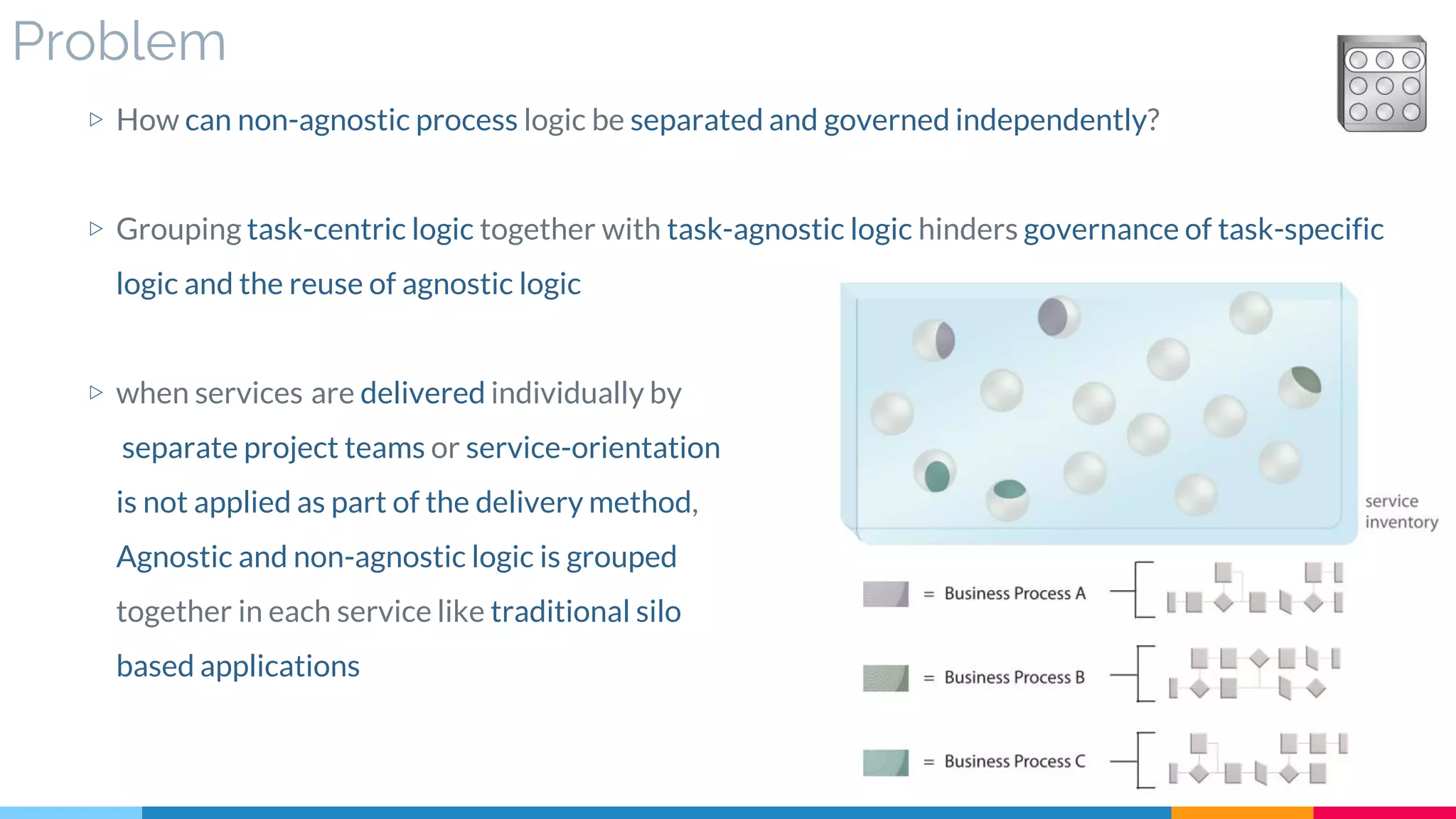
▷ How can non-agnostic process logic be separated and governed independently?
▷ Grouping task-centric logic together with task-agnostic logic hinders governance of task-specific
logic and the reuse of agnostic logic
▷ when services are delivered individually by
separate project teams or service-orientation
is not applied as part of the delivery method,
Agnostic and non-agnostic logic is grouped
together in each service like traditional silo
based applications
Problem
▷ This approach has several reflections :
1. It reduces opportunities for applying the Service Reusability design principle on a broad scale.
2. It imposes governance complexity when expertise associated with business entities and
business processes lie with different individuals
3. It makes it difficult to apply Non-Agnostic Context, thereby reducing the chances of
successfully abstracting single-purpose cross-entity logic into legal services.
Solution
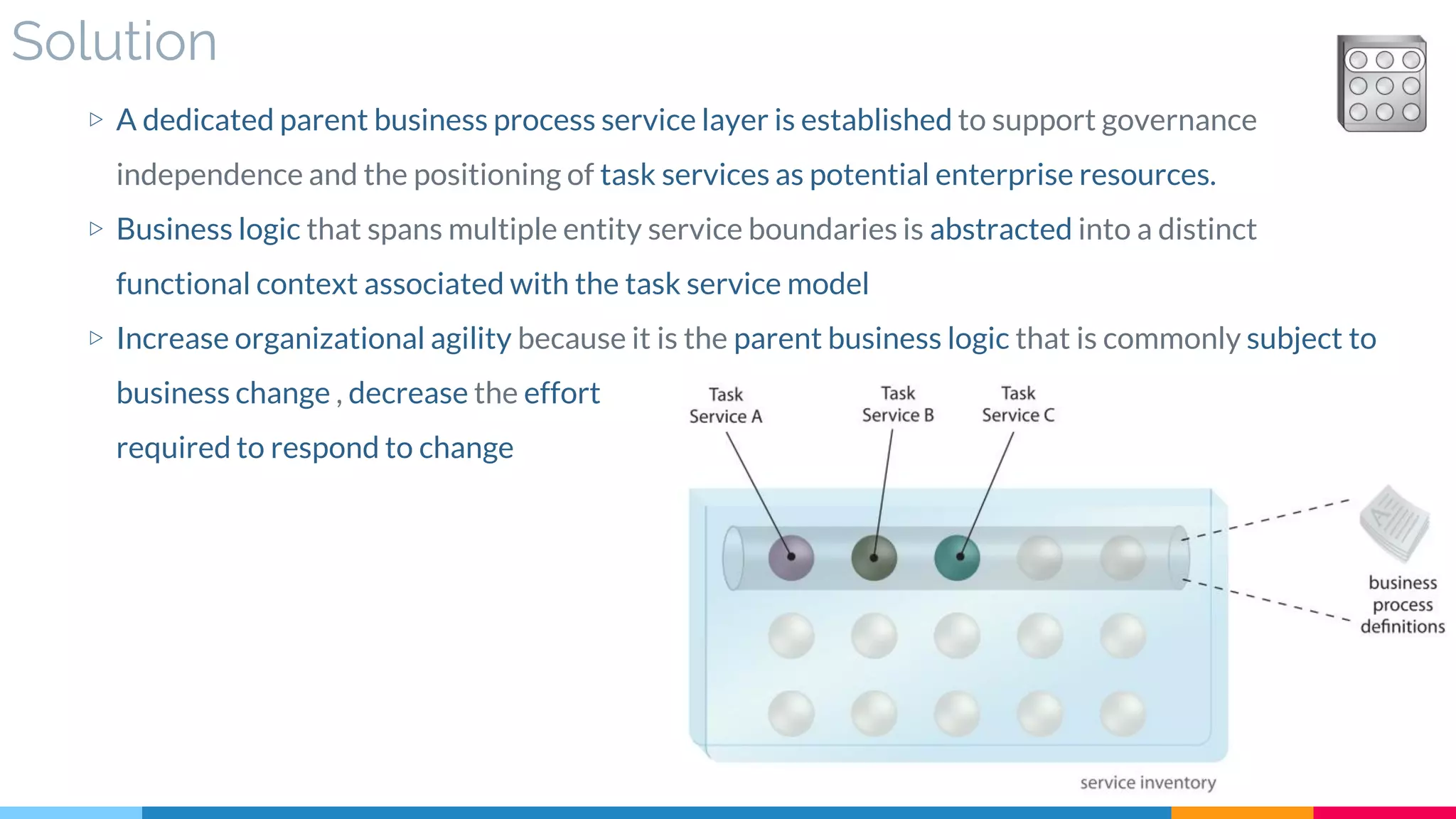
▷ A dedicated parent business process service layer is established to support governance
independence and the positioning of task services as potential enterprise resources.
▷ Business logic that spans multiple entity service boundaries is abstracted into a distinct
functional context associated with the task service model
▷ Increase organizational agility because it is the parent business logic that is commonly subject to
business change , decrease the effort
required to respond to change
Real World Sample
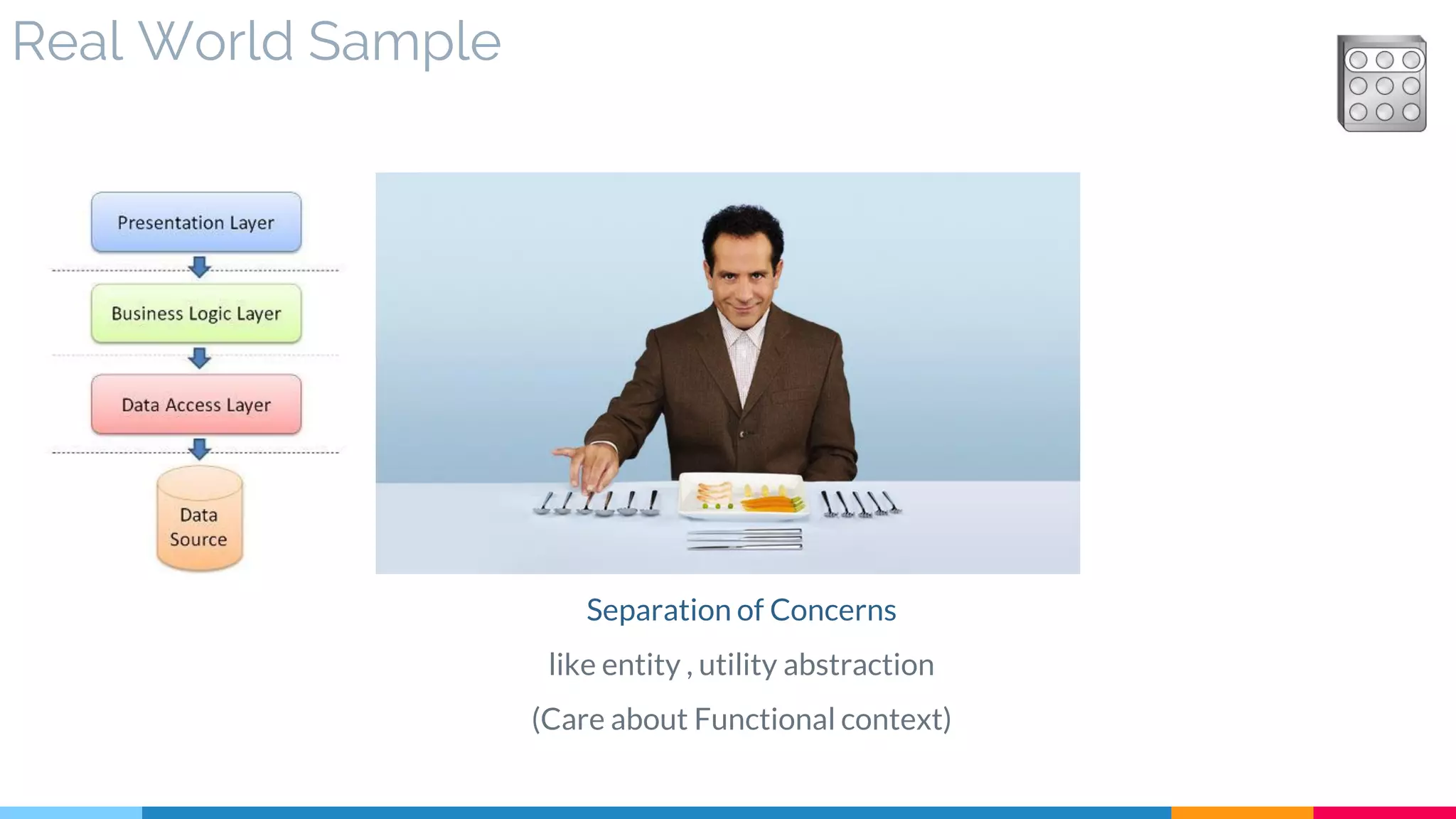
Separation of Concerns
like entity , utility abstraction
(Care about Functional context)
Application
▷ Business process logic is typically filtered out after utility and entity services have been
defined, allowing for the definition of task services that comprise this layer.
▷ The formation of a task service layer is the result of repeatedly applying Service Encapsulation
and Non-Agnostic Context to this logic so as to shape it into well-defined services
▷ It is common to associate a task service with a single business process , this limitation is not
required. As with any service, a task service can be comprised of multiple capabilities, each of
which represents a separate process or task. The only rule is that these processes be related to a
common overarching functional context
▷ The desire to limit a task service to a single process is related to scalability and autonomy concerns
Impact
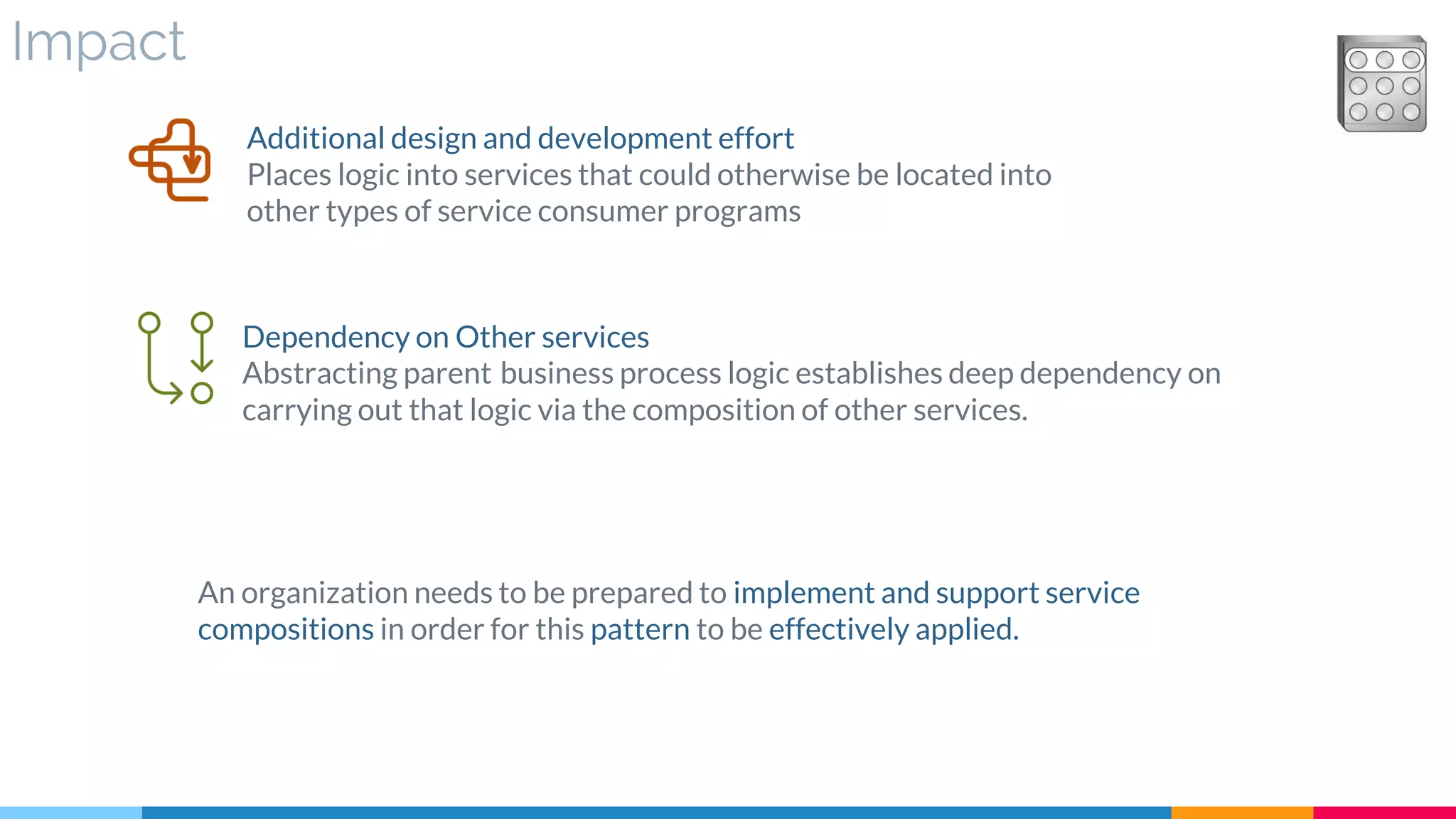
Additional design and development effort
Places logic into services that could otherwise be located into
other types of service consumer programs
An organization needs to be prepared to implement and support service
compositions in order for this pattern to be effectively applied.
Dependency on Other services
Abstracting parent business process logic establishes deep dependency on
carrying out that logic via the composition of other services.
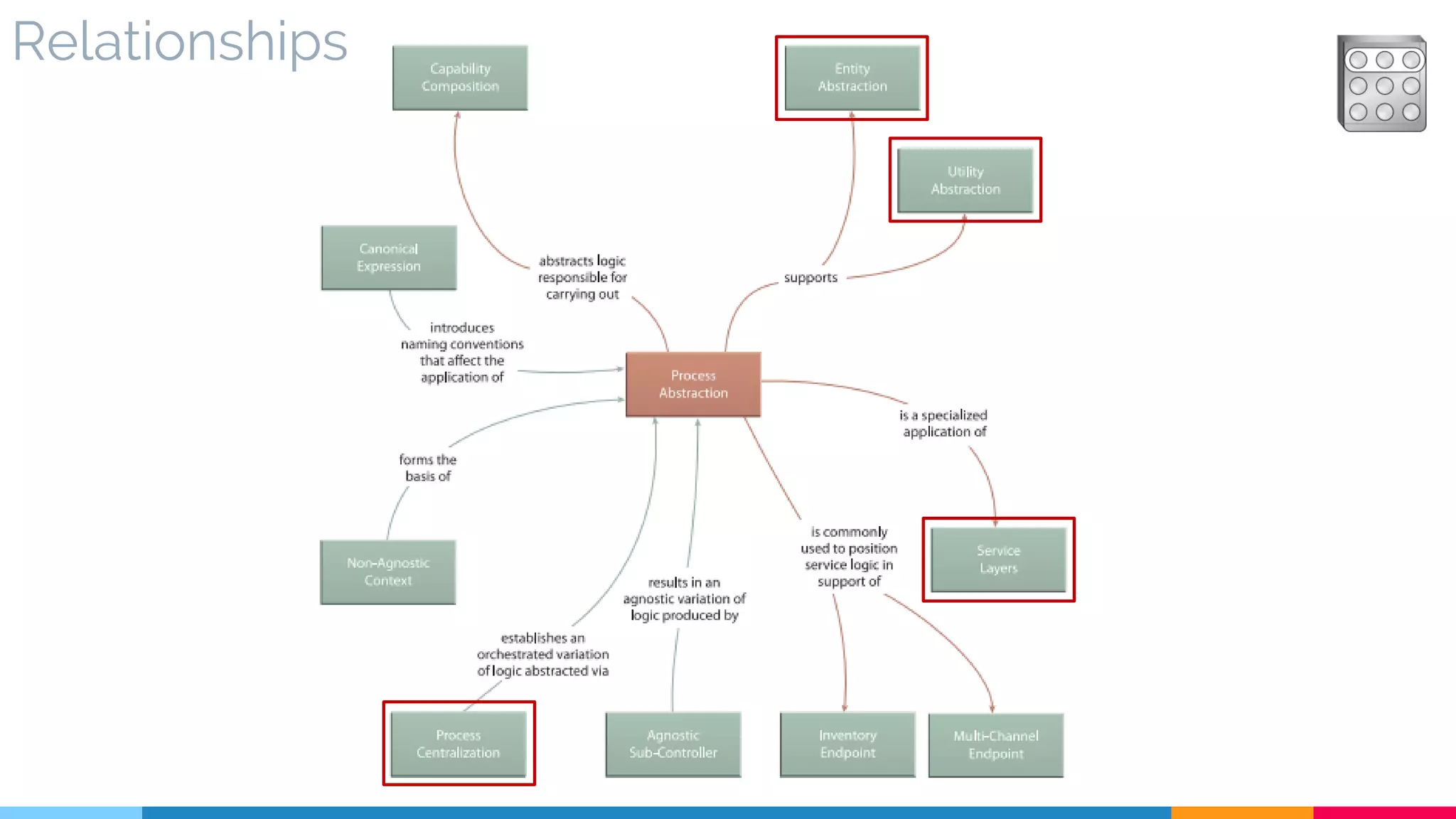
Relationships
Relationships – part of Orchestration
28 Process Centralization
▷ Problem
▷ Solution
▷ Real World Sample
▷ Application
▷ Impact
▷ Relationships
[193]
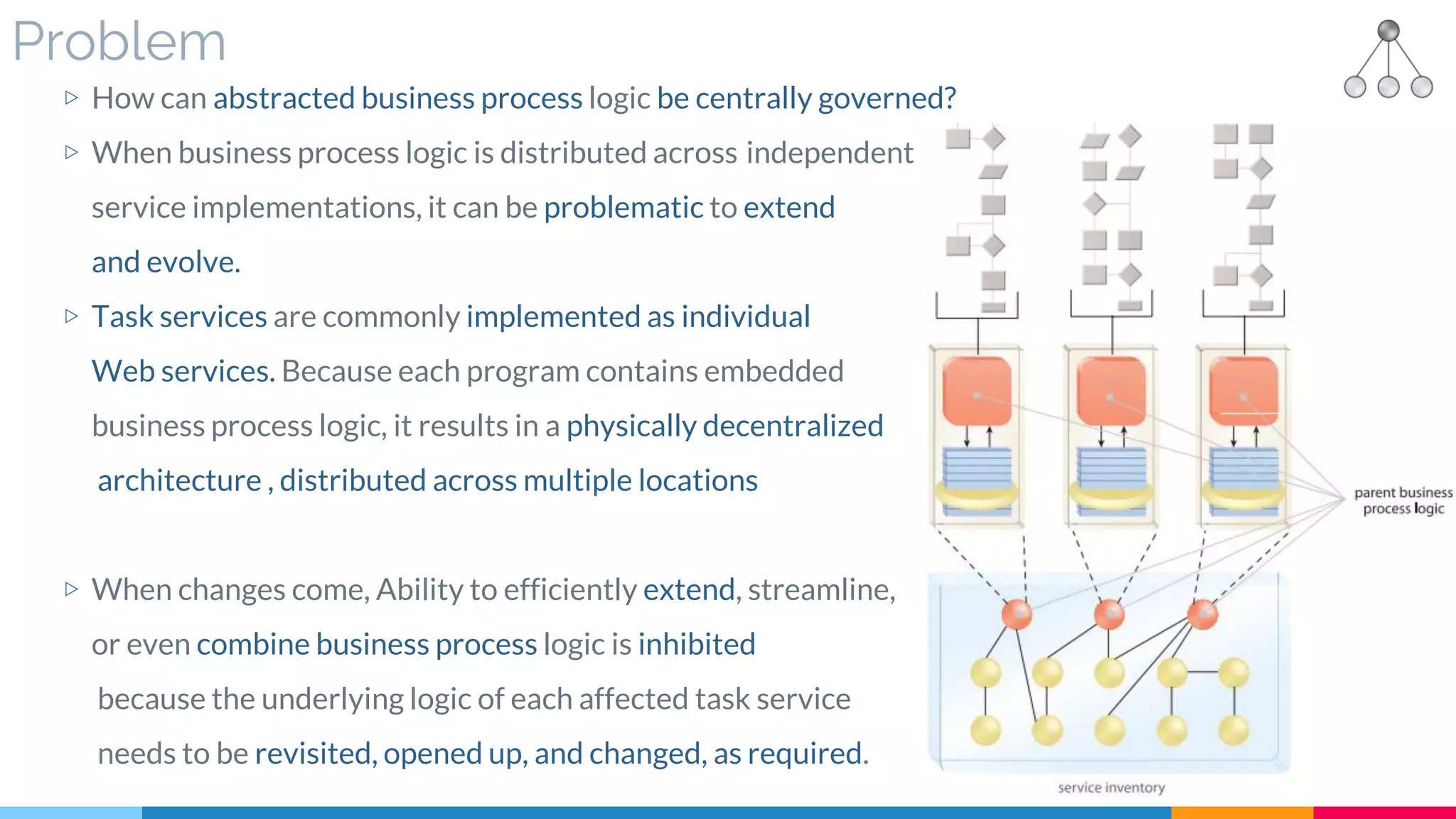
Problem
▷ How can abstracted business process logic be centrally governed?
▷ When business process logic is distributed across independent
service implementations, it can be problematic to extend
and evolve.
▷ Task services are commonly implemented as individual
Web services. Because each program contains embedded
business process logic, it results in a physically decentralized
architecture , distributed across multiple locations
▷ When changes come, Ability to efficiently extend, streamline,
or even combine business process logic is inhibited
because the underlying logic of each affected task service
needs to be revisited, opened up, and changed, as required.
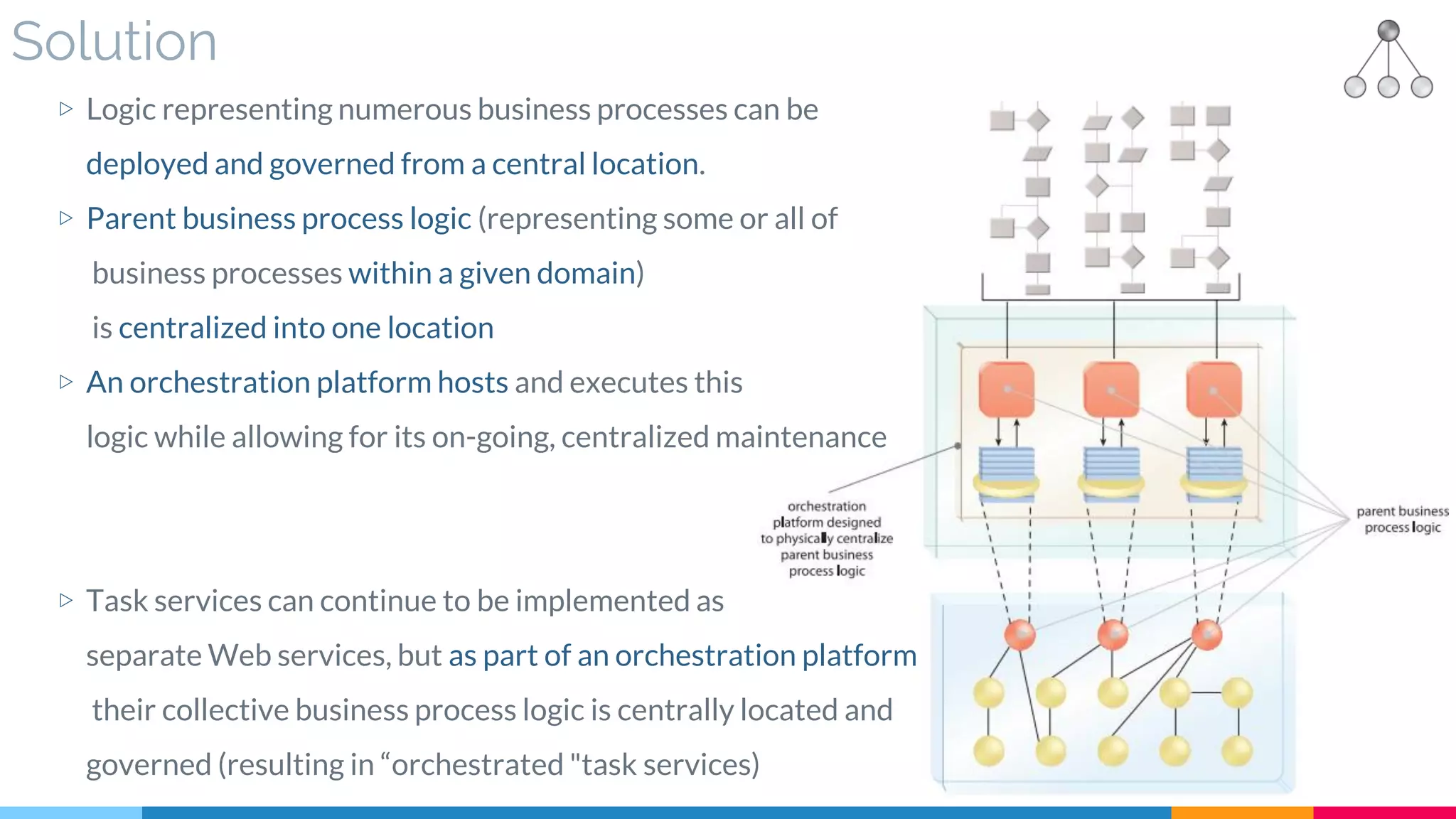
Solution
▷ Logic representing numerous business processes can be
deployed and governed from a central location.
▷ Parent business process logic (representing some or all of
business processes within a given domain)
is centralized into one location
▷ An orchestration platform hosts and executes this
logic while allowing for its on-going, centralized maintenance
▷ Task services can continue to be implemented as
separate Web services, but as part of an orchestration platform
their collective business process logic is centrally located and
governed (resulting in “orchestrated "task services)
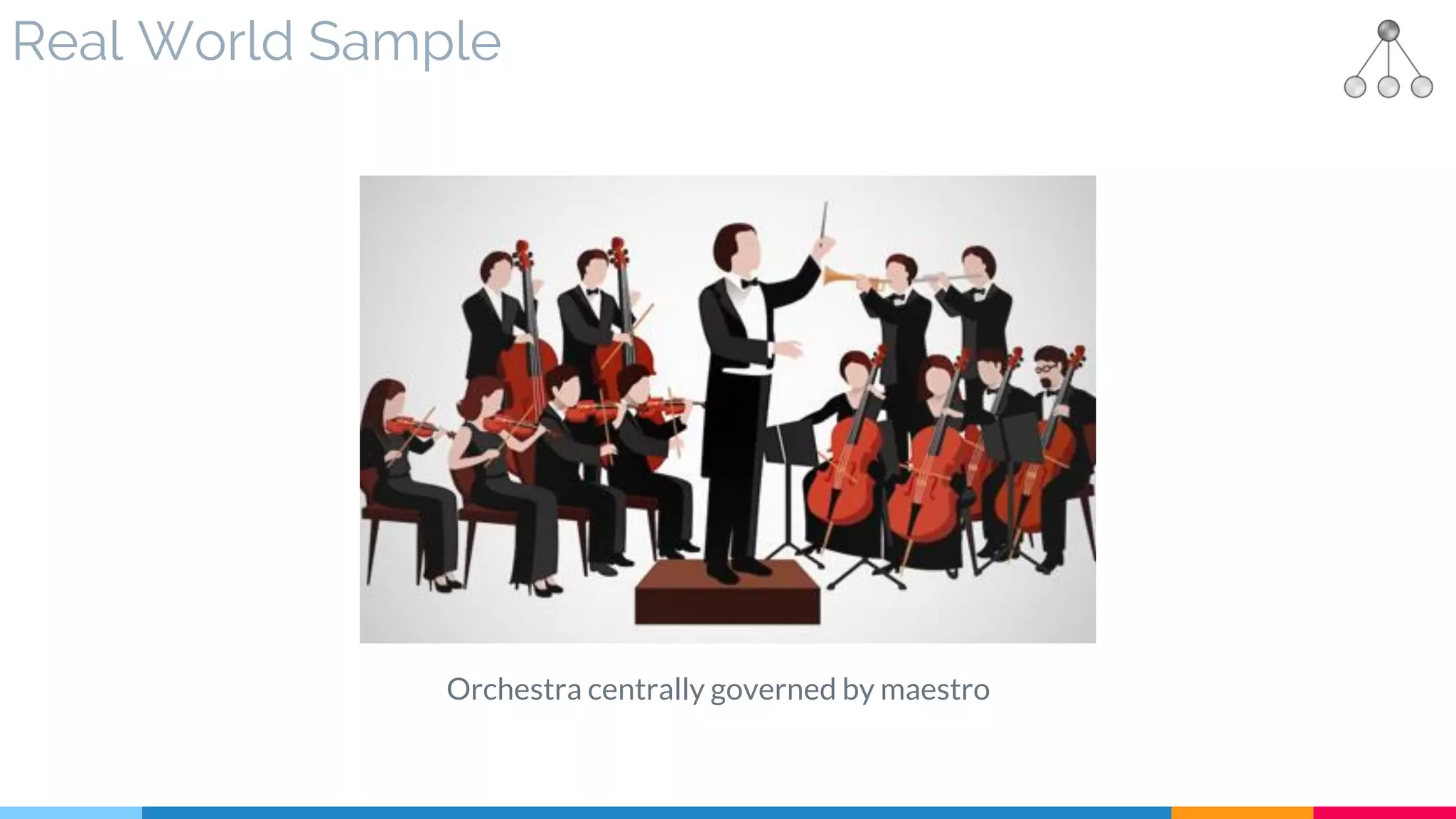
Real World Sample
Orchestra centrally governed by maestro
Application
▷ Middleware platforms provide necessary orchestration technologies to apply this pattern.
▷ Combined with support for open business process definition languages (such as WS-BPEL),
these platforms become suitable for establishing a primary parent composition layer within SOA.
▷ modern orchestration platform is required comprised of the following :
1. A graphical front-end tool allowing users to express and maintain business process logic
2. A back-end middleware runtime environment capable of hosting orchestrated task
services and the corresponding collection of business process definitions created with
the front-end tool
3. Features that comply with industry standards related to business process logic
expression and execution, such as WS-BPEL
Impact
Expensive orchestration technology
Introduce orchestration technology can be expensive and disruptive.
Increase infrastructure requirements
Host and run necessary middleware can increase the size and overall operational
costs of the IT environment as a whole
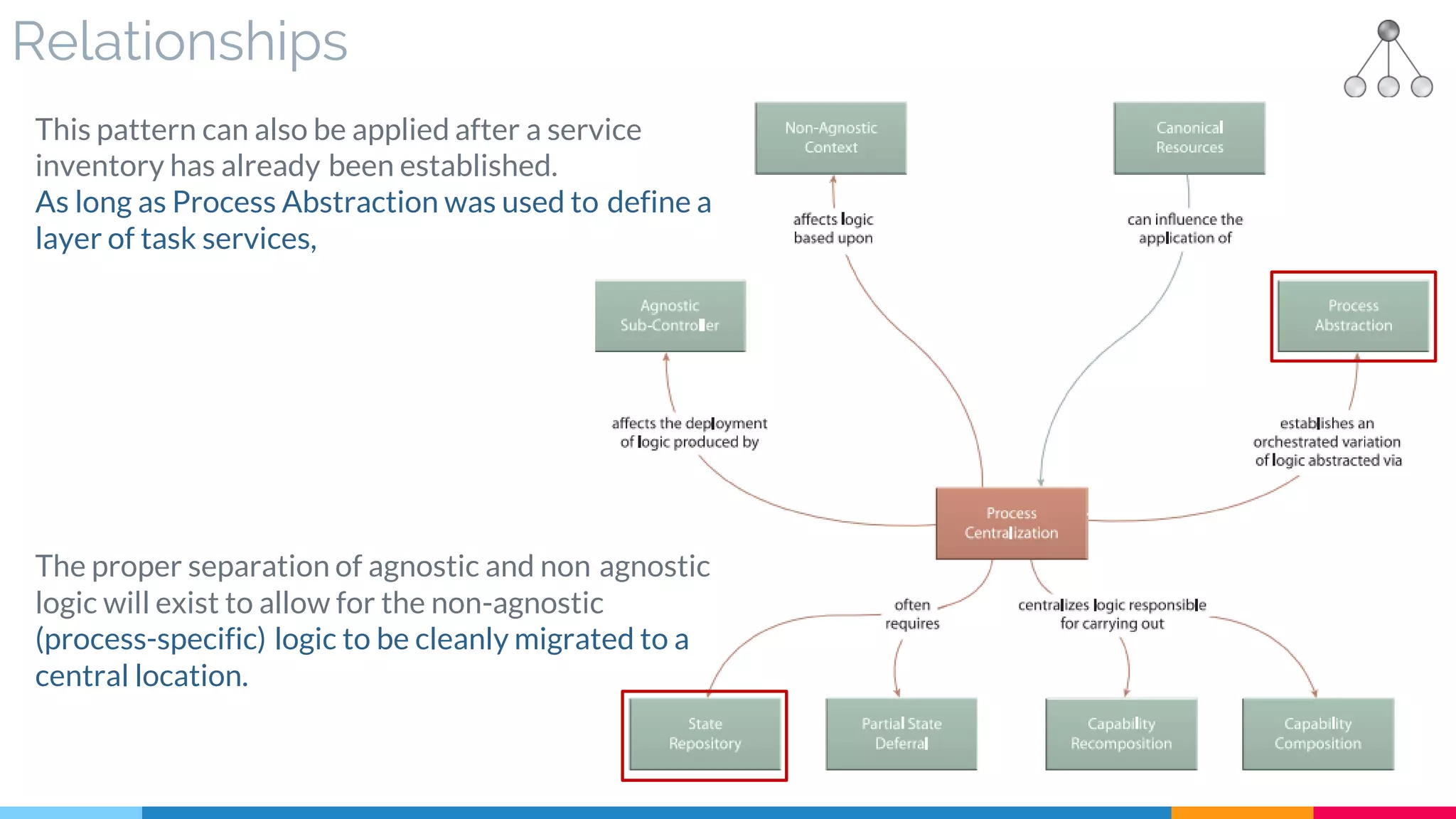
Relationships
This pattern can also be applied after a service
inventory has already been established.
As long as Process Abstraction was used to define a
layer of task services,
The proper separation of agnostic and non agnostic
logic will exist to allow for the non-agnostic
(process-specific) logic to be cleanly migrated to a
central location.
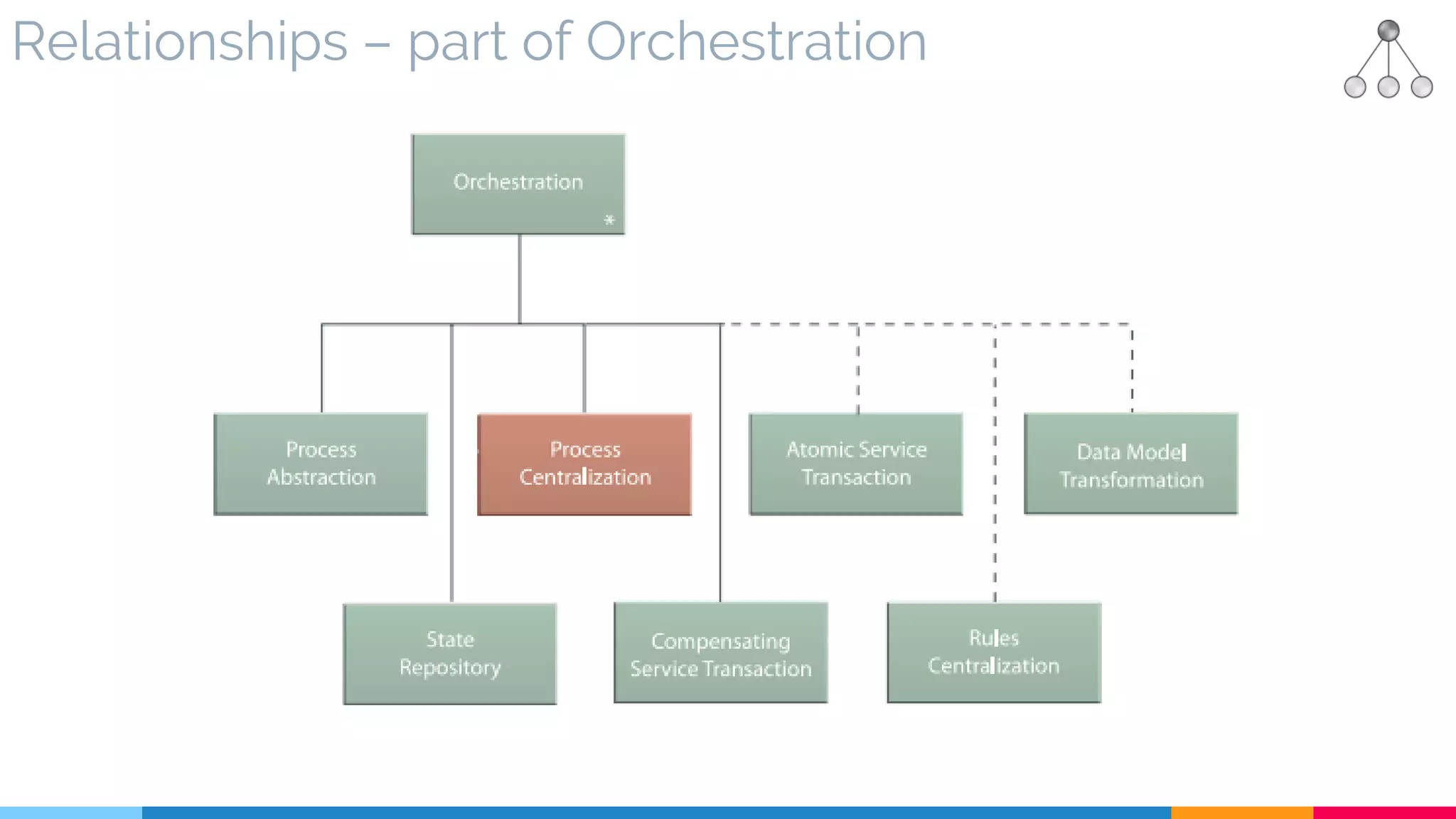
Relationships – part of Orchestration
29 State Repository
▷ Problem
▷ Solution
▷ Real World Sample
▷ Application
▷ Impact
▷ Relationships
[242]
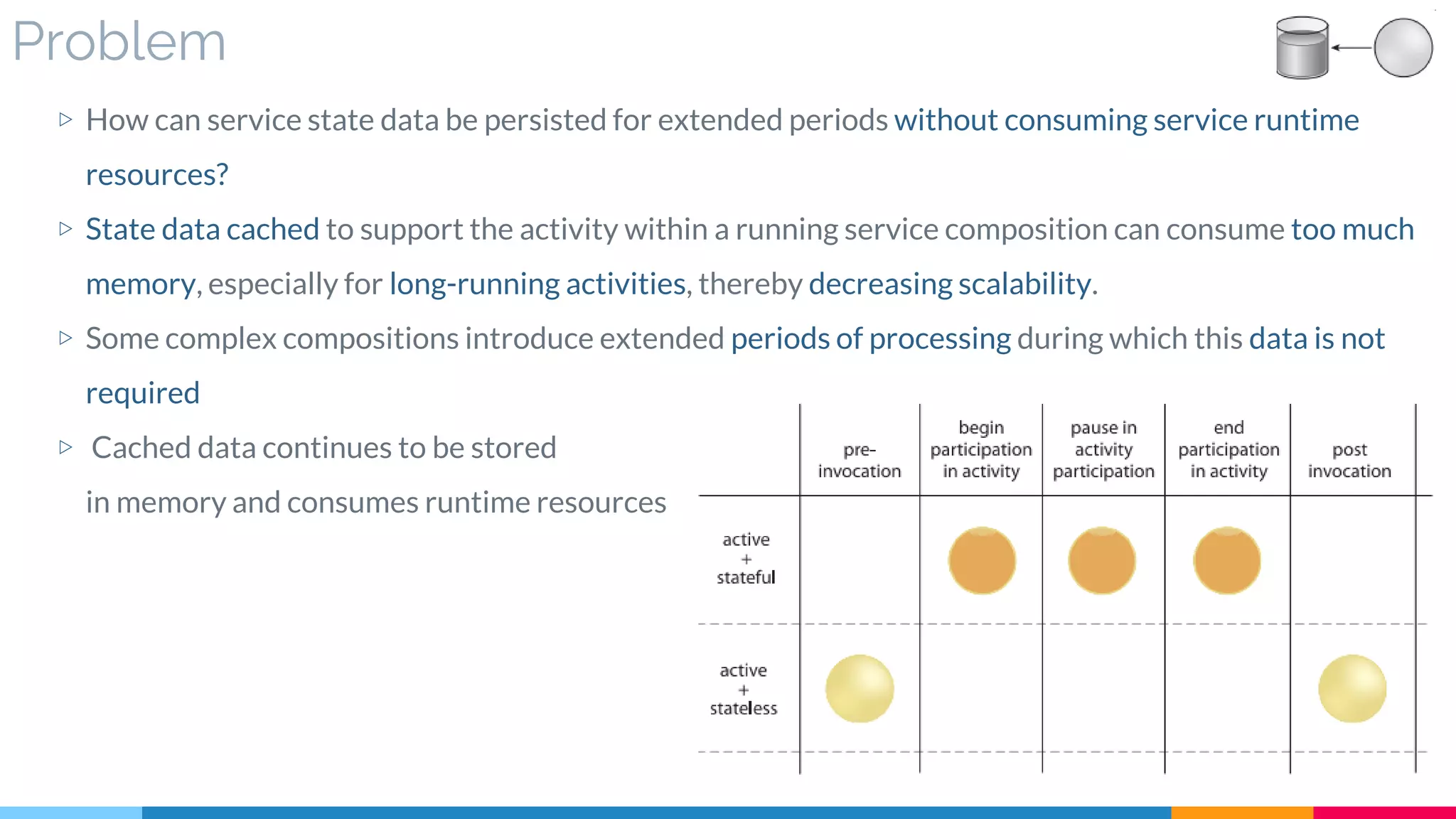
Problem
▷ How can service state data be persisted for extended periods without consuming service runtime
resources?
▷ State data cached to support the activity within a running service composition can consume too much
memory, especially for long-running activities, thereby decreasing scalability.
▷ Some complex compositions introduce extended periods of processing during which this data is not
required
▷ Cached data continues to be stored
in memory and consumes runtime resources
Solution
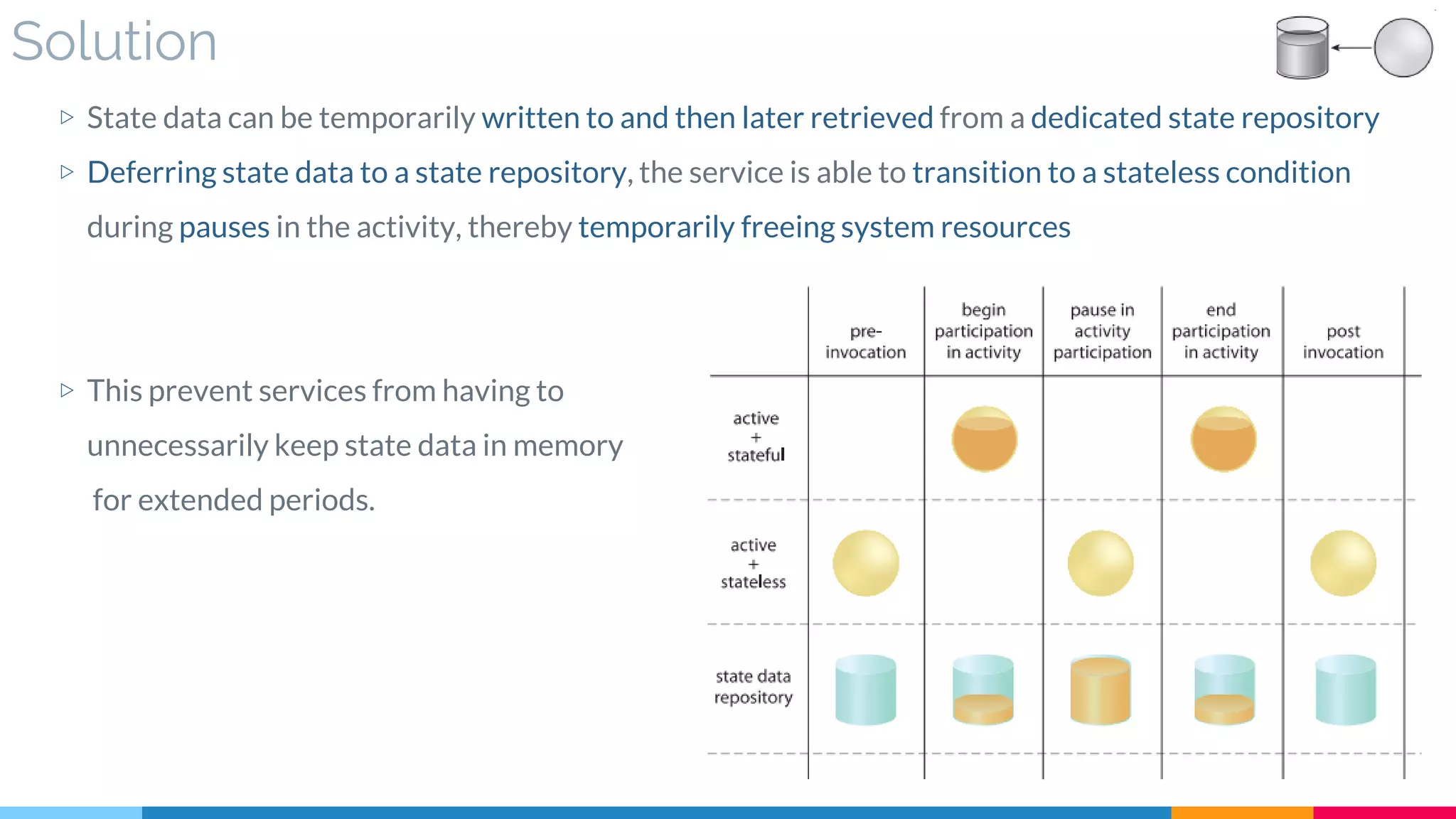
▷ State data can be temporarily written to and then later retrieved from a dedicated state repository
▷ Deferring state data to a state repository, the service is able to transition to a stateless condition
during pauses in the activity, thereby temporarily freeing system resources
▷ This prevent services from having to
unnecessarily keep state data in memory
for extended periods.
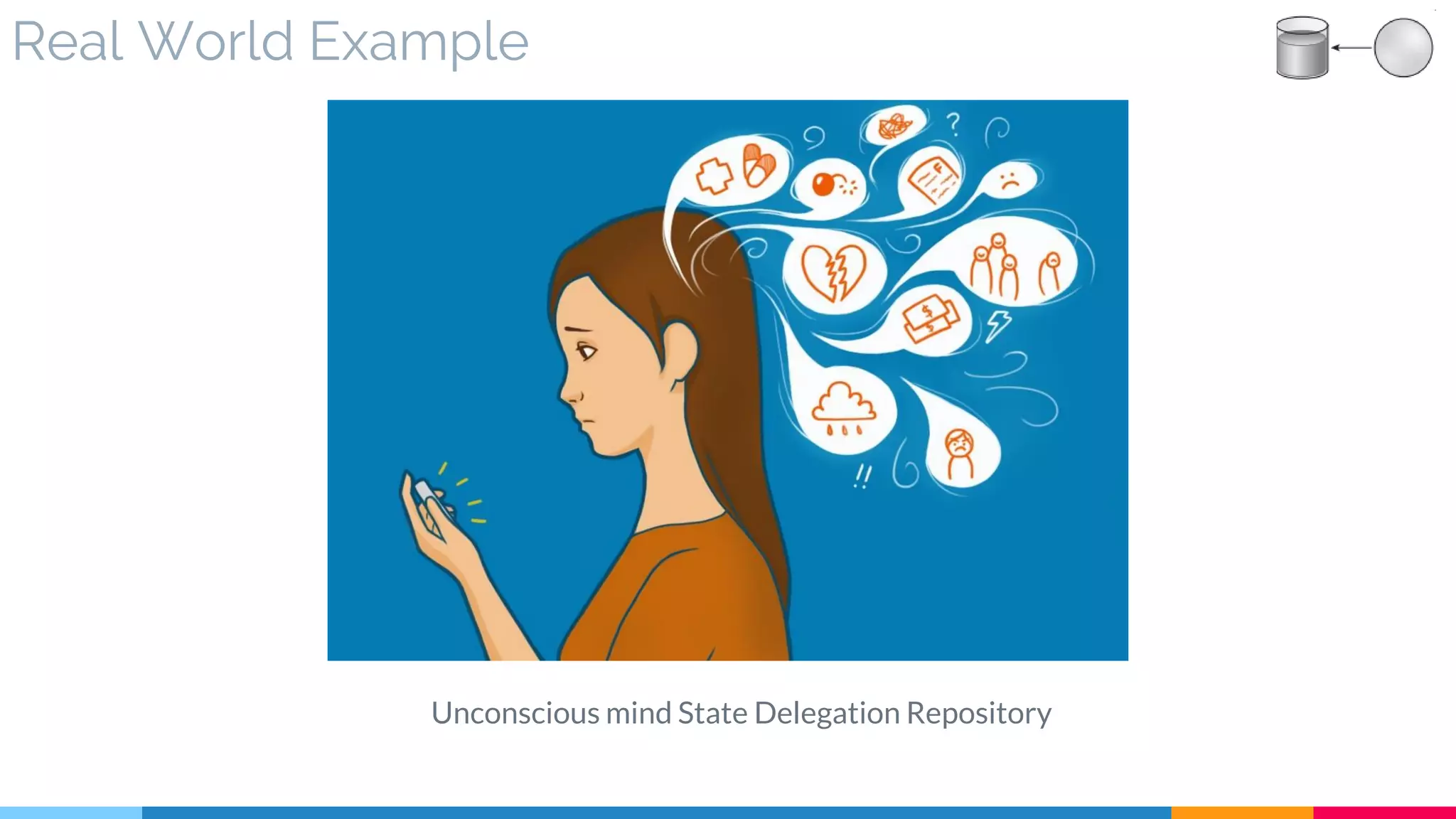
Real World Example
Unconscious mind State Delegation Repository
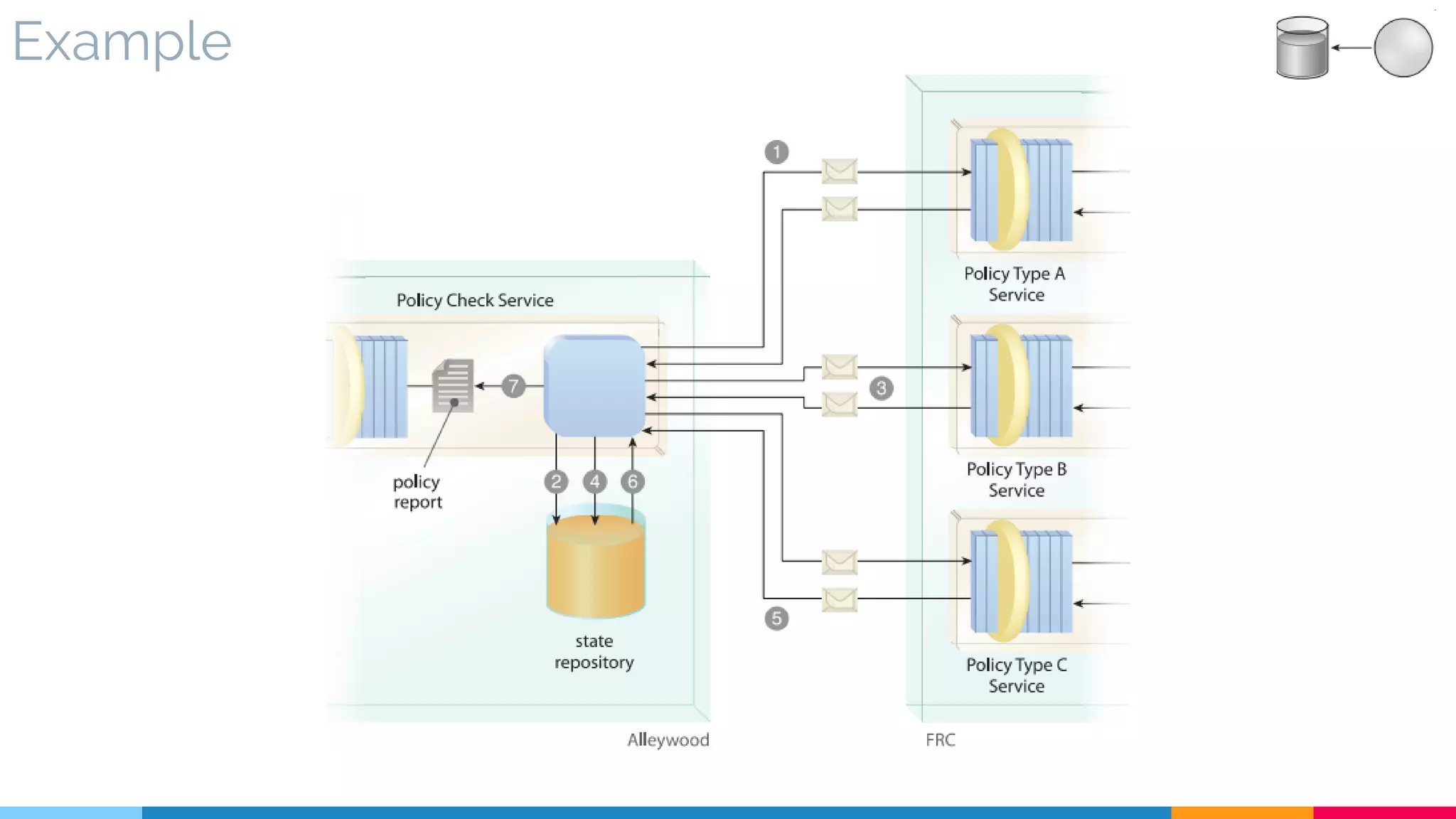
Example
Application
▷ A shared or dedicated repository is made available as part of the inventory or service architecture.
▷ Dedicated database is provided for state deferral purposes
▷ Database located on same physical server as services that utilizing it, so as to minimize runtime
performance overhead associated with writing and retrieval of the data
▷ Another approach is to create dedicated tables within an existing database. ( less effective)
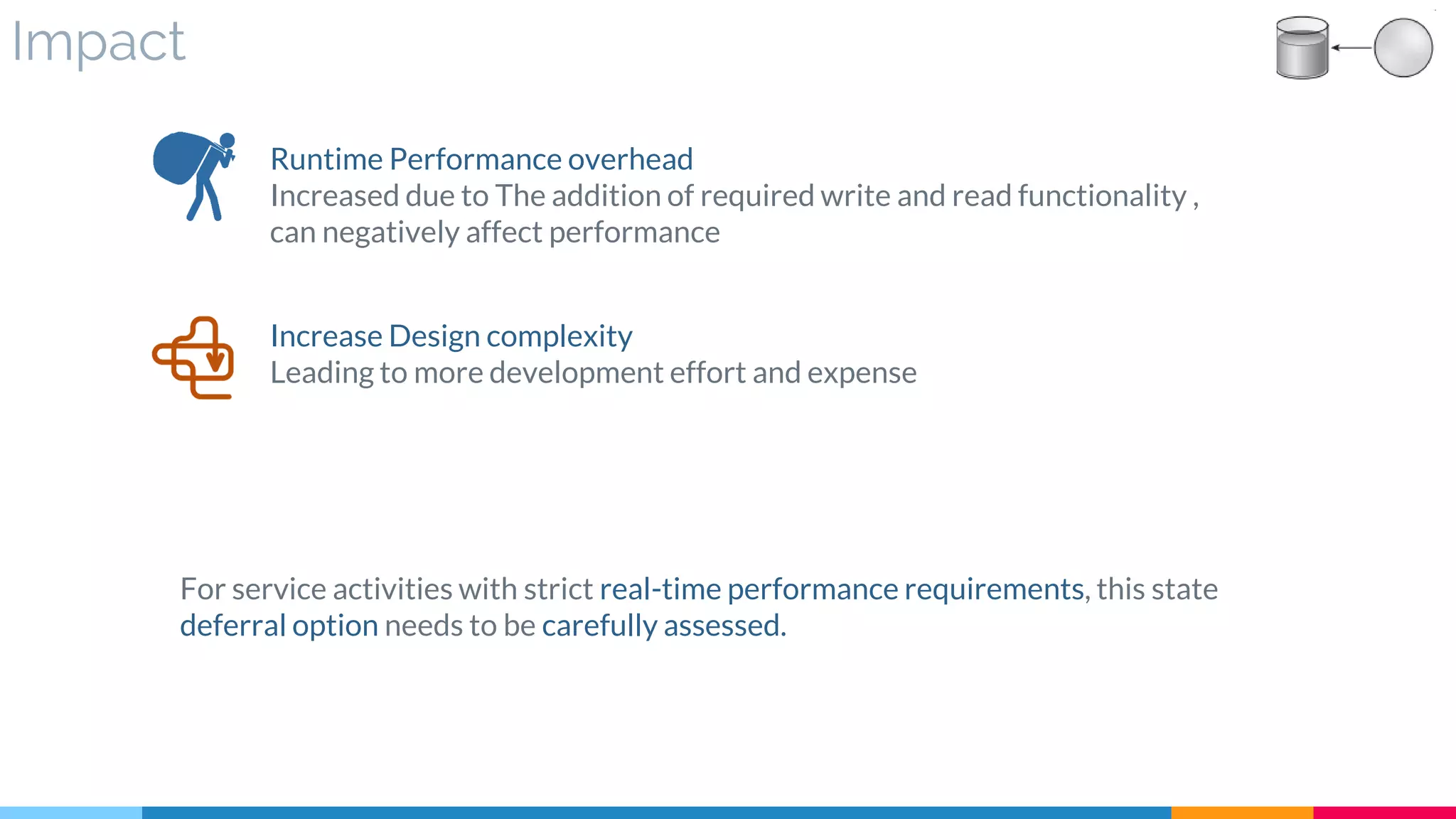
Impact
Runtime Performance overhead
Increased due to The addition of required write and read functionality ,
can negatively affect performance
Increase Design complexity
Leading to more development effort and expense
For service activities with strict real-time performance requirements, this state
deferral option needs to be carefully assessed.
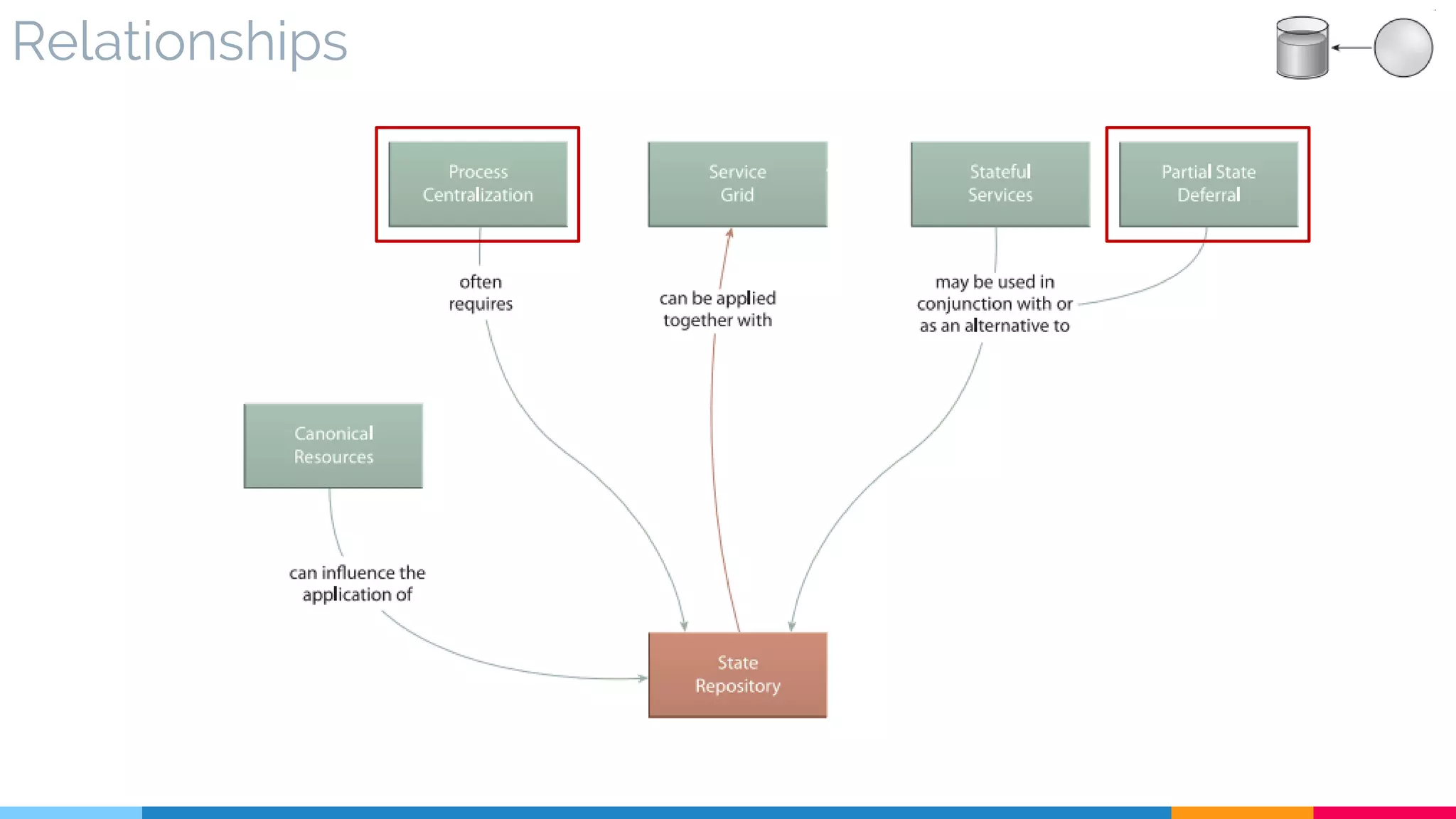
Relationships
Relationships – part of Orchestration
30 Atomic Service Transaction
▷ Problem
▷ Solution
▷ Real World Sample
▷ Application
▷ Impact
▷ Relationships
[623]
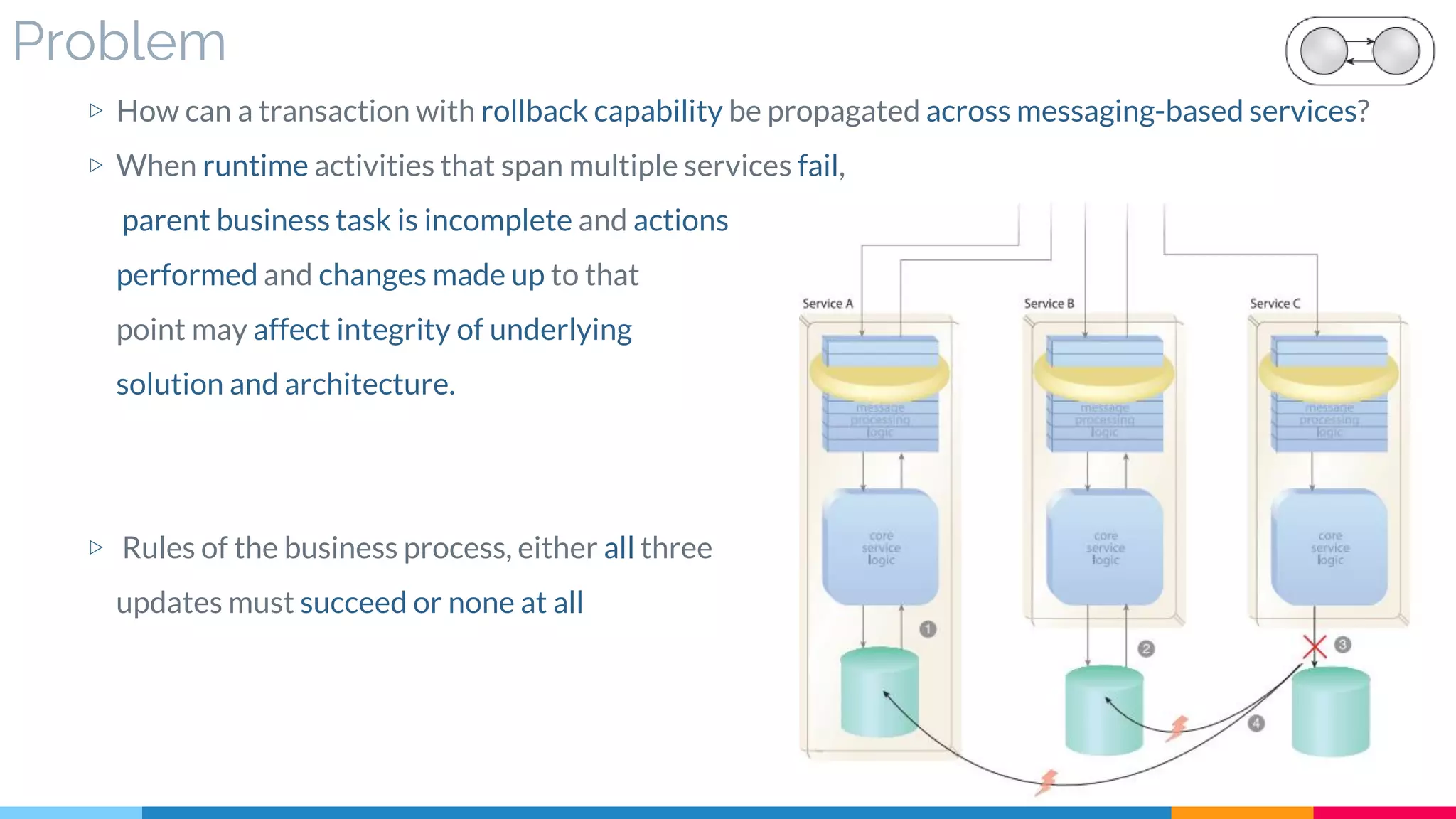
Problem
▷ How can a transaction with rollback capability be propagated across messaging-based services?
▷ When runtime activities that span multiple services fail,
parent business task is incomplete and actions
performed and changes made up to that
point may affect integrity of underlying
solution and architecture.
▷ Rules of the business process, either all three
updates must succeed or none at all
Solution
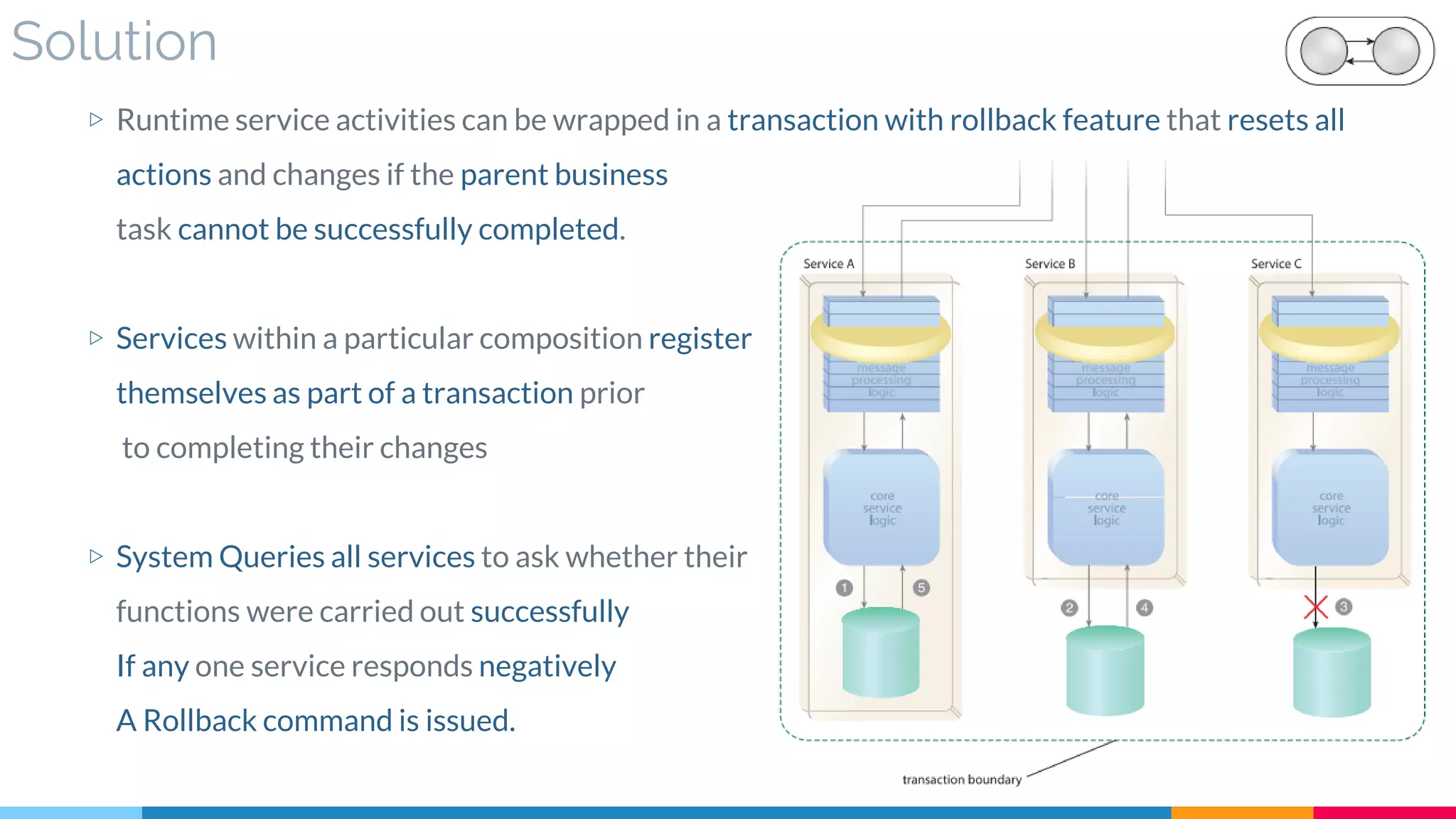
▷ Runtime service activities can be wrapped in a transaction with rollback feature that resets all
actions and changes if the parent business
task cannot be successfully completed.
▷ Services within a particular composition register
themselves as part of a transaction prior
to completing their changes
▷ System Queries all services to ask whether their
functions were carried out successfully
If any one service responds negatively
A Rollback command is issued.
Real World Sample
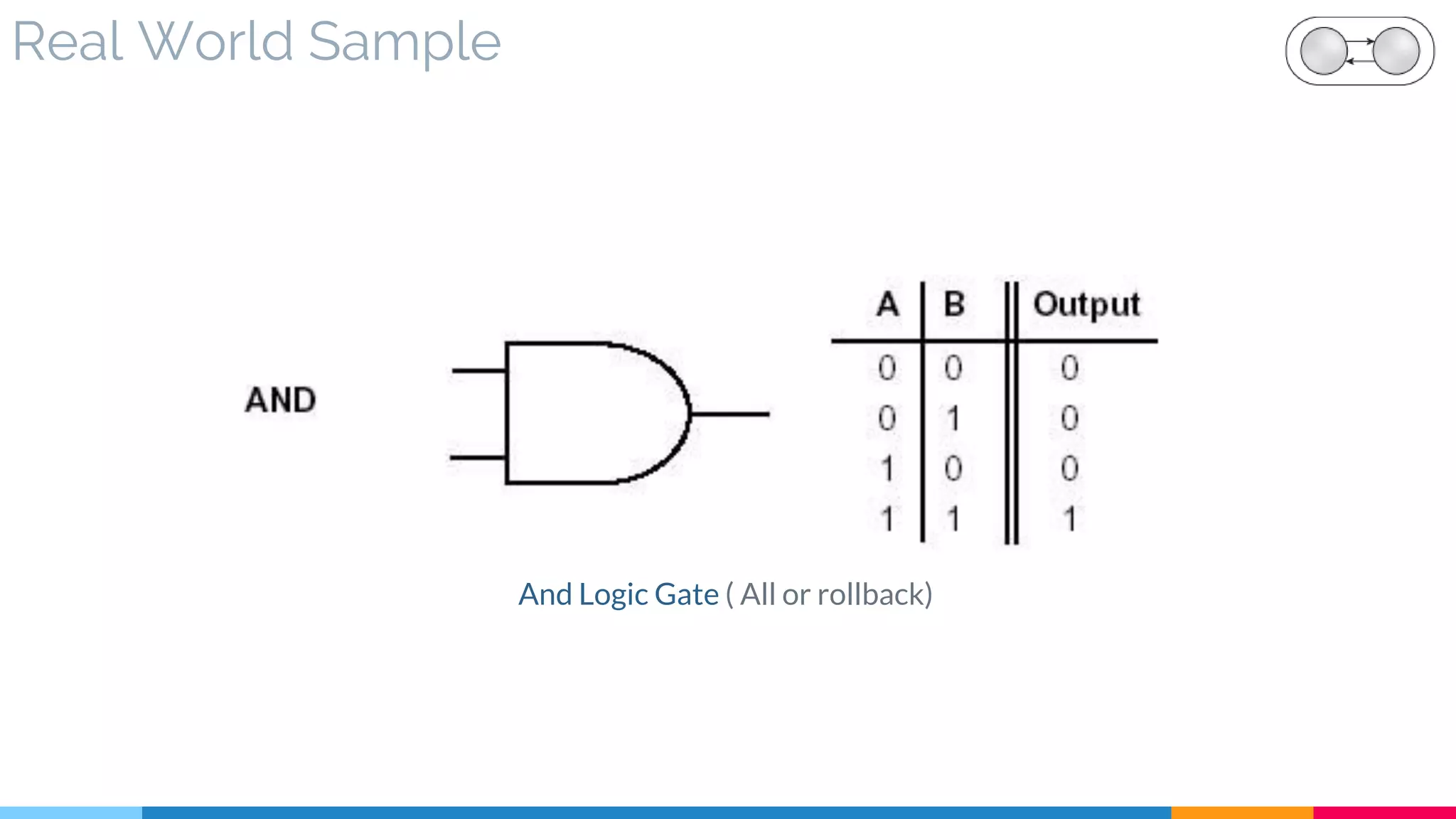
And Logic Gate ( All or rollback)
Application
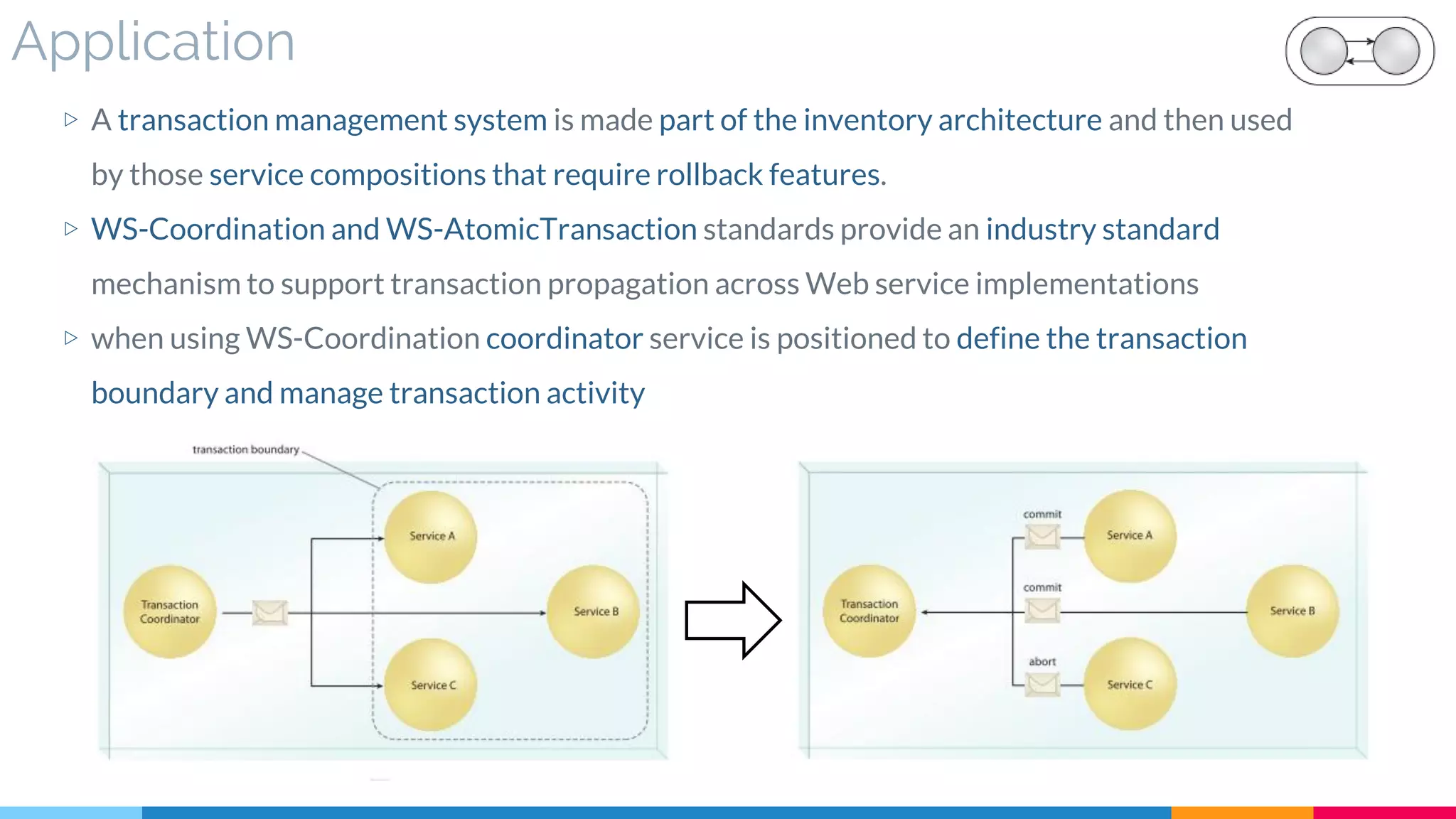
▷ A transaction management system is made part of the inventory architecture and then used
by those service compositions that require rollback features.
▷ WS-Coordination and WS-AtomicTransaction standards provide an industry standard
mechanism to support transaction propagation across Web service implementations
▷ when using WS-Coordination coordinator service is positioned to define the transaction
boundary and manage transaction activity
Impact
Memory Consumption
Because of the requirement for each service to preserve its original
state until it is notified to rollback or commit its changes.
(Add up and reduce overall service scalability)
(Capture a snapshot of a resource prior to making changes to it)
Relationships
Relationships – part of Orchestration
31 Compensating Service Transaction
▷ Problem
▷ Solution
▷ Real World Sample
▷ Application
▷ Impact
▷ Relationships
[631]
Problem
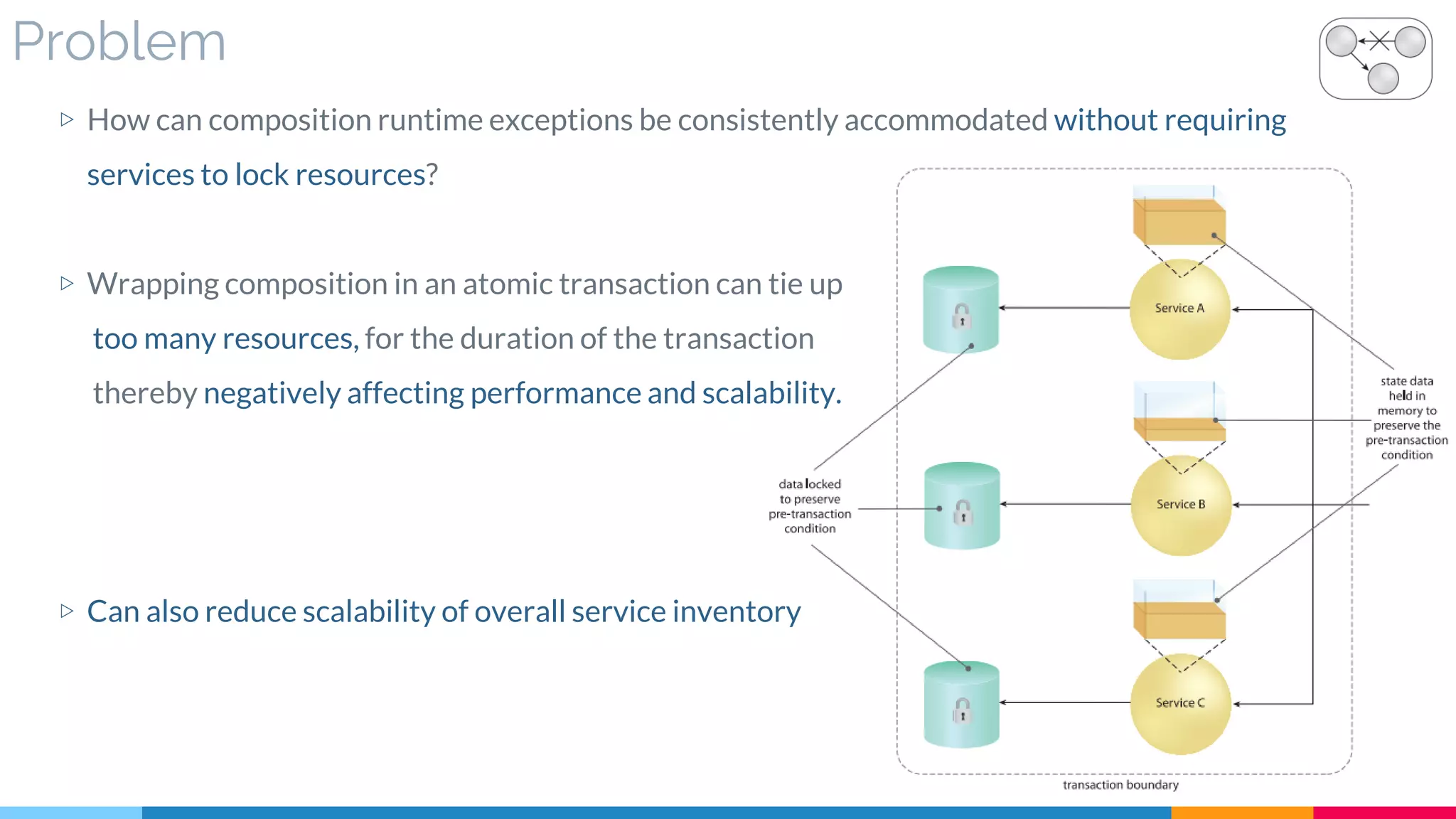
▷ How can composition runtime exceptions be consistently accommodated without requiring
services to lock resources?
▷ Wrapping composition in an atomic transaction can tie up
too many resources, for the duration of the transaction
thereby negatively affecting performance and scalability.
▷ Can also reduce scalability of overall service inventory
Solution
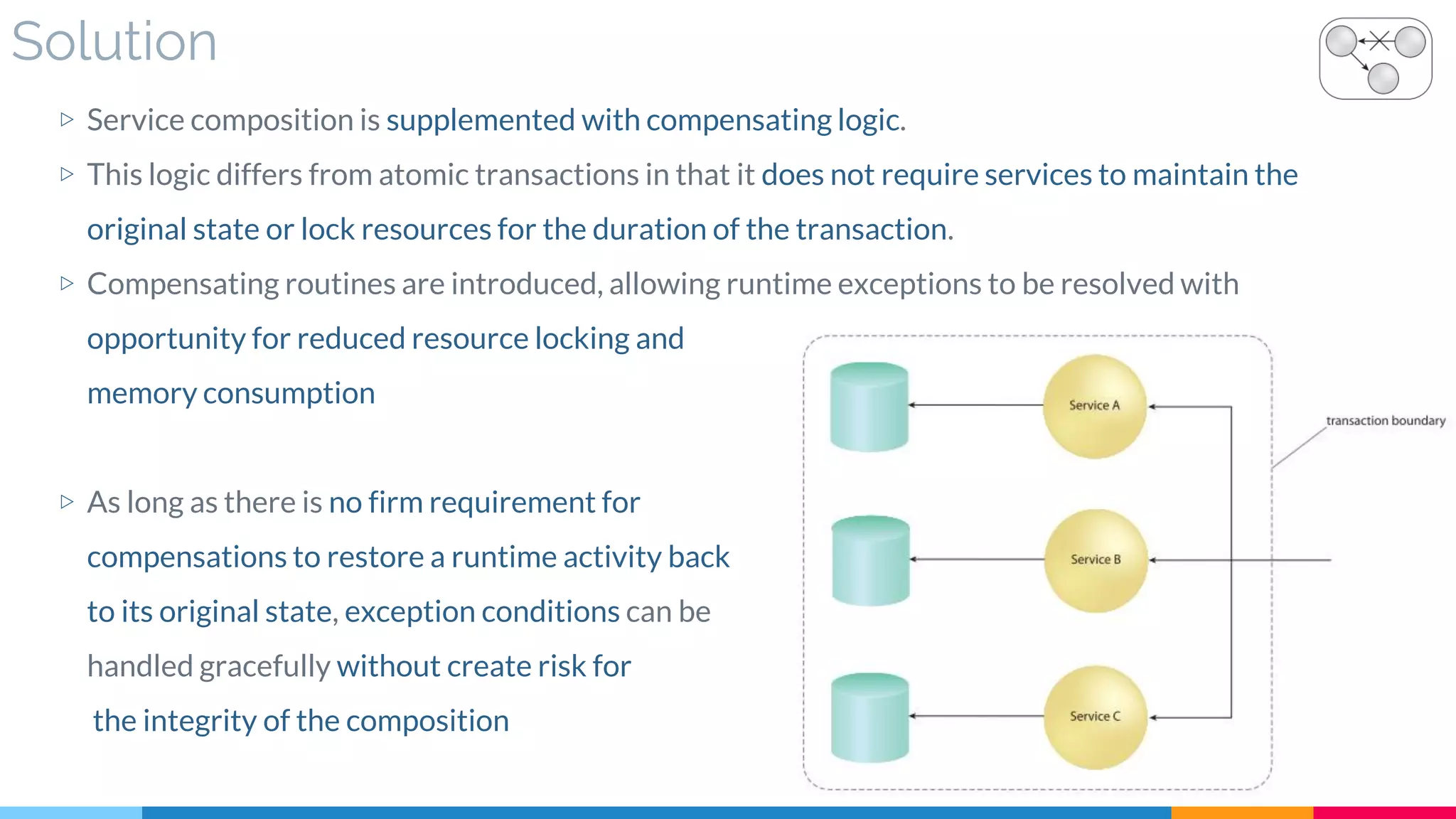
▷ Service composition is supplemented with compensating logic.
▷ This logic differs from atomic transactions in that it does not require services to maintain the
original state or lock resources for the duration of the transaction.
▷ Compensating routines are introduced, allowing runtime exceptions to be resolved with
opportunity for reduced resource locking and
memory consumption
▷ As long as there is no firm requirement for
compensations to restore a runtime activity back
to its original state, exception conditions can be
handled gracefully without create risk for
the integrity of the composition
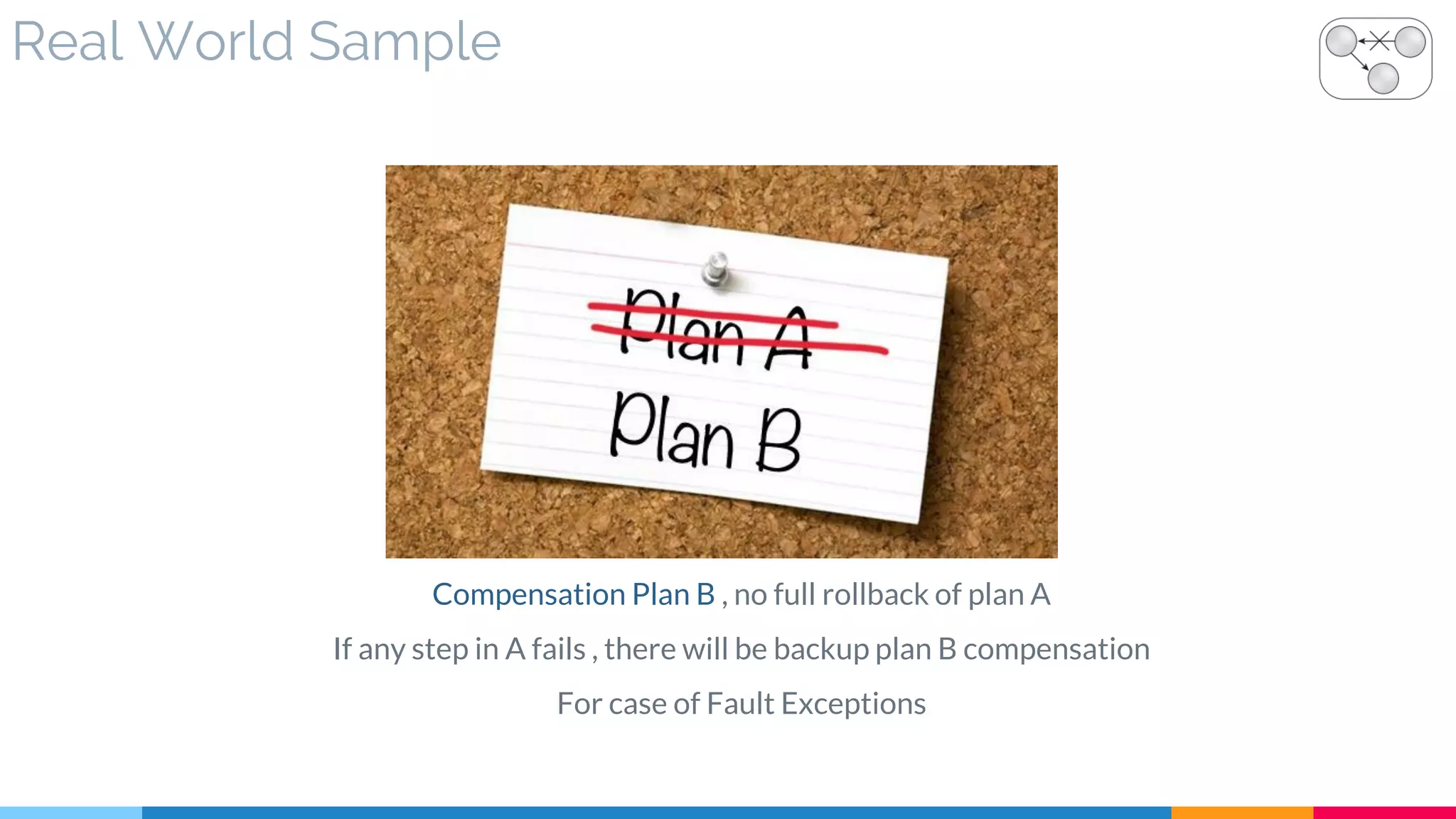
Real World Sample
Compensation Plan B , no full rollback of plan A
If any step in A fails , there will be backup plan B compensation
For case of Fault Exceptions
Application
▷ Compensation logic is pre-defined and implemented as part of the parent composition
controller logic or via individual “undo” service capabilities.
▷ Logic can be extended with compensating routines that also respond to exception conditions
with pre-determined exception handling logic
▷ This allows the parent composition logic to respond to an exception condition by calling undo
capability of each service that was invoked up until that point.
▷ WS-BPEL language provides a common means of defining compensating processes as part of
the overall parent composition logic
▷ Compensating logic is typically defined at these levels:
• composition member
• composition controller
Impact
Open-ended Compensation logic
- Left up to the designer, it can vary in quality and effectiveness.
- Unlike atomic transactions that are governed by specific rules, and can vary
in its actual effectiveness
Bloat the service contract
services that do perform a range of data or resource access functions,
having to append the service contract with an undo capability for each
existing capability that alters the service implementation state
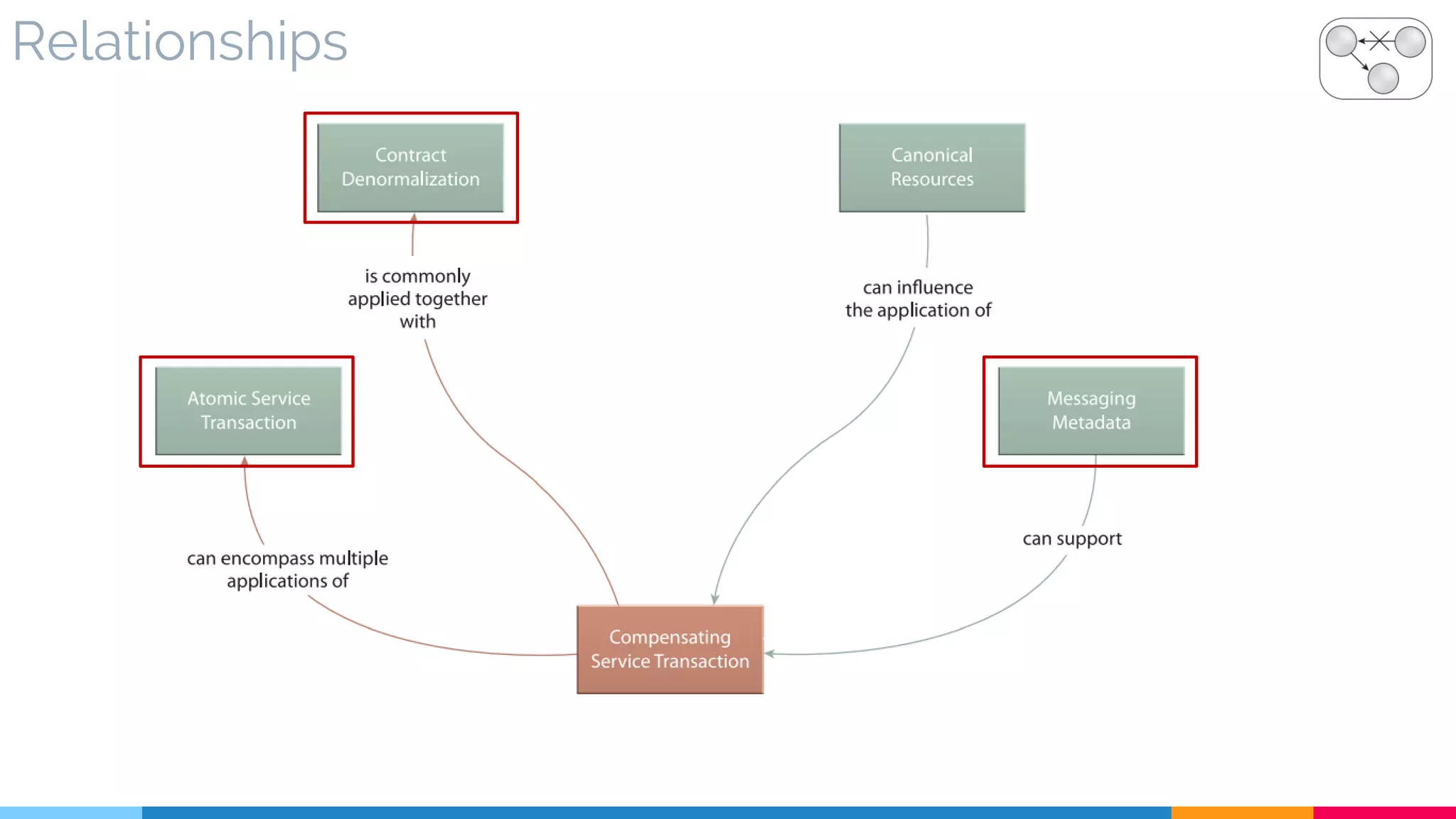
Relationships
Relationships – part of Orchestration
“To Be continue with SOA

Thanks!
SOA Architecture Certification
You can find me at:
@MohamedZekus
eng.mohamedzakarya@gmail.com

SOA Design Patterns

  • 2.
  • 3.
    Course Calendar Exam 1: Fundamental SOA & Service-Oriented Computing Exam 2 : SOA Technology Concepts Exam 3 : SOA Design & Architecture Exam 4 : Advanced SOA Design & Architecture Exam 5 : SOA Design & Architecture Lab
  • 4.
  • 5.
    Session Agenda 1. ESBDesign Patterns 2. Inventory Design Patterns 3. Service Design Patterns 4. Orchestration Design Patterns
  • 6.
    Enterprise Service Bus ▷Service Broker ▷ Data Model Transformation ▷ Data Format Transformation ▷ Protocol Bridging ▷ Intermediate Routing ▷ Asynchronous Queue ▷ Reliable Messaging ▷ Event-Driven Messaging ▷ Rules Centralization ▷ Policy Centralization 11
  • 7.
    1 Enterprise ServiceBus ▷ Introduction ▷ ESB Message Processing ▷ Extended Enterprise Service Bus [704]
  • 8.
    Introduction Environment designed toinclude any interconnectivity between services Intermediate layer of processing Base Patterns that Comprise ESB Incompatible Translation ( Data Model , Format , Protocol) 1. Service Broker Queuing Mechanism enable asynchronous message exchanges 3. Asynchronous Queue Intelligent routing options to facilitate various runtime conditions 2. Intermediate Routing
  • 9.
    ESB Message Processing Establisha middleware-based messaging mechanism Message undergoing various processing steps carried out by an ESB in order to successfully transform and deliver the message contents to their destination Some message transmissions may not require all of this functionality
  • 10.
    Extended Enterprise ServiceBus Core Patterns in Left Side Common Extend Base patterns in Right Side
  • 11.
    2 Service Broker ▷Introduction ▷ Nested Patterns of Service Broker ▷ Core Part of ESB [707]
  • 12.
    Introduction Multifaceted runtime conversionfeatures that enable integration between systems. Common part of middleware platforms Patterns that Comprise Broker ▷ Added bonus of being able to perform more than one transformation function at same time. ▷ Transformation Patterns used only out of necessity.
  • 13.
    Nested Patterns ofService Broker Convert Data between different incompatible schema structure Data Model Transformation Enable communication between different communication protocols Protocol Bridging Dynamic Translate one data format to Another Data Format Transformation
  • 14.
    Part of ESB Broker-relatedfeatures are a fundamental part of ESB platforms.
  • 15.
    3 Data ModelTransformation ▷ Problem ▷ Solution ▷ Real World Sample ▷ Application ▷ Impact ▷ Relationships [671]
  • 16.
    Problem ▷ How canservices interoperate when using different data models for the same type of data? ▷ Services may use incompatible schemas to represent same data prevent service interaction and composition ▷ Canonical Schema has not been successfully applied ▷ Schema incompatibilities can impose interoperability challenges
  • 17.
    Solution ▷ A datatransformation technology can be used to convert data between various schema structures at runtime ▷ Enable non-standardized messaging framework, to dynamically overcome difference between schemas used by a service contract and messages transmitted to that contract.
  • 18.
    Real World Sample MigrateContact Information from Samsung to iPhone
  • 19.
    Application ▷ Use brokerservices that existed as part of middleware platforms. ▷ Mapping logic needs to be developed and deployed to perform transformation at runtime ▷ XSLT style sheets represents the most common application of this pattern ▷ Only applied when other patterns cannot be realized to their full potential ▷ Ensure “transformation avoidance” as you can throughout service-orientation ▷ This pattern as a last resort to solving interoperability problems.
  • 20.
    Impact Runtime performance overhead Everytime services with disparate schemas need to exchange data Development effort Development of the mapping logic Design complexity Into a service composition and the service inventory as a whole
  • 21.
  • 22.
    Relationships – partof ESB , Broker
  • 23.
    Relationships – Partof Orchestration
  • 24.
    4 Data FormatTransformation ▷ Problem ▷ Solution ▷ Real World Sample ▷ Application ▷ Impact ▷ Relationships [681]
  • 25.
    Problem ▷ How canservices interact with programs that communicate with different data formats? ▷ Service may be incompatible with resources it needs to access due to different data format ( service consumer may use different format , incompatible ) A service may have been standardized to send and receive XML-formatted data but is required to also retrieve data from a legacy environment that only supports the CSV format
  • 26.
    Solution ▷ Intermediary dataformat transformation logic needs to be introduced ▷ Dynamically translate one data format into another. This service abstracts the legacy application API and provides XML-to-CSV and CSV-to-XML functions
  • 27.
    Real World Sample Transformfrom PDF to Excel Format Fruit to Juice Blender
  • 28.
    Application ▷ Add dedicatedtransformation service. ▷ Data format transformation logic can exist within a service’s internal logic, within a service Agent ▷ Middleware will often provide out-of-the-box services and agents that perform a variety of data format conversions.
  • 29.
    Impact Runtime performance overhead Formatconversion will need to be executed every time interaction between disparate format sources is required Development effort When required transformation logic needs to be custom-programmed Design complexity Introduce a new layer in an already distributed environment. Often considered natural requirements in enterprise with legacy applications and resources
  • 30.
  • 31.
    Relationships – partof ESB , Broker
  • 32.
    5 Protocol Bridging ▷Problem ▷ Solution ▷ Real World Sample ▷ Application ▷ Impact ▷ Relationships [687]
  • 33.
    Problem ▷ How cana service exchange data with consumers that use different communication protocols? ▷ Services using different communication protocols or different versions of the same protocol cannot exchange data. Services delivered by different project teams or at different times can be built using different communication technologies common scenario when design standards are not prevalent in an enterprise Leading to missed opportunities to reuse and recompose services for new purposes
  • 34.
    Solution ▷ Protocol bridgingtechnology is introduced to enable communication between different communication protocols ▷ Dynamic conversion between protocols at runtime
  • 35.
    Real World Sample USB-Cto VGA Adapter Bluetooth car Converter
  • 36.
    Application ▷ This Patternused when legacy systems need to act as service consumers or when legacy logic needs to be encapsulated by services ▷ A protocol bridging layer is composed of a set of adapters that act as on-/off-ramps for a given transport protocol. ▷ Consumer programs and services connect to a broker that provide bridging protocol ▷ Off-the-shelf products provided by the broker or a third-party vendor
  • 37.
    Impact Runtime Performance overhead Formatconversion will need to be executed every time interaction between disparate format sources is required Protocol Bridging is a pattern only used out of necessity. Design complexity Introduce a layer in distributed environment. May even result in inaccurate semantic meanings being applied to message contents.
  • 38.
  • 39.
    Relationships – partof ESB , Broker
  • 40.
    6 Intermediate Routing ▷Problem ▷ Solution ▷ Real World Sample ▷ Application ▷ Impact ▷ Relationships [549]
  • 41.
    Problem ▷ How candynamic runtime factors affect the path of a message? ▷ The larger and more complex a service composition is, the more difficult it is to expect and design for all possible runtime scenarios especially in asynchronous , messaging-based. ▷ The message routing logic embedded within the logic of each service in a composition if there is unexpected factors can lead to unexpected system failure like : 1. Service Not available 2. Incorrect Routing (Internal service routing logic send message to wrong destination) 3. Cancelled Routing ( can’t route return to sender , terminate service activity)
  • 42.
  • 43.
    Solution ▷ Message pathscan be dynamically determined through the use of intermediary routing logic ▷ multi-purpose routing logic can be abstracted as separate part of architecture (event-driven service agents) ▷ Intercept messages and dynamically determine their paths
  • 44.
  • 45.
    Application ▷ Specialized implementationof Service Agent (Routing-centric agents) ▷ Often provided by middleware and are a fundamental component of ESB products like ▷ Determines a message’s path based on its contents ( inside or metadata) ▷ Model complex business processes (Recompose services on the fly) ▷ Access business rules engine to accurately assess message destinations 1. Content-Based Routing ( Commonly Used)
  • 46.
    Application 2. Load Balancing ▷Important when concurrent usage demands are commonplace ▷ Directing a message to one or more identical service instances ( increase efficiency) 3. 1:1 Routing ▷ Routing agent directly wired to a single physical service at any point in time ▷ Routing them to different service instances or redundant service implementations ( include standard fail-over requirements)
  • 47.
    Impact Performance overhead add overheadcompared to direct service-to-service communication Security Concerns Who will process a message containing sensitive data Difficult Management of dynamic routing paths Centralized routing rule management system need to take place to reduce risks
  • 48.
  • 49.
  • 50.
    7 Asynchronous Queue ▷Problem ▷ Solution ▷ Real World Sample ▷ Application ▷ Impact ▷ Relationships [582]
  • 51.
    Problem ▷ How cana service and its consumers accommodate isolated failures and avoid unnecessarily locking resources? ▷ When a service capability requires that consumers interact with it synchronously, it can inhibit performance and reliability (locking both consumer and service) ▷ Either service or consumer cannot guarantee its availability
  • 52.
  • 53.
    Solution ▷ A servicecan exchange messages with its consumers via an intermediary buffer (remaining temporally decoupled) ▷ A queue is introduced as an intermediary buffer receives request messages and then forwards them on behalf of the service consumers
  • 54.
    Solution ▷ If thetarget service is unavailable, the queue acts as temporary storage and retains the message. It then periodically attempts retransmission
  • 55.
    Real World Sample RestaurantAsynchronous Launch Queue Take Order Number , Then Receive Order
  • 56.
    Application ▷ Queuing technologyneeds to be incorporated into the surrounding architecture ▷ In modern ESB platforms, the use of a queue can be completely transparent (neither consumer nor service may know that a queue was involved in a data exchange) ▷ The queuing framework can be supported by intelligent service agents that detect when a queue is required and intercept message transmissions ▷ Queue Can Leverage asynchronous message exchange by incorporating topics and message broadcasts to multiple consumers, as per Event-Driven Messaging
  • 57.
    Impact There may beno acknowledgement of successful message delivery Atomic transactions may not be possible Difficult to control and monitor. Can lead to complex service activities that are difficult to design
  • 58.
  • 59.
    Relationships – partof ESB , Broker
  • 60.
    8 Reliable Messaging ▷Problem ▷ Solution ▷ Real World Sample ▷ Application ▷ Impact ▷ Relationships ▷ Reliability (Acknowledgment – Assurance) [592]
  • 61.
    Problem ▷ How canservices communicate reliably when implemented in an unreliable environment? ▷ Service communication cannot be guaranteed when using unreliable messaging protocols or when dependent on an otherwise unreliable environment.
  • 62.
    Solution ▷ The inventoryarchitecture is equipped with a reliability framework that tracks and temporarily persists message transmissions and issues positive and negative acknowledgements to communicate successful and failed transmissions to message senders. WS-Reliable Messaging standard (A) Persistent repository (B)
  • 63.
    Real World Sample PostalReliability Index Measures the level of postal operational efficiency. Quality of service performance, incl. predictability, across all categories of postal delivery services, with a focus on domestic and inbound of the postal delivery process and operations
  • 64.
    Application ▷ A reliabilityframework is typically comprised of infrastructure and intermediary processing logic capable of: 1. Guaranteeing message delivery during failure conditions via the use of a persistence store 2. Tracking messages at runtime 3. Issuing acknowledgements for individual or sequences of message ▷ The repository used for guaranteed delivery may provide the option to store messages in memory or on disk so as to act as a back-up mechanism for when message transmissions fail ▷ Allows admins to track status of messages and trace causes behind unresolved delivery problems.
  • 65.
    Impact Additional performance andguarantee requirements Reliable Messaging introduces a layer of processing that includes runtime message capture, persistence, tracking, and acknowledgement notification issuance. Increase Complexity of service-oriented solutions Relative to the size of their service compositions The use of various delivery rules (including those based on group message delivery via sequences), it may not be possible to wrap services using reliability features into atomic transactions, as per Atomic Service Transaction
  • 66.
  • 67.
    Relationships – partof ESB , Broker
  • 68.
    Reliability - Acknowledgement 1.Sequence acknowledgement sent by the RM destination after the successful delivery of a sequence of messages. The nature of a sequence is determined by a set of reliability rules known as delivery assurances
  • 69.
    Reliability - Acknowledgement 2.Request acknowledgement sent by RM source to RM destination, indicating that RM source would like to receive an acknowledgement message before the sequence completes..
  • 70.
    Reliability - Acknowledgement 3.Negative acknowledgement sent by the RM destination to the RM source, indicating a failed delivery prior to the completion of the sequence.
  • 71.
    Reliability – DeliveryAssurance 1. AtMostOnce delivery assurance - Promises the delivery of one or zero messages. - If more than one of the same message is delivered, an error condition occurs - However situations may arise when a message will never reach a destination. - Messages are never transferred more than once
  • 72.
    Reliability – DeliveryAssurance 2. AtLeastOnce delivery assurance - Allows a message to be delivered once or several times. - The delivery of zero messages creates an error condition
  • 73.
    Reliability – DeliveryAssurance 3. ExactlyOnce delivery assurance - Guarantees that a message only will be delivered once. - An error is raised if zero or duplicate messages are delivered
  • 74.
    Reliability – DeliveryAssurance 4. InOrder delivery assurance - Ensure that messages are delivered in a specific sequence - Delivery of messages out of sequence triggers an error - Can be combined with any of the previously described assurances
  • 75.
    9 Event-Driven Messaging ▷Problem ▷ Solution ▷ Real World Sample ▷ Application ▷ Impact ▷ Relationships [599]
  • 76.
    Problem ▷ How canservice consumers be automatically notified of runtime service events? ▷ Traditional MEPs, consumer need to continually poll the service to find out whether such an event had occurred (and to then retrieve the corresponding event details). ▷ This approach can leads to numerous unnecessary service invocations and data exchanges , also introduce delays as to when the consumer receives the event information because it may be only able to check for the event at predetermined polling intervals. ( schedule service )
  • 77.
    Solution ▷ The consumerestablishes itself as a subscriber of the service. The service, in turn, automatically issues notifications of relevant events to this and any of its subscribers. ▷ Event management program is introduced, allowing the service consumer to set itself up as a subscriber to events associated with a service that assumes role of publisher. ▷ Service (acting as publisher) automatically sends the event details to the event management program, which then broadcasts an event notification to all of the consumers registered as subscribers of the event.
  • 78.
    Real World Sample Subscribeto Youtube Channel Notification Bell
  • 79.
    Application ▷ A messagingframework is implemented capable of supporting the publish-and-subscribe MEP and associated complex event processing and tracking. ▷ An event-driven messaging framework is implemented as an extension to the service inventory. ▷ Runtime platforms, messaging middleware, and ESB products commonly provide the necessary infrastructure for message processing and tracing capabilities, along with service agents that supply complex event processing, filtering, and correlation
  • 80.
    Impact Notification broadcast can’tbe predicted Consumer must always be available to receive notification message transmissions. Cannot combined as part of Atomic Service Transaction Publisher/subscriber availability issues can arise Messages are typically issued via the one-way MEP, which does not require an acknowledgement response from consumer. The previous can raise serious reliability issues that can be addressed through application of Asynchronous Queuing : when the consumer not available . Persist message in queue & Reliable Messaging : to make sure that message have been send to destination
  • 81.
  • 82.
    Relationships – partof ESB , Broker
  • 83.
    10. Policy Centralization ▷Problem ▷ Solution ▷ Real World Sample ▷ Application ▷ Impact ▷ Relationships [207]
  • 84.
    Problem ▷ How canpolicies be normalized and consistently enforced across multiple services? ▷ Common Policies that apply to multiple services can introduce redundancy and inconsistency within service logic and contracts ▷ Leads to bloated policy content and increases the governance burden required to ensure that common policies are kept in synch over time. ▷ WSDL documents is extended with individual WS-Policy definitions.
  • 85.
    Solution ▷ Global ordomain-specific policies can be isolated and applied to multiple services. ▷ Abstracted into separate policy definition documents or service agents that are part of an inventory-wide policy enforcement framework ▷ Positioned to apply to multiple services, thereby reducing redundancy and providing centralized policy governance
  • 86.
  • 87.
    Application ▷ A policyframework added to the inventory architecture so that policies can be separately defined and associated with services and then validated, enforced, and even audited at runtime ▷ WS-Policy framework includes a separate WS-PolicyAttachments specification that explains binding mechanisms for policies. ▷ Policy definitions can be embedded within or linked to WSDL documents
  • 88.
    Impact Performance overhead Each centralizedpolicy effectively adds a layer of runtime processing and service dependency. Policies Conflict Risk of conflict between centralized and service-specific policies. Formal analysis and governance processes can help avoid these situations. increased up-front analysis Required prior to the delivery of WS-Policy definitions
  • 89.
  • 90.
    Relationships – partof ESB Middle-tier platforms can provide policy features supported by runtime agents that carry out policy compliance checking. In these environments, global and domain-level policies can also be established via service agents that act as policy enforcement points
  • 91.
    Example A single globalpolicy (A) is established, thereby replacing the redundant policy definitions entirely.
  • 92.
    11 Rules Centralization ▷Problem ▷ Solution ▷ Real World Sample ▷ Application ▷ Impact ▷ Relationships [216]
  • 93.
    Problem ▷ How canbusiness rules be abstracted and centrally governed? ▷ The same business rules may apply across different business services, leading to redundancy and governance challenges ▷ A global change to either rule will therefore impact multiple services
  • 94.
    Solution ▷ Business rulescan be physically abstracted into a dedicated part of the architecture under management of specialized rules engines and platforms. ▷ This centralizes access to business rule logic and avoids redundancy. (they can be modified and evolved from a single location)
  • 95.
    Real World Sample NetworkRules in Insurance Companies
  • 96.
    Application ▷ A centralservice can be established to provide an official access point for the creation, modification, retrieval, and application of business rules. ▷ Modern runtime platforms have native rules repositories and processing logic that is made accessible via a set of system service agents and APIs. ▷ This allows any service to interface with business rules-related logic without having to compose a separate service ▷ Centralized rule services are most often classified as members of the utility service layer
  • 97.
    Impact Tight architectural dependenciesupon Rules services Accessing centralized business rules , the overall service inventory could become “locked in” to a particular vendor platform. Decentralizing business logic move business rules associated with business services into a separate location Performance Requirement increase due to the need for business rules to be retrieved or applied at runtime Caching mechanisms can reduce of this impact to an extend
  • 98.
  • 99.
    Relationships – partof ESB , Orchestration
  • 100.
    Service Inventory Patterns ▷DomainInventory ▷Service Normalization ▷Logic Centralization ▷Schema Centralization 4
  • 101.
    12 Domain Inventory ▷Problem ▷ Solution ▷ Real World Sample ▷ Application ▷ Impact ▷ Relationships [123]
  • 102.
    Problem ▷ How canservices be delivered to maximize recomposition when enterprise-wide Standardization , Governance is not possible? ▷ Establishing an single enterprise service inventory may be unmanageable (single enterprise inventory may be impractical or even unrealistic) ▷ May jeopardize the success of an SOA adoption as a whole.
  • 103.
    Solution ▷ Services canbe grouped into manageable, domain-specific service inventories ▷ Multiple service inventories are created for one enterprise ▷ Each of which can be independently standardized, governed, and owned.
  • 104.
    Real World Sample DomainStore (Internal Delivery, International Delivery) OR Enterprise work for different Industries
  • 105.
    Application ▷ Inventory domainboundaries need to be carefully established. ▷ Domain service inventories are an appropriate alternative when :  Enterprise does not have an established, global data models and creating them is considered unrealistic.  Implementation environment is a large enterprise without strong executive sponsorship and wide-spread support for the SOA initiative  Organization is incapable of changing the complexion of its IT departments in support of a more centralized governance model.
  • 106.
    Application ▷ Organizations willoften have options as to how the domains are defined like :  Organizational business areas represented by specific IT departments or groups. These business areas would then establish the basis for business domains.  Organizational business domains not represented by separate IT departments or groups. These domains can still form the basis of service inventory boundaries but require cooperation across IT departments.  Remote offices, each with its own IT department and development center. This can result in geographical-based domains.
  • 107.
    Impact Cross-domain Transformation Requirements Becauseof Standardization differences between domain service inventories Reduces the overall benefit potential of the SOA adoption. Performance Overhead Cross-domain data exchange impact the development and design effort of corresponding service compositions often lead to the creation of redundant services across domains.
  • 108.
  • 109.
    13 Service Normalization ▷Problem ▷ Solution ▷ Real World Sample ▷ Application ▷ Impact ▷ Relationships [131]
  • 110.
    Problem ▷ How cana service inventory avoid redundant service logic ? ▷ when services are delivered by multiple project teams , risk that services will be created with overlapping functional boundaries, making it difficult to enable wide-spread reuse. ▷ Denormalization of the inventory - Inability to establish service capabilities as the official endpoints for bodies of agnostic logic - Services with overlapping can become out of synch, providing same functions in different ways
  • 111.
    Solution ▷ The serviceinventory needs to be designed with an emphasis on service boundary alignment ▷ Services are collectively modeled before their individual physical contracts are created , ensure that it does not overlap with other services ▷ The result is a service inventory with a higher degree of functional normalization
  • 112.
  • 113.
    Application ▷ Ensure service-levelautonomy applied – Common Steps include : 1. Identifying and decomposing a business process definition that pertains to the inventory boundary 2. Allocating the individual parts of the process into appropriate new or existing conceptual service candidates 3. Validating that no two service boundaries overlap. To fully apply Service Normalization requires that this process be carried out iteratively , once for every business process that is associated with the scope of the service inventory Typically part of a top-down delivery effort. (Up Front Analysis)
  • 114.
    Impact Continual governance effort Ensurethat services maintain normalization throughout the inventory as they are revised and evolved over time. Conceptually modeled prior to delivery Can result in separate analysis project that needs to be completed before any service can actually be built to guarantee inventory-wide normalization (as part of inventory service blueprint specification)
  • 115.
  • 116.
    14 Logic Centralization ▷Problem ▷ Solution ▷ Real World Sample ▷ Application ▷ Impact ▷ Relationships [136]
  • 117.
    Problem ▷ How canthe misuse of redundant service logic be avoided? ▷ If agnostic services are not reused, redundant functionality can be delivered in other services, ▷ Result problems associated with inventory denormalization , service ownership and governance
  • 118.
    Solution ▷ Access toreusable functionality is limited to official agnostic services ▷ The level to which the centralization of logic succeeds as an enterprise-wide standard determines the extent to which the repeated ROI of services can be realized
  • 119.
    Real World Sample LibraryBooks Logic Centralization
  • 120.
    Application ▷ Agnostic servicesneed to be properly designed and governed, and their use must be enforced via enterprise standards ▷ Make service more discoverable by applying Metadata Centralization ▷ if a new capability needed by a project team falls within the boundary of an existing service, corresponding functionality needs to be added to that service instead of ending up elsewhere
  • 121.
    Impact For example: - Existingproject plans and processes are impacted by requiring the involvement of reusable services as part of their development projects. - There may be resistance to giving up control of solution designs if teams are forced to include existing agnostic services or produce new services that need to be reusable. Raise Cultural Issues Introduce Logic Centralization into organization that does not sponsor reuse raise issues with people and IT departments affected by service delivery projects
  • 122.
  • 123.
    15 Schema Centralization ▷Problem ▷ Solution ▷ Real World Sample ▷ Application ▷ Impact ▷ Relationships [200]
  • 124.
    Problem ▷ How canservice contracts be designed to avoid redundant data representation? ▷ Different service contracts often need to express capabilities that process similar business documents, resulting in redundant schema content that is difficult to govern. ▷ In Large enterprise environment , the context established by each service boundary will usually not be exclusive to one body of data. ▷ The need for duplicate schema data models emerges, leading to the definition of service contracts with redundant content
  • 125.
    Solution ▷ Schemas canbe designed and implemented independently from the service capabilities that utilize them to represent the structure and typing of message content ▷ schema architecture can be established and standardized somewhat separately from the parent service layer. ▷ Select schemas that exist as physically separate parts of the service contract are shared across multiple contracts.
  • 126.
    Real World Sample LoginSchema for Google Services
  • 127.
    Application ▷ Up-front analysiseffort is required to establish a schema layer independent of and in support of the service layer ▷ Separate schema layer is taken into account subsequent to the completion of the service inventory blueprint as following steps : 1. Complete a service inventory blueprint to establish a conceptual representation of planned searvices within an inventory. 2. Determine the required centralized schema definitions to represent the common business entities and information sets likely to be processed by services in this inventory. 3. Create the schema definitions by applying design standards to ensure consistency and normalization. 4. Create the WSDL definitions using the standard schemas wherever appropriate and supplementing the contract with any required service-specific schemas.
  • 128.
    Impact Data standardization Challenges maintenanceof the shared schemas and the enforcement of associated design standards. Shared Schema Governance Important as multiple services can form dependencies on the same schema definitions. Any change to a centralized schema can affect numerous service contracts.
  • 129.
  • 130.
    Relationships – CanonicalSchema ** Canonical Schema Establishes standardized XML Schema definitions. can be applied in direct support of Standardized Service Contract . ** Schema Centralization Mandates that schema definitions be shared across multiple contracts.
  • 131.
    Service Design Patterns ▷Contract Centralization ▷ Official Endpoint ▷ Service Façade ▷ Redundant Implementation ▷ Service Data Replication ▷ Decoupled Contract ▷ Concurrent Contract ▷ Legacy Wrapper ▷ Service Agent ▷ Messaging Metadata 10
  • 132.
    16 Contract Centralization ▷Problem ▷ Solution ▷ Real World Sample ▷ Application ▷ Impact ▷ Relationships [409]
  • 133.
    Problem ▷ How candirect consumer-to-implementation coupling be avoided? ▷ Consumer programs designed to access underlying service resources using different entry points ▷ Different implementation dependencies that inhibit service from evolving in response to change. ▷ Bypass the service contract and simply access its underlying logic directly using native protocols ▷ Service ends up with numerous tight dependencies
  • 134.
    Solution ▷ Contract Centralizationestablishes a design standard that positions the service contract as the sole entry point into service logic. ▷ Consistent form of loose coupling with all service consumer programs
  • 135.
    Real World Sample Drivinglicense Contract Driving School Driving Test ** Driving License Issue Illegal immigration Visa Issue Legal Country Ports ** Country Entry
  • 136.
    Application ▷ This patternestablishes a distinction between the official published service contract and other parts of the service that can also be accessed via separate technical endpoints ▷ For example, a consumer could interface with an underlying service component via that component’s API. This API still represents a technical contract, but not the “official” service entry point. ▷ Web services and REST services provide an effective means of establishing a centralized contract while remaining decoupled from the service’s underlying environment as per Decoupled Contract
  • 137.
    Impact Performance overhead Forcing consumerprograms to access service capabilities and resources via a central contract requires also on-going standardization effort Resistance to centralization is common Tactical requirements, such as time-to-market priorities and budget restrictions, can motivate some project teams to simply disregard this pattern altogether.
  • 138.
  • 139.
    17 Official Endpoint ▷Introduction [711]
  • 140.
    Introduction Two Patterns Worktogether to form Official Endpoint Logic Centralization Contract Centralization - Asks designers to build consumer programs that only invoke Particular services when specific types of information processing are required - Does not address how this logic is to be accessed - Asks designers to build consumer programs that access a service only via its published contract - Does not indicate which services should be accessed for specific purposes.
  • 141.
    Introduction ▷ Official Endpointsupports the goal of establishing a federated layer of service endpoints
  • 142.
    18 Service Façade ▷Problem ▷ Solution ▷ Real World Sample ▷ Application ▷ Impact ▷ Relationships [333]
  • 143.
    Problem ▷ How cana service accommodate changes to its contract or implementation while allowing the core service logic to evolve independently? ▷ The coupling of the core service logic to contracts and implementation resources can inhibit its evolution and negatively impact service consumers. ▷ If the core service logic is coupled directly to the contract, any changes to how the service interacts with consumers will require changes to the core service logic. ▷ Changes can result to design-time and runtime challenges.
  • 144.
    Problem – design-time, runtime challenges ▷ Single body of service logic required to support multiple contracts, so introducing new decision logic and requiring core business routines to process different types of input and output messages. ▷ The usage patterns of shared resources accessed by the service are changed, resulting in changes to the established service behavior that end up negatively affecting existing service consumers. ▷ The service implementation is upgraded or refactored, resulting in changes to the core business logic in order to accommodate the new and/or improved implementation. ▷ The service is subjected to decomposition, as per Service Decomposition
  • 145.
    Solution ▷ A servicefaçade component is used to abstract a part of the service architecture with negative coupling potential. ▷ Façade logic is inserted into the service architecture to establish one or more layers of abstraction , can accommodate future changes to the service contract, the service logic, and the underlying service implementation.
  • 146.
  • 147.
    Application ▷ A separatefaçade component is incorporated into the service design. ▷ service façade logic is primarily responsible for providing supplemental, intermediate processing logic in support of the core service logic.
  • 148.
    Application Common types oflogic that tend to reside within a service façade component include: 1. Relaying Logic : Façade logic simply relays input and output messages between contract and core service logic or between the core service logic and other parts of the service architecture. 2. Broker Logic : - Façade logic carries out transformation logic as per patterns associated with Service Broker - This may be required when a single unit of core service logic is used together with multiple service contracts, as per Concurrent Contracts 3. Behavior Correction: Façade logic is used compensate for changes in the behavior of the core service logic in order to maintain the service behavior to which established consumers have become familiar.
  • 149.
    Application 4. Contract-Specific Requirements -Service facades are coupled to contracts to accommodate different types of service consumers, - This can include special security, reliability, and activity management processing requirements. While all of this processing can also be located within the core service logic, it may be desirable to isolate it into façade components when the processing requirements are exclusive to specific contracts.
  • 150.
    Application New service contractscan be accommodated by repeating this pattern to introduce new façade components, thereby potentially shielding the core service logic When service façade logic is used to correct the behavior of changed core service logic, it is also typically positioned between the contract and core service logic.
  • 151.
    Application Core service logicare subject to change, resulting in the release of a second version
  • 152.
    Application One service façadecomponent abstracts a shared database (resource A) whereas another abstracts a legacy system (resource B). This abstraction helps protect the core service logic from changes to either of these parts of the underlying service implementation.
  • 153.
    Impact Performance overhead ,Design and development effort Due to Addition of façade component Although some performance overhead is expected, it is generally minor as long as façade and core service components are located on the same physical server. Some governance overhead can also be expected, due to the increased amount of components per service Creating façade components results in an increased amount of physical logic decomposition.
  • 154.
  • 155.
    19 Redundant Implementation ▷Problem ▷ Solution ▷ Real World Sample ▷ Application ▷ Impact ▷ Relationships [345]
  • 156.
    Problem ▷ How canthe reliability and availability of a service be increased? ▷ service being actively reused introduces a potential single point of failure that may risk the reliability of all compositions in which it participates if an unexpected error condition occurs. ▷ When a highly reused service becomes unexpectedly unavailable, it will risk all of its service consumers.
  • 157.
    Solution ▷ Reusable servicescan be deployed via redundant implementations or with failover support. ▷ High reuse services or providing critical functionality can be deployed with multiple implementation to guarantee high availability and increased reliability ▷ Having redundant implementations of agnostic services provides fail-over protection should any one implementation go down.
  • 158.
    Real World Sample RedundantFailover camera Battery Backup Redundant sim card Implementation for type of customers (Internet – calls)
  • 159.
    Application ▷ The sameservice implementation is redundantly deployed or supported by infrastructure with redundancy features. ▷ there are several ways to apply this pattern • Different redundant service implementations can be established for different sets of service consumers. • One service implementation is designated as the official contact point for consumers, but it is further supported by one or more backup implementations that are used in case of failure or unavailability.
  • 160.
    Application ▷ Service Ahas multiple service contracts as well as a redundant implementation, allowing this service to facilitate a wide range of consumer programs.
  • 161.
    Impact Extra operational-related governanceeffort to keep all redundant implementations in synch. Increased infrastructure requirements Additional hardware and administration effort may be needed for each redundantly implemented service
  • 162.
  • 163.
    20 Service DataReplication ▷ Problem ▷ Solution ▷ Real World Sample ▷ Application ▷ Impact ▷ Relationships [350]
  • 164.
    Problem ▷ How canservice autonomy be preserved when services require access to shared data sources? ▷ Service logic can be deployed in isolation to increase service autonomy, but services continue to lose autonomy when requiring access to shared data sources. ▷ The most isolated service will still need to interact with some central database to access or update business data ▷ These repositories shared with various parts of enterprise include legacy applications , encounter locking and performance constraints that will inhibit their individual autonomy
  • 165.
    Solution ▷ Services canhave their own dedicated databases with replication to shared data sources. ▷ Service implementations can be equipped with dedicated databases, but instead of creating dedicated data stores, the databases provide replicated data from a central data source. ▷ Services can access centralized data with increased autonomy while not requiring exclusive ownership over the data
  • 166.
  • 167.
    Application ▷ An additionaldatabase needs to be provided for the service and one or more replication channels need to be enabled between it and the shared data sources. ▷ This design pattern is especially relevant to agnostic services that are heavily reused and need to facilitate multiple compositions. ▷ Some services (especially those providing reporting-related capabilities) may only require read access to data, which can be fulfilled by a one-way data replication channel. ▷ Most services, though, end up requiring both read and update abilities, which leads to the need for two-way replication
  • 168.
    Application ▷ Some replicationstrategies can even introduce the need for additional databases that provide fully replicated data sets on behalf of a central database ▷ Become the contact point for service databases requiring only a subset of the replicated information. ▷ Modern replication technology allows for the runtime transformation of database schemas , enable the replicated database to be tuned for individual service architectures while performance and reliability is acceptable.
  • 169.
    Impact Additional infrastructure cost -Due to replicated shared databases extensions , - Two-way replication required complex data replication architecture - With all of the additional licenses required for the dedicated service databases Difficult to manage Excess of replication channels can be difficult to manage.
  • 170.
  • 171.
    21 Decoupled Contract ▷Problem ▷ Solution ▷ Real World Sample ▷ Application ▷ Impact ▷ Relationships [401]
  • 172.
    Problem ▷ How cana service express its capabilities independently of its implementation? ▷ In Contract to Implementation coupling technical contract physically bound to underlying service logic when the service is built solely as a component (like , .NET , Java) ▷ As a result, the utilization and evolution of services is inhibited because they can only be used by consumer programs compatible with their technology ▷ Bridging and transformation products generally results in increased integration effort and reduced number of potential service consumers (reduced reuse potential).
  • 173.
    Solution ▷ The servicecontract is physically decoupled from its implementation ▷ The service contract is created as a physically separate part of the overall service implementation ▷ This decouples the contract from the underlying service implementation, allowing it to be independently designed and governed
  • 174.
    Real World Sample RemoteControl ( type of decoupled contract)
  • 175.
    Application ▷ Web servicesrepresent most popular means of applying this design pattern, as they force service contract to be expressed in separate description documents using industry standard meta languages (WSDL-WADL) ▷ A service’s technical interface is physically separated and subject to relevant service-orientation design principles ▷ A common risk associated with expressing service contracts using Web service technologies is the established approach of auto-generating Web service contract description documents (WSDL, XML Schema, and WS-Policy definitions) via modern development tools ( Negative coupling type ) (This technique can result in implementation coupling)
  • 176.
    Application ▷ Contract implementationcoupling of the service contract can propagate implementation coupling to service consumers.
  • 177.
    Application ▷ service contractcan be kept free of implementation details, consumers can avoid binding to them ( Logic to contract coupling)
  • 178.
    Impact Service Utilization Deficiencies withincontract technology platform can inhibit the utilization of service. Vendor Platform’s Capabilities service , its consumers tied to any limitations associated with maturity of vendor platform’s support for relevant contract and related communications technologies deficiencies on service inventory Standardizing on a technology decoupled contract design can then impose any deficiencies on the service inventory as a whole
  • 179.
  • 180.
    22 Concurrent Contract ▷Problem ▷ Solution ▷ Real World Sample ▷ Application ▷ Impact ▷ Relationships [421]
  • 181.
    Problem ▷ How cana service facilitate multi-consumer coupling requirements and abstraction concerns at the same time? (challenging in contract design to accommodates different consumers types) ▷ A service’s contract may not be suitable for or applicable to all potential service consumers. ▷ For example, service contract may need to incorporate special processing extensions (such as policy assertions) not supported by all consumer programs ▷ One contract support a range of consumer types is challenging both from design and governance perspectives and can ultimately lead to security concerns and constraints that limit the service’s overall effectiveness
  • 182.
    Solution ▷ Multiple contractscan be created for a single service, each target a specific type of consumer. ▷ Allows each contract to be extended and governed individually ▷ Also provides the option of exposing a subset of the service capabilities to specific consumers
  • 183.
    Real World Sample ConcurrentEdition contract [ Same service provided by multiple contracts to accommodate consumers concerns]
  • 184.
    Application ▷ This patternis ideally applied together with Service Façade to support new contracts as required. ▷ separate façade can actually be created for each new contract ▷ Often additional contracts are not considered necessary until well after the deployment of the service and its original contract
  • 185.
    Impact Increasing Governance Effort Eachnew contract can effectively add a new service endpoint to an inventory Consumer Perspective adding new contracts to same service is equivalent of adding new services Bloating of a service inventory Confuse consumer designers trying to discover or choose the appropriate variation of a contract.
  • 186.
  • 187.
    23 Legacy Wrapper ▷Problem ▷ Solution ▷ Real World Sample ▷ Application ▷ Impact ▷ Relationships [441]
  • 188.
    Problem ▷ How canwrapper services with non-standard contracts be prevented from spreading indirect consumer-to-implementation coupling? ▷ Legacy systems introduce a non-standard service contract with high technology coupling requirements , resulting in a increase of implementation coupling throughout all service consumer programs. ▷ High contract-to-logic coupling resulting in high implementation coupling by service consumers. ▷ Nature of Webservice adapter contains embedded, implementation-specific (and sometimes technology-specific) details.
  • 189.
    Solution ▷ Non-standard wrapperservice can be replaced by or wrapped with a standardized service contract with minimal impact on existing service consumers. ▷ Wrapper service extracts, encapsulates, and possibly eliminates legacy technical details from contract. ▷ Create a standardized legacy wrapper service that expresses legacy function in a standardized manner. ▷ Tight coupling of service logic to both legacy API and the service contract reduce service consumers from implementation coupling.
  • 190.
    Real World Sample LegacyWrapper of old building ( ‫المباني‬ ‫ترميم‬ ‫عملية‬–‫األثار‬ )
  • 191.
    Application ▷ A customservice contract and required service logic need to be developed to represent the proprietary legacy interface represent in two ways : 1. Add New Wrapper Service : if introduce new service contract 2. Add New service Capability : if parts of a legacy resource fall within a predefined service boundary ▷ Wrapper service (or capability) will typically contain logic that performs transformation between its standardized contract and the native legacy interface, accomplished by eliminating and encapsulating technical information
  • 192.
    Application ▷ Eliminating TechnicalInformation: 1. Eliminate input and output data contain highly proprietary characteristics like [error code can be replaced by SOAP Fault] 2. Usually result in Utility service ▷ Encapsulating Technical Information: 1. Replace legacy-specific data with standardized business data 2. Partition standardized business data from proprietary legacy data into body and header sections 3. Usually result in add the wrapper logic as an extension of a business service.
  • 193.
    Impact Performance overhead adds alayer of processing and associated performance overhead with the additional service invocation and data transformation requirements. When new systems or resources are introduced into a service architecture, 1. The overall behavior of the service may be impacted, 2. It may be required to supplement the service logic with additional functions that compensate for any potential negative effects these behavioral changes may have on consumers , Service Façade is often used for this purpose.
  • 194.
    Relationships Legacy Wrapper isa therefore frequently applied together with Enterprise Service Bus in order to leverage the broker capabilities natively provided by ESB platforms.
  • 195.
    24 Service Agent ▷Problem ▷ Solution ▷ Real World Sample ▷ Application ▷ Impact ▷ Relationships [543]
  • 196.
    Problem ▷ How canevent-driven logic be separated and governed independently? ▷ Service composition logic consists of a series of service invocations; each invocation enlisting a service to carry out a segment of the overall parent business process logic ▷ Larger business processes can be very complex, especially when having to incorporate numerous “what if” conditions via compensation and exception handling sub-processes. As a result, service compositions can grow large. ▷ The performance of larger compositions can suffer from the collective overhead of having to invoke multiple services to automate a single task.
  • 197.
    Solution ▷ Event-driven logiccan be deferred to event-driven programs that don’t require explicit invocation, thereby reducing the size and performance strain of service compositions. ▷ Service logic that is triggered by a predictable event can be isolated into a separate program especially designed for automatic invocation upon the occurrence of the event. ▷ This reduces the amount of composition logic that needs to reside within services , further decreases quantity of services (or service invocations) required for a given composition ▷ Two service agents replace the need for explicit invocation of utility services E and G. By deferring common logic to service agents.
  • 198.
    Real World Sample NurseEvent-Driven Agent of (Doctor check up service) ( Temperature , pressure , length , weight) measurements
  • 199.
    Application ▷ The event-drivenlogic is implemented as a service agent—a program with no published contract that is capable of intercepting and processing messages at runtime. ▷ Service agents can be designed to automatically respond to predefined conditions without invocation via a published contract , service agent typically lightweight , generally contain common utility-centric processing logic , commonly deployed to facilitate inter-service communication ▷ vendor runtime platforms commonly provide “system-level” agents that carry out utility functions such as authentication, authorization, logging, audit, and load balancing. ▷ Service agents can also be custom-developed to provide business-centric and/or single-purpose logic as well.
  • 200.
    Application Sample ▷ Messageprocessing logic that is a natural part of any Web service implementation actually consists of a series of system (and perhaps custom) service agents that collectively carry out necessary runtime actions. ▷ A variety of service agents are part of the Accounts service architecture. Some perform general processing of all data while others are specific to input or output data flow.
  • 201.
    Impact Composition complexity notreduced Although the perceived size of the composition may be reduced, The actual complexity of the composition itself does not decrease. Governance Issue Service agents will need to be owned and maintained by a separate group that needs to understand the inventory-wide impacts of any changes made to agent logic , An agent versioning system will be further required to address these challenges. Dependency of service agents vendor technology Event-driven agents and over reliance on service agents can further tie an inventory architecture to proprietary vendor technology.
  • 202.
  • 203.
    25 Messaging Metadata ▷Problem ▷ Solution ▷ Real World Sample ▷ Application ▷ Impact ▷ Relationships [538]
  • 204.
    Problem ▷ How canservices be designed to process activity-specific data at runtime? ▷ Persistent connections between a service and its consumer place various types of state and context data about current service activity into memory, allowing routines within service capabilities to access this information as required. ▷ Moving from RPC-based toward a messaging-based removes this. ▷ Persistent connections are no longer available. This can place the burden of runtime activity management onto the services themselves. ( metadata with message)
  • 205.
    Solution ▷ Message contentscan be supplemented with activity-specific metadata that can be interpreted and processed separately at runtime. ▷ State data, rules, and even processing instructions can be located within the messages.
  • 206.
  • 207.
    Application ▷ Messaging technologyused for service communication needs to support message headers , so messaging metadata can be consistently located within a reserved part of message document ▷ Many types of messaging metadata have been standardized through the emergence of WS-* extensions that define industry standard SOAP header blocks, like ▷ WS-Addressing ▷ WS-MetadataExchange ▷ WS-Security ▷ WS-Policy https://en.wikipedia.org/wiki/List_of_web_service_specifications
  • 208.
    Impact Runtime Performance overhead Becauseof interpretation and processing of different types of messaging headers Design complexity Complex message paths that may be difficult to govern and evolve
  • 209.
  • 210.
    Orchestration Patterns ▷Process Abstraction ▷StateRepository ▷Atomic Service Transaction ▷Compensating Service Transaction ▷Process Centralization 5
  • 211.
    26 Orchestration ▷ Introduction ▷Orchestration Components ▷ Extended Orchestration [701]
  • 212.
    Introduction - Dedicated tothe effective maintenance and execution of parent business process logic - Support complex service composition logic that can result in long-running runtime activities Business Process Execution - Separating non-agnostic logic from agnostic logic 1. Process Abstraction - Limits the physical distribution of abstracted process logic into one (or a group) of locations - Centralized maintenance of parent composition logic via specialized tools provided by orchestration platform. 2. Process Centralization
  • 213.
    Introduction - Enables orchestrationto support long-running service activities - Provide state management repository that can be leveraged as a state deferral mechanism. 3. State Repository - Supports long-running processes by allowing parent composition logic to be supplemented with compensation sub processes that address exception conditions. 4. Compensating service Transaction
  • 214.
    Orchestration Components Non-agnostic businessprocess logic is abstracted and then physically centralized into an environment that provides a native state management repository. The logic is executed and managed via an orchestration engine, which may support industry standards, such as WS-BPEL
  • 215.
    Extended Orchestration Core Patternsin Left Side Common Extend Base patterns in Right Side
  • 216.
    27 Process Abstraction ▷Problem ▷ Solution ▷ Real World Sample ▷ Application ▷ Impact ▷ Relationships [182]
  • 217.
    Problem ▷ How cannon-agnostic process logic be separated and governed independently? ▷ Grouping task-centric logic together with task-agnostic logic hinders governance of task-specific logic and the reuse of agnostic logic ▷ when services are delivered individually by separate project teams or service-orientation is not applied as part of the delivery method, Agnostic and non-agnostic logic is grouped together in each service like traditional silo based applications
  • 218.
    Problem ▷ This approachhas several reflections : 1. It reduces opportunities for applying the Service Reusability design principle on a broad scale. 2. It imposes governance complexity when expertise associated with business entities and business processes lie with different individuals 3. It makes it difficult to apply Non-Agnostic Context, thereby reducing the chances of successfully abstracting single-purpose cross-entity logic into legal services.
  • 219.
    Solution ▷ A dedicatedparent business process service layer is established to support governance independence and the positioning of task services as potential enterprise resources. ▷ Business logic that spans multiple entity service boundaries is abstracted into a distinct functional context associated with the task service model ▷ Increase organizational agility because it is the parent business logic that is commonly subject to business change , decrease the effort required to respond to change
  • 220.
    Real World Sample Separationof Concerns like entity , utility abstraction (Care about Functional context)
  • 221.
    Application ▷ Business processlogic is typically filtered out after utility and entity services have been defined, allowing for the definition of task services that comprise this layer. ▷ The formation of a task service layer is the result of repeatedly applying Service Encapsulation and Non-Agnostic Context to this logic so as to shape it into well-defined services ▷ It is common to associate a task service with a single business process , this limitation is not required. As with any service, a task service can be comprised of multiple capabilities, each of which represents a separate process or task. The only rule is that these processes be related to a common overarching functional context ▷ The desire to limit a task service to a single process is related to scalability and autonomy concerns
  • 222.
    Impact Additional design anddevelopment effort Places logic into services that could otherwise be located into other types of service consumer programs An organization needs to be prepared to implement and support service compositions in order for this pattern to be effectively applied. Dependency on Other services Abstracting parent business process logic establishes deep dependency on carrying out that logic via the composition of other services.
  • 223.
  • 224.
    Relationships – partof Orchestration
  • 225.
    28 Process Centralization ▷Problem ▷ Solution ▷ Real World Sample ▷ Application ▷ Impact ▷ Relationships [193]
  • 226.
    Problem ▷ How canabstracted business process logic be centrally governed? ▷ When business process logic is distributed across independent service implementations, it can be problematic to extend and evolve. ▷ Task services are commonly implemented as individual Web services. Because each program contains embedded business process logic, it results in a physically decentralized architecture , distributed across multiple locations ▷ When changes come, Ability to efficiently extend, streamline, or even combine business process logic is inhibited because the underlying logic of each affected task service needs to be revisited, opened up, and changed, as required.
  • 227.
    Solution ▷ Logic representingnumerous business processes can be deployed and governed from a central location. ▷ Parent business process logic (representing some or all of business processes within a given domain) is centralized into one location ▷ An orchestration platform hosts and executes this logic while allowing for its on-going, centralized maintenance ▷ Task services can continue to be implemented as separate Web services, but as part of an orchestration platform their collective business process logic is centrally located and governed (resulting in “orchestrated "task services)
  • 228.
    Real World Sample Orchestracentrally governed by maestro
  • 229.
    Application ▷ Middleware platformsprovide necessary orchestration technologies to apply this pattern. ▷ Combined with support for open business process definition languages (such as WS-BPEL), these platforms become suitable for establishing a primary parent composition layer within SOA. ▷ modern orchestration platform is required comprised of the following : 1. A graphical front-end tool allowing users to express and maintain business process logic 2. A back-end middleware runtime environment capable of hosting orchestrated task services and the corresponding collection of business process definitions created with the front-end tool 3. Features that comply with industry standards related to business process logic expression and execution, such as WS-BPEL
  • 230.
    Impact Expensive orchestration technology Introduceorchestration technology can be expensive and disruptive. Increase infrastructure requirements Host and run necessary middleware can increase the size and overall operational costs of the IT environment as a whole
  • 231.
    Relationships This pattern canalso be applied after a service inventory has already been established. As long as Process Abstraction was used to define a layer of task services, The proper separation of agnostic and non agnostic logic will exist to allow for the non-agnostic (process-specific) logic to be cleanly migrated to a central location.
  • 232.
    Relationships – partof Orchestration
  • 233.
    29 State Repository ▷Problem ▷ Solution ▷ Real World Sample ▷ Application ▷ Impact ▷ Relationships [242]
  • 234.
    Problem ▷ How canservice state data be persisted for extended periods without consuming service runtime resources? ▷ State data cached to support the activity within a running service composition can consume too much memory, especially for long-running activities, thereby decreasing scalability. ▷ Some complex compositions introduce extended periods of processing during which this data is not required ▷ Cached data continues to be stored in memory and consumes runtime resources
  • 235.
    Solution ▷ State datacan be temporarily written to and then later retrieved from a dedicated state repository ▷ Deferring state data to a state repository, the service is able to transition to a stateless condition during pauses in the activity, thereby temporarily freeing system resources ▷ This prevent services from having to unnecessarily keep state data in memory for extended periods.
  • 236.
    Real World Example Unconsciousmind State Delegation Repository
  • 237.
  • 238.
    Application ▷ A sharedor dedicated repository is made available as part of the inventory or service architecture. ▷ Dedicated database is provided for state deferral purposes ▷ Database located on same physical server as services that utilizing it, so as to minimize runtime performance overhead associated with writing and retrieval of the data ▷ Another approach is to create dedicated tables within an existing database. ( less effective)
  • 239.
    Impact Runtime Performance overhead Increaseddue to The addition of required write and read functionality , can negatively affect performance Increase Design complexity Leading to more development effort and expense For service activities with strict real-time performance requirements, this state deferral option needs to be carefully assessed.
  • 240.
  • 241.
    Relationships – partof Orchestration
  • 242.
    30 Atomic ServiceTransaction ▷ Problem ▷ Solution ▷ Real World Sample ▷ Application ▷ Impact ▷ Relationships [623]
  • 243.
    Problem ▷ How cana transaction with rollback capability be propagated across messaging-based services? ▷ When runtime activities that span multiple services fail, parent business task is incomplete and actions performed and changes made up to that point may affect integrity of underlying solution and architecture. ▷ Rules of the business process, either all three updates must succeed or none at all
  • 244.
    Solution ▷ Runtime serviceactivities can be wrapped in a transaction with rollback feature that resets all actions and changes if the parent business task cannot be successfully completed. ▷ Services within a particular composition register themselves as part of a transaction prior to completing their changes ▷ System Queries all services to ask whether their functions were carried out successfully If any one service responds negatively A Rollback command is issued.
  • 245.
    Real World Sample AndLogic Gate ( All or rollback)
  • 246.
    Application ▷ A transactionmanagement system is made part of the inventory architecture and then used by those service compositions that require rollback features. ▷ WS-Coordination and WS-AtomicTransaction standards provide an industry standard mechanism to support transaction propagation across Web service implementations ▷ when using WS-Coordination coordinator service is positioned to define the transaction boundary and manage transaction activity
  • 247.
    Impact Memory Consumption Because ofthe requirement for each service to preserve its original state until it is notified to rollback or commit its changes. (Add up and reduce overall service scalability) (Capture a snapshot of a resource prior to making changes to it)
  • 248.
  • 249.
    Relationships – partof Orchestration
  • 250.
    31 Compensating ServiceTransaction ▷ Problem ▷ Solution ▷ Real World Sample ▷ Application ▷ Impact ▷ Relationships [631]
  • 251.
    Problem ▷ How cancomposition runtime exceptions be consistently accommodated without requiring services to lock resources? ▷ Wrapping composition in an atomic transaction can tie up too many resources, for the duration of the transaction thereby negatively affecting performance and scalability. ▷ Can also reduce scalability of overall service inventory
  • 252.
    Solution ▷ Service compositionis supplemented with compensating logic. ▷ This logic differs from atomic transactions in that it does not require services to maintain the original state or lock resources for the duration of the transaction. ▷ Compensating routines are introduced, allowing runtime exceptions to be resolved with opportunity for reduced resource locking and memory consumption ▷ As long as there is no firm requirement for compensations to restore a runtime activity back to its original state, exception conditions can be handled gracefully without create risk for the integrity of the composition
  • 253.
    Real World Sample CompensationPlan B , no full rollback of plan A If any step in A fails , there will be backup plan B compensation For case of Fault Exceptions
  • 254.
    Application ▷ Compensation logicis pre-defined and implemented as part of the parent composition controller logic or via individual “undo” service capabilities. ▷ Logic can be extended with compensating routines that also respond to exception conditions with pre-determined exception handling logic ▷ This allows the parent composition logic to respond to an exception condition by calling undo capability of each service that was invoked up until that point. ▷ WS-BPEL language provides a common means of defining compensating processes as part of the overall parent composition logic ▷ Compensating logic is typically defined at these levels: • composition member • composition controller
  • 255.
    Impact Open-ended Compensation logic -Left up to the designer, it can vary in quality and effectiveness. - Unlike atomic transactions that are governed by specific rules, and can vary in its actual effectiveness Bloat the service contract services that do perform a range of data or resource access functions, having to append the service contract with an undo capability for each existing capability that alters the service implementation state
  • 256.
  • 257.
    Relationships – partof Orchestration
  • 258.
    “To Be continuewith SOA 
  • 259.
    Thanks! SOA Architecture Certification Youcan find me at: @MohamedZekus eng.mohamedzakarya@gmail.com