TELKOMNIKA, Vol.15, No.3, September 2017, pp. 1083~1087
ISSN: 1693-6930, accredited A by DIKTI, Decree No: 58/DIKTI/Kep/2013
DOI: 10.12928/TELKOMNIKA.v15i3.5493  1083
Received April 5, 2017; Revised June 17, 2017; Accepted July 3, 2017
Design LTE Microstrip Antenna Rectangular Patch with
Beetle-Shaped Slot
Yusnita Rahayu*1
, Haziq Hazman2
, Razali Ngah3
1,2
Department of Electrical Engineering, Universitas Riau, Simpang Baru Panam, Pekanbaru 28293,
Indonesia
3
Wireless Communication Centre, Faculty of Electrical Engineering, Universiti Teknologi Malaysia,
Johor Bahru, Malaysia
*Corresponding author, e-mail: yusnita.rahayu@lecturer.unri.ac.id
Abstract
In this paper, the microstrip antenna rectangular patch with beetle shaped slot is presented. The
characterization results of the proposed antenna obtained by changing the dimensions of the ground
plane. CST software is used to design and analyze this proposed antenna. The simulated results of
proposed antenna show that the antenna works at the frequency of 2.1 GHz while the return loss of -32.18
dB with the bandwidth reaches 155.19 MHz and the gain of 3.895 dBi.
Keywords: Patch Antenna, LTE, Beetle-Shaped Slot
Copyright © 2017 Universitas Ahmad Dahlan. All rights reserved.
1. Introduction
LTE (Long Term Evolution) technology has been released. LTE will be the step towards
the fourth generation (4G) originated from radio technology which is designed to improve
network capacity and speed. LTE provides downlink capacity of at least 100 Mbps and uplinks
capacity of at least 50 Mbps [1].
Microstrip antenna is suitable for LTE application. Nowadays, it is increasingly used for
wireless application because of its low cost and easy to fabricate. However, the microstrip
antenna has a weakness in bandwidth. It has small bandwidth. To overcome it, there are
several ways to broaden the bandwidth such as creating a slot, thicken the substrate, array the
elements of antenna, ground plane modification, etc. Papers [2-5] has discussed the affect of
changing the shape of ground plane dimension to the frequency and bandwidth of microstrip
antennas. They show that the bandwidth increased by changing the shape of ground plane.
Papers [6-7] has proposed the microstrip antenna used for applications such as WLAN, UMTS,
LTE and WIMAX. Rationing coaxial probe is used to optimize the antenna impedance which is
connected to the patch and the outer conductor connected to the ground plane [8-13]. In this
paper, the rectangular microstrip patch antenna with beetle-shaped slot uses the coaxial probe
for LTE applications with operating frequency of 2.1 GHz. Paper [14] discusses the optimal
synthesis of fixed-geometry linear array antennas for dynamically reconfigure their radiation
pattern. CST software is used to design the proposed antenna. The simulated results show that
the return loss of -32.18 dB and the gain of 3.895 dBi has been achieved. While the bandwidth
reaches 155.19 MHz and the radiation pattern of proposed antenna is omni-directional.
2. Research Method
The proposed rectangular microstrip antenna is designed by using CST software with
beetle-shaped slot on patch and coaxial probe feed. The FR-4 with dielectric constant (εr) of 4.4
and 1.6 mm of thickness is chosen.
There are several formulas that are used to determine the size of the rectangular-
shaped microstrip antenna.
Equation (1) is used to specify the patch width (w), equation (2)-(3) are used to
calculated the patch length:
 ISSN: 1693-6930
TELKOMNIKA Vol. 15, No. 3, September 2017 : 1083 – 1087
1084
W = (1)
Description :
C = the speed of light (3x10⁸
m/s)
fr = frequency
ɛr = the dielectric constant of the substrate
reff =
ɛ ɛ
(2)
Description :
h = height substrate
ɛreff = The effective dielectric constant
Δl =
ɛ
ɛ
(3)
Leff =
ɛ
(4)
Description :
Leff = the effective length
L = Leff - 2 ΔL (5)
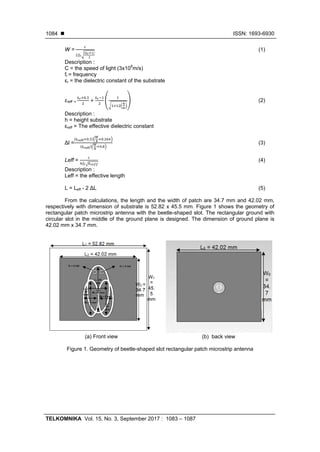
From the calculations, the length and the width of patch are 34.7 mm and 42.02 mm,
respectively with dimension of substrate is 52.82 x 45.5 mm. Figure 1 shows the geometry of
rectangular patch microstrip antenna with the beetle-shaped slot. The rectangular ground with
circular slot in the middle of the ground plane is designed. The dimension of ground plane is
42.02 mm x 34.7 mm.
(a) Front view (b) back view
Figure 1. Geometry of beetle-shaped slot rectangular patch microstrip antenna
TELKOMNIKA ISSN: 1693-6930 
Design LTE Microstrip Antenna Rectangular Patch with Beetle-Shaped Slot (Yusnita Rahayu)
1085
Table 1. The dimensions of proposed antenna
Dimension Size (mm)/(rad)
W1 45.5
W2 34.7
W3 12
W4 8
W5 8
W6 34.7
L1 52.82
L2 42.02
L3 26
L4 20
L5 20
L6 42.02
H1 2
H2 2
3. Results and Analysis
In this paper, the characterization has been performed in order to obtain the desired
return loss, bandwidth and frequency. The proposed antenna is expected to work at 2.1 GHz.
Table 2. Varying the width of ground plane
Characterization
Dimension ground (mm) Working Frequency
(GHz)
Return loss ≤ -
10 (dB)
Bandwidth
(MHz)L W
1 42,02 34.7 1.985 -4.868 ~
2 27.5 24 2.607 -19.129 323.18
3 27.5 19.5 2.093 -21.827 114.62
4 27.5 19 2.1 -32.18 155.19
Table 2 lists the width characterization of the ground plane. The first characterization is
an initial design which the return loss is still above -10 dB. The initial dimensions are obtained
from the calculation. The second characterization has resulted the bandwidth of 323.18 MHz
with the width of ground plane of 24 mm and the length of 27.5 mm. For the third
characterization, the smallest bandwidth is obtained of 114.62 MHz. The fourth characterization,
the desired frequency of 2.1 GHz is achieved with the return loss of -32.18 dB and bandwidth of
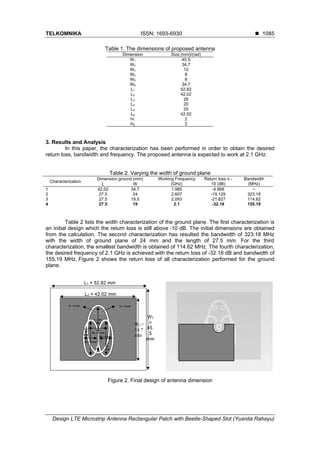
155.19 MHz. Figure 2 shows the return loss of all characterization performed for the ground
plane.
Figure 2. Final design of antenna dimension
 ISSN: 1693-6930
TELKOMNIKA Vol. 15, No. 3, September 2017 : 1083 – 1087
1086
Figure 2. Frequency and return loss characterization.
(a) (b)
Figure 3. Radiation Pattern Gain Simulation Result
Figure 3 shows the radiation pattern of the proposed antenna. The nearly omni
directional is shown in Figure 3(a) and the simulated gain of the antenna is 3.895 dBi.
4. Conclusion
The simulation results of the fourth characterization show that the working frequency of
2.1 GHz was obtained when W6 = 19 mm and L6 = 27.5 mm. The bandwidth and the return loss
of antenna are 155.19 MHz and -32.18 dB, respectively. The gain of antenna is 3.895 dBi with
nearly omni directional radiation pattern.
References
[1] Dony Sugianto, Tommi Hariyadi. Design of Microstrip Antenna for LTE (Long Term Evolution) 700
MHz Applications. International Conference of Information and Communication Technology (ICoICT).
2013.
[2] D Prabhakar, P Mallikarjuna Rao, M Satyanarayana. Design and Performance Analysis of Microstrip
Antenna using different Ground Plane Techniques for WLAN Application. International Journal
Wireless and Microwave Technologies. 2016; 4: 48-58.
[3] L Lolit Kumar Singh, Bhaskar Gupta, Partha P Sarkar. A Review on Effects of Finite Ground Plane on
Microstrip Antenna Performance. International Journal of Electronics and Communication
Engineering & Technology (IJECET). 2012; 3(3): 287-292.
[4] Sudipta Das, Partha P. Sarkar, Santosh K. Chowdhury. Design and Analysis of a Compact Triple
Band Slotted Microstrip Antenna with Modified Ground Plane for Wireless Communication
Applications. Progress in Electromagnetics Research B. 2014; 60: 215-225.
TELKOMNIKA ISSN: 1693-6930 
Design LTE Microstrip Antenna Rectangular Patch with Beetle-Shaped Slot (Yusnita Rahayu)
1087
[5] Maheshkumar Ninu Patil, Bhagwan Swaroop Sharma. Rectangular Patch Antenna for Infinite and
Finite Ground Plane. International Journal of Advanced Technology in Engineering and Science.
2014; 2(8).
[6] FNM Redzwan, Ali MN Md Tan, NF Miswadi. Design of Tri-band Planar Inverted F Antenna (PIFA)
with Parasitic Elements for UMTS2100, LTE and WiMAX Mobile Applications. IEEE 2015
International Conference on Computer, Communication, and Control Technology (I4CT 2015).
Kuching, Sarawak, Malaysia. 2015.
[7] Shailesh Kumar, Gajanand Jagrawal, Deepak Billore. E–Shaped Coaxial Feed Microstrip Patch
Antenna for WLAN and WIMAX Applications. International Journal of Current Engineering and
Technology. 2015; 5(2).
[8] Seyi Stephen Olokede, Clement Anowe Adamariko, Yazeed Mohammed Qasaymeh. Equivalent
circuit model of a coaxial excited microstrip-fed quasi-lumped element resonator antenna array. IET
Microwaves, Antennas & Propagation. 2014.
[9] Chia-Hsun Yeh, Bo-Shau Chen, Chih-Chiang Chen. L-shaped probe feed patch antenna with circular
polarization radiation for UHF RFID applications. RF and Wireless Technologies for Biomedical and
Healthcare Applications (IMWS-BIO), 2015 IEEE MTT-S 2015 International Microwave Workshop
Series on, IEEE. 2015: 214-215.
[10] VR Gupta, N Gupta. An Artificial Neural Network Model for Feed Position of the Microstrip
Antenna. Elektronika ir Elektrotechnika. 2016; 60(4): 82-89.
[11] Malay Gangopadhyaya, Abhranila Das, Soummya Priyo Chattopadhyay, Saumyabrata Dutta, and
Bob Gill. Resonant frequency optimization of coaxially fed rectangular Microstrip Antenna using
Cuckoo Search algorithm. Information Technology, Electronics and Mobile Communication
Conference (IEMCON), 2016 IEEE 7th Annual. 2016: 1-4.
[12] DC Nascimento, JC da S Lacava. Design of Arrays of Linearly Polarized Patch Antennas on an FR4
Substrate: Design of a probe-fed electrically equivalent microstrip radiator. IEEE Antennas and
Propagation Magazine. 2015; 57(4): 12-22.
[13] Neeraj Kumari, Amit Kumar. Design and Performance Evaluation of Different Feeding Technique for
IMT Advanced (4G) Antenna. 2016.
[14] T Isernia, A Massa, AF Morabito, P Rocca. On the optimal synthesis of phase-only reconfigurable
antenna arrays. Proceedings of the 5th European Conference on Antennas and Propagation (EuCAP
2011). Rome, Italy. 2011: 2074-2077.

Design LTE Microstrip Antenna Rectangular Patch with Beetle-Shaped Slot

  • 1.
    TELKOMNIKA, Vol.15, No.3,September 2017, pp. 1083~1087 ISSN: 1693-6930, accredited A by DIKTI, Decree No: 58/DIKTI/Kep/2013 DOI: 10.12928/TELKOMNIKA.v15i3.5493  1083 Received April 5, 2017; Revised June 17, 2017; Accepted July 3, 2017 Design LTE Microstrip Antenna Rectangular Patch with Beetle-Shaped Slot Yusnita Rahayu*1 , Haziq Hazman2 , Razali Ngah3 1,2 Department of Electrical Engineering, Universitas Riau, Simpang Baru Panam, Pekanbaru 28293, Indonesia 3 Wireless Communication Centre, Faculty of Electrical Engineering, Universiti Teknologi Malaysia, Johor Bahru, Malaysia *Corresponding author, e-mail: yusnita.rahayu@lecturer.unri.ac.id Abstract In this paper, the microstrip antenna rectangular patch with beetle shaped slot is presented. The characterization results of the proposed antenna obtained by changing the dimensions of the ground plane. CST software is used to design and analyze this proposed antenna. The simulated results of proposed antenna show that the antenna works at the frequency of 2.1 GHz while the return loss of -32.18 dB with the bandwidth reaches 155.19 MHz and the gain of 3.895 dBi. Keywords: Patch Antenna, LTE, Beetle-Shaped Slot Copyright © 2017 Universitas Ahmad Dahlan. All rights reserved. 1. Introduction LTE (Long Term Evolution) technology has been released. LTE will be the step towards the fourth generation (4G) originated from radio technology which is designed to improve network capacity and speed. LTE provides downlink capacity of at least 100 Mbps and uplinks capacity of at least 50 Mbps [1]. Microstrip antenna is suitable for LTE application. Nowadays, it is increasingly used for wireless application because of its low cost and easy to fabricate. However, the microstrip antenna has a weakness in bandwidth. It has small bandwidth. To overcome it, there are several ways to broaden the bandwidth such as creating a slot, thicken the substrate, array the elements of antenna, ground plane modification, etc. Papers [2-5] has discussed the affect of changing the shape of ground plane dimension to the frequency and bandwidth of microstrip antennas. They show that the bandwidth increased by changing the shape of ground plane. Papers [6-7] has proposed the microstrip antenna used for applications such as WLAN, UMTS, LTE and WIMAX. Rationing coaxial probe is used to optimize the antenna impedance which is connected to the patch and the outer conductor connected to the ground plane [8-13]. In this paper, the rectangular microstrip patch antenna with beetle-shaped slot uses the coaxial probe for LTE applications with operating frequency of 2.1 GHz. Paper [14] discusses the optimal synthesis of fixed-geometry linear array antennas for dynamically reconfigure their radiation pattern. CST software is used to design the proposed antenna. The simulated results show that the return loss of -32.18 dB and the gain of 3.895 dBi has been achieved. While the bandwidth reaches 155.19 MHz and the radiation pattern of proposed antenna is omni-directional. 2. Research Method The proposed rectangular microstrip antenna is designed by using CST software with beetle-shaped slot on patch and coaxial probe feed. The FR-4 with dielectric constant (εr) of 4.4 and 1.6 mm of thickness is chosen. There are several formulas that are used to determine the size of the rectangular- shaped microstrip antenna. Equation (1) is used to specify the patch width (w), equation (2)-(3) are used to calculated the patch length:
  • 2.
     ISSN: 1693-6930 TELKOMNIKAVol. 15, No. 3, September 2017 : 1083 – 1087 1084 W = (1) Description : C = the speed of light (3x10⁸ m/s) fr = frequency ɛr = the dielectric constant of the substrate reff = ɛ ɛ (2) Description : h = height substrate ɛreff = The effective dielectric constant Δl = ɛ ɛ (3) Leff = ɛ (4) Description : Leff = the effective length L = Leff - 2 ΔL (5) From the calculations, the length and the width of patch are 34.7 mm and 42.02 mm, respectively with dimension of substrate is 52.82 x 45.5 mm. Figure 1 shows the geometry of rectangular patch microstrip antenna with the beetle-shaped slot. The rectangular ground with circular slot in the middle of the ground plane is designed. The dimension of ground plane is 42.02 mm x 34.7 mm. (a) Front view (b) back view Figure 1. Geometry of beetle-shaped slot rectangular patch microstrip antenna
  • 3.
    TELKOMNIKA ISSN: 1693-6930 Design LTE Microstrip Antenna Rectangular Patch with Beetle-Shaped Slot (Yusnita Rahayu) 1085 Table 1. The dimensions of proposed antenna Dimension Size (mm)/(rad) W1 45.5 W2 34.7 W3 12 W4 8 W5 8 W6 34.7 L1 52.82 L2 42.02 L3 26 L4 20 L5 20 L6 42.02 H1 2 H2 2 3. Results and Analysis In this paper, the characterization has been performed in order to obtain the desired return loss, bandwidth and frequency. The proposed antenna is expected to work at 2.1 GHz. Table 2. Varying the width of ground plane Characterization Dimension ground (mm) Working Frequency (GHz) Return loss ≤ - 10 (dB) Bandwidth (MHz)L W 1 42,02 34.7 1.985 -4.868 ~ 2 27.5 24 2.607 -19.129 323.18 3 27.5 19.5 2.093 -21.827 114.62 4 27.5 19 2.1 -32.18 155.19 Table 2 lists the width characterization of the ground plane. The first characterization is an initial design which the return loss is still above -10 dB. The initial dimensions are obtained from the calculation. The second characterization has resulted the bandwidth of 323.18 MHz with the width of ground plane of 24 mm and the length of 27.5 mm. For the third characterization, the smallest bandwidth is obtained of 114.62 MHz. The fourth characterization, the desired frequency of 2.1 GHz is achieved with the return loss of -32.18 dB and bandwidth of 155.19 MHz. Figure 2 shows the return loss of all characterization performed for the ground plane. Figure 2. Final design of antenna dimension
  • 4.
     ISSN: 1693-6930 TELKOMNIKAVol. 15, No. 3, September 2017 : 1083 – 1087 1086 Figure 2. Frequency and return loss characterization. (a) (b) Figure 3. Radiation Pattern Gain Simulation Result Figure 3 shows the radiation pattern of the proposed antenna. The nearly omni directional is shown in Figure 3(a) and the simulated gain of the antenna is 3.895 dBi. 4. Conclusion The simulation results of the fourth characterization show that the working frequency of 2.1 GHz was obtained when W6 = 19 mm and L6 = 27.5 mm. The bandwidth and the return loss of antenna are 155.19 MHz and -32.18 dB, respectively. The gain of antenna is 3.895 dBi with nearly omni directional radiation pattern. References [1] Dony Sugianto, Tommi Hariyadi. Design of Microstrip Antenna for LTE (Long Term Evolution) 700 MHz Applications. International Conference of Information and Communication Technology (ICoICT). 2013. [2] D Prabhakar, P Mallikarjuna Rao, M Satyanarayana. Design and Performance Analysis of Microstrip Antenna using different Ground Plane Techniques for WLAN Application. International Journal Wireless and Microwave Technologies. 2016; 4: 48-58. [3] L Lolit Kumar Singh, Bhaskar Gupta, Partha P Sarkar. A Review on Effects of Finite Ground Plane on Microstrip Antenna Performance. International Journal of Electronics and Communication Engineering & Technology (IJECET). 2012; 3(3): 287-292. [4] Sudipta Das, Partha P. Sarkar, Santosh K. Chowdhury. Design and Analysis of a Compact Triple Band Slotted Microstrip Antenna with Modified Ground Plane for Wireless Communication Applications. Progress in Electromagnetics Research B. 2014; 60: 215-225.
  • 5.
    TELKOMNIKA ISSN: 1693-6930 Design LTE Microstrip Antenna Rectangular Patch with Beetle-Shaped Slot (Yusnita Rahayu) 1087 [5] Maheshkumar Ninu Patil, Bhagwan Swaroop Sharma. Rectangular Patch Antenna for Infinite and Finite Ground Plane. International Journal of Advanced Technology in Engineering and Science. 2014; 2(8). [6] FNM Redzwan, Ali MN Md Tan, NF Miswadi. Design of Tri-band Planar Inverted F Antenna (PIFA) with Parasitic Elements for UMTS2100, LTE and WiMAX Mobile Applications. IEEE 2015 International Conference on Computer, Communication, and Control Technology (I4CT 2015). Kuching, Sarawak, Malaysia. 2015. [7] Shailesh Kumar, Gajanand Jagrawal, Deepak Billore. E–Shaped Coaxial Feed Microstrip Patch Antenna for WLAN and WIMAX Applications. International Journal of Current Engineering and Technology. 2015; 5(2). [8] Seyi Stephen Olokede, Clement Anowe Adamariko, Yazeed Mohammed Qasaymeh. Equivalent circuit model of a coaxial excited microstrip-fed quasi-lumped element resonator antenna array. IET Microwaves, Antennas & Propagation. 2014. [9] Chia-Hsun Yeh, Bo-Shau Chen, Chih-Chiang Chen. L-shaped probe feed patch antenna with circular polarization radiation for UHF RFID applications. RF and Wireless Technologies for Biomedical and Healthcare Applications (IMWS-BIO), 2015 IEEE MTT-S 2015 International Microwave Workshop Series on, IEEE. 2015: 214-215. [10] VR Gupta, N Gupta. An Artificial Neural Network Model for Feed Position of the Microstrip Antenna. Elektronika ir Elektrotechnika. 2016; 60(4): 82-89. [11] Malay Gangopadhyaya, Abhranila Das, Soummya Priyo Chattopadhyay, Saumyabrata Dutta, and Bob Gill. Resonant frequency optimization of coaxially fed rectangular Microstrip Antenna using Cuckoo Search algorithm. Information Technology, Electronics and Mobile Communication Conference (IEMCON), 2016 IEEE 7th Annual. 2016: 1-4. [12] DC Nascimento, JC da S Lacava. Design of Arrays of Linearly Polarized Patch Antennas on an FR4 Substrate: Design of a probe-fed electrically equivalent microstrip radiator. IEEE Antennas and Propagation Magazine. 2015; 57(4): 12-22. [13] Neeraj Kumari, Amit Kumar. Design and Performance Evaluation of Different Feeding Technique for IMT Advanced (4G) Antenna. 2016. [14] T Isernia, A Massa, AF Morabito, P Rocca. On the optimal synthesis of phase-only reconfigurable antenna arrays. Proceedings of the 5th European Conference on Antennas and Propagation (EuCAP 2011). Rome, Italy. 2011: 2074-2077.