Download to read offline
![International Journal of Engineering Research and Development
e-ISSN: 2278-067X, p-ISSN: 2278-800X, www.ijerd.com
Volume 10, Issue 2 (February 2014), PP.08-15
8
Design, Manufacturing and Testing of Circular Welding
Positioner
Prof. N.B.Totala, Sarang S. Bhutada, Nakul R. Katruwar,
Rachan R. Rai, Ketan N. Dhumke
1(
Assistant Professor, Department of Mechanical Engineering, MIT Academy of Engineering,
Alandi (D), Pune Maharashtra 412105.)
2,3,4&5
(Department of Mechanical Engineering, Sinhgad Institute of Technology, Pune
Maharashtra 411041.)
Abstract:- This paper deals with the construction and working of all components required for welding
positioner.With an increase in size and complexity of today‟s welding requirements, new techniques must be
developed so as to ease the operator‟s burden and ensure uniform and efficient circular welding.In this paper the
various components of the circular welding positioner are critically designed, manufactured and tested, along
with which a cost and time parameters have been included to aid in the manufacturing of the positioner. The arc
torch is fixed to an adjustable clamp, not hand held. It is different from a robot since operator‟s continuous
surveillance and intervention are essential for successful work
Keywords:- Circular welding, CO2 welding, Welding positioner, Welding gun subassembly, Automation
I. INTRODUCTION
Welding is a process for joining different materials. The large bulk of materials that are welded are
metals and their alloys, although the term welding is also applied to the joining of other materials such as
thermoplastics. In order to join two or more pieces of metal together by one of the welding processes, the most
essential requirement is heat. Pressure may also be employed, but this is not, in many processes essential. The
use of welding in today‟s technology is extensive. It had a phenomenal rise since about 1930, this growth has
been faster than the general industrial growth. [1]
Welding-positioner is a special accessory tool or manipulator that helps achieving the required
economic results of a welding program. It all depends on the process used, on what is going to be welded, on
quantity and quality of what has to be provided, and on whether the Return on Investment (ROI) is going to
justify the expense for procuring the tool.
Welding positioner is an advanced implement that helps perform welding. It keeps in place the
elements being welded, while providing some relative, progressive, smooth movement between the torch of a
fusion welding head and the joint to be welded. The movement is relative, because it does not matter if the arc
source or the work is fixed, while the other element moves along simple lines. A welding table, although very
useful, has no intrinsic movements available so that it falls short of the above definition. Welding-positioner is a
necessary tool for highly productive mechanically assisted manual welding for those different processes that
supply filler metal continuously from a spool (GMAW, SAW) or for GTAW with thin sections if filler metal is
not required.
A set of uniformly placed good quality tack welds has to be made to bridge the gap and to provide
some rigidity against the stresses developed during welding. A Welding-positioner assures enhanced quality and
increased productivity. This is the most important gain, because of reduction of downtime, and also as the
welding parameters can be selected to provide the maximum weld deposition rate, compatible with acceptable
(not excessive) heat input. Arc-on time is equally increased resulting in potential reduction of welding costs.
Jafar Takabi et al. state that the operating temperature plays a key role in the overall performance of a
bearing system. Affected by the bearing temperature are many critical parameters, such as the lubricant viscosity,
load-carrying capacity, load distribution and power loss. This typically results because of an imbalance between
the frictional heat generation inside the bearing and heat dissipation to the surroundings. Consequently, the
bearing components undergo excessive thermal expansion resulting in sudden increase in the contact loads.
They presented a novel idea for comparing the combination of geometric and elastic accommodations with the
nominal clearance wherein the expansion of inner ring and shaft was treated as a de-stabilizing factor and that of
the housing as a stabilizing factor [2]](https://image.slidesharecdn.com/b1020815-140322033636-phpapp01/75/International-Journal-of-Engineering-Research-and-Development-1-2048.jpg)
![Design, Manufacturing and Testing of Circular Welding Positioner
9
Jun Yong Choi et al suggested that the application of fracture mechanics is being increased gradually to
assess the safety of welding crack- containing structures and suggest cracks initiate and propagate in welding
joint part due to impact and fatigue load, therefore it is necessary to improve welding performance and fracture
resistance of welding part in structure. Their study presents a suitable CO2 welding process for lap joints, taking
into consideration tensile strength and fatigue strength under various welding conditions. [3]
Lelio Della Pietra investigated experimentally the tension variation in a flat belt transmission which is
obtained by measuring its deformation with electrical resistance strain gauges as transducers. He also proved
that two models of validity showing the strength of weld are equally important which were one addition arc and
sliding to presence of shear strain along different sliding angles on driving and driven pulleys. These model
gave the force transmitted into the device. [4]
II. DESIGN METHODOLOGY
In our attempt to design a special purpose machine we have adopted a very careful approach, the total design
work has been divided into two parts:
System design
Mechanical design
A. System Design
System design mainly concerns with the various physical constraints and ergonomics, space
requirements, arrangement of various components on the main frame of machine, no. of controls, position of
these controls, ease of maintenance, scope of further improvement, height of m/c from ground etc. In system
design we mainly concentrate on the following parameters;
1. System selection based on physical constraints:-
While selecting any m/c it must be checked whether it is going to be used in large scale or
small scale industry in our case it is to be used in small scale industry so space is a major constraint.
The system is to be very compact. The mechanical design has direct norms with the system design
hence the foremost job is to control the physical parameters.
2. Arrangement of various components:-
Keeping into view the space restriction, the components should be laid such that their easy
removal or servicing is possible moreover every component should be easily seen and none should be
hidden. Every possible space is utilized in component arrangement.
3. Components of system:-
As already stated, system should be compact enough so that it can be accommodated at a
corner of a room. All the moving parts should be well closed and compact. A compact system gives a
better look and structure.
4. Chances of failure:-
The losses incurred by owner in case of failure of a component are important criteria of
design. Factor of safety while doing the mechanical design is kept high so that there are less chances of
failure. Periodic maintenance is required to keep the m/c trouble free.
5. Servicing facility:-
The layout of components should be such that easy servicing is possible especially those
components which required frequent servicing can be easily dismantled.
6. Height of m/c from ground:-
For ease and comfort of operator the height of m/c should be properly decided so that he may
not get tired during operation also enough clearance should be provided from ground for cleaning
purpose.
7. Weight of machine:-
The total weight of m/c depends upon the selection of material components as well as
dimension of components. A higher weighted m/c is difficult for transportation and in case of major
break down it becomes difficult to repair.](https://image.slidesharecdn.com/b1020815-140322033636-phpapp01/75/International-Journal-of-Engineering-Research-and-Development-2-2048.jpg)
![Design, Manufacturing and Testing of Circular Welding Positioner
10
B. Mechanical Design
In Mechanical design the components are categories in two parts.
Design parts
Parts to be purchased
For design parts detail design is done and dimensions thus obtained are compared to next higher dimension
which are readily available in market. This simplifies the assembly as well as post production servicing work.
The various tolerances on work pieces are specified in the manufacturing drawings. The process charts are
prepared and passed on to the manufacturing stage.
The parts are to be purchased directly are specified and selected from standard catalogues and are specified
so as to have case of procurement.
A. DESIGN OF PARTSMotor Selection
Thus selecting a motor of the following specifications
1. Single phase AC motor
2. Commutator motor
3. TEFC construction
4. Power = 1/15 HP = 60 watt
5. Speed= 0-6000 rpm (variable)
Motor torque calculated T=0.095 Nm
B. Design Of Worm Shaft
Material selection: -Designation: EN 24 [2]
ASME CODE FOR DESIGN OF SHAFT:
τ per = 0.18 x 800= 144 N/mm2
τ per = 0.30 x 680 =204 N/mm2
Considering minimum value of the above values,
τ per = 144 N/mm2
Shaft is provided with key way, this will reduce its strength. Hence reducing above value of allowable stress by
25%.
τ per = 108 N/mm2
This is the allowable value of shear stress that can be induced in the shaft material for safe operation.
To calculate worm shaft torque:
Power = Motor is 60 watt power, run at 6000 rpm, connected to worm shaft by belt pulley arrangement with
reduction ratio 1:5.
Hence input to worm gear box = 1200 rpm
T=0.48Nm
C. Design Of Worm Wheel Shaft
Material Selection: - Designation: EN 24[5]
Asme code for design of shaft:
τ per = 0.18 x 800 = 144 N/mm2
τ per = 0.30 x 680 =204 N/mm2
Considering minimum value of the above values,
τ per = 144 N/mm2
Shaft is provided with key way, this will reduce its strength. Hence reducing above value of allowable stress by
25%.
τ per = 108 N/mm2
This is the allowable value of shear stress that can be induced in the shaft material for safe operation.
D. Design Of Key
Selecting parallel key from standard data book for given application. Material of key is 55C8 [3]
Table I
For Shaft Diameter(mm) Above 12
Up to 17
Key cross section(mm) Width (b) 5
Height (h) 5
Dimensions (b×h×l):-5×5×24](https://image.slidesharecdn.com/b1020815-140322033636-phpapp01/75/International-Journal-of-Engineering-Research-and-Development-3-2048.jpg)
![Design, Manufacturing and Testing of Circular Welding Positioner
11
E. Design Of Worm And Worm Wheel
The pair of worm and worm wheel used in the machine is designated as
1/80/10/1.5.The worm is made of case hardened steel EN24 whereas the worm wheel is made of Phosphor
bronze. [6]
As the drive is capable of transmitting 0.1796 kW and we intend to transmit 0.06 kW therefore the drive is safe.
F. Selection Of Bearing
1. Selection of worm shaft bearing:
Deep groove ball bearing is most frequently used bearing. These bearing take the loads in radial as well
as axial. Here, calculated shaft diameter “d = 16 mm” which is safe under torsional load but during selection of
ball bearing we found that 16 mm bore diameter bearing is not available in standard catalogue of bearing. So we
select next standard size of shaft diameter “d = 17 mm” from bearing series 6003ZZ. [6]
Table II
Brg Basic Design
No (SKF)
Bore dia.(d)
mm
Outside
dia.(D) mm
Width(B)
mm
Basic capacity
Static
„Co‟ (N)
Dynamic
„C‟ (N)
6003ZZ 17 35 10 2850 4650
2. Selection of worm wheel shaft bearing
Deep groove ball bearing is most frequently used bearing. These bearing take the loads in radial as well
as axial. Here, calculated shaft diameter “d = 22 mm” which is safe under torsional load but during selection of
ball bearing we found that 22 mm bore dia. bearing is not available in standard catalogue of bearing. So we
select next standard size of shaft diameter “d = 25 mm” from bearing series 6005ZZ. [6]
Table III
Brg Basic Design
No (SKF)
Bore
dia.(d)
mm
Outside
dia.(D)
mm
Width(B)
mm
Basic capacity
Static
„Co‟ (N)
Dynamic
„C‟ (N)
6005ZZ 25 47 12 7800 5200
G. Design Of Open Belt Drive
Motor pulley diameter = 20 mm
Reduction ratio = 5
Input shaft pulley diameter = 100 mm
Coefficient of friction = 0.2
Maximum allowable tension in belt = 200 N
Center distance = 120 mm
Arc of contact for smaller pulley (α) =141° [7]
Ratio of belt tension=4.2[7]
Width at the base is given by (b2) =3.1mm
Area of cross section of belt (A) = 18.2
Mass of belt per meter length = 0.23 kg/m
Velocity = 4.19 m/sec
Centrifugal tension (Tc) = 4.034 N
Tension at tight side (T1) = 200 - 4.034=195.966N
Tension on slack side (T2) =49N
H. Design Of Screw For Tilting Mechanism
Material selection: - [6]
Table IV
Material Bearing Pressure, (N/mm2) Rubbing Speed
Screw Nut
Steel C.I 13-17 Low Speed
Calculate load (w) on screw
W = Weight of work piece + Weight of base plate
W = 315.1 N
For core diameter (d) = 8 mm, pitch (p) = 1 mm [2]](https://image.slidesharecdn.com/b1020815-140322033636-phpapp01/75/International-Journal-of-Engineering-Research-and-Development-4-2048.jpg)
![Design, Manufacturing and Testing of Circular Welding Positioner
12
Core diameter of screw (dc) = d – p = 8 – 1 = 7 mm
z = no. of threads in engagement with nut = 12
I. Design Of Spring
Material selection: - [6]
Patented cold drawn steel wire (unalloyed).
Sut=1390N/mm2
Permissible shear stress=0.3×Sut=417N/mm2
We assume maximum force that can be applied by hand (P) is 70 N. As there are two springs, therefore force on
each spring is 35 N.
Assume spring index, C = 5 [6]
From required load condition the free length is 60mm.
Table V: Designed Table
Sr. No Part Name Dimension
1. Motor 60 W, 0-6000 rpm
2. Worm Shaft Ø = 16mm
3. Worm Wheel Shaft Ø = 22mm
4. Key 5×5×24mm
5. Bearing 6003ZZ,6005ZZ
6. Worm And Worm Wheel 1/80/10/1.5
7. Open Belt Drive FZ 6×500
8. Screw Ø = 8, 1 mm pitch
9. Spring d = 1.2 mm, Lf = 60mm
III. MANUFACTURING
Details of manufacturing is given below
A. Machining Parameters[8,9,10]
Table VI: Machining Parameters
Sr No. Part Name Tools Time
Required
M/C tools Cutting Tools Measurement
Instruments
Min
1 Worm Shaft Lathe,
hobbing
Facing tool, Turning tool,
Parting tool, Chamfering
Tool, Hob
Vernier
Calliper
201
2 Worm Wheel
Shaft
Lathe, Milling
m/c
Facing tool, Turning tool,
End mill
Vernier 104
3 Worm Gear Lathe,
hobbing,
Slotting.
Turning tool, Twist drill,
Boring tool, Slotting tool,
Hob.
Vernier 124
4 Pulley Lathe Turning tool, Facing tool,
Twist drill, Boring tool,
Parting tool, Form tool.
Vernier 108
5 Input Shaft
Bearing
Housing
Milling,
Lathe.
Facing cutter, Twist drill,
Boring tool
Vernier 70
6 Output Shaft
Bearing
housing
Milling,
Lathe.
Facing cutter, Twist drill,
Boring tool.
Vernier 76
7 Base Plate Wire cutting,
Milling, Lathe
Wire cutter, End Mill,
Twist drill
Vernier 73](https://image.slidesharecdn.com/b1020815-140322033636-phpapp01/75/International-Journal-of-Engineering-Research-and-Development-5-2048.jpg)
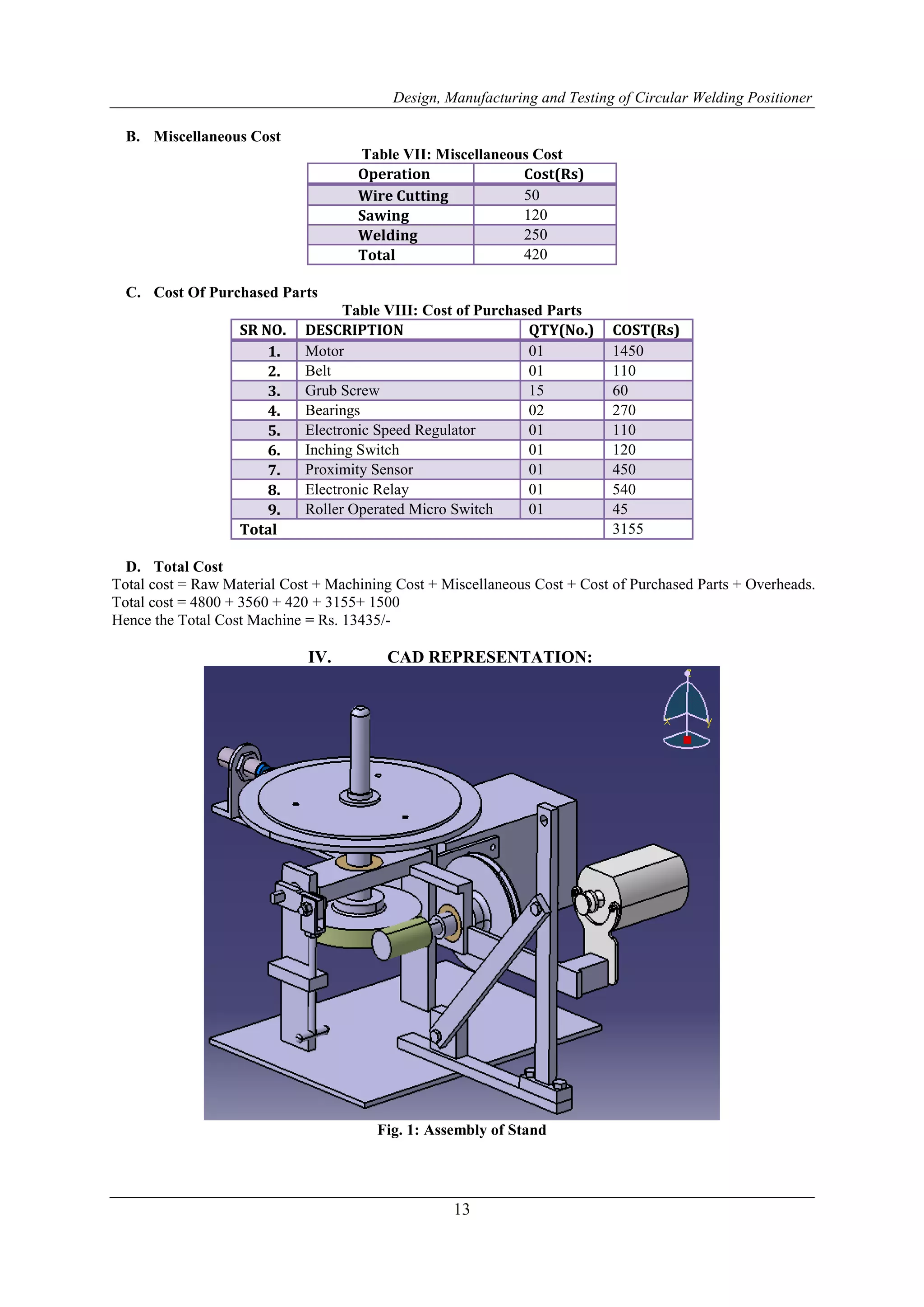
![Design, Manufacturing and Testing of Circular Welding Positioner
14
Fig. 2: Subassembly of Gun Holder
Fig. 3: Welding positioner
V. TESTING
For testing purpose following parameters are considered: [1]
1. Electrode Size
For work piece thickness of 2.0 - 4.0 mm, wire diameter 1.0 – 1.2 mm is selected.
2. Welding Current and Voltage
For electrode diameter 1.0 – 1.2 mm, current range is 60 – 160 A, voltage range is 16 – 25 V.
3. Arc Travel Speed
The speed at which arc moves along the joint is 0.44 m/min.
4. Results
Time required for loading and unloading the job = 15 sec
Time required for actual welding process = 15 sec
Total cycle time = 30 sec
Production rate = 120 pieces per hour.](https://image.slidesharecdn.com/b1020815-140322033636-phpapp01/75/International-Journal-of-Engineering-Research-and-Development-7-2048.jpg)
![Design, Manufacturing and Testing of Circular Welding Positioner
15
VI. DISCUSSIONS
The designed welding positioner can be used for the following applications.
1. To weld the bush inside fork of a bike.
2. CO2 welding of circular or staggered welded joints is possible.
3. Welding of pipe and flange can be done.
4. Pressure vessel heads, nozzles and other fittings can be welded.
5. Welding of small circular automobile components for example silencer.
VII. FUTURE SCOPE
1. Currently the welding positioner is used with welding gun which is fed manually and has a spring return
mechanism which can be replaced and automated with pneumatic cylinders.
2. The guide bars can be replaced with linear guide ways in order to increase accuracy.
3. The entire positioner can be controlled using Microprocessors to increase automation.
VIII. CONCLUSION
1. A Heavy load capacity of table of about 30 kg is achieved.
2. Adjustable table speed (0 to 15 rpm).
3. Auto stop feature, operation at precise positions (starts and end process).
4. Multiple indexer positions (3), enables to make staggered welded joints.
5. Ease of operation, as table automatically stops as per indexer button position and next operation is started
by merely pressing the inching switch.
6. Compact, the entire drive assembly fitted below the table itself, and the controls are placed on the front at
ergonomic positions.
7. Weight and easy to operate.
8. Low power consumption (60 watt).
9. Precise and noiseless in operation.
10. Less skilled operator can perform operation.
REFERENCES
[1]. “Welding Technology”, O P Khanna; Dhanapat Rai Publication; 1999.
[2]. Jafar Takabi, M.M. Khonsari, “Experimental testing and thermal analysis of ball bearings”, Tribology
International 60 (2013) 93–103.
[3]. Lelio Della Pietra et al “Tension in flat belt transmission: Experimental investigation”, Mechanism and
Machine Theory 70 (2013) ,pp 129–156
[4]. Jun young choi et al., “Effect of current and Voltage on on strength of lap joint with CO2 welding
process key engineering materials”, vol. 297-300(2005),pp 2859-2863
[5]. “P S G Design Data Book”; Published by Kalaikathir Achchagam, 2011.
[6]. “Design of Machine Elements”, V B Bhandari; Tata McGraw Hill Publication; 2009.
[7]. “Machine Design”, R S Khurmi and J K Gupta; S Chand Publication; 2010.
[8]. “Engineering Mechanism”, Erdman and Sandor; Prentice Hall Publication; 2001.
[9]. “Manufacturing Science”, Amitabh Ghosh and Malik; East West Publication; 2011.
[10]. “Elements of Workshop Technology” Vol 1- Manufacturing Processes, S K Hajra Choudhury and A K
Hajra Choudhury; Media Promoters and Publishers Pvt. Ltd.; 1994.](https://image.slidesharecdn.com/b1020815-140322033636-phpapp01/75/International-Journal-of-Engineering-Research-and-Development-8-2048.jpg)

The document discusses the design, manufacturing, and testing of a circular welding positioner, aimed at improving welding efficiency and operator ease. It describes the critical components and design methodology, with an emphasis on cost-effectiveness and user ergonomics. Testing results indicate the positioner's potential for increased productivity and quality in welding applications.


