Downloaded 10 times
![International Journal of Engineering Research and Development
e-ISSN: 2278-067X, p-ISSN: 2278-800X, www.ijerd.com
Volume 10, Issue 11 (November 2014), PP.14-21
14
Experimental investigation and optimization study of combustion
chamber geometry on performance and emission parameters
using Rice bran biodiesel
*Hariram.V1
and Hema Kumar. M2
1,2
Department of Automobile Engineering Hindustan Institute of Technology & Science
Hindustan University, Chennai, Tamil Nadu, India.
Abstract:- An experimental investigation and optimization study of various piston geometries was conducted
on Greaves single cylinder direct injection compression ignition engine using straight diesel and blends of rice
bran biodiesel. The three combustion chamber geometries used in this study were Standard toroidal piston
(STP), hemispherical bowl piston (HBP) and Shallow toroidal re-entrant piston (STRP) at compression ratios of
18:1, 19.04:1 and 16.4:1 respectively. Rice bran biodiesel was derived by two step trans-esterification process
with an optimum yield of 86% with molar ratio 1:6, 06% of catalyst (KOH), 90 min reaction time and 65o
C
reaction temperature. The performance parameters like brake specific energy consumption, brake thermal
efficiency and the emission parameters like carbon monoxide, unburned hydrocarbons and oxides of nitrogen
were analysed in detail. It was noticed that the BSEC of STRP was 12.1% with diesel and 14.02% with B100
biodiesel blend. The brake thermal efficiency was also found to be improved with biodiesel blend with STRP on
comparison with STP and HBP. The carbon monoxide and hydrocarbon emission was found to decrease with
STRP geometry were as HBP exhibited negative improvement. NOx emission was also found to increase with
STRP.
Keywords:- Toroidal piston, transesterification, biodiesel, hydrocarbon, BSEC
I. INTRODUCTION
Internal combustion engines are broadly classified as compression ignition engine and spark ignition
engines. The compression ignition engines also known as diesel engines, which finds major application in
transportation and industrial sector. As day by day the application of diesel engines are increased. The
consumption of petrol and diesel also increased at tremendous rate and the diesel engine also emits exhaust
emission at an elevated level especially oxides of nitrogen. It was found that the consumption of diesel was
enormously increased when compared to other petroleum products which made the usage of blends of biodiesel
necessary for its usage in Compression Ignition engines because of its environment friendly, biodegrading and
non-toxicity factors [2]. Various biodiesels were used by researchers such as Neem, Cottonseed, Rice bran,
Rapeseed, Karanja and Jatropha. Since vegetable oil biodiesel contains more amount of oxygen, its emissions
which includes oxides of carbon, oxides of nitrogen, polyaromatic and aliphatic compounds were reduced to a
greater extent. Generally vegetable oil biodiesel are chains of triglycerides which are transformed into shorter
chains of monoglycerides and glycerol by employing transesterification process [1]. One such attempt is
experimentally investigated in the present study by varying the combustion geometry of the existing piston
fuelled with B100 Rice bran Biodiesel (RBBD) to minimize the exhaust emissions and enhance the
performance.
The production of rice bran biodiesel was analysed using two step acid catalysed transesterification in
which the free fatty acids were reduced to less than 35% in the primary step and 98% of fatty acid methyl esters
were derived in the two step Methanolysis reaction. The reaction found a huge quantity of residues with a
mixture of phytosterol and steryl esters [9]. Rice bran biodiesel characterization was carried out with the
variations in temperature, catalyst concentration, amount of methanol and reaction time. It was found that the
molar ratio 9:1 with 0.75% of catalyst, 55⁰C of reaction temperature and 1 hour of reaction time yield optimal
rice bran biodiesel [1, 17]. Straight rice bran biodiesel was used without diesel in a six cylinder DI diesel engine
which showed greater decrease in carbon monoxide, hydrocarbons, smoke and particulates with a minimal
increase in oxides of nitrogen [16].
Blends of Pongamia biodiesel was analysed in a single cylinder four stroke direct injection diesel
engine with Shallow Depth Re-entrant, Toroidal, Toroidal re- entrant and hemispherical combustion geometries.
The performance and emission parameters were studied and found that toroidal re-entrant combustion chamber
showed better performance with a notable reduction in emission [5]. Better fuel mixture can be achieved by
optimizing the combustion chamber apart from parameters like injection timing, injection pressure, atomization](https://image.slidesharecdn.com/b10111421-150115033221-conversion-gate01/85/Experimental-investigation-and-optimization-study-of-combustion-chamber-geometry-on-performance-and-emission-parameters-using-Rice-bran-biodiesel-1-320.jpg)
![International Journal of Engineering Research and Development
e-ISSN: 2278-067X, p-ISSN: 2278-800X, www.ijerd.com
Volume 10, Issue 11 (November 2014), PP.14-21
14
Experimental investigation and optimization study of combustion
chamber geometry on performance and emission parameters
using Rice bran biodiesel
*Hariram.V1
and Hema Kumar. M2
1,2
Department of Automobile Engineering Hindustan Institute of Technology & Science
Hindustan University, Chennai, Tamil Nadu, India.
Abstract:- An experimental investigation and optimization study of various piston geometries was conducted
on Greaves single cylinder direct injection compression ignition engine using straight diesel and blends of rice
bran biodiesel. The three combustion chamber geometries used in this study were Standard toroidal piston
(STP), hemispherical bowl piston (HBP) and Shallow toroidal re-entrant piston (STRP) at compression ratios of
18:1, 19.04:1 and 16.4:1 respectively. Rice bran biodiesel was derived by two step trans-esterification process
with an optimum yield of 86% with molar ratio 1:6, 06% of catalyst (KOH), 90 min reaction time and 65o
C
reaction temperature. The performance parameters like brake specific energy consumption, brake thermal
efficiency and the emission parameters like carbon monoxide, unburned hydrocarbons and oxides of nitrogen
were analysed in detail. It was noticed that the BSEC of STRP was 12.1% with diesel and 14.02% with B100
biodiesel blend. The brake thermal efficiency was also found to be improved with biodiesel blend with STRP on
comparison with STP and HBP. The carbon monoxide and hydrocarbon emission was found to decrease with
STRP geometry were as HBP exhibited negative improvement. NOx emission was also found to increase with
STRP.
Keywords:- Toroidal piston, transesterification, biodiesel, hydrocarbon, BSEC
I. INTRODUCTION
Internal combustion engines are broadly classified as compression ignition engine and spark ignition
engines. The compression ignition engines also known as diesel engines, which finds major application in
transportation and industrial sector. As day by day the application of diesel engines are increased. The
consumption of petrol and diesel also increased at tremendous rate and the diesel engine also emits exhaust
emission at an elevated level especially oxides of nitrogen. It was found that the consumption of diesel was
enormously increased when compared to other petroleum products which made the usage of blends of biodiesel
necessary for its usage in Compression Ignition engines because of its environment friendly, biodegrading and
non-toxicity factors [2]. Various biodiesels were used by researchers such as Neem, Cottonseed, Rice bran,
Rapeseed, Karanja and Jatropha. Since vegetable oil biodiesel contains more amount of oxygen, its emissions
which includes oxides of carbon, oxides of nitrogen, polyaromatic and aliphatic compounds were reduced to a
greater extent. Generally vegetable oil biodiesel are chains of triglycerides which are transformed into shorter
chains of monoglycerides and glycerol by employing transesterification process [1]. One such attempt is
experimentally investigated in the present study by varying the combustion geometry of the existing piston
fuelled with B100 Rice bran Biodiesel (RBBD) to minimize the exhaust emissions and enhance the
performance.
The production of rice bran biodiesel was analysed using two step acid catalysed transesterification in
which the free fatty acids were reduced to less than 35% in the primary step and 98% of fatty acid methyl esters
were derived in the two step Methanolysis reaction. The reaction found a huge quantity of residues with a
mixture of phytosterol and steryl esters [9]. Rice bran biodiesel characterization was carried out with the
variations in temperature, catalyst concentration, amount of methanol and reaction time. It was found that the
molar ratio 9:1 with 0.75% of catalyst, 55⁰C of reaction temperature and 1 hour of reaction time yield optimal
rice bran biodiesel [1, 17]. Straight rice bran biodiesel was used without diesel in a six cylinder DI diesel engine
which showed greater decrease in carbon monoxide, hydrocarbons, smoke and particulates with a minimal
increase in oxides of nitrogen [16].
Blends of Pongamia biodiesel was analysed in a single cylinder four stroke direct injection diesel
engine with Shallow Depth Re-entrant, Toroidal, Toroidal re- entrant and hemispherical combustion geometries.
The performance and emission parameters were studied and found that toroidal re-entrant combustion chamber
showed better performance with a notable reduction in emission [5]. Better fuel mixture can be achieved by
optimizing the combustion chamber apart from parameters like injection timing, injection pressure, atomization](https://image.slidesharecdn.com/b10111421-150115033221-conversion-gate01/75/Experimental-investigation-and-optimization-study-of-combustion-chamber-geometry-on-performance-and-emission-parameters-using-Rice-bran-biodiesel-1-2048.jpg)
![Experimental investigation and optimization study of combustion chamber geometry on performance and...
15
and spray cone angle. Comparison studies were also made on conventional combustion chamber with re-entrant
combustion chamber which enhances the dynamics of fluid over the piston during combustion. The combustion
chamber geometries along with variation in injection pressure and injection timing were studied to improve the
combustion, performance and emission parameters with diesel and biodiesel blends. The shape of combustion
chamber helps in atomizing and progress towards complete combustion [7].
The performance and emission parameters were experimentally investigated in the single cylinder
diesel engine with variations in ceramic coating of the combustion chamber using diesel and biodiesel. It was
found that thermal barrier coating significantly improved the performance parameters like brake thermal
efficiency(BTE), mechanical efficiency (ME) and brake specific energy consumption(BSEC) with optimal
emissions of unburned hydrocarbons (UBHC), carbon monoxide (CO), oxides of nitrogen (NOx), smoke and
particulates.
Nomenclature and Abbreviations
Nomenclature & AbbreviationsCI Compression Ignition
DI Direct Injection
BSEC Brake Specific Energy Consumption
BTE Brake Thermal Efficiency
UBHC Unburned Hydrocarbons
CO Carbon Monoxide
NOx Oxides of Nitrogen
bTDC Before Top Dead Center
STP Standard Toroidal Piston
STRP Shallow Toroidal Re-entrant Piston
HBP Hemispherical Bowl Piston
RRBO Raw Rice bran Oil
RBBD Rice bran Biodiesel
B100 100% RBBD
FFA Free Fatty Acid
FAME Fatty Acid Methyl Ester
II. MATERIALS AND METHODS
A. Biodiesel production and properties
Raw Rice Bran Oil (RRBO) was procured from an oil mill in Vellore district, Tamil Nadu India. It was
estimated to contain 12% of Free Fatty Acids (FFA’s) with the help of its acid value and titration method. Two
step transesterification was used to convert RRBO into biodiesel. It was reported that the base catalysed
esterification will be effective with the vegetable oils containing less than 2% of FFA in order to reduce the FFA
content acid catalysed transesterification was carried out with 2% of concentrated sulphuric acid and methanol
solution [15]. 200 ml of RRBO was heated to 60⁰C in a round bottom flask and stirred continuously at 250 rpm
for 2 hours with the addition of sulphuric acid and methanol. The primary acid catalysed esterification was
followed by base catalysed esterification with molar ratio of 1:6, 0.6% of catalyst, 90 minutes reaction time and
65⁰C reaction temperature. 1.8 grams of potassium hydroxide was selected as catalyst with 1:6 molar ratio of
methanol the transesterification reaction was initiated after washing the vegetable oil to reduce storage problems
as shown in Fig 1. The base catalyst esterification completely converts the FFA and triglycerides into Fatty acid
methyl esters (FAME’s). A round bottom flask was used with 60 to 65⁰C reaction temperature and stirred at 400
rpm with the addition RRBO into potassium hydroxide-methanol solution. The reaction temperature was
maintained as above for 2 hours for conversion to take place. The esterification process was completed with a
layer formation which separates glycerol and FAME’s. The physio-chemical properties of RBBD and fatty acid
profiles were estimated and found to be within ASTM standards as shown in Table 1 and 2. [3, 4, 9].](https://image.slidesharecdn.com/b10111421-150115033221-conversion-gate01/85/Experimental-investigation-and-optimization-study-of-combustion-chamber-geometry-on-performance-and-emission-parameters-using-Rice-bran-biodiesel-2-320.jpg)
![Experimental investigation and optimization study of combustion chamber geometry on performance and...
16
Fig 1. Transesterification Reaction
Table 1. Comparison of Physiochemical properties - Raw Rice bran oil and Diesel
Property / Fuel Diesel a
RRBO
Density(kg/m3
) 840 877
Kinematic Viscosity @ 40⁰C (cSt) 3.17 5.28
Flash Point (⁰C) 67 184
Fire Point (⁰C) 102 198
Cloud Point (⁰C) 5 11
Pour point (⁰C) 01 -03
Calorific Value (kJ/kg) 44700 39853
Cetane Number 50 54.6
Shailendra Sinha et al. (2008)
B. Modification of Combustion chamber
Standard Toroidal piston (STP), Hemispherical Bowl piston (HBP) and Shallow Toroidal Re-entrant
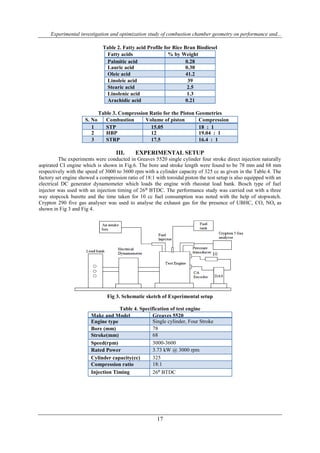
piston (STRP) were analysed in the present investigation. Greaves 5520 Compression Ignition engine was
selected with the factory set STP, redesigned HBP and STRP using CATIA software as shown in Fig.2. The
dimensions of these pistons were analysed and its corresponding compression ratio were determined by molten
wax technique. The compression ratio of standard piston was found to be 18:1 whereas the compression ratio of
redesigned HBP and STRP were 19.04:1, 16.4:1 respectively which is shown in Table.3. These variations in
piston will affect the atomization of fuel and thereby its performance and emissions shows alteration [13].
Fig 2. Comparison of Piston Geometries - Standard Toroidal Piston (A), Hemispherical bowl Piston
(B), Shallow toroidal Re-entrant piston (C)](https://image.slidesharecdn.com/b10111421-150115033221-conversion-gate01/85/Experimental-investigation-and-optimization-study-of-combustion-chamber-geometry-on-performance-and-emission-parameters-using-Rice-bran-biodiesel-3-320.jpg)
![Experimental investigation and optimization study of combustion chamber geometry on performance and...
18
Fig 4. Pictorial view of Test engine
IV. RESULTS AND DISCUSSION
The performance and emission parameters were analysed with the Greaves 5520 engine with the
variations in piston geometries i.e. STP, STRP and HBP with straight diesel and Rice bran biodiesel (RBBD).
The parameters like Brake Specific Energy Consumption, Brake Thermal Efficiency, Oxides of Carbon, Oxides
of Nitrogen and Unburned Hydrocarbons were studied for the above mentioned combustion chamber.
C. Variation in performance parameters
The Brake Specific Energy Consumption (BSEC) varying with Brake Mean Effective Pressure
(BMEP) is shown in Fig.5. At low loads the BSEC for HBP was found to be 40 MJ/kW-hr with diesel as fuel
whereas B100 showed 38.12 MJ/kW- hr. At part load condition the BSEC for all type of piston and fuel showed
a decreasing trend with STRP consuming 12.47 MJ/kW- hr which may be due to better air fuel mixing and
spray atomization. At full load condition HBP showed an abnormal increase with diesel and B100 which is a
result of incomplete combustion. At the same load the STP and STRP with diesel and B100 blend showed a
decreasing trend in comparison with HBP geometry. It was evident from the Fig 5. that the BSEC of STRP with
B100 blend showed 15.08 MJ/kW- hr of energy consumption [6].
Fig 5. Variation of BSEC with BMEP
The variation of Brake Thermal Efficiency (BTE) and Brake Mean Effective Pressure for STP, STRP,
and HBP with straight diesel and B100 RBBD is shown in Fig 6. Initially at low loading conditions the BTE of
STP with diesel and B100 was found to be 11.23% and 13.16% respectively whereas STRP exhibited 12.1%
and 14.02% with straight diesel and B100 blends respectively. The HBP showed a very minimal BTE of 9.53%
and 11.15% with straight diesel and B100 as shown in Fig.8. at part loads the BTE of all the piston geometries
showed an increasing trend with the STRP has the highest BTE further it has been noticed that at full load
conditions the BTE of STRP with straight diesel and B100 RBBD as 27.33% and 29.31% respectively whereas
STP showed only 27.24% with B100 blend which may be due to better combustion, swirl and squish created in
the re-entrant piston geometry. The HBP showed a negative increase in BTE at full load as shown in Fig.8
which may be due to poor premixed combustion phase [10-12].](https://image.slidesharecdn.com/b10111421-150115033221-conversion-gate01/85/Experimental-investigation-and-optimization-study-of-combustion-chamber-geometry-on-performance-and-emission-parameters-using-Rice-bran-biodiesel-5-320.jpg)
![Experimental investigation and optimization study of combustion chamber geometry on performance and...
19
Fig 6. Variation of BTE with BMEP
D. Variation in Emission parameters
CO emissions are mainly formed due to incomplete combustion and improper oxidation of carbon
atoms to carbon dioxide. The Fig.7 shows an increasing trend of CO emissions across all loads in STP, STRP
and HBP geometries with diesel and B100 fuels. The STP exhibits 0.09 to 0.04 % of CO emissions at part load
conditions with diesel and RBBD B100. At similar load the HBP and STRP showed 0.11 to 0.08% and 0.08 to
0.03% of CO for straight diesel and RBBD respectively. From the Fig.8 it is evident that the STRP emits lesser
quantity of CO for both diesel and Biodiesel blends which may be due to better oxidative stability and enhanced
swirl squish motion in the combustion chamber. Generally HBP showed a negative increase of 5 to 7% on
comparison with STP as shown in Fig.9 [6,8].
Fig 7. Variation of CO with BMEP
Fig.8 shows the variations in UBHC emission for STD, HBP and STRP with diesel and B100 RBBD.
On general comparison the emissions of UBHC showed an increasing trend irrespective of piston geometries
with STRP B100 as 3 ppm and HBP B100 as 11 ppm at low loads the UBHC emission was found to be varying
between 3 ppm to 17ppm across all piston geometries. At part load and high load HBP exhibit higher emissions
of HC as given in the Fig.10 which may be due to incomplete combustion and effect of cylinder wall quenching.
STRP with diesel and B100 RBBD were found to emit 17 ppm and 11 ppm of UBHC during part load condition
25 ppm and 19 ppm during full load condition which is 13 to 15% lower than HBP [14].](https://image.slidesharecdn.com/b10111421-150115033221-conversion-gate01/85/Experimental-investigation-and-optimization-study-of-combustion-chamber-geometry-on-performance-and-emission-parameters-using-Rice-bran-biodiesel-6-320.jpg)
![Experimental investigation and optimization study of combustion chamber geometry on performance and...
20
Fig 8. Variation of UBHC with BMEP
The variation in Oxides of nitrogen for all the piston geometries with straight diesel and RBBD B100
blend is shown in Fig 9. The STP exhibited 154 ppm, 242 ppm, 428 ppm at low load, part load and full load
respectively which is a decrease in 3 to 4% with RBBD B100 as the fuel. HBP exhibited 86 ppm at part load and
274 ppm at full load for RBBD blend and 118 ppm at part load and 304 ppm for straight diesel. This piston was
subjected to 20% more than the full load condition which showed a sharp increase in the NOx emission upto 450
ppm which is 2% to 4% lesser than STP. The STRP was found optimum at low load, part load and full load
conditions where the NOx emissions were found to be 178 ppm and 210 ppm, 272 ppm and 304 ppm, 453 ppm
and 485 ppm respectively for RBBD blend and straight diesel which may be due to lack of oxygen for
oxidation, atomization of fuel and fuel viscosity at higher loads. Generally HBP was not suitable at part load and
full load operation on comparison with STP and STRP. [18]
Fig 9. Variation of NOx with BMEP
V. CONCLUSION
From the present experimental investigation and optimization study, it can be concluded that rice bran
biodiesel yield was optimum in two stage transesterification process. The yield of biodiesel was found to be
higher at 1:6 molar ratio with KOH as catalyst. With the increase in reaction time and reaction temperature more
than 2 hrs, the biodiesel conversion rate showed no significant improvement. The physio-chemical properties of
the rice bran biodiesel were found with ASTM standards. The three piston geometries studied were STP, HBP
and STRP which were designed and machined. The modified piston geometries were tested in Greaves single
cylinder direct injection compression ignition engine and found that STRP geometry exhibited better
performance and emission characteristics. The BSEC of STRP with RBBD B100 was found to be 15.08
MJ/kW-hr were as STP and HBP showed 15.5 MJ/kW-hr and 14.34 MJ/kW-hr respectively at full load
condition. The BTE was also found to be increased between 10% to 15% for STRP on comparison with STP
and HBP which was due to higher calorific value of RBBD B100 and higher swirl and swish for STRP. The
emission of CO showed a variation between 0.17% to 0.26% for STP, HBP and STRP. Since RBBD contained
more oxygen, the CO emission was reduced in STRP geometry by 6% to 8%. HBP showed higher CO emission
which was due to improper mixing of air and fuel. The variation of UBHC was also found to be better in STRP](https://image.slidesharecdn.com/b10111421-150115033221-conversion-gate01/85/Experimental-investigation-and-optimization-study-of-combustion-chamber-geometry-on-performance-and-emission-parameters-using-Rice-bran-biodiesel-7-320.jpg)
![Experimental investigation and optimization study of combustion chamber geometry on performance and...
21
than STP and HBP at part load and full load operations. The UBHC emission for STRP was 25 ppm and 19 ppm
for diesel and biodiesel blend at full load which was due to the effect of wall quenching and incomplete
combustion. The NOx emission was found to be higher at all loads for STRP than STP and HBP geometries
which was due to lack of oxygen at higher temperature, higher swirl and swish.
The present study finally reveals that STRP geometry was found more suitable with blends of rice bran
biodiesel at part and full load conditions due to better mixing of air-fuel and higher swirl and swish air motion in
re-entrant combustion chambers.
REFERENCES
[1]. Altin R, Cetinkaya S and Yucesu HS. The potential of using vegetable oil fuels as fuel for diesel
engine. Energy Conversion Management 2001;42(5):529 – 38.
[2]. Cerit M, Buyukkaya E and Engin T. Thermal analysis of a partially ceramic coated piston: Effect on
cold start HC emission in a spark ignition engine. Applied Thermal Engineering 2011;336 – 41.
[3]. Cigizolu K.B, Ozaktas T and Karaosmanoglu F. Used sunflower oil as an alternative fuel for diesel
engines. Energy Sources 1997;19:559 – 66.
[4]. El Boulifi N, Bouaid A, Martinez M and Aracil J. Optimization and oxidative stability of biodiesel
production from rice bran oil. Renewable Energy 2013;53:141 – 47.
[5]. Hanbey Hazar. Cotton methyl ester usage in a diesel engine equipped with insulated combustion
chamber. Applied Energy 2010;87:134 – 40.
[6]. Hariram V and G.Mohan Kumar, Combustion analysis of algal oil methyl ester in a direct injection
compression ignition engine. Journal of Engineering Science and Technology 2013 : 8(1) : 77-92.
[7]. Jaichandar S, Annamalai K, and Arikaran P. Comparitive evaluation of pongamia biodiesel with open
and re-entrant combustion chambers in a DI diesel engine. International Journal of Automotive
Engineering and Technologies 2014;3(2):66 – 73.
[8]. Jaichandar S, Senthil Kumar P and Annamalai K. Combined effect of injection timing and combustion
chamber geometry on the performance of a biodiesel fuelled diesel engine. Energy 2012;47:388 – 94.
[9]. Pramanik K, Properties and use of Jatropha curcas oil and diesel fuel blends in compression ignition
engine. Renewable Energy 2003;28:239-48.
[10]. Puhan S, Vedaraman N, Sankaranayanan G and Ram B.V.B, Performance and emission study of
mahua oil (madhuca indica oil) ethyl ester in a 4 stroke natural aspirated direct injection diesel engine.
Renewable Energy 2005;30:1269 – 78.
[11]. Rajendra Prasath B, Tamil Porai P and Mohammed Shabir F. An Experimental Comparison of
Combustion, performance and emission in a single cylinder thermal barrier coated diesel engine using
diesel and biodiesel. Global Journal of Science Frontier Research 2010;10(4):2 – 8.
[12]. Rajendra Prasath B, Tamil Porai P and Mohammed Shabir F. Analysis of Combustion, performance
and emission characteristics of low heat rejection engine using biodiesel. International Journal of
Thermal Sciences 2010;49:2483 – 90.
[13]. Saito T, DaishoY Uchida N, and Ikeya N. Effects of combustion chamber geometry on diesel
combustion. Society of Automobile Engineers Paper; 1986. 861186.
[14]. Saravanan S, Nagarajan G, Lakshmi Narayana Rao G and Sampath S. Feasibility study of crude rice
bran oil as a diesel substitute in a DI-CI engine without modifications. Energy for Sustainable
Development 2007;11(3).
[15]. Saravanan S, Nagarajan G and Lakshmi Narayana Rao G. Feasibility analysis of crude rice bran oil
methyl ester blend as a stationary and automotive diesel engine fuel. Energy for Sustainable
Development 2009;13:52 – 55.
[16]. Shailendra Sinha, Avinash Kumar Agarwal and Sanjeev Garg. Biodiesel development from rice bran
oil: Transesterification process optimization and fuel characterization. Energy Conversion and
Management 2008;49:1248 – 57.
[17]. Siti Zullaikah, Chao-Chin Lai, Shaik Ramjan and Vali, Yi-Hsu Ju. A two-step acid-catalyzed process
for the production of biodiesel from rice bran oil. Bioresource Technology 2005;96:1889 – 96.
[18]. Usta N. An experimental study on performance and exhaust emissions of diesel engine fuelled with
tobacco seed oil methyl ester. Energy Conversion Management 2005;46:2373 – 86.](https://image.slidesharecdn.com/b10111421-150115033221-conversion-gate01/85/Experimental-investigation-and-optimization-study-of-combustion-chamber-geometry-on-performance-and-emission-parameters-using-Rice-bran-biodiesel-8-320.jpg)

This study investigates the impact of various combustion chamber geometries on the performance and emissions of a single-cylinder diesel engine fueled with rice bran biodiesel and diesel blends. Three piston designs—standard toroidal, hemispherical bowl, and shallow toroidal re-entrant—were analyzed, revealing that the shallow toroidal re-entrant piston generally improved brake thermal efficiency and reduced carbon monoxide and unburned hydrocarbon emissions compared to the others. Additionally, the research highlights the importance of biodiesel derived from rice bran for reducing harmful emissions while enhancing engine performance.


