Mathematical Theory and Modeling www.iiste.org
ISSN 2224-5804 (Paper) ISSN 2225-0522 (Online)
Vol.4, No.3, 2014
80
A Modified ODE Solver for Autonomous Initial Value Problems
Zaib-un-Nisa Memon1*
Sania Qureshi2
Asif Ali Shaikh3
Muhammad Saleem Chandio4
1. Lecturer of Mathematics, Department of Basic Sciences and Related Studies, Mehran University of
Engineering and Technology, Jamshoro, Sindh, Pakistan.
2. Lecturer of Mathematics, Department of Basic Sciences and Related Studies, Mehran University of
Engineering and Technology, Jamshoro, Sindh, Pakistan.
3. Assistant Professor of Mathematics, Department of Basic Sciences and Related Studies, Mehran
University of Engineering and Technology, Jamshoro, Sindh, Pakistan.
4. Professor of Mathematics, Institute of Mathematics and Computer Science, University of Sindh,
Jamshoro, Sindh, Pakistan.
*
Email of the corresponding author: zaib.memon@faculty.muet.edu.pk
Abstract
In this work, modified version of a well-known variant of Euler method, known as the Improved Euler method,
is proposed with a view to attain greater accuracy and efficiency. The attention is focused upon performance of
the proposed method in autonomous initial value problems of ordinary differential equations. Order of accuracy
of the proposed modified method is proved to be two using Taylor’s expansion. Numerical experiments are
performed using MS Excel 2010.
Keywords: ODE solver, numerical solution, initial value problem.
1. Introduction
Mathematical Modeling of several problems in areas such as Engineering, Science, Medicine, Economics, and
etc. often leads to initial value problems of ordinary differential equations. There is no general analytical method
to solve every differential equation as discussed in (Burden, Faires, & Reynolds, 1981) and (Chandio & Memon,
2010). A number of analytical methods exist for finding an exact solution to an ordinary differential equation.
However, the limitation of analytical techniques to solve nonlinear differential equations has impeded the use of
numerical techniques for obtaining an accurate approximate solution of the differential equation. Numerical
methods for the solution of initial value problems in ordinary differential equations are efficient tools
that have been gradually developed by various mathematicians since the late 18th century. Later; in 20th
century, this subject made an enormous progress in the context of modern computers as evident in (Hassan,
Abolarin, & Jimoh, 2006).
2. Existing ODE Solvers
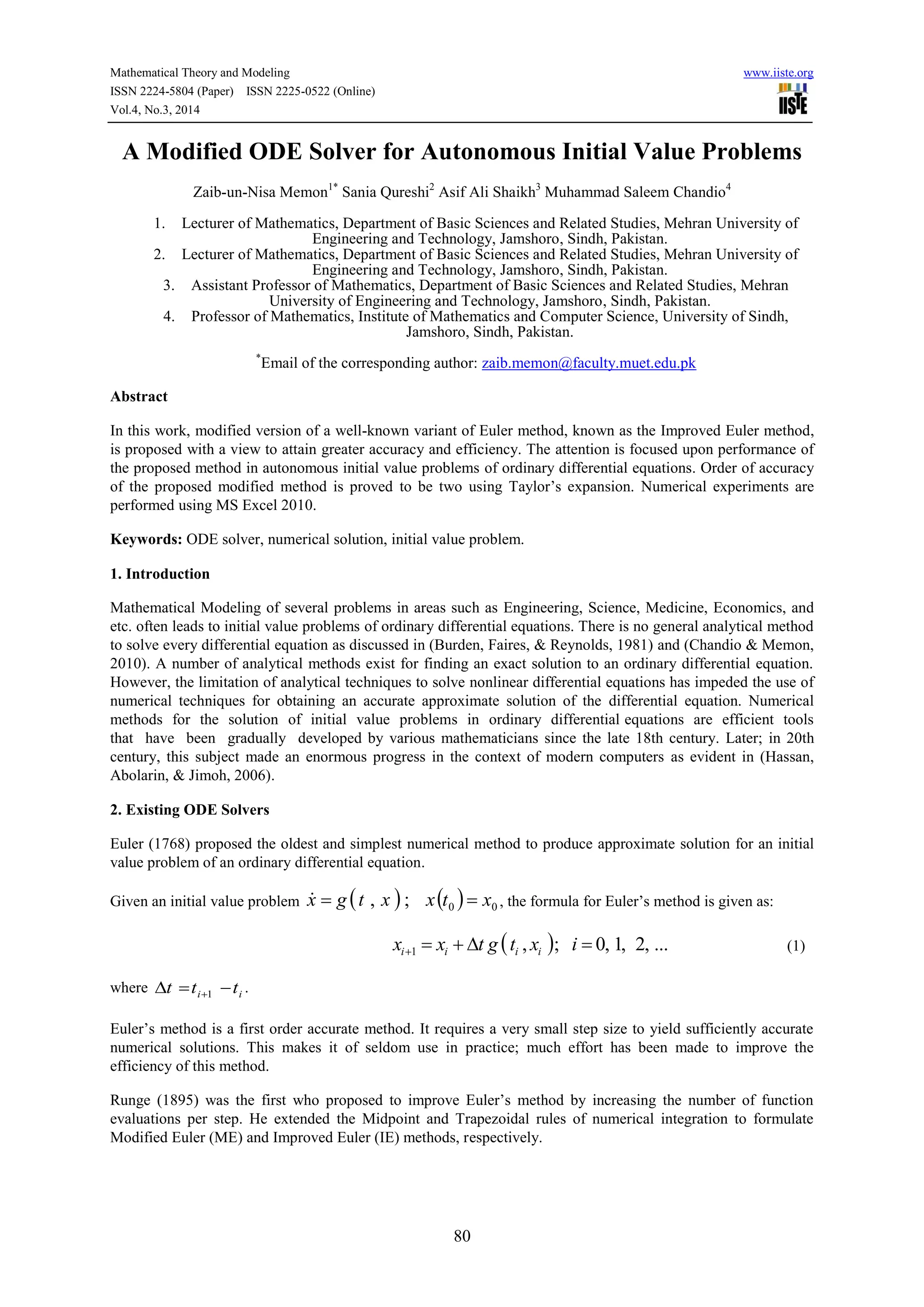
Euler (1768) proposed the oldest and simplest numerical method to produce approximate solution for an initial
value problem of an ordinary differential equation.
Given an initial value problem     00;, xtxxtgx  , the formula for Euler’s method is given as:
  ...,2,1,0;,1  ixtgtxx iiii (1)
where ii ttt  1 .
Euler’s method is a first order accurate method. It requires a very small step size to yield sufficiently accurate
numerical solutions. This makes it of seldom use in practice; much effort has been made to improve the
efficiency of this method.
Runge (1895) was the first who proposed to improve Euler’s method by increasing the number of function
evaluations per step. He extended the Midpoint and Trapezoidal rules of numerical integration to formulate
Modified Euler (ME) and Improved Euler (IE) methods, respectively.
Mathematical Theory and Modeling www.iiste.org
ISSN 2224-5804 (Paper) ISSN 2225-0522 (Online)
Vol.4, No.3, 2014
81
 




 


 iiiiii xtg
t
x
t
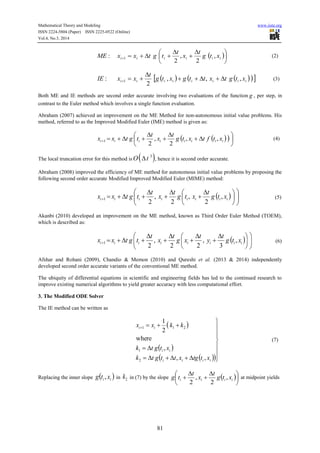
tgtxxME ,
2
,
2
: 1
(2)
     iiiiiiii xtgtxttgxtg
t
xxIE ,,,
2
: 1 

 (3)
Both ME and IE methods are second order accurate involving two evaluations of the function g , per step, in
contrast to the Euler method which involves a single function evaluation.
Abraham (2007) achieved an improvement on the ME Method for non-autonomous initial value problems. His
method, referred to as the Improved Modified Euler (IME) method is given as:
   









 iiiiiiii xtftxtg
t
x
t
tgtxx ,,
2
,
2
1
(4)
The local truncation error for this method is  3
tO  , hence it is second order accurate.
Abraham (2008) improved the efficiency of ME method for autonomous initial value problems by proposing the
following second order accurate Modified Improved Modified Euler (MIME) method:
  










 




 iiiiiiii xtg
t
xtg
t
x
t
tgtxx ,
2
,
2
,
2
1 (5)
Akanbi (2010) developed an improvement on the ME method, known as Third Order Euler Method (TOEM),
which is described as:
  










 






 iiiiiiii xtg
t
y
t
xg
t
x
t
tgtxx ,
3
,
22
,
2
1 (6)
Afshar and Rohani (2009), Chandio & Memon (2010) and Qureshi et al. (2013 & 2014) independently
developed second order accurate variants of the conventional ME method.
The ubiquity of differential equations in scientific and engineering fields has led to the continued research to
improve existing numerical algorithms to yield greater accuracy with less computational effort.
3. The Modified ODE Solver
The IE method can be written as
 
 
  










iiii
ii
ii
xttgxttgtk
xtgtk
kkxx
,,
,
where
2
1
2
1
211
(7)
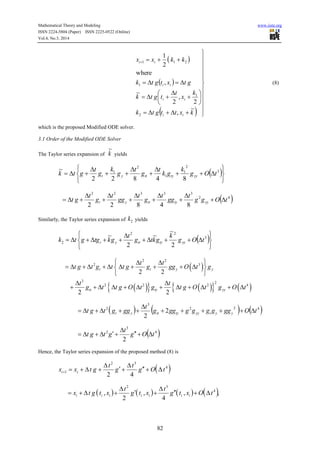
Replacing the inner slope  ii xtg , in 2k in (7) by the slope  




 


 iiii xtg
t
x
t
tg ,
2
,
2
at midpoint yields
Mathematical Theory and Modeling www.iiste.org
ISSN 2224-5804 (Paper) ISSN 2225-0522 (Online)
Vol.4, No.3, 2014
82
 
 
  






















kxttgtk
k
x
t
tgtk
gtxtgtk
kkxx
ii
ii
ii
ii
~
,
2
,
2
~
,
where
2
1
2
1
1
211
(8)
which is the proposed Modified ODE solver.
3.1 Order of the Modified ODE Solver
The Taylor series expansion of k
~
yields
 












 3
2
1
1
2
1
84822
~
tOg
k
gk
t
g
t
g
k
g
t
gtk yytyttyt
 42
33322
84822
tOgg
t
gg
t
g
t
gg
t
g
t
gt yytyttyt 










Similarly, the Taylor series expansion of 2k yields
 








 3
22
2
2
~
~
2
~
tOg
k
gktg
t
gktggtk yytyttyt
 
       
2 2
2 3
3 2
2 2 2 4
2 2
2 2
t t y y
tt ty yy
t t
t g t g t t g g gg O t g
t t
g t t g O t g t g O t g O t
  
           
 
 
           
     422
3
2
2
2
tOggggggggg
t
gggtgt yytyytyttyt 


 4
3
2
2
tOg
t
gtgt 


Hence, the Taylor series expansion of the proposed method (8) is
 4
32
1
42
tOg
t
g
t
gtxx ii 




       ,,
4
,
2
, 4
32
tOxtg
t
xtg
t
xtgtx iiiiiii 




Mathematical Theory and Modeling www.iiste.org
ISSN 2224-5804 (Paper) ISSN 2225-0522 (Online)
Vol.4, No.3, 2014
83
And, that of the exact solution  1itx is
           4
32
1
62
tOtx
t
tx
t
txttxtx iiiii 




            4
32
,
6
,
2
, tOtxtg
t
txtg
t
txtgttx iiiiiii 




Assuming   ii xtx  , the local truncation error  of the proposed method is
     34
3
11
12
tOtOg
t
txx ii 

 
Hence, the proposed method is second order accurate.
4. Numerical Experiments
In this section; first and second order initial value problems are chosen to analyze performance of the proposed
modified ODE solver with respect to absolute errors taking step size of 0.1 over the interval [0, 4]; and the
number of function evaluations involved for a given error tolerance at 4t .
Problem 01 Consider the IVP:     10;2  xxxx which possesses the analytical solution:
  t
e
tx 2
1
2

 .
Figure 1. Error comparison at 1.0t Figure 2. Function evaluations vs. error tolerance at
4t
Mathematical Theory and Modeling www.iiste.org
ISSN 2224-5804 (Paper) ISSN 2225-0522 (Online)
Vol.4, No.3, 2014
84
Problem 02   ,20;096  xxxx    30 x Exact solution:     t
ettx 3
32 
 .
Figure 3. Error comparison at 1.0t Figure 4. Function evaluations vs. error tolerance at
4t
Problem 03 Consider the IVP:     20,10;3  xxxx  with exact solution:    4
15.0  ttx .
Figure 5. Error comparison at 1.0t Figure 6. Function evaluations vs. error tolerance at
4t
5. Discussion & Conclusion
In this paper a modified version of IE method is proposed which is found to be second order accurate. The
proposed method is tested on three autonomous initial value problems. Figures 1, 3 and 5 show that the proposed
scheme yields smaller errors (absolute) than both IE and ME methods at sufficiently large step size of 0.1.
Moreover, it is observed from figures 2, 4 and 6 that for the specified error tolerance (in terms of absolute error)
at 4t , the proposed scheme takes into account the number of function evaluations less than or equal to that
taken by the IE method; thus depicting the faster convergence of the proposed scheme.
6. Future Work
Future work will be devoted to testing the performance of proposed method on non-autonomous initial value
problems along with a comprehensive analysis of the scheme with respect to the critical issues including
convergence, consistency, stability and error bounds.
References
Abraham, O. (2007). Improving the Modified Euler method. Leonardo Journal of Sciences(10), 1-7.
Abraham, O. (2008). Improving the Improved Modified Euler Method for Better Performance on
Autonomous Initial Value Problems. Leonardo Journal of Sciences(12), 57-66.
Mathematical Theory and Modeling www.iiste.org
ISSN 2224-5804 (Paper) ISSN 2225-0522 (Online)
Vol.4, No.3, 2014
85
Afshar, M. H., & Rohani, M. (2009). Embedded Modified Euler Method: an efficient and accurate
model. Proceedings of the Institution of Civil Engineers Water Management, 162, pp. 199-
209.
Akanbi, M. (2010). A Third Order Euler Method For Numerical Solution Of Ordinary Differential
Equations. ARPN Journal of Engineering and Applied Sciences, 5(8), 42-49.
Burden, R. L., Faires, J. D., & Reynolds, A. C. (1981). Numerical Analysis (2nd ed.). Boston: Prindle,
Weber & Schmidt.
Chandio, M. S., & Memon, A. G. (2010). Improving the efficiency of Heun's method. Sindh Univ.
Res. Jour. (Sci. Ser.), 42(2), 85-88.
Euler, L. (1768). Institutiones calculi integralis. Volumen Primum, Opera Omnia, 11.
Hassan, A. B., Abolarin, M. S., & Jimoh, O. H. (2006). The Application of Visual Basic Computer
Programming Language to Simulate Numerical Iterations. Australian Journal of Technology,
10(1), 109-119.
Qureshi, S., Memon, Z., Shaikh, A. A., & Chandio, M. S. (2013). On the Construction and
Comparison of an Explicit Iterative Algorithm with nonstandard Finite Difference Schemes.
Mathematical Theory and Modelling, 3(13), 78-87.
Qureshi, S., Shaikh, A. A., Memon, Z., & Chandio, M. S. (2014). Analysis of Accuracy, Stability,
Consistency and Convergence of an Explicit Iterative Algorithm. Mathematical Theory and
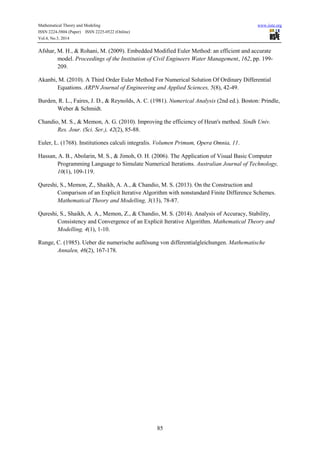
Modelling, 4(1), 1-10.
unge, . ). eber die numerische aufl sung von differentialgleichungen. Mathematische
Annalen, 46(2), 167-178.

A modified ode solver for autonomous initial value problems

  • 1.
    Mathematical Theory andModeling www.iiste.org ISSN 2224-5804 (Paper) ISSN 2225-0522 (Online) Vol.4, No.3, 2014 80 A Modified ODE Solver for Autonomous Initial Value Problems Zaib-un-Nisa Memon1* Sania Qureshi2 Asif Ali Shaikh3 Muhammad Saleem Chandio4 1. Lecturer of Mathematics, Department of Basic Sciences and Related Studies, Mehran University of Engineering and Technology, Jamshoro, Sindh, Pakistan. 2. Lecturer of Mathematics, Department of Basic Sciences and Related Studies, Mehran University of Engineering and Technology, Jamshoro, Sindh, Pakistan. 3. Assistant Professor of Mathematics, Department of Basic Sciences and Related Studies, Mehran University of Engineering and Technology, Jamshoro, Sindh, Pakistan. 4. Professor of Mathematics, Institute of Mathematics and Computer Science, University of Sindh, Jamshoro, Sindh, Pakistan. * Email of the corresponding author: zaib.memon@faculty.muet.edu.pk Abstract In this work, modified version of a well-known variant of Euler method, known as the Improved Euler method, is proposed with a view to attain greater accuracy and efficiency. The attention is focused upon performance of the proposed method in autonomous initial value problems of ordinary differential equations. Order of accuracy of the proposed modified method is proved to be two using Taylor’s expansion. Numerical experiments are performed using MS Excel 2010. Keywords: ODE solver, numerical solution, initial value problem. 1. Introduction Mathematical Modeling of several problems in areas such as Engineering, Science, Medicine, Economics, and etc. often leads to initial value problems of ordinary differential equations. There is no general analytical method to solve every differential equation as discussed in (Burden, Faires, & Reynolds, 1981) and (Chandio & Memon, 2010). A number of analytical methods exist for finding an exact solution to an ordinary differential equation. However, the limitation of analytical techniques to solve nonlinear differential equations has impeded the use of numerical techniques for obtaining an accurate approximate solution of the differential equation. Numerical methods for the solution of initial value problems in ordinary differential equations are efficient tools that have been gradually developed by various mathematicians since the late 18th century. Later; in 20th century, this subject made an enormous progress in the context of modern computers as evident in (Hassan, Abolarin, & Jimoh, 2006). 2. Existing ODE Solvers Euler (1768) proposed the oldest and simplest numerical method to produce approximate solution for an initial value problem of an ordinary differential equation. Given an initial value problem     00;, xtxxtgx  , the formula for Euler’s method is given as:   ...,2,1,0;,1  ixtgtxx iiii (1) where ii ttt  1 . Euler’s method is a first order accurate method. It requires a very small step size to yield sufficiently accurate numerical solutions. This makes it of seldom use in practice; much effort has been made to improve the efficiency of this method. Runge (1895) was the first who proposed to improve Euler’s method by increasing the number of function evaluations per step. He extended the Midpoint and Trapezoidal rules of numerical integration to formulate Modified Euler (ME) and Improved Euler (IE) methods, respectively.
  • 2.
    Mathematical Theory andModeling www.iiste.org ISSN 2224-5804 (Paper) ISSN 2225-0522 (Online) Vol.4, No.3, 2014 81            iiiiii xtg t x t tgtxxME , 2 , 2 : 1 (2)      iiiiiiii xtgtxttgxtg t xxIE ,,, 2 : 1    (3) Both ME and IE methods are second order accurate involving two evaluations of the function g , per step, in contrast to the Euler method which involves a single function evaluation. Abraham (2007) achieved an improvement on the ME Method for non-autonomous initial value problems. His method, referred to as the Improved Modified Euler (IME) method is given as:               iiiiiiii xtftxtg t x t tgtxx ,, 2 , 2 1 (4) The local truncation error for this method is  3 tO  , hence it is second order accurate. Abraham (2008) improved the efficiency of ME method for autonomous initial value problems by proposing the following second order accurate Modified Improved Modified Euler (MIME) method:                     iiiiiiii xtg t xtg t x t tgtxx , 2 , 2 , 2 1 (5) Akanbi (2010) developed an improvement on the ME method, known as Third Order Euler Method (TOEM), which is described as:                       iiiiiiii xtg t y t xg t x t tgtxx , 3 , 22 , 2 1 (6) Afshar and Rohani (2009), Chandio & Memon (2010) and Qureshi et al. (2013 & 2014) independently developed second order accurate variants of the conventional ME method. The ubiquity of differential equations in scientific and engineering fields has led to the continued research to improve existing numerical algorithms to yield greater accuracy with less computational effort. 3. The Modified ODE Solver The IE method can be written as                  iiii ii ii xttgxttgtk xtgtk kkxx ,, , where 2 1 2 1 211 (7) Replacing the inner slope  ii xtg , in 2k in (7) by the slope            iiii xtg t x t tg , 2 , 2 at midpoint yields
  • 3.
    Mathematical Theory andModeling www.iiste.org ISSN 2224-5804 (Paper) ISSN 2225-0522 (Online) Vol.4, No.3, 2014 82                              kxttgtk k x t tgtk gtxtgtk kkxx ii ii ii ii ~ , 2 , 2 ~ , where 2 1 2 1 1 211 (8) which is the proposed Modified ODE solver. 3.1 Order of the Modified ODE Solver The Taylor series expansion of k ~ yields                3 2 1 1 2 1 84822 ~ tOg k gk t g t g k g t gtk yytyttyt  42 33322 84822 tOgg t gg t g t gg t g t gt yytyttyt            Similarly, the Taylor series expansion of 2k yields            3 22 2 2 ~ ~ 2 ~ tOg k gktg t gktggtk yytyttyt           2 2 2 3 3 2 2 2 2 4 2 2 2 2 t t y y tt ty yy t t t g t g t t g g gg O t g t t g t t g O t g t g O t g O t                                     422 3 2 2 2 tOggggggggg t gggtgt yytyytyttyt     4 3 2 2 tOg t gtgt    Hence, the Taylor series expansion of the proposed method (8) is  4 32 1 42 tOg t g t gtxx ii             ,, 4 , 2 , 4 32 tOxtg t xtg t xtgtx iiiiiii     
  • 4.
    Mathematical Theory andModeling www.iiste.org ISSN 2224-5804 (Paper) ISSN 2225-0522 (Online) Vol.4, No.3, 2014 83 And, that of the exact solution  1itx is            4 32 1 62 tOtx t tx t txttxtx iiiii                  4 32 , 6 , 2 , tOtxtg t txtg t txtgttx iiiiiii      Assuming   ii xtx  , the local truncation error  of the proposed method is      34 3 11 12 tOtOg t txx ii     Hence, the proposed method is second order accurate. 4. Numerical Experiments In this section; first and second order initial value problems are chosen to analyze performance of the proposed modified ODE solver with respect to absolute errors taking step size of 0.1 over the interval [0, 4]; and the number of function evaluations involved for a given error tolerance at 4t . Problem 01 Consider the IVP:     10;2  xxxx which possesses the analytical solution:   t e tx 2 1 2   . Figure 1. Error comparison at 1.0t Figure 2. Function evaluations vs. error tolerance at 4t
  • 5.
    Mathematical Theory andModeling www.iiste.org ISSN 2224-5804 (Paper) ISSN 2225-0522 (Online) Vol.4, No.3, 2014 84 Problem 02   ,20;096  xxxx    30 x Exact solution:     t ettx 3 32   . Figure 3. Error comparison at 1.0t Figure 4. Function evaluations vs. error tolerance at 4t Problem 03 Consider the IVP:     20,10;3  xxxx  with exact solution:    4 15.0  ttx . Figure 5. Error comparison at 1.0t Figure 6. Function evaluations vs. error tolerance at 4t 5. Discussion & Conclusion In this paper a modified version of IE method is proposed which is found to be second order accurate. The proposed method is tested on three autonomous initial value problems. Figures 1, 3 and 5 show that the proposed scheme yields smaller errors (absolute) than both IE and ME methods at sufficiently large step size of 0.1. Moreover, it is observed from figures 2, 4 and 6 that for the specified error tolerance (in terms of absolute error) at 4t , the proposed scheme takes into account the number of function evaluations less than or equal to that taken by the IE method; thus depicting the faster convergence of the proposed scheme. 6. Future Work Future work will be devoted to testing the performance of proposed method on non-autonomous initial value problems along with a comprehensive analysis of the scheme with respect to the critical issues including convergence, consistency, stability and error bounds. References Abraham, O. (2007). Improving the Modified Euler method. Leonardo Journal of Sciences(10), 1-7. Abraham, O. (2008). Improving the Improved Modified Euler Method for Better Performance on Autonomous Initial Value Problems. Leonardo Journal of Sciences(12), 57-66.
  • 6.
    Mathematical Theory andModeling www.iiste.org ISSN 2224-5804 (Paper) ISSN 2225-0522 (Online) Vol.4, No.3, 2014 85 Afshar, M. H., & Rohani, M. (2009). Embedded Modified Euler Method: an efficient and accurate model. Proceedings of the Institution of Civil Engineers Water Management, 162, pp. 199- 209. Akanbi, M. (2010). A Third Order Euler Method For Numerical Solution Of Ordinary Differential Equations. ARPN Journal of Engineering and Applied Sciences, 5(8), 42-49. Burden, R. L., Faires, J. D., & Reynolds, A. C. (1981). Numerical Analysis (2nd ed.). Boston: Prindle, Weber & Schmidt. Chandio, M. S., & Memon, A. G. (2010). Improving the efficiency of Heun's method. Sindh Univ. Res. Jour. (Sci. Ser.), 42(2), 85-88. Euler, L. (1768). Institutiones calculi integralis. Volumen Primum, Opera Omnia, 11. Hassan, A. B., Abolarin, M. S., & Jimoh, O. H. (2006). The Application of Visual Basic Computer Programming Language to Simulate Numerical Iterations. Australian Journal of Technology, 10(1), 109-119. Qureshi, S., Memon, Z., Shaikh, A. A., & Chandio, M. S. (2013). On the Construction and Comparison of an Explicit Iterative Algorithm with nonstandard Finite Difference Schemes. Mathematical Theory and Modelling, 3(13), 78-87. Qureshi, S., Shaikh, A. A., Memon, Z., & Chandio, M. S. (2014). Analysis of Accuracy, Stability, Consistency and Convergence of an Explicit Iterative Algorithm. Mathematical Theory and Modelling, 4(1), 1-10. unge, . ). eber die numerische aufl sung von differentialgleichungen. Mathematische Annalen, 46(2), 167-178.