IOSR Journal of Mechanical and Civil Engineering (IOSR-JMCE)
e-ISSN: 2278-1684,p-ISSN: 2320-334X, Volume 12, Issue 3 Ver. II (May. - Jun. 2015), PP 16-23
www.iosrjournals.org
DOI: 10.9790/1684-12321623 www.iosrjournals.org 16 | Page
Experimental Study and Analysis of Various Machining Process
and Nickel coating on Mild Steel
Mohd Wajid ali1
, Dr.P.Sammaiah2
,N. Sudheer Kumar2
M.Tech Post Graduate Student
Dept. of Mechanical Engineering, SR Engineering College, Warangal, Telangana, India.
2
Professor, Dept. of Mechanical Engineering, SR Engineering College, Warangal, Telangana, India.
2
Asst. Professor. Dept. of Mechanical Engineering, SR Engineering College, Warangal, Telangana, India.
Abstract: Quality of surface is an important factor to decide the performance of a manufactured product.
Surface quality affect product performance like assembly fit, aesthetic appeal that a potential customer might
have for the product. For this study, it has been made of turning, surface Grinding, and Nickel coating process
on Mild steel rod. Developed for external cylindrical & internal cylindrical surface finishing on surface
grinding machine, has been used to test the surface roughness, mechanical properties, Micro structure hardness
test, salt spray testing. The two regimes of rough finishing and fine finishing have been characterized. A sharp
transition from rough to fine finishing occurs at a stone oscillation frequency. The objective of the present work
is to evaluate the parametric study of surface finishing process. An experimental investigation to study the
performance of a surface finishing process by using turning process carbide tool and grinding process abrasive
stones and NI Coated surface finish. The effects of these parameters on surface finish of work-piece have been
investigated.
Keywords: Turning, Cylindrical Grinding, Nickel coating, Speed, Feed, Depth Of Cut, Surface Roughness,
Micro Structure, Hardness Test, Salt Spray.
I. Introduction
Improving the appearance of a finished product for purely aesthetic reasons can be important because it
often increases the salability of the product [1]. The increased product performance and safety provided by
proper edge and surface finishing, hardness, microstructure, corrosion resistance is also important. The removal
of burrs and sharp edges improves safety for both the worker and product user by eliminating the possibility of
cuts and making parts easier to handle [2]. For critical components, the surface condition and edge geometry can
be a major influence on component performance and durability. From strictly an engineering point-of-view,
surface finishing is primarily good for one thing: preventing corrosion. Quality of surface is an important factor
to decide the performance of a manufactured product [3]. Surface quality affect product performance like
assembly fit, aesthetic appeal that a potential customer might have for the product. A surface is defined as the
exterior boundary of an object with its surroundings, which may be any other object, a fluid or space or
combination of these [4]. The surface encloses the object’s bulk mechanical and physical properties. A surface
is what we touch, when we held a manufactured object. Normally dimensions of the object are specified in its
drawing relating the various surfaces to each other. These nominal surfaces, representing the intended surface
contour of the manufactured part, are defined by line in the drawing [5].The nominal surfaces of the object are
represented by perfect straight lines, perfect circles, round holes, absolute perpendicularity and straightness. A
variety of processes are used to make the designed parts. In totality the manufacturing result is wide variations
in surface characteristics [6-7]. It is important to know the technology of surface generation. Only then the root
causes of deviations can be determined and fixed to get the good results.
II. Experimental Details:
2.1 Material Used:
Soft material: MILD STEEL (2062)
Grinding wheel: SiC (GRADE SIZE 60)
DIMENSIONS: L-50mm×70 OD×50 ID
GRADE C% Mn% S% P% Si% C.E%
A 0.23 1.5 0.05 0.05 - 0.42
B 0.22 1.5 0.045 0.045 0.04 0.41
C 0.2 1.5 0.04 0.04 0.4 0.39
Table 1. Compositions at different grades
Experimental Study and Analysis of Various Machining Process and Nickel coating on Mild Steel
DOI: 10.9790/1684-12321623 www.iosrjournals.org 17 | Page
2.2 Experimental Procedure:
A grinding wheel is an expendable wheel used for various grinding and abrasive machining operations.
It is generally made from a matrix of coarse abrasive particles pressed and bonded together to form a solid,
circular shape, various profiles and cross sections are available depending on the intended usage for the wheel.
Grinding wheels may also be made from a solid steel or aluminum disc with particles bonded to the surface.
Figure 1. Cylindrical grinding machine
WHEEL
SPEED
Rpm
WORK
SPEED
Rpm
FEED
mm/Re
v
DOC
Mm
Cutting
speed
m/min
SURFACE
ROUGHNESS
Ra µm
Grain size
Mesh/inch
2500 250 0.15 0.02 549.77 0.248 60
2500 250 0.16 0.02 549.77 0.256 60
2500 250 0.17 0.04 549.77 0.256 60
2500 250 0.11 0.04 549.77 0.238 60
Table 2. Variation of grain size with respect to wheel speed
Turning process: Turning is the removal of metal from the outer diameter of a rotating cylindrical work piece. Turning is
used to reduce the diameter of the work piece, usually to a specified dimension, and to produce a smooth finish on the metal.
Often the work piece will be turned so that adjacent sections have different diameters [8]. The need for selecting and
implementing optimal machining conditions and most suitable cutting tools has been felt very important over few decades.
Surface roughness has become the most significant technical requirement and it is an index of product quality. In order to
develop a surface roughness model and optimize, it is essential to understand the current status of work in this area.
S.No RPM F.R DOC Cutting speed m/min µm RA
1 500 0.10 0.5 109.95 1.67
2 500 0.15 1 109.95 1.94
3 500 0.2 1.5 109.95 2.12
4 800 0.10 0.5 175.92 1.61
5 800 0.15 1 175.92 1.80
6 800 0.2 1.5 175.92 2.25
Table 3 Cutting speed with respect to surface roughness
Surface Methodology can be defined as a statistical method that uses quantitative data from appropriate
experiments to determine the dependent parameters such as, surface roughness, tool life with independent
parameters [9].
Figure 2. Surface roughness tester
Cutting speed, feed rate and depth of cut, in a turning and cylindrical grinding process. The graphical
representations of these equations are called response surfaces, which can be used to describe the individual and
Experimental Study and Analysis of Various Machining Process and Nickel coating on Mild Steel
DOI: 10.9790/1684-12321623 www.iosrjournals.org 18 | Page
cumulative effect of the input variables on the response and to determine the mutual interactions between the
input variables and their subsequent effect on the response.
SAMPLE DESCRIPTION OBSERVATION
VALUE
MATERIAL
SPECIFICATION
Cylindrical piece (grinding) 0.2 µm Ra IS 2062
Cylindrical piece (Turning) 1.6 µm Ra IS 2062
Cylindrical piece (NI Coated) 0.05 µm Ra EN-9
Table 4 surface roughness for various machining process
Vickers Hardness:
The Vickers Hardness Test on anodic coatings is carried ut on the edge of the film so that the effect of
the underlying, soft, aluminum is eliminated. This requires a section of the sample to be made, which is then
suitably mounted (usually in a resin) and subsequently polished. The prepared sample is then put on the tester's
table and the operator uses it's microscope to find the anodic film. Once a target area is found the test can begin.
This uses a pyramid shaped diamond tip, which bears on the target under a given load.
Material
specification
IS 2062
Observed values in HV
Impression
1
Impression
2
Impression
3
Avg
Mild Steel 158 157 158 157.67
Table 5. Hardness for cylinder piece during grinding process
Material
specification
Observed values in HV
Impression 1 Impression2 Impression 3 Avg
Mild Steel IS
2062
251 254 254 253.00
Table 6. Hardness for cylinder piece during turning process
Material specification Observed values in HV
Impression 1 Impression 2 Impression 3 Avg
Mild Steel IS 2062 655 644 644 647.67 HV 5
Mild Steel IS 2062 613 606 620 613.00 HV 10
Table 7 Hardness for cylinder piece during coating process
SALT SPARY TEST CHAMBER
Duration: 1 hour
Temperature: 350
c
Salt solution: 5 % 1 of Nacl solution
SPRAY TEST (FOG)
Cylindrical Piece
MATERIAL SPECIFICATION: IS 2062
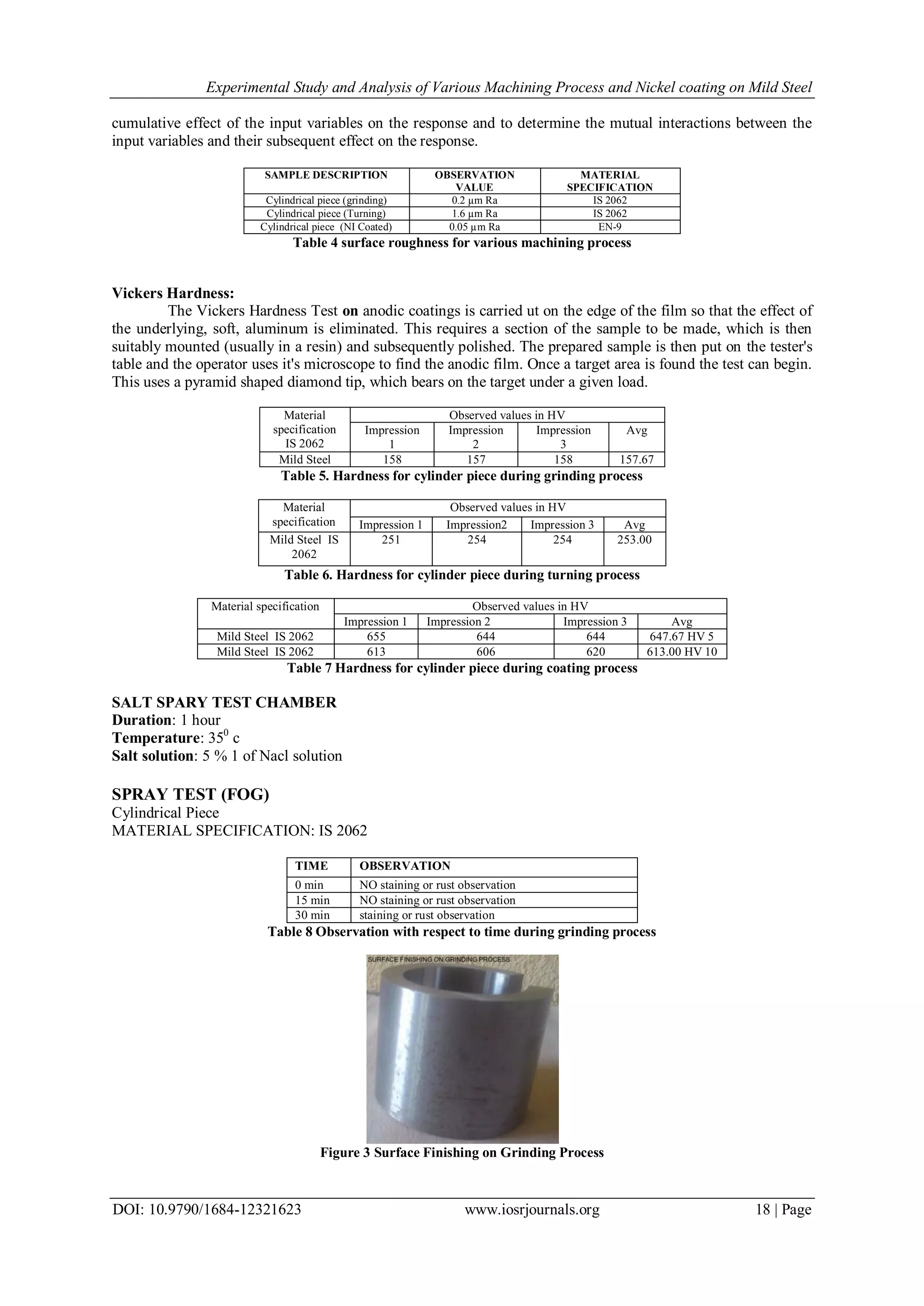
TIME OBSERVATION
0 min NO staining or rust observation
15 min NO staining or rust observation
30 min staining or rust observation
Table 8 Observation with respect to time during grinding process
Figure 3 Surface Finishing on Grinding Process
Experimental Study and Analysis of Various Machining Process and Nickel coating on Mild Steel
DOI: 10.9790/1684-12321623 www.iosrjournals.org 19 | Page
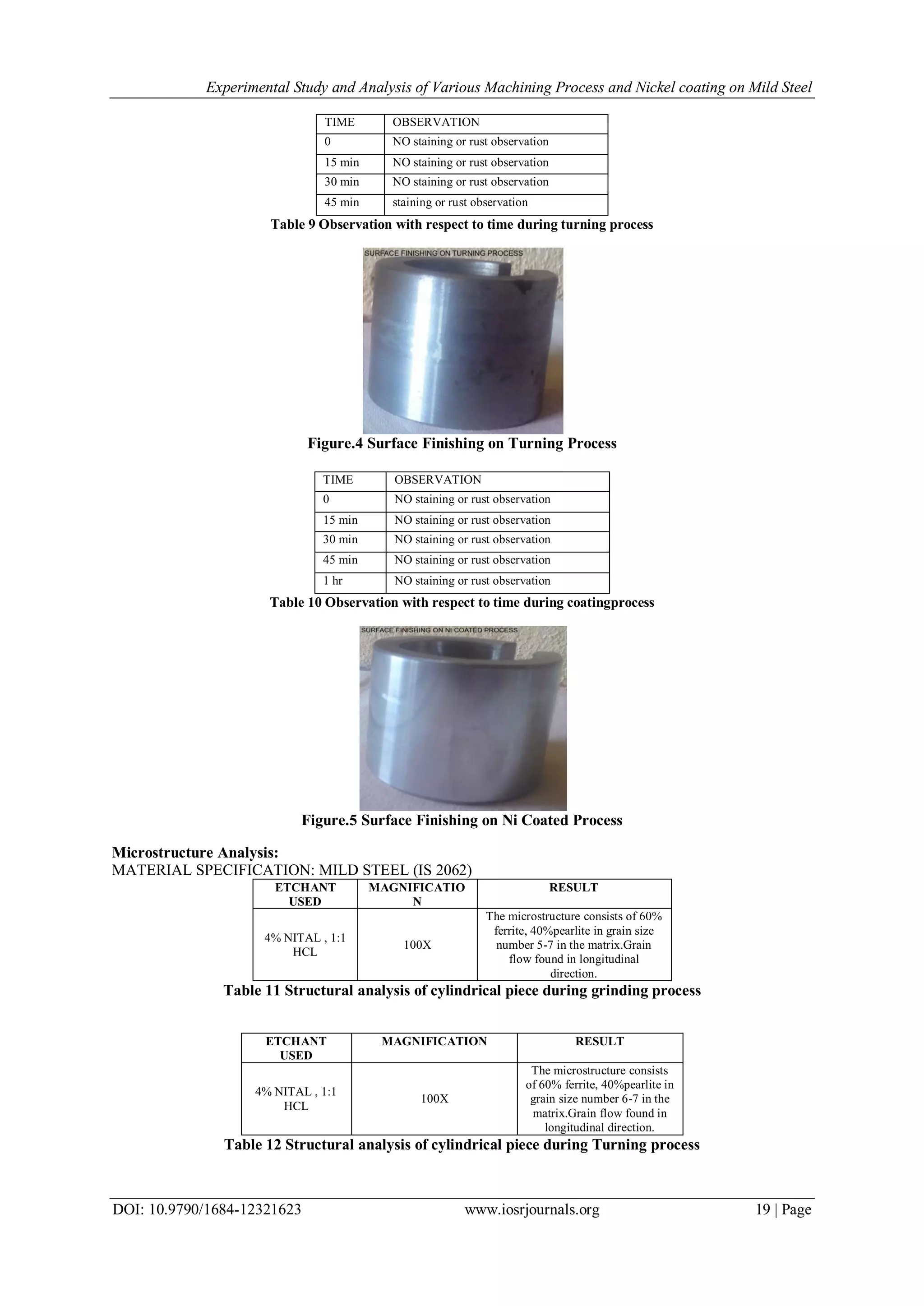
TIME OBSERVATION
0 NO staining or rust observation
15 min NO staining or rust observation
30 min NO staining or rust observation
45 min staining or rust observation
Table 9 Observation with respect to time during turning process
Figure.4 Surface Finishing on Turning Process
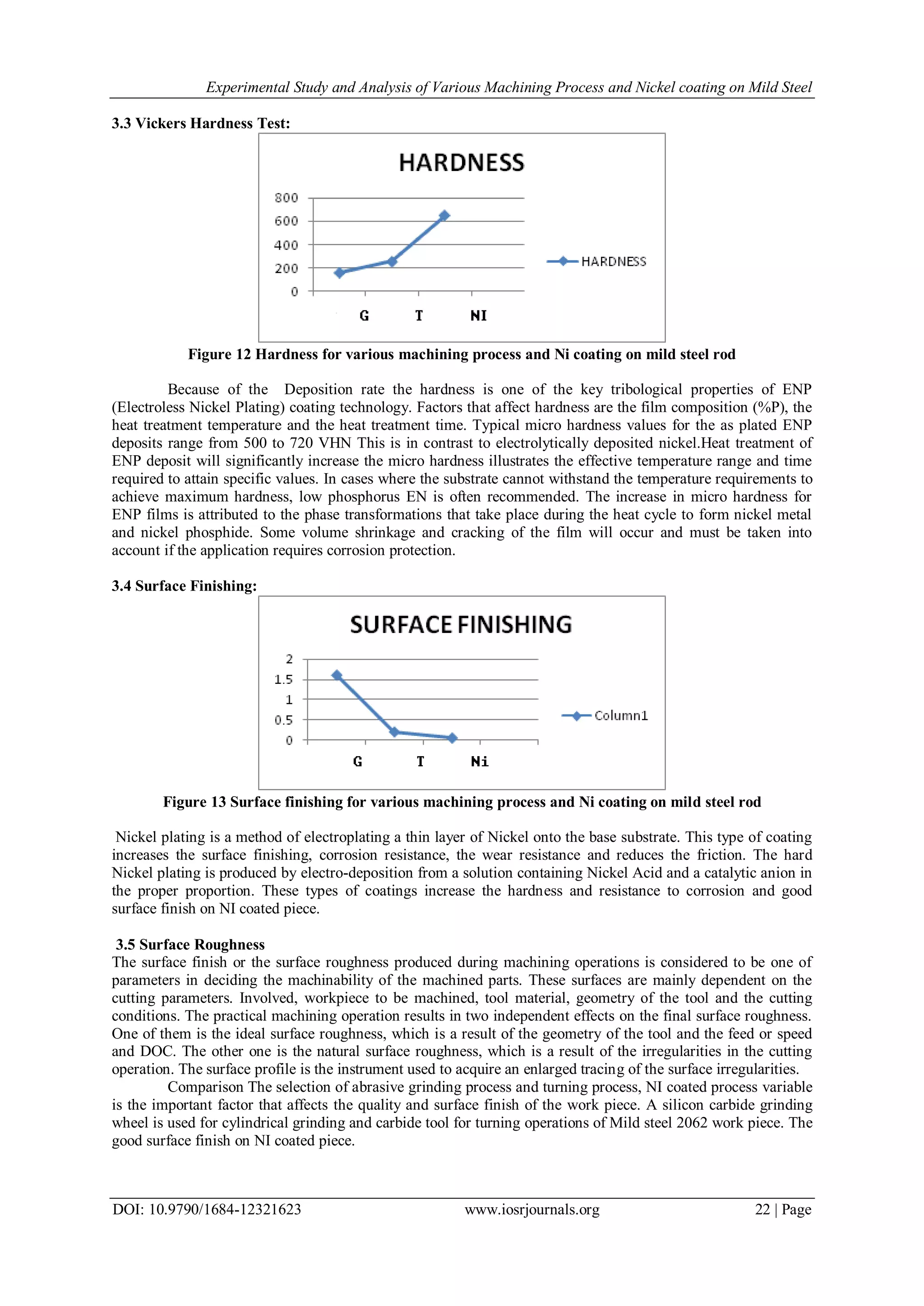
TIME OBSERVATION
0 NO staining or rust observation
15 min NO staining or rust observation
30 min NO staining or rust observation
45 min NO staining or rust observation
1 hr NO staining or rust observation
Table 10 Observation with respect to time during coatingprocess
Figure.5 Surface Finishing on Ni Coated Process
Microstructure Analysis:
MATERIAL SPECIFICATION: MILD STEEL (IS 2062)
ETCHANT
USED
MAGNIFICATIO
N
RESULT
4% NITAL , 1:1
HCL
100X
The microstructure consists of 60%
ferrite, 40%pearlite in grain size
number 5-7 in the matrix.Grain
flow found in longitudinal
direction.
Table 11 Structural analysis of cylindrical piece during grinding process
ETCHANT
USED
MAGNIFICATION RESULT
4% NITAL , 1:1
HCL
100X
The microstructure consists
of 60% ferrite, 40%pearlite in
grain size number 6-7 in the
matrix.Grain flow found in
longitudinal direction.
Table 12 Structural analysis of cylindrical piece during Turning process
Experimental Study and Analysis of Various Machining Process and Nickel coating on Mild Steel
DOI: 10.9790/1684-12321623 www.iosrjournals.org 20 | Page
ETCHANT
USED
MAGNIFICATION RESULT
4% NITAL , 1:1
HCL
100X
The microstructure consists
of 60% ferrite, 40%pearlite
in grain size number 6-7 in
the matrix.
Grain flow found in
longitudinal direction.
Table 13 Structural analysis of cylindrical piece during Coating process
III. Result And Discussions:
3.1 grinding Process:
Cutting speed calculation
V=πDN/1000=π.70.2500/1000=549.77 m/min
Figure 6 surface roughness with respect to feed rate
Surface roughness at various feed rates as shown in the figure 6. During cylindrical Grinding process, as the feed
rate increases the surface roughness also increases. But the surface roughness value 0.238 Ra indicated as the optimum
situation in terms of Surface Roughness values.
Figure 7 Surface roughness with respect to depth of cut
Surface roughness at various depth of cut as shown in the figure 7. As the depth of cut increases its shows better
surface finish. Also its shows uniform surface roughness values as the depth of cut increases.
Figure 8 surface roughness at various speeds
Surface roughness at various speeds as shown in the figure 8. As speed increases the surface roughness is better
compare to the depth of cut at various conditions.
Experimental Study and Analysis of Various Machining Process and Nickel coating on Mild Steel
DOI: 10.9790/1684-12321623 www.iosrjournals.org 21 | Page
3.2 Turning process:
Cutting speed calculation:
V=πDN/1000=π.70.500/1000=109.95 m/min
=π.70.800/1000=175.92 m/min
Figure 9 Surface roughness at various feed rate during turning process
During turning Process feed rate decreases its shows good surface finish. For Feed Rate, the surface
roughness value 1.61Ra indicated as the optimum situation in terms of Surface Roughness values.
Figure 10 Surface roughness at various depth of cut during turning process
From the observation it is clear that as the depth of cut decreases the surface roughness is better. For
depth of cut, the surface roughness value 1.61Ra indicated as the optimum situation in terms of Surface
Roughness values.
Figure 11 Surface roughness at various speeds during turning process
During this process as the speed increases the surface roughness shows uniform throughout the process due to
more speed and fast material removal rate, due to this the surface roughness is better at high speed.
Experimental Study and Analysis of Various Machining Process and Nickel coating on Mild Steel
DOI: 10.9790/1684-12321623 www.iosrjournals.org 22 | Page
3.3 Vickers Hardness Test:
Figure 12 Hardness for various machining process and Ni coating on mild steel rod
Because of the Deposition rate the hardness is one of the key tribological properties of ENP
(Electroless Nickel Plating) coating technology. Factors that affect hardness are the film composition (%P), the
heat treatment temperature and the heat treatment time. Typical micro hardness values for the as plated ENP
deposits range from 500 to 720 VHN This is in contrast to electrolytically deposited nickel.Heat treatment of
ENP deposit will significantly increase the micro hardness illustrates the effective temperature range and time
required to attain specific values. In cases where the substrate cannot withstand the temperature requirements to
achieve maximum hardness, low phosphorus EN is often recommended. The increase in micro hardness for
ENP films is attributed to the phase transformations that take place during the heat cycle to form nickel metal
and nickel phosphide. Some volume shrinkage and cracking of the film will occur and must be taken into
account if the application requires corrosion protection.
3.4 Surface Finishing:
Figure 13 Surface finishing for various machining process and Ni coating on mild steel rod
Nickel plating is a method of electroplating a thin layer of Nickel onto the base substrate. This type of coating
increases the surface finishing, corrosion resistance, the wear resistance and reduces the friction. The hard
Nickel plating is produced by electro-deposition from a solution containing Nickel Acid and a catalytic anion in
the proper proportion. These types of coatings increase the hardness and resistance to corrosion and good
surface finish on NI coated piece.
3.5 Surface Roughness
The surface finish or the surface roughness produced during machining operations is considered to be one of
parameters in deciding the machinability of the machined parts. These surfaces are mainly dependent on the
cutting parameters. Involved, workpiece to be machined, tool material, geometry of the tool and the cutting
conditions. The practical machining operation results in two independent effects on the final surface roughness.
One of them is the ideal surface roughness, which is a result of the geometry of the tool and the feed or speed
and DOC. The other one is the natural surface roughness, which is a result of the irregularities in the cutting
operation. The surface profile is the instrument used to acquire an enlarged tracing of the surface irregularities.
Comparison The selection of abrasive grinding process and turning process, NI coated process variable
is the important factor that affects the quality and surface finish of the work piece. A silicon carbide grinding
wheel is used for cylindrical grinding and carbide tool for turning operations of Mild steel 2062 work piece. The
good surface finish on NI coated piece.
Experimental Study and Analysis of Various Machining Process and Nickel coating on Mild Steel
DOI: 10.9790/1684-12321623 www.iosrjournals.org 23 | Page
Figure No.9 surface finishing process
IV. Conclusions
On the basis of this investigation, the following conclusions can be drawn. .
1. Thus in our project, we have performed a detailed experiment process of the cutting parameters influencing
the surface roughness on a metal after Turning, Grinding, NI coated Process.
2. In our work process we have identified the values of the optimum cutting parameters to get the minimum
Surface roughness.
3. We have experimented with various combinations of the three cutting parameters i.e. Spindle Speed, Depth of
Cut and Feed Rate.
4. We have arrived on a conclusion that the minimum surface roughness in Mild steel is obtained when the
Spindle speed is (2500 rpm approx.), Depth of cut and Feed Rate are minimum (i.e 0.04 mm and 0.11 mm
respectively).
5. The input parameters like speed of grinding, feed, has a significant effect on surface roughness, whereas
depth of cut has the least effect on surface roughness of Mild steel.
6. The optimized minimum surface roughness is 0.238 μm that is about 78% of the initial value.
7. It was found that good surface finish is obtained during the cylindrical grinding process with optimum
grinding conditions.
8. Cutting Speed, Feed Rate and Depth of Cut plays an important role in the cylindrical grinding parameters.
9. The optimum parameters of cylindrical grinding process to overcome the problem of poor surface finishing.
10. Close tolerance can be achieved.
11. Increase in cutting parameters affects the vibration of the grinding machine, grinding wheel, more metal
removal and excessive heat on the work piece. The above causes will results in poor surface finish. This study is
valuable for the Researchers to develop their basic knowledge about fundamental methodology and procedures
are conducted.
12. Analysis is done for the obtained values and it is found that the surface roughness increases with increase in
the depth of cut and with increase in the feed rate.
13. And the surface roughness decrease slightly by increasing the speed. It is found that the feed and depth of
cut is the most affecting factor for surface roughness. Taguchi method has been adopted for the design of
experiments and Optimization of the surface roughness was done using Experimental Tested and Predictive
equation was obtained. A confirmation test was then performed which depicted that the selected parameters and
predictive equation were accurate to within the limits of the measurement instrument.
Acknowledgements
The authors would like to thank them authorities of SR Engineering College‐Warangal, Jyothi Spectro Analysis
Laboratory‐Hyderabad, for providing the facilities to carry out this work.
References
[1]. V. Pallavi, Anoop kumarandT. Mohandas (2012). Optimization of turning parameters for surface roughness using taguchi method.
International Journal of Mechanical Engineering. Vol. 5 : Issue 2.
[2]. Surinder kumar, Meenu and P.S.Satsangi (2012). A genetic algorithmic approach for optimization of surface roughness prediction
model in turning using UD-GFRP composite. Indian Journal of Engineering and Materials Sciences. Vol. 19, 386-396
[3]. S. Thamizhmanii, S. Saparudin, S. Hasan,2007, “Analyses of Surface Roughness by Turning process using Taguchi method”.
Journal of Achievements in Materials and Manufact uring Engineering, Volume 20 Issues 1-2 January-February 2007, pp.503-506.
[4]. 6. Raviraj Shetty, R. Pai, V. Kamathand S. S. Rao, 2008, “Study On Surface Roughness Minimization In Turning Of Dracs Using
Surface Roughness Methodology And Taguchi Under Pressured Steam Jet Approach”. ARPN Journal of Engineering and Applied
Sciences (ISSN: 1819-6608) VOL. 3, NO. 1, February 2008, pp.59-67.
[5]. J. A. Di Bari, “Electrodeposition of nickel,” in Modern Electroplating, M. Schlesinger and M. Paunovic, Eds., John Wiley and Sons,
2000.
[6]. W. Lu, D. Zuo, M. Wang, and F. Xu, “Analysis of interlayer between mild steel and NI ,” Key Engineering Materials, vol. 375-376,
pp. 92–96, 2008. View at Scopus

B012321623

  • 1.
    IOSR Journal ofMechanical and Civil Engineering (IOSR-JMCE) e-ISSN: 2278-1684,p-ISSN: 2320-334X, Volume 12, Issue 3 Ver. II (May. - Jun. 2015), PP 16-23 www.iosrjournals.org DOI: 10.9790/1684-12321623 www.iosrjournals.org 16 | Page Experimental Study and Analysis of Various Machining Process and Nickel coating on Mild Steel Mohd Wajid ali1 , Dr.P.Sammaiah2 ,N. Sudheer Kumar2 M.Tech Post Graduate Student Dept. of Mechanical Engineering, SR Engineering College, Warangal, Telangana, India. 2 Professor, Dept. of Mechanical Engineering, SR Engineering College, Warangal, Telangana, India. 2 Asst. Professor. Dept. of Mechanical Engineering, SR Engineering College, Warangal, Telangana, India. Abstract: Quality of surface is an important factor to decide the performance of a manufactured product. Surface quality affect product performance like assembly fit, aesthetic appeal that a potential customer might have for the product. For this study, it has been made of turning, surface Grinding, and Nickel coating process on Mild steel rod. Developed for external cylindrical & internal cylindrical surface finishing on surface grinding machine, has been used to test the surface roughness, mechanical properties, Micro structure hardness test, salt spray testing. The two regimes of rough finishing and fine finishing have been characterized. A sharp transition from rough to fine finishing occurs at a stone oscillation frequency. The objective of the present work is to evaluate the parametric study of surface finishing process. An experimental investigation to study the performance of a surface finishing process by using turning process carbide tool and grinding process abrasive stones and NI Coated surface finish. The effects of these parameters on surface finish of work-piece have been investigated. Keywords: Turning, Cylindrical Grinding, Nickel coating, Speed, Feed, Depth Of Cut, Surface Roughness, Micro Structure, Hardness Test, Salt Spray. I. Introduction Improving the appearance of a finished product for purely aesthetic reasons can be important because it often increases the salability of the product [1]. The increased product performance and safety provided by proper edge and surface finishing, hardness, microstructure, corrosion resistance is also important. The removal of burrs and sharp edges improves safety for both the worker and product user by eliminating the possibility of cuts and making parts easier to handle [2]. For critical components, the surface condition and edge geometry can be a major influence on component performance and durability. From strictly an engineering point-of-view, surface finishing is primarily good for one thing: preventing corrosion. Quality of surface is an important factor to decide the performance of a manufactured product [3]. Surface quality affect product performance like assembly fit, aesthetic appeal that a potential customer might have for the product. A surface is defined as the exterior boundary of an object with its surroundings, which may be any other object, a fluid or space or combination of these [4]. The surface encloses the object’s bulk mechanical and physical properties. A surface is what we touch, when we held a manufactured object. Normally dimensions of the object are specified in its drawing relating the various surfaces to each other. These nominal surfaces, representing the intended surface contour of the manufactured part, are defined by line in the drawing [5].The nominal surfaces of the object are represented by perfect straight lines, perfect circles, round holes, absolute perpendicularity and straightness. A variety of processes are used to make the designed parts. In totality the manufacturing result is wide variations in surface characteristics [6-7]. It is important to know the technology of surface generation. Only then the root causes of deviations can be determined and fixed to get the good results. II. Experimental Details: 2.1 Material Used: Soft material: MILD STEEL (2062) Grinding wheel: SiC (GRADE SIZE 60) DIMENSIONS: L-50mm×70 OD×50 ID GRADE C% Mn% S% P% Si% C.E% A 0.23 1.5 0.05 0.05 - 0.42 B 0.22 1.5 0.045 0.045 0.04 0.41 C 0.2 1.5 0.04 0.04 0.4 0.39 Table 1. Compositions at different grades
  • 2.
    Experimental Study andAnalysis of Various Machining Process and Nickel coating on Mild Steel DOI: 10.9790/1684-12321623 www.iosrjournals.org 17 | Page 2.2 Experimental Procedure: A grinding wheel is an expendable wheel used for various grinding and abrasive machining operations. It is generally made from a matrix of coarse abrasive particles pressed and bonded together to form a solid, circular shape, various profiles and cross sections are available depending on the intended usage for the wheel. Grinding wheels may also be made from a solid steel or aluminum disc with particles bonded to the surface. Figure 1. Cylindrical grinding machine WHEEL SPEED Rpm WORK SPEED Rpm FEED mm/Re v DOC Mm Cutting speed m/min SURFACE ROUGHNESS Ra µm Grain size Mesh/inch 2500 250 0.15 0.02 549.77 0.248 60 2500 250 0.16 0.02 549.77 0.256 60 2500 250 0.17 0.04 549.77 0.256 60 2500 250 0.11 0.04 549.77 0.238 60 Table 2. Variation of grain size with respect to wheel speed Turning process: Turning is the removal of metal from the outer diameter of a rotating cylindrical work piece. Turning is used to reduce the diameter of the work piece, usually to a specified dimension, and to produce a smooth finish on the metal. Often the work piece will be turned so that adjacent sections have different diameters [8]. The need for selecting and implementing optimal machining conditions and most suitable cutting tools has been felt very important over few decades. Surface roughness has become the most significant technical requirement and it is an index of product quality. In order to develop a surface roughness model and optimize, it is essential to understand the current status of work in this area. S.No RPM F.R DOC Cutting speed m/min µm RA 1 500 0.10 0.5 109.95 1.67 2 500 0.15 1 109.95 1.94 3 500 0.2 1.5 109.95 2.12 4 800 0.10 0.5 175.92 1.61 5 800 0.15 1 175.92 1.80 6 800 0.2 1.5 175.92 2.25 Table 3 Cutting speed with respect to surface roughness Surface Methodology can be defined as a statistical method that uses quantitative data from appropriate experiments to determine the dependent parameters such as, surface roughness, tool life with independent parameters [9]. Figure 2. Surface roughness tester Cutting speed, feed rate and depth of cut, in a turning and cylindrical grinding process. The graphical representations of these equations are called response surfaces, which can be used to describe the individual and
  • 3.
    Experimental Study andAnalysis of Various Machining Process and Nickel coating on Mild Steel DOI: 10.9790/1684-12321623 www.iosrjournals.org 18 | Page cumulative effect of the input variables on the response and to determine the mutual interactions between the input variables and their subsequent effect on the response. SAMPLE DESCRIPTION OBSERVATION VALUE MATERIAL SPECIFICATION Cylindrical piece (grinding) 0.2 µm Ra IS 2062 Cylindrical piece (Turning) 1.6 µm Ra IS 2062 Cylindrical piece (NI Coated) 0.05 µm Ra EN-9 Table 4 surface roughness for various machining process Vickers Hardness: The Vickers Hardness Test on anodic coatings is carried ut on the edge of the film so that the effect of the underlying, soft, aluminum is eliminated. This requires a section of the sample to be made, which is then suitably mounted (usually in a resin) and subsequently polished. The prepared sample is then put on the tester's table and the operator uses it's microscope to find the anodic film. Once a target area is found the test can begin. This uses a pyramid shaped diamond tip, which bears on the target under a given load. Material specification IS 2062 Observed values in HV Impression 1 Impression 2 Impression 3 Avg Mild Steel 158 157 158 157.67 Table 5. Hardness for cylinder piece during grinding process Material specification Observed values in HV Impression 1 Impression2 Impression 3 Avg Mild Steel IS 2062 251 254 254 253.00 Table 6. Hardness for cylinder piece during turning process Material specification Observed values in HV Impression 1 Impression 2 Impression 3 Avg Mild Steel IS 2062 655 644 644 647.67 HV 5 Mild Steel IS 2062 613 606 620 613.00 HV 10 Table 7 Hardness for cylinder piece during coating process SALT SPARY TEST CHAMBER Duration: 1 hour Temperature: 350 c Salt solution: 5 % 1 of Nacl solution SPRAY TEST (FOG) Cylindrical Piece MATERIAL SPECIFICATION: IS 2062 TIME OBSERVATION 0 min NO staining or rust observation 15 min NO staining or rust observation 30 min staining or rust observation Table 8 Observation with respect to time during grinding process Figure 3 Surface Finishing on Grinding Process
  • 4.
    Experimental Study andAnalysis of Various Machining Process and Nickel coating on Mild Steel DOI: 10.9790/1684-12321623 www.iosrjournals.org 19 | Page TIME OBSERVATION 0 NO staining or rust observation 15 min NO staining or rust observation 30 min NO staining or rust observation 45 min staining or rust observation Table 9 Observation with respect to time during turning process Figure.4 Surface Finishing on Turning Process TIME OBSERVATION 0 NO staining or rust observation 15 min NO staining or rust observation 30 min NO staining or rust observation 45 min NO staining or rust observation 1 hr NO staining or rust observation Table 10 Observation with respect to time during coatingprocess Figure.5 Surface Finishing on Ni Coated Process Microstructure Analysis: MATERIAL SPECIFICATION: MILD STEEL (IS 2062) ETCHANT USED MAGNIFICATIO N RESULT 4% NITAL , 1:1 HCL 100X The microstructure consists of 60% ferrite, 40%pearlite in grain size number 5-7 in the matrix.Grain flow found in longitudinal direction. Table 11 Structural analysis of cylindrical piece during grinding process ETCHANT USED MAGNIFICATION RESULT 4% NITAL , 1:1 HCL 100X The microstructure consists of 60% ferrite, 40%pearlite in grain size number 6-7 in the matrix.Grain flow found in longitudinal direction. Table 12 Structural analysis of cylindrical piece during Turning process
  • 5.
    Experimental Study andAnalysis of Various Machining Process and Nickel coating on Mild Steel DOI: 10.9790/1684-12321623 www.iosrjournals.org 20 | Page ETCHANT USED MAGNIFICATION RESULT 4% NITAL , 1:1 HCL 100X The microstructure consists of 60% ferrite, 40%pearlite in grain size number 6-7 in the matrix. Grain flow found in longitudinal direction. Table 13 Structural analysis of cylindrical piece during Coating process III. Result And Discussions: 3.1 grinding Process: Cutting speed calculation V=πDN/1000=π.70.2500/1000=549.77 m/min Figure 6 surface roughness with respect to feed rate Surface roughness at various feed rates as shown in the figure 6. During cylindrical Grinding process, as the feed rate increases the surface roughness also increases. But the surface roughness value 0.238 Ra indicated as the optimum situation in terms of Surface Roughness values. Figure 7 Surface roughness with respect to depth of cut Surface roughness at various depth of cut as shown in the figure 7. As the depth of cut increases its shows better surface finish. Also its shows uniform surface roughness values as the depth of cut increases. Figure 8 surface roughness at various speeds Surface roughness at various speeds as shown in the figure 8. As speed increases the surface roughness is better compare to the depth of cut at various conditions.
  • 6.
    Experimental Study andAnalysis of Various Machining Process and Nickel coating on Mild Steel DOI: 10.9790/1684-12321623 www.iosrjournals.org 21 | Page 3.2 Turning process: Cutting speed calculation: V=πDN/1000=π.70.500/1000=109.95 m/min =π.70.800/1000=175.92 m/min Figure 9 Surface roughness at various feed rate during turning process During turning Process feed rate decreases its shows good surface finish. For Feed Rate, the surface roughness value 1.61Ra indicated as the optimum situation in terms of Surface Roughness values. Figure 10 Surface roughness at various depth of cut during turning process From the observation it is clear that as the depth of cut decreases the surface roughness is better. For depth of cut, the surface roughness value 1.61Ra indicated as the optimum situation in terms of Surface Roughness values. Figure 11 Surface roughness at various speeds during turning process During this process as the speed increases the surface roughness shows uniform throughout the process due to more speed and fast material removal rate, due to this the surface roughness is better at high speed.
  • 7.
    Experimental Study andAnalysis of Various Machining Process and Nickel coating on Mild Steel DOI: 10.9790/1684-12321623 www.iosrjournals.org 22 | Page 3.3 Vickers Hardness Test: Figure 12 Hardness for various machining process and Ni coating on mild steel rod Because of the Deposition rate the hardness is one of the key tribological properties of ENP (Electroless Nickel Plating) coating technology. Factors that affect hardness are the film composition (%P), the heat treatment temperature and the heat treatment time. Typical micro hardness values for the as plated ENP deposits range from 500 to 720 VHN This is in contrast to electrolytically deposited nickel.Heat treatment of ENP deposit will significantly increase the micro hardness illustrates the effective temperature range and time required to attain specific values. In cases where the substrate cannot withstand the temperature requirements to achieve maximum hardness, low phosphorus EN is often recommended. The increase in micro hardness for ENP films is attributed to the phase transformations that take place during the heat cycle to form nickel metal and nickel phosphide. Some volume shrinkage and cracking of the film will occur and must be taken into account if the application requires corrosion protection. 3.4 Surface Finishing: Figure 13 Surface finishing for various machining process and Ni coating on mild steel rod Nickel plating is a method of electroplating a thin layer of Nickel onto the base substrate. This type of coating increases the surface finishing, corrosion resistance, the wear resistance and reduces the friction. The hard Nickel plating is produced by electro-deposition from a solution containing Nickel Acid and a catalytic anion in the proper proportion. These types of coatings increase the hardness and resistance to corrosion and good surface finish on NI coated piece. 3.5 Surface Roughness The surface finish or the surface roughness produced during machining operations is considered to be one of parameters in deciding the machinability of the machined parts. These surfaces are mainly dependent on the cutting parameters. Involved, workpiece to be machined, tool material, geometry of the tool and the cutting conditions. The practical machining operation results in two independent effects on the final surface roughness. One of them is the ideal surface roughness, which is a result of the geometry of the tool and the feed or speed and DOC. The other one is the natural surface roughness, which is a result of the irregularities in the cutting operation. The surface profile is the instrument used to acquire an enlarged tracing of the surface irregularities. Comparison The selection of abrasive grinding process and turning process, NI coated process variable is the important factor that affects the quality and surface finish of the work piece. A silicon carbide grinding wheel is used for cylindrical grinding and carbide tool for turning operations of Mild steel 2062 work piece. The good surface finish on NI coated piece.
  • 8.
    Experimental Study andAnalysis of Various Machining Process and Nickel coating on Mild Steel DOI: 10.9790/1684-12321623 www.iosrjournals.org 23 | Page Figure No.9 surface finishing process IV. Conclusions On the basis of this investigation, the following conclusions can be drawn. . 1. Thus in our project, we have performed a detailed experiment process of the cutting parameters influencing the surface roughness on a metal after Turning, Grinding, NI coated Process. 2. In our work process we have identified the values of the optimum cutting parameters to get the minimum Surface roughness. 3. We have experimented with various combinations of the three cutting parameters i.e. Spindle Speed, Depth of Cut and Feed Rate. 4. We have arrived on a conclusion that the minimum surface roughness in Mild steel is obtained when the Spindle speed is (2500 rpm approx.), Depth of cut and Feed Rate are minimum (i.e 0.04 mm and 0.11 mm respectively). 5. The input parameters like speed of grinding, feed, has a significant effect on surface roughness, whereas depth of cut has the least effect on surface roughness of Mild steel. 6. The optimized minimum surface roughness is 0.238 μm that is about 78% of the initial value. 7. It was found that good surface finish is obtained during the cylindrical grinding process with optimum grinding conditions. 8. Cutting Speed, Feed Rate and Depth of Cut plays an important role in the cylindrical grinding parameters. 9. The optimum parameters of cylindrical grinding process to overcome the problem of poor surface finishing. 10. Close tolerance can be achieved. 11. Increase in cutting parameters affects the vibration of the grinding machine, grinding wheel, more metal removal and excessive heat on the work piece. The above causes will results in poor surface finish. This study is valuable for the Researchers to develop their basic knowledge about fundamental methodology and procedures are conducted. 12. Analysis is done for the obtained values and it is found that the surface roughness increases with increase in the depth of cut and with increase in the feed rate. 13. And the surface roughness decrease slightly by increasing the speed. It is found that the feed and depth of cut is the most affecting factor for surface roughness. Taguchi method has been adopted for the design of experiments and Optimization of the surface roughness was done using Experimental Tested and Predictive equation was obtained. A confirmation test was then performed which depicted that the selected parameters and predictive equation were accurate to within the limits of the measurement instrument. Acknowledgements The authors would like to thank them authorities of SR Engineering College‐Warangal, Jyothi Spectro Analysis Laboratory‐Hyderabad, for providing the facilities to carry out this work. References [1]. V. Pallavi, Anoop kumarandT. Mohandas (2012). Optimization of turning parameters for surface roughness using taguchi method. International Journal of Mechanical Engineering. Vol. 5 : Issue 2. [2]. Surinder kumar, Meenu and P.S.Satsangi (2012). A genetic algorithmic approach for optimization of surface roughness prediction model in turning using UD-GFRP composite. Indian Journal of Engineering and Materials Sciences. Vol. 19, 386-396 [3]. S. Thamizhmanii, S. Saparudin, S. Hasan,2007, “Analyses of Surface Roughness by Turning process using Taguchi method”. Journal of Achievements in Materials and Manufact uring Engineering, Volume 20 Issues 1-2 January-February 2007, pp.503-506. [4]. 6. Raviraj Shetty, R. Pai, V. Kamathand S. S. Rao, 2008, “Study On Surface Roughness Minimization In Turning Of Dracs Using Surface Roughness Methodology And Taguchi Under Pressured Steam Jet Approach”. ARPN Journal of Engineering and Applied Sciences (ISSN: 1819-6608) VOL. 3, NO. 1, February 2008, pp.59-67. [5]. J. A. Di Bari, “Electrodeposition of nickel,” in Modern Electroplating, M. Schlesinger and M. Paunovic, Eds., John Wiley and Sons, 2000. [6]. W. Lu, D. Zuo, M. Wang, and F. Xu, “Analysis of interlayer between mild steel and NI ,” Key Engineering Materials, vol. 375-376, pp. 92–96, 2008. View at Scopus