BUSINESS PLAN
ON
CLOTHES
Presented by
Balaka Deka (148905)
Nishi Vyas (148933)
Pushpika Vyas (148938)
Shravanthi (148946)
Haritha (148949)
CONTENT
 Company Profile
 Proposed Capacity
 Current structure of industry
 Marketing Plan
 Production process flow
 Products
 Human resource and Equipment Requirements
 Project Economics
 Threats and Key success factor
 Company Name
The fashion world
 Mission
“Satisfying our customers by providing them best qualitative stuff and unique
designs keeping in view their comforts and excellence”.
1.Company Profile
 Our Objectives
Non-financial objective
 To be among the top ten favorite brands
 To add new design in every season.
Financial objective:
 To maintain an inflation growth in earning per year at a rate
of 12%.
 To obtain a return on equity of at least 30%.
 Providing stitching facilities to other boutiques in which are
lacking this facility.
B O U T I QU E BU S I N E S S
 Product Description
Mekhela Sador of Assamese culture is remarkably wide, according the
vast cultures , geographical differences , purchasing capacities
,influence of the western culture, and bewildering diversities of the
ethnic groups.
2.PROPOSED CAPACITY
 The Boutique business capacity is greatly dependent on the market
size and the number of potential clientele one can attract
 Furthermore, the women fashion wear garments will be designed
through a contracted designer and then stitched through in-house
stitching unit.
 On average, a designer can supply forty designs per
month from which nearly thirty designs are selected on average.
Total designs selected by designer 20
No. of dresses in each design 50
Total number of dresses 1000
Approximately, total capacity of the defined unit with 5 stitching
machines (basis on 8-10 hours shift) will be about 750 dresses. The
breakup of the total number of dresses will be as follows:
 Total Project Cost
The Boutique shop needs a total investment of about Rs. 1.83
million.
This includes a capital investment of Rs.1, 299,430 and a sum of
Rs.530, 680 as working capital.
3.CURRENT STRUCTURE OF THE
INDUSTRY
 Currently, the boutique industry is relatively unorganized and is
scattered in and around the posh areas of the districts of Assam i.e.
Dhubri, Barpeta, Nalbari, Kokrajhar etc.
 Mostly sell the traditional dresses
having indigenous/local designs, whereas the ones in Guwahati,
Jorhat, Dibrugarh deal in fashion wear greatly influenced by the west
and the local trends in vogue.
 As such, there is no exact detail
available of the number of boutiques , especially in women wear
,because there is no association or link between these enterprises.
The reason being the business rivalries and the competitive
structure of this industry .
4.MARKETING PLAN
The marketing of boutique follows the conventional marketing
pattern which is dependent on selection
of venue of the outlet/s and the product mix (designs and sizes), as
well as the promotional strategy .Furthermore, the boutique owner
has to marketing techniques like:
Usage of print media
 i.e. printing of posters and pamphlets as well as displaying it and
distributing it at proper places.
Advertisement
 in print media i.e. newspapers and fashion magazines, etc.
Usage of electronic media
 i.e. projection of the boutique in fashion programs, advertisement on
television, and provision of dresses to various television plays and films.
Event arrangement
 like fashion shows and photo-shoots.
Usage of e-commerce
 i.e. launching of website and advertising on web.
 Word-of-Mouth
 Call the advertising department for an appointment. They show you what
they offer.
 Direct Mail
 Send out a post card about your business to mailing list, friends and family
and maybe former co-workers.
 Membership cards
 Telemarketing
 Exhibitions in universities
5.PRODUCTION PROCESS
FLOW
Design
Pattern Making/Cutting:
Stitching
Finishing:
Presentation/Market
6.PRODUCTS
 Product Mix
 Products will be priced at the high end to reflect the quality and
exclusiveness associated with the brand. High-end materials such as
Crinkle Chiffon, Georjet Chiffon,Pat Muga Silk, Medium Silk, Toss Pat,
Kesa Pat etc will be used. This boutique will offer following product
categories of men wears:
 Casual Wear
 Semi Formal Wear
 Formal Wear
 Each product category will include the following product lines:
 Ethnic Wear
 Formal Wear – Party dresses and special occasion dresses.
 Contemporary Wear
 Fusion Wear – Combination of eastern and western wear, suitable for the
international market as well.
 Western Wear
 Tops, Pants and various other styles.
 Product Mix
Category % of total outfits
Casual wear 34%
Semi formal wear 33%
Formal wear 33%
 Average Sale Price
Category Avg. price per outfit
Casual wear 3,200
Semi formal wear 6000
Formal wear 15,500
 Costs of Goods Sold and other Expenses
Category Cost (percentage of sales)
Casual wear 35%
Semi formal wear 32%
Formal wear 30%
7.HUMAN RESOURCE
REQUIREMENTS
Positions Required Salary per month Salary per annum
Production staff
Designer 1 15,000 1,80,000
Tailor 5 7,000 4,20,000
Press/ironman/
Finishing
1 4,000 48,000
Dyer 1 5,000 60,000
Total 7,08,000
Administrative Salaries
Sales girl 2 6,000 1,44,000
Office boy 1 3,500 42,000
Guard 1 5,000 60,000
Peon/ Sweeper 2 2,500 60,000
Total 14 3,06,000
8. MACHINERY/EQUIPMENT
DETAILS
Stitching Machinery No. Rs/unit Rs
Single needle lock stitching m/c 8 19,900 1,59,200
Over lock m/c 1 56,800 56,800
Embroidery 1 29,900 29,900
Total 2,45,900
 O F F I C E E QU I P M E N T
Other equipment No. Rs/Unit Rs
Computers 1 25,000 25,00
Computer printer 1 12,000 12,000
Telephones 2 3,500 7,000
Fax m/c 1 12,000 12,000
Software 1 30,000 30,000
Total 86,000
 P R E M I S E S F O R S H O P A N D S T I T C H I N G U N I T
The size of the shop should be at least 800 Sq.ft i.e. 20 feet front and 40
feet depth.
The shop will be obtained on rental basis, and the rent estimation for such
a shop is Rs 56,000/month.
 Rent cost detail
Security for renting shop/outlet (Rent @ Rs.56,000per
month.3monthsrentassecurity)
1,68,000
Interior decoration (installing lighting,
mannequins,hanging racks, mirrors, glass panes,
cash counter,and other décor, etc.)
4,37,884
Security forrenting ahouseforinstallingthestitching unit
(Rent@Rs15,000permonth)
45,000
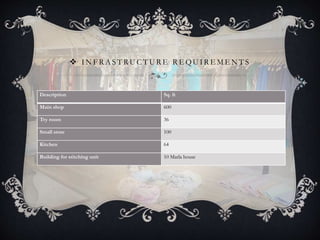
 I N F R A S T RU C T U R E R E QU I R E M E N T S
Description Sq. ft
Main shop 600
Try room 36
Small store 100
Kitchen 64
Building for stitching unit 10 Marla house
9.PROJECT ECONOMICS
 Project Cost
Description Cost(Rs)
Machinery and equipment 1,66,300
Furniture and fixture (Interior decoration) 4,37,884
Office equipment 86,000
Security deposits for premises 2,13,000
Pre-operating expenses
Salaries 31,000
Promotional expenses 67,246
Total capital cost 1,299,430
Working capital
Raw material( Fabric & Accessories) 1,04,680
Prepaid rent( Boutique and stitching unit) 4,26,000
Total working capital 5,30,680
Project cost 1,830,110
 Project Returns
Internal rate of return 67%
Payback period (years) 1.50
Net present value(NPV) 3,684,374
 Financing plan
Financing Rs
Equity 60% 1,098,066
Debt 40% 7,32,044
10.KEY SUCCESS FACTORS
There are a number of factors, which contribute towards the success of a project. In case
of the project of Boutiquesome of the Key Success Factors are as follows:
 Proper care while producing dresses should be adopted
 Proper Inventory management i.e. keeping minimum inventory as per past sales trends.
 The dress designs should be according to the emerging trends and fashions.
 Designing of dresses according to the consumer tastes/preferences gathered through
consumer surveys.
 The location of the outlet should be properly selected and attractively
decorated so as to target the clientele effectively.
 The customer satisfaction should be given due importance, because it
is the customer satisfaction, which can increase the sales. Hence, excellent
customer service should be provided.
11. THREATS FOR THE BUSINESS
 Competitive Structure of the market
 The market of the boutiques is highly competitive; therefore if the entrepreneur is not
well responsive to the tastes and response of the clientele as well as the fashions in vogue
he/she may not be able to capitalize the opportunity properly.
 Do not partner with a competing store.
 Pilferage in the designs
 The designs which a designer produces can be sold by the staff even before that
design is launched and that can pose serious threat to the business because in the
fashion industry it is the uniqueness of the design which matters.
 Selection of the wrong venue
 Selection of the wrong venue can be a major hurdle in achieving the desired
business objectives. Selection of the wrong design
 If the designs are not selected according to the tastes of the clientele then it can
be detrimental for the business, so the clientele taste should be properly tracked.
 Improper documentation of the sales receipt record may lead to problems with
Tax department.
THANK YOU

B plan on clothes

  • 1.
    BUSINESS PLAN ON CLOTHES Presented by BalakaDeka (148905) Nishi Vyas (148933) Pushpika Vyas (148938) Shravanthi (148946) Haritha (148949)
  • 2.
    CONTENT  Company Profile Proposed Capacity  Current structure of industry  Marketing Plan  Production process flow  Products  Human resource and Equipment Requirements  Project Economics  Threats and Key success factor
  • 3.
     Company Name Thefashion world  Mission “Satisfying our customers by providing them best qualitative stuff and unique designs keeping in view their comforts and excellence”. 1.Company Profile
  • 4.
     Our Objectives Non-financialobjective  To be among the top ten favorite brands  To add new design in every season. Financial objective:  To maintain an inflation growth in earning per year at a rate of 12%.  To obtain a return on equity of at least 30%.  Providing stitching facilities to other boutiques in which are lacking this facility.
  • 5.
    B O UT I QU E BU S I N E S S  Product Description Mekhela Sador of Assamese culture is remarkably wide, according the vast cultures , geographical differences , purchasing capacities ,influence of the western culture, and bewildering diversities of the ethnic groups.
  • 6.
    2.PROPOSED CAPACITY  TheBoutique business capacity is greatly dependent on the market size and the number of potential clientele one can attract  Furthermore, the women fashion wear garments will be designed through a contracted designer and then stitched through in-house stitching unit.  On average, a designer can supply forty designs per month from which nearly thirty designs are selected on average.
  • 7.
    Total designs selectedby designer 20 No. of dresses in each design 50 Total number of dresses 1000 Approximately, total capacity of the defined unit with 5 stitching machines (basis on 8-10 hours shift) will be about 750 dresses. The breakup of the total number of dresses will be as follows:
  • 8.
     Total ProjectCost The Boutique shop needs a total investment of about Rs. 1.83 million. This includes a capital investment of Rs.1, 299,430 and a sum of Rs.530, 680 as working capital.
  • 9.
    3.CURRENT STRUCTURE OFTHE INDUSTRY  Currently, the boutique industry is relatively unorganized and is scattered in and around the posh areas of the districts of Assam i.e. Dhubri, Barpeta, Nalbari, Kokrajhar etc.  Mostly sell the traditional dresses having indigenous/local designs, whereas the ones in Guwahati, Jorhat, Dibrugarh deal in fashion wear greatly influenced by the west and the local trends in vogue.
  • 10.
     As such,there is no exact detail available of the number of boutiques , especially in women wear ,because there is no association or link between these enterprises. The reason being the business rivalries and the competitive structure of this industry .
  • 11.
    4.MARKETING PLAN The marketingof boutique follows the conventional marketing pattern which is dependent on selection of venue of the outlet/s and the product mix (designs and sizes), as well as the promotional strategy .Furthermore, the boutique owner has to marketing techniques like: Usage of print media  i.e. printing of posters and pamphlets as well as displaying it and distributing it at proper places.
  • 12.
    Advertisement  in printmedia i.e. newspapers and fashion magazines, etc. Usage of electronic media  i.e. projection of the boutique in fashion programs, advertisement on television, and provision of dresses to various television plays and films. Event arrangement  like fashion shows and photo-shoots. Usage of e-commerce  i.e. launching of website and advertising on web.
  • 13.
     Word-of-Mouth  Callthe advertising department for an appointment. They show you what they offer.  Direct Mail  Send out a post card about your business to mailing list, friends and family and maybe former co-workers.  Membership cards  Telemarketing  Exhibitions in universities
  • 14.
  • 15.
    6.PRODUCTS  Product Mix Products will be priced at the high end to reflect the quality and exclusiveness associated with the brand. High-end materials such as Crinkle Chiffon, Georjet Chiffon,Pat Muga Silk, Medium Silk, Toss Pat, Kesa Pat etc will be used. This boutique will offer following product categories of men wears:  Casual Wear  Semi Formal Wear  Formal Wear
  • 16.
     Each productcategory will include the following product lines:  Ethnic Wear  Formal Wear – Party dresses and special occasion dresses.  Contemporary Wear  Fusion Wear – Combination of eastern and western wear, suitable for the international market as well.  Western Wear  Tops, Pants and various other styles.
  • 17.
     Product Mix Category% of total outfits Casual wear 34% Semi formal wear 33% Formal wear 33%  Average Sale Price Category Avg. price per outfit Casual wear 3,200 Semi formal wear 6000 Formal wear 15,500
  • 18.
     Costs ofGoods Sold and other Expenses Category Cost (percentage of sales) Casual wear 35% Semi formal wear 32% Formal wear 30%
  • 19.
    7.HUMAN RESOURCE REQUIREMENTS Positions RequiredSalary per month Salary per annum Production staff Designer 1 15,000 1,80,000 Tailor 5 7,000 4,20,000 Press/ironman/ Finishing 1 4,000 48,000 Dyer 1 5,000 60,000 Total 7,08,000 Administrative Salaries Sales girl 2 6,000 1,44,000 Office boy 1 3,500 42,000 Guard 1 5,000 60,000 Peon/ Sweeper 2 2,500 60,000 Total 14 3,06,000
  • 20.
    8. MACHINERY/EQUIPMENT DETAILS Stitching MachineryNo. Rs/unit Rs Single needle lock stitching m/c 8 19,900 1,59,200 Over lock m/c 1 56,800 56,800 Embroidery 1 29,900 29,900 Total 2,45,900
  • 21.
     O FF I C E E QU I P M E N T Other equipment No. Rs/Unit Rs Computers 1 25,000 25,00 Computer printer 1 12,000 12,000 Telephones 2 3,500 7,000 Fax m/c 1 12,000 12,000 Software 1 30,000 30,000 Total 86,000
  • 22.
     P RE M I S E S F O R S H O P A N D S T I T C H I N G U N I T The size of the shop should be at least 800 Sq.ft i.e. 20 feet front and 40 feet depth. The shop will be obtained on rental basis, and the rent estimation for such a shop is Rs 56,000/month.  Rent cost detail Security for renting shop/outlet (Rent @ Rs.56,000per month.3monthsrentassecurity) 1,68,000 Interior decoration (installing lighting, mannequins,hanging racks, mirrors, glass panes, cash counter,and other décor, etc.) 4,37,884 Security forrenting ahouseforinstallingthestitching unit (Rent@Rs15,000permonth) 45,000
  • 23.
     I NF R A S T RU C T U R E R E QU I R E M E N T S Description Sq. ft Main shop 600 Try room 36 Small store 100 Kitchen 64 Building for stitching unit 10 Marla house
  • 24.
    9.PROJECT ECONOMICS  ProjectCost Description Cost(Rs) Machinery and equipment 1,66,300 Furniture and fixture (Interior decoration) 4,37,884 Office equipment 86,000 Security deposits for premises 2,13,000 Pre-operating expenses Salaries 31,000 Promotional expenses 67,246
  • 25.
    Total capital cost1,299,430 Working capital Raw material( Fabric & Accessories) 1,04,680 Prepaid rent( Boutique and stitching unit) 4,26,000 Total working capital 5,30,680 Project cost 1,830,110  Project Returns Internal rate of return 67% Payback period (years) 1.50 Net present value(NPV) 3,684,374
  • 26.
     Financing plan FinancingRs Equity 60% 1,098,066 Debt 40% 7,32,044
  • 27.
    10.KEY SUCCESS FACTORS Thereare a number of factors, which contribute towards the success of a project. In case of the project of Boutiquesome of the Key Success Factors are as follows:  Proper care while producing dresses should be adopted  Proper Inventory management i.e. keeping minimum inventory as per past sales trends.  The dress designs should be according to the emerging trends and fashions.  Designing of dresses according to the consumer tastes/preferences gathered through consumer surveys.
  • 28.
     The locationof the outlet should be properly selected and attractively decorated so as to target the clientele effectively.  The customer satisfaction should be given due importance, because it is the customer satisfaction, which can increase the sales. Hence, excellent customer service should be provided.
  • 29.
    11. THREATS FORTHE BUSINESS  Competitive Structure of the market  The market of the boutiques is highly competitive; therefore if the entrepreneur is not well responsive to the tastes and response of the clientele as well as the fashions in vogue he/she may not be able to capitalize the opportunity properly.  Do not partner with a competing store.  Pilferage in the designs
  • 30.
     The designswhich a designer produces can be sold by the staff even before that design is launched and that can pose serious threat to the business because in the fashion industry it is the uniqueness of the design which matters.  Selection of the wrong venue  Selection of the wrong venue can be a major hurdle in achieving the desired business objectives. Selection of the wrong design  If the designs are not selected according to the tastes of the clientele then it can be detrimental for the business, so the clientele taste should be properly tracked.  Improper documentation of the sales receipt record may lead to problems with Tax department.
  • 31.