M hamza
Salleh qayyum
Faisal islam
Aqib basheer
Mehwish
Boron
Aluminum
Gallium
Indium
Thallium
Introduction:
 Aluminum: Is a chemical element in the
boron group with the symbol “Al” and
atomic number 13.
It is a silvery-white. Soft, Non-magnetic,
Ductile metal.
Atomic mass:26.981539+8×10ˉ⁷u.
Melting point: 660.3°ϲ .
 Discovery of aluminum:
It is discovered by Hans Oersted in
1825.
 Origin of name:
The name is derived from the Latin
name for Alum “alumin” mea.
 Properties of Aluminum:
Low density and there for low weight,
high strength, superior malleability, easy
excellent corrosion resistance and good
thermal and electrical conductivity are
amongst Aluminum.
Use of Aluminum:
Aluminum is a silvery-white light
weight metal. It is soft and malleable,
products including cans, foils, window
frames and airplane- parts.
facts of Aluminum:
Aluminum is element no.13 on the
periodic table Of elements. This element is
the second most abundant metallic element
in earth's crust after silicon. Aluminum is
present in more than 270 minerals.
Reaction of Aluminum:-
• Reaction with water:
The surface of Aluminum metal is
covered with a thin layer of oxide that
helps
Protect the metal from attack by air.
So normally Aluminum metal does
not react with air. If the oxide layer is
damaged, the Aluminum metal is
exposed to attack, even by water.
Aluminum is insoluble in water.
Reaction of Aluminum:-
• Reaction with water:
The surface of Aluminum metal is
covered with a thin layer of oxide that
helps
Protect the metal from attack by air.
So normally Aluminum metal does
not react with air. If the oxide layer is
damaged, the Aluminum metal is
exposed to attack, even by water.
Aluminum is insoluble in water.
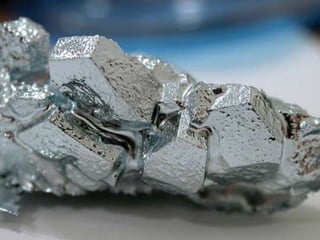
Gallium is an element of 3rd a
group.
Its electronic configuration is
[Ar ] 3d104s24p1
It was discovered in 1875.
Atomic Number 31
Atomic Mass 69.72
g/mol
Density of Gallium is 5.1 g.cm-3 at
20°C
Gallium reacts with halogens
to form gallium halides like
GaF3, GaBr3, GaCl3 etc.
Ga + 3 Cl
GaCl3
Ga + 3 F
GaF3
 About 95 percent of all gallium
produced is used to make a
single compound, gallium
arsenide (GaAs)
Gallium arsenide has many
uses in all fields of life
Indium is chemical element with
symbol 'In' and atomic no. 49
It is post transition metal that's
makes up 0.21 parts per
million of the earth's crust
symbol: [In]
Electronic Configuration: [Kr]
4d105s25p1
Atomic no: 49
Atomic mass: 114.818 u ±
0.003 u
Isotopes: 11
Density: 7.31 g.cm-3 at 20°C
 Melting point: 156.60°C, 313.88°F,
429.75 k
 Boiling point: 2,027°C, 3681°F, 2300 K
 Ionic radius: 0.092 nm (+2)
 Structure: Crystal ; tetragonal
 Colour: Silver ; white
 Energy of first ionization: 558.2 kJ mol-1
 Energy of second ionization: 1820.2 kJ mol-1
 Energy of third ionization: 2704 kJ mol-1
 Vander wals radius: 0.162 nm
 Nof electron / proton's: 49
 No's of neutron's: 66
 Standard potentional: - 0.34v (In3+/Zn)
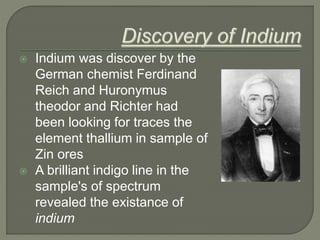
 Indium was discover by the
German chemist Ferdinand
Reich and Huronymus
theodor and Richter had
been looking for traces the
element thallium in sample of
Zin ores
 A brilliant indigo line in the
sample's of spectrum
revealed the existance of
indium
 Indium is used to dope
germanium to make
transistor
 It is used to make other
electrical components
such as rectifiers,
thermistor and photo-
conductors
 It is used to make
mirrors that are as
reflective as silver
mirrors but do not
ternish as quickly
Chemicals
 Indium is unaffected by dry air at ordinary
temperature
 It unit directly with sulpher and helogens
 It is unaffected by boiling water or potassium
but dissolved in mineral acids
 The electrolytic solution pressure of indium
10 2 to 10 3 atomsphare places in b/w iron and
lead in the electro motive series
Physical
 Indium is silvery white low melting point
metal belonging to the less typical metals
group.
 So soft that like sodium it can be cut with
a knife.
 Softer than lead ductile and retains
malleable.
 It become super conducting at 3.37 k.
 It does not formed its on mineral for
example sphalerite,Zns.
 Highest solibulity in mercury (57%).
 Indium was coating bearing in high
performance aircraft engines during
world War (II).
 In 1905,tiny beads of indium were
used for the emitters and collectors
of PNP-alloys, junction transistors
 In 1924,indium was found to have
valued property of stabilizing non,
Ferous metals
 Used as a transparent conductive
coating on glass tube substrate
 It's wire is used as a vaccum seal
and a thermal conductor in
cryogenies
It is very abundant on earth's crust
example : much more then silver for
example and the annual silver production
is at least 40 time's bigger then the annual
indium production Geographically
Indium is abundant is south America ,
Canada, Australia , China and CIS the
reserves widely spread.
Atomic number (81)
Atomic mass (204.3833)
Discovery year (1861)
Electronic configuration
(6s2,6p1)
Bluish white element.
Heavy and soft.
Boiling point (302.c).
Melting point (1457.c).
Density (11.85) gram per
centimeter cube.
Electronic configuration
(6s2,6p1).
Isotopes (2).
 Geometry (hexagonal).
Atomic radius (1.71).
Oxidation states (3).
Thallium react with
air.
Also perform
substitution
reactions
Thallium sulfate used as rodent
killer .
Used in photoelectric cell.
Thallium oxides used to make
high refractive glass.
Alloy with mercury used in low
temperature thermometers.
Thallium found in ores .
Pyrites.
By product of refining of
copper, zinc and lead.
Manganese nodules on the
ocean floor.
The end

group 3 A

  • 2.
    M hamza Salleh qayyum Faisalislam Aqib basheer Mehwish
  • 3.
  • 4.
    Introduction:  Aluminum: Isa chemical element in the boron group with the symbol “Al” and atomic number 13. It is a silvery-white. Soft, Non-magnetic, Ductile metal. Atomic mass:26.981539+8×10ˉ⁷u. Melting point: 660.3°ϲ .
  • 5.
     Discovery ofaluminum: It is discovered by Hans Oersted in 1825.  Origin of name: The name is derived from the Latin name for Alum “alumin” mea.  Properties of Aluminum: Low density and there for low weight, high strength, superior malleability, easy excellent corrosion resistance and good thermal and electrical conductivity are amongst Aluminum.
  • 6.
    Use of Aluminum: Aluminumis a silvery-white light weight metal. It is soft and malleable, products including cans, foils, window frames and airplane- parts. facts of Aluminum: Aluminum is element no.13 on the periodic table Of elements. This element is the second most abundant metallic element in earth's crust after silicon. Aluminum is present in more than 270 minerals.
  • 8.
    Reaction of Aluminum:- •Reaction with water: The surface of Aluminum metal is covered with a thin layer of oxide that helps Protect the metal from attack by air. So normally Aluminum metal does not react with air. If the oxide layer is damaged, the Aluminum metal is exposed to attack, even by water. Aluminum is insoluble in water.
  • 9.
    Reaction of Aluminum:- •Reaction with water: The surface of Aluminum metal is covered with a thin layer of oxide that helps Protect the metal from attack by air. So normally Aluminum metal does not react with air. If the oxide layer is damaged, the Aluminum metal is exposed to attack, even by water. Aluminum is insoluble in water.
  • 11.
    Gallium is anelement of 3rd a group. Its electronic configuration is [Ar ] 3d104s24p1 It was discovered in 1875.
  • 12.
    Atomic Number 31 AtomicMass 69.72 g/mol Density of Gallium is 5.1 g.cm-3 at 20°C
  • 13.
    Gallium reacts withhalogens to form gallium halides like GaF3, GaBr3, GaCl3 etc. Ga + 3 Cl GaCl3 Ga + 3 F GaF3
  • 14.
     About 95percent of all gallium produced is used to make a single compound, gallium arsenide (GaAs) Gallium arsenide has many uses in all fields of life
  • 17.
    Indium is chemicalelement with symbol 'In' and atomic no. 49 It is post transition metal that's makes up 0.21 parts per million of the earth's crust symbol: [In] Electronic Configuration: [Kr] 4d105s25p1 Atomic no: 49 Atomic mass: 114.818 u ± 0.003 u Isotopes: 11 Density: 7.31 g.cm-3 at 20°C
  • 18.
     Melting point:156.60°C, 313.88°F, 429.75 k  Boiling point: 2,027°C, 3681°F, 2300 K  Ionic radius: 0.092 nm (+2)  Structure: Crystal ; tetragonal  Colour: Silver ; white  Energy of first ionization: 558.2 kJ mol-1  Energy of second ionization: 1820.2 kJ mol-1  Energy of third ionization: 2704 kJ mol-1  Vander wals radius: 0.162 nm  Nof electron / proton's: 49  No's of neutron's: 66  Standard potentional: - 0.34v (In3+/Zn)
  • 19.
     Indium wasdiscover by the German chemist Ferdinand Reich and Huronymus theodor and Richter had been looking for traces the element thallium in sample of Zin ores  A brilliant indigo line in the sample's of spectrum revealed the existance of indium
  • 20.
     Indium isused to dope germanium to make transistor  It is used to make other electrical components such as rectifiers, thermistor and photo- conductors  It is used to make mirrors that are as reflective as silver mirrors but do not ternish as quickly
  • 21.
    Chemicals  Indium isunaffected by dry air at ordinary temperature  It unit directly with sulpher and helogens  It is unaffected by boiling water or potassium but dissolved in mineral acids  The electrolytic solution pressure of indium 10 2 to 10 3 atomsphare places in b/w iron and lead in the electro motive series
  • 22.
    Physical  Indium issilvery white low melting point metal belonging to the less typical metals group.  So soft that like sodium it can be cut with a knife.  Softer than lead ductile and retains malleable.  It become super conducting at 3.37 k.  It does not formed its on mineral for example sphalerite,Zns.  Highest solibulity in mercury (57%).
  • 23.
     Indium wascoating bearing in high performance aircraft engines during world War (II).  In 1905,tiny beads of indium were used for the emitters and collectors of PNP-alloys, junction transistors  In 1924,indium was found to have valued property of stabilizing non, Ferous metals  Used as a transparent conductive coating on glass tube substrate  It's wire is used as a vaccum seal and a thermal conductor in cryogenies
  • 24.
    It is veryabundant on earth's crust example : much more then silver for example and the annual silver production is at least 40 time's bigger then the annual indium production Geographically Indium is abundant is south America , Canada, Australia , China and CIS the reserves widely spread.
  • 26.
    Atomic number (81) Atomicmass (204.3833) Discovery year (1861) Electronic configuration (6s2,6p1)
  • 28.
    Bluish white element. Heavyand soft. Boiling point (302.c). Melting point (1457.c). Density (11.85) gram per centimeter cube.
  • 29.
    Electronic configuration (6s2,6p1). Isotopes (2). Geometry (hexagonal). Atomic radius (1.71). Oxidation states (3).
  • 30.
    Thallium react with air. Alsoperform substitution reactions
  • 31.
    Thallium sulfate usedas rodent killer . Used in photoelectric cell. Thallium oxides used to make high refractive glass. Alloy with mercury used in low temperature thermometers.
  • 32.
    Thallium found inores . Pyrites. By product of refining of copper, zinc and lead. Manganese nodules on the ocean floor.
  • 33.