16.
p - B L O C KE L E M E N T S
1. GROUP 13 ELEMENTS (BORON FAMILY)
1. Introduction
Elements of group 13 belong to p-block elements, since the last electron in them is present in the p-orbital. All
these elements have three electrons in the outer most orbit: two in the s-orbital and one in the p-orbital. Thus, the
electronic configuration of the outermost energy levels of these elements maybe represented as ns2
np1
.
Table 16.1: Electronic configuration for Group 13
Element with At. No. Configuration with inert gas core
B 5
[He]2s2
2p1
Al 13
[Ne]3s2
3p1
Ga 31
[Ar]3d10
4 s2
4p1
In 49
[Kr]4d10
5s2
5p1
Tl 81
[Xe]4f14
5d10
6 s2
6p1
1.2 Boron
Preparation:
Na2B4O7  2HCl  5H2O  4H3BO3  2NaCl
2H3BO3 B2O3  3H2O
B2O3  3Mg  2B  3MgO
Physical Properties: Low electronegativity,
hard, absorbs neutrons, steel grey in color.
Some dissimilarities of
boron with other elements of this group are:
(a) Boron does not form positive ions in
aqueous solution and has low oxidation
potential.
(b) Boron always forms covalent
compounds
16 . 2 | p - Block
Elements
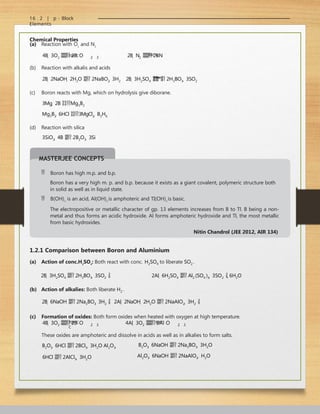
Chemical Properties
2 3
(a) Reaction with O2
and N2
700∘C
4B  3O2  2B O 2B  N2  2BN
700∘C
(b) Reaction with alkalis and acids
2B  2NaOH  2H2O  2NaBO2  3H2 2B  3H2SO4 
o
x
i
d
a
t
i
o
n

 2H3BO3  3SO2
(c) Boron reacts with Mg, which on hydrolysis give diborane.
3Mg  2B Mg3B2
Mg3B2  6HCl 3MgCl2  B2H6
(d) Reaction with silica
3SiO2  4B  2B2O3  3Si
MASTERJEE CONCEPTS
 Boron has high m.p. and b.p.
Boron has a very high m. p. and b.p. because it exists as a giant covalent, polymeric structure both
in solid as well as in liquid state.
 B(OH)3
is an acid, Al(OH)3
is amphoteric and TI(OH)3
is basic.
The electropositive or metallic character of gp. 13 elements increases from B to Tl. B being a non-
metal and thus forms an acidic hydroxide. Al forms amphoteric hydroxide and Tl, the most metallic
from basic hydroxides.
Nitin Chandrol (JEE 2012, AIR 134)
1.2.1 Comparison between Boron and Aluminium
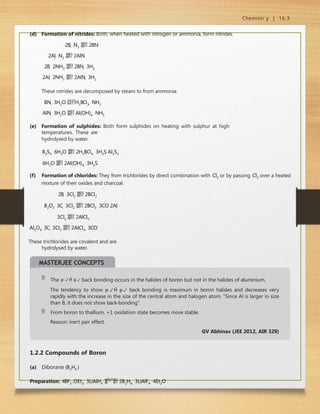
(a) Action of conc.H2
SO4
: Both react with conc. H2SO4 to liberate SO2 .
2B  3H2SO4  2H3BO3  3SO2  2Al  6H2SO4  Al2 (SO4 )3  3SO2  6H2O
(b) Action of alkalies: Both liberate H2 .
2B  6NaOH  2Na3BO3  3H2  2Al  2NaOH  2H2O  2NaAlO2  3H2 
(c) Formation of oxides: Both form oxides when heated with oxygen at high temperature.
4B  3O2  2B O 2 3 2 3
4Al  3O2  2Al O
700∘C 800∘
C
These oxides are amphoteric and dissolve in acids as well as in alkalies to form salts.
B2O3  6HCl  2BCl3  3H2O Al2O3 
6HCl  2AlCl3  3H2O
B2O3  6NaOH  2Na3BO3  3H2O
Al2O3  6NaOH  2NaAlO2  H2O
Chemistr y | 16.3
(d) Formation of nitrides: Both, when heated with nitrogen or ammonia, form nitrides.
2B  N2  2BN
2Al  N2  2AlN
2B  2NH3  2BN  3H2
2Al  2NH3  2AlN  3H2
These nitrides are decomposed by steam to from ammonia.
BN  3H2O H3BO3  NH3
AlN  3H2O  Al(OH)3  NH3
(e) Formation of sulphides: Both form sulphides on heating with sulphur at high
temperatures. These are
hydrolysed by water.
B2S3  6H2O  2H3BO3  3H2S Al2S3 
6H2O  2Al(OH)3  3H2S
(f) Formation of chlorides: They from trichlorides by direct combination with Cl2 or by passing Cl2 over a heated
mixture of their oxides and charcoal.
2B  3Cl2  2BCl3
B2O3  3C  3Cl2  2BCl3  3CO 2Al 
3Cl2  2AlCl3
Al2O3  3C  3Cl2  2AlCl3  3CO
These trichlorides are covalent and are
hydrolysed by water.
BCl3  3H2O H3BO3  3HCl AlCl3 
3H2O  Al(OH)3  3HCl
MASTERJEE CONCEPTS
 The p   p back bonding occurs in the halides of boron but not in the halides of aluminium.
The tendency to show p p back bonding is maximum in boron halides and decreases very
rapidly with the increase in the size of the central atom and halogen atom. “Since Al is larger in size
than B, it does not show back-bonding”.
 From boron to thallium, +1 oxidation state becomes more stable.
Reason: inert pair effect.
GV Abhinav (JEE 2012, AIR 329)
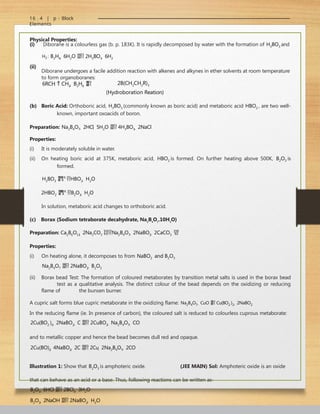
1.2.2 Compounds of Boron
(a) Diborane (B2H6 )
Preparation: 4BF3 .OEt2  3LiAlH4 
E
t2O

 2B2H6  3LiAlF4  4Et2O
16 . 4 | p - Block
Elements
Physical Properties:
(ii)
(i) Diborane is a colourless gas (b. p. 183K). It is rapidly decomposed by water with the formation of H3BO3 and
H2 : B2H6  6H2O  2H3BO3  6H2
Diborane undergoes a facile addition reaction with alkenes and alkynes in ether solvents at room temperature
to form organoboranes:
2B(CH2CH2R)3
(Hydroboration Reation)
6RCH  CH2  B2H6 


(b) Boric Acid: Orthoboric acid, H3BO3 (commonly known as boric acid) and metaboric acid HBO2 , are two well-
known, important oxoacids of boron.
Preparation: Na2B4O7  2HCl  5H2O  4H3BO3  2NaCl
Properties:
(i) It is moderately soluble in water.
(ii) On heating boric acid at 375K, metaboric acid, HBO2 is formed. On further heating above 500K, B2O3 is
formed.
H3BO3 
3
7
5
K
HBO2  H2O
2HBO2 
5
0
0
K
B2O3  H2O
In solution, metaboric acid changes to orthoboric acid.
(c) Borax (Sodium tetraborate decahydrate, Na2
B4
O7
.10H2
O)
Preparation: Ca2B6O11  2Na2CO3 Na2B4O7  2NaBO2  2CaCO3 
Properties:
(i) On heating alone, it decomposes to from NaBO2 and B2O3
Na2B4O7  2NaBO2  B2O3
(ii) Borax bead Test: The formation of coloured metaborates by transition metal salts is used in the borax bead
test as a qualitative analysis. The distinct colour of the bead depends on the oxidizing or reducing
flame of the bunsen burner.
A cupric salt forms blue cupric metaborate in the oxidizing flame: Na2B4O7  CuO 

 Cu(BO2 )2  2NaBO2
In the reducing flame (ie. In presence of carbon), the coloured salt is reduced to colourless cuprous metaborate:
2Cu(BO2 )2  2NaBO2  C  2CuBO2  Na2B4O7  CO
and to metallic copper and hence the bead becomes dull red and opaque.
2Cu(BO)2  4NaBO2  2C  2Cu  2Na2B4O7  2CO
Illustration 1: Show that B2O3 is amphoteric oxide. (JEE MAIN) Sol: Amphoteric oxide is an oxide
that can behave as an acid or a base. Thus, following reactions can be written as-
B2O3  6HCl  2BCl3  3H2O
B2O3  2NaOH  2NaBO2  H2O
Chemistr y | 16.5
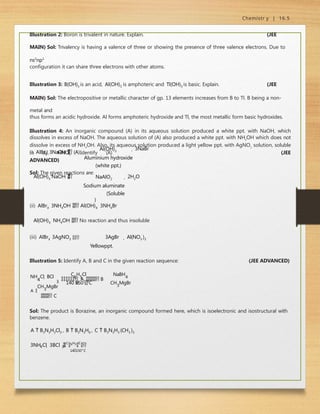
Illustration 2: Boron is trivalent in nature. Explain. (JEE
MAIN) Sol: Trivalency is having a valence of three or showing the presence of three valence electrons. Due to
ns2
np1
configuration it can share three electrons with other atoms.
Illustration 3: B(OH)3 is an acid, Al(OH)3 is amphoteric and Tl(OH)3 is basic. Explain. (JEE
MAIN) Sol: The electropositive or metallic character of gp. 13 elements increases from B to Tl. B being a non-
metal and
thus forms an acidic hydroxide. Al forms amphoteric hydroxide and Tl, the most metallic form basic hydroxides.
Illustration 4: An inorganic compound (A) in its aqueous solution produced a white ppt. with NaOH, which
dissolves in excess of NaOH. The aqueous solution of (A) also produced a white ppt. with NH4
OH which does not
dissolve in excess of NH4
OH. Also, its aqueous solution produced a light yellow ppt. with AgNO3
solution, soluble
in dil. HNO3
. Identify (A) (JEE
ADVANCED)
Sol: The given reactions are:
Al(OH)3
Aluminium hydroxide
(white ppt.)
(i) AlBr3  3NaOH 

 (A)
 3NaBr
NaAlO2
Sodium aluminate
(Soluble
)
Al(OH)3 NaOH 

  2H2O
(ii) AlBr3  3NH4OH  Al(OH)3  3NH4Br
Al(OH)3  NH4OH  No reaction and thus insoluble
(iii) AlBr3  3AgNO3  3AgBr  Al(NO3 )3
Yellowppt.
Illustration 5: Identify A, B and C in the given reaction sequence: (JEE ADVANCED)
C6
H5
Cl NaBH4
4
NH Cl  BCl
3
 A  B
140 
150C CH3
MgBr
A 
CH3
MgBr
 C
Sol: The product is Borazine, an inorganic compound formed here, which is isoelectronic and isostructural with
benzene.
A  B3N3H3Cl3 , B  B3N3H6 , C  B3N3H3 (CH3 )3
4 3
3NH Cl  3BCl 

C
6H5
C
l

140150∘C
16 . 6 | p - Block
Elements
Reactions are:
Cl
B
N
H
Cl
B
N
H
N H
B
Cl
(A)
3CH3MgBr
NH
BH
BH
NH
NH
BH
N
H
H3C
B
CH3
B
B
N
N
H
CH3
(B)
(C)
H
Illustration 6: Aluminium vessels should not be cleaned with a cleansing agent containing washing soda. Why?
(JEE ADVANCED)
Sol: Washing soda (Na2CO3 ) reacts with water to form NaOH and Al gets dissolved in caustic soda.
2Al 2NaOH 2H2O 

 2NaAlO2
 3H2
Sodium meta aluminate
Illustration 7: The p p back bonding occurs in the halides of boron but not in the halides of
aluminium. Explain. (JEE ADVANCED)
Sol: The tendency to show p p back bonding is maximum in boron halides and decrease very rapidly with
the increase in the size of central atom and halogen atom. Since, Al is larger in size than B and thus, does not
show back bonding.
Illustration 8: Borazole or borazine is more reactive than benzene. Explain. (JEE ADVANCED)
Sol: In Borazine, B=N bonds are polar and therefore, reactivity of borazole is more than benzene which possesses
non-polar C=C and C-C bonds. The more negative group attacks boron atom.
Illustration 9: From boron to thallium, +1 oxidation state becomes more stable. Explain. (JEE ADVANCED)
Sol: Inert pair effect is the tendency shown by the outermost s-electrons of the post transition elements to remain
unionized or unshared. [Due to inert pair effect.]
2. GROUP 14 ELEMENTS (CARBON FAMILY)
1. Introduction
Carbon, silicon, germanium, tin and lead constitute the group 14 of the periodic table.
The electronic configuration of these elements are as given below.
Chemistr y | 16.7
Table 16.2: Electronic Configuration of Group 14 Elements:
Element At. No Electronic Configuration
C 6
1s2
,2s2
2p2
or[He]2s2
2p2
Si 14
1s2
,2s2
2p6
,3s2
3p2
or[Ne]3s2
3p2
Ge 32
1s2
,2s2
2p6
,3s2
3p6
,3d10
, 4s2
p2
or[Ar]3d10
4s2
4p2
Sn 50
1s2
,2s2
2p6
,3s2
3p6
,3d10
, 4s2
4p6
, 4d10
,5s2
5p2
or[Kr] 4d10
5s2
5p2
Pb 82
1s2
,2s2
2p6
,3s2
3p6
,3d10
, 4s2
4p6
, 4d10
4 f14
,5s2
5p2
d10
,6s2
6p2
or[Xe] 4f14
5d10
6s2
6p2
2. Carbon
1. Allotropes of Carbon
(a) Crystalline form: Diamond and graphite are the two crystalline forms of carbon.
(b) Amorphous form: Coal, Coke, Charcoal (or wood charcoal), animal charcoal (or bone black), Lamp black,
Carbon black, Gas carbon and Petroleum coke are the amorphous forms of carbon.
2.2.2 Important Compounds of Carbon
(a) Carbon Monoxide (CO)
Preparation: (i) By heating oxides of heavy metals e. g. iron, zinc etc with carbon.
Fe2O3  3C  2Fe  3CO
ZnO  C  Zn  CO
Two important industrial fuels-water gas and producer gas, contains carbon along with hydrogen and nitrogen,
Water gas is obtained by passing steam over hot coke
C  H2O 

 CO  H2
(water gas)
2CO  4N2
(producer gas)
2C  O2  4N2 


Properties: (i) It is a powerful reducing agent and reduces many metal oxides to the corresponding metal .For e. g.
Fe2O3  3CO  2Fe  3CO2
CuO  CO  Cu  CO2
Tests: (a) Burns with a blue
flame
(b) A filter paper soaked in platinum or palladium chloride turns pink, green or black due to reduction of the
chloride by carbon monoxide.
(b) Carbon dioxide (CO2
):
Preparation: CaCO3  2HCl  CaCl2  H2O  CO2
16 . 8 | p - Block Elements
Properties: (i) It turns lime water milky and the milkiness disappears when CO2
is passed in excess.
Ca(OH)2  CO2  CaCO3  H2O
CaCO3  H2O  CO2  Ca(HCO3 )2
(ii) Solid carbon dioxide or dry ice is
obtained by cooling CO2 under
pressure. It passes to the solid state
straight
from gaseous state without
liquefying (hence called dry ice).
3. Carbides: Carbon reacts with
more electropositive elements to
form carbides at high
temperature. Types of
Carbides:
(a) Salt-like Carbides: These are
the ionic salts containing either
C2
2
(acetylide ion) or C4
(methanide ion) e. g.
CaC2 , Al4 C3 ,Be2C .
(b) Covalent Carbides: These are the carbides of non-metals such as silicon and boron. In Such carbides, the
atoms of two elements are bonded to each other through covalent bonds. SiC is also known as
Carborundum.
(c) Interstitial Carbides: They are formed by transition elements and consist of metallic lattices with carbon
atoms in the interstices. e. g. tungsten carbide WC, vanadium carbide VC.
2.3 Silicon
Extraction: Commercial form of silicon is obtained by the reduction of SiO2 with C or
CaC2 in an electric furnace.
High purity silicon is obtained either from SiCl4 or from SiHCl3 .
Properties: Silicon is obtained by the reduction of silica. It exists in two allotropic
forms:
(a) amorphous (b) crystalline
The amorphous variety is obtained by heating dry powdered silica with magnesium.
SiO2  2Mg Si  2MgO
The crystalline variety is
obtained by heating a finely
powdered sand or quartz
with carbon in an electric
furnace
where, a small amount of iron
is added to prevent the
formation of carborundum
(SiC)
SiO2  2C Si  2CO
Amorphous silicon is chemically more reactive than crystalline silicon. Amorphous silicon is a brownish powder. It
burns brilliantly in oxygen and ignites spontaneously in fluorine.
Si  O2 SiO2
Si  2F SiF
(b)
(c)
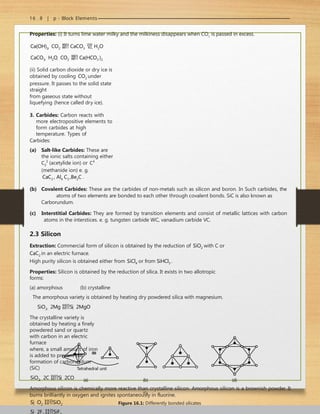
Figure 16.1: Differently bonded silicates
(d)
Tetrahedral unit
(a)
Chemistr y | 16.9
NaAlSi3
O8
, zeolites, e.g., chabazite Ca2
[(AlO2
)4
(SiO2
)8
)H2
O], micas (muscovite)[KAl2
(Si3
AlO10
)(OH)2
] and asbestos
[Mg(Si2
O5
)(OH)4
]. The basic structural unit in silicates is the SiO4
tetrahedron. The SiO4
tetrahedral can be linked in
several different ways. Depending on the number of corners (0, 1, 2, 3 or 4) of the SiO4
tetrahedral shared, various
kinds of silicates, single or double chains, rings, sheet or three-dimensional networks are formed.
(e)
(f)
Figure 16.2: Normal orthosilicates
Normal orthosilicates (e.g. Mg2SiO4 ) contain discrete SiO4
units. When two SiO4
tetrahedra share a corner (common
oxygen atom), we get the (Si2O7 )6
unit and the silicates are called pyrosilicates. When SiO4
units share two oxygen
atoms with each other, cyclic or linear single chain silicates are formed with empirical formula [(SiO3 )2
]n as present
in beryl (a mineral) Be3Al2Si6O18 . A linear silicate chain is present in pyroxenes (e.g. MgCaSi2O6 ). If two chains are
cross-linked, the resulting double stranded silicates have the composition [(Si4O11 )6
]n and are called amphiboles.
Asbestos belongs to this class. Two dimensional sheet structures are formed, three corners of each SiO4
tetrahedron
are shared as found in clays which contains  
2 5
Si O
2
4
units. When all the four corners of the SiO tetrahedron are
shared, 3D networks are formed, leading to different forms of silica. If in this, three-dimensional network, part of
the silicon is replaced by aluminum (Al3
) . This will require the incorporation of other cations (Na
,K
or Ca2
) for
maintaining the charge balance. The resultant 3D networks give aluminosilicates which include feldspars and
zeolites. Two important man-made silicates from a practical point of view are glass and cement.
2.3.2 Silicones
These are organosilicon polymers containing Si—O—Si linkages. They may be linear, cyclic or cross-linked polymers.
These are prepared from alkyl-or aryl-chlorosilanes which in turn are obtained from Grignard reagent and silicon
tetrachloride.
CH3MgCl
Methyl
magnesium
Chloride
2CH3MgCl

SiCl4



Silicon
tetrachloride
CH3SiCl3  MgCl2
Methyl
trichlorosilane
 SiCl4 (CH3 )2 SiCl2  2MgCl2
Dimethyl dichlorosilane



Preparation: Hydrolysis of the chlorides yields the corresponding silanols which polymerize by condensation by
elimination of one water molecule from 2 molecules of alkyl silanols.
3
Si
H2O
CH3
CH Cl CH3
CH3 Cl
Dimethyldichlorosilane
Si
OH
OH
-H2O
3
CH CH3
CH3
CH3
HO Si O Si OH
Dimethylsilandiol
16 . 10 | p - Block Elements
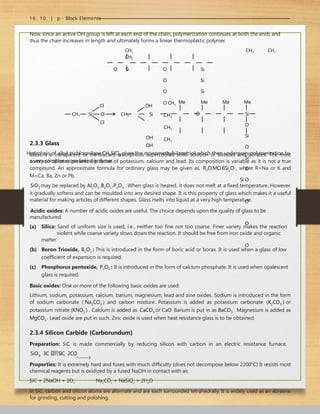
Now, since an active OH group is left at each end of the chain, polymerization continues at both the ends and
thus the chain increases in length and ultimately forms a linear thermoplastic polymer.
CH3 CH3 CH3
CH3
O Si O Si
O Si
O Si
O CH3
CH3
CH3
CH3
Hydrolysis of alkyl trichlorosilane CH3SiCl3 gives the monomethylsilanetriol which then undergoes polymerization to
a very complex cross-linked polymer.
Cl
CH3 Si Cl
Cl
OH
CH3 Si
OH
OH
Me Me Me Me
O Si
O
Si
O
Si
O
Si O
O
O
O
2.3.3 Glass
Glass is a transparent or translucent amorphous supercooled solid solution of silicates and borates. The most
common silicates present are those of potassium, calcium and lead. Its composition is variable as it is not a true
compound. An approximate formula for ordinary glass may be given as, R2O.MO.6Si2O , where R=Na or K and
M=Ca, Ba, Zn or Pb.
SiO2 may be replaced by Al2O3 ,B2O3 ,P2O5 . When glass is heated, it does not melt at a fixed temperature. However,
it gradually softens and can be moulded into any desired shape. It is this property of glass which makes it a useful
material for making articles of different shapes. Glass melts into liquid at a very high temperature.
Acidic oxides: A number of acidic oxides are useful. The choice depends upon the quality of glass to be
manufactured.
(a) Silica: Sand of uniform size is used, i.e., neither too fine nor too coarse. Finer variety makes the reaction
violent while coarse variety slows down the reaction. It should be free from iron oxide and organic
matter.
(b) Boron Trioxide, B2O3 : This is introduced in the form of boric acid or borax. It is used when a glass of low
coefficient of expansion is required.
(c) Phosphorus pentoxide, P2O5 : It is introduced in the form of calcium phosphate. It is used when opalescent
glass is required.
Basic oxides: One or more of the following basic oxides are used:
Lithium, sodium, potassium, calcium, barium, magnesium, lead and zine oxides. Sodium is introduced in the form
of sodium carbonate ( Na2CO3 ) and carbon mixture. Potassium is added as potassium carbonate (K2CO3 ) or
potassium nitrate (KNO3 ) . Calcium is added as CaCO3 or CaO. Barium is put in as BaCO3 . Magnesium is added as
MgCO3 . Lead oxide are put in such. Zinc oxide is used when heat resistance glass is to be obtained.
2.3.4 Silicon Carbide (Carborundum)
Preparation: SiC is made commercially by reducing silicon with carbon in an electric resistance furnace.
SiO2  3C SiC  2CO
Properties: It is extremely hard and fuses with much difficulty (does not decompose below 2200°C) It resists most
chemical reagents but is oxidized by a fused NaOH in contact with air.
SiC + 2NaOH + 2O2
Na2
CO3
+ NaSiO3
+ 2H2
O
In SiC, carbon and silicon atoms are alternate and are each surrounded tetrahedrally. It is widely used as an abrasive
for grinding, cutting and polishing.
Chemistr y |
16.11
(i) Smaller size of F gives rise to less steric repulsion in SiF2
.
6
(ii) Interaction of a lone pair of F with Si is stronger than
that of a chlorine lone pair.
4 4
 The hydrolysis of CCl is not possible but SiCl is easily hydrolysed. Silicon can accomodate OH
ion
due to the presence of 3d-subshell. whereas C-atom does not possess d-orbitals in its 2nd
shell
Anand K ((JEE 2011, AIR 47))
MASTERJEE CONCEPTS
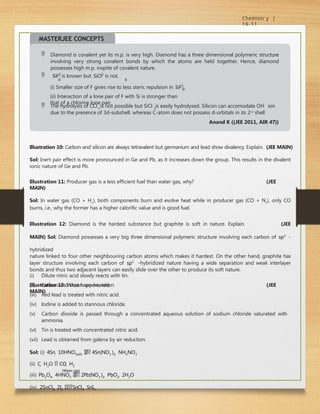
 Diamond is covalent yet its m.p. is very high. Diamond has a three dimensional polymeric structure
involving very strong covalent bonds by which the atoms are held together. Hence, diamond
possesses high m.p. inspite of covalent nature.
 SiF2
is known but SiCl2
is not,
6 6
Illustration 10: Carbon and silicon are always tetravalent but germanium and lead show divalency. Explain. (JEE MAIN)
Sol: Inert pair effect is more pronounced in Ge and Pb, as it increases down the group. This results in the divalent
ionic nature of Ge and Pb.
Illustration 11: Producer gas is a less efficient fuel than water gas, why? (JEE
MAIN)
Sol: In water gas (CO + H2
), both components burn and evolve heat while in producer gas (CO + N2
), only CO
burns, i.e., why the former has a higher calorific value and is good fuel.
Illustration 12: Diamond is the hardest substance but graphite is soft in nature. Explain. (JEE
MAIN) Sol: Diamond possesses a very big three dimensional polymeric structure involving each carbon of sp3
-
hybridized
nature linked to four other neighbouring carbon atoms which makes it hardest. On the other hand, graphite has
layer structure involving each carbon of sp2
-hybridized nature having a wide separation and weak interlayer
bonds and thus two adjacent layers can easily slide over the other to produce its soft nature.
Illustration 13: What happens when: (JEE
MAIN)
(vi)
(i) Dilute nitric acid slowly reacts with tin.
(ii) Carbon and steam are heated.
(iii) Red lead is treated with nitric acid.
(iv) Iodine is added to stannous chloride.
(v) Carbon dioxide is passed through a concentrated aqueous solution of sodium chloride saturated with
ammonia.
Tin is treated with concentrated nitric acid.
(vii) Lead is obtained from galena by air reduction.
Sol: (i) 4Sn  10HNO3(dil)  4Sn(NO3 )2  NH4NO3
(ii) C  H2O  CO  H2
(Water gas)
(iii) Pb3O4  4HNO3  2Pb(NO3 )2  PbO2  2H2O
(iv) 2SnCl2  2I2 SnCl4  SnI4
16 . 12 | p - Block Elements
(v) NaCl  NH4OH  CO2 NaHCO3  NH4Cl
(vi) Sn  4HNO3(conc.) H2SnO3  4NO2  H2O
(vii) 2PbS  3O2  2PbO  2SO2
(vii) PbS  2O2 PbSO4
Illustration 14: Indicate the principal ingredients of the following:
(i) Coal gas
Sol:
(ii)Coal gas
(iii)Producer gas
(iv) Water gas
(ii) Producer gas (iii) Water gas. (JEE MAIN)
H2
+CH4
+CO
CO+N2
CO+H2
Illustration 15: A bluish metal (A) has a high density and readily dissolves in medium concentrated HNO3
and
liberates a gas (B) which on mixing with air turns into red coloured gas(C). Metal is little affected by dil HCl or
H2
SO4
. The solution containing bipositive ions of (A) gives red precipitate (D) when H2
S is passed in presence of
saturated solution of KCl. `D’ on dilution turns black forming E and F. Identify A to F. (JEE
ADVANCED)
Sol: A=Pb; B=NO; C= NO2 ; D= Pb2SCl2 ; E=PbS; E= PbCl2
Reactions are:  2NO  
4H2O (B)Nitricoxide
(i) 3Pb  8HNO3 3Pb(NO3 )2
(A)
(ii) 2NO  O2 

 2NO2 
NitrogendioxideC
(iii) Metal is a little affected by dilute HCl or H2SO4 due to the formation of insoluble PbCl2 or PbSO4 on the surface.
(iv) 2Pb2
 H2S  2Cl


 Pb2SCl2  2H
Lead
sulphochloride(D)
(v) Pb2SCl2 

 PbS  PbCl2
(E)black (F)
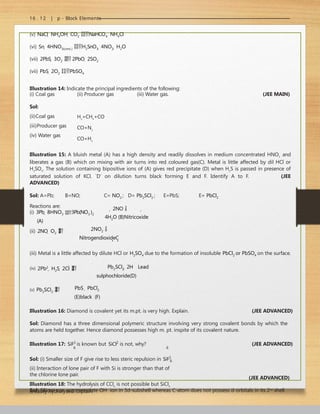
Illustration 16: Diamond is covalent yet its m.pt. is very high. Explain. (JEE ADVANCED)
Sol: Diamond has a three dimensional polymeric structure involving very strong covalent bonds by which the
atoms are held together. Hence diamond possesses high m. pt. inspite of its covalent nature.
Illustration 17: SiF2
is known but SiCl2
is not, why? (JEE ADVANCED)
6 6
Sol: (i) Smaller size of F give rise to less steric repulsion in SiF2
6
(ii) Interaction of lone pair of F with Si is stronger than that of
the chlorine lone pair.
Illustration 18: The hydrolysis of CCl4
is not possible but SiCl4
is easily hydrolysed. Explain.
(JEE ADVANCED)
Sol: Silicon can accommodate OH‒
ion in 3d-subshell whereas C-atom does not possess d-orbitals in its 2nd
shell.
Chemistr y |
16.13
2 3
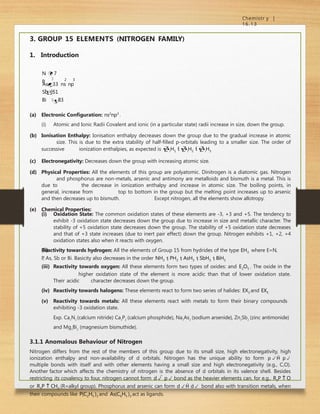
3. GROUP 15 ELEMENTS (NITROGEN FAMILY)
1. Introduction
N  7
P

15
Sb51

As33 ns np

Bi 83
(a) Electronic Configuration: ns2
np3
.
(i) Atomic and Ionic Radii Covalent and ionic (in a particular state) radii increase in size, down the group.
(b) Ionisation Enthalpy: Ionisation enthalpy decreases down the group due to the gradual increase in atomic
size. This is due to the extra stability of half-filled p-orbitals leading to a smaller size. The order of
successive ionization enthalpies, as expected is iH1  iH2  iH3
(c) Electronegativity: Decreases down the group with increasing atomic size.
(d) Physical Properties: All the elements of this group are polyatomic. Dinitrogen is a diatomic gas. Nitrogen
and phosphorus are non-metals, arsenic and antimony are metalloids and bismuth is a metal. This is
due to the decrease in ionization enthalpy and increase in atomic size. The boiling points, in
general, increase from top to bottom in the group but the melting point increases up to arsenic
and then decreases up to bismuth. Except nitrogen, all the elements show allotropy.
(e) Chemical Properties:
(ii)
(i) Oxidation State: The common oxidation states of these elements are -3, +3 and +5. The tendency to
exhibit -3 oxidation state decreases down the group due to increase in size and metallic character. The
stability of +5 oxidation state decreases down the group. The stability of +5 oxidation state decreases
and that of +3 state increases (due to inert pair effect) down the group. Nitrogen exhibits +1, +2, +4
oxidation states also when it reacts with oxygen.
Reactivity towards hydrogen: All the elements of Group 15 from hydrides of the type EH3 where E=N,
P
, As, Sb or Bi. Basicity also decreases in the order NH3  PH3  AsH3  SbH3  BiH3
(iii) Reactivity towards oxygen: All these elements form two types of oxides: and E2O5 . The oxide in the
higher oxidation state of the element is more acidic than that of lower oxidation state.
Their acidic character decreases down the group.
(iv) Reactivity towards halogens: These elements react to form two series of halides: EX3 and EX5
(v) Reactivity towards metals: All these elements react with metals to form their binary compounds
exhibiting -3 oxidation state.
Exp. Ca3
N2
(calcium nitride) Ca3
P2
(calcium phosphide), Na3
As2
(sodium arsenide), Zn3
Sb2
(zinc antimonide)
and Mg3
Bi2
(magnesium bismuthide).
3.1.1 Anomalous Behaviour of Nitrogen
Nitrogen differs from the rest of the members of this group due to its small size, high electronegativity, high
ionization enthalpy and non-availability of d orbitals. Nitrogen has the unique ability to form p p
multiple bonds with itself and with other elements having a small size and high electronegativity (e.g., C,O).
Another factor which affects the chemistry of nitrogen is the absence of d orbitals in its valence shell. Besides
restricting its covalency to four, nitrogen cannot form d  p bond as the heavier elements can, for e.g., R3P  O
or R3P  CH2 (R=alkyl group). Phosphorus and arsenic can form d d bond also with transition metals, when
their compounds like P(C2H5 )3 and As(C6H5 )3 act as ligands.
16 . 14 | p - Block Elements
2. Important Compounds of Nitrogen
1. Dinitrogen
Preparation:
(a) In the laboratory, dinitrogen is prepared by treating an aqueous solution of ammonium chloride with sodium
nitrite.
NH4Cl(aq)  NaNO2 (aq)  N2 (g)  2H2O(l)  NaCl(aq)
(b) It can also be prepared by the thermal decomposition of ammonium dichromate.
(NH4 )2 Cr2O7 H
e
a
t
N2  4H2O  Cr2O3
Properties: Dinitrogen is a colourless,
odourless, tasteless and non-toxic gas.
Chemical properties:
(c) It combines with hydrogen at about
773 K in the presence of a catalyst
(Haber’s Process) to form ammonia:
N2 (g)  3H2 (g) 
7
7
3
K
 2NH3 (g);
(b) Dinitrogen combines with dioxygen only
at a very high temperature (at about
2000 K) to form nitric oxide, NO.
N2  O2 (g) H
e
a
t
 2NO(g)
The main use of dinitrogen is in the manufacture of ammonia and other industrial chemicals containing
nitrogen (e.g., calcium cyanamide). It also finds use where an inert atmosphere is required (for e.g., in the iron
and steel industry, inert diluent for reactive chemicals). Liquid dinitrogen is used as a refrigerant to preserve
biological materials, food items and in cryosurgery.
3.2.2 Ammonia
By urea: NH2CONH2  2H2O (NH4 )2 CO3
Decomposition of (NH4 )2 CO3 gives 2NH3 
H2O  CO2
By Haber’s process.
N2 (g)  3H2 (g)  2NH3 (g); ƒH0  46.1kJmol1
According to Le Chatelier’s principle, high
pressure would favour the formation of
ammonia.
Properties: Ammonia is a colourless gas
with a pungent odour.
Chemical Properties: Due to hydrogen
bonding, it exists in both solid and liquid
states and has higher melting
and boiling points than expected on the
basis of its molecular mass.
Basic nature of ammonia
NH (g)  H O(I) NH 
(aq)  OH
3 4
(blue) (deepblue)
Cu2
(aq)  4NH3 (aq) [Cu(NH ) ]2
(aq)
Chemistr y |
16.15
AgCl(s)
(whiteppt)
Ag
(aq)  Cl
(aq) 


(colourless)
AgCl(s)  2NH3aq [Ag(NH3 )2 ]Cl(aq)
(whiteppt) (colourless)
Uses: Ammonia is used to produce various nitrogenous fertilisers (ammonium nitrate, urea, ammonium phosphate
and ammonium sulphate) and in the manufacture of some inorganic nitrogen compounds, the most important
one being nitric acid. Liquid ammonia is also used as a refrigerant.
3.2.3 Oxides of Nitrogen
Table 16.3: Oxides of nitrogen
Name Formula Oxidation state of
nitrogen
Common preparation methods Physical appearance
and chemical nature
Dinitrogen oxide
[Nitrogen(I) oxide]
N2
O +1
NH4NO3 H
e
a
t
N2O  2H2O
Colourless gas,
neutral
Nitrogen monoxide
[Nitrogen(II) oxide]
NO +2 2NaNO2  2FeSO4  3H2SO4
 Fe2 (SO4 )3  2NaHSO4
2H2O  2NO
Colourless gas,
neutral
Dinitrogen trioxide
[Nitrogen(III) oxide]
N2
O3
+3

Blue solid, acidic
Nitrogen dioxide
[Nitrogen(IV) oxide]
NO2
+4
2Pb(NO3 )2 
6
7
3
K

4NO2
 2PbO  O2
Brown gas, acidic
Dinitrogen tetroxide
[Nitrogen(IV) oxide]
N2O4
+4 2NO2

c
o
o
l
N2
O4
Heat
Colourless solid/
liquid, acidic
Dinitrogen pentoxide
[Nitrogen(V) oxide]
N2O5
+5 2HNO3  P4O10

c
o
o
l
 4HPO3  2N2O5
Heat
Colourless solid,
acidic
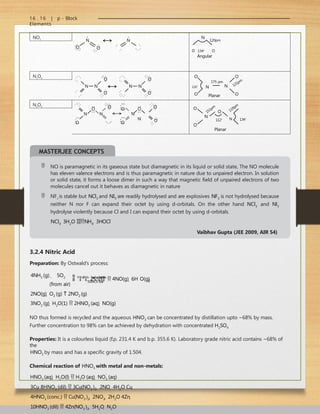
Table 16.4: Resonance structure and bond parameters of some oxides
Formula Resonance Structures Bond Parameters
N2
O :
:
:
:
N=N=O  NN O
:
:
:
: N N O
113pm 119pm
Linear
NO :
:
:
N = O  N = O
:
:
:
: N O
115pm
N2
O3
N N
O
:
:
O
:
:
:
N N
114pm
O 105o
O
N N
130o
186pm
117o
O
121pm
Planar
16 . 16 | p - Block
Elements
NO2
O
:
:
:
N
O
:
:
N
N
120pm
O 134o
O
Angular
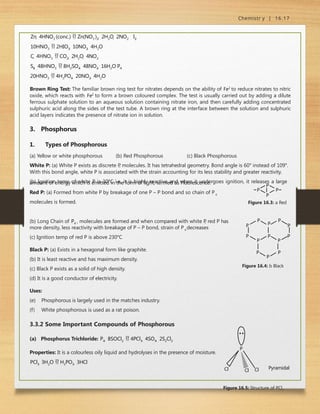
N2
O4
N N
O
:
:
O
:
:
:
N N
O
:
:
O
:
:
:
:
O
O
135o
N
175 pm
N
O
O
121pm
Planar
N2
O5
:
:O
:
:
:
:
O
N N
O
:
:
:
:O
:O
:
:
:
:
:
:
O
:
:
:
O
:
:
O
N
N
O
O
O
N
N 134o
112o
151pm
119pm
Planar
MASTERJEE CONCEPTS
 NO is paramagnetic in its gaseous state but diamagnetic in its liquid or solid state, The NO molecule
has eleven valence electrons and is thus paramagnetic in nature due to unpaired electron. In solution
or solid state, it forms a loose dimer in such a way that magnetic field of unpaired electrons of two
molecules cancel out it behaves as diamagnetic in nature
 NF3
is stable but NCl3 and NI3 are readily hydrolysed and are explosives NF3 is not hydrolysed because
neither N nor F can expand their octet by using d-orbitals. On the other hand NCl3 and Nl3
hydrolyse violently because Cl and I can expand their octet by using d-orbitals.
NCl3  3H2O NH3  3HOCl
Vaibhav Gupta (JEE 2009, AIR 54)
3.2.4 Nitric Acid
Preparation: By Ostwald’s process:
2
500K,9 bar
4NH3 (g)  5O2
(from air)
 P
t /
R
h
g
a
u
g
e
c
a
t
a
l
y
s
t
 4NO(g)  6H O(g)
2NO(g)  O2 (g)  2NO2 (g)
3NO2 (g)  H2O(1)  2HNO3 (aq)  NO(g)
NO thus formed is recycled and the aqueous HNO3 can be concentrated by distillation upto ~68% by mass.
Further concentration to 98% can be achieved by dehydration with concentrated H2SO4
Properties: It is a colourless liquid (f.p. 231.4 K and b.p. 355.6 K). Laboratory grade nitric acid contains ~68% of
the
HNO3 by mass and has a specific gravity of 1.504.
Chemical reaction of HNO3 with metal and non-metals:
HNO3 (aq)  H2O(l)  H3O
(aq)  NO3

(aq)
3Cu 8HNO3 (dil)  3Cu(NO3 )2  2NO  4H2O Cu 
4HNO3 (conc.)  Cu(NO3 )2  2NO2  2H2O 4Zn 
10HNO3 (dil)  4Zn(NO3 )2  5H2O  N2O
Chemistr y | 16.17
Zn  4HNO3 (conc.)  Zn(NO3 )2  2H2O  2NO2 I2 
10HNO3  2HIO3  10NO2  4H2O
C  4HNO3  CO2  2H2O  4NO2
S8  48HNO3  8H2SO4  48NO2  16H2O P4 
20HNO3  4H3PO4  20NO2  4H2O
Brown Ring Test: The familiar brown ring test for nitrates depends on the ability of Fe2
to reduce nitrates to nitric
oxide, which reacts with Fe2
to form a brown coloured complex. The test is usually carried out by adding a dilute
ferrous sulphate solution to an aqueous solution containing nitrate iron, and then carefully adding concentrated
sulphuric acid along the sides of the test tube. A brown ring at the interface between the solution and sulphuric
acid layers indicates the presence of nitrate ion in solution.
3. Phosphorus
1. Types of Phosphorous
(a) Yellow or white phosphorous (b) Red Phosphorous (c) Black Phosphorous
White P: (a) White P exists as discrete P
, molecules. It has tetrahedral geometry. Bond angle is 60° instead of 109°.
With this bond angle, white P is associated with the strain accounting for its less stability and greater reactivity.
(b) Ignition temp of white P is 30°C i.e. it is highly reactive and when it undergoes ignition, it releases a large
amount of energy which is emitted in the form of light, termed as Fluorescence.
Red P: (a) Formed from white P by breakage of one P – P bond and so chain of P4
P
P
P P
Figure 16.3: a Red
molecules is formed.
(b) Long Chain of P4 , molecules are formed and when compared with white P
, red P has P
P
P
P
P
P
P
P
P
P
P
P P
Figure 16.4: b Black
4
more density, less reactivity with breakage of P – P bond, strain of P decreases
(c) Ignition temp of red P is above 230°C
Black P: (a) Exists in a hexagonal form like graphite.
(b) It is least reactive and has maximum density.
(c) Black P exists as a solid of high density.
(d) It is a good conductor of electricity.
Uses:
(e) Phosphorous is largely used in the matches industry.
(f) White phosphorous is used as a rat poison.
3.3.2 Some Important Compounds of Phosphorous
(a) Phosphorus Trichloride: P4  8SOCl2  4PCl3  4SO4  2S2Cl2
Properties: It is a colourless oily liquid and hydrolyses in the presence of moisture.
PCl3  3H2O  H3PO3  3HCl
Cl
Cl
Cl
P
Pyramidal
Figure 16.5: Structure of PCl3
16 . 18 | p - Block Elements
(b) Phosphorus Pentachloride
Preparation:
P4  10Cl2  4PCl5
P4  10SO2Cl2  4PCl5  10SO2
Note: In gaseous and liquid phases, it has a trigonal bipyramidal structure
as shown. The three equatorial P-Cl bonds are equivalent, while the two axial
bonds are longer than equatorial bonds. This is due to the fact that the axial
bond pairs suffer more repulsion as compared to equatorial bond pairs.
Properties: PCl5
is a yellowish white powder and in moist air, it hydrolyses to
POCl3
and finally gets converted to phosphoric acid.
5
Cl
Cl
Cl
Structure of PCl
Cl
Cl
P
240pm
202pm
Figure 16.6: Structure of PCl5
PCl5  H2O  POCl3  2HCl
POCl3  3H2O  H3PO4  3HCl
PCl5 
h
e
a
t
PCl3  Cl2
Note: In the solid state it exists as an ionic solid, [PCl4 ]
[PCl6 ]
in which the cation, [PCl4 ]
is tetrahedral and the
anion, [PCl6 ]
octahedral.
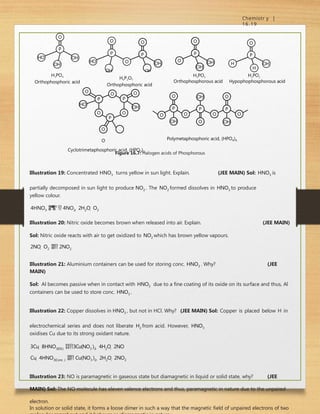
3.3.3 Oxoacids of Phosphorus
Table 16.5: Oxoacids of Phosphorus
Name Formula Oxidation state of
Phosphorous
Characteristic bonds and their
number
Preparation
Hypophosphorous
(phosphinic)
H3
PO2
+1 One P-OH
Two P-H
One P=O
white P4
+ alkali
Orthophosphorous
(Phosphonic)
H3
PO3
+3 Two P-OH
One P-H P-O-P
One P=O
P2
O3
+ H2
O
Pyrophosphorous
H4P2O5
+3 Two P-OH
Two P-H
Two P=O
PCl3
+ H3
PO3
Hypophosphoric H4
P2
O6
+4 Four P-OH
Two P=O
One P-P
red P4
+ alkali
Orthophosphoric H3
PO4
+5 Three P-OH
One P=O
P4
O10
+ H2
O
Pyrophosphoric
H4P2O7
+5 Four P-OH
Two P=O
One P-O-P
heat phosphoric
acid
Metaphosphoric (HPO3
)n
+5 Three P-OH
Three P=O
Three P-O-P
Phosphorus acid
+Br2
, heat in a
sealed tube
Chemistr y |
16.19
O
P
HO
OH
OH
O
P
HO O
O
P
OH
OH OH
H4P2O7
Orthophosphoric acid
O
O
P
OH
OH
H3PO3
O
P
H OH
H
H3PO2
H3PO4
Orthophosphoric acid Orthophosphorous acid Hypophophosphorous acid
O
HO
P
O
P
O
O O
OH
P
O
O
Cyclotrimetaphosphoric acid, (HPO3)3
O
P
O
OH
O O
P
OH
O
P
O
OH
O
Polymetaphosphoric acid, (HPO4)4
Figure 16.7: Halogen acids of Phosphorous
Illustration 19: Concentrated HNO3 turns yellow in sun light. Explain. (JEE MAIN) Sol: HNO3 is
partially decomposed in sun light to produce NO2 . The NO2 formed dissolves in HNO3 to produce
yellow colour.
4HNO3 
S
u
n
l
i
g
h
t
 4NO2  2H2O  O2
Illustration 20: Nitric oxide becomes brown when released into air. Explain.
Sol: Nitric oxide reacts with air to get oxidized to NO2 which has brown yellow vapours.
2NO  O2  2NO2
(JEE MAIN)
Illustration 21: Aluminium containers can be used for storing conc. HNO3 . Why? (JEE
MAIN)
Sol: Al becomes passive when in contact with HNO3 due to a fine coating of its oxide on its surface and thus, Al
containers can be used to store conc. HNO3 .
Illustration 22: Copper dissolves in HNO3 , but not in HCl. Why? (JEE MAIN) Sol: Copper is placed below H in
electrochemical series and does not liberate H2 from acid. However, HNO3
oxidises Cu due to its strong oxidant nature.
3Cu  8HNO3(Dil.) 3Cu(NO3 )2  4H2O  2NO
Cu  4HNO3(Conc .)  Cu(NO3 )2  2H2O  2NO2
Illustration 23: NO is paramagnetic in gaseous state but diamagnetic in liquid or solid state, why? (JEE
MAIN) Sol: The NO molecule has eleven valence electrons and thus, paramagnetic in nature due to the unpaired
electron.
In solution or solid state, it forms a loose dimer in such a way that the magnetic field of unpaired electrons of two
16 . 20 | p - Block Elements
Illustration 24: Which among P4O10 ,Cl2O7 , I2O5 has the greatest affinity for water? (JEE
ADVANCED) Sol: P4O10 , one of the most powerful dehydrating agents known. Cl2O7 is the product of
dehydration of HClO4 by
P4O10 . 12HClO4  P4O10  6Cl2O7  4H3PO4
Also, I2O5 is obtained by heating HIO3 and thus, it cannot have too great affinity for water.
Illustration 25: Describe the action of heat on the following compounds: (JEE ADVANCED)
(i) Ammonium nitrate
(iii) Ammonium Chloride
(v) Ammonium dichromate
(vii) Phosphorous acid
(ix) Copper nitrate
(ii) Ammonium nitrite
(iv) A mixture of NaNO2 and NH4Cl
(vi) Orthophosphoric acid
(viii) Hypophosphorous acid
(x) Silver Nitrate
3
(vi) 2H PO4 H4P2O7  H2O
Sol: (i) NH4NO3 N2O  2H2O
(ii) NH4NO2 N2  2H2O
(iii) NH4Cl
NH3  HCl
(iv) NaNO2  NH4Cl N2  NaCl 
2H2O
(v)(NH4 )2 Cr2O7 N2  Cr2O3 
4H2O
205∘C
3
H PO4 HPO3  H2O
600∘ C
4H3PO4 R
e
d
h
e
a
t

P4O1
0  6H2O
(vii) 4H3PO3 3H3PO4  PH3
(viii) 2H3PO2 H3PO4  PH3
(ix) 2Cu(NO3 )2  2CuO  4NO2  O2
(x) 2AgNO3  2Ag  2NO2  O2
Illustration 26: What happens when an aqueous solution of hydrazine reacts with:
(i) An aqueous solution I2 .
(ii) An alkaline solution of copper sulphate.
(iii) An aqueous alkaline solution of potassium ferricyanide.
(iv) An ammoniacal solution of silver nitrate.
Sol: (i) N2H4  2I2 N2  4HI
(ii) N2H4  2CuSO4  4KOH N2  2Cu  2K2SO4  4H2O
(iii) 4K3[Fe(CN)6 ]  4KOH  N2H4  4K4 [Fe(CN)6 ]  4H2O  N2
(iv) N2H4  2NH4OH  2AgNO3 N2  2Ag  2NH4NO3  2H2O
(JEE ADVANCED)
Chemistr y | 16.21
Illustration 27: An inorganic compound (A) when heated decomposes completely to give only two gases (B) and
(C). (B) is a neutral gas, fairly soluble in water and itself decomposes on heating to two different gases (D) and (E).
(A)When warmed with NaOH gives another gas (F) which turns mercurous nitrate paper black. After
sometime, the gas (F) ceases to evolve, however its supply is restored by treating residual solution with
aluminium powder. Identify (A) to (F) and give necessary equations. (JEE
ADVANCED)
Sol: NH4NO3 H
e
a
t
N2O  2H2O
(A) (B) (C)
2N2O H
e
a
t
 N2 O2
(B) (D) (E)
NH4NO3 NaOH NaNO3 NH3 H2O
(A) (F)
Al  NaOH  H2O NaAlO2  3H
NaNO3  8H NaOH  NH3  2H2O
2NH3 Hg2 (NO3 )2  2H2O Hg2 (OH)2 2NH4NO3
(F) Black
Illustration 28: NF3 is stable but NCl3 and NI3 are readily hydrolysed and are explosives. Explain. (JEE ADVANCED)
Sol: NF3 is not hydrolysed because neither N nor F can expand their octet by using d-orbitals. On the other
hand, NCl3 and NI3 hydrolyse violently because Cl and I can expand their octet by using their d-orbitals.
NCl3  3H2O NH3  3HOCl
2 4
Te

4. GROUP 16 ELEMENTS (OXYGEN FAMILY)
1. Introduction
These are called chalcogen. Because these are ore forming elements {Chalco=ore}
O 
S

Sens np (electronic configuration table)

Po
(a) Electronic Configuration: ns2
np4
(b) Atomic and Ionic Radii: Due to the increase in the number of shells, atomic and ionic radii increase from top
to bottom in the group. The size of oxygen atom is, however, exceptionally small.
(c) Electron Gain Enthalpy: Because of the compact nature of oxygen atom, it has less negative electron gain
enthalpy than sulphur. However, from sulphur onwards the value again becomes less negative up to polonium.
(d) Physical Properties: Oxygen and sulphur are non-metals, selenium and tellurium metalloids, whereas
polonium is a metal. Polonium is radioactive and is short lived (Half-life= 13.8 days).
The melting and boiling points increase with an increase in atomic number down the group.
16 . 22 | p - Block Elements
4.1.1 Anomalous Behaviour of Oxygen
Due to its small size and high electronegativity, strong hydrogen bonding is observed in H2O and not in H2S .
(a) Reactivity with hydrogen: All the elements of Group 16 form hydrides of the type H2E (E=O, S, Se, Te, Po).
Their acidic character increases from H2O to H2Te . The increase in acidic character can be explained in
terms of a decrease in bond enthalpy for the dissociation of H-E bond down the group. Owing to the
decrease in enthalpy for the dissociation of H-E bond, down the group, the thermal stability of
hydrides also decreases from H2O to H2Po . All the hydrides except water possess reducing property
and this character increases from H2S to H2Te .
(b) Reactivity with oxygen: All these elements from oxides of the EO2 and EO3 types where E=S, Se, Te or Po.
(c) Reactivity towards the halogens: Elements of group 16 form a large number of halides of the type, EX6 ,EX4
and EX2 where E is an element of the group and X is a halogen. The stability of the halides decreases
in the order F
 Cl
 Br
 I
.
4.2 Dioxygen
Preparation: Dioxygen can be obtained in the laboratory by the following ways:
(a) By heating oxygen containing salts such as chlorates, nitrates and permanganates.
2KCIO3 
H
e
a
t

 2KCl  3O2
MnO2
(b) Hydrogen peroxide is readily decomposed into water and dioxygen by catalysts such as finely divided metals
and manganese dioxide. 2H2O2 (aq)  2H2O(l)  O2 (g)
(c) On a large scale, it can be prepared from water or air. Electrolysis of water leads to the release of hydrogen at
the cathode and oxygen at the anode.
Properties: Dioxygen is a colourless and odourless gas. Its solubility in water is to the extent of 3.08 cm3
in 100 cm3
water at 293 K which is just sufficient for the vital support of marine and aquatic life.
Some of the reactions of dioxygen with metals, non-metals and other compounds are given below:
2Ca  O2  2CaO
4Al  3O2  2Al2O3
P4  5O2  P4O10
C  O2  CO2
2ZnS  3O2  2ZnO  2SO2
CH4  2O2  CO2  2H2O
Some compounds are
catalytically oxidized. For
e.g.
V O
2SO2  O2 
2 5  2SO3
2HCl  O2 
C
u
C
l2
 2Cl2  2H2O
4.3 Sulphur
(a) Rhombic sulphur (  -sulphur): This allotrope is yellow in colour, m.p. 385.8 K and specific gravity
2.06. Rhombic sulphur crystals are formed on evaporating the solution of roll sulphur in CS2 . It is insoluble in
water but dissolves to some extent in benzene, alcohol and ether. It is readily soluble in CS2 .
(b) Monoclinic sulphur (  -sulphur): This form of sulphur is prepared by melting rhombic sulphur in a
dish and cooling. Till a crust is formed. Two holes are made in the crust and the remaining liquid poured out.
On removing the crust, colourless needle shaped crystals of  -sulphur are formed. It is stable above 369 K
and
Chemistr y | 16.23
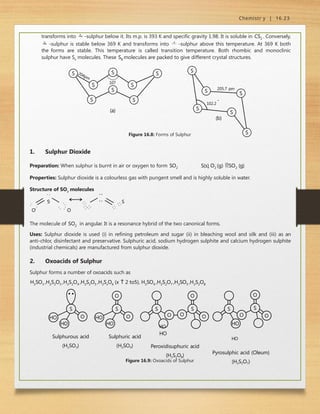
transforms into  -sulphur below it. Its m.p. is 393 K and specific gravity 1.98. It is soluble in CS2 . Conversely,
 -sulphur is stable below 369 K and transforms into  -sulphur above this temperature. At 369 K both
the forms are stable. This temperature is called transition temperature. Both rhombic and monoclinic
sulphur have S8
molecules. These S8 molecules are packed to give different crystal structures.
S
S
S
S
204pm
S
S
S
107
S
(a)
S
S
S S
S
S
+
102.2
205.7 pm
(b)
Figure 16.8: Forms of Sulphur
:
:
:
:
:
:
:
1. Sulphur Dioxide
Preparation: When sulphur is burnt in air or oxygen to form SO2 S(s) O2 (g) SO2 (g)
Properties: Sulphur dioxide is a colourless gas with pungent smell and is highly soluble in water.
Structure of SO2
molecules
S S
O O
The molecule of SO2 in angular. It is a resonance hybrid of the two canonical forms.
Uses: Sulphur dioxide is used (i) in refining petroleum and sugar (ii) in bleaching wool and silk and (iii) as an
anti-chlor, disinfectant and preservative. Sulphuric acid, sodium hydrogen sulphite and calcium hydrogen sulphite
(industrial chemicals) are manufactured from sulphur dioxide.
2. Oxoacids of Sulphur
Sulphur forms a number of oxoacids such as
H2SO3 ,H2S2O3 ,H2S2O4 ,H2S2O5 ,H2SxO6 (x  2 to5), H2SO4 ,H2S2O7 ,H2SO5 ,H2S2O8
O
S
HO
HO
O
S
HO
HO
O
S
O O
S
O
O
HO
HO
Peroxidisuphuric acid
(H2S2O8)
S
O O
S
O
HO
HO
Pyrosulphic acid (Oleum)
(H2S2O7)
Sulphurous acid
(H2SO3)
Sulphuric acid
(H2SO4)
Figure 16.9: Oxoacids of Sulphur
16 . 24 | p - Block Elements
4.3.3 Sulphuric Acid
Manufacture: Sulphuric acid is one of the most important industrial chemicals worldwide. Sulphuric acid is
manufactured by the Contact Process which involves three steps:
(a) Burning of sulphur or sulphide ores in air to generate SO2
(b) Conversion of SO2 to SO3 by the reaction with oxygen in the presence of a catalyst (V2O5 ) , and
(c) Absorption of SO3 in H2SO4 to give Oleum (H2S2O7 ) . The SO2 produced is purified by removing dust and
other impurities such as arsenic compounds.
The key step in the manufacture of H2SO4 is the catalytic oxidation of SO2 with O2 to give SO3 in the presence of
V2O5 (catalyst).
2SO (g) O (g) 
V2O
5  2SO (g);  H  196.6 kJ mol1
2 2 3 r
Manufacture of Sulphuric Acid: The reaction is exothermic, reversible and the forward reaction leads to a
decrease in volume. The SO3 gas from the catalytic converter is absorbed in concentrated H2SO4 to produce
oleum. Dilution of oleum with water gives H2SO4 of the desired concentration. In the industry, two steps are
carried out simultaneously to make the process a continuous one and also to reduce the cost.
SO3 H2SO4 H2S2O7 (Oleum). The sulphuric acid obtained by Contact process is 96-98% pure.
Properties: Sulphuric acid is a colourless, dense, oily liquid with a specific gravity of 1.84 at 298 K. It dissolves in
water with the evolution of a large quantity of heat. While preparing sulphuric acid solution from concentrated
sulphuric acid. The concentrated acid must be added slowly into water with constant stirring. The chemical reaction
of sulphuric acid is as a result of the following characteristics: (a) low volatility (b) strong acidic character (c) strong
affinity for water and (d) ability to act as an oxidizing agent.
H2
SO4
(aq)  H2
O(l)  H3
O
(aq) HSO4

(aq) ; Ka1
 very large(Ka1
 10)
HSO4

(aq)  H2O(l)  H3O
(aq); Ka  1.2 x102
2
Chemical Reactions:
2MX H2SO4  2HX  M2SO4 (X  F, Cl, NO3 )
M  Metal
C12H22O11 H
2S
O4
1
2
C 11H2O
Cu  2H2SO4 (conc.)  CuSO4  SO2 
2H2O
3S  2H2SO4 (conc.)  3SO2  2H2O
C  2H2SO4 (conc.)  CO2  2SO2  2H2O
MASTERJEE CONCEPTS
 Among H2O, HCland NH3 ,H2O has the highest boiling point and HCl the lowest. H2O is capable
of showing more stronger H-bonding than NH3 , while HCl has no H-bonding. The b.p. order is
H2O  NH3  HCl.
 H2
S acts only as a reducing agent while SO2 can act both as a reducing agent and oxidizing agent. S
in SO2 has a oxidation state of +4. It lies between the minimum oxidation state (-2) and maximum
oxidation (+6) of S. Thus, S in SO2 can show an increase in its oxidation number (i.e., act as a
reductant) or can show a decrease in its oxidation number (i.e., it acts as an oxidant). On the other
hand, in H2S, S is in -2 oxidation state and can only increase its oxidation state to act as a reductant.
GV Abhinav (JEE 2012, AIR 329)
Chemistr y |
16.25
Illustration 29: What are the oxidation states of S in the following compounds:
(a) PbS (b) SO2 (c) SF6 (d) Na2S2O3 (e) H2SO3
Sol: (a) -2, (b) +4, (c) +4, (d) +2, (e) +4
(JEE MAIN)
Illustration 30: H2S acts only as reducing agent while SO2 can act both as reducing agent and oxidising agent.
Explain. (JEE MAIN)
Sol: S in SO2 has oxidation state +4. It lies between the minimum oxidation state (-2) and maximum oxidation
state (+6) of S. Thus S in SO2 can show an increase in its ox. no. (i.e., act as reductant) or can show a decrease in
its ox. no. (i.e., act as oxidant). On the other hand, in H2S, S is in -2 oxidation state and can only increase its
oxidation state to act as reductant.
Illustration 31: Nitric acid cannot be used to prepare H2S . Explain.
Sol: Nitric acid is an oxidizing agent. It will oxidise H2S .
H2S  2HNO3  2NO2  S  2H2O
(JEE MAIN)
Illustration 32: Among H2O , HCl and NH3 , H2O has the highest boiling point and HCl the lowest. (JEE
MAIN)
Sol: H2O is capable of showing more stronger H-bonding than NH3 , while HCl has no H-bonding. The b.p. order
is H2O  NH3  HCl
Illustration 33: Conc. H2SO4 cannot be used for drying up H2S . Explain
Sol: Conc. H2SO4 oxidises H2S to S and thus cannot be used as for drying up H2S .
H2SO4  H2S  2H2O  SO2  S
(JEE MAIN)
Illustration 34: Ozone destroys a mercury meniscus. Why? (JEE ADVANCED)
Sol: Ozone oxidises Hg to mercury suboxide which starts sticking to glass and loses its mobility. Hence, Hg loses
its meniscus in contact with ozone. However, it can be regained by the action of H2O2 .
2Hg  O3  Hg2O  O2
(JEE ADVANCED)
Illustration 35: KMnO4 should not be dissolved in conc. H2SO4
. Explain.
Sol: KMnO4 forms explosive covalent compound, Mn2O7 with conc. H2SO4
2KMnO4  H2SO4(conc)  K2SO4  Mn2O7  H2O
However it can be dissolved in dil. H2SO4 to give nascent oxygen, if it is to be used as an oxidant
Illustration 36: SO2 acts as bleaching agent. Explain. (JEE ADVANCED)
Sol: SO2 in presence of water is oxidized to H2SO4 liberating nascent hydrogen, which reduces/bleaches the
colouring matter.
SO2  2H2O  H2SO4  2[H]
Colouring matter + 2[H]  Colourless compound
16 . 26 | p - Block
Elements
Illustration 37: An acidified K2Cr2O7 paper turns green when exposed to SO2 . Explain.
Sol: SO2 reduces K2Cr2O7 to green chromium sulphate.
3SO2  K2Cr2O7  H2SO4  K2SO4  Cr2 (SO4 )3  H2O Green
(JEE ADVANCED)
2 5
ns np
Br
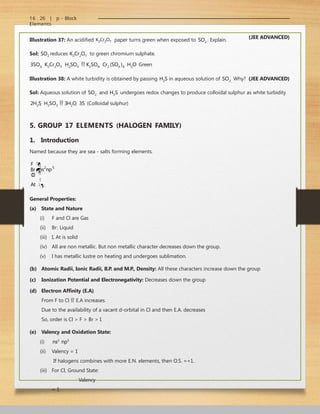
Illustration 38: A white turbidity is obtained by passing H2S in aqueous solution of SO2 Why? (JEE ADVANCED)
Sol: Aqueous solution of SO2 and H2S undergoes redox changes to produce colloidal sulphur as white turbidity.
2H2S  H2SO3  3H2O  3S (Colloidal sulphur)
5. GROUP 17 ELEMENTS (HALOGEN FAMILY)
1. Introduction
Named because they are sea - salts forming elements.
F 
Cl


I 

At
General Properties:
(a) State and Nature
(i) F and Cl are Gas
(ii) Br: Liquid
(iii) I, At is solid
(iv) All are non metallic. But non metallic character decreases down the group.
(v) I has metallic lustre on heating and undergoes sublimation.
(b) Atomic Radii, Ionic Radii, B.P. and M.P., Density: All these characters increase down the group
(c) Ionization Potential and Electronegativity: Decreases down the group
(d) Electron Affinity (E.A)
From F to Cl  E.A increases.
Due to the availability of a vacant d-orbital in Cl and then E.A. decreases
So, order is Cl > F > Br > I.
(e) Valency and Oxidation State:
(i) ns2
np5
(ii) Valency = 1
If halogens combines with more E.N. elements, then O.S. =+1.
(iii) For Cl, Ground State:
Valency
= 1
Chemistr y |
16.27
2
3s
st
1 E.S.
5
3p 3d
2
3s
4
3p
1
3d
Trigonal
bipyramidal
3
sp
d
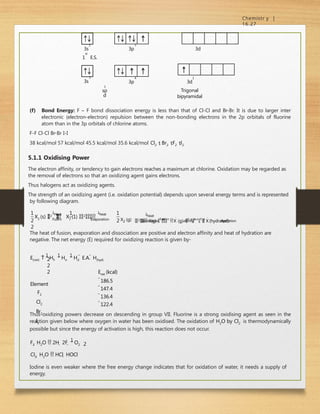
(f) Bond Energy: F – F bond dissociation energy is less than that of Cl-Cl and Br-Br. It is due to larger inter
electronic (electron-electron) repulsion between the non-bonding electrons in the 2p orbitals of fluorine
atom than in the 3p orbitals of chlorine atoms.
F-F Cl-Cl Br-Br I-I
38 kcal/mol 57 kcal/mol 45.5 kcal/mol 35.6 kcal/mol Cl2  Br2 F2 l2
5.1.1 Oxidising Power
The electron affinity, or tendency to gain electrons reaches a maximum at chlorine. Oxidation may be regarded as
the removal of electrons so that an oxidizing agent gains electrons.
Thus halogens act as oxidizing agents.
The strength of an oxidizing agent (i.e. oxidation potential) depends upon several energy terms and is represented
by following diagram.
1
Heat
1
heat
Fusim Evaporation
1 1
2
2
1
2
X2 (s) 
2 

 X2 (1) 2
1
heat
Dissociation affinity hydration
X2 (g) 2 X(g) E
l
e
c
t
r
o
n
X
(g) 
h e
a
t o
f

 X
(hydrated)
The heat of fusion, evaporation and dissociation are positive and electron affinity and heat of hydration are
negative. The net energy (E) required for oxidizing reaction is given by-
E(net) 
1
Hf 
1
Hv 
1
Hd  E.A.  H(hyd)
2
2
2
Element
F2
Cl2
Br2
I2
Enet (kcal)
186.5
147.4
136.4
122.4
Thus oxidizing powers decrease on descending in group VII. Fluorine is a strong oxidising agent as seen in the
reaction given below where oxygen in water has been oxidised. The oxidation of H2O by Cl2 is thermodynamically
possible but since the energy of activation is high, this reaction does not occur.
F2  H2O  2H
 2F

1
O2 2
Cl2  H2O  HCl  HOCl
Iodine is even weaker where the free energy change indicates that for oxidation of water, it needs a supply of
energy.
16 . 28 | p - Block Elements
Chemical Properties
(a) Reaction with H2
(i) All halogens reacts with H2 to form hydrogen halides.
H2  X2  2HX
(ii) Reactivity of Halogens F > Cl > Br > I
(iii) HCl, HBr, HI acts as reducing agent.
(b) Reaction with H2
O
(i) H2
O acts as reducing agent only with fluorine.
2F2  2H2O  4HF  O2
(ii) H2O  I2  No Reaction.
(c) Displacement reaction
(i) F2  2NaX  2NaF  X2 X Cl,Br, I
Cl2  2NaX  2NaCl X2 X  Br2 , I2 
So order of displacement [F2 Cl2 Br2 I 2 ]
(ii) If Halogen is in –ve O.S., then it is replaced by more E.N. element.
(iii) If Halogen is +ve O.S., then it is replaced by less E.N. element.
(d) Reaction with metals: Metal halides are formed F > Cl > Br > I
(e) Reaction with non-metals: Non-metallic halides are formed.
Eg. NF3 , PCl3 etc.
(f) Reaction with NH3
(i) 3F2 NH3 NF3  3HF
(ii) 3Cl2 NH3 NCl3  3HCl
(g) Reaction with NaOH
(i)
(ii)
F2 NaOH (dil.) 2NaFOF2 H2O
2F2  4NaOH (conc.) 4NaF 2H2O  O2
(h) Formation of oxides
(i) No oxides of F because of its maximum E.N. character.
(ii) Rest form
X2O
Eg. 1
Cl2O
X2O3
3
Cl2O3
X2O5
5
Cl2O5
X2O7
7
Cl2O7
(iii) All these oxides are acidic
(iv) Acidity decreases down the group and maximum active oxide is Cl2O7
(v)Formation of oxyacids
(i) F does not form any oxyacid due to High E.N.
Chemistr y |
16.29
(ii) Rest oxyacids are
HXO
HXO2
HXO3 HXO4
1
3
5 7
Hypohalous
Halous
Halic acid Perhalic acid
acid
acid
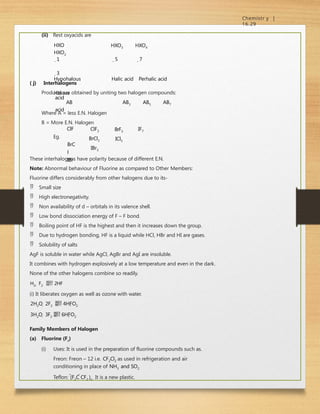
( j) Interhalogens
Products are obtained by uniting two halogen compounds:
AB AB3 AB5 AB7
Where A = less E.N. Halogen
B = More E.N. Halogen
BrF5
ICl5
ClF
Eg.
BrC
l
IBr
ClF3
BrCl3
IBr3
IF7
These interhalogens have polarity because of different E.N.
Note: Abnormal behaviour of Fluorine as compared to Other Members:
Fluorine differs considerably from other halogens due to its-
 Small size
 High electronegativity.
 Non availability of d – orbitals in its valence shell.
 Low bond dissociation energy of F – F bond.
 Boiling point of HF is the highest and then it increases down the group.
 Due to hydrogen bonding, HF is a liquid while HCl, HBr and HI are gases.
 Solubility of salts
AgF is soluble in water while AgCl, AgBr and AgI are insoluble.
It combines with hydrogen explosively at a low temperature and even in the dark.
None of the other halogens combine so readily.
H2  F2  2HF
(i) It liberates oxygen as well as ozone with water.
2H2O  2F2  4HFO2
3H2O  3F2  6HFO2
Family Members of Halogen
(a) Fluorine (F2
)
(i) Uses: It is used in the preparation of fluorine compounds such as.
Freon: Freon – 12 i.e. CF2Cl2 as used in refrigeration and air
conditioning in place of NH3 and SO2
Teflon: (F2C CF2 )n It is a new plastic.
16 . 30 | p - Block Elements
Chlorine (Cl2
)
(a) Preparation: By the electrolysis of brine (Aq. Solution of NaCl) in nelson cell. This is the cheapest method
NaCl 
N
a
Cl
H2O

 H
 OH
At Cathode:
H
e



H
HH H2
At anode:
Cl
 Cle
Cl  Cl  Cl2 
(b) Deacon’s process:
4HCl  O2 
C
u
C
l2

 2H2O  2Cl2
4 : 1
Chlorine gas thus obtained contains N2 and
O2 and is used for the manufacture of
bleaching powder by
Hasenclever’s process
(c) Uses:
(i) As a germicide and disinfectant.
(ii) Domestic antiseptic solution (NaOCl)
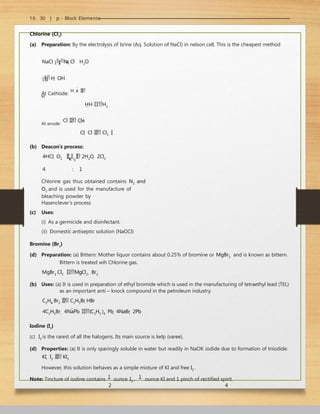
Bromine (Br2
)
(d) Preparation: (a) Bittern: Mother liquor contains about 0.25% of bromine or MgBr2 and is known as bittern.
Bittern is treated wih Chlorine gas.
MgBr2 Cl2 MgCl2  Br2
(b) Uses: (a) It is used in preparation of ethyl bromide which is used in the manufacturing of tetraethyl lead (TEL)
as an important anti – knock compound in the petroleum industry.
C2H6 Br2  C2H5Br HBr
4C2H5Br  4NaPb (C2H5 )4 Pb  4NaBr  2Pb
Iodine (I2
)
(c) I2 is the rarest of all the halogens. Its main source is kelp (varee).
(d) Properties: (a) It is only sparingly soluble in water but readily in NaOK iodide due to formation of triiodide.
KI  I2  KI3
However, this solution behaves as a simple mixture of KI and free I2 .
Note: Tincture of iodine contains 1
ounce I2 , 1
ounce KI and 1 pinch of rectified spirit.
2 4
Chemistr y |
16.31
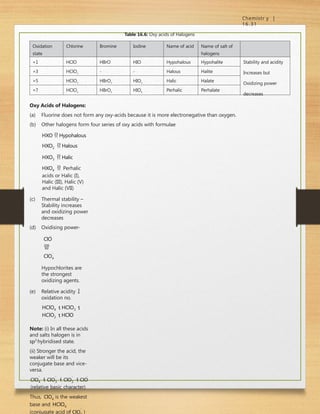
Table 16.6: Oxy acids of Halogens
Oxidation
state
Chlorine Bromine Iodine Name of acid Name of salt of
halogens
+1 HClO HBrO HIO Hypohalous Hypohalite Stability and acidity
Increases but
Oxidizing power
decreases
+3 HClO2
- - Halous Halite
+5 HClO3
HBrO3
HIO3
Halic Halate
+7 HClO4
HBrO4
HIO4
Perhalic Perhalate
Oxy Acids of Halogens:
(a) Fluorine does not form any oxy-acids because it is more electronegative than oxygen.
(b) Other halogens form four series of oxy acids with formulae
HXO  Hypohalous
HXO2  Halous
HXO3  Halic
HXO4  Perhalic
acids or Halic (I),
Halic (III), Halic (V)
and Halic (VII)
(c) Thermal stability –
Stability increases
and oxidizing power
decreases
(d) Oxidising power-
ClO

ClO4

Hypochlorites are
the strongest
oxidizing agents.
(e) Relative acidity 
oxidation no.
HClO4  HClO3 
HClO2  HClO
Note: (i) In all these acids
and salts halogen is in
sp3
hybridised state.
(ii) Stronger the acid, the
weaker will be its
conjugate base and vice-
versa.
ClO4

 ClO3

 ClO2

 ClO
(relative basic character)
Thus, ClO4

is the weakest
base and HClO4
(conjugate acid of ClO 
)
16 . 32 | p - Block Elements
MASTERJEE CONCEPTS
 Fluorine exhibits a covalence of one only whereas other halogens show a covalence ranging from
1 to 7. Because in fluorine vacant d-orbitals are not present and so the electron can’t be unpaired
by electronic excitation. On the other hand, rest all halogens show covalence from 1 to 7 by the
excitation of their p-electrons to d-subshells.
 KHF2
is well known, whereas KHCl2 or KHBr2 does not exist. H2F2 exists as dimeric
molecule due to H-bonding and thus, shows dibasic nature. Hence, it gives two series of
salts KHF2 [K
and F
..........H  F
] and KF [K
and F
] whereas HCl and HBr do not show hydrogen
bonding and thus formation of KHCl2 or KHBr2 is not possible.
Chinmay S Purandare (JEE 2012, AIR 698)
Illustration 39: Pure Hl kept in a bottle acquires a brown colour after some time. Explain. (JEE MAIN)
Sol: Hl is strong reducing agent and is oxidized by oxygen to I2 . The liberated iodine is dissolved there and
imparts a brown colour to the solution. 4HI O2  2H2O  2I2
Illustration 40: Iodine dissolves more in Kl solution, than in pure water. Explain (JEE
MAIN) Sol: I2 is non-polar in nature and thus its solubility in water (a polar solvent) is less which however
becomes more
if Kl is present due to a complex formation. I2 KI KI3 (soluble complex)
Illustration 41: Chlorine is a gas while iodine is a solid under ordinary conditions. Explain. (JEE
MAIN) Sol: Due to high mol. wt., Van der Waals’ forces of attraction one stronger in I2 .
Illustration 42: Fluorine exhibits a covalence of one only whereas other halogens show a covalence ranging from
1 to 7. (JEE
MAIN)
Sol: Because in fluorine, vacant d-orbitals are not present and so electrons can’t be unpaired by electronic
excitation. On the other hand, rest all halogens show covalence from 1 to 7 by excitation of their s and p-electrons
to d-subshells.
Halogens (Cl, Br, I) ns np nd
Ground state
Covalence = 1
Covalence = 3
Covalence = 5
Covalence = 7
I excited state
II excited state
III excited state
Fluorine is the most electronegative element and thus shows only negative oxidation state. Furthermore, it has
2s2
2p5
configuration and thus shows only -1 oxidation state in order to complete its octet. Also like other
halogens, it does not have vacant d-orbitals in its valence shell.
Chemistr y | 16.33
Illustration 43: Fluorine is a non-metal whereas iodine shows some metallic properties as well. Explain.
(JEE MAIN)
Sol: Owing to small size and high I.E., F has no tendency to lose electron. I is large and has lower I.E. So, it may
lose
an electron.
Illustration 44: Why are halogens coloured and on moving from F2 to I2 , the colour of halogens becomes dark,
why? (JEE ADVANCED)
Sol: Because energy required in electronic excitation and de-excitation lies in visible region. On moving from
F2 to I2 , the size of atom increases and so energy levels become closer and so promotion energy becomes less.
So, colour deepens.
Illustration 45: Dry chlorine does not act as bleaching agent. (JEE
ADVANCED) Sol: The bleaching action of Cl2 is due to its reaction with H2O to liberate nascent oxygen.
Illustration 46: Iodine stains on cloths can be removed by hypo.
Sol: Hypo reacts with iodine to form water soluble sodium tetrathionate and sodium iodide.
I2  2Na2S2O3  2NaI  Na2S4O6
(JEE ADVANCED)
2 6
Illustration 47: Colour of KI solution containing starch turns blue when chlorine water is added to it. Explain.
(JEE ADVANCED)
Sol: Cl2 replaces I2 from its aqueous solution due to its higher standard reduction potential than iodine.
Cl2  2KI  2KCl  I2
Illustration 48: KHF2 is well known, whereas KHBr2 does not exist. Explain. (JEE
ADVANCED) Sol: H2F2 exists as dimeric molecule due to H—bonding and thus shows dibasic nature. Hence it
gives two series of
salts KHF2 as [ K
and F
........H  F
] and KF [ K
and F
] whereas HCl and HBr do not show hydrogen bonding and
thus formation of KHCl2 or KHBr2 is not possible.
6. NOBLE GASES OR RARE GASES
1. Introduction
They occur in the atmosphere infrequently and are hence also referred to as the rare gases.
He 2 1s2
Ne 10
Ar
18

Xe 54

Kr 36ns np

Rn 86
All have octet configuration except He having duplet configuration.
(a) They exist in gaseous state.
(b) Rn is produced by the disintegration of radium and is radioactive itself.
16 . 34 | p - Block Elements
(c) Ramsay discovered these gases.
(d) The first inert gas to be discovered by Ramsay was argon.
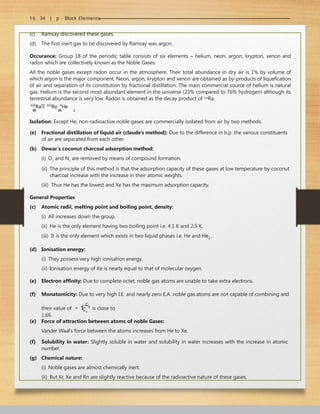
Occurance: Group 18 of the periodic table consists of six elements – helium, neon, argon, krypton, xenon and
radon which are collectively known as the Noble Gases.
All the noble gases except radon occur in the atmosphere. Their total abundance in dry air is 1% by volume of
which argon is the major component. Neon, argon, krypton and xenon are obtained as by-products of liquefication
of air and separation of its constitution by fractional distillation. The main commercial source of helium is natural
gas. Helium is the second most abundant element in the universe (23% compared to 76% hydrogen) although its
terrestrial abundance is very low. Radon is obtained as the decay product of 226
Ra.
226
Ra 222
Rn 4
He
88 86 2
Isolation: Except He, non-radioactive noble gases are commercially isolated from air by two methods.
(e) Fractional distillation of liquid air (claude’s method): Due to the difference in b.p. the various constituents
of air are separated from each other.
(b) Dewar’s coconut charcoal adsorption method:
(i) O2
and N2
are removed by means of compound formation.
(ii) The principle of this method is that the adsorption capacity of these gases at low temperature by coconut
charcoal increase with the increase in their atomic weights.
(iii) Thus He has the lowest and Xe has the maximum adsorption capacity.
General Properties
(c) Atomic radii, melting point and boiling point, density:
(i) All increases down the group.
(ii) He is the only element having two boiling point i.e. 4.1 K and 2.5 K.
(iii) It is the only element which exists in two liquid phases i.e. He and He2 .
(d) Ionisation energy:
(i) They possess very high ionisation energy.
(ii) Ionisation energy of Xe is nearly equal to that of molecular oxygen.
(e) Electron affinity: Due to complete octet, noble gas atoms are unable to take extra electrons.
(f) Monatomicity: Due to very high I.E. and nearly zero E.A. noble gas atoms are not capable of combining and
their value of  
Cp
is close to
1.66.
Cv
(e) Force of attraction between atoms of noble Gases:
Vander Waal’s force between the atoms increases from He to Xe.
(f) Solubility in water: Slightly soluble in water and solubility in water increases with the increase in atomic
number.
(g) Chemical nature:
(i) Noble gases are almost chemically inert.
(ii) But Kr, Xe and Rn are slightly reactive because of the radioactive nature of these gases.
Chemistr y | 16.35
(h) Adsorption of inert gases:
(i) Done on coconut. Gas particles are adsorbed at the surface of coconut charcoal
(ii) Larger the size, more will be the adsorption. So, maximum adsorption of Xe at highest temp.
(iii) First gas discovered was Argon. (Ar Lazy gas)
(iv) The other inert gas isolated was Neon.
(v) The other inert gas which remained a hidden gas krypton (Kryptos = Hidden)
(vi) Then Xenon (Xenon = danger) was discovered
(vii) Rn emits , ,  radiations.
(viii) Discovery of the by Lockeyer on sun’s atmosphere.
Family members of noble gases:
Noble gas compounds proved elusive for many years. The real chemistry of noble gases began in 1962 with the
isolation of an orange yellow solid by Neil Bartlett from the reaction of xenon with PtF6
. Bartlett had noticed that
PtF6
reacts with oxygen to form O2
+
[PtF6
]‒
and since the ionization enthalpies of O2
and Xe are close to each other
[X e1170; O2  1175 kJ mol1
] , he reasoned that PtF6
would react with xenon to form Xe
[PtF6 ]*
. Since this
exciting discovery, several other xenon compounds, mainly with the most electronegative elements-fluorine and
oxygen, have been synthesised. The compounds of krypton are fewer, only the difluoride (KrF2
) has been studied
in detail. Compounds of radon have not been isolated but only identified by radiotracer techniques. No true
compounds of Ar, Ne or He are known.
Xenon (Xe): It is the only element that forms true compounds and that too with highly reactive elements F2
.
Xenon forms three binary fluorides, XeF2 , XeF4 and XeF6 by the direct union of elements under appropriate
sunlight or light from a high pressure mercury arc lamp:
Xe(g)  F2 (g) 
6
7
3 K
,
1
b
a
r

 XeF2 (s)
(xenon in excess)
Xe(g)  2F2 (g) 
8
7
3 K
,
7
b
a
r

 XeF2 (s)
(1:5 ratio)
Xe(g)  3F2 (g) 5

7
3 K
,
7
0 b
a
r

 XeF6 (s)
(1:20 ratio)
XeF2 , XeF4 and XeF6 are colourless solids subliming readily at 298 K. They are powerful fluorinating agents. They
are readily hydrolysed by even traces of water. The hydrolysis of XeF2
can be represented by the equation:
2XeF2 (s)  2H2O(l)  2Xe(g)  4HF(aq) O 2(g)
The structures of the three xenon fluorides can be deduced from VSEPR theory (Valence shell electron pair theory).
XeF2
and XeF4
have linear and square planar structures, respectively. XeF6
has seven electron pairs (6 bonding
pairs and one lone pair) and would thus have a distorted octahedral structure as found experimentally in the gas
phase. In the solid state, XeF6
contains tetrameric and hexameric units in which acceptors form cationic species and
fluoride ion donors form fluoroanions.
4
XeF2  PF5 [XeF]
[PF6 ]
XeF
SbF5 [xeF3 ]
[SbF6 ]
XeF6  MF M
[XeF7 ]
[M  Na,K,Rb or Cs]
16 . 36 | p - Block
Elements
(a) XeF2
:
Xe
+
F
1:2
1:5
1
:
2
0
XeF2
XeF4
XeF4
(b) XeF4
:
(c) XeF6
:
3 3
sp d
Distorted octahedral
(d) Reaction with H2
O:
XeF6  H2O  H2F2  XeOF4
sp3
d2
(Square Pyramidal)
XeOF4 H2O  XeO2F2 H2F2
Xenon dioxy difluoride (sp3
d) i.e.
Trigonal bipyramid
XeO2F2  H2O  XeO3  H2F2
Explosive Xenon trioxide (sp3
)
Neon and Argon:
(a) Gets trapped in the interstitial spaces of
H2O or alcohols and this type of
mixture resulted in what is called as
a clatharate compound.
(b) These compounds are not formed by
He.
Uses:
(c) Noble gases are widely used to provide
inert atmospheres in metallurgical
process
(d) He is used as a cooling medium in gas cooled atomic reactions because of its high thermal conductivity, low
viscosity and low density.
(e) Liquid He is used in gas thermometers required for low temperature measurement.
(f) Neon in neon lamps.
(g) Neon is used in neon tubes for rectifiers, voltage regulators etc.
(h) Argon is used in filling incandescent lamps.
(i) Xe is used in the discharge tube for quick photography.
(j) Rn is used in the treatment of cancer (Radiotherapy)
Chemistr y |
16.37
MASTERJEE CONCEPTS
 Noble gases have zero electron affinity. Noble gases have stable electronic configuration. Hence, it
is difficult to add the electron
 Atomic size of noble gases is maximum in their period. For noble gases only, Van der Waals’ radii can
be obtained. For rest of the elements, covalent or Ionic radii are obtained. Van der Waals’ radii are
always larger than covalent radii.
 Decreasing order of Xe-F bond length in XeF2
, XeF4
, XeF6
XeF2
> XeF4
> XeF6
2.00Å 1.95Å 1.89Å
Bond shortening may be accounted in terms of an
increase in the charge on a xenon atom.
V
a
i
b
h
a
v
G
u
p
t
a
(
J
E
E
2
0
0
9
,
A
I
R
5
4
)
Illustration 49: Helium and neon do not form compounds with fluorine. Explain.
Sol: They are chemically unreactive, owing to small size and high I.E.
(JEE MAIN)
Illustration 50: Why do noble gases have zero electron affinity? (JEE MAIN)
Sol: Noble gases have stable electronic configuration. Hence, it is difficult to add the electron resulting in zero
electron affinity.
Illustration 51: Why are noble gases less reactive? (JEE MAIN)
Sol: Due to completely filled outermost shell.
Illustration 52: Atomic size of noble gases is maximum in their period. Explain. (JEE MAIN)
Sol: For noble gases only Van der Waals’ radii can be obtained. For rest all elements, covalent or ionic radii are
obtained. Van der Waals’ radii are always larger than covalent radii.
Illustration 53: Noble gases have maximum ionization energy in their period. (JEE MAIN)
Sol: Due to a more effective nuclear charge which increases along the period.
Illustration 54: The b.p. of noble gases increases with the increase in at. no. Explain.
Sol: As at. wt. increases, Van der Waals’ forces of attraction becomes strong.
Illustration 55: Why is helium molecule, ( He2
) not formed?
Sol: For He2 , bond order is zero.
(JEE ADVANCED)
(JEE ADVANCED)
Illustration 56: Xenon has a closed shell configuration but forms compounds with fluorine. Explain.
(JEE ADVANCED)
Sol: Gases and thus the outermost shell electrons of Xe are excited to d-subshell.
Illustration 57: Complete the following reactions. (JEE ADVANCED)
16 . 38 | p - Block
Elements
4
(i) XeF6  H2O 


(ii) XeF2  H2 


(iii) XeF6  SiO2 


(iv) XeF6  NH3 


(v) XeF6  SbF5 


(vi) XeF4  KI 


78o C
(vii) XeF  BCl3 
(viii) XeF2  HClO4 


Sol:
(i) XeF6  3H2O  XeO3  6HF
(ii) XeF2 H2  Xe 2HF
(iii) 2XeF6  SiO2  2XeOF4 SiF4
2XeOF4  SiO2  2XeO2F2 SiF4
2XeO2F2  SiO2  2XeO3 SiF4
Explosive
(iv) XeF6  8NH3  Xe 6NH4F  N2
(v) XeF6  SbF5 


[XeF5 ]
[SbF6 ]
Addition ionic product is
formed
4 3 2
(vi) XeF4  4KI  Xe 4KF  2I2
78o C
(vii) 3XeF  4BCl 3  4BF  3Xe  6Cl
(viii) XeF2  2HClO4  Xe(O  ClO3 )2  2HF]
Illustration 58: Arrange the XeF2 , XeF4 , XeF6 in decreasing order of Xe-F bond length give reason also.
(JEE ADVANCED)
Sol: XeF2  XeF4  XeF6 , bond shortening may be accounted for in terms of increase in the charge on a xenon atom.
2.00 A∘
1.95∘
1.89∘

P-BLOCK-ELEMENTS- Group 13 th THEORY.pptx

  • 1.
    16. p - BL O C KE L E M E N T S 1. GROUP 13 ELEMENTS (BORON FAMILY) 1. Introduction Elements of group 13 belong to p-block elements, since the last electron in them is present in the p-orbital. All these elements have three electrons in the outer most orbit: two in the s-orbital and one in the p-orbital. Thus, the electronic configuration of the outermost energy levels of these elements maybe represented as ns2 np1 . Table 16.1: Electronic configuration for Group 13 Element with At. No. Configuration with inert gas core B 5 [He]2s2 2p1 Al 13 [Ne]3s2 3p1 Ga 31 [Ar]3d10 4 s2 4p1 In 49 [Kr]4d10 5s2 5p1 Tl 81 [Xe]4f14 5d10 6 s2 6p1 1.2 Boron Preparation: Na2B4O7  2HCl  5H2O  4H3BO3  2NaCl 2H3BO3 B2O3  3H2O B2O3  3Mg  2B  3MgO Physical Properties: Low electronegativity, hard, absorbs neutrons, steel grey in color. Some dissimilarities of boron with other elements of this group are: (a) Boron does not form positive ions in aqueous solution and has low oxidation potential. (b) Boron always forms covalent compounds
  • 2.
    16 . 2| p - Block Elements Chemical Properties 2 3 (a) Reaction with O2 and N2 700∘C 4B  3O2  2B O 2B  N2  2BN 700∘C (b) Reaction with alkalis and acids 2B  2NaOH  2H2O  2NaBO2  3H2 2B  3H2SO4  o x i d a t i o n   2H3BO3  3SO2 (c) Boron reacts with Mg, which on hydrolysis give diborane. 3Mg  2B Mg3B2 Mg3B2  6HCl 3MgCl2  B2H6 (d) Reaction with silica 3SiO2  4B  2B2O3  3Si MASTERJEE CONCEPTS  Boron has high m.p. and b.p. Boron has a very high m. p. and b.p. because it exists as a giant covalent, polymeric structure both in solid as well as in liquid state.  B(OH)3 is an acid, Al(OH)3 is amphoteric and TI(OH)3 is basic. The electropositive or metallic character of gp. 13 elements increases from B to Tl. B being a non- metal and thus forms an acidic hydroxide. Al forms amphoteric hydroxide and Tl, the most metallic from basic hydroxides. Nitin Chandrol (JEE 2012, AIR 134) 1.2.1 Comparison between Boron and Aluminium (a) Action of conc.H2 SO4 : Both react with conc. H2SO4 to liberate SO2 . 2B  3H2SO4  2H3BO3  3SO2  2Al  6H2SO4  Al2 (SO4 )3  3SO2  6H2O (b) Action of alkalies: Both liberate H2 . 2B  6NaOH  2Na3BO3  3H2  2Al  2NaOH  2H2O  2NaAlO2  3H2  (c) Formation of oxides: Both form oxides when heated with oxygen at high temperature. 4B  3O2  2B O 2 3 2 3 4Al  3O2  2Al O 700∘C 800∘ C These oxides are amphoteric and dissolve in acids as well as in alkalies to form salts. B2O3  6HCl  2BCl3  3H2O Al2O3  6HCl  2AlCl3  3H2O B2O3  6NaOH  2Na3BO3  3H2O Al2O3  6NaOH  2NaAlO2  H2O
  • 3.
    Chemistr y |16.3 (d) Formation of nitrides: Both, when heated with nitrogen or ammonia, form nitrides. 2B  N2  2BN 2Al  N2  2AlN 2B  2NH3  2BN  3H2 2Al  2NH3  2AlN  3H2 These nitrides are decomposed by steam to from ammonia. BN  3H2O H3BO3  NH3 AlN  3H2O  Al(OH)3  NH3 (e) Formation of sulphides: Both form sulphides on heating with sulphur at high temperatures. These are hydrolysed by water. B2S3  6H2O  2H3BO3  3H2S Al2S3  6H2O  2Al(OH)3  3H2S (f) Formation of chlorides: They from trichlorides by direct combination with Cl2 or by passing Cl2 over a heated mixture of their oxides and charcoal. 2B  3Cl2  2BCl3 B2O3  3C  3Cl2  2BCl3  3CO 2Al  3Cl2  2AlCl3 Al2O3  3C  3Cl2  2AlCl3  3CO These trichlorides are covalent and are hydrolysed by water. BCl3  3H2O H3BO3  3HCl AlCl3  3H2O  Al(OH)3  3HCl MASTERJEE CONCEPTS  The p   p back bonding occurs in the halides of boron but not in the halides of aluminium. The tendency to show p p back bonding is maximum in boron halides and decreases very rapidly with the increase in the size of the central atom and halogen atom. “Since Al is larger in size than B, it does not show back-bonding”.  From boron to thallium, +1 oxidation state becomes more stable. Reason: inert pair effect. GV Abhinav (JEE 2012, AIR 329) 1.2.2 Compounds of Boron (a) Diborane (B2H6 ) Preparation: 4BF3 .OEt2  3LiAlH4  E t2O   2B2H6  3LiAlF4  4Et2O
  • 4.
    16 . 4| p - Block Elements Physical Properties: (ii) (i) Diborane is a colourless gas (b. p. 183K). It is rapidly decomposed by water with the formation of H3BO3 and H2 : B2H6  6H2O  2H3BO3  6H2 Diborane undergoes a facile addition reaction with alkenes and alkynes in ether solvents at room temperature to form organoboranes: 2B(CH2CH2R)3 (Hydroboration Reation) 6RCH  CH2  B2H6    (b) Boric Acid: Orthoboric acid, H3BO3 (commonly known as boric acid) and metaboric acid HBO2 , are two well- known, important oxoacids of boron. Preparation: Na2B4O7  2HCl  5H2O  4H3BO3  2NaCl Properties: (i) It is moderately soluble in water. (ii) On heating boric acid at 375K, metaboric acid, HBO2 is formed. On further heating above 500K, B2O3 is formed. H3BO3  3 7 5 K HBO2  H2O 2HBO2  5 0 0 K B2O3  H2O In solution, metaboric acid changes to orthoboric acid. (c) Borax (Sodium tetraborate decahydrate, Na2 B4 O7 .10H2 O) Preparation: Ca2B6O11  2Na2CO3 Na2B4O7  2NaBO2  2CaCO3  Properties: (i) On heating alone, it decomposes to from NaBO2 and B2O3 Na2B4O7  2NaBO2  B2O3 (ii) Borax bead Test: The formation of coloured metaborates by transition metal salts is used in the borax bead test as a qualitative analysis. The distinct colour of the bead depends on the oxidizing or reducing flame of the bunsen burner. A cupric salt forms blue cupric metaborate in the oxidizing flame: Na2B4O7  CuO    Cu(BO2 )2  2NaBO2 In the reducing flame (ie. In presence of carbon), the coloured salt is reduced to colourless cuprous metaborate: 2Cu(BO2 )2  2NaBO2  C  2CuBO2  Na2B4O7  CO and to metallic copper and hence the bead becomes dull red and opaque. 2Cu(BO)2  4NaBO2  2C  2Cu  2Na2B4O7  2CO Illustration 1: Show that B2O3 is amphoteric oxide. (JEE MAIN) Sol: Amphoteric oxide is an oxide that can behave as an acid or a base. Thus, following reactions can be written as- B2O3  6HCl  2BCl3  3H2O B2O3  2NaOH  2NaBO2  H2O
  • 5.
    Chemistr y |16.5 Illustration 2: Boron is trivalent in nature. Explain. (JEE MAIN) Sol: Trivalency is having a valence of three or showing the presence of three valence electrons. Due to ns2 np1 configuration it can share three electrons with other atoms. Illustration 3: B(OH)3 is an acid, Al(OH)3 is amphoteric and Tl(OH)3 is basic. Explain. (JEE MAIN) Sol: The electropositive or metallic character of gp. 13 elements increases from B to Tl. B being a non- metal and thus forms an acidic hydroxide. Al forms amphoteric hydroxide and Tl, the most metallic form basic hydroxides. Illustration 4: An inorganic compound (A) in its aqueous solution produced a white ppt. with NaOH, which dissolves in excess of NaOH. The aqueous solution of (A) also produced a white ppt. with NH4 OH which does not dissolve in excess of NH4 OH. Also, its aqueous solution produced a light yellow ppt. with AgNO3 solution, soluble in dil. HNO3 . Identify (A) (JEE ADVANCED) Sol: The given reactions are: Al(OH)3 Aluminium hydroxide (white ppt.) (i) AlBr3  3NaOH    (A)  3NaBr NaAlO2 Sodium aluminate (Soluble ) Al(OH)3 NaOH     2H2O (ii) AlBr3  3NH4OH  Al(OH)3  3NH4Br Al(OH)3  NH4OH  No reaction and thus insoluble (iii) AlBr3  3AgNO3  3AgBr  Al(NO3 )3 Yellowppt. Illustration 5: Identify A, B and C in the given reaction sequence: (JEE ADVANCED) C6 H5 Cl NaBH4 4 NH Cl  BCl 3  A  B 140  150C CH3 MgBr A  CH3 MgBr  C Sol: The product is Borazine, an inorganic compound formed here, which is isoelectronic and isostructural with benzene. A  B3N3H3Cl3 , B  B3N3H6 , C  B3N3H3 (CH3 )3 4 3 3NH Cl  3BCl   C 6H5 C l  140150∘C
  • 6.
    16 . 6| p - Block Elements Reactions are: Cl B N H Cl B N H N H B Cl (A) 3CH3MgBr NH BH BH NH NH BH N H H3C B CH3 B B N N H CH3 (B) (C) H Illustration 6: Aluminium vessels should not be cleaned with a cleansing agent containing washing soda. Why? (JEE ADVANCED) Sol: Washing soda (Na2CO3 ) reacts with water to form NaOH and Al gets dissolved in caustic soda. 2Al 2NaOH 2H2O    2NaAlO2  3H2 Sodium meta aluminate Illustration 7: The p p back bonding occurs in the halides of boron but not in the halides of aluminium. Explain. (JEE ADVANCED) Sol: The tendency to show p p back bonding is maximum in boron halides and decrease very rapidly with the increase in the size of central atom and halogen atom. Since, Al is larger in size than B and thus, does not show back bonding. Illustration 8: Borazole or borazine is more reactive than benzene. Explain. (JEE ADVANCED) Sol: In Borazine, B=N bonds are polar and therefore, reactivity of borazole is more than benzene which possesses non-polar C=C and C-C bonds. The more negative group attacks boron atom. Illustration 9: From boron to thallium, +1 oxidation state becomes more stable. Explain. (JEE ADVANCED) Sol: Inert pair effect is the tendency shown by the outermost s-electrons of the post transition elements to remain unionized or unshared. [Due to inert pair effect.] 2. GROUP 14 ELEMENTS (CARBON FAMILY) 1. Introduction Carbon, silicon, germanium, tin and lead constitute the group 14 of the periodic table. The electronic configuration of these elements are as given below.
  • 7.
    Chemistr y |16.7 Table 16.2: Electronic Configuration of Group 14 Elements: Element At. No Electronic Configuration C 6 1s2 ,2s2 2p2 or[He]2s2 2p2 Si 14 1s2 ,2s2 2p6 ,3s2 3p2 or[Ne]3s2 3p2 Ge 32 1s2 ,2s2 2p6 ,3s2 3p6 ,3d10 , 4s2 p2 or[Ar]3d10 4s2 4p2 Sn 50 1s2 ,2s2 2p6 ,3s2 3p6 ,3d10 , 4s2 4p6 , 4d10 ,5s2 5p2 or[Kr] 4d10 5s2 5p2 Pb 82 1s2 ,2s2 2p6 ,3s2 3p6 ,3d10 , 4s2 4p6 , 4d10 4 f14 ,5s2 5p2 d10 ,6s2 6p2 or[Xe] 4f14 5d10 6s2 6p2 2. Carbon 1. Allotropes of Carbon (a) Crystalline form: Diamond and graphite are the two crystalline forms of carbon. (b) Amorphous form: Coal, Coke, Charcoal (or wood charcoal), animal charcoal (or bone black), Lamp black, Carbon black, Gas carbon and Petroleum coke are the amorphous forms of carbon. 2.2.2 Important Compounds of Carbon (a) Carbon Monoxide (CO) Preparation: (i) By heating oxides of heavy metals e. g. iron, zinc etc with carbon. Fe2O3  3C  2Fe  3CO ZnO  C  Zn  CO Two important industrial fuels-water gas and producer gas, contains carbon along with hydrogen and nitrogen, Water gas is obtained by passing steam over hot coke C  H2O    CO  H2 (water gas) 2CO  4N2 (producer gas) 2C  O2  4N2    Properties: (i) It is a powerful reducing agent and reduces many metal oxides to the corresponding metal .For e. g. Fe2O3  3CO  2Fe  3CO2 CuO  CO  Cu  CO2 Tests: (a) Burns with a blue flame (b) A filter paper soaked in platinum or palladium chloride turns pink, green or black due to reduction of the chloride by carbon monoxide. (b) Carbon dioxide (CO2 ): Preparation: CaCO3  2HCl  CaCl2  H2O  CO2
  • 8.
    16 . 8| p - Block Elements Properties: (i) It turns lime water milky and the milkiness disappears when CO2 is passed in excess. Ca(OH)2  CO2  CaCO3  H2O CaCO3  H2O  CO2  Ca(HCO3 )2 (ii) Solid carbon dioxide or dry ice is obtained by cooling CO2 under pressure. It passes to the solid state straight from gaseous state without liquefying (hence called dry ice). 3. Carbides: Carbon reacts with more electropositive elements to form carbides at high temperature. Types of Carbides: (a) Salt-like Carbides: These are the ionic salts containing either C2 2 (acetylide ion) or C4 (methanide ion) e. g. CaC2 , Al4 C3 ,Be2C . (b) Covalent Carbides: These are the carbides of non-metals such as silicon and boron. In Such carbides, the atoms of two elements are bonded to each other through covalent bonds. SiC is also known as Carborundum. (c) Interstitial Carbides: They are formed by transition elements and consist of metallic lattices with carbon atoms in the interstices. e. g. tungsten carbide WC, vanadium carbide VC. 2.3 Silicon Extraction: Commercial form of silicon is obtained by the reduction of SiO2 with C or CaC2 in an electric furnace. High purity silicon is obtained either from SiCl4 or from SiHCl3 . Properties: Silicon is obtained by the reduction of silica. It exists in two allotropic forms: (a) amorphous (b) crystalline The amorphous variety is obtained by heating dry powdered silica with magnesium. SiO2  2Mg Si  2MgO The crystalline variety is obtained by heating a finely powdered sand or quartz with carbon in an electric furnace where, a small amount of iron is added to prevent the formation of carborundum (SiC) SiO2  2C Si  2CO Amorphous silicon is chemically more reactive than crystalline silicon. Amorphous silicon is a brownish powder. It burns brilliantly in oxygen and ignites spontaneously in fluorine. Si  O2 SiO2 Si  2F SiF (b) (c) Figure 16.1: Differently bonded silicates (d) Tetrahedral unit (a)
  • 9.
    Chemistr y |16.9 NaAlSi3 O8 , zeolites, e.g., chabazite Ca2 [(AlO2 )4 (SiO2 )8 )H2 O], micas (muscovite)[KAl2 (Si3 AlO10 )(OH)2 ] and asbestos [Mg(Si2 O5 )(OH)4 ]. The basic structural unit in silicates is the SiO4 tetrahedron. The SiO4 tetrahedral can be linked in several different ways. Depending on the number of corners (0, 1, 2, 3 or 4) of the SiO4 tetrahedral shared, various kinds of silicates, single or double chains, rings, sheet or three-dimensional networks are formed. (e) (f) Figure 16.2: Normal orthosilicates Normal orthosilicates (e.g. Mg2SiO4 ) contain discrete SiO4 units. When two SiO4 tetrahedra share a corner (common oxygen atom), we get the (Si2O7 )6 unit and the silicates are called pyrosilicates. When SiO4 units share two oxygen atoms with each other, cyclic or linear single chain silicates are formed with empirical formula [(SiO3 )2 ]n as present in beryl (a mineral) Be3Al2Si6O18 . A linear silicate chain is present in pyroxenes (e.g. MgCaSi2O6 ). If two chains are cross-linked, the resulting double stranded silicates have the composition [(Si4O11 )6 ]n and are called amphiboles. Asbestos belongs to this class. Two dimensional sheet structures are formed, three corners of each SiO4 tetrahedron are shared as found in clays which contains   2 5 Si O 2 4 units. When all the four corners of the SiO tetrahedron are shared, 3D networks are formed, leading to different forms of silica. If in this, three-dimensional network, part of the silicon is replaced by aluminum (Al3 ) . This will require the incorporation of other cations (Na ,K or Ca2 ) for maintaining the charge balance. The resultant 3D networks give aluminosilicates which include feldspars and zeolites. Two important man-made silicates from a practical point of view are glass and cement. 2.3.2 Silicones These are organosilicon polymers containing Si—O—Si linkages. They may be linear, cyclic or cross-linked polymers. These are prepared from alkyl-or aryl-chlorosilanes which in turn are obtained from Grignard reagent and silicon tetrachloride. CH3MgCl Methyl magnesium Chloride 2CH3MgCl  SiCl4    Silicon tetrachloride CH3SiCl3  MgCl2 Methyl trichlorosilane  SiCl4 (CH3 )2 SiCl2  2MgCl2 Dimethyl dichlorosilane    Preparation: Hydrolysis of the chlorides yields the corresponding silanols which polymerize by condensation by elimination of one water molecule from 2 molecules of alkyl silanols. 3 Si H2O CH3 CH Cl CH3 CH3 Cl Dimethyldichlorosilane Si OH OH -H2O 3 CH CH3 CH3 CH3 HO Si O Si OH Dimethylsilandiol
  • 10.
    16 . 10| p - Block Elements Now, since an active OH group is left at each end of the chain, polymerization continues at both the ends and thus the chain increases in length and ultimately forms a linear thermoplastic polymer. CH3 CH3 CH3 CH3 O Si O Si O Si O Si O CH3 CH3 CH3 CH3 Hydrolysis of alkyl trichlorosilane CH3SiCl3 gives the monomethylsilanetriol which then undergoes polymerization to a very complex cross-linked polymer. Cl CH3 Si Cl Cl OH CH3 Si OH OH Me Me Me Me O Si O Si O Si O Si O O O O 2.3.3 Glass Glass is a transparent or translucent amorphous supercooled solid solution of silicates and borates. The most common silicates present are those of potassium, calcium and lead. Its composition is variable as it is not a true compound. An approximate formula for ordinary glass may be given as, R2O.MO.6Si2O , where R=Na or K and M=Ca, Ba, Zn or Pb. SiO2 may be replaced by Al2O3 ,B2O3 ,P2O5 . When glass is heated, it does not melt at a fixed temperature. However, it gradually softens and can be moulded into any desired shape. It is this property of glass which makes it a useful material for making articles of different shapes. Glass melts into liquid at a very high temperature. Acidic oxides: A number of acidic oxides are useful. The choice depends upon the quality of glass to be manufactured. (a) Silica: Sand of uniform size is used, i.e., neither too fine nor too coarse. Finer variety makes the reaction violent while coarse variety slows down the reaction. It should be free from iron oxide and organic matter. (b) Boron Trioxide, B2O3 : This is introduced in the form of boric acid or borax. It is used when a glass of low coefficient of expansion is required. (c) Phosphorus pentoxide, P2O5 : It is introduced in the form of calcium phosphate. It is used when opalescent glass is required. Basic oxides: One or more of the following basic oxides are used: Lithium, sodium, potassium, calcium, barium, magnesium, lead and zine oxides. Sodium is introduced in the form of sodium carbonate ( Na2CO3 ) and carbon mixture. Potassium is added as potassium carbonate (K2CO3 ) or potassium nitrate (KNO3 ) . Calcium is added as CaCO3 or CaO. Barium is put in as BaCO3 . Magnesium is added as MgCO3 . Lead oxide are put in such. Zinc oxide is used when heat resistance glass is to be obtained. 2.3.4 Silicon Carbide (Carborundum) Preparation: SiC is made commercially by reducing silicon with carbon in an electric resistance furnace. SiO2  3C SiC  2CO Properties: It is extremely hard and fuses with much difficulty (does not decompose below 2200°C) It resists most chemical reagents but is oxidized by a fused NaOH in contact with air. SiC + 2NaOH + 2O2 Na2 CO3 + NaSiO3 + 2H2 O In SiC, carbon and silicon atoms are alternate and are each surrounded tetrahedrally. It is widely used as an abrasive for grinding, cutting and polishing.
  • 11.
    Chemistr y | 16.11 (i)Smaller size of F gives rise to less steric repulsion in SiF2 . 6 (ii) Interaction of a lone pair of F with Si is stronger than that of a chlorine lone pair. 4 4  The hydrolysis of CCl is not possible but SiCl is easily hydrolysed. Silicon can accomodate OH ion due to the presence of 3d-subshell. whereas C-atom does not possess d-orbitals in its 2nd shell Anand K ((JEE 2011, AIR 47)) MASTERJEE CONCEPTS  Diamond is covalent yet its m.p. is very high. Diamond has a three dimensional polymeric structure involving very strong covalent bonds by which the atoms are held together. Hence, diamond possesses high m.p. inspite of covalent nature.  SiF2 is known but SiCl2 is not, 6 6 Illustration 10: Carbon and silicon are always tetravalent but germanium and lead show divalency. Explain. (JEE MAIN) Sol: Inert pair effect is more pronounced in Ge and Pb, as it increases down the group. This results in the divalent ionic nature of Ge and Pb. Illustration 11: Producer gas is a less efficient fuel than water gas, why? (JEE MAIN) Sol: In water gas (CO + H2 ), both components burn and evolve heat while in producer gas (CO + N2 ), only CO burns, i.e., why the former has a higher calorific value and is good fuel. Illustration 12: Diamond is the hardest substance but graphite is soft in nature. Explain. (JEE MAIN) Sol: Diamond possesses a very big three dimensional polymeric structure involving each carbon of sp3 - hybridized nature linked to four other neighbouring carbon atoms which makes it hardest. On the other hand, graphite has layer structure involving each carbon of sp2 -hybridized nature having a wide separation and weak interlayer bonds and thus two adjacent layers can easily slide over the other to produce its soft nature. Illustration 13: What happens when: (JEE MAIN) (vi) (i) Dilute nitric acid slowly reacts with tin. (ii) Carbon and steam are heated. (iii) Red lead is treated with nitric acid. (iv) Iodine is added to stannous chloride. (v) Carbon dioxide is passed through a concentrated aqueous solution of sodium chloride saturated with ammonia. Tin is treated with concentrated nitric acid. (vii) Lead is obtained from galena by air reduction. Sol: (i) 4Sn  10HNO3(dil)  4Sn(NO3 )2  NH4NO3 (ii) C  H2O  CO  H2 (Water gas) (iii) Pb3O4  4HNO3  2Pb(NO3 )2  PbO2  2H2O (iv) 2SnCl2  2I2 SnCl4  SnI4
  • 12.
    16 . 12| p - Block Elements (v) NaCl  NH4OH  CO2 NaHCO3  NH4Cl (vi) Sn  4HNO3(conc.) H2SnO3  4NO2  H2O (vii) 2PbS  3O2  2PbO  2SO2 (vii) PbS  2O2 PbSO4 Illustration 14: Indicate the principal ingredients of the following: (i) Coal gas Sol: (ii)Coal gas (iii)Producer gas (iv) Water gas (ii) Producer gas (iii) Water gas. (JEE MAIN) H2 +CH4 +CO CO+N2 CO+H2 Illustration 15: A bluish metal (A) has a high density and readily dissolves in medium concentrated HNO3 and liberates a gas (B) which on mixing with air turns into red coloured gas(C). Metal is little affected by dil HCl or H2 SO4 . The solution containing bipositive ions of (A) gives red precipitate (D) when H2 S is passed in presence of saturated solution of KCl. `D’ on dilution turns black forming E and F. Identify A to F. (JEE ADVANCED) Sol: A=Pb; B=NO; C= NO2 ; D= Pb2SCl2 ; E=PbS; E= PbCl2 Reactions are:  2NO   4H2O (B)Nitricoxide (i) 3Pb  8HNO3 3Pb(NO3 )2 (A) (ii) 2NO  O2    2NO2  NitrogendioxideC (iii) Metal is a little affected by dilute HCl or H2SO4 due to the formation of insoluble PbCl2 or PbSO4 on the surface. (iv) 2Pb2  H2S  2Cl    Pb2SCl2  2H Lead sulphochloride(D) (v) Pb2SCl2    PbS  PbCl2 (E)black (F) Illustration 16: Diamond is covalent yet its m.pt. is very high. Explain. (JEE ADVANCED) Sol: Diamond has a three dimensional polymeric structure involving very strong covalent bonds by which the atoms are held together. Hence diamond possesses high m. pt. inspite of its covalent nature. Illustration 17: SiF2 is known but SiCl2 is not, why? (JEE ADVANCED) 6 6 Sol: (i) Smaller size of F give rise to less steric repulsion in SiF2 6 (ii) Interaction of lone pair of F with Si is stronger than that of the chlorine lone pair. Illustration 18: The hydrolysis of CCl4 is not possible but SiCl4 is easily hydrolysed. Explain. (JEE ADVANCED) Sol: Silicon can accommodate OH‒ ion in 3d-subshell whereas C-atom does not possess d-orbitals in its 2nd shell.
  • 13.
    Chemistr y | 16.13 23 3. GROUP 15 ELEMENTS (NITROGEN FAMILY) 1. Introduction N  7 P  15 Sb51  As33 ns np  Bi 83 (a) Electronic Configuration: ns2 np3 . (i) Atomic and Ionic Radii Covalent and ionic (in a particular state) radii increase in size, down the group. (b) Ionisation Enthalpy: Ionisation enthalpy decreases down the group due to the gradual increase in atomic size. This is due to the extra stability of half-filled p-orbitals leading to a smaller size. The order of successive ionization enthalpies, as expected is iH1  iH2  iH3 (c) Electronegativity: Decreases down the group with increasing atomic size. (d) Physical Properties: All the elements of this group are polyatomic. Dinitrogen is a diatomic gas. Nitrogen and phosphorus are non-metals, arsenic and antimony are metalloids and bismuth is a metal. This is due to the decrease in ionization enthalpy and increase in atomic size. The boiling points, in general, increase from top to bottom in the group but the melting point increases up to arsenic and then decreases up to bismuth. Except nitrogen, all the elements show allotropy. (e) Chemical Properties: (ii) (i) Oxidation State: The common oxidation states of these elements are -3, +3 and +5. The tendency to exhibit -3 oxidation state decreases down the group due to increase in size and metallic character. The stability of +5 oxidation state decreases down the group. The stability of +5 oxidation state decreases and that of +3 state increases (due to inert pair effect) down the group. Nitrogen exhibits +1, +2, +4 oxidation states also when it reacts with oxygen. Reactivity towards hydrogen: All the elements of Group 15 from hydrides of the type EH3 where E=N, P , As, Sb or Bi. Basicity also decreases in the order NH3  PH3  AsH3  SbH3  BiH3 (iii) Reactivity towards oxygen: All these elements form two types of oxides: and E2O5 . The oxide in the higher oxidation state of the element is more acidic than that of lower oxidation state. Their acidic character decreases down the group. (iv) Reactivity towards halogens: These elements react to form two series of halides: EX3 and EX5 (v) Reactivity towards metals: All these elements react with metals to form their binary compounds exhibiting -3 oxidation state. Exp. Ca3 N2 (calcium nitride) Ca3 P2 (calcium phosphide), Na3 As2 (sodium arsenide), Zn3 Sb2 (zinc antimonide) and Mg3 Bi2 (magnesium bismuthide). 3.1.1 Anomalous Behaviour of Nitrogen Nitrogen differs from the rest of the members of this group due to its small size, high electronegativity, high ionization enthalpy and non-availability of d orbitals. Nitrogen has the unique ability to form p p multiple bonds with itself and with other elements having a small size and high electronegativity (e.g., C,O). Another factor which affects the chemistry of nitrogen is the absence of d orbitals in its valence shell. Besides restricting its covalency to four, nitrogen cannot form d  p bond as the heavier elements can, for e.g., R3P  O or R3P  CH2 (R=alkyl group). Phosphorus and arsenic can form d d bond also with transition metals, when their compounds like P(C2H5 )3 and As(C6H5 )3 act as ligands.
  • 14.
    16 . 14| p - Block Elements 2. Important Compounds of Nitrogen 1. Dinitrogen Preparation: (a) In the laboratory, dinitrogen is prepared by treating an aqueous solution of ammonium chloride with sodium nitrite. NH4Cl(aq)  NaNO2 (aq)  N2 (g)  2H2O(l)  NaCl(aq) (b) It can also be prepared by the thermal decomposition of ammonium dichromate. (NH4 )2 Cr2O7 H e a t N2  4H2O  Cr2O3 Properties: Dinitrogen is a colourless, odourless, tasteless and non-toxic gas. Chemical properties: (c) It combines with hydrogen at about 773 K in the presence of a catalyst (Haber’s Process) to form ammonia: N2 (g)  3H2 (g)  7 7 3 K  2NH3 (g); (b) Dinitrogen combines with dioxygen only at a very high temperature (at about 2000 K) to form nitric oxide, NO. N2  O2 (g) H e a t  2NO(g) The main use of dinitrogen is in the manufacture of ammonia and other industrial chemicals containing nitrogen (e.g., calcium cyanamide). It also finds use where an inert atmosphere is required (for e.g., in the iron and steel industry, inert diluent for reactive chemicals). Liquid dinitrogen is used as a refrigerant to preserve biological materials, food items and in cryosurgery. 3.2.2 Ammonia By urea: NH2CONH2  2H2O (NH4 )2 CO3 Decomposition of (NH4 )2 CO3 gives 2NH3  H2O  CO2 By Haber’s process. N2 (g)  3H2 (g)  2NH3 (g); ƒH0  46.1kJmol1 According to Le Chatelier’s principle, high pressure would favour the formation of ammonia. Properties: Ammonia is a colourless gas with a pungent odour. Chemical Properties: Due to hydrogen bonding, it exists in both solid and liquid states and has higher melting and boiling points than expected on the basis of its molecular mass. Basic nature of ammonia NH (g)  H O(I) NH  (aq)  OH 3 4 (blue) (deepblue) Cu2 (aq)  4NH3 (aq) [Cu(NH ) ]2 (aq)
  • 15.
    Chemistr y | 16.15 AgCl(s) (whiteppt) Ag (aq) Cl (aq)    (colourless) AgCl(s)  2NH3aq [Ag(NH3 )2 ]Cl(aq) (whiteppt) (colourless) Uses: Ammonia is used to produce various nitrogenous fertilisers (ammonium nitrate, urea, ammonium phosphate and ammonium sulphate) and in the manufacture of some inorganic nitrogen compounds, the most important one being nitric acid. Liquid ammonia is also used as a refrigerant. 3.2.3 Oxides of Nitrogen Table 16.3: Oxides of nitrogen Name Formula Oxidation state of nitrogen Common preparation methods Physical appearance and chemical nature Dinitrogen oxide [Nitrogen(I) oxide] N2 O +1 NH4NO3 H e a t N2O  2H2O Colourless gas, neutral Nitrogen monoxide [Nitrogen(II) oxide] NO +2 2NaNO2  2FeSO4  3H2SO4  Fe2 (SO4 )3  2NaHSO4 2H2O  2NO Colourless gas, neutral Dinitrogen trioxide [Nitrogen(III) oxide] N2 O3 +3  Blue solid, acidic Nitrogen dioxide [Nitrogen(IV) oxide] NO2 +4 2Pb(NO3 )2  6 7 3 K  4NO2  2PbO  O2 Brown gas, acidic Dinitrogen tetroxide [Nitrogen(IV) oxide] N2O4 +4 2NO2  c o o l N2 O4 Heat Colourless solid/ liquid, acidic Dinitrogen pentoxide [Nitrogen(V) oxide] N2O5 +5 2HNO3  P4O10  c o o l  4HPO3  2N2O5 Heat Colourless solid, acidic Table 16.4: Resonance structure and bond parameters of some oxides Formula Resonance Structures Bond Parameters N2 O : : : : N=N=O  NN O : : : : N N O 113pm 119pm Linear NO : : : N = O  N = O : : : : N O 115pm N2 O3 N N O : : O : : : N N 114pm O 105o O N N 130o 186pm 117o O 121pm Planar
  • 16.
    16 . 16| p - Block Elements NO2 O : : : N O : : N N 120pm O 134o O Angular N2 O4 N N O : : O : : : N N O : : O : : : : O O 135o N 175 pm N O O 121pm Planar N2 O5 : :O : : : : O N N O : : : :O :O : : : : : : O : : : O : : O N N O O O N N 134o 112o 151pm 119pm Planar MASTERJEE CONCEPTS  NO is paramagnetic in its gaseous state but diamagnetic in its liquid or solid state, The NO molecule has eleven valence electrons and is thus paramagnetic in nature due to unpaired electron. In solution or solid state, it forms a loose dimer in such a way that magnetic field of unpaired electrons of two molecules cancel out it behaves as diamagnetic in nature  NF3 is stable but NCl3 and NI3 are readily hydrolysed and are explosives NF3 is not hydrolysed because neither N nor F can expand their octet by using d-orbitals. On the other hand NCl3 and Nl3 hydrolyse violently because Cl and I can expand their octet by using d-orbitals. NCl3  3H2O NH3  3HOCl Vaibhav Gupta (JEE 2009, AIR 54) 3.2.4 Nitric Acid Preparation: By Ostwald’s process: 2 500K,9 bar 4NH3 (g)  5O2 (from air)  P t / R h g a u g e c a t a l y s t  4NO(g)  6H O(g) 2NO(g)  O2 (g)  2NO2 (g) 3NO2 (g)  H2O(1)  2HNO3 (aq)  NO(g) NO thus formed is recycled and the aqueous HNO3 can be concentrated by distillation upto ~68% by mass. Further concentration to 98% can be achieved by dehydration with concentrated H2SO4 Properties: It is a colourless liquid (f.p. 231.4 K and b.p. 355.6 K). Laboratory grade nitric acid contains ~68% of the HNO3 by mass and has a specific gravity of 1.504. Chemical reaction of HNO3 with metal and non-metals: HNO3 (aq)  H2O(l)  H3O (aq)  NO3  (aq) 3Cu 8HNO3 (dil)  3Cu(NO3 )2  2NO  4H2O Cu  4HNO3 (conc.)  Cu(NO3 )2  2NO2  2H2O 4Zn  10HNO3 (dil)  4Zn(NO3 )2  5H2O  N2O
  • 17.
    Chemistr y |16.17 Zn  4HNO3 (conc.)  Zn(NO3 )2  2H2O  2NO2 I2  10HNO3  2HIO3  10NO2  4H2O C  4HNO3  CO2  2H2O  4NO2 S8  48HNO3  8H2SO4  48NO2  16H2O P4  20HNO3  4H3PO4  20NO2  4H2O Brown Ring Test: The familiar brown ring test for nitrates depends on the ability of Fe2 to reduce nitrates to nitric oxide, which reacts with Fe2 to form a brown coloured complex. The test is usually carried out by adding a dilute ferrous sulphate solution to an aqueous solution containing nitrate iron, and then carefully adding concentrated sulphuric acid along the sides of the test tube. A brown ring at the interface between the solution and sulphuric acid layers indicates the presence of nitrate ion in solution. 3. Phosphorus 1. Types of Phosphorous (a) Yellow or white phosphorous (b) Red Phosphorous (c) Black Phosphorous White P: (a) White P exists as discrete P , molecules. It has tetrahedral geometry. Bond angle is 60° instead of 109°. With this bond angle, white P is associated with the strain accounting for its less stability and greater reactivity. (b) Ignition temp of white P is 30°C i.e. it is highly reactive and when it undergoes ignition, it releases a large amount of energy which is emitted in the form of light, termed as Fluorescence. Red P: (a) Formed from white P by breakage of one P – P bond and so chain of P4 P P P P Figure 16.3: a Red molecules is formed. (b) Long Chain of P4 , molecules are formed and when compared with white P , red P has P P P P P P P P P P P P P Figure 16.4: b Black 4 more density, less reactivity with breakage of P – P bond, strain of P decreases (c) Ignition temp of red P is above 230°C Black P: (a) Exists in a hexagonal form like graphite. (b) It is least reactive and has maximum density. (c) Black P exists as a solid of high density. (d) It is a good conductor of electricity. Uses: (e) Phosphorous is largely used in the matches industry. (f) White phosphorous is used as a rat poison. 3.3.2 Some Important Compounds of Phosphorous (a) Phosphorus Trichloride: P4  8SOCl2  4PCl3  4SO4  2S2Cl2 Properties: It is a colourless oily liquid and hydrolyses in the presence of moisture. PCl3  3H2O  H3PO3  3HCl Cl Cl Cl P Pyramidal Figure 16.5: Structure of PCl3
  • 18.
    16 . 18| p - Block Elements (b) Phosphorus Pentachloride Preparation: P4  10Cl2  4PCl5 P4  10SO2Cl2  4PCl5  10SO2 Note: In gaseous and liquid phases, it has a trigonal bipyramidal structure as shown. The three equatorial P-Cl bonds are equivalent, while the two axial bonds are longer than equatorial bonds. This is due to the fact that the axial bond pairs suffer more repulsion as compared to equatorial bond pairs. Properties: PCl5 is a yellowish white powder and in moist air, it hydrolyses to POCl3 and finally gets converted to phosphoric acid. 5 Cl Cl Cl Structure of PCl Cl Cl P 240pm 202pm Figure 16.6: Structure of PCl5 PCl5  H2O  POCl3  2HCl POCl3  3H2O  H3PO4  3HCl PCl5  h e a t PCl3  Cl2 Note: In the solid state it exists as an ionic solid, [PCl4 ] [PCl6 ] in which the cation, [PCl4 ] is tetrahedral and the anion, [PCl6 ] octahedral. 3.3.3 Oxoacids of Phosphorus Table 16.5: Oxoacids of Phosphorus Name Formula Oxidation state of Phosphorous Characteristic bonds and their number Preparation Hypophosphorous (phosphinic) H3 PO2 +1 One P-OH Two P-H One P=O white P4 + alkali Orthophosphorous (Phosphonic) H3 PO3 +3 Two P-OH One P-H P-O-P One P=O P2 O3 + H2 O Pyrophosphorous H4P2O5 +3 Two P-OH Two P-H Two P=O PCl3 + H3 PO3 Hypophosphoric H4 P2 O6 +4 Four P-OH Two P=O One P-P red P4 + alkali Orthophosphoric H3 PO4 +5 Three P-OH One P=O P4 O10 + H2 O Pyrophosphoric H4P2O7 +5 Four P-OH Two P=O One P-O-P heat phosphoric acid Metaphosphoric (HPO3 )n +5 Three P-OH Three P=O Three P-O-P Phosphorus acid +Br2 , heat in a sealed tube
  • 19.
    Chemistr y | 16.19 O P HO OH OH O P HOO O P OH OH OH H4P2O7 Orthophosphoric acid O O P OH OH H3PO3 O P H OH H H3PO2 H3PO4 Orthophosphoric acid Orthophosphorous acid Hypophophosphorous acid O HO P O P O O O OH P O O Cyclotrimetaphosphoric acid, (HPO3)3 O P O OH O O P OH O P O OH O Polymetaphosphoric acid, (HPO4)4 Figure 16.7: Halogen acids of Phosphorous Illustration 19: Concentrated HNO3 turns yellow in sun light. Explain. (JEE MAIN) Sol: HNO3 is partially decomposed in sun light to produce NO2 . The NO2 formed dissolves in HNO3 to produce yellow colour. 4HNO3  S u n l i g h t  4NO2  2H2O  O2 Illustration 20: Nitric oxide becomes brown when released into air. Explain. Sol: Nitric oxide reacts with air to get oxidized to NO2 which has brown yellow vapours. 2NO  O2  2NO2 (JEE MAIN) Illustration 21: Aluminium containers can be used for storing conc. HNO3 . Why? (JEE MAIN) Sol: Al becomes passive when in contact with HNO3 due to a fine coating of its oxide on its surface and thus, Al containers can be used to store conc. HNO3 . Illustration 22: Copper dissolves in HNO3 , but not in HCl. Why? (JEE MAIN) Sol: Copper is placed below H in electrochemical series and does not liberate H2 from acid. However, HNO3 oxidises Cu due to its strong oxidant nature. 3Cu  8HNO3(Dil.) 3Cu(NO3 )2  4H2O  2NO Cu  4HNO3(Conc .)  Cu(NO3 )2  2H2O  2NO2 Illustration 23: NO is paramagnetic in gaseous state but diamagnetic in liquid or solid state, why? (JEE MAIN) Sol: The NO molecule has eleven valence electrons and thus, paramagnetic in nature due to the unpaired electron. In solution or solid state, it forms a loose dimer in such a way that the magnetic field of unpaired electrons of two
  • 20.
    16 . 20| p - Block Elements Illustration 24: Which among P4O10 ,Cl2O7 , I2O5 has the greatest affinity for water? (JEE ADVANCED) Sol: P4O10 , one of the most powerful dehydrating agents known. Cl2O7 is the product of dehydration of HClO4 by P4O10 . 12HClO4  P4O10  6Cl2O7  4H3PO4 Also, I2O5 is obtained by heating HIO3 and thus, it cannot have too great affinity for water. Illustration 25: Describe the action of heat on the following compounds: (JEE ADVANCED) (i) Ammonium nitrate (iii) Ammonium Chloride (v) Ammonium dichromate (vii) Phosphorous acid (ix) Copper nitrate (ii) Ammonium nitrite (iv) A mixture of NaNO2 and NH4Cl (vi) Orthophosphoric acid (viii) Hypophosphorous acid (x) Silver Nitrate 3 (vi) 2H PO4 H4P2O7  H2O Sol: (i) NH4NO3 N2O  2H2O (ii) NH4NO2 N2  2H2O (iii) NH4Cl NH3  HCl (iv) NaNO2  NH4Cl N2  NaCl  2H2O (v)(NH4 )2 Cr2O7 N2  Cr2O3  4H2O 205∘C 3 H PO4 HPO3  H2O 600∘ C 4H3PO4 R e d h e a t  P4O1 0  6H2O (vii) 4H3PO3 3H3PO4  PH3 (viii) 2H3PO2 H3PO4  PH3 (ix) 2Cu(NO3 )2  2CuO  4NO2  O2 (x) 2AgNO3  2Ag  2NO2  O2 Illustration 26: What happens when an aqueous solution of hydrazine reacts with: (i) An aqueous solution I2 . (ii) An alkaline solution of copper sulphate. (iii) An aqueous alkaline solution of potassium ferricyanide. (iv) An ammoniacal solution of silver nitrate. Sol: (i) N2H4  2I2 N2  4HI (ii) N2H4  2CuSO4  4KOH N2  2Cu  2K2SO4  4H2O (iii) 4K3[Fe(CN)6 ]  4KOH  N2H4  4K4 [Fe(CN)6 ]  4H2O  N2 (iv) N2H4  2NH4OH  2AgNO3 N2  2Ag  2NH4NO3  2H2O (JEE ADVANCED)
  • 21.
    Chemistr y |16.21 Illustration 27: An inorganic compound (A) when heated decomposes completely to give only two gases (B) and (C). (B) is a neutral gas, fairly soluble in water and itself decomposes on heating to two different gases (D) and (E). (A)When warmed with NaOH gives another gas (F) which turns mercurous nitrate paper black. After sometime, the gas (F) ceases to evolve, however its supply is restored by treating residual solution with aluminium powder. Identify (A) to (F) and give necessary equations. (JEE ADVANCED) Sol: NH4NO3 H e a t N2O  2H2O (A) (B) (C) 2N2O H e a t  N2 O2 (B) (D) (E) NH4NO3 NaOH NaNO3 NH3 H2O (A) (F) Al  NaOH  H2O NaAlO2  3H NaNO3  8H NaOH  NH3  2H2O 2NH3 Hg2 (NO3 )2  2H2O Hg2 (OH)2 2NH4NO3 (F) Black Illustration 28: NF3 is stable but NCl3 and NI3 are readily hydrolysed and are explosives. Explain. (JEE ADVANCED) Sol: NF3 is not hydrolysed because neither N nor F can expand their octet by using d-orbitals. On the other hand, NCl3 and NI3 hydrolyse violently because Cl and I can expand their octet by using their d-orbitals. NCl3  3H2O NH3  3HOCl 2 4 Te  4. GROUP 16 ELEMENTS (OXYGEN FAMILY) 1. Introduction These are called chalcogen. Because these are ore forming elements {Chalco=ore} O  S  Sens np (electronic configuration table)  Po (a) Electronic Configuration: ns2 np4 (b) Atomic and Ionic Radii: Due to the increase in the number of shells, atomic and ionic radii increase from top to bottom in the group. The size of oxygen atom is, however, exceptionally small. (c) Electron Gain Enthalpy: Because of the compact nature of oxygen atom, it has less negative electron gain enthalpy than sulphur. However, from sulphur onwards the value again becomes less negative up to polonium. (d) Physical Properties: Oxygen and sulphur are non-metals, selenium and tellurium metalloids, whereas polonium is a metal. Polonium is radioactive and is short lived (Half-life= 13.8 days). The melting and boiling points increase with an increase in atomic number down the group.
  • 22.
    16 . 22| p - Block Elements 4.1.1 Anomalous Behaviour of Oxygen Due to its small size and high electronegativity, strong hydrogen bonding is observed in H2O and not in H2S . (a) Reactivity with hydrogen: All the elements of Group 16 form hydrides of the type H2E (E=O, S, Se, Te, Po). Their acidic character increases from H2O to H2Te . The increase in acidic character can be explained in terms of a decrease in bond enthalpy for the dissociation of H-E bond down the group. Owing to the decrease in enthalpy for the dissociation of H-E bond, down the group, the thermal stability of hydrides also decreases from H2O to H2Po . All the hydrides except water possess reducing property and this character increases from H2S to H2Te . (b) Reactivity with oxygen: All these elements from oxides of the EO2 and EO3 types where E=S, Se, Te or Po. (c) Reactivity towards the halogens: Elements of group 16 form a large number of halides of the type, EX6 ,EX4 and EX2 where E is an element of the group and X is a halogen. The stability of the halides decreases in the order F  Cl  Br  I . 4.2 Dioxygen Preparation: Dioxygen can be obtained in the laboratory by the following ways: (a) By heating oxygen containing salts such as chlorates, nitrates and permanganates. 2KCIO3  H e a t   2KCl  3O2 MnO2 (b) Hydrogen peroxide is readily decomposed into water and dioxygen by catalysts such as finely divided metals and manganese dioxide. 2H2O2 (aq)  2H2O(l)  O2 (g) (c) On a large scale, it can be prepared from water or air. Electrolysis of water leads to the release of hydrogen at the cathode and oxygen at the anode. Properties: Dioxygen is a colourless and odourless gas. Its solubility in water is to the extent of 3.08 cm3 in 100 cm3 water at 293 K which is just sufficient for the vital support of marine and aquatic life. Some of the reactions of dioxygen with metals, non-metals and other compounds are given below: 2Ca  O2  2CaO 4Al  3O2  2Al2O3 P4  5O2  P4O10 C  O2  CO2 2ZnS  3O2  2ZnO  2SO2 CH4  2O2  CO2  2H2O Some compounds are catalytically oxidized. For e.g. V O 2SO2  O2  2 5  2SO3 2HCl  O2  C u C l2  2Cl2  2H2O 4.3 Sulphur (a) Rhombic sulphur (  -sulphur): This allotrope is yellow in colour, m.p. 385.8 K and specific gravity 2.06. Rhombic sulphur crystals are formed on evaporating the solution of roll sulphur in CS2 . It is insoluble in water but dissolves to some extent in benzene, alcohol and ether. It is readily soluble in CS2 . (b) Monoclinic sulphur (  -sulphur): This form of sulphur is prepared by melting rhombic sulphur in a dish and cooling. Till a crust is formed. Two holes are made in the crust and the remaining liquid poured out. On removing the crust, colourless needle shaped crystals of  -sulphur are formed. It is stable above 369 K and
  • 23.
    Chemistr y |16.23 transforms into  -sulphur below it. Its m.p. is 393 K and specific gravity 1.98. It is soluble in CS2 . Conversely,  -sulphur is stable below 369 K and transforms into  -sulphur above this temperature. At 369 K both the forms are stable. This temperature is called transition temperature. Both rhombic and monoclinic sulphur have S8 molecules. These S8 molecules are packed to give different crystal structures. S S S S 204pm S S S 107 S (a) S S S S S S + 102.2 205.7 pm (b) Figure 16.8: Forms of Sulphur : : : : : : : 1. Sulphur Dioxide Preparation: When sulphur is burnt in air or oxygen to form SO2 S(s) O2 (g) SO2 (g) Properties: Sulphur dioxide is a colourless gas with pungent smell and is highly soluble in water. Structure of SO2 molecules S S O O The molecule of SO2 in angular. It is a resonance hybrid of the two canonical forms. Uses: Sulphur dioxide is used (i) in refining petroleum and sugar (ii) in bleaching wool and silk and (iii) as an anti-chlor, disinfectant and preservative. Sulphuric acid, sodium hydrogen sulphite and calcium hydrogen sulphite (industrial chemicals) are manufactured from sulphur dioxide. 2. Oxoacids of Sulphur Sulphur forms a number of oxoacids such as H2SO3 ,H2S2O3 ,H2S2O4 ,H2S2O5 ,H2SxO6 (x  2 to5), H2SO4 ,H2S2O7 ,H2SO5 ,H2S2O8 O S HO HO O S HO HO O S O O S O O HO HO Peroxidisuphuric acid (H2S2O8) S O O S O HO HO Pyrosulphic acid (Oleum) (H2S2O7) Sulphurous acid (H2SO3) Sulphuric acid (H2SO4) Figure 16.9: Oxoacids of Sulphur
  • 24.
    16 . 24| p - Block Elements 4.3.3 Sulphuric Acid Manufacture: Sulphuric acid is one of the most important industrial chemicals worldwide. Sulphuric acid is manufactured by the Contact Process which involves three steps: (a) Burning of sulphur or sulphide ores in air to generate SO2 (b) Conversion of SO2 to SO3 by the reaction with oxygen in the presence of a catalyst (V2O5 ) , and (c) Absorption of SO3 in H2SO4 to give Oleum (H2S2O7 ) . The SO2 produced is purified by removing dust and other impurities such as arsenic compounds. The key step in the manufacture of H2SO4 is the catalytic oxidation of SO2 with O2 to give SO3 in the presence of V2O5 (catalyst). 2SO (g) O (g)  V2O 5  2SO (g);  H  196.6 kJ mol1 2 2 3 r Manufacture of Sulphuric Acid: The reaction is exothermic, reversible and the forward reaction leads to a decrease in volume. The SO3 gas from the catalytic converter is absorbed in concentrated H2SO4 to produce oleum. Dilution of oleum with water gives H2SO4 of the desired concentration. In the industry, two steps are carried out simultaneously to make the process a continuous one and also to reduce the cost. SO3 H2SO4 H2S2O7 (Oleum). The sulphuric acid obtained by Contact process is 96-98% pure. Properties: Sulphuric acid is a colourless, dense, oily liquid with a specific gravity of 1.84 at 298 K. It dissolves in water with the evolution of a large quantity of heat. While preparing sulphuric acid solution from concentrated sulphuric acid. The concentrated acid must be added slowly into water with constant stirring. The chemical reaction of sulphuric acid is as a result of the following characteristics: (a) low volatility (b) strong acidic character (c) strong affinity for water and (d) ability to act as an oxidizing agent. H2 SO4 (aq)  H2 O(l)  H3 O (aq) HSO4  (aq) ; Ka1  very large(Ka1  10) HSO4  (aq)  H2O(l)  H3O (aq); Ka  1.2 x102 2 Chemical Reactions: 2MX H2SO4  2HX  M2SO4 (X  F, Cl, NO3 ) M  Metal C12H22O11 H 2S O4 1 2 C 11H2O Cu  2H2SO4 (conc.)  CuSO4  SO2  2H2O 3S  2H2SO4 (conc.)  3SO2  2H2O C  2H2SO4 (conc.)  CO2  2SO2  2H2O MASTERJEE CONCEPTS  Among H2O, HCland NH3 ,H2O has the highest boiling point and HCl the lowest. H2O is capable of showing more stronger H-bonding than NH3 , while HCl has no H-bonding. The b.p. order is H2O  NH3  HCl.  H2 S acts only as a reducing agent while SO2 can act both as a reducing agent and oxidizing agent. S in SO2 has a oxidation state of +4. It lies between the minimum oxidation state (-2) and maximum oxidation (+6) of S. Thus, S in SO2 can show an increase in its oxidation number (i.e., act as a reductant) or can show a decrease in its oxidation number (i.e., it acts as an oxidant). On the other hand, in H2S, S is in -2 oxidation state and can only increase its oxidation state to act as a reductant. GV Abhinav (JEE 2012, AIR 329)
  • 25.
    Chemistr y | 16.25 Illustration29: What are the oxidation states of S in the following compounds: (a) PbS (b) SO2 (c) SF6 (d) Na2S2O3 (e) H2SO3 Sol: (a) -2, (b) +4, (c) +4, (d) +2, (e) +4 (JEE MAIN) Illustration 30: H2S acts only as reducing agent while SO2 can act both as reducing agent and oxidising agent. Explain. (JEE MAIN) Sol: S in SO2 has oxidation state +4. It lies between the minimum oxidation state (-2) and maximum oxidation state (+6) of S. Thus S in SO2 can show an increase in its ox. no. (i.e., act as reductant) or can show a decrease in its ox. no. (i.e., act as oxidant). On the other hand, in H2S, S is in -2 oxidation state and can only increase its oxidation state to act as reductant. Illustration 31: Nitric acid cannot be used to prepare H2S . Explain. Sol: Nitric acid is an oxidizing agent. It will oxidise H2S . H2S  2HNO3  2NO2  S  2H2O (JEE MAIN) Illustration 32: Among H2O , HCl and NH3 , H2O has the highest boiling point and HCl the lowest. (JEE MAIN) Sol: H2O is capable of showing more stronger H-bonding than NH3 , while HCl has no H-bonding. The b.p. order is H2O  NH3  HCl Illustration 33: Conc. H2SO4 cannot be used for drying up H2S . Explain Sol: Conc. H2SO4 oxidises H2S to S and thus cannot be used as for drying up H2S . H2SO4  H2S  2H2O  SO2  S (JEE MAIN) Illustration 34: Ozone destroys a mercury meniscus. Why? (JEE ADVANCED) Sol: Ozone oxidises Hg to mercury suboxide which starts sticking to glass and loses its mobility. Hence, Hg loses its meniscus in contact with ozone. However, it can be regained by the action of H2O2 . 2Hg  O3  Hg2O  O2 (JEE ADVANCED) Illustration 35: KMnO4 should not be dissolved in conc. H2SO4 . Explain. Sol: KMnO4 forms explosive covalent compound, Mn2O7 with conc. H2SO4 2KMnO4  H2SO4(conc)  K2SO4  Mn2O7  H2O However it can be dissolved in dil. H2SO4 to give nascent oxygen, if it is to be used as an oxidant Illustration 36: SO2 acts as bleaching agent. Explain. (JEE ADVANCED) Sol: SO2 in presence of water is oxidized to H2SO4 liberating nascent hydrogen, which reduces/bleaches the colouring matter. SO2  2H2O  H2SO4  2[H] Colouring matter + 2[H]  Colourless compound
  • 26.
    16 . 26| p - Block Elements Illustration 37: An acidified K2Cr2O7 paper turns green when exposed to SO2 . Explain. Sol: SO2 reduces K2Cr2O7 to green chromium sulphate. 3SO2  K2Cr2O7  H2SO4  K2SO4  Cr2 (SO4 )3  H2O Green (JEE ADVANCED) 2 5 ns np Br Illustration 38: A white turbidity is obtained by passing H2S in aqueous solution of SO2 Why? (JEE ADVANCED) Sol: Aqueous solution of SO2 and H2S undergoes redox changes to produce colloidal sulphur as white turbidity. 2H2S  H2SO3  3H2O  3S (Colloidal sulphur) 5. GROUP 17 ELEMENTS (HALOGEN FAMILY) 1. Introduction Named because they are sea - salts forming elements. F  Cl   I   At General Properties: (a) State and Nature (i) F and Cl are Gas (ii) Br: Liquid (iii) I, At is solid (iv) All are non metallic. But non metallic character decreases down the group. (v) I has metallic lustre on heating and undergoes sublimation. (b) Atomic Radii, Ionic Radii, B.P. and M.P., Density: All these characters increase down the group (c) Ionization Potential and Electronegativity: Decreases down the group (d) Electron Affinity (E.A) From F to Cl  E.A increases. Due to the availability of a vacant d-orbital in Cl and then E.A. decreases So, order is Cl > F > Br > I. (e) Valency and Oxidation State: (i) ns2 np5 (ii) Valency = 1 If halogens combines with more E.N. elements, then O.S. =+1. (iii) For Cl, Ground State: Valency = 1
  • 27.
    Chemistr y | 16.27 2 3s st 1E.S. 5 3p 3d 2 3s 4 3p 1 3d Trigonal bipyramidal 3 sp d (f) Bond Energy: F – F bond dissociation energy is less than that of Cl-Cl and Br-Br. It is due to larger inter electronic (electron-electron) repulsion between the non-bonding electrons in the 2p orbitals of fluorine atom than in the 3p orbitals of chlorine atoms. F-F Cl-Cl Br-Br I-I 38 kcal/mol 57 kcal/mol 45.5 kcal/mol 35.6 kcal/mol Cl2  Br2 F2 l2 5.1.1 Oxidising Power The electron affinity, or tendency to gain electrons reaches a maximum at chlorine. Oxidation may be regarded as the removal of electrons so that an oxidizing agent gains electrons. Thus halogens act as oxidizing agents. The strength of an oxidizing agent (i.e. oxidation potential) depends upon several energy terms and is represented by following diagram. 1 Heat 1 heat Fusim Evaporation 1 1 2 2 1 2 X2 (s)  2    X2 (1) 2 1 heat Dissociation affinity hydration X2 (g) 2 X(g) E l e c t r o n X (g)  h e a t o f   X (hydrated) The heat of fusion, evaporation and dissociation are positive and electron affinity and heat of hydration are negative. The net energy (E) required for oxidizing reaction is given by- E(net)  1 Hf  1 Hv  1 Hd  E.A.  H(hyd) 2 2 2 Element F2 Cl2 Br2 I2 Enet (kcal) 186.5 147.4 136.4 122.4 Thus oxidizing powers decrease on descending in group VII. Fluorine is a strong oxidising agent as seen in the reaction given below where oxygen in water has been oxidised. The oxidation of H2O by Cl2 is thermodynamically possible but since the energy of activation is high, this reaction does not occur. F2  H2O  2H  2F  1 O2 2 Cl2  H2O  HCl  HOCl Iodine is even weaker where the free energy change indicates that for oxidation of water, it needs a supply of energy.
  • 28.
    16 . 28| p - Block Elements Chemical Properties (a) Reaction with H2 (i) All halogens reacts with H2 to form hydrogen halides. H2  X2  2HX (ii) Reactivity of Halogens F > Cl > Br > I (iii) HCl, HBr, HI acts as reducing agent. (b) Reaction with H2 O (i) H2 O acts as reducing agent only with fluorine. 2F2  2H2O  4HF  O2 (ii) H2O  I2  No Reaction. (c) Displacement reaction (i) F2  2NaX  2NaF  X2 X Cl,Br, I Cl2  2NaX  2NaCl X2 X  Br2 , I2  So order of displacement [F2 Cl2 Br2 I 2 ] (ii) If Halogen is in –ve O.S., then it is replaced by more E.N. element. (iii) If Halogen is +ve O.S., then it is replaced by less E.N. element. (d) Reaction with metals: Metal halides are formed F > Cl > Br > I (e) Reaction with non-metals: Non-metallic halides are formed. Eg. NF3 , PCl3 etc. (f) Reaction with NH3 (i) 3F2 NH3 NF3  3HF (ii) 3Cl2 NH3 NCl3  3HCl (g) Reaction with NaOH (i) (ii) F2 NaOH (dil.) 2NaFOF2 H2O 2F2  4NaOH (conc.) 4NaF 2H2O  O2 (h) Formation of oxides (i) No oxides of F because of its maximum E.N. character. (ii) Rest form X2O Eg. 1 Cl2O X2O3 3 Cl2O3 X2O5 5 Cl2O5 X2O7 7 Cl2O7 (iii) All these oxides are acidic (iv) Acidity decreases down the group and maximum active oxide is Cl2O7 (v)Formation of oxyacids (i) F does not form any oxyacid due to High E.N.
  • 29.
    Chemistr y | 16.29 (ii)Rest oxyacids are HXO HXO2 HXO3 HXO4 1 3 5 7 Hypohalous Halous Halic acid Perhalic acid acid acid ( j) Interhalogens Products are obtained by uniting two halogen compounds: AB AB3 AB5 AB7 Where A = less E.N. Halogen B = More E.N. Halogen BrF5 ICl5 ClF Eg. BrC l IBr ClF3 BrCl3 IBr3 IF7 These interhalogens have polarity because of different E.N. Note: Abnormal behaviour of Fluorine as compared to Other Members: Fluorine differs considerably from other halogens due to its-  Small size  High electronegativity.  Non availability of d – orbitals in its valence shell.  Low bond dissociation energy of F – F bond.  Boiling point of HF is the highest and then it increases down the group.  Due to hydrogen bonding, HF is a liquid while HCl, HBr and HI are gases.  Solubility of salts AgF is soluble in water while AgCl, AgBr and AgI are insoluble. It combines with hydrogen explosively at a low temperature and even in the dark. None of the other halogens combine so readily. H2  F2  2HF (i) It liberates oxygen as well as ozone with water. 2H2O  2F2  4HFO2 3H2O  3F2  6HFO2 Family Members of Halogen (a) Fluorine (F2 ) (i) Uses: It is used in the preparation of fluorine compounds such as. Freon: Freon – 12 i.e. CF2Cl2 as used in refrigeration and air conditioning in place of NH3 and SO2 Teflon: (F2C CF2 )n It is a new plastic.
  • 30.
    16 . 30| p - Block Elements Chlorine (Cl2 ) (a) Preparation: By the electrolysis of brine (Aq. Solution of NaCl) in nelson cell. This is the cheapest method NaCl  N a Cl H2O   H  OH At Cathode: H e    H HH H2 At anode: Cl  Cle Cl  Cl  Cl2  (b) Deacon’s process: 4HCl  O2  C u C l2   2H2O  2Cl2 4 : 1 Chlorine gas thus obtained contains N2 and O2 and is used for the manufacture of bleaching powder by Hasenclever’s process (c) Uses: (i) As a germicide and disinfectant. (ii) Domestic antiseptic solution (NaOCl) Bromine (Br2 ) (d) Preparation: (a) Bittern: Mother liquor contains about 0.25% of bromine or MgBr2 and is known as bittern. Bittern is treated wih Chlorine gas. MgBr2 Cl2 MgCl2  Br2 (b) Uses: (a) It is used in preparation of ethyl bromide which is used in the manufacturing of tetraethyl lead (TEL) as an important anti – knock compound in the petroleum industry. C2H6 Br2  C2H5Br HBr 4C2H5Br  4NaPb (C2H5 )4 Pb  4NaBr  2Pb Iodine (I2 ) (c) I2 is the rarest of all the halogens. Its main source is kelp (varee). (d) Properties: (a) It is only sparingly soluble in water but readily in NaOK iodide due to formation of triiodide. KI  I2  KI3 However, this solution behaves as a simple mixture of KI and free I2 . Note: Tincture of iodine contains 1 ounce I2 , 1 ounce KI and 1 pinch of rectified spirit. 2 4
  • 31.
    Chemistr y | 16.31 Table16.6: Oxy acids of Halogens Oxidation state Chlorine Bromine Iodine Name of acid Name of salt of halogens +1 HClO HBrO HIO Hypohalous Hypohalite Stability and acidity Increases but Oxidizing power decreases +3 HClO2 - - Halous Halite +5 HClO3 HBrO3 HIO3 Halic Halate +7 HClO4 HBrO4 HIO4 Perhalic Perhalate Oxy Acids of Halogens: (a) Fluorine does not form any oxy-acids because it is more electronegative than oxygen. (b) Other halogens form four series of oxy acids with formulae HXO  Hypohalous HXO2  Halous HXO3  Halic HXO4  Perhalic acids or Halic (I), Halic (III), Halic (V) and Halic (VII) (c) Thermal stability – Stability increases and oxidizing power decreases (d) Oxidising power- ClO  ClO4  Hypochlorites are the strongest oxidizing agents. (e) Relative acidity  oxidation no. HClO4  HClO3  HClO2  HClO Note: (i) In all these acids and salts halogen is in sp3 hybridised state. (ii) Stronger the acid, the weaker will be its conjugate base and vice- versa. ClO4   ClO3   ClO2   ClO (relative basic character) Thus, ClO4  is the weakest base and HClO4 (conjugate acid of ClO  )
  • 32.
    16 . 32| p - Block Elements MASTERJEE CONCEPTS  Fluorine exhibits a covalence of one only whereas other halogens show a covalence ranging from 1 to 7. Because in fluorine vacant d-orbitals are not present and so the electron can’t be unpaired by electronic excitation. On the other hand, rest all halogens show covalence from 1 to 7 by the excitation of their p-electrons to d-subshells.  KHF2 is well known, whereas KHCl2 or KHBr2 does not exist. H2F2 exists as dimeric molecule due to H-bonding and thus, shows dibasic nature. Hence, it gives two series of salts KHF2 [K and F ..........H  F ] and KF [K and F ] whereas HCl and HBr do not show hydrogen bonding and thus formation of KHCl2 or KHBr2 is not possible. Chinmay S Purandare (JEE 2012, AIR 698) Illustration 39: Pure Hl kept in a bottle acquires a brown colour after some time. Explain. (JEE MAIN) Sol: Hl is strong reducing agent and is oxidized by oxygen to I2 . The liberated iodine is dissolved there and imparts a brown colour to the solution. 4HI O2  2H2O  2I2 Illustration 40: Iodine dissolves more in Kl solution, than in pure water. Explain (JEE MAIN) Sol: I2 is non-polar in nature and thus its solubility in water (a polar solvent) is less which however becomes more if Kl is present due to a complex formation. I2 KI KI3 (soluble complex) Illustration 41: Chlorine is a gas while iodine is a solid under ordinary conditions. Explain. (JEE MAIN) Sol: Due to high mol. wt., Van der Waals’ forces of attraction one stronger in I2 . Illustration 42: Fluorine exhibits a covalence of one only whereas other halogens show a covalence ranging from 1 to 7. (JEE MAIN) Sol: Because in fluorine, vacant d-orbitals are not present and so electrons can’t be unpaired by electronic excitation. On the other hand, rest all halogens show covalence from 1 to 7 by excitation of their s and p-electrons to d-subshells. Halogens (Cl, Br, I) ns np nd Ground state Covalence = 1 Covalence = 3 Covalence = 5 Covalence = 7 I excited state II excited state III excited state Fluorine is the most electronegative element and thus shows only negative oxidation state. Furthermore, it has 2s2 2p5 configuration and thus shows only -1 oxidation state in order to complete its octet. Also like other halogens, it does not have vacant d-orbitals in its valence shell.
  • 33.
    Chemistr y |16.33 Illustration 43: Fluorine is a non-metal whereas iodine shows some metallic properties as well. Explain. (JEE MAIN) Sol: Owing to small size and high I.E., F has no tendency to lose electron. I is large and has lower I.E. So, it may lose an electron. Illustration 44: Why are halogens coloured and on moving from F2 to I2 , the colour of halogens becomes dark, why? (JEE ADVANCED) Sol: Because energy required in electronic excitation and de-excitation lies in visible region. On moving from F2 to I2 , the size of atom increases and so energy levels become closer and so promotion energy becomes less. So, colour deepens. Illustration 45: Dry chlorine does not act as bleaching agent. (JEE ADVANCED) Sol: The bleaching action of Cl2 is due to its reaction with H2O to liberate nascent oxygen. Illustration 46: Iodine stains on cloths can be removed by hypo. Sol: Hypo reacts with iodine to form water soluble sodium tetrathionate and sodium iodide. I2  2Na2S2O3  2NaI  Na2S4O6 (JEE ADVANCED) 2 6 Illustration 47: Colour of KI solution containing starch turns blue when chlorine water is added to it. Explain. (JEE ADVANCED) Sol: Cl2 replaces I2 from its aqueous solution due to its higher standard reduction potential than iodine. Cl2  2KI  2KCl  I2 Illustration 48: KHF2 is well known, whereas KHBr2 does not exist. Explain. (JEE ADVANCED) Sol: H2F2 exists as dimeric molecule due to H—bonding and thus shows dibasic nature. Hence it gives two series of salts KHF2 as [ K and F ........H  F ] and KF [ K and F ] whereas HCl and HBr do not show hydrogen bonding and thus formation of KHCl2 or KHBr2 is not possible. 6. NOBLE GASES OR RARE GASES 1. Introduction They occur in the atmosphere infrequently and are hence also referred to as the rare gases. He 2 1s2 Ne 10 Ar 18  Xe 54  Kr 36ns np  Rn 86 All have octet configuration except He having duplet configuration. (a) They exist in gaseous state. (b) Rn is produced by the disintegration of radium and is radioactive itself.
  • 34.
    16 . 34| p - Block Elements (c) Ramsay discovered these gases. (d) The first inert gas to be discovered by Ramsay was argon. Occurance: Group 18 of the periodic table consists of six elements – helium, neon, argon, krypton, xenon and radon which are collectively known as the Noble Gases. All the noble gases except radon occur in the atmosphere. Their total abundance in dry air is 1% by volume of which argon is the major component. Neon, argon, krypton and xenon are obtained as by-products of liquefication of air and separation of its constitution by fractional distillation. The main commercial source of helium is natural gas. Helium is the second most abundant element in the universe (23% compared to 76% hydrogen) although its terrestrial abundance is very low. Radon is obtained as the decay product of 226 Ra. 226 Ra 222 Rn 4 He 88 86 2 Isolation: Except He, non-radioactive noble gases are commercially isolated from air by two methods. (e) Fractional distillation of liquid air (claude’s method): Due to the difference in b.p. the various constituents of air are separated from each other. (b) Dewar’s coconut charcoal adsorption method: (i) O2 and N2 are removed by means of compound formation. (ii) The principle of this method is that the adsorption capacity of these gases at low temperature by coconut charcoal increase with the increase in their atomic weights. (iii) Thus He has the lowest and Xe has the maximum adsorption capacity. General Properties (c) Atomic radii, melting point and boiling point, density: (i) All increases down the group. (ii) He is the only element having two boiling point i.e. 4.1 K and 2.5 K. (iii) It is the only element which exists in two liquid phases i.e. He and He2 . (d) Ionisation energy: (i) They possess very high ionisation energy. (ii) Ionisation energy of Xe is nearly equal to that of molecular oxygen. (e) Electron affinity: Due to complete octet, noble gas atoms are unable to take extra electrons. (f) Monatomicity: Due to very high I.E. and nearly zero E.A. noble gas atoms are not capable of combining and their value of   Cp is close to 1.66. Cv (e) Force of attraction between atoms of noble Gases: Vander Waal’s force between the atoms increases from He to Xe. (f) Solubility in water: Slightly soluble in water and solubility in water increases with the increase in atomic number. (g) Chemical nature: (i) Noble gases are almost chemically inert. (ii) But Kr, Xe and Rn are slightly reactive because of the radioactive nature of these gases.
  • 35.
    Chemistr y |16.35 (h) Adsorption of inert gases: (i) Done on coconut. Gas particles are adsorbed at the surface of coconut charcoal (ii) Larger the size, more will be the adsorption. So, maximum adsorption of Xe at highest temp. (iii) First gas discovered was Argon. (Ar Lazy gas) (iv) The other inert gas isolated was Neon. (v) The other inert gas which remained a hidden gas krypton (Kryptos = Hidden) (vi) Then Xenon (Xenon = danger) was discovered (vii) Rn emits , ,  radiations. (viii) Discovery of the by Lockeyer on sun’s atmosphere. Family members of noble gases: Noble gas compounds proved elusive for many years. The real chemistry of noble gases began in 1962 with the isolation of an orange yellow solid by Neil Bartlett from the reaction of xenon with PtF6 . Bartlett had noticed that PtF6 reacts with oxygen to form O2 + [PtF6 ]‒ and since the ionization enthalpies of O2 and Xe are close to each other [X e1170; O2  1175 kJ mol1 ] , he reasoned that PtF6 would react with xenon to form Xe [PtF6 ]* . Since this exciting discovery, several other xenon compounds, mainly with the most electronegative elements-fluorine and oxygen, have been synthesised. The compounds of krypton are fewer, only the difluoride (KrF2 ) has been studied in detail. Compounds of radon have not been isolated but only identified by radiotracer techniques. No true compounds of Ar, Ne or He are known. Xenon (Xe): It is the only element that forms true compounds and that too with highly reactive elements F2 . Xenon forms three binary fluorides, XeF2 , XeF4 and XeF6 by the direct union of elements under appropriate sunlight or light from a high pressure mercury arc lamp: Xe(g)  F2 (g)  6 7 3 K , 1 b a r   XeF2 (s) (xenon in excess) Xe(g)  2F2 (g)  8 7 3 K , 7 b a r   XeF2 (s) (1:5 ratio) Xe(g)  3F2 (g) 5  7 3 K , 7 0 b a r   XeF6 (s) (1:20 ratio) XeF2 , XeF4 and XeF6 are colourless solids subliming readily at 298 K. They are powerful fluorinating agents. They are readily hydrolysed by even traces of water. The hydrolysis of XeF2 can be represented by the equation: 2XeF2 (s)  2H2O(l)  2Xe(g)  4HF(aq) O 2(g) The structures of the three xenon fluorides can be deduced from VSEPR theory (Valence shell electron pair theory). XeF2 and XeF4 have linear and square planar structures, respectively. XeF6 has seven electron pairs (6 bonding pairs and one lone pair) and would thus have a distorted octahedral structure as found experimentally in the gas phase. In the solid state, XeF6 contains tetrameric and hexameric units in which acceptors form cationic species and fluoride ion donors form fluoroanions. 4 XeF2  PF5 [XeF] [PF6 ] XeF SbF5 [xeF3 ] [SbF6 ] XeF6  MF M [XeF7 ] [M  Na,K,Rb or Cs]
  • 36.
    16 . 36| p - Block Elements (a) XeF2 : Xe + F 1:2 1:5 1 : 2 0 XeF2 XeF4 XeF4 (b) XeF4 : (c) XeF6 : 3 3 sp d Distorted octahedral (d) Reaction with H2 O: XeF6  H2O  H2F2  XeOF4 sp3 d2 (Square Pyramidal) XeOF4 H2O  XeO2F2 H2F2 Xenon dioxy difluoride (sp3 d) i.e. Trigonal bipyramid XeO2F2  H2O  XeO3  H2F2 Explosive Xenon trioxide (sp3 ) Neon and Argon: (a) Gets trapped in the interstitial spaces of H2O or alcohols and this type of mixture resulted in what is called as a clatharate compound. (b) These compounds are not formed by He. Uses: (c) Noble gases are widely used to provide inert atmospheres in metallurgical process (d) He is used as a cooling medium in gas cooled atomic reactions because of its high thermal conductivity, low viscosity and low density. (e) Liquid He is used in gas thermometers required for low temperature measurement. (f) Neon in neon lamps. (g) Neon is used in neon tubes for rectifiers, voltage regulators etc. (h) Argon is used in filling incandescent lamps. (i) Xe is used in the discharge tube for quick photography. (j) Rn is used in the treatment of cancer (Radiotherapy)
  • 37.
    Chemistr y | 16.37 MASTERJEECONCEPTS  Noble gases have zero electron affinity. Noble gases have stable electronic configuration. Hence, it is difficult to add the electron  Atomic size of noble gases is maximum in their period. For noble gases only, Van der Waals’ radii can be obtained. For rest of the elements, covalent or Ionic radii are obtained. Van der Waals’ radii are always larger than covalent radii.  Decreasing order of Xe-F bond length in XeF2 , XeF4 , XeF6 XeF2 > XeF4 > XeF6 2.00Å 1.95Å 1.89Å Bond shortening may be accounted in terms of an increase in the charge on a xenon atom. V a i b h a v G u p t a ( J E E 2 0 0 9 , A I R 5 4 ) Illustration 49: Helium and neon do not form compounds with fluorine. Explain. Sol: They are chemically unreactive, owing to small size and high I.E. (JEE MAIN) Illustration 50: Why do noble gases have zero electron affinity? (JEE MAIN) Sol: Noble gases have stable electronic configuration. Hence, it is difficult to add the electron resulting in zero electron affinity. Illustration 51: Why are noble gases less reactive? (JEE MAIN) Sol: Due to completely filled outermost shell. Illustration 52: Atomic size of noble gases is maximum in their period. Explain. (JEE MAIN) Sol: For noble gases only Van der Waals’ radii can be obtained. For rest all elements, covalent or ionic radii are obtained. Van der Waals’ radii are always larger than covalent radii. Illustration 53: Noble gases have maximum ionization energy in their period. (JEE MAIN) Sol: Due to a more effective nuclear charge which increases along the period. Illustration 54: The b.p. of noble gases increases with the increase in at. no. Explain. Sol: As at. wt. increases, Van der Waals’ forces of attraction becomes strong. Illustration 55: Why is helium molecule, ( He2 ) not formed? Sol: For He2 , bond order is zero. (JEE ADVANCED) (JEE ADVANCED) Illustration 56: Xenon has a closed shell configuration but forms compounds with fluorine. Explain. (JEE ADVANCED) Sol: Gases and thus the outermost shell electrons of Xe are excited to d-subshell. Illustration 57: Complete the following reactions. (JEE ADVANCED)
  • 38.
    16 . 38| p - Block Elements 4 (i) XeF6  H2O    (ii) XeF2  H2    (iii) XeF6  SiO2    (iv) XeF6  NH3    (v) XeF6  SbF5    (vi) XeF4  KI    78o C (vii) XeF  BCl3  (viii) XeF2  HClO4    Sol: (i) XeF6  3H2O  XeO3  6HF (ii) XeF2 H2  Xe 2HF (iii) 2XeF6  SiO2  2XeOF4 SiF4 2XeOF4  SiO2  2XeO2F2 SiF4 2XeO2F2  SiO2  2XeO3 SiF4 Explosive (iv) XeF6  8NH3  Xe 6NH4F  N2 (v) XeF6  SbF5    [XeF5 ] [SbF6 ] Addition ionic product is formed 4 3 2 (vi) XeF4  4KI  Xe 4KF  2I2 78o C (vii) 3XeF  4BCl 3  4BF  3Xe  6Cl (viii) XeF2  2HClO4  Xe(O  ClO3 )2  2HF] Illustration 58: Arrange the XeF2 , XeF4 , XeF6 in decreasing order of Xe-F bond length give reason also. (JEE ADVANCED) Sol: XeF2  XeF4  XeF6 , bond shortening may be accounted for in terms of increase in the charge on a xenon atom. 2.00 A∘ 1.95∘ 1.89∘