Azure Service Fabric
...a gentle introduction
Alessandro Melchiori
Solution architect @ Particular Software
alessandro [dot] melchiori [at] particular [dot] net
twitter: @amelchiori
blog: http://melkio.codiceplastico.com
github: http://github.com/melkio
Alessandro Melchiori
• Why Service Fabric?
• Service Fabric overview
• What is a microservice?
 Actor model
 Stateless and Stateful
• Monitoring
 Service Fabric Explorer
• Upgrade application
Agenda
Why Service Fabric?
Where Service Fabric?
Why Service Fabric?
Why Service Fabric?
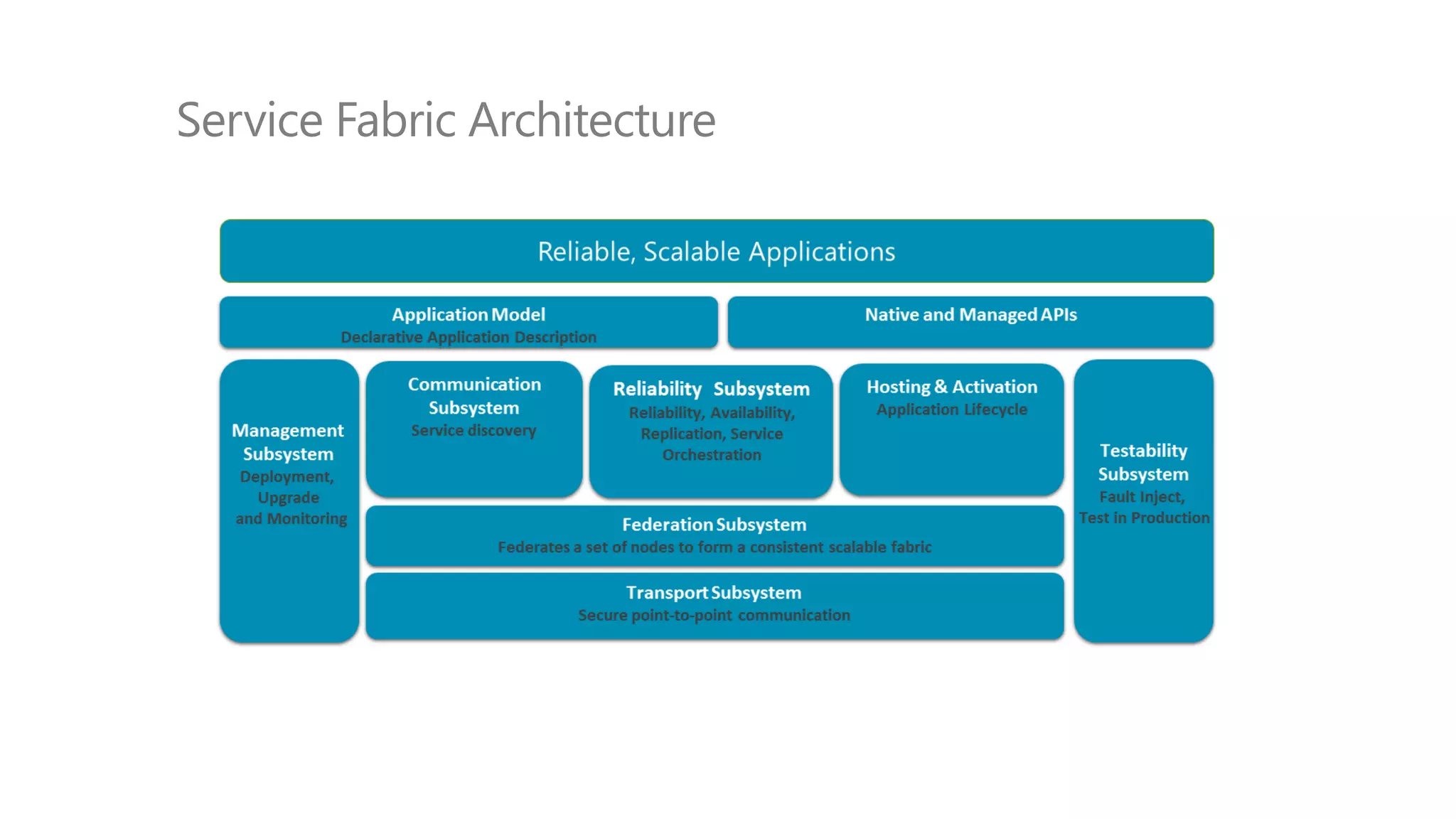
Service Fabric Architecture
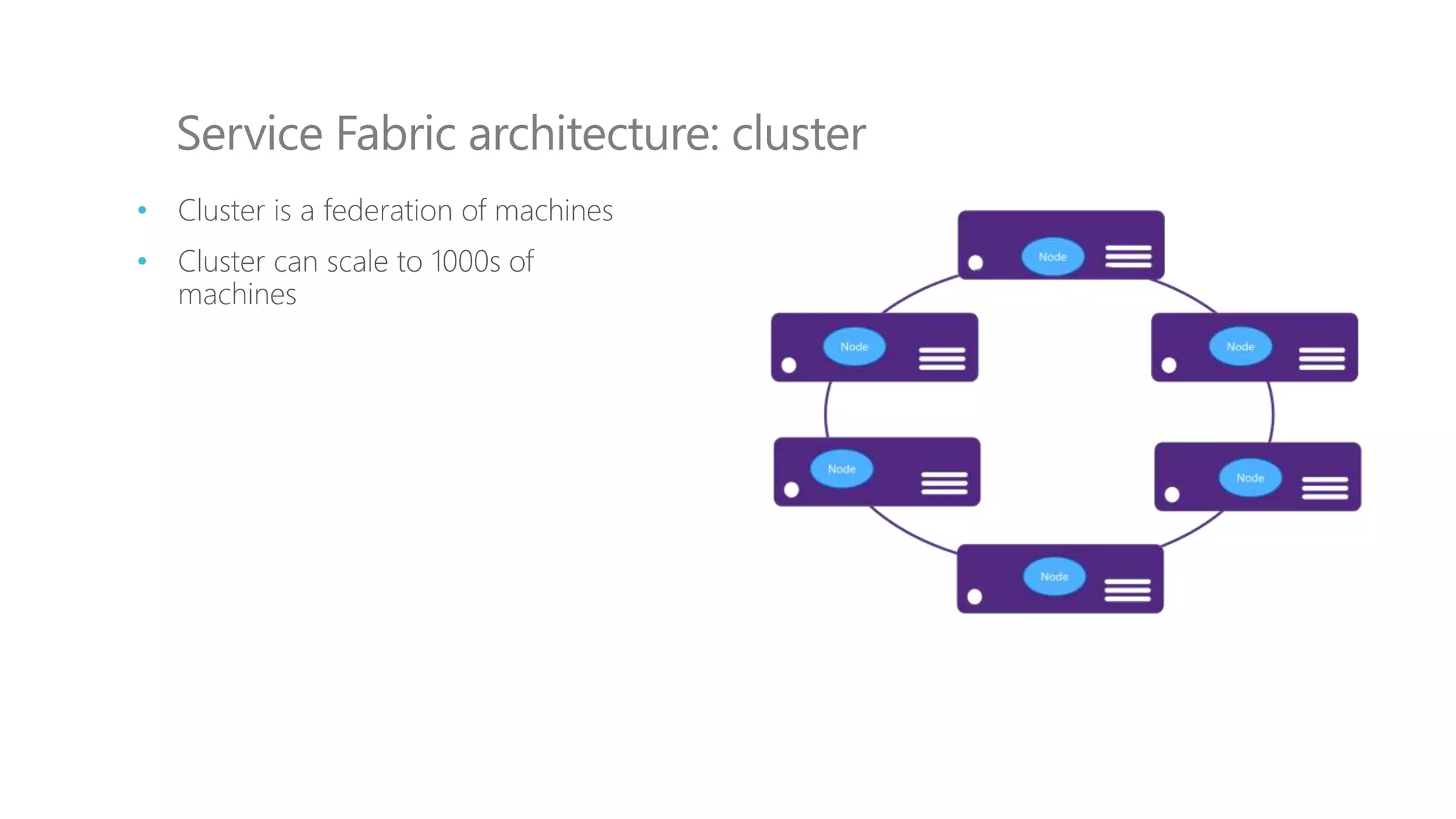
Service Fabric architecture: cluster
• Cluster is a federation of machines
• Cluster can scale to 1000s of
machines
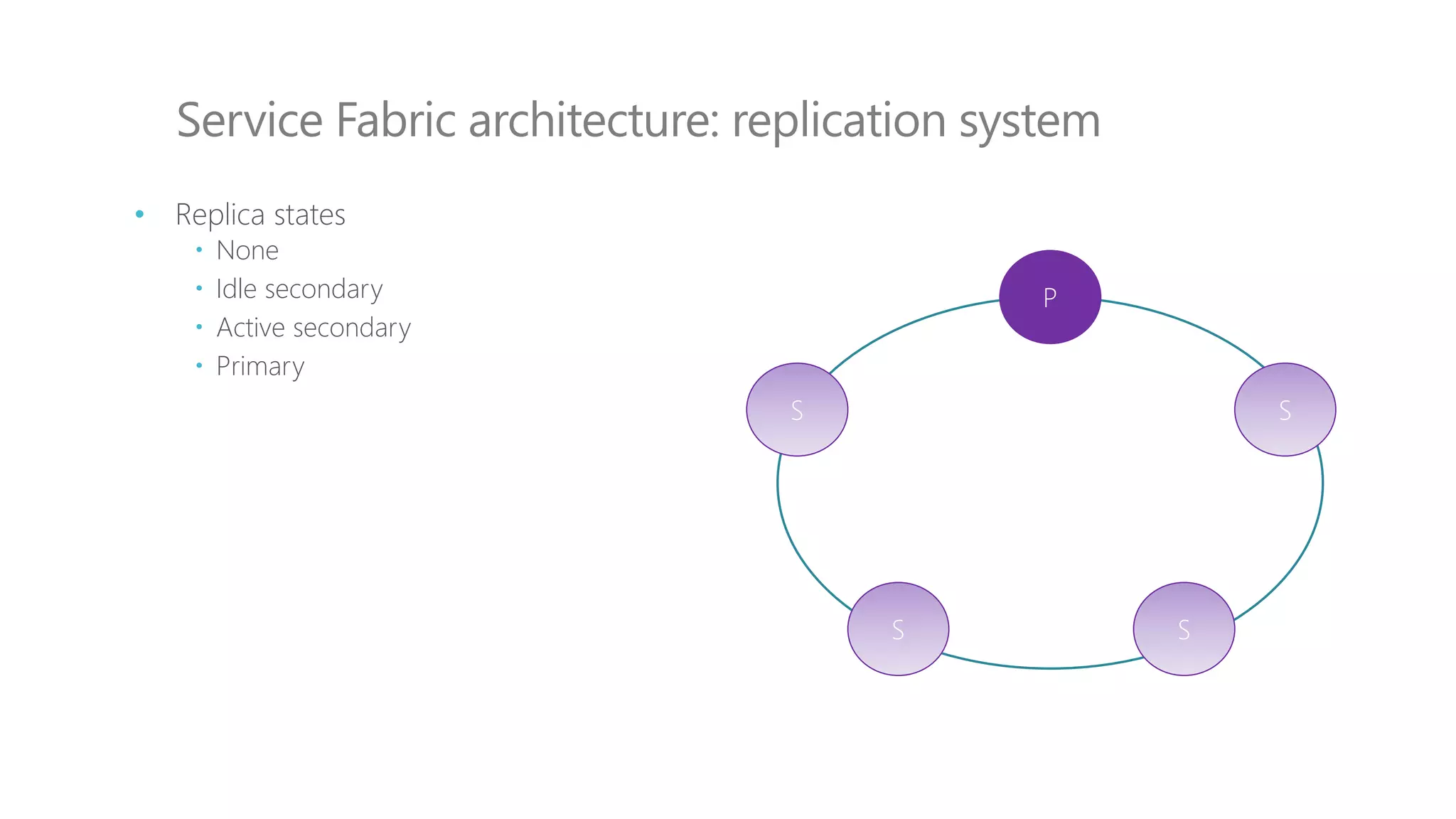
Service Fabric architecture: replication system
P
S S
S S
• Replica states
 None
 Idle secondary
 Active secondary
 Primary
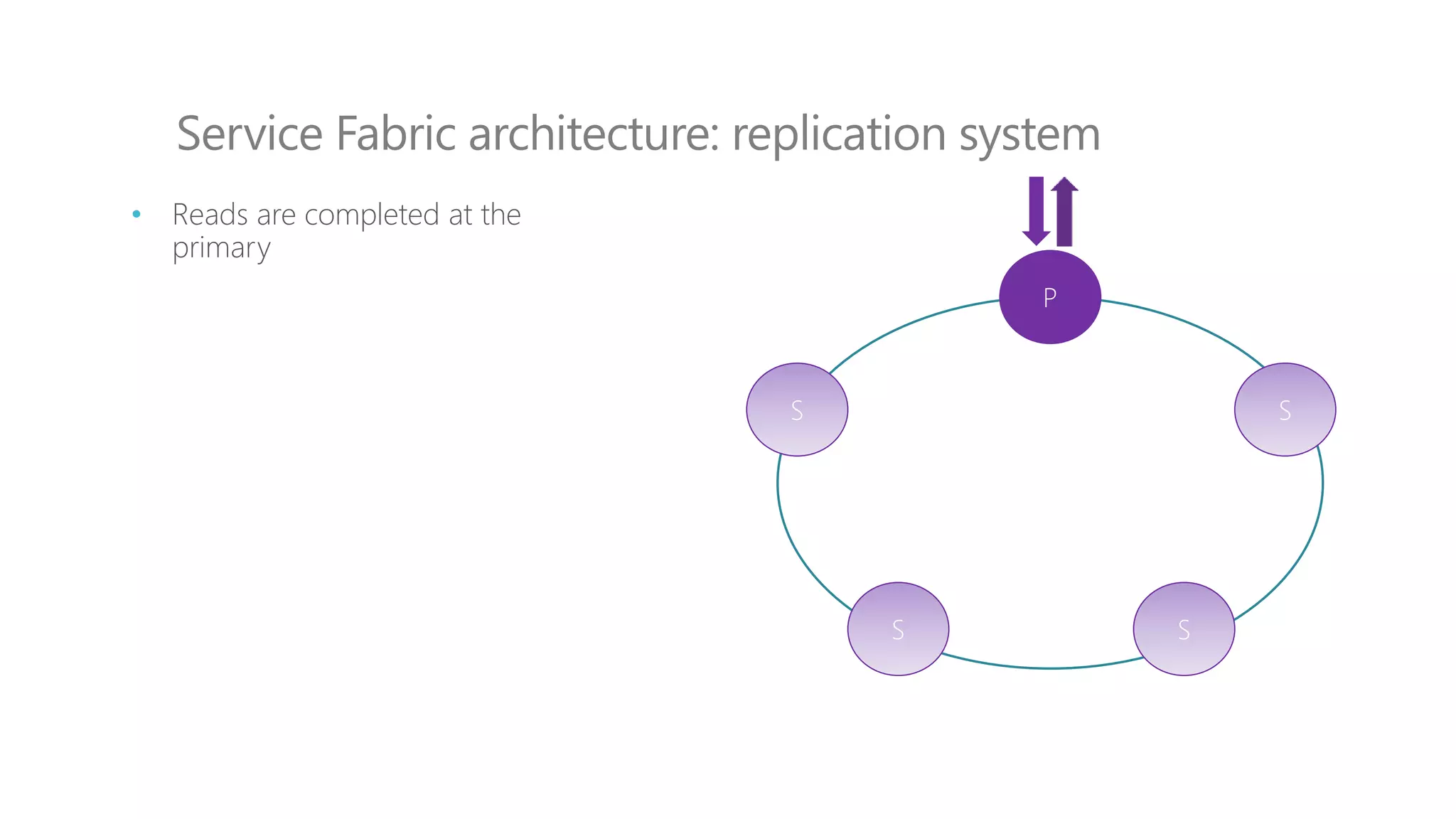
Service Fabric architecture: replication system
P
S S
S S
• Reads are completed at the
primary
Service Fabric architecture: replication system
P
S S
S S
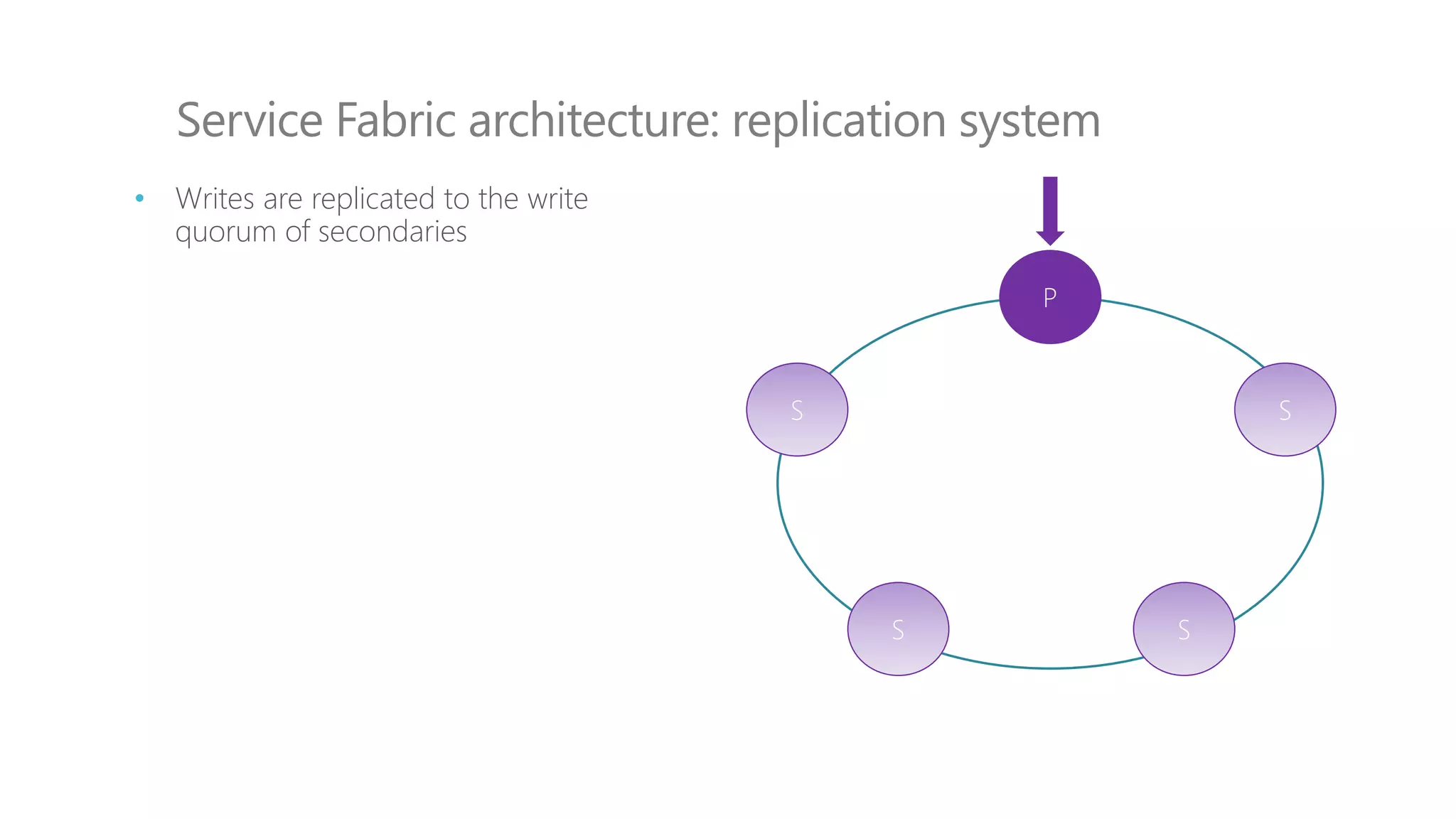
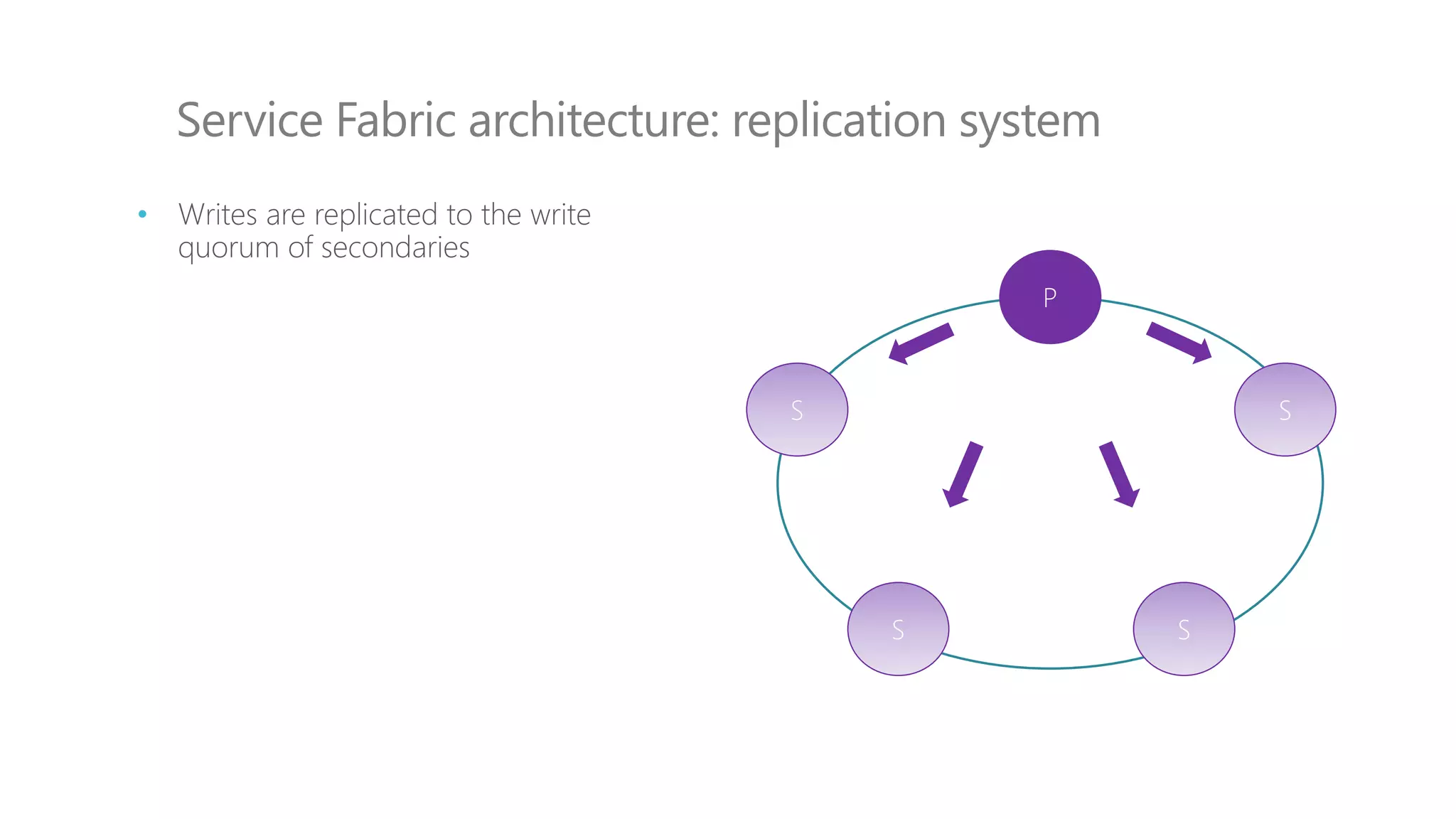
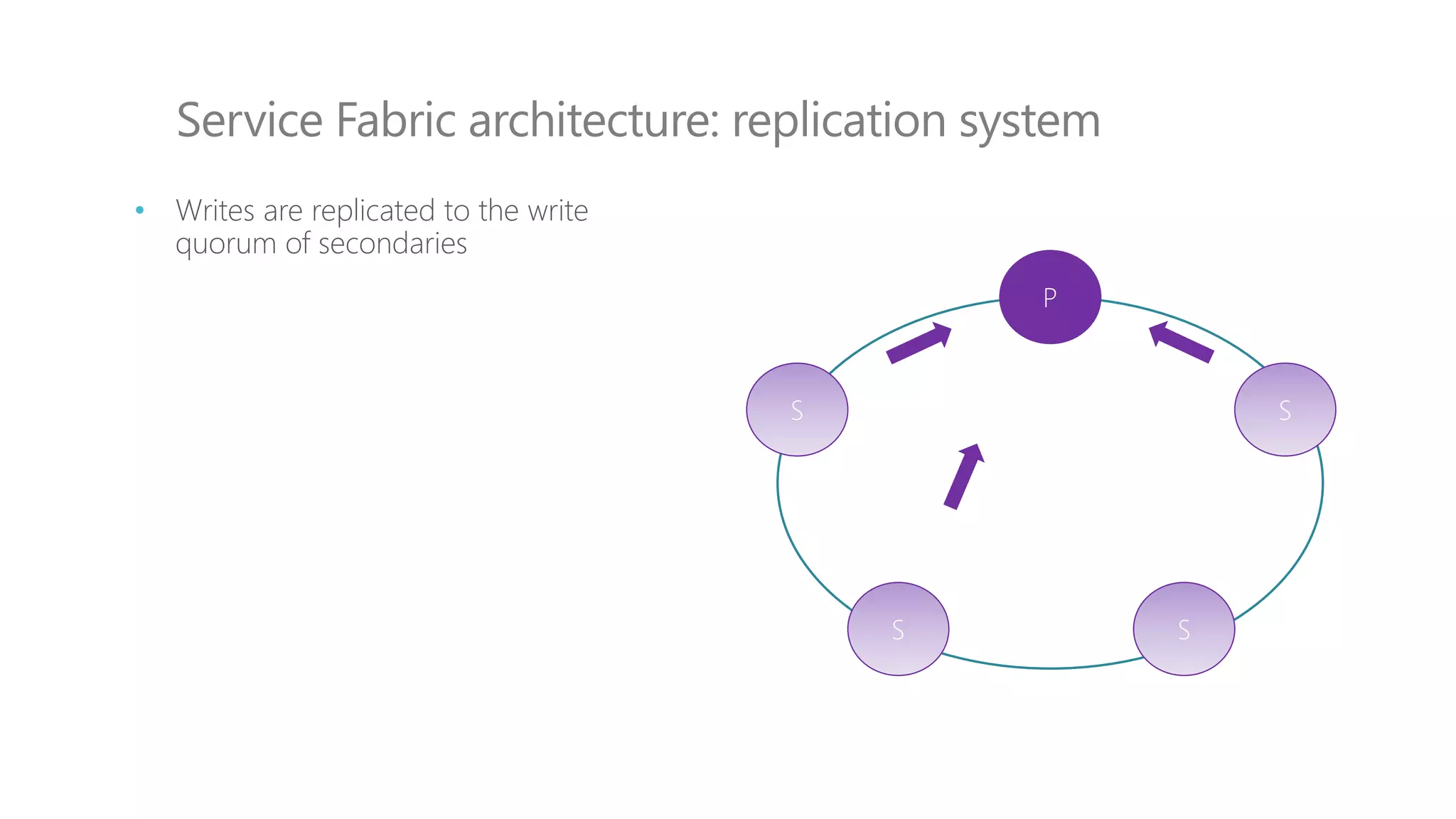
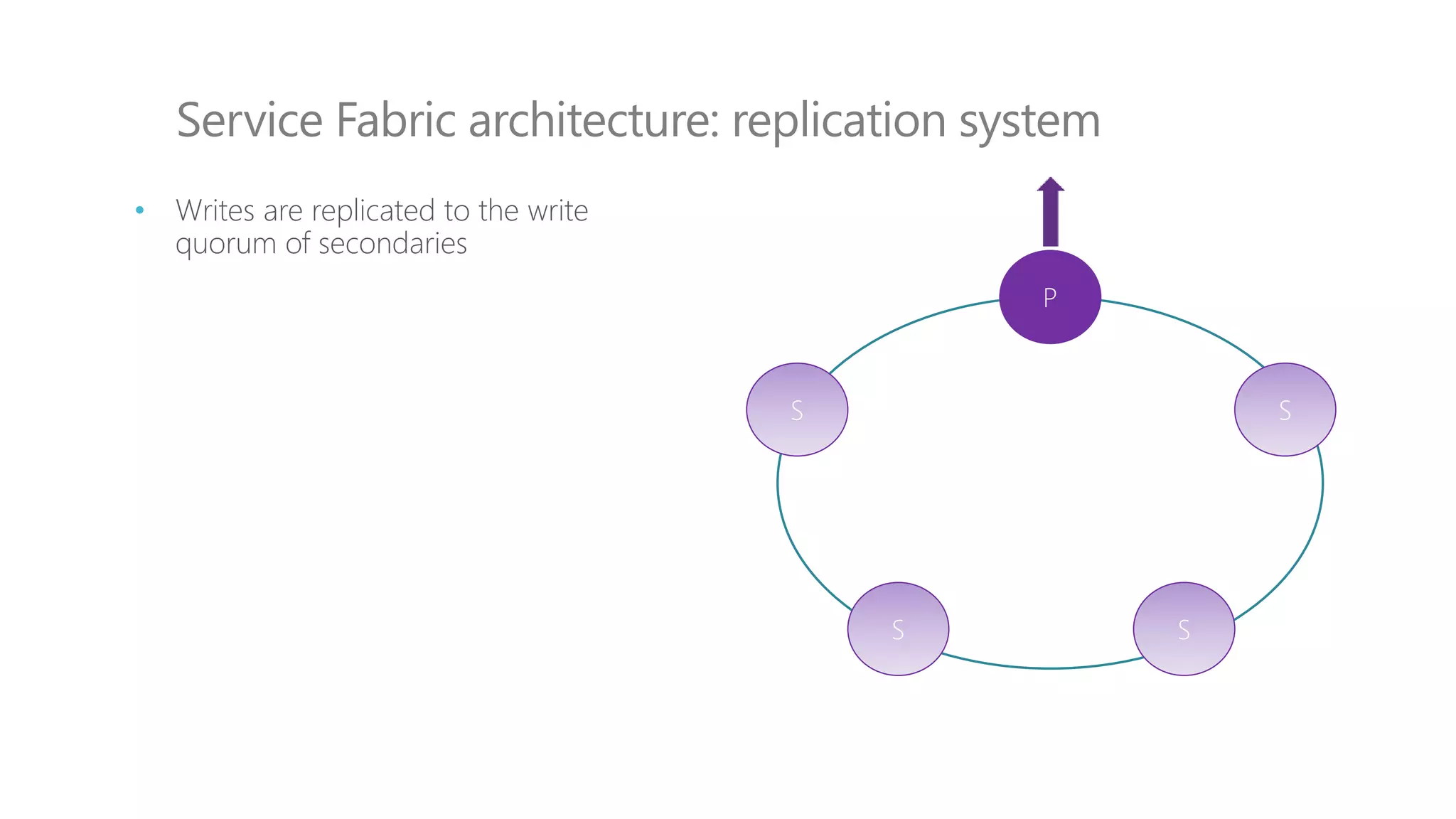
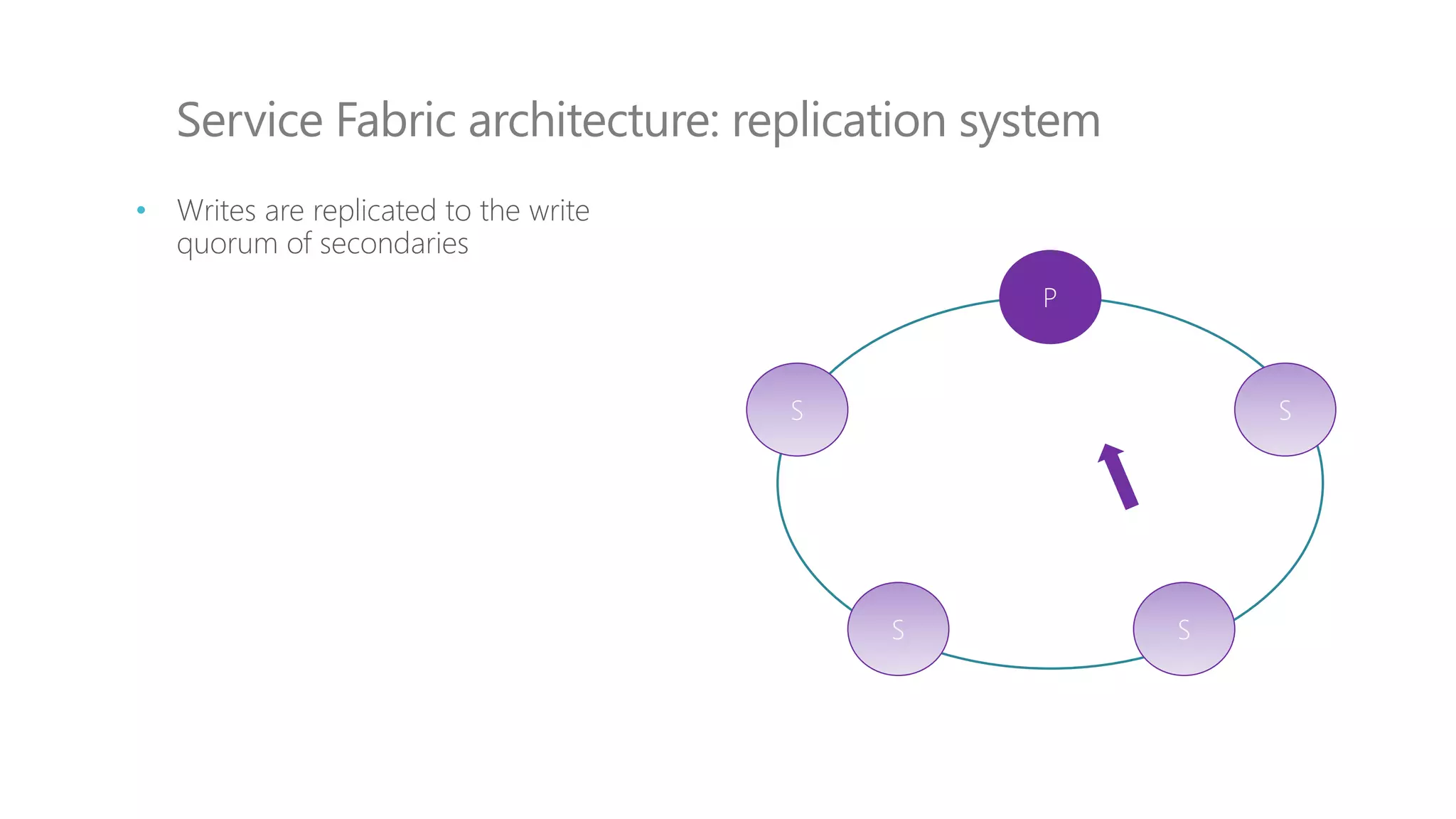
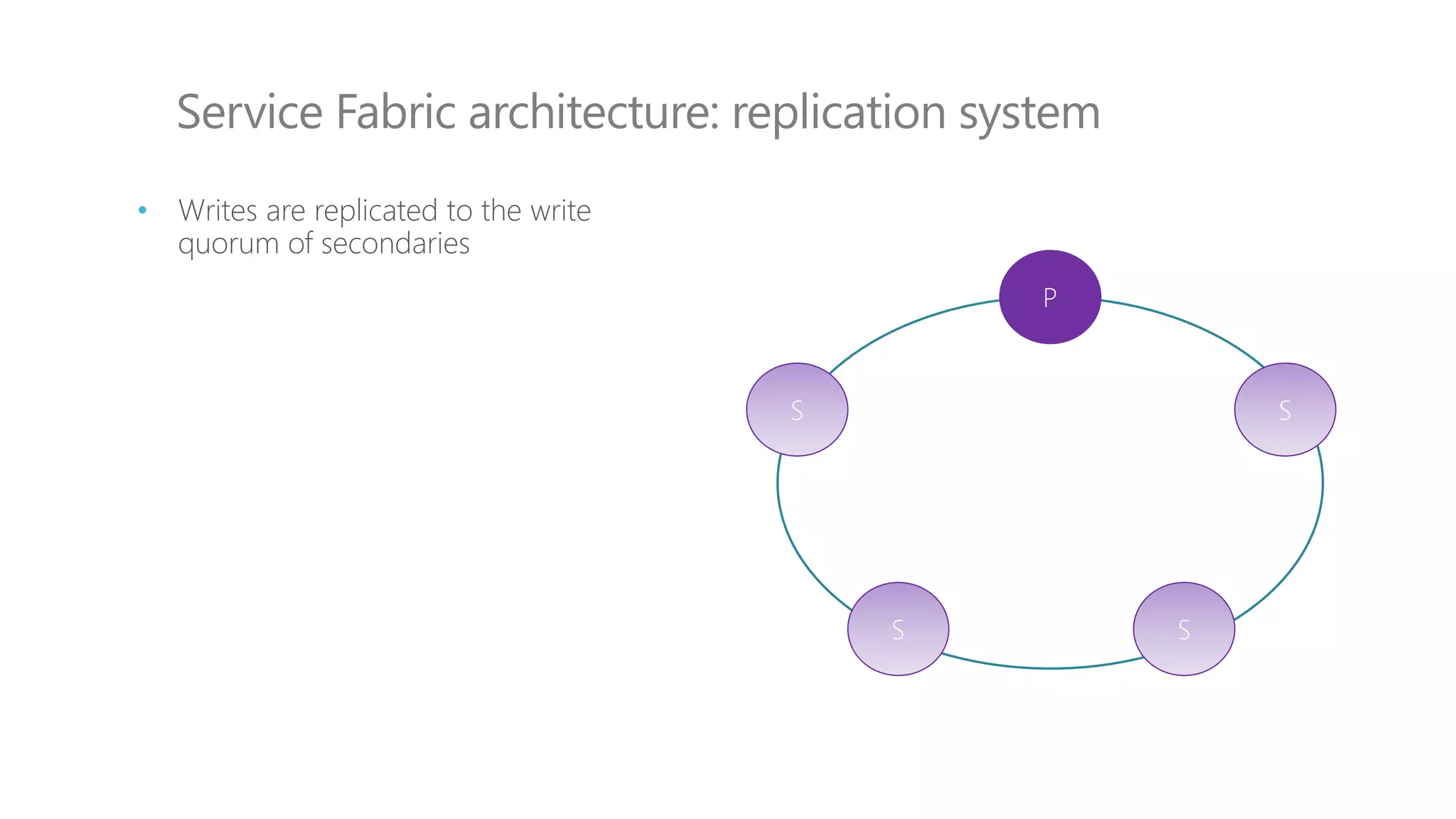
• Writes are replicated to the write
quorum of secondaries
Service Fabric architecture: replication system
P
S S
S S
• Writes are replicated to the write
quorum of secondaries
Service Fabric architecture: replication system
P
S S
S S
• Writes are replicated to the write
quorum of secondaries
Service Fabric architecture: replication system
P
S S
S S
• Writes are replicated to the write
quorum of secondaries
Service Fabric architecture: replication system
P
S S
S S
• Writes are replicated to the write
quorum of secondaries
Service Fabric architecture: replication system
P
S S
S S
• Writes are replicated to the write
quorum of secondaries
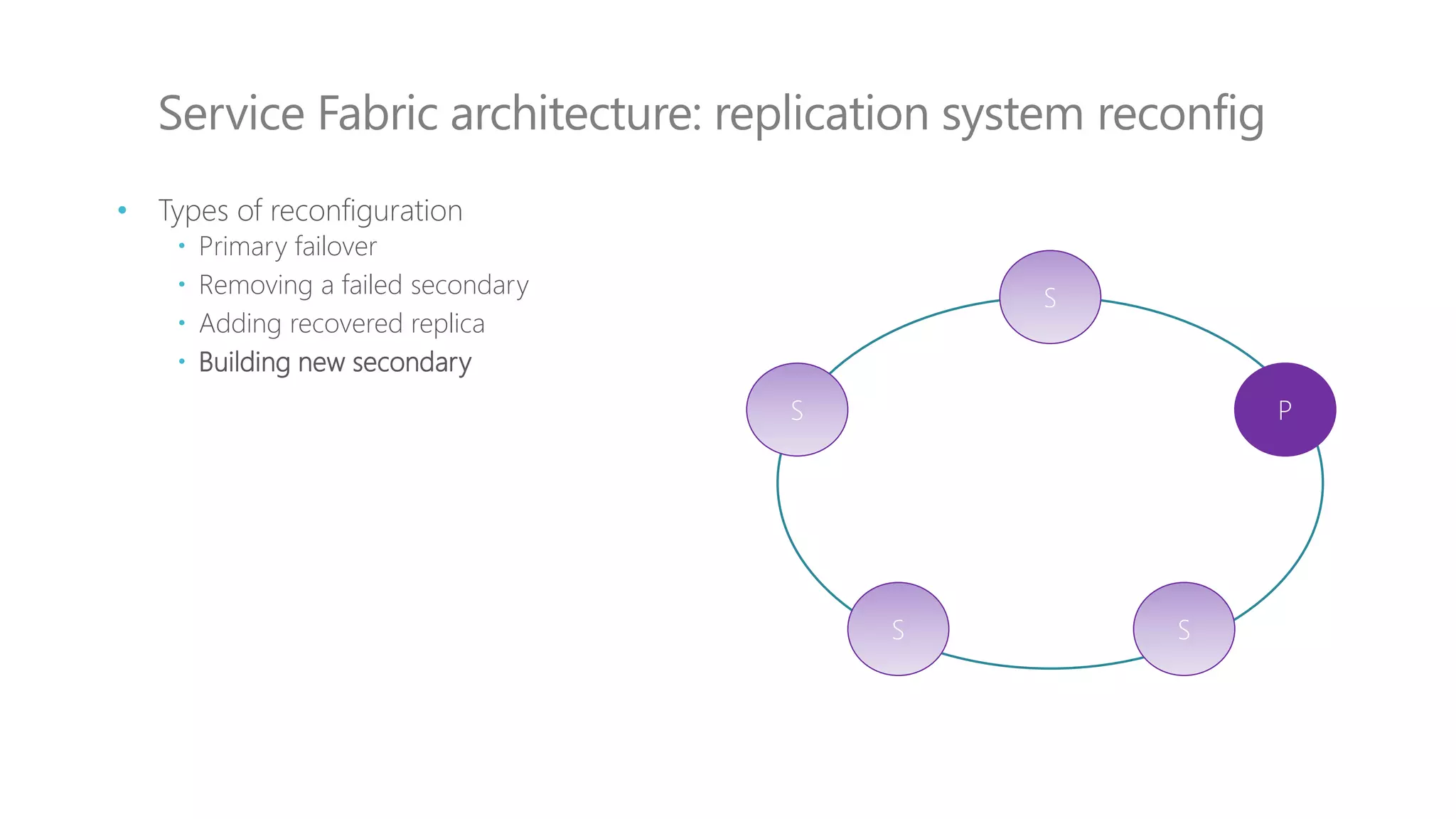
Service Fabric architecture: replication system reconfig
P
S S
S S
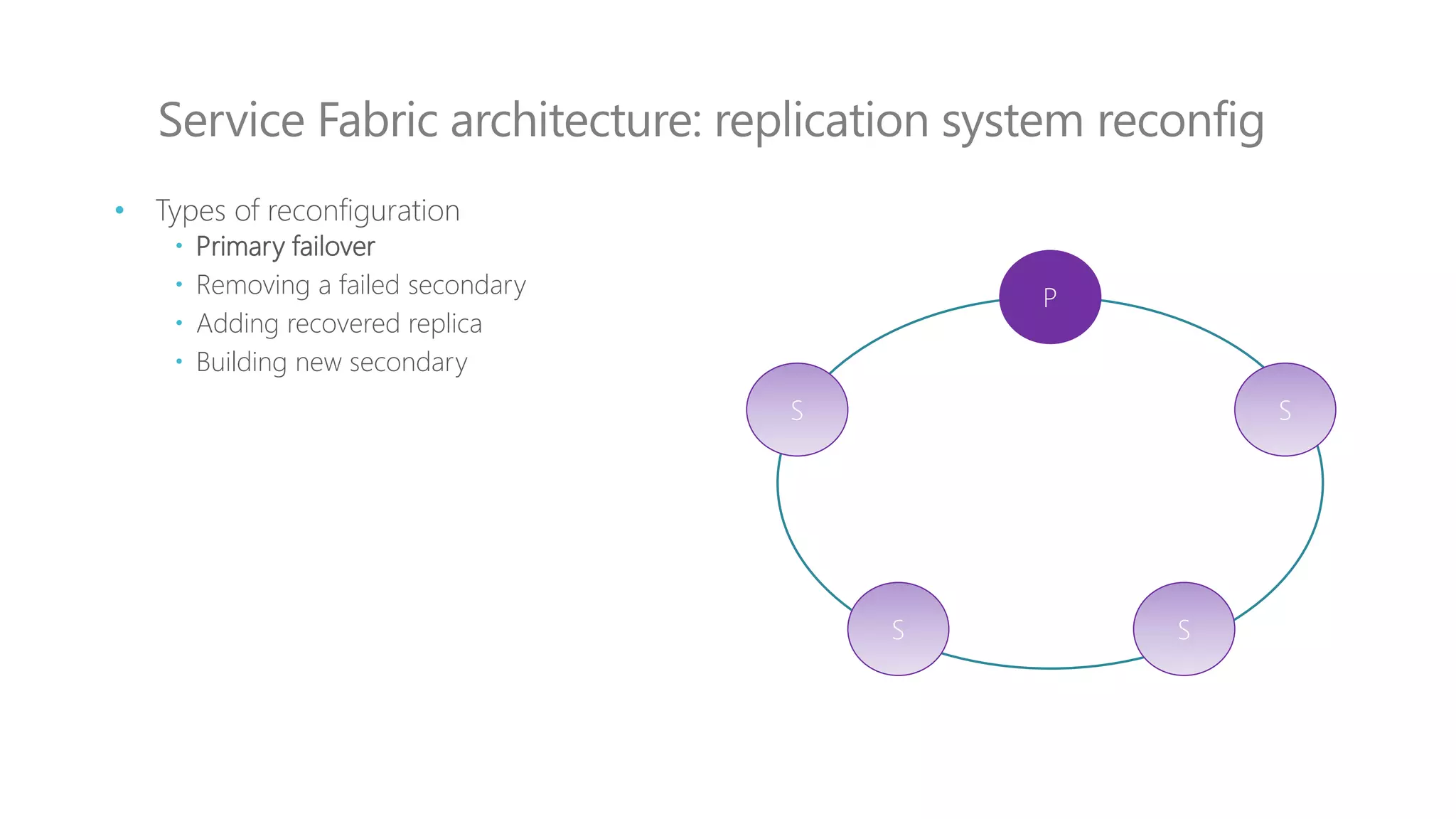
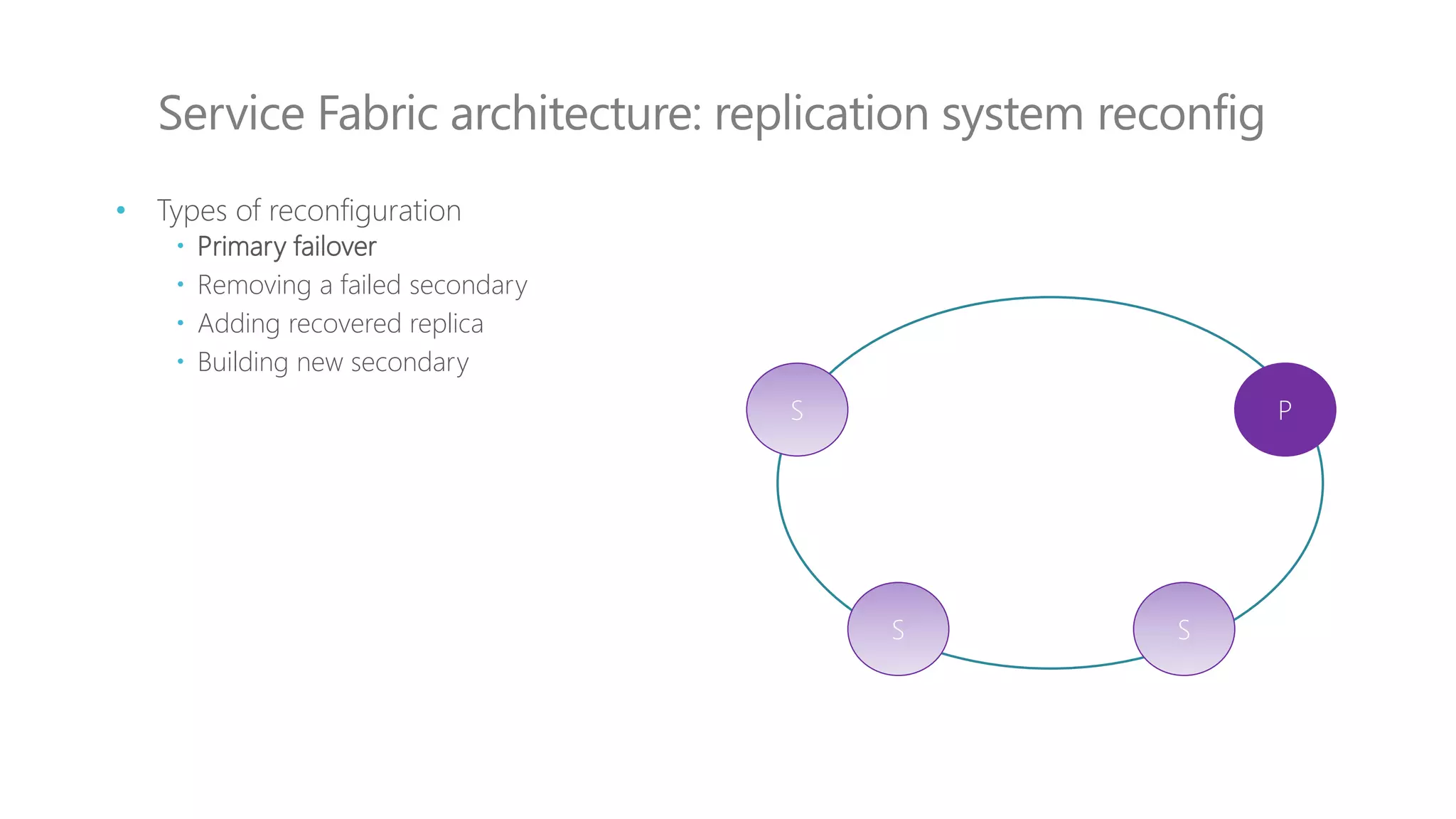
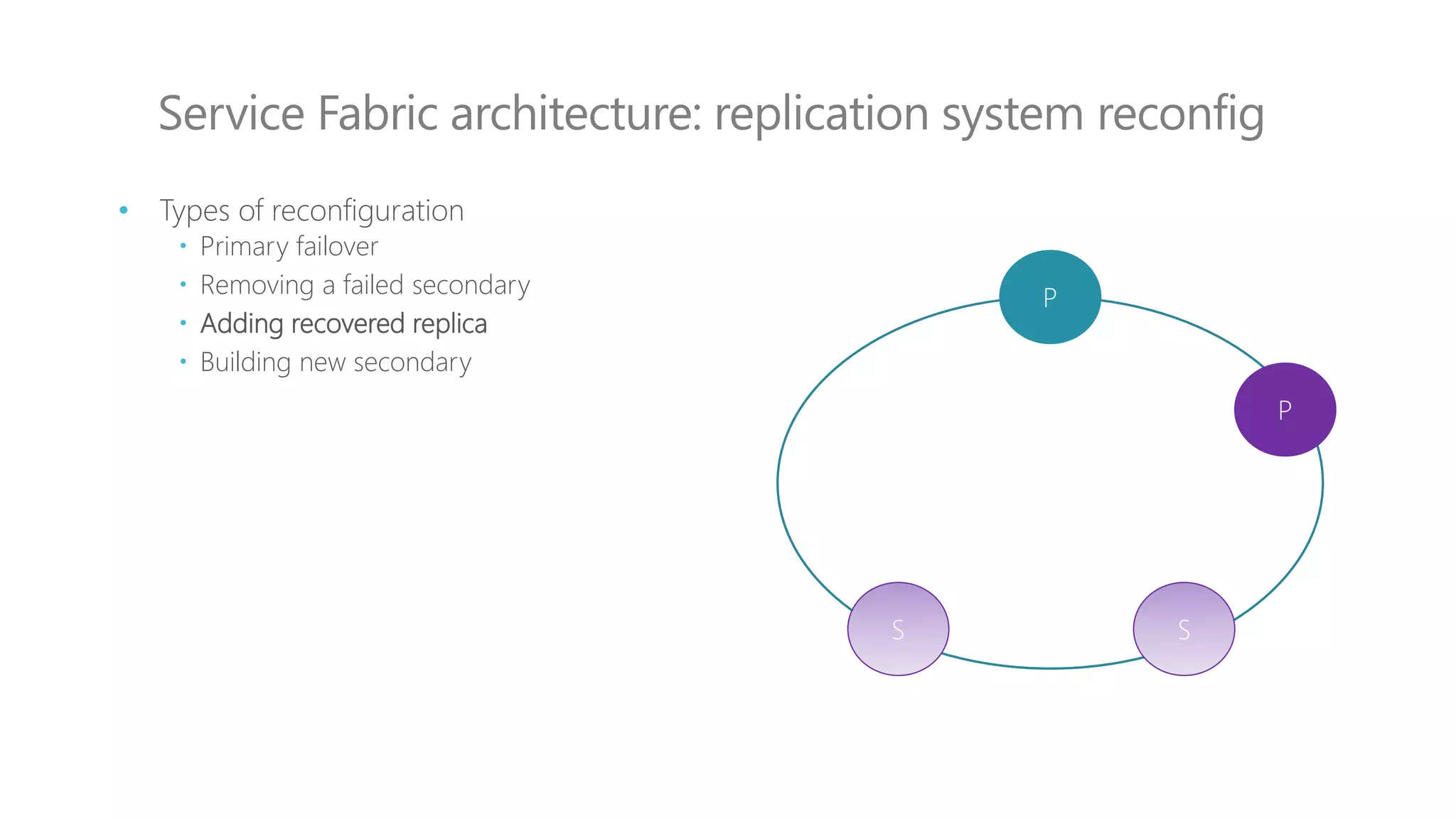
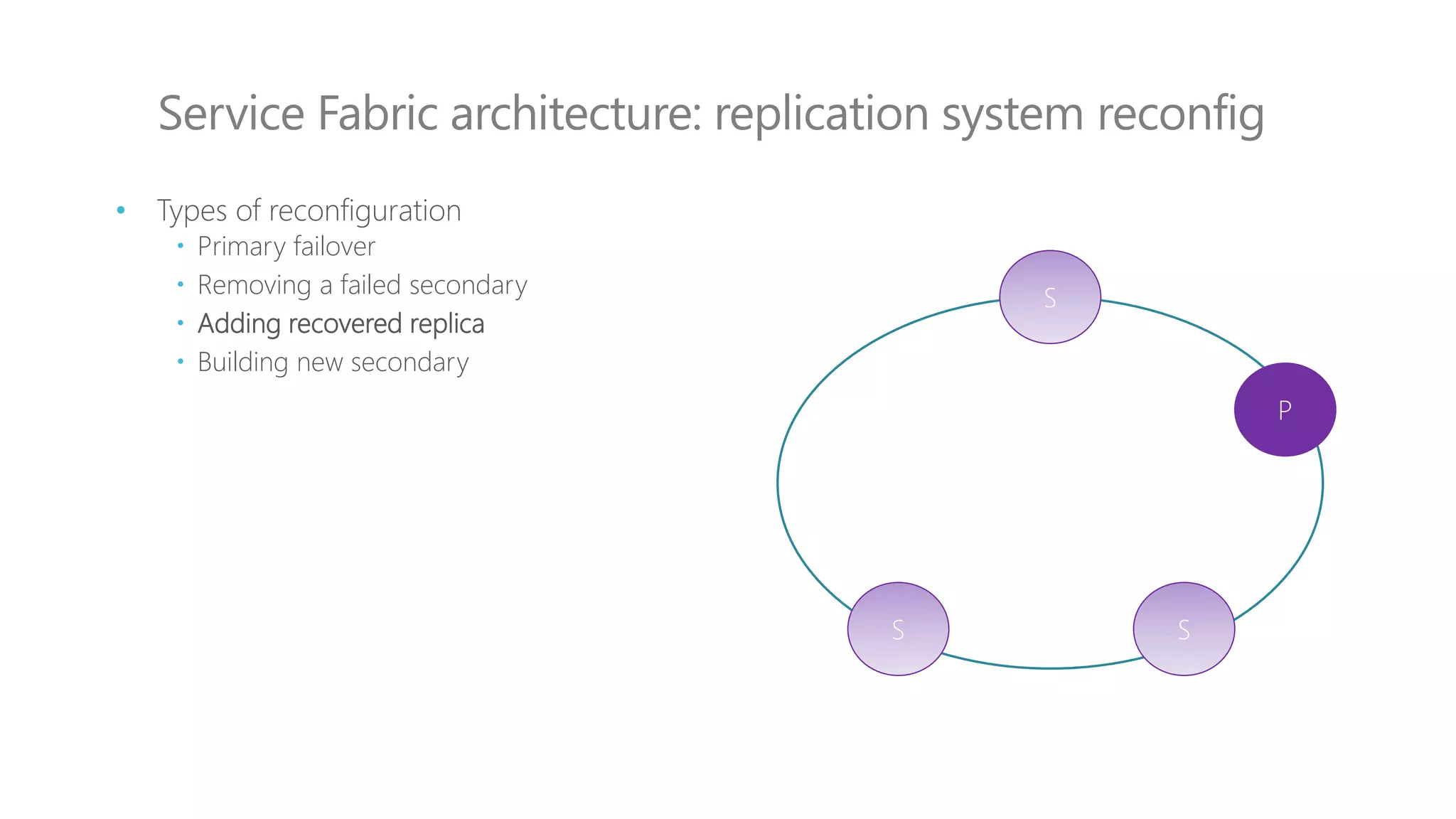
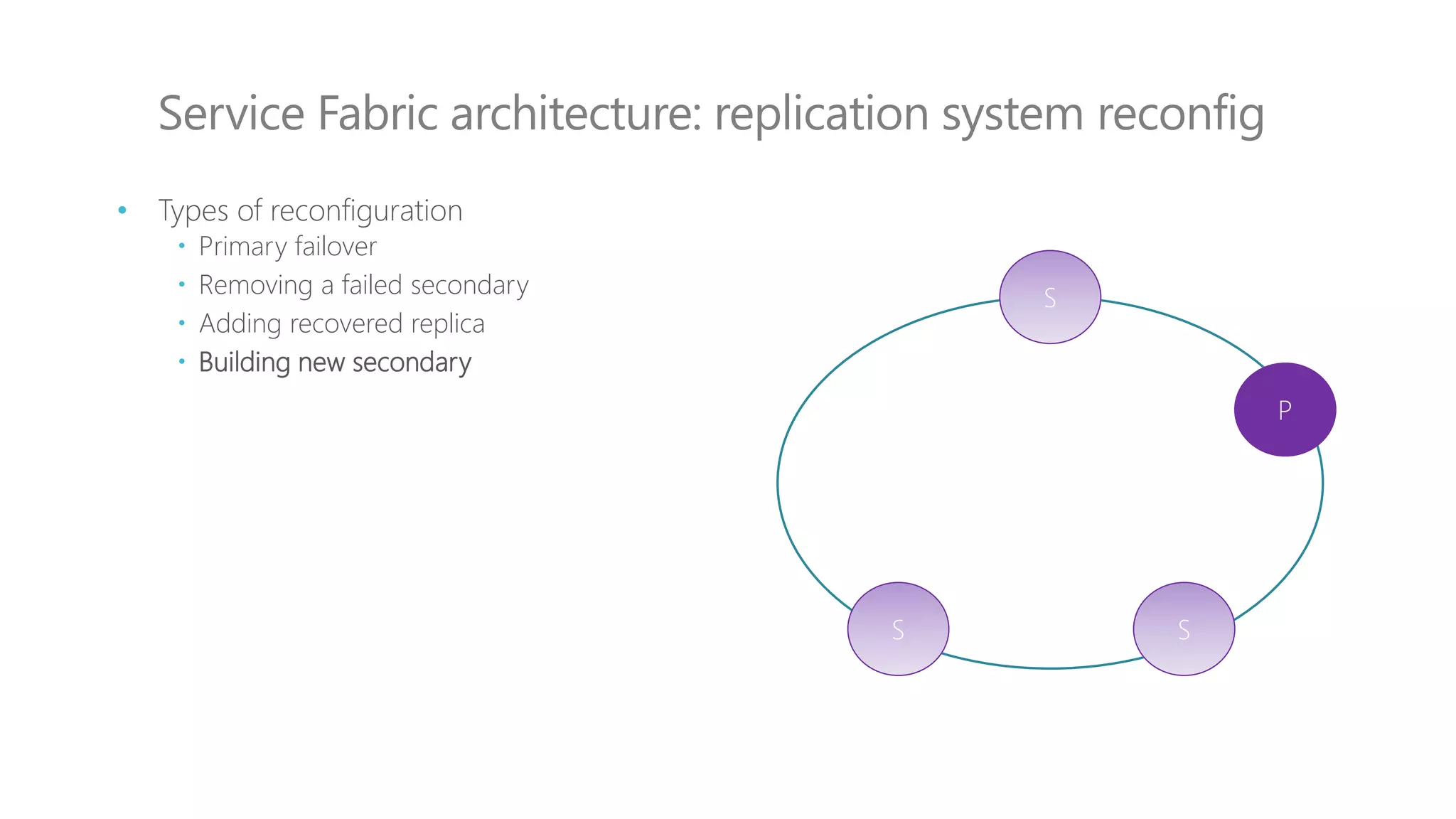
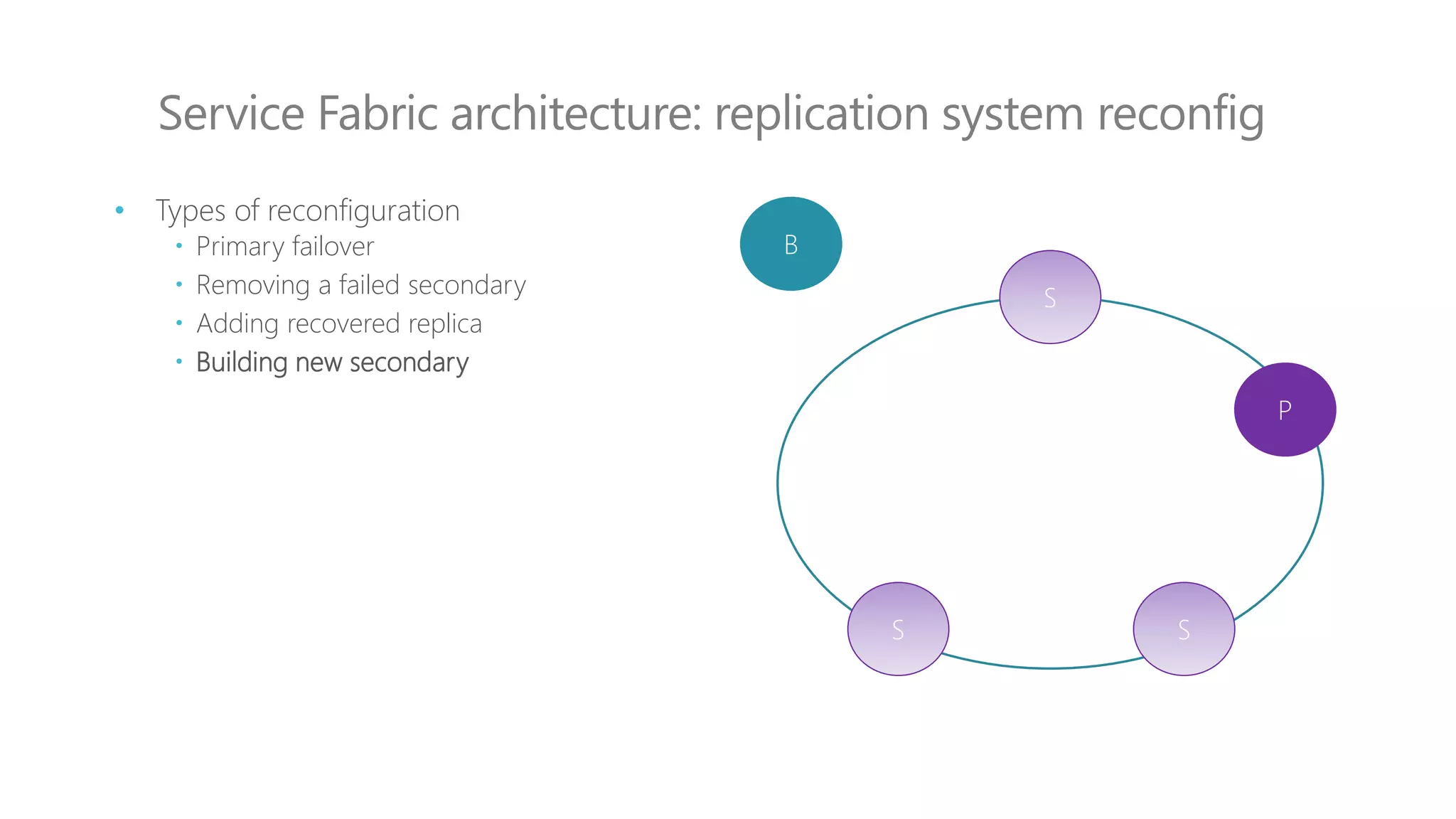
• Types of reconfiguration
 Primary failover
 Removing a failed secondary
 Adding recovered replica
 Building new secondary
Service Fabric architecture: replication system reconfig
P
S S
S S
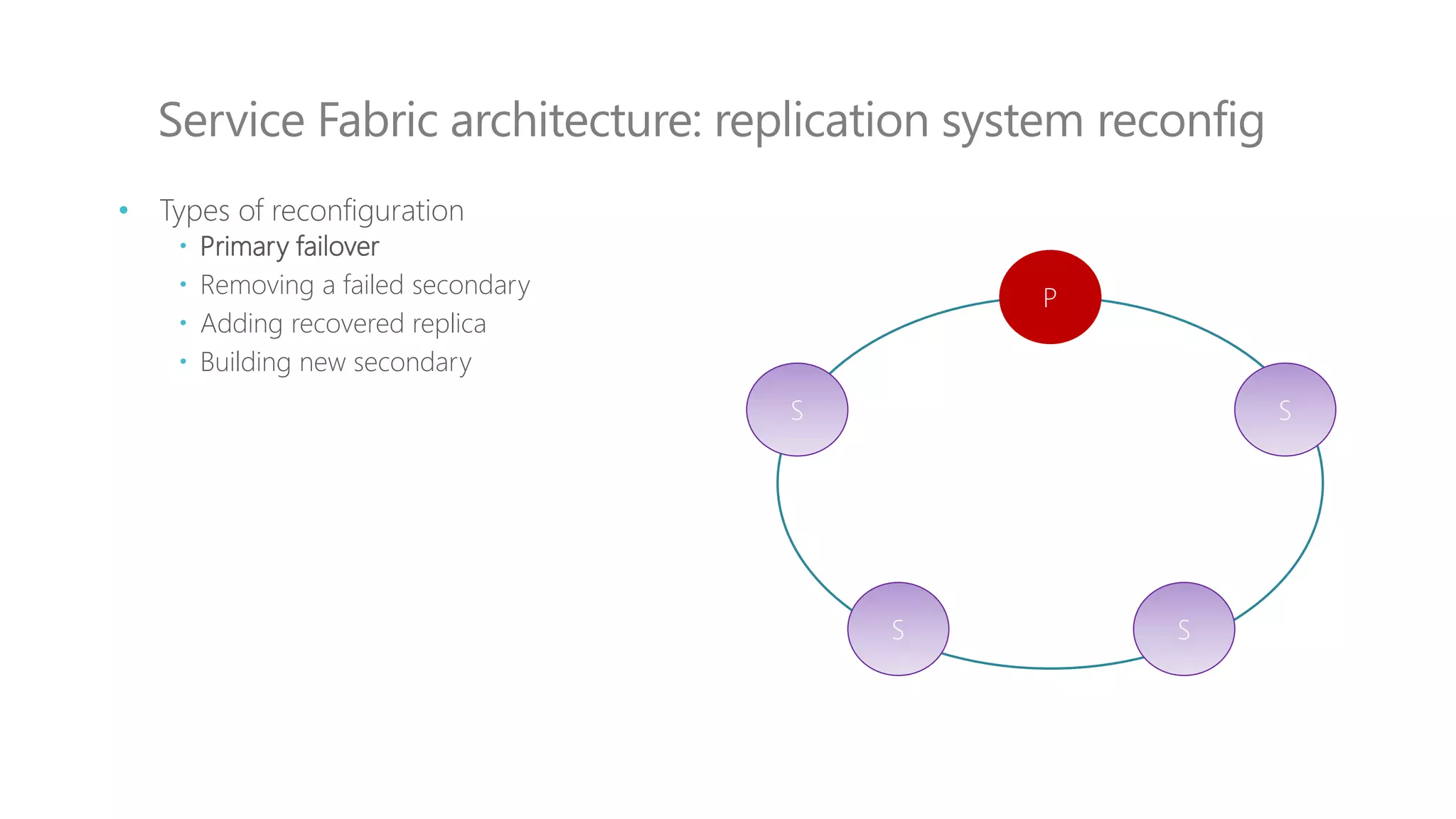
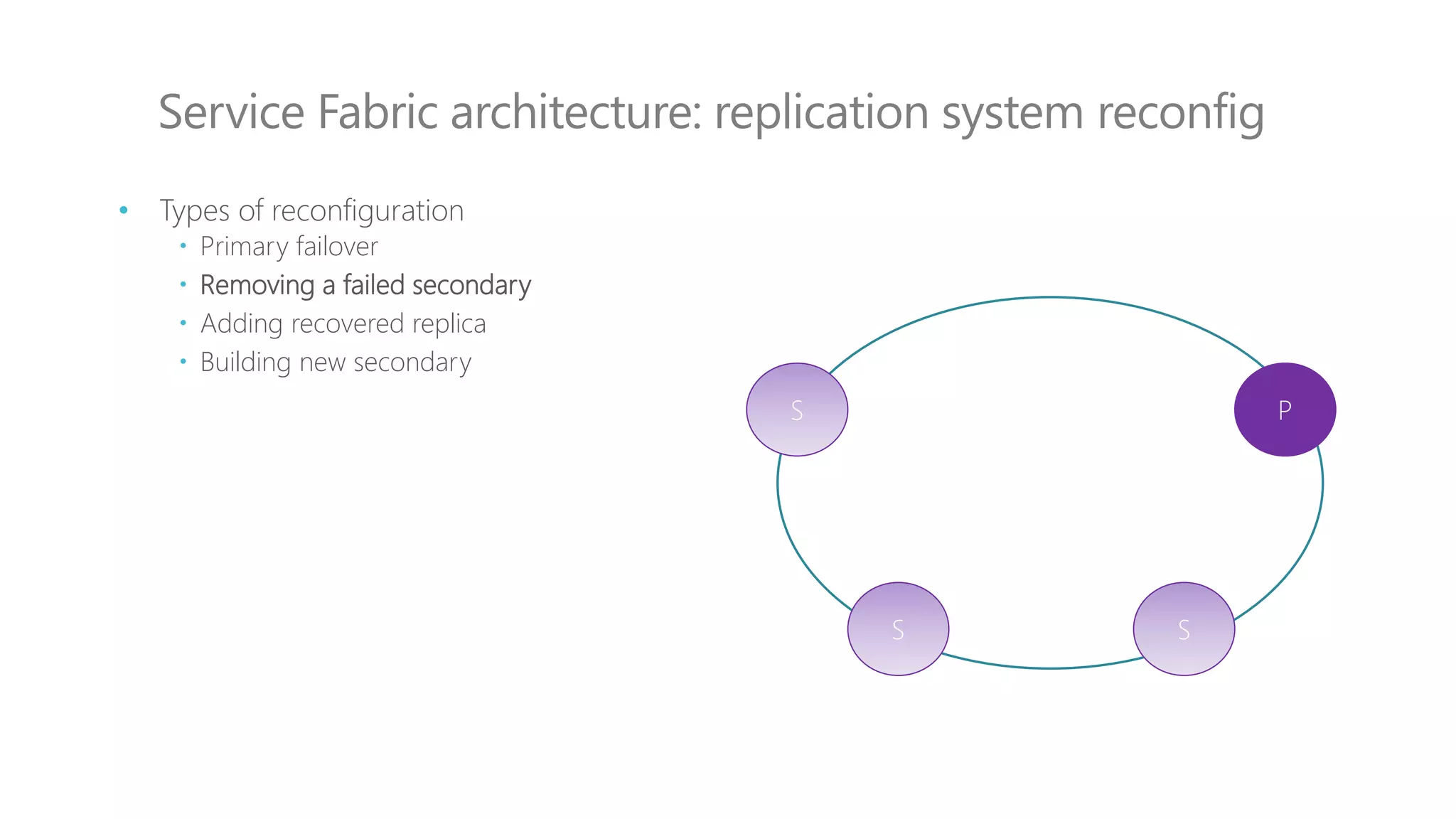
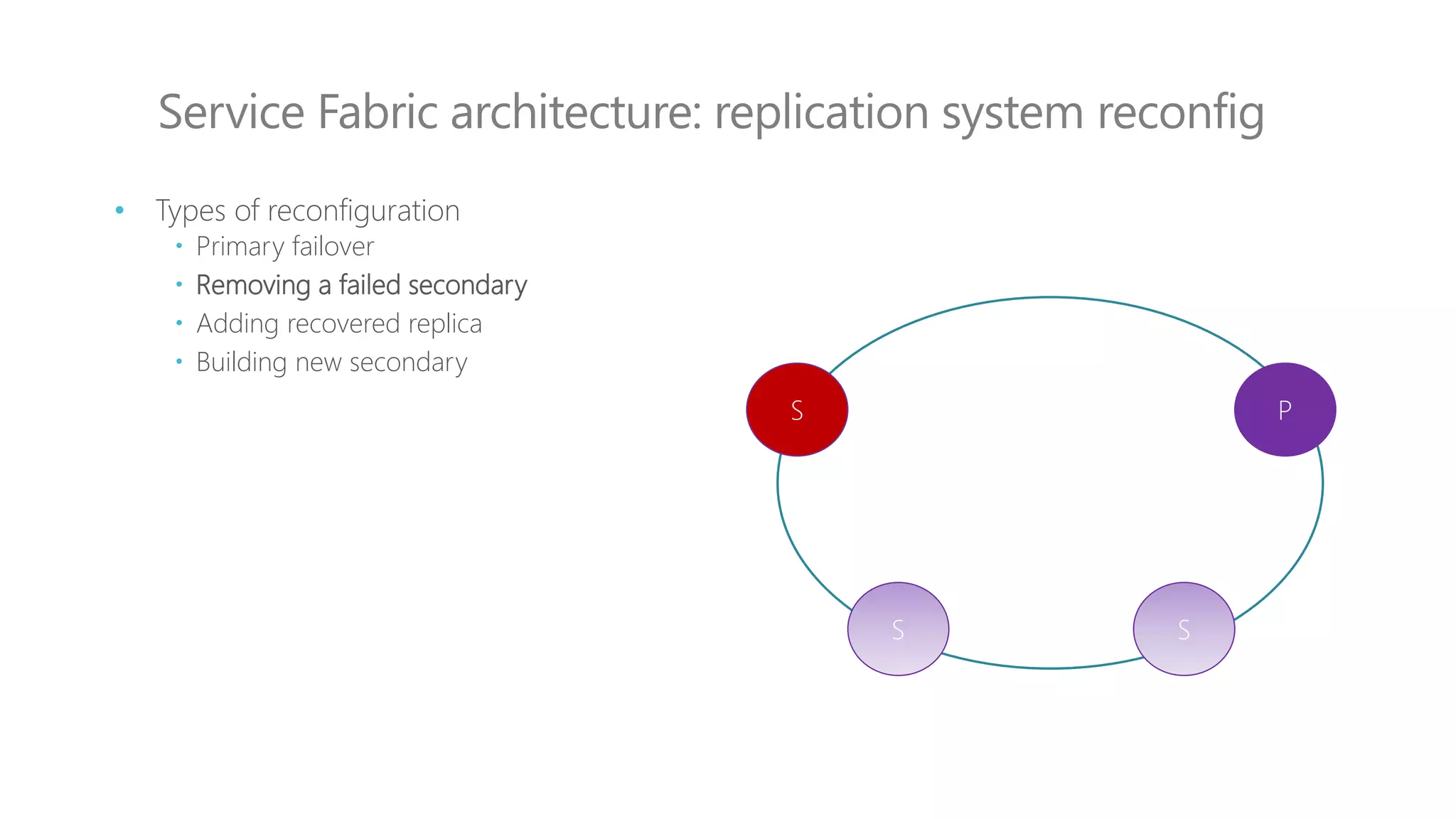
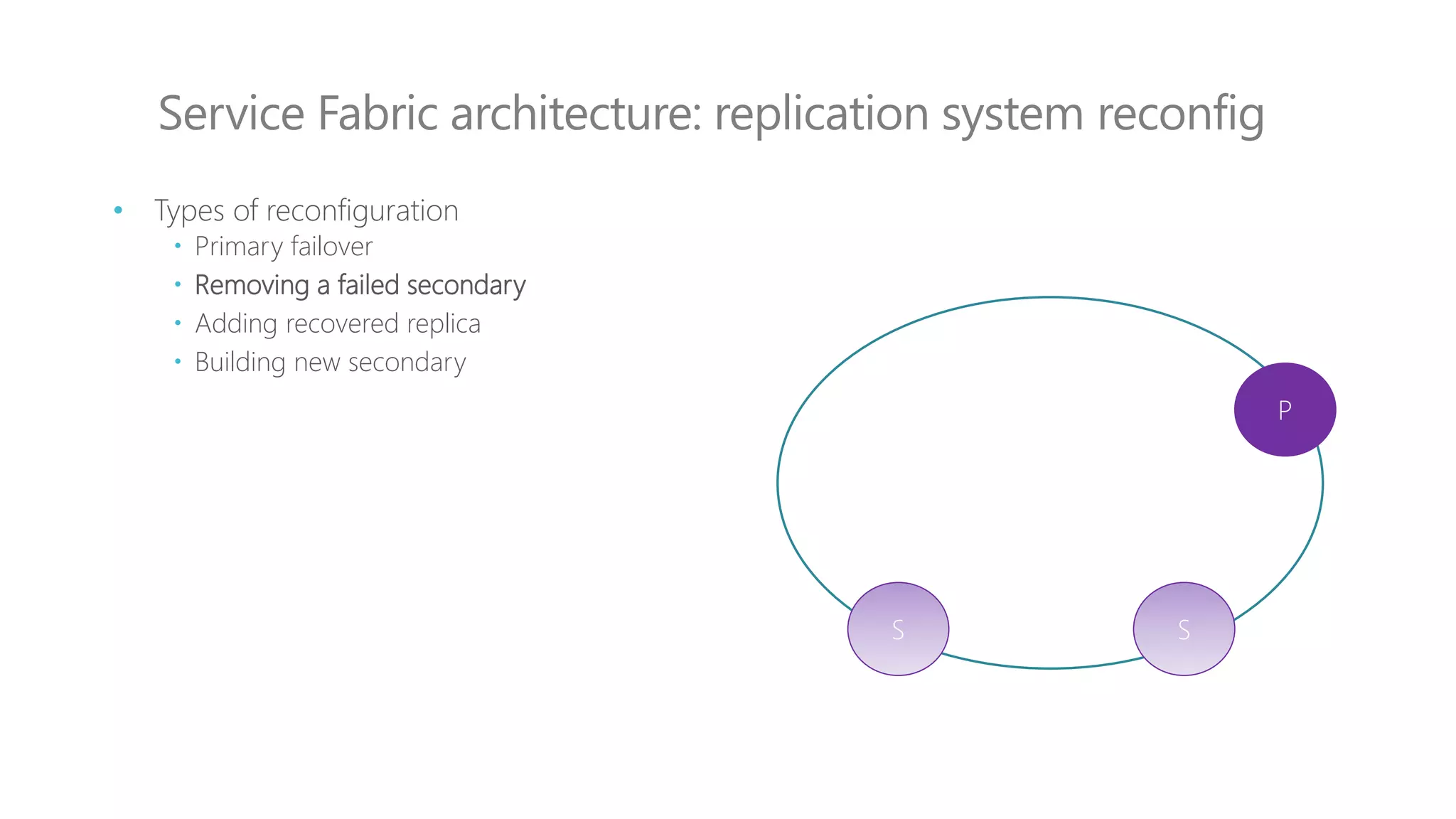
• Types of reconfiguration
 Primary failover
 Removing a failed secondary
 Adding recovered replica
 Building new secondary
Service Fabric architecture: replication system reconfig
S P
S S
• Types of reconfiguration
 Primary failover
 Removing a failed secondary
 Adding recovered replica
 Building new secondary
Service Fabric architecture: replication system reconfig
S P
S S
• Types of reconfiguration
 Primary failover
 Removing a failed secondary
 Adding recovered replica
 Building new secondary
Service Fabric architecture: replication system reconfig
S P
S S
• Types of reconfiguration
 Primary failover
 Removing a failed secondary
 Adding recovered replica
 Building new secondary
Service Fabric architecture: replication system reconfig
P
S S
• Types of reconfiguration
 Primary failover
 Removing a failed secondary
 Adding recovered replica
 Building new secondary
Service Fabric architecture: replication system reconfig
P
P
S S
• Types of reconfiguration
 Primary failover
 Removing a failed secondary
 Adding recovered replica
 Building new secondary
Service Fabric architecture: replication system reconfig
S
P
S S
• Types of reconfiguration
 Primary failover
 Removing a failed secondary
 Adding recovered replica
 Building new secondary
Service Fabric architecture: replication system reconfig
S
P
S S
• Types of reconfiguration
 Primary failover
 Removing a failed secondary
 Adding recovered replica
 Building new secondary
Service Fabric architecture: replication system reconfig
S
P
S S
• Types of reconfiguration
 Primary failover
 Removing a failed secondary
 Adding recovered replica
 Building new secondary
B
Service Fabric architecture: replication system reconfig
S
S P
S S
• Types of reconfiguration
 Primary failover
 Removing a failed secondary
 Adding recovered replica
 Building new secondary
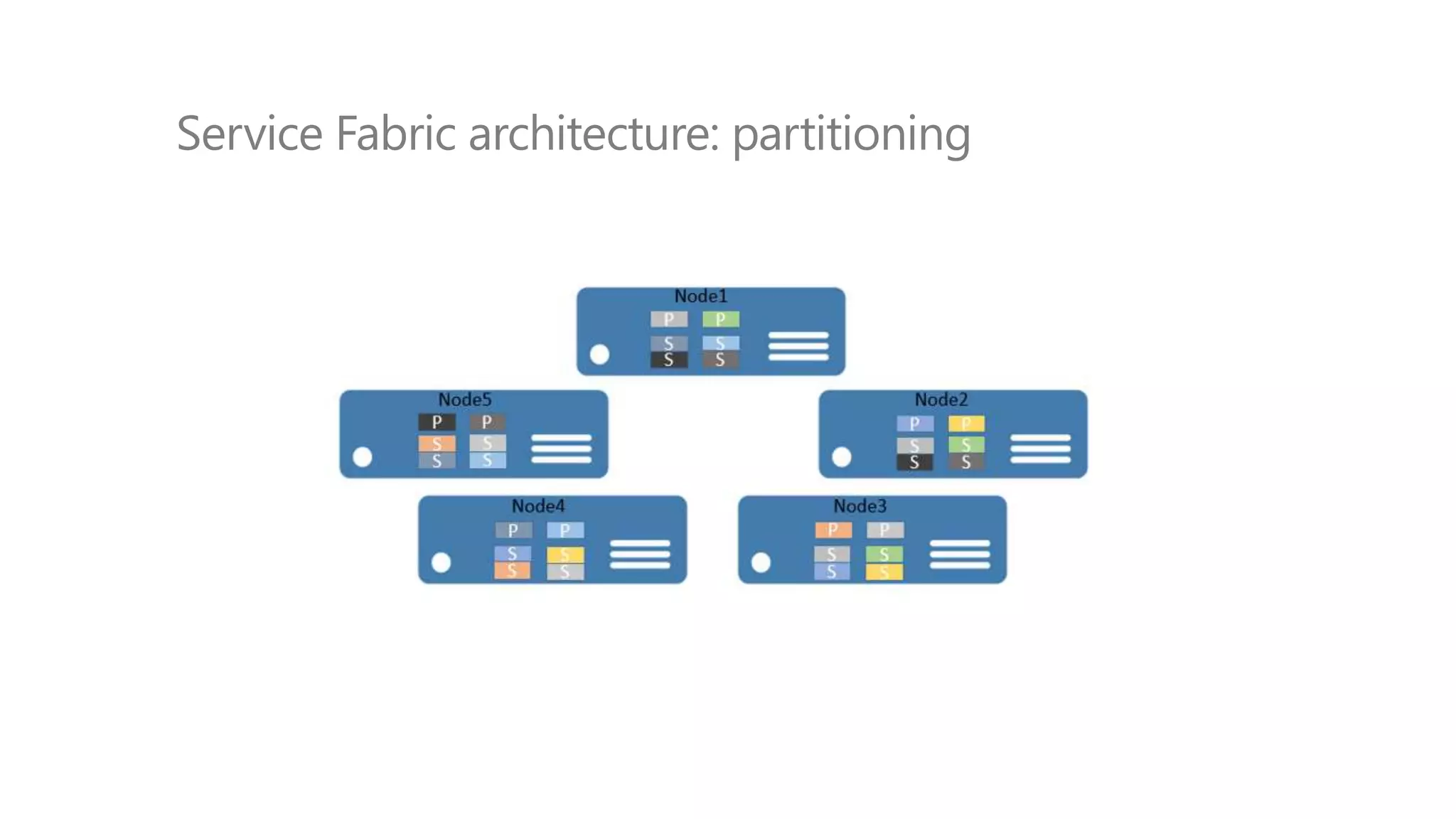
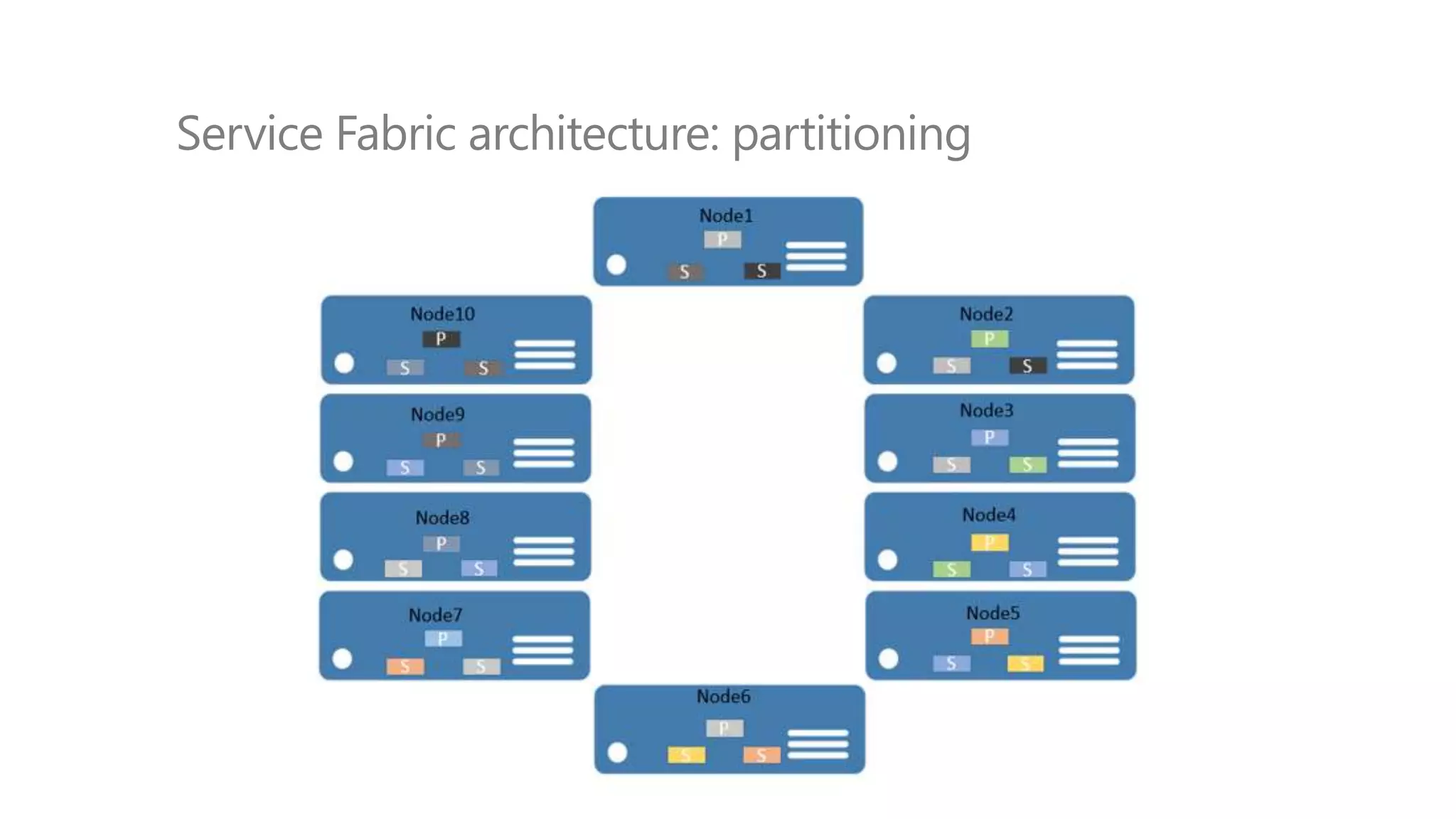
Service Fabric architecture: partitioning
• Allow data/computation to be spread across nodes
• A partition must fit in 1 node / 1 node can hold multiple partitions
• Cross-partitions operations requires network hops and different transactions
• SF balances partitions across nodes
Service Fabric architecture: partitioning
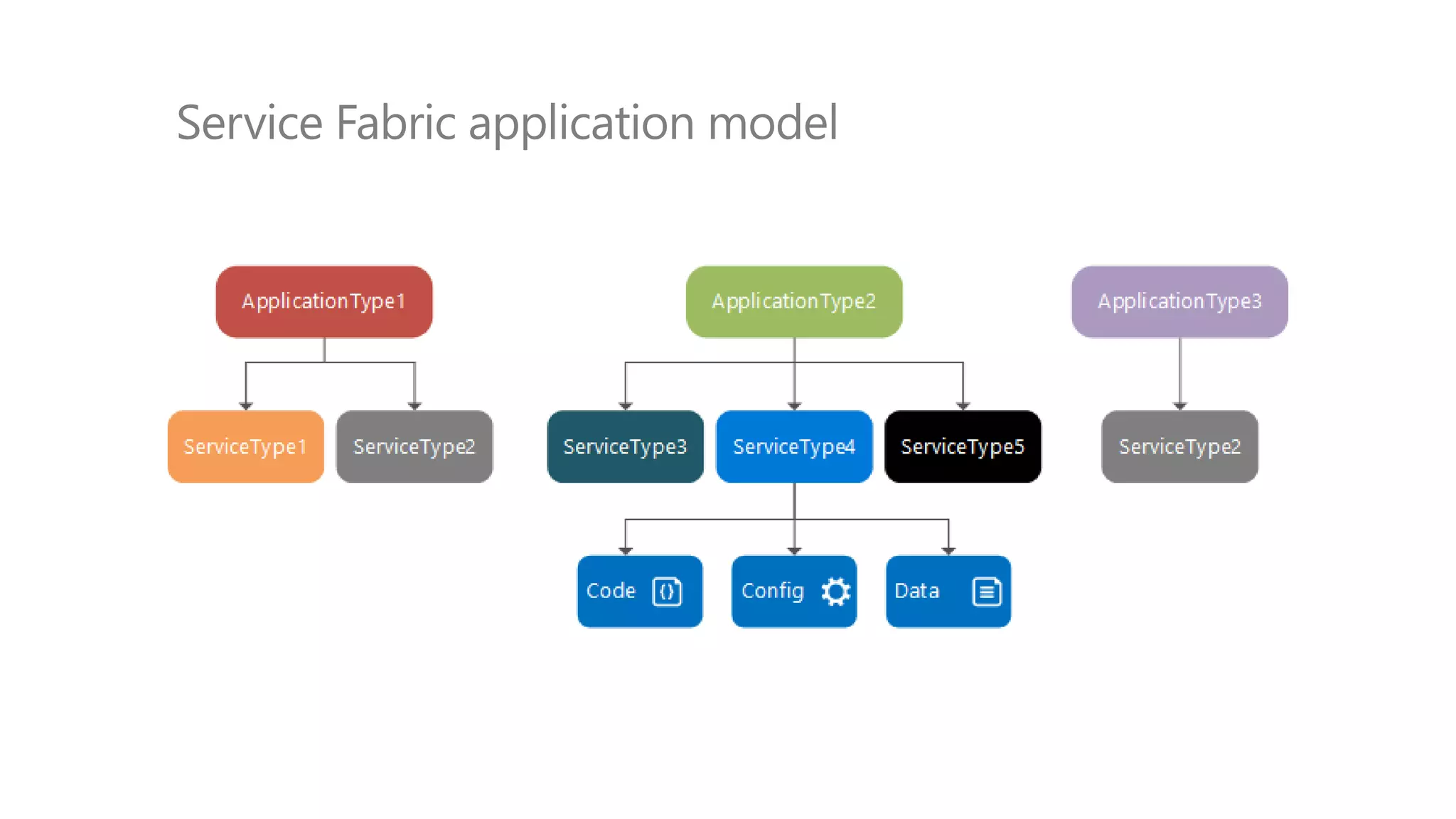
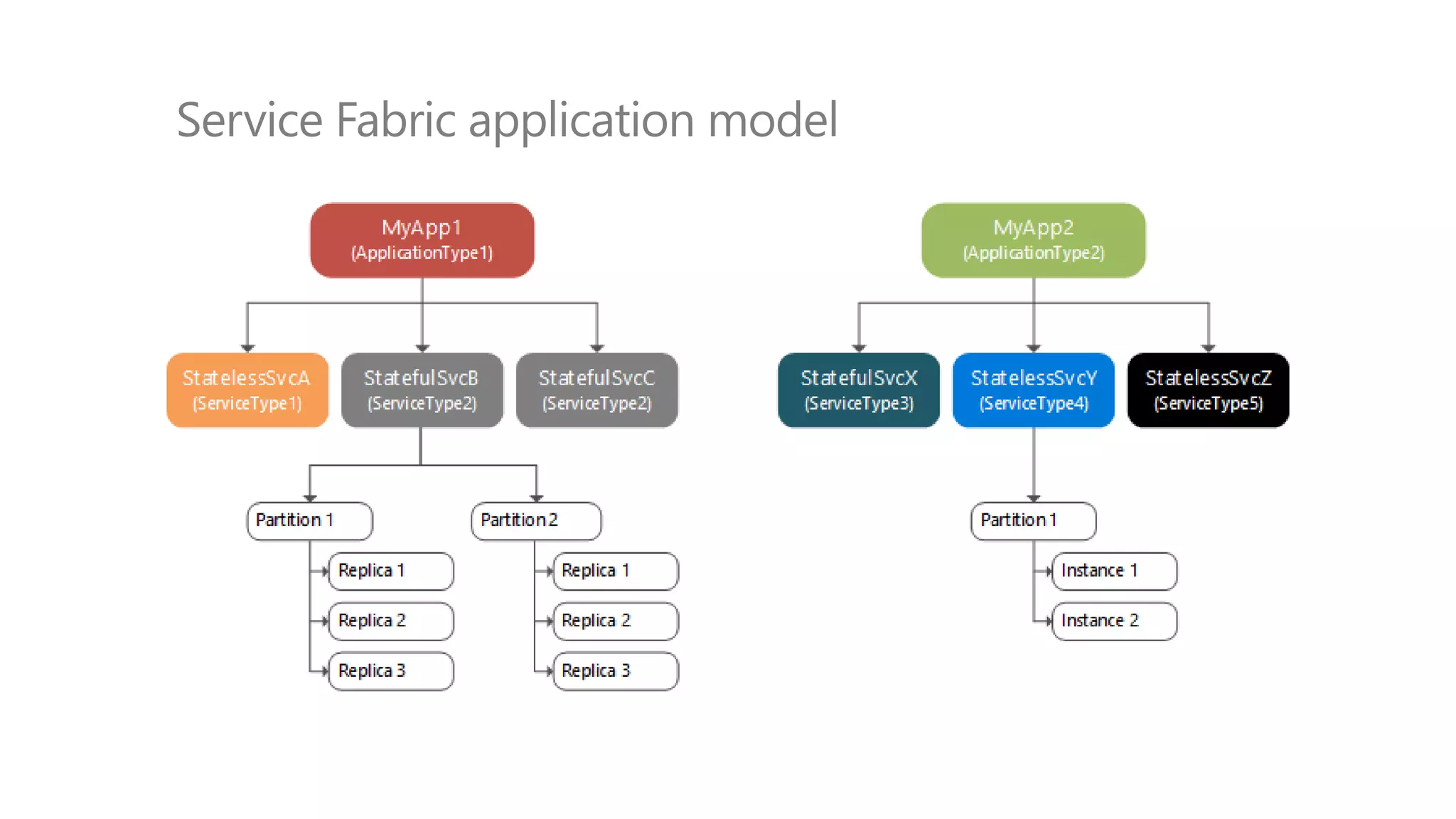
Service Fabric application model
DEMO
run your local cluster
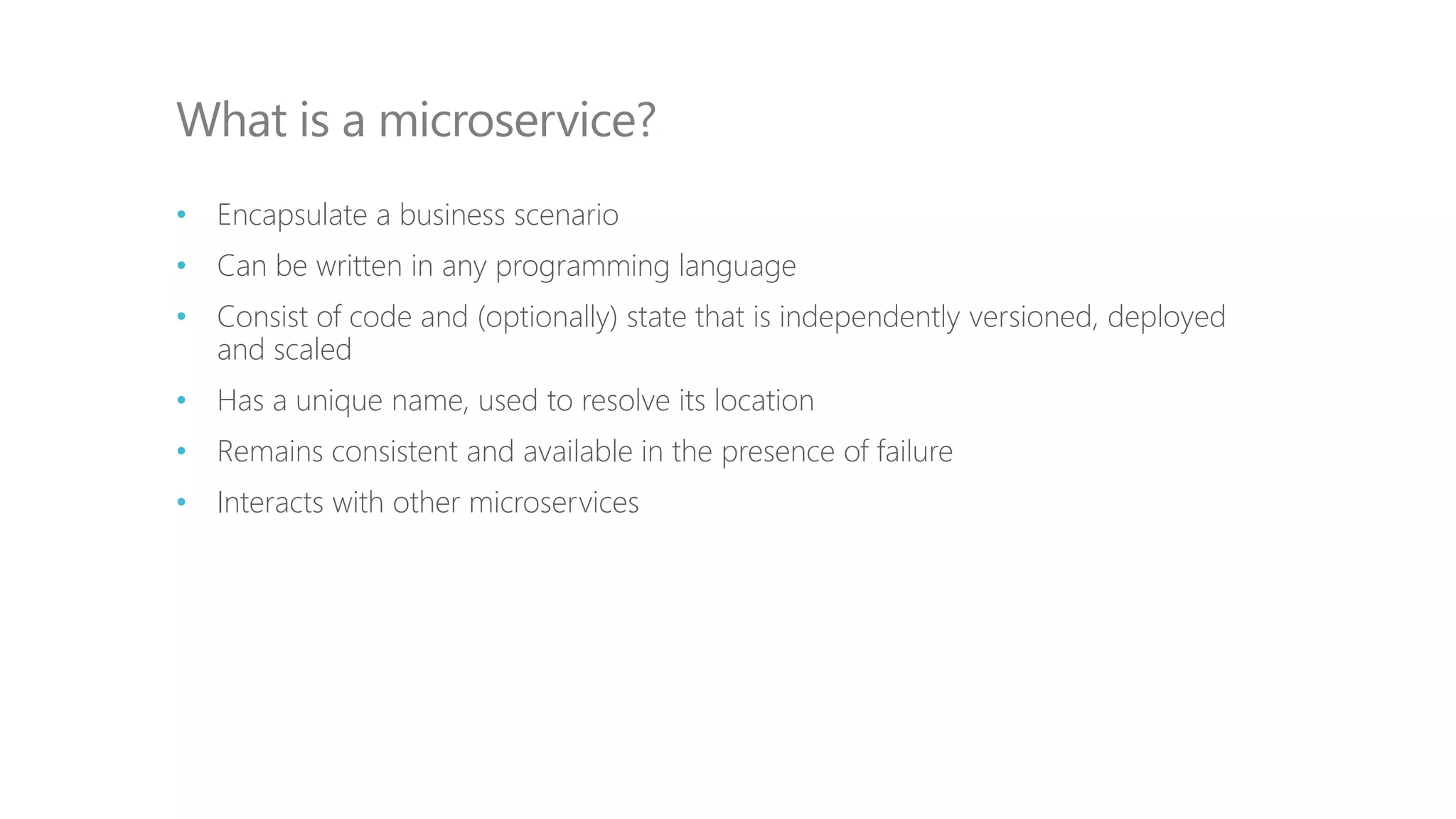
• Encapsulate a business scenario
• Can be written in any programming language
• Consist of code and (optionally) state that is independently versioned, deployed
and scaled
• Has a unique name, used to resolve its location
• Remains consistent and available in the presence of failure
• Interacts with other microservices
What is a microservice?
The actor model in computer science is a mathematical model of
concurrent computation that treats "actors" as the universal primitives of
concurrent computation: in response to a message that it receives, an
actor can make local decisions, create more actors, send more
messages, and determine how to respond to the next message received
https://en.wikipedia.org/wiki/Actor_model
Actor model
The actor model in computer science is a mathematical model of
concurrent computation that treats "actors" as the universal primitives of
concurrent computation: in response to a message that it receives, an
actor can make local decisions, create more actors, send more
messages, and determine how to respond to the next message received
https://en.wikipedia.org/wiki/Actor_model
Actor model
Actor model
Actor model
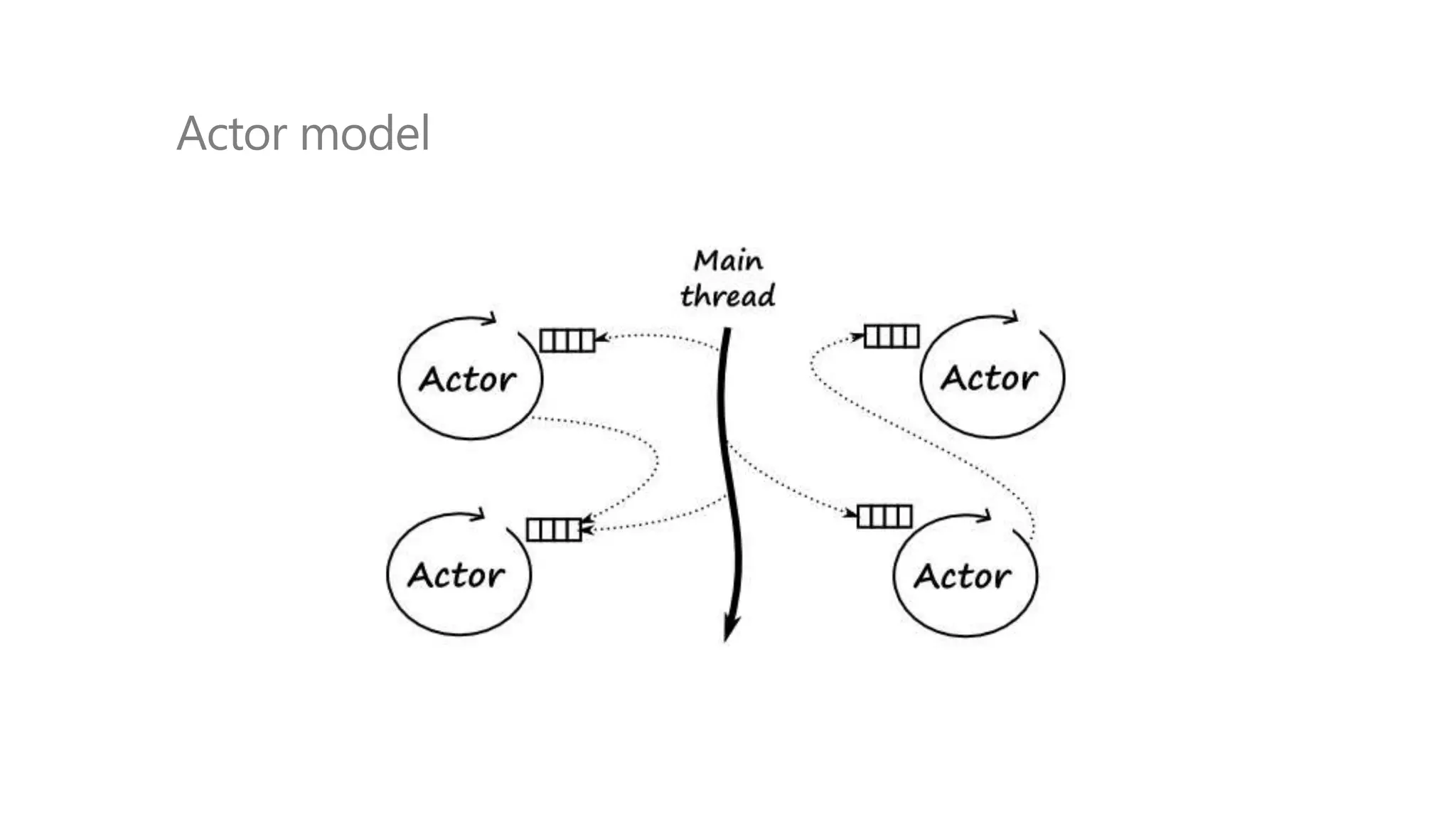
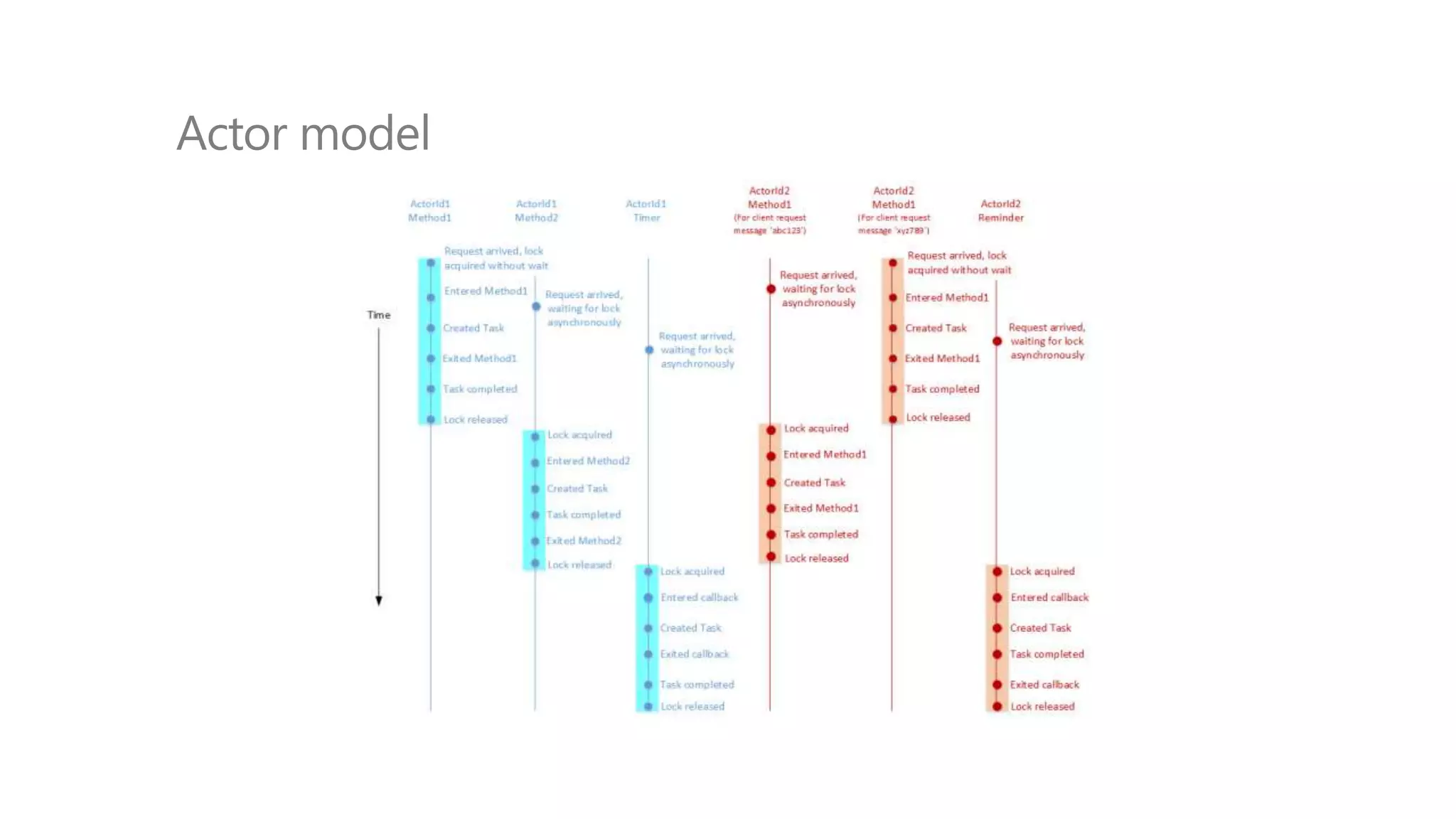
• Actors are isolated, single-threaded components that encapsulate both state and
behavior
• Each such actor is uniquely identified by an actor ID
• Actors interact with rest of the system, including other actors, by passing
asynchronous messages using a request-response pattern
Service Fabric Reliable Actors API
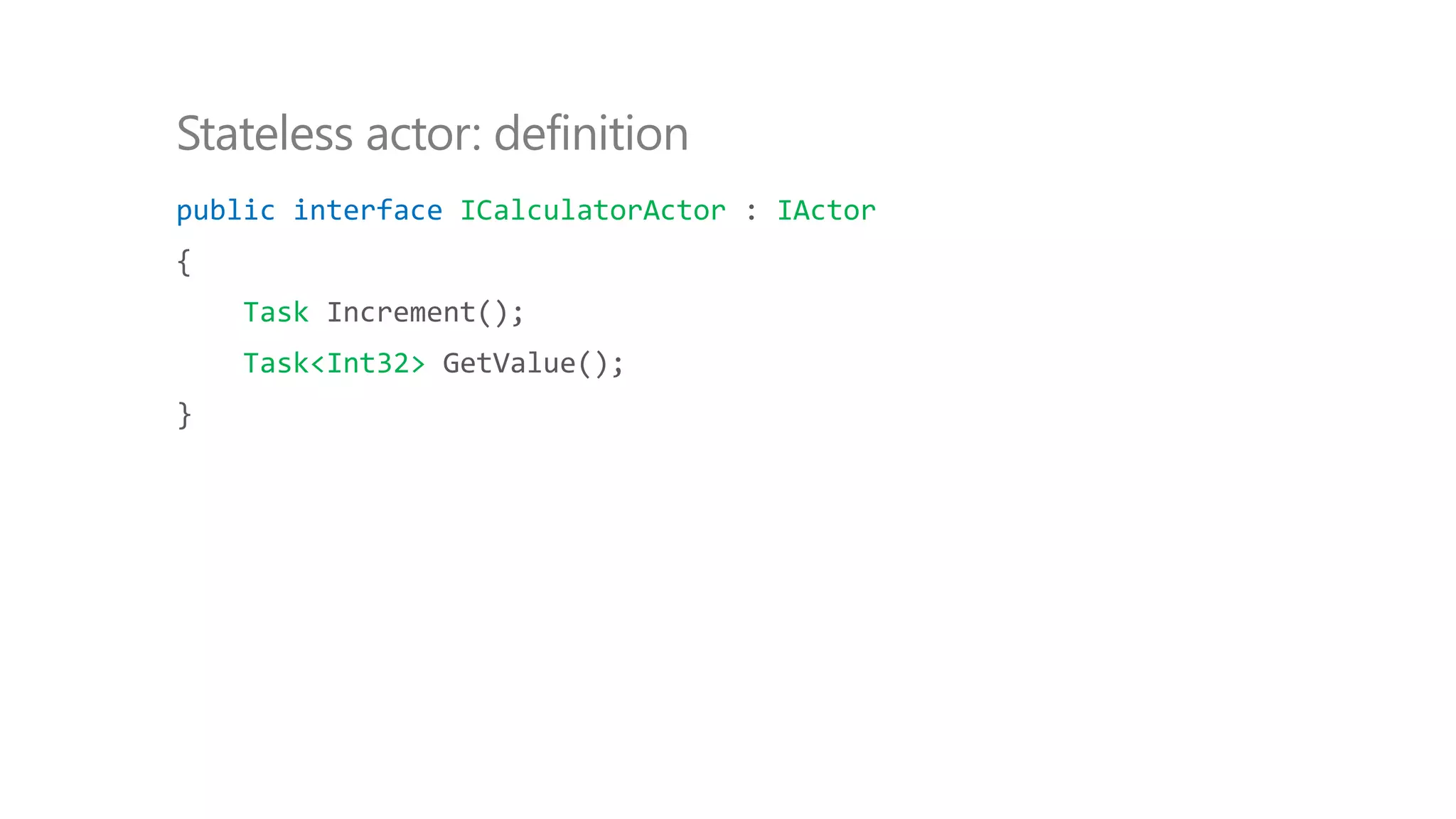
public interface ICalculatorActor : IActor
{
Task Increment();
Task<Int32> GetValue();
}
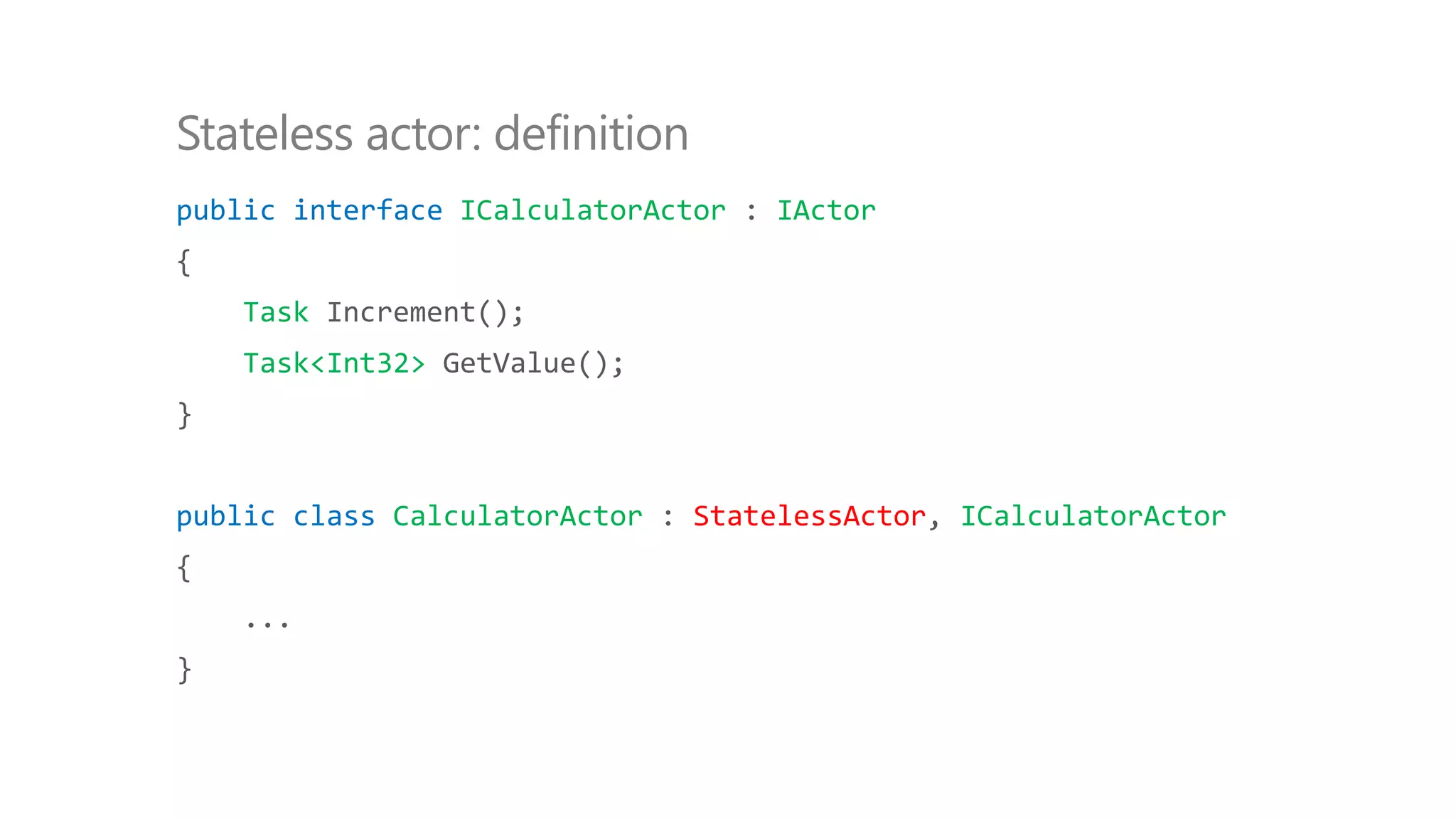
Stateless actor: definition
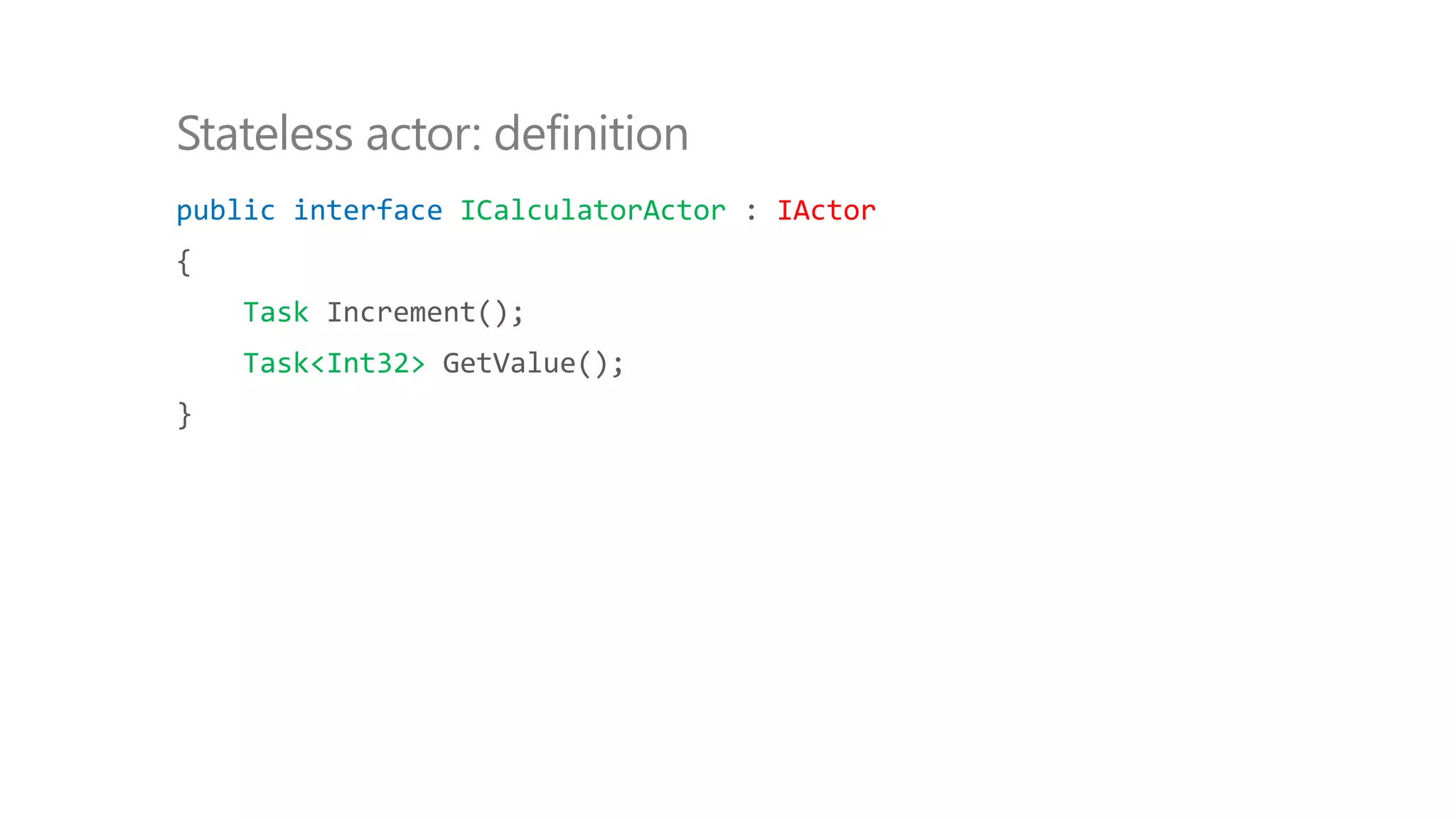
public interface ICalculatorActor : IActor
{
Task Increment();
Task<Int32> GetValue();
}
Stateless actor: definition
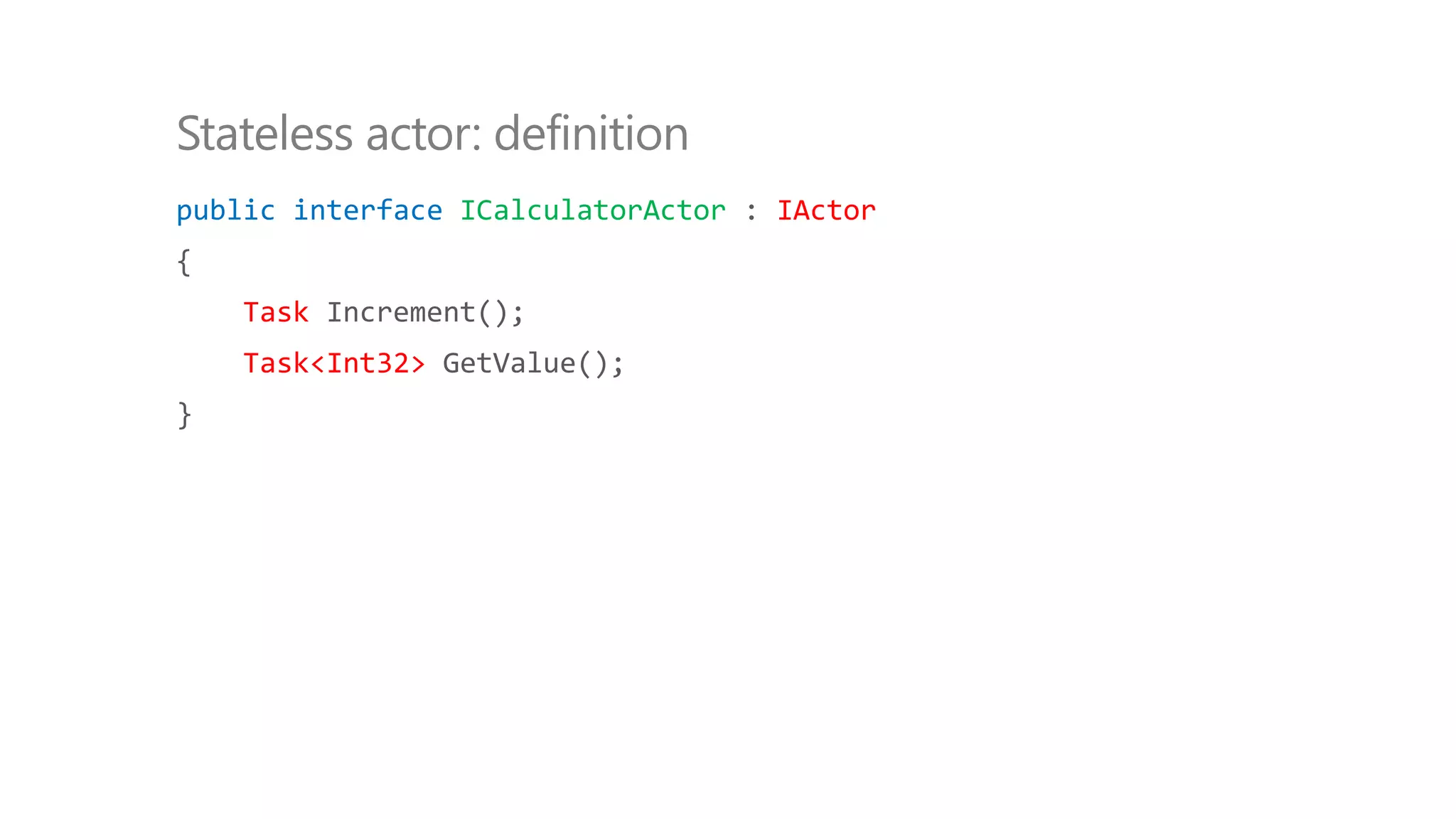
public interface ICalculatorActor : IActor
{
Task Increment();
Task<Int32> GetValue();
}
Stateless actor: definition
public interface ICalculatorActor : IActor
{
Task Increment();
Task<Int32> GetValue();
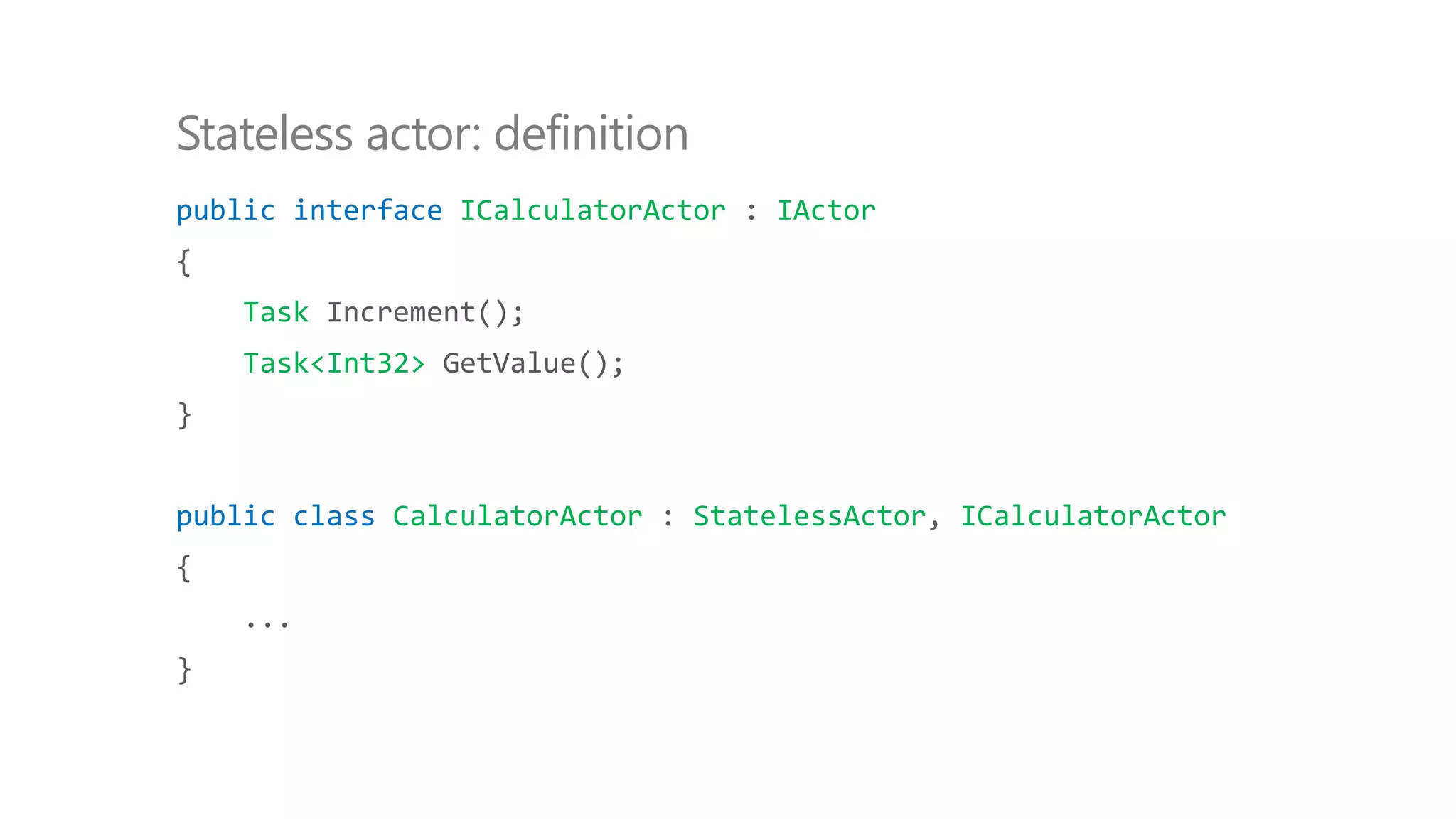
}
public class CalculatorActor : StatelessActor, ICalculatorActor
{
...
}
Stateless actor: definition
public interface ICalculatorActor : IActor
{
Task Increment();
Task<Int32> GetValue();
}
public class CalculatorActor : StatelessActor, ICalculatorActor
{
...
}
Stateless actor: definition
public interface ICalculatorActor : IActor
{
Task Increment();
Task<Int32> GetValue();
}
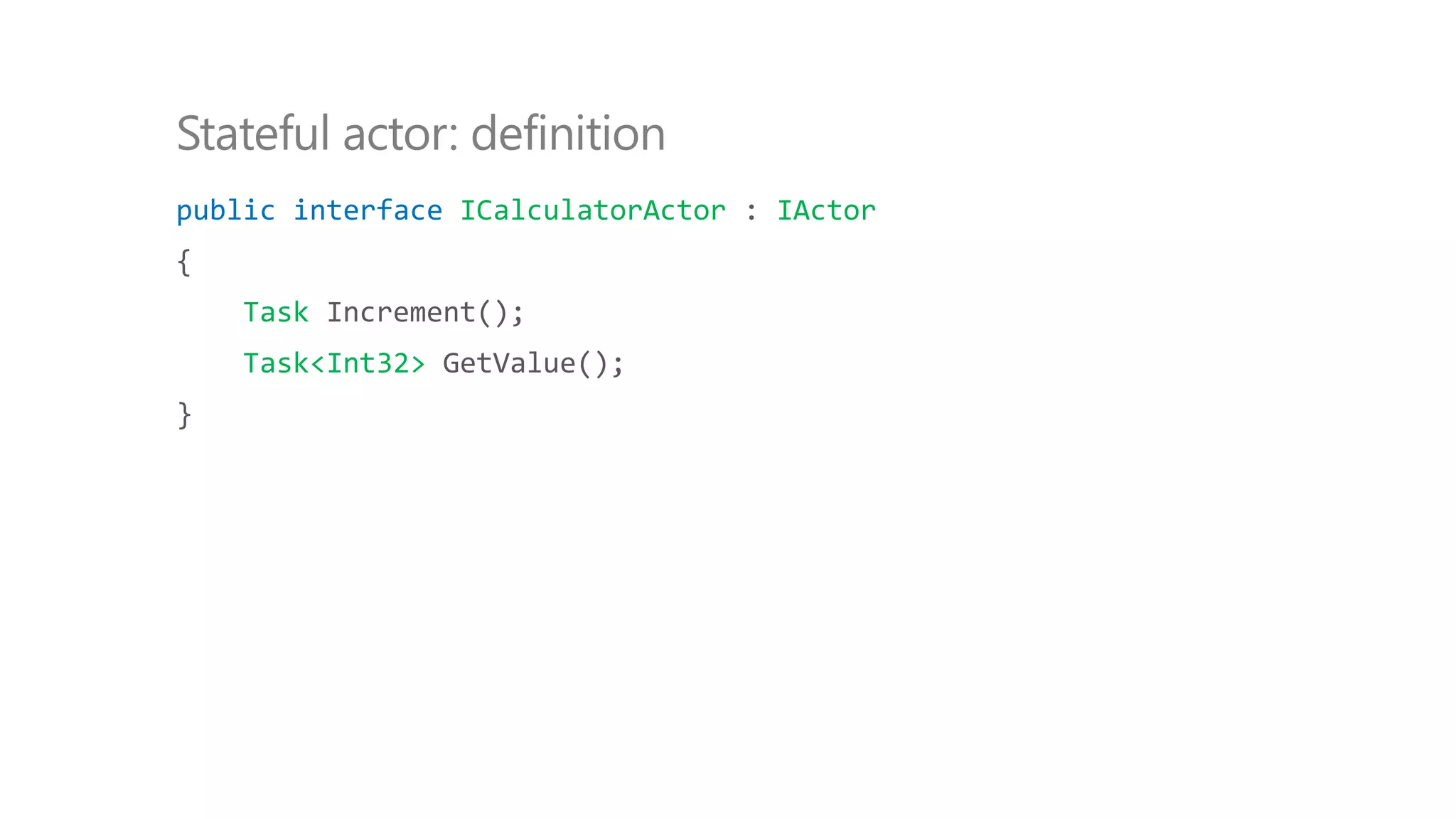
Stateful actor: definition
public interface ICalculatorActor : IActor
{
Task Increment();
Task<Int32> GetValue();
}
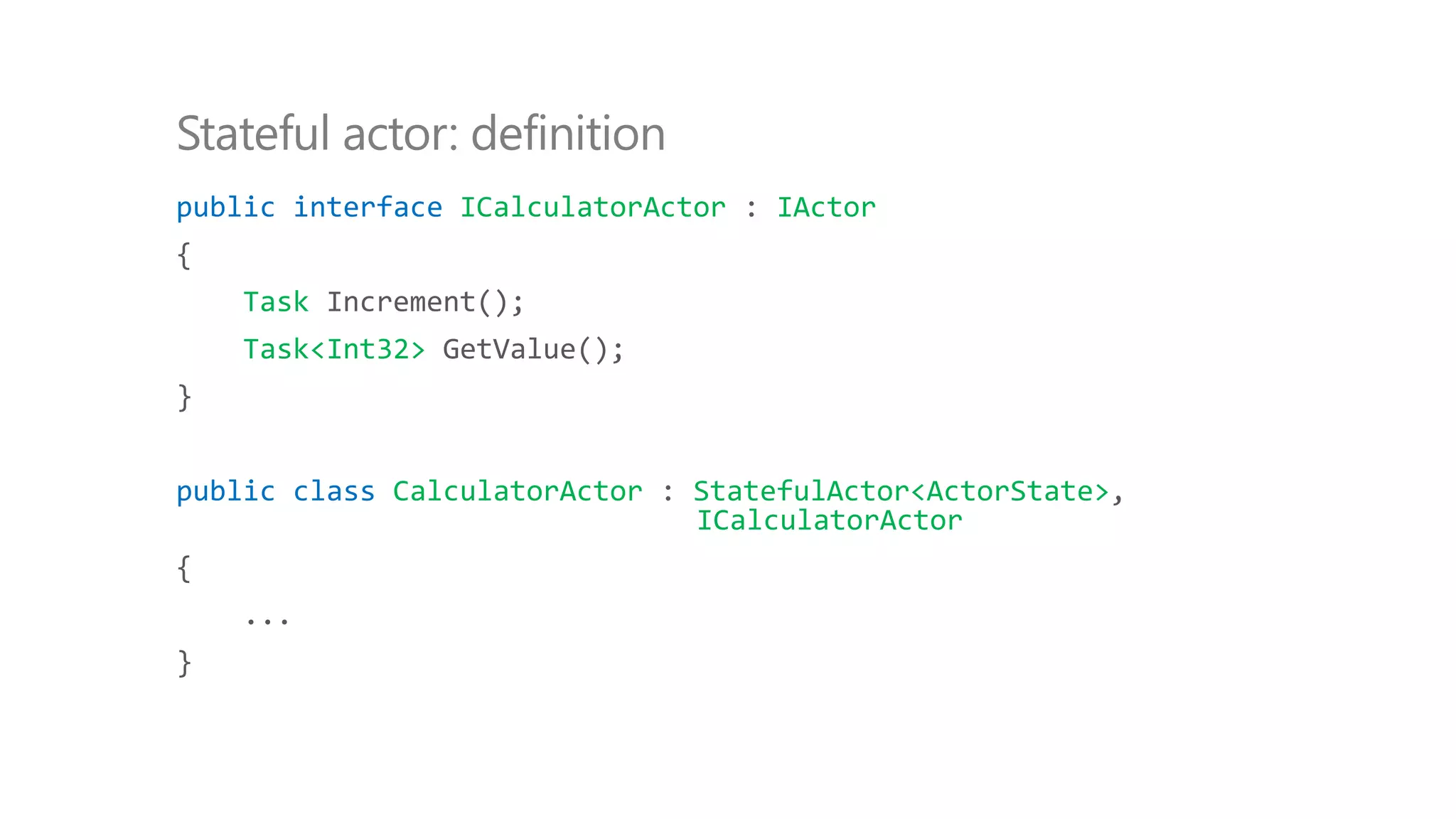
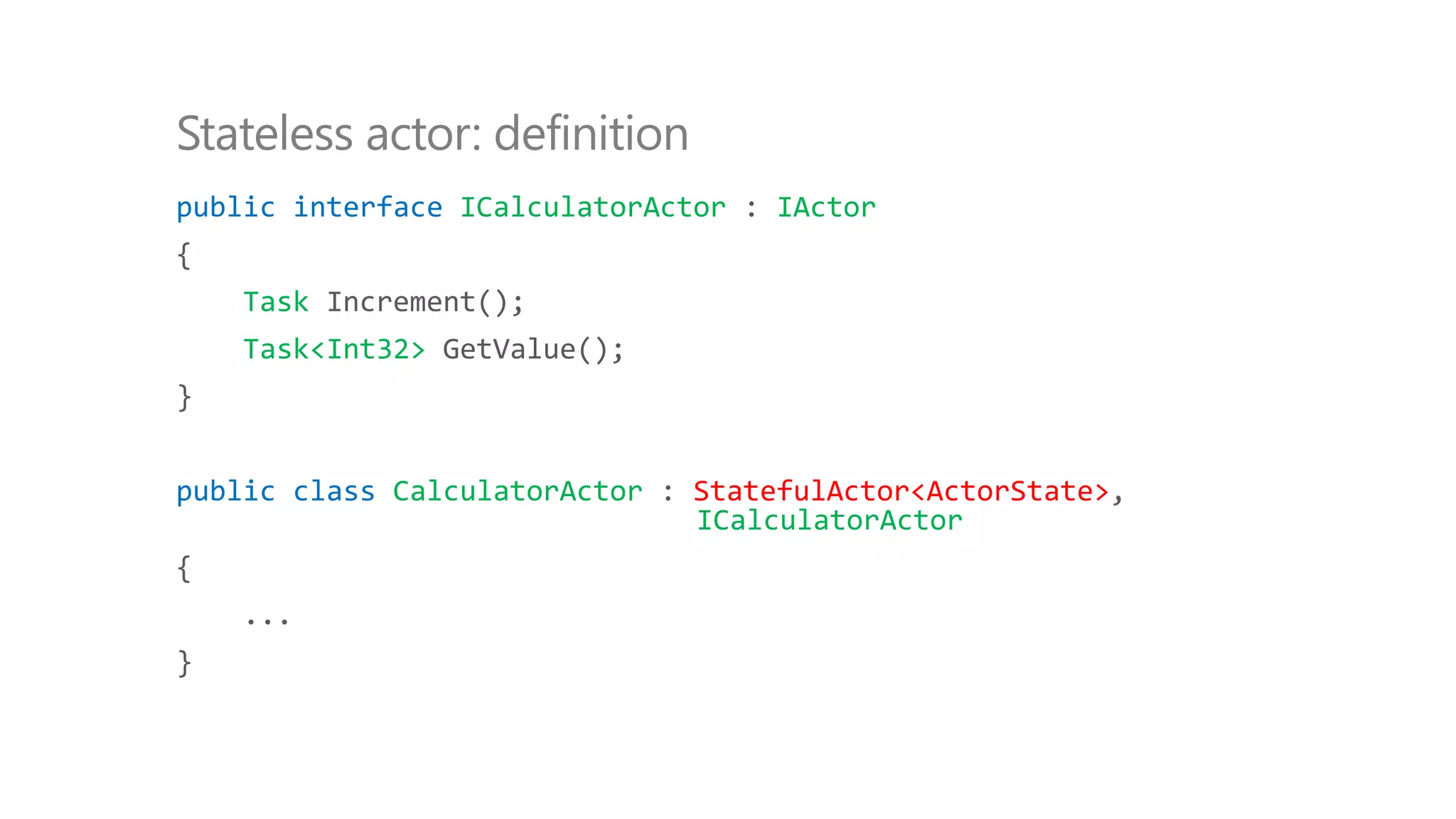
public class CalculatorActor : StatefulActor<ActorState>,
ICalculatorActor
{
...
}
Stateful actor: definition
public interface ICalculatorActor : IActor
{
Task Increment();
Task<Int32> GetValue();
}
public class CalculatorActor : StatefulActor<ActorState>,
ICalculatorActor
{
...
}
Stateless actor: definition
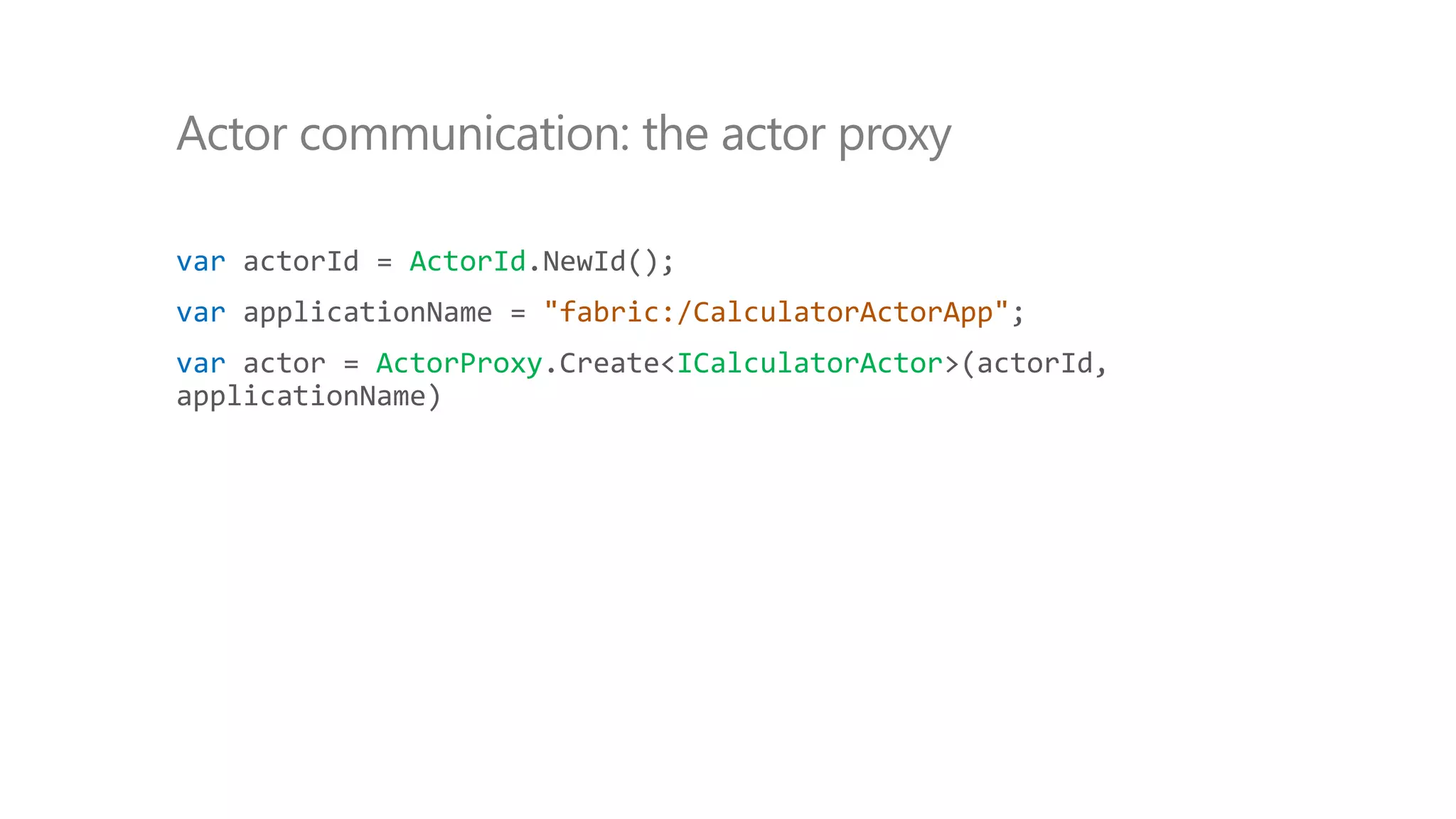
var actorId = ActorId.NewId();
var applicationName = "fabric:/CalculatorActorApp";
var actor = ActorProxy.Create<ICalculatorActor>(actorId,
applicationName)
Actor communication: the actor proxy
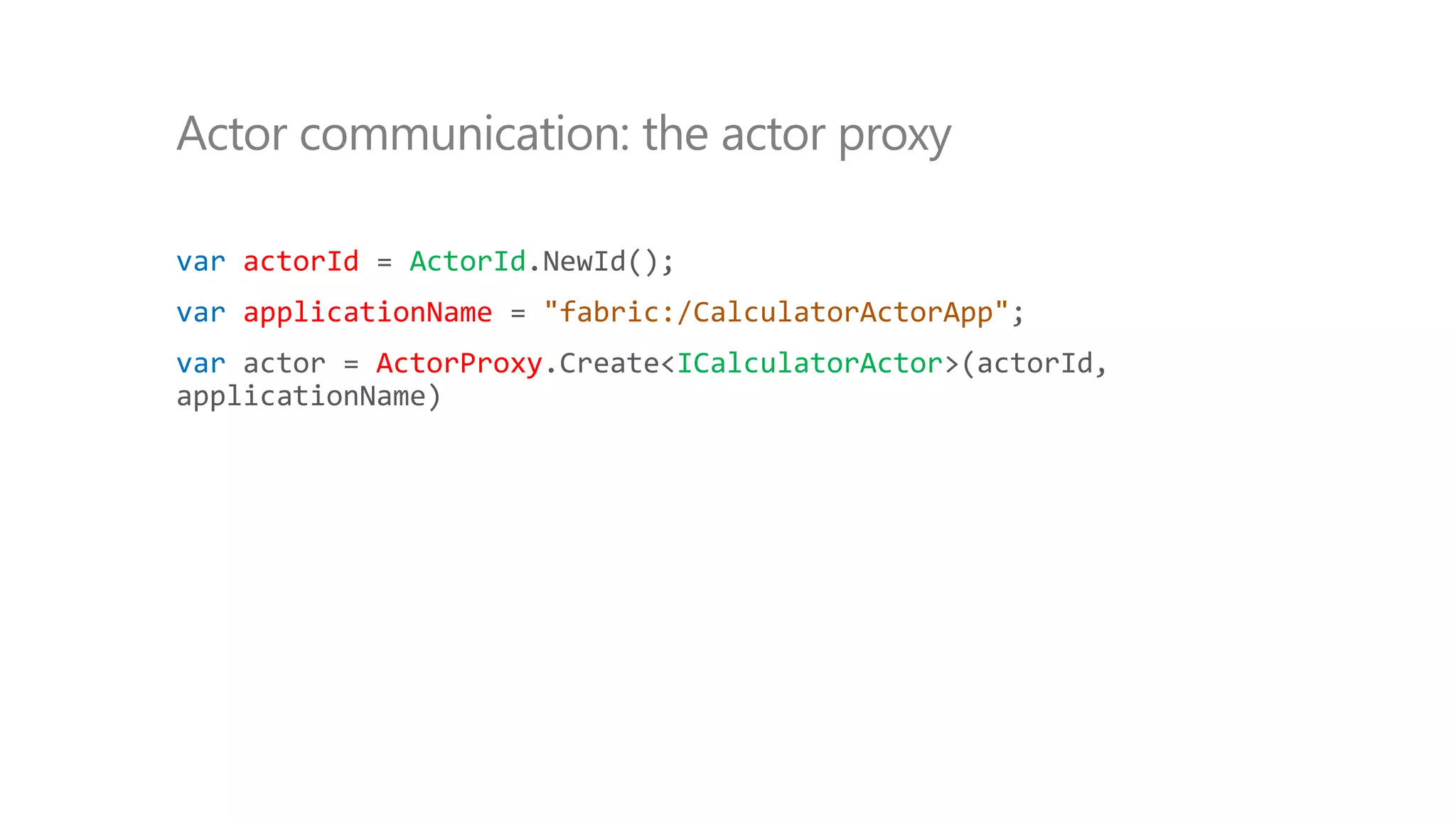
var actorId = ActorId.NewId();
var applicationName = "fabric:/CalculatorActorApp";
var actor = ActorProxy.Create<ICalculatorActor>(actorId,
applicationName)
Actor communication: the actor proxy
DEMO
stateless actor vs stateful actor
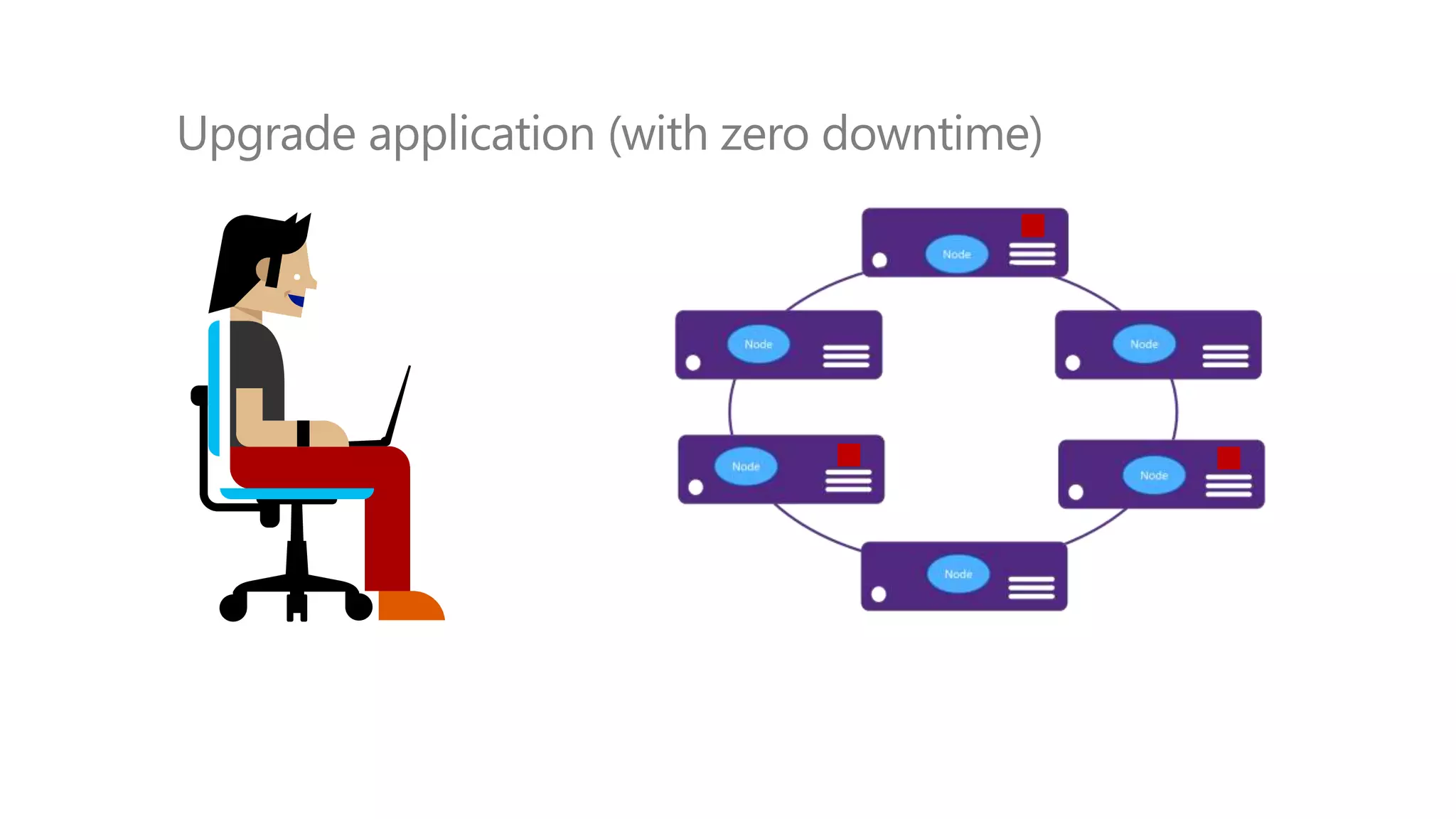
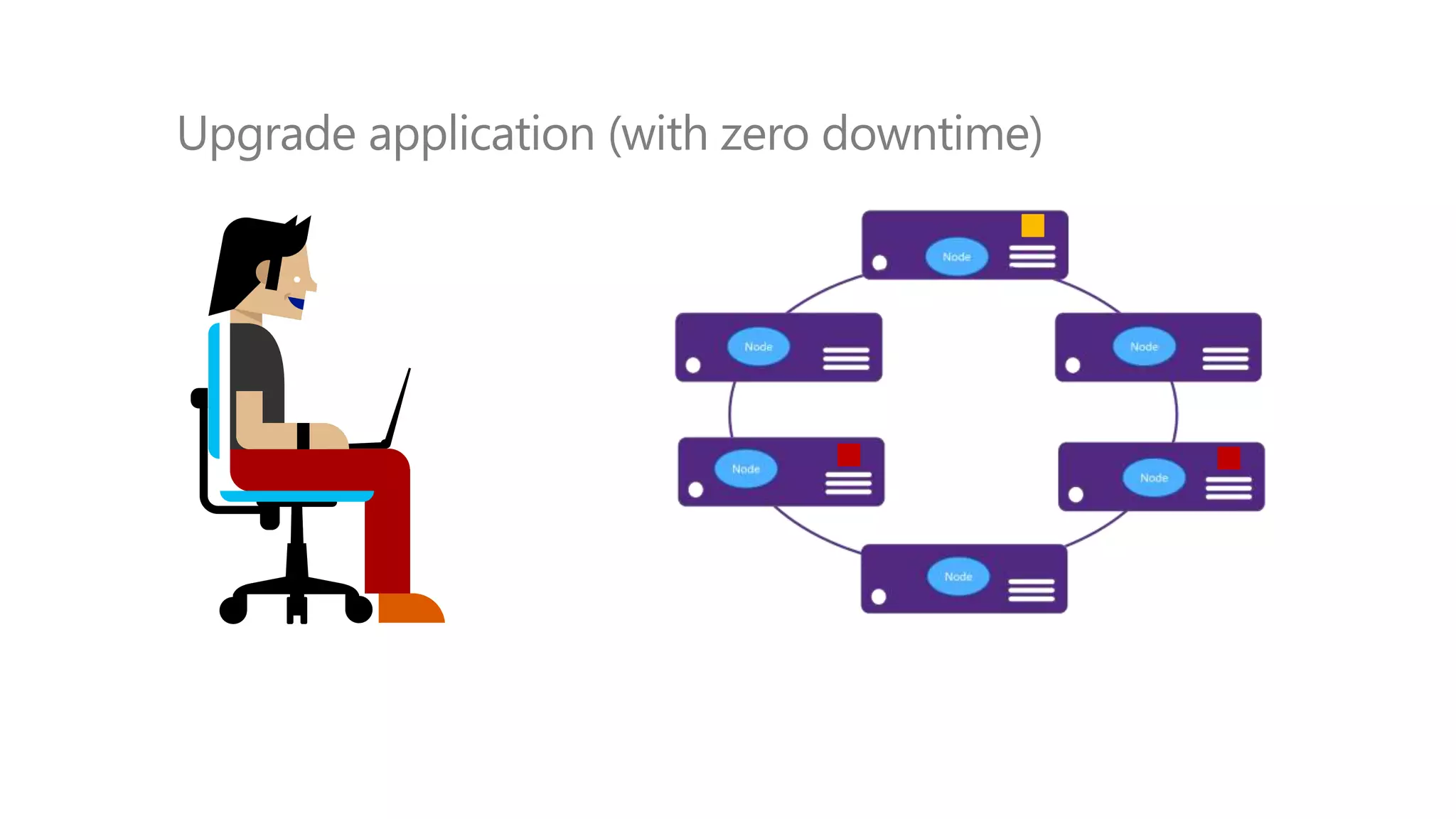
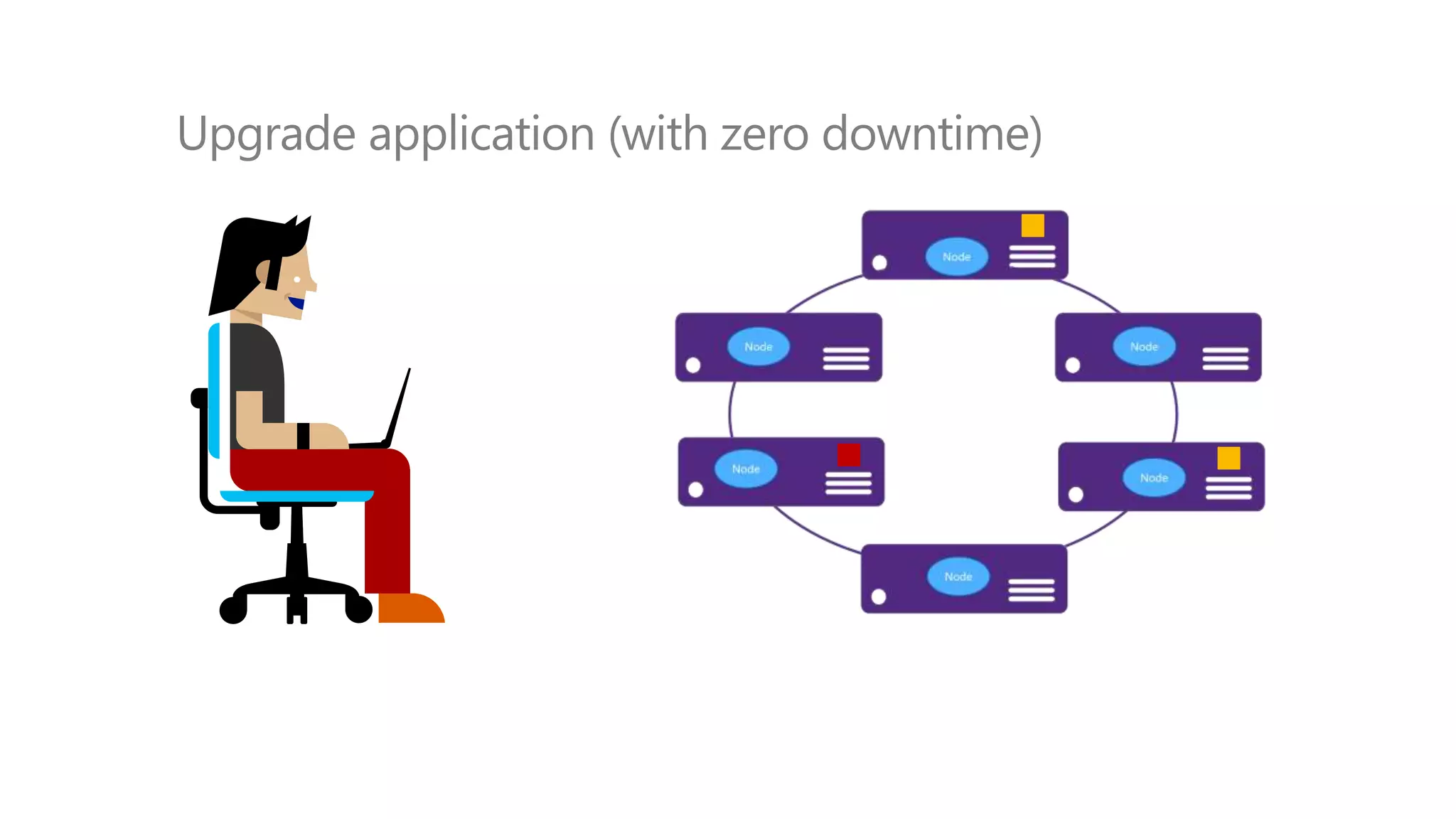
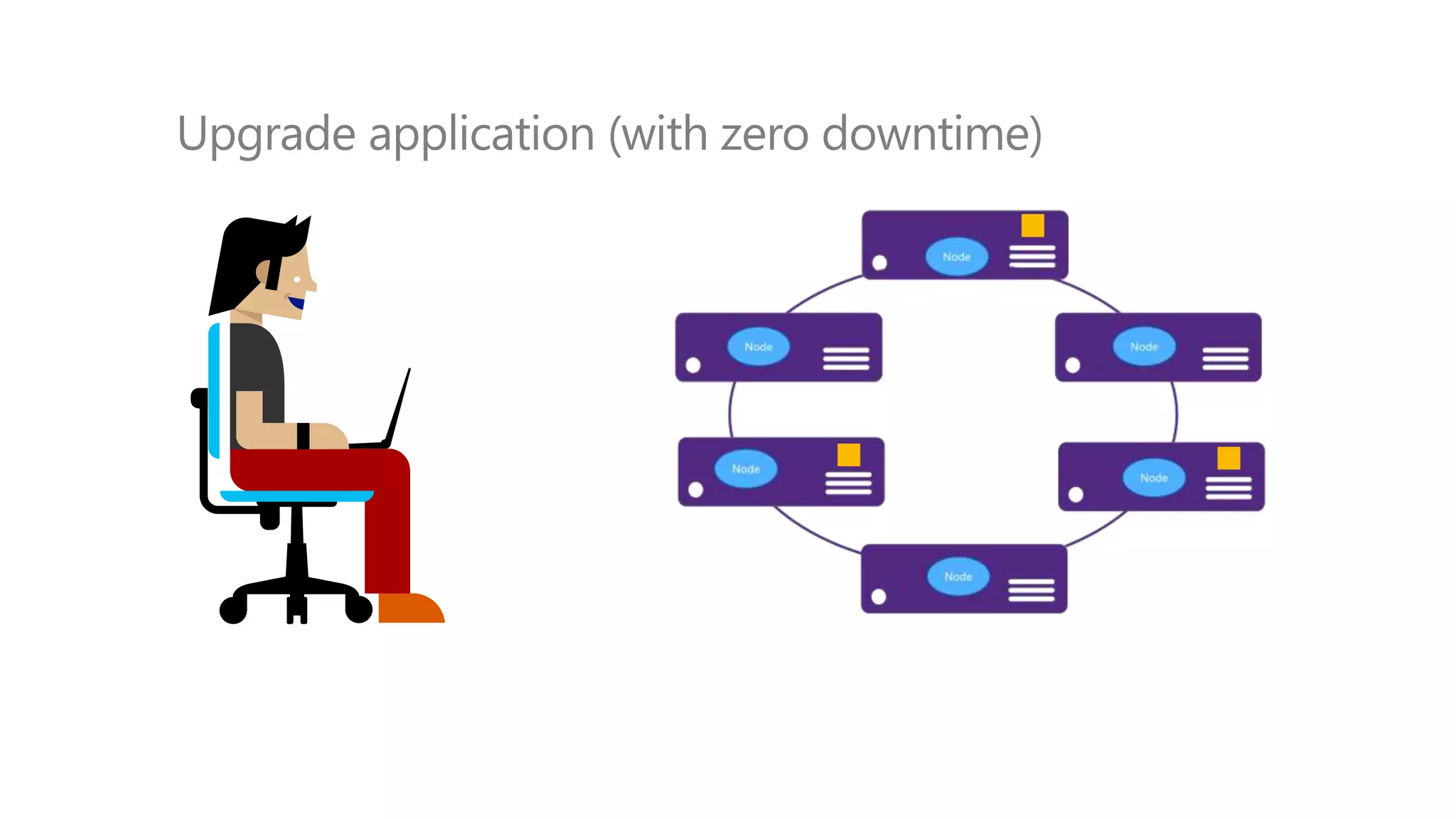
Upgrade application (with zero downtime)
DEMO
upgrade application
Free e-book available at:
http://go.particular.net/Liguria
Curiosi?

Azure service fabric: a gentle introduction

  • 1.
    Azure Service Fabric ...agentle introduction Alessandro Melchiori
  • 2.
    Solution architect @Particular Software alessandro [dot] melchiori [at] particular [dot] net twitter: @amelchiori blog: http://melkio.codiceplastico.com github: http://github.com/melkio Alessandro Melchiori
  • 3.
    • Why ServiceFabric? • Service Fabric overview • What is a microservice?  Actor model  Stateless and Stateful • Monitoring  Service Fabric Explorer • Upgrade application Agenda
  • 4.
  • 5.
  • 7.
  • 8.
  • 9.
  • 10.
    Service Fabric architecture:cluster • Cluster is a federation of machines • Cluster can scale to 1000s of machines
  • 11.
    Service Fabric architecture:replication system P S S S S • Replica states  None  Idle secondary  Active secondary  Primary
  • 12.
    Service Fabric architecture:replication system P S S S S • Reads are completed at the primary
  • 13.
    Service Fabric architecture:replication system P S S S S • Writes are replicated to the write quorum of secondaries
  • 14.
    Service Fabric architecture:replication system P S S S S • Writes are replicated to the write quorum of secondaries
  • 15.
    Service Fabric architecture:replication system P S S S S • Writes are replicated to the write quorum of secondaries
  • 16.
    Service Fabric architecture:replication system P S S S S • Writes are replicated to the write quorum of secondaries
  • 17.
    Service Fabric architecture:replication system P S S S S • Writes are replicated to the write quorum of secondaries
  • 18.
    Service Fabric architecture:replication system P S S S S • Writes are replicated to the write quorum of secondaries
  • 19.
    Service Fabric architecture:replication system reconfig P S S S S • Types of reconfiguration  Primary failover  Removing a failed secondary  Adding recovered replica  Building new secondary
  • 20.
    Service Fabric architecture:replication system reconfig P S S S S • Types of reconfiguration  Primary failover  Removing a failed secondary  Adding recovered replica  Building new secondary
  • 21.
    Service Fabric architecture:replication system reconfig S P S S • Types of reconfiguration  Primary failover  Removing a failed secondary  Adding recovered replica  Building new secondary
  • 22.
    Service Fabric architecture:replication system reconfig S P S S • Types of reconfiguration  Primary failover  Removing a failed secondary  Adding recovered replica  Building new secondary
  • 23.
    Service Fabric architecture:replication system reconfig S P S S • Types of reconfiguration  Primary failover  Removing a failed secondary  Adding recovered replica  Building new secondary
  • 24.
    Service Fabric architecture:replication system reconfig P S S • Types of reconfiguration  Primary failover  Removing a failed secondary  Adding recovered replica  Building new secondary
  • 25.
    Service Fabric architecture:replication system reconfig P P S S • Types of reconfiguration  Primary failover  Removing a failed secondary  Adding recovered replica  Building new secondary
  • 26.
    Service Fabric architecture:replication system reconfig S P S S • Types of reconfiguration  Primary failover  Removing a failed secondary  Adding recovered replica  Building new secondary
  • 27.
    Service Fabric architecture:replication system reconfig S P S S • Types of reconfiguration  Primary failover  Removing a failed secondary  Adding recovered replica  Building new secondary
  • 28.
    Service Fabric architecture:replication system reconfig S P S S • Types of reconfiguration  Primary failover  Removing a failed secondary  Adding recovered replica  Building new secondary B
  • 29.
    Service Fabric architecture:replication system reconfig S S P S S • Types of reconfiguration  Primary failover  Removing a failed secondary  Adding recovered replica  Building new secondary
  • 30.
    Service Fabric architecture:partitioning • Allow data/computation to be spread across nodes • A partition must fit in 1 node / 1 node can hold multiple partitions • Cross-partitions operations requires network hops and different transactions • SF balances partitions across nodes
  • 31.
  • 32.
  • 33.
  • 34.
  • 35.
  • 36.
    • Encapsulate abusiness scenario • Can be written in any programming language • Consist of code and (optionally) state that is independently versioned, deployed and scaled • Has a unique name, used to resolve its location • Remains consistent and available in the presence of failure • Interacts with other microservices What is a microservice?
  • 37.
    The actor modelin computer science is a mathematical model of concurrent computation that treats "actors" as the universal primitives of concurrent computation: in response to a message that it receives, an actor can make local decisions, create more actors, send more messages, and determine how to respond to the next message received https://en.wikipedia.org/wiki/Actor_model Actor model
  • 38.
    The actor modelin computer science is a mathematical model of concurrent computation that treats "actors" as the universal primitives of concurrent computation: in response to a message that it receives, an actor can make local decisions, create more actors, send more messages, and determine how to respond to the next message received https://en.wikipedia.org/wiki/Actor_model Actor model
  • 39.
  • 40.
  • 41.
    • Actors areisolated, single-threaded components that encapsulate both state and behavior • Each such actor is uniquely identified by an actor ID • Actors interact with rest of the system, including other actors, by passing asynchronous messages using a request-response pattern Service Fabric Reliable Actors API
  • 42.
    public interface ICalculatorActor: IActor { Task Increment(); Task<Int32> GetValue(); } Stateless actor: definition
  • 43.
    public interface ICalculatorActor: IActor { Task Increment(); Task<Int32> GetValue(); } Stateless actor: definition
  • 44.
    public interface ICalculatorActor: IActor { Task Increment(); Task<Int32> GetValue(); } Stateless actor: definition
  • 45.
    public interface ICalculatorActor: IActor { Task Increment(); Task<Int32> GetValue(); } public class CalculatorActor : StatelessActor, ICalculatorActor { ... } Stateless actor: definition
  • 46.
    public interface ICalculatorActor: IActor { Task Increment(); Task<Int32> GetValue(); } public class CalculatorActor : StatelessActor, ICalculatorActor { ... } Stateless actor: definition
  • 47.
    public interface ICalculatorActor: IActor { Task Increment(); Task<Int32> GetValue(); } Stateful actor: definition
  • 48.
    public interface ICalculatorActor: IActor { Task Increment(); Task<Int32> GetValue(); } public class CalculatorActor : StatefulActor<ActorState>, ICalculatorActor { ... } Stateful actor: definition
  • 49.
    public interface ICalculatorActor: IActor { Task Increment(); Task<Int32> GetValue(); } public class CalculatorActor : StatefulActor<ActorState>, ICalculatorActor { ... } Stateless actor: definition
  • 50.
    var actorId =ActorId.NewId(); var applicationName = "fabric:/CalculatorActorApp"; var actor = ActorProxy.Create<ICalculatorActor>(actorId, applicationName) Actor communication: the actor proxy
  • 51.
    var actorId =ActorId.NewId(); var applicationName = "fabric:/CalculatorActorApp"; var actor = ActorProxy.Create<ICalculatorActor>(actorId, applicationName) Actor communication: the actor proxy
  • 52.
  • 53.
  • 54.
  • 55.
  • 56.
  • 57.
  • 58.
    Free e-book availableat: http://go.particular.net/Liguria Curiosi?