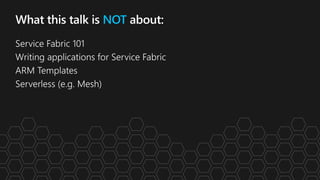
NOT
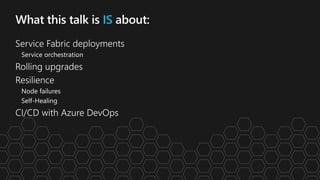
IS
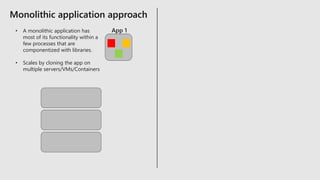
Monolithic application approach
• A monolithic application has
most of its functionality within a
few processes that are
componentized with libraries.
• Scales by cloning the app on
multiple servers/VMs/Containers
App 1
App 1
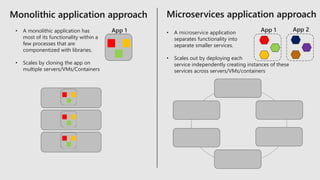
Monolithic application approach Microservices application approach
• A microservice application
separates functionality into
separate smaller services.
• Scales out by deploying each
service independently creating instances of these
services across servers/VMs/containers
• A monolithic application has
most of its functionality within a
few processes that are
componentized with libraries.
• Scales by cloning the app on
multiple servers/VMs/Containers
App 1 App 2
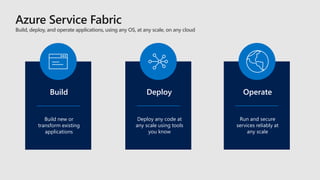
Run and secure
services reliably at
any scale
Operate
Deploy any code at
any scale using tools
you know
Deploy
Build new or
transform existing
applications
Build
Azure Service Fabric
Build, deploy, and operate applications, using any OS, at any scale, on any cloud
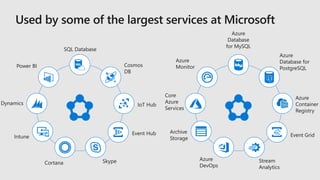
Power BI
Dynamics
Intune
Cortana Skype
Cosmos
DB
IoT Hub
Event Hub
SQL Database
Azure
Monitor
Core
Azure
Services
Archive
Storage
Azure
DevOps
Stream
Analytics
Azure
Database for
PostgreSQL
Azure
Database
for MySQL
Azure
Container
Registry
Event Grid
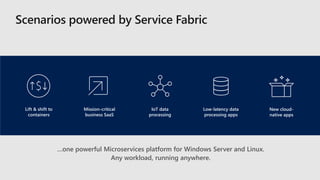
Scenarios powered by Service Fabric
Lift & shift to
containers
Mission-critical
business SaaS
IoT data
processing
Low-latency data
processing apps
…one powerful Microservices platform for Windows Server and Linux.
Any workload, running anywhere.
New cloud-
native apps
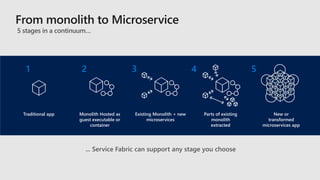
From monolith to Microservice
5 stages in a continuum…
... Service Fabric can support any stage you choose
New or
transformed
microservices app
5
Parts of existing
monolith
extracted
4
Existing Monolith + new
microservices
3
Monolith Hosted as
guest executable or
container
2
Traditional app
1
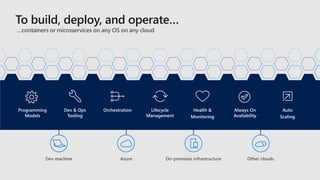
To build, deploy, and operate…
…containers or microservices on any OS on any cloud
Programming
Models
Dev & Ops
Tooling
Orchestration Lifecycle
Management
Health &
Monitoring
Always On
Availability
Auto
Scaling
Azure On-premises infrastructure Other cloudsDev machine
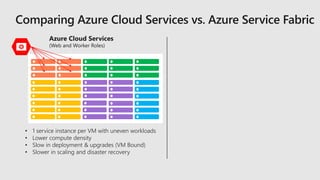
Azure Cloud Services
(Web and Worker Roles)
• 1 service instance per VM with uneven workloads
• Lower compute density
• Slow in deployment & upgrades (VM Bound)
• Slower in scaling and disaster recovery
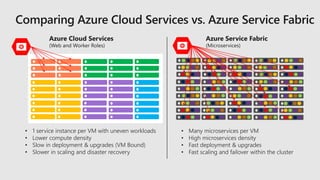
Azure Cloud Services
(Web and Worker Roles)
Azure Service Fabric
(Microservices)
• 1 service instance per VM with uneven workloads
• Lower compute density
• Slow in deployment & upgrades (VM Bound)
• Slower in scaling and disaster recovery
• Many microservices per VM
• High microservices density
• Fast deployment & upgrades
• Fast scaling and failover within the cluster
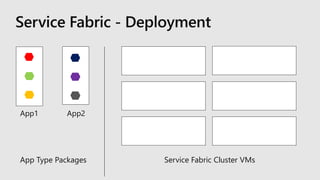
App1 App2
Service Fabric - Deployment
App Type Packages Service Fabric Cluster VMs
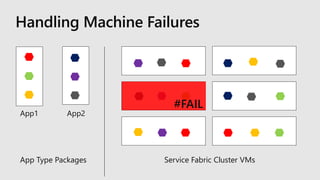
App1 App2
Handling Machine Failures

#FAIL
App Type Packages Service Fabric Cluster VMs
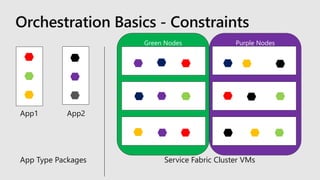
Purple NodesGreen Nodes
App1 App2
Orchestration Basics - Constraints
App Type Packages Service Fabric Cluster VMs
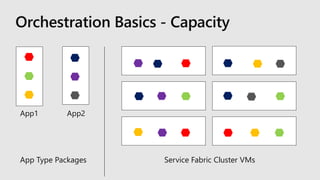
App1 App2
Orchestration Basics - Capacity
App Type Packages Service Fabric Cluster VMs
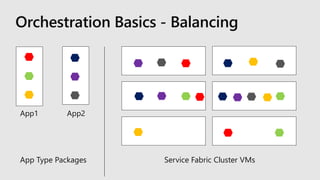
App1 App2
Orchestration Basics - Balancing
App Type Packages Service Fabric Cluster VMs
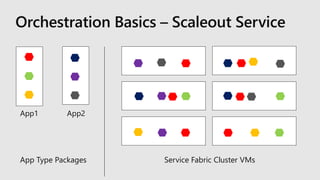
App1 App2
Orchestration Basics – Scaleout Service
App Type Packages Service Fabric Cluster VMs
App1 App2
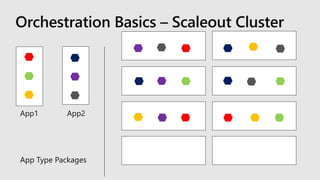
Orchestration Basics – Scaleout Cluster
App Type Packages
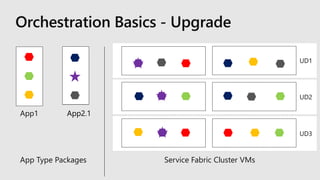
UD3
UD2
UD1
App1 App2
Orchestration Basics - Upgrade
App2.1
App Type Packages Service Fabric Cluster VMs
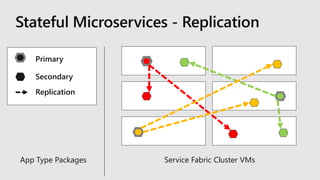
Stateful Microservices - Replication
Primary
Secondary
Replication
App Type Packages Service Fabric Cluster VMs
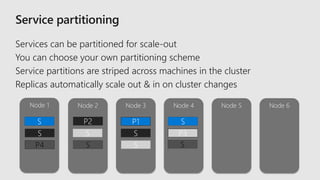
Node 5Node 4Node 3 Node 6Node 2Node 1
Services can be partitioned for scale-out
You can choose your own partitioning scheme
Service partitions are striped across machines in the cluster
Replicas automatically scale out & in on cluster changes
P2
S
S
S
P4
S
P1
S
P3S
S
S
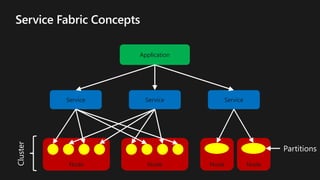
Application
Service Service Service
Node Node Node Node
Cluster
Partitions
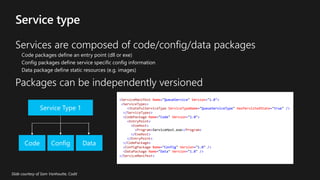
Services are composed of code/config/data packages
Code packages define an entry point (dll or exe)
Config packages define service specific config information
Data package define static resources (e.g. images)
Packages can be independently versioned
<ServiceManifest Name="QueueService" Version="1.0">
<ServiceTypes>
<StatefulServiceType ServiceTypeName="QueueServiceType" HasPersistedState="true" />
</ServiceTypes>
<CodePackage Name="Code" Version="1.0">
<EntryPoint>
<ExeHost>
<Program>ServiceHost.exe</Program>
</ExeHost>
</EntryPoint>
</CodePackage>
<ConfigPackage Name="Config" Version="1.0" />
<DataPackage Name="Data" Version="1.0" />
</ServiceManifest>
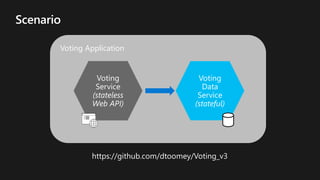
Voting Application
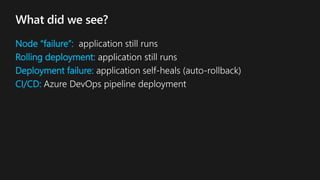
Node “failure”:
Rolling deployment:
Deployment failure:
CI/CD:
https://docs.microsoft.com/en-us/azure/service-fabric/service-fabric-quickstart-dotnet
https://docs.microsoft.com/en-us/azure/service-fabric/service-fabric-quickstart-containers
https://docs.microsoft.com/en-us/azure/service-fabric/service-fabric-quickstart-containers-linux
http://aka.ms/ServiceFabricSDK
https://mva.microsoft.com/en-US/training-courses/building-microservices-applications-on-azure-service-fabric-16747
http://aka.ms/ServiceFabricSamples
http://aka.ms/tryservicefabric
https://blogs.msdn.microsoft.com/azureservicefabric/2016/07/06/introduction-to-service-fabric-lab-part-1/
https://stackoverflow.com/questions/tagged/azure-service-fabric
http://aka.ms/ServiceFabricForum
https://github.com/azure/service-fabric-issues
http://aka.ms/ServiceFabricSlack here
here
dtoomey@deloitte.com.au
@daniel2me
linkedin.com/in/danieltoomey
mindovermessaging.com
github.com/dtoomey
Service Fabric Deployments

Service Fabric Deployments

Editor's Notes

  • #7 Problem with monolithic application is complexity of deployment and lack of scalability at a granular level.
  • #8 Service Fabric allows you to scales services independently, and not limited to one service per virtual machine. Looks complex, right?
  • #9 Visual Studio, Azure DevOps, Yeoman, Octopus Deploy
  • #10 Service Fabric runs several Million cores at Microsoft.
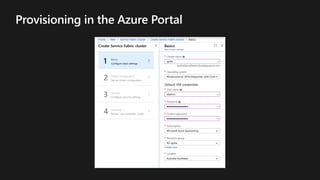
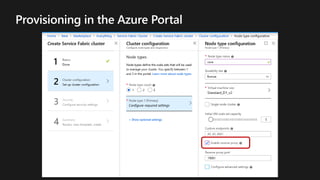
  • #29 The recommended VM SKU is Standard D3 or Standard D3_V2 or equivalent with a minimum of 14 GB of local SSD. Reverse proxy addresses services in the cluster that exposes HTTP endpoints including HTTPS. greatly simplifies calling other services and their methods by having a specific URI format handles the resolve, connect, retry steps required for one service to communicate with another using the Naming Service. Hides the Naming Service from you when calling other services by making this as simple as calling a URL.
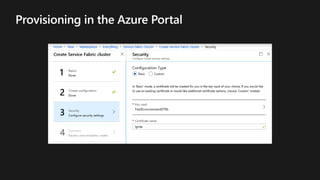
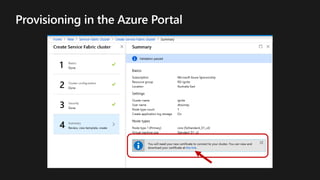
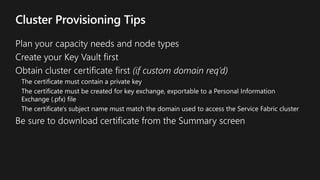
  • #33 The certificate must contain a private key. The certificate must be created for key exchange, exportable to a Personal Information Exchange (.pfx) file. The certificate's subject name must match the domain used to access the Service Fabric cluster. This is required to provide SSL for the cluster's HTTPS management endpoints and Service Fabric Explorer. You cannot obtain an SSL certificate from a certificate authority (CA) for the .cloudapp.azure.com domain. Acquire a custom domain name for your cluster. When you request a certificate from a CA the certificate's subject name must match the custom domain name used for your cluster.
  • #35 Objective: Present the Core Concepts that make up a Service Fabric Application Notes: A Service Fabric Application is made up of a collection of Services, where each service id responsible for performing some distinct function. Services are composed of Code, Configuration, and Data, where code is the executable binaries, configuration consists of the service settings that affect its runtime behavior, and data is any arbitrary static data that the service will consume at runtime. Service Fabric supports several different Service models, and can be categorized as being either Stateful Services or Stateless Services (the different service models will be discussed in an upcoming slide.) At runtime, services are deployed into a Cluster, where a cluster is a scalable collection made up of a set of either physical or virtual machines. Each machine (physical or virtual) that is part of a cluster is called a Node. Service Fabric manages distribution of services across the cluster based on placement criteria identified in the service’s configuration and also on the application’s resource balancing needs. The configuration for each service will include a partition scheme for that service, as well as instance and/or replica counts. Services can split data and processing across multiple partitions, which are then spread out across the nodes in a cluster. Stateless services have instances, whereas stateful services have replicas. Instances provide availability, in that in the event of a failure of one instance, the other instances continue to function. Replicas keep the state for a service in sync across multiple partitions; should one replica fail, one of the others will take its place and a new replica will be created.
  • #44 fa