Actor Model in .NET:
Akka.NET vs Microsoft Orleans
for the curious
William Tulloch
Lead Consultant – Readify
@wtulloch
Preamble
Concurrency and distributed applications
What is the Actor Model?
The Model of Actor Model
A way of reasoning about concurrent computation
What is the Actor Model
A way of reasoning about concurrent computation
Is inherently concurrent
The Model of Actor Model
Is a conceptual model for reasoning about concurrent
computation
Is inherently concurrent
Manages concurrency through message passing
The Model of Actor Model
Is a conceptual model for reasoning about concurrent
computation
Adopts the philosophy that everything is an actor
Is inherently concurrent
Manages concurrency through message passing
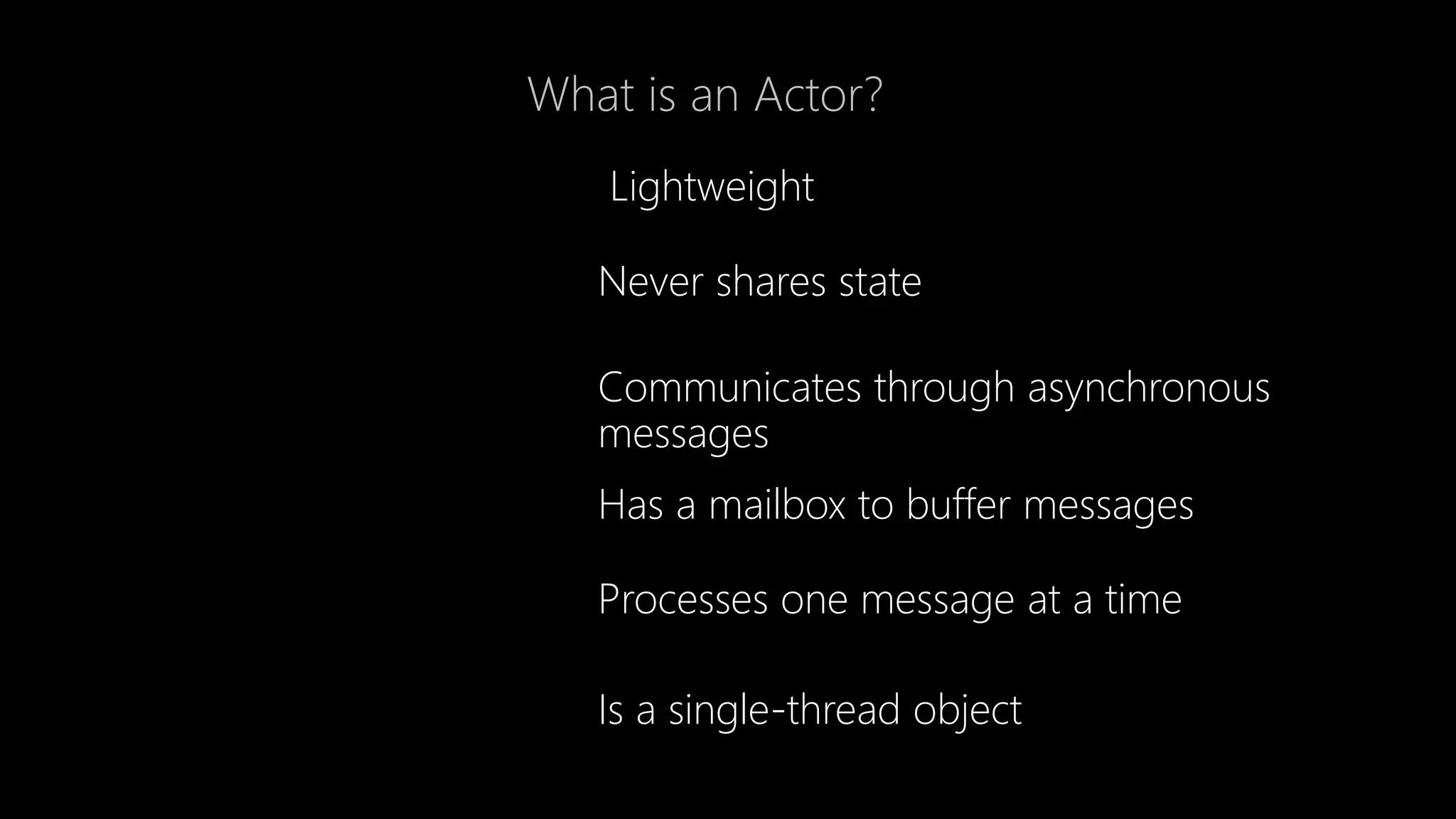
What is an Actor?
Lightweight
Never shares state
Communicates through asynchronous
messages
Has a mailbox to buffer messages
Processes one message at a time
Is a single-thread object
An Actor Can not exist on its own
Microsoft Orleans
&
Akka.NET
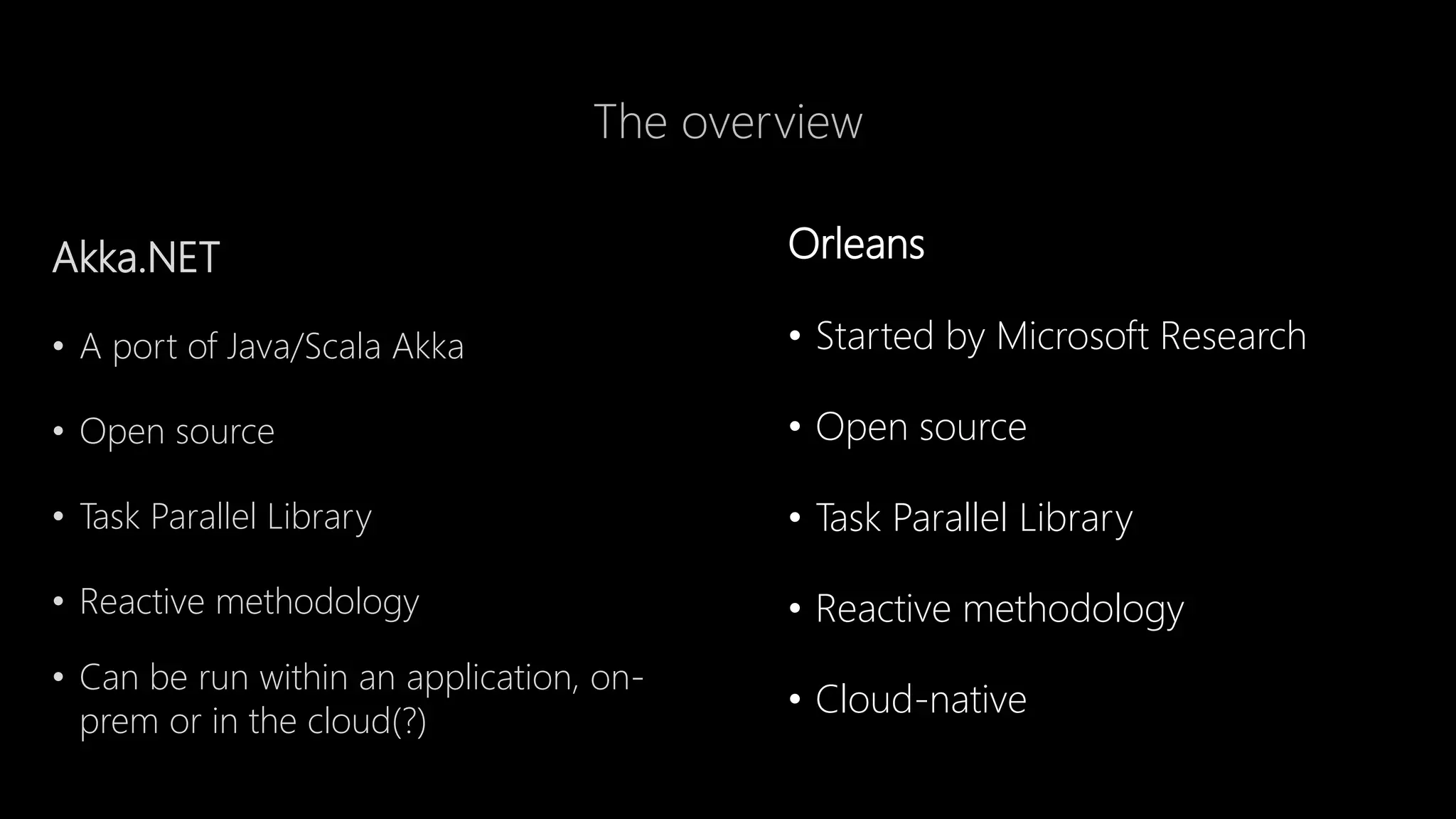
The overview
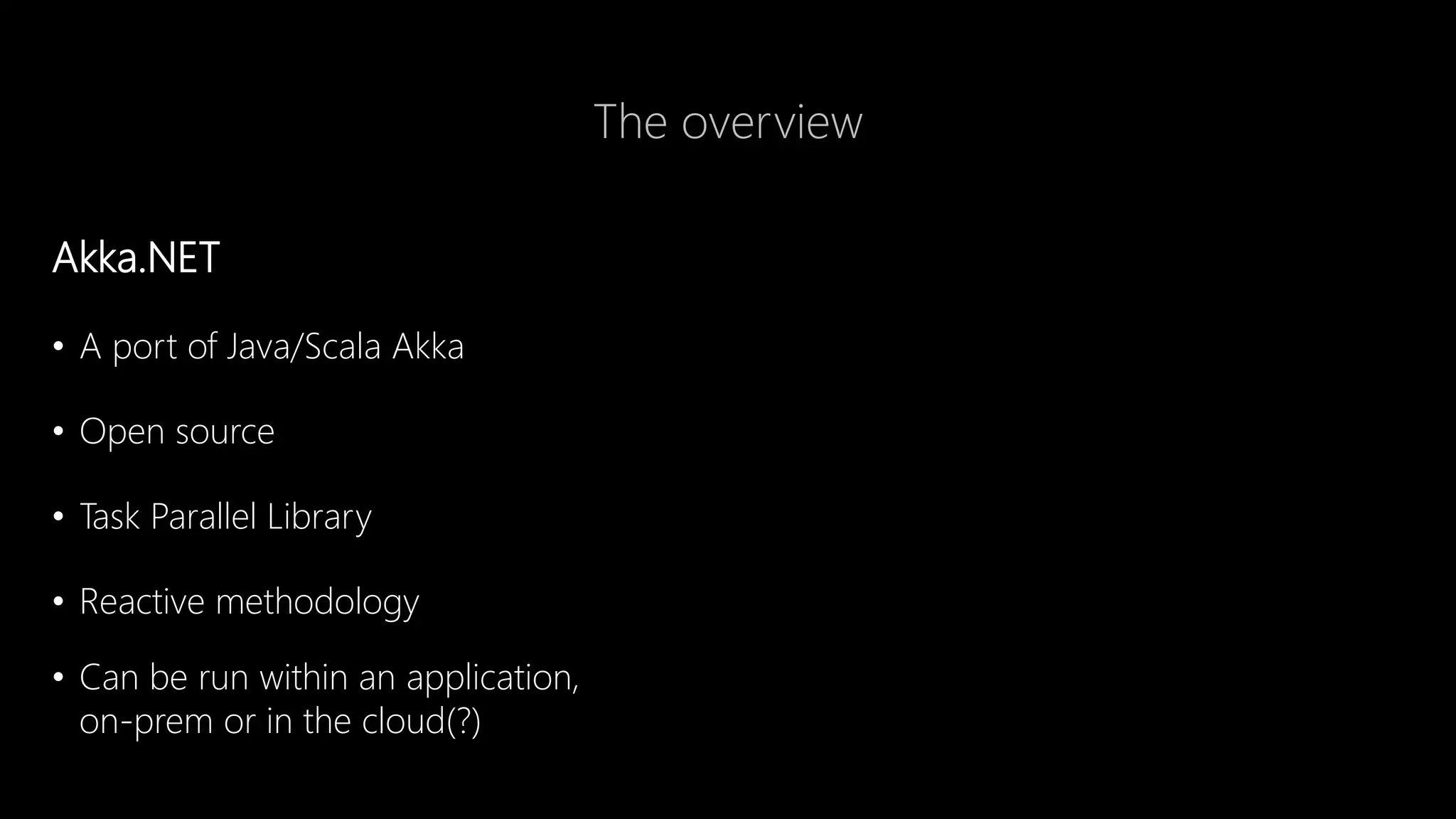
Akka.NET
• A port of Java/Scala Akka
• Open source
• Task Parallel Library
• Reactive methodology
• Can be run within an application,
on-prem or in the cloud(?)
The overview
Orleans
• Started by Microsoft Research
• Open source
• Task Parallel Library
• Reactive methodology
• Cloud-native
Akka.NET
• A port of Java/Scala Akka
• Open source
• Task Parallel Library
• Reactive methodology
• Can be run within an application, on-
prem or in the cloud(?)
Orleans versus Akka.NET
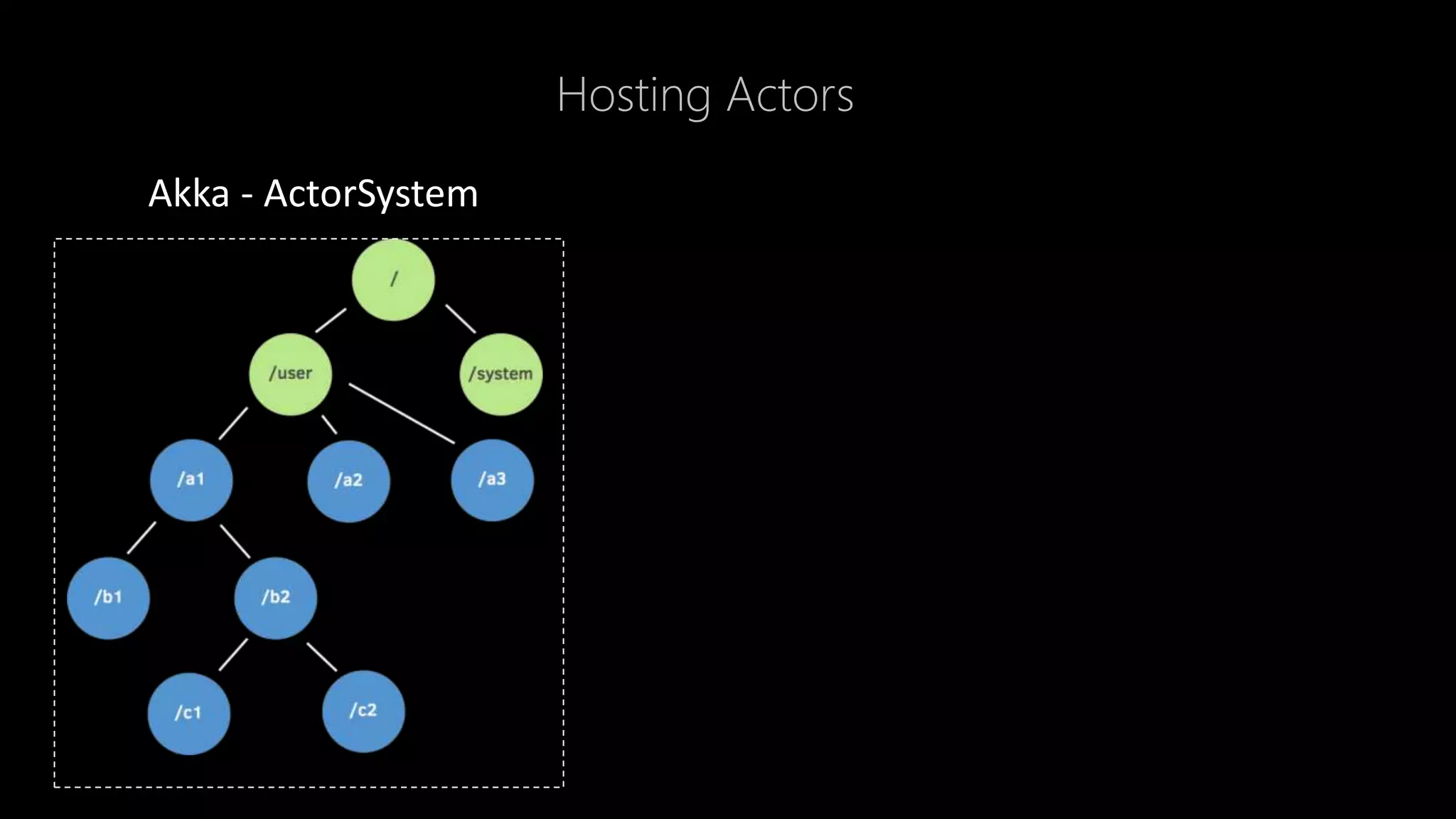
Hosting Actors
Image from Halo Orleans at build 2104
Orleans - SiloAkka - ActorSystem
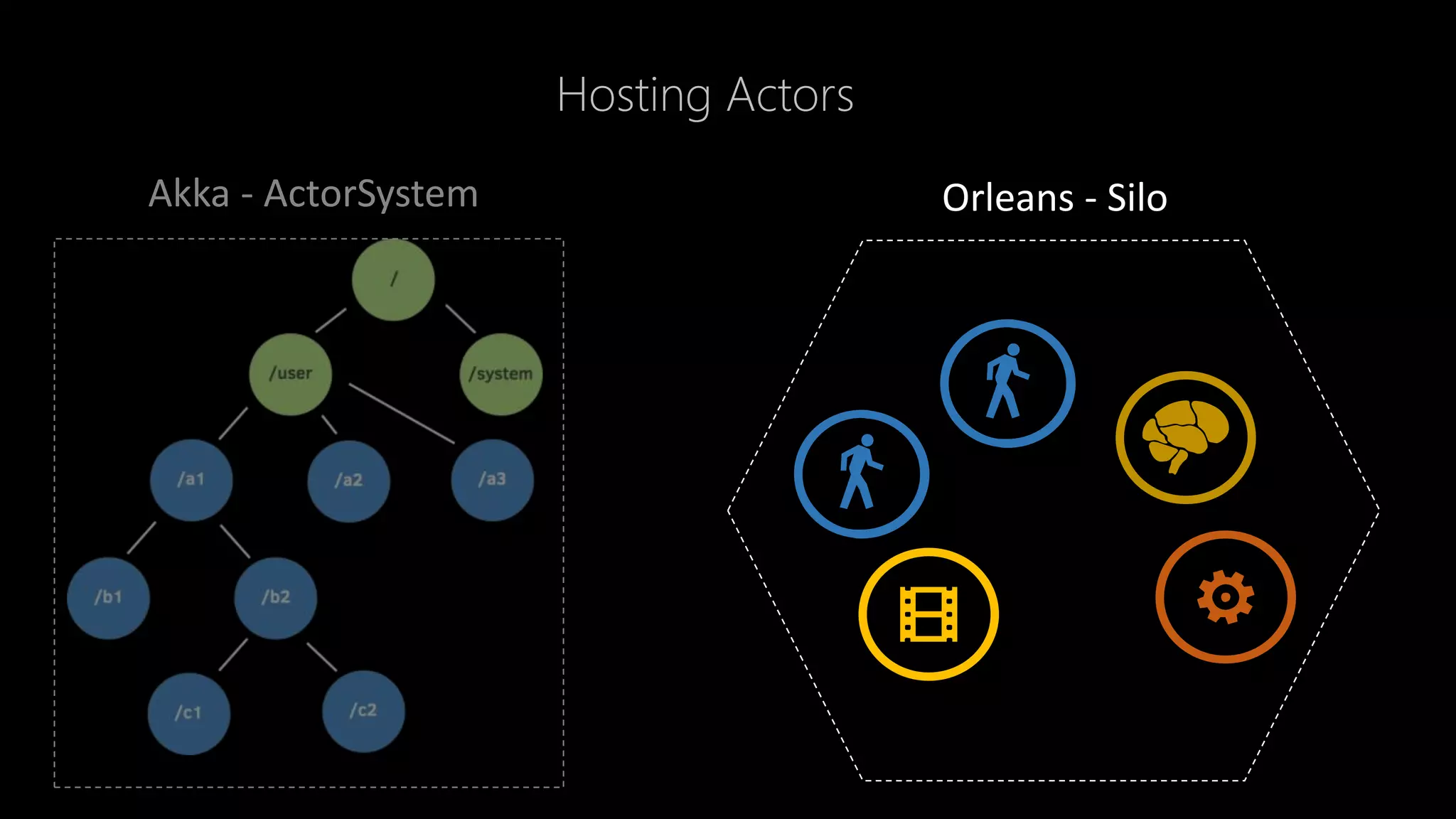
Hosting Actors
Image from Halo Orleans at build 2104
Orleans - SiloAkka - ActorSystem
Actors versus Grains
Orleans: An Actor is Grain
Grain instances always exist virtually
Orleans: An Actor is Grain
Grain instances always exist virtually
Are created on demand
Orleans: An Actor is Grain
Grain instances always exist virtually
Are created on demand
Are location transparent
Orleans: An Actor is Grain
Grain instances always exist virtually
Are created on demand
Are location transparent
Every grain must have an Id
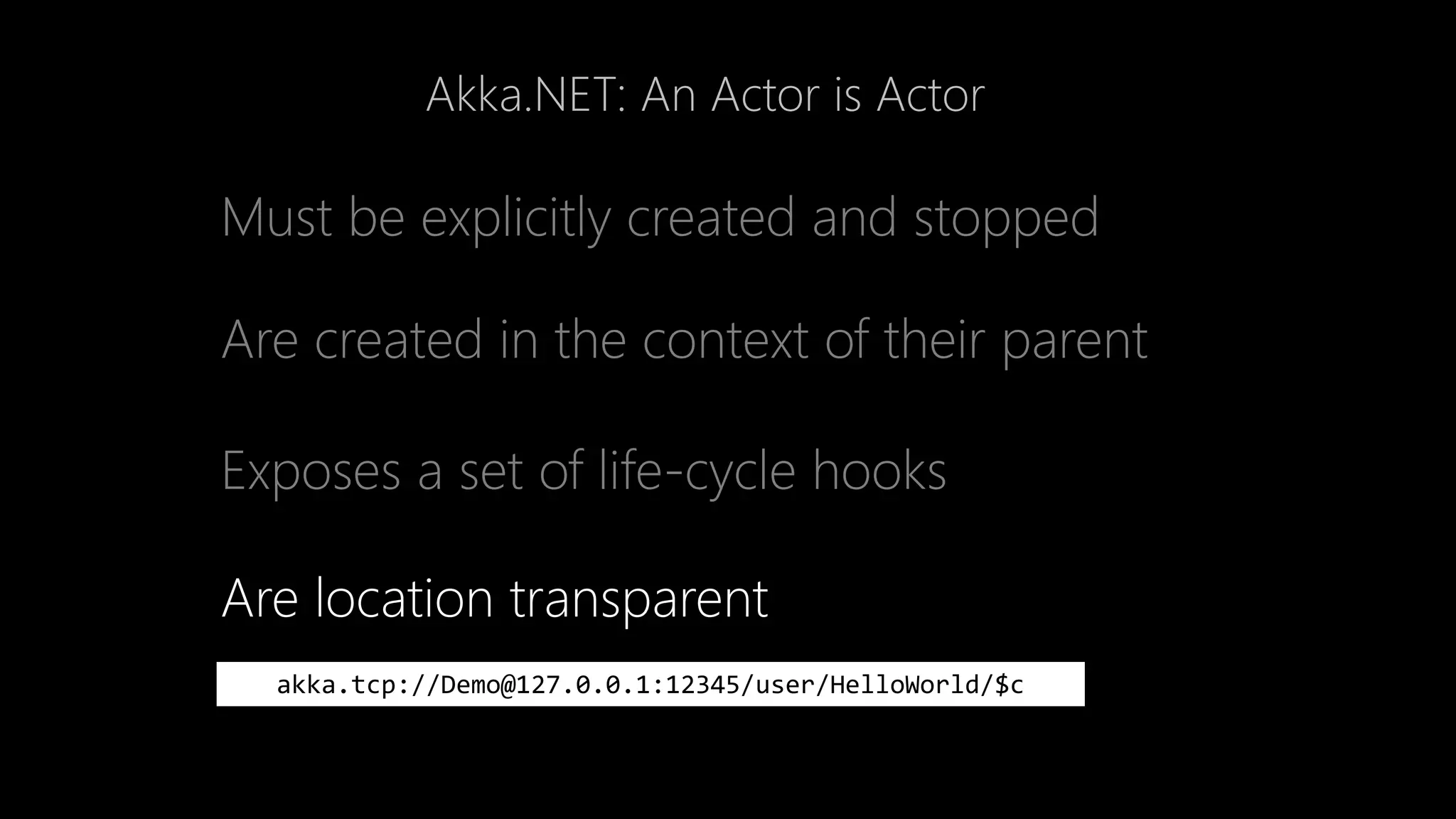
Akka.NET: An Actor is Actor
Must be explicitly created and stopped
Akka.NET: An Actor is Actor
Must be explicitly created and stopped
Are created in the context of their parent
Akka.NET: An Actor is Actor
Must be explicitly created and stopped
Are created in the context of their parent
Exposes a set of life-cycle hooks
Akka.NET: An Actor is Actor
Must be explicitly created and stopped
Are created in the context of their parent
Exposes a set of life-cycle hooks
Are location transparent
akka.tcp://Demo@127.0.0.1:12345/user/HelloWorld/$c
Creating grains and actors
Creating a grain
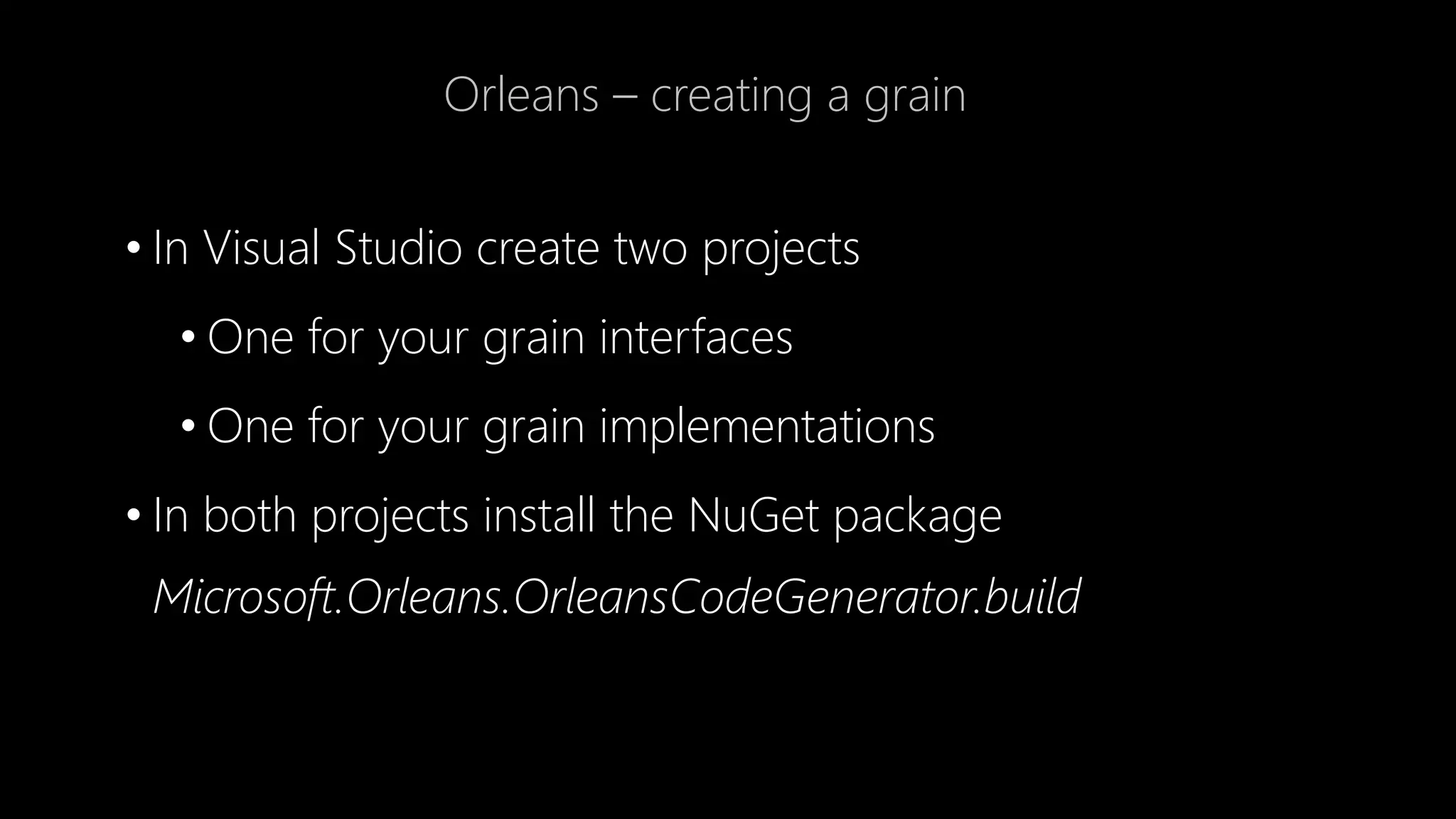
Orleans – creating a grain
• In Visual Studio create two projects
• One for your grain interfaces
• One for your grain implementations
• In both projects install the NuGet package
Microsoft.Orleans.OrleansCodeGenerator.build
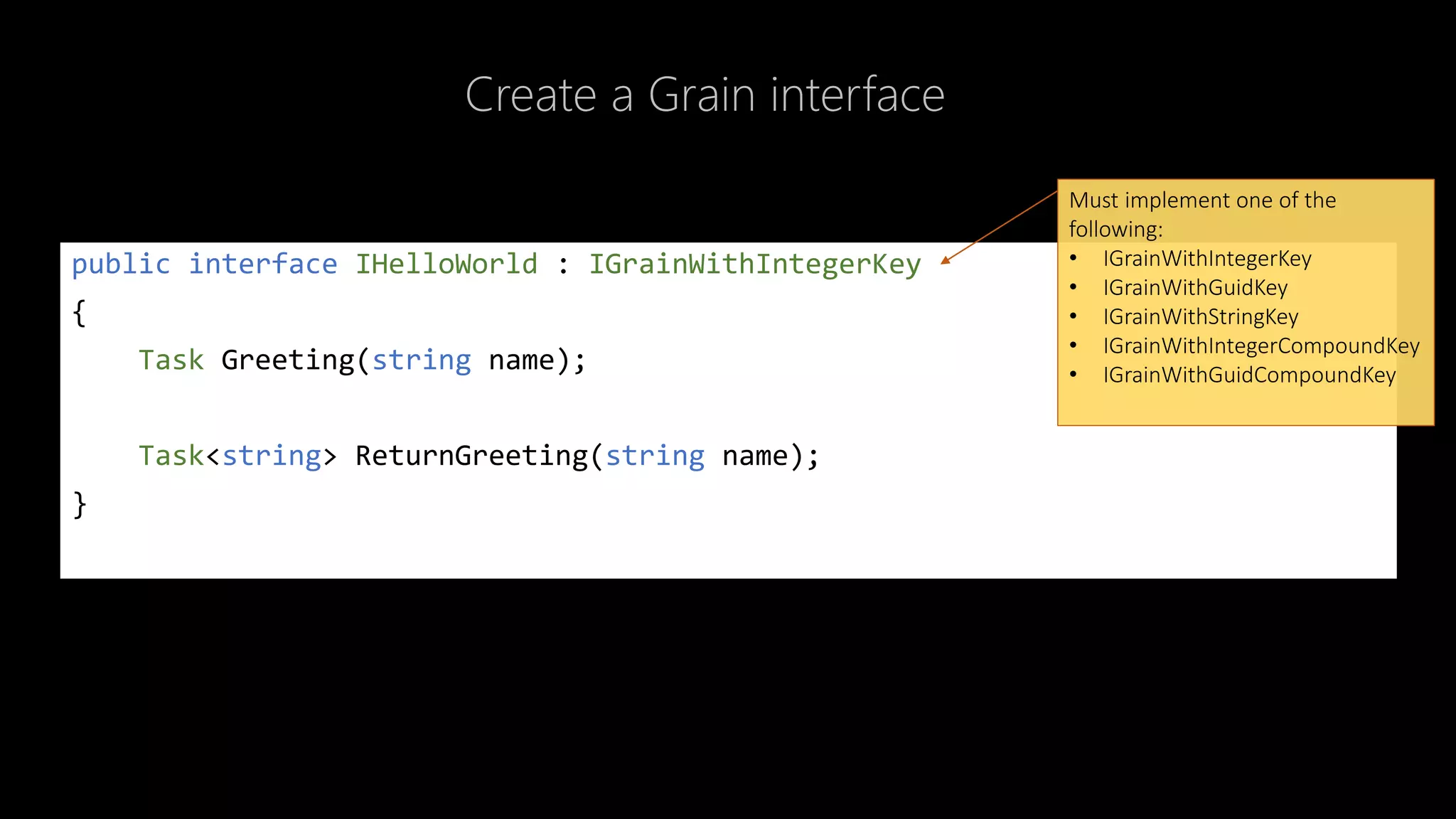
Create a Grain interface
public interface IHelloWorld : IGrainWithIntegerKey
{
Task Greeting(string name);
Task<string> ReturnGreeting(string name);
}
Must implement one of the
following:
• IGrainWithIntegerKey
• IGrainWithGuidKey
• IGrainWithStringKey
• IGrainWithIntegerCompoundKey
• IGrainWithGuidCompoundKey
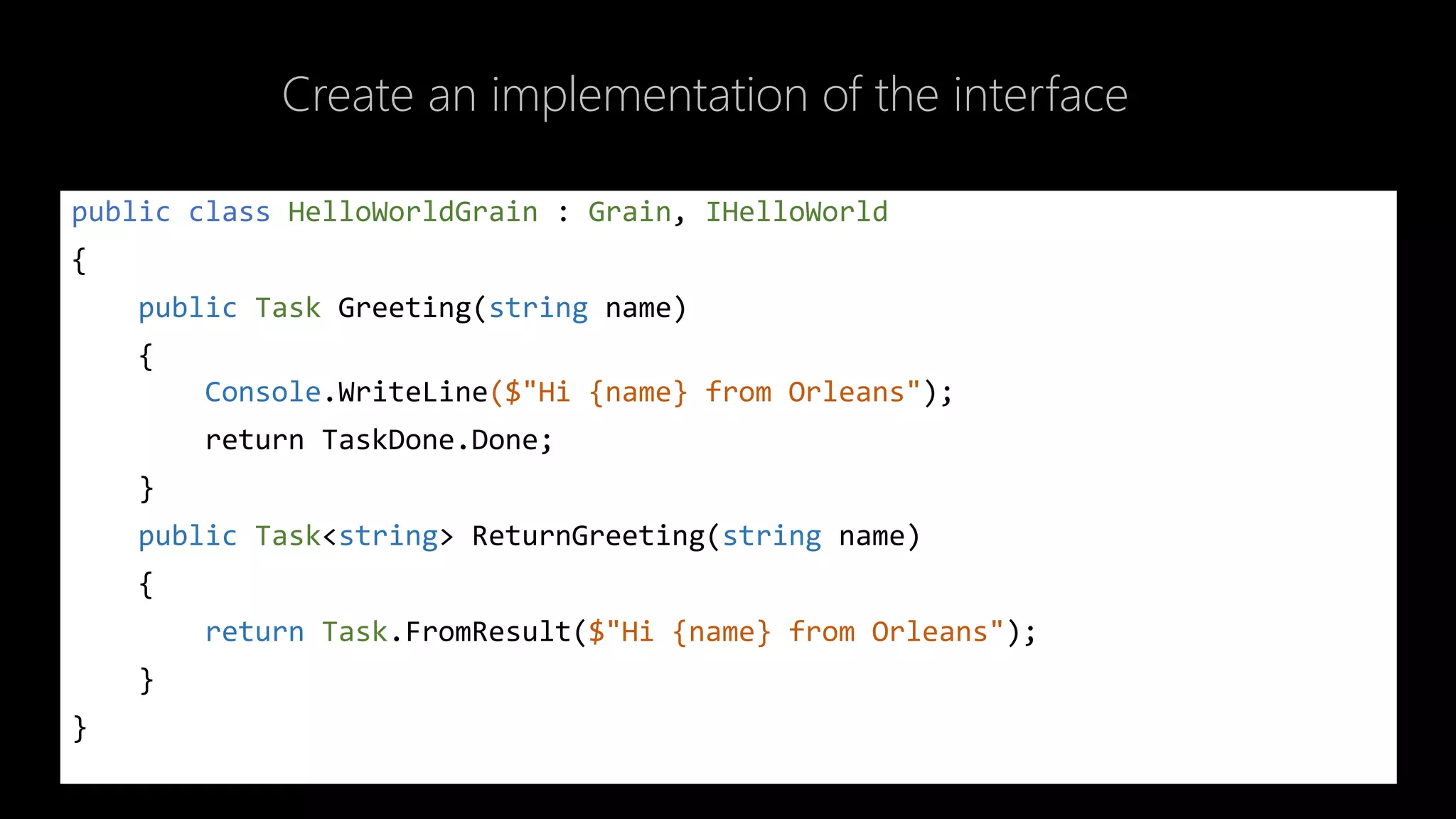
Create an implementation of the interface
public class HelloWorldGrain : Grain, IHelloWorld
{
public Task Greeting(string name)
{
Console.WriteLine($"Hi {name} from Orleans");
return TaskDone.Done;
}
public Task<string> ReturnGreeting(string name)
{
return Task.FromResult($"Hi {name} from Orleans");
}
}
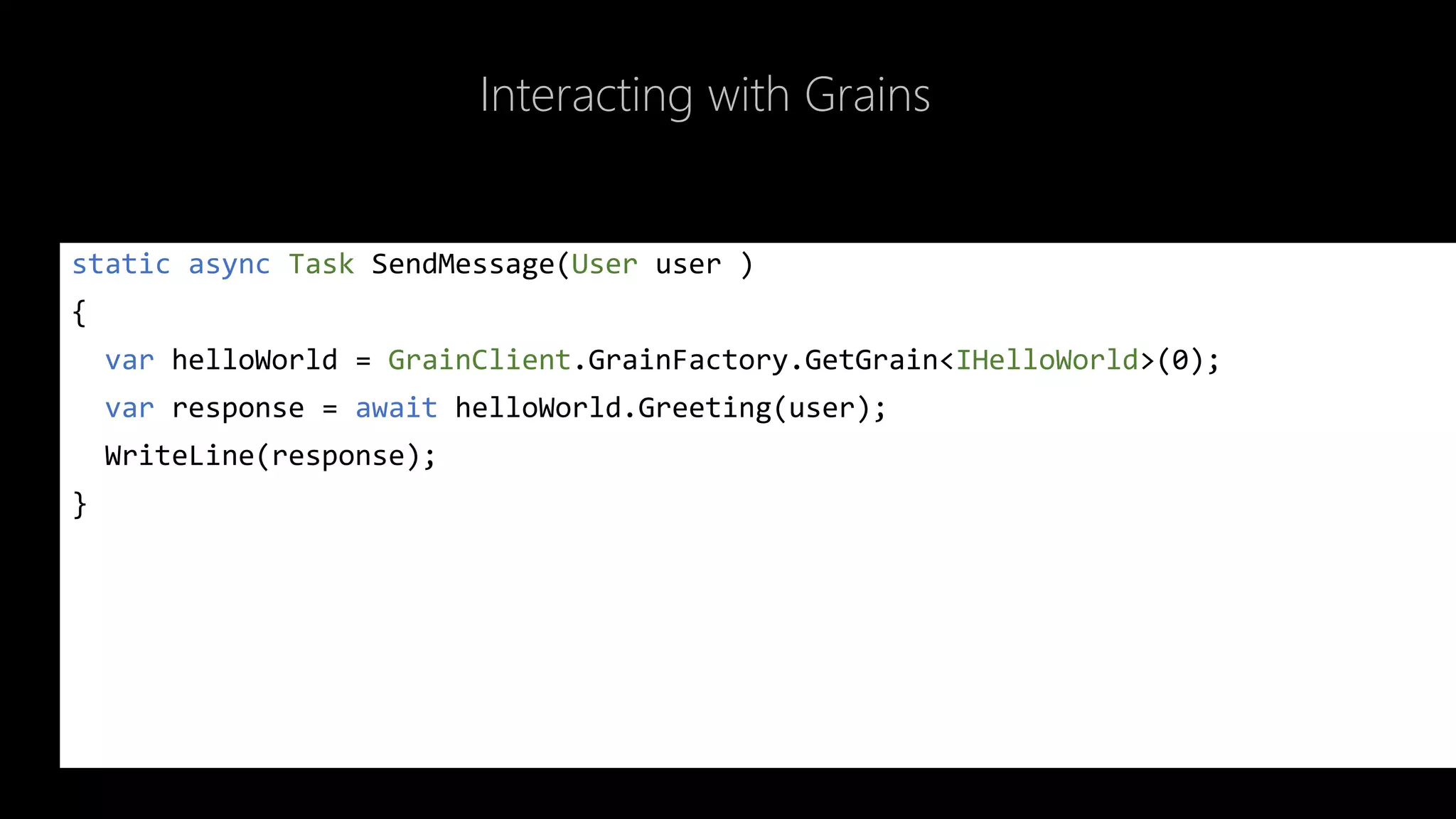
Interacting with Grains
static async Task SendMessage(User user )
{
var helloWorld = GrainClient.GrainFactory.GetGrain<IHelloWorld>(0);
var response = await helloWorld.Greeting(user);
WriteLine(response);
}
Creating an Actor
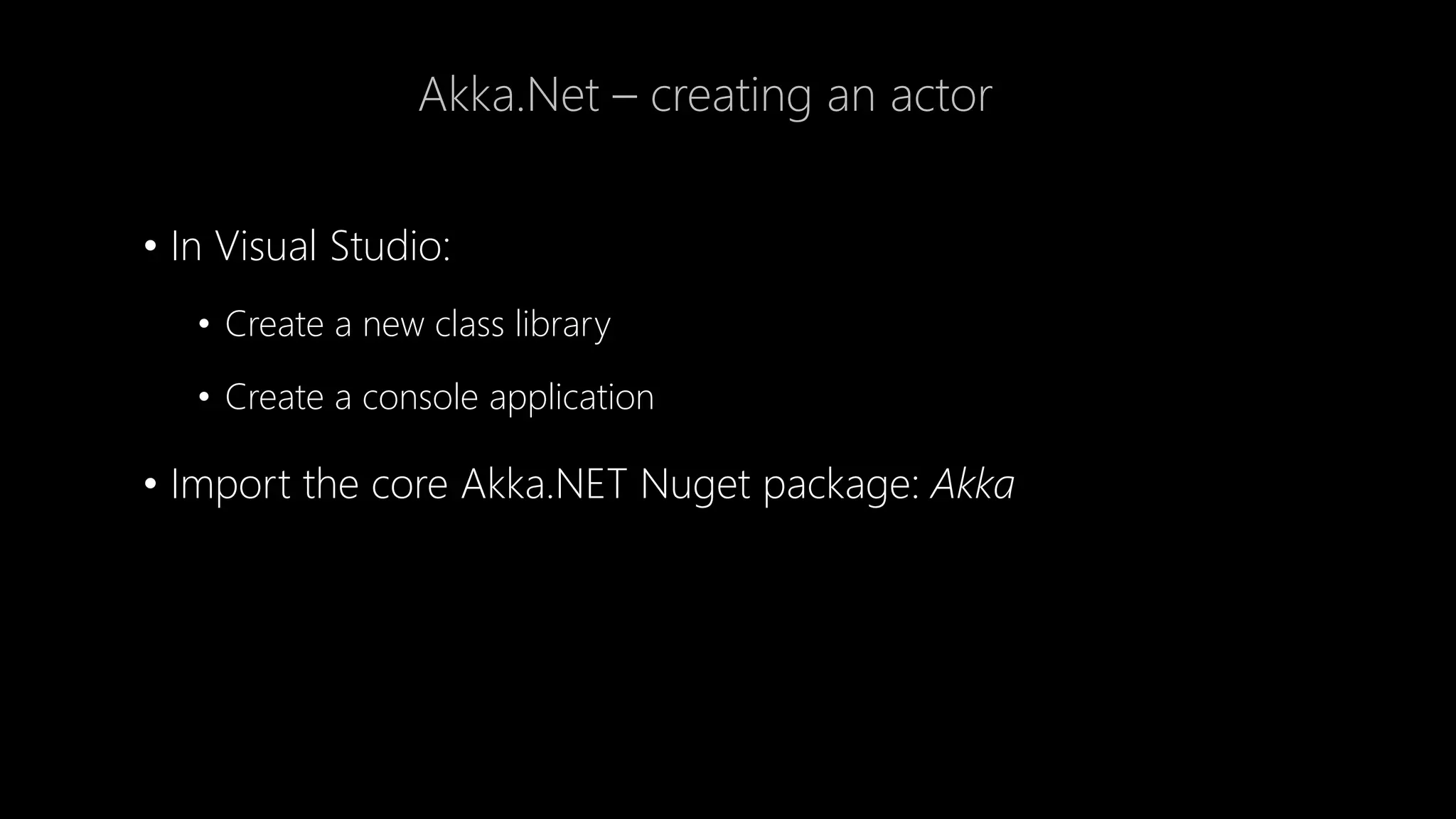
Akka.Net – creating an actor
• In Visual Studio:
• Create a new class library
• Create a console application
• Import the core Akka.NET Nuget package: Akka
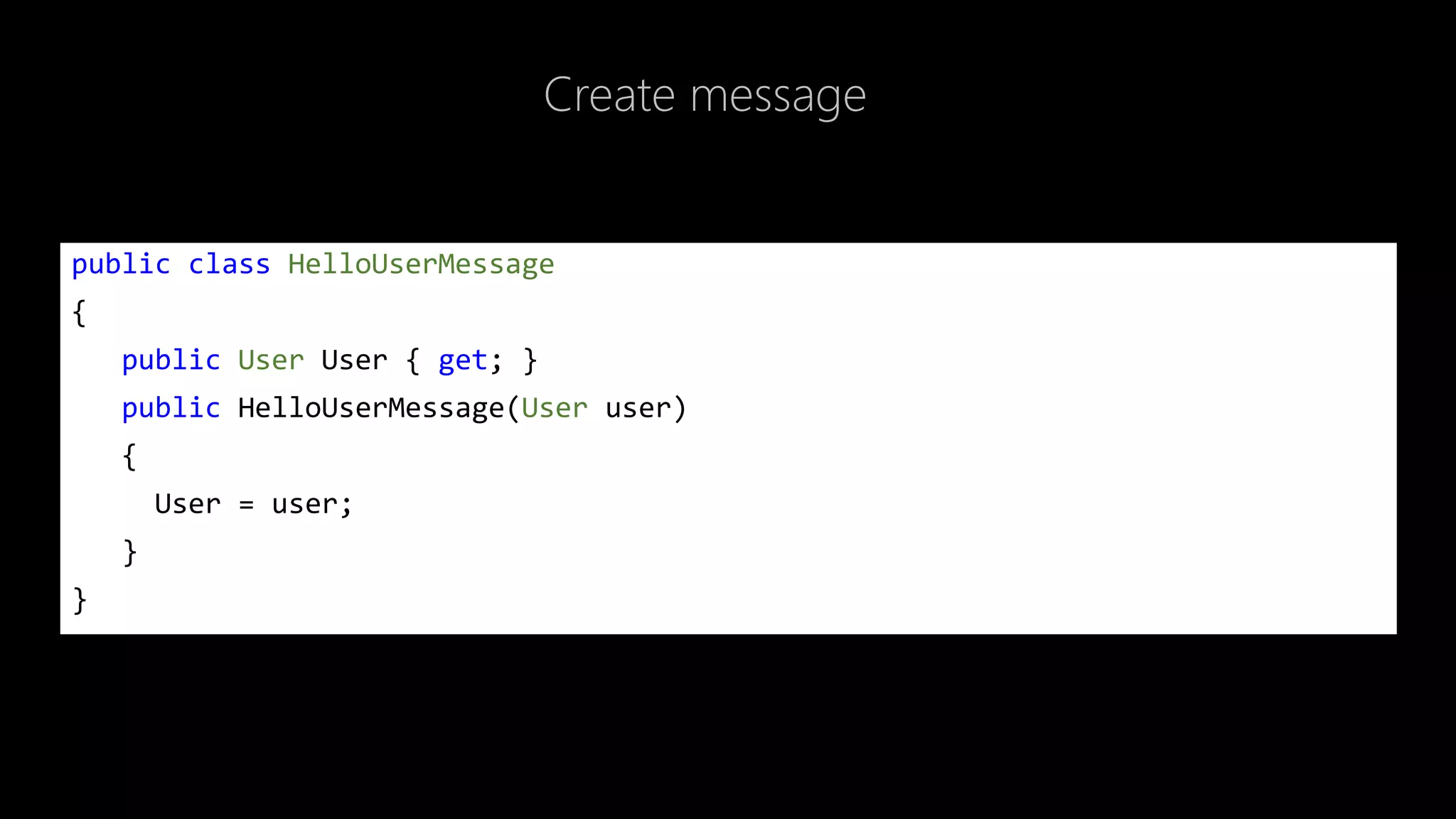
Create message
public class HelloUserMessage
{
public User User { get; }
public HelloUserMessage(User user)
{
User = user;
}
}
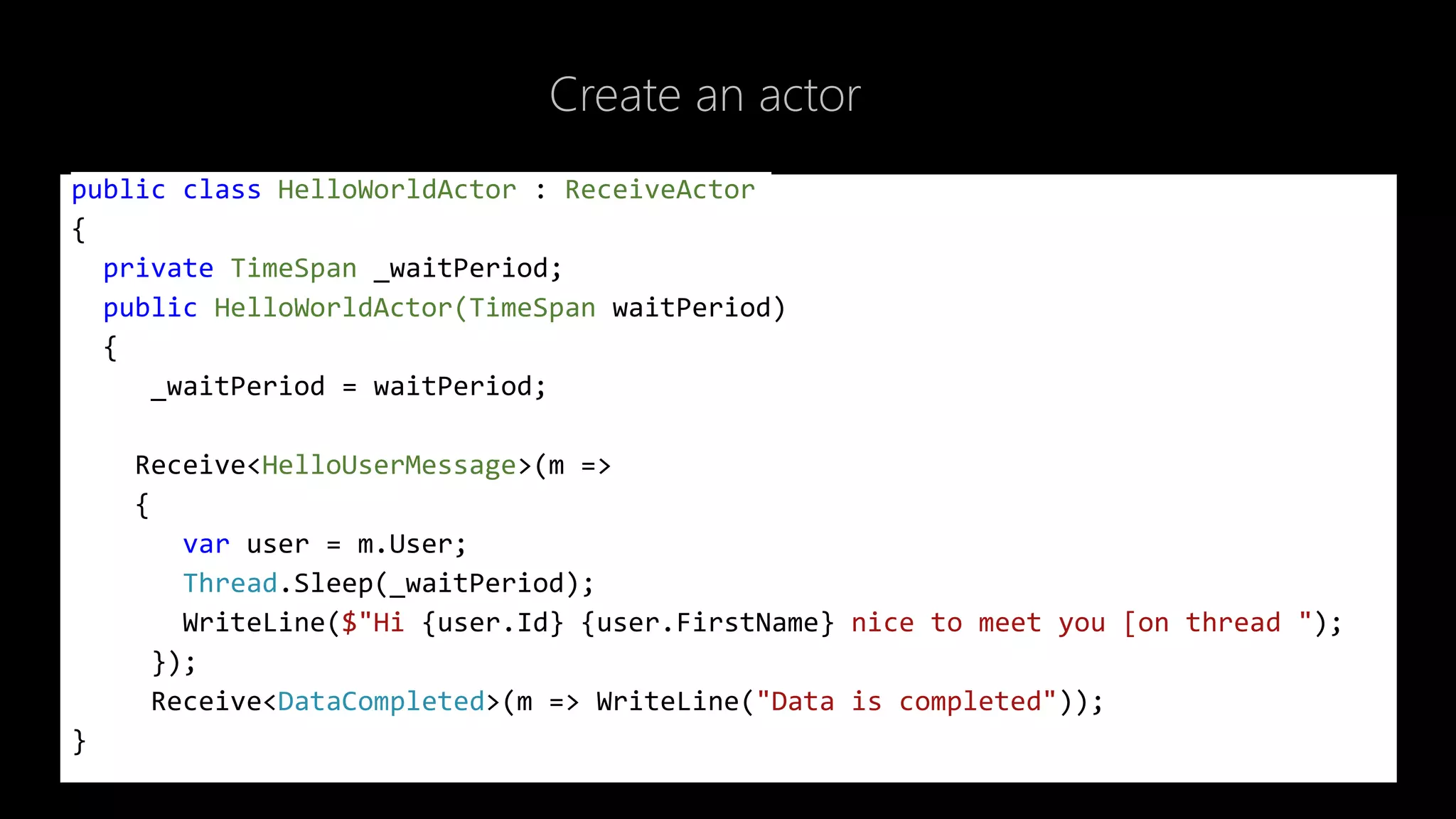
Create an actor
public class HelloWorldActor : ReceiveActor
{
private TimeSpan _waitPeriod;
public HelloWorldActor(TimeSpan waitPeriod)
{
_waitPeriod = waitPeriod;
Receive<HelloUserMessage>(m =>
{
var user = m.User;
Thread.Sleep(_waitPeriod);
WriteLine($"Hi {user.Id} {user.FirstName} nice to meet you [on thread ");
});
Receive<DataCompleted>(m => WriteLine("Data is completed"));
}
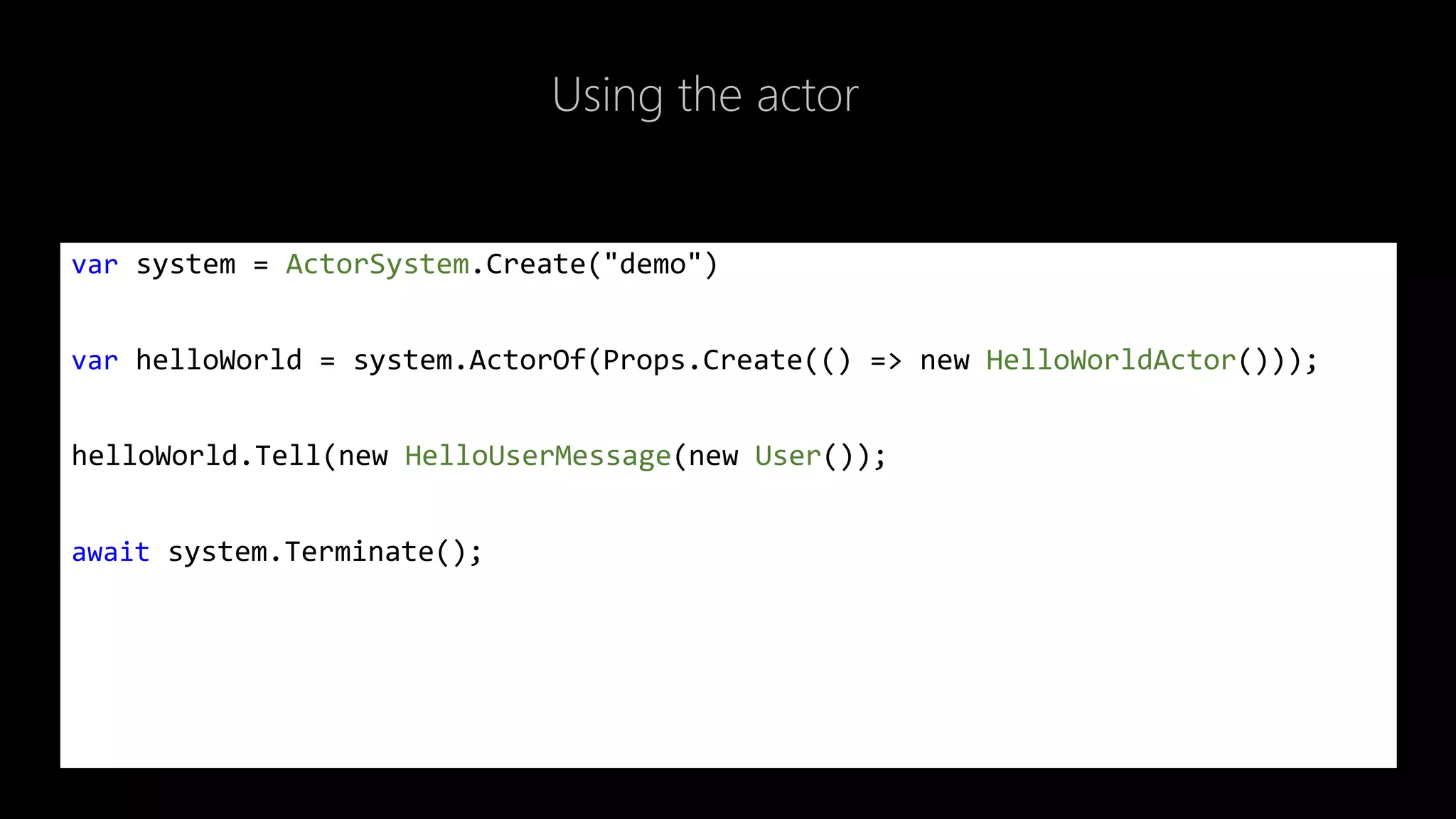
Using the actor
var system = ActorSystem.Create("demo")
var helloWorld = system.ActorOf(Props.Create(() => new HelloWorldActor()));
helloWorld.Tell(new HelloUserMessage(new User());
await system.Terminate();
Demo Hello World
Messages and Serialisation
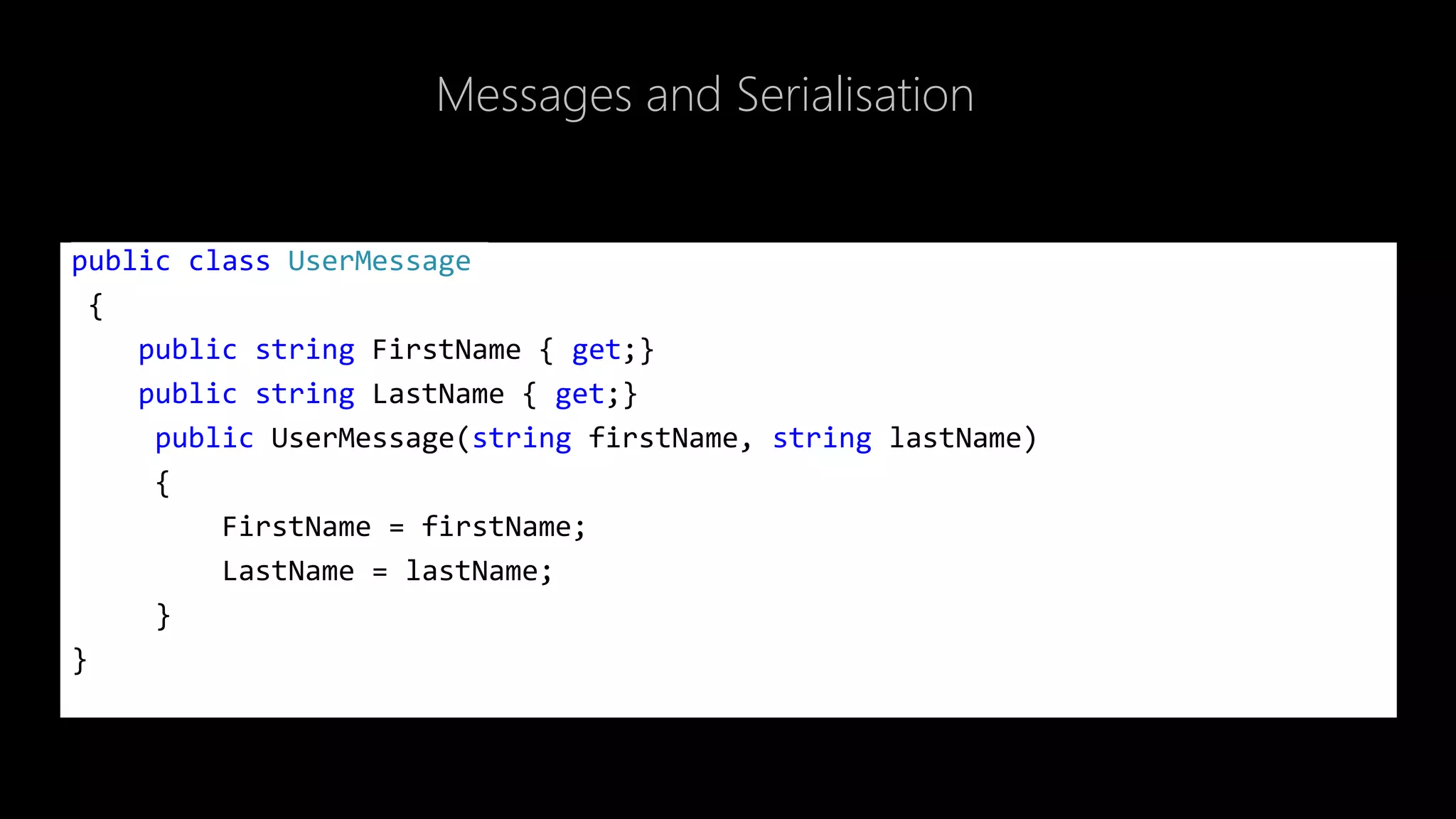
public class UserMessage
{
public string FirstName { get;}
public string LastName { get;}
public UserMessage(string firstName, string lastName)
{
FirstName = firstName;
LastName = lastName;
}
}
Messages and serialisation
Task<string> Greeting(string firstName, string lastName);
Task<Immutable<byte[]>> ProcessRequest(Immutable<byte[]> request);
Messages and Serialisation
[Immutable]
public class User
{
public string FirstName { get;}
public string LastName { get;}
}
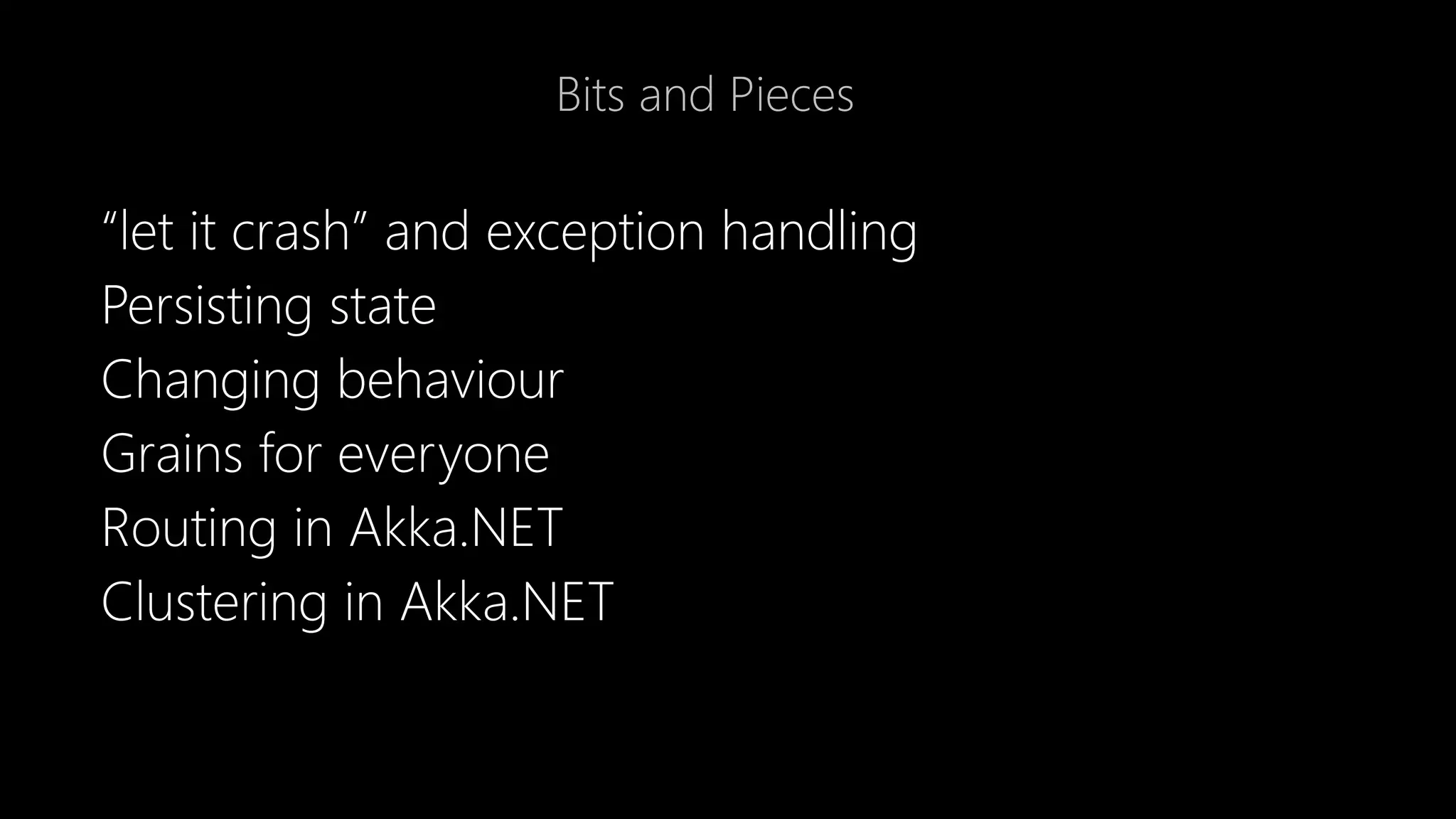
Bits and Pieces
“let it crash” and exception handling
Persisting state
Changing behaviour
Grains for everyone
Routing in Akka.NET
Clustering in Akka.NET
Summing up
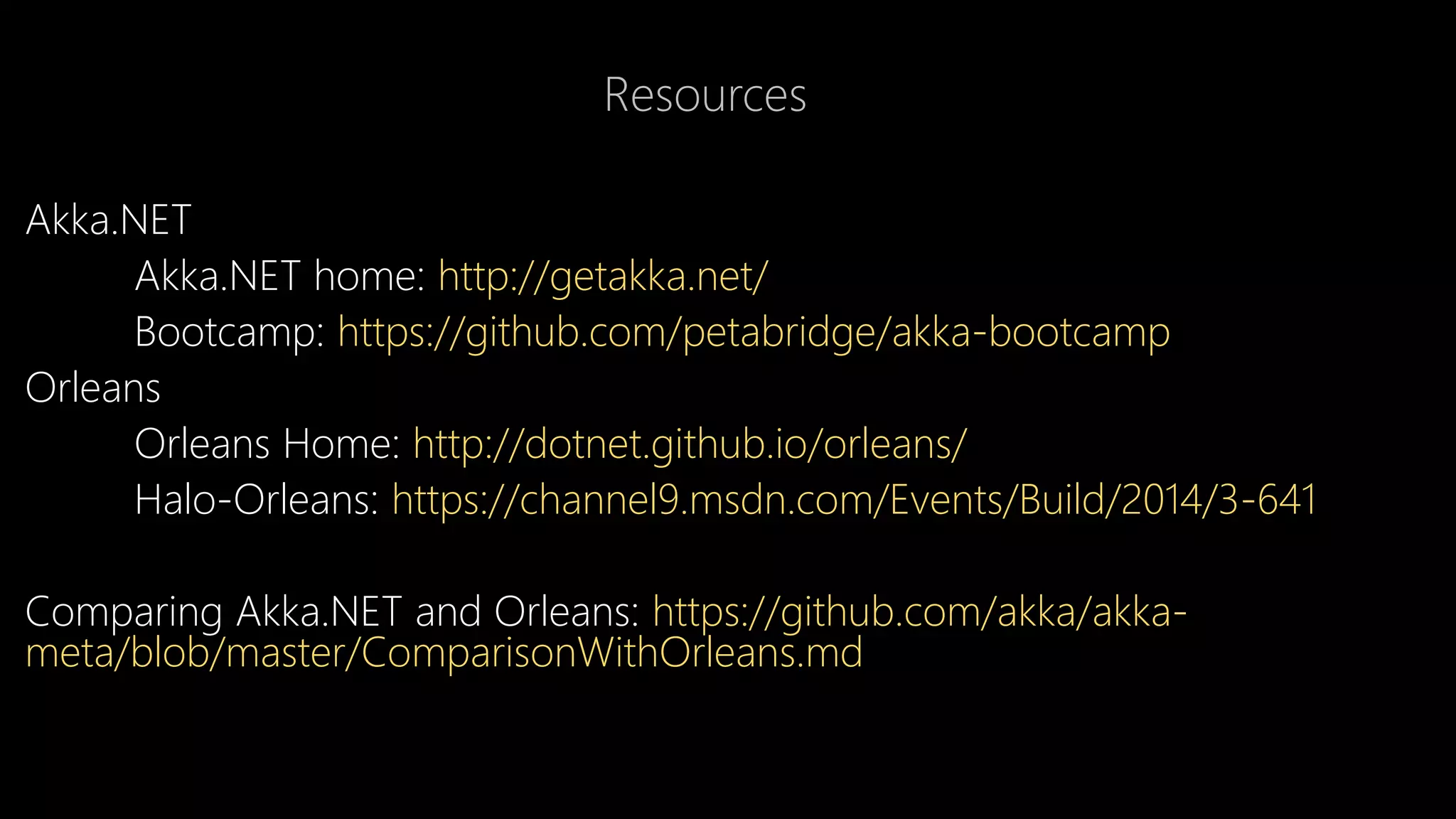
Resources
Akka.NET
Akka.NET home: http://getakka.net/
Bootcamp: https://github.com/petabridge/akka-bootcamp
Orleans
Orleans Home: http://dotnet.github.io/orleans/
Halo-Orleans: https://channel9.msdn.com/Events/Build/2014/3-641
Comparing Akka.NET and Orleans: https://github.com/akka/akka-
meta/blob/master/ComparisonWithOrleans.md

Akka.net versus microsoft orleans

  • 2.
    Actor Model in.NET: Akka.NET vs Microsoft Orleans for the curious William Tulloch Lead Consultant – Readify @wtulloch
  • 3.
  • 4.
    What is theActor Model?
  • 5.
    The Model ofActor Model A way of reasoning about concurrent computation
  • 6.
    What is theActor Model A way of reasoning about concurrent computation Is inherently concurrent
  • 7.
    The Model ofActor Model Is a conceptual model for reasoning about concurrent computation Is inherently concurrent Manages concurrency through message passing
  • 8.
    The Model ofActor Model Is a conceptual model for reasoning about concurrent computation Adopts the philosophy that everything is an actor Is inherently concurrent Manages concurrency through message passing
  • 9.
    What is anActor? Lightweight Never shares state Communicates through asynchronous messages Has a mailbox to buffer messages Processes one message at a time Is a single-thread object
  • 10.
    An Actor Cannot exist on its own
  • 11.
  • 12.
    The overview Akka.NET • Aport of Java/Scala Akka • Open source • Task Parallel Library • Reactive methodology • Can be run within an application, on-prem or in the cloud(?)
  • 13.
    The overview Orleans • Startedby Microsoft Research • Open source • Task Parallel Library • Reactive methodology • Cloud-native Akka.NET • A port of Java/Scala Akka • Open source • Task Parallel Library • Reactive methodology • Can be run within an application, on- prem or in the cloud(?)
  • 14.
  • 15.
    Hosting Actors Image fromHalo Orleans at build 2104 Orleans - SiloAkka - ActorSystem
  • 16.
    Hosting Actors Image fromHalo Orleans at build 2104 Orleans - SiloAkka - ActorSystem
  • 17.
  • 18.
    Orleans: An Actoris Grain Grain instances always exist virtually
  • 19.
    Orleans: An Actoris Grain Grain instances always exist virtually Are created on demand
  • 20.
    Orleans: An Actoris Grain Grain instances always exist virtually Are created on demand Are location transparent
  • 21.
    Orleans: An Actoris Grain Grain instances always exist virtually Are created on demand Are location transparent Every grain must have an Id
  • 22.
    Akka.NET: An Actoris Actor Must be explicitly created and stopped
  • 23.
    Akka.NET: An Actoris Actor Must be explicitly created and stopped Are created in the context of their parent
  • 24.
    Akka.NET: An Actoris Actor Must be explicitly created and stopped Are created in the context of their parent Exposes a set of life-cycle hooks
  • 25.
    Akka.NET: An Actoris Actor Must be explicitly created and stopped Are created in the context of their parent Exposes a set of life-cycle hooks Are location transparent akka.tcp://Demo@127.0.0.1:12345/user/HelloWorld/$c
  • 26.
  • 27.
  • 28.
    Orleans – creatinga grain • In Visual Studio create two projects • One for your grain interfaces • One for your grain implementations • In both projects install the NuGet package Microsoft.Orleans.OrleansCodeGenerator.build
  • 29.
    Create a Graininterface public interface IHelloWorld : IGrainWithIntegerKey { Task Greeting(string name); Task<string> ReturnGreeting(string name); } Must implement one of the following: • IGrainWithIntegerKey • IGrainWithGuidKey • IGrainWithStringKey • IGrainWithIntegerCompoundKey • IGrainWithGuidCompoundKey
  • 30.
    Create an implementationof the interface public class HelloWorldGrain : Grain, IHelloWorld { public Task Greeting(string name) { Console.WriteLine($"Hi {name} from Orleans"); return TaskDone.Done; } public Task<string> ReturnGreeting(string name) { return Task.FromResult($"Hi {name} from Orleans"); } }
  • 31.
    Interacting with Grains staticasync Task SendMessage(User user ) { var helloWorld = GrainClient.GrainFactory.GetGrain<IHelloWorld>(0); var response = await helloWorld.Greeting(user); WriteLine(response); }
  • 32.
  • 33.
    Akka.Net – creatingan actor • In Visual Studio: • Create a new class library • Create a console application • Import the core Akka.NET Nuget package: Akka
  • 34.
    Create message public classHelloUserMessage { public User User { get; } public HelloUserMessage(User user) { User = user; } }
  • 35.
    Create an actor publicclass HelloWorldActor : ReceiveActor { private TimeSpan _waitPeriod; public HelloWorldActor(TimeSpan waitPeriod) { _waitPeriod = waitPeriod; Receive<HelloUserMessage>(m => { var user = m.User; Thread.Sleep(_waitPeriod); WriteLine($"Hi {user.Id} {user.FirstName} nice to meet you [on thread "); }); Receive<DataCompleted>(m => WriteLine("Data is completed")); }
  • 36.
    Using the actor varsystem = ActorSystem.Create("demo") var helloWorld = system.ActorOf(Props.Create(() => new HelloWorldActor())); helloWorld.Tell(new HelloUserMessage(new User()); await system.Terminate();
  • 37.
  • 38.
  • 39.
    Messages and Serialisation publicclass UserMessage { public string FirstName { get;} public string LastName { get;} public UserMessage(string firstName, string lastName) { FirstName = firstName; LastName = lastName; } }
  • 40.
    Messages and serialisation Task<string>Greeting(string firstName, string lastName); Task<Immutable<byte[]>> ProcessRequest(Immutable<byte[]> request);
  • 41.
    Messages and Serialisation [Immutable] publicclass User { public string FirstName { get;} public string LastName { get;} }
  • 42.
    Bits and Pieces “letit crash” and exception handling Persisting state Changing behaviour Grains for everyone Routing in Akka.NET Clustering in Akka.NET
  • 43.
  • 44.
    Resources Akka.NET Akka.NET home: http://getakka.net/ Bootcamp:https://github.com/petabridge/akka-bootcamp Orleans Orleans Home: http://dotnet.github.io/orleans/ Halo-Orleans: https://channel9.msdn.com/Events/Build/2014/3-641 Comparing Akka.NET and Orleans: https://github.com/akka/akka- meta/blob/master/ComparisonWithOrleans.md

Editor's Notes

  • #4 Why has the actor model appeared to suddenly become the flavour of the month? Because multi-threaded concurrency is hard and distributed multi-threaded concurrency is harder again. Shared state Race conditions lock and deadlocks hard to understand and maintain not easily distributed. In the .NET ecosystem the three best known frameworks that in one form or another implement the actor model are service fabric, akka.net and Microsoft Orleans. It is these last two that we are looking at today. In this talk we really only to skim the surface of either of these frame works
  • #5 First proposed by Hewitt, Bishop and Steiger in 1973 as a mathematical theory of computation.
  • #9  Another key feature of the actor model is the concept of distribution. Given an actor is a single unit of code with a mailbox and an internal state, whether that actor running locally or on a remote node is irrelevant to the sender. As long as the message gets there what does it matter?
  • #10 An Actor is a primitive unit of computation <click slides> In addition to characteristics an actor Can create other actors Can send messages to other actors Can change its behaviour to determine what to do with the next message Another key feature of the actor model is the concept of distribution. Given an actor is a single unit of code with a mailbox and an internal state, whether that actor running locally or on a remote node is irrelevant to the sender. As long as the message gets there what does it matter?
  • #12 “One actor is no actor, they come in sys­tems, and they have to have addresses so that one actor can send mes­sages to another actor.” – Carl Hewitt
  • #13 Having got the preliminaries out of the way time to dig into Orleans and Akka.net And have a look at how they both compare with each other and how they have approached implementing the Actor Model.
  • #15 So as you can see there is at least on the surface some similarities but in many ways that is where it ends. To paraphrase from Dr. Roland Kuhn's article comparing Orleans and Akka actors; with Orleans the primary focus is to simplify distributed computing so that non-experts can write efficient, scalable and reliable distributed services. Akka on the other hand is toolkit for creating distributed systems offering full control over the domain but also exposing its inherent complexity. In other words Orleans provides a relatively low entry point into the actor model paradigm for developers from an OO background whereas Akka.net requires you rethink your approach to programing.
  • #17 Akka uses a supervisor hierarchy
  • #18 Silos are more like a commune where actors exist as independent think of it like a bucket of actors
  • #19 an actor is a logical unit of computation and in terms of the key characteristics that make up an actor, lightweight, single threaded, no shared state, etc. Orleans and Akka.NET are pretty much on par but after that their respective implementations are radically diverge reflecting the differences in their design philosophy.
  • #20 In Orleans what we have been referring to as an actor is Grain. This difference in terminology reflects the difference in how The Developers of Orleans have approached the problem. A grain is also referred to as a virtual actor as it may or not exist it any point in time. Within Orleans if a grain has been idle for a period of time it will be garbage collected to free up memory. In terms of lifecycle grains are either activated or deactivated, They can never be programmatically started or stopped.
  • #26 Such as: PreStart PostStop PreRestart PostRestart
  • #41 In Akka.NET Actors explicitly communicate via messages. And by convention should be immutable (though this is currently not enforced)
  • #42 In Orleans the existence of a message is not so obvious and I have to admit this bothers me a little. When a grain method is invoked, the Orleans runtime makes a deep copy of the method arguments and forms the request out of the copies. This protects against the calling code modifying the argument objects before the data is passed to the called grain. The Orleans.Concurrency.Immutable wrapper class
  • #45 When I first