Executive Summary
• Global trade is based on an estimated €16 trillion supply chain sector.
• Goods are produced and distributed through a vast network of
producers, retailers, distributors, transporters and suppliers in a complex
arrangement of processes for managing contracts, payments, labelling,
sealing, logistics, anti-counterfeit and anti-fraud.
Current Situation
• The scale and complexity of the systems involved leads to high
transactional costs, frequent mismatches and errors in manual
paperwork, as well as losses through degradation and theft along the
way.
• Other issues include abusive or unsafe working conditions;
environmental damage through inefficacies, illegal extraction and
production processes; forgery and imitation and health risks through
poor supply chain management.
• Actual processes remain costly and unreliable, especially in regions with
high levels of corruption.
Call for a new SCM
There is a growing call for safer, more trustworthy and transparent
supply chains of goods and services.
The main question…
Blockchain technology can really improve today's supply chains and
logistics sector to respond to operational inefficiencies, fraud and perhaps
even some 'grand challenges' such as unethical labour practices and
environmental degradation?
Let us restate the definition
Blockchain technology is fundamentally
about adding trust to an untrusted
environment and exploiting a distributed
ledger mechanism, supported by the
majority of nodes, in a peer-to-peer
network in order to create an authoritative
record of significant events
From a business point of view a blockchain
can be defined as a platform whereby peers
can exchange values using transactions
without the need for a central trusted
arbitrator
19
Gartner Document
Note: Value creation bucketed into Cost takeout, Risk management savings, Innovation. Value and TAM calculated by Keystone Strategy using bottoms up business process mapping and cost allocation. Not all industries are expected to adopt blockchain immediately;
some (Finance and Insurance) are expected to start adopting in 1-2 years, others (IoT, Healthcare, Supply Chain) to start adopting in 7-10 years). According to EY FinSec would see full adoption in 3-5 years with IoT, Health, Supply Chain to follow full adoption shortly
there after. Technology TAM estimated at 10-20% of value. US numbers only. More aggressive case than MSFT POV.
Source: Keystone Strategy Research
Early adopters Later adopters
Business Value created due to Blockchain
$B USD Early adopters Later adopters
Total Addressable Market for Technology
$B USD
High case
Low case$50
Blockchain can drive over $500B in Business Value and
$50-100B in Technology total addressable market by 2026
Challenges hindering mainstream adoption of Blockchain
Co-operation & Establishing Standards
• In order to gain widespread adoption, standards need to be agreed between
participants that create a common set of protocols for individual firms to adopt.
This is challenging given the number of participants that need to come to
agreement
• For some markets “Critical mass” will be achieved by a smaller group that will then
work together and create de-facto standards
Regulatory Framework
• Regulators will focus on how blockchain achieves outcomes
that align with regulatory concerns (e.g. AML/KYC,
Resilience, Recovery and Resolution)
• Specific local regulations such as specific Asian data Secrecy
requirements will need to be met
• Negative connotations associated with bitcoin impact on
regulator’s perceptions
Scalability & Resilience
• Bitcoin’s transaction capacity (~3 transactions per
second) precludes mainstream capital markets
adoption
• Regulators concerns around operational resilience will
need to be satisfied
Legal Framework
• To trade significant values of assets firms need to ensure that they
can perfect legal title to the underlying asset recorded by the
tokenised asset in the distributed ledger
• An identified challenges is achieving a uniform legal framework
across a distributed set of peer parties with no centralised authority
Settling value in “real money”
• Any mainstream application will need settlement certainty in
real money
• Tokenized solutions pose an added layer of settlement and
counterparty risk that will not be acceptable
Legal and regulatory, rather than technology are primary barriers for blockchain adoption
Blockchain in Supply Chain
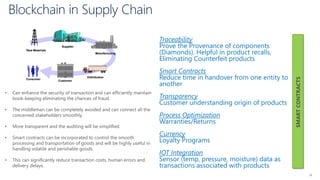
Traceability
Prove the Provenance of components
(Diamonds). Helpful in product recalls,
Eliminating Counterfeit products
Smart Contracts
Reduce time in handover from one entity to
another
Transparency
Customer understanding origin of products
Process Optimization
Warranties/Returns
Currency
Loyalty Programs
IOT Integration
Sensor (temp, pressure, moisture) data as
transactions associated with products
26
SMARTCONTRACTS
• Can enhance the security of transaction and can efficiently maintain
book-keeping eliminating the chances of fraud.
• The middleman can be completely avoided and can connect all the
concerned stakeholders smoothly.
• More transparent and the auditing will be simplified.
• Smart contracts can be incorporated to control the smooth
processing and transportation of goods and will be highly useful in
handling volatile and perishable goods.
• This can significantly reduce transaction costs, human errors and
delivery delays.
Blockchain in Supply Chain
• Mechanism for attaching information to
the product in a way that is visible to the
customer
• Discerning consumers and retailers would
like to know when and where the fish was
caught, and whether environmentally
friendly fishing methods were used.
• They would also be interested to learn what
ingredients were introduced during
processing, whether there was a risk of
tampering, whether the product was
handled and stored properly, and where any
"value-added" changes occurred.
27
How…
• Blockchain-based applications have the potential to improve supply
chains by providing infrastructure for registering, certifying and
tracking at a low cost goods being transferred between often distant
parties, who are connected via a supply chain but do not necessarily
trust each other.
• All goods are uniquely identified via 'tokens' and can then be
transferred via the blockchain, with each transaction verified and time-
stamped in an encrypted but transparent process.
• Smart contracts could also be deployed to automatically execute
payments and other procedures.
How…
Potential impacts and development
Several companies are already testing blockchain for record-keeping in
their supply chains… let’s see …
Mojix
• Mojix lets retailers automate their supply chains to enable smart
contracts, making the delivery of goods more reliable with less
overhead.
• The solution developed by Mojix allows for Blockchain-based smart
contracts between retailers, suppliers and logistics providers.
Everledger
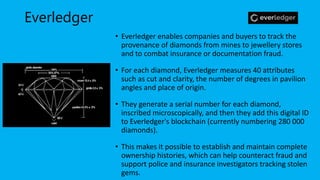
• Everledger enables companies and buyers to track the
provenance of diamonds from mines to jewellery stores
and to combat insurance or documentation fraud.
• For each diamond, Everledger measures 40 attributes
such as cut and clarity, the number of degrees in pavilion
angles and place of origin.
• They generate a serial number for each diamond,
inscribed microscopically, and then they add this digital ID
to Everledger's blockchain (currently numbering 280 000
diamonds).
• This makes it possible to establish and maintain complete
ownership histories, which can help counteract fraud and
support police and insurance investigators tracking stolen
gems.
Provenance
• Provenance has developed a real-time data platform that gathers and
verifies the origin of an asset by assigning it a token or 'digital
passport' that can be tracked.
• Provenance gives you the tools you need to create living histories for
any product.
SkuChain (formally ThingChain)
• Skuchain applies the cryptographic principles developed in the Bitcoin
network to security and visibility for the global supply chain.
• Skuchain is building a system of next generation identifiers in the
form of both barcodes and RFID tags to digitally secure the transfer of
goods across the entire global economy.
• While most anti counterfeiting systems rely on copy restistant labels,
holograms etc., skuchain relies on the uncopyable nature of a
blockchain ledger to solve the problem of supply chain integrity
Skuchain's system will provide cryptographic proof of each SKU's
origin, supply chain than can be verified all the way to the point of
consumption.
CargoChain
• CargoChain digitizes international trade by creating a secure, eternal
record of important trade documents on the Blockchain and
establishes ‘smarter’ contractual relationships between trade parties.
International
GateChain
• Gatechain redefines the trade finance industry with blockchain
technology. Gatechain offers electronic documents/ smart contract
and payment obligations in a faster, easier, leaner and more secure
way.
Hijro (formally Fluent)
• Hijro is the financial operating network for global trade powered by
distributed ledger technology.
Modum
• Modum.io creates sensor devices leveraging blockchain technology to
assert data immutability and public accessibility while saving costs in
the pharma supply chain.
• Our product monitors the temperature of each parcel during the
shipment to fully ensure GDP regulations.
• All data is transferred to the blockchain where a smart contract
assesses against the product attributes.
• A solution on the Swiss market in June 2016 with 95% success rate
and great feedback.
Blockchain supply chains v0.4

Blockchain supply chains v0.4

  • 3.
    Executive Summary • Globaltrade is based on an estimated €16 trillion supply chain sector. • Goods are produced and distributed through a vast network of producers, retailers, distributors, transporters and suppliers in a complex arrangement of processes for managing contracts, payments, labelling, sealing, logistics, anti-counterfeit and anti-fraud.
  • 4.
    Current Situation • Thescale and complexity of the systems involved leads to high transactional costs, frequent mismatches and errors in manual paperwork, as well as losses through degradation and theft along the way. • Other issues include abusive or unsafe working conditions; environmental damage through inefficacies, illegal extraction and production processes; forgery and imitation and health risks through poor supply chain management. • Actual processes remain costly and unreliable, especially in regions with high levels of corruption.
  • 5.
    Call for anew SCM There is a growing call for safer, more trustworthy and transparent supply chains of goods and services.
  • 8.
    The main question… Blockchaintechnology can really improve today's supply chains and logistics sector to respond to operational inefficiencies, fraud and perhaps even some 'grand challenges' such as unethical labour practices and environmental degradation?
  • 10.
    Let us restatethe definition Blockchain technology is fundamentally about adding trust to an untrusted environment and exploiting a distributed ledger mechanism, supported by the majority of nodes, in a peer-to-peer network in order to create an authoritative record of significant events From a business point of view a blockchain can be defined as a platform whereby peers can exchange values using transactions without the need for a central trusted arbitrator 19 Gartner Document
  • 11.
    Note: Value creationbucketed into Cost takeout, Risk management savings, Innovation. Value and TAM calculated by Keystone Strategy using bottoms up business process mapping and cost allocation. Not all industries are expected to adopt blockchain immediately; some (Finance and Insurance) are expected to start adopting in 1-2 years, others (IoT, Healthcare, Supply Chain) to start adopting in 7-10 years). According to EY FinSec would see full adoption in 3-5 years with IoT, Health, Supply Chain to follow full adoption shortly there after. Technology TAM estimated at 10-20% of value. US numbers only. More aggressive case than MSFT POV. Source: Keystone Strategy Research Early adopters Later adopters Business Value created due to Blockchain $B USD Early adopters Later adopters Total Addressable Market for Technology $B USD High case Low case$50 Blockchain can drive over $500B in Business Value and $50-100B in Technology total addressable market by 2026
  • 12.
    Challenges hindering mainstreamadoption of Blockchain Co-operation & Establishing Standards • In order to gain widespread adoption, standards need to be agreed between participants that create a common set of protocols for individual firms to adopt. This is challenging given the number of participants that need to come to agreement • For some markets “Critical mass” will be achieved by a smaller group that will then work together and create de-facto standards Regulatory Framework • Regulators will focus on how blockchain achieves outcomes that align with regulatory concerns (e.g. AML/KYC, Resilience, Recovery and Resolution) • Specific local regulations such as specific Asian data Secrecy requirements will need to be met • Negative connotations associated with bitcoin impact on regulator’s perceptions Scalability & Resilience • Bitcoin’s transaction capacity (~3 transactions per second) precludes mainstream capital markets adoption • Regulators concerns around operational resilience will need to be satisfied Legal Framework • To trade significant values of assets firms need to ensure that they can perfect legal title to the underlying asset recorded by the tokenised asset in the distributed ledger • An identified challenges is achieving a uniform legal framework across a distributed set of peer parties with no centralised authority Settling value in “real money” • Any mainstream application will need settlement certainty in real money • Tokenized solutions pose an added layer of settlement and counterparty risk that will not be acceptable Legal and regulatory, rather than technology are primary barriers for blockchain adoption
  • 14.
    Blockchain in SupplyChain Traceability Prove the Provenance of components (Diamonds). Helpful in product recalls, Eliminating Counterfeit products Smart Contracts Reduce time in handover from one entity to another Transparency Customer understanding origin of products Process Optimization Warranties/Returns Currency Loyalty Programs IOT Integration Sensor (temp, pressure, moisture) data as transactions associated with products 26 SMARTCONTRACTS • Can enhance the security of transaction and can efficiently maintain book-keeping eliminating the chances of fraud. • The middleman can be completely avoided and can connect all the concerned stakeholders smoothly. • More transparent and the auditing will be simplified. • Smart contracts can be incorporated to control the smooth processing and transportation of goods and will be highly useful in handling volatile and perishable goods. • This can significantly reduce transaction costs, human errors and delivery delays.
  • 15.
    Blockchain in SupplyChain • Mechanism for attaching information to the product in a way that is visible to the customer • Discerning consumers and retailers would like to know when and where the fish was caught, and whether environmentally friendly fishing methods were used. • They would also be interested to learn what ingredients were introduced during processing, whether there was a risk of tampering, whether the product was handled and stored properly, and where any "value-added" changes occurred. 27
  • 17.
    How… • Blockchain-based applicationshave the potential to improve supply chains by providing infrastructure for registering, certifying and tracking at a low cost goods being transferred between often distant parties, who are connected via a supply chain but do not necessarily trust each other. • All goods are uniquely identified via 'tokens' and can then be transferred via the blockchain, with each transaction verified and time- stamped in an encrypted but transparent process. • Smart contracts could also be deployed to automatically execute payments and other procedures.
  • 18.
  • 20.
    Potential impacts anddevelopment Several companies are already testing blockchain for record-keeping in their supply chains… let’s see …
  • 21.
    Mojix • Mojix letsretailers automate their supply chains to enable smart contracts, making the delivery of goods more reliable with less overhead. • The solution developed by Mojix allows for Blockchain-based smart contracts between retailers, suppliers and logistics providers.
  • 22.
    Everledger • Everledger enablescompanies and buyers to track the provenance of diamonds from mines to jewellery stores and to combat insurance or documentation fraud. • For each diamond, Everledger measures 40 attributes such as cut and clarity, the number of degrees in pavilion angles and place of origin. • They generate a serial number for each diamond, inscribed microscopically, and then they add this digital ID to Everledger's blockchain (currently numbering 280 000 diamonds). • This makes it possible to establish and maintain complete ownership histories, which can help counteract fraud and support police and insurance investigators tracking stolen gems.
  • 23.
    Provenance • Provenance hasdeveloped a real-time data platform that gathers and verifies the origin of an asset by assigning it a token or 'digital passport' that can be tracked. • Provenance gives you the tools you need to create living histories for any product.
  • 24.
    SkuChain (formally ThingChain) •Skuchain applies the cryptographic principles developed in the Bitcoin network to security and visibility for the global supply chain. • Skuchain is building a system of next generation identifiers in the form of both barcodes and RFID tags to digitally secure the transfer of goods across the entire global economy. • While most anti counterfeiting systems rely on copy restistant labels, holograms etc., skuchain relies on the uncopyable nature of a blockchain ledger to solve the problem of supply chain integrity Skuchain's system will provide cryptographic proof of each SKU's origin, supply chain than can be verified all the way to the point of consumption.
  • 25.
    CargoChain • CargoChain digitizesinternational trade by creating a secure, eternal record of important trade documents on the Blockchain and establishes ‘smarter’ contractual relationships between trade parties. International
  • 26.
    GateChain • Gatechain redefinesthe trade finance industry with blockchain technology. Gatechain offers electronic documents/ smart contract and payment obligations in a faster, easier, leaner and more secure way.
  • 27.
    Hijro (formally Fluent) •Hijro is the financial operating network for global trade powered by distributed ledger technology.
  • 28.
    Modum • Modum.io createssensor devices leveraging blockchain technology to assert data immutability and public accessibility while saving costs in the pharma supply chain. • Our product monitors the temperature of each parcel during the shipment to fully ensure GDP regulations. • All data is transferred to the blockchain where a smart contract assesses against the product attributes. • A solution on the Swiss market in June 2016 with 95% success rate and great feedback.