
Ayurved
aPrepared by
Pooja Khanpara
Asst. Professor
APIP, Jamnagar
AYURVEDA
Ayurveda is the dominant herbal tradition
in India. It still enjoys the faith of a large
number of people of our country though it is
perhaps , the oldest system of healing in the
world.
It is encouraged in many countries like
Japan, Germany etc
Definition
• The term “ Ayurveda” is derived from two
Sanskrit words , Ayur and Veda .
• Ayur means life andVeda means
knowledge or science.
• ThereforeAyurveda means science of
life or way of life.
• Ayurved
a
incorporatesscience,
religion and
philosophy in
it.
• Beside
s,
dealing with principles for
maintenance of health , it as also
developed a wide range therapeutic
measures to combat illness.
Principle
• The principle of Ayurveda is based on the
conceptof five basicelementsand
tridoshas.
• Accordingto Ayurveda, the whole universe
made up of five basic elements (
Pancha mahabuthas)
• Th
e
whole universe includes the material
world, plant kingdom and all other
living beings. In other words ,these five
elements together form the basis of all
matter. The five elements are – Akasha
(ether), Vayu ( air), Agni (fire), Jala
(water), Prithvi (earth)
• There is a balanced condensation of
these elements in different proportions to
suit the needs and requirements of
different structures and functions of the
body matrix and its parts. The growth
and development of body matrix depends
on its nutrition i.e.. on food. The food, in
turn, is composed of above elements.
• Th
e
health or sicknessdepends on the
presence or absence of a balanced
state of the total body matrix including
the balance between its different
constituents .
• The properties, location and
manifestations of these elements are
as follows
• Ethe
r
is non resistance, it is
located in hebody cavities like mouth, thorax,
abdomen
, lung cavity, digestive tract.
• Air is related to movements, vibrations
and oscillations. They manifests
movement of muscles, pulsation of
heart, expansion and contraction of
• Fir
e
concerne
d
to
radiation
,
it
manifest
sdigestion,
metabolism
, and intelligence.
temperature
,
visio
n
• Water is related to force and
cohesion.
Located in cytoplasm, blood, salivary
glands, gastric juice.
• Earth is concerned to resistance and
solidarity. They manifests skin, nails, hairs
and bones.
• These elements manifest in the
functioning of our scenes.
• They are also closely related to our ability
to perceive and interact with environment.
TRIDOSHAS
• The five elements combine to form “ Tri
Doshas”
i.e Vata, Pitta, and Kappha. They are the “
Basic Forces ’’ and also known as the “ Pillars
of Life”
• Vata (Air principle) the elements ether and air
• Pitta (Fire principle) the elements fire and
water
• According to the Ayurveda , sickness is
due to the imbalance of any one or
more of the three doshas.
• Eg Aggravation of Pitta leads to
indigestion, skin diseases and liver
problems.
Factors
• Factors responsible for imbalance of
doshas are physical, mental,
spiritual and environmental may
contribute for the imbalance of doshas
Diagnosis
• In Ayurveda diagnosis is always
done of the patient as whole.
• Diagnosis is
carried out
to find out
whichdosha is aggravated. For his purpose ,
nadi (Pulse),tongue , skin, physical
features, stool, urine etc are examined.
Treatment
• The importance of treatment is to restore
the balance and harmony of doshas with
proper diet and drugs
• Selection of the drugs –
• Base
d
upon 1. Rasa (Taste), 2.
Virya
(Potency) and Vipaka (Taste after
digestion)
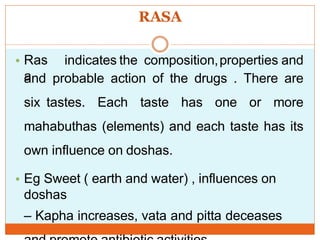
RASA
• Ras
a
indicates the composition,properties and
and probable action of the drugs . There are
six tastes. Each taste has one or more
mahabuthas (elements) and each taste has its
own influence on doshas.
• Eg Sweet ( earth and water) , influences on
doshas
– Kapha increases, vata and pitta deceases
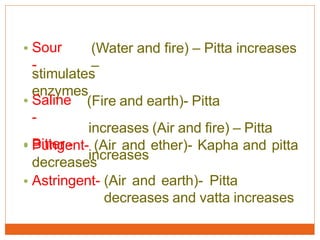
• Sour
-
(Water and fire) – Pitta increases
–
stimulates
enzymes
• Saline
-
• Bitter -
(Fire and earth)- Pitta
increases (Air and fire) – Pitta
increases
• Pungent- (Air and ether)- Kapha and pitta
decreases
• Astringent- (Air and earth)- Pitta
decreases and vatta increases
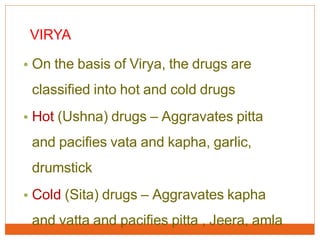
VIRYA
• On the basis of Virya, the drugs are
classified into hot and cold drugs
• Hot (Ushna) drugs – Aggravates pitta
and pacifies vata and kapha, garlic,
drumstick
• Cold (Sita) drugs – Aggravates kapha
and vatta and pacifies pitta , Jeera, amla
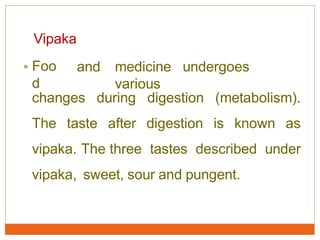
Vipaka
• Foo
d
and medicine undergoes
various
changes during digestion (metabolism).
The taste after digestion is known as
vipaka. The three tastes described under
vipaka, sweet, sour and pungent.
• Sweet – Aggravates kapha and
alleviates pitta and vatha
• Sou
r
– Aggravates pitha and
alleviates
kapha and vatha
• Pungent – Aggravatesvatha and
alleviates kapha
THANK YOU

Ayurvedasystem by pooja

  • 1.
  • 2.
    AYURVEDA Ayurveda is thedominant herbal tradition in India. It still enjoys the faith of a large number of people of our country though it is perhaps , the oldest system of healing in the world. It is encouraged in many countries like Japan, Germany etc
  • 3.
    Definition • The term“ Ayurveda” is derived from two Sanskrit words , Ayur and Veda . • Ayur means life andVeda means knowledge or science. • ThereforeAyurveda means science of life or way of life.
  • 4.
    • Ayurved a incorporatesscience, religion and philosophyin it. • Beside s, dealing with principles for maintenance of health , it as also developed a wide range therapeutic measures to combat illness.
  • 5.
    Principle • The principleof Ayurveda is based on the conceptof five basicelementsand tridoshas. • Accordingto Ayurveda, the whole universe made up of five basic elements ( Pancha mahabuthas)
  • 6.
    • Th e whole universeincludes the material world, plant kingdom and all other living beings. In other words ,these five elements together form the basis of all matter. The five elements are – Akasha (ether), Vayu ( air), Agni (fire), Jala (water), Prithvi (earth)
  • 7.
    • There isa balanced condensation of these elements in different proportions to suit the needs and requirements of different structures and functions of the body matrix and its parts. The growth and development of body matrix depends on its nutrition i.e.. on food. The food, in turn, is composed of above elements.
  • 8.
    • Th e health orsicknessdepends on the presence or absence of a balanced state of the total body matrix including the balance between its different constituents . • The properties, location and manifestations of these elements are as follows
  • 9.
    • Ethe r is nonresistance, it is located in hebody cavities like mouth, thorax, abdomen , lung cavity, digestive tract. • Air is related to movements, vibrations and oscillations. They manifests movement of muscles, pulsation of heart, expansion and contraction of
  • 10.
    • Fir e concerne d to radiation , it manifest sdigestion, metabolism , andintelligence. temperature , visio n • Water is related to force and cohesion. Located in cytoplasm, blood, salivary glands, gastric juice.
  • 11.
    • Earth isconcerned to resistance and solidarity. They manifests skin, nails, hairs and bones. • These elements manifest in the functioning of our scenes. • They are also closely related to our ability to perceive and interact with environment.
  • 12.
    TRIDOSHAS • The fiveelements combine to form “ Tri Doshas” i.e Vata, Pitta, and Kappha. They are the “ Basic Forces ’’ and also known as the “ Pillars of Life” • Vata (Air principle) the elements ether and air • Pitta (Fire principle) the elements fire and water
  • 13.
    • According tothe Ayurveda , sickness is due to the imbalance of any one or more of the three doshas. • Eg Aggravation of Pitta leads to indigestion, skin diseases and liver problems.
  • 14.
    Factors • Factors responsiblefor imbalance of doshas are physical, mental, spiritual and environmental may contribute for the imbalance of doshas
  • 15.
    Diagnosis • In Ayurvedadiagnosis is always done of the patient as whole. • Diagnosis is carried out to find out whichdosha is aggravated. For his purpose , nadi (Pulse),tongue , skin, physical features, stool, urine etc are examined.
  • 16.
    Treatment • The importanceof treatment is to restore the balance and harmony of doshas with proper diet and drugs • Selection of the drugs – • Base d upon 1. Rasa (Taste), 2. Virya (Potency) and Vipaka (Taste after digestion)
  • 17.
    RASA • Ras a indicates thecomposition,properties and and probable action of the drugs . There are six tastes. Each taste has one or more mahabuthas (elements) and each taste has its own influence on doshas. • Eg Sweet ( earth and water) , influences on doshas – Kapha increases, vata and pitta deceases
  • 18.
    • Sour - (Water andfire) – Pitta increases – stimulates enzymes • Saline - • Bitter - (Fire and earth)- Pitta increases (Air and fire) – Pitta increases • Pungent- (Air and ether)- Kapha and pitta decreases • Astringent- (Air and earth)- Pitta decreases and vatta increases
  • 19.
    VIRYA • On thebasis of Virya, the drugs are classified into hot and cold drugs • Hot (Ushna) drugs – Aggravates pitta and pacifies vata and kapha, garlic, drumstick • Cold (Sita) drugs – Aggravates kapha and vatta and pacifies pitta , Jeera, amla
  • 20.
    Vipaka • Foo d and medicineundergoes various changes during digestion (metabolism). The taste after digestion is known as vipaka. The three tastes described under vipaka, sweet, sour and pungent.
  • 21.
    • Sweet –Aggravates kapha and alleviates pitta and vatha • Sou r – Aggravates pitha and alleviates kapha and vatha • Pungent – Aggravatesvatha and alleviates kapha
  • 22.