Prof . G.S.Murthy
HISTORY OF ORGANIC  FARMING Albert Howard  1873-1947 pioneer, botanist by profession .( President Indian National Congress  1926). Supported traditional Indian agricultural practices. His theme was healthy soil, healthy people, live stock and crops. Documented Organic training techniques. Slow poisoning of the soil by chemical fertilisers Book:  Agricultural Testament. The approach for Ag should be from land not from lab.
History of Organic Farming Rudolf steiner  1924 (German) Balancing the interaction of animals- plants-Soils (Ecology )management.  Built Biodynamic farming in Germany Lord   NorthBourne The term organic farming was first coined by him in his book  Look to the land 1939. A treatise on holistic ecology and agriculture .
History of Organic Farming Lady Eve Belfour  UK systematically experimented on organic and conventional farming from 1939-1943 Book- LIVING SOIL 1944. Emphasised on the spiritual and ethical values Manobu Fukuoka  (Japan) microbiologist  Developed a model “ No-Till ” organic farming and practiced and preached from 1940 for thirty years.  (Now known as  fukuoka  farming )
The five major principles of Fukuoka's farming methods are 1. No tillage  2. No fertilizer  3. No pesticides  4.  No weeding  5. No pruning  Fukuoka has learned how plants can grow naturally and vigorously with little or no human effort. For over fifty years he has achieved surplus yields of rice, barley, plums, citrus fruits and vegetables by means of natural farming. Fukuoka's methods have also been used to green the deserts. Books:  One straw revolution,  Road back to nature  and Natural way of farming.
Western Researchers on Organic Farming J.I Rodale  USA 1950:  Popularised the term sustainable agriculture and the method of organic farming in USA and published several scientific reports. Rodale research Institute NY 1972 International federation of organicAgriculture  (IFOA)  movement in France. Co-ordinates all efforts in organic farming world wide .
Conspiracy of Industrial World Post war scenario Ammonium nitrate lost it’ s importance  after the invention of Nuclear Bomb. Chemical fertilisers are imposed on the farmers market in the name of productivity.  Silentspring .  RachelCarson.1962 ., Tragedy of using toxic chemicals and pesticides
Disaster of Chemical Fertilisers The result is Loss of soil fertility- Land degradation Loss of biodiversity,  Water scarcity, Biodiversity  erosion,  climate change, Chemically contaminated foods Destruction of traditional knowledge systems
Organic Farming and Bringing Life to the Soil Organic farming offers “ Living soil”  theory. Living soil is  Rich in nutrients N P K  Sufficient minerals for plant nutrition B,Cl,Co,Cu,Fe,Mn,Mg,Mo,S and Zn Rich in micro-organisms that support plant growth Contains large amount of top soil
Organic Farming – Improving the Fertility of Soil Rich in organic matter( improves soil structure and moisture) improves water retaining capacity-improves underground water level Note :  Latest Nasa satellite survey reports ground water levels of north India have been declining  33cm ( one foot) per year.  Times of India 14 th  Aug, ’09.
Cow – Mother of Farming Subhas palekar  Amaravati Maharashtra Mob: 09423702877 Palekar’s views Mother earth is  Annapurna It’s degradation is our doing All the useful organisms billions and billions were destroyed by chemical fertilisers. We have to put a full stop for this  indiscriminate  use of fertilisers To replenish and bring back the soil to living condition the source is  COW and its products mainly its Dung and Urine .
COW- Mother of Farming Manure from  one cow  can maintain  30 acres  of cultivation profitably.  Jivamrutam  a value added manure from cow’s dung and urine.( See Natural farming –By palekar) Dung is gold mine - A Book by International society for cow protection  ISCOWP.ORG  says The only way to the problems of shortage of food grains, water, fuel, shelter, good health, nutrition, eradication of poverty and unemployment is  dung-Dung and only  Dung
Cows are forever, Arun Firodia, Chairman, Kinetic group, pune Technical article  The TOI, Dec, 2004 Methane farming a concept of alternate energy In India  250 Mn cattle, 1250 Mn tonnes of cow dung The methane produced can entirely replace LPG, Kerosene use for cooking and petrol for transportation The By-product is an excellent  organic manure Gobar gas research stn  in U.P. finding :  Each cow produces methane equivalent to  225 Lts of petrol/yr
COW -  Economic Prosperity Gobar from  75 Mn cows  can meet the kerosene and LPG requirement for 100 crore population 40 Mn cows  can produce energy equivalent to  8 Mn tonnes petrol  ( Our annual national petrol consumption  (2003-04  figs) The  gobar slurry  produced in this process will yield  50Mn tonnes  of organic manure rich in N and P Meets all the  fertiliser  requirement  for  150 Mn Ha  of crop lands of India
COW -  A Potential Economic Tool Most important phase of basic Indian economy  (Cowbased)  was ignored by the frenzied  industrial tempo. we need not oppose industry but  emphatically  insist that all industrial development must be in consonance and in conformity with basic ( cow based )  indian economy.  This requires will at Govt. as well as people’s level Industry should support,  not distort and destroy  this basic cow economy of the country.
Some questions to make people think What else you want? Why import oil and face oil and energy crisis? Do we have the national will? Are we on the right direction in shaping the industrial and economic policies of our country? Or else are we playing to the tune of Industry driven technologies and policies  to serve the interests of few and few countries? Is it not the proper time to think?
Some questions to be answered Can organic farming produce enough food for everybody? In the so called green revolution areas (irrigated lands ) conversion to organic agriculture usually gives the same yields. In traditional rainfed agriculture ( with low external inputs)org.Ag has shownpotential to increase yields.
U.N. FAO Report 2002 Organic sustainable agriculture practices can provide synergic benefits that include mitigating climate change  It has major potential for reducing  Agricultural GHG s Energy use in  conventional  Ag systems is  200 times  than that of  Org.systems . Because most of the energy is used in the manufacture  of pesticides etc ., Note : They are thrust by the big business, influences the policy centers, MNC s, money , economics Ref:  Innovations Agronomiques (2009),4,P. 269  several such reports are available
Institute of science in society ISIS UK report 31/1/08 Dr.Mac wan HO Synthetic fertilisers and oil based fertilisers release CO2 through quick decay of soil organic matter(Carbon) On the other hand organic approach sequesters carbon it takes carbon from the air and puts back into the soil Agriculture as we practice now is one of the major contributers to global warming.But it could be the biggest mitigator.The choice is ours.
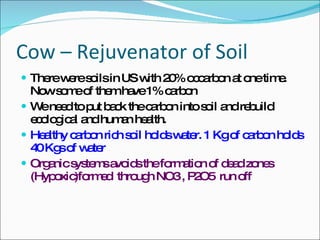
Cow – Rejuvenator of Soil There were soils in US with 20% occarbon at one time. Now some of them have 1% carbon We need to put back the carbon into soil and rebuild ecological and human health. Healthy carbon rich soil holds water. 1 Kg of carbon holds 40 Kgs of water Organic systems avoids the formation of dead zones (Hypoxic)formed  through NO3 , P2O5  run off
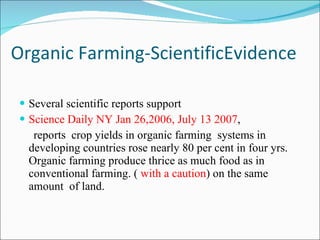
Organic Farming-ScientificEvidence Several scientific reports support Science Daily NY Jan 26,2006, July 13 2007 , reports  crop yields in organic farming  systems in developing countries rose nearly 80 per cent in four yrs. Organic farming produce thrice as much food as in conventional farming. (  with a caution ) on the same amount  of land.
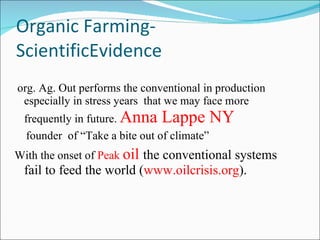
Organic Farming-ScientificEvidence org. Ag. Out performs the conventional in production especially in stress years  that we may face more frequently in future.  Anna Lappe NY founder  of “Take a bite out of climate” With the onset of  Peak  oil  the conventional systems fail to feed the world ( www.oilcrisis.org ).
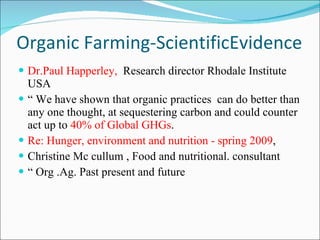
Organic Farming-ScientificEvidence Dr.Paul Happerley,  Research director Rhodale Institute USA “  We have shown that organic practices  can do better than any one thought, at sequestering carbon and could counter act up to  40% of Global GHGs . Re: Hunger, environment and nutrition - spring 2009 , Christine Mc cullum , Food and nutritional. consultant “  Org .Ag. Past present and future
Questions on Organic Farming Is it possible to meet the nutrient requirement In this system plant nutrition depends on biologically derived nutrients( Slow kinetics but perpetual) instead of readily soluble forms. Animal dung ( cow),crop residues,green manure, biofertilisers, biosolids from agro industries and food processing wastes are the natural sources. Note: 600-700 million ton of Ag. waste is available in the country which is not properly utilised .
Organic Farming – Some Vital Statistics India produces  1800 million tons  of animal dung Even 2/3 of dung is used produce  120 million  cubic meters of bio gas daily and  440 million tons  of manure per year. ( equal to 2.5mn tons of nitrogen,2.75 m tons of P2O5 and 1.8 m tons of K2O. Note: It is estimated  25 million  workers in developing countries  are poisoned each year by pestides. It  Can be avoided by organic farming.
Organic Farming – Economic Potential Is it economically beneficial ? The  business in 2005 was  30 bn us dollars ,with a growth rate of  20-25% . Govt.Agencies should help the small scale farmers get proper returns for their organic produce. 30% land holding with small farmers and they possess 70% cattle. They need to be trained in cattle rearing for right economies.  Answer is palekar’s approach of natural farming linked to cow.
Are there any environmental benefits 30 years of research at Rodale institute Ny USA showed that it is possible to substantially mitigate the impacts of global warming UNCTAD/WTO report says Agriculture is both affected by climate change but also contributes to it. Org. farming mitigates and reduces green house gas emission where  as intensive  chemical fertiliser farming increases ghg emission
Conclusions of a recent intl. symposium conducted  by AAAS Feb 2009 at Chicago Theme:  living soil-food quality Conclusions: Organically grown spinach  contains less nitrate concn. Which carcinogenic.( Review  of a decade’s work) Scientists agree org.farming delivers healthier rich soil and nutritionally enhanced food. 30% increase in anti oxidants and tastier . Average child in US is exposed to  five pesticides  daily. Organic foods are free from them. Public health costs  of pesticides use in US are  1.1 Bn $
Agriculture holds the key to global warming Barbara kessler ,  Science Ny  june 2, 2009 Five ways to reduce and seqester  GHG s  1)enriching the soil carbon(  the third largest  carbon pool) by burying carbon in the form of Bio-char. 2) farming with periannials:  periannial trees including (forests) shurbs, palms, and grasses that produce food ( live stock food and fuel)
Organic Farming – Climate Friendly 3)climate friendly live stock production. Live stock produce 50% of GHG s. 4) Manure management  and methane  capture for bio-gas production. 5) protecting natural habitat,restoring degraded watersheds, restoration of vegetation.
Mahatma Gandhi ji’s swadeswhi movement Charakha is a means for independance  Swadeshi is a movement 1930 entire country involved.  In his words The concept of  swadeshi  is not vindictive. It is a  necessity  for national existance. We got freedom in 1947. How independent are we? It is a big question. .
Gandhi – Cow - Organic Farming  Gandhiji said rural india is real india. Is it safe and secure particularly  for small farmers i.e 60% of our rural population Modern technology and the business, propelled by the forces of  market and politics  is responsible for disappearing of forests, drying of rivers,  degradation  of farm lands and for the disappearing of bio-diversity.
Organic Farming - Points to Ponder  If man is making mess of his personal social and ecological life, it is not because of want of knowledge, “  It is because of  lack of discipline ” The gap between  knowledge and practice  is widening continuously. This distance is greater than the distance between  knowledge and ignorance
Organic Farming - Points to Ponder Ponder on this  “ Who am I”  “What do I own” You are apparently rich but your direction is wrong. Where it leads to? Finally  How good are the financial returns  if the water you drink , the food you eat and the air you breathe  are dreadfully contaminated .
Organic Farming - Points to Ponder Industry robs, exploits the poor,  the ignorant rural masses propagating  Consumerism .  MNC s play deterministic roles.  Govt is helpless . Economics got divorced from  social concern  because the study of management is merely concerned with materials and wealth. What is the remedy to make rural poor rich enough to provide two meals a day.
Organic Farming - Points to Ponder Org. farming has the answer.  Eleminates farmer suicides. Mitigates economic recession Improves rural economy Empowers the farmer
Organic Farming - Points to Ponder Org farming is a movement originated in developed countries to mitigate the evils of market driven economies. Everybody is a victim . rich and poor developed and developing countries everybody. The reason Mans’greed.  Mahatma said There is enough for man’s needs but not to his greed . If man does not learn through wisdom, nature teaches him by force. E.g. global warming, climate change,soil degradation  etc.,
Organic Farming - Points to Ponder Eternal vigilance is the price of the freedom. To be aware and make people aware is called  Jnana yagna.  B.G. It is going on in this country since ages.  It is time to remember our  mother earth  and the  closely related cow  in our own future interests .
VMGG YATRA IS ONE SUCH EFFORT Web:  www.gougram.org An effort to keep the Indian villages on the path of sustainable development through cow and cow based economy.
Action Plan To encourage farmers to rear  indigenous  cows and bulls To educate the farmers towards wholistic approach towards  cow based economy To encourage to develop  rural technologies  applied to organic farming methods and improve  employment potential in villages  To create conditions for  reverse migration  from cities to villages
A Historical Movement To keep our land fertile and be independent To keep the rural poor self sufficient To withstand the market driven economies and the consumerism To mitigate recession and its effects Note: Our failure to evaluate  justly the nature’s gifts  to mankind is the serious problem
A Historical Movement Some features the Yatra Yatra  starts on 30 th  sept 2009 vijayadasami day from Kurukshetra. Covers 20,000 km in108 days There will be several regional yatras connecting the main Crores  of signatures will be obtained Touches lakhs of villages Hence:  Participate  and co operate in  this movement of national necessityand  importance.
Eminent personalities leading this movement Sri Raghavendra Bharati swami ji Sri sri Ravishankarji Sri Ramdevji Sri Mata Amritananda mai ji Sri Acharya vidya sagarji Sri Acharya Mahapragna ji Swamy Dayananda sarswati ji Sri Murari Bapu  ji SriPranav Pandyaji  Hon.President Dr H.R .Nagendra working president
References: An agricultural testament-by sir.Albert Howard,1940 Other Indian press, Goa. Secrets of the soil-peter  Tompkins and  Christopher Bird  Rupa and co, second Ed.,2004. Philosophy of spiritual farming(zero budget natural farming)-subash palekar. Oraganic agriculture-P.K.tandon,1995 . Sustainable agriculture,  www.sustainet.org Center for Indian knowledge systems, TN.  www.ciks.org
Recent references  New study confirms the ecological virtues of organic farming. Mark shwartz., Stanford nes service.,6 th  March 2006. Carbon sequestration potential of Org.Ag. Bente Foeried., e.al., Nutrient cycling in Agro systems, Vol.6. No 1. p13-26 (jan 2004).  article based on USDA report  Carbon credits to farmers p 10,Nov-Dec 2008 GHG gases mitigation in Org.Ag.,, Pete smith et..al., Phil. Trans. of the Roy.So.,B.,vol363(815-363) 2008.
References “ Africa: Reinventing Agriculture”, Stephen Leahy, Inter Press Service,  (Johannesburg), 15 April 2008,  http://allafrica.com/stories/200804150171.html   “ Urgent changes needed in global farming practices to avoid environmental destruction” Greenpeace International Press Release, 15 April 2008.  “ GM foods ‘not the answer’ to world’s food shortage crisis, report says”, Sean Poulter,  The Daily Mail , 16 April 2008  http://www.dailymail.co.uk/pages/live/articles/news/news.html?in_article_id =559965&in_page_id=1770   GM food, biofuels and a hungry world, Editorial,  The Daily Mail , 16 April 2008 http://www.dailymail.co.uk/pages/live/articles/news/newscomment.html?in_page_id =1787&in_article_id=559945   What is the International Assessment of Agricultural Knowledge, Science & Technology, IAASD? A compilation from its plenary decisions and official documents,  http://www.agassessment-watch.org/docs/IAASTD_on_three_pages.pdf   International Assessment of Agricultural Knowledge, Science & Technology (IAASTD) Synthesis Report 25 November 2007,  http://www.agassessment.org/docs/Synthesis_Report_261107_text.pdf   Ho MW. Food without fossil fuels now. Invited Keynote Lecture, 2nd Mediterranean Conference on Organic Agriculture in Croatia, Organic Agriculture – Contribution to Sustainable Ecosystem, 2-6 April 2008, Dubrovnik University. Dubrovnik, Croatia,  http://www.i-sis.org.uk/foodWithoutFossilFuels.php   Ho MW, Burcher S, Lim LC et al.  Food Futures Now, Organic, Sustainable, Fossil Fuel Free , ISIS TWN Report, London & Penang, 2008.  “ Global food system ‘must change’” BBC News, 15 April 2008,  http://news.bbc.co.uk/1/hi/sci/tech/7347239.stm   “ Change in farming can feed world – report”, John Vidal, The Guardian, 16 April 2008,  http://www.guardian.co.uk/environment/2008/apr/16/food.biofuels   Saunders PT. Marketing masquerading as scientific survey.  Science in Society 38  (to appear).  Ho MW and Saunders PT. “UK faremers upbeat about GM crops” debunked.  Science in Society 38  (to appear).  printer friendly version
Recent references  contd : www.sustainable.org  Recent growth patterns of US organic food markets, US dept. of agriculture, Bulletin. No 777,Sept,2002. www.twnside.org.sg  (third world network) benefits of organic farming report, March 08 Beware of pesticides in food chain-Prof.  R.S.Chauhan,organiser  august 16,2009,p.31 Org.Ag. , past, present and future, Christine Mc Cullum-Hunger and Env nutrition, Spring 2009. Rodale  research institute reports,N.Y. www.govigyan.com.  Research Centre at Nagpur
Thaindian News July, 2009.(ANI) Change in fertiliser subsidy policy can save crores of rupees. Ensures food security –  Green peace 2008-09 fert. Sbusidy  Rs. 1,20,000 crores . Recommendations: Look for alternative subsidy systems to sustainable Ag. Refocus scientific research and ensure food security under changing climatic conditions Dr.B.Croy,  Dr.G.Nchattopadyay, Viswabharati Univ. And Dr.Reyes Tirado, Green peace Res. Labs. Univ. of Exter
Some quotes to think Cow is the source of progress and prosperity. Mahatma Gandhiji  Cow protection is the eternal Dharma of India Babu Rajendra Prasad Cow is the foundation of our country. Giyani Zailsingh Neither Koran nor Arabian  customs permit killing of  cow – Hakim Ajmal Khan According to me there is nothing more scientific and intelligent act than banning cow slaughter— J.P.Narayan
Quotes Cow’s milk is tonic, it’s ghee is ambrosia and its’ meat is disease.  Hazarat Mohamad Killing a bull s equivalent to killing a cow.  Jesus christ I have studied both koran and Bible. According to both of them to kill a cow even indirectly is a great sin.  Achaya vinoba Bhave Several such quotes are available THINK
QUERIES????
THANK YOU

Organic Farming

  • 1.
  • 2.
    HISTORY OF ORGANIC FARMING Albert Howard 1873-1947 pioneer, botanist by profession .( President Indian National Congress 1926). Supported traditional Indian agricultural practices. His theme was healthy soil, healthy people, live stock and crops. Documented Organic training techniques. Slow poisoning of the soil by chemical fertilisers Book: Agricultural Testament. The approach for Ag should be from land not from lab.
  • 3.
    History of OrganicFarming Rudolf steiner 1924 (German) Balancing the interaction of animals- plants-Soils (Ecology )management. Built Biodynamic farming in Germany Lord NorthBourne The term organic farming was first coined by him in his book Look to the land 1939. A treatise on holistic ecology and agriculture .
  • 4.
    History of OrganicFarming Lady Eve Belfour UK systematically experimented on organic and conventional farming from 1939-1943 Book- LIVING SOIL 1944. Emphasised on the spiritual and ethical values Manobu Fukuoka (Japan) microbiologist Developed a model “ No-Till ” organic farming and practiced and preached from 1940 for thirty years. (Now known as fukuoka farming )
  • 5.
    The five majorprinciples of Fukuoka's farming methods are 1. No tillage 2. No fertilizer 3. No pesticides 4. No weeding 5. No pruning Fukuoka has learned how plants can grow naturally and vigorously with little or no human effort. For over fifty years he has achieved surplus yields of rice, barley, plums, citrus fruits and vegetables by means of natural farming. Fukuoka's methods have also been used to green the deserts. Books: One straw revolution, Road back to nature and Natural way of farming.
  • 6.
    Western Researchers onOrganic Farming J.I Rodale USA 1950: Popularised the term sustainable agriculture and the method of organic farming in USA and published several scientific reports. Rodale research Institute NY 1972 International federation of organicAgriculture (IFOA) movement in France. Co-ordinates all efforts in organic farming world wide .
  • 7.
    Conspiracy of IndustrialWorld Post war scenario Ammonium nitrate lost it’ s importance after the invention of Nuclear Bomb. Chemical fertilisers are imposed on the farmers market in the name of productivity. Silentspring . RachelCarson.1962 ., Tragedy of using toxic chemicals and pesticides
  • 8.
    Disaster of ChemicalFertilisers The result is Loss of soil fertility- Land degradation Loss of biodiversity, Water scarcity, Biodiversity erosion, climate change, Chemically contaminated foods Destruction of traditional knowledge systems
  • 9.
    Organic Farming andBringing Life to the Soil Organic farming offers “ Living soil” theory. Living soil is Rich in nutrients N P K Sufficient minerals for plant nutrition B,Cl,Co,Cu,Fe,Mn,Mg,Mo,S and Zn Rich in micro-organisms that support plant growth Contains large amount of top soil
  • 10.
    Organic Farming –Improving the Fertility of Soil Rich in organic matter( improves soil structure and moisture) improves water retaining capacity-improves underground water level Note : Latest Nasa satellite survey reports ground water levels of north India have been declining 33cm ( one foot) per year. Times of India 14 th Aug, ’09.
  • 11.
    Cow – Motherof Farming Subhas palekar Amaravati Maharashtra Mob: 09423702877 Palekar’s views Mother earth is Annapurna It’s degradation is our doing All the useful organisms billions and billions were destroyed by chemical fertilisers. We have to put a full stop for this indiscriminate use of fertilisers To replenish and bring back the soil to living condition the source is COW and its products mainly its Dung and Urine .
  • 12.
    COW- Mother ofFarming Manure from one cow can maintain 30 acres of cultivation profitably. Jivamrutam a value added manure from cow’s dung and urine.( See Natural farming –By palekar) Dung is gold mine - A Book by International society for cow protection ISCOWP.ORG says The only way to the problems of shortage of food grains, water, fuel, shelter, good health, nutrition, eradication of poverty and unemployment is dung-Dung and only Dung
  • 13.
    Cows are forever,Arun Firodia, Chairman, Kinetic group, pune Technical article The TOI, Dec, 2004 Methane farming a concept of alternate energy In India 250 Mn cattle, 1250 Mn tonnes of cow dung The methane produced can entirely replace LPG, Kerosene use for cooking and petrol for transportation The By-product is an excellent organic manure Gobar gas research stn in U.P. finding : Each cow produces methane equivalent to 225 Lts of petrol/yr
  • 14.
    COW - Economic Prosperity Gobar from 75 Mn cows can meet the kerosene and LPG requirement for 100 crore population 40 Mn cows can produce energy equivalent to 8 Mn tonnes petrol ( Our annual national petrol consumption (2003-04 figs) The gobar slurry produced in this process will yield 50Mn tonnes of organic manure rich in N and P Meets all the fertiliser requirement for 150 Mn Ha of crop lands of India
  • 15.
    COW - A Potential Economic Tool Most important phase of basic Indian economy (Cowbased) was ignored by the frenzied industrial tempo. we need not oppose industry but emphatically insist that all industrial development must be in consonance and in conformity with basic ( cow based ) indian economy. This requires will at Govt. as well as people’s level Industry should support, not distort and destroy this basic cow economy of the country.
  • 16.
    Some questions tomake people think What else you want? Why import oil and face oil and energy crisis? Do we have the national will? Are we on the right direction in shaping the industrial and economic policies of our country? Or else are we playing to the tune of Industry driven technologies and policies to serve the interests of few and few countries? Is it not the proper time to think?
  • 17.
    Some questions tobe answered Can organic farming produce enough food for everybody? In the so called green revolution areas (irrigated lands ) conversion to organic agriculture usually gives the same yields. In traditional rainfed agriculture ( with low external inputs)org.Ag has shownpotential to increase yields.
  • 18.
    U.N. FAO Report2002 Organic sustainable agriculture practices can provide synergic benefits that include mitigating climate change It has major potential for reducing Agricultural GHG s Energy use in conventional Ag systems is 200 times than that of Org.systems . Because most of the energy is used in the manufacture of pesticides etc ., Note : They are thrust by the big business, influences the policy centers, MNC s, money , economics Ref: Innovations Agronomiques (2009),4,P. 269 several such reports are available
  • 19.
    Institute of sciencein society ISIS UK report 31/1/08 Dr.Mac wan HO Synthetic fertilisers and oil based fertilisers release CO2 through quick decay of soil organic matter(Carbon) On the other hand organic approach sequesters carbon it takes carbon from the air and puts back into the soil Agriculture as we practice now is one of the major contributers to global warming.But it could be the biggest mitigator.The choice is ours.
  • 20.
    Cow – Rejuvenatorof Soil There were soils in US with 20% occarbon at one time. Now some of them have 1% carbon We need to put back the carbon into soil and rebuild ecological and human health. Healthy carbon rich soil holds water. 1 Kg of carbon holds 40 Kgs of water Organic systems avoids the formation of dead zones (Hypoxic)formed through NO3 , P2O5 run off
  • 21.
    Organic Farming-ScientificEvidence Severalscientific reports support Science Daily NY Jan 26,2006, July 13 2007 , reports crop yields in organic farming systems in developing countries rose nearly 80 per cent in four yrs. Organic farming produce thrice as much food as in conventional farming. ( with a caution ) on the same amount of land.
  • 22.
    Organic Farming-ScientificEvidence org.Ag. Out performs the conventional in production especially in stress years that we may face more frequently in future. Anna Lappe NY founder of “Take a bite out of climate” With the onset of Peak oil the conventional systems fail to feed the world ( www.oilcrisis.org ).
  • 23.
    Organic Farming-ScientificEvidence Dr.PaulHapperley, Research director Rhodale Institute USA “ We have shown that organic practices can do better than any one thought, at sequestering carbon and could counter act up to 40% of Global GHGs . Re: Hunger, environment and nutrition - spring 2009 , Christine Mc cullum , Food and nutritional. consultant “ Org .Ag. Past present and future
  • 24.
    Questions on OrganicFarming Is it possible to meet the nutrient requirement In this system plant nutrition depends on biologically derived nutrients( Slow kinetics but perpetual) instead of readily soluble forms. Animal dung ( cow),crop residues,green manure, biofertilisers, biosolids from agro industries and food processing wastes are the natural sources. Note: 600-700 million ton of Ag. waste is available in the country which is not properly utilised .
  • 25.
    Organic Farming –Some Vital Statistics India produces 1800 million tons of animal dung Even 2/3 of dung is used produce 120 million cubic meters of bio gas daily and 440 million tons of manure per year. ( equal to 2.5mn tons of nitrogen,2.75 m tons of P2O5 and 1.8 m tons of K2O. Note: It is estimated 25 million workers in developing countries are poisoned each year by pestides. It Can be avoided by organic farming.
  • 26.
    Organic Farming –Economic Potential Is it economically beneficial ? The business in 2005 was 30 bn us dollars ,with a growth rate of 20-25% . Govt.Agencies should help the small scale farmers get proper returns for their organic produce. 30% land holding with small farmers and they possess 70% cattle. They need to be trained in cattle rearing for right economies. Answer is palekar’s approach of natural farming linked to cow.
  • 27.
    Are there anyenvironmental benefits 30 years of research at Rodale institute Ny USA showed that it is possible to substantially mitigate the impacts of global warming UNCTAD/WTO report says Agriculture is both affected by climate change but also contributes to it. Org. farming mitigates and reduces green house gas emission where as intensive chemical fertiliser farming increases ghg emission
  • 28.
    Conclusions of arecent intl. symposium conducted by AAAS Feb 2009 at Chicago Theme: living soil-food quality Conclusions: Organically grown spinach contains less nitrate concn. Which carcinogenic.( Review of a decade’s work) Scientists agree org.farming delivers healthier rich soil and nutritionally enhanced food. 30% increase in anti oxidants and tastier . Average child in US is exposed to five pesticides daily. Organic foods are free from them. Public health costs of pesticides use in US are 1.1 Bn $
  • 29.
    Agriculture holds thekey to global warming Barbara kessler , Science Ny june 2, 2009 Five ways to reduce and seqester GHG s 1)enriching the soil carbon( the third largest carbon pool) by burying carbon in the form of Bio-char. 2) farming with periannials: periannial trees including (forests) shurbs, palms, and grasses that produce food ( live stock food and fuel)
  • 30.
    Organic Farming –Climate Friendly 3)climate friendly live stock production. Live stock produce 50% of GHG s. 4) Manure management and methane capture for bio-gas production. 5) protecting natural habitat,restoring degraded watersheds, restoration of vegetation.
  • 31.
    Mahatma Gandhi ji’sswadeswhi movement Charakha is a means for independance Swadeshi is a movement 1930 entire country involved. In his words The concept of swadeshi is not vindictive. It is a necessity for national existance. We got freedom in 1947. How independent are we? It is a big question. .
  • 32.
    Gandhi – Cow- Organic Farming Gandhiji said rural india is real india. Is it safe and secure particularly for small farmers i.e 60% of our rural population Modern technology and the business, propelled by the forces of market and politics is responsible for disappearing of forests, drying of rivers, degradation of farm lands and for the disappearing of bio-diversity.
  • 33.
    Organic Farming -Points to Ponder If man is making mess of his personal social and ecological life, it is not because of want of knowledge, “ It is because of lack of discipline ” The gap between knowledge and practice is widening continuously. This distance is greater than the distance between knowledge and ignorance
  • 34.
    Organic Farming -Points to Ponder Ponder on this “ Who am I” “What do I own” You are apparently rich but your direction is wrong. Where it leads to? Finally How good are the financial returns if the water you drink , the food you eat and the air you breathe are dreadfully contaminated .
  • 35.
    Organic Farming -Points to Ponder Industry robs, exploits the poor, the ignorant rural masses propagating Consumerism . MNC s play deterministic roles. Govt is helpless . Economics got divorced from social concern because the study of management is merely concerned with materials and wealth. What is the remedy to make rural poor rich enough to provide two meals a day.
  • 36.
    Organic Farming -Points to Ponder Org. farming has the answer. Eleminates farmer suicides. Mitigates economic recession Improves rural economy Empowers the farmer
  • 37.
    Organic Farming -Points to Ponder Org farming is a movement originated in developed countries to mitigate the evils of market driven economies. Everybody is a victim . rich and poor developed and developing countries everybody. The reason Mans’greed. Mahatma said There is enough for man’s needs but not to his greed . If man does not learn through wisdom, nature teaches him by force. E.g. global warming, climate change,soil degradation etc.,
  • 38.
    Organic Farming -Points to Ponder Eternal vigilance is the price of the freedom. To be aware and make people aware is called Jnana yagna. B.G. It is going on in this country since ages. It is time to remember our mother earth and the closely related cow in our own future interests .
  • 39.
    VMGG YATRA ISONE SUCH EFFORT Web: www.gougram.org An effort to keep the Indian villages on the path of sustainable development through cow and cow based economy.
  • 40.
    Action Plan Toencourage farmers to rear indigenous cows and bulls To educate the farmers towards wholistic approach towards cow based economy To encourage to develop rural technologies applied to organic farming methods and improve employment potential in villages To create conditions for reverse migration from cities to villages
  • 41.
    A Historical MovementTo keep our land fertile and be independent To keep the rural poor self sufficient To withstand the market driven economies and the consumerism To mitigate recession and its effects Note: Our failure to evaluate justly the nature’s gifts to mankind is the serious problem
  • 42.
    A Historical MovementSome features the Yatra Yatra starts on 30 th sept 2009 vijayadasami day from Kurukshetra. Covers 20,000 km in108 days There will be several regional yatras connecting the main Crores of signatures will be obtained Touches lakhs of villages Hence: Participate and co operate in this movement of national necessityand importance.
  • 43.
    Eminent personalities leadingthis movement Sri Raghavendra Bharati swami ji Sri sri Ravishankarji Sri Ramdevji Sri Mata Amritananda mai ji Sri Acharya vidya sagarji Sri Acharya Mahapragna ji Swamy Dayananda sarswati ji Sri Murari Bapu ji SriPranav Pandyaji Hon.President Dr H.R .Nagendra working president
  • 44.
    References: An agriculturaltestament-by sir.Albert Howard,1940 Other Indian press, Goa. Secrets of the soil-peter Tompkins and Christopher Bird Rupa and co, second Ed.,2004. Philosophy of spiritual farming(zero budget natural farming)-subash palekar. Oraganic agriculture-P.K.tandon,1995 . Sustainable agriculture, www.sustainet.org Center for Indian knowledge systems, TN. www.ciks.org
  • 45.
    Recent references New study confirms the ecological virtues of organic farming. Mark shwartz., Stanford nes service.,6 th March 2006. Carbon sequestration potential of Org.Ag. Bente Foeried., e.al., Nutrient cycling in Agro systems, Vol.6. No 1. p13-26 (jan 2004). article based on USDA report Carbon credits to farmers p 10,Nov-Dec 2008 GHG gases mitigation in Org.Ag.,, Pete smith et..al., Phil. Trans. of the Roy.So.,B.,vol363(815-363) 2008.
  • 46.
    References “ Africa:Reinventing Agriculture”, Stephen Leahy, Inter Press Service,  (Johannesburg), 15 April 2008, http://allafrica.com/stories/200804150171.html “ Urgent changes needed in global farming practices to avoid environmental destruction” Greenpeace International Press Release, 15 April 2008. “ GM foods ‘not the answer’ to world’s food shortage crisis, report says”, Sean Poulter, The Daily Mail , 16 April 2008 http://www.dailymail.co.uk/pages/live/articles/news/news.html?in_article_id =559965&in_page_id=1770 GM food, biofuels and a hungry world, Editorial, The Daily Mail , 16 April 2008 http://www.dailymail.co.uk/pages/live/articles/news/newscomment.html?in_page_id =1787&in_article_id=559945 What is the International Assessment of Agricultural Knowledge, Science & Technology, IAASD? A compilation from its plenary decisions and official documents, http://www.agassessment-watch.org/docs/IAASTD_on_three_pages.pdf International Assessment of Agricultural Knowledge, Science & Technology (IAASTD) Synthesis Report 25 November 2007, http://www.agassessment.org/docs/Synthesis_Report_261107_text.pdf Ho MW. Food without fossil fuels now. Invited Keynote Lecture, 2nd Mediterranean Conference on Organic Agriculture in Croatia, Organic Agriculture – Contribution to Sustainable Ecosystem, 2-6 April 2008, Dubrovnik University. Dubrovnik, Croatia, http://www.i-sis.org.uk/foodWithoutFossilFuels.php Ho MW, Burcher S, Lim LC et al. Food Futures Now, Organic, Sustainable, Fossil Fuel Free , ISIS TWN Report, London & Penang, 2008. “ Global food system ‘must change’” BBC News, 15 April 2008, http://news.bbc.co.uk/1/hi/sci/tech/7347239.stm “ Change in farming can feed world – report”, John Vidal, The Guardian, 16 April 2008, http://www.guardian.co.uk/environment/2008/apr/16/food.biofuels Saunders PT. Marketing masquerading as scientific survey. Science in Society 38 (to appear). Ho MW and Saunders PT. “UK faremers upbeat about GM crops” debunked. Science in Society 38 (to appear). printer friendly version
  • 47.
    Recent references contd : www.sustainable.org Recent growth patterns of US organic food markets, US dept. of agriculture, Bulletin. No 777,Sept,2002. www.twnside.org.sg (third world network) benefits of organic farming report, March 08 Beware of pesticides in food chain-Prof. R.S.Chauhan,organiser august 16,2009,p.31 Org.Ag. , past, present and future, Christine Mc Cullum-Hunger and Env nutrition, Spring 2009. Rodale research institute reports,N.Y. www.govigyan.com. Research Centre at Nagpur
  • 48.
    Thaindian News July,2009.(ANI) Change in fertiliser subsidy policy can save crores of rupees. Ensures food security – Green peace 2008-09 fert. Sbusidy Rs. 1,20,000 crores . Recommendations: Look for alternative subsidy systems to sustainable Ag. Refocus scientific research and ensure food security under changing climatic conditions Dr.B.Croy, Dr.G.Nchattopadyay, Viswabharati Univ. And Dr.Reyes Tirado, Green peace Res. Labs. Univ. of Exter
  • 49.
    Some quotes tothink Cow is the source of progress and prosperity. Mahatma Gandhiji Cow protection is the eternal Dharma of India Babu Rajendra Prasad Cow is the foundation of our country. Giyani Zailsingh Neither Koran nor Arabian customs permit killing of cow – Hakim Ajmal Khan According to me there is nothing more scientific and intelligent act than banning cow slaughter— J.P.Narayan
  • 50.
    Quotes Cow’s milkis tonic, it’s ghee is ambrosia and its’ meat is disease. Hazarat Mohamad Killing a bull s equivalent to killing a cow. Jesus christ I have studied both koran and Bible. According to both of them to kill a cow even indirectly is a great sin. Achaya vinoba Bhave Several such quotes are available THINK
  • 51.
  • 52.