
Cindy Cruz-Cabrera
about.me/cindycruzcabrera / en.gravatar.com/cindycatz
ph.linkedin.com/in/cindycruzcabrera
 Define “plagiarism”
 Determine the ethics of avoiding plagiarism
 Identify types of plagiarism
 Discuss how to avoid plagiarism
 Comes from the Latin word for THIEF,
PLUNDERER, HUNTING NET, and
KIDNAPPER
 “the outright stealing of another person’s ideas”
 Just like your belongings, ideas should be
treated with exclusivity and respect
 Unlike anything for sale, ideas won’t cost you
much
 Share button
 Attribution
 Tag
 Dates and timestamps
 Creative Commons
 Ethics
 Internet – easier verification
 Submitting a paper bought from somebody who
makes it his/her official business to sell papers
 Submitting a paper that somebody else has
written, whether you paid him/her for it or not
 Copying a paper from a source text without
acknowledging the source
 Retweet
 RT with comment
 MT (“modified tweet”)
 Issue: multiple meanings
 HT (“hat tip” or “heard through”)
 via
 To get good grades
 To help out a friend
 Copying materials from a source text with an
acknowledgement but without quotation marks
 Paraphrasing materials from a source text
without acknowledging the source
 Lack of time to check for proper documentation
(or simply carelessness)
 Lack of awareness about rules for proper
documentation
 Lack of guidance on the expectations of the
academe
 Cryptomnesia – false impression that ideas are
ours rather than other people’s
 Previous research practices which ignore other
academic conventions
 Lack of practice in the current requirements of
academic research
 Other sociocultural considerations
 Language constraints: writing experience,
kinds of writing done, how well the student
knows the language
 The irrelevant reference list
 Stolen references
 Bad paraphrasing
 Use of quotable quotes
 Knowing what to do
 Right attitude towards research and academic
work
 What to do?
 SELECT and CITE
 CONTRIBUTE NEW IDEAS TO PREVIOUS
RESEARCH
 CRITIQUE
Requires that you process all your borrowed
materials by
 Paraphrasing
 Summarizing / precis
 Quoting
 Acknowledging your sources by mentioning
them within the body of your paper and listing
them at the end of your paper
 Internal
 External
 More popularly called “summarizing”
 Concerned with the central idea, the core
information (rather than the details that support
it)
 COB – comprehensive, objective, brief
 KISS – keep it short and simple
 About 1/3 the length of original material
 “What does the text say in a nutshell?”
 “In what way can the text be better
understood?”
 Rewrite the text in order to simplify it
 Focus not only on what is said, but also how it
is said
 Follows the source text point by point, including
central idea and details
 Breaks information down into manageable
units
Requires
 Acknowledgement phrase
 Parenthetical citation / footnote / endnote
 A comment explaining what the quote is about
 A QUOTE CANNOT STAND BY ITSELF
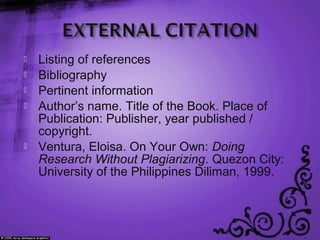
 Listing of references
 Bibliography
 Pertinent information
 Author’s name. Title of the Book. Place of
Publication: Publisher, year published /
copyright.
 Ventura, Eloisa. On Your Own: Doing
Research Without Plagiarizing. Quezon City:
University of the Philippines Diliman, 1999.
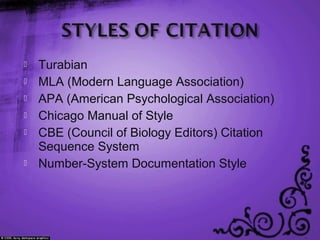
 Turabian
 MLA (Modern Language Association)
 APA (American Psychological Association)
 Chicago Manual of Style
 CBE (Council of Biology Editors) Citation
Sequence System
 Number-System Documentation Style

Avoiding plagiarism

  • 1.
    Cindy Cruz-Cabrera about.me/cindycruzcabrera /en.gravatar.com/cindycatz ph.linkedin.com/in/cindycruzcabrera
  • 2.
     Define “plagiarism” Determine the ethics of avoiding plagiarism  Identify types of plagiarism  Discuss how to avoid plagiarism
  • 3.
     Comes fromthe Latin word for THIEF, PLUNDERER, HUNTING NET, and KIDNAPPER  “the outright stealing of another person’s ideas”  Just like your belongings, ideas should be treated with exclusivity and respect  Unlike anything for sale, ideas won’t cost you much
  • 4.
     Share button Attribution  Tag  Dates and timestamps  Creative Commons  Ethics  Internet – easier verification
  • 5.
     Submitting apaper bought from somebody who makes it his/her official business to sell papers  Submitting a paper that somebody else has written, whether you paid him/her for it or not  Copying a paper from a source text without acknowledging the source
  • 6.
     Retweet  RTwith comment  MT (“modified tweet”)  Issue: multiple meanings  HT (“hat tip” or “heard through”)  via
  • 7.
     To getgood grades  To help out a friend
  • 8.
     Copying materialsfrom a source text with an acknowledgement but without quotation marks  Paraphrasing materials from a source text without acknowledging the source
  • 9.
     Lack oftime to check for proper documentation (or simply carelessness)  Lack of awareness about rules for proper documentation  Lack of guidance on the expectations of the academe  Cryptomnesia – false impression that ideas are ours rather than other people’s
  • 10.
     Previous researchpractices which ignore other academic conventions  Lack of practice in the current requirements of academic research  Other sociocultural considerations  Language constraints: writing experience, kinds of writing done, how well the student knows the language
  • 11.
     The irrelevantreference list  Stolen references  Bad paraphrasing  Use of quotable quotes
  • 12.
     Knowing whatto do  Right attitude towards research and academic work  What to do?  SELECT and CITE  CONTRIBUTE NEW IDEAS TO PREVIOUS RESEARCH  CRITIQUE
  • 13.
    Requires that youprocess all your borrowed materials by  Paraphrasing  Summarizing / precis  Quoting
  • 14.
     Acknowledging yoursources by mentioning them within the body of your paper and listing them at the end of your paper  Internal  External
  • 15.
     More popularlycalled “summarizing”  Concerned with the central idea, the core information (rather than the details that support it)  COB – comprehensive, objective, brief  KISS – keep it short and simple  About 1/3 the length of original material  “What does the text say in a nutshell?”
  • 16.
     “In whatway can the text be better understood?”  Rewrite the text in order to simplify it  Focus not only on what is said, but also how it is said  Follows the source text point by point, including central idea and details  Breaks information down into manageable units
  • 17.
    Requires  Acknowledgement phrase Parenthetical citation / footnote / endnote  A comment explaining what the quote is about  A QUOTE CANNOT STAND BY ITSELF
  • 18.
     Listing ofreferences  Bibliography  Pertinent information  Author’s name. Title of the Book. Place of Publication: Publisher, year published / copyright.  Ventura, Eloisa. On Your Own: Doing Research Without Plagiarizing. Quezon City: University of the Philippines Diliman, 1999.
  • 19.
     Turabian  MLA(Modern Language Association)  APA (American Psychological Association)  Chicago Manual of Style  CBE (Council of Biology Editors) Citation Sequence System  Number-System Documentation Style