Impromptu
Speaking
WITH
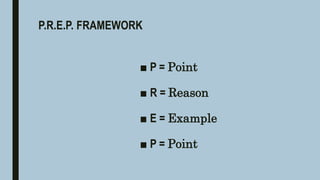
P.R.E.P. FRAMEWORK
■ P = Point
■ R = Reason
■ E = Example
■ P = Point
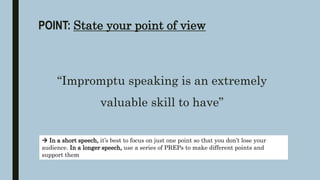
POINT: State your point of view
“Impromptu speaking is an extremely
valuable skill to have”
 In a short speech, it’s best to focus on just one point so that you don’t lose your
audience. In a longer speech, use a series of PREPs to make different points and
support them
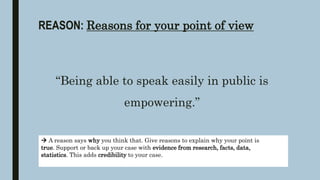
REASON: Reasons for your point of view
“Being able to speak easily in public is
empowering.”
 A reason says why you think that. Give reasons to explain why your point is
true. Support or back up your case with evidence from research, facts, data,
statistics. This adds credibility to your case.
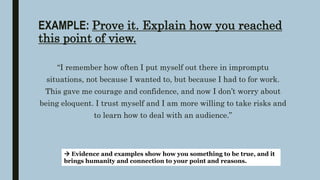
EXAMPLE: Prove it. Explain how you reached
this point of view.
“I remember how often I put myself out there in impromptu
situations, not because I wanted to, but because I had to for work.
This gave me courage and confidence, and now I don’t worry about
being eloquent. I trust myself and I am more willing to take risks and
to learn how to deal with an audience.”
 Evidence and examples show how you something to be true, and it
brings humanity and connection to your point and reasons.
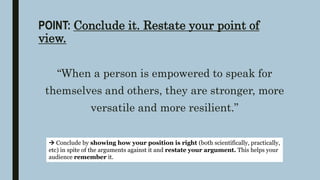
POINT: Conclude it. Restate your point of
view.
“When a person is empowered to speak for
themselves and others, they are stronger, more
versatile and more resilient.”
 Conclude by showing how your position is right (both scientifically, practically,
etc) in spite of the arguments against it and restate your argument. This helps your
audience remember it.
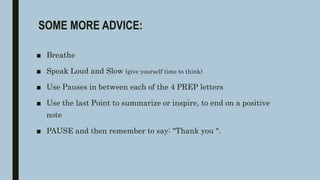
SOME MORE ADVICE:
■ Breathe
■ Speak Loud and Slow (give yourself time to think)
■ Use Pauses in between each of the 4 PREP letters
■ Use the last Point to summarize or inspire, to end on a positive
note
■ PAUSE and then remember to say: "Thank you ".
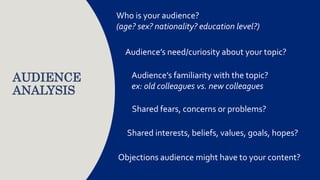
AUDIENCE
ANALYSIS
Who is your audience?
(age? sex? nationality? education level?)
Audience’s need/curiosity about your topic?
Audience’s familiarity with the topic?
ex: old colleagues vs. new colleagues
Shared fears, concerns or problems?
Objections audience might have to your content?
Shared interests, beliefs, values, goals, hopes?
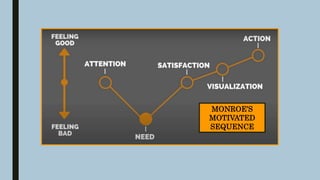
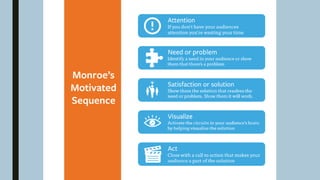
MONROE’S
MOTIVATED
SEQUENCE
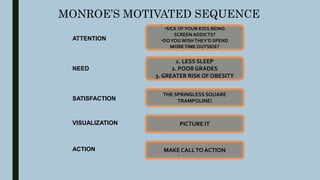
ATTENTION
NEED
SATISFACTION
VISUALIZATION
ACTION
•SICK OFYOUR KIDS BEING
SCREEN ADDICTS?
•DOYOU WISHTHEY’D SPEND
MORETIME OUTSIDE?
1. LESS SLEEP
2. POOR GRADES
3. GREATER RISK OF OBESITY
THE SPRINGLESS SQUARE
TRAMPOLINE!
PICTURE IT
MAKE CALLTO ACTION
MONROE’S MOTIVATED SEQUENCE
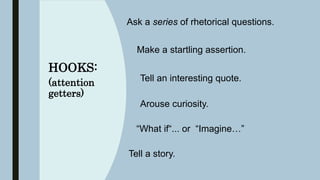
HOOKS:
(attention
getters)
Ask a series of rhetorical questions.
“What if“... or “Imagine…”
Make a startling assertion.
Tell an interesting quote.
Tell a story.
Arouse curiosity.
PREP Method.pptx

PREP Method.pptx

  • 1.
  • 2.
    P.R.E.P. FRAMEWORK ■ P= Point ■ R = Reason ■ E = Example ■ P = Point
  • 3.
    POINT: State yourpoint of view “Impromptu speaking is an extremely valuable skill to have”  In a short speech, it’s best to focus on just one point so that you don’t lose your audience. In a longer speech, use a series of PREPs to make different points and support them
  • 4.
    REASON: Reasons foryour point of view “Being able to speak easily in public is empowering.”  A reason says why you think that. Give reasons to explain why your point is true. Support or back up your case with evidence from research, facts, data, statistics. This adds credibility to your case.
  • 5.
    EXAMPLE: Prove it.Explain how you reached this point of view. “I remember how often I put myself out there in impromptu situations, not because I wanted to, but because I had to for work. This gave me courage and confidence, and now I don’t worry about being eloquent. I trust myself and I am more willing to take risks and to learn how to deal with an audience.”  Evidence and examples show how you something to be true, and it brings humanity and connection to your point and reasons.
  • 6.
    POINT: Conclude it.Restate your point of view. “When a person is empowered to speak for themselves and others, they are stronger, more versatile and more resilient.”  Conclude by showing how your position is right (both scientifically, practically, etc) in spite of the arguments against it and restate your argument. This helps your audience remember it.
  • 7.
    SOME MORE ADVICE: ■Breathe ■ Speak Loud and Slow (give yourself time to think) ■ Use Pauses in between each of the 4 PREP letters ■ Use the last Point to summarize or inspire, to end on a positive note ■ PAUSE and then remember to say: "Thank you ".
  • 8.
    AUDIENCE ANALYSIS Who is youraudience? (age? sex? nationality? education level?) Audience’s need/curiosity about your topic? Audience’s familiarity with the topic? ex: old colleagues vs. new colleagues Shared fears, concerns or problems? Objections audience might have to your content? Shared interests, beliefs, values, goals, hopes?
  • 9.
  • 11.
    ATTENTION NEED SATISFACTION VISUALIZATION ACTION •SICK OFYOUR KIDSBEING SCREEN ADDICTS? •DOYOU WISHTHEY’D SPEND MORETIME OUTSIDE? 1. LESS SLEEP 2. POOR GRADES 3. GREATER RISK OF OBESITY THE SPRINGLESS SQUARE TRAMPOLINE! PICTURE IT MAKE CALLTO ACTION MONROE’S MOTIVATED SEQUENCE
  • 19.
    HOOKS: (attention getters) Ask a seriesof rhetorical questions. “What if“... or “Imagine…” Make a startling assertion. Tell an interesting quote. Tell a story. Arouse curiosity.