August, 2015
By: Robbie Liza E. Caytiles
Biographical Approach
Biographical criticism uses details about
an author's personal life to analyse the
author's works.
 It relies on autobiographies,
correspondence, and other primary
materials about the author and is a form of
historical criticism.
What is Biographical Approach?
Critics doing biographical
analysis carefully examine
incidents in the lives of authors
and try to identify events,
settings, objects, buildings,
people, etc. found in the novels
with historical sources.
The difficultly with this sort of
criticism, and reason it has
somewhat fallen out of favour,
is that fictionalized accounts,
even when they may have
been inspired by actual events
and people, often suffer a sea
change when they are
introduced into novels.
Advantages and
Disadvantages
Works well for some which are obviously
political or biographical in nature.
It also is necessary to take a historical
approach in order to place allusions in
there proper classical, political, or biblical
background.
Advantages:
"The intentional fallacy". Tends to reduce art to the
level of biography and make it relative rather than
universal.
New Critics refer to the historical / biographical critic's
belief that the meaning or value of a work may be
determined by the author's intention as "the
intentional fallacy." They believe that this approach
tends to reduce art to the level of biography and make
it relative (to the times) rather than universal.
Disadvantages:
Origin of the
Approach
As early as the nineteenth century,
scholars considered literary texts
against the background of the author’s
biography. The aim was to find
references to the author’s life,
education and socio-cultural
environment in a literary work.
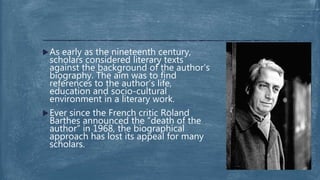
Ever since the French critic Roland
Barthes announced the “death of the
author” in 1968, the biographical
approach has lost its appeal for many
scholars.
Barthes and critics following
him have argued that an
author’s biography is
irrelevant since the meaning
of a text only emerges in
the reading process and the
reader thus becomes the
real ‘author’ of the text.
One could argue against this radical viewpoint
that there are texts where knowledge of an
author’s biography can sometimes help us
understand the text better because otherwise
we would not be able to decipher certain
allusions or references. Bearing this knowledge
in mind, it is then interesting to see where the
literary text deviates from references to the
author’s real life.
Questions to
Biographical
Approach
A. What aspects of the author’s personal life are relevant to this
story?
B. Which of the author’s stated beliefs are reflected in the
work?
C. Does the writer challenge or support the values of her
contemporaries?
D. What seem to be the author’s major concerns? Do they
reflect any of the writer’s personal experiences?
E. Do any of the events in the story correspond to events
experienced by the author?
F. Do any of the characters in the story correspond to real
people?
The Glass Menagerie
Tennessee Williams

Biographical approach

  • 1.
    August, 2015 By: RobbieLiza E. Caytiles Biographical Approach
  • 2.
    Biographical criticism usesdetails about an author's personal life to analyse the author's works.  It relies on autobiographies, correspondence, and other primary materials about the author and is a form of historical criticism. What is Biographical Approach?
  • 3.
    Critics doing biographical analysiscarefully examine incidents in the lives of authors and try to identify events, settings, objects, buildings, people, etc. found in the novels with historical sources.
  • 4.
    The difficultly withthis sort of criticism, and reason it has somewhat fallen out of favour, is that fictionalized accounts, even when they may have been inspired by actual events and people, often suffer a sea change when they are introduced into novels.
  • 5.
  • 6.
    Works well forsome which are obviously political or biographical in nature. It also is necessary to take a historical approach in order to place allusions in there proper classical, political, or biblical background. Advantages:
  • 7.
    "The intentional fallacy".Tends to reduce art to the level of biography and make it relative rather than universal. New Critics refer to the historical / biographical critic's belief that the meaning or value of a work may be determined by the author's intention as "the intentional fallacy." They believe that this approach tends to reduce art to the level of biography and make it relative (to the times) rather than universal. Disadvantages:
  • 8.
  • 9.
    As early asthe nineteenth century, scholars considered literary texts against the background of the author’s biography. The aim was to find references to the author’s life, education and socio-cultural environment in a literary work. Ever since the French critic Roland Barthes announced the “death of the author” in 1968, the biographical approach has lost its appeal for many scholars.
  • 10.
    Barthes and criticsfollowing him have argued that an author’s biography is irrelevant since the meaning of a text only emerges in the reading process and the reader thus becomes the real ‘author’ of the text.
  • 11.
    One could argueagainst this radical viewpoint that there are texts where knowledge of an author’s biography can sometimes help us understand the text better because otherwise we would not be able to decipher certain allusions or references. Bearing this knowledge in mind, it is then interesting to see where the literary text deviates from references to the author’s real life.
  • 12.
  • 13.
    A. What aspectsof the author’s personal life are relevant to this story? B. Which of the author’s stated beliefs are reflected in the work? C. Does the writer challenge or support the values of her contemporaries? D. What seem to be the author’s major concerns? Do they reflect any of the writer’s personal experiences? E. Do any of the events in the story correspond to events experienced by the author? F. Do any of the characters in the story correspond to real people?
  • 14.