VISUAL INFORMATION
Researchers across academic disciplines are well trained in using writing to develop and convey their insights, but
only some learn how visuals can help them organize and communicate their ideas.
Academic Writing is the formal tone and attitude of writing in which visual information is one of its element.
Meaning: The use of visuals (rather than words) to communicate an idea or support an argument.
Use of one or more of the various visual media with or without sound. Generally, visual information includes still
photography, motion picture photography, video or audio recording, graphic arts, visual aids, models, display,
visual presentation services, and the support processes.
Research suggests that information displayed visually is well remembered: "retention of information three days after a
meeting or other event is six times greater when information is presented by visual and oral means than when the
information is presented by the spokenword alone." (U.S. Department of Labor OSHA Office of Training and
Education, 1996)
Although visuals do largely speak for themselves, it is usual to help the reader interpret them by briefly
commenting on their main features when referring to visual information in the text, the word figure is used for
everything (such as maps, charts and graphs) except tables.
Figures and tables should be numbered and given a title.
Titles of tables are written above, while titles of figures are written below the data.
As with other data, sources must be given for all visual information.
If you are writing a lengthy work, such as a dissertation, you will need to provide lists of tables and figures,
showing numbers, titles and page numbers, after the contents page.
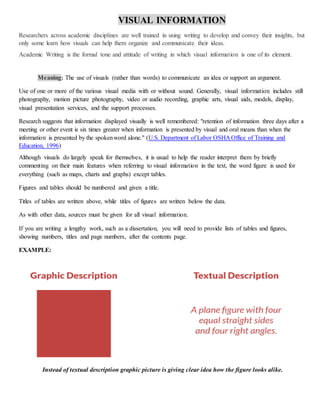
EXAMPLE:
Instead of textual description graphic picture is giving clear idea how the figure looks alike.
TYPES OF VISUAL INFORMATION
 Tablesandfiguresmaybe usedas evidence tosupportacademicargument.
 They are mostly used in report writing.
 It is important that tables and figures are used purposefully (i.e. with good reason) and referenced
correctly.
 Tables are used in academic text to display
 Statistical data
 Comparison of information
 Illustrate the functions
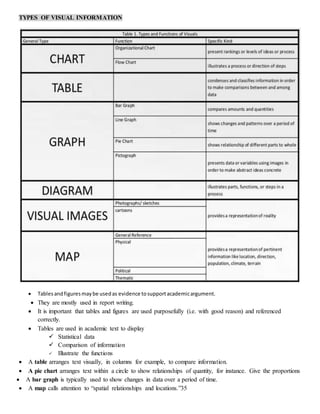
 A table arranges text visually, in columns for example, to compare information.
 A pie chart arranges text within a circle to show relationships of quantity, for instance. Give the proportions
 A bar graph is typically used to show changes in data over a period of time.
 A map calls attention to “spatial relationships and locations.”35
TABLES:
BAR GRAPHA:
PIE CHART:
EDUCATIONAL IMPLICATION:
It’s well worth learning what you can, because visuals have the unique ability to help us:
 Develop ideas and understand experiences that language cannot yet describe
 Gather and analyze complex and/or abstract ideas in simple, immediate ways
 Communicate across language, knowledge, ideological, and other barriers
 Impact decision-making, which largely happens in our pre-lingual, pre-rational brains
 Visual aids are worth including in your presentations because they can help you explain information more
coherently which makes presenting easier for you and learning easier for the audience.
 They also help add variety to your presentation thus making it more interesting for the audience. If the
audience understands what you're saying and they are more engaged, they're more likely to be persuaded by
you.
 On other hand, well-selected images can improve comprehension and insight when developers
strategically place such graphics within a course. Unlike text, pictures have the power to enrich
communication and stimulate emotional response. In order to utilize visuals in a way that will
reinforce course material and facilitate learning, it is necessary to use images that:
 Represent actual objects, people, or places.
 Simplify complex or abstract ideas.
 Bridge already learned materials with the unfamiliar.
SELF RELECTION:
 If you are writing a lengthy work, such as a dissertation, you will need to provide lists of tables and
figures, showing numbers, titles and page numbers, after the content page that could be easily farmed by
using visual information element.
 Visual information make the textual content interesting.
 Visual adhere the interest of readers and it gives clear picture
REFERENCES:
http://www.conradiator.com/resources/pdf/literacies4eigvil_ct2003.pdf
https://pdfs.semanticscholar.org/8f6c/36d260763dd3dd33c53b5b1edc21a8755a28.pdf
https://www.kau.edu.sa/Files/0013287/Subjects/academic-writing-handbook-international-students-3rd-ed%20(2).pdf
https://www.researchgate.net/publication/286909809_Visual_Literacy_in_Educational_Practice

Visual Information writeup

  • 1.
    VISUAL INFORMATION Researchers acrossacademic disciplines are well trained in using writing to develop and convey their insights, but only some learn how visuals can help them organize and communicate their ideas. Academic Writing is the formal tone and attitude of writing in which visual information is one of its element. Meaning: The use of visuals (rather than words) to communicate an idea or support an argument. Use of one or more of the various visual media with or without sound. Generally, visual information includes still photography, motion picture photography, video or audio recording, graphic arts, visual aids, models, display, visual presentation services, and the support processes. Research suggests that information displayed visually is well remembered: "retention of information three days after a meeting or other event is six times greater when information is presented by visual and oral means than when the information is presented by the spokenword alone." (U.S. Department of Labor OSHA Office of Training and Education, 1996) Although visuals do largely speak for themselves, it is usual to help the reader interpret them by briefly commenting on their main features when referring to visual information in the text, the word figure is used for everything (such as maps, charts and graphs) except tables. Figures and tables should be numbered and given a title. Titles of tables are written above, while titles of figures are written below the data. As with other data, sources must be given for all visual information. If you are writing a lengthy work, such as a dissertation, you will need to provide lists of tables and figures, showing numbers, titles and page numbers, after the contents page. EXAMPLE: Instead of textual description graphic picture is giving clear idea how the figure looks alike.
  • 2.
    TYPES OF VISUALINFORMATION  Tablesandfiguresmaybe usedas evidence tosupportacademicargument.  They are mostly used in report writing.  It is important that tables and figures are used purposefully (i.e. with good reason) and referenced correctly.  Tables are used in academic text to display  Statistical data  Comparison of information  Illustrate the functions  A table arranges text visually, in columns for example, to compare information.  A pie chart arranges text within a circle to show relationships of quantity, for instance. Give the proportions  A bar graph is typically used to show changes in data over a period of time.  A map calls attention to “spatial relationships and locations.”35
  • 3.
  • 4.
    EDUCATIONAL IMPLICATION: It’s wellworth learning what you can, because visuals have the unique ability to help us:  Develop ideas and understand experiences that language cannot yet describe  Gather and analyze complex and/or abstract ideas in simple, immediate ways  Communicate across language, knowledge, ideological, and other barriers  Impact decision-making, which largely happens in our pre-lingual, pre-rational brains  Visual aids are worth including in your presentations because they can help you explain information more coherently which makes presenting easier for you and learning easier for the audience.  They also help add variety to your presentation thus making it more interesting for the audience. If the audience understands what you're saying and they are more engaged, they're more likely to be persuaded by you.  On other hand, well-selected images can improve comprehension and insight when developers strategically place such graphics within a course. Unlike text, pictures have the power to enrich communication and stimulate emotional response. In order to utilize visuals in a way that will reinforce course material and facilitate learning, it is necessary to use images that:  Represent actual objects, people, or places.  Simplify complex or abstract ideas.  Bridge already learned materials with the unfamiliar. SELF RELECTION:  If you are writing a lengthy work, such as a dissertation, you will need to provide lists of tables and figures, showing numbers, titles and page numbers, after the content page that could be easily farmed by using visual information element.  Visual information make the textual content interesting.  Visual adhere the interest of readers and it gives clear picture REFERENCES: http://www.conradiator.com/resources/pdf/literacies4eigvil_ct2003.pdf https://pdfs.semanticscholar.org/8f6c/36d260763dd3dd33c53b5b1edc21a8755a28.pdf https://www.kau.edu.sa/Files/0013287/Subjects/academic-writing-handbook-international-students-3rd-ed%20(2).pdf https://www.researchgate.net/publication/286909809_Visual_Literacy_in_Educational_Practice